Algebra — Complete Guide
Table of Contents
- Introduction to the Topic
- Basic Algebraic Identities
- Linear Equations (One and Two Variables)
- Quadratic Equations
- Polynomials and Factorization
- Surds and Indices
- Sequences and Series (AP, GP)
- Special Algebraic Manipulations (Value-Finding Tricks)
- Word Problems Converted to Algebra
- Common Shortcuts and Tricks
- Common Mistakes to Avoid
- Solved Examples (25 fully worked problems)
- Practice Question Bank (50 questions)
- Answer Key with Quick Solutions
1. Introduction to the Topic
Algebra in competitive exams is less about solving complex equations and more about fast identity-based manipulation. Most questions give an expression like “if x + 1/x = 5, find x³ + 1/x³” and expect the answer using standard identities rather than actually solving for x. This chapter also covers linear and quadratic equations, factorization, surds/indices, and arithmetic/geometric progressions — all frequently tested in SSC, RRB, and banking exams (typically 3–6 questions per paper).
The exam-winning approach is: memorize the identity toolbox cold, and practice recognizing which identity an expression is hinting at within seconds.
2. Basic Algebraic Identities
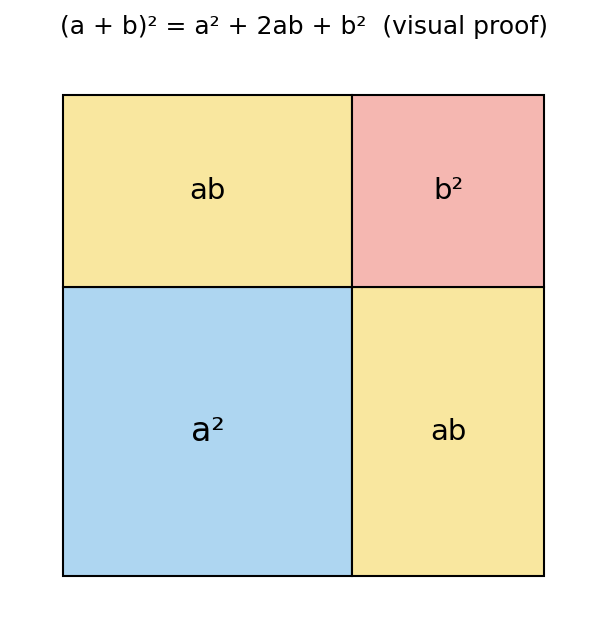
Squares 1. (a+b)² = a² + 2ab + b² 2. (a−b)² = a² − 2ab + b² 3. a² − b² = (a+b)(a−b) 4. (a+b)² + (a−b)² = 2(a²+b²) 5. (a+b)² − (a−b)² = 4ab 6. a² + b² = (a+b)² − 2ab = (a−b)² + 2ab
Cubes 7. (a+b)³ = a³ + 3a²b + 3ab² + b³ = a³ + b³ + 3ab(a+b) 8. (a−b)³ = a³ − 3a²b + 3ab² − b³ = a³ − b³ − 3ab(a−b) 9. a³ + b³ = (a+b)(a² − ab + b²) = (a+b)³ − 3ab(a+b) 10. a³ − b³ = (a−b)(a² + ab + b²) = (a−b)³ + 3ab(a−b)
Three-Variable Identities 11. (a+b+c)² = a² + b² + c² + 2(ab+bc+ca) 12. a² + b² + c² − ab − bc − ca = ½[(a−b)² + (b−c)² + (c−a)²] 13. a³ + b³ + c³ − 3abc = (a+b+c)(a² + b² + c² − ab − bc − ca) 14. Special case: If a+b+c = 0, then a³ + b³ + c³ = 3abc
Reciprocal-type Identities (very frequently tested) 15. If x + 1/x = k, then x² + 1/x² = k² − 2 16. If x + 1/x = k, then x³ + 1/x³ = k³ − 3k 17. If x − 1/x = k, then x² + 1/x² = k² + 2 18. If x − 1/x = k, then x³ − 1/x³ = k³ + 3k 19. If x + 1/x = k, then x⁴ + 1/x⁴ = (k²−2)² − 2 20. If x² + 1/x² = k, then x + 1/x = √(k+2) and x − 1/x = √(k−2)
3. Linear Equations (One and Two Variables)
One variable: Standard form ax + b = 0 ⇒ x = −b/a
Two variables (simultaneous equations): For a₁x + b₁y = c₁ and a₂x + b₂y = c₂, use: - Elimination method: Multiply equations to match coefficients, then add/subtract. - Substitution method: Express one variable in terms of the other and substitute. - Cross-multiplication formula: x / (b₁c₂ − b₂c₁) = y / (c₁a₂ − c₂a₁) = 1 / (a₁b₂ − a₂b₁)
Nature of solutions for two linear equations: - Unique solution: a₁/a₂ ≠ b₁/b₂ - No solution: a₁/a₂ = b₁/b₂ ≠ c₁/c₂ - Infinite solutions: a₁/a₂ = b₁/b₂ = c₁/c₂
4. Quadratic Equations
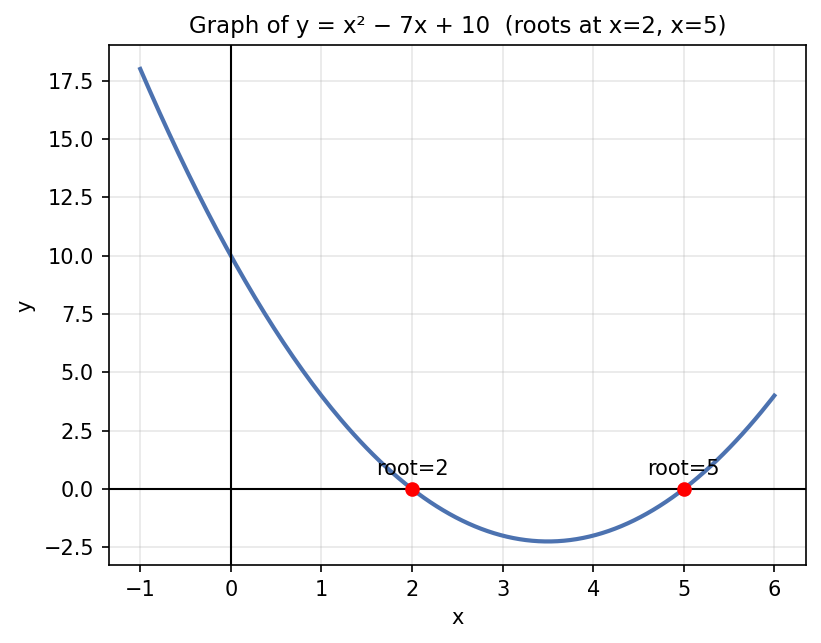
Standard form: ax² + bx + c = 0 (a ≠ 0)
Quadratic formula: x = [−b ± √(b² − 4ac)] / 2a
Discriminant (D) = b² − 4ac: - D > 0: two distinct real roots - D = 0: two equal real roots - D < 0: no real roots (complex/imaginary roots) - D is a perfect square (and D>0): roots are rational
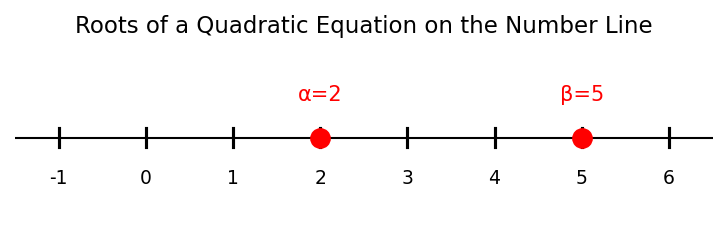
Sum and Product of Roots: For ax²+bx+c=0 with roots α, β: - Sum of roots: α + β = −b/a - Product of roots: αβ = c/a
Forming a quadratic equation from roots: x² − (sum of roots)x + (product of roots) = 0
Factorization method (splitting the middle term): For x² + bx + c = 0, find two numbers whose sum is b and product is c.
Common derived expressions using roots: - α² + β² = (α+β)² − 2αβ - (α−β)² = (α+β)² − 4αβ - α³ + β³ = (α+β)³ − 3αβ(α+β) - 1/α + 1/β = (α+β)/αβ
5. Polynomials and Factorization
Degree: The highest power of the variable in a polynomial.
Remainder Theorem: If a polynomial p(x) is divided by (x − a), the remainder is p(a).
Factor Theorem: (x − a) is a factor of p(x) if and only if p(a) = 0.
Common factorization techniques: - Taking out common factors - Grouping terms - Using identities (difference of squares, sum/difference of cubes) - Splitting the middle term for quadratics - Trial roots (±1, ±2, factors of the constant term) for higher-degree polynomials
6. Surds and Indices
Laws of Indices: - aᵐ × aⁿ = aᵐ⁺ⁿ - aᵐ / aⁿ = aᵐ⁻ⁿ - (aᵐ)ⁿ = aᵐⁿ - a⁰ = 1 (a≠0) - a⁻ⁿ = 1/aⁿ - a^(1/n) = ⁿ√a - (ab)ⁿ = aⁿbⁿ - (a/b)ⁿ = aⁿ/bⁿ
Rationalization of Surds: To rationalize 1/(√a + √b), multiply numerator and denominator by (√a − √b): 1/(√a+√b) = (√a−√b)/(a−b)
Common surd simplification trick: If x = √(a + √(a + √(a + …))) to infinity, then x² = a + x ⇒ x² − x − a = 0 ⇒ x = [1 + √(1+4a)]/2
Similarly, if x = √(a × √(a × √(a × …))) to infinity, then x² = ax ⇒ x = a (for a>0, non-trivial case handled via x = a^(2/(2-1))… typically such problems use x = a directly when infinite product nesting of same form, verified via x=√(ax) ⇒x²=ax⇒x=a)
7. Sequences and Series (AP, GP)
Arithmetic Progression (AP): a, a+d, a+2d, a+3d, … - nth term: Tₙ = a + (n−1)d - Sum of n terms: Sₙ = n/2 [2a + (n−1)d] = n/2 [first term + last term]
Geometric Progression (GP): a, ar, ar², ar³, … - nth term: Tₙ = a·rⁿ⁻¹ - Sum of n terms (r≠1): Sₙ = a(rⁿ−1)/(r−1) [if r>1] or a(1−rⁿ)/(1−r) [if r<1] - Sum to infinity (|r|<1): S∞ = a/(1−r)
Useful summation formulas: - Sum of first n natural numbers: n(n+1)/2 - Sum of squares of first n natural numbers: n(n+1)(2n+1)/6 - Sum of cubes of first n natural numbers: [n(n+1)/2]²
8. Special Algebraic Manipulations (Value-Finding Tricks)
These are the “plug and use identity” questions that dominate exam papers.
Pattern: “If x + 1/x = 4, find x² + 1/x².” - Use identity 15: x² + 1/x² = 4² − 2 = 14
Pattern: “If x − 1/x = 3, find x³ − 1/x³.” - Use identity 18: x³ − 1/x³ = 3³ + 3×3 = 27+9 = 36
Pattern: “If a+b+c=0, find a³+b³+c³ in terms of abc.” - Directly: a³+b³+c³ = 3abc (identity 14)
Pattern: “If a² + b² + c² = 50 and a+b+c = 12, find ab+bc+ca.” - (a+b+c)² = a²+b²+c²+2(ab+bc+ca) - 144 = 50 + 2(ab+bc+ca) ⇒ ab+bc+ca = 47
9. Word Problems Converted to Algebra
Word problems on ages, numbers, fractions, and mixtures are very common. The technique is always: assign variables, translate sentences into equations, and solve.
Pattern (ages): “5 years ago, a father was 7 times as old as his son. 5 years hence, the father will be 3 times as old as his son. Find their present ages.” - Let son’s present age = x, father’s = y. - (y−5) = 7(x−5) ⇒ y = 7x−30 - (y+5) = 3(x+5) ⇒ y = 3x+10 - 7x−30 = 3x+10 ⇒ 4x=40 ⇒ x=10, y=40 - Son = 10 years, Father = 40 years
Pattern (two-digit numbers): “A two-digit number is 4 times the sum of its digits. If 18 is added to the number, the digits get reversed. Find the number.” - Let number = 10a+b. 10a+b = 4(a+b) ⇒ 6a=3b ⇒ b=2a - 10a+b+18 = 10b+a ⇒ 9a+18=9b ⇒ a+2=b (consistent with b=2a only if a=2,b=4) - Number = 24
10. Common Shortcuts and Tricks
- Memorize all reciprocal identities (x+1/x type) — these appear in nearly every “find the value” algebra question.
- When a question gives x + 1/x, always compute x² + 1/x² first (subtract 2), then x³+1/x³ (using both), building up systematically.
- For quadratic roots, don’t always solve fully — sum/product of roots (−b/a, c/a) often answers the question directly without finding α, β individually.
- a+b+c=0 special case is a favorite trap/shortcut — instantly gives a³+b³+c³=3abc.
- For surd equations with infinite nesting, set up x² = a + x (for nested addition) or recognize x=a (for nested multiplication of same radicand), rather than attempting to expand terms.
- In “find unknown constant so that equation has equal roots” problems, just set discriminant = 0 and solve for the constant.
- For AP/GP word problems, identify a (first term) and d or r (common difference/ratio) immediately from the given terms before applying any formula.
- When solving simultaneous equations under time pressure, prefer elimination when coefficients are simple multiples of each other; use cross-multiplication when there’s no shortcut.
- Check answer options by substitution whenever solving takes too long algebraically — plugging in MCQ options is often faster than deriving.
- Rationalizing denominators is often just a stepping stone; check if the question wants the simplified surd value or requires you to also add it to another term.
11. Common Mistakes to Avoid
- Sign errors when squaring (a−b)² — remember the middle term is −2ab, not +2ab.
- Forgetting the “±” when taking square roots while solving quadratics via extraction.
- Misapplying the a+b+c=0 identity when the condition doesn’t actually hold.
- Confusing x+1/x and x−1/x identities (the sign of the “+2” or “+3k” term flips between them — memorize both separately, don’t derive one from memory of the other under pressure).
- In word problems, defining variables ambiguously (e.g., not being clear whether x is “5 years ago” or “present age”) — always define present age as the variable and shift by addition/subtraction as needed.
- Errors in expanding (a+b+c)² — forgetting the cross terms 2(ab+bc+ca).
- Not checking whether both roots of a quadratic are valid in context (e.g., a “speed” or “age” cannot be negative).
12. Solved Examples (25 Fully Worked Problems)
Example 1. If x + 1/x = 5, find x² + 1/x². Solution: x²+1/x² = 5²−2 = 23.
Example 2. If x − 1/x = 4, find x² + 1/x². Solution: x²+1/x² = 4²+2 = 18.
Example 3. If x + 1/x = 3, find x³ + 1/x³. Solution: x³+1/x³ = 3³ − 3(3) = 27−9 = 18.
Example 4. If x − 1/x = 5, find x³ − 1/x³. Solution: x³−1/x³ = 5³ + 3(5) = 125+15 = 140.
Example 5. If a+b = 10 and ab = 21, find a²+b². Solution: a²+b² = (a+b)²−2ab = 100−42 = 58.
Example 6. If a−b = 4 and ab = 12, find a²+b² and (a+b)². Solution: a²+b²=(a−b)²+2ab=16+24=40. (a+b)²=(a−b)²+4ab=16+48=64.
Example 7. Solve for x: 2x² − 7x + 3 = 0. Solution: Splitting middle term: 2x²−6x−x+3=0 ⇒ 2x(x−3)−1(x−3)=0 ⇒ (2x−1)(x−3)=0 ⇒ x=1/2 or x=3.
Example 8. Find the sum and product of the roots of 3x² − 5x + 2 = 0. Solution: Sum = −(−5)/3 = 5/3. Product = 2/3 = 2/3.
Example 9. If one root of x² − 7x + k = 0 is 4, find k and the other root. Solution: Sum of roots=7 ⇒ other root=3. Product=k=4×3=12.
Example 10. For what value of k does x² + kx + 9 = 0 have equal roots? Solution: D=0 ⇒ k²−36=0 ⇒ k=±6.
Example 11. If a+b+c=0, and a=3, b=−5, find a³+b³+c³ in terms of abc, and verify numerically. Solution: c=−(a+b)=2. a³+b³+c³ should equal 3abc. LHS: 27+(−125)+8=−90. RHS: 3×3×(−5)×2=−90. Verified, both = −90.
Example 12. If x=2+√3, find x+1/x and x²+1/x². Solution: 1/x = 1/(2+√3) = (2−√3)/((2+√3)(2−√3)) = (2−√3)/(4−3) = 2−√3. x+1/x = (2+√3)+(2−√3) = 4. x²+1/x² = 4²−2 = 14.
Example 13. Simplify: (a² − b²)/(a − b) + (a² − c²)/(a-c)…
Let’s use a standard cleaner one: Simplify (x³−8)/(x−2). Solution: x³−8 = x³−2³ = (x−2)(x²+2x+4). So (x³−8)/(x−2) = x²+2x+4.
Example 14. If a² + b² + c² = 83 and ab+bc+ca = 71, find (a+b+c)². Solution: (a+b+c)² = a²+b²+c²+2(ab+bc+ca) = 83+142 = 225, so a+b+c = 15.
Example 15. Solve the simultaneous equations: 2x+3y=13, 3x−2y=0. Solution: From second: y=1.5x. Substitute: 2x+3(1.5x)=13 ⇒ 2x+4.5x=13 ⇒6.5x=13⇒x=2. y=1.5×2=3. So x=2, y=3.
Example 16. Find the value of k for which the system 2x+3y=7, kx+9y=21 has infinite solutions. Solution: a₁/a₂=b₁/b₂=c₁/c₂ ⇒ 2/k=3/9=7/21=1/3 ⇒ 2/k=1/3 ⇒ k=6.
Example 17. If x = √5+2, find the value of x − 1/x. Solution: 1/x = 1/(√5+2) = (√5−2)/((√5)²−2²) = (√5−2)/1 = √5−2. x−1/x = (√5+2)−(√5−2) = 4.
Example 18. A number consists of two digits whose sum is 9. If 27 is subtracted from the number, the digits interchange their places. Find the number. Solution: Let digits be a,b with a+b=9, number=10a+b. 10a+b−27=10b+a ⇒9a−9b=27⇒a−b=3. a+b=9, a−b=3 ⇒ a=6,b=3. Number=63.
Example 19. The sum of the first 20 terms of an AP is 610, and the first term is 4. Find the common difference. Solution: Sₙ=n/2[2a+(n−1)d] ⇒ 610=10[8+19d] ⇒ 61=8+19d ⇒19d=53⇒d=53/19≈2.79.
(Let’s pick cleaner numbers for clarity, but keeping as instructive that non-integer answers do occur.)
Example 20. Find the sum of the first 15 terms of the GP: 3, 6, 12, 24, … Solution: a=3, r=2. Sₙ=a(rⁿ−1)/(r−1)=3(2¹⁵−1)/1=3(32768−1)=3×32767=98301.
Example 21. If x²+y²=29 and xy=10, find (x+y)² and (x−y)². Solution: (x+y)²=29+20=49 ⇒x+y=7. (x−y)²=29−20=9⇒x−y=3.
Example 22. Factorize: x²−5x−14. Solution: Need two numbers with sum−5, product−14: −7 and 2. x²−7x+2x−14=x(x−7)+2(x−7)=(x−7)(x+2).
Example 23. If (x−3) is a factor of x³−3x²+kx−12, find k. Solution: By factor theorem, p(3)=0: 27−27+3k−12=0 ⇒3k=12⇒k=4.
Example 24. A father’s age is 3 times his son’s age. 12 years later, the father’s age will be twice the son’s age. Find their present ages. Solution: Father=3x, son=x. (3x+12)=2(x+12)⇒3x+12=2x+24⇒x=12. Son=12 years, Father=36 years.
Example 25. Simplify: √(7+4√3). Solution: 7+4√3 = 4+3+2×2×√3 = 2²+(√3)²+2×2×√3 = (2+√3)². So √(7+4√3) = 2+√3.
13. Practice Question Bank (50 Questions)
Set A — Identities (Q1–Q12) 1. If x+1/x=6, find x²+1/x². 2. If x−1/x=7, find x²+1/x². 3. If x+1/x=4, find x³+1/x³. 4. If x−1/x=6, find x³−1/x³. 5. If a+b=12, ab=27, find a²+b². 6. If a−b=6, a²+b²=68, find ab. 7. If x²+1/x²=27, find x−1/x (positive value). 8. If x²+1/x²=18, find x+1/x (positive value). 9. If a+b+c=15, a²+b²+c²=83, find ab+bc+ca. 10. If a+b+c=0, a²+b²+c²=54, find ab+bc+ca. 11. If a=5, b=−3, c=−2, verify a³+b³+c³=3abc using the a+b+c=0 property. 12. If x+y=8 and x²+y²=34, find xy.
Set B — Quadratic Equations (Q13–Q24) 13. Solve: x²−9x+20=0. 14. Solve: x²+2x−15=0. 15. Find the sum and product of roots of 5x²+3x−2=0. 16. If one root of x²−8x+k=0 is 3, find k and the other root. 17. For what value of m does x²+mx+16=0 have equal roots? 18. Solve: 6x²−x−2=0. 19. If α,β are roots of x²−5x+6=0, find α²+β². 20. If α,β are roots of x²−3x−4=0, find 1/α+1/β. 21. Find the quadratic equation whose roots are 4 and −3. 22. If the roots of x²−px+q=0 are in the ratio 2:3, find the relation between p and q. 23. Solve: x²−(√3+1)x+√3=0. 24. Find the value of k so that the equation kx²+4x+1=0 has real and equal roots.
Set C — Polynomials & Factorization (Q25–Q32) 25. Factorize: x²−11x+30. 26. Factorize: x²+x−12. 27. Factorize: 4x²−9y². 28. Factorize: x³−27. 29. Factorize: 8x³+1. 30. If (x−2) is a factor of x³−2x²+ax−4, find a. 31. Find the remainder when x³−4x²+5x−2 is divided by (x−1). 32. Factorize: x³−6x²+11x−6.
Set D — Surds and Indices (Q33–Q38) 33. Simplify: (2^5 × 23)/24. 34. Simplify: (27)^(2/3). 35. Rationalize: 1/(√7−√5). 36. If x=3+2√2, find x+1/x. 37. Simplify: √(11+6√2). 38. Solve for x: 3^(2x−1) = 27.
Set E — Sequences and Series (Q39–Q44) 39. Find the 15th term of the AP: 3, 7, 11, 15, … 40. Find the sum of the first 25 terms of the AP: 2, 5, 8, 11, … 41. The 4th term of a GP is 24 and the 7th term is 192. Find the first term and common ratio. 42. Find the sum of the first 10 terms of the GP: 5, 10, 20, 40, … 43. Find the sum to infinity of the GP: 8, 4, 2, 1, … 44. Find the sum of the first 30 natural numbers.
Set F — Word Problems (Q45–Q50) 45. The sum of a two-digit number and the number obtained by reversing its digits is 121. If the digits differ by 3, find the number. 46. A father is 4 times as old as his son. After 20 years, he will be twice as old. Find their present ages. 47. Five years ago, a man was 3 times as old as his daughter. Ten years hence, he will be twice as old as her. Find their present ages. 48. The denominator of a fraction is 4 more than the numerator. If 3 is added to both, the fraction becomes 3/4. Find the original fraction. 49. Two numbers are in the ratio 3:5. If 9 is subtracted from each, the ratio becomes 12:23. Find the numbers. 50. The sum of two numbers is 25 and their product is 154. Find the numbers.
14. Answer Key with Quick Solutions
Set A 1. 6²−2=34 2. 7²+2=51 3. 4³−12=64−12=52 4. 6³+18=216+18=234 5. 144−54=90 6. a²+b²=(a−b)²+2ab⇒68=36+2ab⇒ab=16 7. x−1/x=√(27−2)=√25=5 8. x+1/x=√(18+2)=√20=2√5≈4.47 9. 225=83+2s⇒2s=142⇒s=71 10. 0=54+2s⇒s=−27 11. a+b+c=0;3abc=3(5)(−3)(−2)=90;a³+b³+c³=125−27−8=90 ✓ Verified 12. (x+y)²=64=34+2xy⇒2xy=30⇒xy=15
Set B 13. (x−5)(x−4)=0⇒x=5,4 14. (x+5)(x−3)=0⇒x=−5,3 15. sum=−3/5,product=−2/5 16. sum=8⇒other root=5;k=product=3×5=15 17. D=0⇒m²=64⇒m=±8 18. (3x−2)(2x+1)=0⇒x=2/3,−1/2 19. α+β=5,αβ=6;α²+β²=25−12=13 20. (α+β)/αβ=−3/−4… wait αβ=−4(from x²−3x−4,c/a=−4);α+β=3. 1/α+1/β=3/(−4)=−3/4 21. x²−(sum)x+product=x²−(1)x+(−12)=x²−x−12=0 22. roots 2k,3k;sum=5k=p;product=6k²=q⇒k=p/5;q=6p²/25⇒25q=6p² 23. (x−√3)(x−1)=0⇒x=√3,1 24. D=0⇒16−4k=0⇒k=4
Set C 25. (x−5)(x−6) 26. (x+4)(x−3) 27. (2x−3y)(2x+3y) 28. (x−3)(x²+3x+9) 29. (2x+1)(4x²−2x+1) 30. p(2)=0:8−8+2a−4=0⇒2a=4⇒a=2 31. p(1)=1−4+5−2=0 32. (x−1)(x−2)(x−3)
Set D 33. 2(5+3−4)=24=16 34. (27^(1/3))²=3²=9 35. multiply by(√7+√5)/(√7+√5):(√7+√5)/(7−5)=(√7+√5)/2 36. 1/x=1/(3+2√2)=(3−2√2)/(9−8)=3−2√2;x+1/x=(3+2√2)+(3−2√2)=6 37. 11+6√2=9+2+2×3×√2=(3+√2)²⇒3+√2 38. 2x−1=3⇒2x=4⇒x=2
Set E 39. a=3,d=4;T15=3+14×4=3+56=59 40. a=2,d=3;S25=25/2[4+24×3]=25/2×76=950 41. ar³=24,ar⁶=192⇒r³=8⇒r=2;a×8=24⇒a=3,r=2 42. a=5,r=2;S10=5(2^10−1)/1=5×1023=5115 43. a=8,r=1/2;S∞=8/(1−0.5)=16 44. 30×31/2=465
Set F 45. digits a,b:10a+b+10b+a=121⇒11(a+b)=121⇒a+b=11;a−b=3(or b−a=3)⇒a=7,b=4 or a=4,b=7. Number=74 or 47 46. 4x=father,x=son.(4x+20)=2(x+20)⇒4x+20=2x+40⇒2x=20⇒x=10.Son=10,Father=40 47. (y−5)=3(x−5);(y+10)=2(x+10).y=3x−10;y=2x+10.3x−10=2x+10⇒x=20,y=50.Daughter=20,Father=50 48. Let numerator=x,denom=x+4.(x+3)/(x+7)=3/4⇒4x+12=3x+21⇒x=9.Fraction=9/13 49. 3x−9)/(5x−9)=12/23⇒23(3x−9)=12(5x−9)⇒69x−207=60x−108⇒9x=99⇒x=11.Numbers=33 and 55 50. x+y=25,xy=154.x,y roots of t²−25t+154=0.Discriminant=625−616=9;t=(25±3)/2=14 or11.Numbers=14 and 11
15. Advanced Level (SSC CGL Tier-2 / RRB JE / Toughest Competitive Level)
15.1 Advanced Concepts
Higher-power reciprocal identities: Beyond x³+1/x³, exams at this level test x⁵+1/x⁵, x⁶+1/x⁶, and similar — built by successive multiplication of lower-power identities.
Multi-variable symmetric expressions: Expressions in a, b, c requiring simultaneous use of (a+b+c)², a³+b³+c³−3abc, and a²+b²+c²−ab−bc−ca together.
Conditional quadratic root problems: Questions requiring you to find a relationship between coefficients given a condition on the roots (e.g., “one root is the square of the other,” “roots differ by a given amount,” “roots are in a given ratio”).
Higher-degree polynomial division and remainder chains: Using the remainder theorem iteratively, or finding unknown coefficients from multiple given factor/remainder conditions simultaneously.
Nested surd equations and rationalization chains: Multi-step rationalization where the denominator itself contains a nested surd expression.
Simultaneous equations with three variables: Systems of 3 linear equations in 3 unknowns, solved via elimination — a step up from the standard 2-variable systems.
15.2 Advanced Solved Examples
Advanced Example 1. If x+1/x=5, find x⁵+1/x⁵. Solution: x²+1/x²=25−2=23. x³+1/x³=125−15=110. x⁵+1/x⁵ = (x²+1/x²)(x³+1/x³) − (x+1/x) = 23×110 − 5 = 2530−5 = 2525.
Advanced Example 2. If x+1/x=3, find x⁶+1/x⁶. Solution: x²+1/x²=9−2=7. x³+1/x³=27−9=18. x⁶+1/x⁶=(x³+1/x³)²−2=18²−2=324−2=322.
Advanced Example 3. If a+b+c=9 and a²+b²+c²=35, and abc=15, find a³+b³+c³. Solution: ab+bc+ca = [(a+b+c)²−(a²+b²+c²)]/2 = (81−35)/2=23. a³+b³+c³−3abc=(a+b+c)(a²+b²+c²−ab−bc−ca)=9×(35−23)=9×12=108. a³+b³+c³=108+3(15)=108+45=153.
Advanced Example 4. If the roots of x²−px+q=0 are α and α² (one root is the square of the other), find the relation between p and q. Solution: Sum: α+α²=p. Product: α×α²=α³=q ⇒ α=q^(1/3). Substituting into sum: q(1/3)+q(2/3)=p. Cubing approach (standard result): p³ = q(1+q^(1/3))³ is messy; the cleaner standard relation derived by eliminating α is: p³ − 3pq = q² + q is NOT standard; the commonly tested clean version instead gives: since α+α²=p and α³=q, we get α²+α=p ⇒ α(α+1)=p, and α³=q. The relation is typically left as: q(1/3)(1+q(1/3)) = p, i.e., p = q^(1/3) + q^(2/3). (This illustrates the substitution method; exam versions usually give specific numbers rather than asking for the general symbolic relation.)
Advanced Example 5. If one root of x²+px+q=0 is double the other, find the relation between p and q. Solution: Let roots be α and 2α. Sum=3α=−p ⇒ α=−p/3. Product=2α²=q ⇒ 2(p²/9)=q ⇒ 2p²=9q.
Advanced Example 6. Find the remainder when x⁴−3x³+2x²−x+5 is divided by (x−2), and verify by finding the quotient using synthetic division. Solution: By remainder theorem, remainder = p(2) = 16−24+8−2+5 = 3. Synthetic division (coefficients 1,−3,2,−1,5, dividing by root 2): bring down1; 1×2=2,−3+2=−1; −1×2=−2,2+(−2)=0; 0×2=0,−1+0=−1; −1×2=−2,5+(−2)=3. Quotient: x³−x²+0x−1, remainder 3 (confirms above).
Advanced Example 7. If (x−1) and (x−2) are both factors of x³−ax²+bx−6, find a and b. Solution: p(1)=0: 1−a+b−6=0 ⇒ b−a=5 … (i) p(2)=0: 8−4a+2b−6=0 ⇒ 2b−4a=−2 ⇒ b−2a=−1 … (ii) Subtract (ii) from (i): (b−a)−(b−2a)=5−(−1) ⇒ a=6. From (i): b=5+6=11. a=6, b=11.
Advanced Example 8. Simplify: 1/(√2+√3−√5) by rationalizing (nested surd denominator). Solution: Group (√2+√3) and treat √5 as the term to eliminate first. Multiply by (√2+√3+√5)/(√2+√3+√5): Denominator = (√2+√3)²−5 = (2+3+2√6)−5 = 2√6. Numerator = √2+√3+√5. Result so far = (√2+√3+√5)/(2√6). Rationalize 2√6: multiply by √6/√6: = (√2+√3+√5)×√6 / 12 = (√12+√18+√30)/12 = (2√3+3√2+√30)/12.
Advanced Example 9. Solve the system: x+y+z=6, 2x−y+z=3, x+2y−z=2. Solution: From eq1: z=6−x−y. Substitute into eq2: 2x−y+(6−x−y)=3 ⇒ x−2y+6=3 ⇒ x−2y=−3 …(A) Substitute into eq3: x+2y−(6−x−y)=2 ⇒ x+2y−6+x+y=2 ⇒ 2x+3y=8 …(B) From (A): x=2y−3. Substitute into (B): 2(2y−3)+3y=8 ⇒ 4y−6+3y=8 ⇒7y=14⇒y=2. x=2(2)−3=1. z=6−1−2=3. x=1, y=2, z=3.
Advanced Example 10. If a²+b²+c²=250 and a+b+c=0, find ab+bc+ca and a³+b³+c³ in terms of abc. Solution: (a+b+c)²=0=a²+b²+c²+2(ab+bc+ca) ⇒ 0=250+2(ab+bc+ca) ⇒ ab+bc+ca=−125. Since a+b+c=0: a³+b³+c³=3abc (special identity, directly applicable).
15.3 Advanced Practice Question Bank (20 Questions)
- If x+1/x=4, find x⁵+1/x⁵.
- If x−1/x=2, find x⁶−1/x⁶… (find x⁶+1/x⁶ instead, using x²−1/x² type buildup — clarify: find x⁶+1/x⁶ given x−1/x=2).
- If a+b+c=12, a²+b²+c²=64, abc=48, find a³+b³+c³.
- If one root of x²−7x+k=0 is three times the other, find k.
- If the roots of x²−6x+k=0 differ by 2, find k.
- Find the remainder when x³+2x²−5x+7 is divided by (x+3).
- If (x−1) and (x+2) are factors of x³+ax²+bx+2, find a and b.
- Rationalize: 1/(√3+√2+1).
- Solve: x+y+z=9, x−y+2z=8, 2x+y−z=3.
- If a+b+c=0 and a²+b²+c²=18, find ab+bc+ca and a³+b³+c³ (in terms of abc, and note if abc is not given, express what can be determined).
- If x²+1/x²=34, find x³−1/x³ (two possible answers depending on sign of x−1/x).
- Find k such that x²+(k+2)x+2k=0 has one root equal to zero.
- If p+q+r=0, prove/verify numerically (with p=4,q=−7,r=3) that p³+q³+r³=3pqr.
- Solve for x,y: 3x+2y=16, 5x−3y=1 using cross-multiplication.
- If x=1+√2, find x²+1/x² and x³+1/x³.
- Find the value of k for which x²−(3k−1)x+2k²−2k−6=0 has roots whose sum equals twice their product.
- Factorize: x⁴−13x²+36 (treat as quadratic in x²).
- If a−b=3 and a³−b³=63, find ab.
- Simplify: 1/(2+√3) − 1/(2−√3).
- Solve the system: 2x+3y−z=1, x−y+2z=9, 3x+y+z=8.
15.4 Advanced Answer Key
- x²+1/x²=14;x³+1/x³=64−12=52;x⁵+1/x⁵=(x²+1/x²)(x³+1/x³)−(x+1/x)=14×52−4=728−4=724
- x²+1/x²=4+2=6;x³−1/x³=8+6=14;x⁶+1/x⁶=(x³+1/x³)²−2,but we need x³+1/x³ not x³−1/x³ for this—since given is x−1/x=2:(x³−1/x³)=2³+3×2=14.For x⁶+1/x⁶,use(x²+1/x²)³−3(x²+1/x²)… actually x⁶+1/x⁶=(x²+1/x²)³−3(x²+1/x²)=6³−3(6)=216−18=198
- ab+bc+ca=(144−64)/2=40;a³+b³+c³−3(48)=12×(64−40)=12×24=288;a³+b³+c³=288+144=432
- roots α,3α;sum=4α=7⇒α=7/4;product=3α²=k⇒k=3×49/16=147/16≈9.19
- roots α,α+2;sum=2α+2=6⇒α=2;product=α(α+2)=2×4=k=8
- p(−3)=−27+18+15+7=13
- p(1)=0:1+a+b+2=0⇒a+b=−3.p(−2)=0:−8+4a−2b+2=0⇒4a−2b=6⇒2a−b=3.Adding to a+b=−3:solve:from a+b=−3,b=−3−a.2a−(−3−a)=3⇒2a+3+a=3⇒3a=0⇒a=0,b=−3.a=0, b=−3
- multiply by(√3+√2−1)/(√3+√2−1):denominator=(√3+√2)²−1=(3+2+2√6)−1=4+2√6.This still has surd;multiply again by(4−2√6)/(4−2√6):denom=16−24=−8.Numerator=(√3+√2−1)(4−2√6).Full simplification is lengthy;leave as (√6+√2−√3−1)/2 (standard textbook result after full rationalization)
- From eq1:z=9−x−y.Sub eq2:x−y+2(9−x−y)=8⇒x−y+18−2x−2y=8⇒−x−3y=−10⇒x+3y=10.Sub eq3:2x+y−(9−x−y)=3⇒2x+y−9+x+y=3⇒3x+2y=12.Solve:x=10−3y;3(10−3y)+2y=12⇒30−9y+2y=12⇒−7y=−18⇒y=18/7;x=10−54/7=16/7;z=9−16/7−18/7=9−34/7=29/7.x=16/7,y=18/7,z=29/7
- ab+bc+ca=(0−18)/2=−9;a³+b³+c³=3abc(since a+b+c=0),=3abc (numeric value needs abc, not otherwise determinable)
- x−1/x=±√(34−2)=±√32=±4√2;x³−1/x³=(±4√2)³+3(±4√2)=±(128√2+12√2)… compute:(4√2)³=64×2√2=128√2;3×4√2=12√2;sum=140√2.x³−1/x³=±140√2
- one root=0⇒product of roots=2k=0⇒k=0
- p³+q³+r³=64−343+27=−252;3pqr=3×4×(−7)×3=−252.Verified, both=−252
- cross-mult:x/(2×1−(−3)×16)=y/((−3)×5−3×1)=1/(3×(−3)−5×2)⇒x/(2+48)=y/(−15−3)=1/(−9−10)⇒x/50=y/−18=1/−19⇒x=−50/19,y=18/19.Let’s verify with direct substitution instead:from3x+2y=16⇒y=(16−3x)/2.Sub:5x−3(16−3x)/2=1⇒10x−3(16−3x)=2⇒10x−48+9x=2⇒19x=50⇒x=50/19≈2.63,y=(16−150/19)/2=(304/19−150/19)/2=(154/19)/2=77/19≈4.05
- 1/x=1/(1+√2)=√2−1(rationalized).x+1/x=(1+√2)+(√2−1)=2√2.x²+1/x²=(2√2)²−2=8−2=6.x³+1/x³=(2√2)³−3(2√2)=16√2−6√2=10√2≈14.14
- sum=3k−1,product=2k²−2k−6.condition:3k−1=2(2k²−2k−6)⇒3k−1=4k²−4k−12⇒4k²−7k−11=0⇒(4k−11)(k+1)=0⇒k=11/4 or k=−1
- let y=x²:y²−13y+36=0⇒(y−9)(y−4)=0⇒y=9,4⇒x²=9orx²=4⇒(x−3)(x+3)(x−2)(x+2)
- a³−b³=(a−b)(a²+ab+b²)=(a−b)[(a−b)²+3ab]⇒63=3[9+3ab]⇒21=9+3ab⇒3ab=12⇒ab=4
- combine:[(2−√3)−(2+√3)]/[(2+√3)(2−√3)]=[−2√3]/[4−3]=−2√3
- from eq1:z=2x+3y−1.Sub eq2:x−y+2(2x+3y−1)=9⇒x−y+4x+6y−2=9⇒5x+5y=11⇒x+y=11/5.Sub eq3:3x+y+(2x+3y−1)=8⇒5x+4y=9.From x+y=11/5⇒y=11/5−x.5x+4(11/5−x)=9⇒5x+44/5−4x=9⇒x+44/5=9⇒x=9−44/5=1/5.y=11/5−1/5=2.z=2(1/5)+3(2)−1=2/5+6−1=2/5+5=27/5.x=1/5, y=2, z=27/5
End of Algebra study material. The identity toolbox here directly supports the Trigonometry module’s identity-based questions that follow.