The state obtains own-tax revenue from levies assigned to it under the constitutional and GST framework. State GST, excise, motor-vehicle taxes and stamp-related collections are examples whose exact composition should be checked in the annual receipt book. Non-tax revenue may include fees, royalties, interest or dividends. The state's share in central taxes is a transfer from the Union's divisible pool; grants-in-aid are a separate stream and may have conditions or purposes.
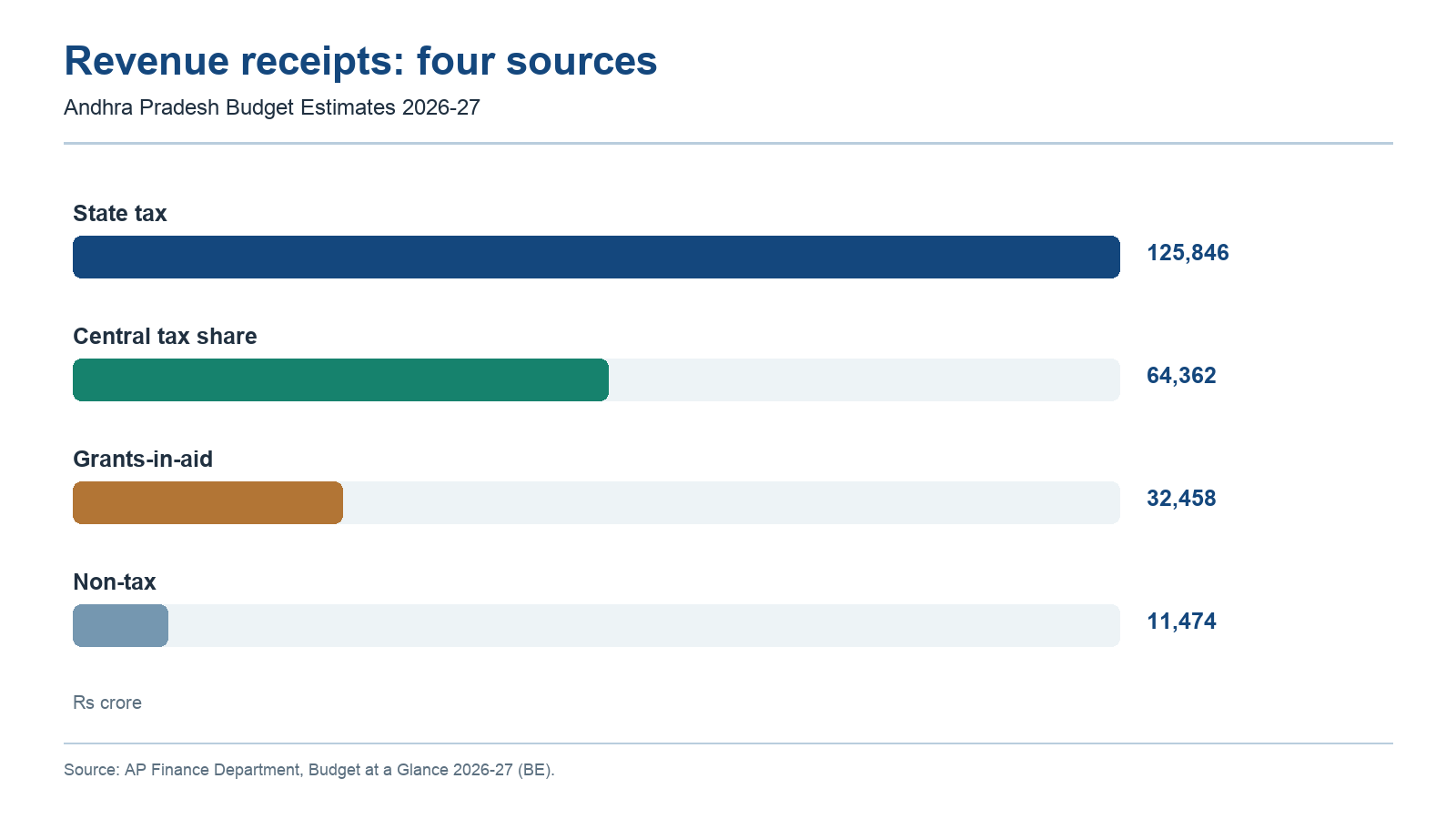
In BE 2026-27, the Budget at a Glance lists revenue receipts of ₹2,34,140.14 crore. The components shown are state tax revenue ₹1,25,845.78 crore, non-tax revenue ₹11,473.98 crore, share of central taxes ₹64,362.16 crore and grants-in-aid ₹32,458.22 crore. Their sum matches the revenue-receipts total. An exam question may call one stream “own revenue” and another “central transfer”; adding tax devolution to state tax revenue without saying so will produce a wrong answer.
Budget growth in a line does not automatically mean the tax rate rose. Economic activity, compliance, price changes, a new tax base and one-off payments can all change collections. Likewise, a receipt estimate may be revised downward during the year. Compare BE 2026-27 with RE 2025-26 for planning direction, and compare actuals with actuals for an established trend. Treat a budget speech's political explanation as an interpretation, while the finance tables supply the accounting facts.
Worked example: Check the arithmetic of revenue receipts: state tax, state non-tax, central tax share and grants add to the published 2026–27 BE total. Classify each before calculating. A central tax share is money transferred through devolution, not a tax imposed by the state. A market loan is a capital receipt and creates a liability. An answer that adds borrowing to revenue receipts may reach a larger cash total but uses the wrong budget category.
Active recall: Add the four revenue-receipt components to get the total. Which components count as central transfers?
Where revenue receipts come from, BE 2026-27
The four official components add to ₹2,34,140.14 crore. Borrowing is excluded.
Read this visual
The bars show only revenue receipts. State tax is the largest listed component; central tax devolution and grants are transfers with different bases. Market borrowing is deliberately absent because it is a capital receipt. Add the four values to verify the published total.
Map geometry: APSDMA. Budget figures and region descriptions: AP Finance Department. Educational comparison visual.