Revenue deficit is revenue expenditure minus revenue receipts when expenditure exceeds receipts. It indicates that current receipts do not cover current spending. Fiscal deficit measures the broader gap between total expenditure and non-borrowed receipts, and is a proxy for borrowing requirement under the budget definition. Primary deficit subtracts interest payments from fiscal deficit. These three measures answer different questions; one cannot substitute for another.
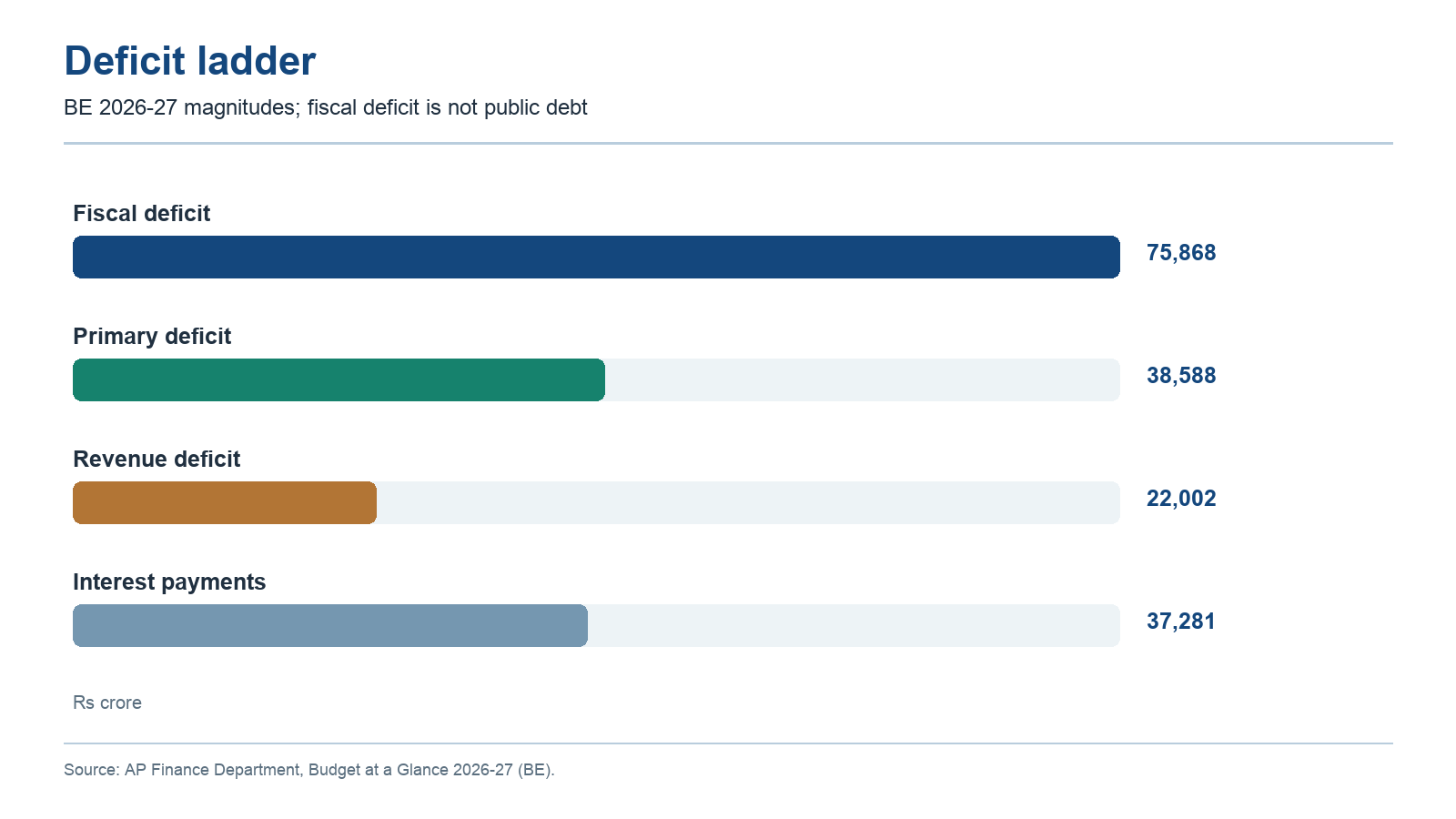
The 2026-27 BE shows a revenue deficit of ₹22,002.50 crore, fiscal deficit of ₹75,868.09 crore and primary deficit of ₹38,587.54 crore, displayed with minus signs in the official balance table. It lists interest payments of ₹37,280.55 crore. Subtracting interest from the fiscal deficit's magnitude gives the primary deficit's magnitude. The budget also expresses revenue and fiscal deficits as 1.11% and 3.84% of projected GSDP respectively. Those ratios depend on both the deficit and the projected GSDP denominator.
Never infer that a lower BE deficit than last year's RE has already been achieved. A BE is a target under assumptions about receipts and spending; the audited account may differ. Nor should public debt be called the annual fiscal deficit. Debt is a stock accumulated over time, while deficit is a flow for one year. A loan repayment can change debt without being the same as revenue expenditure.
Worked example: Use the budget's deficit ladder as a worked calculation. Revenue expenditure of ₹2,56,142.64 crore minus revenue receipts of ₹2,34,140.14 crore gives a revenue deficit of ₹22,002.50 crore. Fiscal deficit is broader because it includes the capital side. Subtracting interest payments of ₹37,280.55 crore from the ₹75,868.09 crore fiscal-deficit magnitude gives a primary deficit of ₹38,587.54 crore. Keep all four values labelled BE 2026–27.
Active recall: Compute primary deficit from fiscal deficit and interest. Explain the difference between a debt stock and a deficit flow.
Three deficits are different measures
Magnitudes shown for BE 2026-27. Primary deficit excludes interest from fiscal deficit.
Read this visual
The three deficit bars measure different gaps. The primary-deficit magnitude is fiscal deficit less interest; public debt is a stock and therefore does not belong on this annual-flow ladder. Every amount here is a 2026–27 Budget Estimate, not an audited result.
Map geometry: APSDMA. Budget figures and region descriptions: AP Finance Department. Educational comparison visual.