The last chapter asks a different skill from a chapter-specific practice set. In a mixed paper, the method is not named for you. You must identify the model, choose a short route, manage time and notice when an answer is implausible. The 50-question set here deliberately revisits earlier topics in a shuffled order.
1. Read for the operation, not the familiar noun
A train question may be a unit-conversion problem, a relative-speed problem or a length-crossing problem. A percentage question may ask for a changed base, reverse percentage or weighted mean. Underline the requested quantity and list the given units before choosing a formula. The topic label is useful during teaching but can become a crutch during revision.
Worked example 1. A 120 m train moving at 54 km/h passes a 180 m platform. Convert 54 km/h to 15 m/s. Crossing distance is 120+180=300 m, so time is 20 seconds. The noun “train” did not itself tell us whether to add lengths; the phrase “passes a platform completely” did.
2. Set a time budget and a return rule
During practice, record the time for each item, including time spent deciding the method. If a question remains structurally unclear after an initial read, mark it and move on. Return after simpler items are finished. This is a practice strategy, not a substitute for learning difficult topics: review the skipped items later, without time pressure, and document the missing idea.
A useful log has columns for question ID, topic, attempted method, reason for error and correction. Error types include wrong base, wrong unit, incorrect formula, arithmetic slip, misread wording and unsupported guess. Counting errors by type shows which habit to change. Repeating all 50 questions indiscriminately is less efficient than revisiting the concepts behind misses.
3. Estimate before detailed computation
Estimate a magnitude or bound whenever possible. A 12% discount on ₹1,000 is around ₹120, so a final price around ₹880 makes sense. A joint-work time must be shorter than the faster worker's solo time. A combined average lies between its component averages. A circle's area is larger than the area of an inscribed square of side equal to its radius. These bounds do not prove an answer, but they reject impossible options.
Worked example 2. A principal of ₹5,000 at 8% simple interest for two years earns roughly ₹400 per year, so SI should be ₹800. If an option says ₹8,000, no fine calculation is needed to reject it. The exact formula confirms 5,000×8×2/100=₹800.
4. Re-solve a miss in three passes
First, re-read the stem without seeing the answer and restate it in your own words. Second, solve from first principles, showing units and base values. Third, compare your route with the worked solution and identify the earliest divergence. A wrong answer may have been caused by a correct formula applied to the wrong quantity, so simply memorising the final option letter will not help.
For a suspected defective question, check whether the wording permits more than one reasonable interpretation, whether the figure has all needed labels and whether two options are numerically equivalent. Mark such an item for editorial review instead of inventing a private rule to force one answer. This book's generation audit checks its numerical key, but readers should still learn to demand clear wording.
5. Spaced active recall
After a session, revisit each error the next day and again several days later. On the second attempt, cover the worked solution and write the governing principle first. A principle such as “profit percentage uses cost price” transfers to new numbers; a memorised answer does not. Mix old and new topics so method selection becomes automatic.
Worked example 3. If you missed an “equal selling price, equal profit/loss percentage” item, do not simply repeat its numbers. Derive two cost prices from a common SP, add them, and compare with total SP. Then test the reasoning with a different percentage. The transferable fact is the changed cost base.
6. A final self-audit
Before finishing a timed set, scan answers for impossible units, signs and ranges. Did a duration come out negative? Did a percentage exceed 100% in a situation where it cannot? Did an area carry cm rather than cm²? Are a diagram's lengths used consistently? A short audit can catch errors that are cheaper to fix than to understand later from a score report.
Recall before practice
1. Name the first two facts to mark in a mixed arithmetic stem. 2. Give one bound for a combined-work answer and one for a combined average. 3. Describe how to classify an error more precisely than “careless mistake”. 4. Explain why the first divergence from the worked solution matters.
Chapter 20 practice — 50 questions
Choose one option for each item. Keep a separate answer list; explanations follow this set.
1. A 70-litre acid-water mixture contains 10% water. How much pure water must be added so that water becomes 25% of the new mixture?
A. 21 litres B. 14 litres C. 28 litres D. 84 litres
2. A and B together can complete a work in 30 hours. A alone can complete it in 75 hours. In how many hours can B alone complete the work?
A. 45 hours B. 105 hours C. 50 hours D. 21 3/7 hours
3. The price of an article is first increased by 10% and then decreased by 10%. What is the net percentage change?
A. decrease of 1% B. decrease of 3% C. increase of 1% D. decrease of 16%
4. A book is marked at ₹3,150 and sold at a discount of 50%. What is its selling price?
A. ₹1,525 B. ₹3,100 C. ₹1,575 D. ₹4,725
5. Pipes P and Q together can fill a cistern in 30 hours, while pipe P alone can fill it in 45 hours. In how many hours will pipe Q alone fill the tank?
A. 75 hours B. 15 hours C. 18 hours D. 90 hours
6. A boatman can travel at 21 km/h in still water. If the speed of the current is 1 km/h, how much time will it take to cover 88 km downstream?
A. 4 hours 30 minutes B. 4 hours 11 minutes C. 4 hours D. 4 hours 24 minutes
7. The simple interest on a certain sum at 4.5% per annum for 6 years is ₹4,725. What is the sum?
A. ₹1,05,000 B. ₹28,350 C. ₹78,750 D. ₹17,500
8. A cheetah is moving at 90 km/h. What is its speed in metres per second?
A. 30 m/s B. 324 m/s C. 1.5 m/s D. 25 m/s
9. What is the largest 5-digit number exactly divisible by 32?
A. 99969 B. 99936 C. 99967 D. 99968
10. Simplify: 16.99 − 16 + 250.8 − 34
A. 217.79 B. 285.79 C. 317.79 D. 370.7
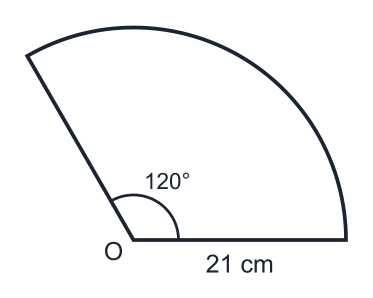
| 11. In the figure, O is the centre of a circle of radius 21 cm and the sector shown has central angle 120°. What is the area of the sector? (Take π = 22/7) A. 462 cm² B. 1386 cm² C. 924 cm² D. 44 cm² |
12. A clock gains 15 minutes in 24 hours. It was set right at 9 a.m. What time will it show at 5 p.m. on the same day?
A. 5:05 p.m. B. 5:10 p.m. C. 4:55 p.m. D. 5:00 p.m.
13. Find the value of √(1 + 3 + 5 + … + 41).
A. 21 B. 41 C. 20 D. 22
14. The sum of 31 numbers is 8463. Find their average.
A. 8463 B. 272 C. 273 D. 274
15. The compounded ratio of 6 : 7 and 6 : 1 is:
A. 36 : 7 B. 1 : 7 C. 3 : 2 D. 7 : 36
16. Find the greatest length of a measuring tape that can measure exactly 36 cm, 60 cm and 180 cm.
A. 12 cm B. 180 cm C. 24 cm D. 6 cm
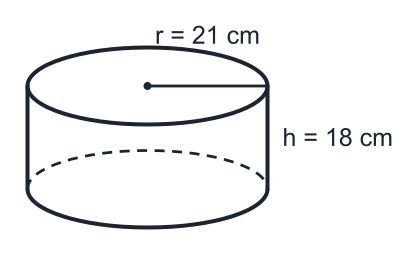
| 17. A solid cylinder has base radius 21 cm and height 18 cm, as shown. Find its curved surface area. (Take π = 22/7) A. 1188 cm² B. 5148 cm² C. 2376 cm² D. 24948 cm² |
18. Two vessels contain milk and water in the ratios 5 : 2 and 2 : 1 respectively. If quantities in the ratio 3 : 1 from the two vessels are mixed, what is the ratio of milk to water in the resulting mixture?
A. 17 : 7 B. 25 : 59 C. 7 : 3 D. 59 : 25
19. Travelling at 40 km/h, Asha reaches the office 10 minutes late; travelling at 60 km/h, Asha reaches 10 minutes early. What is the distance from home to the office?
A. 40 km B. 80 km C. 16.67 km D. 20 km
20. How many numbers between 333 and 586 (both inclusive) are divisible by 17?
A. 16 B. 14 C. 34 D. 15
21. What is the cube root of 287496?
A. 67 B. 66 C. 65 D. 76
22. Express 0.360360360… (the block 360 recurring) as a fraction in its lowest terms.
A. 40/111 B. 40/1111 C. 9/25 D. 4/11
23. The base of a right prism is a right-angled triangle with legs 6 cm and 8 cm, and the height of the prism is 10 cm. Find its lateral surface area.
A. 140 cm² B. 240 cm² C. 288 cm² D. 120 cm²
24. The average age of 13 students is 53 years. When the teacher's age is included, the average rises by 4. Find the teacher's age.
A. 1 years B. 105 years C. 57 years D. 109 years
25. A motorboat covers 21 km downstream and 5 km upstream in 4 hours. If the speed of the stream is 1 km/h, find the speed of the boat in still water.
A. 8 km/h B. 5 km/h C. 7 km/h D. 6 km/h
26. The price of an article is first increased by 25% and then decreased by 10%. What is the net percentage change?
A. increase of 16% B. increase of 12.5% C. increase of 15% D. decrease of 12.5%
27. Find the simple interest on ₹5,500 at 12% per annum for 9 months.
A. ₹495 B. ₹5,940 C. ₹990 D. ₹5,995
28. How many complete rotations does the hour hand of a clock make in a day (24 hours)?
A. 24 B. 1 C. 12 D. 2
29. Two numbers differ by 4 and their product is 3,717. Find their sum.
A. 126 B. 1 C. 122 D. 123
30. Arjun alone can do a work in 42 days, Arjun and Suresh together in 24 days, and Arjun, Suresh and Rahul together in 21 days. In how many days can Suresh alone do the work?
A. 56 days B. 24 days C. 18 days D. 3 days
31. A tap can fill a tank in 20 hours. After half the tank is filled, 4 more taps of the same size are opened. What is the total time taken to fill the tank completely?
A. 12½ hours B. 12 hours C. 10 hours D. 4 hours
32. In a factory there are 220 engineers and 200 technicians. 3/4 of the engineers and 3/4 of the technicians are women. What is the ratio of the total number of men to the total number of women?
A. 106 : 315 B. 11 : 10 C. 3 : 1 D. 1 : 3
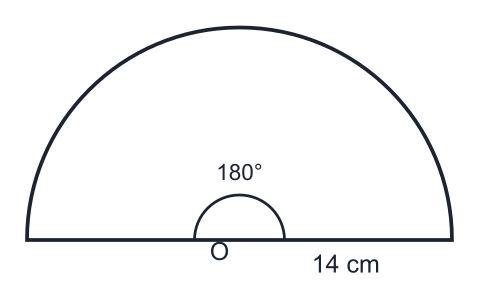
| 33. In the figure, a sector of a circle with centre O has radius 14 cm and central angle 180°. Find the perimeter of the sector. (Take π = 22/7) A. 72 cm B. 88 cm C. 58 cm D. 44 cm |
34. 300 mangoes were bought at ₹1,290 per hundred and sold at a total profit of ₹405. What was the selling price per dozen?
A. ₹181 B. ₹155 C. ₹16 D. ₹171
35. A and B can do a work in 28 days, B and C in 36 days, and C and A in 42 days. In how many days can A alone finish the work?
A. 22 10/11 days B. 63 days C. 11 5/11 days D. 35⅓ days
36. What is the greatest 6-digit number that is a perfect cube?
A. 1000000 B. 999999 C. 970299 D. 941192
37. A batsman scores 105 runs in his 15th innings and thus raises his average by 4. Find his previous batting average.
A. 45 B. 7 C. 49 D. 41
38. If 0.02 × x = 0.5 × 0.5, then x is equal to:
A. 0.02 B. 12.5 C. 125 D. 1.25
39. Three numbers are in the ratio 6 : 8 : 9 and their HCF is 21. What is their LCM?
A. 1512 B. 72 C. 9072 D. 483
40. In an arithmetic progression the 8th term is 37 and the 13th term is 47. What is the sum of its first 30 terms?
A. 1643 B. 1980 C. 1560 D. 1479
41. Five containers A to E hold milk-water mixtures. The total volume and the ratio of milk to water in each is: A: 90 L (3 : 7); B: 117 L (7 : 2); C: 35 L (3 : 2); D: 98 L (4 : 3); E: 30 L (3 : 2). If the contents of D and E are poured into an empty vessel, what is the ratio of milk to water in it?
A. 7 : 5 B. 25 : 18 C. 37 : 27 D. 27 : 37
42. A boat whose speed in still water is 5 km/h takes 3 hours more to go 36 km upstream than to go the same distance downstream. What is the speed of the stream?
A. 6 km/h B. 2 km/h C. 1 km/h D. 5 km/h
43. A washing machine is available for ₹9,000 cash, or for ₹3,000 cash down followed by a single payment of ₹6,240 after 3 months. What rate of simple interest per annum is charged under the instalment plan?
A. 4% B. 18% C. 10⅔% D. 16%
44. The price of wheat falls by 33⅓%. By what percent must a family increase its consumption of wheat so that its expenditure on wheat remains the same?
A. 60% B. 150% C. 25% D. 50%
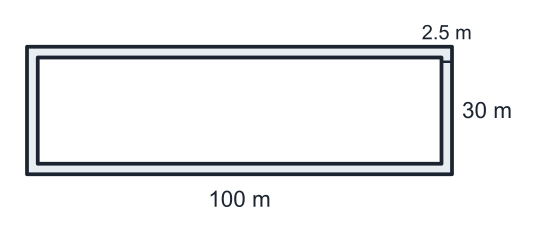
| 45. A rectangular lawn 100 m × 30 m has a 2.5 m wide path inside it along the boundary, as shown. Find the cost of paving the path at ₹12 per m². A. ₹28,500 B. ₹7,500 C. ₹7,800 D. ₹36,000 |
46. A thief is spotted by a policeman from a distance of 600 m. When the policeman starts the chase, the thief also starts running. The thief runs at 27 km/h and the policeman at 36 km/h. How far will the thief have run before he is caught?
A. 2400 m B. 900 m C. 1800 m D. 1900 m
47. In how many minutes does the minute hand of a clock gain 26 minute-spaces over the hour hand?
A. 27 3/11 minutes B. 26 minutes C. 29 5/11 minutes D. 28 4/11 minutes
48. Pipe A can fill a water tank in 12 hours and pipe B in 18 hours. Pipe A is opened at 9:30 a.m. and pipe B at 10:30 a.m. on the same day. At what time will the tank be full?
A. 4:42 p.m. B. 5:42 p.m. C. 9:30 p.m. D. 5:06 p.m.
49. A man gives 1/3 of his money to his elder son, 30% to his younger son and the rest to his three daughters in the ratio 2 : 3 : 5. If one son gets ₹3,100 more than the other, what is the largest share received by a daughter?
A. ₹6,820 B. ₹17,050 C. ₹3,100 D. ₹10,230
50. A dealer sells 14 cups for ₹840 at a profit of 50%. How many cups should he sell for ₹1,352 to earn a profit of 30%?
A. 34 B. 26 C. 23 D. 24
Chapter 20 — Answers and explanations
After checking the key, re-solve any miss without looking at the formula.
1. B. Fix the component that does not change: acid = 90% of 70 = 63 L stays fixed and becomes 75% of the new total ⇒ new total = 63 × 100/75 = 84 L. Quantity added = 84 − 70 = 14 L. (Taking 15% of 70 = 10.5 L ignores that the total also grows.)
APAR26-20-28 | Adding a pure component to change the percentage | Easy
2. C. Total work = LCM(75, 30) = 150 units. (A+B) do 150/30 = 5 units per hour; A does 150/75 = 2. So B does 5 − 2 = 3 units per hour and needs 150/3 = 50 hours. (Subtracting the times, 75 − 30 = 45, is wrong: rates subtract, not times.)
APAR26-20-31 | Together time and one worker known | Easy
3. A. Net change = a + b + ab/100 with a = 10, b = -10: 10 + (-10) + (10 × -10)/100 = -1%. A 1% decrease. (Simply adding the two percentages, 0%, ignores the compounding term.)
APAR26-20-16 | Successive percentage change | Easy
4. C. Discount = 50% of MP = 50/100 × ₹3,150 = ₹1,575. Selling price = MP − discount = ₹3,150 − ₹1,575 = ₹1,575. So SP = ₹1,575.
APAR26-20-22 | Single discount | Easy
5. D. Rate of Q = 1/30 − 1/45 = 3/90 − 2/90 = 1/90, so Q alone fills the tank in 90/1 = 90 hours. (Taking 45 − 30 = 15 as the answer is the common slip.)
APAR26-20-34 | Second pipe from combined time | Easy
6. C. Downstream speed = 21 + 1 = 22 km/h. Time = distance/speed = 88/22 = 4 hours = 4 hours. (Using the still-water speed gives 4.19 h, which ignores the current.)
APAR26-20-40 | Time for one leg | Easy
7. D. P = SI × 100/(R × T) = ₹4,725 × 100/(4.5 × 6) = ₹4,72,500/27 = ₹17,500.
APAR26-20-25 | Principal from SI | Easy
8. D. 1 km/h = 1000 m / 3600 s = 5/18 m/s. 90 × 5/18 = 25 m/s. (Multiplying by 18/5 gives 324, the reverse conversion.)
APAR26-20-37 | km/h to m/s | Easy
9. D. Largest 5-digit number = 99999. 99999 ÷ 32 leaves remainder 31. Subtract it: 99999 − 31 = 99968, which is divisible by 32.
APAR26-20-01 | Largest / smallest multiple | Easy
10. A. Line up the decimal points (write every term to 2 decimal places). Positives: 16.99 + 250.8 = 267.79; negatives: 16 + 34 = 50. Result = 267.79 − 50 = 217.79.
APAR26-20-07 | Adding and subtracting decimals | Easy
11. A. Area of a sector = (θ/360°) × πr² = (120/360) × (22/7) × 21 × 21 = (120/360) × 1386 = 462 cm². (The full circle's area 1386 is the trap option.)
APAR26-20-46 | Area of a sector from radius and central angle | Easy
12. A. Error is proportional to elapsed time: in 8 hours the clock gains 15 × 8/24 = 5 minutes. So at 5 p.m. it shows 5 p.m. + 5 min = 5:05 p.m. (a fast clock shows a later time, a slow clock an earlier one).
APAR26-20-43 | Time shown by a fast/slow clock | Easy
13. A. The sum of the first n odd numbers is n². Here the last term is 41 = 2n − 1, so n = (41 + 1)/2 = 21 terms, and the sum = 21² = 441. Therefore √(441) = 21. (Do not use 41 itself as n.)
APAR26-20-10 | Square root of the sum of odd numbers | Easy
14. C. Average of a group of numbers = sum of the numbers/number of terms = 8463/31 = 273.
APAR26-20-19 | Average from sum (direct) | Easy
15. A. The compounded ratio of a : b and c : d is ac : bd. Here (6 × 6) : (7 × 1) = 36 : 7 = 36 : 7. (Adding the terms, 3 : 2, is wrong.)
APAR26-20-13 | Compounded ratio | Easy
16. A. The largest tape must divide each quantity exactly, so it is the HCF. 36 = 2^2 × 3^2; 60 = 2^2 × 3 × 5; 180 = 2^2 × 3^2 × 5; common primes at lowest powers give HCF = 12 cm. (The LCM would give the smallest quantity measurable by all, the opposite question.)
APAR26-20-04 | Largest measure (HCF) | Easy
17. C. Curved surface area = 2πrh = 2 × (22/7) × 21 × 18 = 2376 cm². (Adding the two circular ends gives the total surface area 5148 cm², which is not asked.)
APAR26-20-49 | Curved surface area of a cylinder | Easy
18. D. Take 63 L from the first (LCM-friendly) and 21 L from the second. Milk = 63 × 5/7 + 21 × 2/3 = 45 + 14 = 59; water = 18 + 7 = 25. Ratio = 59 : 25 = 59 : 25. (Adding ratio terms directly, 7 : 3, is wrong.)
APAR26-20-29 | Combining two mixtures | Medium
19. A. The difference between the two journey times is 10 + 10 = 20 minutes = 20/60 h. d/40 − d/60 = 20/60 ⇒ d × 20/2400 = 20/60 ⇒ d = 2400 × 20/(60 × 20) = 40 km. (Using only one of the two minute figures is the usual slip.)
APAR26-20-38 | Distance from late/early at two speeds | Medium
20. D. Count = ⌊586/17⌋ − ⌊(333 − 1)/17⌋ = 34 − 19 = 15. (Using ⌊(586 − 333)/17⌋ = 14 can be off by one.)
APAR26-20-02 | Counting multiples | Medium
21. B. Ignore the last three digits: 287 lies between 6³ = 216 and 7³ = 343, so the tens digit is 6. The unit digit of 287496 is 6, and only 6³ ends in 6, so the unit digit is 6. Cube root = 66. (Prime factorisation: 287496 = 2^3 × 3^3 × 11^3.)
APAR26-20-11 | Cube root of a perfect cube | Medium
22. A. Let x = 0.360360360…. Multiply by 10^3: 1000x = 360.360360… Subtract: 1000x − x = 360 ⇒ 999x = 360 ⇒ x = 360/999 = 40/111. (Rule: a pure recurring block of 3 digits goes over 999; 360/1000 would be the terminating decimal 0.360.)
APAR26-20-08 | Pure recurring decimal to fraction | Medium
23. B. Hypotenuse = √(6² + 8²) = 10 cm, so base perimeter = 6 + 8 + 10 = 24 cm. Lateral surface area = perimeter × height = 24 × 10 = 240 cm². (Adding the two triangular ends gives the TSA 288 cm².)
APAR26-20-50 | Lateral surface area of a right triangular prism | Medium
24. D. New average = 53 + 4 = 57. New member's value = newAvg × (n+1) − oldAvg × n = 57 × 14 − 53 × 13 = 109.
APAR26-20-20 | Average change on member added | Medium
25. D. Let still-water speed = x km/h. Then 21/(x + 1) + 5/(x − 1) = 4. Clearing denominators: 4x² − 26x + 12 = 0, whose admissible root is x = 6. Check: 21/7 + 5/5 = 3 + 1 = 4 ✓. (Total distance/total time = 6.5 km/h is a trap.)
APAR26-20-41 | Still-water speed from a mixed trip | Medium
26. B. Net change = a + b + ab/100 with a = 25, b = -10: 25 + (-10) + (25 × -10)/100 = 12.5%. A 12.5% increase. (Simply adding the two percentages, 15%, ignores the compounding term.)
APAR26-20-17 | Successive percentage change | Medium
27. A. Simple interest = P × R × T/100 with P = ₹5,500, R = 12% and T = 9/12 years: ₹5,500 × 12 × 9/12/100 = ₹495. (Time must be in years: 9 months = 9/12 year.)
APAR26-20-26 | Simple interest (direct) | Medium
28. D. The hour hand takes 12 hours for one full rotation of the dial, so in 24 hours it completes 24/12 = 2 rotations (the minute hand makes 24).
APAR26-20-44 | Clock facts | Medium
29. C. Let the numbers be x and x + 4: x(x + 4) = 3,717. Since √3,717 ≈ 61, try factors near it: 59 × 63 = 3,717 ✓. So the numbers are 59 and 63; HCF = 1, sum = 122. Required: 122.
APAR26-20-05 | Numbers from product and difference | Medium
30. A. Total work = LCM(42, 24, 21) = 168 units. Rates: Arjun = 168/42 = 4; (Arjun+Suresh) = 168/24 = 7; (all three) = 168/21 = 8 units/day. So Suresh = 7 − 4 = 3 and Rahul = 8 − 7 = 1 units/day. Suresh alone: 168/3 = 56 days.
APAR26-20-32 | Nested group times | Medium
31. B. First half: 20/2 = 10 hours with one tap. Second half: 5 taps together fill 5× as fast, so time = (20/2) ÷ 5 = 2 hours. Total = 10 + 2 = 12 hours. (Dividing the whole 20 h by 5 ignores that the extra taps start only at the halfway mark.)
APAR26-20-35 | Extra identical taps after half the tank | Medium
32. D. Women = 3/4 × 220 + 3/4 × 200 = 165 + 150 = 315. Men = (220 − 165) + (200 − 150) = 55 + 50 = 105. Ratio men : women = 105 : 315 = 1 : 3.
APAR26-20-14 | Caselet: fractions of sub-groups | Medium
33. A. Arc length = (θ/360°) × 2πr = (180/360) × 2 × (22/7) × 14 = 44 cm. Perimeter of the sector = 2r + arc = 2 × 14 + 44 = 72 cm. (Giving only the arc length, 44 cm, forgets the two radii.)
APAR26-20-47 | Perimeter of a sector | Medium
34. D. Total CP = (300/100) × ₹1,290 = ₹3,870. Total SP = CP + profit = ₹3,870 + ₹405 = ₹4,275. Number of dozens = 300/12 = 25, so SP per dozen = ₹4,275/25 = ₹171.
APAR26-20-23 | Bought per hundred, sold per dozen | Medium
35. B. Total work = LCM(28, 36, 42) = 252 units. Pair rates: 9, 7, 6 units/day. Adding counts everyone twice: 2(A+B+C) = 22, so A+B+C = 11 units/day; A = (A+B+C) − (B+C) = 11 − 7 = 4 units/day, so A alone takes 252/4 = 63 days. (Forgetting to halve the pair-sum is the standard trap.)
APAR26-20-33 | Pairwise times, one worker | Difficult
36. C. The greatest 6-digit number is 999999. ∛999999 ≈ 100, so the required root is 99 and the number is 99³ = 970299. (1000000 has 7 digits.)
APAR26-20-12 | greatest 6-digit perfect cube | Difficult
37. A. New average = score − (n−1)×k = 105 − 14×4 = 49. Previous average = new average − k = 49 − 4 = 45.
APAR26-20-21 | Cricket batting average | Difficult
38. B. Right side: 0.5 × 0.5 = 0.25 (1 + 1 = 2 decimal places before dropping trailing zeros). So x = 0.25 ÷ 0.02 = 25 ÷ 2 = 12.5. (Multiply numerator and denominator by 100 to clear the decimal in the divisor.)
APAR26-20-09 | Decimal equation | Difficult
39. A. Numbers = 6 × 21, 8 × 21, 9 × 21 = 126, 168, 189. LCM = 21 × LCM(6, 8, 9) = 21 × 72 = 1512. (Multiplying all three ratio terms, 6 × 8 × 9 × 21 = 9072, over-counts the shared factors.)
APAR26-20-06 | LCM of three numbers from ratio and HCF | Difficult
40. C. t13 − t8 = (13 − 8)d ⇒ 47 − 37 = 5d ⇒ d = 2. Then a = t8 − (8 − 1)d = 37 − 14 = 23. S30 = 30/2 × [2 × 23 + 29 × 2] = 30/2 × 104 = 1560.
APAR26-20-03 | Arithmetic progression | Difficult
41. C. Milk: D 56 L + E 18 L = 74 L; water: 42 + 12 = 54 L. Ratio = 74 : 54 = 37 : 27. (Adding the ratio terms directly, 7 : 5, is wrong because the totals differ.)
APAR26-20-30 | Mixture table: ratio after combining containers | Difficult
42. C. Let stream speed = x km/h. 36/(5 − x) − 36/(5 + x) = 3 ⇒ 36 × 2x/(25 − x²) = 3 ⇒ 72x = 3(25 − x²) ⇒ 3x² + 72x − 75 = 0. Check x = 1: 36/4 − 36/6 = 9 − 6 = 3 ✓. Stream speed = 1 km/h.
APAR26-20-42 | Stream speed from extra upstream time | Difficult
43. D. Balance owed = ₹9,000 − ₹3,000 = ₹6,000. Interest charged = ₹6,240 − ₹6,000 = ₹240 for 3 months. Rate = ₹240 × 100 × 12/(₹6,000 × 3) = 16% p.a. (Interest is on the balance, not on the full cash price.)
APAR26-20-27 | Rate charged under a cash-down scheme | Difficult
44. D. Price falls by 1/3: new price = 2/3 of old. To keep expenditure fixed, consumption must become 3/2 of old, an increase of 1/2 = 1/2 = 50%.
APAR26-20-18 | Price change and consumption | Difficult
45. B. Area of path = 100 × 30 − (95 × 25) = 3000 − 2375 = 625 m². Cost = 625 × ₹12 = ₹7,500. (Using 2w(L + B) = 650 m² for the path double-counts the corners and gives ₹7,800.)
APAR26-20-48 | Cost of paving a path inside a rectangle | Difficult
46. C. Relative speed = 36 − 27 = 9 km/h = 9 × 5/18 = 2.5 m/s. Time to close the 600 m gap = 600/2.5 = 240 s = 4 minutes. In that time the thief runs 27 km/h = 7.5 m/s × 240 s = 1800 m. (Using the policeman's own speed instead of the relative speed is the trap.)
APAR26-20-39 | Distance run by the thief before capture | Difficult
47. D. In 60 minutes the minute hand gains 60 − 5 = 55 minute-spaces. So 26 spaces are gained in 26 × 60/55 = 26 × 12/11 = 28 4/11 minutes (not 26 minutes: the hour hand also moves).
APAR26-20-45 | Time to gain minute-spaces | Difficult
48. D. Capacity = LCM(12, 18) = 36 units; A gives 3, B gives 2 units/h. From 9:30 a.m. to 10:30 a.m. only A runs: 3 × 1 = 3 units; 33 units remain. Together at 5 units/h they take 6⅗ h = 6 hours 36 minutes. So the tank is full at 10:30 a.m. + 6 hours 36 minutes = 5:06 p.m.
APAR26-20-36 | Clock time when the tank is full | Difficult
49. B. Let the total be T. Sons get T × 1/3 and T × 30/100; their difference = T × |1/3 − 30/100| = ₹3,100 ⇒ T = ₹93,000. Sons: ₹31,000 and ₹27,900; remainder for daughters = ₹93,000 − ₹31,000 − ₹27,900 = ₹34,100. Split 2 : 3 : 5 (one part = ₹3,410): ₹6,820, ₹10,230, ₹17,050. Largest daughter's share = ₹17,050.
APAR26-20-15 | Multi-stage division of property | Difficult
50. B. CP of 14 cups = ₹840 × 100/150 = ₹560, so CP per item = ₹40. For 30% profit, SP per item = ₹40 × 130/100 = ₹52. Number = ₹1,352 ÷ ₹52 = 26. (Using the old SP per item, ₹60, gives 22.53.)
APAR26-20-24 | Number of items for a target profit | Difficult