Profit and Loss — Complete Guide
Table of Contents
- Introduction to the Topic
- Basic Concepts and Terminology
- Core Formulas
- Type 1: Basic Profit/Loss Calculation
- Type 2: Marked Price and Discount
- Type 3: Successive Discounts
- Type 4: False Weight/Measure Problems
- Type 5: Multiple Transactions (Buying/Selling in Bulk, Mixed Profit/Loss)
- Type 6: Cost Price/Selling Price Ratio Problems
- Common Shortcuts and Tricks
- Common Mistakes to Avoid
- Solved Examples (25 fully worked problems)
- Practice Question Bank (50 questions)
- Answer Key with Quick Solutions
1. Introduction to the Topic
Profit and Loss is a percentage-heavy chapter built almost entirely on the relationship between Cost Price (CP), Selling Price (SP), and Marked Price (MP). SSC, RRB, and banking exams typically ask 2-4 questions from this chapter, and mastery here is largely about applying the base formula correctly with the right reference value (CP is always the base for profit/loss %, MP is always the base for discount %).
2. Basic Concepts and Terminology
Cost Price (CP): The price at which an item is purchased/produced.
Selling Price (SP): The price at which an item is sold.
Marked Price (MP) / List Price: The price displayed/labeled on the item, before any discount.
Profit: SP − CP (when SP > CP)
Loss: CP − SP (when CP > SP)
Discount: MP − SP (the reduction offered on the marked price)
3. Core Formulas
Formula 1: Profit % = (Profit/CP) × 100 = [(SP−CP)/CP] × 100
Formula 2: Loss % = (Loss/CP) × 100 = [(CP−SP)/CP] × 100
Formula 3: SP = CP × (100+Profit%)/100 [when there’s a profit] SP = CP × (100−Loss%)/100 [when there’s a loss]
Formula 4: CP = SP × 100/(100+Profit%) [when there’s a profit] CP = SP × 100/(100−Loss%) [when there’s a loss]
Formula 5: Discount % = (Discount/MP) × 100 = [(MP−SP)/MP] × 100
Formula 6: SP = MP × (100−Discount%)/100
Formula 7 (successive discounts): Net discount % = a+b−(ab/100) [for two successive discounts a% and b%] — note this is subtracted, unlike successive profit% which adds the cross term.
Formula 8 (false weight): If a dishonest shopkeeper uses a false weight of x grams instead of the true weight of y grams (claiming to sell y grams but actually giving x grams), while charging for y grams: Profit % = [(y−x)/x] × 100 (when cost price is based on actual weight given)
Formula 9 (equal SP, different profit/loss %): If two items are sold at the same SP, one at a% profit and other at a% loss, there is always a NET LOSS of (a²/100)% on the total transaction (regardless of the actual SP value).
4. Type 1: Basic Profit/Loss Calculation
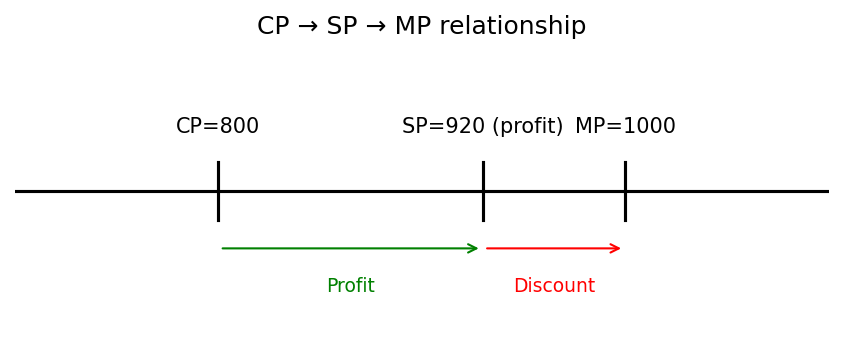
Pattern: “A man buys an article for ₹800 and sells it for ₹920. Find his profit percentage.” - Profit=120. Profit%=(120/800)×100=15%
Pattern: “An article is sold at a loss of 12%. If it was bought for ₹500, find the selling price.” - SP=500×(100−12)/100=500×0.88=₹440
5. Type 2: Marked Price and Discount
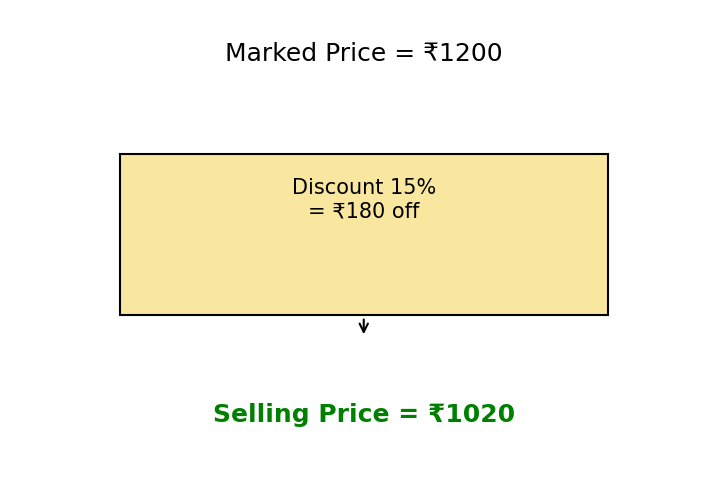
Pattern: “A shopkeeper marks an article at ₹1200 and sells it after a discount of 15%. Find the SP.” - SP=1200×0.85=₹1020
Pattern: “An article marked at ₹2000 is sold for ₹1700. Find the discount percentage.” - Discount=300. Discount%=(300/2000)×100=15%
Pattern (finding MP from CP, profit%, and discount%): “A shopkeeper wants to make a profit of 20% after giving a discount of 10%. If the CP is ₹900, find the MP.” - Required SP=900×1.2=1080. MP×0.9=1080 ⇒ MP=1080/0.9=₹1200
6. Type 3: Successive Discounts
Pattern: “Find the single equivalent discount for successive discounts of 20% and 10%.” - Net=20+10−(20×10)/100=30−2=28%
Pattern (three successive discounts): “Find the single equivalent discount for 10%, 10%, and 10% successive discounts.” - First combine 10% and 10%: 10+10−1=19%. Then combine 19% and 10%: 19+10−1.9=27.1%
7. Type 4: False Weight/Measure Problems
Pattern: “A shopkeeper claims to sell rice at cost price but uses a weight of 900g instead of 1kg. Find his profit percentage.” - Profit%=[(1000−900)/900]×100=(100/900)×100=11.11%
8. Type 5: Multiple Transactions (Mixed Profit/Loss)
Pattern: “A man sells two watches for ₹1980 each, one at a profit of 10% and the other at a loss of 10%. Find his overall gain or loss percentage.” - Using the shortcut: net loss=(10²/100)%=1% loss. - Let’s verify: CP1=1980/1.1=1800; CP2=1980/0.9=2200. Total CP=4000. Total SP=3960. Loss=40. Loss%=(40/4000)×100=1% loss ✓ (matches shortcut)
9. Type 6: Cost Price/Selling Price Ratio Problems
Pattern: “If the SP of 15 articles equals the CP of 18 articles, find the profit percentage.” - Let CP of 1 article=1. SP of 15 articles=CP of 18 articles=18. SP of 1 article=18/15=1.2. - Profit%=(1.2−1)/1×100=20%
10. Common Shortcuts and Tricks
- Always use CP as the base for profit/loss %, and MP as the base for discount % — mixing these up is the single most common error in this chapter.
- Successive discount formula uses subtraction (a+b−ab/100), while successive profit/growth formula uses addition (a+b+ab/100) — memorize both directions clearly.
- Equal SP, equal profit%/loss%: net result is ALWAYS a loss of (common%)²/100 — this shortcut avoids computing individual CPs.
- For CP/SP ratio-of-articles problems (“SP of x articles = CP of y articles”), directly compute profit% = [(y−x)/x]×100 (a very fast shortcut derived from Type 6’s method).
- False weight profit% = [(true weight − false weight)/false weight] × 100 — treat this exactly like the CP/SP ratio shortcut.
- When a problem gives marked price, discount%, and desired profit%, work backward from CP: find required SP first (from profit%), then find MP (from discount% applied to MP giving that SP).
- Discount is always calculated on MP, never on CP — a frequent source of confusion when problems mention both values.
- For three or more successive discounts, combine two at a time repeatedly using the pairwise formula rather than trying to compute all at once.
11. Common Mistakes to Avoid
- Using SP as the base for profit%/loss% instead of CP.
- Using CP as the base for discount% instead of MP.
- Adding successive discounts directly (20%+10%=30%) instead of using the correct net-discount formula (28%, not 30%).
- Forgetting the “always a loss” result in the equal-SP-equal-%-profit/loss scenario, and instead assuming the net result is zero.
- Sign errors in false weight problems — the profit is based on the goods actually given (false/lower quantity), not the claimed quantity.
- Confusing “discount on MP” with “reduction from CP” — these are different bases entirely.
- Not accounting for compounding when discounts or profits are applied in sequence, rather than added directly.
12. Solved Examples (25 Fully Worked Problems)
Example 1. A man buys an article for ₹450 and sells it for ₹540. Find his profit percentage. Solution: Profit=90. Profit%=(90/450)×100=20%.
Example 2. An article is sold at a loss of 8%. If the CP is ₹625, find the SP. Solution: SP=625×0.92=₹575.
Example 3. A shopkeeper sells an article for ₹690, incurring a loss of 8%. Find the CP. Solution: CP=690×100/92=₹750.
Example 4. Find the SP of an article whose CP is ₹1200, to earn a profit of 25%. Solution: SP=1200×1.25=₹1500.
Example 5. An article marked at ₹1500 is sold after a discount of 20%. Find the SP. Solution: SP=1500×0.8=₹1200.
Example 6. Find the discount percentage if an article marked at ₹800 is sold for ₹680. Solution: Discount=120. Discount%=(120/800)×100=15%.
Example 7. A shopkeeper wants a profit of 15% after offering a discount of 10%. If CP=₹1020, find the MP. Solution: Required SP=1020×1.15=1173. MP=1173/0.9=₹1303.33.
Example 8. Find the single equivalent discount for successive discounts of 25% and 20%. Solution: 25+20−(25×20)/100=45−5=40%.
Example 9. Find the single equivalent discount for three successive discounts of 10%, 20%, 10%. Solution: Combine10&20: 10+20−2=28%. Combine28&10:28+10−2.8=35.2%.
Example 10. A dishonest trader claims to sell goods at cost price but uses a weight of 800g for every 1kg. Find his profit percentage. Solution: Profit%=[(1000−800)/800]×100=(200/800)×100=25%.
Example 11. A man sells two articles for ₹2400 each, one at 20% profit and the other at 20% loss. Find his overall gain/loss percentage. Solution: Net loss=(20²)/100=4% loss.
Example 12. If the SP of 20 articles equals the CP of 25 articles, find the profit percentage. Solution: Profit%=[(25−20)/20]×100=25%.
Example 13. A shopkeeper allows a discount of 10% and still makes a profit of 26%. Find the profit percentage if no discount were allowed (i.e., find profit% on the marked price sale directly). Solution: Let CP=100. SP(with 10% discount)=100×1.26=126=MP×0.9 ⇒ MP=140. Without discount, SP=MP=140. Profit%=(140−100)/100×100=40%.
Example 14. A trader marks his goods 40% above cost price and allows a discount of 15%. Find his profit percentage. Solution: Let CP=100. MP=140. SP=140×0.85=119. Profit%=19%.
Example 15. By selling an article for ₹960, a man loses 4%. At what price should he sell it to gain 10%? Solution: CP=960×100/96=1000. Required SP=1000×1.1=₹1100.
Example 16. A man buys 12 pens for ₹100 and sells them at 8 pens for ₹100. Find his profit or loss percentage. Solution: CP per pen=100/12. SP per pen=100/8. Profit%=[(100/8−100/12)/(100/12)]×100=[(12.5−8.33)/8.33]×100≈50%.
Example 17. A shopkeeper sells an article at a 10% loss. Had he sold it for ₹66 more, he would have gained 5%. Find the CP. Solution: Let CP=x. SP1=0.9x. SP2=1.05x. Difference=1.05x−0.9x=0.15x=66. x=₹440.
Example 18. Find the marked price of an article if it’s sold after a 25% discount for ₹1500. Solution: MP=1500/0.75=₹2000.
Example 19. A trader buys 100 kg of rice for ₹6000 and sells 60 kg at 10% profit and the rest at 5% loss. Find his overall profit/loss percentage. Solution: CP per kg=60. SP of 60kg=60×60×1.1=3960. SP of 40kg=40×60×0.95=2280. Total SP=3960+2280=6240. Total CP=6000. Profit=240. Profit%=(240/6000)×100=4%.
Example 20. A man sold an article at a loss of 15%. Had he sold it for ₹450 more, he would have gained 5%. Find the CP. Solution: 0.05x−(−0.15x)=450⇒0.2x=450⇒x=₹2250.
Example 21. Find the CP of an article that is sold for ₹1955 at a profit of 15%. Solution: CP=1955×100/115=₹1700.
Example 22. A shopkeeper offers successive discounts of 20% and 5% on an article marked at ₹2500. Find the effective SP and the single equivalent discount. Solution: SP=2500×0.8×0.95=2500×0.76=₹1900. Equivalent discount%=(2500−1900)/2500×100=24% (matches 20+5−1=24 ✓).
Example 23. A retailer buys goods at 20% discount on MP and sells them at MP. Find his profit percentage. Solution: Let MP=100. CP=80. SP=100. Profit%=(20/80)×100=25%.
Example 24. By selling 45 lemons for ₹40, a woman loses 20%. How many lemons should she sell for ₹24 to gain 20% on the whole? Solution: SP for 45 lemons=40, this is at 20% loss ⇒ CP for 45=40/0.8=50 ⇒ CP per lemon=50/45=10/9. To gain 20%, SP per lemon=(10/9)×1.2=12/9=4/3. Number of lemons for ₹24=24/(4/3)=24×3/4=18 lemons.
Example 25. A shopkeeper marks his goods at 50% above CP and allows successive discounts of 20% and 10%. Find his profit or loss percentage. Solution: Let CP=100. MP=150. SP=150×0.8×0.9=150×0.72=108. Profit%=8%.
13. Practice Question Bank (50 Questions)
Set A — Basic Profit/Loss (Q1–Q12) 1. A man buys an article for ₹720 and sells it for ₹864. Find his profit%. 2. An article is sold at 12% loss for ₹528. Find the CP. 3. Find the SP of an article with CP ₹950 to gain 18%. 4. An article sold at ₹1440 incurs a loss of 10%. Find the CP. 5. A man sells an article for ₹690 at a profit of 15%. Find the CP. 6. Find the loss percentage if an article bought for ₹800 is sold for ₹680. 7. A man buys an item for ₹550 and wants a profit of 30%. Find the required SP. 8. An article’s CP is ₹1250. It’s sold for ₹1000. Find the loss%. 9. A trader sells goods at ₹2760, gaining 15%. Find the CP. 10. Find CP if SP=₹918 and loss%=15%. 11. A man buys a bicycle for ₹2500 and sells it at a loss of 8%. Find the SP. 12. An article is bought for ₹640 and sold for a profit of 25%. Find the SP.
Set B — Marked Price & Discount (Q13–Q22) 13. Find the SP of an article marked ₹2500 with a 12% discount. 14. An article marked at ₹1800 is sold for ₹1530. Find the discount%. 15. Find the MP if SP=₹850 after a 15% discount. 16. A shopkeeper wants 20% profit after a 10% discount on CP=₹900. Find MP. 17. Find the single equivalent discount for successive discounts of 30% and 10%. 18. Find the single equivalent discount for 15%, 15%, and 15% successive discounts. 19. A trader marks goods 60% above CP and allows a 25% discount. Find profit%. 20. An article marked ₹3000 is sold after two successive discounts of 10% and 5%. Find the SP. 21. Find the MP of an article sold for ₹1360 after a discount of 20%. 22. A shopkeeper allows a discount of 12% and still gains 32%. Find the profit% if sold at MP without discount.
Set C — False Weight (Q23–Q28) 23. A trader uses a weight of 950g instead of 1kg. Find his profit%. 24. A shopkeeper claims to sell at CP but uses a 900g weight for 1kg. Find profit%. 25. A dishonest dealer professes to sell at CP but uses a false weight and gains 25%. Find the weight he uses instead of 1kg. 26. A trader uses a weight of 720g for 750g. Find his profit%. 27. A grocer sells rice at CP using a weight of 950g for 1000g claimed. Find profit%. 28. A trader gains 20% by using a false weight instead of the true one. Find the false weight (in grams, out of 1000g true weight).
Set D — Multiple Transactions (Q29–Q36) 29. A man sells two articles for ₹1200 each, one at 25% profit and other at 25% loss. Find overall %. 30. Find the overall profit/loss% if a shopkeeper sells 2 items at ₹3000 each, one at 15% loss and other at 15% profit. 31. A man sells 150kg wheat, 90kg at 8% profit and 60kg at 4% loss, CP=₹40/kg. Find overall profit%. 32. A shopkeeper buys 50 chairs at ₹800 each. He sells 30 at 20% profit and 20 at 10% loss. Find overall profit%. 33. Two horses are sold at ₹9975 each, one at 15% profit and one at 15% loss. Find the total profit or loss. 34. A trader buys 200 items, sells 120 at 15% profit and 80 at 5% loss, at a uniform CP. Find overall profit%. 35. A man sold 2 watches at ₹1596 each, one at 12% profit, other at 12% loss. Find overall gain/loss. 36. A shopkeeper sells two TVs at the same price, one at 30% profit and other at 30% loss. Find overall loss%.
Set E — Ratio & Advanced (Q37–Q44) 37. If SP of 25 articles = CP of 30 articles, find profit%. 38. If SP of 12 articles = CP of 15 articles, find profit%. 39. If SP of 40 articles = CP of 32 articles, find loss%. 40. A man buys 8 articles for ₹10 and sells 10 for ₹8. Find profit/loss%. 41. A shopkeeper sells an article at a loss of 12%. Had he sold it for ₹80 more, he’d have gained 8%. Find the CP. 42. By selling an article for ₹1520, a man gains 12%. Find the SP for a 20% gain. 43. A man buys apples at 6 for ₹10 and sells at 5 for ₹10. Find profit%. 44. A dealer sold an article at 8% loss. Had he sold it for ₹800 more, he would have gained 12%. Find CP.
Set F — Mixed/Advanced (Q45–Q50) 45. A shopkeeper marks goods 25% above CP and gives a discount such that he still makes a 10% profit. Find the discount%. 46. Find the CP of an article sold at ₹4025 with a 15% profit, then find the SP needed for a 25% profit on the same CP. 47. A retailer buys an article at 15% discount on MP=₹2000 and sells at 10% above MP. Find his profit%. 48. A man sells an article at a profit of 20%. If he had bought it at 10% less and sold it for ₹36 less, he would have gained 30%. Find the CP. 49. A shopkeeper sold two articles, each for ₹2970, one at a profit of 10% and the other at a loss of 10%. Find whether there’s an overall profit or loss, and by how much. 50. A merchant marks his goods at a price that allows him a 25% profit after giving a 20% discount. Find the CP as a percentage of MP.
14. Answer Key with Quick Solutions
Set A 1. profit=144;profit%=(144/720)×100=20% 2. CP=528×100/88=₹600 3. SP=950×1.18=₹1121 4. CP=1440×100/90=₹1600 5. CP=690×100/115=₹600 6. loss=120;loss%=(120/800)×100=15% 7. SP=550×1.3=₹715 8. loss%=(250/1250)×100=20% 9. CP=2760×100/115=₹2400 10. CP=918×100/85=₹1080 11. SP=2500×0.92=₹2300 12. SP=640×1.25=₹800
Set B 13. SP=2500×0.88=₹2200 14. discount=270;discount%=(270/1800)×100=15% 15. MP=850/0.85=₹1000 16. requiredSP=900×1.2=1080;MP=1080/0.9=₹1200 17. 30+10−3=37% 18. combine15&15:15+15−2.25=27.75;combine27.75&15:27.75+15−4.1625=38.5875% 19. CP=100,MP=160,SP=160×0.75=120;profit%=20% 20. SP=3000×0.9×0.95=₹2565 21. MP=1360/0.8=₹1700 22. CP=100,SP(discounted)=132=MP×0.88⇒MP=150;withoutdiscount SP=150;profit%=50%
Set C 23. profit%=[(1000−950)/950]×100≈5.26% 24. profit%=[(1000−900)/900]×100≈11.11% 25. 25%gain⇒(1000−x)/x=0.25⇒1000−x=0.25x⇒1000=1.25x⇒x=800g 26. profit%=[(750−720)/720]×100≈4.17% 27. profit%=[(1000−950)/950]×100≈5.26% 28. (1000−x)/x=0.2⇒1000−x=0.2x⇒x=1000/1.2≈833.33g
Set D 29. net loss=(25²)/100=6.25% loss 30. net loss=(15²)/100=2.25% loss 31. CP total=150×40=6000;SP=90×40×1.08+60×40×0.96=3888+2304=6192;profit=192;profit%=(192/6000)×100=3.2% 32. CP=50×800=40000;SP=30×800×1.2+20×800×0.9=28800+14400=43200;profit=3200;profit%=(3200/40000)×100=8% 33. net loss=(15²)/100=2.25%;CP total=9975/1.15+9975/0.85=8673.9+11735.3=20409.2;loss=20409.2×0.0225≈₹459.2 loss(approx, matching%method) 34. CP=1(per item,200total);SP=120×1.15+80×0.95=138+76=214;total CP=200;profit=14;profit%=(14/200)×100=7% 35. net loss=(12²)/100=1.44% loss 36. net loss=(30²)/100=9% loss
Set E 37. profit%=[(30−25)/25]×100=20% 38. profit%=[(15−12)/12]×100=25% 39. loss%=[(40−32)/40]×100=20% 40. CPperarticle=10/8=1.25;SPperarticle=8/10=0.8;loss%=[(1.25−0.8)/1.25]×100=36% 41. 0.08x+0.12x=80⇒0.2x=80⇒x=₹400 42. CP=1520/1.12≈1357.14;SP(20%)=1357.14×1.2≈₹1628.57 43. CPperapple=10/6=1.667;SPperapple=10/5=2;profit%=[(2−1.667)/1.667]×100=20% 44. 0.08x+0.12x=800⇒0.2x=800⇒x=₹4000 45. CP=100,MP=125;requiredSP=110;discount=15;discount%=(15/125)×100=12% 46. CP=4025/1.15=3500;SP(25%)=3500×1.25=₹4375 47. CP=2000×0.85=1700;SP=2000×1.1=2200;profit=500;profit%=(500/1700)×100≈29.41% 48. let CP=x,newCP=0.9x,SP1=1.2x,SP2=SP1−36=1.2x−36,and SP2=0.9x×1.3=1.17x.So1.2x−36=1.17x⇒0.03x=36⇒x=₹1200 49. net loss=(10²)/100=1% loss;CP total=2970/1.1+2970/0.9=2700+3300=6000;total SP=5940;loss=60(matches1%of6000=60✓) 50. CP=100(base),SP(with25%profit)=125=MP×0.8⇒MP=156.25;CP as % of MP=(100/156.25)×100=64%
End of Profit and Loss study material. This chapter’s percentage-base logic (CP vs MP) connects directly to the Mixtures and Alligation module that follows.