For AP Police Constable and SI arithmetic. This chapter builds the habits that make later chapters faster: identify the kind of number, reduce it to prime factors when useful, and choose a divisibility or remainder rule before calculating. A correct shortcut is a compressed proof. If you cannot explain why it works, do the longer method.
1. Read the question before doing arithmetic
A number-system question usually asks one of five things: what kind of number is it; how many numbers meet a condition; whether one number divides another; what remainder is left; or what digit appears at the end of a large power. The same number can be approached differently for each request. For example, 360 is even because its last digit is even, divisible by 9 because its digit sum is 9, and has 24 positive factors because its prime form is 2³ × 3² × 5. Writing out all factors to answer the first two questions would waste time; looking only at the last digit would not answer the third.
Before using a formula, underline the bounds and words such as strictly between, at most, least, greatest, distinct and positive. “Between 1 and 100” may mean open or closed endpoints depending on the wording. The question should tell you. The difference between “up to 100” and “less than 100” matters when 100 itself is a multiple or square.
2. Sets of numbers and place value
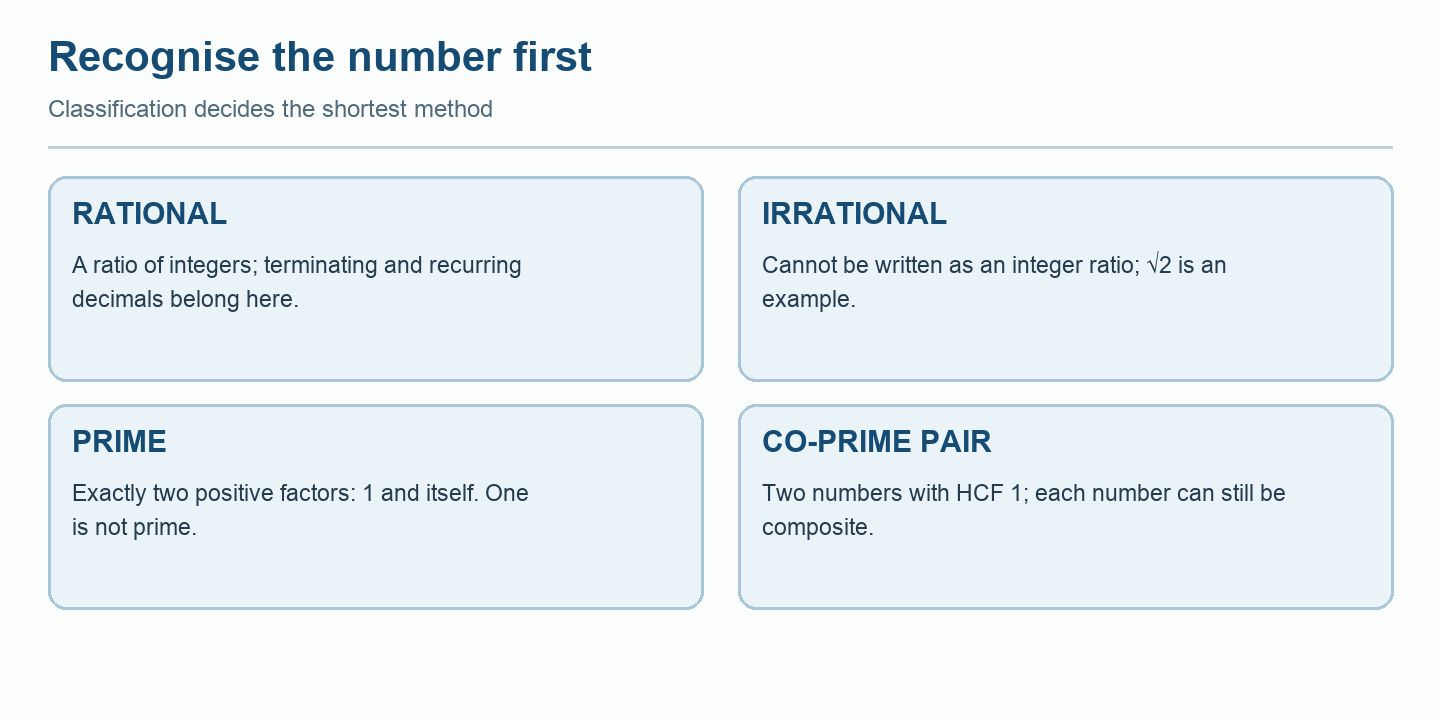
Classify the number before choosing a method
Read this visual. Prime, rational and co-prime describe different properties.
The natural numbers used in school counting begin 1, 2, 3, … . Whole numbers add zero. Integers include negatives. A rational number can be written as a fraction a/b with integers a and b and b ≠ 0. A terminating decimal such as 0.125 and a recurring decimal such as 0.333… are rational. Numbers such as √2 and π are irrational. Real numbers contain both rational and irrational numbers. In a test, do not infer that a square root is irrational merely because it has a radical sign: √49 = 7, whereas √50 = 5√2 is irrational.
In a base-ten numeral, each digit's value depends on position. The digit 7 has face value 7 wherever it appears, but place value 700 in 7,384 and 70 in 3,742. A two-digit number with tens digit a and units digit b is 10a + b; reversing it gives 10b + a. Their difference is 9(a − b). This is why the difference between a two-digit number and its reversal is divisible by 9. For a three-digit number abc, the value is 100a + 10b + c. Reversal changes it by 99(c − a), so the tens digit cancels. These expressions turn word puzzles into small equations.
Worked example 1. A two-digit number is 27 more than its reverse, and its digits sum to 11. Let the tens and units digits be a and b. Then 9(a − b) = 27, so a − b = 3; also a + b = 11. Adding gives 2a = 14, hence a = 7 and b = 4. The number is 74. Check: 74 − 47 = 27. The check prevents a common reversal mistake.
3. Prime, composite and co-prime
A prime has exactly two positive factors, 1 and itself. The number 1 is neither prime nor composite. A composite has more than two positive factors. To test whether n is prime, it is enough to try prime divisors no larger than √n. If n has a factor larger than √n, the paired factor must be smaller than √n. Thus, to test 97, try 2, 3, 5 and 7; none divides it, so 97 is prime. Trying every integer up to 96 would be needless.
Two numbers are co-prime if their highest common factor is 1. Neither number needs to be prime. For example, 8 and 9 are both composite but co-prime. In contrast, 14 and 21 are not co-prime because both are divisible by 7. “Consecutive integers are co-prime” follows because any common divisor of n and n + 1 must divide their difference, 1. This proof is more useful than memorising a list of pairs.
A perfect square has even powers for every prime in its factorisation; a perfect cube has exponents that are multiples of 3. A number that is both a square and a cube is a sixth power, because each prime exponent must be a multiple of both 2 and 3. This observation handles questions that look like two separate lists. Do not confuse a “perfect number” with a perfect square. A perfect number equals the sum of its proper positive divisors; 6 and 28 are familiar examples.
Worked example 2. How many numbers from 1 through 500 are both perfect squares and perfect cubes? They are sixth powers. The candidates are 1⁶ = 1, 2⁶ = 64 and 3⁶ = 729. Since 729 exceeds 500, there are two. If the question says strictly between 1 and 500, exclude 1 and answer one. The endpoint is part of the reasoning.
4. Prime factors and the factor-count rule
Every positive integer greater than 1 has a unique prime factorisation apart from factor order. Write 360 = 2³ × 3² × 5. A divisor of 360 chooses 0, 1, 2 or 3 copies of 2; 0, 1 or 2 copies of 3; and 0 or 1 copy of 5. The independent choices give (3 + 1)(2 + 1)(1 + 1) = 24 positive factors. The rule for n = p₁^a₁ p₂^a₂ … pₖ^aₖ is therefore (a₁ + 1)(a₂ + 1)…(aₖ + 1). It counts 1 and n.
For odd divisors, choose exponent zero for the factor 2 and vary only the odd-prime exponents. The number of even divisors is total divisors minus odd divisors. The number of distinct prime factors is k, not the total count of prime factors with repetition. For 360, there are three distinct primes, six prime factors counting powers, 24 divisors in all, six odd divisors and 18 even divisors. Distinguish these five requests before selecting a formula.
Worked example 3. Find the smallest positive integer m that makes 72m a perfect square. Since 72 = 2³ × 3², only the exponent of 2 is odd. Multiply by 2 to make 2⁴ × 3² = 144. Thus m = 2. Multiplying by 3 would make the exponent of 3 odd and fail. For a perfect cube, 72 needs 2³ already but 3² needs one more 3, so the smallest multiplier would be 3.
A useful extension concerns trailing zeros. In base ten, each trailing zero comes from a factor 10 = 2 × 5. Factorials contain far more 2s than 5s, so count the 5s: zeros in n! equal ⌊n/5⌋ + ⌊n/25⌋ + ⌊n/125⌋ + … until the terms are zero. The brackets mean whole-number quotient. For 30!, this gives 6 + 1 = 7 zeros. A student who counts only multiples of 5 forgets that 25 contributes an extra factor of 5.
5. Divisibility rules that save time
Divisibility by 2 depends on an even last digit; by 5 on last digit 0 or 5; by 10 on last digit 0. For 4, examine the last two digits; for 8, the last three digits. For 3 or 9, add digits and test that sum. Divisibility by 6 requires both 2 and 3. Divisibility by 12 requires both 3 and 4. Divisibility by 25 requires the last two digits to be 00, 25, 50 or 75. These rules work because powers of ten are divisible by the chosen modulus except for the relevant trailing places, or because 10 is congruent to 1 modulo 3 and 9.
For 11, alternate the digit sums. A number is divisible by 11 when the difference between the sum of digits in alternating positions is 0 or a multiple of 11. For 47,916, compute (4 + 9 + 6) − (7 + 1) = 11, so it is divisible by 11. The alternating convention can start from either end; changing the start changes the sign but not divisibility. Check the actual number rather than trusting a visually neat pattern.
Worked example 4. Find the missing digit x if 52x65 is divisible by 9. The known digit sum is 5 + 2 + 6 + 5 = 18. We need 18 + x to be a multiple of 9. Since x is a digit, x can be 0 or 9. If the options offer only one, choose it; if both appear, the question has two correct answers and must be corrected. This is an example of why answer-key QA matters as much as solving skill.
Worked example 5. Determine the digit y if 63y75 is divisible by both 25 and 9. The ending 75 already ensures divisibility by 25. The digit sum is 6 + 3 + y + 7 + 5 = 21 + y; the only digit making a multiple of 9 is y = 6, giving 27. The two tests are independent and both must hold.
6. Quotient and remainder
The division algorithm states N = dq + r, where d is a positive divisor, q is an integer and 0 ≤ r < d. The strict inequality matters: a “remainder 12 when divided by 10” is impossible. If N = 15q + 7, then N leaves remainder 2 on division by 5 because 15q is divisible by 5 and 7 leaves 2. If N leaves remainder a and M leaves remainder b on division by d, then N + M leaves the remainder of a + b after dividing by d; products work in the same way.
When a question says several numbers leave the same remainder on division by an unknown d, subtract the numbers. If N₁ = dq₁ + r and N₂ = dq₂ + r, then N₂ − N₁ = d(q₂ − q₁). Thus d divides every difference. To find the greatest such divisor, calculate the HCF of the differences, then check that the resulting common remainder is smaller than d. This connects Chapter 1 to Chapter 2.
Worked example 6. A number leaves remainder 5 on division by 12. What remainder does three times the number leave on division by 12? Write N = 12q + 5. Then 3N = 36q + 15 = 12(3q + 1) + 3. The remainder is 3, not 15, because a remainder must be below 12.
For large powers, use a repeating remainder cycle rather than multiplying the whole number. Modulo 9, powers of 2 repeat 2, 4, 8, 7, 5, 1 and then start again. The cycle length is 6. To find 2⁵⁹ mod 9, divide 59 by 6: the remainder is 5, so use the fifth term, 5. If an exponent is a multiple of 6, use the sixth term, not a nonexistent “zeroth” term.
7. Unit-digit cycles
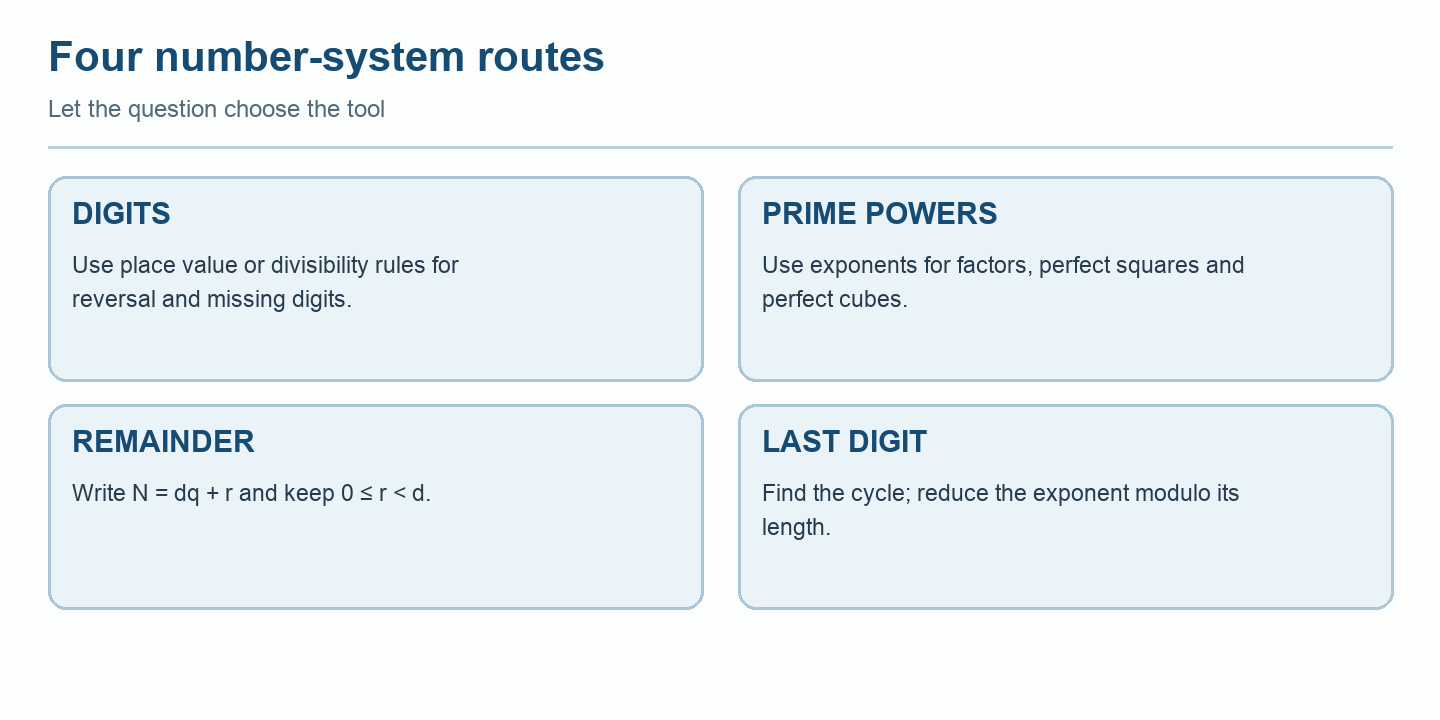
Four routes through number-system problems
Read this visual. Let the stem decide whether digits, factors, remainders or a last-digit cycle matter.
Only the base's last digit affects the last digit of a power. The cycle of 2 is 2, 4, 8, 6; of 3 is 3, 9, 7, 1; of 7 is 7, 9, 3, 1; and of 8 is 8, 4, 2, 6. A base ending in 0, 1, 5 or 6 keeps that ending for every positive integer power. A base ending in 4 or 9 has a two-step cycle. Learn the pattern by multiplying once or twice; do not memorise it without understanding why the final digit repeats after finitely many steps.
Worked example 7. Find the unit digit of 27⁵⁸. The base ends in 7. Its cycle has length 4; 58 divided by 4 leaves remainder 2. The second term of 7, 9, 3, 1 is 9. The giant power is never computed. For a sum or product of large powers, find each unit digit first and then add or multiply those digits, keeping only the last digit.
8. Counting multiples and squares in an interval
The number of positive multiples of d no larger than N is ⌊N/d⌋. For an inclusive interval L through U, count ⌊U/d⌋ − ⌊(L − 1)/d⌋. This subtracts multiples before L. To count squares no larger than N, use ⌊√N⌋; to exclude the square at a strict lower boundary, adjust that boundary explicitly. For non-integer square roots, compare nearby integers rather than relying on a decimal approximation alone.
Worked example 8. How many multiples of 12 lie from 100 through 500, both included? Calculate ⌊500/12⌋ − ⌊99/12⌋ = 41 − 8 = 33. The first is 108 and the last is 492; listing them in steps of 12 gives (492 − 108)/12 + 1 = 33 as a cross-check. Directly dividing 500 − 100 by 12 would miss the endpoint alignment.
9. Fast method, safe check
In the examination, first classify the task. Use place value for digit reversal; prime powers for factor counts and square/cube conditions; digit sums for divisibility by 3 or 9; the final places for 4, 8 or 25; N = dq + r for remainder questions; and a cycle for last digits of powers. Write one line of reason for each choice. Then check the answer against a boundary, unit or simple substitution. This last check often costs less time than correcting a wrong answer later.
The 30 questions that follow are a first editorial pilot. They come from Pareeksha's bank but remain subject to a separate rights, answer and duplication audit before the finished 1,000-question edition. The final chapter will carry 50 explained questions after that review.
Chapter 1 practice — 50 questions
Choose one option for each item. Keep a separate answer list; explanations follow this set.
1. What is the sum of the first 39 even natural numbers?
A. 780 B. 1560 C. 1521 D. 1599
2. Which of the following numbers is divisible by 11?
A. 84766 B. 53892 C. 47346 D. 19152
3. What is the difference between the place value and the face value of the digit 8 in the number 27287?
A. 80 B. 88 C. 79 D. 72
4. How many natural numbers up to 366 are divisible by 9?
A. 42 B. 41 C. 40 D. 39
5. What is the 10th term of the arithmetic progression 19, 23, 27, 31, …?
A. 40 B. 59 C. 51 D. 55
6. Which of the following numbers is divisible by 9?
A. 489672 B. 594803 C. 845443 D. 179187
7. What is the unit digit of 13^21?
A. 5 B. 7 C. 9 D. 3
8. What is the smallest 4-digit number exactly divisible by 29?
A. 1000 B. 1015 C. 1016 D. 1044
9. What is the difference between the place value and the face value of the digit 3 in the number 2606388?
A. 303 B. 299 C. 300 D. 297
10. What is the smallest 3-digit number exactly divisible by 23?
A. 115 B. 100 C. 116 D. 138
11. What is the sum of the first 47 natural numbers?
A. 2256 B. 1175 C. 1128 D. 2209
12. If the 7-digit number 963x230 is divisible by 11, what is the value of x?
A. 6 B. 5 C. 4 D. 7
13. How many natural numbers up to 339 are divisible by 8?
A. 41 B. 43 C. 44 D. 42
14. What is the 25th term of the arithmetic progression 14, 22, 30, 38, …?
A. 206 B. 214 C. 198 D. 200
15. What is the smallest 4-digit number exactly divisible by 37?
A. 1037 B. 1000 C. 1073 D. 1036
16. Two numbers, when divided by a certain divisor, leave remainders 22 and 13 respectively. When their sum is divided by the same divisor, the remainder is 5. What is the divisor?
A. 35 B. 30 C. 31 D. 40
17. What is the remainder when 10^77 is divided by 11?
A. 1 B. 10 C. 8 D. 0
18. Which of the following numbers is divisible by 143?
A. 56320 B. 18700 C. 95029 D. 29744
19. How many pairs of co-prime numbers can be formed from the integers 17 to 21 (both inclusive)?
A. 10 B. 2 C. 8 D. 9
20. How many numbers between 357 and 904 (both inclusive) are divisible by 8?
A. 69 B. 113 C. 70 D. 68
21. What is the least number that must be added to 85510 so that the result is exactly divisible by 16?
A. 16 B. 10 C. 6 D. 11
22. Find the value of 1³ + 2³ + 3³ + … + 24³.
A. 76176 B. 90576 C. 90000 D. 4900
23. How many numbers between 338 and 682 (both inclusive) are divisible by 14?
A. 25 B. 23 C. 48 D. 24
24. Which of the following pairs of numbers is co-prime?
A. (27, 45) B. (21, 52) C. (34, 74) D. (56, 88)
25. Two numbers, when divided by a certain divisor, leave remainders 27 and 4 respectively. When their sum is divided by the same divisor, the remainder is 2. What is the divisor?
A. 31 B. 33 C. 29 D. 30
26. Which of the following pairs of numbers is NOT co-prime?
A. (33, 86) B. (60, 85) C. (35, 72) D. (47, 95)
27. In the number 3345198, what is the sum of the place values of the digits 5 and 4?
A. 45000 B. 35000 C. 1 D. 9
28. How many numbers between 264 and 607 (both inclusive) are divisible by 14?
A. 26 B. 24 C. 43 D. 25
29. What is the remainder when 2^38 is divided by 5?
A. 1 B. 0 C. 2 D. 4
30. Which of the following numbers is divisible by 44?
A. 29612 B. 44108 C. 76832 D. 79752
31. Find the value of 1² + 2² + 3² + … + 11².
A. 4356 B. 627 C. 506 D. 462
32. Find the number of even factors of 5292.
A. 36 B. 24 C. 12 D. 25
33. Which of the following numbers is divisible by 221?
A. 76141 B. 18551 C. 78728 D. 22321
34. How many prime numbers lie between 832 and 857?
A. 1 B. 4 C. 2 D. 3
35. Two numbers, when divided by a certain divisor, leave remainders 9 and 12 respectively. When their sum is divided by the same divisor, the remainder is 6. What is the divisor?
A. 15 B. 16 C. 27 D. 21
36. What is the least number that must be added to 89438 so that the result is exactly divisible by 24?
A. 10 B. 14 C. 24 D. 11
37. Find the total number of factors of 1200.
A. 8 B. 31 C. 30 D. 28
38. Two numbers, when divided by a certain divisor, leave remainders 18 and 12 respectively. When their sum is divided by the same divisor, the remainder is 6. What is the divisor?
A. 24 B. 30 C. 36 D. 25
39. A number when successively divided by 2, 9 and 6 leaves remainders 1, 7 and 3 respectively. What is the smallest such number?
A. 177 B. 69 C. 11 D. 99
40. Find the number of even factors of 6.
A. 2 B. 4 C. 3 D. 1
41. What is the smallest 5-digit number which is exactly divisible by 4, 9 and 24?
A. 10008 B. 9936 C. 10080 D. 10009
42. What is the remainder when 12^398 is divided by 7?
A. 3 B. 4 C. 2 D. 5
43. What is the sum of all odd numbers between 74 and 202?
A. 8832 B. 8631 C. 8907 D. 9035
44. If the 7-digit number 461y11x is divisible by 88, what is the value of (x + y)?
A. 2 B. 4 C. 3 D. 5
45. How many natural numbers up to 380 are divisible by 5 and also by 2?
A. 38 B. 37 C. 266 D. 39
46. What is the least positive integer n for which 2^(2n) + 2^n is divisible by 12?
A. 3 B. 5 C. 2 D. 4
47. How many pairs of co-prime numbers can be formed from the integers 19 to 26 (both inclusive)?
A. 8 B. 21 C. 20 D. 28
48. How many natural numbers up to 758 are divisible by 2 and also by 5?
A. 74 B. 530 C. 76 D. 75
49. How many pairs of co-prime numbers can be formed from the integers 46 to 54 (both inclusive)?
A. 24 B. 36 C. 12 D. 25
50. Find the number of distinct prime factors of 2646.
A. 3 B. 6 C. 24 D. 4
Chapter 1 — Answers and explanations
After checking the key, re-solve any miss without looking at the formula.
1. B. The series is 2 + 4 + 6 + … + 78. Sum of the first n even natural numbers = n(n + 1) = 39 × 40 = 1560.
APAR26-01-02 | Sum of series | Easy
2. A. Rule for 11: difference of alternate digit sums 0 or a multiple of 11. Check each option — 84766: alternating sum 11; 19152: alternating sum -10; 47346: alternating sum 2; 53892: alternating sum 3. Only 84766 passes the test, so it is the number divisible by 11.
APAR26-01-15 | Divisibility test | Easy
3. D. The digit 8 is in the tens place, so its place value = 8 × 10 = 80. Its face value is just 8. Difference = 80 − 8 = 72.
APAR26-01-08 | Place and face value | Easy
4. C. The multiples of 9 up to 366 are 9, 18, …, 360. Their count = ⌊366/9⌋ = 40 (366 ÷ 9 = 40 remainder 6).
APAR26-01-07 | Counting multiples | Easy
5. D. First term a = 19, common difference d = 23 − 19 = 4. nth term = a + (n − 1)d = 19 + (10 − 1) × 4 = 19 + 36 = 55. (Using n·d instead of (n − 1)·d gives 59, the usual slip.)
APAR26-01-09 | Arithmetic progression | Easy
6. A. Rule for 9: sum of digits divisible by 9. Check each option — 489672: digit sum 36; 845443: digit sum 28; 594803: digit sum 29; 179187: digit sum 33. Only 489672 passes the test, so it is the number divisible by 9.
APAR26-01-06 | Divisibility test | Easy
7. D. Only the unit digit 3 of the base matters. Powers of 3 end in 3, 9, 7, 1 repeating every 4. 21 ÷ 4 leaves remainder 1, so the unit digit is the 1st in the cycle: 3.
APAR26-01-03 | Unit digit | Easy
8. B. Smallest 4-digit number = 1000. 1000 ÷ 29 leaves remainder 14, so add (29 − 14) = 15: 1000 + 15 = 1015.
APAR26-01-10 | Largest / smallest multiple | Easy
9. D. The digit 3 is in the hundreds place, so its place value = 3 × 100 = 300. Its face value is just 3. Difference = 300 − 3 = 297.
APAR26-01-14 | Place and face value | Easy
10. A. Smallest 3-digit number = 100. 100 ÷ 23 leaves remainder 8, so add (23 − 8) = 15: 100 + 15 = 115.
APAR26-01-01 | Largest / smallest multiple | Easy
11. C. The series is 1 + 2 + 3 + … + 47. Sum of the first n natural numbers = n(n + 1)/2 = 47 × 48/2 = 1128.
APAR26-01-13 | Sum of series | Easy
12. B. Divisibility rule for 11: difference of alternate digit sums 0 or a multiple of 11. Testing the digits 0–9 against this rule, the number becomes 9635230 (alternating sum of digits of 9635230 = 0), which satisfies it. Hence x = 5.
APAR26-01-05 | Divisibility: missing digit | Easy
13. D. The multiples of 8 up to 339 are 8, 16, …, 336. Their count = ⌊339/8⌋ = 42 (339 ÷ 8 = 42 remainder 3).
APAR26-01-12 | Counting multiples | Easy
14. A. First term a = 14, common difference d = 22 − 14 = 8. nth term = a + (n − 1)d = 14 + (25 − 1) × 8 = 14 + 192 = 206. (Using n·d instead of (n − 1)·d gives 214, the usual slip.)
APAR26-01-11 | Arithmetic progression | Easy
15. D. Smallest 4-digit number = 1000. 1000 ÷ 37 leaves remainder 1, so add (37 − 1) = 36: 1000 + 36 = 1036.
APAR26-01-04 | Largest / smallest multiple | Easy
16. B. Sum of the individual remainders = 22 + 13 = 35. The sum leaves only 5, so the divisor was subtracted once: divisor = 35 − 5 = 30.
APAR26-01-26 | Remainders | Medium
17. B. Find the cycle: 10^2 = 100 leaves remainder 1 on division by 11. Write 77 = 2 × 38 + 1, so 10^77 = (10^2)^38 × 10^1 ≡ 1 × 10^1 = 10 (mod 11). Remainder = 10.
APAR26-01-38 | Remainders | Medium
18. D. Rule for 143: 143 = 11 × 13; divide by 11 and by 13. Check each option — 29744 ÷ 143 = 208.00; 18700 ÷ 143 = 130.77; 56320 ÷ 143 = 393.85; 95029 ÷ 143 = 664.54. Only 29744 passes the test, so it is the number divisible by 143.
APAR26-01-37 | Divisibility test | Medium
19. C. There are 5 integers, giving 5C2 = 10 pairs in all. Pairs with a common factor greater than 1: (18, 20), (18, 21) — 2 pairs. Co-prime pairs = 10 − 2 = 8.
APAR26-01-30 | Co-prime pairs | Medium
20. A. Count = ⌊904/8⌋ − ⌊(357 − 1)/8⌋ = 113 − 44 = 69. (Using ⌊(904 − 357)/8⌋ = 68 can be off by one.)
APAR26-01-19 | Counting multiples | Medium
21. B. 85510 ÷ 16 gives quotient 5344 and remainder 6. To reach the next multiple add (16 − 6) = 10: 85510 + 10 = 85520 = 16 × 5345. (Adding the remainder = 6 is the trap.)
APAR26-01-17 | Largest / smallest multiple | Medium
22. C. Σn³ = [n(n + 1)/2]² = [24 × 25/2]² = 300² = 90000. (Note Σn³ equals the square of Σn.)
APAR26-01-24 | Sum of series | Medium
23. D. Count = ⌊682/14⌋ − ⌊(338 − 1)/14⌋ = 48 − 24 = 24. (Using ⌊(682 − 338)/14⌋ = 24 can be off by one.)
APAR26-01-28 | Counting multiples | Medium
24. B. Two numbers are co-prime when their HCF is 1. Compute: HCF(27, 45) = 9, HCF(21, 52) = 1, HCF(34, 74) = 2, HCF(56, 88) = 8. Only (21, 52) has HCF 1, so it is the co-prime pair.
APAR26-01-23 | Co-prime numbers | Medium
25. C. Sum of the individual remainders = 27 + 4 = 31. The sum leaves only 2, so the divisor was subtracted once: divisor = 31 − 2 = 29.
APAR26-01-22 | Remainders | Medium
26. B. Two numbers are co-prime when their HCF is 1. Compute: HCF(33, 86) = 1, HCF(60, 85) = 5, HCF(35, 72) = 1, HCF(47, 95) = 1. Only (60, 85) has HCF 5 ≠ 1, so it is not co-prime.
APAR26-01-35 | Co-prime numbers | Medium
27. A. Place value of 5 (thousands place) = 5000; place value of 4 (ten thousands place) = 40000. Sum = 5000 + 40000 = 45000. (Using face values 5 and 4 is the trap.)
APAR26-01-31 | Place and face value | Medium
28. D. Count = ⌊607/14⌋ − ⌊(264 − 1)/14⌋ = 43 − 18 = 25. (Using ⌊(607 − 264)/14⌋ = 24 can be off by one.)
APAR26-01-34 | Counting multiples | Medium
29. D. Find the cycle: 2^4 = 16 leaves remainder 1 on division by 5. Write 38 = 4 × 9 + 2, so 2^38 = (2^4)^9 × 2^2 ≡ 1 × 2^2 = 4 (mod 5). Remainder = 4.
APAR26-01-40 | Remainders | Medium
30. A. Rule for 44: divisible by both 4 and 11. Check each option — 29612: alternating sum 0; 79752: alternating sum 2; 44108: alternating sum 9; 76832: alternating sum 8. Only 29612 passes the test, so it is the number divisible by 44.
APAR26-01-16 | Divisibility test | Medium
31. C. Sum of the squares of the first n natural numbers: Σn² = n(n + 1)(2n + 1)/6. With n = 11: 11 × 12 × 23/6 = 3036/6 = 506. (Using [n(n + 1)/2]² here is the Σn³ formula, a common mix-up.)
APAR26-01-32 | Sum of series | Medium
32. B. Prime factorisation: 5292 = 2^2 × 3^3 × 7^2. Total factors = (2 + 1) × (3 + 1) × (2 + 1) = 36. Odd factors use no 2: (3 + 1) × (2 + 1) = 12. Even factors = 36 − 12 = 24.
APAR26-01-20 | Number of factors | Medium
33. D. Rule for 221: 221 = 13 × 17; divide by 13 and by 17. Check each option — 22321 ÷ 221 = 101.00; 18551 ÷ 221 = 83.94; 78728 ÷ 221 = 356.24; 76141 ÷ 221 = 344.53. Only 22321 passes the test, so it is the number divisible by 221.
APAR26-01-36 | Divisibility test | Medium
34. C. Test each odd number between 832 and 857 for divisibility by primes up to √857 ≈ 29 (2, 3, 5, 7, …). The primes are 839, 853, so the count is 2.
APAR26-01-29 | Prime numbers | Medium
35. A. Sum of the individual remainders = 9 + 12 = 21. The sum leaves only 6, so the divisor was subtracted once: divisor = 21 − 6 = 15.
APAR26-01-33 | Remainders | Medium
36. A. 89438 ÷ 24 gives quotient 3726 and remainder 14. To reach the next multiple add (24 − 14) = 10: 89438 + 10 = 89448 = 24 × 3727. (Adding the remainder = 14 is the trap.)
APAR26-01-39 | Largest / smallest multiple | Medium
37. C. Prime factorisation: 1200 = 2^4 × 3 × 5^2. Number of factors = product of (exponent + 1) = (4 + 1) × (1 + 1) × (2 + 1) = 30.
APAR26-01-21 | Number of factors | Medium
38. A. Sum of the individual remainders = 18 + 12 = 30. The sum leaves only 6, so the divisor was subtracted once: divisor = 30 − 6 = 24.
APAR26-01-18 | Remainders | Medium
39. B. Rebuild from the last quotient (take it as 0): last quotient stage = 3; previous stage = 3 × 9 + 7 = 34; number = 34 × 2 + 1 = 69. Check: 69 ÷ 2 → quotient 34, remainder 1, and so on.
APAR26-01-25 | Successive division | Medium
40. A. Prime factorisation: 6 = 2 × 3. Total factors = (1 + 1) × (1 + 1) = 4. Odd factors use no 2: (1 + 1) = 2. Even factors = 4 − 2 = 2.
APAR26-01-27 | Number of factors | Medium
41. A. LCM(4, 9, 24) = 72. Smallest 5-digit number 10000 ÷ 72 leaves 64; next multiple = 10000 + 8 = 10008. Answer = 10008.
APAR26-01-42 | Largest / smallest multiple | Difficult
42. B. Find the cycle: 12^6 = 2985984 leaves remainder 1 on division by 7. Write 398 = 6 × 66 + 2, so 12^398 = (12^6)^66 × 12^2 ≡ 1 × 12^2 = 144 (mod 7). Remainder = 4.
APAR26-01-41 | Remainders | Difficult
43. A. Odd numbers between 74 and 202: 75, 77, …, 201 — an AP with d = 2 and n = (201 − 75)/2 + 1 = 64 terms. Sum = n × (first + last)/2 = 64 × (75 + 201)/2 = 64 × 138 = 8832.
APAR26-01-48 | Sum of series | Difficult
44. C. Divisibility rule for 88: divisible by both 8 and 11. Testing the digits 0–9 against this rule, the number becomes 4611112 (alternating sum of digits of 4611112 = 0), which satisfies it. So x = 2, y = 1 and x + y = 3.
APAR26-01-46 | Divisibility: missing digit | Difficult
45. A. Divisible by both 5 and 2 means divisible by LCM(5, 2) = 10. Count = ⌊380/10⌋ = 38. (Using the product 10 instead of the LCM is the trap when the numbers are not co-prime.)
APAR26-01-47 | Counting multiples | Difficult
46. A. 2^(2n) + 2^n = 2^n(2^n + 1). Try small n in turn: n = 1: 2^2 + 2^1 = 6 (remainder 6); n = 2: 2^4 + 2^2 = 20 (remainder 8); n = 3: 2^6 + 2^3 = 72 (divisible). The least n is 3.
APAR26-01-50 | Divisibility of expressions | Difficult
47. C. There are 8 integers, giving 8C2 = 28 pairs in all. Pairs with a common factor greater than 1: (20, 22), (20, 24), (20, 25), (20, 26), (21, 24), (22, 24), (22, 26), (24, 26) — 8 pairs. Co-prime pairs = 28 − 8 = 20.
APAR26-01-49 | Co-prime pairs | Difficult
48. D. Divisible by both 2 and 5 means divisible by LCM(2, 5) = 10. Count = ⌊758/10⌋ = 75. (Using the product 10 instead of the LCM is the trap when the numbers are not co-prime.)
APAR26-01-43 | Counting multiples | Difficult
49. A. There are 9 integers, giving 9C2 = 36 pairs in all. Pairs with a common factor greater than 1: (46, 48), (46, 50), (46, 52), (46, 54), (48, 50), (48, 51), (48, 52), (48, 54), (50, 52), (50, 54), (51, 54), (52, 54) — 12 pairs. Co-prime pairs = 36 − 12 = 24.
APAR26-01-45 | Co-prime pairs | Difficult
50. A. Prime factorisation: 2646 = 2 × 3^3 × 7^2. The distinct primes in the factorisation are 2, 3, 7, so there are 3 distinct prime factors. (The total number of factors, 24, is a different quantity.)
APAR26-01-44 | Number of factors | Difficult