For AP Police Constable and SI arithmetic. The highest common factor (HCF) finds the largest whole unit that divides several quantities without leftover. The least common multiple (LCM) finds the first shared step or time at which repeated events align. Both come from prime factors, but the words largest and least do not by themselves identify the operation. A question about the largest square tile uses HCF; one about the least number divisible by several values uses LCM. Decide what the result must do.
1. The shared-prime picture
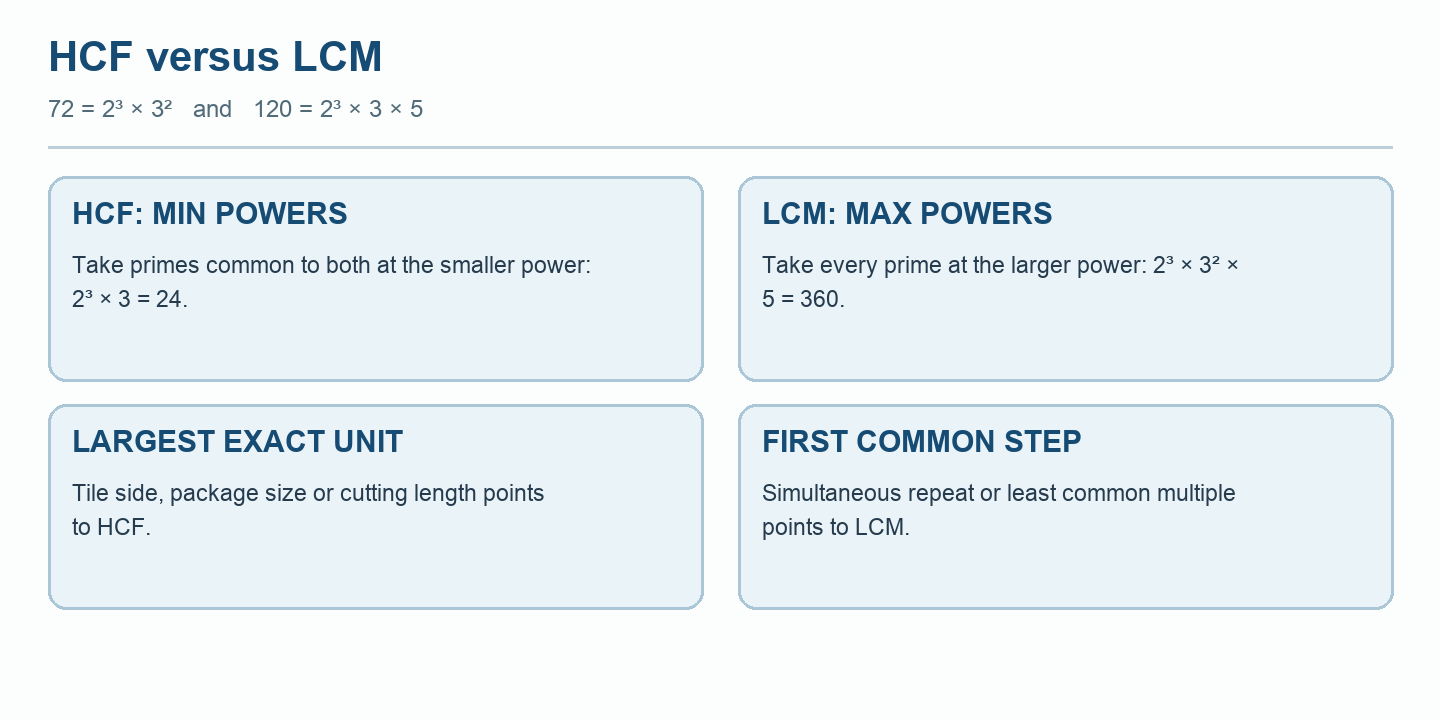
Compare prime powers for HCF and LCM
Read this visual. HCF takes smaller common powers; LCM takes larger powers from every prime.
Write 72 = 2³ × 3² and 120 = 2³ × 3 × 5. The HCF takes each prime common to both numbers at the smaller exponent: 2³ × 3 = 24. The LCM takes every prime that appears at the larger exponent: 2³ × 3² × 5 = 360. The HCF must divide each original number; the LCM must be divisible by each. These two checks make an answer self-testing.
For two numbers a and b, a × b = HCF(a,b) × LCM(a,b). The identity follows because, for every prime, the smaller and larger exponents add to the two original exponents. It does not transfer unchanged to three numbers. For three numbers, calculate the prime exponents or use LCM(a,b,c) = LCM(LCM(a,b),c). A common wrong turn is to multiply three numbers and divide by their HCF once.
Worked example 1. Find HCF and LCM of 84 and 126. Factor: 84 = 2² × 3 × 7; 126 = 2 × 3² × 7. The common minimum powers give HCF = 2 × 3 × 7 = 42. The maximum powers give LCM = 2² × 3² × 7 = 252. Check: 84 × 126 = 10,584 and 42 × 252 = 10,584. If the book's printed options disagree with both checks, treat the question as defective.
2. Euclid's division method
Prime factorisation is pleasant for small numbers. With awkward numbers, repeated division can be faster. Divide the larger by the smaller, then divide the former divisor by the remainder. Continue until the remainder is zero; the last non-zero remainder is the HCF. Why? A number dividing both a and b also divides a − qb, so replacing a with its remainder does not change the common divisors.
Worked example 2. Find the HCF of 1,073 and 851. Calculate 1,073 = 1 × 851 + 222; 851 = 3 × 222 + 185; 222 = 1 × 185 + 37; 185 = 5 × 37. The last non-zero remainder is 37. Check by division: 1,073/37 = 29 and 851/37 = 23. If a third length is 1,517, divide it by 37: 1,517/37 = 41, so the HCF of all three stays 37.
The Euclidean method also appears indirectly in “largest container”, “longest equal piece” and “largest square tile” questions. Translate the story into exact divisibility before performing the arithmetic. If material may be left unused, the problem is different; the condition “nothing left over” is what makes HCF decisive.
3. Greatest equal measure versus first common event
A 96 cm by 120 cm rectangle can be tiled by identical square tiles of largest side 24 cm, since 24 is the HCF of 96 and 120. The number of tiles is (96/24) × (120/24) = 4 × 5 = 20. Do not answer “24 tiles”: 24 is a length. In a packing problem, HCF gives units per packet, and the number of packets requires a second division. Units are part of the solution.
Events repeating every 12 and 18 minutes coincide after LCM(12,18) = 36 minutes, provided they coincide at the stated starting time and continue on those intervals. A time-of-day question then adds the interval to the clock. If one interval changes after the starting moment, use the new interval from that moment onward. If events have different starting offsets, LCM alone may not locate a meeting time; set up congruences or list early events.
Worked example 3. Three patrol vehicles return to a checkpoint every 18, 24 and 30 minutes and all arrive there at 7:10 a.m. The next common return is after LCM(18,24,30). Factor 18 = 2 × 3², 24 = 2³ × 3, 30 = 2 × 3 × 5. The LCM is 2³ × 3² × 5 = 360 minutes, or six hours. The answer is 1:10 p.m., not “360 p.m.” The time unit must be converted before adding to the clock.
4. Reconstructing two numbers
Suppose the HCF is h. Write the numbers hx and hy, where x and y are co-prime. Then their LCM is hxy. This representation makes many two-number puzzles small. If HCF = 12 and LCM = 180, then xy = 15. Co-prime factor pairs of 15 are (1,15) and (3,5), giving unordered number pairs (12,180) and (36,60). If the two numbers belong to named people, machines or routes, (12,180) and (180,12) are separate assignments even though they are the same unordered pair.
Worked example 4. Two positive numbers have HCF 14 and LCM 420. Their difference is 14. Write them 14x and 14y with co-prime x,y. Then xy = 420/14 = 30 and |x − y| = 14/14 = 1. The factor pair 5 and 6 satisfies both conditions and is co-prime. The numbers are 70 and 84. Check: HCF(70,84) = 14 and LCM = 70 × 84/14 = 420.
If a question gives ratio x:y in lowest terms and HCF h, the numbers are hx and hy. “In lowest terms” is essential: ratio 6:8 reduces to 3:4. If you treat 6 and 8 as co-prime, you double the numbers incorrectly. For a ratio 3:5 and LCM 180, the numbers are 3h and 5h with LCM 15h, so h = 12 and the numbers are 36 and 60.
5. The product identity and its limits
For two positive integers, HCF × LCM = product. If HCF = 16 and product = 23,296, the LCM is 1,456. But a purported pair must be possible: HCF must divide LCM. If a multiple-choice option says HCF 15 and LCM 80, reject it because 80 is not divisible by 15. The converse is not enough to identify a unique pair; several pairs can share the same HCF and LCM.
Worked example 5. The sum of two numbers is 231, their HCF is 33 and their LCM is 396. Set the numbers to 33x and 33y with co-prime x,y. Then x + y = 231/33 = 7 and xy = 396/33 = 12. The numbers x,y are 3 and 4; the originals are 99 and 132. Their difference is 33. Checking the pair at the end catches a tempting but false move: taking 396/33 and calling 12 one of the original numbers.
The HCF and LCM of rational quantities require an agreed common unit and exact fractional values. In typical elementary exam questions, convert finite decimals to integers by multiplying all quantities by the same power of ten, solve the integer problem, then divide the result by that power of ten. Do not casually apply an integer formula to approximate measurements. When a statement says two amounts of milk have an “LCM in litres”, confirm that it treats the stated amounts as exact rational quantities; if the meaning is ambiguous, the item belongs in editorial review rather than a final answer key.
6. Remainder patterns
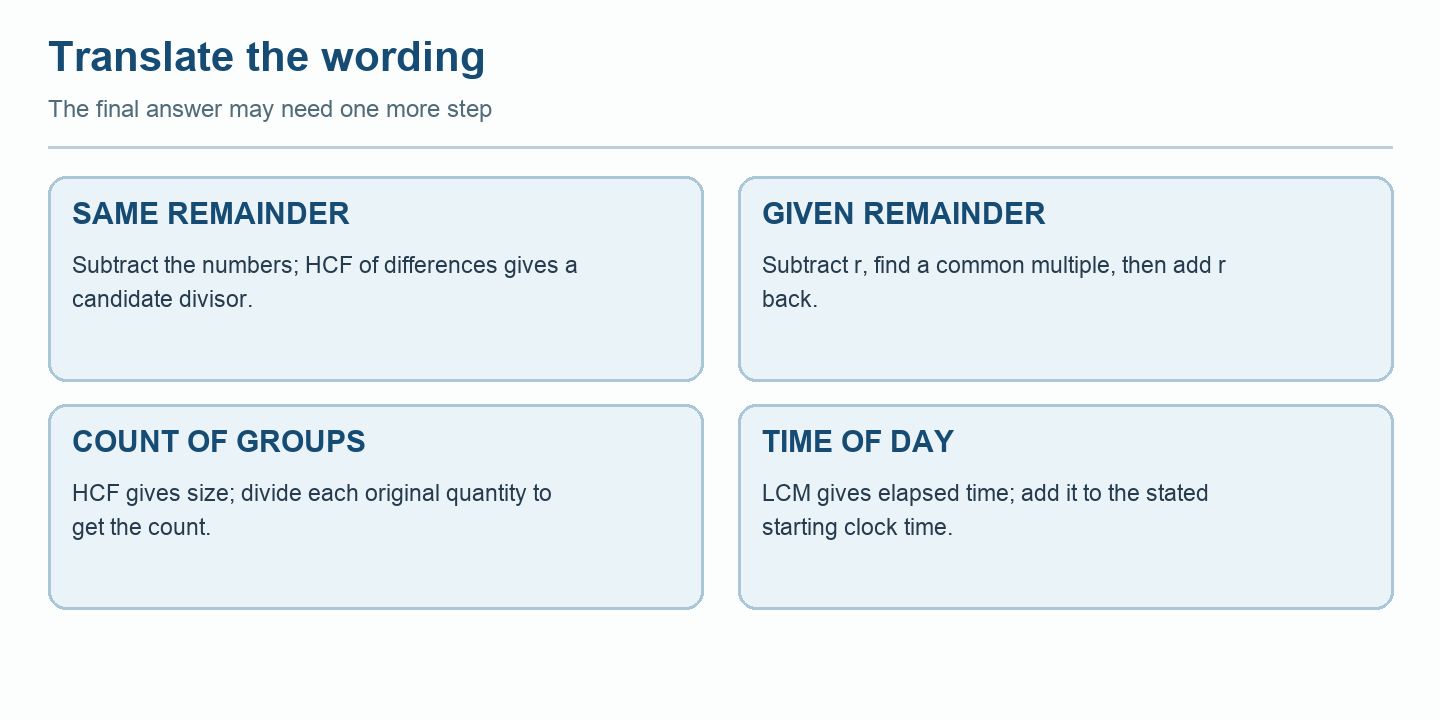
Translate the final operation
Read this visual. A shared interval may still need a starting time added; a shared measure may need a piece count.
If several numbers leave the same remainder when divided by d, then d divides every difference between them. For 355, 487 and 575, the differences are 132 and 88; HCF(132,88) = 44. Indeed, each original number leaves remainder 3 when divided by 44. The remainder 3 is below 44, so the divisor is valid. The greatest possible divisor is 44. A problem that gives different remainders needs each remainder subtracted before finding an HCF.
For a number that leaves the same specified remainder r upon division by a, b and c, subtract r. The remaining number must be a common multiple of a, b and c. The least positive solution is often LCM(a,b,c) + r, but check the wording and the remainder condition r < each divisor. A number equal to r itself may satisfy the division statements with quotient zero; an exam question that intends a number larger than all divisors should say so. If it asks for the least three-digit number, find the smallest multiple L that moves Lk + r into three digits.
Worked example 6. Find the least three-digit number leaving remainder 8 on division by 15, 20 and 25. Their LCM is 300. Solutions are 300k + 8 for non-negative integers k. The k = 0 value is 8, below three digits; k = 1 gives 308. It leaves remainder 8 in all three divisions. The answer is 308.
7. Word-problem traps
“Largest size of identical groups with no leftovers” points to HCF. “Least number divisible by all” points to LCM. “Next simultaneous occurrence” points to LCM only if the start is simultaneous. “Same remainder for several numbers” points to the HCF of differences. “One number missing, HCF and LCM known” points to the product identity. “Number of groups” demands a final division. The arithmetic method is often one line; deciding the correct translation is the real test.
Worked example 7. Three rolls contain 84 m, 126 m and 210 m of wire. All wire must be cut into pieces of the longest equal length. HCF(84,126,210) = 42 m. The rolls provide 2, 3 and 5 pieces, for 10 pieces in total. If the question asks length, answer 42 m; if it asks count, answer 10. The two results use the same HCF but different final steps.
Worked example 8. Two warning systems signal every 14 and 18 seconds and signal together at exactly noon. In the next ten minutes, including noon, how many simultaneous signals occur? LCM(14,18) = 126 seconds. The common signals occur at t = 0, 126, 252, 378 and 504 seconds; 630 seconds is beyond ten minutes. There are five, not four, because the wording includes the starting signal. This is an endpoint-count problem as well as an LCM problem.
8. Check before moving on
For an HCF answer, divide every given number by it and ensure the quotients share no further common factor. For an LCM answer, divide it by every given number and ensure no smaller positive candidate works. For a reconstructed pair, verify both HCF and LCM. For a remainder problem, calculate the actual remainder and compare it with the divisor. For a timing problem, convert minutes or seconds into clock time carefully. These small checks prevent most avoidable exam mistakes.
The 30 questions that follow are a first editorial pilot. The finished chapter will carry 50 verified, explained questions. A source-bank QA label alone does not establish that a question and its image, if any, are ready for a downloadable book and website reader.
Chapter 2 practice — 50 questions
Choose one option for each item. Keep a separate answer list; explanations follow this set.
1. Find the LCM of 2^2 × 3^2, 3 × 5^3 × 7 and 2^3 × 5.
A. 2^5 × 3^3 × 5^4 × 7 B. 2^3 × 3^2 × 5^3 C. 2^3 × 3^2 × 5^3 × 7 D. 1
2. Three bells ring at intervals of 16 minutes, 18 minutes and 20 minutes respectively. If they ring together at the same instant, after how much time will they next ring together?
A. 144 minutes B. 2 minutes C. 720 minutes D. 54 minutes
3. Two numbers are in the ratio 5 : 7 and their HCF is 4. Find the sum of the numbers.
A. 48 B. 140 C. 52 D. 28
4. The HCF of fractions is given by:
A. LCM of numerators ÷ HCF of denominators B. LCM of numerators ÷ LCM of denominators C. HCF of numerators ÷ HCF of denominators D. HCF of numerators ÷ LCM of denominators
5. Find the LCM of 12 and 30.
A. 30 B. 120 C. 360 D. 60
6. Find the HCF of 42 and 98.
A. 7 B. 14 C. 28 D. 42
7. Which of the following correctly describes the HCF of two numbers?
A. the greatest number that divides both numbers exactly B. the greatest number that is divisible by both numbers C. the product of all the prime factors of both numbers D. the smallest number that is divisible by both numbers
8. Find the HCF of 20 and 28.
A. 2 B. 8 C. 20 D. 4
9. Two numbers are in the ratio 5 : 9 and their HCF is 6. Find the sum of the numbers.
A. 54 B. 270 C. 84 D. 90
10. Find the HCF of 120 and 144.
A. 12 B. 48 C. 24 D. 120
11. The LCM of a set of numbers can never be less than:
A. the largest number of the set B. the sum of the numbers C. the smallest number of the set D. the HCF of the set
12. Find the LCM of 6, 21 and 30.
A. 3780 B. 42 C. 420 D. 210
13. Find the LCM of 25 and 27.
A. 1350 B. 700 C. 650 D. 675
14. Find the HCF of 84 and 154.
A. 28 B. 14 C. 84 D. 7
15. The HCF of two co-prime numbers is:
A. 1 B. 0 C. their product D. their LCM
16. Find the LCM of 3^3 × 5^2, 2^2 × 3^3 × 7^3 and 2 × 5^2.
A. 2^2 × 3^3 × 5^2 B. 1 C. 2^2 × 3^3 × 5^2 × 7^3 D. 2^3 × 3^6 × 5^4 × 7^3
17. Two numbers differ by 6 and their product is 1,927. Find their sum.
A. 89 B. 88 C. 1 D. 94
18. Find the HCF of 144, 720 and 936.
A. 73 B. 144 C. 72 D. 36
19. The HCF and LCM of two numbers are 19 and 2394 respectively. If one of the numbers is 266, find the other number.
A. 2128 B. 9 C. 171 D. 1539
20. Three bells ring at intervals of 8 minutes, 16 minutes and 30 minutes respectively. If they ring together at 10:00 am, at what time will they next ring together?
A. 2:00 pm B. 6:00 pm C. 1:45 pm D. 2:15 pm
21. The HCF and LCM of two numbers are 13 and 845 respectively. If one of the numbers is 169, find the other number.
A. 65 B. 676 C. 325 D. 5
22. The HCF and LCM of two numbers are 7 and 196 respectively. If one of the numbers is 28, find the other number.
A. 343 B. 49 C. 168 D. 7
23. Two numbers are in the ratio 4 : 9 and their LCM is 612. Find the sum of the two numbers.
A. 17 B. 68 C. 221 D. 153
24. The HCF and LCM of two numbers are 8 and 264 respectively. If one of the numbers is 88, find the other number.
A. 72 B. 176 C. 3 D. 24
25. Three bells ring at intervals of 4 minutes, 8 minutes and 18 minutes respectively. If they ring together at 11:00 am, at what time will they next ring together?
A. 12:27 pm B. 1:24 pm C. 12:12 pm D. 11:57 am
26. Three drums contain 252 litres, 270 litres and 360 litres of milk. The milk is to be poured into cans of equal capacity, each can being completely filled, using the largest possible can. What is the least number of cans needed?
A. 49 B. 48 C. 50 D. 18
27. Find the smallest number which when divided by 8, 9 and 14 leaves a remainder 3 in each case.
A. 504 B. 501 C. 507 D. 1011
28. Find the LCM of 2^2 × 7^2, 3^3 × 5^2 and 2^2 × 5^3.
A. 1 B. 2^2 × 3^3 × 5^3 C. 2^4 × 3^3 × 5^5 × 7^2 D. 2^2 × 3^3 × 5^3 × 7^2
29. Find the HCF of 336, 420 and 1260.
A. 42 B. 84 C. 168 D. 336
30. Find the LCM of 35, 60, 75 and 84.
A. 2100 B. 420 C. 1050 D. 4200
31. Find the HCF of 8^3 and 20^3.
A. 64,000 B. 512 C. 64 D. 4
32. Two numbers are in the ratio 3 : 5. If their HCF is 21, what is their LCM?
A. 6615 B. 315 C. 168 D. 15
33. Find the smallest number which when increased by 13 is exactly divisible by 10, 15 and 32.
A. 480 B. 493 C. 947 D. 467
34. Find the HCF of 108, 324 and 468.
A. 36 B. 108 C. 72 D. 18
35. Find the LCM of 42, 75 and 120.
A. 1050 B. 4200 C. 8400 D. 2100
36. Find the HCF of 128, 224 and 288.
A. 64 B. 16 C. 128 D. 32
37. Find the HCF of 4^3 and 6^2.
A. 576 B. 8 C. 4 D. 36
38. Find the HCF of 336, 528 and 672.
A. 96 B. 24 C. 336 D. 48
39. Three drums contain 425 litres, 500 litres and 550 litres of milk. The milk is to be poured into cans of equal capacity, each can being completely filled, using the largest possible can. What is the least number of cans needed?
A. 60 B. 25 C. 59 D. 58
40. Find the smallest number which when increased by 13 is exactly divisible by 9, 10 and 12.
A. 347 B. 180 C. 167 D. 193
41. Find the smallest 4-digit number which when increased by 10 becomes exactly divisible by 6, 20 and 32.
A. 1440 B. 1910 C. 1430 D. 1450
42. Three runners complete one lap of a circular track in 15 seconds, 18 seconds and 40 seconds respectively. If they start together at a certain instant, how many more times will they be together at the starting point in the next 1 hour (excluding the start)?
A. 9 B. 11 C. 240 D. 10
43. Three numbers are in the ratio 3 : 5 : 6 and their HCF is 25. What is their LCM?
A. 30 B. 750 C. 350 D. 2250
44. Find the smallest 4-digit number which when divided by 20, 21 and 35 leaves remainders 10, 11 and 25 respectively.
A. 1260 B. 1270 C. 1235 D. 1250
45. The sum of two numbers is 90, their HCF is 6 and their LCM is 264. Find the numbers.
A. 18 and 72 B. 24 and 66 C. 30 and 60 D. 6 and 84
46. Find the smallest 4-digit number which when decreased by 9 becomes exactly divisible by 6, 14 and 27.
A. 1125 B. 1143 C. 1134 D. 1521
47. Find the HCF of 24^2 and 36^2.
A. 12 B. 5,184 C. 576 D. 144
48. Find the greatest 3-digit number which when divided by 6, 8 and 16 leaves a remainder 3 in each case.
A. 963 B. 960 C. 915 D. 957
49. The sum of two numbers is 121, their HCF is 11 and their LCM is 330. Find the numbers.
A. 60 and 61 B. 55 and 66 C. 44 and 77 D. 11 and 110
50. Find the smallest 4-digit number which when divided by 5, 10 and 16 leaves a remainder 4 in each case.
A. 1124 B. 1044 C. 1036 D. 1040
Chapter 2 — Answers and explanations
After checking the key, re-solve any miss without looking at the formula.
1. C. For the LCM take every prime that appears, each at its highest power: 2 → highest power 3, 3 → highest power 2, 5 → highest power 3, 7 → highest power 1. LCM = 2^3 × 3^2 × 5^3 × 7 = 63000. (Taking lowest powers gives the HCF, 1.)
APAR26-02-02 | LCM from prime factorisations | Easy
2. C. They coincide again after the least common multiple of the intervals. 16 = 2^4; 18 = 2 × 3^2; 20 = 2^2 × 5; LCM = 2^4 × 3^2 × 5 = 720 minutes. (The HCF, 2, or the sum, 54, are the usual wrong picks.)
APAR26-02-01 | Coinciding periodic events | Easy
3. A. Since 5 and 7 are co-prime, the numbers are 5x and 7x with HCF = x = 4. So the numbers are 5 × 4 = 20 and 7 × 4 = 28; the sum of the numbers = 48.
APAR26-02-04 | Numbers from ratio and HCF | Easy
4. D. HCF of fractions = (HCF of numerators)/(LCM of denominators); LCM of fractions = (LCM of numerators)/(HCF of denominators). Swapping the two is the standard trap.
APAR26-02-08 | Concept of HCF and LCM | Easy
5. D. Prime factorise: 12 = 2^2 × 3; 30 = 2 × 3 × 5. LCM takes every prime at its highest power: 2^2 × 3 × 5 = 60. (The product 360 is a common multiple but not the least one unless the numbers are co-prime.)
APAR26-02-15 | LCM of numbers | Easy
6. B. Prime factorise each number: 42 = 2 × 3 × 7; 98 = 2 × 7^2. Take the common primes with their lowest powers: 2 × 7 = 14. So HCF = 14. (Check: 42 ÷ 14 = 3, 98 ÷ 14 = 7, and 3 and 7 have no common factor.)
APAR26-02-13 | HCF of numbers | Easy
7. A. HCF (Highest Common Factor) is the greatest number that divides each of the given numbers exactly; the smallest number divisible by both is the LCM.
APAR26-02-11 | Concept of HCF and LCM | Easy
8. D. Prime factorise each number: 20 = 2^2 × 5; 28 = 2^2 × 7. Take the common primes with their lowest powers: 2^2 = 4. So HCF = 4. (Check: 20 ÷ 4 = 5, 28 ÷ 4 = 7, and 5 and 7 have no common factor.)
APAR26-02-07 | HCF of numbers | Easy
9. C. Since 5 and 9 are co-prime, the numbers are 5x and 9x with HCF = x = 6. So the numbers are 5 × 6 = 30 and 9 × 6 = 54; the sum of the numbers = 84.
APAR26-02-12 | Numbers from ratio and HCF | Easy
10. C. Prime factorise each number: 120 = 2^3 × 3 × 5; 144 = 2^4 × 3^2. Take the common primes with their lowest powers: 2^3 × 3 = 24. So HCF = 24. (Check: 120 ÷ 24 = 5, 144 ÷ 24 = 6, and 6 and 5 have no common factor.)
APAR26-02-03 | HCF of numbers | Easy
11. A. Every number in the set divides the LCM, so the LCM is at least as large as the largest number (it equals the largest number when that number is a multiple of all the others).
APAR26-02-05 | Concept of HCF and LCM | Easy
12. D. Prime factorise: 6 = 2 × 3; 21 = 3 × 7; 30 = 2 × 3 × 5. LCM takes every prime at its highest power: 2 × 3 × 5 × 7 = 210.
APAR26-02-10 | LCM of numbers | Easy
13. D. Prime factorise: 25 = 5^2; 27 = 3^3. LCM takes every prime at its highest power: 3^3 × 5^2 = 675. (The product 675 is a common multiple but not the least one unless the numbers are co-prime.)
APAR26-02-14 | LCM of numbers | Easy
14. B. Prime factorise each number: 84 = 2^2 × 3 × 7; 154 = 2 × 7 × 11. Take the common primes with their lowest powers: 2 × 7 = 14. So HCF = 14. (Check: 84 ÷ 14 = 6, 154 ÷ 14 = 11, and 6 and 11 have no common factor.)
APAR26-02-09 | HCF of numbers | Easy
15. A. Co-prime numbers have no common factor other than 1, so their HCF is 1 (and their LCM equals their product).
APAR26-02-06 | Concept of HCF and LCM | Easy
16. C. For the LCM take every prime that appears, each at its highest power: 2 → highest power 2, 3 → highest power 3, 5 → highest power 2, 7 → highest power 3. LCM = 2^2 × 3^3 × 5^2 × 7^3 = 926100. (Taking lowest powers gives the HCF, 1.)
APAR26-02-18 | LCM from prime factorisations | Medium
17. B. Let the numbers be x and x + 6: x(x + 6) = 1,927. Since √1,927 ≈ 44, try factors near it: 41 × 47 = 1,927 ✓. So the numbers are 41 and 47; HCF = 1, sum = 88. Required: 88.
APAR26-02-21 | Numbers from product and difference | Medium
18. C. Prime factorise each number: 144 = 2^4 × 3^2; 720 = 2^4 × 3^2 × 5; 936 = 2^3 × 3^2 × 13. Take the common primes with their lowest powers: 2^3 × 3^2 = 72. So HCF = 72. (Check: 144 ÷ 72 = 2, 720 ÷ 72 = 10, 936 ÷ 72 = 13, and 2, 13 and 10 have no common factor.)
APAR26-02-28 | HCF of numbers | Medium
19. C. Other number = (HCF × LCM) ÷ given number = (19 × 2394) ÷ 266 = 45,486 ÷ 266 = 171. (Dividing only the LCM by 266 forgets the HCF factor.)
APAR26-02-40 | Other number from HCF and LCM | Medium
20. A. Interval between coincidences = LCM(8, 16, 30) = 240 minutes = 4 h 0 min. Adding to 10:00 am gives 2:00 pm.
APAR26-02-31 | Next time periodic events coincide | Medium
21. A. Other number = (HCF × LCM) ÷ given number = (13 × 845) ÷ 169 = 10,985 ÷ 169 = 65. (Dividing only the LCM by 169 forgets the HCF factor.)
APAR26-02-36 | Other number from HCF and LCM | Medium
22. B. Other number = (HCF × LCM) ÷ given number = (7 × 196) ÷ 28 = 1,372 ÷ 28 = 49. (Dividing only the LCM by 28 forgets the HCF factor.)
APAR26-02-23 | Other number from HCF and LCM | Medium
23. C. Let the numbers be 4x and 9x. As 4 and 9 are co-prime, LCM = 4 × 9 × x = 36x = 612 ⇒ x = 17. HCF = x = 17; numbers = 68 and 153, sum = 221. Required: 221.
APAR26-02-16 | HCF / numbers from ratio and LCM | Medium
24. D. Other number = (HCF × LCM) ÷ given number = (8 × 264) ÷ 88 = 2,112 ÷ 88 = 24. (Dividing only the LCM by 88 forgets the HCF factor.)
APAR26-02-17 | Other number from HCF and LCM | Medium
25. C. Interval between coincidences = LCM(4, 8, 18) = 72 minutes = 1 h 12 min. Adding to 11:00 am gives 12:12 pm.
APAR26-02-33 | Next time periodic events coincide | Medium
26. A. Capacity of the largest can = HCF(252, 270, 360) = 18 litres. Number of cans = 252/18 + 270/18 + 360/18 = 14 + 15 + 20 = 49.
APAR26-02-24 | Largest measure and number of fillings | Medium
27. C. LCM(8, 9, 14) = 504 is the smallest number divisible by all three. Adding the common remainder: required number = 504 + 3 = 507. (Subtracting the remainder, 501, answers a different question.)
APAR26-02-27 | Smallest number leaving a common remainder | Medium
28. D. For the LCM take every prime that appears, each at its highest power: 2 → highest power 2, 3 → highest power 3, 5 → highest power 3, 7 → highest power 2. LCM = 2^2 × 3^3 × 5^3 × 7^2 = 661500. (Taking lowest powers gives the HCF, 1.)
APAR26-02-32 | LCM from prime factorisations | Medium
29. B. Prime factorise each number: 336 = 2^4 × 3 × 7; 420 = 2^2 × 3 × 5 × 7; 1260 = 2^2 × 3^2 × 5 × 7. Take the common primes with their lowest powers: 2^2 × 3 × 7 = 84. So HCF = 84. (Check: 336 ÷ 84 = 4, 420 ÷ 84 = 5, 1260 ÷ 84 = 15, and 15, 4 and 5 have no common factor.)
APAR26-02-37 | HCF of numbers | Medium
30. A. Prime factorise: 35 = 5 × 7; 60 = 2^2 × 3 × 5; 75 = 3 × 5^2; 84 = 2^2 × 3 × 7. LCM takes every prime at its highest power: 2^2 × 3 × 5^2 × 7 = 2100.
APAR26-02-20 | LCM of numbers | Medium
31. C. Write each in primes: 8^3 = (2^3)^3 = 2^9 = 512; 20^3 = (2^2 × 5)^3 = 2^6 × 5^3 = 8,000. HCF takes common primes at lowest powers: 2^6 = 64. (Note: HCF(8, 20)^3 = 64 is not the same thing.)
APAR26-02-35 | HCF of powers | Medium
32. B. Numbers = 3 × 21 = 63 and 5 × 21 = 105. LCM = 3 × 5 × 21 = 315 (for co-prime ratio terms, LCM = product of the ratio terms × HCF). Check: HCF × LCM = 21 × 315 = 6615 = 63 × 105.
APAR26-02-22 | LCM from ratio and HCF | Medium
33. D. LCM(10, 15, 32) = 480. The number plus 13 must be a multiple of 480; the smallest such choice is 480 itself. So the number = 480 − 13 = 467. (Adding 13 to the LCM instead gives 493, the classic sign slip.)
APAR26-02-30 | Smallest number ± k divisible | Medium
34. A. Prime factorise each number: 108 = 2^2 × 3^3; 324 = 2^2 × 3^4; 468 = 2^2 × 3^2 × 13. Take the common primes with their lowest powers: 2^2 × 3^2 = 36. So HCF = 36. (Check: 108 ÷ 36 = 3, 324 ÷ 36 = 9, 468 ÷ 36 = 13, and 13, 9 and 3 have no common factor.)
APAR26-02-34 | HCF of numbers | Medium
35. B. Prime factorise: 42 = 2 × 3 × 7; 75 = 3 × 5^2; 120 = 2^3 × 3 × 5. LCM takes every prime at its highest power: 2^3 × 3 × 5^2 × 7 = 4200.
APAR26-02-26 | LCM of numbers | Medium
36. D. Prime factorise each number: 128 = 2^7; 224 = 2^5 × 7; 288 = 2^5 × 3^2. Take the common primes with their lowest powers: 2^5 = 32. So HCF = 32. (Check: 128 ÷ 32 = 4, 224 ÷ 32 = 7, 288 ÷ 32 = 9, and 7, 9 and 4 have no common factor.)
APAR26-02-38 | HCF of numbers | Medium
37. C. Write each in primes: 4^3 = (2^2)^3 = 2^6 = 64; 6^2 = (2 × 3)^2 = 2^2 × 3^2 = 36. HCF takes common primes at lowest powers: 2^2 = 4. (Note: HCF(4, 6)^2 = 4 is not the same thing.)
APAR26-02-29 | HCF of powers | Medium
38. D. Prime factorise each number: 336 = 2^4 × 3 × 7; 528 = 2^4 × 3 × 11; 672 = 2^5 × 3 × 7. Take the common primes with their lowest powers: 2^4 × 3 = 48. So HCF = 48. (Check: 336 ÷ 48 = 7, 528 ÷ 48 = 11, 672 ÷ 48 = 14, and 7, 14 and 11 have no common factor.)
APAR26-02-39 | HCF of numbers | Medium
39. C. Capacity of the largest can = HCF(425, 500, 550) = 25 litres. Number of cans = 425/25 + 500/25 + 550/25 = 17 + 20 + 22 = 59.
APAR26-02-25 | Largest measure and number of fillings | Medium
40. C. LCM(9, 10, 12) = 180. The number plus 13 must be a multiple of 180; the smallest such choice is 180 itself. So the number = 180 − 13 = 167. (Adding 13 to the LCM instead gives 193, the classic sign slip.)
APAR26-02-19 | Smallest number ± k divisible | Medium
41. C. LCM(6, 20, 32) = 480. We need (number + 10) to be a multiple of 480 that is at least 1010. 1010 ÷ 480 → next multiple = 1440. So the number = 1440 − 10 = 1430.
APAR26-02-50 | Smallest 4-digit number ± k divisible | Difficult
42. D. They coincide every LCM(15, 18, 40) = 360 seconds. 1 hour = 3600 seconds. Number of coincidences after the start = ⌊3600/360⌋ = 10. (Counting the starting instant too would give 11.)
APAR26-02-47 | Number of coincidences in a period | Difficult
43. B. Numbers = 3 × 25, 5 × 25, 6 × 25 = 75, 125, 150. LCM = 25 × LCM(3, 5, 6) = 25 × 30 = 750. (Multiplying all three ratio terms, 3 × 5 × 6 × 25 = 2250, over-counts the shared factors.)
APAR26-02-49 | LCM of three numbers from ratio and HCF | Difficult
44. D. Notice divisor − remainder is constant: 20 − 10 = 10, 21 − 11 = 10, 35 − 25 = 10. So (number + 10) is divisible by all three, i.e. a multiple of LCM(20, 21, 35) = 420. The smallest multiple of 420 that is at least 1010 is 1260. Required number = 1260 − 10 = 1250. (Adding 10 instead, 1270, is the sign trap.)
APAR26-02-46 | Remainders with a constant divisor − remainder gap | Difficult
45. B. Let the numbers be 6a and 6b with a, b co-prime. Sum: 6(a + b) = 90 ⇒ a + b = 15. LCM: 6ab = 264 ⇒ ab = 44. Co-prime pair with sum 15 and product 44: a = 4, b = 11. Numbers = 24 and 66. Check: 24 × 66 = 1584 = 6 × 264.
APAR26-02-48 | Numbers from sum, HCF and LCM | Difficult
46. B. LCM(6, 14, 27) = 378. We need (number − 9) to be a multiple of 378 that is at least 991. 991 ÷ 378 → next multiple = 1134. So the number = 1134 + 9 = 1143.
APAR26-02-45 | Smallest 4-digit number ± k divisible | Difficult
47. D. Write each in primes: 24^2 = (2^3 × 3)^2 = 2^6 × 3^2 = 576; 36^2 = (2^2 × 3^2)^2 = 2^4 × 3^4 = 1,296. HCF takes common primes at lowest powers: 2^4 × 3^2 = 144. (Note: HCF(24, 36)^2 = 144 is not the same thing.)
APAR26-02-44 | HCF of powers | Difficult
48. A. LCM(6, 8, 16) = 48, so the number is of the form 48k + 3. The largest multiple of 48 that keeps 48k + 3 at most 999 is 960 (= 48 × 20). Required number = 960 + 3 = 963.
APAR26-02-43 | Greatest n-digit number with a common remainder | Difficult
49. B. Let the numbers be 11a and 11b with a, b co-prime. Sum: 11(a + b) = 121 ⇒ a + b = 11. LCM: 11ab = 330 ⇒ ab = 30. Co-prime pair with sum 11 and product 30: a = 5, b = 6. Numbers = 55 and 66. Check: 55 × 66 = 3630 = 11 × 330.
APAR26-02-41 | Numbers from sum, HCF and LCM | Difficult
50. B. LCM(5, 10, 16) = 80, so the number is of the form 80k + 4. The smallest multiple of 80 that keeps 80k + 4 at least 1000 is 1040 (= 80 × 13). Required number = 1040 + 4 = 1044.
APAR26-02-42 | Smallest n-digit number with a common remainder | Difficult