Two-dimensional mensuration concerns length, perimeter and area. Perimeter measures a boundary in linear units; area measures a surface in square units. A diagram is a calculation aid, not a substitute for reading the stated dimensions and units. When a shape is composite, split it into standard pieces or subtract a cut-out.
1. Rectangles and squares
A rectangle of length l and breadth b has perimeter 2(l+b) and area lb. A square of side a has perimeter 4a and area a². If a square's area is known, first take the square root to recover side before calculating perimeter. Area and perimeter cannot be interchanged because their units differ.
Worked example 1. A 30 m by 20 m field has perimeter 2(30+20)=100 m and area 30×20=600 m². A 2 m-wide path inside it leaves a central rectangle of 26 m by 16 m, area 416 m². The path covers 600−416=184 m².
For an outside path of width w around a rectangle, each dimension grows by 2w; for an inside path, each shrinks by 2w. Check that an inside path is narrow enough to leave a positive central dimension.
2. Triangles
Triangle area is 1/2 × base × perpendicular height. The height must meet the chosen base at a right angle, sometimes outside an obtuse triangle. In a right triangle, the two perpendicular sides serve as base and height. The Pythagorean theorem, a²+b²=c², connects the two legs and hypotenuse; it does not give area until the perpendicular sides are identified.
Worked example 2. A right triangle has legs 9 cm and 12 cm. Its hypotenuse is √(81+144)=15 cm, and area is 1/2×9×12=54 cm². Using 15 as the height with base 9 would be wrong.
When all three sides are given, Heron's formula uses semiperimeter s=(a+b+c)/2 and area √[s(s−a)(s−b)(s−c)]. First check the triangle inequality: the sum of any two sides must exceed the third. An impossible triangle should not be pushed through a formula.
3. Parallelograms and trapeziums
A parallelogram has area base × perpendicular height. Its slanted side is not the height unless it happens to be perpendicular to the base. A trapezium with parallel sides a and b and perpendicular separation h has area (a+b)h/2. A rhombus has area half the product of its diagonals when the diagonals are perpendicular.
Worked example 3. A trapezium has parallel sides 10 cm and 18 cm, separated by 7 cm. Area=(10+18)×7/2=98 cm². Its nonparallel side lengths are unnecessary for this area question.
4. Circles and sectors
For radius r, circumference is 2πr and area is πr². Diameter is 2r. If a radius doubles, circumference doubles but area quadruples. A semicircle's area is half a full circle's area; its perimeter is the curved half-circumference plus the diameter, πr+2r. A sector with central angle θ has area (θ/360)πr² and arc length (θ/360)2πr.
Worked example 4. A circle has radius 7 cm. Using π=22/7, area is 154 cm² and circumference is 44 cm. A quarter-sector has area 38.5 cm² and curved arc length 11 cm. Its full perimeter adds two radii, giving 25 cm.
Where the question specifies π=22/7 or 3.14, use that value. If it does not and answer choices are exact expressions, retain π rather than introducing an unnecessary approximation.
5. Composite figures and unit conversion
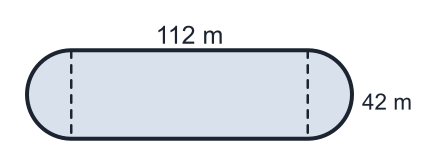
Draw boundaries to avoid double-counting overlapping pieces. For a square with a circular hole, subtract the hole area from the square area. For a stadium shape, add the central rectangle to two semicircles, which together form one circle. Perimeter requires tracing only the outside boundary; an internal joining edge is not counted.
Area conversions square the linear conversion factor: 1 m² = 10,000 cm², not 100 cm². One hectare is 10,000 m². If dimensions are in mixed units, convert before multiplying. A 2 m by 50 cm rectangle is 2 m by 0.5 m, area 1 m².
Recall before practice
1. Distinguish a triangle's side from its perpendicular height. 2. Explain why doubling a circle's radius quadruples its area. 3. Find the perimeter pieces of a semicircle. 4. State how to convert square metres to square centimetres.
Chapter 16 practice — 50 questions
Choose one option for each item. Keep a separate answer list; explanations follow this set.
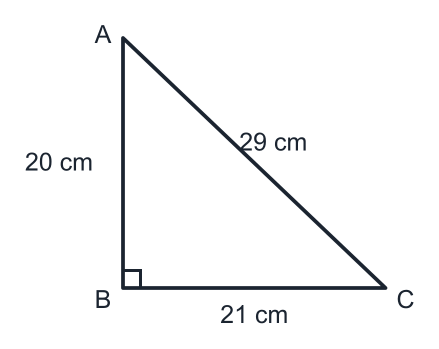
| 1. In the given figure, triangle ABC is right-angled at B. If AB = 20 cm, BC = 21 cm and AC = 29 cm, what is the area of the triangle? A. 420 cm² B. 290 cm² C. 210 cm² D. 70 cm² |
2. The length of a rectangular field is twice its breadth. If the perimeter of the field is 150 m, what is its area?
A. 1275 m² B. 150 m² C. 1250 m² D. 625 m²
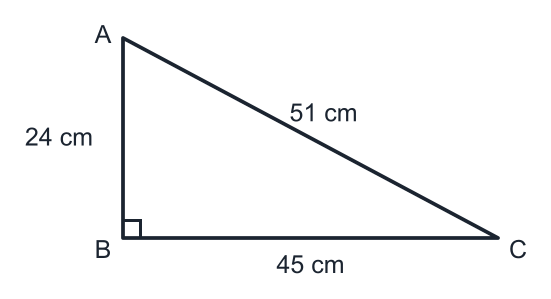
| 3. In the given figure, triangle ABC is right-angled at B. If AB = 24 cm, BC = 45 cm and AC = 51 cm, what is the area of the triangle? A. 540 cm² B. 1080 cm² C. 612 cm² D. 120 cm² |
4. If the radius of a circle is increased by 10%, by what per cent does its area increase?
A. 10% B. 20% C. 27% D. 21%
5. If the side of an equilateral triangle is increased by 15%, by what per cent does its area increase?
A. 47.25% B. 30% C. 32.25% D. 15%
6. If the side of an equilateral triangle is increased by 100%, by what per cent does its area increase?
A. 300% B. 200% C. 100% D. 400%
7. ABCD is a rhombus with diagonals BD = 24 cm and AC = 40 cm. Find its area.
A. 960 cm² B. 128 cm² C. 240 cm² D. 480 cm²
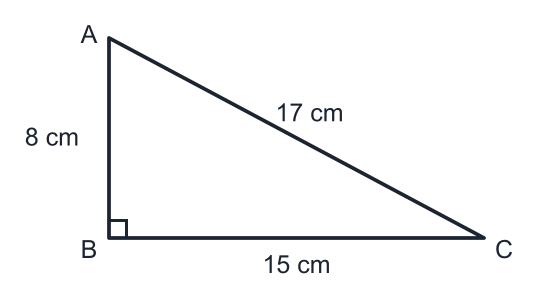
| 8. In the given figure, triangle ABC is right-angled at B. If AB = 8 cm, BC = 15 cm and AC = 17 cm, what is the area of the triangle? A. 120 cm² B. 40 cm² C. 60 cm² D. 68 cm² |
9. The length of a rectangular field is twice its breadth. If the perimeter of the field is 174 m, what is its area?
A. 1711 m² B. 174 m² C. 1682 m² D. 841 m²
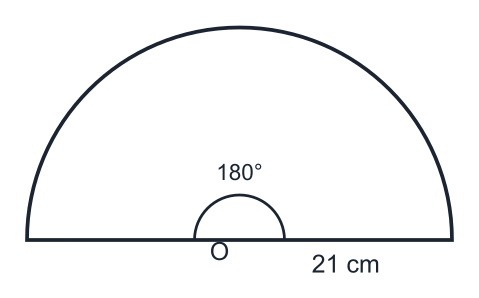
| 10. In the figure, O is the centre of a circle of radius 21 cm and the sector shown has central angle 180°. What is the area of the sector? (Take π = 22/7) A. 66 cm² B. 693 cm² C. 346.5 cm² D. 1386 cm² |
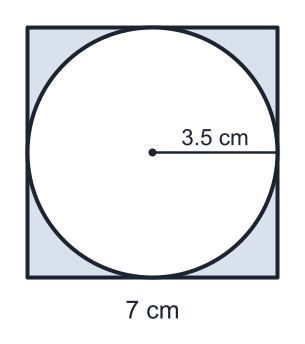
| 11. The largest possible circle is cut out of a square sheet of side 7 cm, as shown. What is the area of the sheet left over (shaded)? (Take π = 22/7) A. 27 cm² B. 38.5 cm² C. 5.25 cm² D. 10.5 cm² |
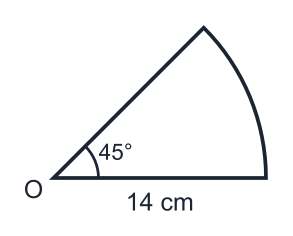
| 12. In the figure, O is the centre of a circle of radius 14 cm and the sector shown has central angle 45°. What is the area of the sector? (Take π = 22/7) A. 154 cm² B. 11 cm² C. 616 cm² D. 77 cm² |
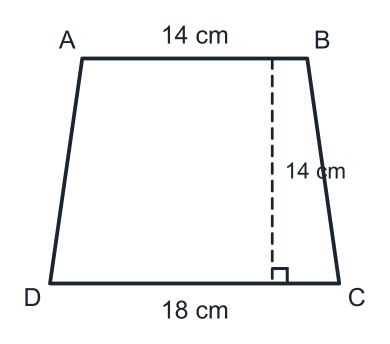
| 13. In trapezium ABCD shown in the figure, AB ∥ DC, AB = 14 cm, DC = 18 cm and the distance between the parallel sides is 14 cm. Find its area. A. 224 cm² B. 448 cm² C. 252 cm² D. 116 cm² |
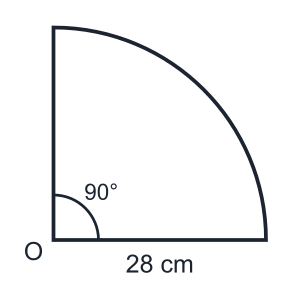
| 14. In the figure, O is the centre of a circle of radius 28 cm and the sector shown has central angle 90°. What is the area of the sector? (Take π = 22/7) A. 2464 cm² B. 44 cm² C. 1232 cm² D. 616 cm² |
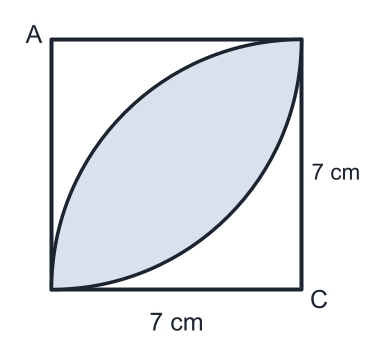
| 15. ABCD is a square of side 7 cm. Quadrants of radius 7 cm are drawn with centres A and C, as shown. Find the area of the shaded (leaf-shaped) region common to both. (Take π = 22/7) A. 105 cm² B. 28 cm² C. 77 cm² D. 14 cm² |
16. Each side of rhombus ABCD is 39 cm, and diagonal BD is 30 cm. What is its area?
A. 1080 cm² B. 2160 cm² C. 1521 cm² D. 585 cm²
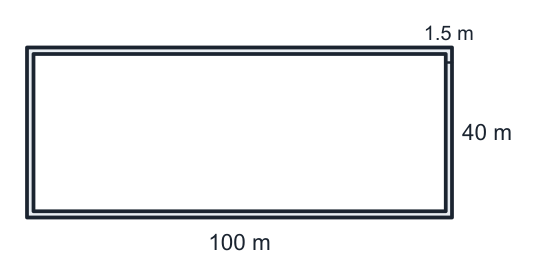
| 17. A rectangular park is 100 m long and 40 m wide. A path 1.5 m wide runs inside the park along its boundary, as shown in the figure. What is the area of the path? A. 420 m² B. 411 m² C. 280 m² D. 4000 m² |
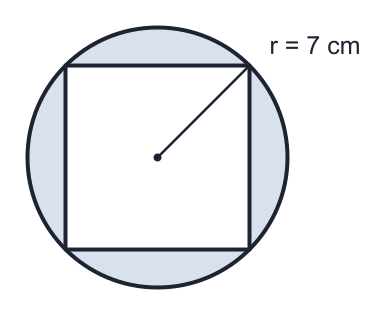
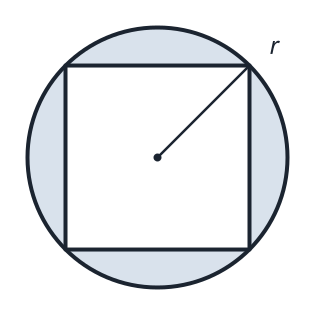
| 18. A square is inscribed in a circle of radius 7 cm, as shown. Find the area of the circle that lies outside the square (shaded). (Take π = 22/7) A. 154 cm² B. 105 cm² C. 56 cm² D. 98 cm² |
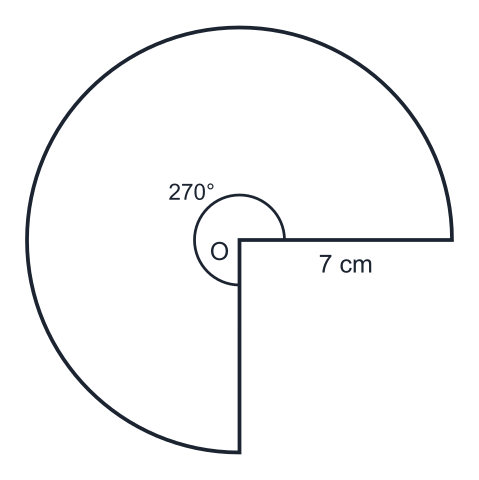
| 19. In the figure, a sector of a circle with centre O has radius 7 cm and central angle 270°. Find the perimeter of the sector. (Take π = 22/7) A. 40 cm B. 44 cm C. 33 cm D. 47 cm |
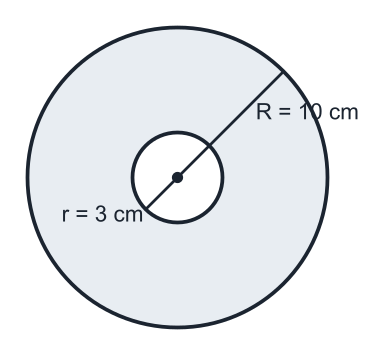
| 20. Two concentric circles have radii R = 10 cm and r = 3 cm, as shown. What is the area of the ring (shaded region) between them? (Take π = 22/7) A. 286 cm² B. 28.29 cm² C. 314.29 cm² D. 154 cm² |
21. The circumference of a circle is equal to the sum of the circumferences of two circles of radii 9 cm and 16 cm. What is the diameter of the circle?
A. 337 cm B. 25 cm C. 50 cm D. 14 cm
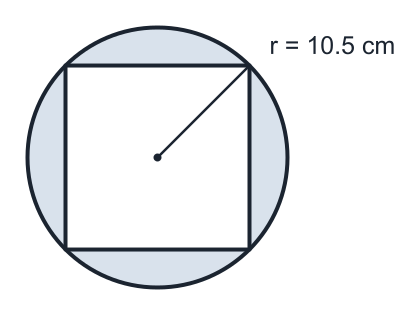
| 22. A square is inscribed in a circle of radius 10.5 cm, as shown. Find the area of the circle that lies outside the square (shaded). (Take π = 22/7) A. 126 cm² B. 101 cm² C. 113 cm² D. 63 cm² |
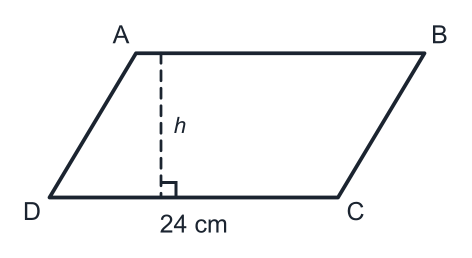
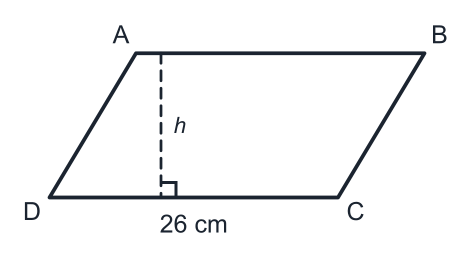
| 23. The base of the parallelogram ABCD in the figure is twice its height. If the area of the parallelogram is 288 cm², what is its height? A. 14 cm B. 12 cm C. 24 cm D. 72 cm |
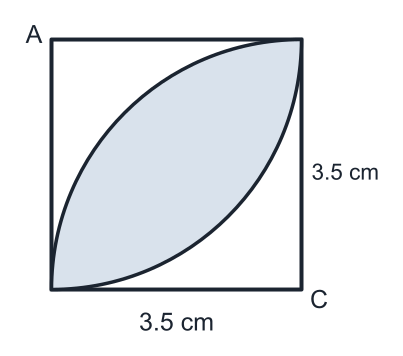
| 24. ABCD is a square of side 3.5 cm. Quadrants of radius 3.5 cm are drawn with centres A and C, as shown. Find the area of the shaded (leaf-shaped) region common to both. (Take π = 22/7) A. 7 cm² B. 10 cm² C. 19 cm² D. 4 cm² |
| 25. A playground is in the shape of a rectangle 112 m × 42 m with a semicircle on each of its shorter sides, as shown. Find the area of the playground. (Take π = 22/7) A. 5397 m² B. 6090 m² C. 10248 m² D. 4704 m² |
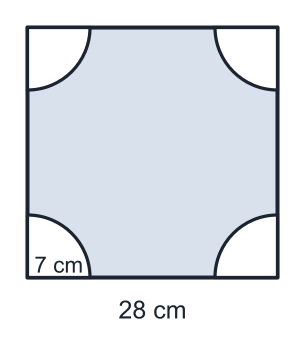
| 26. In the figure, ABCD is a square of side 28 cm and a quadrant of a circle of radius 7 cm is drawn at each corner. Find the area of the shaded region. (Take π = 22/7) A. 168 cm² B. 784 cm² C. 476 cm² D. 630 cm² |
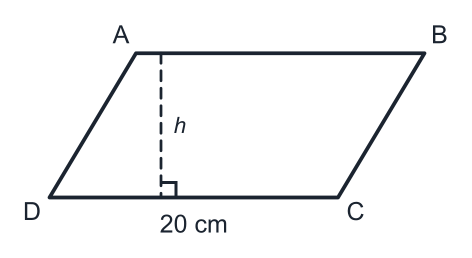
| 27. The base of the parallelogram ABCD in the figure is twice its height. If the area of the parallelogram is 200 cm², what is its height? A. 12 cm B. 20 cm C. 50 cm D. 10 cm |
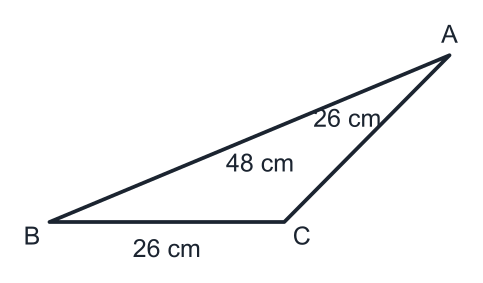
| 28. The sides of triangle ABC shown in the figure are BC = 26 cm, CA = 26 cm and AB = 48 cm. Find the area of the triangle. A. 338 cm² B. 100 cm² C. 1200 cm² D. 240 cm² |
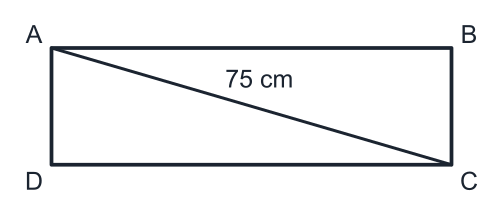
| 29. The sides of the rectangle ABCD in the figure are in the ratio 7 : 24 and its diagonal AC is 75 cm. What is the perimeter of the rectangle? A. 294 cm B. 93 cm C. 186 cm D. 1512 cm |
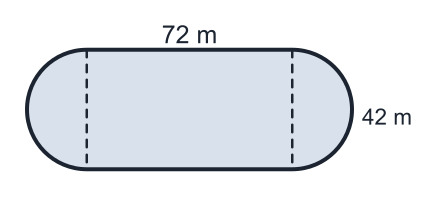
| 30. A playground is in the shape of a rectangle 72 m × 42 m with a semicircle on each of its shorter sides, as shown. Find the perimeter of the playground. (Take π = 22/7) A. 276 m B. 204 m C. 408 m D. 228 m |
31. The diagonal of a square is 8 cm. What is the area of the square?
A. 16 cm² B. 32 cm² C. 64 cm² D. 128 cm²
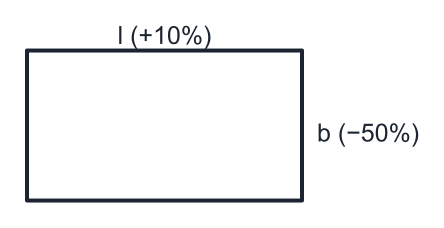
| 32. The length of a rectangle is increased by 10% and its breadth is decreased by 50%, as marked in the figure. What is the percentage change in its area? A. 40% decrease B. 50% decrease C. 45% decrease D. 60% decrease |
33. The perimeter of a semicircular plate is 180 cm. What is its radius? (Take π = 22/7)
A. 28.64 cm B. 45 cm C. 35 cm D. 70 cm
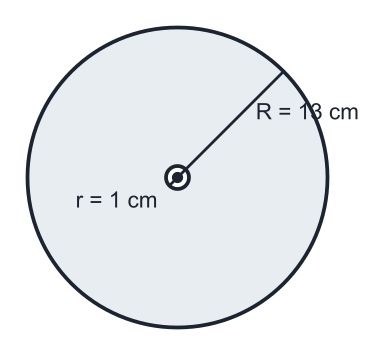
| 34. Two concentric circles have radii R = 13 cm and r = 1 cm, as shown. What is the area of the ring (shaded region) between them? (Take π = 22/7) A. 531.14 cm² B. 528 cm² C. 452.57 cm² D. 3.14 cm² |
| 35. The base of the parallelogram ABCD in the figure is twice its height. If the area of the parallelogram is 338 cm², what is its height? A. 12 cm B. 26 cm C. 15 cm D. 13 cm |
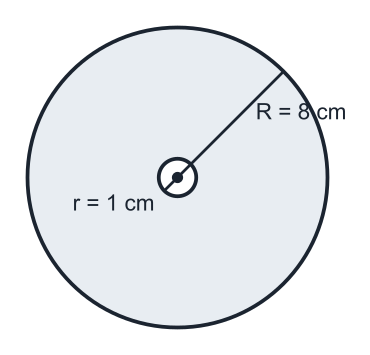
| 36. Two concentric circles have radii R = 8 cm and r = 1 cm, as shown. What is the area of the ring (shaded region) between them? (Take π = 22/7) A. 201.14 cm² B. 3.14 cm² C. 154 cm² D. 198 cm² |
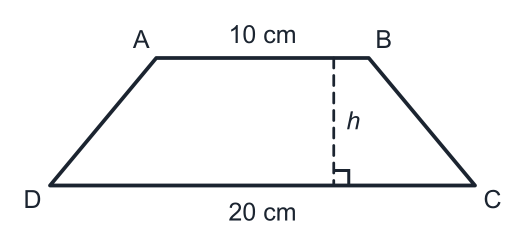
| 37. The parallel sides of the trapezium ABCD in the figure are AB = 10 cm and DC = 20 cm, and its area is 90 cm². What is the distance between the parallel sides? A. 6 cm B. 3 cm C. 4 cm D. 12 cm |
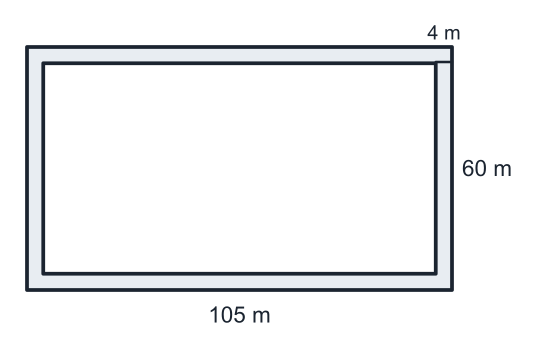
| 38. A rectangular park is 105 m long and 60 m wide. A path 4 m wide runs inside the park along its boundary, as shown in the figure. What is the area of the path? A. 1320 m² B. 6300 m² C. 1256 m² D. 330 m² |
39. The radius of a circle is 28 cm and the length of an arc of a sector of the circle is 7 cm. What is the area of the sector?
A. 98 cm² B. 196 cm² C. 63 cm² D. 392 cm²
40. The radius of a circle is 16 cm and the length of an arc of a sector of the circle is 12 cm. What is the area of the sector?
A. 128 cm² B. 96 cm² C. 44 cm² D. 192 cm²
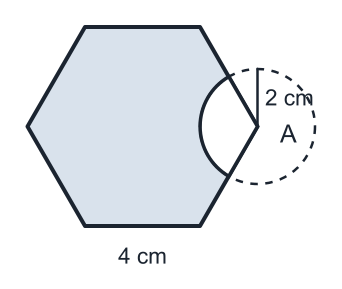
| 41. A circle of radius 2 cm is drawn with its centre at vertex A of a regular hexagon of side 4 cm, as shown. What is the area of the part of the hexagon lying outside the circle? A. (24√3 − 4π) cm² B. (24√3 − 4π/3) cm² C. (48√3 − 4π/3) cm² D. (24√3 − 2π/3) cm² |
42. A triangle has sides 9 cm, 10 cm and 17 cm. D, E and F are the midpoints of its sides. What is the area of triangle DEF?
A. 9 cm² B. 12 cm² C. 18 cm² D. 36 cm²
| 43. A square is inscribed in a circle. What is the ratio of the area of the square to the area of the circle? (Take π = 22/7) A. 11 : 7 B. 1 : 2 C. 7 : 11 D. 11 : 14 |
44. The outer radius of a circular ring is 14 cm and the area of the ring is 462 cm². What is the inner radius of the ring? (Take π = 22/7)
A. 8 cm B. 7 cm C. 14 cm D. 6 cm
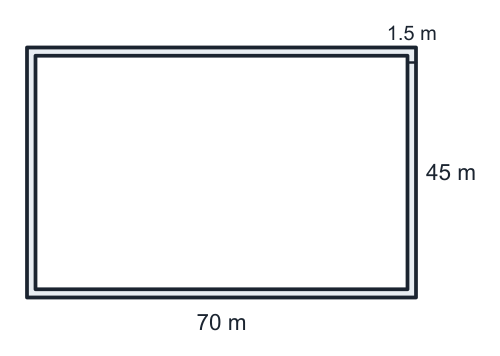
| 45. A rectangular lawn 70 m × 45 m has a 1.5 m wide path inside it along the boundary, as shown. Find the cost of paving the path at ₹20 per m². A. ₹6,900 B. ₹56,280 C. ₹63,000 D. ₹6,720 |
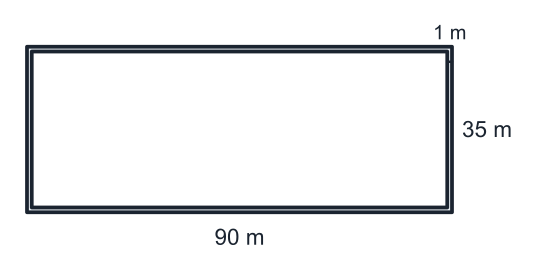
| 46. A rectangular lawn 90 m × 35 m has a 1 m wide path inside it along the boundary, as shown. Find the cost of paving the path at ₹10 per m². A. ₹31,500 B. ₹2,460 C. ₹29,040 D. ₹2,500 |
47. A triangle has sides 16 cm, 30 cm and 34 cm. D, E and F are the midpoints of its sides. What is the area of triangle DEF?
A. 120 cm² B. 240 cm² C. 30 cm² D. 60 cm²
48. The area of a sector of a circle of radius 14 cm is 154 cm². What is the central angle of the sector? (Take π = 22/7)
A. 90° B. 180° C. 45° D. 270°
| 49. Quadrants are drawn from two opposite corners A and C of a square ABCD, each with radius equal to the side, as shown. If the leaf-shaped common region has area 112 cm², find the side of the square. (Take π = 22/7) A. 7 cm B. 14 cm C. 28 cm D. 15 cm |
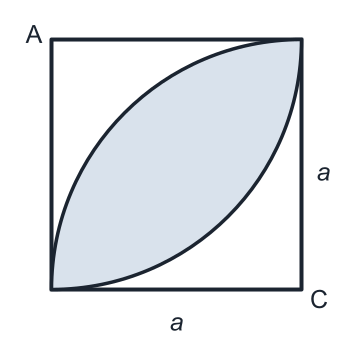
50. A triangle has sides 20 cm, 48 cm and 52 cm. D, E and F are the midpoints of its sides. What is the area of triangle DEF?
A. 240 cm² B. 480 cm² C. 60 cm² D. 120 cm²
Chapter 16 — Answers and explanations
After checking the key, re-solve any miss without looking at the formula.
1. C. In a right-angled triangle the two perpendicular sides are the base and height. Area = ½ × AB × BC = ½ × 20 × 21 = 210 cm². (The hypotenuse 29 cm is not used; ½ × 20 × 29 = 290 is a common error.)
APAR26-16-03 | Area of a right-angled triangle | Easy
2. C. Let breadth = x, length = 2x. Perimeter = 2(2x + x) = 6x = 150 ⇒ x = 25. So the field is 50 m × 25 m and area = 50 × 25 = 1250 m². (Treating it as a square of side 37.5 m gives 1406.25, which is wrong.)
APAR26-16-05 | Rectangle with length twice the breadth | Easy
3. A. In a right-angled triangle the two perpendicular sides are the base and height. Area = ½ × AB × BC = ½ × 24 × 45 = 540 cm². (The hypotenuse 51 cm is not used; ½ × 24 × 51 = 612 is a common error.)
APAR26-16-09 | Area of a right-angled triangle | Easy
4. D. Area ∝ (radius)². New area = (1.1)² = 1.21 times the old ⇒ increase = 21%. Shortcut: p + p + p²/100 = 10 + 10 + 1 = 21%. (Simply doubling to 20% misses the p²/100 term.)
APAR26-16-39 | Percentage increase in area of a circle | Easy
5. C. Area ∝ (side)². New area = (1.15)² = 1.3225 times the old ⇒ increase = 32.25%. Shortcut: p + p + p²/100 = 15 + 15 + 2.25 = 32.25%. (Simply doubling to 30% misses the p²/100 term.)
APAR26-16-37 | Percentage increase in area of a equilateral triangle | Easy
6. A. Area ∝ (side)². New area = (2)² = 4 times the old ⇒ increase = 300%. Shortcut: p + p + p²/100 = 100 + 100 + 100 = 300%. (Simply doubling to 200% misses the p²/100 term.)
APAR26-16-38 | Percentage increase in area of a equilateral triangle | Easy
7. D. Area of a rhombus = ½ × d₁ × d₂ = ½ × 24 × 40 = 480 cm². (Multiplying the diagonals without the half, 960, is the common mistake.)
APAR26-16-06 | Area of a rhombus from its diagonals | Easy
8. C. In a right-angled triangle the two perpendicular sides are the base and height. Area = ½ × AB × BC = ½ × 8 × 15 = 60 cm². (The hypotenuse 17 cm is not used; ½ × 8 × 17 = 68 is a common error.)
APAR26-16-01 | Area of a right-angled triangle | Easy
9. C. Let breadth = x, length = 2x. Perimeter = 2(2x + x) = 6x = 174 ⇒ x = 29. So the field is 58 m × 29 m and area = 58 × 29 = 1682 m². (Treating it as a square of side 43.5 m gives 1892.25, which is wrong.)
APAR26-16-04 | Rectangle with length twice the breadth | Easy
10. B. Area of a sector = (θ/360°) × πr² = (180/360) × (22/7) × 21 × 21 = (180/360) × 1386 = 693 cm². (The full circle's area 1386 is the trap option.)
APAR26-16-02 | Area of a sector from radius and central angle | Easy
11. D. The largest circle has diameter = side ⇒ r = 7/2 = 3.5 cm. Circle area = (22/7) × 3.5² = 38.5 cm². Left over = 49 − 38.5 = 10.5 cm². (Using r = 7 instead of 3.5 gives a circle bigger than the square.)
APAR26-16-36 | Area of a square not covered by its inscribed circle | Easy
12. D. Area of a sector = (θ/360°) × πr² = (45/360) × (22/7) × 14 × 14 = (45/360) × 616 = 77 cm². (The full circle's area 616 is the trap option.)
APAR26-16-08 | Area of a sector from radius and central angle | Easy
13. A. Area of a trapezium = ½ × (sum of parallel sides) × height = ½ × (14 + 18) × 14 = ½ × 32 × 14 = 224 cm².
APAR26-16-07 | Area of a trapezium | Easy
14. D. Area of a sector = (θ/360°) × πr² = (90/360) × (22/7) × 28 × 28 = (90/360) × 2464 = 616 cm². (The full circle's area 2464 is the trap option.)
APAR26-16-10 | Area of a sector from radius and central angle | Easy
15. B. Each quadrant = (1/4)πr² = 38.5 cm². The two quadrants together cover the square once plus the overlap once more, so overlap = 2 × 38.5 − 49 = 28 cm². Shortcut: leaf = (π/2 − 1)r² = (4/7)r² for π = 22/7. (Giving one quadrant's area 38.5 is the trap.)
APAR26-16-45 | Leaf-shaped region between two quadrants in a square | Medium
16. A. Diagonals of a rhombus bisect each other at right angles. Half of BD = 15 cm, so half of AC = √(39² − 15²) = √1296 = 36 cm ⇒ AC = 72 cm. Area = ½ × 30 × 72 = 1080 cm². (side² = 1521 is not the area — a rhombus is not a square.)
APAR26-16-19 | Rhombus from side and one diagonal | Medium
17. B. Inner rectangle = (100 − 2 × 1.5) × (40 − 2 × 1.5) = 97 × 37 = 3589 m². Area of path = 4000 − 3589 = 411 m². (2w(L + B) = 420 double-counts the four corner squares.)
APAR26-16-15 | Area of a path inside a rectangle | Medium
18. C. The square's diagonal = diameter = 14 cm, so its area = d²/2 = 14²/2 = 98 cm². Circle area = (22/7) × 7² = 154 cm². Shaded = 154 − 98 = 56 cm². (Taking the side of the square as 14 gives 196 for the square — wrong.)
APAR26-16-46 | Area of a circle outside its inscribed square | Medium
19. D. Arc length = (θ/360°) × 2πr = (270/360) × 2 × (22/7) × 7 = 33 cm. Perimeter of the sector = 2r + arc = 2 × 7 + 33 = 47 cm. (Giving only the arc length, 33 cm, forgets the two radii.)
APAR26-16-14 | Perimeter of a sector | Medium
20. A. Area of ring = πR² − πr² = π(R² − r²) = (22/7) × (10² − 3²) = (22/7) × 91 = 286 cm². (π(R − r)² = 154 is the classic wrong move; (R − r)² ≠ R² − r².)
APAR26-16-13 | Area of a circular ring | Medium
21. C. 2πR = 2π × 9 + 2π × 16 ⇒ R = 9 + 16 = 25 cm (circumference is proportional to radius, so radii simply add). Diameter = 2R = 50 cm. (25 cm is the radius, not the diameter.)
APAR26-16-21 | Circumference equal to sum of two circumferences | Medium
22. A. The square's diagonal = diameter = 21 cm, so its area = d²/2 = 21²/2 = 220.5 cm². Circle area = (22/7) × 10.5² = 346.5 cm². Shaded = 346.5 − 220.5 = 126 cm². (Taking the side of the square as 21 gives 441 for the square — wrong.)
APAR26-16-42 | Area of a circle outside its inscribed square | Medium
23. B. Let height = h, then base = 2h. Area = base × height = 2h × h = 2h² = 288 ⇒ h² = 144 ⇒ h = 12 cm (and base = 24 cm). Choosing 24 answers the base, not the height.
APAR26-16-11 | Parallelogram with base twice the height | Medium
24. A. Each quadrant = (1/4)πr² = 9.63 cm². The two quadrants together cover the square once plus the overlap once more, so overlap = 2 × 9.63 − 12.25 = 7 cm². Shortcut: leaf = (π/2 − 1)r² = (4/7)r² for π = 22/7. (Giving one quadrant's area 9.63 is the trap.)
APAR26-16-44 | Leaf-shaped region between two quadrants in a square | Medium
25. B. The two semicircles of diameter 42 m together form one circle of radius 21 m: area = (22/7) × 21² = 1386 m². Rectangle = 112 × 42 = 4704 m². Total = 4704 + 1386 = 6090 m². (Adding two full circles, 5544, is the trap.)
APAR26-16-47 | Area of a running track (rectangle with semicircular ends) | Medium
26. D. Four quadrants of the same radius make one full circle: 4 × (1/4)πr² = πr² = (22/7) × 7² = 154 cm². Shaded area = square − circle = 28² − 154 = 784 − 154 = 630 cm². (Subtracting four full circles, 616, is the trap.)
APAR26-16-43 | Square minus four quadrants at its corners | Medium
27. D. Let height = h, then base = 2h. Area = base × height = 2h × h = 2h² = 200 ⇒ h² = 100 ⇒ h = 10 cm (and base = 20 cm). Choosing 20 answers the base, not the height.
APAR26-16-12 | Parallelogram with base twice the height | Medium
28. D. Semi-perimeter s = (26 + 26 + 48)/2 = 50. By Heron's formula, area = √[s(s − a)(s − b)(s − c)] = √(50 × 24 × 24 × 2) = √57600 = 240 cm².
APAR26-16-27 | Area by Heron's formula | Medium
29. C. Let the sides be 7x and 24x. Diagonal² = (7x)² + (24x)² = 625x² = 75² ⇒ x = 3. Sides are 21 cm and 72 cm. Perimeter = 2(l + b) = 2(72 + 21) = 186 cm.
APAR26-16-22 | Rectangle from ratio of sides and diagonal (perimeter) | Medium
30. A. Perimeter = the two long sides + two semicircular arcs (= one full circumference of diameter 42) = 2 × 72 + (22/7) × 42 = 144 + 132 = 276 m. (The shorter sides 42 m are inside the figure and are not part of the boundary.)
APAR26-16-40 | Perimeter of a rectangle with semicircular ends | Medium
31. B. For a square, diagonal d = a√2, so area = a² = d²/2 = 8²/2 = 64/2 = 32 cm². (Squaring the diagonal, 64, gives twice the area.)
APAR26-16-17 | Area of a square from its diagonal | Medium
32. C. New area = (1.1l)(0.5b) = 0.55 lb. Change = -45%, i.e. a 45% decrease. Shortcut: x + y + xy/100 = 10 + (-50) + (10 × -50)/100 = -45%. (Adding 10 and -50 alone, -40%, ignores the xy/100 term.)
APAR26-16-41 | Net percentage change in area of a rectangle | Medium
33. C. Perimeter of a semicircle = πr + 2r (arc plus the diameter) = r(22/7 + 2) = 36r/7 = 180 ⇒ r = 35 cm. (Forgetting the diameter and using πr alone gives a wrong radius.)
APAR26-16-18 | Radius of a semicircle from its perimeter | Medium
34. B. Area of ring = πR² − πr² = π(R² − r²) = (22/7) × (13² − 1²) = (22/7) × 168 = 528 cm². (π(R − r)² = 452.57 is the classic wrong move; (R − r)² ≠ R² − r².)
APAR26-16-20 | Area of a circular ring | Medium
35. D. Let height = h, then base = 2h. Area = base × height = 2h × h = 2h² = 338 ⇒ h² = 169 ⇒ h = 13 cm (and base = 26 cm). Choosing 26 answers the base, not the height.
APAR26-16-26 | Parallelogram with base twice the height | Medium
36. D. Area of ring = πR² − πr² = π(R² − r²) = (22/7) × (8² − 1²) = (22/7) × 63 = 198 cm². (π(R − r)² = 154 is the classic wrong move; (R − r)² ≠ R² − r².)
APAR26-16-24 | Area of a circular ring | Medium
37. A. Area = ½ × (a + b) × h ⇒ 90 = ½ × (10 + 20) × h = 15 × h ⇒ h = 90/15 = 6 cm. (Dividing by the full sum 30 instead of its half gives 3, which is wrong.)
APAR26-16-16 | Height of a trapezium from its area | Medium
38. C. Inner rectangle = (105 − 2 × 4) × (60 − 2 × 4) = 97 × 52 = 5044 m². Area of path = 6300 − 5044 = 1256 m². (2w(L + B) = 1320 double-counts the four corner squares.)
APAR26-16-28 | Area of a path inside a rectangle | Medium
39. A. Area of a sector = ½ × radius × arc length = ½ × 28 × 7 = 98 cm². (No π is needed — the arc length already contains it; r × l = 196 without the half is the trap.)
APAR26-16-25 | Area of a sector from radius and arc length | Medium
40. B. Area of a sector = ½ × radius × arc length = ½ × 16 × 12 = 96 cm². (No π is needed — the arc length already contains it; r × l = 192 without the half is the trap.)
APAR26-16-23 | Area of a sector from radius and arc length | Medium
41. B. Area of a regular hexagon = (3√3/2)a² = (3√3/2) × 16 = 24√3 cm². Each interior angle of a regular hexagon is 120°, so only a 120° sector of the circle lies inside: (120/360)πr² = (1/3)π × 4 = 4π/3 cm². Required area = (24√3 − 4π/3) cm². (Subtracting the whole circle 4π is the trap — identify the sector angle first.)
APAR26-16-50 | Regular hexagon minus a circle centred at a vertex | Difficult
42. A. By Heron's formula (s = 18) the area of the triangle = 36 cm². Joining the midpoints divides a triangle into 4 congruent triangles, so area of DEF = ¼ × 36 = 9 cm². (Halving the sides halves each length but quarters the area — ½ × 36 = 18 is the trap.)
APAR26-16-30 | Triangle formed by joining midpoints | Difficult
43. C. Let the radius be r; the square's diagonal is 2r, so its area = (2r)²/2 = 2r². Square : circle = 2r² : πr² = 2 : π = 2 : (22/7) = 14 : 22 = 7 : 11.
APAR26-16-49 | Ratio of areas: square inscribed in a circle | Difficult
44. B. π(R² − r²) = 462 ⇒ R² − r² = 462 × 7/22 = 147 ⇒ r² = 196 − 147 = 49 ⇒ r = 7 cm. (Solving π(R − r)² = area instead gives a wrong width.)
APAR26-16-35 | Inner radius of a ring from its area | Difficult
45. D. Area of path = 70 × 45 − (67 × 42) = 3150 − 2814 = 336 m². Cost = 336 × ₹20 = ₹6,720. (Using 2w(L + B) = 345 m² for the path double-counts the corners and gives ₹6,900.)
APAR26-16-33 | Cost of paving a path inside a rectangle | Difficult
46. B. Area of path = 90 × 35 − (88 × 33) = 3150 − 2904 = 246 m². Cost = 246 × ₹10 = ₹2,460. (Using 2w(L + B) = 250 m² for the path double-counts the corners and gives ₹2,500.)
APAR26-16-29 | Cost of paving a path inside a rectangle | Difficult
47. D. 16² + 30² = 34², so the triangle is right-angled and its area = ½ × 16 × 30 = 240 cm². Joining the midpoints divides a triangle into 4 congruent triangles, so area of DEF = ¼ × 240 = 60 cm². (Halving the sides halves each length but quarters the area — ½ × 240 = 120 is the trap.)
APAR26-16-34 | Triangle formed by joining midpoints | Difficult
48. A. Area of the whole circle = (22/7) × 14² = 616 cm². Sector area/circle area = 154/616 = θ/360 ⇒ θ = 360 × 154/616 = 90°.
APAR26-16-31 | Central angle of a sector from its area | Difficult
49. B. Leaf area = 2 × (1/4)πa² − a² = (π/2 − 1)a² = (11/7 − 1)a² = (4/7)a². So (4/7)a² = 112 ⇒ a² = 112 × 7/4 = 196 ⇒ a = 14 cm. (Treating the leaf as a quadrant, (11/14)a² = 112, gives a wrong side.)
APAR26-16-48 | Side of a square from the leaf area between two quadrants | Difficult
50. D. 20² + 48² = 52², so the triangle is right-angled and its area = ½ × 20 × 48 = 480 cm². Joining the midpoints divides a triangle into 4 congruent triangles, so area of DEF = ¼ × 480 = 120 cm². (Halving the sides halves each length but quarters the area — ½ × 480 = 240 is the trap.)
APAR26-16-32 | Triangle formed by joining midpoints | Difficult