Three-dimensional shapes have volume and surface area. Volume uses cubic units; surface area uses square units. “Lateral” or “curved” area excludes some end faces, while “total” area includes every exposed face. The diagram should identify what is covered, painted, filled or displaced before a formula is chosen.
1. Cubes and cuboids
A cuboid with length l, breadth b and height h has volume lbh and total surface area 2(lb+bh+hl). Its lateral surface area, excluding top and bottom, is 2h(l+b). A cube of side a has volume a³ and total surface area 6a². Doubling every dimension multiplies volume by 8 and area by 4.
Worked example 1. A box is 8 cm by 5 cm by 3 cm. Volume is 120 cm³. Total surface area is 2(40+15+24)=158 cm². If the box has no lid and the bottom and four walls are material, exposed construction area is 158−40=118 cm².
2. Cylinders
A right circular cylinder of radius r and height h has volume πr²h, curved surface area 2πrh and total surface area 2πr(h+r) when both circular ends are included. An open-top cylinder has one circular end, so material area is 2πrh+πr². Circumference 2πr is the width of its unrolled curved surface.
Worked example 2. A cylinder with r=7 cm and h=10 cm has volume 490π cm³ and curved area 140π cm². If π=22/7, these become 1,540 cm³ and 440 cm². State which value of π was used.
3. Cones and spheres
A right cone has volume (1/3)πr²h. Its curved surface area is πrl, where slant height l=√(r²+h²); total area adds base area πr². The vertical height and slant height are different lengths. A sphere has surface area 4πr² and volume (4/3)πr³. A hemisphere has half a sphere's volume, curved area 2πr² and total area 3πr² if its flat base is included.
Worked example 3. A cone has radius 3 cm and vertical height 4 cm. Slant height is 5 cm. Volume is (1/3)π×9×4=12π cm³, while curved surface area is π×3×5=15π cm². Substituting 4 for slant height in surface area would give the wrong result.
4. Displacement and capacity
When an object is submerged in water without spilling, displaced liquid volume equals the submerged object's volume. A rise in a vessel's water level is displaced volume divided by the vessel's horizontal cross-sectional area, provided the cross-section is constant. For a rectangular vessel, area is length×breadth; for a cylindrical vessel, area is πR².
Worked example 4. A solid of volume 200 cm³ is fully submerged in a tank with base 20 cm×10 cm. Water rises by 200/(20×10)=1 cm. This assumes the tank is wide enough to contain the object and no water spills.
Capacity conversion is practical: 1 litre = 1,000 cm³ = 0.001 m³. Thus a tank of 2 m³ holds 2,000 litres. Convert all dimensions to the same unit before finding volume. Multiplying centimetres by metres without conversion produces a meaningless unit mix.
5. Recasting and cut-out solids
Melting and recasting preserves volume if there is no material loss. A large cube melted into smaller equal cubes has the same total volume. Surface area generally changes. Hollow or drilled solids require subtracting the removed volume and tracing newly exposed surfaces for area.
Worked example 5. A cube of side 6 cm is recast into cubes of side 2 cm. Original volume is 216 cm³; each small cube is 8 cm³, so there are 27. Original surface area was 216 cm², while the small cubes together have 27×24=648 cm². Volume stayed constant; area tripled.
Recall before practice
1. Identify which faces are included in total and lateral surface area. 2. Distinguish cone slant height from vertical height. 3. Convert 3.5 litres to cubic centimetres. 4. Explain why recasting preserves volume but changes surface area.
Chapter 17 practice — 50 questions
Choose one option for each item. Keep a separate answer list; explanations follow this set.
| 1. Find the surface area of a sphere whose diameter is 21 cm. (Take π = 22/7) A. 1386 cm² B. 5544 cm² C. 1452 cm² D. 693 cm² |
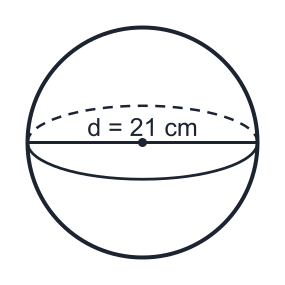
2. Find the total surface area of a cube of edge 8 cm.
A. 256 cm² B. 384 cm² C. 64 cm² D. 512 cm²
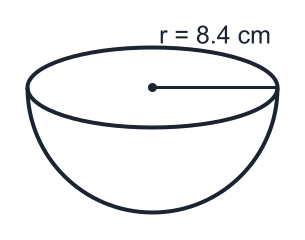
| 3. Find the volume of a solid hemisphere of diameter 16.8 cm, shown in the figure. (Take π = 22/7) A. 1862.784 cm³ B. 1241.856 cm³ C. 3725.568 cm³ D. 2483.712 cm³ |
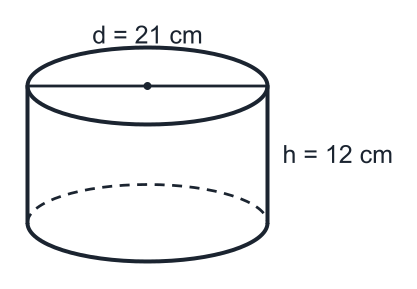
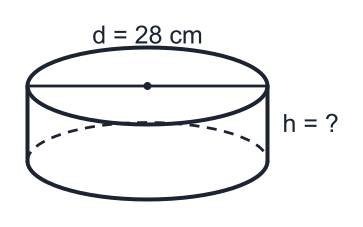
| 4. A solid cylinder has base diameter 21 cm and height 12 cm, as shown. Find its total surface area. (Take π = 22/7) A. 2178 cm² B. 4158 cm² C. 1485 cm² D. 792 cm² |
5. If the radius of a sphere is made 3 times, its surface area becomes how many times the original?
A. 3 times B. 9 times C. 6 times D. 27 times
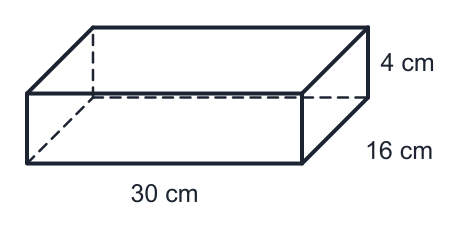
| 6. A cuboid measures 30 cm × 16 cm × 4 cm, as shown in the figure. What is its volume? A. 1328 cm³ B. 960 cm³ C. 664 cm³ D. 1920 cm³ |
7. A solid cylinder of radius 9 cm and height 15 cm is melted and recast into a cone of radius 9 cm. What is the height of the cone?
A. 5 cm B. 45 cm C. 135 cm D. 15 cm
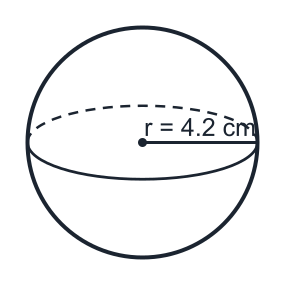
| 8. What is the volume of a sphere of radius 4.2 cm? (Take π = 22/7) A. 155.232 cm³ B. 310.464 cm³ C. 232.848 cm³ D. 221.76 cm³ |
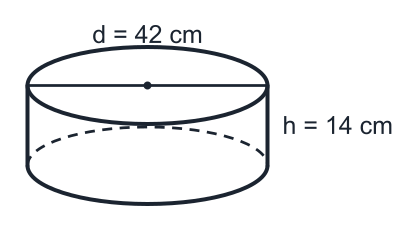
| 9. A solid cylinder has base diameter 42 cm and height 14 cm, as shown. Find its curved surface area. (Take π = 22/7) A. 19404 cm² B. 924 cm² C. 1848 cm² D. 4620 cm² |
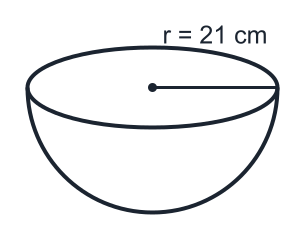
| 10. Find the volume of a solid hemisphere of diameter 42 cm, shown in the figure. (Take π = 22/7) A. 19404 cm³ B. 4158 cm³ C. 58212 cm³ D. 29106 cm³ |
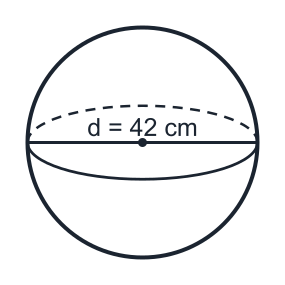
| 11. Find the surface area of a sphere whose diameter is 42 cm. (Take π = 22/7) A. 1386 cm² B. 22176 cm² C. 2772 cm² D. 5544 cm² |
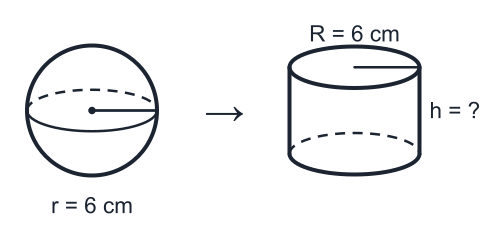
| 12. A solid metallic sphere of radius 6 cm is melted and recast into a solid cylinder of radius 6 cm. What is the height of the cylinder? A. 10 cm B. 48 cm C. 24 cm D. 8 cm |
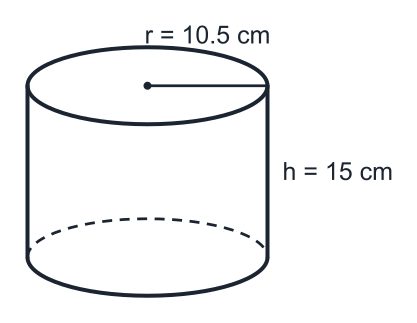
| 13. A solid cylinder has base radius 10.5 cm and height 15 cm, as shown. Find its curved surface area. (Take π = 22/7) A. 495 cm² B. 1683 cm² C. 1980 cm² D. 990 cm² |
14. Find the lateral surface area of a cube of edge 21 cm.
A. 441 cm² B. 2646 cm² C. 1764 cm² D. 9261 cm²
15. A solid cylinder of radius 5 cm and height 4 cm is melted and recast into a cone of radius 10 cm. What is the height of the cone?
A. 3 cm B. 6 cm C. 1 cm D. 9 cm
16. A solid sphere of radius 8 cm is melted and recast into small solid spheres each of radius 2 cm. How many small spheres are obtained?
A. 128 B. 4 C. 64 D. 16
17. A spherical tank of radius 9 m is filled half with water. What is the volume of water in the tank? (Leave the answer in terms of π.)
A. 972π m³ B. 162π m³ C. 495π m³ D. 486π m³
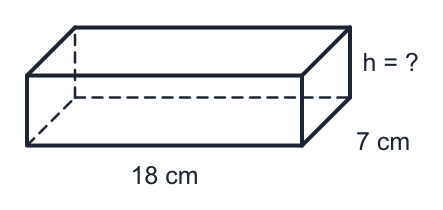
| 18. The total surface area of a cuboid is 352 cm². Its length is 18 cm and breadth 7 cm, as shown. Find its height. A. 3 cm B. 4 cm C. 2 cm D. 1 cm |
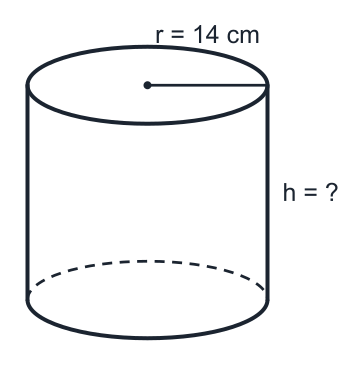
| 19. The total surface area of a cylinder of base radius 14 cm is 3432 cm². Find its height. (Take π = 22/7) A. 50 cm B. 27 cm C. 25 cm D. 39 cm |
20. If the radius of a sphere is increased by 10%, by what per cent does its surface area increase?
A. 21% B. 30% C. 20% D. 27%
21. A solid sphere of radius 20 cm is melted and recast into small solid spheres each of radius 4 cm. How many small spheres are obtained?
A. 250 B. 25 C. 125 D. 5
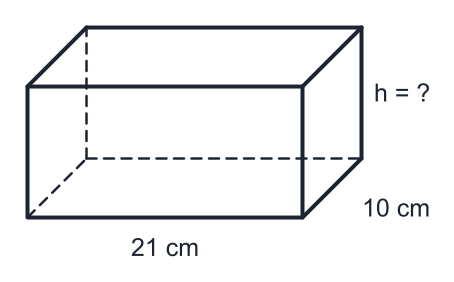
| 22. The volume of a cuboid is 2100 cm³. Its length is 21 cm and breadth 10 cm. Find its height. A. 11 cm B. 10 cm C. 9 cm D. 50 cm |
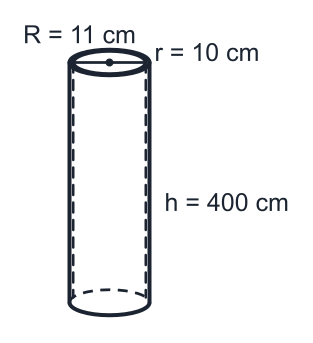
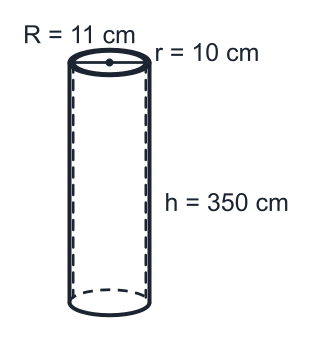
| 23. A hollow metal pipe has outer radius 11 cm, inner radius 10 cm and length 4 m, as shown. Find its total surface area. (Take π = 22/7) A. 52932 cm² B. 55572 cm² C. 52866 cm² D. 52800 cm² |
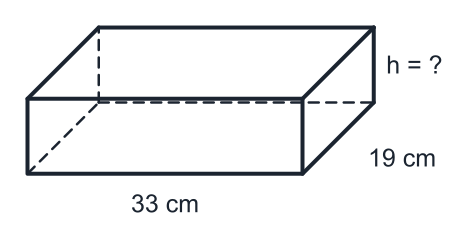
| 24. The volume of a cuboid is 5643 cm³. Its length is 33 cm and breadth 19 cm. Find its height. A. 9 cm B. 86 cm C. 10 cm D. 8 cm |
25. If the length of a cuboid is halved, the breadth is tripled and the height is kept the same, what is the percentage increase in its volume?
A. 150% B. 25% C. 50% D. 100%
26. The surface area of a sphere is 154 cm². What is its diameter? (Take π = 22/7)
A. 14 cm B. 8 cm C. 7 cm D. 6 cm
27. The base of a right prism is a right-angled triangle with legs 7 cm and 24 cm, and the height of the prism is 15 cm. Find its lateral surface area.
A. 840 cm² B. 1008 cm² C. 1260 cm² D. 465 cm²
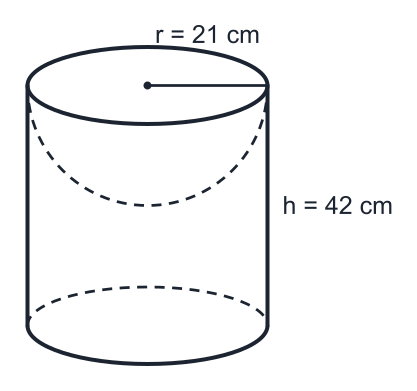
| 28. From a solid cylinder of radius 21 cm and height 42 cm, a hemispherical cavity of the same radius is hollowed out, as shown. Find the volume of the remaining solid. (Take π = 22/7) A. 58212 cm³ B. 38808 cm³ C. 19404 cm³ D. 77616 cm³ |
29. A room is 10 m long, 5 m wide and 5 m high. Find the cost of painting its four walls at ₹25 per m².
A. ₹1,875 B. ₹6,250 C. ₹5,000 D. ₹3,750
30. A cylinder of height 28 cm has volume 17248 cm³. Another cylinder has radius three times that of the first and height 12 cm. Find the volume of the second cylinder.
A. 17248 cm³ B. 22176 cm³ C. 66528 cm³ D. 155232 cm³
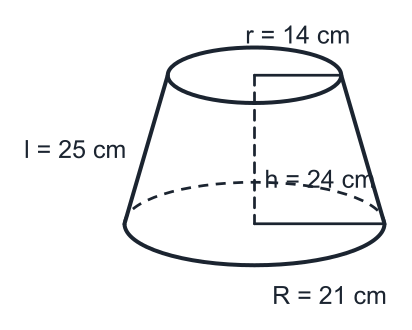
| 31. The radii of the circular ends of a frustum of a cone are 21 cm and 14 cm and its height is 24 cm, as shown. Find its volume. (Take π = 22/7) A. 16016 cm³ B. 70224 cm³ C. 23408 cm³ D. 11088 cm³ |
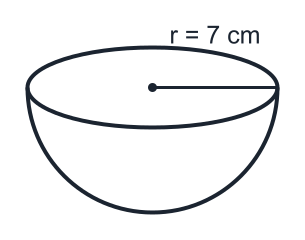
| 32. A solid hemisphere has radius 7 cm. What is its curved surface area? (Take π = 22/7) A. 308 cm² B. 616 cm² C. 462 cm² D. 154 cm² |
33. The base of a right prism is a right-angled triangle with legs 24 cm and 45 cm, and the height of the prism is 15 cm. Find its volume.
A. 1800 cm³ B. 16200 cm³ C. 8100 cm³ D. 2700 cm³
| 34. The total surface area of a cylinder of base diameter 28 cm is 1936 cm². Find its height. (Take π = 22/7) A. 22 cm B. 16 cm C. 8 cm D. 4 cm |
35. A solid sphere of radius 4 cm is melted and recast into small solid spheres each of radius 2 cm. How many small spheres are obtained?
A. 8 B. 2 C. 16 D. 4
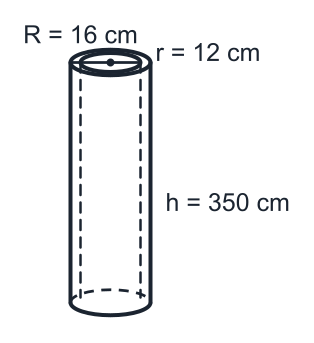
| 36. A hollow metal pipe has outer radius 16 cm, inner radius 12 cm and length 3.5 m, as shown. Find its total surface area. (Take π = 22/7) A. 66528 cm² B. 61952 cm² C. 62304 cm² D. 61600 cm² |
| 37. A solid metallic sphere of radius 9 cm is melted and recast into a solid cylinder of radius 9 cm. What is the height of the cylinder? A. 12 cm B. 4 cm C. 108 cm D. 36 cm |
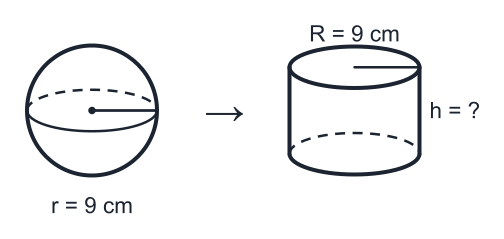
| 38. A solid metallic sphere of radius 12 cm is melted and recast into a solid cylinder of radius 12 cm. What is the height of the cylinder? A. 48 cm B. 18 cm C. 192 cm D. 16 cm |
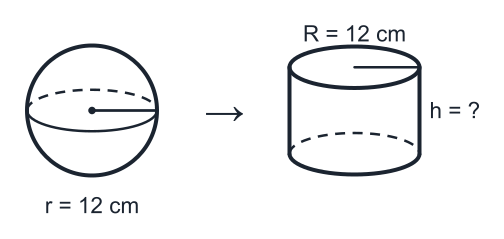
| 39. The total surface area of a cylinder of base diameter 7 cm is 539 cm². Find its height. (Take π = 22/7) A. 21 cm B. 42 cm C. 23 cm D. 36 cm |
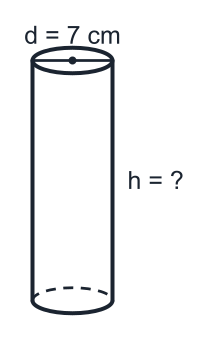
40. A room is 8 m long, 8 m wide and 4 m high. Find the cost of painting its four walls at ₹15 per m².
A. ₹3,840 B. ₹2,880 C. ₹1,920 D. ₹960
41. The radius of a cylinder is increased by 10% and its height is increased by 50%. What is the percentage change in its volume?
A. 60% increase B. 65% increase C. 81.5% increase D. 70% increase
42. The total surface area of a solid hemisphere is 41.58 cm². Find its volume. (Take π = 22/7)
A. 38.808 cm³ B. 9.702 cm³ C. 87.318 cm³ D. 19.404 cm³
43. A solid sphere of radius 18 cm is melted and recast into 216 identical small spheres. What is the ratio of the total surface area of the small spheres to the surface area of the original sphere?
A. 36 : 1 B. 6 : 1 C. 1 : 6 D. 216 : 1
44. A solid sphere of radius 8 cm is melted and recast into 64 identical small spheres. What is the ratio of the total surface area of the small spheres to the surface area of the original sphere?
A. 64 : 1 B. 4 : 1 C. 1 : 4 D. 16 : 1
45. The radius of a cylinder is increased by 10% and its height is increased by 10%. What is the percentage change in its volume?
A. 21% increase B. 20% increase C. 30% increase D. 33.1% increase
46. A solid metallic cylinder of radius 12 cm and height 24 cm is melted to make small cones each of radius 2 cm and height 4 cm. How many cones are formed?
A. 216 B. 324 C. 1944 D. 648
47. A solid copper sphere of radius 6 cm is melted and drawn into a wire of diameter 1.2 cm. Find the length of the wire in metres.
A. 28 m B. 8 m C. 9 m D. 18 m
48. The total surface area of a solid hemisphere is 1039.5 cm². Find its volume. (Take π = 22/7)
A. 10914.75 cm³ B. 4851 cm³ C. 1212.75 cm³ D. 2425.5 cm³
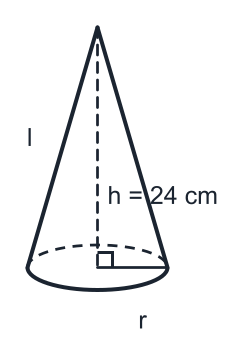
| 49. The volume of a cone is 1232 cm³ and its height is 24 cm. Find its curved surface area. (Take π = 22/7) A. 550 cm² B. 528 cm² C. 1100 cm² D. 704 cm² |
| 50. A hollow cylindrical pipe is 3.5 m long; its outer and inner radii are 11 cm and 10 cm, as shown. What is the volume of metal in the pipe? (Take π = 22/7) A. 23100 cm³ B. 110000 cm³ C. 1100 cm³ D. 133100 cm³ |
Chapter 17 — Answers and explanations
After checking the key, re-solve any miss without looking at the formula.
1. A. Radius r = 21/2 = 10.5 cm. Surface area = 4πr² = 4 × (22/7) × 10.5 × 10.5 = 1386 cm². (Using the diameter in place of the radius gives 5544 cm², four times too large.)
APAR26-17-12 | Surface area of a sphere from its diameter | Easy
2. B. A cube has 6 equal square faces. Total surface area = 6a² = 6 × 8² = 6 × 64 = 384 cm². (4a² = 256 counts only the four side faces.)
APAR26-17-08 | Total surface area of a cube | Easy
3. B. r = 16.8/2 = 8.4 cm. Volume of a hemisphere = (2/3)πr³ = (2/3) × (22/7) × 8.4³ = (2/3) × (22/7) × 592.704 = 1241.856 cm³. (Using (4/3)πr³ gives the full sphere, 2483.712 cm³.)
APAR26-17-06 | Volume of a hemisphere | Easy
4. C. r = 21/2 = 10.5 cm. Total surface area = 2πr(r + h) = 2 × (22/7) × 10.5 × (10.5 + 12) = 2 × (22/7) × 10.5 × 22.5 = 1485 cm². (Leaving out the two ends gives only the CSA 792 cm².)
APAR26-17-03 | Total surface area of a cylinder | Easy
5. B. Surface area varies as the square of the linear dimension. New surface area = 3² × original = 9 times. (27 times is the volume factor, not the area factor.)
APAR26-17-01 | Scaling a sphere: surface area | Easy
6. D. Volume of a cuboid = length × breadth × height = 30 × 16 × 4 = 1920 cm³. (2(lb + bh + hl) = 1328 is the surface area, not the volume.)
APAR26-17-02 | Volume of a cuboid | Easy
7. B. πr²h = (1/3)πR²H ⇒ H = 3r²h/R² = 3 × 9² × 15/9² = 3645/81 = 45 cm. (Equating πr²h = πR²H without the 1/3 gives 15 cm.)
APAR26-17-05 | Cylinder recast into a cone | Easy
8. B. Volume of a sphere = (4/3)πr³ = (4/3) × (22/7) × 4.2³ = (4/3) × (22/7) × 74.088 = 310.464 cm³. (4πr² = 221.76 is the surface area.)
APAR26-17-10 | Volume of a sphere | Easy
9. C. r = 42/2 = 21 cm. Curved surface area = 2πrh = 2 × (22/7) × 21 × 14 = 1848 cm². (Adding the two circular ends gives the total surface area 4620 cm², which is not asked.)
APAR26-17-13 | Curved surface area of a cylinder | Easy
10. A. r = 42/2 = 21 cm. Volume of a hemisphere = (2/3)πr³ = (2/3) × (22/7) × 21³ = (2/3) × (22/7) × 9261 = 19404 cm³. (Using (4/3)πr³ gives the full sphere, 38808 cm³.)
APAR26-17-11 | Volume of a hemisphere | Easy
11. D. Radius r = 42/2 = 21 cm. Surface area = 4πr² = 4 × (22/7) × 21 × 21 = 5544 cm². (Using the diameter in place of the radius gives 22176 cm², four times too large.)
APAR26-17-14 | Surface area of a sphere from its diameter | Easy
12. D. Volume is conserved: (4/3)πr³ = πR²h ⇒ h = 4r³/(3R²) = 4 × 6³/(3 × 6²) = 864/108 = 8 cm. (Forgetting the 1/3 gives 24 cm.)
APAR26-17-07 | Sphere recast into a cylinder | Easy
13. D. Curved surface area = 2πrh = 2 × (22/7) × 10.5 × 15 = 990 cm². (Adding the two circular ends gives the total surface area 1683 cm², which is not asked.)
APAR26-17-15 | Curved surface area of a cylinder | Easy
14. C. Lateral surface area counts the 4 side faces only. LSA = 4a² = 4 × 21² = 4 × 441 = 1764 cm². (6a² = 2646 is the total surface area.)
APAR26-17-09 | Lateral surface area of a cube | Easy
15. A. πr²h = (1/3)πR²H ⇒ H = 3r²h/R² = 3 × 5² × 4/10² = 300/100 = 3 cm. (Equating πr²h = πR²H without the 1/3 gives 1 cm.)
APAR26-17-04 | Cylinder recast into a cone | Easy
16. C. Number = volume of big sphere / volume of small sphere = (4/3)π8³ / (4/3)π2³ = (8/2)³ = 4³ = 64. (Using the ratio of radii squared, 16, is the surface-area ratio, not the volume ratio.)
APAR26-17-33 | Sphere recast into smaller spheres | Medium
17. D. Volume of the sphere = (4/3)πr³ = (4/3)π × 9³ = (4/3)π × 729 = 972π m³. Water = 1/2 of this = 1/2 × 972π = 486π m³. (486π m³ is the empty part.)
APAR26-17-20 | Volume of a sphere filled to a fraction (in terms of π) | Medium
18. C. TSA = 2(lb + bh + hl) ⇒ 352 = 2(126 + 7h + 18h) ⇒ 176 = 126 + 25h ⇒ 25h = 50 ⇒ h = 2 cm. (Forgetting to halve the TSA first, or to subtract lb, gives a wrong height.)
APAR26-17-29 | Height of a cuboid from its total surface area | Medium
19. C. TSA = 2πr(r + h) ⇒ 3432 = 2 × (22/7) × 14 × (14 + h) ⇒ 14 + h = 39 ⇒ h = 25 cm. (Treating the given area as the CSA gives h = 39 cm, which is wrong.)
APAR26-17-16 | Height of a cylinder from its TSA | Medium
20. A. New radius = 110% of the original = 1.1 times. Surface area ∝ (radius)², so new area = 1.1² = 1.21 times ⇒ increase of 21%. (Simply doubling 10% to get 20% ignores the cross terms.)
APAR26-17-28 | Percentage change in surface area | Medium
21. C. Number = volume of big sphere / volume of small sphere = (4/3)π20³ / (4/3)π4³ = (20/4)³ = 5³ = 125. (Using the ratio of radii squared, 25, is the surface-area ratio, not the volume ratio.)
APAR26-17-32 | Sphere recast into smaller spheres | Medium
22. B. Volume = l × b × h ⇒ 2100 = 21 × 10 × h = 210 × h ⇒ h = 2100/210 = 10 cm. (Dividing by l + b = 31 instead of l × b is the trap.)
APAR26-17-26 | Missing dimension of a cuboid from its volume | Medium
23. A. h = 4 m = 400 cm. TSA = outer CSA + inner CSA + two rings = 2πRh + 2πrh + 2π(R² − r²) = 2π(R + r)(h + R − r) = 2 × (22/7) × 21 × (400 + 1) = 2 × (22/7) × 21 × 401 = 52932 cm². (Omitting the two end rings gives 52800 cm².)
APAR26-17-31 | Total surface area of a hollow cylinder | Medium
24. A. Volume = l × b × h ⇒ 5643 = 33 × 19 × h = 627 × h ⇒ h = 5643/627 = 9 cm. (Dividing by l + b = 52 instead of l × b is the trap.)
APAR26-17-22 | Missing dimension of a cuboid from its volume | Medium
25. C. New volume = (0.5 × 3 × 1) × V = 1.5V. Change = (1.5 − 1) × 100% = 50%, i.e. a 50% increase. (150% is the new volume as a percentage of the old, not the change.)
APAR26-17-24 | Percentage change in volume when dimensions of a cuboid change | Medium
26. C. 4πr² = 154 ⇒ r² = 154 × 7/(4 × 22) = 12.25 ⇒ r = 3.5 cm, so diameter = 2r = 7 cm. (Stopping at the radius 3.5 cm is the usual slip.)
APAR26-17-37 | Diameter of a sphere from its surface area | Medium
27. A. Hypotenuse = √(7² + 24²) = 25 cm, so base perimeter = 7 + 24 + 25 = 56 cm. Lateral surface area = perimeter × height = 56 × 15 = 840 cm². (Adding the two triangular ends gives the TSA 1008 cm².)
APAR26-17-34 | Lateral surface area of a right triangular prism | Medium
28. B. Volume of cylinder = πr²h = (22/7) × 21² × 42 = 58212 cm³. Volume of the hemisphere = (2/3)πr³ = (2/3) × (22/7) × 21³ = 19404 cm³. Remaining = 58212 − 19404 = 38808 cm³.
APAR26-17-38 | Volume remaining after carving a hemisphere from a cylinder | Medium
29. D. Area of four walls = 2h(l + b) = 2 × 5 × (10 + 5) = 2 × 5 × 15 = 150 m². Cost = 150 × ₹25 = ₹3,750. (Including the floor and ceiling, or using the volume 250, is wrong here.)
APAR26-17-19 | Cost of painting the four walls of a room | Medium
30. C. V = πr²h, so V₂/V₁ = (r₂/r₁)² × (h₂/h₁) = (3/1)² × 12/28 = 9/1 × 12/28. V₂ = 17248 × 108/28 = 66528 cm³. (Scaling the radius factor only once, 22176, is the trap — the radius is squared.)
APAR26-17-35 | Volume of a cylinder from a related cylinder | Medium
31. C. Volume of a frustum = (1/3)πh(R² + Rr + r²) = (1/3) × (22/7) × 24 × (441 + 294 + 196) = (1/3) × (22/7) × 24 × 931 = 23408 cm³. (Leaving out the middle term Rr is the usual slip.)
APAR26-17-40 | Volume of a frustum of a cone | Medium
32. A. Curved surface area of a hemisphere = half of the sphere's 4πr² = 2πr² = 2 × (22/7) × 7² = 308 cm². (3πr² = 462 includes the flat face and is the total surface area.)
APAR26-17-18 | Curved surface area of a hemisphere | Medium
33. C. Volume of a prism = base area × height. Base area = ½ × 24 × 45 = 540 cm². Volume = 540 × 15 = 8100 cm³. (Using ⅓ as for a pyramid gives 2700, which is wrong.)
APAR26-17-39 | Volume of a right triangular prism | Medium
34. C. r = 28/2 = 14 cm. TSA = 2πr(r + h) ⇒ 1936 = 2 × (22/7) × 14 × (14 + h) ⇒ 14 + h = 22 ⇒ h = 8 cm. (Treating the given area as the CSA gives h = 22 cm, which is wrong.)
APAR26-17-17 | Height of a cylinder from its TSA | Medium
35. A. Number = volume of big sphere / volume of small sphere = (4/3)π4³ / (4/3)π2³ = (4/2)³ = 2³ = 8. (Using the ratio of radii squared, 4, is the surface-area ratio, not the volume ratio.)
APAR26-17-25 | Sphere recast into smaller spheres | Medium
36. C. h = 3.5 m = 350 cm. TSA = outer CSA + inner CSA + two rings = 2πRh + 2πrh + 2π(R² − r²) = 2π(R + r)(h + R − r) = 2 × (22/7) × 28 × (350 + 4) = 2 × (22/7) × 28 × 354 = 62304 cm². (Omitting the two end rings gives 61600 cm².)
APAR26-17-27 | Total surface area of a hollow cylinder | Medium
37. A. Volume is conserved: (4/3)πr³ = πR²h ⇒ h = 4r³/(3R²) = 4 × 9³/(3 × 9²) = 2916/243 = 12 cm. (Forgetting the 1/3 gives 36 cm.)
APAR26-17-21 | Sphere recast into a cylinder | Medium
38. D. Volume is conserved: (4/3)πr³ = πR²h ⇒ h = 4r³/(3R²) = 4 × 12³/(3 × 12²) = 6912/432 = 16 cm. (Forgetting the 1/3 gives 48 cm.)
APAR26-17-30 | Sphere recast into a cylinder | Medium
39. A. r = 7/2 = 3.5 cm. TSA = 2πr(r + h) ⇒ 539 = 2 × (22/7) × 3.5 × (3.5 + h) ⇒ 3.5 + h = 24.5 ⇒ h = 21 cm. (Treating the given area as the CSA gives h = 24.5 cm, which is wrong.)
APAR26-17-23 | Height of a cylinder from its TSA | Medium
40. C. Area of four walls = 2h(l + b) = 2 × 4 × (8 + 8) = 2 × 4 × 16 = 128 m². Cost = 128 × ₹15 = ₹1,920. (Including the floor and ceiling, or using the volume 256, is wrong here.)
APAR26-17-36 | Cost of painting the four walls of a room | Medium
41. C. V = πr²h. New volume = π(1.1r)²(1.5h) = 1.1² × 1.5 × V = 1.815V. Change = (1.815 − 1) × 100 = 81.5%, i.e. a 81.5% increase. (Adding 2 × 10 + 50 = 70% ignores the product terms.)
APAR26-17-44 | Net percentage change in the volume of a cylinder | Difficult
42. D. 3πr² = 41.58 ⇒ r² = 41.58 × 7/(3 × 22) = 4.41 ⇒ r = 2.1 cm. Volume = (2/3)πr³ = (2/3) × (22/7) × 2.1³ = 19.404 cm³. (Using 2πr² for the given area — forgetting the flat face — gives a wrong radius.)
APAR26-17-46 | Volume of a hemisphere from its total surface area | Difficult
43. B. 216 × (4/3)πr³ = (4/3)π18³ ⇒ r³ = 5832/216 = 27 ⇒ r = 3 cm. Total SA of small spheres = 216 × 4π(3)² = 7776π; SA of the big sphere = 4π(18)² = 1296π. Ratio = 7776 : 1296 = 6 : 1. In general it equals R/r — surface area increases on splitting.
APAR26-17-43 | Surface-area ratio after recasting into small spheres | Difficult
44. B. 64 × (4/3)πr³ = (4/3)π8³ ⇒ r³ = 512/64 = 8 ⇒ r = 2 cm. Total SA of small spheres = 64 × 4π(2)² = 1024π; SA of the big sphere = 4π(8)² = 256π. Ratio = 1024 : 256 = 4 : 1. In general it equals R/r — surface area increases on splitting.
APAR26-17-41 | Surface-area ratio after recasting into small spheres | Difficult
45. D. V = πr²h. New volume = π(1.1r)²(1.1h) = 1.1² × 1.1 × V = 1.331V. Change = (1.331 − 1) × 100 = 33.1%, i.e. a 33.1% increase. (Adding 2 × 10 + 10 = 30% ignores the product terms.)
APAR26-17-50 | Net percentage change in the volume of a cylinder | Difficult
46. D. Number of cones = πr²h / [(1/3)πr₂²h₂] = 3r²h/(r₂²h₂) = 3 × 12² × 24/(2² × 4) = 10368/16 = 648. (Forgetting the factor 3 from the cone's 1/3 gives 216.)
APAR26-17-47 | Cylinder recast into many cones | Difficult
47. B. Wire radius = 1.2/2 = 0.6 cm. (4/3)π × 6³ = π × 0.6² × L ⇒ L = 4 × 216/(3 × 0.36) = 800 cm = 8 m. (Using the diameter 1.2 as the radius gives L = 2 m.)
APAR26-17-42 | Sphere drawn into a wire | Difficult
48. D. 3πr² = 1039.5 ⇒ r² = 1039.5 × 7/(3 × 22) = 110.25 ⇒ r = 10.5 cm. Volume = (2/3)πr³ = (2/3) × (22/7) × 10.5³ = 2425.5 cm³. (Using 2πr² for the given area — forgetting the flat face — gives a wrong radius.)
APAR26-17-49 | Volume of a hemisphere from its total surface area | Difficult
49. A. (1/3) × (22/7) × r² × 24 = 1232 ⇒ r² = 1232 × 21/(22 × 24) = 49 ⇒ r = 7 cm. Slant height l = √(7² + 24²) = √625 = 25 cm. CSA = πrl = (22/7) × 7 × 25 = 550 cm². (πrh = 528 uses the height instead of the slant height.)
APAR26-17-45 | Curved surface area of a cone from its volume and height | Difficult
50. A. h = 3.5 m = 350 cm. Volume of metal = π(R² − r²)h = (22/7) × (11² − 10²) × 350 = (22/7) × 21 × 350 = 23100 cm³. (π(R − r)²h = 1100 is the classic wrong move; (R − r)² ≠ R² − r².)
APAR26-17-48 | Volume of metal in a hollow cylinder | Difficult