Geometry questions test relationships before arithmetic. A clear sketch should show lines, angles, equal lengths and the requested unknown. Diagrams in practice sets are aids, but their appearance may not be to scale. Use stated measurements and proven properties, not visual guessing.
1. Lines and angles
Angles on a straight line total 180°; angles around a point total 360°. Vertically opposite angles are equal. When a transversal crosses parallel lines, corresponding and alternate interior angles are equal, while co-interior angles add to 180°. Each rule has a specific placement of lines; mark the relevant parallel lines before applying it.
Worked example 1. Two adjacent angles on a straight line are in the ratio 2:3. Let them be 2x and 3x. Since 5x=180°, x=36°, and the angles are 72° and 108°.
2. Triangles
Interior angles of a triangle total 180°. An exterior angle equals the sum of the two non-adjacent interior angles. Equal sides in an isosceles triangle face equal angles; equal angles face equal sides. Triangle inequality requires the sum of any two sides to exceed the third. For a right triangle, the hypotenuse is opposite the right angle and is the longest side.
Worked example 2. A triangle has angles in the ratio 2:3:4. Their nine parts total 180°, so one part is 20°. The angles are 40°, 60° and 80°. No drawing measurement is needed.
Congruent triangles match in size and shape; similar triangles match in shape and have proportional corresponding sides. For similar triangles with side scale k, perimeter scales by k and area by k². If one triangle's side is twice a corresponding side, its area is four times as large, not twice.
3. Quadrilaterals and polygons
Interior angles of any quadrilateral total 360°. A parallelogram has opposite sides and angles equal; adjacent angles sum to 180°. A rectangle adds four right angles; a rhombus adds four equal sides; a square has both properties. Do not assume every rhombus has right angles or every rectangle has equal sides.
An n-sided polygon has interior-angle sum (n−2)×180°. A regular polygon has each exterior turning angle 360°/n. The exterior angles, one at each vertex in the same direction, always total 360°. These formulas can recover the number of sides from a stated regular angle.
Worked example 3. Each exterior angle of a regular polygon is 30°. Its number of sides is 360/30=12. Its interior angle is 150°, and the interior-angle sum is (12−2)×180°=1,800°.
4. Circles
All radii of a circle are equal. A tangent is perpendicular to the radius at the contact point. An angle at the centre subtending an arc is twice an angle at the circumference standing on the same arc, subject to the usual placement. Opposite angles in a cyclic quadrilateral add to 180°. Chords equidistant from the centre are equal, and a perpendicular from the centre to a chord bisects it.
Worked example 4. If an angle at the circumference is 35° on a given arc, the central angle on that same arc is 70°. State the shared arc; using an angle standing on the opposite arc can change the relationship.
5. Coordinate and diagram discipline
When points are given by coordinates, horizontal and vertical differences form a right triangle. Distance between (x₁,y₁) and (x₂,y₂) is √[(x₂−x₁)²+(y₂−y₁)²]. The midpoint averages corresponding coordinates. A figure that appears horizontal in a sketch is not necessarily declared parallel to another line; follow labels and stated properties.
Worked example 5. Points (1,2) and (7,10) differ by 6 horizontally and 8 vertically. Their distance is √(36+64)=10. Their midpoint is (4,6). Units are needed only if the coordinate axes specify them.
6. Proof before calculation
For every figure question, write the property that supplies the equation: “straight-line angles sum to 180°”, “corresponding angles are equal” or “similar-side ratio is 2:3”. This makes the reasoning auditable and prevents a correct-looking number from resting on a false diagram assumption.
Recall before practice
1. State the three common angle sums: straight line, point and triangle. 2. Explain how area changes under a similarity scale of 3. 3. Distinguish rectangle from rhombus properties. 4. State the tangent-radius relation at the contact point.
Chapter 18 practice — 50 questions
Choose one option for each item. Keep a separate answer list; explanations follow this set.
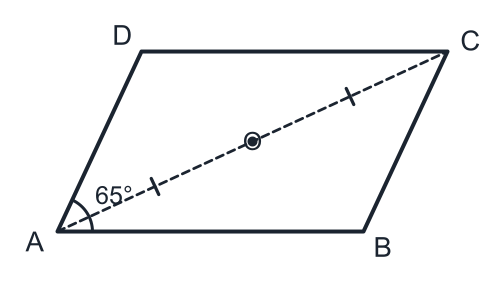
| 1. The diagonals AC and BD of parallelogram ABCD intersect at O. If AO = (2x + 7) cm and OC = (x + 26) cm, find the value of x. A. 26 B. 19 C. 45 D. 7 |
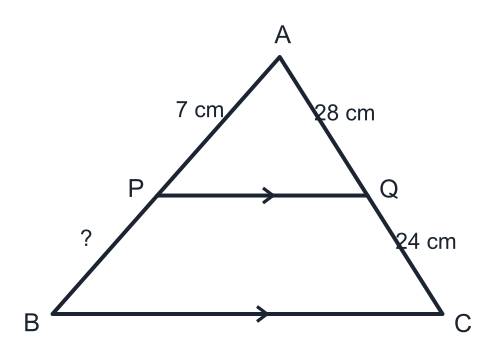
| 2. In triangle ABC, P and Q are points on AB and AC respectively such that PQ ∥ BC. If AP = 7 cm, AQ = 28 cm, QC = 24 cm, find PB. A. 6 cm B. 96 cm C. 31 cm D. 7 cm |
3. A circle with centre O has diameter 50 cm. AB and CD are two equal parallel chords, each 30 cm long, on opposite sides of the centre. Find the distance between them.
A. 25 cm B. 5 cm C. 40 cm D. 20 cm
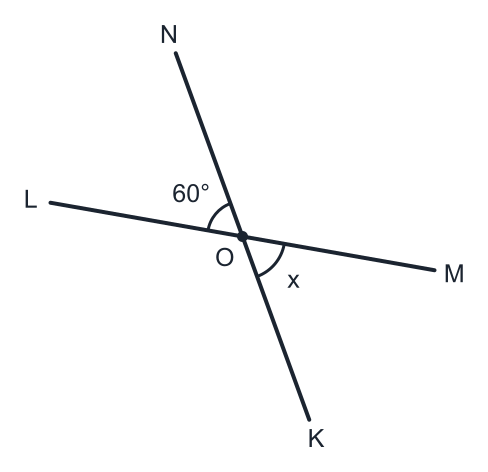
| 4. Two straight lines LM and NK intersect at O. If ∠LON = 60°, find x (= ∠MOK). A. 240° B. 120° C. 60° D. 30° |
5. How many diagonals does a polygon with 8 sides have?
A. 40 B. 20 C. 24 D. 28
6. A circle with centre O has diameter 30 cm. KL and MN are two equal parallel chords, each 24 cm long, on opposite sides of the centre. Find the distance between them.
A. 18 cm B. 15 cm C. 9 cm D. 6 cm
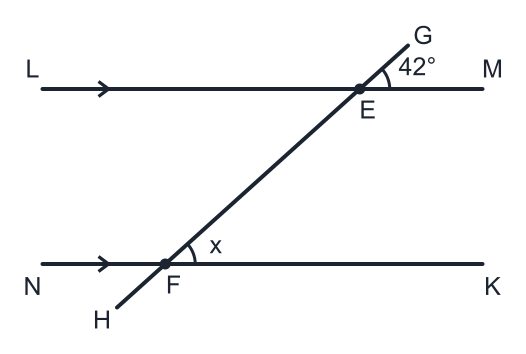
| 7. In the given figure, LM ∥ NK and the transversal GH meets them at E and F respectively. If ∠MEG = 42°, then the value of x (= ∠KFE) is: A. 48° B. 138° C. 42° D. 21° |
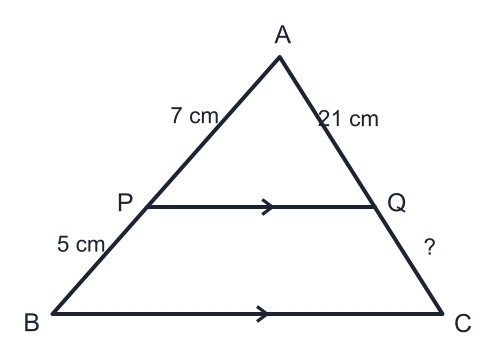
| 8. In triangle ABC, P and Q are points on AB and AC respectively such that PQ ∥ BC. If AP = 7 cm, PB = 5 cm, AQ = 21 cm, find QC. A. 15 cm B. 26 cm C. 29.4 cm D. 1.67 cm |
9. The angles of a quadrilateral are in the ratio 2 : 4 : 5 : 7. Find its largest angle.
A. 40° B. 140° C. 160° D. 20°
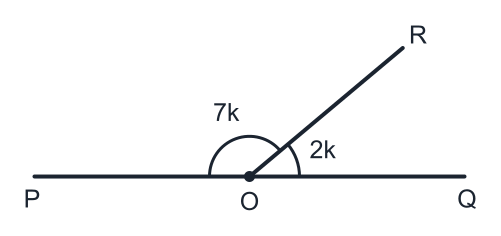
| 10. In the figure, POQ is a straight line and ∠POR : ∠ROQ = 7 : 2. Find ∠POR. A. 90° B. 40° C. 280° D. 140° |
11. A straight line cuts two concentric circles with centre O in chords XY = 18 cm (outer circle) and LM = 8 cm (inner circle). If the radii are R and r respectively, find R² − r².
A. 65 cm² B. 260 cm² C. 10 cm² D. 5 cm²
12. The sides of a triangle ABC are 75 cm, 21 cm and 72 cm. D, E, F are the mid-points of its sides. Find the area of triangle DEF.
A. 756 cm² B. 94.5 cm² C. 378 cm² D. 189 cm²
13. The sides of a right-angled triangle PQR are 20 cm, 21 cm and 29 cm. Find the radius of its incircle.
A. 14.48 cm B. 14.5 cm C. 6 cm D. 35 cm
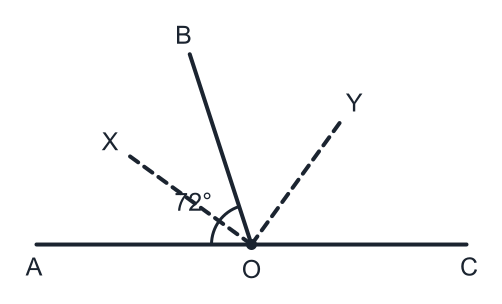
| 14. In the figure, AOC is a straight line, ∠AOB = 72°, and OX, OY are the bisectors of ∠AOB and ∠BOC respectively. Find ∠AOY. A. 90° B. 36° C. 108° D. 126° |
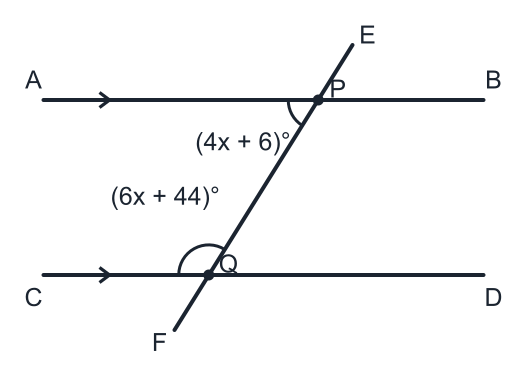
| 15. In the given figure, AB ∥ CD and the transversal EF meets them at P and Q respectively. If ∠CQP = (6x + 44)° and ∠APQ = (4x + 6)°, find the value of x. A. 8 B. 18 C. 26 D. 13 |
16. Which of the following sets of lengths CANNOT be the sides of a triangle?
A. 11 cm, 15 cm, 20 cm B. 3 cm, 3 cm, 11 cm C. 5 cm, 6 cm, 7 cm D. 6 cm, 12 cm, 17 cm
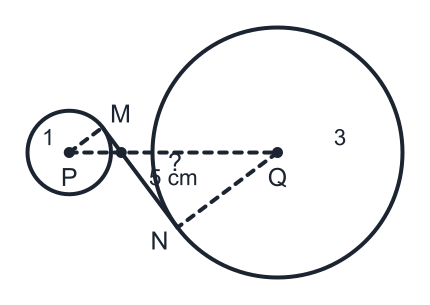
| 17. Two circles of radii 1 cm and 3 cm have their centres 5 cm apart. Find the length of a transverse common tangent. A. 4 cm B. 1 cm C. 5 cm D. 3 cm |
18. Two sides of an isosceles triangle XYZ are 9 cm and 22 cm. Find the perimeter of the triangle.
A. 53 cm B. 40 cm C. 31 cm D. 44 cm
19. What is the sum of all exterior angles of a convex polygon with 13 sides, one at each vertex?
A. 360° B. 180° C. 1980° D. 720°
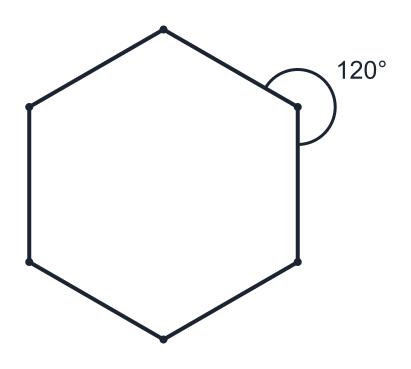
| 20. Each interior angle of a regular polygon is 120°. How many sides does it have? A. 7 B. 3 C. 5 D. 6 |
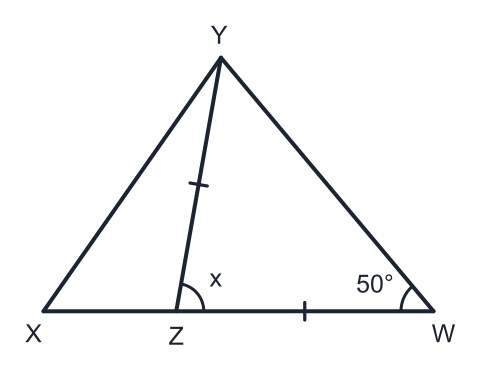
| 21. Side XZ of triangle XYZ is produced to W such that YZ = ZW. If ∠YWZ = 50°, find ∠YZW. A. 80° B. 100° C. 50° D. 130° |
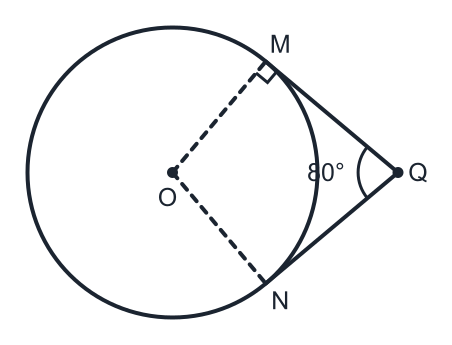
| 22. QM and QN are tangents from an external point Q to a circle with centre O. If ∠MQN = 80°, find ∠MON. A. 50° B. 80° C. 100° D. 110° |
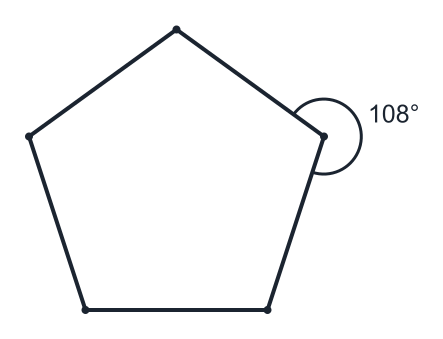
| 23. Each interior angle of a regular polygon is 108°. How many sides does it have? A. 4 B. 5 C. 6 D. 72 |
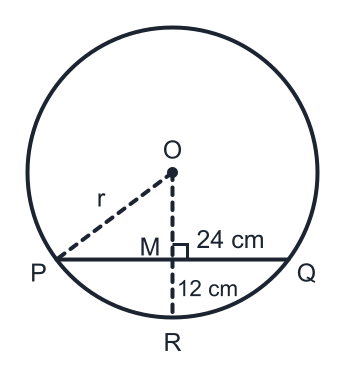
| 24. PQ is a chord of a circle with centre O. The perpendicular from O to PQ meets it at M and the circle at R. If PQ = 48 cm and MR = 12 cm, find the radius. A. 36 cm B. 48 cm C. 30 cm D. 24 cm |
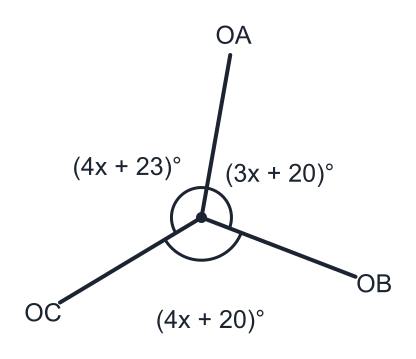
| 25. In the figure, OA, OB, OC are rays from O with ∠AOB = (3x + 20)°, ∠BOC = (4x + 20)°, ∠COA = (4x + 23)°. Find the value of x. A. 27 B. 54 C. 22 D. 32 |
26. Two sides of an isosceles triangle PQR are 12 cm and 25 cm. Find the perimeter of the triangle.
A. 50 cm B. 37 cm C. 49 cm D. 62 cm
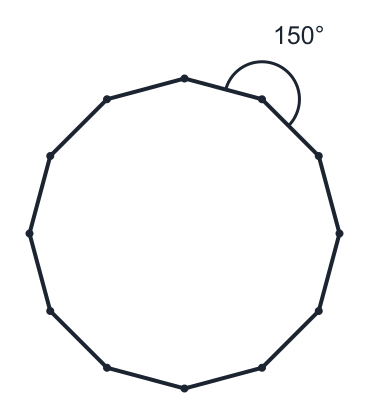
| 27. Each interior angle of a regular polygon is 150°. How many sides does it have? A. 11 B. 13 C. 186 D. 12 |
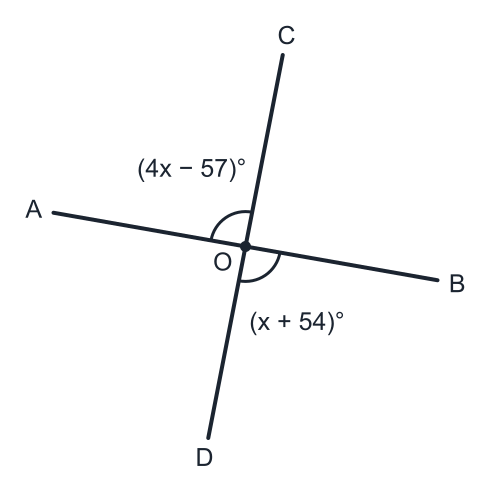
| 28. Two straight lines AB and CD intersect at O. If ∠AOC = (4x − 57)° and ∠BOD = (x + 54)°, find the value of x. A. 74 B. 37 C. 42 D. 32 |
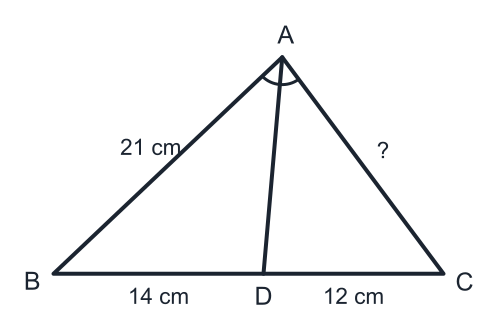
| 29. In triangle ABC, AD bisects ∠A and meets BC at D. If BD = 14 cm, DC = 12 cm and AB = 21 cm, find AC. A. 18 cm B. 21 cm C. 20 cm D. 24.5 cm |
30. Two circles of radii 10 cm and 4 cm have their centres 50 cm apart. Find the length of a transverse common tangent.
A. 36 cm B. 49 cm C. 50 cm D. 48 cm
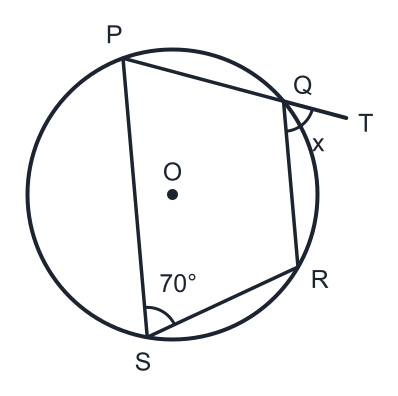
| 31. PQRS is a cyclic quadrilateral and side PQ is produced to T. If ∠PSR = 70°, find ∠RQT. A. 220° B. 70° C. 110° D. 68° |
32. Which of the following sets of lengths can be the sides of a triangle?
A. 7 cm, 14 cm, 26 cm B. 8 cm, 13 cm, 21 cm C. 3 cm, 9 cm, 10 cm D. 7 cm, 7 cm, 16 cm
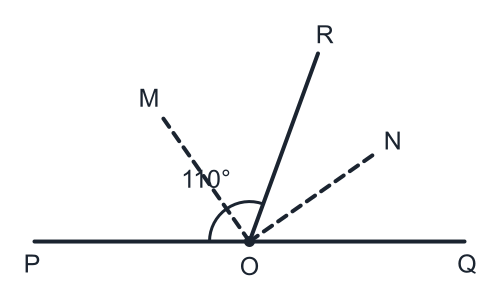
| 33. In the figure, POQ is a straight line, ∠POR = 110°, and OM, ON are the bisectors of ∠POR and ∠ROQ respectively. Find ∠PON. A. 55° B. 90° C. 145° D. 70° |
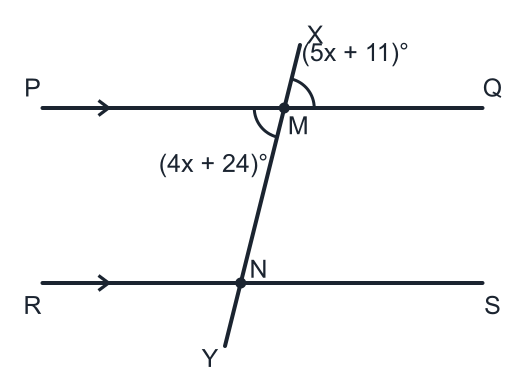
| 34. In the given figure, PQ ∥ RS and the transversal XY meets them at M and N respectively. If ∠PMN = (4x + 24)° and ∠QMX = (5x + 11)°, find the value of x. A. 18 B. 8 C. 13 D. 26 |
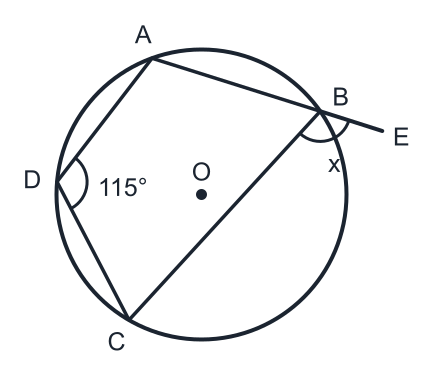
| 35. ABCD is a cyclic quadrilateral and side AB is produced to E. If ∠ADC = 115°, find ∠CBE. A. 70° B. 110° C. 115° D. 65° |
36. Three angles of a quadrilateral are 90°, 108° and 69°. Find its fourth angle.
A. 113° B. 93° C. 267° D. 103°
37. A polygon has 35 diagonals. How many sides does it have?
A. 11 B. 9 C. 8 D. 10
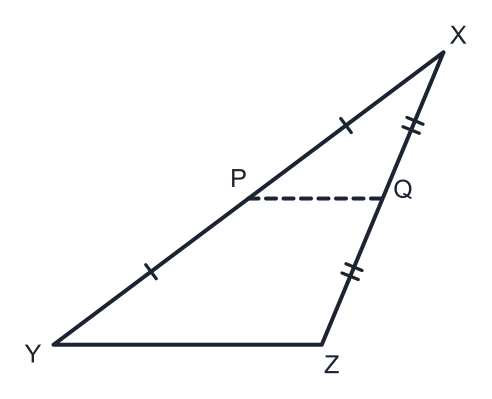
| 38. In triangle XYZ, P and Q are the mid-points of XY and XZ respectively. If XY = 40 cm, YZ = 22 cm and ZX = 26 cm, find the perimeter of triangle XPQ. A. 88 cm B. 22 cm C. 44 cm D. 55 cm |
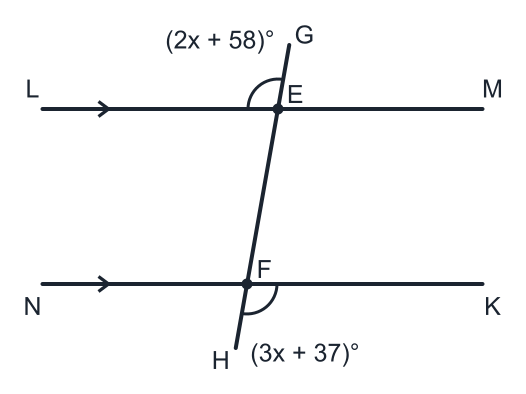
| 39. In the given figure, LM ∥ NK and the transversal GH meets them at E and F respectively. If ∠LEG = (2x + 58)° and ∠KFH = (3x + 37)°, find the value of x. A. 16 B. 26 C. 17 D. 21 |
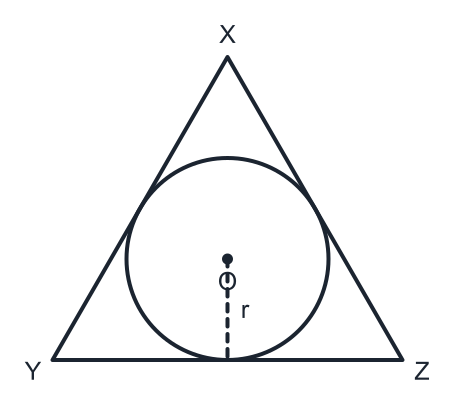
| 40. The area of the circle inscribed in an equilateral triangle XYZ is 154 cm². Find the side of the triangle. (Take π = 22/7) A. 14√2 cm B. 14 cm C. 7√3 cm D. 14√3 cm |
41. KL and MN are two parallel chords of a circle of radius 13 cm, of lengths 10 cm and 24 cm respectively, lying on opposite sides of the centre O. Find the distance between the chords.
A. 5 cm B. 7 cm C. 17 cm D. 12 cm
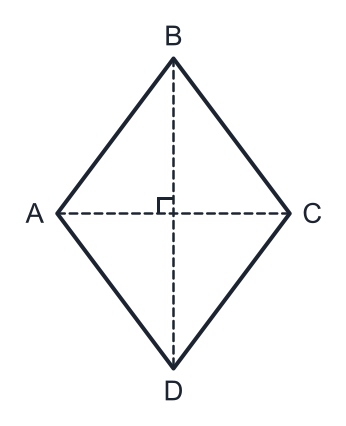
| 42. One diagonal of a rhombus is 30 cm and its side is 25 cm. Find the length of the other diagonal. A. 40 B. 25 C. 20 D. 30 |
43. In which of the following ratios must the angles of a triangle be for it to be obtuse-angled?
A. 1 : 2 : 2 B. 3 : 4 : 5 C. 2 : 5 : 11 D. 1 : 2 : 3
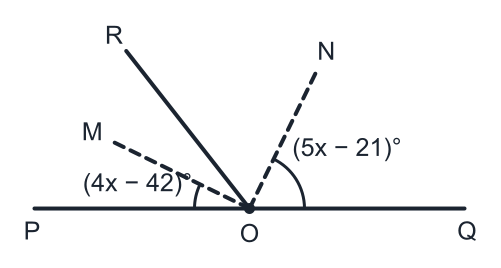
| 44. In the figure, POQ is a straight line and OM, ON bisect ∠POR and ∠ROQ respectively. If ∠POM = (4x − 42)° and ∠NOQ = (5x − 21)°, find ∠POR. A. 128° B. 52° C. 26° D. 17° |
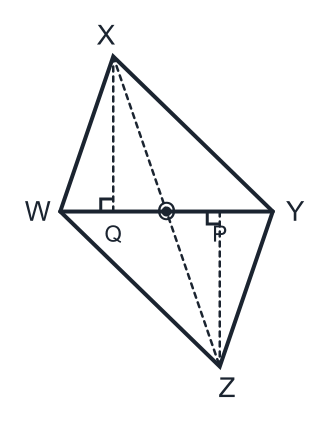
| 45. In quadrilateral WXYZ, XQ and ZP are perpendiculars drawn from X and Z respectively to diagonal WY, with XQ = ZP. The diagonals WY and XZ intersect at O. If ZX = 148 cm, find the length of OX. A. 148 B. 76 C. 74 D. 75 |
| 46. Find the area of a rhombus whose diagonals are 48 cm and 90 cm. A. 4320 cm² B. 69 cm² C. 2160 cm² D. 1080 cm² |
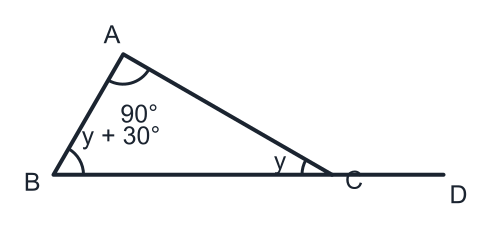
| 47. In triangle ABC, ∠BAC = 90° and ∠ABC exceeds ∠ACB by 30°. Find ∠ABC. A. 90° B. 30° C. 45° D. 60° |
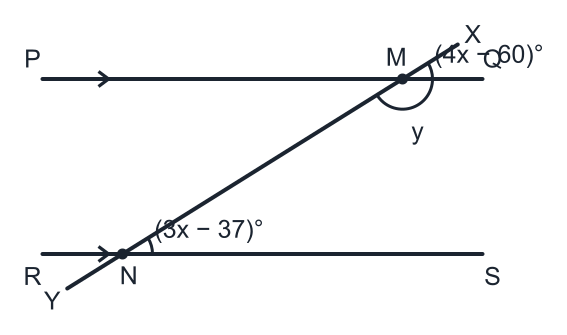
| 48. In the given figure, PQ ∥ RS and the transversal XY meets them at M and N respectively. If ∠QMX = (4x − 60)° and ∠SNM = (3x − 37)°, then the measure of y (= ∠QMN) is: A. 158° B. 23° C. 32° D. 148° |
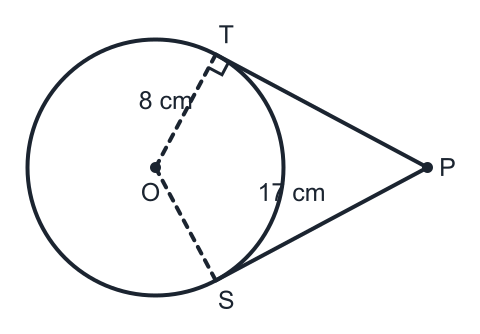
| 49. From a point P, 17 cm from the centre O of a circle of radius 8 cm, two tangents PT and PS are drawn. Find the area of quadrilateral OTPS. A. 120 cm² B. 60 cm² C. 136 cm² D. 240 cm² |
50. Two circles have radii 7 cm and 2 cm and the distance between their centres is 6 cm. How many common tangents can be drawn to the two circles?
A. 0 B. 1 C. 2 D. 3
Chapter 18 — Answers and explanations
After checking the key, re-solve any miss without looking at the formula.
1. B. The diagonals of a parallelogram bisect each other, so AO = OC: 2x + 7 = x + 26 ⇒ x = 19. So x = 19.
APAR26-18-41 | Parallelogram: diagonals bisect each other | Easy
2. A. By the basic proportionality theorem (Thales), PQ ∥ BC ⇒ AP/PB = AQ/QC. Substituting: 7/6 = 28/24 with PB = x ⇒ PB = 6 cm. (Pairing the wrong segments, e.g. AP/AQ, is the usual mistake.)
APAR26-18-14 | Basic proportionality theorem | Easy
3. C. Radius = 25 cm, half-chord = 15 cm. Distance of each chord from the centre = √(25² − 15²) = √400 = 20 cm. The chords are on opposite sides, so the distance between them = 20 + 20 = 40 cm. (Answering 20 cm forgets the second chord.)
APAR26-18-28 | Equal parallel chords | Easy
4. C. ∠LON and ∠MOK are vertically opposite angles, and vertically opposite angles are equal. So x = 60°.
APAR26-18-03 | Vertically opposite angles / linear pair | Easy
5. B. Number of diagonals of an n-sided polygon = n(n − 3)/2 = 8(8 − 3)/2 = 8 × 5/2 = 20. (n(n−1)/2 counts every pair of vertices, including the n sides themselves — those must be excluded.)
APAR26-18-39 | Number of diagonals of a polygon | Easy
6. A. Radius = 15 cm, half-chord = 12 cm. Distance of each chord from the centre = √(15² − 12²) = √81 = 9 cm. The chords are on opposite sides, so the distance between them = 9 + 9 = 18 cm. (Answering 9 cm forgets the second chord.)
APAR26-18-27 | Equal parallel chords | Easy
7. C. ∠MEG and ∠KFE are corresponding angles, so they are equal. Hence x = 42°. (Watch the position of the angle in the figure before applying the rule.)
APAR26-18-02 | Parallel lines and a transversal | Easy
8. A. By the basic proportionality theorem (Thales), PQ ∥ BC ⇒ AP/PB = AQ/QC. Substituting: 7/5 = 21/x ⇒ QC = 15 cm. (Pairing the wrong segments, e.g. AP/AQ, is the usual mistake.)
APAR26-18-15 | Basic proportionality theorem | Easy
9. B. Let the angles be 2k, 4k, 5k, 7k. Sum = 18k = 360° ⇒ k = 20°. The angles are 40°, 80°, 100°, 140°; the largest is 140°.
APAR26-18-40 | Quadrilateral angles in a ratio | Easy
10. D. Angles on a straight line add to 180°. Let the angles be 7k and 2k: 9k = 180° ⇒ k = 20°. So ∠POR = 140° and ∠ROQ = 40°. (Using 360° instead of 180° is the usual slip.)
APAR26-18-01 | Linear pair in a ratio | Easy
11. A. Drop the perpendicular ON (length d) to the line; it bisects both chords. R² = d² + 9² and r² = d² + 4², so R² − r² = 9² − 4² = 81 − 16 = 65 cm². (Using full chords instead of half-chords gives 260, four times too big.)
APAR26-18-29 | Line cutting two concentric circles | Easy
12. D. 21² + 72² = 75², so the triangle is right-angled and its area = ½ × 21 × 72 = 756 cm². Joining the mid-points divides the triangle into 4 congruent triangles, so area(DEF) = ¼ × 756 = 189 cm². (Halving the area is the common error; sides halve, area quarters.)
APAR26-18-13 | Area of the triangle formed by joining mid-points | Easy
13. C. For a right triangle with legs a, b and hypotenuse c, inradius r = (a + b − c)/2 = (20 + 21 − 29)/2 = 6 cm. (Check via r = Δ/s: Δ = 210, s = 35, r = 6.)
APAR26-18-16 | Inradius of a right triangle | Easy
14. D. ∠BOC = 180° − 72° = 108°, so ∠BOY = ½ × 108° = 54°. Then ∠AOY = ∠AOB + ∠BOY = 72° + 54° = 126°.
APAR26-18-05 | Bisectors of adjacent angles | Medium
15. D. ∠CQP and ∠APQ are co-interior angles (sum 180°), so (6x + 44) + (4x + 6) = 180. Solving, x = 13. (Check: ∠CQP = 122° and ∠APQ = 58°, which add to 180°.)
APAR26-18-10 | Parallel lines and a transversal (expressions in x) | Medium
16. B. Three lengths form a triangle only if the sum of the two smaller ones exceeds the largest. Checks: 11 cm, 15 cm, 20 cm: 11 + 15 > 20; 3 cm, 3 cm, 11 cm: 3 + 3 < 11; 5 cm, 6 cm, 7 cm: 5 + 6 > 7; 6 cm, 12 cm, 17 cm: 6 + 12 > 17. Only 3 cm, 3 cm, 11 cm fails it.
APAR26-18-19 | Triangle inequality | Medium
17. D. Transverse common tangent = √(d² − (r₁ + r₂)²) = √(5² − 4²) = √(25 − 16) = √9 = 3 cm. (Using r₁ − r₂ gives the direct tangent formula.)
APAR26-18-36 | Length of a transverse common tangent | Medium
18. A. The third side equals one of the given sides. If it were 9 cm, the sides 9, 9, 22 would violate the triangle inequality (9 + 9 = 18 < 22). So the third side must be 22 cm, and the perimeter = 9 + 22 + 22 = 53 cm.
APAR26-18-18 | Isosceles triangle and the triangle inequality | Medium
19. A. The sum of the exterior angles of any convex polygon, taken one at each vertex, is always 360°, regardless of the number of sides.
APAR26-18-42 | Sum of exterior angles | Medium
20. D. Exterior angle = 180° − 120° = 60°. Number of sides n = 360°/exterior angle = 360/60 = 6. (Dividing 360 by the interior angle directly is the common mistake.)
APAR26-18-44 | Regular polygon: sides from interior angle | Medium
21. A. YZ = ZW ⇒ ∠ZYW = ∠YWZ = 50°. Exterior angle ∠XZY = 50° + 50° = 100°, and ∠YZW = 180° − 100° = 80° (linear pair). Required = 80°.
APAR26-18-23 | Exterior angle of an isosceles triangle (reverse) | Medium
22. C. In quadrilateral OMQN, ∠OMQ = ∠ONQ = 90° (radius ⊥ tangent), so ∠MON = 180° − 80° = 100°. OQ bisects the angle between the tangents: ∠OQM = 40°. Also QM = QN gives ∠QMN = 50°, so ∠OMN = 90° − 50° = 40°. Required = 100°.
APAR26-18-32 | Two tangents from an external point (angles) | Medium
23. B. Exterior angle = 180° − 108° = 72°. Number of sides n = 360°/exterior angle = 360/72 = 5. (Dividing 360 by the interior angle directly is the common mistake.)
APAR26-18-43 | Regular polygon: sides from interior angle | Medium
24. C. Let the radius be r. Then OM = r − 12 and PM = 24 cm. OP² = OM² + PM² ⇒ r² = (r − 12)² + 24² ⇒ 24r = 720 ⇒ r = 30 cm.
APAR26-18-35 | Chord with the perpendicular extended to the circle | Medium
25. A. Angles around a point sum to 360°: (3x + 20) + (4x + 20) + (4x + 23) = 360 ⇒ 11x + 63 = 360 ⇒ x = 27. (The angles are 101°, 128°, 131°.)
APAR26-18-09 | Angles around a point in terms of x | Medium
26. D. The third side equals one of the given sides. If it were 12 cm, the sides 12, 12, 25 would violate the triangle inequality (12 + 12 = 24 < 25). So the third side must be 25 cm, and the perimeter = 12 + 25 + 25 = 62 cm.
APAR26-18-24 | Isosceles triangle and the triangle inequality | Medium
27. D. Exterior angle = 180° − 150° = 30°. Number of sides n = 360°/exterior angle = 360/30 = 12. (Dividing 360 by the interior angle directly is the common mistake.)
APAR26-18-47 | Regular polygon: sides from interior angle | Medium
28. B. Vertically opposite angles are equal: 4x − 57 = 1x + 54 ⇒ x = 37, so ∠AOC = 91°. (Setting the two expressions to add to 180° is the trap.)
APAR26-18-06 | Vertically opposite angles in x | Medium
29. A. AB/AC = BD/DC = 14/12. AC = 21 × 12/14 = 18 cm. (Inverting the ratio is the usual error.)
APAR26-18-22 | Angle bisector theorem (find a side) | Medium
30. D. Transverse common tangent = √(d² − (r₁ + r₂)²) = √(50² − 14²) = √(2500 − 196) = √2304 = 48 cm. (Using r₁ − r₂ gives the direct tangent formula.)
APAR26-18-31 | Length of a transverse common tangent | Medium
31. B. ∠PQR = 180° − ∠PSR = 180° − 70° = 110° (opposite angles of a cyclic quadrilateral). ∠RQT = 180° − 110° = 70° (linear pair). Rule: the exterior angle of a cyclic quadrilateral equals the interior opposite angle.
APAR26-18-30 | Exterior angle of a cyclic quadrilateral | Medium
32. C. Three lengths form a triangle only if the sum of the two smaller ones exceeds the largest. Checks: 7 cm, 14 cm, 26 cm: 7 + 14 < 26; 8 cm, 13 cm, 21 cm: 8 + 13 = 21; 3 cm, 9 cm, 10 cm: 3 + 9 > 10; 7 cm, 7 cm, 16 cm: 7 + 7 < 16. Only 3 cm, 9 cm, 10 cm satisfies the inequality.
APAR26-18-21 | Triangle inequality | Medium
33. C. ∠ROQ = 180° − 110° = 70°, so ∠RON = ½ × 70° = 35°. Then ∠PON = ∠POR + ∠RON = 110° + 35° = 145°.
APAR26-18-07 | Bisectors of adjacent angles | Medium
34. C. ∠PMN and ∠QMX are vertically opposite angles, so 4x + 24 = 5x + 11. Solving, x = 13. (Check: ∠PMN = 76° and ∠QMX = 76°.)
APAR26-18-04 | Parallel lines and a transversal (expressions in x) | Medium
35. C. ∠ABC = 180° − ∠ADC = 180° − 115° = 65° (opposite angles of a cyclic quadrilateral). ∠CBE = 180° − 65° = 115° (linear pair). Rule: the exterior angle of a cyclic quadrilateral equals the interior opposite angle.
APAR26-18-33 | Exterior angle of a cyclic quadrilateral | Medium
36. B. The angles of a quadrilateral sum to 360°. Fourth angle = 360° − (90 + 108 + 69)° = 360° − 267° = 93°.
APAR26-18-48 | Fourth angle of a quadrilateral | Medium
37. D. n(n − 3)/2 = 35 ⇒ n² − 3n − 70 = 0 ⇒ (n − 10)(n + 7) = 0 ⇒ n = 10 (rejecting the negative root).
APAR26-18-45 | Number of sides from diagonal count | Medium
38. C. XP = ½XY, XQ = ½XZ and, by the mid-point theorem, PQ = ½YZ. So the perimeter of triangle XPQ is half that of XYZ. Perimeter of XYZ = 40 + 22 + 26 = 88 cm, so required perimeter = 44 cm.
APAR26-18-20 | Mid-point theorem: perimeters | Medium
39. D. ∠LEG and ∠KFH are alternate exterior angles, so 2x + 58 = 3x + 37. Solving, x = 21. (Check: ∠LEG = 100° and ∠KFH = 100°.)
APAR26-18-08 | Parallel lines and a transversal (expressions in x) | Medium
40. D. πr² = 154 ⇒ r² = 154 × 7/22 = 49 ⇒ r = 7 cm. For an equilateral triangle r = a/(2√3), so a = 2√3 r = 2√3 × 7 = 14√3 cm.
APAR26-18-17 | Equilateral triangle from incircle area | Medium
41. C. Distance of KL from O = √(13² − 5²) = 12 cm; distance of MN = √(13² − 12²) = 5 cm. Opposite sides ⇒ distance between chords = 12 + 5 = 17 cm. (Subtracting gives 7 cm, the same-side answer.)
APAR26-18-34 | Unequal parallel chords (opposite sides) | Medium
42. A. Half of the known diagonal = 30/2 = 15 cm. By the Pythagorean relation, half the other diagonal = √(side² − (15)²) = √(25² − 15²) = 20 cm, so the other diagonal = 2 × 20 = 40 cm.
APAR26-18-46 | Rhombus: other diagonal from side | Medium
43. C. For a ratio a : b : c the largest angle = 180° × c/(a + b + c). Largest angles: 1 : 2 : 2 → 72°; 3 : 4 : 5 → 75°; 2 : 5 : 11 → 110°; 1 : 2 : 3 → 90°. Only 2 : 5 : 11 gives an angle greater than 90°.
APAR26-18-26 | Angle ratio giving a right / obtuse triangle | Difficult
44. B. Half of ∠POR plus half of ∠ROQ is half of 180°, so ∠POM + ∠NOQ = 90°: (4x − 42) + (5x − 21) = 90 ⇒ x = 17. Then ∠POM = 26°, ∠NOQ = 64°, so ∠POR = 52° and ∠ROQ = 128°.
APAR26-18-11 | Bisectors of a linear pair (expressions in x) | Difficult
45. C. In triangles OXQ and OZP: angle OQX = angle OPZ = 90°, angle XOQ = angle ZOP (vertically opposite), and XQ = ZP. By AAS congruence, triangle OXQ ≅ triangle OZP, so OX = OZ. Hence O is the midpoint of diagonal XZ, and ZX = 2 × OX = 2 × 74 cm = 148 cm.
APAR26-18-50 | Quadrilateral: equal perpendiculars on a diagonal | Difficult
46. C. Area of a rhombus = (1/2) × d1 × d2 = (1/2) × 48 × 90 = 2160 cm². (Multiplying the diagonals without halving is a common slip.)
APAR26-18-49 | Rhombus: area from diagonals | Difficult
47. D. ∠ABC + ∠ACB = 180° − 90° = 90°. Let ∠ACB = y, then ∠ABC = y + 30°: 2y + 30° = 90° ⇒ y = 30°. So ∠ABC = 30° + 30° = 60°.
APAR26-18-25 | Angle sum with a difference | Difficult
48. D. Step 1: ∠QMX and ∠SNM are corresponding angles, so 4x − 60 = 3x − 37 ⇒ x = 23, giving ∠QMX = 32°. Step 2: ∠QMX and ∠QMN are a linear pair (sum 180°), so y = 180° − 32° = 148°.
APAR26-18-12 | Parallel lines and a transversal (two-step) | Difficult
49. A. PT = √(17² − 8²) = √(289 − 64) = 15 cm. The quadrilateral is two congruent right triangles OTP and OSP: area = 2 × ½ × 8 × 15 = 120 cm². (Half of this, 60 cm², is the area of one triangle only.)
APAR26-18-38 | Area of the kite formed by two tangents | Difficult
50. C. r₁ + r₂ = 9 cm and r₁ − r₂ = 5 cm; d = 6 cm, so the circles intersect (r₁ − r₂ < d < r₁ + r₂). Number of common tangents: apart → 4, touching externally → 3, intersecting → 2, touching internally → 1, one inside the other → 0. Answer: 2.
APAR26-18-37 | Number of common tangents | Difficult