Count by a rule, not by scanning
In a rectangular grid with R rows and C columns of smallest cells, choose any two of the R+1 horizontal boundary lines and any two of the C+1 vertical boundary lines. This makes C(R+1,2) × C(C+1,2) rectangles of all sizes. For a 2×3 grid, choose 2 from 3 horizontal lines and 2 from 4 vertical lines: 3×6=18 rectangles. Counting only the six unit cells misses larger rectangles.
Triangles and overlapping figures
For a fan of lines from one vertex to points on the opposite base, a triangle is determined by choosing any two rays from the common vertex. If there are k rays, the count is k(k−1)/2, provided all chosen pairs meet the same straight base and no extra divisions change the shape. For complicated figures, classify by size or by position. Count small, medium and large shapes separately, and note overlaps so each is counted once.
Lines, segments and regions
A full horizontal line cut by vertical lines remains one distinct straight line, but contains several segments. Read the noun carefully. In a grid, the number of smallest bounded regions is R×C; do not include the infinite outside region. When additional crossing lines appear, each new line can create more regions according to how many earlier lines it crosses at distinct interior points. The diagram, not a memorised formula alone, determines whether crossings coincide or meet at an edge.
Final check
Use a second counting method where possible. For a grid, sum rectangles by height and width as a check against the line-choice formula. For painted or overlapping figures, label counted shapes lightly on a photocopy or scratch sketch. Ask whether the question means all sizes, only unit shapes, enclosed regions, complete straight lines or line segments. Those distinctions produce different correct answers from the same picture. The final practice set uses original diagrams; inspect each at readable scale.
Practice — 50 questions
Attempt every item before reading the answers below. Figure questions require the printed or on-screen diagram.
1. Study the grid figure given below, formed by 7 horizontal lines and 5 vertical lines into 6 rows and 4 columns of unit cells. What is the total number of rectangles of every size present in it?

A. 206 B. 24 C. 210 D. 214
2. Study the figure: from the top vertex A of triangle ABC, 2 line(s) are drawn to points on the opposite side BC. Count the total number of triangles in the given figure.

A. 3 B. 7 C. 5 D. 6
3. The figure below is a grid made of 2 rows and 3 columns of smallest cells (drawn using 3 horizontal and 4 vertical lines). How many squares (of all sizes) are there in the figure?

A. 8 B. 11 C. 5 D. 18
4. In the grid shown below, 6 rows and 4 columns of the smallest squares are formed using 7 horizontal and 5 vertical lines. Count the total number of squares (all sizes included) in the figure.
A. 52 B. 74 C. 210 D. 50
5. Study the figure: from the top vertex A of triangle ABC, 2 line(s) are drawn to points on the opposite side BC. How many triangles (of all sizes) are there in the figure?

A. 8 B. 7 C. 4 D. 6
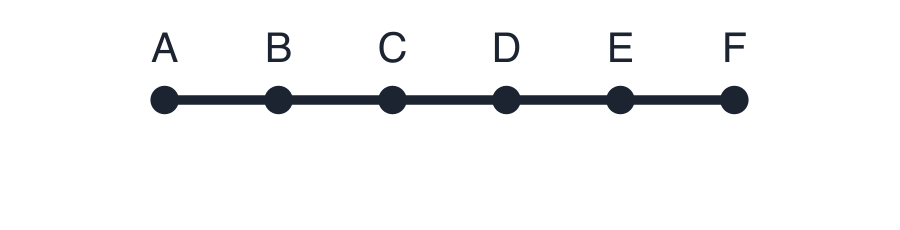
6. The figure below shows 6 distinct points marked on a single straight line. What is the total number of line segments whose endpoints are among the marked points?
A. 11 B. 36 C. 15 D. 5
7. In the figure below, triangle ABC has 1 straight line(s) drawn from the vertex A to the base BC. Count the total number of triangles in the given figure.

A. 4 B. 1 C. 5 D. 3
8. The figure below is a grid made of 3 rows and 5 columns of smallest cells (drawn using 4 horizontal and 6 vertical lines). Count the total number of squares (all sizes included) in the figure.

A. 28 B. 29 C. 52 D. 26
9. In the grid shown below, 7 rows and 4 columns of the smallest squares are formed using 8 horizontal and 5 vertical lines. Count the total number of rectangles (all sizes included) in the figure.

A. 308 B. 280 C. 276 D. 284
10. In the grid shown below, 4 rows and 3 columns of the smallest squares are formed using 5 horizontal and 4 vertical lines. What is the total number of squares of every size present in it?

A. 17 B. 12 C. 40 D. 20
11. In the figure below, triangle ABC has 4 straight line(s) drawn from the vertex A to the base BC. Count the total number of triangles in the given figure.

A. 14 B. 16 C. 17 D. 15
12. Study the figure: from the top vertex A of triangle ABC, 4 line(s) are drawn to points on the opposite side BC, and 2 straight line(s) parallel to BC are drawn across the triangle. How many triangles (of all sizes) are there in the figure?

A. 46 B. 48 C. 45 D. 30
13. Study the figure: from the top vertex A of triangle ABC, 2 line(s) are drawn to points on the opposite side BC, and 2 straight line(s) parallel to BC are drawn across the triangle. What is the total number of triangles formed in the figure?

A. 12 B. 9 C. 18 D. 8
14. Study the grid figure given below, formed by 4 horizontal lines and 4 vertical lines into 3 rows and 3 columns of unit cells. How many rectangles (of all sizes, not just the smallest cells) are there in the figure?

A. 34 B. 36 C. 15 D. 45
15. Study the figure: from the top vertex A of triangle ABC, 3 line(s) are drawn to points on the opposite side BC, and 2 straight line(s) parallel to BC are drawn across the triangle. How many triangles (of all sizes) are there in the figure?

A. 20 B. 29 C. 30 D. 10
16. The figure below is a grid made of 3 rows and 7 columns of smallest cells (drawn using 4 horizontal and 8 vertical lines). How many rectangles (of all sizes, not just the smallest cells) are there in the figure?

A. 21 B. 168 C. 164 D. 31
17. The figure below is a grid made of 4 rows and 6 columns of smallest cells (drawn using 5 horizontal and 7 vertical lines). Count the total number of rectangles (all sizes included) in the figure.

A. 234 B. 208 C. 186 D. 210
18. Study the grid figure given below, formed by 4 horizontal lines and 7 vertical lines into 3 rows and 6 columns of unit cells. Excluding the smallest 1×1 cells, what is the total number of squares of size 2×2 or larger?

A. 12 B. 16 C. 15 D. 14
19. The figure below is a grid made of 3 rows and 4 columns of smallest cells (drawn using 4 horizontal and 5 vertical lines). Count the total number of squares (all sizes included) in the figure.

A. 60 B. 18 C. 40 D. 20
20. In the figure below, triangle ABC has 2 straight line(s) drawn from the vertex A to the base BC, and 2 straight line(s) parallel to BC are drawn across the triangle. What is the total number of triangles formed in the figure?

A. 17 B. 8 C. 19 D. 18
21. In the figure, 6 points are marked on one straight line. What is the total number of line segments whose endpoints are among the marked points?
A. 15 B. 5 C. 16 D. 11
22. In the grid shown below, 9 rows and 7 columns of the smallest squares are formed using 10 horizontal and 8 vertical lines. Count only the squares of size 2×2 and above in the figure — how many are there in total?

A. 134 B. 63 C. 131 D. 133
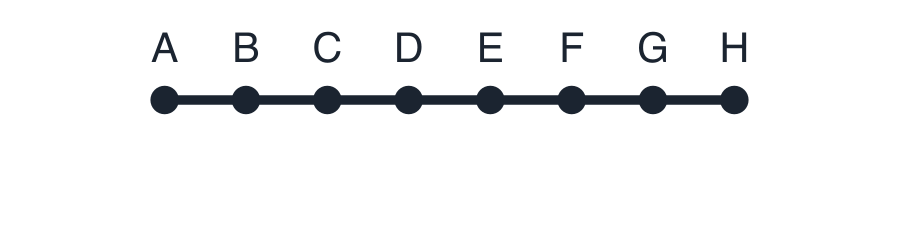
23. In the figure, 8 points are marked on one straight line. How many distinct line segments, with both endpoints at the marked points, can be counted in the figure?
A. 8 B. 28 C. 7 D. 16
24. In the figure below, triangle ABC has 7 straight line(s) drawn from the vertex A to the base BC, and 4 straight line(s) parallel to BC are drawn across the triangle. How many line segments (each running between two consecutive marked or intersection points) are there in the figure in total?

A. 14 B. 313 C. 315 D. 314
25. Study the grid figure given below, formed by 6 horizontal lines and 8 vertical lines into 5 rows and 7 columns of unit cells. Count the total number of rectangles (all sizes included) in the figure.

A. 47 B. 422 C. 420 D. 455
26. Study the figure: a rectangular frame is crossed by 3 straight lines, each running from one edge of the frame to another. At how many points do these lines intersect one another inside the rectangle (crossings with the rectangle's own boundary are not counted)?

A. 7 B. 6 C. 2 D. 3
27. In the figure below, 2 straight lines are drawn from edge to edge across a rectangle. Into how many separate regions do these lines divide the interior of the rectangle?

A. 3 B. 4 C. 5 D. 6
28. Study the figure: 2 overlapping circles are shown, each pair of circles intersecting. How many distinct bounded regions do the circles form (counting every enclosed part)?

A. 2 B. 3 C. 4 D. 5
29. Study the figure: a rectangular frame is crossed by 3 straight lines, each running from one edge of the frame to another. How many distinct regions (parts) is the rectangle divided into by the drawn lines?

A. 4 B. 8 C. 3 D. 7
30. In the figure below, 3 straight lines are drawn from edge to edge across a rectangle. At how many points do these lines intersect one another inside the rectangle (crossings with the rectangle's own boundary are not counted)?

A. 5 B. 3 C. 2 D. 4
31. In the figure below, 2 straight lines are drawn from edge to edge across a rectangle. How many distinct regions (parts) is the rectangle divided into by the drawn lines?

A. 5 B. 6 C. 1 D. 4
32. The figure below is a grid made of 2 rows and 3 columns of the smallest cells, drawn using 3 horizontal and 4 vertical straight lines. Counting only the bounded (enclosed) regions — not the single outer unbounded region — into how many parts does this figure divide the plane?
A. 8 B. 5 C. 18 D. 6
33. The figure below is a grid made of 4 rows and 4 columns of the smallest cells, drawn using 5 horizontal and 5 vertical straight lines. How many distinct straight LINES (not the shorter segments between intersection points, but full lines) are used to draw this figure?

A. 40 B. 9 C. 13 D. 10
34. In the grid shown below, 4 rows and 7 columns of the smallest cells are formed using exactly 5 horizontal and 8 vertical lines. How many distinct straight LINES (not the shorter segments between intersection points, but full lines) are used to draw this figure?

A. 13 B. 15 C. 11 D. 14
35. Study the figure: a rectangular frame is crossed by 3 straight lines, each running from one edge of the frame to another. How many distinct regions (parts) is the rectangle divided into by the drawn lines?

A. 8 B. 9 C. 6 D. 7
36. The figure below is a grid made of 7 rows and 3 columns of the smallest cells, drawn using 8 horizontal and 4 vertical straight lines. Counting each full horizontal or vertical line only once (not the segments it is cut into), how many distinct straight lines make up the figure?

A. 52 B. 12 C. 11 D. 21
37. Study the figure: a rectangular frame is crossed by 3 straight lines, each running from one edge of the frame to another. How many points of intersection are formed by the drawn lines inside the frame?

A. 9 B. 6 C. 3 D. 5
38. In the figure below, 3 straight lines are drawn from edge to edge across a rectangle. How many points of intersection are formed by the drawn lines inside the frame?

A. 3 B. 2 C. 4 D. 9
39. Study the figure: a rectangular frame is crossed by 4 straight lines, each running from one edge of the frame to another. How many points of intersection are formed by the drawn lines inside the frame?

A. 5 B. 11 C. 4 D. 6
40. In the figure below, 3 circles are drawn so that every two of them cross each other. At how many points do these circles cut one another?

A. 5 B. 7 C. 6 D. 8
41. In the figure below, 3 circles are drawn so that every two of them cross each other. Into how many separate enclosed regions is the area covered by the circles divided?

A. 7 B. 8 C. 3 D. 6
42. Study the figure: a rectangular frame is crossed by 4 straight lines, each running from one edge of the frame to another. Into how many separate regions do these lines divide the interior of the rectangle?

A. 12 B. 11 C. 9 D. 16
43. In the figure below, 4 straight lines are drawn from edge to edge across a rectangle. Into how many separate regions do these lines divide the interior of the rectangle?

A. 11 B. 6 C. 13 D. 8
44. Study the figure: 3 overlapping circles are shown, each pair of circles intersecting. Into how many separate enclosed regions is the area covered by the circles divided?

A. 9 B. 8 C. 3 D. 7
45. In the grid shown below, 4 rows and 3 columns of the smallest cells are formed using exactly 5 horizontal and 4 vertical lines. How many distinct straight LINES (not the shorter segments between intersection points, but full lines) are used to draw this figure?
A. 11 B. 10 C. 12 D. 9
46. The figure below is a grid made of 3 rows and 7 columns of the smallest cells, drawn using 4 horizontal and 8 vertical straight lines. How many distinct straight LINES (not the shorter segments between intersection points, but full lines) are used to draw this figure?
A. 10 B. 12 C. 13 D. 52
47. Study the grid figure given below, formed by 5 horizontal lines and 5 vertical lines arranged into 4 rows and 4 columns of unit cells. Counting only the bounded (enclosed) regions — not the single outer unbounded region — into how many parts does this figure divide the plane?
A. 17 B. 8 C. 20 D. 16
48. In the grid shown below, 8 rows and 5 columns of the smallest cells are formed using exactly 9 horizontal and 6 vertical lines. Counting only the bounded (enclosed) regions — not the single outer unbounded region — into how many parts does this figure divide the plane?

A. 40 B. 54 C. 540 D. 13
49. In the figure below, 3 circles are drawn so that every two of them cross each other. How many points of intersection do the circles have in total?

A. 8 B. 6 C. 3 D. 7
50. Study the grid figure given below, formed by 7 horizontal lines and 6 vertical lines arranged into 6 rows and 5 columns of unit cells. Counting each full horizontal or vertical line only once (not the segments it is cut into), how many distinct straight lines make up the figure?

A. 13 B. 71 C. 15 D. 11
Answers and explanations
After checking the key, explain the rule or diagram transformation to yourself before moving on.
1. C. Choosing any 2 of the 7 horizontal lines and any 2 of the 5 vertical lines as the sides of a rectangle gives every rectangle in the figure exactly once. Total rectangles = C(7,2) × C(5,2) = 21 × 10 = 210.
APRS26-16-01 | Counting rectangles — 6×4 grid | Easy
2. D. Every line in the figure except the base BC passes through A (the two sides AB, AC and the 2 drawn line(s)), so every triangle has A as a vertex and a part of BC as its base. Choosing any 2 of the 4 lines through A gives one triangle: C(4, 2) = 6.
APRS26-16-02 | Counting triangles — fan of 2 line(s) from the apex | Easy
3. A. For each square size k×k (k = 1 to 2), the number of positions it can occupy is (2−k+1)×(3−k+1). Total squares = (2−1+1)×(3−1+1) + (2−2+1)×(3−2+1) = 8.
APRS26-16-03 | Counting squares — 2×3 grid | Easy
4. D. For each square size k×k (k = 1 to 4), the number of positions it can occupy is (6−k+1)×(4−k+1). Total squares = (6−1+1)×(4−1+1) + (6−2+1)×(4−2+1) + (6−3+1)×(4−3+1) + (6−4+1)×(4−4+1) = 50.
APRS26-16-04 | Counting squares — 6×4 grid | Easy
5. D. Every line in the figure except the base BC passes through A (the two sides AB, AC and the 2 drawn line(s)), so every triangle has A as a vertex and a part of BC as its base. Choosing any 2 of the 4 lines through A gives one triangle: C(4, 2) = 6.
APRS26-16-05 | Counting triangles — fan of 2 line(s) from the apex | Easy
6. C. A segment is fixed by choosing its two endpoints from the 6 marked points. Number of segments = C(6, 2) = 6×5/2 = 15.
APRS26-16-06 | Counting line segments — 6 collinear points | Easy
7. D. Every line in the figure except the base BC passes through A (the two sides AB, AC and the 1 drawn line(s)), so every triangle has A as a vertex and a part of BC as its base. Choosing any 2 of the 3 lines through A gives one triangle: C(3, 2) = 3.
APRS26-16-07 | Counting triangles — fan of 1 line(s) from the apex | Easy
8. D. For each square size k×k (k = 1 to 3), the number of positions it can occupy is (3−k+1)×(5−k+1). Total squares = (3−1+1)×(5−1+1) + (3−2+1)×(5−2+1) + (3−3+1)×(5−3+1) = 26.
APRS26-16-08 | Counting squares — 3×5 grid | Easy
9. B. Choosing any 2 of the 8 horizontal lines and any 2 of the 5 vertical lines as the sides of a rectangle gives every rectangle in the figure exactly once. Total rectangles = C(8,2) × C(5,2) = 28 × 10 = 280.
APRS26-16-09 | Counting rectangles — 7×4 grid | Medium
10. D. For each square size k×k (k = 1 to 3), the number of positions it can occupy is (4−k+1)×(3−k+1). Total squares = (4−1+1)×(3−1+1) + (4−2+1)×(3−2+1) + (4−3+1)×(3−3+1) = 20.
APRS26-16-10 | Counting squares — 4×3 grid | Medium
11. D. Every line in the figure except the base BC passes through A (the two sides AB, AC and the 4 drawn line(s)), so every triangle has A as a vertex and a part of BC as its base. Choosing any 2 of the 6 lines through A gives one triangle: C(6, 2) = 15.
APRS26-16-11 | Counting triangles — fan of 4 line(s) from the apex | Medium
12. C. The 6 lines through A (sides AB, AC and the 4 drawn line(s)) give C(6, 2) = 15 triangles with base on BC. The 2 parallel line(s) plus BC give 3 possible bases, each producing the same 15 triangles (lines parallel to BC never form a triangle with each other). Total = 15 × 3 = 45.
APRS26-16-12 | Counting triangles — fan of 4 line(s) with 2 parallel(s) to the base | Medium
13. C. The 4 lines through A (sides AB, AC and the 2 drawn line(s)) give C(4, 2) = 6 triangles with base on BC. The 2 parallel line(s) plus BC give 3 possible bases, each producing the same 6 triangles (lines parallel to BC never form a triangle with each other). Total = 6 × 3 = 18.
APRS26-16-13 | Counting triangles — fan of 2 line(s) with 2 parallel(s) to the base | Medium
14. B. Choosing any 2 of the 4 horizontal lines and any 2 of the 4 vertical lines as the sides of a rectangle gives every rectangle in the figure exactly once. Total rectangles = C(4,2) × C(4,2) = 6 × 6 = 36.
APRS26-16-14 | Counting rectangles — 3×3 grid | Medium
15. C. The 5 lines through A (sides AB, AC and the 3 drawn line(s)) give C(5, 2) = 10 triangles with base on BC. The 2 parallel line(s) plus BC give 3 possible bases, each producing the same 10 triangles (lines parallel to BC never form a triangle with each other). Total = 10 × 3 = 30.
APRS26-16-15 | Counting triangles — fan of 3 line(s) with 2 parallel(s) to the base | Medium
16. B. Choosing any 2 of the 4 horizontal lines and any 2 of the 8 vertical lines as the sides of a rectangle gives every rectangle in the figure exactly once. Total rectangles = C(4,2) × C(8,2) = 6 × 28 = 168.
APRS26-16-16 | Counting rectangles — 3×7 grid | Medium
17. D. Choosing any 2 of the 5 horizontal lines and any 2 of the 7 vertical lines as the sides of a rectangle gives every rectangle in the figure exactly once. Total rectangles = C(5,2) × C(7,2) = 10 × 21 = 210.
APRS26-16-17 | Counting rectangles — 4×6 grid | Medium
18. D. Total squares of all sizes = 32 (using Σ (3−k+1)(6−k+1) for k = 1 to 3). Subtracting the 18 unit (1×1) squares, or equivalently summing only k = 2 to 3: (3−2+1)×(6−2+1) + (3−3+1)×(6−3+1) = 14.
APRS26-16-18 | Counting squares (size ≥ 2×2) — 3×6 grid | Medium
19. D. For each square size k×k (k = 1 to 3), the number of positions it can occupy is (3−k+1)×(4−k+1). Total squares = (3−1+1)×(4−1+1) + (3−2+1)×(4−2+1) + (3−3+1)×(4−3+1) = 20.
APRS26-16-19 | Counting squares — 3×4 grid | Medium
20. D. The 4 lines through A (sides AB, AC and the 2 drawn line(s)) give C(4, 2) = 6 triangles with base on BC. The 2 parallel line(s) plus BC give 3 possible bases, each producing the same 6 triangles (lines parallel to BC never form a triangle with each other). Total = 6 × 3 = 18.
APRS26-16-20 | Counting triangles — fan of 2 line(s) with 2 parallel(s) to the base | Medium
21. A. A segment is fixed by choosing its two endpoints from the 6 marked points. Number of segments = C(6, 2) = 6×5/2 = 15.
APRS26-16-21 | Counting line segments — 6 collinear points | Medium
22. D. Total squares of all sizes = 196 (using Σ (9−k+1)(7−k+1) for k = 1 to 7). Subtracting the 63 unit (1×1) squares, or equivalently summing only k = 2 to 7: (9−2+1)×(7−2+1) + (9−3+1)×(7−3+1) + (9−4+1)×(7−4+1) + (9−5+1)×(7−5+1) + (9−6+1)×(7−6+1) + (9−7+1)×(7−7+1) = 133.
APRS26-16-22 | Counting squares (size ≥ 2×2) — 9×7 grid | Difficult
23. B. A segment is fixed by choosing its two endpoints from the 8 marked points. Number of segments = C(8, 2) = 8×7/2 = 28.
APRS26-16-23 | Counting line segments — 8 collinear points | Difficult
24. C. Base BC has 9 points on it (B, C and the 7 foot(s) of the drawn lines) → C(9,2) = 36 segments. Each of the 9 lines through A (AB, AC and the 7 drawn lines) is cut into 6 points by the base and the 4 parallel(s) → C(6,2) = 15 segments each, i.e. 9×15 = 135. Each of the 4 parallel line(s) is cut by AB, AC and the 7 drawn lines into 9 points → C(9,2) = 36 segments each, i.e. 144. Total = 36 + 135 + 144 = 315.
APRS26-16-24 | Counting line segments — fan of 7 line(s) with 4 parallel(s) | Difficult
25. C. Choosing any 2 of the 6 horizontal lines and any 2 of the 8 vertical lines as the sides of a rectangle gives every rectangle in the figure exactly once. Total rectangles = C(6,2) × C(8,2) = 15 × 28 = 420.
APRS26-16-25 | Counting rectangles — 5×7 grid | Difficult
26. D. Every pair of the 3 lines crosses exactly once inside the rectangle and no three lines meet at one point, so the number of intersection points equals the number of pairs of lines: C(3, 2) = 3×2/2 = 3. (Counting directly on the figure gives the same 3 crossings.)
APRS26-16-26 | Intersection points — 3 lines across a rectangle | Easy
27. B. Start with 1 region (the empty rectangle). Each new line adds one region for itself plus one more for every earlier line it crosses. Here every pair of lines crosses inside the rectangle (1 crossing points in all), so regions = 1 + 2 + 1 = 4.
APRS26-16-27 | Regions formed — 2 lines across a rectangle | Easy
28. B. Adding circles one at a time: the 1st circle encloses 1 region; each later circle crosses every earlier circle twice, so the i-th circle adds 2(i − 1) regions. Total bounded regions = 1 + 2 + 4 + … = 2² − 2 + 1 = 3.
APRS26-16-28 | Enclosed regions — 2 overlapping circles | Easy
29. D. Start with 1 region (the empty rectangle). Each new line adds one region for itself plus one more for every earlier line it crosses. Here every pair of lines crosses inside the rectangle (3 crossing points in all), so regions = 1 + 3 + 3 = 7.
APRS26-16-29 | Regions formed — 3 lines across a rectangle | Easy
30. B. Every pair of the 3 lines crosses exactly once inside the rectangle and no three lines meet at one point, so the number of intersection points equals the number of pairs of lines: C(3, 2) = 3×2/2 = 3. (Counting directly on the figure gives the same 3 crossings.)
APRS26-16-30 | Intersection points — 3 lines across a rectangle | Easy
31. D. Start with 1 region (the empty rectangle). Each new line adds one region for itself plus one more for every earlier line it crosses. Here every pair of lines crosses inside the rectangle (1 crossing points in all), so regions = 1 + 2 + 1 = 4.
APRS26-16-31 | Regions formed — 2 lines across a rectangle | Easy
32. D. The grid has 2 rows and 3 columns of smallest cells, and each smallest cell is exactly one bounded region (the outer, unbounded region is not counted). Number of enclosed regions = 2 × 3 = 6.
APRS26-16-32 | Enclosed regions — 2×3 grid | Easy
33. D. The figure is drawn with 5 horizontal lines and 5 vertical lines, each counted once regardless of how many times it is crossed. Total distinct lines = 5 + 5 = 10. (This is different from the number of short segments between intersection points, which would instead be C×(R+1) + R×(C+1) = 40.)
APRS26-16-33 | Distinct lines — 4×4 grid | Easy
34. A. The figure is drawn with 5 horizontal lines and 8 vertical lines, each counted once regardless of how many times it is crossed. Total distinct lines = 5 + 8 = 13. (This is different from the number of short segments between intersection points, which would instead be C×(R+1) + R×(C+1) = 67.)
APRS26-16-34 | Distinct lines — 4×7 grid | Medium
35. D. Start with 1 region (the empty rectangle). Each new line adds one region for itself plus one more for every earlier line it crosses. Here every pair of lines crosses inside the rectangle (3 crossing points in all), so regions = 1 + 3 + 3 = 7.
APRS26-16-35 | Regions formed — 3 lines across a rectangle | Medium
36. B. The figure is drawn with 8 horizontal lines and 4 vertical lines, each counted once regardless of how many times it is crossed. Total distinct lines = 8 + 4 = 12. (This is different from the number of short segments between intersection points, which would instead be C×(R+1) + R×(C+1) = 52.)
APRS26-16-36 | Distinct lines — 7×3 grid | Medium
37. C. Every pair of the 3 lines crosses exactly once inside the rectangle and no three lines meet at one point, so the number of intersection points equals the number of pairs of lines: C(3, 2) = 3×2/2 = 3. (Counting directly on the figure gives the same 3 crossings.)
APRS26-16-37 | Intersection points — 3 lines across a rectangle | Medium
38. A. Every pair of the 3 lines crosses exactly once inside the rectangle and no three lines meet at one point, so the number of intersection points equals the number of pairs of lines: C(3, 2) = 3×2/2 = 3. (Counting directly on the figure gives the same 3 crossings.)
APRS26-16-38 | Intersection points — 3 lines across a rectangle | Medium
39. D. Every pair of the 4 lines crosses exactly once inside the rectangle and no three lines meet at one point, so the number of intersection points equals the number of pairs of lines: C(4, 2) = 4×3/2 = 6. (Counting directly on the figure gives the same 6 crossings.)
APRS26-16-39 | Intersection points — 4 lines across a rectangle | Medium
40. C. Every pair of circles meets in exactly 2 points and no point lies on three circles, so the number of intersection points = 2 × C(3, 2) = 2 × 3 = 6.
APRS26-16-40 | Intersection points — 3 overlapping circles | Medium
41. A. Adding circles one at a time: the 1st circle encloses 1 region; each later circle crosses every earlier circle twice, so the i-th circle adds 2(i − 1) regions. Total bounded regions = 1 + 2 + 4 + … = 3² − 3 + 1 = 7.
APRS26-16-41 | Enclosed regions — 3 overlapping circles | Medium
42. B. Start with 1 region (the empty rectangle). Each new line adds one region for itself plus one more for every earlier line it crosses. Here every pair of lines crosses inside the rectangle (6 crossing points in all), so regions = 1 + 4 + 6 = 11.
APRS26-16-42 | Regions formed — 4 lines across a rectangle | Medium
43. A. Start with 1 region (the empty rectangle). Each new line adds one region for itself plus one more for every earlier line it crosses. Here every pair of lines crosses inside the rectangle (6 crossing points in all), so regions = 1 + 4 + 6 = 11.
APRS26-16-43 | Regions formed — 4 lines across a rectangle | Medium
44. D. Adding circles one at a time: the 1st circle encloses 1 region; each later circle crosses every earlier circle twice, so the i-th circle adds 2(i − 1) regions. Total bounded regions = 1 + 2 + 4 + … = 3² − 3 + 1 = 7.
APRS26-16-44 | Enclosed regions — 3 overlapping circles | Medium
45. D. The figure is drawn with 5 horizontal lines and 4 vertical lines, each counted once regardless of how many times it is crossed. Total distinct lines = 5 + 4 = 9. (This is different from the number of short segments between intersection points, which would instead be C×(R+1) + R×(C+1) = 31.)
APRS26-16-45 | Distinct lines — 4×3 grid | Medium
46. B. The figure is drawn with 4 horizontal lines and 8 vertical lines, each counted once regardless of how many times it is crossed. Total distinct lines = 4 + 8 = 12. (This is different from the number of short segments between intersection points, which would instead be C×(R+1) + R×(C+1) = 52.)
APRS26-16-46 | Distinct lines — 3×7 grid | Medium
47. D. The grid has 4 rows and 4 columns of smallest cells, and each smallest cell is exactly one bounded region (the outer, unbounded region is not counted). Number of enclosed regions = 4 × 4 = 16.
APRS26-16-47 | Enclosed regions — 4×4 grid | Difficult
48. A. The grid has 8 rows and 5 columns of smallest cells, and each smallest cell is exactly one bounded region (the outer, unbounded region is not counted). Number of enclosed regions = 8 × 5 = 40.
APRS26-16-48 | Enclosed regions — 8×5 grid | Difficult
49. B. Every pair of circles meets in exactly 2 points and no point lies on three circles, so the number of intersection points = 2 × C(3, 2) = 2 × 3 = 6.
APRS26-16-49 | Intersection points — 3 overlapping circles | Difficult
50. A. The figure is drawn with 7 horizontal lines and 6 vertical lines, each counted once regardless of how many times it is crossed. Total distinct lines = 7 + 6 = 13. (This is different from the number of short segments between intersection points, which would instead be C×(R+1) + R×(C+1) = 71.)
APRS26-16-50 | Distinct lines — 6×5 grid | Difficult