Opposite faces never touch
A cube has six faces arranged in three opposite pairs. When a net is folded, faces on opposite sides cannot be seen together from one corner. In a standard cross-shaped net, the two squares attached on opposite sides of the centre often become opposite, but verify the actual net rather than using a memorised template. Mark a central face, fold adjacent faces upward in your mind and track the last flap that closes the cube.
Three visible faces meet at a corner
Any drawing of a cube from one corner shows exactly one face from each opposite pair. This gives a fast elimination test: if an option shows two known opposite faces together, it is impossible. But passing the opposite-face test may not be sufficient. The clockwise order of three labels around the visible corner also matters. Mirror-image cube arrangements cannot be obtained by rotating the physical cube.
Compare two views
If two dice views show one face in common, hold that common face fixed and compare the neighbours in order. The faces that are exposed in one view and replaced in the other may be opposite, depending on the exact views. Do not infer opposites from a single drawing where only three faces appear. Sketch the three opposite pairs as A↔D, B↔E, C↔F once determined, then test all options systematically.
Count painted cubes carefully
When a large cube is divided into small cubes and outer faces are painted, corner cubes have three painted faces, non-corner edge cubes have two, interior face cubes have one, and fully interior cubes have none. For n small cubes per edge, the counts are 8, 12(n−2), 6(n−2)² and (n−2)³ respectively when n≥2. Verify that these four counts sum to n³. Some practice items concern cuboids; use separate edge lengths rather than applying the cube formula blindly.
Practice — 50 questions
Attempt every item before reading the answers below. Figure questions require the printed or on-screen diagram.
1. The sheet of paper shown below is folded along the lines to form a cube. Which of the following options shows a cube that CAN be formed from this sheet?
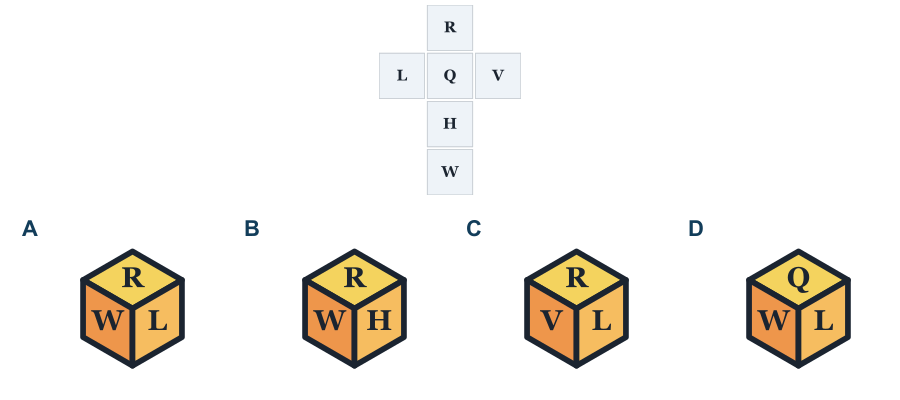
2. The sheet of paper shown below is folded along the lines to form a cube. Which of the following options shows a cube that CAN be formed from this sheet?
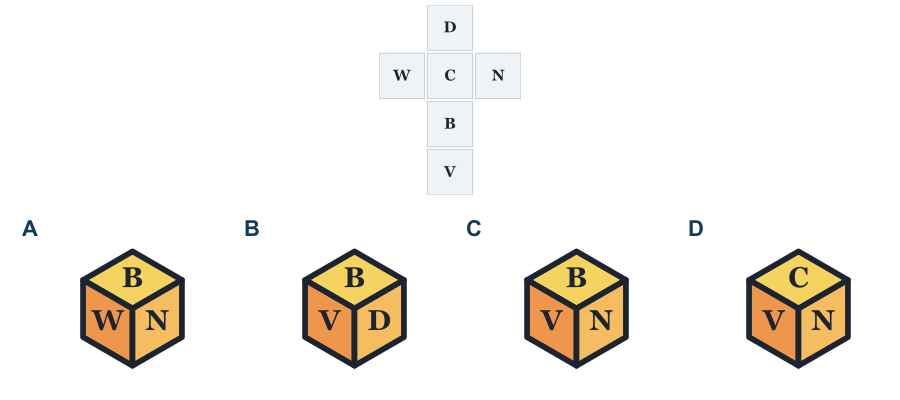
3. The sheet of paper shown below is folded along the lines to form a cube. Which of the following options shows a cube that CAN be formed from this sheet?
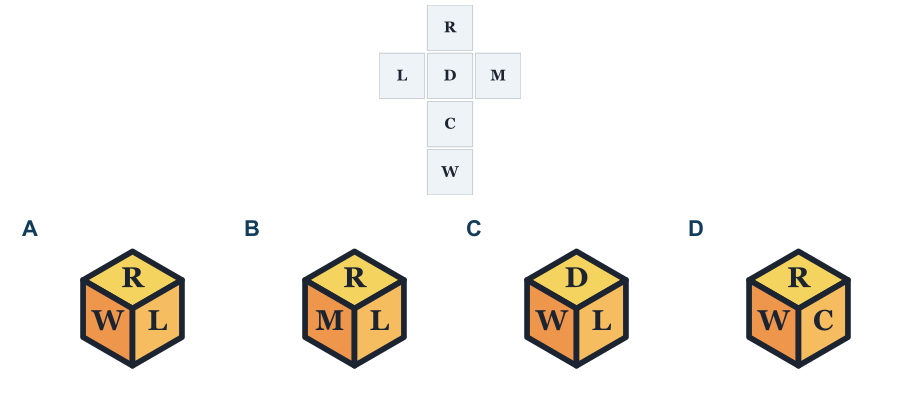
4. The sheet of paper shown below is folded along the lines to form a cube. Which of the following options shows a cube that CAN be formed from this sheet?
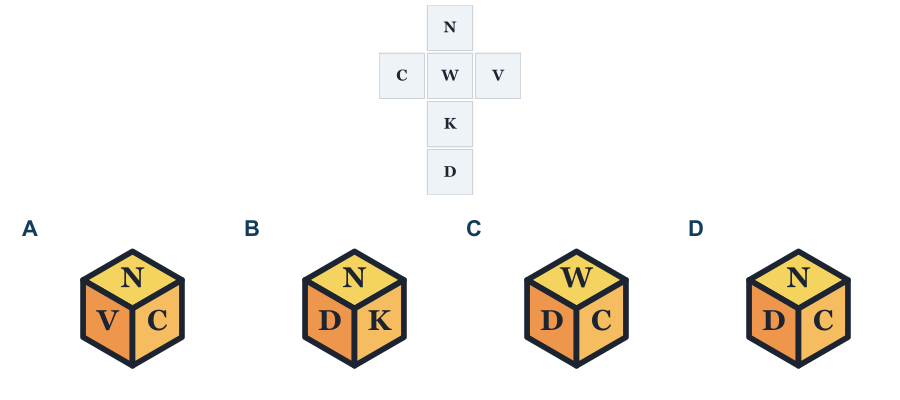
5. The sheet of paper shown below is folded along the lines to form a cube. Which of the following options shows a cube that CAN be formed from this sheet?
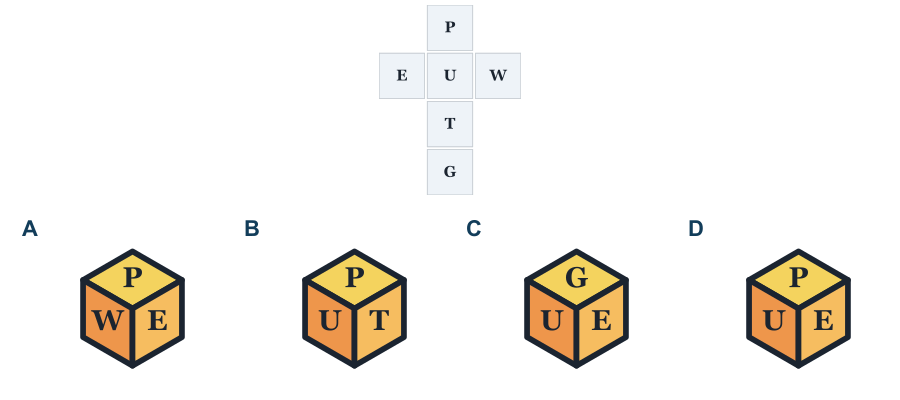
6. The sheet of paper shown below is folded along the lines to form a cube. Which of the following options shows a cube that CAN be formed from this sheet?
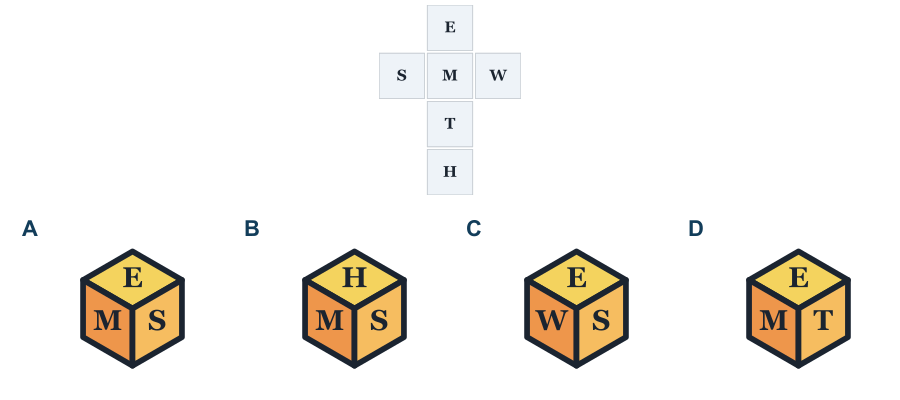
7. The sheet of paper shown below is folded along the lines to form a cube. Which of the following options shows a cube that CAN be formed from this sheet?
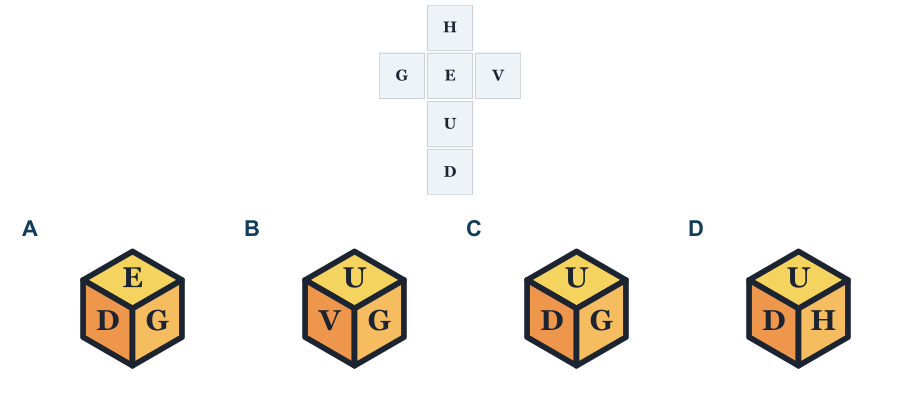
8. The sheet of paper shown below is folded along the lines to form a cube. Which of the following options shows a cube that CAN be formed from this sheet?
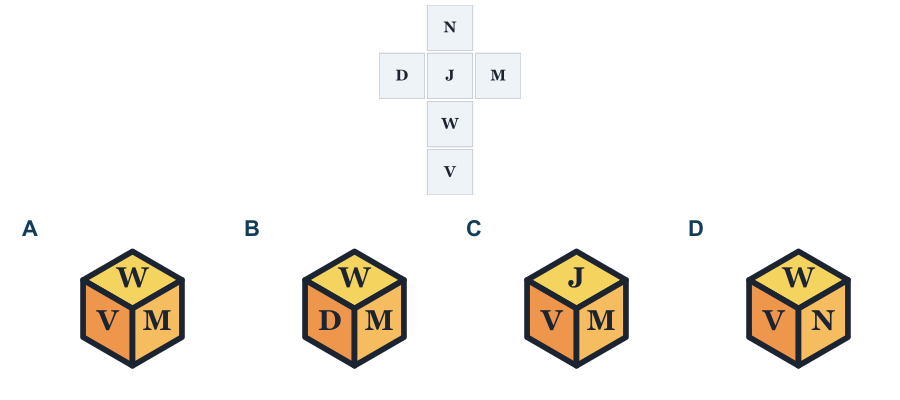
9. Two positions of the same dice are shown above (Position 1 and Position 2), each showing three of its faces. The face marked '6' appears in both positions. Which face is opposite to the face marked '6'?

A. 5 B. 3 C. 1 D. 2
10. Two positions of the same dice are shown above (Position 1 and Position 2), each showing three of its faces. The face marked 'L' appears in both positions. Which face is opposite to the face marked 'L'?

A. E B. Q C. P D. B
11. Two positions of the same dice are shown above (Position 1 and Position 2), each showing three of its faces. The face marked '5' appears in both positions. Which face is opposite to the face marked '5'?

A. 4 B. 2 C. 3 D. 1
12. Two positions of the same dice are shown above (Position 1 and Position 2), each showing three of its faces. The face marked 'A' appears in both positions. Which face is opposite to the face marked 'A'?

A. D B. G C. H D. R
13. Two positions of the same dice are shown above (Position 1 and Position 2), each showing three of its faces. The face marked '3' appears in both positions. Which face is opposite to the face marked '3'?

A. 2 B. 4 C. 1 D. 5
14. Two positions of the same dice are shown above (Position 1 and Position 2), each showing three of its faces. The face marked '2' appears in both positions. Which face is opposite to the face marked '2'?

A. 5 B. 6 C. 1 D. 3
15. Two positions of the same dice are shown above (Position 1 and Position 2), each showing three of its faces. The face marked 'U' appears in both positions. Which face is opposite to the face marked 'U'?

A. J B. D C. A D. E
16. Two positions of the same dice are shown above (Position 1 and Position 2), each showing three of its faces. The face marked 'C' appears in both positions. Which face is opposite to the face marked 'C'?

A. T B. G C. K D. M
17. Two positions of the same dice are shown above (Position 1 and Position 2), each showing three of its faces. The face marked '4' appears in both positions. Which face is opposite to the face marked '4'?

A. 5 B. 3 C. 1 D. 6
18. Two positions of the same dice are shown above (Position 1 and Position 2), each showing three of its faces. The face marked 'G' appears in both positions. Which face is opposite to the face marked 'G'?

A. J B. U C. L D. B
19. Two positions of the same dice are shown above (Position 1 and Position 2), each showing three of its faces. The face marked '4' appears in both positions. Which face is opposite to the face marked '4'?

A. 5 B. 3 C. 6 D. 1
20. Two positions of the same dice are shown above (Position 1 and Position 2), each showing three of its faces. The face marked '5' appears in both positions. Which face is opposite to the face marked '5'?

A. 3 B. 4 C. 6 D. 2
21. Two positions of the same dice are shown above (Position 1 and Position 2), each showing three of its faces. The face marked '3' appears in both positions. Which face is opposite to the face marked '3'?

A. 1 B. 5 C. 6 D. 4
22. Three positions of the same dice are shown above (Position 1, Position 2, Position 3), each showing three of its faces. Using any positions that share a common face, find which face is opposite to the face marked '6'.
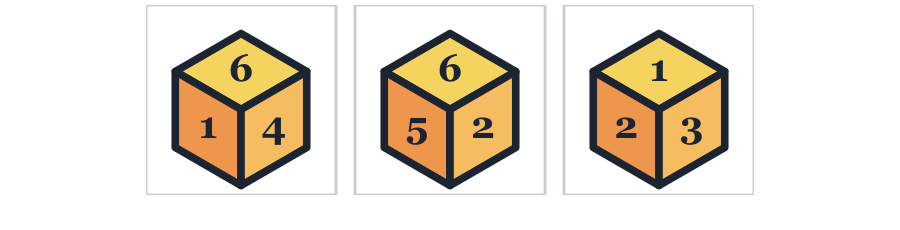
A. 4 B. 3 C. 2 D. 1
23. The sheet of paper shown below is folded along the lines to form a cube. Which of the following options shows a cube that CAN be formed from this sheet?
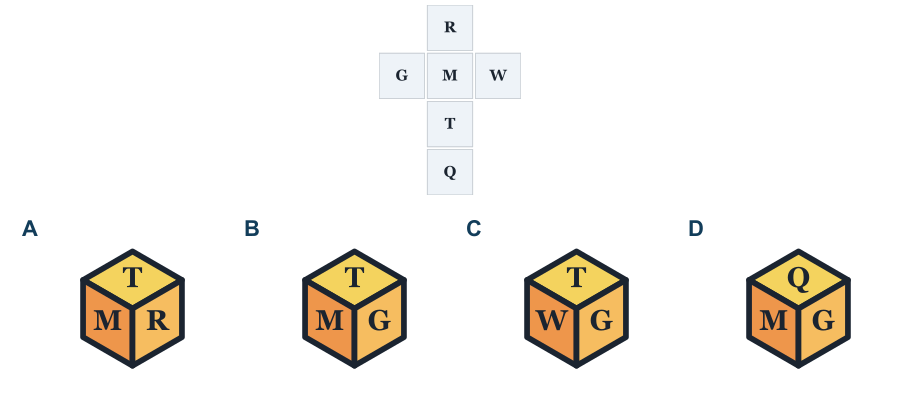
24. The sheet of paper shown below is folded along the lines to form a cube. Which of the following options shows a cube that CAN be formed from this sheet?
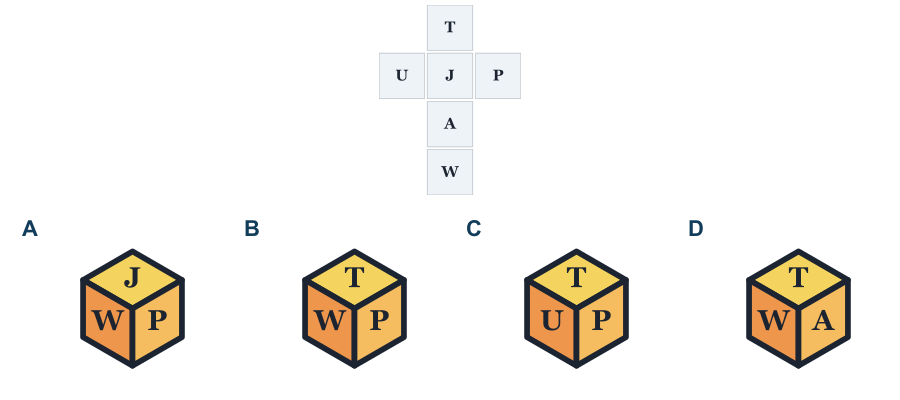
25. The sheet of paper shown below is folded along the lines to form a cube. Which of the following options shows a cube that CAN be formed from this sheet?
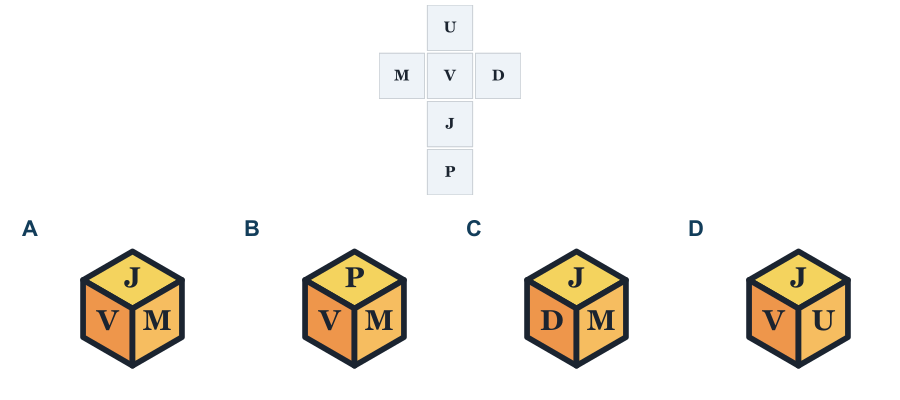
26. A cube of side 4 cm, painted black on the outside, is cut into unit cubes of side 1 cm. How many of the resulting unit cubes have no face painted?
A. 8 B. 5 C. 6 D. 7
27. A cube of side 4 cm, painted red on the outside, is cut into unit cubes of side 1 cm. How many of the resulting unit cubes have exactly one face painted?
A. 23 B. 25 C. 20 D. 24
28. A cube of side 5 cm is painted green on all its outer surfaces and then cut into unit cubes of side 1 cm. How many unit cubes have exactly two faces painted?
A. 34 B. 32 C. 37 D. 36
29. A carpenter paints black on every outer face of a cube of side 3 cm and then saws it into unit cubes of side 1 cm. How many of these unit cubes have exactly two faces painted?
A. 16 B. 12 C. 13 D. 11
30. All the outer surfaces of a cube of side 4 cm are coloured black. It is then cut into unit cubes of side 1 cm. Find the number of unit cubes with exactly one face painted.
A. 27 B. 26 C. 24 D. 22
31. A carpenter paints red on every outer face of a cube of side 4 cm and then saws it into unit cubes of side 1 cm. How many of these unit cubes have exactly three faces painted?
A. 12 B. 11 C. 9 D. 8
32. A cube of side 3 cm, painted red on the outside, is cut into unit cubes of side 1 cm. How many of the resulting unit cubes have exactly three faces painted?
A. 4 B. 12 C. 6 D. 8
33. A cube of side 5 cm, painted red on the outside, is cut into unit cubes of side 1 cm. How many of the resulting unit cubes have exactly three faces painted?
A. 9 B. 8 C. 10 D. 7
34. A cube of side 6 cm is painted blue on all its outer surfaces and then cut into unit cubes of side 1 cm. How many unit cubes have no face painted?
A. 62 B. 64 C. 66 D. 63
35. A carpenter paints blue on every outer face of a cube of side 5 cm and then saws it into unit cubes of side 1 cm. How many of these unit cubes have exactly three faces painted?
A. 5 B. 8 C. 10 D. 7
36. A cuboid of dimensions 5 cm × 4 cm × 5 cm is painted green on all its outer surfaces and then cut into unit cubes of side 1 cm. How many unit cubes have no face painted?
A. 22 B. 20 C. 18 D. 16
37. A cube of side 6 cm is painted black on all its outer surfaces and then cut into unit cubes of side 1 cm. How many unit cubes have exactly two faces painted?
A. 48 B. 50 C. 51 D. 46
38. All the outer surfaces of a cube of side 5 cm are coloured yellow. It is then cut into unit cubes of side 1 cm. Find the number of unit cubes with exactly two faces painted.
A. 35 B. 37 C. 36 D. 34
39. A carpenter paints red on every outer face of a cube of side 6 cm and then saws it into unit cubes of side 1 cm. How many of these unit cubes have exactly two faces painted?
A. 51 B. 45 C. 48 D. 47
40. A cube of side 5 cm is painted yellow on all its outer surfaces and then cut into unit cubes of side 1 cm. How many unit cubes have exactly three faces painted?
A. 8 B. 5 C. 4 D. 6
41. A carpenter paints black on every outer face of a cube of side 6 cm and then saws it into unit cubes of side 1 cm. How many of these unit cubes have exactly two faces painted?
A. 52 B. 46 C. 44 D. 48
42. All the outer surfaces of a cuboid of dimensions 5 cm × 5 cm × 3 cm are coloured red. It is then cut into unit cubes of side 1 cm. Find the number of unit cubes with exactly three faces painted.
A. 8 B. 11 C. 12 D. 5
43. A cube of side 6 cm is painted black on all its outer surfaces and then cut into unit cubes of side 1 cm. How many unit cubes have exactly three faces painted?
A. 4 B. 12 C. 5 D. 8
44. A cuboid of dimensions 6 cm × 3 cm × 5 cm, painted green on the outside, is cut into unit cubes of side 1 cm. How many of the resulting unit cubes have exactly one face painted?
A. 34 B. 39 C. 42 D. 38
45. A cube of side 6 cm, painted red on the outside, is cut into unit cubes of side 1 cm. How many of the resulting unit cubes have exactly one face painted?
A. 100 B. 96 C. 95 D. 93
46. A carpenter paints green on every outer face of a cube of side 6 cm and then saws it into unit cubes of side 1 cm. How many of these unit cubes have exactly two faces painted?
A. 46 B. 45 C. 44 D. 48
47. A cuboid of dimensions 7 cm × 6 cm × 3 cm has its top and bottom faces painted black and its remaining four side faces painted green. It is then cut into unit cubes of side 1 cm. How many unit cubes have exactly one black face and exactly one green face?
A. 39 B. 35 C. 36 D. 34
48. A cube of side 8 cm is painted green on all its outer surfaces and then cut into unit cubes of side 1 cm. How many unit cubes have exactly two faces painted?
A. 73 B. 72 C. 68 D. 76
49. A cuboid of dimensions 8 cm × 5 cm × 4 cm has its top and bottom faces painted black and its remaining four side faces painted blue. It is then cut into unit cubes of side 1 cm. How many unit cubes have exactly one black face and exactly one blue face?
A. 39 B. 32 C. 36 D. 37
50. A cube of side 8 cm is painted black on all its outer surfaces and then cut into unit cubes of side 1 cm. How many unit cubes have no face painted?
A. 217 B. 214 C. 216 D. 220
Answers and explanations
After checking the key, explain the rule or diagram transformation to yourself before moving on.
1. A. Folding this net (Top/Bottom fold up-and-down from Front, Left/Right fold back from Front's side edges, and Back folds around from beyond Bottom to land opposite Front) fixes the opposite-face pairs as Front↔Back, Top↔Bottom, Left↔Right. Here that means Q↔W, R↔H, L↔V. Any 3 faces seen together must contain exactly one label from each pair — the correct option shows {R, W, L}, one from each pair. The other options each show two labels from the SAME pair together (e.g. W with Q, or similar) — impossible, since opposite faces of a cube can never both be visible at once.
APRS26-15-01 | Net to cube | Easy
2. C. Folding this net (Top/Bottom fold up-and-down from Front, Left/Right fold back from Front's side edges, and Back folds around from beyond Bottom to land opposite Front) fixes the opposite-face pairs as Front↔Back, Top↔Bottom, Left↔Right. Here that means C↔V, D↔B, W↔N. Any 3 faces seen together must contain exactly one label from each pair — the correct option shows {B, V, N}, one from each pair. The other options each show two labels from the SAME pair together (e.g. V with C, or similar) — impossible, since opposite faces of a cube can never both be visible at once.
APRS26-15-02 | Net to cube | Easy
3. A. Folding this net (Top/Bottom fold up-and-down from Front, Left/Right fold back from Front's side edges, and Back folds around from beyond Bottom to land opposite Front) fixes the opposite-face pairs as Front↔Back, Top↔Bottom, Left↔Right. Here that means D↔W, R↔C, L↔M. Any 3 faces seen together must contain exactly one label from each pair — the correct option shows {R, W, L}, one from each pair. The other options each show two labels from the SAME pair together (e.g. W with D, or similar) — impossible, since opposite faces of a cube can never both be visible at once.
APRS26-15-03 | Net to cube | Easy
4. D. Folding this net (Top/Bottom fold up-and-down from Front, Left/Right fold back from Front's side edges, and Back folds around from beyond Bottom to land opposite Front) fixes the opposite-face pairs as Front↔Back, Top↔Bottom, Left↔Right. Here that means W↔D, N↔K, C↔V. Any 3 faces seen together must contain exactly one label from each pair — the correct option shows {N, D, C}, one from each pair. The other options each show two labels from the SAME pair together (e.g. D with W, or similar) — impossible, since opposite faces of a cube can never both be visible at once.
APRS26-15-04 | Net to cube | Easy
5. D. Folding this net (Top/Bottom fold up-and-down from Front, Left/Right fold back from Front's side edges, and Back folds around from beyond Bottom to land opposite Front) fixes the opposite-face pairs as Front↔Back, Top↔Bottom, Left↔Right. Here that means U↔G, P↔T, E↔W. Any 3 faces seen together must contain exactly one label from each pair — the correct option shows {P, U, E}, one from each pair. The other options each show two labels from the SAME pair together (e.g. U with G, or similar) — impossible, since opposite faces of a cube can never both be visible at once.
APRS26-15-05 | Net to cube | Easy
6. A. Folding this net (Top/Bottom fold up-and-down from Front, Left/Right fold back from Front's side edges, and Back folds around from beyond Bottom to land opposite Front) fixes the opposite-face pairs as Front↔Back, Top↔Bottom, Left↔Right. Here that means M↔H, E↔T, S↔W. Any 3 faces seen together must contain exactly one label from each pair — the correct option shows {E, M, S}, one from each pair. The other options each show two labels from the SAME pair together (e.g. M with H, or similar) — impossible, since opposite faces of a cube can never both be visible at once.
APRS26-15-06 | Net to cube | Easy
7. C. Folding this net (Top/Bottom fold up-and-down from Front, Left/Right fold back from Front's side edges, and Back folds around from beyond Bottom to land opposite Front) fixes the opposite-face pairs as Front↔Back, Top↔Bottom, Left↔Right. Here that means E↔D, H↔U, G↔V. Any 3 faces seen together must contain exactly one label from each pair — the correct option shows {U, D, G}, one from each pair. The other options each show two labels from the SAME pair together (e.g. D with E, or similar) — impossible, since opposite faces of a cube can never both be visible at once.
APRS26-15-07 | Net to cube | Easy
8. A. Folding this net (Top/Bottom fold up-and-down from Front, Left/Right fold back from Front's side edges, and Back folds around from beyond Bottom to land opposite Front) fixes the opposite-face pairs as Front↔Back, Top↔Bottom, Left↔Right. Here that means J↔V, N↔W, D↔M. Any 3 faces seen together must contain exactly one label from each pair — the correct option shows {W, V, M}, one from each pair. The other options each show two labels from the SAME pair together (e.g. V with J, or similar) — impossible, since opposite faces of a cube can never both be visible at once.
APRS26-15-08 | Net to cube | Easy
9. D. Position 1 shows {6, 4, 3} and Position 2 shows {6, 1, 5} — together they name '6' plus 4 distinct other faces: 3, 5, 1, 4. Since faces shown together in the same view can never be opposite each other, none of these 4 can be opposite '6'. That leaves only one of the die's 6 faces unaccounted for — the face never shown in either position — which must be the one opposite '6'. That face is '2'.
APRS26-15-09 | Opposite face — two positions | Medium
10. C. Position 1 shows {L, T, B} and Position 2 shows {L, E, Q} — together they name 'L' plus 4 distinct other faces: E, B, Q, T. Since faces shown together in the same view can never be opposite each other, none of these 4 can be opposite 'L'. That leaves only one of the die's 6 faces unaccounted for — the face never shown in either position — which must be the one opposite 'L'. That face is 'P'.
APRS26-15-10 | Opposite face — two positions | Medium
11. C. Position 1 shows {5, 6, 2} and Position 2 shows {5, 1, 4} — together they name '5' plus 4 distinct other faces: 4, 1, 2, 6. Since faces shown together in the same view can never be opposite each other, none of these 4 can be opposite '5'. That leaves only one of the die's 6 faces unaccounted for — the face never shown in either position — which must be the one opposite '5'. That face is '3'.
APRS26-15-11 | Opposite face — two positions | Medium
12. B. Position 1 shows {A, R, N} and Position 2 shows {A, D, H} — together they name 'A' plus 4 distinct other faces: D, H, R, N. Since faces shown together in the same view can never be opposite each other, none of these 4 can be opposite 'A'. That leaves only one of the die's 6 faces unaccounted for — the face never shown in either position — which must be the one opposite 'A'. That face is 'G'.
APRS26-15-12 | Opposite face — two positions | Medium
13. B. Position 1 shows {3, 5, 2} and Position 2 shows {3, 1, 6} — together they name '3' plus 4 distinct other faces: 2, 1, 5, 6. Since faces shown together in the same view can never be opposite each other, none of these 4 can be opposite '3'. That leaves only one of the die's 6 faces unaccounted for — the face never shown in either position — which must be the one opposite '3'. That face is '4'.
APRS26-15-13 | Opposite face — two positions | Medium
14. C. Position 1 shows {2, 4, 3} and Position 2 shows {2, 6, 5} — together they name '2' plus 4 distinct other faces: 5, 6, 3, 4. Since faces shown together in the same view can never be opposite each other, none of these 4 can be opposite '2'. That leaves only one of the die's 6 faces unaccounted for — the face never shown in either position — which must be the one opposite '2'. That face is '1'.
APRS26-15-14 | Opposite face — two positions | Medium
15. A. Position 1 shows {U, E, A} and Position 2 shows {U, M, D} — together they name 'U' plus 4 distinct other faces: D, A, E, M. Since faces shown together in the same view can never be opposite each other, none of these 4 can be opposite 'U'. That leaves only one of the die's 6 faces unaccounted for — the face never shown in either position — which must be the one opposite 'U'. That face is 'J'.
APRS26-15-15 | Opposite face — two positions | Medium
16. B. Position 1 shows {C, M, D} and Position 2 shows {C, K, T} — together they name 'C' plus 4 distinct other faces: T, K, M, D. Since faces shown together in the same view can never be opposite each other, none of these 4 can be opposite 'C'. That leaves only one of the die's 6 faces unaccounted for — the face never shown in either position — which must be the one opposite 'C'. That face is 'G'.
APRS26-15-16 | Opposite face — two positions | Medium
17. D. Position 1 shows {4, 3, 2} and Position 2 shows {4, 5, 1} — together they name '4' plus 4 distinct other faces: 3, 5, 1, 2. Since faces shown together in the same view can never be opposite each other, none of these 4 can be opposite '4'. That leaves only one of the die's 6 faces unaccounted for — the face never shown in either position — which must be the one opposite '4'. That face is '6'.
APRS26-15-17 | Opposite face — two positions | Medium
18. D. Position 1 shows {G, J, U} and Position 2 shows {G, L, E} — together they name 'G' plus 4 distinct other faces: U, L, J, E. Since faces shown together in the same view can never be opposite each other, none of these 4 can be opposite 'G'. That leaves only one of the die's 6 faces unaccounted for — the face never shown in either position — which must be the one opposite 'G'. That face is 'B'.
APRS26-15-18 | Opposite face — two positions | Medium
19. D. Position 1 shows {4, 5, 2} and Position 2 shows {4, 3, 6} — together they name '4' plus 4 distinct other faces: 6, 3, 5, 2. Since faces shown together in the same view can never be opposite each other, none of these 4 can be opposite '4'. That leaves only one of the die's 6 faces unaccounted for — the face never shown in either position — which must be the one opposite '4'. That face is '1'.
APRS26-15-19 | Opposite face — two positions | Medium
20. B. Position 1 shows {5, 1, 2} and Position 2 shows {5, 3, 6} — together they name '5' plus 4 distinct other faces: 6, 2, 3, 1. Since faces shown together in the same view can never be opposite each other, none of these 4 can be opposite '5'. That leaves only one of the die's 6 faces unaccounted for — the face never shown in either position — which must be the one opposite '5'. That face is '4'.
APRS26-15-20 | Opposite face — two positions | Medium
21. B. Position 1 shows {3, 6, 1} and Position 2 shows {3, 4, 2} — together they name '3' plus 4 distinct other faces: 6, 1, 4, 2. Since faces shown together in the same view can never be opposite each other, none of these 4 can be opposite '3'. That leaves only one of the die's 6 faces unaccounted for — the face never shown in either position — which must be the one opposite '3'. That face is '5'.
APRS26-15-21 | Opposite face — two positions | Medium
22. B. The face '6' is common to Position 1 {6, 1, 4} and Position 2 {6, 5, 2} (Position 3 {1, 2, 3} is extra, consistent information but not needed here). Together, Positions 1 and 2 name '6' plus 4 distinct other faces: 1, 2, 4, 5. None of these 4 can be opposite '6' (they were each seen together with it). The one remaining face, never shown in Position 1 or 2, must be opposite '6' — that is '3'.
APRS26-15-22 | Opposite face — three positions | Difficult
23. B. Folding this net (Top/Bottom fold up-and-down from Front, Left/Right fold back from Front's side edges, and Back folds around from beyond Bottom to land opposite Front) fixes the opposite-face pairs as Front↔Back, Top↔Bottom, Left↔Right. Here that means M↔Q, R↔T, G↔W. Any 3 faces seen together must contain exactly one label from each pair — the correct option shows {T, M, G}, one from each pair. The other options each show two labels from the SAME pair together (e.g. M with Q, or similar) — impossible, since opposite faces of a cube can never both be visible at once.
APRS26-15-23 | Net to cube | Difficult
24. B. Folding this net (Top/Bottom fold up-and-down from Front, Left/Right fold back from Front's side edges, and Back folds around from beyond Bottom to land opposite Front) fixes the opposite-face pairs as Front↔Back, Top↔Bottom, Left↔Right. Here that means J↔W, T↔A, U↔P. Any 3 faces seen together must contain exactly one label from each pair — the correct option shows {T, W, P}, one from each pair. The other options each show two labels from the SAME pair together (e.g. W with J, or similar) — impossible, since opposite faces of a cube can never both be visible at once.
APRS26-15-24 | Net to cube | Difficult
25. A. Folding this net (Top/Bottom fold up-and-down from Front, Left/Right fold back from Front's side edges, and Back folds around from beyond Bottom to land opposite Front) fixes the opposite-face pairs as Front↔Back, Top↔Bottom, Left↔Right. Here that means V↔P, U↔J, M↔D. Any 3 faces seen together must contain exactly one label from each pair — the correct option shows {J, V, M}, one from each pair. The other options each show two labels from the SAME pair together (e.g. V with P, or similar) — impossible, since opposite faces of a cube can never both be visible at once.
APRS26-15-25 | Net to cube | Difficult
26. A. Cutting a cube of side 4 cm into 1 cm unit cubes gives 4 × 4 × 4 = 64 unit cubes. Counting by how many of the outer painted faces each unit cube touches: 0 faces → 8, 1 face → 24, 2 faces → 24, 3 faces → 8 (check: 8+24+24+8 = 64). So unit cubes with no face painted = 8.
APRS26-15-26 | Painted cube (single color) | Easy
27. D. Cutting a cube of side 4 cm into 1 cm unit cubes gives 4 × 4 × 4 = 64 unit cubes. Counting by how many of the outer painted faces each unit cube touches: 0 faces → 8, 1 face → 24, 2 faces → 24, 3 faces → 8 (check: 8+24+24+8 = 64). So unit cubes with exactly one face painted = 24.
APRS26-15-27 | Painted cube (single color) | Easy
28. D. Cutting a cube of side 5 cm into 1 cm unit cubes gives 5 × 5 × 5 = 125 unit cubes. Counting by how many of the outer painted faces each unit cube touches: 0 faces → 27, 1 face → 54, 2 faces → 36, 3 faces → 8 (check: 27+54+36+8 = 125). So unit cubes with exactly two faces painted = 36.
APRS26-15-28 | Painted cube (single color) | Easy
29. B. Cutting a cube of side 3 cm into 1 cm unit cubes gives 3 × 3 × 3 = 27 unit cubes. Counting by how many of the outer painted faces each unit cube touches: 0 faces → 1, 1 face → 6, 2 faces → 12, 3 faces → 8 (check: 1+6+12+8 = 27). So unit cubes with exactly two faces painted = 12.
APRS26-15-29 | Painted cube (single color) | Easy
30. C. Cutting a cube of side 4 cm into 1 cm unit cubes gives 4 × 4 × 4 = 64 unit cubes. Counting by how many of the outer painted faces each unit cube touches: 0 faces → 8, 1 face → 24, 2 faces → 24, 3 faces → 8 (check: 8+24+24+8 = 64). So unit cubes with exactly one face painted = 24.
APRS26-15-30 | Painted cube (single color) | Easy
31. D. Cutting a cube of side 4 cm into 1 cm unit cubes gives 4 × 4 × 4 = 64 unit cubes. Counting by how many of the outer painted faces each unit cube touches: 0 faces → 8, 1 face → 24, 2 faces → 24, 3 faces → 8 (check: 8+24+24+8 = 64). So unit cubes with exactly three faces painted = 8.
APRS26-15-31 | Painted cube (single color) | Easy
32. D. Cutting a cube of side 3 cm into 1 cm unit cubes gives 3 × 3 × 3 = 27 unit cubes. Counting by how many of the outer painted faces each unit cube touches: 0 faces → 1, 1 face → 6, 2 faces → 12, 3 faces → 8 (check: 1+6+12+8 = 27). So unit cubes with exactly three faces painted = 8.
APRS26-15-32 | Painted cube (single color) | Easy
33. B. Cutting a cube of side 5 cm into 1 cm unit cubes gives 5 × 5 × 5 = 125 unit cubes. Counting by how many of the outer painted faces each unit cube touches: 0 faces → 27, 1 face → 54, 2 faces → 36, 3 faces → 8 (check: 27+54+36+8 = 125). So unit cubes with exactly three faces painted = 8.
APRS26-15-33 | Painted cube (single color) | Easy
34. B. Cutting a cube of side 6 cm into 1 cm unit cubes gives 6 × 6 × 6 = 216 unit cubes. Counting by how many of the outer painted faces each unit cube touches: 0 faces → 64, 1 face → 96, 2 faces → 48, 3 faces → 8 (check: 64+96+48+8 = 216). So unit cubes with no face painted = 64.
APRS26-15-34 | Painted cube (single color) | Medium
35. B. Cutting a cube of side 5 cm into 1 cm unit cubes gives 5 × 5 × 5 = 125 unit cubes. Counting by how many of the outer painted faces each unit cube touches: 0 faces → 27, 1 face → 54, 2 faces → 36, 3 faces → 8 (check: 27+54+36+8 = 125). So unit cubes with exactly three faces painted = 8.
APRS26-15-35 | Painted cube (single color) | Medium
36. C. Cutting a cuboid of dimensions 5 cm × 4 cm × 5 cm into 1 cm unit cubes gives 5 × 4 × 5 = 100 unit cubes. Counting by how many of the outer painted faces each unit cube touches: 0 faces → 18, 1 face → 42, 2 faces → 32, 3 faces → 8 (check: 18+42+32+8 = 100). So unit cubes with no face painted = 18.
APRS26-15-36 | Painted cuboid (single color) | Medium
37. A. Cutting a cube of side 6 cm into 1 cm unit cubes gives 6 × 6 × 6 = 216 unit cubes. Counting by how many of the outer painted faces each unit cube touches: 0 faces → 64, 1 face → 96, 2 faces → 48, 3 faces → 8 (check: 64+96+48+8 = 216). So unit cubes with exactly two faces painted = 48.
APRS26-15-37 | Painted cube (single color) | Medium
38. C. Cutting a cube of side 5 cm into 1 cm unit cubes gives 5 × 5 × 5 = 125 unit cubes. Counting by how many of the outer painted faces each unit cube touches: 0 faces → 27, 1 face → 54, 2 faces → 36, 3 faces → 8 (check: 27+54+36+8 = 125). So unit cubes with exactly two faces painted = 36.
APRS26-15-38 | Painted cube (single color) | Medium
39. C. Cutting a cube of side 6 cm into 1 cm unit cubes gives 6 × 6 × 6 = 216 unit cubes. Counting by how many of the outer painted faces each unit cube touches: 0 faces → 64, 1 face → 96, 2 faces → 48, 3 faces → 8 (check: 64+96+48+8 = 216). So unit cubes with exactly two faces painted = 48.
APRS26-15-39 | Painted cube (single color) | Medium
40. A. Cutting a cube of side 5 cm into 1 cm unit cubes gives 5 × 5 × 5 = 125 unit cubes. Counting by how many of the outer painted faces each unit cube touches: 0 faces → 27, 1 face → 54, 2 faces → 36, 3 faces → 8 (check: 27+54+36+8 = 125). So unit cubes with exactly three faces painted = 8.
APRS26-15-40 | Painted cube (single color) | Medium
41. D. Cutting a cube of side 6 cm into 1 cm unit cubes gives 6 × 6 × 6 = 216 unit cubes. Counting by how many of the outer painted faces each unit cube touches: 0 faces → 64, 1 face → 96, 2 faces → 48, 3 faces → 8 (check: 64+96+48+8 = 216). So unit cubes with exactly two faces painted = 48.
APRS26-15-41 | Painted cube (single color) | Medium
42. A. Cutting a cuboid of dimensions 5 cm × 5 cm × 3 cm into 1 cm unit cubes gives 5 × 5 × 3 = 75 unit cubes. Counting by how many of the outer painted faces each unit cube touches: 0 faces → 9, 1 face → 30, 2 faces → 28, 3 faces → 8 (check: 9+30+28+8 = 75). So unit cubes with exactly three faces painted = 8.
APRS26-15-42 | Painted cuboid (single color) | Medium
43. D. Cutting a cube of side 6 cm into 1 cm unit cubes gives 6 × 6 × 6 = 216 unit cubes. Counting by how many of the outer painted faces each unit cube touches: 0 faces → 64, 1 face → 96, 2 faces → 48, 3 faces → 8 (check: 64+96+48+8 = 216). So unit cubes with exactly three faces painted = 8.
APRS26-15-43 | Painted cube (single color) | Medium
44. D. Cutting a cuboid of dimensions 6 cm × 3 cm × 5 cm into 1 cm unit cubes gives 6 × 3 × 5 = 90 unit cubes. Counting by how many of the outer painted faces each unit cube touches: 0 faces → 12, 1 face → 38, 2 faces → 32, 3 faces → 8 (check: 12+38+32+8 = 90). So unit cubes with exactly one face painted = 38.
APRS26-15-44 | Painted cuboid (single color) | Medium
45. B. Cutting a cube of side 6 cm into 1 cm unit cubes gives 6 × 6 × 6 = 216 unit cubes. Counting by how many of the outer painted faces each unit cube touches: 0 faces → 64, 1 face → 96, 2 faces → 48, 3 faces → 8 (check: 64+96+48+8 = 216). So unit cubes with exactly one face painted = 96.
APRS26-15-45 | Painted cube (single color) | Medium
46. D. Cutting a cube of side 6 cm into 1 cm unit cubes gives 6 × 6 × 6 = 216 unit cubes. Counting by how many of the outer painted faces each unit cube touches: 0 faces → 64, 1 face → 96, 2 faces → 48, 3 faces → 8 (check: 64+96+48+8 = 216). So unit cubes with exactly two faces painted = 48.
APRS26-15-46 | Painted cube (single color) | Medium
47. C. Total unit cubes = 7 × 6 × 3 = 126. A unit cube touches a black face only if it lies in the top or bottom layer (0 or 1 such face), and touches a green face once for each of the 4 side faces it lies on (0, 1, or 2 such faces, 2 only at a vertical edge). Counting directly over all 126 unit cubes gives 36 cubes with exactly one black face and exactly one green face.
APRS26-15-47 | Painted box (two colors) | Difficult
48. B. Cutting a cube of side 8 cm into 1 cm unit cubes gives 8 × 8 × 8 = 512 unit cubes. Counting by how many of the outer painted faces each unit cube touches: 0 faces → 216, 1 face → 216, 2 faces → 72, 3 faces → 8 (check: 216+216+72+8 = 512). So unit cubes with exactly two faces painted = 72.
APRS26-15-48 | Painted cube (single color) | Difficult
49. C. Total unit cubes = 8 × 5 × 4 = 160. A unit cube touches a black face only if it lies in the top or bottom layer (0 or 1 such face), and touches a blue face once for each of the 4 side faces it lies on (0, 1, or 2 such faces, 2 only at a vertical edge). Counting directly over all 160 unit cubes gives 36 cubes with exactly one black face and exactly one blue face.
APRS26-15-49 | Painted box (two colors) | Difficult
50. C. Cutting a cube of side 8 cm into 1 cm unit cubes gives 8 × 8 × 8 = 512 unit cubes. Counting by how many of the outer painted faces each unit cube touches: 0 faces → 216, 1 face → 216, 2 faces → 72, 3 faces → 8 (check: 216+216+72+8 = 512). So unit cubes with no face painted = 216.
APRS26-15-50 | Painted cube (single color) | Difficult