Chapter 12 — Pollution and environmental health
Exam link: common foundation; standards and rules require dated verification.
Learning aim: explain pollution through source, pathway, receptor and dose; distinguish major pollution forms and interpret monitoring data carefully.
12.1 A practical model: source → pathway → receptor
Pollution is the introduction of matter, energy or other agents into the environment in a way that causes or can cause adverse change. To analyze a case, identify four parts:
1. Source: where the contaminant or disturbance originates—vehicle exhaust, industrial discharge, open burning, fertilizer runoff, noise source or waste site.
2. Pathway: how it moves—air, surface water, groundwater, soil, food, sound transmission or direct contact.
3. Receptor: who or what is exposed—people, fish, crops, soil organisms, birds or another habitat.
4. Exposure and effect: how much reaches the receptor, for how long and by what route, and what response is observed.
This model prevents a common error: assuming that a source automatically produces the same effect everywhere. Distance, wind, water flow, barriers, chemical transformation, timing and receptor sensitivity alter exposure. A monitoring result near a source can differ from one downwind or downstream.
12.2 Air pollution: emissions, ambient concentration and exposure
Air pollution includes harmful gases and particles in outdoor or indoor air. Sources can be stationary, such as industry or power generation, or mobile, such as road traffic. Burning biomass and waste, construction dust, natural events and regional transport can also contribute. The source mix varies by place and time.
An emission is material released from a source. An ambient concentration is what is measured in the surrounding air at a location and time. A person’s exposure depends on where they spend time and how pollutants enter the body. These quantities are related but not identical. A low reading at one monitor does not prove that every neighbourhood has the same air quality.
Particles can differ by size, composition and source. Fine particles can remain airborne and travel; coarse dust may settle more quickly. Gases such as nitrogen dioxide, sulfur dioxide, carbon monoxide and ozone have different sources, atmospheric chemistry and health effects. Ground-level ozone is a secondary pollutant formed through reactions involving precursor gases and sunlight; it is not the same as the protective stratospheric ozone layer.
India's National Ambient Air Quality Standards specify pollutant limits, averaging periods and locations. If a question asks for a standard, use the exact CPCB table and identify the pollutant, unit and averaging time. A limit is a regulatory benchmark, not a guarantee that concentrations below it cause no effect to every person.
12.3 Water pollution and oxygen demand
Water pollution can arise from untreated sewage, industrial effluent, agricultural runoff, solid waste, mining, oil or sediment. Effects depend on pollutant type, concentration, duration, water flow, temperature and the ecosystem. Some contaminants are toxic at low levels; others alter oxygen, acidity, salinity or nutrient balance.
Biochemical oxygen demand (BOD) estimates the oxygen used by microorganisms as they decompose biodegradable organic matter under specified test conditions. Higher BOD can indicate greater biodegradable organic loading, but it is not a direct measure of every pollutant or a complete measure of ecosystem health. Dissolved oxygen (DO) is the oxygen available in water for aquatic organisms. Its level varies with temperature, mixing, photosynthesis, respiration and decomposition.
A wastewater discharge with high organic matter can raise oxygen demand downstream. If oxygen is consumed faster than it is replenished, aquatic organisms can be stressed. The effect depends on dilution, flow and reaeration. Nutrients can also drive algal growth; decomposition may then increase oxygen demand. Do not equate any one water-test value with a complete diagnosis.
12.4 Soil contamination and food pathways
Soil can receive heavy metals, pesticides, hydrocarbons, salts, industrial residues and waste leachate. Some substances bind to soil particles; others dissolve and move into groundwater or plants. Persistence, mobility and toxicity differ. A contaminant may enter a food web when organisms take it up, but bioaccumulation and biomagnification are specific processes and do not apply equally to every chemical.
Sampling design matters. A single soil sample may miss a hotspot or depth gradient. Risk assessment considers concentration, chemical form, exposure route, contact frequency and receptor. Remediation may involve removal, containment, degradation, immobilization or monitored natural recovery; the suitable method depends on the contaminant and site.
12.5 Noise pollution
Noise is unwanted or harmful sound. It is described by sound level, frequency, timing and duration. Road traffic, construction, industry, loudspeakers and aircraft may be sources. Effects can include annoyance, sleep disturbance, interference with communication and stress; wildlife may also be affected through altered communication or movement.
India's Noise Pollution (Regulation and Control) Rules define ambient standards by area category and time period. The relevant dB(A) value must be read alongside the area type and day/night definition. Avoid giving one “permitted noise level” without context. Enforcement also depends on source, location, time and applicable permissions.
12.6 Thermal, light and plastic pollution
Thermal pollution is an undesirable change in environmental temperature, often associated with warm-water discharge. Temperature influences dissolved oxygen and organism metabolism; a sudden thermal change can stress species adapted to narrower ranges. The effect depends on discharge volume, mixing and seasonal conditions.
Artificial light at night can disrupt orientation, feeding, migration or reproduction for some species. Shielded fixtures, lower intensity and timing controls can reduce unnecessary illumination. Plastic pollution ranges from large items that entangle or obstruct organisms to small fragments and additives that move through water and soil. Microplastics are not a single substance with one risk profile; polymer, size, shape, additives and exposure route matter.
12.7 Monitoring: a sample is not the environment
Monitoring is a designed measurement process. Before comparing two sites, check the unit, instrument, calibration, collection time, weather, depth, sample handling and laboratory method. Compare averages and peaks only when definitions match. A mean can hide short extreme events; a maximum can be driven by one unusual reading. A trend requires repeated observations across comparable periods.
For a pollution case, ask:
- What parameter was measured and in what unit?
- What standard or baseline is relevant, and for which averaging period?
- Where and when was the sample taken?
- Does the measurement represent emission, ambient condition or exposure?
- Is the stated cause directly measured or inferred?
- Are other sources or seasonal factors plausible?
AP worked case: urban lake after rainfall
After heavy rain, a lake has visible foam near an inlet and low dissolved oxygen at one site. The foam may be associated with surfactants or organic material, but appearance alone cannot identify the chemical. Low DO may arise from organic decomposition, temperature, restricted mixing or other causes. A proper investigation samples multiple locations and depths, measures relevant indicators, tracks inflow, records weather and tests suspected sources. The first response should protect public health and preserve evidence; a cleanup without diagnosis may conceal the source while leaving it active.
Figure 12.1 — Pollution pathway: show sources, air/water/soil pathways, receptors and monitoring points; include a feedback arrow for mitigation. Distinguish emission, concentration and exposure.
Exam traps and retrieval
- An emission, ambient concentration and individual exposure are different measurements.
- High BOD suggests biodegradable organic demand under a test method; it is not a universal toxicity score.
- Dissolved oxygen changes with temperature, mixing and biological activity.
- Ground-level ozone and stratospheric ozone are different atmospheric issues.
- Noise standards depend on area and time category.
- One sample cannot establish a trend or identify the source by itself.
For a factory discharge, draw a source–pathway–receptor chain. Name two measurements that would test the pathway and one that would measure a receptor effect. Then explain why an ambient standard must be compared with a matching averaging period.
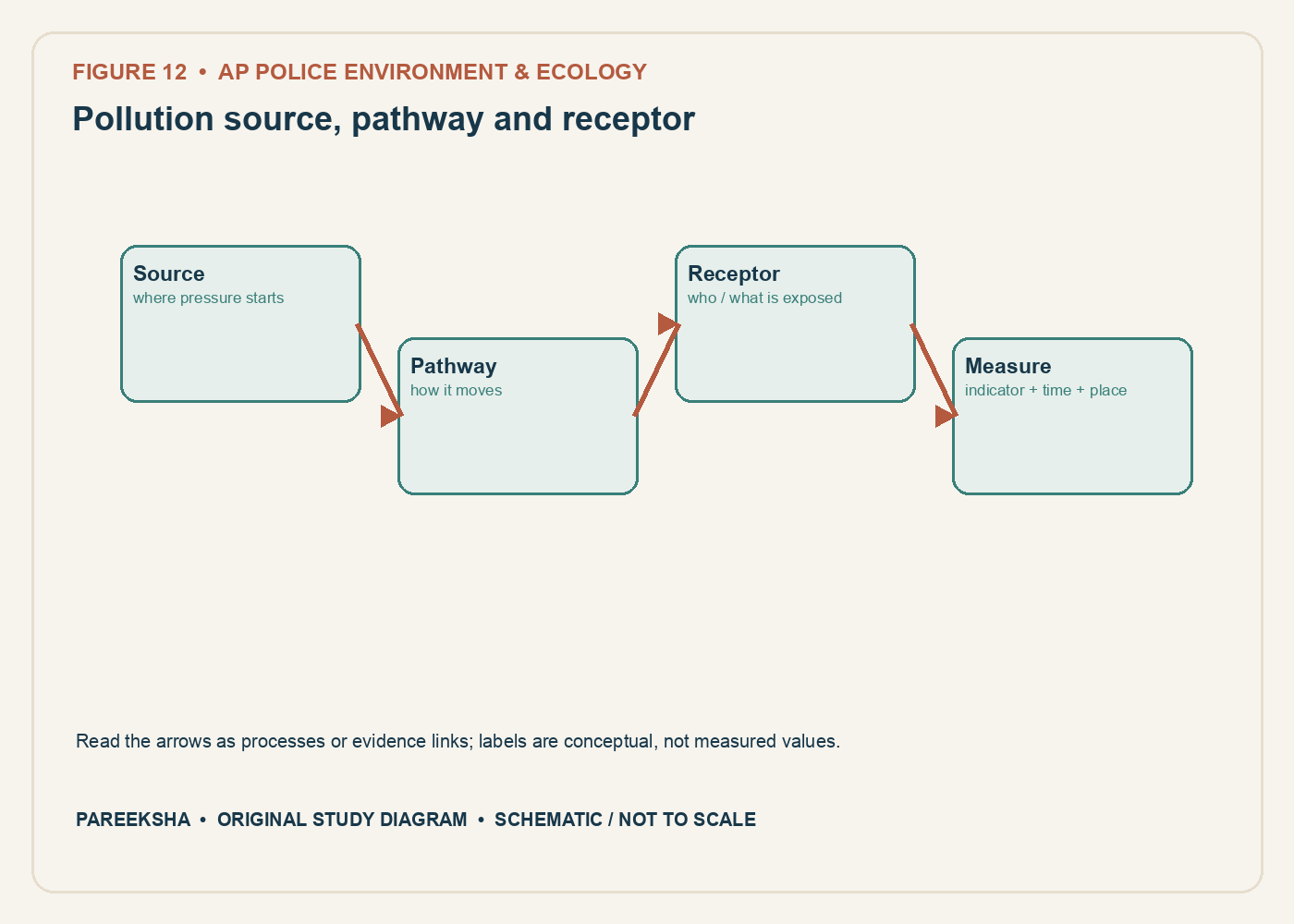
Figure 12.1 Pollution source, pathway and receptor. Original explanatory diagram; schematic and not to scale.
Chapter practice questions
1. In a source–pathway–receptor model, a receptor is:
A. The device that produced a pollutant
B. The route a pollutant takes
C. The person, organism or system that may be exposed to a pressure
D. The laboratory instrument only
Answer: C. The receptor is the exposed person, organism or environmental system. Source and pathway describe where the pressure originates and how it reaches the receptor.
2. A factory releases a contaminant that moves through a drain and reaches a fish habitat. In this chain, the drain is primarily the:
A. Receptor
B. Population
C. Food pyramid
D. Pathway
Answer: D. The drain conveys the contaminant from its source to the habitat. The habitat and organisms may be receptors.
3. Which is a secondary air pollutant?
A. Ozone formed in the lower atmosphere through reactions involving precursor gases and sunlight
B. Carbon monoxide emitted directly by incomplete combustion
C. Dust mechanically lifted from a road
D. Sulphur dioxide emitted by a source
Answer: A. Ground-level ozone forms through atmospheric chemistry involving precursor pollutants and sunlight. The other examples can be emitted directly as primary pollutants.
4. Why can particulate-matter health risk depend on particle size?
A. Larger particles are always invisible
B. Smaller particles can penetrate more deeply into the respiratory system
C. Particle size determines the legal jurisdiction only
D. Size has no relation to inhalation
Answer: B. Particle size affects transport and deposition in the respiratory tract. Health effects also depend on composition, exposure and individual vulnerability.
5. National Ambient Air Quality Standards (NAAQS) are best described as:
A. A list of industrial products
B. A wildlife survey method
C. Ambient-air concentration standards for specified pollutants and averaging periods
D. A single measurement of indoor air
Answer: C. NAAQS specify concentration limits for ambient air and include pollutant-specific averaging periods. Exact values should be read from the official standard table.
6. A one-hour pollution reading exceeds a daily-average standard’s value. What must be checked before declaring a formal exceedance?
A. The colour of the monitoring station
B. The district population only
C. Whether the pollutant has a common name
D. The standard’s averaging period, data completeness and applicable statistical method
Answer: D. Standards apply over defined averaging periods and data criteria. A short-duration value cannot automatically be compared with a 24-hour or annual standard.
7. Biochemical oxygen demand (BOD) is used as an indicator of:
A. Oxygen consumed by microorganisms while decomposing biodegradable organic matter under test conditions
B. The total number of fish in a river
C. Salinity alone
D. Airborne dust concentration
Answer: A. BOD estimates oxygen demand from biodegradable organic material under specified conditions. It is not a direct count of pathogens or all toxic pollutants.
8. High nutrient loading can contribute to low dissolved oxygen because:
A. Nutrients turn directly into oxygen
B. Decomposition of excess biomass can consume oxygen
C. Decomposers stop functioning
D. Water cannot hold oxygen
Answer: B. Excess production followed by decomposition can raise oxygen demand, particularly where mixing is limited. Temperature and hydrology also matter.
9. Which statement about noise pollution is correct?
A. A brief loud event and continuous exposure are always identical
B. Noise cannot affect sleep
C. Exposure depends on level, duration, timing and receptor sensitivity
D. A sound meter measures air-pollutant mass
Answer: C. Noise exposure is evaluated with relevant metrics and context. Duration, timing and receptor sensitivity affect potential impacts.
10. Soil contamination is most directly evaluated by:
A. Counting birds in a nearby forest only
B. Measuring rainfall once
C. Assuming soil is unaffected by land use
D. Sampling relevant soil locations and comparing measured contaminants with an appropriate benchmark or risk context
Answer: D. Soil assessment needs a sampling plan, analytes and a context-appropriate benchmark. Exposure routes and land use affect risk interpretation.
11. What is bioaccumulation?
A. Build-up of a substance in an organism over time through uptake and elimination balance
B. Movement of water through plants
C. The annual increase in forest area
D. A predator’s hunting strategy
Answer: A. Bioaccumulation describes accumulation within an organism over time when uptake exceeds elimination. Biomagnification concerns concentration changes across trophic levels.
12. Which distinction is correct?
A. The terms always mean exactly the same thing
B. Bioaccumulation occurs within an organism; biomagnification describes increasing concentration across trophic levels for some substances
C. Biomagnification applies only to water temperature
D. Bioaccumulation is a type of succession
Answer: B. The concepts are related but distinct. Persistence and chemical properties influence whether biomagnification occurs.
13. A contaminant concentration is high in water at one sampling point. What is not established by that measurement alone?
A. The concentration at that point and time, if measurement is valid
B. The need to examine context
C. Its source, duration, full spatial extent and resulting health effect
D. The value reported by the laboratory
Answer: C. A single sample can establish a concentration at a place and time, but not source, duration, exposure or causation of health outcomes.
14. Which intervention targets pollution prevention rather than end-of-pipe treatment?
A. Adding a scrubber after emissions are generated
B. Treating wastewater before discharge
C. Collecting ash after combustion
D. Replacing a hazardous input with a safer process material
Answer: D. Substitution prevents or reduces pollutant generation at the source. Scrubbers and wastewater treatment are important controls but act after or during generation.
15. Why is “dilution solves pollution” an unsafe principle?
A. Dilution can lower concentration locally while leaving pollutant mass and ecological exposure elsewhere
B. Water never mixes
C. Pollutants cannot move downstream
D. Concentration is unrelated to risk
Answer: A. Dilution may change concentration but not destroy pollutant mass. It can shift exposure downstream and does not replace prevention or treatment.
16. Which is a non-point source of pollution?
A. A single monitored discharge pipe
B. Diffuse runoff from many fields and roads across a catchment
C. One identified stack
D. A laboratory sample bottle
Answer: B. Non-point pollution comes from diffuse sources over an area, often transported by runoff. Point sources have identifiable discharge locations.
17. Thermal pollution can affect aquatic organisms because it may:
A. Remove all chemicals from water
B. Increase oxygen solubility in every case
C. Alter temperature and oxygen conditions, influencing metabolism and habitat suitability
D. Have no effect on organisms
Answer: C. Temperature affects metabolic rates and dissolved oxygen, among other processes. The effects depend on magnitude, duration and species tolerance.
18. Which measure can reduce plastic leakage into waterways most directly?
A. Increase single-use material without collection
B. Move waste to an unlined riverbank
C. Ignore drainage channels
D. Prevent littering and improve collection, segregation and material recovery
Answer: D. Prevention, collection and sound material management reduce the chance of waste entering waterways. Cleanup alone does not address generation and leakage pathways.
19. Why do air-quality measurements need station location and instrument details?
A. Exposure varies spatially and readings depend on siting, calibration and method
B. All locations have identical air
C. Instruments never need calibration
D. Station metadata changes pollutant chemistry
Answer: A. Monitoring results are meaningful only with location and method metadata. Siting and instrument performance influence representativeness and reliability.
20. A community reports respiratory symptoms near an industrial area. Which is the most responsible first approach?
A. Assume the factory caused every case without investigation
B. Combine health surveillance, exposure monitoring, source information and appropriate public-health review
C. Dismiss the reports without measurement
D. Use one anecdote as a statewide rate
Answer: B. A careful assessment investigates exposure and health patterns while protecting privacy and avoiding premature causal claims. Public-health and environmental expertise are both relevant.
21. Which statement about pollution standards is correct?
A. A standard is meaningless if a sample meets it
B. One standard applies to every medium and averaging period
C. Meeting a numerical limit does not necessarily mean every local risk or ecological concern is absent
D. Standards eliminate the need for enforcement
Answer: C. Standards provide regulatory benchmarks, but site-specific exposure, cumulative effects and other pollutants may still matter. Compliance requires valid monitoring and enforcement.
22. Why distinguish exposure from hazard?
A. Exposure means the same as toxicity
B. Hazard exists only after disease appears
C. Receptors cannot be exposed to pollutants
D. A hazardous agent may pose different risk depending on whether and how a receptor is exposed
Answer: D. Hazard is the capacity to cause harm; exposure describes contact. Risk depends on hazard, exposure and vulnerability.