Chapter 13 — Waste, circularity and producer responsibility
Exam link: common foundation; Indian rule names and commencement dates are edition-sensitive.
Learning aim: apply the waste hierarchy, distinguish waste streams and understand why segregation and traceability precede treatment and disposal.
13.1 Waste is a material flow, not just a municipal pile
Waste management begins with a question about material: what was discarded, by whom, in what quantity and condition, and where can it safely go next? A household bin may contain food scraps, packaging, batteries, electronics and sanitary waste. These materials do not belong to one treatment route. Mixing them can contaminate recyclables, expose workers and complicate safe disposal.
An effective system connects generation, segregation, storage, collection, transport, processing, recovery and final disposal. If one stage fails, downstream infrastructure may receive mixed or hazardous material it was not designed to handle. A recycling plant cannot recover clean material reliably if collection mixes it with wet organic waste. A landfill is not a substitute for an authorized treatment route for every hazardous item.
13.2 The waste hierarchy
The waste hierarchy prioritizes preventing waste and reducing material use, then reuse, repair and recycling or recovery where appropriate, with treatment and safe disposal for residuals. The order expresses a general preference, not a rigid answer for every life-cycle comparison. A reusable product that requires excessive transport or has a short life can have different impacts from the simple label “reusable.” Good policy considers the material's full life cycle, health risks and available infrastructure.
Circular-economy thinking aims to keep products and materials in use and reduce waste, but a circular label does not prove that a process is safe or low-impact. Recycling consumes energy and water; recovered material may have limits on quality; some hazardous components require controlled handling. Prevention and design decisions can avoid a waste stream before it forms.
13.3 Segregation protects workers and material value
Segregation separates waste at the point of generation into streams that can be handled safely. Organic material can be directed to composting or biomethanation where conditions and markets are suitable. Clean dry recyclables can enter sorting and material-recovery systems. Domestic hazardous items need an authorized collection path. Residual waste requires treatment or disposal consistent with the current rules and facility capability.
Segregation is not complete when a family uses two bins if a collection vehicle recombines them. The whole chain—household, institution, bulk generator, collection worker, transporter and processor—must maintain separation. Awareness, collection design, worker safety, user fees and enforcement can affect participation. Informal waste workers often play a substantial role in recovery and should be included in safe, fair system design.
13.4 Different streams need different rules and routes
Waste categories are defined by law and management needs. Terms can overlap in ordinary speech but have distinct regulatory meaning. A general guide should identify the stream and then check the current Gazette rules:
- Municipal/solid waste: ordinary household, commercial and institutional waste covered by the current solid-waste framework. As of this book's 11 October 2026 cutoff, the Gazette lists the Solid Waste Management Rules, 2026, effective 1 April 2026, superseding the 2016 rules. The exact duties and definitions should be read in the notified text.
- Plastic waste: packaging and plastic items managed under the plastic-waste rules, with producer/importer/brand-owner duties and extended-producer-responsibility provisions subject to amendments and portal procedures.
- E-waste: discarded electrical and electronic equipment, components and materials requiring traceable channelization and regulated recovery. The current central rule is the E-Waste (Management) Rules, 2022, with later amendments; verify the applicable amendments before listing targets or schedules.
- Battery waste: batteries follow a separate rules framework, including extended producer responsibility and authorized collection/recycling; targets and registrations change by amendment.
- Biomedical waste: waste from health-care activities may be infectious, sharps-related or chemically hazardous; source segregation, packaging, treatment and disposal follow the dedicated biomedical rules.
- Hazardous and other waste: classification depends on the notified definition and schedules, not solely on the generator's description. Handling, storage and transboundary movement are regulated separately.
- Construction and demolition waste: generated during construction, renovation and demolition; as of the stated cutoff, the 2025 rules took effect on 1 April 2026 and replaced the 2016 framework.
The rule dates above are intentionally stated with a cutoff. A current exam paper could test a later amendment. Do not convert the table into an undated permanent fact list; check the Gazette, CPCB and MoEFCC rules portal before a new edition.
13.5 Extended producer responsibility
Extended Producer Responsibility (EPR) makes producers, importers or brand owners responsible for specified stages of the post-consumer product or packaging lifecycle, according to the relevant rules. It is intended to support collection, recycling or environmentally sound management and can shift some costs away from local bodies and consumers. EPR is implemented through category-specific obligations, registration, certificates or reporting as defined by the applicable rule.
EPR does not mean that a producer physically collects every discarded item itself. Producers may use authorized recyclers or collection systems and must meet the duties specified in current law. A policy summary must distinguish the principle from operational targets, portal procedures and enforcement provisions. Those may change through Gazette amendments or official directions.
13.6 Composting, biomethanation and landfilling
Composting uses microorganisms to stabilize organic material under managed aerobic conditions. Feedstock quality, moisture, aeration, temperature and contamination affect the product. A compost market and quality control matter: material contaminated with plastics or heavy metals may be unsuitable.
Anaerobic digestion breaks down organic material without oxygen and can produce biogas and a digestate. Process design and feedstock characteristics determine gas output and digestate quality. The process does not make every contaminant disappear.
A sanitary landfill is engineered to manage residual waste with controls such as liners, leachate collection, gas management, cover and monitoring. It is distinct from an open dump. Even a properly designed landfill requires site suitability, operation and long-term care. Open dumping and burning can expose people and ecosystems to smoke, contaminated runoff and vectors.
13.7 A material-flow example
A household discards a broken phone, a food-smeared wrapper, vegetable peel and a used battery. The phone may contain recoverable materials but also components that require safe dismantling; route it through an authorized e-waste channel. The battery should be separately collected through a permitted system, not placed in an informal fire or mixed with wet waste. The peel can be composted if the collection and processing system accepts it. The wrapper's recyclability depends on its material composition, cleanliness and local facility. The correct route is not inferred from appearance alone.
This example shows why “recyclable” is a system property. A material may be technically recyclable yet lack a local collection route or viable processor. Policy and product design should make the intended route clear.
13.8 Waste pickers and safe recovery
Informal workers may recover valuable material before or during municipal collection. Their knowledge can improve segregation and resource recovery. However, work without protective equipment, safe handling or recognition can expose people to sharps, toxic materials, traffic and smoke. Inclusive systems can provide identification, protective gear, sorting space, stable payment arrangements, training and access to social protections, consistent with local law and programme design.
AP worked case: mixed waste beside a drain
A town finds mixed waste accumulating beside a storm drain. Removing the pile is an immediate action, but recurring waste points to a system problem. Investigators should check collection frequency, container location, generator behaviour, street-vending patterns, drainage design, worker access and enforcement. The response can combine source segregation, reliable collection, designated dry-waste recovery, safe handling of domestic hazardous items and drain maintenance. Simply installing a sign may not alter incentives or access.
Figure 13.1 — Material hierarchy and chain: show prevention → reuse/repair → recycling/biological recovery → treatment → final disposal, with separate tracks for hazardous/special streams. Show feedback into product design and procurement.
Exam traps and retrieval
- “Waste” is not one homogeneous stream; rule and treatment depend on material and risk.
- Solid waste rules do not subsume e-waste, batteries, biomedical or hazardous waste.
- Recyclability depends on collection, sorting, processing and safe end markets.
- EPR duties come from category-specific current rules; do not assume one universal producer obligation.
- Composting and biomethanation require feedstock and process control.
- A sanitary landfill is engineered residual disposal; an open dump is not equivalent.
- The Solid Waste Management Rules, 2026 are the current central rules at this edition cutoff; verify subsequent amendments before reuse.
For the four discarded items in the worked example, identify a likely separate route and explain one uncertainty for each. Then name two system failures that can make a recycling facility ineffective even when it exists.
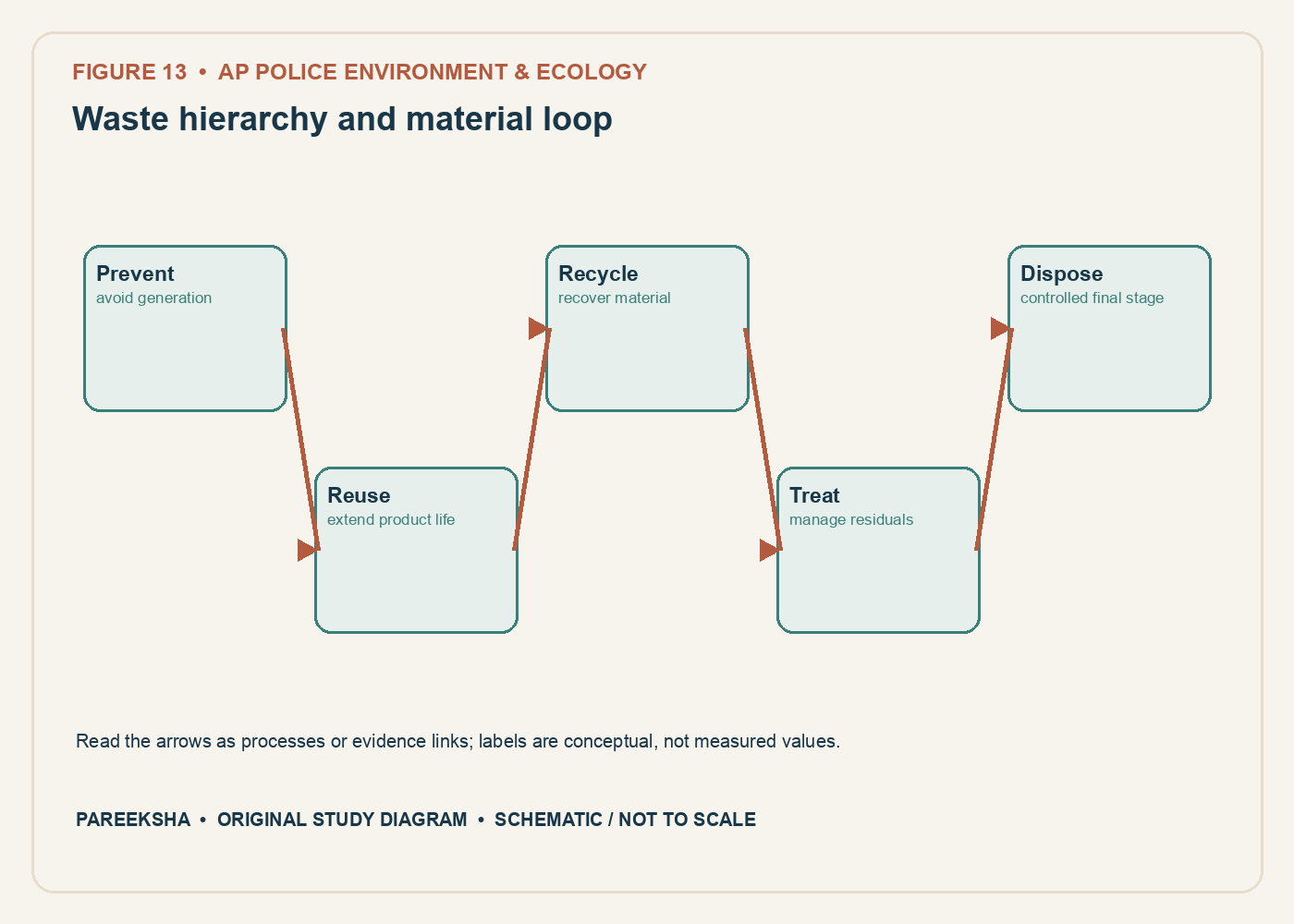
Figure 13.1 Waste hierarchy and material loop. Original explanatory diagram; schematic and not to scale.
Chapter practice questions
1. The waste hierarchy generally gives priority to:
A. Preventing waste generation before reuse, recycling, recovery and disposal
B. Landfilling all materials first
C. Mixing every waste stream together
D. Burning all waste without controls
Answer: A. Prevention and reduction are usually preferred because they avoid resource use and pollution upstream. Reuse, recycling and recovery follow where appropriate; safe disposal remains necessary for residuals.
2. Why is segregation at source important?
A. It makes every waste recyclable
B. It keeps recoverable materials cleaner and can prevent hazardous mixing
C. It removes the need for collection
D. It increases contamination by design
Answer: B. Separation where waste is generated can improve material recovery and keep hazardous fractions from contaminating other streams. Effective collection and processing are still required.
3. Which stream generally requires a distinct collection and treatment route because it may contain infectious or hazardous material?
A. Clean office paper
B. Garden leaves only
C. Biomedical waste
D. Uncontaminated glass bottles
Answer: C. Biomedical waste needs segregation and treatment under its specific rules because it can present infection or chemical risks. It must not be casually mixed with municipal waste.
4. A discarded mobile phone is most appropriately considered:
A. Biodegradable garden waste
B. Construction debris
C. A wetland plant
D. E-waste, with materials and components requiring an appropriate collection/recovery system
Answer: D. Electronic equipment and components enter the e-waste stream when discarded. Formal rules and current producer-responsibility requirements should be checked in the latest Gazette.
5. Extended Producer Responsibility (EPR) is broadly intended to:
A. Make producers responsible for specified post-consumer collection or management obligations
B. Transfer all waste liability to consumers only
C. Remove the need to design products
D. Apply only to untreated sewage
Answer: A. EPR extends producer responsibility into the post-consumer stage for covered product or packaging streams. The exact obligations differ by the applicable rules and current amendments.
6. Which statement about recycling is most accurate?
A. Every material can be recycled infinitely without loss
B. It can recover material but requires suitable sorting, markets and process controls
C. Recycling automatically eliminates waste generation
D. Recycling is identical to landfilling
Answer: B. Recycling can conserve resources but performance depends on material quality, collection and processing. Some materials degrade or are not practically recoverable.
7. A city sends mixed waste to an open dump. Which major concern is relevant?
A. Open dumping always creates safe compost
B. Mixed waste prevents pollution
C. Leachate, fires, odour, vectors and uncontrolled emissions may affect people and ecosystems
D. The dump can never affect groundwater
Answer: C. Uncontrolled disposal can create multiple exposure pathways. Impacts depend on site conditions, waste composition and management.
8. Composting is most suitable for:
A. Batteries mixed with food scraps
B. Electronic circuit boards
C. Asbestos-containing waste
D. Properly separated biodegradable organic material under controlled conditions
Answer: D. Composting biologically processes suitable organic material. Contaminants and incompatible hazardous materials should be excluded through segregation.
9. Which practice supports a circular economy?
A. Designing products for durability, repair, reuse and material recovery
B. Increasing planned obsolescence
C. Mixing hazardous waste into recyclables
D. Discarding products after one use by default
Answer: A. Circular design can reduce virgin material use and waste by extending product life and enabling recovery. It still requires safe processes and consumer/producer systems.
10. Construction and demolition waste can often contain:
A. Only food scraps
B. Concrete, bricks, metals, wood and soil-like materials
C. Only infectious sharps
D. Only liquid fuel
Answer: B. C&D waste streams may contain several recoverable mineral and material fractions. The current C&D rules and state implementation determine specific duties.
11. Why should battery waste not be mixed indiscriminately with ordinary waste?
A. Batteries are always harmless
B. Mixing improves recovery automatically
C. Some battery chemistries contain materials or stored energy that can create fire and contamination risks
D. Batteries are a type of compost
Answer: C. Batteries can present fire, chemical and resource-recovery concerns. They need an appropriate collection and processing route under current requirements.
12. Which is the best way to evaluate a municipal waste programme?
A. Count only the number of posters printed
B. Measure city rainfall alone
C. Ignore the final destination of collected waste
D. Track generation, segregation quality, collection coverage, processing, residual disposal and outcomes
Answer: D. A waste system includes each stage from generation to final treatment. Collection alone does not show whether material was safely processed.
13. A producer has an EPR obligation under a particular rule. Where should the precise target and reporting duty be checked?
A. The latest applicable Gazette rules, amendments and official portal directions
B. A generic waste poster
C. A rule from another product category
D. An undated blog summary only
Answer: A. EPR targets and procedures are stream-specific and can change. Use the binding text and current implementing instructions.
14. Which statement about the Solid Waste Management Rules, 2026 is date-sensitive and must be checked before release?
A. That waste can be generated by households
B. Their exact definitions, covered entities, duties and transition provisions
C. That segregation affects recovery
D. That landfills require management
Answer: B. The Gazette text governs exact scope and duties. General waste-management concepts do not replace line-by-line review of current legal requirements.
15. When did the Solid Waste Management Rules, 2026 come into force according to the cited Gazette notification?
A. 1 January 2020
B. 26 January 1950
C. 1 April 2026
D. 14 September 2006
Answer: C. Gazette S.O. 388(E), dated 27 January 2026, provides a commencement date of 1 April 2026 and supersedes the 2016 rules. Reconfirm the notification before print.
16. Which statement about a 2026 waste rule should be treated as binding only after checking the Gazette?
A. Waste can be sorted by material
B. Landfills occupy land
C. Recycling recovers materials
D. A specific numerical target or exemption
Answer: D. Targets and exemptions are legal details that depend on the exact instrument and amendments. They must not be inferred from general summaries.
17. Why is waste prevention placed above disposal in the hierarchy?
A. It avoids material use and waste impacts before they arise
B. It guarantees that no residual waste exists
C. It requires no design changes
D. It works only after landfill closure
Answer: A. Preventing waste can avoid upstream extraction, manufacturing and disposal impacts. It does not eliminate the need to manage existing or unavoidable waste.
18. A collection vehicle mixes separated recyclables with residual waste. Which system failure is illustrated?
A. Excessive biodiversity
B. Breakdown between source segregation and downstream handling
C. Successful material recovery
D. A nutrient cycle
Answer: B. Segregation only works when collection and processing preserve separated streams. The chain can fail after the household stage.
19. Which practice best protects workers handling hazardous waste?
A. Mixing it with food waste
B. Removing labels and safety information
C. Stream-specific training, safe equipment, segregation and controlled treatment
D. Open burning without protective measures
Answer: C. Worker safety requires knowing the material, preventing exposure, using suitable protective measures and applying controlled handling and treatment.
20. A landfill gas-capture system is introduced. Which statement is most accurate?
A. It proves the landfill has no environmental impact
B. It eliminates leachate automatically
C. It makes all waste recyclable
D. It can reduce some methane emissions, but prevention and safe site management remain important
Answer: D. Gas capture can reduce methane release and may recover energy, but it does not address every landfill impact. Proper design, operation and monitoring remain necessary.
21. Why should hazardous waste be kept separate from ordinary recyclables?
A. It can contaminate materials and expose workers or users to risk
B. Hazardous materials always improve paper quality
C. Separation prevents all pollution everywhere
D. Recycling requires mixing every waste type
Answer: A. Hazardous material can contaminate a stream and create exposure during collection or processing. Specific rules establish its handling requirements.
22. A city reports tonnes collected but not tonnes processed or safely disposed. What is missing?
A. The name of the municipal commissioner only
B. Evidence about the waste chain after collection and its final outcomes
C. The colour of collection bins
D. The city’s latitude alone
Answer: B. Collection volume is an input/output metric at one stage. Treatment, recovery and residual disposal data are needed to judge system performance.