Chapter 14 — Climate change, ozone and environmental change
Exam link: common foundation; national targets are date-stamped.
Learning aim: distinguish weather from climate, explain the enhanced greenhouse effect and separate climate change from ozone depletion and acid deposition.
14.1 Weather, climate and variability
Weather describes the state of the atmosphere at a place and time: temperature, rainfall, wind, cloud, humidity and related conditions. Climate describes patterns and statistics of weather over a longer period, including averages, variation and extremes. A cold day does not disprove a warming trend; one hot day does not establish it. Long-term claims require comparable records and a defined period.
Climate variability refers to natural or internal fluctuations across seasons and years. Climate change refers to a persistent change in average conditions or variability over extended periods. Natural processes influence climate, and human activities have increased greenhouse-gas concentrations, strengthening the heat-trapping effect. The scientific conclusion is based on multiple lines of evidence, including direct measurements, physical understanding and reconstructed records.
14.2 The natural greenhouse effect and its enhancement
Earth receives energy from the Sun. The surface absorbs some energy and emits infrared radiation. Greenhouse gases in the atmosphere absorb and re-emit part of that outgoing radiation, warming the lower atmosphere and surface compared with a planet without the natural greenhouse effect. This natural process supports habitable conditions.
Human activity adds greenhouse gases through fossil-fuel combustion, land-use change, agriculture, industrial processes and waste. Higher concentrations alter the planet's energy balance and raise the likelihood of long-term warming. Carbon dioxide, methane, nitrous oxide and certain industrial gases differ in lifetime and warming influence. Water vapour is an important greenhouse gas and often acts as a feedback: warmer air can hold more moisture, which can further influence warming.
The enhanced greenhouse effect is not the same as the hole in the ozone layer. The greenhouse effect concerns infrared energy and atmospheric heat balance. Ozone depletion concerns chemical loss of stratospheric ozone that shields life from much harmful ultraviolet radiation. Some substances can affect both climate and ozone, but the mechanisms and policy instruments are distinct.
14.3 Forcing, feedback and observed impacts
A radiative forcing changes the balance between incoming and outgoing energy. Greenhouse gases produce a positive forcing that tends to warm the system; aerosols can have different effects through scattering, absorption and cloud interactions. Feedbacks are responses that amplify or damp an initial change. Examples include changes in water vapour, ice reflectivity, vegetation and clouds. Feedbacks can operate on different timescales and are not always simple.
Impacts are regionally varied. Warming can influence heat stress, rainfall intensity, drought risk, glacier mass, sea level, ocean conditions and ecosystems. The direction and magnitude vary by region and emission pathway. A change in average rainfall does not tell us whether every district becomes wetter or drier. Extreme-event attribution also requires careful analysis; climate change can shift probabilities or intensity without being the sole cause of a particular event.
14.4 Mitigation and adaptation
Mitigation reduces greenhouse-gas emissions or enhances removals. Examples include energy efficiency, clean electricity, lower-emission transport, reducing methane leakage, protecting and restoring ecosystems, and changing industrial processes. Adaptation adjusts systems to actual or expected climate impacts: heat action plans, resilient water systems, early warning, coastal planning, drought preparedness and climate-resilient agriculture.
Mitigation and adaptation complement each other. A coastal wetland restoration can support habitat, livelihoods and risk management, but it should not be described as a substitute for emissions reduction. Adaptation has limits where hazards exceed the capacity of systems to cope. Both require distributional analysis: who has resources to adapt, whose emissions are reduced, and who bears the costs?
14.5 India’s current NDC: target versus observed outcome
On 24 April 2026, India submitted a new Nationally Determined Contribution for 2031–2035 to the UNFCCC. It states three quantified targets: reduce GDP emissions intensity by 47% by 2035 from the 2005 level; achieve about 60% cumulative electric-power installed capacity from non-fossil-fuel-based energy resources by 2035; and create a carbon sink of 3.5–4.0 billion tonnes of CO₂-equivalent through forest and tree cover by 2035 compared with the 2005 baseline. The active UNFCCC registry entry and the April 2026 NDC are the primary sources for these targets.
The 2022 updated NDC set earlier 2030 targets. It remains useful historical context, but it is no longer the latest submission for a question asking India’s current NDC at this edition cutoff. Always state which submission and target year you mean.
Keep three quantities separate: installed capacity (power-generating capability), electricity generation (energy actually produced) and emissions intensity (emissions per unit of GDP). A capacity target is not the same as the share of electricity actually generated from non-fossil sources. A reduction in emissions intensity does not necessarily mean absolute emissions have fallen; GDP and total output may grow. This distinction is a common data-interpretation trap.
14.6 Ozone depletion and the Montreal Protocol
The stratospheric ozone layer absorbs much of the Sun's harmful ultraviolet-B radiation. Certain human-made ozone-depleting substances release chlorine or bromine in the stratosphere and catalytically destroy ozone. The Montreal Protocol on Substances that Deplete the Ozone Layer created a framework for phasing down or phasing out listed substances, with adjustments and amendments over time.
Ozone depletion is not caused by ordinary carbon dioxide emissions, and the ozone hole is not a hole through which the atmosphere escapes. The “hole” describes a severe seasonal reduction in ozone concentration, especially over Antarctica under specific atmospheric conditions. Recovery is gradual and depends on atmospheric lifetimes and compliance. The Kigali Amendment adds climate-related control of hydrofluorocarbons, which generally do not deplete ozone but are potent greenhouse gases.
14.7 Acid deposition
Acid deposition includes wet forms such as rain, snow or fog and dry deposition of acidic particles or gases. Sulfur dioxide and nitrogen oxides can be transformed in the atmosphere and deposited, affecting soils, waters, vegetation and materials. The resulting effect depends on emissions, atmospheric transport, local buffering capacity and ecosystem sensitivity. Not every rainfall event is “acid rain,” and natural sources also contribute acidity.
14.8 ENSO and Indian monsoon variability
The El Niño–Southern Oscillation (ENSO) is a coupled ocean–atmosphere pattern in the tropical Pacific with warm (El Niño) and cool (La Niña) phases and a neutral state. It can influence global circulation, but its effect on India's monsoon is probabilistic and interacts with other climate drivers. A particular El Niño does not guarantee a weak monsoon in every part of India; outcomes vary by season and year.
For exam questions, avoid deterministic wording. ENSO is a source of interannual variability, not synonymous with climate change. Climate change can alter background conditions and interact with variability, but each phenomenon has a distinct definition.
Figure 14.1 — Four concepts, four pathways: side-by-side: greenhouse forcing (infrared balance), ozone depletion (stratospheric chemistry/UV shielding), acid deposition (precursor emissions/transport/deposition), and ENSO (coupled Pacific ocean–atmosphere variability). Use distinct arrows and no single shared “pollution” mechanism.
AP application: coastal exposure and ecosystem adaptation
Andhra Pradesh's coastal settlements, lagoons, estuaries, agriculture and fisheries face a mix of climate hazards and non-climate pressures. A coastal flood event may involve storm surge, tide, rainfall, river discharge, drainage constraints and settlement exposure. Mangroves or wetlands can contribute to risk reduction in some settings, but their performance varies. Planning should combine warnings, evacuation, safe infrastructure, shoreline space, ecosystem condition and livelihood protection. A map should distinguish the hazard area, exposed assets and vulnerable groups rather than shade a whole district as equally at risk.
Exam traps and retrieval
- Weather is short-term atmospheric state; climate describes long-term patterns and variability.
- The natural greenhouse effect is necessary; the enhanced effect comes from increased greenhouse-gas concentrations.
- Ozone depletion and global warming have different primary mechanisms.
- Mitigation addresses causes; adaptation addresses impacts and vulnerability.
- Installed capacity differs from generation, and emissions intensity differs from total emissions.
- ENSO influences variability probabilistically; it is not climate change itself.
- An individual cyclone or flood cannot be attributed to climate change from timing alone.
Use a four-column table to compare greenhouse warming, ozone depletion, acid deposition and ENSO by mechanism, timescale, major observation and policy response. Then explain why a non-fossil installed-capacity target cannot be restated as the same percentage of electricity generation.
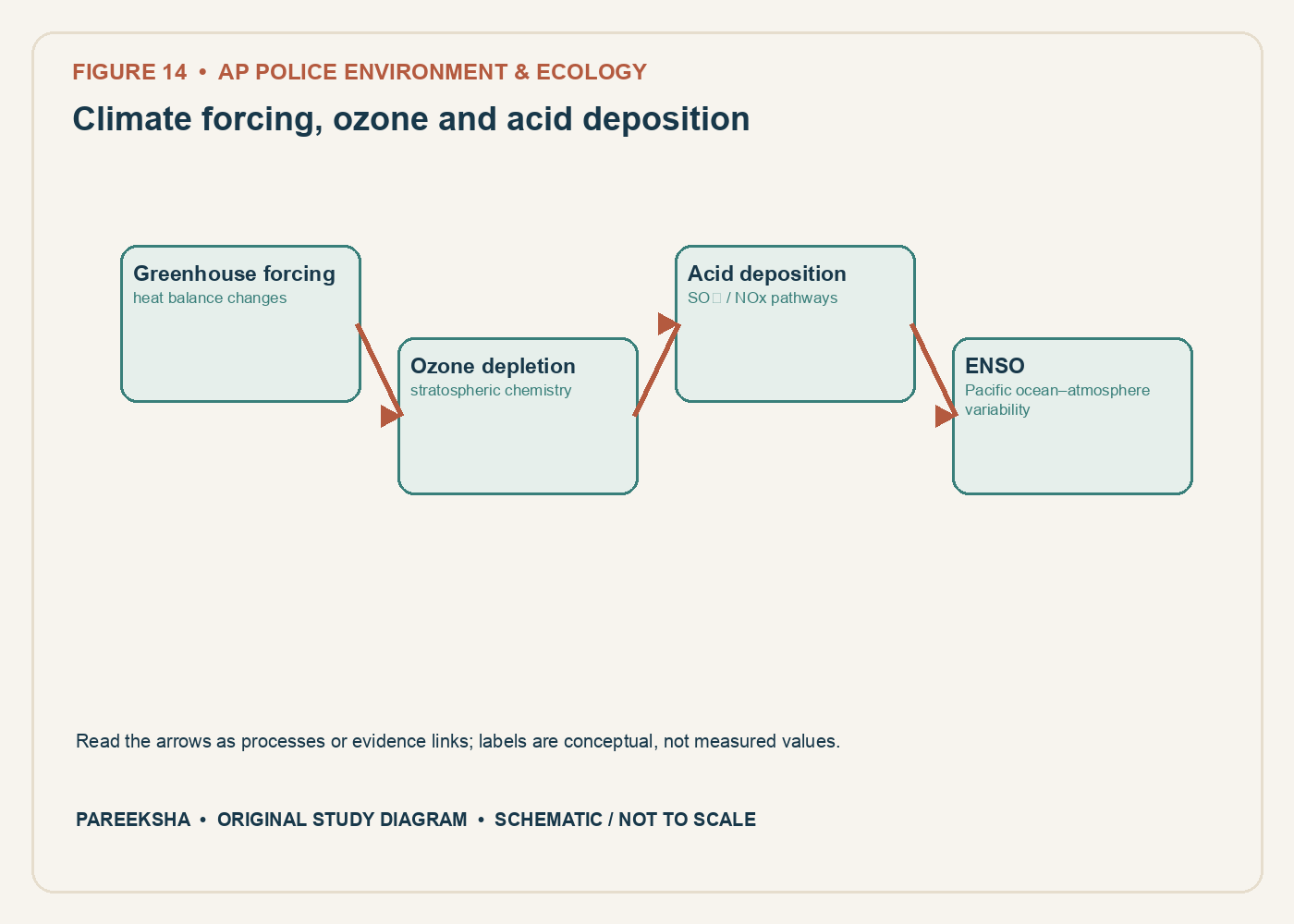
Figure 14.1 Climate forcing, ozone and acid deposition. Original explanatory diagram; schematic and not to scale.
Chapter practice questions
1. The enhanced greenhouse effect is primarily caused by:
A. A hole in the ozone layer letting all heat escape
B. Ocean tides stopping sunlight
C. Increased concentrations of heat-trapping gases altering Earth’s energy balance
D. Nitrogen fixation in soils
Answer: C. Greenhouse gases absorb and re-emit outgoing infrared radiation. Human activities have increased concentrations of several such gases, strengthening warming.
2. Which statement distinguishes weather from climate?
A. Weather is global and climate is always local
B. They are identical terms
C. Climate changes every hour only
D. Weather describes short-term atmospheric conditions; climate describes statistics and patterns over longer periods
Answer: D. Weather concerns conditions over short timescales. Climate describes long-term distributions and variability, commonly assessed over multi-decadal periods.
3. Which is a greenhouse gas?
A. Carbon dioxide
B. Argon
C. Neon
D. Helium
Answer: A. Carbon dioxide absorbs infrared radiation and is a greenhouse gas. The other options are noble gases that are not significant greenhouse gases in Earth’s atmosphere.
4. Ozone depletion in the stratosphere and global warming are:
A. The same process under two names
B. Distinct environmental problems with different primary mechanisms, though some substances affect both
C. Both caused only by volcanic ash
D. Unrelated to atmospheric chemistry
Answer: B. Ozone depletion involves chemical destruction of stratospheric ozone, historically driven by ozone-depleting substances. Climate change involves changes in Earth’s energy balance; some compounds influence both.
5. The ozone layer that absorbs much harmful ultraviolet radiation is mainly in the:
A. Lower ocean
B. Soil profile
C. Stratosphere
D. Tropospheric river channel
Answer: C. Most atmospheric ozone resides in the stratosphere. Ground-level ozone in the troposphere is an air pollutant and has different effects.
6. Ground-level ozone is commonly formed through reactions involving:
A. Oxygen and salt only in darkness
B. Soil minerals without air
C. Carbon dioxide alone in lakes
D. Nitrogen oxides and volatile organic compounds in sunlight
Answer: D. Photochemical reactions involving NOx and volatile organic compounds can form tropospheric ozone. Conditions and precursor ratios affect formation.
7. Acid deposition can form when which emissions undergo atmospheric reactions?
A. Sulphur dioxide and nitrogen oxides
B. Oxygen and argon
C. Water vapour alone
D. Helium and neon
Answer: A. SO₂ and NOx can form acidic compounds in the atmosphere and return through wet or dry deposition. Effects depend on deposition and ecosystem buffering.
8. ENSO is associated with coupled variability in the tropical Pacific involving:
A. Himalayan snowfall alone
B. Ocean temperatures and atmospheric circulation
C. Soil nitrogen only
D. The ozone layer only
Answer: B. El Niño–Southern Oscillation includes linked oceanic and atmospheric changes in the tropical Pacific. It can influence global weather patterns but does not determine every local event.
9. Which statement about El Niño and Indian monsoon rainfall is most accurate?
A. Every El Niño causes drought across all of India
B. El Niño is a type of cyclone
C. El Niño can influence monsoon probability, but it does not determine every year’s rainfall by itself
D. It has no ocean-atmosphere connection
Answer: C. ENSO is one influence among several, including Indian Ocean conditions, land processes and intraseasonal variability. A probabilistic influence is not a deterministic forecast.
10. Climate mitigation aims primarily to:
A. Prepare communities for unavoidable impacts only
B. Measure daily weather only
C. Stop all seasonal variation
D. Reduce greenhouse-gas emissions or enhance sinks
Answer: D. Mitigation limits climate change by reducing emissions or increasing removals. Adaptation reduces harm from actual or expected impacts.
11. Climate adaptation includes:
A. Adjusting systems to reduce harm from actual or expected climate impacts
B. Increasing emissions to match impacts
C. Measuring only annual electricity generation
D. Removing all ecosystems from planning
Answer: A. Adaptation involves changes that reduce vulnerability or exploit beneficial opportunities. It can include early warning, resilient infrastructure and ecosystem-based measures.
12. India’s NDC for 2031–2035, submitted in April 2026, states a target to reduce emissions intensity of GDP by how much from the 2005 level by 2035?
A. 10 percent
B. 47 percent
C. 75 percent
D. 100 percent
Answer: B. India’s April 2026 NDC states a 47% reduction in GDP emissions intensity from the 2005 level by 2035. It is a target, not an observed outcome; the active UNFCCC registry entry should be rechecked before publication.
13. India’s 2031–2035 NDC expresses its non-fossil power target as a share of:
A. Total electricity actually generated each day
B. Household connections only
C. Cumulative installed electric power capacity by 2035
D. Imported fuel volume
Answer: C. The April 2026 commitment is about 60% of cumulative installed electric power capacity from non-fossil sources by 2035. Capacity share is not the same as generation share.
14. Why is installed capacity different from electricity generation?
A. Capacity is measured only in rainfall
B. Generation is a map boundary
C. They are always identical numbers
D. Capacity describes potential output under specified conditions; generation measures energy actually produced over time
Answer: D. Installed capacity is a power capability measure, while generation is energy delivered across a time period. Utilisation and resource availability affect actual generation.
15. Which observation provides evidence of long-term climate change more directly than a single hot afternoon?
A. A multi-decadal record showing persistent change in temperature statistics
B. One day’s maximum temperature
C. A single storm photograph
D. A month’s rainfall at one gauge
Answer: A. Climate is assessed from long-term patterns and distributions. Individual weather events can be influenced by climate but do not alone establish a trend.
16. Sea-level rise can result from:
A. Ozone depletion alone
B. Thermal expansion of warming seawater and addition of water from land ice
C. Declining soil nutrients
D. The daily rotation of Earth only
Answer: B. Ocean warming expands seawater, and melting land ice adds water to the ocean. Regional sea-level patterns also vary due to ocean dynamics and land movement.
17. Which is a climate feedback?
A. An exam answer key
B. A fixed map legend
C. A change in the climate system that influences the initial forcing, amplifying or reducing it
D. A type of protected-area notification
Answer: C. Feedbacks alter the response to an initial forcing. They can be positive or negative depending on whether they amplify or dampen change.
18. Why can climate impacts differ among districts in the same state?
A. Climate is identical at every point
B. District borders control global warming
C. All people have equal vulnerability
D. Exposure, elevation, coast, livelihood, infrastructure and adaptive capacity vary
Answer: D. Regional impacts vary with physical and social conditions. Local climate projections and vulnerability assessments are needed for planning.
19. India’s 2031–2035 NDC includes a forest-and-tree-cover carbon-sink target of:
A. 3.5–4.0 billion tonnes of CO₂-equivalent by 2035, compared with the 2005 baseline
B. 3.5–4.0 million tonnes by 2020, compared with a 2015 baseline
C. 47 billion tonnes by 2035, compared with a 2005 baseline
D. 60 billion tonnes by 2030, compared with a 1990 baseline
Answer: A. The April 2026 NDC states a 3.5–4.0 billion tonne CO₂-equivalent carbon-sink target through forest and tree cover by 2035 against the 2005 baseline. It is a target, not an observed result.
20. A local flood occurs during a year of intense rainfall. Which conclusion is most defensible?
A. One flood proves the entire climate trend
B. The event should be evaluated with hydrology, exposure and long-term climate evidence before attributing it
C. Climate change can never affect floods
D. Rainfall data are irrelevant
Answer: B. Attribution requires event and climate analysis, including exposure and land-use changes. A single event alone does not establish or rule out a climate influence.
21. Which gas is a major anthropogenic greenhouse gas but not the primary ozone-depleting substance class historically controlled by the Montreal Protocol?
A. Chlorofluorocarbons
B. Halons
C. Carbon dioxide
D. Methyl bromide
Answer: C. CO₂ is a major greenhouse gas. CFCs, halons and methyl bromide are among ozone-depleting substances controlled under the Montreal Protocol; some also have strong warming effects.
22. A climate projection should be interpreted with attention to:
A. One exact future value with no assumptions
B. The colour of the graph only
C. A single weather report
D. Scenario, model, spatial scale, time horizon and uncertainty range
Answer: D. Projections depend on emissions pathways and model assumptions and are more uncertain at some scales than others. Ranges and scenarios are part of the result.