Chapter 15 — Indian environmental law and institutions
Exam link: common foundation; exact provisions and amendments are date-sensitive.
Learning aim: connect constitutional principles, major environmental statutes and the roles of regulators, biodiversity bodies and the National Green Tribunal.
15.1 Constitutional foundations
Environmental governance in India draws on constitutional duties, legislation, rules, notifications, institutions and judicial decisions. The Constitution is not a detailed pollution-control manual; it establishes principles and responsibilities that Parliament and State legislatures implement through law.
Article 48A, in Part IV, directs the State to endeavour to protect and improve the environment and safeguard forests and wildlife. Article 51A(g), in Part IVA, states a fundamental duty of citizens to protect and improve the natural environment, including forests, lakes, rivers and wildlife, and to have compassion for living creatures. Both were inserted by the Constitution (Forty-second Amendment) Act, 1976; the relevant provisions took effect on 3 January 1977. The first is a Directive Principle; the second is a citizen duty. They are not interchangeable with a statutory permit or a site-specific restriction.
The Supreme Court has also interpreted environmental protection through constitutional rights and public-law principles. Such doctrine develops through judgments and context. A study guide can explain that courts have treated environmental quality as connected to life and public health, but it should not reduce a complex case to the statement “every environmental issue is an Article 21 violation.” Use the judgment, facts and remedy relevant to the question.
15.2 The Environment (Protection) Act, 1986
The Environment (Protection) Act, 1986 provides a broad central framework for protecting and improving the environment. It empowers the Central Government to take measures and make rules within the Act's provisions. Many detailed standards and waste-management rules are notified under this umbrella. The Act should not be confused with every rule made under it: a statute provides the enabling framework, while subordinate legislation supplies specific requirements.
The law's scope and application are read with amendments, rules and notifications. As of the stated edition cutoff, the Environment (Protection) Act has also been amended in recent years, including changes affecting penalty provisions. This book focuses on institutional and process concepts; it does not reproduce old penalty tables. Any future penalty question must use the consolidated text in force on the exam date.
15.3 Water and air pollution-control laws
The Water (Prevention and Control of Pollution) Act, 1974 established a statutory framework for preventing and controlling water pollution and maintaining or restoring water quality. It provides for Central and State Pollution Control Boards and assigns them functions under the Act. The Air (Prevention and Control of Pollution) Act, 1981 provides a corresponding statutory framework for prevention, control and abatement of air pollution and board functions.
The Central Pollution Control Board (CPCB) works at the national level; State Pollution Control Boards (SPCBs) operate within the applicable state legal framework. Functions can include setting or recommending standards where authorized, monitoring, technical advice, coordination, consent administration and enforcement under the relevant Act and rules. The precise power depends on the statute, amendment, notification and delegation; a board's portal page is not a replacement for the law.
The Water Act was amended in 2024. Because it was enacted under Article 252 and subsequent resolutions can affect state application, the amendment's territorial application and commencement must be checked for each state before making a current claim. The book will avoid an undated statement that every amendment applies identically in every state. For pollution-control practice questions, identify which board and which statute the scenario actually invokes.
15.4 Forest, wildlife and biodiversity statutes
The Wild Life (Protection) Act, 1972 provides the statutory basis for listed wildlife protections, protected-area categories, authorities and regulated activities. The 2022 amendment commenced on 1 April 2023. It changed schedules and added or revised provisions, including one concerning invasive alien species. A current question should be checked against the consolidated amended law, not an old bare-act summary.
The Forest (Conservation) Act, 1980 was amended in 2023 and renamed the Van (Sanrakshan Evam Samvardhan) Adhiniyam. Its title, definitions, scope and exceptions should be checked in the 2023 amending Act and subsequent notifications. Do not use the older title as if no amendment occurred, and do not infer that this statute alone establishes every person's rights or forest status.
The Biological Diversity Act, 2002 provides a framework for conservation, sustainable use and fair and equitable sharing of benefits associated with biological resources and knowledge. Its institutions include the National Biodiversity Authority (NBA), State Biodiversity Boards and Biodiversity Management Committees, with functions defined by statute and rules. The Act was amended in 2023 and Biological Diversity Rules, 2024 were notified. Before publication, exact provisions and exemptions must be checked in the amended text and rules.
15.5 National Green Tribunal
The National Green Tribunal (NGT) was established under the National Green Tribunal Act, 2010 to adjudicate specified civil cases involving substantial environmental questions and matters arising under the laws listed in the Act. It also has statutory appellate jurisdiction in specified matters. The Act provides for relief, compensation and restitution in relevant cases and directs the Tribunal to apply specified principles.
The NGT does not replace every environmental authority or ordinary court for every dispute. Jurisdiction depends on the Act, the legal provision, the kind of order challenged, limitation rules and case facts. A basic exam question may ask its establishing Act or broad role; a procedural question requires current statutory text and case law.
15.6 A simple institutional map
- MoEFCC: central ministry responsible for national environment, forest and climate policy and for specified approvals and notifications.
- CPCB: central statutory board under pollution-control laws, with national coordination, monitoring and technical functions.
- SPCB/PCC: state/UT pollution-control institutions, with roles assigned under applicable pollution laws and delegated processes.
- NBA: national statutory body under the Biological Diversity Act.
- State Biodiversity Board: state-level biodiversity institution under the Act.
- Biodiversity Management Committee (BMC): local statutory body; biodiversity registers and other functions are governed by the amended Act/rules.
- Chief Wildlife Warden / state forest authorities: statutory and administrative roles under wildlife/forest frameworks.
- NGT: tribunal for specified environmental disputes and appeals under its establishing Act.
- Local bodies and communities: important for waste, land-use, local water systems, biodiversity documentation and stewardship under the relevant laws and schemes.
These bodies do not form a single command chain. A pollution complaint, a forest-clearance question, a wildlife offence and a biodiversity-access issue may involve different authorities and procedures. Read the subject of the case before identifying the institution.
15.7 Principles used in environmental governance
The precautionary principle supports preventive action where there is a credible risk of serious harm despite scientific uncertainty; it does not mean that every uncertain claim automatically proves liability. The polluter-pays principle places relevant prevention or remediation costs on the polluter under applicable law and jurisprudence. Sustainable development seeks to integrate environmental protection with social and economic needs. Public trust doctrine treats certain natural resources as held in trust for public use and future generations in relevant legal contexts.
These principles have been shaped by legislation and court decisions. Their application depends on facts, legal authority and remedy. They are not four universal statutory offences or a substitute for compliance procedure.
15.8 Read the source in the right order
When a question asks whether an activity is allowed, proceed from the most specific controlling source:
1. Identify the location, resource and activity.
2. Find the applicable Act and section.
3. Check rules, schedules and current amendments.
4. Read the Gazette notification or order for the site, project or standard.
5. Check the responsible authority and any appeal path.
6. Note the effective date and territorial scope.
A ministry webpage can point to the relevant document but may not be updated when a rule changes. A draft notification is not the final rule. A court order may change how a rule is applied. For a current exam, the final notification and authoritative text take precedence over an old summary.
Figure 15.1 — Institution-to-law map: connect pollution laws to CPCB/SPCB; biodiversity law to NBA/SBB/BMC; wildlife law to wildlife authorities and protected areas; EPA rules/notifications to the Central Government and specified authorities; NGT to listed statutes and appellate/relief functions. Use two-way arrows for coordination and appeals, not a single top-down chain.
Worked case: industrial discharge complaint
Residents report discoloured water downstream of a facility. The first step is evidence and jurisdiction, not an assumed legal conclusion. Record the location, time, flow and observable conditions; preserve samples through an accepted protocol; identify the discharge point and receiving water; and contact the competent pollution-control authority. Whether the Water Act, Environment (Protection) Act rules, consent conditions or another law applies depends on the facility, permit and discharge. If an order is issued, any appeal forum and time limit must be taken from the controlling legal provision. The NGT is not automatically the first office for every complaint.
Exam traps and retrieval
- Article 48A is a Directive Principle; Article 51A(g) is a Fundamental Duty.
- An Act, rule, notification and draft are different legal instruments.
- CPCB and SPCBs have statutory roles, but their powers depend on the applicable Act and delegation.
- A 2024 amendment's territorial application must be checked; do not assume uniform coverage without a commencement/application source.
- NGT jurisdiction is statutory and specified, not universal.
- Current titles and amendment status matter: Wildlife Act amended in 2022; Forest law renamed/amended in 2023; Biodiversity Act amended in 2023 with 2024 Rules.
- A ministry webpage or study note is not a substitute for the controlling Gazette text.
Without looking, identify the constitutional location of Article 48A and Article 51A(g), name one function of CPCB/SPCB, and state one reason a draft ESZ notification cannot prove a final boundary. Then outline the source order for checking a current protected-area activity restriction.
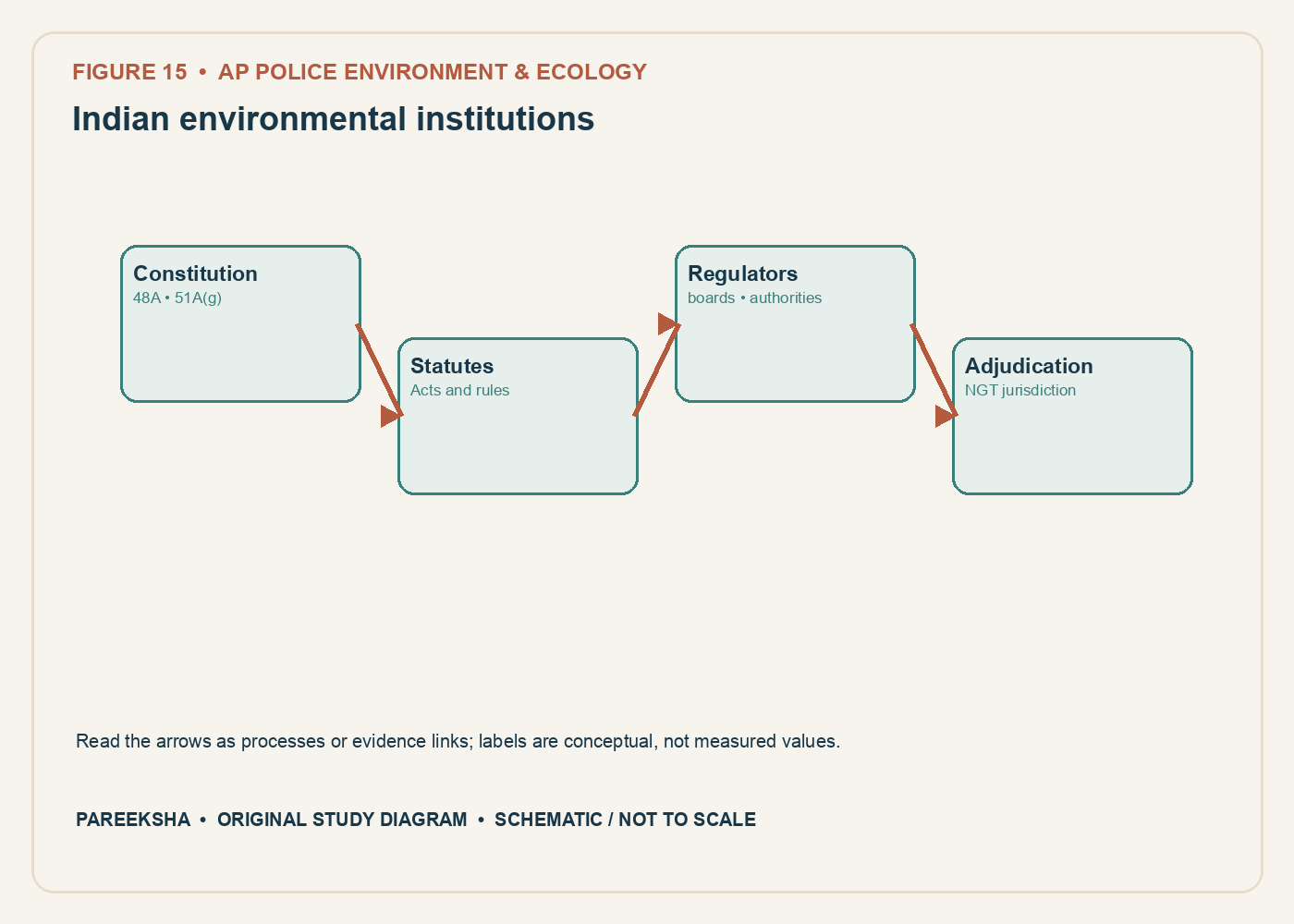
Figure 15.1 Indian environmental institutions. Original explanatory diagram; schematic and not to scale.
Chapter practice questions
1. Article 48A of the Constitution directs the State to:
A. Protect and improve the environment and safeguard forests and wildlife
B. Regulate every private contract
C. Conduct the population census
D. Establish every municipal landfill
Answer: A. Article 48A is a Directive Principle concerning protection and improvement of the environment and safeguarding forests and wildlife. It belongs to Part IV of the Constitution.
2. Article 51A(g) describes a fundamental duty of citizens to:
A. Set national pollution standards
B. Protect and improve the natural environment and show compassion for living creatures
C. Issue forest-clearance notifications
D. Adjudicate every environmental dispute
Answer: B. Article 51A(g), in Part IVA, states a citizen duty to protect and improve the natural environment, including forests, lakes, rivers and wildlife, and to have compassion for living creatures.
3. Which statement best describes the constitutional relationship between Articles 48A and 51A(g)?
A. Both are fundamental rights to free electricity
B. Both are provisions of the Water Act
C. One is a Directive Principle for the State; the other is a fundamental duty of citizens
D. They have identical placement and function
Answer: C. Article 48A is in Part IV, while Article 51A(g) is in Part IVA. They express complementary environmental responsibilities in different constitutional categories.
4. The Environment (Protection) Act, 1986 is commonly described as:
A. A state wildlife census only
B. A municipal tax statute
C. A treaty establishing the Ramsar Convention
D. A broad central framework empowering environmental protection measures
Answer: D. The Act provides a broad statutory framework for environmental protection and associated rules/notifications. Specific duties depend on the Act and instruments made under it.
5. The Water (Prevention and Control of Pollution) Act, 1974 principally concerns:
A. Prevention and control of water pollution and maintaining or restoring water quality
B. National park tourism only
C. Climate projections alone
D. Animal taxonomy
Answer: A. The Water Act provides a statutory framework for prevention and control of water pollution and related board functions. Exact current provisions must be checked in the amended text.
6. The Air (Prevention and Control of Pollution) Act, 1981 establishes a framework concerning:
A. Wetland Ramsar listing only
B. Prevention, control and abatement of air pollution
C. Crop insurance alone
D. The classification of minerals
Answer: B. The Air Act addresses prevention, control and abatement of air pollution and related institutional powers. Current amendment and territorial details should be verified.
7. Which institution is primarily a specialised environmental adjudicatory body created by a central Act?
A. Forest Survey of India
B. Central Water Commission
C. National Green Tribunal
D. Geological Survey of India
Answer: C. The National Green Tribunal was established under the National Green Tribunal Act, 2010 to hear specified environmental matters within its jurisdiction.
8. Which statement about the NGT’s role is most accurate?
A. It replaces all state pollution-control boards
B. It issues every local building permit
C. It manages all national parks directly
D. It hears specified environmental disputes and appeals under its governing Act
Answer: D. The Tribunal’s jurisdiction is defined by statute. Regulatory boards, clearance authorities and local governments retain separate functions.
9. The “polluter pays” principle broadly means:
A. A polluter may bear costs of preventing and remedying pollution, subject to law and adjudication
B. Every taxpayer automatically pays all pollution costs
C. Pollution is legal if a fee is paid
D. Polluters cannot be held responsible
Answer: A. The principle assigns responsibility for pollution-related prevention and remediation costs to the polluter as recognised in applicable law and decisions. It is not a licence to pollute.
10. The precautionary principle is relevant when:
A. No risk is possible
B. A credible risk of serious harm exists despite scientific uncertainty
C. A project has already completed construction
D. A species has no common name
Answer: B. Precaution supports preventive action where credible threats exist even if some scientific uncertainty remains. Its application depends on legal context and evidence.
11. Sustainable development seeks to:
A. Prohibit every economic activity
B. Maximise present output without limits
C. Integrate development needs with environmental protection and intergenerational considerations
D. Replace evidence with opinion
Answer: C. Sustainable development integrates social and economic needs with environmental protection over time. It is not simply a synonym for either unrestricted growth or a total ban.
12. When did the Wild Life (Protection) Amendment Act, 2022 come into force according to its commencement notification?
A. 26 January 1950
B. 5 June 1972
C. 1 April 2026
D. 1 April 2023
Answer: D. The official commencement notification appointed 1 April 2023. The commencement date should be distinguished from passage, assent and publication dates.
13. Why should a student check the latest amended text of an environmental Act?
A. Amendments can change definitions, powers, procedures or penalties
B. Acts never change after enactment
C. A textbook summary is always current
D. Amendments change only the cover page
Answer: A. Statutes may be amended and rules or notifications may modify implementation. Current questions require the law in force at the stated date.
14. Which statement about the Forest (Conservation) Amendment Act, 2023 is safest for a general study note?
A. It replaced the Constitution
B. It amended the 1980 forest-conservation statute; exact current title, scope and exceptions require the enacted text
C. It created every national park in India
D. It is a Ramsar treaty
Answer: B. The 2023 amendment changed the forest-conservation law, including its title and provisions. Details of scope, exceptions and commencement must be read from the Gazette, not inferred from a slogan.
15. The Biological Diversity (Amendment) Act, 2023 is associated with amendments to the framework for:
A. Regulation of air quality only
B. Construction waste only
C. Conservation, sustainable use and fair and equitable sharing of biological resources and associated knowledge
D. Ocean tides only
Answer: C. The Biological Diversity Act framework addresses conservation, sustainable use and benefit-sharing. The amended text and 2024 rules determine current institutional and procedural details.
16. Why should the 2024 Biological Diversity Rules be checked separately from the parent Act?
A. Rules always repeal the Constitution
B. Rules contain no legal effect
C. The Act and rules are necessarily identical documents
D. Rules can prescribe procedures and details under the statute
Answer: D. Rules provide delegated details for implementing the Act. Their scope and any later amendments should be checked in the Gazette.
17. A pollution-control board monitors a discharge and issues a direction under its statute. Which idea does this illustrate?
A. A regulator can exercise statutory powers distinct from a tribunal’s adjudicatory role
B. A regulator and court are always the same institution
C. Monitoring automatically creates a Ramsar site
D. The discharge is lawful without review
Answer: A. Regulators perform functions assigned by their enabling laws; tribunals adjudicate specified matters. Their roles may interact but are not identical.
18. Why should a legal summary distinguish an Act, rule and notification?
A. They are interchangeable labels for a website
B. They are different legal instruments with different powers, scope and amendment paths
C. A notification can never have legal effect
D. An Act is a non-binding press release
Answer: B. An Act is primary legislation; rules and notifications are subordinate instruments made under statutory authority. The exact legal status and scope depend on the enabling provision and text.
19. A rule is published as a draft for public comments. What is the correct status before final notification?
A. It immediately repeals all existing rules
B. It is an Act of Parliament
C. It is a proposal and should not be described as binding final law
D. It cannot be changed
Answer: C. A draft seeks comment and may be revised or withdrawn. Binding effect normally follows final notification and any specified commencement date.
20. Which source is strongest for a question about the exact wording of a statutory provision?
A. An undated social post
B. A coaching note without references
C. A tourist brochure
D. The official Gazette or current consolidated statutory text
Answer: D. The official legal text is the authoritative source for statutory wording. Secondary explanations can aid learning but should not replace it.
21. Why can environmental enforcement involve both central and state institutions?
A. Different statutes assign roles to central authorities, state boards and local bodies
B. Environmental laws apply only to the Union Government
C. State institutions cannot monitor pollution
D. Local bodies have no environmental responsibilities
Answer: A. Institutional responsibilities are distributed across laws and levels of government. The specific authority depends on the statute, issue and location.
22. Which approach is best for a legal MCQ that asks “as of 2026”?
A. Reuse a 2010 answer without checking
B. Verify the latest commencement, amendment and territorial application, then state the date
C. Assume every amendment applies everywhere immediately
D. Avoid reading the Gazette
Answer: B. Effective date and territorial application can differ from enactment or publication. A dated legal answer should identify its operative source.