Chapter 16 — EIA, wetlands governance and public process
Learning aims
By the end of this chapter, you should be able to distinguish environmental assessment from environmental clearance, arrange the main stages of the Indian appraisal process, explain why a public hearing is evidentiary rather than ceremonial, and separate a Ramsar designation from domestic wetland regulation.
16.1 Why appraisal begins before construction
A project can create effects beyond the construction site. A road may fragment habitat; a reservoir may alter downstream flows; an industrial unit may add air emissions and wastewater; a port may change sediment movement. Environmental appraisal asks, before the relevant activity begins, what effects are reasonably foreseeable, which alternatives exist, how serious the effects may be, and what conditions can prevent or reduce harm.
Environmental impact assessment (EIA) is the process of collecting and analysing evidence about likely effects. Environmental clearance (EC) is a regulatory decision made under the applicable legal framework for a project that falls within its scope. An EIA report is evidence considered during appraisal; it is not itself the permission. A clearance is also not a general licence to ignore other laws: forest, wildlife, coastal, pollution-control, land, and local approvals may apply separately.
The central national framework is the Environment Impact Assessment Notification, 2006, issued under the Environment (Protection) Act, 1986, together with its amendments and clarifications. The schedule identifies project types and thresholds. Coverage therefore depends on the scheduled category, size or capacity threshold, location, and any applicable amendment—not simply on whether a project seems large or environmentally important. The precise legal position must be checked against the notification and Gazette amendments in force on the relevant date. Draft amendments are proposals for consultation; they do not become binding merely because a draft is published.
16.2 The main sequence
For a project covered by the notification, the familiar sequence is screening where applicable, scoping, preparation of an EIA report, public consultation where required, appraisal, and a decision by the competent authority. Exact applicability and procedure vary by category and amendments.
Screening is associated with Category B proposals. It determines, under the notification’s criteria, whether a proposal is treated as B1 and requires a detailed EIA, or B2 and follows the applicable reduced process. Do not assume that every Category B project receives the same study or that every B2 proposal is automatically exempt from all other permissions.
Scoping identifies the issues and study boundaries to be addressed. The expert appraisal committee or state-level expert appraisal committee may recommend terms of reference (ToR), subject to the governing rules. Good scoping asks what seasons must be sampled, which settlements and habitats lie in the zone of influence, what baseline data are missing, and whether cumulative effects must be examined. A ToR is a study specification, not approval to build.
Impact study and EIA report examine baseline conditions and predicted effects. A credible assessment should make its methods, locations, seasons, assumptions, and limitations clear. It should compare alternatives, including the no-project option where relevant; estimate direct, indirect and cumulative impacts; identify mitigation; and explain residual risk. A prediction without transparent inputs is hard to audit. A mitigation promise without a responsible party, measurable indicator, budget, or monitoring schedule is hard to enforce.
Public consultation can include a public hearing and written responses, subject to the notification and its exemptions. People who live, work, fish, farm, or use common resources near a project may know seasonal patterns that a short field survey misses. A hearing record can reveal access routes, flood paths, grazing grounds, sacred sites, or livelihood dependence. The response to issues matters as much as the list of issues: the project proponent should explain which concerns changed the design, which require mitigation, and why any concern was not accepted.
Appraisal and decision involve examination of the application, EIA material, consultation record where applicable, and expert recommendations. The competent authority may grant clearance with conditions or reject the proposal. Conditions should connect to risks identified in the evidence. Later compliance monitoring compares actual performance with those conditions. Clearance is therefore the start of a compliance obligation, not proof that predicted impacts will never occur.
16.3 Read an EIA report like an investigator
Use a simple source–pathway–receptor chain. Identify the source of pressure, the route by which it travels, and the people or ecological features exposed. For a quarry, the source may be blasting and vehicle movement; pathways include dust and noise; receptors include workers, nearby homes, crops, and nesting sites. For a river-linked project, the pathway may be altered flow, sediment, temperature, or fish movement.
Check whether baseline data represent the area and seasons. One dry-season sample cannot establish monsoon water quality. A single point cannot describe a long coastline. Ask whether the study distinguishes existing pollution from the project’s additional contribution. Look for maps with scales and coordinates, sampling dates, laboratory methods, detection limits, and raw or summarised data. Watch for a mismatch between the project footprint and study area, unexplained changes between report versions, or a mitigation plan that does not address a stated impact.
Cumulative impact is the combined pressure from the proposal and other existing or reasonably foreseeable activities. If several projects draw water from one basin, each project’s isolated water balance may look acceptable while the basin total is not. Strategic assessment may be needed for plans or policies, because project-by-project review can miss a system-wide limit.
Worked example: a proposed road near a seasonal wetland
The first question is not simply “How many trees will be cut?” Map the wetland’s seasonal boundary, feeder channels, flood-storage area and nearby settlements. Identify road embankment as a possible barrier to water movement, construction sediment as a water-quality pressure, and traffic as a wildlife and noise pressure. Compare a route that avoids the wetland with a route that crosses it. If a crossing is unavoidable, specify culvert location and capacity using hydrological evidence, construction-season restrictions, sediment controls, and post-monsoon checks. A meaningful monitoring measure states what is measured, where, when, by whom, and what action follows a failure.
16.4 Wetland governance and Ramsar status
The Wetlands (Conservation and Management) Rules, 2017 were notified under the Environment (Protection) Act. The Ministry’s implementation guidelines explain that the rules apply to wetlands designated by India as Ramsar sites and to wetlands notified under the rules. The rules establish a state and union-territory wetland authority framework, identification and notification processes, integrated management planning, and regulation of specified activities. For any site-specific legal question, consult the Gazette text, mapped boundary, state notification, and current amendments; a broad web list is not a substitute for the notification.
Ramsar status is an international designation under the Convention on Wetlands. It recognises a site’s international importance and places a responsibility on the country to conserve its ecological character and promote wise use. It does not by itself settle every question of local land title, boundary, permitted activity, or enforcement. Domestic legal protection and site-specific management remain essential.
The distinction matters in Andhra Pradesh. Kolleru is a Ramsar site, but an exam answer about its international designation should not be confused with the exact boundary or the law governing a particular parcel. The same discipline applies to Pulicat, which spans Andhra Pradesh and Tamil Nadu: state boundary, lake geography, Ramsar listing status, sanctuary boundaries, and local management instruments are separate facts to verify from their respective official records.
Wetland assessment should consider ecological character, water sources and outlets, flood storage, fisheries, vegetation, birds, seasonal livelihoods, and pressures from drainage, encroachment, pollution, and altered inflows. “Wise use” does not mean unrestricted use. It means maintaining ecological character while allowing sustainable use consistent with conservation objectives.
16.5 Public process, evidence and accountability
Environmental governance is strongest when the information is accessible before the decision, affected people can submit evidence, the authority gives reasons, and compliance is checked after approval. This is not a claim that every objection must be accepted. It is a claim that material evidence should be heard and answered in a reasoned way.
When reviewing a public hearing record, ask whether the notice reached affected settlements, whether the material was available in a language and form people could use, whether the hearing venue was accessible, and whether the minutes record substantive concerns accurately. Check the response matrix for a clear link from concern to response, design change or reasoned disposition. A list of attendance signatures alone does not show meaningful consultation.
The National Green Tribunal (NGT), created by the National Green Tribunal Act, 2010, provides a specialised forum for specified environmental disputes and appeals within its statutory jurisdiction. It applies principles including sustainable development, the precautionary principle, and polluter pays as provided by law. It does not replace pollution-control boards, clearance authorities, wetland authorities, or ordinary civic administration. Each has a distinct role.
16.6 Common exam traps
- EIA is an assessment process; EC is a regulatory decision.
- ToR defines study requirements; it is not permission to construct.
- A clearance condition creates an obligation; it does not guarantee zero impact.
- Category A and Category B identify appraisal routes under the notification; the scheduled activity and thresholds control coverage.
- A draft notification is not final law.
- Ramsar designation is international recognition; domestic rules and site notifications govern specific legal protections and boundaries.
- A public hearing record is evidence in the process; consultation does not mean every objection automatically vetoes a project.
Retrieval check
1. Put the EIA stages in order and explain why screening is not identical to scoping.
2. In the road-and-wetland example, name one source, one pathway, and two receptors.
3. Explain the difference between Ramsar designation and a domestic wetland notification.
4. What evidence would you request before accepting a claim that a project will not worsen flood risk?
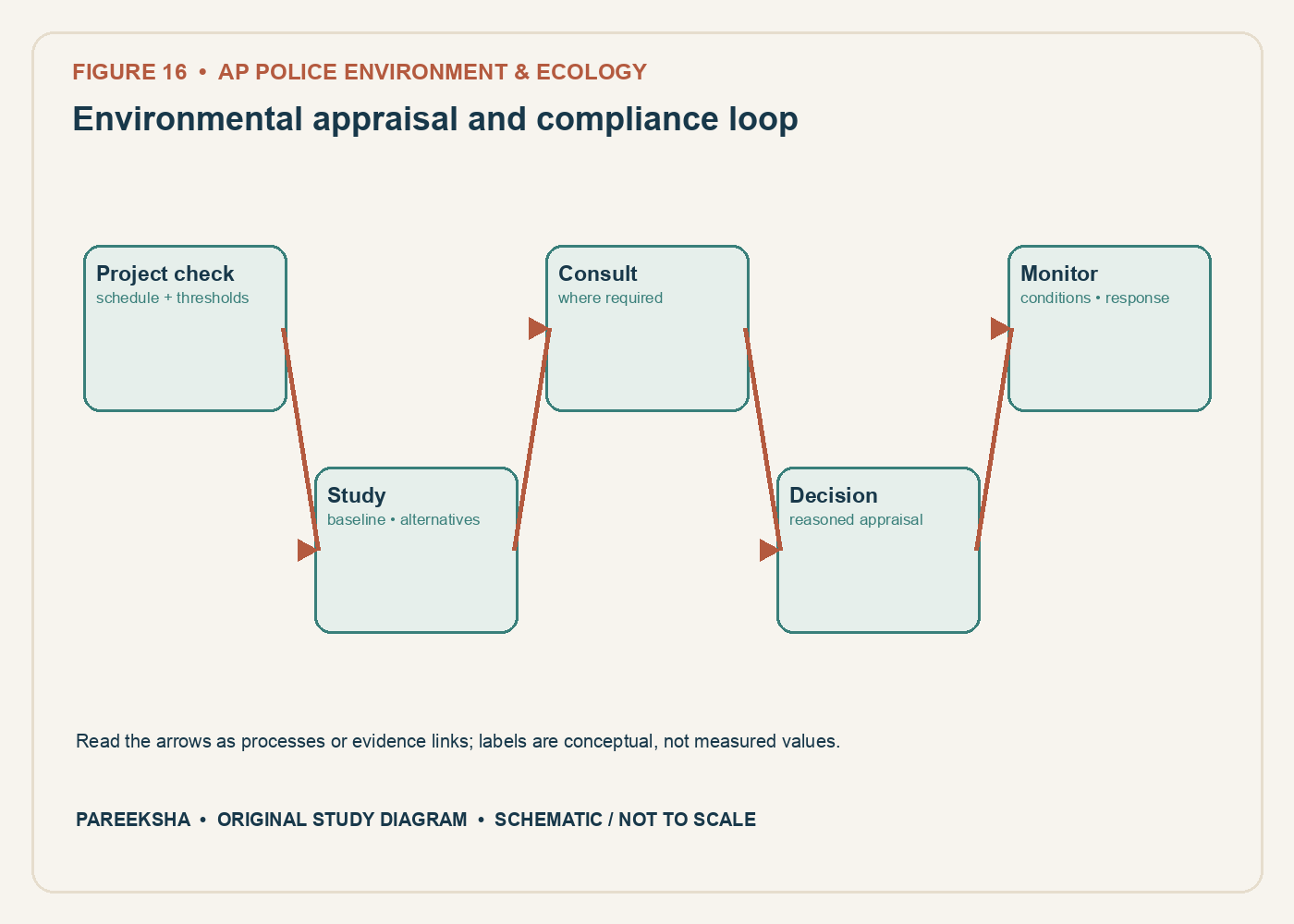
Figure 16.1 Environmental appraisal and compliance loop. Original explanatory diagram; schematic and not to scale.
Chapter practice questions
1. Environmental impact assessment (EIA) is primarily:
A. A land title certificate
B. A guarantee that a project has no effects
C. A process for predicting and evaluating likely environmental effects before a covered project proceeds
D. A wildlife census only
Answer: C. EIA gathers and assesses evidence about likely effects, alternatives and mitigation. It informs a regulatory decision but does not itself prove zero impact.
2. Environmental clearance (EC) is best described as:
A. The same document as an EIA report
B. A public hearing transcript only
C. A post-construction photograph
D. A regulatory decision for a project covered by the applicable notification
Answer: D. Clearance is the authority’s decision under the applicable framework. The EIA report is a supporting assessment, and other permissions may also be required.
3. The principal EIA Notification commonly used in India was issued in:
A. 2006
B. 1972
C. 1986
D. 2017
Answer: A. The Environment Impact Assessment Notification, 2006, S.O. 1533(E), is the principal framework commonly referenced. Current amendments must be checked in the Gazette.
4. Why must a project be checked against the notification’s schedule and thresholds?
A. Every project requires an identical EIA
B. Coverage depends on listed project type, category, size/capacity and applicable provisions
C. Only projects near the coast are covered
D. A project's name alone determines clearance
Answer: B. The schedule and amendments define which projects require prior clearance and which appraisal route applies. A broad impression of project size is not enough.
5. In the EIA process, scoping is concerned mainly with:
A. Paying the contractor
B. Issuing construction completion certificates
C. Identifying the issues and study requirements for the assessment
D. Replacing the public hearing
Answer: C. Scoping defines important issues and terms of reference for study. It is not the final decision to approve a project.
6. A Terms of Reference (ToR) for an EIA study is:
A. A clearance to begin construction
B. A final pollution monitoring result
C. A land ownership record
D. A specification of issues and studies to be addressed
Answer: D. ToR specifies the assessment work. A project still has to follow the applicable appraisal and decision process.
7. Screening is associated particularly with which appraisal category in the 2006 framework?
A. Category B
B. Category A only
C. Ramsar sites only
D. Every household activity
Answer: A. Under the notification’s framework, screening is relevant to Category B proposals to determine the applicable subcategory and study route. Exact criteria require the current text.
8. Why is an EIA baseline ideally collected across relevant seasons?
A. Seasonal variation never occurs
B. Environmental conditions and species use can vary seasonally
C. It removes the need to record methods
D. It guarantees approval
Answer: B. A single season may miss monsoon flows, breeding periods or seasonal pollution. Study design should reflect the project’s likely effects and local variation.
9. Which is a useful element of an EIA alternatives analysis?
A. Describe only the selected design
B. Exclude environmental effects
C. Compare feasible locations or designs, including the no-project alternative where relevant
D. Use a map without a scale
Answer: C. Alternatives analysis can reveal ways to avoid or reduce impacts and provides context for the proposed option. The alternatives considered should be transparent.
10. Public consultation in an environmental appraisal can provide:
A. An automatic veto in every case
B. A replacement for all technical studies
C. A guarantee that no impacts occur
D. Local information about resource use, seasonal conditions and likely effects
Answer: D. Affected people may identify issues missed by limited field studies. Consultation is part of the process where required; it does not mean every objection automatically decides the outcome.
11. Which statement about a public-hearing record is most accurate?
A. Concerns and responses should be documented so the authority can consider material issues
B. Attendance signatures alone prove every issue was resolved
C. Only supportive views may be recorded
D. The record is irrelevant to appraisal
Answer: A. A meaningful record captures issues and responses for consideration. Attendance alone does not show whether concerns were addressed.
12. A draft amendment to an EIA notification is published for comment. What is its status before final notification?
A. Automatically operative nationwide
B. Proposal, not binding final law
C. An amendment to the Constitution
D. A project-specific clearance
Answer: B. Drafts invite feedback and may change. The binding instrument and commencement date must be verified in the final Gazette.
13. Which type of impact can be missed when each proposed project is assessed in isolation?
A. A project’s name
B. The colour of the report cover
C. Cumulative impact from multiple projects and existing pressures
D. The number of copies submitted
Answer: C. Cumulative assessment considers combined effects across time and space. Individual studies can miss basin- or landscape-level limits.
14. An EIA predicts low noise at a nearby settlement. Which information is needed to assess the claim?
A. The settlement’s language only
B. The project’s logo
C. A photograph from a different year
D. Source levels, distance, terrain/barriers, operating schedule, method and receptor locations
Answer: D. A prediction needs transparent assumptions and context. Receptors, operations and measurement/model methods affect the result.
15. A monitoring condition on an EC is most useful when it specifies:
A. Indicator, location, frequency, responsible party, reporting and response to exceedance
B. Only the phrase “monitor regularly”
C. A vague promise without a schedule
D. A one-time photo at inauguration
Answer: A. Conditions should be measurable and enforceable. A clear trigger and response connect monitoring to corrective action.
16. The Wetlands (Conservation and Management) Rules, 2017 were notified under the:
A. Wildlife (Protection) Act, 1972 only
B. Environment (Protection) Act, 1986
C. Motor Vehicles Act
D. Forest Rights Act only
Answer: B. The 2017 Wetlands Rules were issued under the Environment (Protection) Act framework. Specific site applicability and boundaries require the rules and relevant notification.
17. According to MoEFCC implementation guidance, the 2017 Wetlands Rules cover Ramsar-designated wetlands and:
A. Every puddle by automatic Ramsar listing
B. Only wetlands in one state
C. Wetlands notified under the Rules by the competent government authority
D. Only artificial reservoirs
Answer: C. The ministry’s guidance identifies Ramsar-designated wetlands and wetlands notified under the Rules within their scope. A site-specific legal conclusion still requires the applicable records.
18. Ramsar designation primarily signifies:
A. Automatic transfer of the site to an international body
B. A blanket ban on every human activity
C. A local municipal boundary
D. International importance under the Convention on Wetlands, with conservation and wise-use responsibilities
Answer: D. Ramsar listing is international recognition and a commitment to conserve ecological character and wise use. Domestic laws define local permissions and enforcement.
19. Which is the strongest source for whether a particular activity is allowed in a named wetland or ESZ?
A. Current final Gazette notification, mapped boundary and applicable amendments
B. A general biology textbook
C. A draft posted for consultation
D. A travel advertisement
Answer: A. Permissions depend on the specific legal instrument and location. Gazette wording, maps and current amendments control the claim.
20. After EC is granted, which step remains important?
A. Assuming predicted impacts cannot occur
B. Monitoring compliance with clearance conditions and correcting non-compliance
C. Cancelling all other statutory permissions
D. Ending environmental reporting
Answer: B. Post-clearance monitoring checks whether conditions are met and impacts are managed. An EC does not remove ongoing compliance responsibilities.