Chapter 2 — Ecosystem structure, habitat and niche
Exam link: common foundation.
Learning aim: identify an ecosystem's living and non-living components and distinguish the words habitat, niche, population and community in unfamiliar examples.
2.1 Begin with the question, not the label
“Which ecosystem is this?” can be a less useful first question than “What is interacting, where, and over what period?” A shallow wetland, a river reach and a city park can each be studied as an ecosystem. Their boundaries depend on the investigation. A water-quality study may focus on one reach; a fish-movement study may need to include tributaries and seasonal flood connections. The investigator should choose a boundary that includes the processes needed to answer the question and state what lies outside it.
A practical ecosystem description has four parts: the physical setting, the organisms present, the interactions among them and the exchanges with surrounding places. A list of species without conditions is incomplete. A list of soil and water characteristics without organisms is also incomplete. The ecosystem concept joins them in one working picture.
2.2 Abiotic conditions: more than a background
Abiotic components are non-living physical and chemical features. They include light, temperature, water availability, soil or sediment, salinity, acidity, dissolved oxygen, nutrients, wind, slope and disturbance. Their importance differs by ecosystem and season.
In an estuary, freshwater inflow and tidal mixing create a salinity gradient. Some organisms tolerate a broad range; others are restricted to a narrower range. On an exposed coastal site, wave energy and sediment movement may matter. In an upland forest, slope and soil depth may influence runoff and plant establishment. In a pond, dissolved oxygen can vary with temperature, water mixing, photosynthesis and decomposition. No single abiotic factor explains every ecosystem outcome.
An environmental gradient is a measurable change in conditions across space or time—for example, increasing salinity from a freshwater inflow toward the sea. Organisms may be distributed along the gradient according to tolerance, resources and interactions. The distribution is not always a simple band: tides, season, substrate, shade and other organisms may modify it. A diagram should show the gradient and identify the observation period rather than imply a permanent fixed boundary.
2.3 Biotic components and functional roles
Biotic components are organisms. A useful functional grouping is producers, consumers and decomposers, but the labels describe roles in a process rather than moral or fixed categories.
- Producers build organic matter from inorganic materials using an energy source. Many plants and algae use sunlight through photosynthesis. In some environments, microorganisms can use chemical energy.
- Consumers obtain energy and materials by feeding on organisms or organic matter. Their diets may place them at different trophic positions in different food webs.
- Decomposers and detrital feeders process dead material and waste. Bacteria and fungi transform organic substances; many animals fragment and consume detritus. These processes make nutrients available for reuse, though they do not instantly return every element to the same form or location.
The same species can occupy more than one feeding role as its diet changes. “Primary consumer” usually means an organism feeding on producers in a simplified food chain. In a complex food web, an omnivore may feed at multiple trophic levels. Questions that ask for one level should supply a particular food relationship.
2.4 Habitat: the place an organism uses
A habitat is the place or environmental setting in which an organism lives or can be found. It may be described at different scales: a mangrove creek, a muddy intertidal edge, a tree hollow or a patch of submerged vegetation. The correct scale depends on the organism and the question.
Habitat is not always identical to a mapped land-cover class. A satellite map may label a broad area “wetland,” but an animal may rely on a particular water depth, vegetation structure or seasonal connection within it. Two places with the same broad land-cover label can differ in disturbance, water quality and food resources. Conversely, a mobile species may use several habitats during different parts of its life cycle.
2.5 Niche: how an organism fits and functions
An organism's ecological niche concerns how it uses resources and interacts with conditions and other organisms. A niche can include food, foraging time, nesting sites, temperature tolerance, predators, competitors and other relationships. It is not merely the name of the place where the organism is found.
Imagine two bird species feeding in the same wetland. One feeds mainly in shallow water at dawn; another takes prey from mudflats later in the day. They may overlap in habitat yet differ in parts of their resource use. Niche differentiation can reduce direct competition, but one observation does not establish that competition is absent. Food availability, season and population density also matter.
For exam purposes, keep the distinction concise: habitat asks “where?”; niche asks “how does the organism live and use resources?” In a real ecological study the two are linked. A habitat provides conditions and resources; the organism's requirements influence which parts it can use.
2.6 Tolerance, limiting factors and realized distribution
Organisms have ranges of conditions they can tolerate. If temperature, salinity, water or another factor moves beyond a viable range, survival or reproduction may fall. Within a broad tolerance range, performance may still vary; an organism can survive under a condition without thriving there.
A limiting factor is a factor that constrains a process or population under the conditions being considered. Water may limit plant growth in a dry period; oxygen may limit aquatic organisms in poorly mixed water; a nesting site may limit breeding even where food is abundant. The limiting factor can change when conditions change. Therefore, avoid statements such as “light is always the limiting factor for plants.”
A species' potential distribution under suitable conditions may differ from its realized distribution after interactions, dispersal barriers, disturbance and human land use are considered. A map of suitable climate does not prove that a species occupies every suitable cell. It may not have reached that location, the habitat may be fragmented, or competitors and local conditions may matter. This distinction is useful when evaluating a conservation map or a question that equates a predicted range with an observed population.
2.7 Ecosystem boundaries and connectivity
Boundaries help organise observation, but systems exchange matter and organisms. A wetland can receive sediment and nutrients from its catchment. A river can connect spawning, feeding and refuge areas. A forest patch can receive seeds from another patch if dispersal routes remain open. Roads, canals, embankments, fences and built areas can alter those connections. The effect depends on design, location, species and season.
Connectivity describes the degree to which organisms, water, energy or materials can move between places. It is not always synonymous with a continuous green strip. A river corridor may connect aquatic organisms but also carry pollution. A corridor that helps one species may not suit another. Good analysis identifies what is moving and for whom.
An ecotone is a transition zone between ecological communities or ecosystems. It may contain species from neighbouring systems as well as species particularly associated with the transition. An estuarine gradient is a vivid example of changing conditions, though not every gradual transition is a sharply bounded ecotone. A transition zone may be dynamic and shift with season or human changes in water flow.
2.8 A field-style worked example
Suppose students compare two mangrove-edge sites. Site A has a narrow creek, a mix of root forms and regular tidal exchange. Site B is beside a blocked channel and has stagnant pools after rain. The class observes fewer small fish at Site B. Which conclusions are justified?
First identify the units. The sites are habitat patches inside a larger coastal ecosystem. “Fewer small fish” is a population observation only if the survey effort, area, time and method are comparable. The blocked channel is a plausible pressure that could change tidal exchange and water conditions. The observations do not yet prove that blockage caused the fish difference. Measurements of salinity, dissolved oxygen, water depth, season and sampling effort would help test the pathway. A management response might restore flow, but it should be assessed for unintended effects such as erosion or altered sediment movement.
This example asks students to hold two ideas together: the proposed mechanism is ecologically plausible, and the evidence is not yet sufficient to claim causation. In exam questions, the correct option often preserves both.
Figure 2.1 — From setting to niche: use two panels. Panel A labels ecosystem components: abiotic conditions, producers, consumers, decomposers and exchanges across a boundary. Panel B contrasts habitat (place) with a niche description (resources, conditions, timing and interactions). Do not draw the niche as a fixed circular territory.
2.9 Common exam traps
1. Habitat and niche are not interchangeable. A location is not a full account of resource use and relationships.
2. Abiotic means non-living, not unimportant. Water chemistry and temperature can shape biological interactions.
3. A population is one species. A community includes multiple populations; an ecosystem adds physical conditions and exchanges.
4. Observed presence is not proof of optimal conditions. An organism may persist in a marginal or temporary habitat.
5. A boundary is analytical. It does not make the ecosystem sealed.
6. A potential-range map is not an occupancy survey. Distinguish modelled suitability, reported presence and confirmed breeding.
Retrieval and application
Choose a nearby stream, park or farm. State a practical boundary and justify it. Name three abiotic variables, two interacting populations and one outside connection. Describe one organism's habitat and niche separately. Finally, identify a possible limiting factor and the observation needed to support that claim.
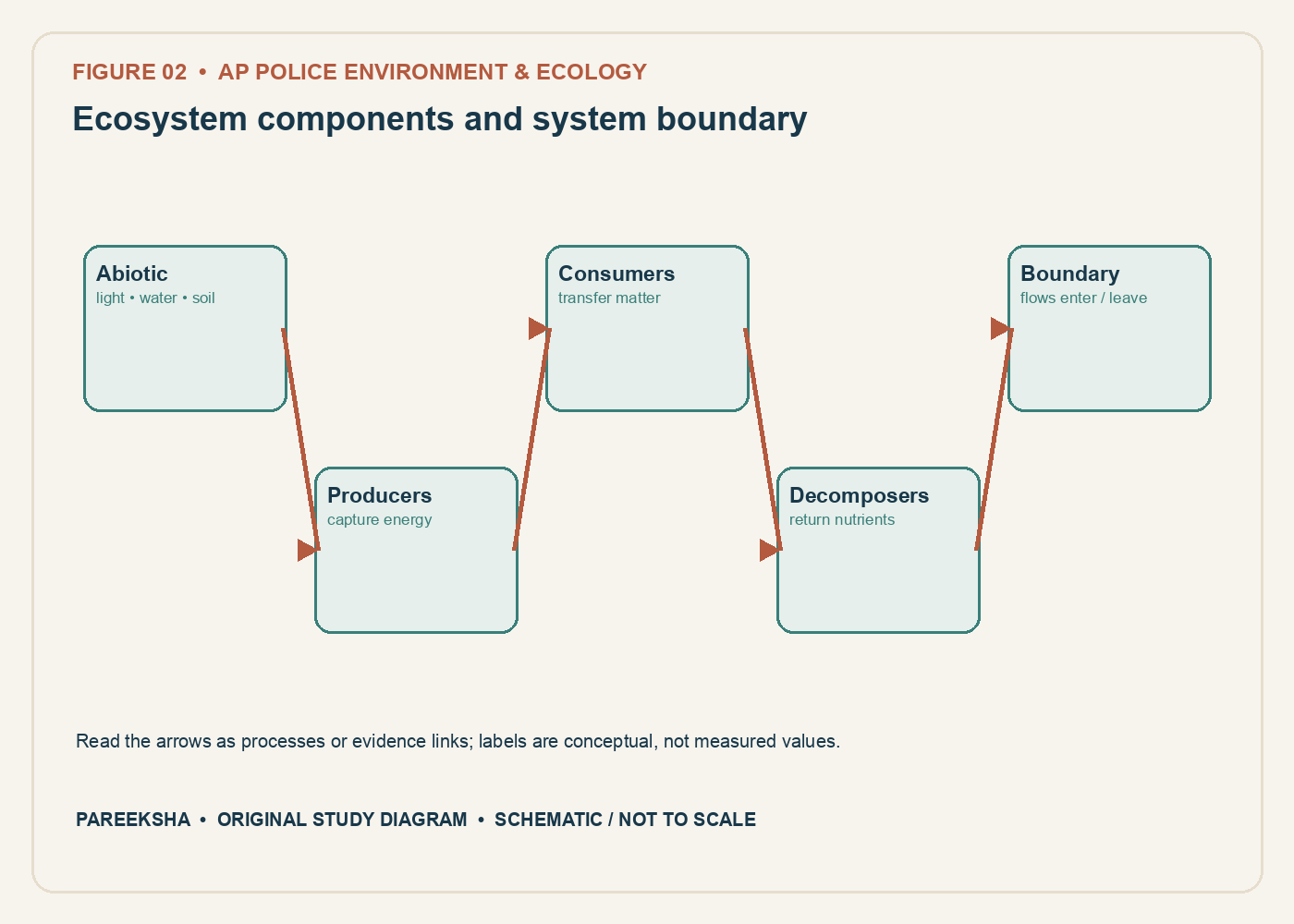
Figure 2.1 Ecosystem components and system boundary. Original explanatory diagram; schematic and not to scale.
Chapter practice questions
1. A small fish lives only in cool, shaded stream pools and feeds on aquatic insect larvae. Which phrase describes the fish’s niche most fully?
A. The stream’s entire catchment boundary
B. The fish’s scientific name alone
C. The set of conditions and resource-use relationships under which it lives
D. The annual rainfall of the whole state
Answer: C. A niche describes a species’ ecological role and the conditions and resources associated with it. It is broader than a place name or taxonomic label.
2. A hollow in a tree trunk used by a nesting bird is best described as part of the bird’s:
A. Trophic level
B. Biome
C. Population growth rate
D. Habitat
Answer: D. Habitat is the place or physical setting where an organism lives. Its niche also includes how it uses resources and interacts with other organisms.
3. Two plant species occupy the same patch, but one is rooted in the wet margin and the other on a drier raised bank. This pattern may reduce direct competition because the plants:
A. Use different portions of the habitat and conditions
B. Have identical niches in all respects
C. Are both abiotic factors
D. Have become one population
Answer: A. Partitioning space or resources can reduce niche overlap. Whether competition is actually reduced should be tested rather than assumed from one observation.
4. Which is a biotic component?
A. Dissolved salt
B. Bacteria decomposing organic matter
C. Water temperature
D. Sediment grain size
Answer: B. Bacteria are living organisms. Salt, temperature and grain size are abiotic components.
5. A plant species grows only within a limited range of soil moisture. Moisture is acting as a:
A. Decomposer
B. Population
C. Limiting factor
D. Biome boundary in every case
Answer: C. A limiting factor restricts survival, growth or distribution when its level falls outside a suitable range. The factor may be biotic or abiotic.
6. A species tolerates a broad temperature range but a narrow salinity range. Which statement follows?
A. Temperature must control its distribution everywhere
B. The species has no niche
C. Salinity is a biotic factor
D. Salinity may be more limiting where local salinity varies beyond its tolerance
Answer: D. The impact of a tolerance limit depends on local conditions. A broad tolerance for one variable does not eliminate limits imposed by another.
7. Why is habitat not always a single, fixed location?
A. Organisms may use different places for feeding, breeding, shelter or seasonal movement
B. Habitat means the organism’s genome
C. Habitat includes only the place where an organism was first described
D. Organisms never move between habitat patches
Answer: A. Many organisms depend on several linked places during a life cycle or across seasons. Conservation may therefore need to protect connections as well as one site.
8. Which description best fits a microhabitat?
A. A broad climate region spanning a continent
B. A small, locally distinct set of conditions within a larger habitat
C. A group of all populations in a state
D. A process by which nutrients cycle
Answer: B. A microhabitat is a small-scale environment with particular conditions, such as a shaded leaf underside or moist rock crevice.
9. A fish disappears from a stream after a barrier blocks movement between breeding and feeding areas. The barrier most directly affects:
A. The chemical identity of oxygen
B. The definition of a biome
C. Connectivity among habitat components
D. The fish’s classification as an organism
Answer: C. A barrier can disconnect areas needed for different life stages. Connectivity is a landscape property that influences access and movement.
10. In a controlled field experiment, researchers add shade to half of similar plots and compare plant growth. What is the main scientific advantage?
A. It proves the same effect occurs in every forest
B. It removes all uncertainty from ecological research
C. It converts an observation into a legal rule
D. It can help isolate the effect of shade while other conditions are monitored
Answer: D. A controlled comparison improves causal inference by varying a factor while tracking other relevant conditions. Replication and careful design are still needed.
11. Which statement about ecological tolerance is most accurate?
A. A species may persist only within a range of conditions, with variation among individuals and life stages
B. Every individual of a species has exactly the same tolerance limits
C. Tolerance applies only to temperature
D. A broad tolerance means a species cannot be affected by habitat change
Answer: A. Tolerance ranges can vary among individuals, populations and life stages. Other factors and interactions also affect survival.
12. A wetland plant grows in shallow water, while its seedlings establish on exposed damp soil. This shows that:
A. The plant has no ecological requirements
B. Habitat conditions can change across life stages
C. Seedlings are abiotic components
D. Water depth cannot influence plant distribution
Answer: B. Germination, establishment and adult growth may have different requirements. Management should consider these life-stage differences.
13. Which pair consists of abiotic factors?
A. Predators and parasites
B. Trees and fungi
C. Salinity and light intensity
D. Fish and plankton
Answer: C. Salinity and light are physical or chemical conditions. The other pairs contain living organisms.
14. A species’ realised niche is often narrower than its potential niche because:
A. Abiotic conditions have no effect
B. Its habitat is always a biome
C. It cannot move
D. Interactions such as competition and predation can restrict where it persists
Answer: D. The potential range under suitable abiotic conditions can be reduced by biotic interactions and dispersal limits. The exact meaning depends on the study framework.
15. What does the phrase “habitat fragmentation” refer to?
A. The breaking of continuous habitat into smaller, separated patches
B. The creation of more connected habitat through corridors
C. The annual change in water temperature
D. The movement of nutrients through a food web
Answer: A. Fragmentation reduces or alters the continuity of habitat and may isolate populations. Its effects depend on patch quality, distance and species movement.
16. A researcher says, “This bird uses mangroves, so it must be a mangrove specialist.” What is the best response?
A. Correct, because any use proves specialisation
B. Not necessarily; evidence about dependence, resource use and use of other habitats is needed
C. Incorrect, because birds cannot have niches
D. Correct only if the mangroves are in a national park
Answer: B. Habitat use alone does not prove specialisation. Researchers should examine frequency, life-stage dependence, alternative habitats and resource use.
17. Why may a species with a wide geographic range still be locally vulnerable?
A. Wide range guarantees stable local numbers
B. Geographic range and population size are identical measures
C. Local habitat loss can eliminate isolated populations even if the species remains elsewhere
D. Local populations have no conservation value
Answer: C. A broad range does not ensure that every local population is secure. Local extirpation can occur while the species persists in other regions.
18. A species occurs in both freshwater and brackish zones but reproduces only where salinity is low. Which survey design is most useful?
A. Sample adults once in one season and infer reproduction everywhere
B. Measure only air temperature
C. Count unrelated plant species
D. Sample across the salinity gradient and include the breeding season and life stages
Answer: D. The design must test distribution and reproduction across conditions and time. Life-stage and seasonal information can reveal a narrower breeding niche.