Chapter 3 — Trophic structure and energy flow
Exam link: common foundation.
Learning aim: read food-chain arrows correctly, distinguish trophic position from taxonomic group, and explain why energy available to higher trophic levels is limited.
3.1 Feeding relationships connect organisms
Organisms require energy to maintain their bodies, grow and reproduce. They also require matter—water and elements that become part of tissues or support life processes. Feeding relationships show one route by which organic matter and energy move through a community.
A food chain is a simplified sequence of feeding links. For example, sunlight supports algae; a small grazing animal consumes algae; a small fish eats that animal; a larger fish eats the smaller fish. The chain is a teaching model. In a real system, each organism may have several foods and several predators.
A food web combines interconnected food chains. It better represents the multiple pathways in many ecosystems. A change to one population can affect several others, but the response is not automatically a simple domino effect. Alternative foods, predators, habitat conditions and compensating changes can strengthen or weaken the impact.
3.2 Read the arrow before reading the story
In an ecological food diagram, an arrow commonly points from the food or energy source toward the consumer: algae → grazer means the grazer consumes the algae. This direction tracks transfer from resource to consumer. It does not mean that the grazer “points toward” what it eats in every diagram convention; always inspect the caption or legend.
Arrow direction matters in exam questions. If a fish eats an insect, the transfer arrow runs from insect to fish. If an eagle eats that fish, the next arrow runs from fish to eagle. A food web with arrows pointing the wrong way reverses the relationship and can lead to a wrong conclusion about which organisms receive energy from a source.
3.3 Producers, consumers and decomposers in context
Producers capture energy and build organic compounds. In a sunlit pond or coastal water, phytoplankton and aquatic plants may contribute to primary production. On land, green plants are familiar producers. The species and their relative contribution vary across systems and seasons.
Consumers obtain organic matter by feeding. A primary consumer in one chain feeds on producers; a secondary consumer eats a primary consumer; a tertiary consumer may feed higher in that simplified chain. The terms describe a position in a particular relationship, not an unchanging identity. An omnivorous bird can occupy more than one trophic position depending on what it eats.
Decomposers and detrital feeders use dead organic material and waste. Their activity breaks down complex material and returns elements to forms that can re-enter ecological processes. Decomposition is influenced by moisture, oxygen, temperature, the material itself and the organisms present. A fallen leaf does not vanish; its components are transformed, stored in organisms or soil, dissolved, transported or released through biological and chemical processes.
Detritus-based pathways are not an afterthought. Dead plant matter can support fungi, bacteria, invertebrates and fish. In many ecosystems, a substantial share of production enters detrital pathways rather than being eaten while alive. A food web that includes only visible predators and prey may miss this route.
3.4 Energy enters, changes form and dissipates
For many ecosystems, sunlight is the principal energy source. Photosynthetic organisms convert a portion of incoming solar energy into chemical energy stored in organic matter. Consumers obtain some of this stored energy when they feed. At every transfer, not all energy becomes new biomass available to the next consumer. Organisms use energy for movement, maintenance and other life processes; some material is not eaten or digested; and heat dissipates to the surroundings.
Thus energy flows through a food web; it does not cycle back as the same usable energy. Ecosystems receive energy continuously and release heat. Matter, by contrast, can be reused through cycles. The distinction is often tested directly.
A small illustrative calculation
Assume a simplified producer level stores 10,000 energy units as biomass over a specified period. If a classroom example assumes 10% transfer to the next trophic level, the next level receives 1,000 units, then 100, then 10. These figures illustrate multiplication by 0.1, not a universal ecological law. Actual transfer efficiency varies with ecosystem, organism, diet, temperature, food quality and measurement method. Never infer that every real food chain transfers exactly one-tenth of its energy.
The time period also matters. Ten thousand units stored over a year cannot be compared directly with a consumer biomass measured on one day unless the quantities and units are made comparable. Energy flow is usually a rate or an amount over a stated interval, while a standing biomass is a snapshot of material present. A question that mixes them without dates or units may be incomplete.
3.5 Primary production: gross and net
Gross primary production (GPP) is the total rate at which producers capture energy and form organic matter. Producers use part of that captured energy for their own respiration. Net primary production (NPP) is the remainder available for growth and, ultimately, consumers and detrital pathways. In simplified form:
> NPP = GPP − producer respiration
This relationship is conceptual and useful in numerical questions when values are supplied in compatible units and for the same area and period. If GPP is 900 units and producer respiration is 350 units, NPP is 550 units. The arithmetic is simple; the exam trap is mixing rates, areas or time periods.
High primary production does not alone guarantee high animal populations. Consumer numbers also depend on food quality, habitat, water, predators, disease, disturbance and movement. Production may be exported from the local system or enter decomposition rather than being consumed by a grazing animal.
3.6 Trophic cascades and their limits
A trophic cascade occurs when a change at one trophic level indirectly affects organisms at other levels. For example, if a predator's numbers fall, a prey population may rise; increased grazing may then alter plant cover. The direction and magnitude depend on the food web and context. Predators may have other prey; prey populations may be limited by habitat or disease; plants may recover quickly or slowly. The term does not mean that every predator change creates a predictable chain of equal steps.
When a case describes a predator decline and plant change, draw the proposed chain and mark each step as measured or inferred. If the case provides data only on predator and plant numbers, the intermediate prey effect might remain a hypothesis. Good reasoning keeps the mechanism visible and the evidence limits explicit.
3.7 Ecological efficiency and the energy pyramid
An ecological efficiency compares energy or production transferred between trophic levels under a specified definition. It helps explain why higher trophic levels often have less energy available, but different efficiency measures use different numerator and denominator quantities. Unless a question defines its measure, avoid assuming a precise percentage.
An energy pyramid represents energy flow or production across trophic levels for a defined area and period. In the usual ecosystem model, energy available decreases at successive transfers, so the pyramid is upright. It is different from a pyramid of organism numbers or standing biomass. A large producer such as a tree can support many insects, so a numbers pyramid may be inverted. In some aquatic systems, a snapshot of producer biomass can be lower than consumer biomass because small producers reproduce and are consumed rapidly; this does not mean the energy pyramid is inverted.
Biomass is the mass of living material in a defined place at a particular time. Its measurement needs a consistent basis—for example, dry mass and area. A biomass pyramid is a stock at a moment, not automatically the total production over a season. This distinction explains why a standing crop can look different from an energy-transfer diagram.
3.8 Food-web stability and biodiversity
A food web with multiple feeding routes can sometimes provide alternative pathways when one resource changes. That does not mean “more species always makes every ecosystem stable.” Stability has multiple meanings: resistance to change, speed of recovery, low variability or persistence of functions. The result depends on which species, interactions and disturbance are involved. A diverse web can contain strong dependencies or sensitive species; a less diverse system can be resilient to one pressure but vulnerable to another.
For exam answers, reject absolute claims such as “every species is equally important” or “removing any one organism collapses the ecosystem.” Ask what function the organism performs, whether alternatives exist, how large the change is and what evidence supports the predicted outcome.
3.9 Work through a wetland web
Picture a simplified wetland web: aquatic plants and algae feed grazing invertebrates; invertebrates are eaten by small fish and some birds; small fish are prey for larger fish and fish-eating birds. Dead plants and animal remains enter detrital pathways processed by microbes and detritivores. A nutrient addition may increase plant or algal production under some conditions. If excess growth later decomposes, microbial respiration can consume dissolved oxygen. The outcome depends on nutrient form, water movement, light, temperature and the rate of decomposition. “More nutrients always mean more fish” is therefore not a safe inference.
Figure 3.1 — Wetland food web: draw producers, grazing invertebrates, small fish, larger fish, birds, microbes and detritus. Arrows run from resource to consumer. Use a separate dashed arrow for a hypothesised nutrient-loading pathway and label it “possible mechanism—requires evidence.”
Figure 3.2 — Energy flow: show sunlight → producer chemical energy → consumer levels, with heat leaving at every transfer and detrital material entering a decomposer pathway. Label all numerical efficiencies as illustrative only; distinguish energy flow from nutrient cycling.
3.10 Common exam traps and retrieval
- A food-chain arrow ordinarily points from food to feeder; verify the figure's stated convention.
- Decomposers are organisms, not a non-living “final trophic level.”
- Energy flows; nutrients and water move through cycles and exchanges.
- The 10% figure is a teaching approximation, not a constant for every link.
- Energy pyramids, biomass pyramids and numbers pyramids measure different things.
- Standing biomass and production are not interchangeable.
- A correlation in a food web is evidence of association, not necessarily the full causal pathway.
Draw a four-link chain for a pond, then convert it into a web with one alternative food for a consumer. Mark the direction of each arrow. Explain what could happen if one prey declines, list one alternative pathway, and state what measurement would be needed before claiming a predator decline.
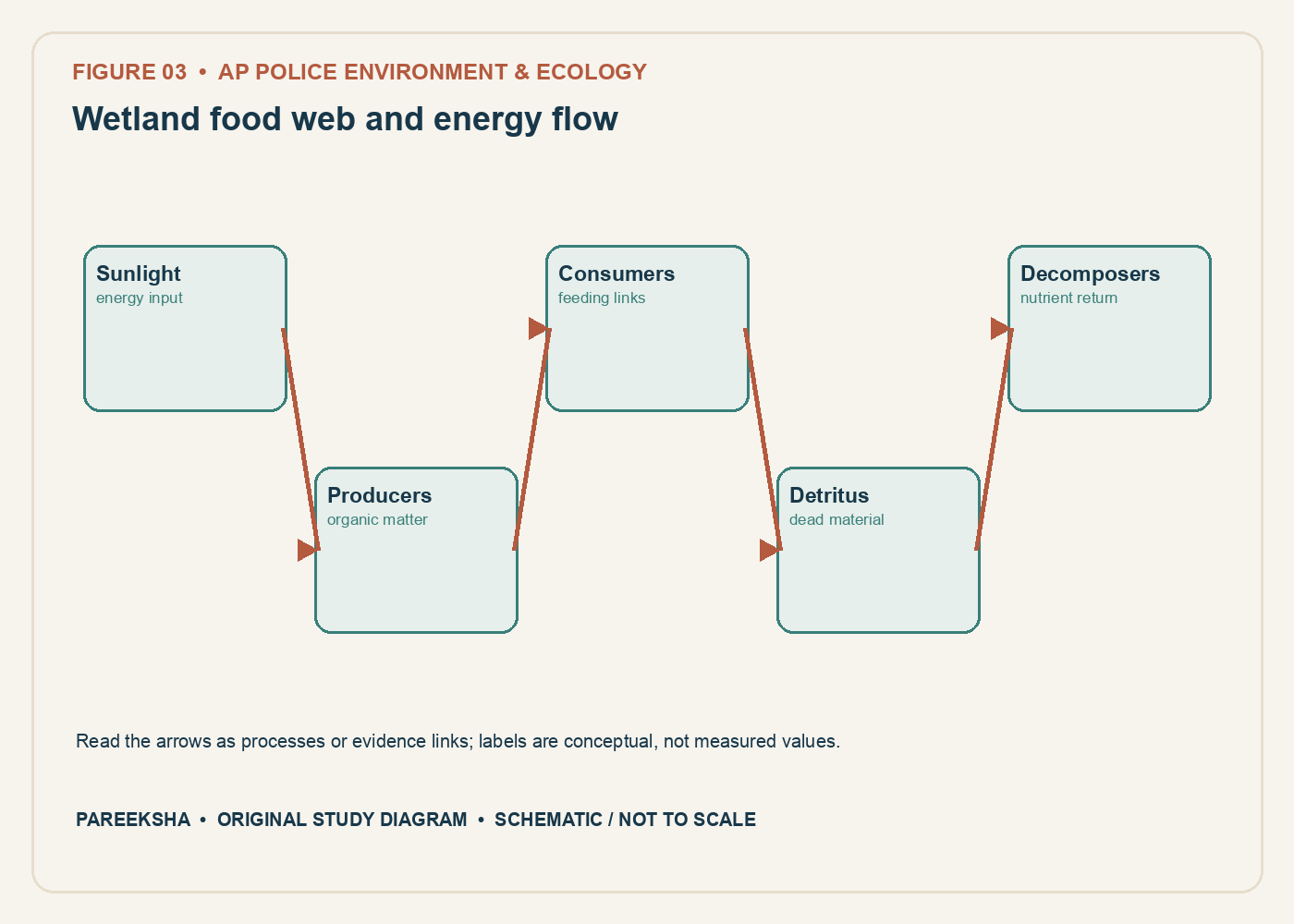
Figure 3.1 Wetland food web and energy flow. Original explanatory diagram; schematic and not to scale.
Chapter practice questions
1. In most ecosystems, the main entry point for energy is:
A. Photosynthesis by producers using sunlight
B. Decomposition of rock
C. Respiration by top consumers
D. Nitrogen fixation by every animal
Answer: A. Photosynthetic producers capture a portion of solar energy and convert it to chemical energy. Some ecosystems use chemical energy sources, but sunlight is the principal entry point in most familiar terrestrial and aquatic food webs.
2. In a food-web diagram, an arrow from a plant to a herbivore usually represents:
A. The direction of animal movement only
B. The direction in which energy and food matter pass
C. A guaranteed increase in both populations
D. A taxonomic relationship
Answer: B. The arrow runs from the resource to the consumer, showing transfer of food matter and energy. It does not by itself predict population change.
3. A decomposer obtains energy mainly by:
A. Making sunlight
B. Converting nitrogen directly into sunlight
C. Breaking down dead organic material and wastes
D. Eating only top predators
Answer: C. Decomposers such as many fungi and bacteria obtain energy while breaking down organic matter. Their activity also returns nutrients to forms that can re-enter ecosystem pathways.
4. Why is energy described as flowing rather than cycling through an ecosystem?
A. Energy is repeatedly recycled without loss
B. Energy exists only in producers
C. Energy cannot be transferred between organisms
D. Energy enters, passes through transformations and is dissipated as heat
Answer: D. Energy transfers are inefficient and some energy becomes heat at each transformation. Matter, unlike energy, cycles through biological and physical pools.
5. If a food chain begins with grass, which is the primary consumer?
A. A grass-eating insect
B. A hawk eating the insect
C. A fungus decomposing a carcass
D. A bacterium fixing nitrogen
Answer: A. A primary consumer feeds directly on producers. The hawk is at a higher consumer level; decomposers and nitrogen-fixing bacteria are not primary consumers in this chain.
6. A pond food web contains algae, zooplankton, small fish and larger fish. If the larger fish declines, which conclusion is safest?
A. Every lower population must increase by the same percentage
B. Some interactions may change, but outcomes depend on the full web and other conditions
C. Algae will certainly disappear
D. Energy will begin to cycle
Answer: B. A change in one consumer can alter predation and competition, but food webs include multiple pathways and environmental controls. The direction and size of effects need evidence.
7. Which statement about a trophic level is correct?
A. It is a fixed physical layer at a constant depth
B. It is identical to a taxonomic class
C. It groups organisms by their feeding position in a food chain or web
D. It includes only organisms of the same species
Answer: C. Trophic level refers to feeding position, such as producer or primary consumer. Omnivores may feed at more than one level.
8. An omnivore eats seeds and insects. In a food-web analysis it may:
A. Be a producer because it eats seeds
B. Be an abiotic factor
C. Never be a consumer
D. Occupy more than one trophic position depending on the food consumed
Answer: D. An omnivore uses resources from different feeding levels. The role assigned can depend on the specific food pathway being analysed.
9. Which group most directly breaks down leaf litter and helps release nutrients?
A. Decomposer fungi and bacteria
B. Only apex predators
C. Sunlight and rainfall alone
D. Primary producers alone
Answer: A. Decomposers metabolise dead organic matter. Physical conditions affect decomposition, but the biological breakdown is chiefly carried out by decomposer organisms.
10. A pyramid of energy is generally upright because:
A. Top consumers create energy from nothing
B. Energy available to the next trophic level declines through transfers
C. Producers always have less energy than consumers
D. Decomposers are excluded from ecosystems
Answer: B. Some energy is used in metabolism or dissipated as heat and not transferred as biomass to the next level. Therefore, energy available generally decreases upward.
11. Which observation would most directly support the claim that a bird is a predator in a particular food web?
A. Its feathers have a bright colour
B. It is listed in a field guide
C. It is seen consuming a smaller animal included in the web
D. It nests above ground
Answer: C. Direct feeding evidence supports a predator–prey link. Appearance, taxonomy or nest location does not establish the feeding interaction.
12. What can happen when a pollutant accumulates in organisms and becomes more concentrated at higher trophic levels?
A. Primary succession
B. Nitrogen fixation
C. Ecological release from all constraints
D. Biomagnification
Answer: D. Biomagnification is an increase in concentration across trophic levels for substances with relevant persistence and biological properties. It does not occur for every pollutant.
13. A food chain shows grass → grasshopper → frog → snake. Which organism is the secondary consumer in this simplified chain?
A. Frog
B. Grass
C. Grasshopper
D. Snake
Answer: A. The grasshopper is the primary consumer; the frog eats it and is the secondary consumer. The snake is one level higher in this simplified pathway.
14. Why might a real food web be more informative than a single food chain?
A. It proves that every organism eats every other organism
B. It shows multiple feeding links and alternative pathways
C. It removes the need to identify species
D. It shows only energy losses as heat
Answer: B. A web represents a network of feeding links and can reveal alternative resources or consumers. It remains a simplified model, not a complete record of all interactions.
15. Which statement about the “10 percent rule” is most careful?
A. Exactly 10% always passes from every trophic level to the next
B. It applies only to water and not land
C. It is a rough teaching illustration; actual transfer efficiency varies
D. It says 90% of every population dies
Answer: C. Transfer efficiency depends on organism, food quality, metabolism and ecosystem conditions. A fixed 10% is not a universal ecological law.
16. A fish eats both algae and zooplankton. Which statement is valid?
A. It must be a producer
B. It cannot be part of a food web
C. Its diet has no effect on trophic classification
D. Its trophic position may depend on which food pathway is considered
Answer: D. When a species consumes resources from different levels, it can occupy a mixed trophic position. A simple chain may conceal this complexity.
17. Which process returns mineral nutrients from dead organic material to ecosystem pools?
A. Decomposition and mineralisation
B. Solar radiation alone
C. Predation without digestion
D. Migration alone
Answer: A. Decomposition breaks down organic matter; mineralisation releases inorganic forms that can be taken up again. The specific pathways vary by nutrient and conditions.
18. A lake loses its top predator. Why can a trophic cascade not be assumed automatically?
A. Predators never influence prey
B. The effect depends on alternative prey, other predators, habitat and environmental conditions
C. Food webs contain only one link
D. Energy becomes matter
Answer: B. Top predators can influence lower levels, but the strength and direction of a cascade vary with food-web structure, ecological context and compensating processes.
19. Which statement correctly distinguishes a food web from a nutrient cycle?
A. Both show only the one-way movement of heat
B. A nutrient cycle contains no abiotic pool
C. A food web maps feeding links; a nutrient cycle maps movement of matter among pools
D. A food web is a map of district boundaries
Answer: C. Food webs focus on who eats whom and associated transfers. Nutrient cycles track matter through organisms, soil, water, air and other reservoirs.
20. In a detritus-based food chain, the initial material is primarily:
A. Pure sunlight
B. Bedrock only
C. A living apex predator
D. Dead organic matter and wastes
Answer: D. Detritus-based pathways begin with dead organic material or waste, which is consumed or decomposed by detritivores and decomposers.