Chapter 5 — Succession, populations and communities
Exam link: common foundation.
Learning aim: interpret population change, carrying capacity, ecological succession and disturbance without treating ecosystem development as a fixed ladder.
5.1 A population is measured in time and space
A population is a group of individuals of the same species in a defined area at a stated time. Population size changes through births, deaths, immigration and emigration. A basic accounting identity is:
> change in population = births + immigration − deaths − emigration
For a short numerical question, all four terms must refer to the same interval and population boundary. If 45 animals are born, 11 die, 8 arrive and 6 leave, the net increase is 36. The arithmetic is straightforward; the ecological challenge is defining the area, time period and method consistently.
Population density divides a count by area or volume. It can be misleading if organisms cluster in suitable habitat, move seasonally or are difficult to detect. A count of birds at a wetland on one morning may reflect weather and movement as well as the number that use the site over a year. Good comparisons standardize survey effort and note uncertainty.
5.2 Growth patterns and carrying capacity
Under idealized conditions with abundant resources, a population may grow rapidly as a fraction of its current size. This is often represented by an exponential curve. Real populations encounter limits: food, water, space, nesting sites, disease, predation, competition and disturbance. A logistic model describes growth that slows as a population approaches an assumed carrying capacity.
Carrying capacity is not a permanent number written into a habitat. It depends on resource supply, environment, interactions, season and the chosen time period. Drought, fire, restoration or land conversion can change conditions. A population may overshoot available resources, fluctuate or move away. Thus a logistic curve is a model for reasoning, not a guarantee that every population rises smoothly to a stable plateau.
Density-dependent influences tend to change in strength with population density, such as competition for limited nesting sites. Density-independent events, such as a severe storm, can affect a population regardless of its density, though effects may vary by habitat and species. These categories are useful but not absolute: an event can interact with density and condition. Read the specific case rather than classify by word alone.
5.3 Age structure, survival and life history
Population size alone may hide important differences. Age structure can indicate how many individuals are juveniles, reproductive adults or older organisms. Survival and reproduction rates differ across life stages. A population with many young individuals may increase later if survival is adequate; a population dominated by older adults may decline even when its present count is large. A simple age pyramid is a model, not a full forecast.
Species also differ in life-history patterns. Some produce many offspring with relatively little parental care; others produce fewer offspring with greater investment. These are broad strategies, not two rigid boxes. Environmental variability, mortality and habitat conditions influence which strategy succeeds. Exam answers should avoid equating “many eggs” with inevitable population growth.
5.4 Community composition and succession
Communities can change in species composition and abundance over time. Ecological succession describes directional change in community composition following colonisation or disturbance. A primary succession sequence begins where soil or established biological communities are absent or very limited, such as newly exposed substrate. Secondary succession follows disturbance where some soil, seeds, roots or organisms remain. The distinction concerns starting conditions; it is not a judgement about ecological value.
Early colonisers can modify local conditions. Plants may stabilize soil, create shade and add organic matter. Other organisms then arrive or increase. Over time, the composition can change. But there is no single fixed sequence that every ecosystem must follow toward one universally “best” climax community. Climate, soils, disturbance frequency, species availability, grazing, fire and human management affect the pathway. A grassland maintained by periodic disturbance is not necessarily an incomplete forest.
Succession can be gradual, patchy or interrupted. A storm may reset part of a shoreline; a fire may create a mosaic of age classes; grazing can maintain open habitat; invasive species can alter recovery. The same disturbance can produce different outcomes in different places because the initial state and surrounding landscape differ.
5.5 Disturbance is part of a system, not always a disaster
A disturbance is an event or process that changes available resources, substrate, organisms or physical structure. Examples include cyclones, floods, drought, fire, erosion, disease and land-use change. Disturbances differ in intensity, frequency, extent and duration. Ecologists ask how a system responds and whether its functions persist or recover.
The effect depends on context. A flood may deliver sediment and water to a floodplain, but extreme flooding can also damage habitats or settlements. Fire may be part of the natural dynamics of some ecosystems, while too frequent or intense fire can prevent regeneration. A cyclone can damage a mangrove stand yet also reshape channels and redistribute sediment. Never infer “beneficial” or “harmful” from the event name alone; identify the habitat, scale, intensity and valued outcome.
Resistance describes how little a system changes during a disturbance. Resilience can describe capacity to recover or reorganize while retaining important functions, but definitions vary by field. When an exam item uses these terms, follow the definition supplied. Recovery of vegetation cover does not necessarily mean full recovery of species composition, soil processes or livelihoods.
5.6 Restoration and reference conditions
Ecological restoration aims to assist recovery of a degraded ecosystem. It begins with a diagnosis: what changed, what processes were interrupted, which local species and habitats remain, and what pressures continue? Planting trees may be appropriate in one setting but not another. Planting in a natural grassland, for example, could replace rather than restore a native habitat. A project should choose reference conditions carefully and monitor ecological outcomes, not count saplings alone.
For a degraded wetland, restoration may involve reconnecting water flows, reducing pollution, managing invasive species, improving native vegetation or changing surrounding land practices. The right measures depend on hydrology, sediment and stakeholder use. If the stressor remains, a one-time intervention may fail. Monitoring should include indicators tied to the project goal: water level, native recruitment, species use, connectivity or water quality.
5.7 A worked succession case
After a channel shifts, a newly exposed sandbar is colonised by pioneer plants. Several years later, shrubs appear on higher patches, while low areas remain seasonally flooded. A simplistic sequence might predict that the entire bar will become woodland. A better explanation notes that elevation, flood frequency, sediment movement and seed availability differ across the bar. Some areas may continue as open habitat; other patches may develop woody cover. The system is a mosaic with distinct pathways.
If managers plant uniform trees across the entire bar, they may stabilize some soil but alter open habitat and flood conveyance. The decision should follow a site assessment and a stated objective. In an exam case, choose the option that acknowledges spatial variation and uses evidence before prescribing a uniform treatment.
Figure 5.1 — Disturbance and recovery: show a changing condition over time before, during and after an event. Use separate lines for vegetation cover and species composition to show that one can recover before the other. Label values schematic; recovery is not a single universal curve.
Figure 5.2 — Population accounting: diagram births/immigration into a bounded population and deaths/emigration out. Add a side panel comparing idealized exponential and logistic curves and annotate that carrying capacity can shift with conditions.
Retrieval and common traps
- Population counts require a boundary, date and method.
- Carrying capacity changes with conditions; it is not a permanent fixed quota.
- Primary and secondary succession differ by starting conditions, especially soil and existing biological material.
- Succession does not always end in one universal forest climax.
- Disturbance may be part of ecosystem dynamics; outcome depends on type, intensity, frequency and habitat.
- Recovery of one indicator does not prove full ecosystem recovery.
- Restoration begins with process and pressure diagnosis; planting alone is not automatically restoration.
Describe one disturbance and identify two conditions that would affect its ecological outcome. For a population survey, name one way detection could differ between sites. Explain why a restored tree count alone is not enough to demonstrate recovery.
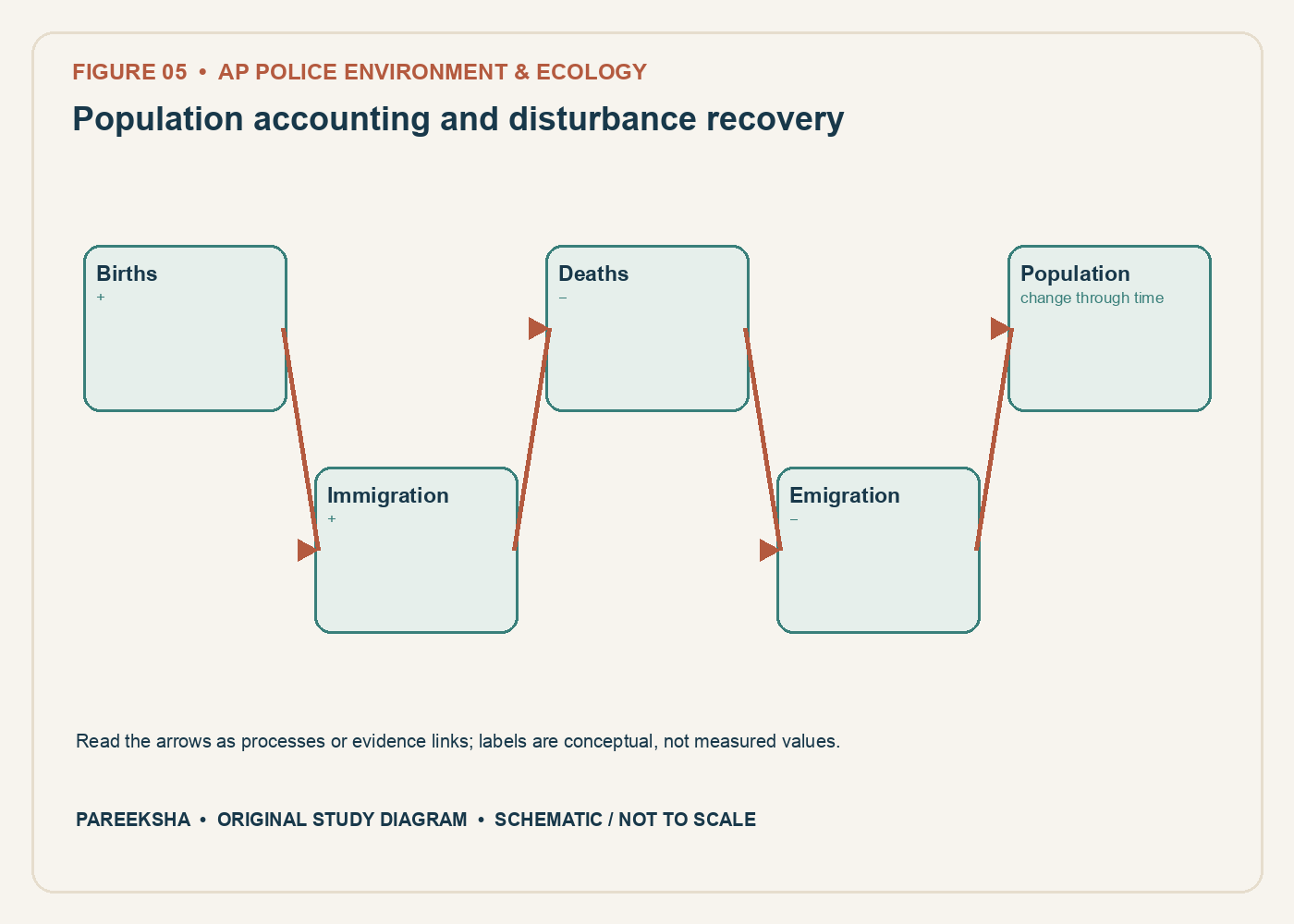
Figure 5.1 Population accounting and disturbance recovery. Original explanatory diagram; schematic and not to scale.
Chapter practice questions
1. Ecological succession refers to:
A. Change in community composition over time
B. Daily movement of water vapour only
C. The classification of one species
D. A fixed food-chain position
Answer: A. Succession describes changes in community composition and structure over time. It is influenced by disturbance, colonisation, interactions and environmental conditions.
2. Primary succession is most likely to begin on:
A. A mature forest after a short rainfall event
B. A surface with little or no developed soil and no prior community
C. A farm with an established soil profile
D. A lake with unchanged vegetation
Answer: B. Primary succession begins where soil and biological legacies are minimal, such as newly exposed rock. The precise starting conditions vary by site.
3. Secondary succession differs from primary succession because it often begins where:
A. No organism has ever existed
B. The atmosphere has no nitrogen
C. Some soil, seed bank or biological legacy remains after disturbance
D. Water cannot enter the system
Answer: C. Secondary succession follows disturbance where some substrate or biological legacy persists. Recovery pathways depend on disturbance severity and site conditions.
4. A fire is followed by fast regrowth from surviving roots and seeds. This is evidence that:
A. Every ecosystem recovers identically
B. Succession is impossible after fire
C. Soil has no ecological role
D. Biological legacies can shape post-disturbance recovery
Answer: D. Surviving roots, seeds, microbes and soil properties influence recovery. The presence and condition of these legacies can vary.
5. Which factor is a density-dependent limit on a population in many circumstances?
A. Competition for a limited nesting site
B. A region-wide volcanic eruption regardless of population density
C. A fixed map boundary
D. Latitude alone
Answer: A. Competition can become stronger as density increases and resources become limiting. A large external event may affect a population without depending on its density.
6. Population size changes through which accounting relationship?
A. Births − immigration + deaths + emigration
B. Births + immigration − deaths − emigration
C. Rainfall + sunlight − soil − wind
D. Producers − decomposers only
Answer: B. Births and immigration add individuals; deaths and emigration remove them. This accounting identity clarifies which process a study must measure.
7. A population grows rapidly at first, then growth slows as resources become limiting. Which model is commonly used to illustrate this pattern?
A. Exponential growth without constraint
B. A nutrient cycle
C. Logistic growth
D. A food-web pyramid
Answer: C. Logistic growth represents slowing increase as a population approaches a modeled carrying capacity. Real populations may fluctuate and rarely follow a perfect curve.
8. Carrying capacity is best understood as:
A. A permanent number that never changes
B. The number of species in a biome
C. The maximum body size of an animal
D. A context-dependent population level that the environment can support over a specified period
Answer: D. Carrying capacity depends on resources, habitat, interactions and time. It is not a fixed universal property of a species.
9. Which statement about the exponential growth model is correct?
A. It assumes idealised conditions with resources not yet limiting
B. It requires a population to stop reproducing
C. It proves that populations grow forever
D. It describes only plant succession
Answer: A. Exponential growth is an idealised model for conditions where per-capita growth remains constant. Resource limits and other pressures eventually alter growth in real systems.
10. A cyclone opens gaps in a coastal forest. Which observation would best assess recovery?
A. A single photograph from an unknown location
B. Repeated measurements of vegetation, regeneration and habitat condition at mapped plots
C. A count of visitors at the nearest town
D. A list of unrelated species from another state
Answer: B. Repeated, georeferenced measurements reveal change and allow comparison. A single image without date or location cannot establish a trend.
11. Why can “climax community” be an oversimplification?
A. Ecosystems never change
B. All species are immortal
C. Communities can remain dynamic under disturbance, climate variation and changing interactions
D. Succession stops after one year everywhere
Answer: C. Older equilibrium ideas can imply a single fixed endpoint. Many ecosystems are dynamic and respond to recurring disturbances and shifting conditions.
12. A population has 120 births, 50 deaths, 15 immigrants and 25 emigrants in a year. Its net numerical change is:
A. Increase of 110
B. Decrease of 60
C. No change
D. Increase of 60
Answer: D. Net change = births + immigration − deaths − emigration = 120 + 15 − 50 − 25 = 60 individuals.
13. A seed bank in soil is important after disturbance because it can:
A. Provide propagules for regeneration when conditions become suitable
B. Guarantee a forest returns to the identical species composition
C. Prevent every invasive species from arriving
D. Replace all ecosystem processes
Answer: A. Stored seeds can contribute to regeneration, but germination and later survival depend on viability, conditions, dispersal and competition. Recovery need not reproduce the previous community exactly.
14. Which is an example of a legacy effect?
A. A researcher changes a chart title
B. Dead wood left by a disturbance continues to influence nutrients and habitat
C. The sun rises in the east
D. A species receives a new common name
Answer: B. Physical and biological remnants can shape later ecosystem conditions. Dead wood, soil structure, surviving organisms and altered hydrology are possible legacies.
15. If a population is below carrying capacity, it must grow at its maximum possible rate. This statement is:
A. True under all circumstances
B. True only for extinct populations
C. False; disease, age structure, habitat quality and other factors also influence growth
D. False because carrying capacity never affects populations
Answer: C. Being below a modeled carrying capacity does not guarantee rapid growth. Population growth depends on multiple demographic and environmental factors.
16. Which measure is most useful for comparing two populations’ growth over different starting sizes?
A. Raw number of births alone
B. Total rainfall at one location
C. The name of the habitat
D. Per-capita growth rate with the period and method stated
Answer: D. A per-capita rate accounts for the population size to which change refers. The period and method are still needed for interpretation.
17. After a disturbance, species richness returns to its earlier value but species identities differ. Which conclusion is supported?
A. A single diversity measure can hide compositional change
B. The community is necessarily identical to its former state
C. Species richness measures species identity
D. Succession has not occurred
Answer: A. Richness counts species, not their identities or relative abundance. Composition can change even when richness is similar.
18. What is the main reason to identify disturbance severity and frequency in a recovery study?
A. All disturbances have the same effect
B. Different disturbance regimes can produce different recovery pathways
C. Frequency is unrelated to ecological change
D. Severity determines a species’ scientific name
Answer: B. Severity, spatial extent and recurrence influence what survives and which processes shape recovery. These details are essential for comparing sites.