Chapter 6 — Species interactions and ecological balance
Exam link: common foundation.
Learning aim: classify interactions by their effects on participants, understand competition and predation in context, and avoid treating ecological balance as a fixed state.
6.1 Interactions are defined by effects
Organisms interact through food, space, shelter, pollination, disease, chemical signals and many other pathways. A useful introductory system records the effect on each participant: positive (+), negative (−) or approximately neutral (0) under the conditions being studied. These signs summarize a relationship; they do not mean the interaction is equally strong at every time or place.
Interaction | Typical sign | Example and caution |
Competition | − / − | Two species use a limited resource; competition may be direct or indirect |
Predation | + / − | Predator consumes prey; predation can regulate or redistribute populations |
Parasitism | + / − | Parasite benefits while host is harmed; host is not usually killed immediately |
Mutualism | + / + | Both participants benefit in a given context; benefits can depend on conditions |
Commensalism | + / 0 | One benefits and the other is not measurably affected in the stated case |
The table is a starting point. A species may have multiple relationships, and an effect can change with context. A plant can compete with one neighbour and provide shelter to another. A grazer may eat a plant but also disperse its seeds. Ecological labels should describe a defined relationship, not assign one permanent identity to a species.
6.2 Competition and resource partitioning
Competition occurs when organisms' use of a limited resource reduces its availability to others. Resources may include food, water, light, nesting sites, territory or access to a pollinator. Competition may be intraspecific (within one species) or interspecific (between species). It can be direct, such as physical exclusion, or indirect, where one species depletes a resource another requires.
Two species can reduce overlap by using different resources, places or times. This is called resource partitioning. It can reduce competition, but it should not be inferred from a single difference. If one bird feeds at dawn and another at dusk, they may overlap in prey or compete through other pathways. The full resource use and context matter.
The competitive exclusion principle is often taught as the idea that species with identical niches cannot coexist indefinitely under stable conditions when a limiting resource is contested. This is a simplified principle, not a claim that any two species sharing food cannot coexist. Real species differ in habitat, time, behaviour, resource quality and response to disturbance. Exam questions should state the assumptions or ask the concept at an appropriate level.
6.3 Predation, herbivory and population effects
Predation is a feeding interaction in which one organism captures and consumes another. Herbivory is feeding on plant or algal material; its effects depend on the plant's ability to regrow, the part eaten and the frequency of grazing. Predators can affect prey numbers and behaviour. They can also influence where prey feed, which may indirectly affect vegetation. This is one route to a trophic cascade.
Predation does not always lower prey populations in a simple, permanent way. Prey reproduction, refuge habitat, alternative food, predator switching and environmental conditions can alter the result. A predator may consume weak or abundant prey, but broad claims about ecological benefit should be supported by the case. “Predators control all prey” and “removing one predator always causes collapse” are overstatements.
6.4 Parasitism and disease ecology
A parasite obtains resources from a host and imposes a cost. Parasites range from organisms living on a host's surface to those living within it. Disease transmission may depend on host density, contact patterns, vector species, climate, sanitation and habitat. A pathogen, host and vector form a system of interactions; changing one part can influence transmission, but outcomes are not determined by temperature or density alone.
Environmental change can affect disease risk through several routes. A change in standing water may alter breeding habitat for some vectors. Habitat fragmentation can alter contact among wildlife, livestock and people. These are hypotheses to investigate, not universal consequences. For public-health questions, use the stated evidence and authoritative health sources; do not infer a disease outbreak from an ecological diagram.
6.5 Mutualism and facilitation
In mutualism, both participants benefit in a specified interaction. Pollinators may obtain food while plants gain pollen transfer. Some plants associate with microorganisms that improve nutrient uptake; the microorganism receives resources from the plant. The interaction may be close and persistent or occur opportunistically.
Facilitation occurs when one organism makes conditions more suitable for another without necessarily forming a specialized partnership. A plant may provide shade, reduce wind or stabilize substrate. In a harsh environment, one species' presence can help another establish. The distinction between mutualism and facilitation depends on the mechanism and the course's definition; exam items should give enough detail to choose.
6.6 Keystone species, foundation species and ecosystem engineers
A keystone species has an effect on community structure that is large relative to its abundance or biomass. The label is context-specific and should be supported by evidence about what changes when the species is lost or restored. A foundation species forms or dominates habitat structure, such as a canopy-forming tree or reef-building organism. An ecosystem engineer physically modifies habitat and thereby changes resource availability for other organisms.
These concepts are related but not interchangeable. A dominant tree may be a foundation species because it shapes canopy and microclimate. A predator can be a keystone without being abundant. An organism that builds a nest or burrow may engineer habitat. Do not classify a species as “keystone” solely because it is rare or culturally important; the ecological effect is the defining evidence.
6.7 Invasive, introduced and native are not synonyms for harmful or harmless
A native species occurs naturally in a region. An introduced or alien species has been moved beyond its native range, intentionally or accidentally. An invasive alien species is generally an introduced species that establishes and spreads, with adverse impacts; legal or programme definitions can vary, so use the definition in the question or current source.
Not every introduced species becomes invasive, and not every non-native organism has the same impact. Some native species can also expand under human-driven environmental change and create management challenges. A sound case identifies origin, spread, impact and context. Control decisions should consider feasibility, non-target effects, community use and the likelihood of reinvasion.
6.8 “Balance of nature” is a poor literal model
Ecosystems are dynamic. Populations fluctuate, habitats shift, and disturbances occur. The phrase “balance of nature” can suggest that there is one static ideal state to which every ecosystem naturally returns. A more useful approach names the functions or outcomes being assessed: persistence of native populations, water quality, soil retention, connectivity, seasonal flood storage or livelihood support.
Trade-offs may occur. A water-control structure can support irrigation while changing seasonal wetland flows. Removing vegetation may expand one land use while increasing erosion or habitat loss. Conservation planning makes goals explicit and evaluates who benefits, who bears costs and what evidence is monitored. Ecology can describe mechanisms and likely outcomes; governance decides how competing values are handled.
Figure 6.1 — Interaction sign matrix: illustrate each relationship with the effect on participant A and B, then show one example and one context note. Use signs as an introductory shorthand, not as a measurement scale.
Worked case: a pollinator and a crop edge
A farmer observes more fruit near a flowering field margin than inside a field centre. One hypothesis is that the margin supports pollinators that move into crops. Other possibilities include differences in soil, irrigation, pesticide exposure, wind or planting density. A comparison should measure visitation, fruit set, field conditions and distance from the margin across multiple sites. If pollinator visits increase but fruit set does not, another factor may limit the outcome. The lesson is not “all margins increase yield”; it is to separate a proposed interaction from the measurements needed to test it.
Retrieval and exam traps
- Interaction signs describe effects in a defined relationship, not a species' permanent role.
- Competition requires a limiting resource; sharing habitat alone does not prove competition.
- Predation can alter prey numbers and behaviour, but outcomes depend on the full food web.
- Keystone, foundation species and ecosystem engineer describe different kinds of ecological importance.
- Introduced does not automatically mean invasive; invasive status includes spread and impact.
- Ecosystems fluctuate; define the function or condition being discussed instead of assuming a single static balance.
Choose one local species pair and describe the interaction with evidence. Then name a second interaction involving one of those species. State how season could change the relationship and what observation would distinguish a causal effect from a simple association.
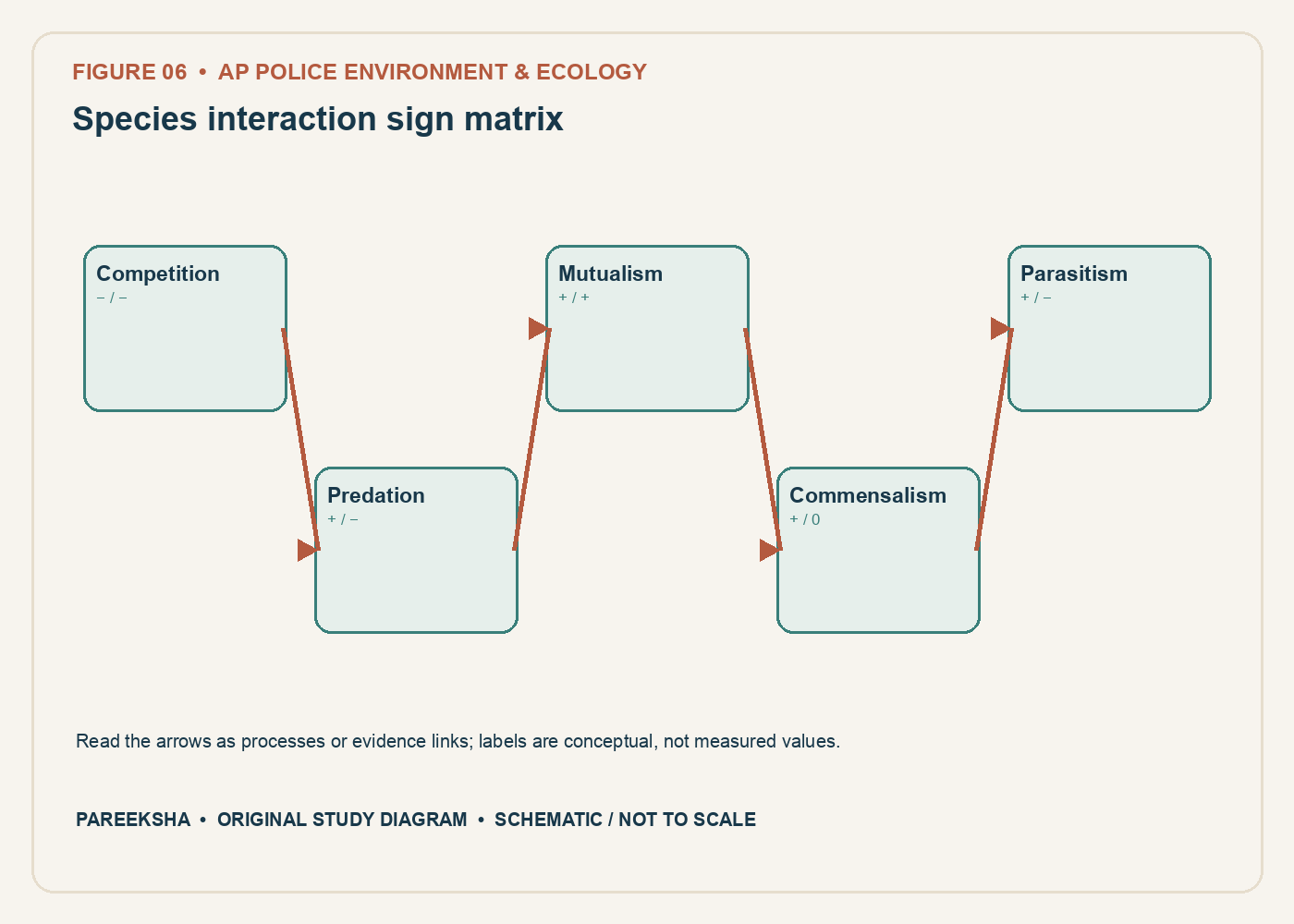
Figure 6.1 Species interaction sign matrix. Original explanatory diagram; schematic and not to scale.
Chapter practice questions
1. Two bird species feed on the same limited insect resource in the same part of a habitat. Their interaction is most likely:
A. Mutualism
B. Commensalism
C. Competition
D. Decomposition
Answer: C. Competition occurs when organisms use a shared limiting resource. Overlap alone does not prove that competition reduces either population; effects need evidence.
2. A predator captures and consumes prey. In the usual sign notation, the interaction is:
A. Both benefit (+/+)
B. Neither is affected (0/0)
C. Predator is harmed; prey benefits (−/+)
D. Predator benefits; prey is harmed (+/−)
Answer: D. Predation benefits the predator through food while harming the prey. Ecological effects can vary in strength and may include indirect consequences.
3. A tick feeds on a mammal and reduces its condition. This is an example of:
A. Parasitism
B. Mutualism
C. Commensalism
D. Facilitation
Answer: A. The parasite benefits while the host is harmed. Some parasites have complex life cycles or effects that depend on host condition and parasite load.
4. A pollinating insect obtains nectar while a flowering plant receives pollen transfer. The interaction is commonly classified as:
A. Competition
B. Mutualism
C. Amensalism
D. Predation
Answer: B. Both partners can benefit: the insect receives food and the plant may receive pollination. The relationship can be conditional and not every visit produces successful pollination.
5. A bird nests in a tree cavity without measurably affecting the tree. Which label may describe this interaction?
A. Parasitism
B. Competition
C. Commensalism
D. Herbivory
Answer: C. Commensalism describes a relationship in which one benefits and the other is not measurably affected. Demonstrating “no effect” can be difficult, so the label depends on evidence.
6. An herbivore eating leaves is engaging in:
A. Denitrification
B. Mutualism in every case
C. Abiotic forcing
D. Herbivory
Answer: D. Herbivory is consumption of plant or algal tissue by an animal. Its effect on the plant can range from minor to severe and may vary with intensity.
7. Which statement about competition is most accurate?
A. It can occur within a species or between species
B. It occurs only between predators
C. It always causes extinction of one species
D. It is a non-living process
Answer: A. Competition may be intraspecific or interspecific and can involve food, space, light, water or mates. Outcomes vary across conditions and time.
8. A vine grows over a shrub and shades it, while the vine gains access to light. The likely interaction is:
A. Mutualism
B. Competition for light
C. Commensalism in all cases
D. Decomposition
Answer: B. Both plants may compete for light, with unequal effects. The precise relationship depends on whether the shrub is measurably harmed and what other resources are involved.
9. An introduced plant spreads rapidly and displaces native vegetation. Which inference is most careful?
A. Every introduced species is automatically invasive
B. Every non-native species has zero ecological effect
C. It may be invasive and harmful in that setting; impacts should be documented
D. Native species cannot be displaced
Answer: C. “Introduced” describes origin outside a native range; “invasive” generally implies spread and harmful impact. Status and effect should be supported by evidence and relevant official classification.
10. A mycorrhizal fungus receives sugars from a plant and helps the plant acquire nutrients. The association is often:
A. Predatory
B. A food pyramid
C. A climatic zone
D. Mutualistic
Answer: D. Many mycorrhizal associations involve reciprocal benefits, though strength and outcomes depend on environmental conditions and partners.
11. Which example is a predator–prey interaction rather than competition?
A. A frog captures and eats an insect
B. Two birds feed on the same fruit crop
C. Two trees compete for light
D. Two fish use the same spawning site
Answer: A. The frog consumes the insect, which is predation. The other examples describe competition for shared resources.
12. Why should ecologists avoid assigning one interaction label from a single observation?
A. Species never interact
B. Interactions can change with context, life stage, resource level and indirect effects
C. Field observations have no value
D. Every interaction is always mutualistic
Answer: B. The same pair may compete under one condition and have little interaction under another. A single event may not establish net effects over time.
13. If two species use different feeding times but the same food source, this may be:
A. A nutrient cycle
B. A biome
C. Temporal resource partitioning
D. Primary productivity
Answer: C. Using a shared resource at different times can reduce direct overlap. Whether it reduces competition depends on the resource’s availability and use patterns.
14. A parasite has a complex life cycle with several hosts. Which study is most relevant to understanding its transmission?
A. Count only the final host once
B. Measure unrelated soil colour
C. Assume all hosts are affected equally
D. Track host roles, contact pathways and life-cycle stages
Answer: D. Transmission depends on the parasite’s stages and host interactions. Sampling only one host may miss key parts of its cycle.
15. A predator is removed from a food web and herbivore numbers later rise. What additional evidence would strengthen a causal interpretation?
A. A comparison with suitable control sites and repeated measures of predator, herbivore and vegetation
B. One unrelated photograph
C. A species list from another region
D. A single anecdote without date or location
Answer: A. Replicated or comparative monitoring helps distinguish predator removal effects from weather, habitat, disease or other changes. Multiple components clarify the mechanism.
16. Which statement about mutualism is correct?
A. Both partners are always unaffected
B. Both partners benefit in the described interaction, but the strength may depend on conditions
C. One partner must always be harmed
D. It is the same as competition
Answer: B. Mutualism is a +/+ interaction in the relevant context. Benefits can vary, and some associations may shift with environmental conditions.
17. A cleaner fish removes parasites from a larger fish. Which evidence would best test whether both benefit?
A. Count the colours of nearby rocks
B. Observe only the cleaner’s movement
C. Measure parasite burden and client condition with and without cleaning access
D. Assume the interaction is mutualistic from its name
Answer: C. Testing both partners’ outcomes requires measures relevant to each. One-sided observation may not establish a reciprocal benefit.
18. Which is an indirect ecological effect?
A. A seed directly germinates after water uptake
B. A thermometer records temperature
C. A bird eats a seed directly
D. A predator reduces an herbivore, which allows plant abundance to rise
Answer: D. The predator’s effect on plants is mediated through the herbivore, so it is indirect. Direct effects occur between the interacting pair itself.