Cartesian Basics and Straight Lines
What to remember
- Every plane-geometry problem in this book is turned into algebra with three tools: the distance formula, the section formula and the slope of a line.
- The centroid, circumcentre and orthocentre of any triangle lie on one line, and the centroid divides the join of orthocentre and circumcentre in the ratio $2:1$.
- A line $Ax+By+C=0$ has slope $-\frac{A}{B}$; two such lines are parallel when their slopes are equal and perpendicular when $A_1A_2+B_1B_2=0$.
- The distance of $(x_1,y_1)$ from $Ax+By+C=0$ is $\frac{\vert Ax_1+By_1+C\vert}{\sqrt{A^2+B^2}}$, and the same expression without the modulus tells you which side of the line the point is on.
- Lines through the meeting point of $L_1=0$ and $L_2=0$ are written $L_1+\lambda L_2=0$; angle bisectors come from equating the two signed distances.
1. The plane, distance and the section formula
Fix two perpendicular number lines, the $x$-axis and the $y$-axis, meeting at the origin $O$. Every point of the plane then has a unique pair $(x,y)$. The axes cut the plane into four quadrants, numbered anticlockwise from the one where both coordinates are positive.
The distance between $P(x_1,y_1)$ and $Q(x_2,y_2)$ is the hypotenuse of a right triangle whose legs are the horizontal and vertical gaps:
The distance of $P$ from the origin is $\sqrt{x_1^2+y_1^2}$. Two points are the same distance from a third point exactly when their squared distances are equal, so in locus work you will compare squares and never carry the root.
Now take a point $R$ on the segment $PQ$ with $PR:RQ=m:n$. Moving from $P$ to $Q$, you cover the fraction $\frac{m}{m+n}$ of the gap in each coordinate, which gives the internal section formula:
If $R$ lies on the line $PQ$ but outside the segment, with $PR:RQ=m:n$, the same algebra works with $n$ replaced by $-n$. That is the external section formula.
| Case | Position of $R$ | Coordinates |
|---|---|---|
| Internal, $m:n$ | between $P$ and $Q$ | $\frac{mx_2+nx_1}{m+n}$, $\frac{my_2+ny_1}{m+n}$ |
| External, $m:n$ | outside, nearer to the smaller of $m,n$ | $\frac{mx_2-nx_1}{m-n}$, $\frac{my_2-ny_1}{m-n}$ |
| Midpoint | $m=n$ | $\frac{x_1+x_2}{2}$, $\frac{y_1+y_2}{2}$ |
Memory trick: The ratio's $m$ sits with the far end! If $PR:RQ=m:n$, then $m$ multiplies $Q$ and $n$ multiplies $P$. Say it as you write: "m with Q, n with P".
A useful consequence: a line $L(x,y)=ax+by+c=0$ cuts the segment $PQ$ in the ratio
The reason is that $R$ is the section point, and substituting its coordinates into $L$ gives zero. A positive ratio means internal division, so $P$ and $Q$ are on opposite sides of the line; a negative ratio means external division.
Example 1: Find the point where the line $2x-y-4=0$ meets the segment joining $A(1,2)$ and $B(4,-3)$, and the ratio in which it divides $AB$.
Let $L=2x-y-4$. Then $L(A)=2-2-4=-4$ and $L(B)=8+3-4=7$.
Ratio $AP:PB=-\frac{-4}{7}=\frac{4}{7}$, positive, so the division is internal.
$P=\left(\frac{4\cdot 4+7\cdot 1}{11},\frac{4\cdot(-3)+7\cdot 2}{11}\right)=\left(\frac{23}{11},\frac{2}{11}\right)$.
Check: $2\cdot\frac{23}{11}-\frac{2}{11}-4=\frac{44}{11}-4=0$.
Why this works: you never had to find the equation of $AB$ or solve two lines; the signs of $L$ at the ends already told you the segment is cut.
2. Triangle centres, area and collinearity
For a triangle with vertices $A(x_1,y_1)$, $B(x_2,y_2)$, $C(x_3,y_3)$ and opposite sides $a=BC$, $b=CA$, $c=AB$, there are four standard points.
- Centroid $G$, where the medians meet. It divides each median $2:1$ from the vertex: $G=\left(\frac{x_1+x_2+x_3}{3},\frac{y_1+y_2+y_3}{3}\right)$.
- Incentre $I$, where the angle bisectors meet and the centre of the inscribed circle: $I=\left(\frac{ax_1+bx_2+cx_3}{a+b+c},\frac{ay_1+by_2+cy_3}{a+b+c}\right)$. Each vertex is weighted by the length of the side opposite it. The reason is that the bisector from $A$ meets $BC$ in the ratio $c:b$, and $I$ divides that bisector in the ratio $(b+c):a$.
- Circumcentre $O$, where the perpendicular bisectors of the sides meet. It is equidistant from all three vertices.
- Orthocentre $H$, where the three altitudes meet.
To find $O$ in practice, write $OA^2=OB^2$ and $OA^2=OC^2$; both are linear in the coordinates of $O$ because the squares cancel. To find $H$, take two altitudes, each through a vertex with slope the negative reciprocal of the opposite side.
The three points $H$, $G$, $O$ always lie on one line, called the Euler line, and $G$ lies between them with $HG:GO=2:1$. In coordinates this means $H=A+B+C-2O$ vector-wise; that is $x_H=x_1+x_2+x_3-2x_O$, and likewise for $y$. Use it as a shortcut once you have two of the three points.
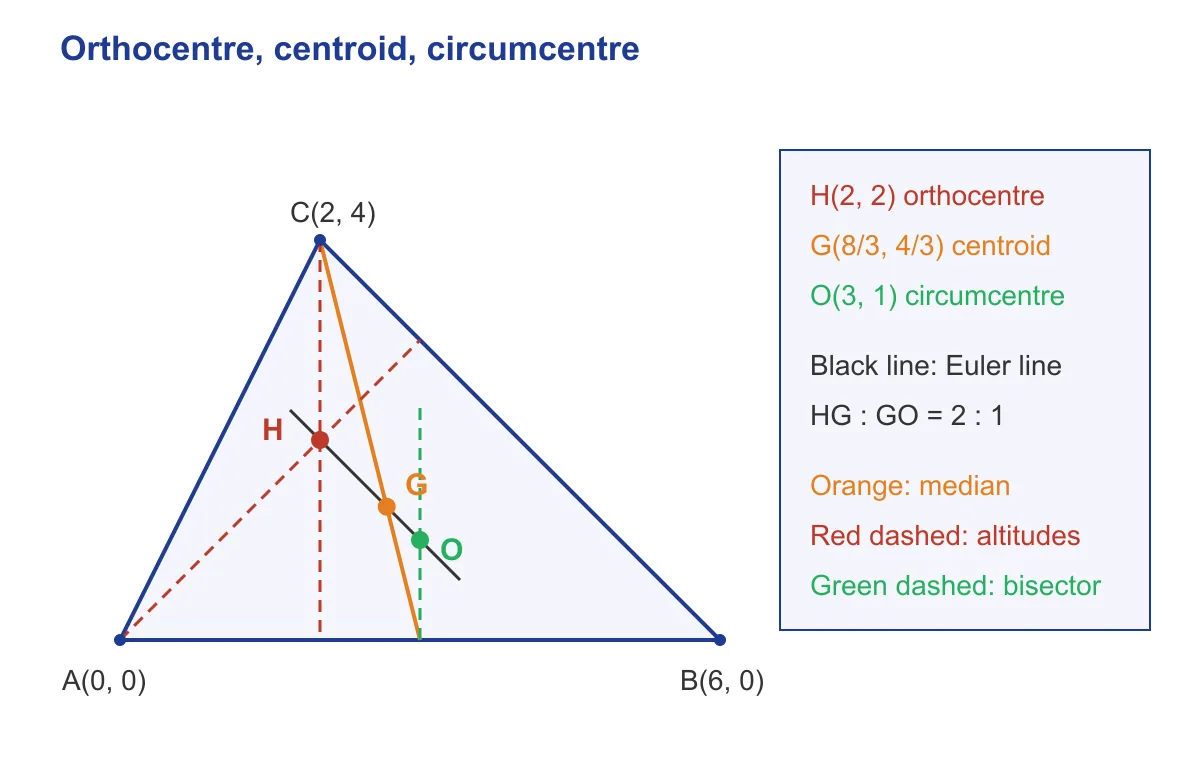
Figure 1.1: Orthocentre, centroid and circumcentre of one triangle, collinear with HG : GO = 2 : 1
Memory trick: H, G, O: "Hot Gold Ore"! Orthocentre, then centroid, then circumcentre along the line, and the gap from H to G is double the gap from G to O. Use it to find the third point when two are known.
Special triangles save work:
| Triangle | Circumcentre | Orthocentre | Other facts |
|---|---|---|---|
| Right-angled | midpoint of the hypotenuse | the vertex at the right angle | $O$ is at distance half the hypotenuse from each vertex |
| Equilateral | coincides with $G$ | coincides with $G$ | incentre is also the same point |
| Isosceles | on the axis of symmetry | on the axis of symmetry | $I$, $G$, $O$, $H$ all lie on the axis |
Example 2: Find the incentre of the triangle with vertices $A(0,0)$, $B(3,0)$, $C(0,4)$.
Sides: $a=BC=\sqrt{9+16}=5$, $b=CA=4$, $c=AB=3$.
$x_I=\frac{5\cdot 0+4\cdot 3+3\cdot 0}{12}=1$, $y_I=\frac{5\cdot 0+4\cdot 0+3\cdot 4}{12}=1$.
So $I=(1,1)$. Check with the inradius of a right triangle, $\frac{3+4-5}{2}=1$, which is the distance of $I$ from both legs.
Why this works: the weights are the opposite side lengths, so the longest side gives the heaviest weight to the vertex it faces.
Area. The area of the triangle with the above vertices is
The same number is half the modulus of the determinant with rows $(x_i,\ y_i,\ 1)$. Three points are collinear exactly when this area is zero. Equivalently, the slopes of $AB$ and $AC$ are equal, though the determinant form also handles vertical lines.
Example 3: Show that the points $(a,\ b+c)$, $(b,\ c+a)$, $(c,\ a+b)$ are collinear.
Take the determinant with rows $(a,\ b+c,\ 1)$, $(b,\ c+a,\ 1)$, $(c,\ a+b,\ 1)$.
Add the first column to the second: every entry of the new second column is $a+b+c$.
Now the second column equals $(a+b+c)$ times the third column, so the determinant is $0$.
Hence the area is zero and the points lie on one line (the line $x+y=a+b+c$).
Why this works: when you see a symmetric pattern, a column operation is faster than expanding.
3. Shifting the origin and locus
If you move the origin to the point $(h,k)$ without turning the axes, a point with old coordinates $(x,y)$ gets new coordinates $(X,Y)$, where
Distances, slopes and angles do not change, because the axes stay parallel to the old ones. What changes is the equation, and the point of shifting is to make it simpler. To simplify a curve, choose $(h,k)$ so that the first-degree terms vanish.
The locus of a point is the set of all positions it can take while obeying a stated condition. To find its equation:
- Call the moving point $P(x,y)$.
- Write the condition in terms of $x$ and $y$ using distance, slope or area.
- Simplify to a relation between $x$ and $y$ alone. Eliminate any helper letter.
- Check whether the condition restricts $x$ or $y$ (for example, a point that must stay in a quadrant).
Example 4: A point $P$ moves so that its distance from $A(0,0)$ is twice its distance from $B(3,0)$. Find its locus, then shift the origin to make the equation simplest.
Condition: $PA=2PB$, so $PA^2=4PB^2$.
$x^2+y^2=4\left[(x-3)^2+y^2\right]=4x^2-24x+36+4y^2$.
Collect: $3x^2+3y^2-24x+36=0$, that is $x^2+y^2-8x+12=0$.
Complete the square: $(x-4)^2+y^2=4$. Take the new origin $(h,k)=(4,0)$, so $x=X+4$, $y=Y$.
The equation becomes $X^2+Y^2=4$.
Why this works: squaring both sides of the distance condition removes the roots, and the shift reads off the centre $(4,0)$ and radius $2$ at once.
4. Slope, angle between lines, parallel and perpendicular
The inclination $\theta$ of a line is the angle it makes with the positive $x$-axis, measured anticlockwise, with $0^\circ\le\theta<180^\circ$. Its slope is $m=\tan\theta$. A vertical line has $\theta=90^\circ$ and no slope. Through $(x_1,y_1)$ and $(x_2,y_2)$ with $x_1\ne x_2$:
If the angle between two lines with slopes $m_1$ and $m_2$ is $\phi$, then
The modulus gives the acute angle. Drop the modulus and the sign tells you the angle measured from line 1 to line 2 anticlockwise; a negative value means the acute angle is $180^\circ$ minus that angle. This follows from $\tan(\theta_2-\theta_1)$ and the tangent subtraction rule.
- Parallel: $m_1=m_2$ (the denominator stays nonzero).
- Perpendicular: $m_1m_2=-1$. When $1+m_1m_2=0$ the formula breaks down because $\phi=90^\circ$.
- A vertical line is perpendicular to a horizontal line even though no slope product exists.
For lines in general form $a_1x+b_1y+c_1=0$ and $a_2x+b_2y+c_2=0$, the slope is $-\frac{a}{b}$, so
| Relation | Condition |
|---|---|
| Parallel | $a_1b_2=a_2b_1$ |
| Perpendicular | $a_1a_2+b_1b_2=0$ |
| Coincident | $\frac{a_1}{a_2}=\frac{b_1}{b_2}=\frac{c_1}{c_2}$ |
| Meet at exactly one point | $a_1b_2\ne a_2b_1$ |
Memory trick: Perpendicular slopes: "flip it and flip its sign"! The slope $\frac{p}{q}$ becomes $-\frac{q}{p}$. In general form, swap the coefficients and change one sign: $ax+by+c$ is met at right angles by $bx-ay+k$.
Example 5: Find the equations of the lines through $(2,3)$ that make an angle of $45^\circ$ with the line $x-2y+1=0$.
The given line has slope $\frac12$. Let the required slope be $m$.
$\tan45^\circ=1=\left\vert\frac{m-\frac12}{1+\frac{m}{2}}\right\vert$, so $m-\frac12=\pm\left(1+\frac m2\right)$.
With $+$: $\frac m2=\frac32$, so $m=3$. With $-$: $\frac{3m}{2}=-\frac12$, so $m=-\frac13$.
Lines: $y-3=3(x-2)$, that is $3x-y-3=0$; and $y-3=-\frac13(x-2)$, that is $x+3y-11=0$.
Check: the two answers are perpendicular ($3\cdot(-\frac13)=-1$), as they must be: they sit $45^\circ$ either side of the given direction, so they are $90^\circ$ apart.
Why this works: the modulus produces two signs, hence two lines; always expect two answers when an angle is prescribed.
5. Forms of the equation of a line
Choose the form that matches the data you were given.
| Form | Equation | Use it when | Exceptions |
|---|---|---|---|
| Slope-intercept | $y=mx+c$ | slope and $y$-intercept known | not for vertical lines |
| Point-slope | $y-y_1=m(x-x_1)$ | a point and slope known | not for vertical lines |
| Two-point | $\frac{y-y_1}{y_2-y_1}=\frac{x-x_1}{x_2-x_1}$ | two points known | cross-multiply if a denominator is $0$ |
| Intercept | $\frac xa+\frac yb=1$ | both intercepts known | not for lines through $O$ or parallel to an axis |
| Normal | $x\cos\alpha+y\sin\alpha=p$ | distance from origin known | $p>0$, $0\le\alpha<2\pi$ |
| General | $Ax+By+C=0$ | everything else | $A,B$ not both zero |
For the general form, the slope is $-\frac AB$, the $x$-intercept is $-\frac CA$ and the $y$-intercept is $-\frac CB$. The normal form needs a short explanation. Let a line be at perpendicular distance $p$ from $O$, with the perpendicular from $O$ making angle $\alpha$ with the positive $x$-axis. The foot of that perpendicular is $(p\cos\alpha,p\sin\alpha)$, and every point $(x,y)$ on the line has the same projection $p$ along the direction $(\cos\alpha,\sin\alpha)$, which is exactly the equation above.
To turn $Ax+By+C=0$ into normal form: move the constant to the right, so $Ax+By=-C$. If $-C$ is negative, multiply by $-1$. Then divide by $\sqrt{A^2+B^2}$. The right-hand side is now $p$, and the coefficients of $x$ and $y$ are $\cos\alpha$ and $\sin\alpha$.
Example 6: A line passes through $P(2,3)$ and its intercepts on the axes are in the ratio $2:3$ (both positive). Find it.
Write $\frac xa+\frac yb=1$ with $b=\frac{3a}{2}$, so $\frac xa+\frac{2y}{3a}=1$.
Through $(2,3)$: $\frac2a+\frac{6}{3a}=\frac4a=1$, so $a=4$ and $b=6$.
Line: $\frac x4+\frac y6=1$, that is $3x+2y-12=0$.
Why this works: stating the ratio in terms of one unknown $a$ keeps it to one equation.
6. Distance, foot, image and position of a point
For the point $P(x_1,y_1)$ and the line $L:Ax+By+C=0$, the perpendicular distance is
You can see why from the normal form: after dividing by $\sqrt{A^2+B^2}$, the expression $x\cos\alpha+y\sin\alpha-p$ at any point is the signed gap between that point's projection and the line's.
For two parallel lines $Ax+By+C_1=0$ and $Ax+By+C_2=0$, put both in the same $A,B$ first. The distance between them is
The foot $F$ of the perpendicular from $P$ to $L$ and the image $P'$ of $P$ in $L$ both lie along the direction $(A,B)$ from $P$, because $(A,B)$ is normal to the line. Writing $L_1=Ax_1+By_1+C$:
The image is the point at twice the distance, so the factor $2$ is the only difference.
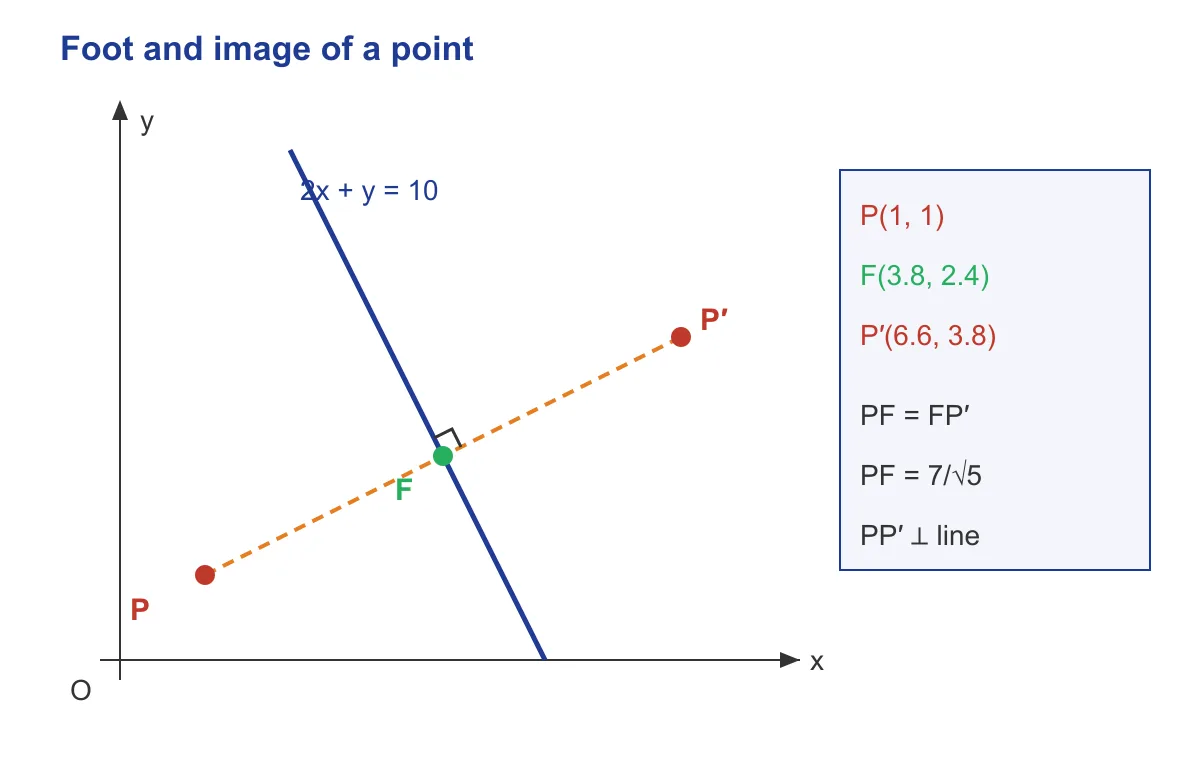
Figure 1.2: Foot and image of P in the line 2x + y = 10
Position. The line divides the plane into two half-planes. Two points $P(x_1,y_1)$ and $Q(x_2,y_2)$ lie on the same side of $L=0$ when $L(x_1,y_1)$ and $L(x_2,y_2)$ have the same sign, and on opposite sides when the signs differ. In particular, the origin and the point $(x_1,y_1)$ are on the same side of the line when $C$ and $L_1$ have the same sign.
Example 7: Find the distance of $P(1,1)$ from $2x+y-10=0$, and the foot and the image of $P$.
$L_1=2+1-10=-7$, and $A^2+B^2=5$.
Distance $=\frac{7}{\sqrt5}$.
Foot: $\frac{x-1}{2}=\frac{y-1}{1}=\frac{7}{5}$, so $x=1+\frac{14}{5}=3.8$ and $y=1+\frac75=2.4$.
Image: the parameter doubles to $\frac{14}{5}$, so $x=1+\frac{28}{5}=6.6$ and $y=1+\frac{14}{5}=3.8$.
Check: the midpoint of $P$ and the image is $(3.8,2.4)$, the foot, and it satisfies $7.6+2.4=10$.
Why this works: the sign of $L_1$ is negative, so the parameter $-\frac{L_1}{5}$ is positive and the foot lies in the direction $(A,B)=(2,1)$.
Parallel lines in this form: $3x+4y-5=0$ and $6x+8y+15=0$. Divide the second by $2$ to get $3x+4y+7.5=0$. Then $d=\frac{\vert-5-7.5\vert}{5}=2.5$.
7. Families of lines, concurrency and angle bisectors
If $L_1=0$ and $L_2=0$ are two lines that meet, then for every real $\lambda$ the equation
is a line through their point of intersection, and every line through that point except $L_2=0$ itself has this form. A single extra condition fixes $\lambda$.
Three lines are concurrent (pass through one point) in two ways: find the meeting point of two and test the third; or require
The determinant test is necessary, but if two of the three lines are parallel, the determinant can vanish without concurrency, so check that the lines are not parallel.
Example 8: Find the lines through the intersection of $2x+y-5=0$ and $x-y-1=0$ that are at distance $1$ from the origin.
The family is $(2+\lambda)x+(1-\lambda)y-(5+\lambda)=0$.
Distance from $O$ is $1$: $\vert5+\lambda\vert=\sqrt{(2+\lambda)^2+(1-\lambda)^2}$.
Square: $25+10\lambda+\lambda^2=5+2\lambda+2\lambda^2$, so $\lambda^2-8\lambda-20=0$, giving $\lambda=10$ or $\lambda=-2$.
$\lambda=10$: $12x-9y-15=0$, that is $4x-3y-5=0$. $\lambda=-2$: $3y-3=0$, that is $y=1$.
Check: both pass through $(2,1)$, and their distances from $O$ are $\frac55=1$ and $1$.
Why this works: the meeting point is $(2,1)$, and the family handled it without solving for it; solving gives the same two lines.
Angle bisectors. A point lies on a bisector of the angle between $a_1x+b_1y+c_1=0$ and $a_2x+b_2y+c_2=0$ when it is equally far from both lines:
The two signs give the two bisectors, which are perpendicular to each other. To decide which is which:
- Multiply each equation by $\pm1$ so that $c_1>0$ and $c_2>0$.
- Compute $a_1a_2+b_1b_2$.
- The bisector with the plus sign bisects the angle containing the origin. If $a_1a_2+b_1b_2>0$, that angle is obtuse; if it is negative, that angle is acute.
| Sign of $a_1a_2+b_1b_2$ (with $c_1,c_2>0$) | Plus-sign bisector | Minus-sign bisector |
|---|---|---|
| positive | obtuse angle (contains $O$) | acute angle |
| negative | acute angle (contains $O$) | obtuse angle |
Memory trick: "Same sign, plus, origin's room, and a positive dot means wide!" Make both constants positive, take the plus sign for the angle with the origin in it, and a positive $a_1a_2+b_1b_2$ means that angle is wide (obtuse).
Example 9: Find the bisector of the acute angle between $3x-4y+7=0$ and $12x+5y-2=0$.
Make $c_2$ positive: second line becomes $-12x-5y+2=0$, $c_2=2>0$, and $c_1=7>0$.
$a_1a_2+b_1b_2=3(-12)+(-4)(-5)=-36+20=-16<0$, so the plus-sign bisector bisects the acute angle.
$\frac{3x-4y+7}{5}=\frac{-12x-5y+2}{13}$, so $39x-52y+91=-60x-25y+10$, giving $99x-27y+81=0$, that is $11x-3y+9=0$.
Check: the other bisector is $21x+77y-101=0$, and $11\cdot21-3\cdot77=0$, so they are perpendicular. The slope of $3x-4y+7=0$ is $\frac34$; with the bisector's $\frac{11}{3}$ the tangent of the angle is $\frac{35/12}{15/4}=\frac79<1$, a half-angle below $45^\circ$, so the full angle is acute.
Why this works: the sign rule removed the guesswork of comparing angles by hand.
Common traps
- Using $m_1m_2=-1$ for a vertical and a horizontal line → they are perpendicular without any slope product; test with $a_1a_2+b_1b_2=0$ instead.
- Writing $\frac{x_2-x_1}{y_2-y_1}$ for slope → slope is rise over run, $\frac{y_2-y_1}{x_2-x_1}$.
- Putting the ratio's $m$ with $P$ in the section formula → $m$ goes with the end $Q$ (the far end).
- Forgetting the modulus in the distance formula, getting a negative distance → keep $\vert\ \vert$, and use the sign only to decide the side.
- Comparing distances to two lines without making $c_1,c_2$ positive first, then naming the wrong bisector → fix signs of the constants before choosing plus or minus.
- Applying the parallel-line distance formula when $A,B$ differ by a factor → scale one equation until the coefficients of $x$ and $y$ match.
- Using the intercept form for a line through the origin → use point-slope; the intercepts are zero and the form fails.
- Taking only one value from $\left\vert\frac{m-m_1}{1+mm_1}\right\vert=\tan\phi$ → the modulus gives two lines, so solve both signs.
- Declaring three lines concurrent just because the determinant is zero → check that no two of them are parallel.
- Taking the incentre weights as the adjacent sides → weights are the sides opposite each vertex.
Quick revision
- Distance: $\sqrt{(x_2-x_1)^2+(y_2-y_1)^2}$.
- Internal division $m:n$: $\left(\frac{mx_2+nx_1}{m+n},\frac{my_2+ny_1}{m+n}\right)$; external: replace $n$ by $-n$.
- A line $L=0$ cuts $PQ$ in the ratio $-\frac{L(P)}{L(Q)}$; a positive ratio means internal division.
- Centroid is the average of the vertices; $H$, $G$, $O$ are collinear with $HG:GO=2:1$.
- Incentre weights each vertex by the opposite side length.
- Right triangle: circumcentre is the midpoint of the hypotenuse, orthocentre is the right-angle vertex.
- Triangle area is $\frac12\vert x_1(y_2-y_3)+x_2(y_3-y_1)+x_3(y_1-y_2)\vert$; zero area means collinear.
- Shift of origin to $(h,k)$: $x=X+h$, $y=Y+k$; slopes and distances do not change.
- Slope $m=\tan\theta=-\frac AB$ for $Ax+By+C=0$.
- Angle between lines: $\tan\phi=\left\vert\frac{m_1-m_2}{1+m_1m_2}\right\vert$.
- Parallel: $a_1b_2=a_2b_1$; perpendicular: $a_1a_2+b_1b_2=0$.
- Point to line: $\frac{\vert Ax_1+By_1+C\vert}{\sqrt{A^2+B^2}}$; between parallel lines: $\frac{\vert C_1-C_2\vert}{\sqrt{A^2+B^2}}$.
- Foot and image use the parameter $-\frac{L_1}{A^2+B^2}$ and $-\frac{2L_1}{A^2+B^2}$ along $(A,B)$.
- Same sign of $L$ means the same side; the family $L_1+\lambda L_2=0$ passes through their intersection.
- Bisectors: $\frac{L_1}{\sqrt{a_1^2+b_1^2}}=\pm\frac{L_2}{\sqrt{a_2^2+b_2^2}}$; with $c_1,c_2>0$ the plus sign gives the angle containing $O$.
Practice questions
The point $P$ divides the segment joining $A(2,-1)$ and $B(8,5)$ internally so that $AP:PB=1:2$. The coordinates of $P$ are
- $(5,2)$
- $(6,3)$
- $(4,1)$
- $(4,3)$
Answer
C. $(4,1)$
$x=\frac{1\cdot8+2\cdot2}{3}=4$, $y=\frac{1\cdot5+2\cdot(-1)}{3}=1$. Check: $AP$ is one third of $AB=(6,6)$, giving $(2,2)$ added to $A$.
The slope of the line joining $(-2,3)$ and $(4,-1)$ is
- $\frac{3}{2}$
- $-\frac{2}{3}$
- $-\frac{3}{2}$
- $\frac{2}{3}$
Answer
B. $-\frac{2}{3}$
$m=\frac{-1-3}{4-(-2)}=\frac{-4}{6}=-\frac23$. Check: $y$ falls as $x$ rises, so the slope is negative.
The equation of the line with $x$-intercept $3$ and $y$-intercept $-2$ is
- $3x-2y-6=0$
- $2x+3y-6=0$
- $3x-2y+6=0$
- $2x-3y-6=0$
Answer
D. $2x-3y-6=0$
$\frac{x}{3}+\frac{y}{-2}=1$; multiply by $6$: $2x-3y=6$. Check: $(3,0)$ gives $6-0-6=0$ and $(0,-2)$ gives $0+6-6=0$.
The inclination of the line $\sqrt{3}x+y+5=0$, measured from the positive $x$-axis between $0^\circ$ and $180^\circ$, is
- $120^\circ$
- $60^\circ$
- $150^\circ$
- $30^\circ$
Answer
A. $120^\circ$
Slope $=-\sqrt3=\tan\theta$ with $0^\circ\le\theta<180^\circ$, so $\theta=120^\circ$ (not $60^\circ$, whose tangent is $+\sqrt3$).
The perpendicular distance of the point $(2,-3)$ from the line $5x-12y+7=0$ is
- $\frac{19}{13}$
- $\frac{29}{13}$
- $\frac{53}{169}$
- $\frac{53}{13}$
Answer
D. $\frac{53}{13}$
$\frac{\vert5\cdot2-12\cdot(-3)+7\vert}{\sqrt{25+144}}=\frac{\vert10+36+7\vert}{13}=\frac{53}{13}$.
The equation of the perpendicular bisector of the segment joining $A(-1,3)$ and $B(5,1)$ is
- $3x+y-8=0$
- $3x-y-4=0$
- $x+3y-8=0$
- $3x-y+4=0$
Answer
B. $3x-y-4=0$
Midpoint $(2,2)$; slope of $AB=\frac{1-3}{5+1}=-\frac13$, so the required slope is $3$. Line: $y-2=3(x-2)$, i.e. $3x-y-4=0$. Check: the point $(0,-4)$ on the line is equidistant from $A$ and $B$: $1+49=50$ and $25+25=50$.
The image of the point $(2,3)$ in the line $x+y=1$ is
- $(-1,-2)$
- $(0,1)$
- $(-2,-1)$
- $(-2,1)$
Answer
C. $(-2,-1)$
$L_1=2+3-1=4$, parameter $-\frac{2\cdot4}{2}=-4$, image $=(2-4,3-4)=(-2,-1)$. Check: the midpoint $(0,1)$ lies on $x+y=1$.
The points $(1,1)$ and $(3,2)$ lie on the same side of the line $x+y-k=0$ for
- $k<2$ or $k>5$
- $k>5$
- $2<k<5$
- $k<2$ or $k>3$
Answer
A. $k<2$ or $k>5$
Values of $x+y-k$ are $2-k$ and $5-k$. Same side needs $(2-k)(5-k)>0$, so $k<2$ or $k>5$.
If $a$, $b$, $c$ are in arithmetic progression, every line $ax+by+c=0$ passes through the fixed point
- $(2,-1)$
- $(-1,2)$
- $(1,2)$
- $(1,-2)$
Answer
D. $(1,-2)$
$2b=a+c$ gives $a-2b+c=0$. Compare with $a\cdot x+b\cdot y+c=0$: $x=1$, $y=-2$ works for all such $a,b,c$.
The circumcentre of the triangle with vertices $(0,0)$, $(8,0)$ and $(0,6)$ is
- $(3,4)$
- $\left(\frac83,2\right)$
- $(4,3)$
- $(0,0)$
Answer
C. $(4,3)$
The triangle is right-angled at the origin, so the circumcentre is the midpoint of the hypotenuse: $\left(\frac{8+0}{2},\frac{0+6}{2}\right)=(4,3)$. ($(8/3,2)$ is the centroid, $(0,0)$ the orthocentre.)
The acute angle between the lines $y=(2-\sqrt3)x+5$ and $y=(2+\sqrt3)x-7$ is
- $60^\circ$
- $75^\circ$
- $45^\circ$
- $30^\circ$
Answer
A. $60^\circ$
$m_1m_2=4-3=1$, $m_1-m_2=-2\sqrt3$. $\tan\phi=\left\vert\frac{-2\sqrt3}{2}\right\vert=\sqrt3$, so $\phi=60^\circ$.
On shifting the origin to $(1,-2)$ without rotating the axes, the equation $x^2+y^2-2x+4y-4=0$ becomes
- $X^2+Y^2-2X+4Y-4=0$
- $X^2+Y^2=9$
- $X^2+Y^2-4X+8Y+11=0$
- $X^2+Y^2=4$
Answer
B. $X^2+Y^2=9$
Put $x=X+1$, $y=Y-2$: $(X+1)^2+(Y-2)^2-2(X+1)+4(Y-2)-4=X^2+Y^2-9$. Check: the curve is a circle with centre $(1,-2)$ and radius $\sqrt{1+4+4}=3$.
The locus of a point equidistant from $(2,0)$ and the line $x=-2$ is
- $y^2=4x$
- $x^2=8y$
- $y^2=-8x$
- $y^2=8x$
Answer
D. $y^2=8x$
$(x-2)^2+y^2=(x+2)^2$ gives $y^2=8x$. Check: the origin is $2$ from $(2,0)$ and $2$ from the line.
The bisector of the acute angle between the lines $4x-3y-1=0$ and $5x-12y+7=0$ is
- $3x-5y+2=0$
- $9x+7y-16=0$
- $7x-9y+2=0$
- $x-9y+8=0$
Answer
C. $7x-9y+2=0$
Rewrite as $-4x+3y+1=0$ and $5x-12y+7=0$ (both constants positive). $a_1a_2+b_1b_2=-20-36<0$, so the plus bisector is acute: $\frac{-4x+3y+1}{5}=\frac{5x-12y+7}{13}$ gives $-77x+99y-22=0$, i.e. $7x-9y+2=0$. Check: the other bisector $9x+7y-16=0$ is perpendicular to it and the half-angle tangent is $\frac{3}{11}<1$.
The distance between the points $(-3,4)$ and $(5,-2)$ is
- 14
- 10
- 100
- 7
Answer
B. 10
$\sqrt{8^2+(-6)^2}=\sqrt{100}=10$.
The centroid of the triangle with vertices $(a,1)$, $(3,b)$ and $(-2,4)$ is $(2,3)$. Find $a+b$.
- 9
- 12
- -1
- 7
Answer
A. 9
$\frac{a+3-2}{3}=2$ gives $a=5$; $\frac{1+b+4}{3}=3$ gives $b=4$. So $a+b=9$.
The area of the triangle with vertices $(1,1)$, $(5,1)$ and $(3,7)$, in square units, is
- 12
- 18
- 6
- 24
Answer
A. 12
Base $=4$ along $y=1$, height $=6$, area $=\frac12\cdot4\cdot6=12$. Formula: $\frac12\vert1(1-7)+5(7-1)+3(1-1)\vert=12$.
The points $A(2,1)$, $B(5,3)$ and $C(k,7)$ are collinear. The value of $k$ is
- 10
- 11
- 13
- 9
Answer
B. 11
Slope $AB=\frac23$; slope $AC=\frac{6}{k-2}$. Equate: $k-2=9$, $k=11$.
The lines $x+2y-3=0$, $2x-y-1=0$ and $3x+y+k=0$ meet at one point. Find $k$.
- -4
- 4
- -2
- 2
Answer
A. -4
The first two meet at $(1,1)$ (from $x=3-2y$: $6-5y=1$). Then $3+1+k=0$, so $k=-4$.
The distance between the parallel lines $3x+4y-5=0$ and $6x+8y+15=0$ is
- 2.5
- 4
- 1
- 3.5
Answer
A. 2.5
Rewrite the second as $3x+4y+7.5=0$. Distance $=\frac{\vert-5-7.5\vert}{5}=2.5$. (Using $15$ unscaled gives $4$, which is wrong.)
Find the sum of the coordinates of the foot of the perpendicular from $(3,4)$ to the line $x+2y=5$.
- 7
- 5
- -0.2
- 3.4
Answer
D. 3.4
$L_1=3+8-5=6$; parameter $-\frac{6}{5}$; foot $=\left(3-\frac65,4-\frac{12}{5}\right)=(1.8,1.6)$, sum $3.4$. Check: $1.8+3.2=5$. ($-0.2$ is the image's sum.)
The tangent of the acute angle between the lines $2x-y+3=0$ and $x+3y-1=0$ is
- 7
- 1
- 5
- 3
Answer
A. 7
$m_1=2$, $m_2=-\frac13$. $\tan\phi=\left\vert\frac{2+\frac13}{1-\frac23}\right\vert=\frac{7/3}{1/3}=7$. (Taking $m_2=+\frac13$ gives $1$.)
The area, in square units, of the triangle formed by the line $3x+4y=12$ with the coordinate axes is
- 6
- 12
- 3
- 24
Answer
A. 6
Intercepts are $4$ and $3$; area $=\frac12\cdot4\cdot3=6$.
The line $3x+y-7=0$ meets the segment joining $A(0,1)$ and $B(3,-1)$ at $P$, with $AP:PB=k:1$. Find $k$.
- 6
- 7
- 1
- 1.5
Answer
A. 6
$L(A)=-6$, $L(B)=9-1-7=1$. $k=-\frac{-6}{1}=6$ (positive, internal). Check: $P=\left(\frac{18}{7},-\frac57\right)$ gives $\frac{54}{7}-\frac57=7$.
In the triangle with vertices $A(0,0)$, $B(4,0)$ and $C(1,3)$, the distance between the circumcentre and the orthocentre is
- 1
- 2
- 0.5
- 3
Answer
A. 1
Altitude from $C$: $x=1$. $BC$ has slope $-1$, so the altitude from $A$ is $y=x$; $H=(1,1)$. Perpendicular bisector of $AB$: $x=2$; $OA^2=OC^2$: $4+y^2=1+(y-3)^2$ gives $y=1$; $O=(2,1)$. $OH=1$. Check: $H=A+B+C-2O=(5-4,3-2)=(1,1)$.
The area, in square units, of the triangle bounded by the lines $y=x$, $y=2x$ and $x+y=6$ is
- 3
- 6
- 12
- 1.5
Answer
A. 3
Vertices: $(0,0)$; $y=x$ with $x+y=6$ gives $(3,3)$; $y=2x$ with $x+y=6$ gives $(2,4)$. Area $=\frac12\vert3\cdot4-2\cdot3\vert=3$.
Given below are two statements: Statement I: The slope of a line parallel to the $y$-axis is not defined. Statement II: A line $ax+by+c=0$ with $b=0$ and $a\ne0$ is parallel to the $y$-axis.
- Both Statement I and Statement II are correct
- Both Statement I and Statement II are incorrect
- Statement I is correct but Statement II is incorrect
- Statement I is incorrect but Statement II is correct
Answer
A. Both Statement I and Statement II are correct
Vertical lines have inclination $90^\circ$, and $\tan90^\circ$ does not exist, so I is correct. With $b=0$ the line is $x=-\frac ca$, vertical, so II is correct.
Given below are two statements: Statement I: The distance between the lines $2x+3y-5=0$ and $4x+6y-1=0$ is $\frac{9}{2\sqrt{13}}$. Statement II: The distance between the same two lines is $\frac{4}{\sqrt{13}}$.
- Both Statement I and Statement II are correct
- Both Statement I and Statement II are incorrect
- Statement I is correct but Statement II is incorrect
- Statement I is incorrect but Statement II is correct
Answer
C. Statement I is correct but Statement II is incorrect
Rewrite the second as $2x+3y-\frac12=0$. Distance $=\frac{\vert-5+\frac12\vert}{\sqrt{13}}=\frac{9}{2\sqrt{13}}$, so I is correct. II uses $-1$ without scaling, so it is incorrect.
Given below are two statements: Statement I: The origin and the point $(2,2)$ lie on the same side of the line $x+y-3=0$. Statement II: The points $(4,0)$ and $(0,0)$ lie on opposite sides of the line $x+y-3=0$.
- Both Statement I and Statement II are correct
- Both Statement I and Statement II are incorrect
- Statement I is correct but Statement II is incorrect
- Statement I is incorrect but Statement II is correct
Answer
D. Statement I is incorrect but Statement II is correct
$L(0,0)=-3$, $L(2,2)=1$: opposite signs, so I is incorrect. $L(4,0)=1$ and $L(0,0)=-3$: opposite signs, so II is correct.
Given below are two statements: Statement I: In every triangle that is not equilateral, the centroid lies on the segment joining the orthocentre and circumcentre and divides it in the ratio $2:1$ from the orthocentre. Statement II: The incentre of the triangle with vertices $(0,0)$, $(4,0)$, $(0,3)$ is $\left(\frac43,1\right)$.
- Both Statement I and Statement II are correct
- Both Statement I and Statement II are incorrect
- Statement I is correct but Statement II is incorrect
- Statement I is incorrect but Statement II is correct
Answer
C. Statement I is correct but Statement II is incorrect
I is the Euler-line result and is correct. For II, the sides opposite $(0,0)$, $(4,0)$, $(0,3)$ are $5,3,4$, so $x=\frac{5\cdot0+3\cdot4+4\cdot0}{12}=1$, $y=\frac{4\cdot3}{12}=1$: the incentre is $(1,1)$, not $\left(\frac43,1\right)$. II is incorrect.
Given below are two statements: Statement I: Every pair of perpendicular lines has slopes whose product is $-1$. Statement II: The lines $3x-y+2=0$ and $6x-2y+1=0$ intersect in exactly one point.
- Both Statement I and Statement II are correct
- Both Statement I and Statement II are incorrect
- Statement I is correct but Statement II is incorrect
- Statement I is incorrect but Statement II is correct
Answer
B. Both Statement I and Statement II are incorrect
I fails for the pair $x=0$ and $y=0$, which are perpendicular but have no slope product. In II both lines have slope $3$ and different constants, so they are parallel and never meet. Both statements are incorrect.
Assertion (A): The slope of the line joining $(a,b)$ and $(a,c)$ with $b\ne c$ is not defined. Reason (R): For these points $x_2-x_1=0$, so the slope formula has a zero denominator.
- Both A and R are true and R is the correct explanation of A
- Both A and R are true but R is not the correct explanation of A
- A is true but R is false
- A is false but R is true
Answer
A. Both A and R are true and R is the correct explanation of A
Both points share the same $x$, so the line is vertical and $x_2-x_1=0$ in $\frac{y_2-y_1}{x_2-x_1}$. R is true and explains A.
Assertion (A): The distance of the origin from the line $3x+4y+10=0$ is $2$. Reason (R): The distance of $(x_1,y_1)$ from $Ax+By+C=0$ is $\frac{Ax_1+By_1+C}{\sqrt{A^2+B^2}}$ with no modulus.
- Both A and R are true and R is the correct explanation of A
- Both A and R are true but R is not the correct explanation of A
- A is true but R is false
- A is false but R is true
Answer
C. A is true but R is false
$\frac{\vert10\vert}{5}=2$, so A is true. R is false: without the modulus the value can be negative, and a distance cannot be.
Assertion (A): The circumcentre of the triangle with vertices $(0,0)$, $(6,0)$ and $(0,8)$ is $(3,3)$. Reason (R): In a right-angled triangle the circumcentre is the midpoint of the hypotenuse.
- Both A and R are true and R is the correct explanation of A
- Both A and R are true but R is not the correct explanation of A
- A is true but R is false
- A is false but R is true
Answer
D. A is false but R is true
The hypotenuse joins $(6,0)$ and $(0,8)$, with midpoint $(3,4)$, so A is false. R is true.
Match List I with List II. List I: a. $2x+3y-6=0$ b. $3x-2y+6=0$ c. $y=5$ d. $x=-4$ List II: i. slope $-\frac23$ ii. slope $\frac32$ iii. slope $0$ iv. slope not defined
- a-ii, b-i, c-iii, d-iv
- a-i, b-ii, c-iii, d-iv
- a-i, b-ii, c-iv, d-iii
- a-iii, b-iv, c-i, d-ii
Answer
B. a-i, b-ii, c-iii, d-iv
Slope $=-\frac AB$: a gives $-\frac23$; b gives $\frac32$; $y=5$ is horizontal (slope $0$); $x=-4$ is vertical (no slope).
Match List I with List II for the triangle with vertices $(0,0)$, $(6,0)$ and $(0,8)$. List I: a. centroid b. circumcentre c. orthocentre d. incentre List II: i. $(0,0)$ ii. $(3,4)$ iii. $(2,2)$ iv. $\left(2,\frac83\right)$
- a-iv, b-ii, c-iii, d-i
- a-iv, b-ii, c-i, d-iii
- a-ii, b-iv, c-i, d-iii
- a-i, b-ii, c-iv, d-iii
Answer
B. a-iv, b-ii, c-i, d-iii
Centroid $=\left(\frac63,\frac83\right)$. Circumcentre is the midpoint of the hypotenuse $(3,4)$. Orthocentre is the right-angle vertex $(0,0)$. Sides opposite the vertices are $10,8,6$, so $I=\left(\frac{8\cdot6}{24},\frac{6\cdot8}{24}\right)=(2,2)$.
Match List I with List II. List I: a. foot of the perpendicular from $(2,5)$ on the line $x-y=0$ b. image of $(2,5)$ in the line $x-y=0$ c. image of $(2,5)$ in the $x$-axis d. image of $(2,5)$ in the $y$-axis List II: i. $(-2,5)$ ii. $(5,2)$ iii. $(3.5,3.5)$ iv. $(2,-5)$
- a-ii, b-iii, c-iv, d-i
- a-iv, b-i, c-iii, d-ii
- a-iii, b-ii, c-i, d-iv
- a-iii, b-ii, c-iv, d-i
Answer
D. a-iii, b-ii, c-iv, d-i
Foot: midpoint of $(2,5)$ and its image, which is $(3.5,3.5)$. Reflection in $y=x$ swaps coordinates: $(5,2)$. The $x$-axis changes the sign of $y$: $(2,-5)$. The $y$-axis changes the sign of $x$: $(-2,5)$.
In the triangle with vertices $A(1,2)$, $B(5,2)$ and $C(3,6)$, the perpendicular distance of the orthocentre from the side $AC$ is
- $1$
- $\frac35$
- $\frac{3}{\sqrt5}$
- $\frac{6}{\sqrt5}$
Answer
C. $\frac{3}{\sqrt5}$
Altitude from $C$: $x=3$. Slope of $BC=\frac{6-2}{3-5}=-2$, so the altitude from $A$ has slope $\frac12$: $y-2=\frac12(x-1)$, giving $H=(3,3)$. Line $AC$: slope $2$, $2x-y=0$. Distance $=\frac{\vert6-3\vert}{\sqrt5}=\frac{3}{\sqrt5}$. Check: $O=(3,3.5)$ and $H=A+B+C-2O=(3,3)$.
A line through $P(2,3)$ cuts the coordinate axes at $A$ and $B$ and $P$ is the midpoint of $AB$. The line is
- $2x+3y-13=0$
- $3x+2y-12=0$
- $x+y-5=0$
- $x-y+1=0$
Answer
B. $3x+2y-12=0$
The midpoint of $A(a,0)$ and $B(0,b)$ is $\left(\frac a2,\frac b2\right)=(2,3)$, so $a=4$, $b=6$. Line $\frac x4+\frac y6=1$, i.e. $3x+2y-12=0$.
A ray of light from $A(1,3)$ strikes the $x$-axis and, after reflection, passes through $B(5,1)$. The point where it strikes the $x$-axis is
- $(2,0)$
- $(3,0)$
- $(5,0)$
- $(4,0)$
Answer
D. $(4,0)$
The image of $B$ in the $x$-axis is $B'(5,-1)$. The line $AB'$ has slope $-1$: $y-3=-(x-1)$, meeting $y=0$ at $x=4$. Check: slopes of the incoming and outgoing paths at $(4,0)$ are $-1$ and $+1$.