Circles
What to remember
- A circle is the set of points at a fixed distance from a fixed point. Every equation you meet is a way of writing "distance from the centre equals the radius": $(x-h)^2+(y-k)^2=r^2$, or in general form $x^2+y^2+2gx+2fy+c=0$ with centre $(-g,-f)$ and radius $\sqrt{g^2+f^2-c}$.
- For a point $P(x_1,y_1)$, the number $S_1=x_1^2+y_1^2+2gx_1+2fy_1+c$ tells you everything: positive means outside, zero means on the circle, negative means inside. It is also the square of the tangent length when $P$ is outside.
- A line and a circle are compared through one number: the distance $p$ from the centre to the line, against the radius $r$. If $p<r$ the line cuts the circle, if $p=r$ it touches, if $p>r$ it misses.
- One shape of equation does three jobs: with $P$ on the circle, $T=0$ is the tangent at $P$; with $P$ outside, $T=0$ is the chord of contact; and $T=S_1$ is the chord whose midpoint is $P$.
- Two circles are classified by the distance $d$ between centres against $r_1+r_2$ and $\vert r_1-r_2\vert$, and the common tangents are 4, 3, 2, 1 or 0. The subtraction $S-S'=0$ gives the radical axis, and $S+\lambda S'=0$ gives every circle through their common points.
1. Writing the equation of a circle
Take the centre $C(h,k)$ and radius $r$. A point $(x,y)$ is on the circle when its distance from $C$ is $r$. Squaring the distance formula gives the centre-radius form
When the centre is the origin this shortens to the standard form $x^2+y^2=r^2$.
Open the brackets and collect terms and you get the general form
Comparing, $g=-h$, $f=-k$ and $c=h^2+k^2-r^2$. So the centre is $(-g,-f)$, found by halving the coefficients of $x$ and $y$ and flipping their signs, and the radius is
Three cases decide what the equation really is. If $g^2+f^2-c>0$ it is a real circle. If $g^2+f^2-c=0$ the radius is zero and the "circle" is the single point $(-g,-f)$. If $g^2+f^2-c<0$ no real point satisfies it. A positive $c$ does not by itself make the circle imaginary; what matters is the size of $g^2+f^2$ against $c$.
A second-degree equation $ax^2+2hxy+by^2+2gx+2fy+c=0$ can represent a circle only when $a=b\ne 0$ and the $xy$ term is missing. If you are handed $5x^2+5y^2-20x+10y-5=0$, divide through by 5 first, because the formulas above need the coefficient of $x^2$ and $y^2$ to be exactly 1.
Three conditions fix a circle, and the general form has three unknowns $g$, $f$, $c$. So a circle through three non-collinear points is found by substituting the points into the general form and solving three linear equations. Often there is a faster way. If the centre is known to lie on a line, use $(x-h)^2+(y-k)^2=r^2$ with $h,k$ related by that line. If two points are the ends of a diameter, use the diameter form.
Diameter form
If $A(x_1,y_1)$ and $B(x_2,y_2)$ are the ends of a diameter, then for any other point $P$ on the circle the angle $APB$ is a right angle. Perpendicular lines have slopes whose product is $-1$, which gives $\frac{y-y_1}{x-x_1}\cdot\frac{y-y_2}{x-x_2}=-1$, and clearing denominators:
The form also holds at $A$ and $B$ themselves, where each product is zero. A useful consequence: if you are asked for the circle through three points and you spot that two of the three segments are perpendicular, the third segment is a diameter.
Example 1: Find the centre and radius of $x^2+y^2-6x+4y-12=0$, and decide whether $(3,3)$ lies on it.
Compare with $x^2+y^2+2gx+2fy+c=0$: $2g=-6$ so $g=-3$; $2f=4$ so $f=2$; $c=-12$.
Centre $=(-g,-f)=(3,-2)$.
$r^2=g^2+f^2-c=9+4+12=25$, so $r=5$.
Test $(3,3)$: distance from the centre is $\sqrt{0+25}=5$. Yes, it lies on the circle.
Why this works: the only effort is halving the coefficients and watching the sign of $c$; subtracting a negative $c$ makes the radius larger.
Example 2: Find the circle through $O(0,0)$, $A(4,0)$ and $B(0,6)$.
The axes meet at $O$ at a right angle, so $\angle AOB=90^\circ$ and $AB$ is a diameter.
Diameter form with ends $(4,0)$ and $(0,6)$: $(x-4)(x-0)+(y-0)(y-6)=0$.
Expand: $x^2-4x+y^2-6y=0$, that is $x^2+y^2-4x-6y=0$.
Check: centre $(2,3)$, radius$^2=4+9-0=13$; the distance from the centre to $A$ is $\sqrt{4+9}=\sqrt{13}$. Good.
Why this works: a right angle at one vertex hands you the diameter, and no system of three equations is needed.
Parametric form
Every point of the circle $(x-h)^2+(y-k)^2=r^2$ can be written
where $\theta$ is the angle that the radius to the point makes with the positive $x$-direction. Since $\cos^2\theta+\sin^2\theta=1$, these satisfy the equation for every $\theta$. For the general form, a point is $(-g+r\cos\theta,\ -f+r\sin\theta)$ with $r=\sqrt{g^2+f^2-c}$.
This form turns a question about a circle into a question about trigonometry. For instance, the largest value of $ax+by$ on the circle is the centre's value plus $r\sqrt{a^2+b^2}$, because $a\cos\theta+b\sin\theta$ has greatest value $\sqrt{a^2+b^2}$.
Memory trick: "Half the coefficient, flip the sign, centre in line." For $x^2+y^2+2gx+2fy+c=0$ the centre is half of each coefficient with the sign changed. Say it aloud while you read off any equation, and the centre is never wrong by a sign.
2. Position of a point and the power of a point
For $P(x_1,y_1)$ and the circle $S\equiv x^2+y^2+2gx+2fy+c=0$, put the coordinates of $P$ into the left side and call the result
Completing squares shows $S_1=CP^2-r^2$, where $C$ is the centre. So $S_1$ is the square of the distance to the centre minus the square of the radius, and its sign says where $P$ is.
| Value of $S_1$ | Position of $P$ | Same fact as |
|---|---|---|
| $S_1>0$ | outside the circle | $CP>r$ |
| $S_1=0$ | on the circle | $CP=r$ |
| $S_1<0$ | inside the circle | $CP<r$ |
The number $S_1$ is called the power of the point. For an outside point, the length of the tangent drawn to the circle is $\sqrt{S_1}$, because the radius to the point of contact, the tangent and the line $CP$ form a right triangle with hypotenuse $CP$: $L^2=CP^2-r^2$.
The nearest and farthest points of the circle from an outside point $P$ lie on the line $CP$. The least distance is $CP-r$ and the greatest is $CP+r$. From an inside point the least distance is $r-CP$ and the greatest is $r+CP$.
Whenever the equation is not yet in the form with $x^2$ and $y^2$ having coefficient 1, fix that first. Otherwise the sign of $S_1$ is still right, but the tangent length and every later formula break.
Memory trick: "Positive Out, Negative In." Positive power, point outside. Negative power, point inside. Zero, standing on the edge.
3. A line and a circle
Let the line be $L$ and let $p$ be the perpendicular distance from the centre $C$ to $L$. Compare $p$ with $r$.
| Comparison | What happens | Number of common points |
|---|---|---|
| $p<r$ | line cuts the circle (secant) | 2 |
| $p=r$ | line touches the circle (tangent) | 1 |
| $p>r$ | line lies outside | 0 |
The same fact can be met algebraically. Substituting $y=mx+c$ into the circle gives a quadratic in $x$, and the discriminant is positive, zero or negative in the three cases. The distance test is usually shorter, so prefer it.
Length of the chord. If the line cuts the circle at $A$ and $B$, drop the perpendicular $CM$ from the centre. Then $M$ is the midpoint of $AB$ and the right triangle $CMA$ gives
Condition of tangency. The line $y=mx+c$ touches $x^2+y^2=r^2$ exactly when its distance from the origin equals $r$:
So the tangents of slope $m$ are $y=mx\pm r\sqrt{1+m^2}$. For the circle $(x-h)^2+(y-k)^2=r^2$, shift the origin to the centre: $y-k=m(x-h)\pm r\sqrt{1+m^2}$. Two parallel tangents always exist for a given slope, one on each side of the centre.
For a line $ax+by+c=0$ and a circle with centre $(h,k)$ and radius $r$, the tangency test is
Example 3: For what values of $k$ does the line $3x+4y=k$ touch the circle $x^2+y^2-2x-4y-4=0$?
Here $g=-1$, $f=-2$, $c=-4$. Centre $(1,2)$, $r^2=1+4+4=9$, so $r=3$.
Write the line as $3x+4y-k=0$. Distance from the centre: $\dfrac{\vert 3+8-k\vert}{5}$.
Set it equal to 3: $\vert 11-k\vert=15$. So $11-k=15$ or $11-k=-15$, giving $k=-4$ or $k=26$.
Why this works: two values appear because there are two parallel tangents of this slope, on opposite sides of the circle. A single answer would mean a case was missed.
4. Tangent and normal at a point; length of the tangent
Let $P(x_1,y_1)$ lie on the circle. The tangent at $P$ is perpendicular to the radius $CP$. For $x^2+y^2=r^2$ the radius has slope $y_1/x_1$, so the tangent has slope $-x_1/y_1$ and its equation is $y-y_1=-\frac{x_1}{y_1}(x-x_1)$, which simplifies, using $x_1^2+y_1^2=r^2$, to
For the general circle, write it as $(x+g)^2+(y+f)^2=g^2+f^2-c$. The same argument gives $(x_1+g)(x+g)+(y_1+f)(y+f)=g^2+f^2-c$, which expands to
The pattern is easy to carry in the head: replace $x^2$ by $xx_1$, $y^2$ by $yy_1$, $2x$ by $x+x_1$ and $2y$ by $y+y_1$, and leave the constant alone. The expression on the left is called $T$.
In parametric form, the tangent at $(h+r\cos\theta,\ k+r\sin\theta)$ is
The normal at $P$ is the line through $P$ perpendicular to the tangent. Because the tangent is perpendicular to the radius, the normal is the radius line itself, so a normal to a circle always passes through the centre. To write it, use the two points $P$ and $C(-g,-f)$.
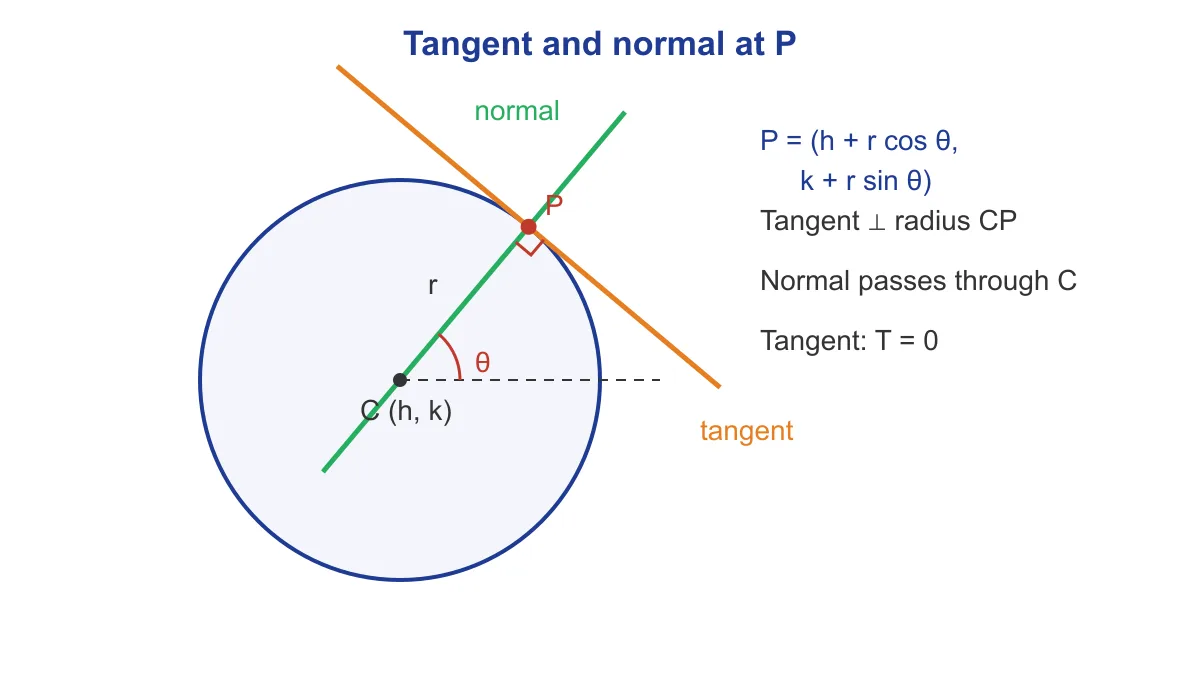
Figure 2.1: Tangent and normal at a point P of a circle; the parametric point at angle θ
Example 4: Show that $(5,5)$ lies on $x^2+y^2-2x-4y-20=0$ and find the tangent and normal there.
Substitute: $25+25-10-20-20=0$. Yes.
Centre $(1,2)$, since $g=-1,\ f=-2$.
Tangent, using $T=0$: $5x+5y-(x+5)-2(y+5)-20=0$. That is $5x+5y-x-5-2y-10-20=0$, so $4x+3y-35=0$.
Normal: through $(1,2)$ and $(5,5)$, slope $\frac{3}{4}$. Equation $y-2=\frac34(x-1)$, so $3x-4y+5=0$.
Check: the radius is $\sqrt{16+9}=5$, and the distance from the centre to the tangent is $\dfrac{\vert 4+6-35\vert}{5}=5$. Good.
Why this works: slopes $-\frac43$ and $\frac34$ multiply to $-1$, as they must for perpendicular lines.
Length of the tangent. From an outside point $P(x_1,y_1)$, each of the two tangents has length
The two tangent lengths are equal, since the two right triangles formed with the centre are congruent.
Memory trick: "Square splits, half halves." In the tangent equation $x^2$ becomes $x\cdot x_1$, $y^2$ becomes $y\cdot y_1$, and each lone $x$ or $y$ becomes the half-sum of the old and new letters. Say it before writing any $T=0$.
5. Chord with a given midpoint, and chord of contact
Chord whose midpoint is given
Let $M(x_1,y_1)$ be a point strictly inside the circle. Among all chords through $M$ there is exactly one that has $M$ as its midpoint, and it is perpendicular to $CM$. Its equation is
That is, $xx_1+yy_1+g(x+x_1)+f(y+y_1)+c=x_1^2+y_1^2+2gx_1+2fy_1+c$.
Why: the line passes through $M$, since both sides agree there. Its $x$ and $y$ coefficients are $x_1+g$ and $y_1+f$, which is the direction of $CM$, so the line is perpendicular to $CM$. A line through $M$ that is perpendicular to the radius to $M$ is exactly the chord bisected at $M$.
For $x^2+y^2=r^2$ this reduces to $xx_1+yy_1=x_1^2+y_1^2$. The chord is shortest among chords through $M$ when $M$ is its midpoint, because it is the farthest from the centre.
Example 5: Find the chord of $x^2+y^2-4x-6y-12=0$ bisected at $(1,2)$ and its length.
$S_1=1+4-4-12-12=-23$, negative, so $(1,2)$ is inside.
$T$: $x\cdot1+y\cdot2-2(x+1)-3(y+2)-12=-x-y-20$.
$T=S_1$ gives $-x-y-20=-23$, so $x+y=3$.
Length: centre $(2,3)$, $r^2=4+9+12=25$. Distance from the centre to $x+y-3=0$ is $\dfrac{\vert 2+3-3\vert}{\sqrt2}=\sqrt2$. Chord $=2\sqrt{25-2}=2\sqrt{23}$.
Why this works: the normal direction $(1,1)$ of the chord matches $CM=(-1,-1)$, confirming the perpendicularity.
Chord of contact
From an outside point $P(x_1,y_1)$ draw the two tangents, touching the circle at $A$ and $B$. The line $AB$ is the chord of contact. Its equation is again
Reason: the tangent at $A(x_A,y_A)$ is $xx_A+yy_A+\dots=0$, and it passes through $P$, so $x_1x_A+y_1y_A+g(x_1+x_A)+f(y_1+y_A)+c=0$. Read this as a statement about $A$: it says $A$ lies on the line $T(x_1,y_1)=0$. The same holds for $B$. A line through $A$ and $B$ is unique, so it is the chord of contact.
The line $T=0$ looks the same whether $P$ is on the circle (tangent) or outside (chord of contact), so the point's position decides what the line means. For an inside point, $T=0$ still exists as a line, but it has no geometric tangent meaning.
If the circle has radius $r$ and $L$ is the tangent length from $P$, with $d=CP$ so that $d^2=r^2+L^2$, the length of the chord of contact is
This comes from comparing two expressions for the area of the right triangle $CAP$: $\frac12\cdot r\cdot L=\frac12\cdot d\cdot\frac{AB}{2}$.
Example 6: From $P(7,1)$ tangents are drawn to $x^2+y^2=25$. Find the tangent length, the chord of contact, and its length.
$S_1=49+1-25=25$, so $L=5$.
Chord of contact: $7x+y=25$.
$d=\sqrt{49+1}=\sqrt{50}$, $r=5$. $AB=\dfrac{2\cdot5\cdot5}{\sqrt{50}}=\dfrac{50}{5\sqrt2}=5\sqrt2$.
Check by distance: centre to $7x+y-25=0$ is $\dfrac{25}{\sqrt{50}}=\dfrac{5}{\sqrt2}$. Chord $=2\sqrt{25-\frac{25}{2}}=2\cdot\dfrac{5}{\sqrt2}=5\sqrt2$. Same.
Why this works: two unrelated routes meet at one number, which is how you catch an arithmetic slip.
Memory trick: "T on the rim is a tangent, T outside is a chord, T equals S1 is the middle." One expression, three jobs, decided by where the point sits.
6. Two circles: relative positions and common tangents
Let two circles have centres $C_1,C_2$, radii $r_1,r_2$, and $d=C_1C_2$. Compare $d$ with $r_1+r_2$ and $\vert r_1-r_2\vert$.
| Condition | Position | Common tangents |
|---|---|---|
| $d>r_1+r_2$ | separate, outside each other | 4 (2 direct, 2 transverse) |
| $d=r_1+r_2$ | touch externally | 3 |
| $\vert r_1-r_2\vert<d<r_1+r_2$ | intersect at two points | 2 |
| $d=\vert r_1-r_2\vert$ | touch internally | 1 |
| $d<\vert r_1-r_2\vert$ | one lies inside the other | 0 |
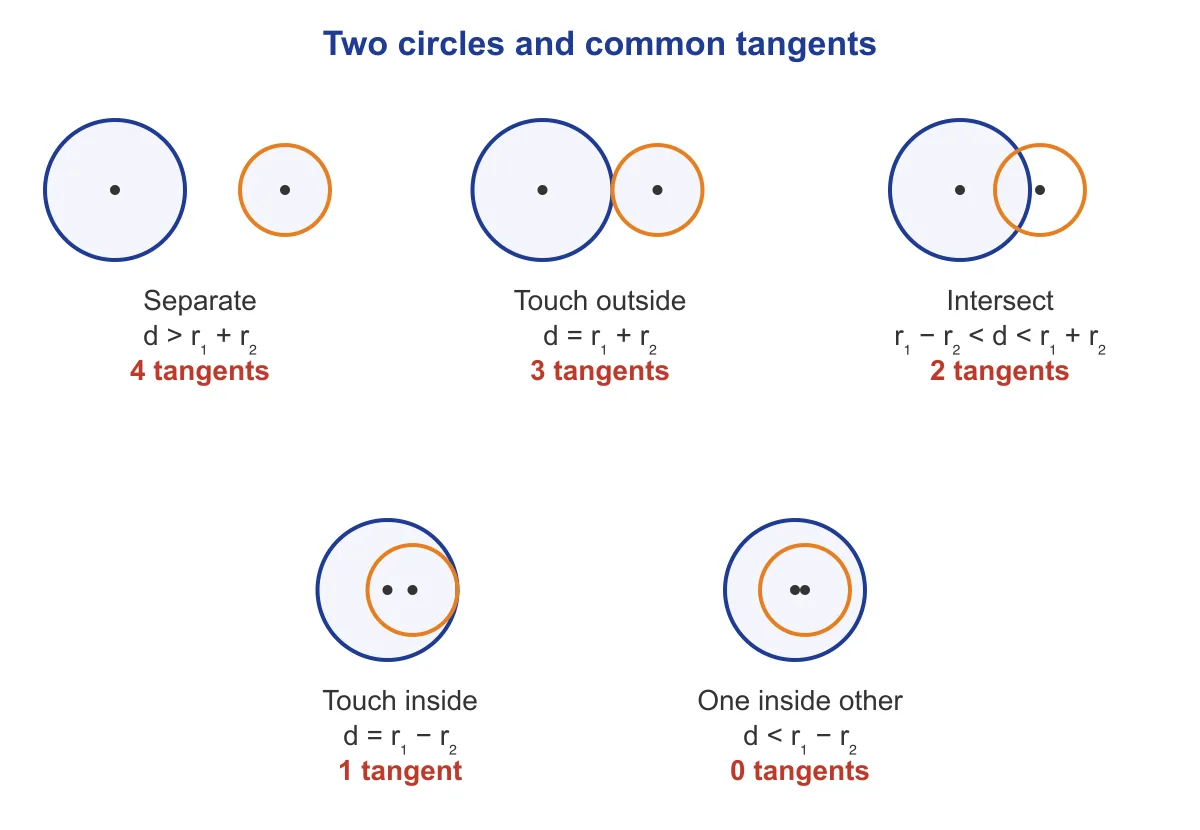
Figure 2.2: The five positions of two circles and the number of common tangents in each
Direct common tangents do not cross the segment $C_1C_2$; transverse ones do cross it. When the circles are separate, the lengths between the two points of contact are
The transverse length exists only when $d\ge r_1+r_2$, which is why the two circles must be outside each other for transverse tangents to be drawn.
Radical axis. Take two circles with $x^2$ and $y^2$ coefficients equal to 1: $S=0$ and $S'=0$. The line
is linear, because the $x^2+y^2$ terms cancel. A point on it has the same power with respect to both circles, so it is called the radical axis. Three facts to carry:
- If the circles intersect, it is the line through the two common points, so it holds the common chord.
- If they touch, it is the common tangent at the point of contact.
- It is perpendicular to the line of centres $C_1C_2$.
The length of the common chord is $2\sqrt{r_1^2-p^2}$, where $p$ is the distance from $C_1$ to the radical axis. The distance $p$ may be measured from either centre as long as you use that circle's radius with it.
Example 7: Circles $x^2+y^2-2x-6y+6=0$ and $x^2+y^2-10x-6y+30=0$. Find their relative position, the number of common tangents, the radical axis and the length of a direct common tangent.
First circle: centre $(1,3)$, $r_1^2=1+9-6=4$, so $r_1=2$.
Second circle: centre $(5,3)$, $r_2^2=25+9-30=4$, so $r_2=2$.
$d=4$ and $r_1+r_2=4$. So $d=r_1+r_2$: the circles touch externally, giving 3 common tangents.
Radical axis: subtract, $(-2x+10x)+(6-30)=0$, so $8x-24=0$, $x=3$. It is the common tangent at the contact point $(3,3)$, and it is perpendicular to the line of centres, which is horizontal.
Direct tangent length: $\sqrt{d^2-(r_1-r_2)^2}=\sqrt{16-0}=4$.
Why this works: equal radii mean the direct tangents are parallel to $C_1C_2$ and as long as $d$.
Memory trick: "Far four, kiss three, cross two, hug one, hide none." Far apart gives 4 tangents, touching from outside 3, crossing 2, touching from inside 1, hiding inside 0. Use it to check the count before you start any calculation.
7. Family of circles; orthogonal circles
Circles through common points
For two circles $S=0$ and $S'=0$ meeting at two points, the equation
represents a circle for every real $\lambda$ (other than $-1$), and each such circle passes through both common points. The reason is simple: a point satisfying $S=0$ and $S'=0$ at once also satisfies the combination. For $\lambda=-1$ it becomes the radical axis, a line.
Similarly, for a circle $S=0$ and a line $L=0$ meeting it,
is a circle through the two points where the line meets the circle, and $\lambda$ is a free constant fixed by one more condition, such as a point the new circle must pass through.
Example 8: Find the circle through the points where $x^2+y^2=4$ meets $x+y=1$, and also through $(1,1)$.
Write $S+\lambda L=0$: $x^2+y^2-4+\lambda(x+y-1)=0$.
Put $(1,1)$: $1+1-4+\lambda(1+1-1)=0$, so $-2+\lambda=0$ and $\lambda=2$.
Substitute: $x^2+y^2-4+2x+2y-2=0$, so $x^2+y^2+2x+2y-6=0$.
Check: at $(1,1)$ we get $1+1+2+2-6=0$. Good.
Why this works: one unknown $\lambda$ is fixed by one extra point, so no intersection points had to be computed.
Orthogonal circles
Two circles are orthogonal if they cut at right angles, that is, if the tangents at a common point are perpendicular. Then the tangent to one at that point passes through the centre of the other, and the triangle $C_1PC_2$ has a right angle at $P$:
For circles $x^2+y^2+2g_1x+2f_1y+c_1=0$ and $x^2+y^2+2g_2x+2f_2y+c_2=0$, substituting $d^2=(g_1-g_2)^2+(f_1-f_2)^2$, $r_1^2=g_1^2+f_1^2-c_1$ and $r_2^2=g_2^2+f_2^2-c_2$ gives the condition
Do not drop the factor 2 on the left. Students lose marks by writing $g_1g_2+f_1f_2=c_1+c_2$, which is wrong.
Common traps
- Reading the centre as $(g,f)$ → the centre is $(-g,-f)$, and the radius is $\sqrt{g^2+f^2-c}$ with $c$ subtracted.
- Using the formulas with $5x^2+5y^2+\dots$ as written → divide by 5 so that $x^2$ and $y^2$ have coefficient 1 before reading $g$, $f$, $c$.
- Calling $x^2+y^2+2x+2y+5=0$ a circle just because it looks like one → check $g^2+f^2-c$ first; here it is $-3$, so there is no real circle.
- Writing the tangent length as $S_1$ → the length is $\sqrt{S_1}$, and it exists only when $S_1\ge0$.
- Giving one value of $k$ in a tangent-line problem → the distance equation $\vert\cdot\vert=r\sqrt{\cdot}$ has two roots; take both unless the question restricts the side.
- Writing $T=0$ and calling it the tangent when the point is outside → for an outside point it is the chord of contact, and it is a tangent only if the point is on the circle.
- Taking the chord with midpoint $M$ as the line through $M$ and the centre → that line is a diameter; the bisected chord is perpendicular to $CM$, and its equation is $T=S_1$.
- Counting common tangents from $d$ alone → compare $d$ with both $r_1+r_2$ and $\vert r_1-r_2\vert$, and remember that touching circles give 3 (outside) or 1 (inside), not 4 or 2.
- Forgetting that $S-S'=0$ is the radical axis only when both equations have the same $x^2+y^2$ coefficient → normalise first.
- Writing the orthogonality condition as $g_1g_2+f_1f_2=c_1+c_2$ → it is $2g_1g_2+2f_1f_2=c_1+c_2$.
Quick revision
- Centre-radius form: $(x-h)^2+(y-k)^2=r^2$; general form centre $(-g,-f)$, radius $\sqrt{g^2+f^2-c}$.
- A second-degree equation is a circle only if the $x^2$ and $y^2$ coefficients are equal and the $xy$ term is absent.
- Diameter form: $(x-x_1)(x-x_2)+(y-y_1)(y-y_2)=0$.
- Parametric point: $(h+r\cos\theta,\ k+r\sin\theta)$.
- Power of a point $S_1=CP^2-r^2$: positive outside, zero on the circle, negative inside.
- Least and greatest distance from an outside point: $CP-r$ and $CP+r$.
- Chord cut by a line: $2\sqrt{r^2-p^2}$, with $p$ the distance from the centre to the line.
- Tangency: $p=r$; for $y=mx+c$ and $x^2+y^2=r^2$, $c^2=r^2(1+m^2)$.
- Tangent at $(x_1,y_1)$: $T=0$; the normal passes through the centre.
- Length of tangent from an outside point: $\sqrt{S_1}$.
- Chord bisected at $(x_1,y_1)$: $T=S_1$; chord of contact from an outside point: $T=0$, of length $2rL/d$.
- Common tangents: $d>r_1+r_2$ gives 4, $d=r_1+r_2$ gives 3, in between gives 2, $d=\vert r_1-r_2\vert$ gives 1, smaller gives 0.
- Direct and transverse tangent lengths: $\sqrt{d^2-(r_1\mp r_2)^2}$.
- Radical axis $S-S'=0$ is perpendicular to $C_1C_2$; the family through common points is $S+\lambda S'=0$.
- Orthogonal circles: $d^2=r_1^2+r_2^2$, equivalently $2g_1g_2+2f_1f_2=c_1+c_2$.
Practice questions
The circle $x^2+y^2-6x+8y-11=0$ has
- centre $(3,-4)$ and radius $\sqrt{14}$
- centre $(3,-4)$ and radius $6$
- centre $(-3,4)$ and radius $\sqrt{14}$
- centre $(-3,4)$ and radius $6$
Answer
B. centre $(3,-4)$ and radius $6$
$g=-3,\ f=4,\ c=-11$. Centre $(-g,-f)=(3,-4)$. $r^2=9+16+11=36$, so $r=6$.
The ends of a diameter of a circle are $(2,3)$ and $(-4,5)$. The equation of the circle is
- $x^2+y^2+2x-8y+7=0$
- $x^2+y^2+2x-8y-7=0$
- $x^2+y^2-2x+8y+7=0$
- $x^2+y^2+2x+8y+7=0$
Answer
A. $x^2+y^2+2x-8y+7=0$
$(x-2)(x+4)+(y-3)(y-5)=0$ gives $x^2+2x-8+y^2-8y+15=0$, i.e. $x^2+y^2+2x-8y+7=0$. Check: centre $(-1,4)$, $r^2=1+16-7=10$, and the distance$^2$ from the centre to $(2,3)$ is $9+1=10$.
The point $(1+3\cos\theta,\,-2+3\sin\theta)$ moves on the circle
- $(x+1)^2+(y-2)^2=9$
- $(x-1)^2+(y-2)^2=9$
- $(x-1)^2+(y+2)^2=9$
- $(x-1)^2+(y+2)^2=3$
Answer
C. $(x-1)^2+(y+2)^2=9$
$x-1=3\cos\theta$ and $y+2=3\sin\theta$. Squaring and adding gives $(x-1)^2+(y+2)^2=9$.
The point $(3,-1)$ with respect to the circle $x^2+y^2-2x+4y-4=0$ is
- outside the circle
- the centre of the circle
- on the circle
- inside the circle
Answer
D. inside the circle
$S_1=9+1-6-4-4=-4<0$, so the point is inside. Check: centre $(1,-2)$, distance$^2=4+1=5<9=r^2$.
The tangent to $x^2+y^2=25$ at the point $(3,4)$ is
- $3x-4y=25$
- $4x+3y=25$
- $3x+4y=5$
- $3x+4y=25$
Answer
D. $3x+4y=25$
$xx_1+yy_1=r^2$ gives $3x+4y=25$. Slope of the radius is $\frac43$, so the tangent slope is $-\frac34$, which matches.
The line $3x-4y+k=0$ touches the circle $x^2+y^2=4$ for
- $k=\pm20$
- $k=\pm5$
- $k=\pm10$
- $k=\pm2$
Answer
C. $k=\pm10$
Distance from the origin: $\frac{\vert k\vert}{5}=2$, so $\vert k\vert=10$.
The equation of the chord of contact of tangents drawn from $(4,-3)$ to $x^2+y^2=16$ is
- $4x-3y=16$
- $3x-4y=16$
- $4x-3y=25$
- $4x+3y=16$
Answer
A. $4x-3y=16$
$S_1=16+9-16=9>0$, so the point is outside. $T=0$: $4x-3y=16$.
The chord of $x^2+y^2-6x+4y-12=0$ that is bisected at the point $(1,-1)$ has the equation
- $x-2y-3=0$
- $2x-y-3=0$
- $2x+y-1=0$
- $x+2y+1=0$
Answer
B. $2x-y-3=0$
Centre $(3,-2)$; $CM$ has direction $(-2,1)$, so the chord has normal $(2,-1)$: $2x-y=c$, through $(1,-1)$ gives $c=3$. Check with $T=S_1$: $S_1=1+1-6-4-12=-20$, $T=-2x+y-17$, so $-2x+y=-3$.
The common chord of $x^2+y^2-2x-4y-4=0$ and $x^2+y^2-6x+2y+6=0$ is the line
- $3x+2y-5=0$
- $2x-3y+5=0$
- $2x+3y-5=0$
- $2x-3y-5=0$
Answer
D. $2x-3y-5=0$
Centres $(1,2)$, $(3,-1)$, radii $3$ and $2$; $d=\sqrt{13}$ lies between $1$ and $5$, so they intersect. Subtracting: $4x-6y-10=0$, i.e. $2x-3y-5=0$.
The number of common tangents to $x^2+y^2=4$ and $x^2+y^2-6x-8y+16=0$ is
- $4$
- $2$
- $3$
- $1$
Answer
C. $3$
Centres $(0,0)$ and $(3,4)$, $d=5$. Radii $2$ and $\sqrt{9+16-16}=3$. $d=r_1+r_2$, so the circles touch externally: $3$ common tangents.
The circles $x^2+y^2-2x-4y+1=0$ and $x^2+y^2+6x+2y+k=0$ cut each other orthogonally when $k$ equals
- $-11$
- $9$
- $-6$
- $11$
Answer
A. $-11$
$2g_1g_2+2f_1f_2=c_1+c_2$ with $g_1=-1,f_1=-2,c_1=1,g_2=3,f_2=1$: $-6-4=1+k$, so $k=-11$.
The circle with centre $(1,-2)$ that touches the line $3x+4y-5=0$ has the equation
- $(x-1)^2+(y+2)^2=100$
- $(x-1)^2+(y+2)^2=4$
- $(x-1)^2+(y+2)^2=10$
- $(x-1)^2+(y+2)^2=2$
Answer
B. $(x-1)^2+(y+2)^2=4$
Radius $=\frac{\vert 3-8-5\vert}{5}=2$, so $r^2=4$.
The maximum value of $3x+4y$ for points $(x,y)$ on the circle $(x-1)^2+(y+1)^2=4$ is
- $9$
- $11$
- $5$
- $10$
Answer
A. $9$
Put $x=1+2\cos\theta,\ y=-1+2\sin\theta$: $3x+4y=-1+6\cos\theta+8\sin\theta$, with greatest value $-1+10=9$.
Which of the following lines is a tangent to the circle $x^2+y^2=25$?
- $3x-4y+20=0$
- $3x-4y+5=0$
- $3x-4y+25=0$
- $3x-4y+15=0$
Answer
C. $3x-4y+25=0$
A tangent needs $\frac{\vert c\vert}{5}=5$, so $\vert c\vert=25$. Only $3x-4y+25=0$ qualifies; the others are at distances $1,3,4$.
The radius of the circle $x^2+y^2-6x+4y-3=0$ is
- 16
- 2
- 4
- 6
Answer
C. 4
$g=-3,f=2,c=-3$: $r^2=9+4+3=16$, so $r=4$.
The length of the tangent from $(6,5)$ to $x^2+y^2-2x-4y-4=0$ is
- 25
- 5
- 6
- 7
Answer
B. 5
$S_1=36+25-12-20-4=25$, so $L=\sqrt{25}=5$.
The least distance of the point $(10,7)$ from the circle $x^2+y^2-4x-2y-20=0$ is
- 15
- 5
- 10
- 3
Answer
B. 5
Centre $(2,1)$, $r^2=4+1+20=25$, $r=5$. $CP=\sqrt{64+36}=10$. Least distance $=10-5=5$.
The length of the chord cut from $x^2+y^2=25$ by the line $3x+4y=15$ is
- 4
- 6
- 8
- 16
Answer
C. 8
$p=\frac{15}{5}=3$. Chord $=2\sqrt{25-9}=8$.
The radius of the circle passing through $(0,0)$, $(6,0)$ and $(0,8)$ is
- 10
- 7
- 4.8
- 5
Answer
D. 5
The angle at the origin is $90^\circ$, so the segment from $(6,0)$ to $(0,8)$ is a diameter of length $\sqrt{36+64}=10$. Radius $5$.
The circles $x^2+y^2=25$ and $x^2+y^2-16x+39=0$ intersect. The length of their common chord is
- 6
- 8
- 3
- 4
Answer
A. 6
Subtract: $16x-64=0$, so the chord lies on $x=4$. Distance from the origin is $4$, so the chord is $2\sqrt{25-16}=6$.
The minimum value of $x^2+y^2$ for points on the circle $(x-3)^2+(y-4)^2=4$ is
- 3
- 9
- 49
- 21
Answer
B. 9
Distance of the centre from the origin is $5$, so the nearest point is at distance $5-2=3$. Minimum of $x^2+y^2$ is $9$.
The line $y=x+c$ with $c>0$ touches the circle $x^2+y^2=8$. The value of $c$ is
- 16
- 2
- 8
- 4
Answer
D. 4
$c^2=r^2(1+m^2)=8\cdot2=16$, so $c=4$.
The circle $x^2+y^2=9$ is cut orthogonally by a circle with centre $(5,0)$. The radius of the second circle is
- 16
- 5
- 4
- 3
Answer
C. 4
Second circle: $x^2+y^2-10x+c=0$. Orthogonality: $0=-9+c$, so $c=9$. $r^2=25-9=16$, $r=4$. Check: $d^2=25=9+16$.
The length of a direct common tangent to the circles $x^2+y^2=64$ and $(x-13)^2+y^2=9$ is
- 13
- 5
- 11
- 12
Answer
D. 12
$d=13$, $r_1=8$, $r_2=3$, and $d>r_1+r_2=11$. Length $=\sqrt{d^2-(r_1-r_2)^2}=\sqrt{169-25}=12$.
A circle passes through the intersection points of $x^2+y^2=4$ and $x+y=1$ and through $(1,3)$. The square of its radius is
- 2.5
- 4
- 6
- 3
Answer
B. 4
$x^2+y^2-4+\lambda(x+y-1)=0$ at $(1,3)$: $6+3\lambda=0$, so $\lambda=-2$. Circle: $x^2+y^2-2x-2y-2=0$, $g=f=-1$, $c=-2$. $r^2=1+1+2=4$.
The tangent at $(4,2)$ to $x^2+y^2=20$ and the two coordinate axes enclose a triangle of area
- 25
- 20
- 12.5
- 50
Answer
A. 25
Tangent: $4x+2y=20$, i.e. $2x+y=10$. Intercepts $5$ and $10$. Area $=\frac12\cdot5\cdot10=25$.
Given below are two statements: Statement I: The equation $x^2+y^2+2x+2y+5=0$ does not represent any real circle. Statement II: The equation $x^2+y^2+2gx+2fy+c=0$ represents a real circle only when $c<0$.
- Both Statement I and Statement II are correct
- Both Statement I and Statement II are incorrect
- Statement I is correct but Statement II is incorrect
- Statement I is incorrect but Statement II is correct
Answer
C. Statement I is correct but Statement II is incorrect
Here $g^2+f^2-c=1+1-5=-3<0$, so no real circle: Statement I is correct. For $g=3,f=0,c=5$ we get $r^2=9-5=4>0$ with $c>0$, so Statement II is false.
Given below are two statements: Statement I: The line $x+y=4$ touches the circle $x^2+y^2=8$. Statement II: A line touches a circle exactly when the distance of the centre from the line equals the radius.
- Both Statement I and Statement II are correct
- Both Statement I and Statement II are incorrect
- Statement I is correct but Statement II is incorrect
- Statement I is incorrect but Statement II is correct
Answer
A. Both Statement I and Statement II are correct
Distance from the origin to $x+y-4=0$ is $\frac{4}{\sqrt2}=2\sqrt2=\sqrt8=r$. Both statements are correct.
Given below are two statements: Statement I: Exactly two tangents can be drawn to a circle from a point inside it. Statement II: The radical axis of two non-intersecting circles is parallel to the line joining their centres.
- Both Statement I and Statement II are correct
- Both Statement I and Statement II are incorrect
- Statement I is correct but Statement II is incorrect
- Statement I is incorrect but Statement II is correct
Answer
B. Both Statement I and Statement II are incorrect
An inside point has $S_1<0$, so no real tangent exists: Statement I is false. The radical axis is perpendicular to the line of centres: Statement II is false.
Given below are two statements: Statement I: The circles $x^2+y^2=4$ and $x^2+y^2-8x+12=0$ touch internally. Statement II: Two circles that touch externally have exactly three common tangents.
- Both Statement I and Statement II are correct
- Both Statement I and Statement II are incorrect
- Statement I is correct but Statement II is incorrect
- Statement I is incorrect but Statement II is correct
Answer
D. Statement I is incorrect but Statement II is correct
Second circle: centre $(4,0)$, $r^2=16-12=4$. Then $d=4=2+2=r_1+r_2$, so they touch externally and Statement I is false. Statement II is true.
Given below are two statements: Statement I: The chord of $x^2+y^2=r^2$ bisected at $(a,b)\ne(0,0)$ is $ax+by=a^2+b^2$. Statement II: A chord bisected at a point $M$ is perpendicular to the line joining the centre and $M$.
- Both Statement I and Statement II are correct
- Both Statement I and Statement II are incorrect
- Statement I is correct but Statement II is incorrect
- Statement I is incorrect but Statement II is correct
Answer
A. Both Statement I and Statement II are correct
$T=S_1$ gives $ax+by=a^2+b^2$, so Statement I is correct. The line has normal $(a,b)$, the direction of $CM$, so Statement II is correct too.
Assertion (A): The equation $x^2+y^2-4x-6y+13=0$ represents a single point. Reason (R): For $x^2+y^2+2gx+2fy+c=0$ the radius is $\sqrt{g^2+f^2-c}$, which is zero when $g^2+f^2=c$.
- Both A and R are true and R is the correct explanation of A
- Both A and R are true but R is not the correct explanation of A
- A is true but R is false
- A is false but R is true
Answer
A. Both A and R are true and R is the correct explanation of A
$g=-2,f=-3,c=13$: $4+9-13=0$, so the radius is zero and the locus is the point $(2,3)$. R states exactly why.
Assertion (A): The tangent to $x^2+y^2=a^2+b^2$ at $(a,b)$ is $ax+by=a^2+b^2$. Reason (R): A tangent to a circle at a point is parallel to the radius through that point.
- Both A and R are true and R is the correct explanation of A
- Both A and R are true but R is not the correct explanation of A
- A is true but R is false
- A is false but R is true
Answer
C. A is true but R is false
$xx_1+yy_1=r^2$ at $(a,b)$ gives A. R is false: the tangent is perpendicular to the radius.
Assertion (A): Circles with centres $(0,0)$ and $(3,0)$ and radii $2$ and $1$ have four common tangents. Reason (R): Two circles whose centre distance exceeds the sum of their radii have four common tangents.
- Both A and R are true and R is the correct explanation of A
- Both A and R are true but R is not the correct explanation of A
- A is true but R is false
- A is false but R is true
Answer
D. A is false but R is true
Here $d=3=2+1$, so the circles touch externally and have three common tangents; A is false. R is a correct statement.
Match List I with List II. List I: a. Centre of $x^2+y^2-6x+8y=0$ b. Radius of $x^2+y^2-6x+8y=0$ c. Value of $S$ at the point $(3,-4)$ for this circle d. Tangent to this circle at the origin. List II: i. $3x-4y=0$ ii. $(3,-4)$ iii. $5$ iv. $-25$
- a-ii, b-iii, c-i, d-iv
- a-ii, b-iii, c-iv, d-i
- a-ii, b-iv, c-iii, d-i
- a-iii, b-ii, c-iv, d-i
Answer
B. a-ii, b-iii, c-iv, d-i
Centre $(3,-4)$; $r^2=9+16=25$, so $r=5$; $S(3,-4)=9+16-18-32=-25$; tangent at the origin from $T=0$: $-3x+4y=0$, i.e. $3x-4y=0$.
Match List I with List II. Two circles have radii $5$ and $3$. List I: a. Distance between centres is $2$ b. Distance between centres is $9$ c. Distance between centres is $8$ d. Distance between centres is $5$. List II: i. exactly 1 common tangent ii. exactly 2 common tangents iii. exactly 3 common tangents iv. exactly 4 common tangents
- a-ii, b-iv, c-iii, d-i
- a-i, b-iv, c-ii, d-iii
- a-iii, b-iv, c-i, d-ii
- a-i, b-iv, c-iii, d-ii
Answer
D. a-i, b-iv, c-iii, d-ii
$d=2=r_1-r_2$: internal touching, 1. $d=9>8$: 4. $d=8=r_1+r_2$: external touching, 3. $d=5$ lies between $2$ and $8$: 2.
Match List I with List II. Consider the circle $x^2+y^2=25$. List I: a. The point $(3,5)$ b. The point $(3,4)$ c. The point $(2,3)$ d. The point $(4,-4)$. List II: i. lies on the circle ii. lies inside the circle iii. lies outside, tangent length $3$ iv. lies outside, tangent length $\sqrt7$
- a-iii, b-ii, c-i, d-iv
- a-iv, b-i, c-ii, d-iii
- a-i, b-iii, c-ii, d-iv
- a-iii, b-i, c-ii, d-iv
Answer
D. a-iii, b-i, c-ii, d-iv
$S_1$ values: $(3,5)$: $9$, so $L=3$; $(3,4)$: $0$; $(2,3)$: $-12$; $(4,-4)$: $7$, so $L=\sqrt7$.
Two circles in the first quadrant touch both coordinate axes and pass through the point $(4,2)$. The distance between their centres is
- $12\sqrt2$
- $8$
- $8\sqrt2$
- $12$
Answer
C. $8\sqrt2$
Centre $(r,r)$, radius $r$: $(4-r)^2+(2-r)^2=r^2$ gives $r^2-12r+20=0$, so $r=2$ or $10$. Centres $(2,2)$ and $(10,10)$ are $8\sqrt2$ apart.
Tangents are drawn from $P(8,0)$ to $x^2+y^2=16$, touching the circle at $A$ and $B$. The area of triangle $PAB$ is
- $12\sqrt3$
- $8\sqrt3$
- $4\sqrt3$
- $16\sqrt3$
Answer
A. $12\sqrt3$
Chord of contact: $8x=16$, $x=2$, so $A,B=(2,\pm2\sqrt3)$, $AB=4\sqrt3$. Height from $P$ to $x=2$ is $6$. Area $=\frac12\cdot4\sqrt3\cdot6=12\sqrt3$. Check: $PA=\sqrt{64-16}=4\sqrt3$; $\text{area}(OAPB)-\text{area}(OAB)=16\sqrt3-4\sqrt3$.
The shortest chord of the circle $x^2+y^2-6x-4y-12=0$ that passes through the point $(5,3)$ has length
- $2\sqrt5$
- $4\sqrt5$
- $10$
- $2\sqrt{15}$
Answer
B. $4\sqrt5$
Centre $(3,2)$, $r^2=25$. $CP^2=4+1=5$. The shortest chord through $P$ is the one bisected at $P$: length $2\sqrt{25-5}=4\sqrt5$.