Chapter 8 — Forests, grasslands and Eastern Ghats
Exam link: common foundation; AP examples support regional application.
Learning aim: relate vegetation structure to environmental conditions, distinguish forest measures and understand fragmentation, corridors and habitat restoration.
8.1 Forest is a structure and a process
A forest is more than a collection of trees. Its structure can include a canopy, smaller trees, shrubs, herbs, climbers, leaf litter, roots, soil organisms and openings. The arrangement affects light, temperature, humidity, movement and the availability of food or shelter. Species composition and layers vary with climate, soil, slope, water, disturbance and history.
Forest types are classified in different systems for different purposes. A broad ecological description may use rainfall, temperature and dominant vegetation; a forest administration may use legal categories or working circles; satellite assessment may classify canopy density and land cover. These measures are not interchangeable. “Forest cover,” “recorded forest area,” “tree cover” and “tree canopy” can have distinct definitions. Any statistic should be tied to the report year, method and definition.
The Forest Survey of India publishes a periodically updated State of Forest Report. For this book, use the report's definitions and table years where forest statistics are required; do not treat its data as a live ground survey. A figure that reports a national or AP forest-cover change is a dated assessment, not a timeless fact. Rather than crowd the book with rankings, focus on how forest structure supports habitat, soil protection, water movement and carbon storage.
8.2 Forest functions and trade-offs
Forest vegetation can intercept rain, slow surface flow, stabilize some soils, provide habitat and store carbon in biomass and soil. These processes depend on forest condition, species, landscape position and climate. A degraded or fragmented forest may not perform identically to an intact one. Tree planting cannot automatically replace a complex native ecosystem: a plantation can differ in species, age structure, undergrowth and hydrological effects.
Forests also support livelihoods, cultural practices and economic uses. Conservation choices must therefore attend to rights, local knowledge, access and the legal status of land. Ecological function and human use can interact; neither should be erased from a case analysis.
8.3 Grasslands are ecosystems, not empty land
Grasslands are habitats in which grasses and other low-growing plants are important structural components. They support herbivores, insects, ground-nesting birds and predators. Some grasslands persist through climate, soil, grazing or recurring disturbance. Others occur as openings within a broader forest mosaic.
A frequent management error is to assume every open area is degraded and should be planted with trees. A tree plantation may increase canopy but remove grassland species and alter fire or grazing patterns. Before restoration, identify the reference ecosystem, historical land use, native species and current pressures. “More trees” is not a complete measure of ecological improvement.
8.4 The Eastern Ghats as a connected but varied landscape
The Eastern Ghats form a discontinuous chain of hills and uplands along parts of peninsular eastern India, separated by river valleys and plains. Within Andhra Pradesh, upland habitats connect with river catchments, drylands and coastal plains. Elevation, aspect, rainfall, soils and human use create local variation. The label “Eastern Ghats” does not describe a uniform forest belt.
Landscape connectivity matters because species need different movement ranges and habitat features. Some organisms can cross a crop matrix; others require continuous cover or stepping-stone patches. A road can create a barrier, cause mortality or provide access that increases disturbance. A corridor may help movement but does not guarantee viable populations if food, breeding sites or protection are inadequate.
8.5 Fragmentation: area, edge and isolation
Habitat fragmentation breaks a continuous habitat into smaller, separated patches. It can reduce total area and increase edge relative to interior. Edges may experience different light, wind, temperature, invasive species and human access. Effects vary by species: a generalist may use edges, while an interior specialist may avoid them.
Three dimensions are useful:
1. Patch area: smaller patches may support fewer individuals or habitat types, though effects depend on quality and species.
2. Isolation: distant or inaccessible patches may receive fewer dispersers, seeds or recolonising animals.
3. Edge exposure: a greater proportion of habitat may experience altered edge conditions.
Fragmentation is not identical to habitat loss. A landscape could retain a similar total area but divide it into isolated pieces; conversely, habitat area may decline without becoming more fragmented if it remains in one patch. Both area and configuration should be measured.
8.6 Fire, grazing and restoration
Fire regimes differ in frequency, intensity, season and spatial extent. Some ecosystems contain species adapted to particular fire patterns, while repeated severe fires can reduce regeneration or change species composition. Fire suppression can also alter habitats that depend on periodic disturbance. Management should use local ecological evidence rather than a universal “fire is always bad” or “fire is always natural” rule.
Grazing can shape plant structure and nutrient movement. Moderate grazing, overgrazing and exclusion have different outcomes depending on habitat and stocking pattern. Removing livestock may aid one sensitive site but allow woody encroachment in another. Management needs a stated goal and monitoring.
Restoration prioritizes natural regeneration where seed sources and ecological processes remain; active planting may be needed when barriers prevent recovery. It should use locally appropriate species, protect soil and water processes and account for invasive plants. A monitoring plan might track native recruitment, canopy structure, grassland cover, connectivity and disturbance—not merely the number of planted saplings.
Figure 8.1 — Habitat patch mosaic: compare one connected patch with several fragmented patches of equal total area. Add edge zones, a road barrier and one possible corridor. State that movement response depends on the species and landscape.
AP case: a road through an upland habitat
Imagine a proposed road crosses an Eastern Ghats slope. A map shows that the road passes near forest cover, but a land-cover layer cannot alone establish wildlife movement or breeding use. Survey season, species, topography, streams, settlements and existing tracks matter. A sound assessment considers direct habitat removal, edge effects, drainage changes, vehicle mortality, access for extraction and possible avoidance or crossing structures. Any mitigation should be site-specific and monitored. The exam lesson is to distinguish the visible footprint from indirect and cumulative pathways.
Retrieval and exam traps
- Forest-cover statistics have definitions and reference years.
- A plantation is not automatically equivalent to a native forest ecosystem.
- Grasslands can be native, species-rich habitats; open land is not automatically degraded forest.
- Fragmentation concerns configuration and connectivity as well as total area.
- Corridors can help movement but do not replace habitat quality or protection.
- Fire and grazing effects depend on ecosystem, timing, intensity and management objective.
Explain why a forest-cover figure needs a definition and year. Draw a grassland-to-forest restoration decision tree and identify the observation needed before selecting the planting option. Then name two indirect effects of a road beyond the paved footprint.
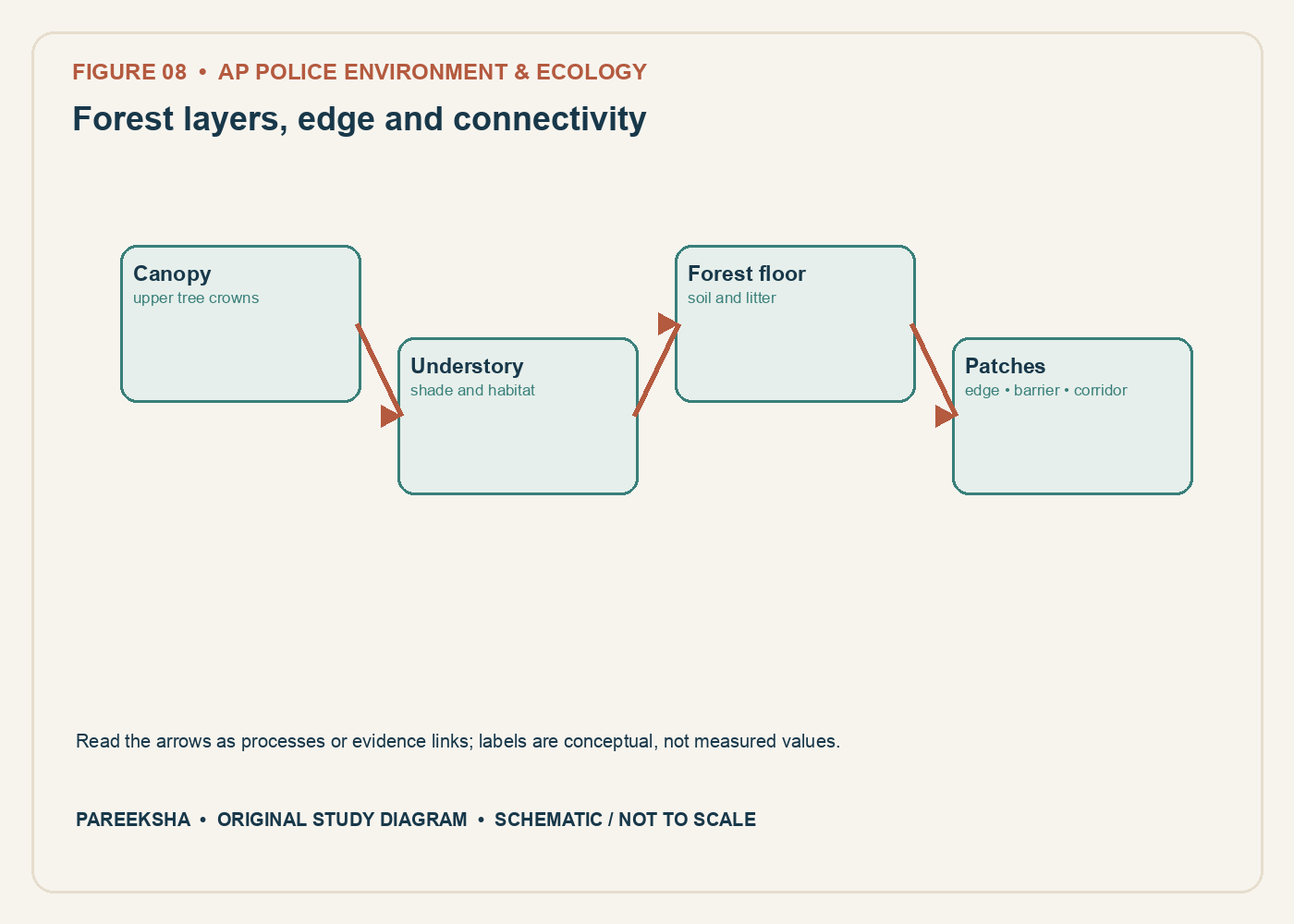
Figure 8.1 Forest layers, edge and connectivity. Original explanatory diagram; schematic and not to scale.
Chapter practice questions
1. Forest canopy refers mainly to:
A. Mineral rock below the soil
B. A river’s flood peak
C. The upper layer formed by crowns of trees
D. The deepest part of a wetland
Answer: C. The canopy is the upper foliage layer in a forest. Forest structure also includes understory, shrub, herb and ground layers, which vary by habitat.
2. Which condition can create a forest edge effect?
A. A nutrient cycle inside a closed leaf
B. A species’ scientific name
C. A uniform canopy with no boundary
D. A sharp boundary between forest and an adjacent open or altered area
Answer: D. Edges can alter light, temperature, wind, moisture and species interactions. Effects vary with edge orientation, age and surrounding land use.
3. Habitat fragmentation most directly describes:
A. The division of continuous habitat into smaller, separated patches
B. A seasonal increase in rainfall
C. A change in trophic level
D. A carbon atom moving through a leaf
Answer: A. Fragmentation reduces continuity and can isolate patches. Habitat loss and fragmentation are related but distinct: an area may lose total habitat and also become more divided.
4. Which statement best defines a wildlife corridor?
A. Any road built through forest
B. A landscape feature that can facilitate movement between habitat areas for particular species
C. A boundary around every national park
D. A river with no organisms
Answer: B. A corridor is useful only if it supports movement for the focal species and is sufficiently safe and connected. A line on a map alone does not establish function.
5. Why can a corridor work for one species but not another?
A. All species travel identically
B. Corridors have no ecological effect
C. Movement ability, habitat needs and tolerance of human disturbance differ
D. Species do not respond to landscape structure
Answer: C. Species vary in body size, behaviour, habitat preference and sensitivity to disturbance. Corridor design should be evidence-based and species-aware.
6. Which is a reasonable measure of habitat connectivity?
A. Counting only the number of roads in a district
B. Measuring air temperature once
C. Listing species without location data
D. Assessing patch spacing, barriers, vegetation quality and documented movement
Answer: D. Connectivity depends on the structure and permeability of the landscape as well as organism movement. Several types of evidence can be combined.
7. What is a key limitation of measuring forest area alone?
A. It may not reveal forest condition, fragmentation, species composition or connectivity
B. Area has no ecological relevance
C. Forests do not change over time
D. Any mapped green area is necessarily natural forest
Answer: A. Area is useful but incomplete. Canopy density, quality, origin, biodiversity, fragmentation and definitions affect interpretation.
8. A grassland is converted to tree plantation and its canopy cover rises. Which conclusion is safest?
A. Biodiversity must have increased
B. Tree cover rose, but this alone does not prove native grassland biodiversity improved
C. Grasslands have no conservation value
D. Plantation and natural forest are identical
Answer: B. Different ecosystems support different species and ecological functions. More canopy is not a universal measure of ecological recovery.
9. Fire in an ecosystem can be:
A. Always beneficial
B. Always caused by lightning
C. A natural or human-influenced disturbance whose effects depend on regime and context
D. Unrelated to vegetation structure
Answer: C. Fire frequency, intensity, season, extent and ecosystem adaptation influence its effects. Human ignition and climate can alter the regime.
10. Which is the best way to distinguish a fire event from a fire regime?
A. They mean exactly the same thing
B. A regime is only a map scale
C. An event is a long-term average
D. An event is one occurrence; a regime describes recurring patterns such as frequency and intensity
Answer: D. A fire regime summarises patterns across time and space, while an event is a single occurrence. Both can be important in ecological analysis.
11. A forest patch loses pollinators after nearby habitat is cleared. This illustrates:
A. A possible indirect ecosystem effect through changed species interactions
B. Proof that all pollinators are predators
C. Nitrogen fixation
D. A change in map projection
Answer: A. Habitat conversion may affect pollinator abundance or movement, which can affect plant reproduction. The pathway must be tested in the specific system.
12. Which approach is most appropriate for restoring a degraded forest landscape?
A. Plant one fast-growing species everywhere
B. Diagnose causes, retain natural regeneration where suitable, and monitor reference-based outcomes
C. Ignore soil, fire and hydrology
D. Measure only seedlings planted, not survival
Answer: B. Restoration should address degradation drivers, ecological context, native regeneration and long-term outcomes. Tree-planting counts alone do not show recovery.
13. What is an ecotone?
A. A species’ population count
B. A pollutant standard
C. A transition zone between ecological communities or habitats
D. A type of food pyramid
Answer: C. An ecotone is a transition zone between communities or ecosystems, often with environmental gradients and combinations of species.
14. A map shows a forest corridor but no field observations of animal movement. Which claim is justified?
A. Every species uses it
B. It proves successful breeding between patches
C. It establishes a legal protected-area boundary
D. The mapped strip is a proposed or potential connection, not confirmed functional movement
Answer: D. Mapping can identify potential connectivity but cannot prove use or demographic benefit without suitable evidence.
15. Which pressure can fragment habitat even when some vegetation remains?
A. A road or fence that restricts movement across the landscape
B. A leaf falling within a forest
C. Cloud formation
D. Seasonal flowering alone
Answer: A. Linear infrastructure and barriers can divide habitat or alter movement even if the land remains partly vegetated.
16. Which statement about grasslands is correct?
A. Every grassland is degraded forest
B. Native grasslands can be ecosystems with distinct species and conservation value
C. Grasslands contain no carbon
D. Grasslands never depend on disturbance
Answer: B. Grasslands are diverse ecosystems, not merely failed forests. Their composition and function depend on climate, soils, disturbance and land use.
17. Why might fire suppression be ecologically harmful in some fire-adapted systems?
A. All fires must be allowed to burn
B. Fire has no ecological role
C. It can alter fuel accumulation and vegetation dynamics, though policy must be site-specific
D. Suppression always increases biodiversity
Answer: C. Fire exclusion can change fuel and succession in some ecosystems. That does not imply uncontrolled fire is desirable; risk and ecology must both be considered.
18. A wildlife underpass is built below a road. Which monitoring would best test whether it works?
A. A count of the construction workers
B. A photograph of the finished structure only
C. A measure of rainfall in another state
D. Camera or track surveys at the crossing, with species, timing and comparison data
Answer: D. Use data suited to detect focal species and movement, and compare use before/after or with reference sites where feasible. Structure completion alone is not ecological success.
19. Forest fragmentation can affect population genetics by:
A. Reducing movement and gene flow among separated populations
B. Increasing gene flow in every case
C. Changing species into abiotic factors
D. Preventing mutation
Answer: A. Barriers may reduce dispersal and gene flow, increasing isolation. Effects vary with species mobility, time and landscape permeability.
20. Which statement about Eastern Ghats conservation is most defensible?
A. Every hill in the chain has identical ecology
B. It should be based on habitat, species, connectivity and community evidence rather than a single broad label
C. A broad physiographic name proves a particular animal is present
D. Conservation requires excluding all human activity without assessment
Answer: B. The Eastern Ghats include varied landscapes and human uses. Claims and interventions should use local evidence and recognise ecological and social context.