Parabola
What to remember
- A parabola is the set of points whose distance from a fixed point (the focus) equals their distance from a fixed line (the directrix). The focus must not lie on the directrix.
- $y^2 = 4ax$ has focus $(a, 0)$, directrix $x = -a$, vertex at the origin, axis the $x$-axis, and latus rectum of length $4a$. Every other standard form is this one turned or flipped.
- The point $(at^2, 2at)$ lies on $y^2 = 4ax$ for every real $t$. Almost every tangent, normal and focal-chord result becomes a short calculation in $t$.
- Tangent to $y^2 = 4ax$: at $(x_1, y_1)$ it is $yy_1 = 2a(x + x_1)$; with slope $m$ it is $y = mx + \frac{a}{m}$, so the condition of tangency is $c = \frac{a}{m}$.
- For a focal chord with end parameters $t_1, t_2$ we always have $t_1 t_2 = -1$; the tangents at its ends are perpendicular and meet on the directrix.
1. Where the parabola comes from
Take a double cone, the shape you get by spinning a straight line about another line it crosses. Now slice it with a flat plane. A plane cutting across the cone gives a circle or an ellipse. A plane that is parallel to one of the slant lines of the cone (one of its generators) gives a parabola. A steeper plane that cuts both halves of the cone gives a hyperbola. So the parabola is the borderline curve between the closed ellipse and the two-branched hyperbola: it is open, it goes off to infinity, and it never closes up.
You will never be asked to work with the cone itself. What you need is the plane-geometry description, which is the next section.
2. Definition and the equation $y^2 = 4ax$
Fix a point $F$ and a line $l$ with $F$ not on $l$. The set of points $P$ with
where $PM$ is the perpendicular distance from $P$ to $l$, is a parabola. $F$ is the focus and $l$ is the directrix.
To get an equation, choose axes cleverly. Drop the perpendicular from $F$ to $l$; let the origin be the midpoint of that perpendicular and let the $x$-axis run along it towards $F$. If the gap from the origin to $F$ is $a$ (with $a > 0$), then $F = (a, 0)$ and the directrix is $x = -a$. For a point $P(x, y)$ the condition $PF = PM$ reads
Square both sides: $x^2 - 2ax + a^2 + y^2 = x^2 + 2ax + a^2$, which leaves
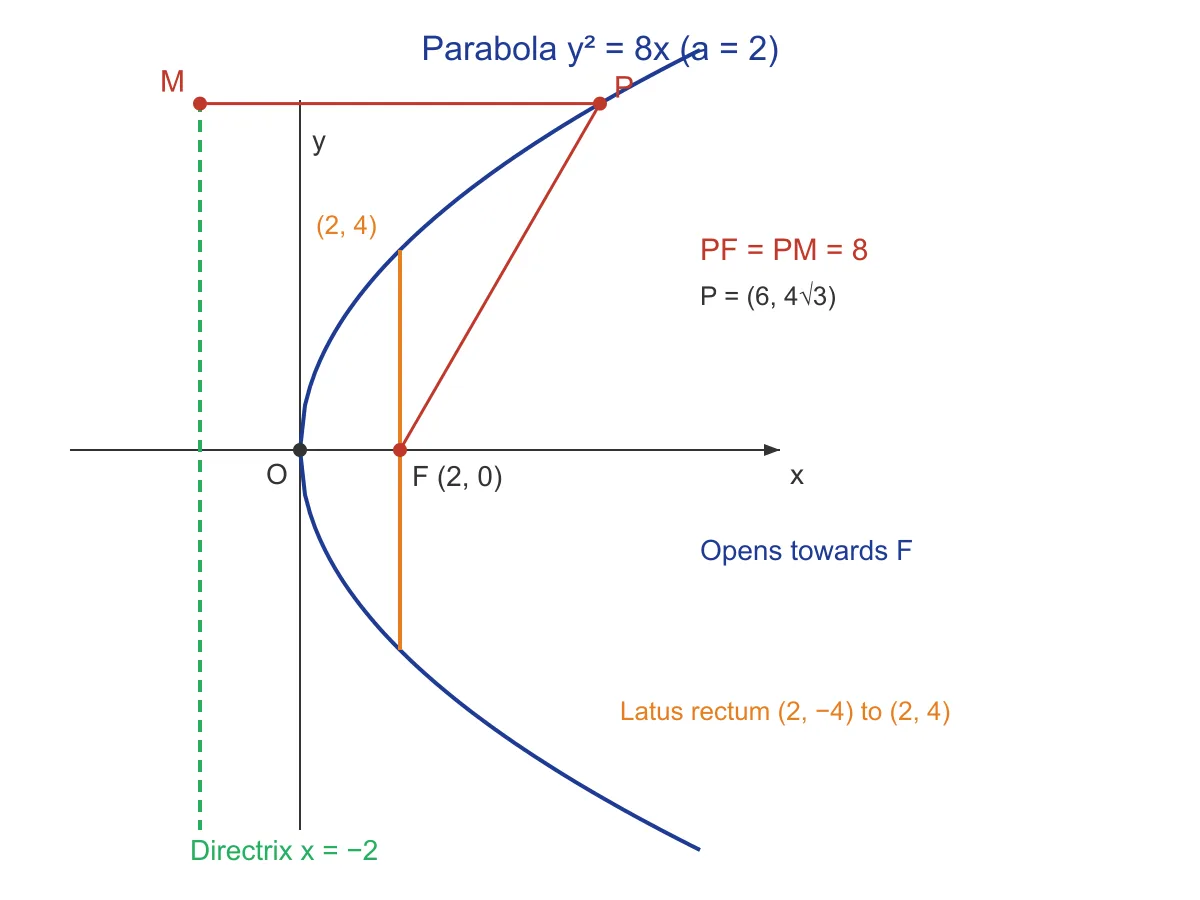
*Figure 1.1: The parabola $y^2 = 8x$ (so $a = 2$): focus, directrix, latus rectum and the equal distances $PF$ and $PM$*
Look at the picture before reading on. The vertex $O$ sits exactly halfway between focus and directrix; that is why the focus is at distance $a$ on one side and the directrix at distance $a$ on the other. The curve opens towards the focus.
Memory trick: "Fair-minded P": a point on the parabola is fair to both, it stays the same distance from the focus and from the directrix. Whenever a question gives you focus and directrix, write $PF = PM$, square, and simplify. No formula to recall.
The words you must know
- Axis: the line through the focus perpendicular to the directrix. The parabola is symmetric about it. For $y^2 = 4ax$ it is $y = 0$.
- Vertex: the point where the curve crosses its axis, halfway between focus and directrix.
- Focal chord: any chord of the parabola passing through the focus.
- Latus rectum: the focal chord perpendicular to the axis. Put $x = a$ in $y^2 = 4ax$: $y^2 = 4a^2$, so the ends are $(a, 2a)$ and $(a, -2a)$ and the length is $4a$.
- Focal distance of a point $P$: the distance $PF$. For $P(x_1, y_1)$ on $y^2 = 4ax$ it equals the distance to the directrix, so
Example 1: For the parabola $y^2 = 12x$ find the focus, directrix, length of latus rectum, and the points on it whose focal distance is 9.
Compare with $y^2 = 4ax$: $4a = 12$, so $a = 3$.
Focus $(3, 0)$. Directrix $x = -3$. Latus rectum length $4a = 12$.
Focal distance $x_1 + a = 9$ gives $x_1 = 6$. Then $y_1^2 = 12 \times 6 = 72$, so $y_1 = \pm 6\sqrt{2}$.
Points: $(6, 6\sqrt{2})$ and $(6, -6\sqrt{2})$.
Why this works: once $a$ is read off, every quantity is a multiple of $a$. The focal-distance formula saves you from the square root of a distance formula.
3. The four standard forms
Flip or rotate the picture and you get four equations. The sign tells the side towards which the curve opens, and the variable that is squared tells you the axis.
| Equation | Opens | Focus | Directrix | Axis | Latus rectum ends |
|---|---|---|---|---|---|
| $y^2 = 4ax$ | right | $(a, 0)$ | $x = -a$ | $y = 0$ | $(a, \pm 2a)$ |
| $y^2 = -4ax$ | left | $(-a, 0)$ | $x = a$ | $y = 0$ | $(-a, \pm 2a)$ |
| $x^2 = 4ay$ | up | $(0, a)$ | $y = -a$ | $x = 0$ | $(\pm 2a, a)$ |
| $x^2 = -4ay$ | down | $(0, -a)$ | $y = a$ | $x = 0$ | $(\pm 2a, -a)$ |
In all four, $a > 0$, the vertex is $(0, 0)$, and the latus rectum has length $4a$. The focal distance of $(x_1, y_1)$ is $x_1 + a$ for $y^2 = 4ax$, $a - x_1$ for $y^2 = -4ax$, $y_1 + a$ for $x^2 = 4ay$, and $a - y_1$ for $x^2 = -4ay$. Do not memorise those four; recompute "distance to the directrix" each time.
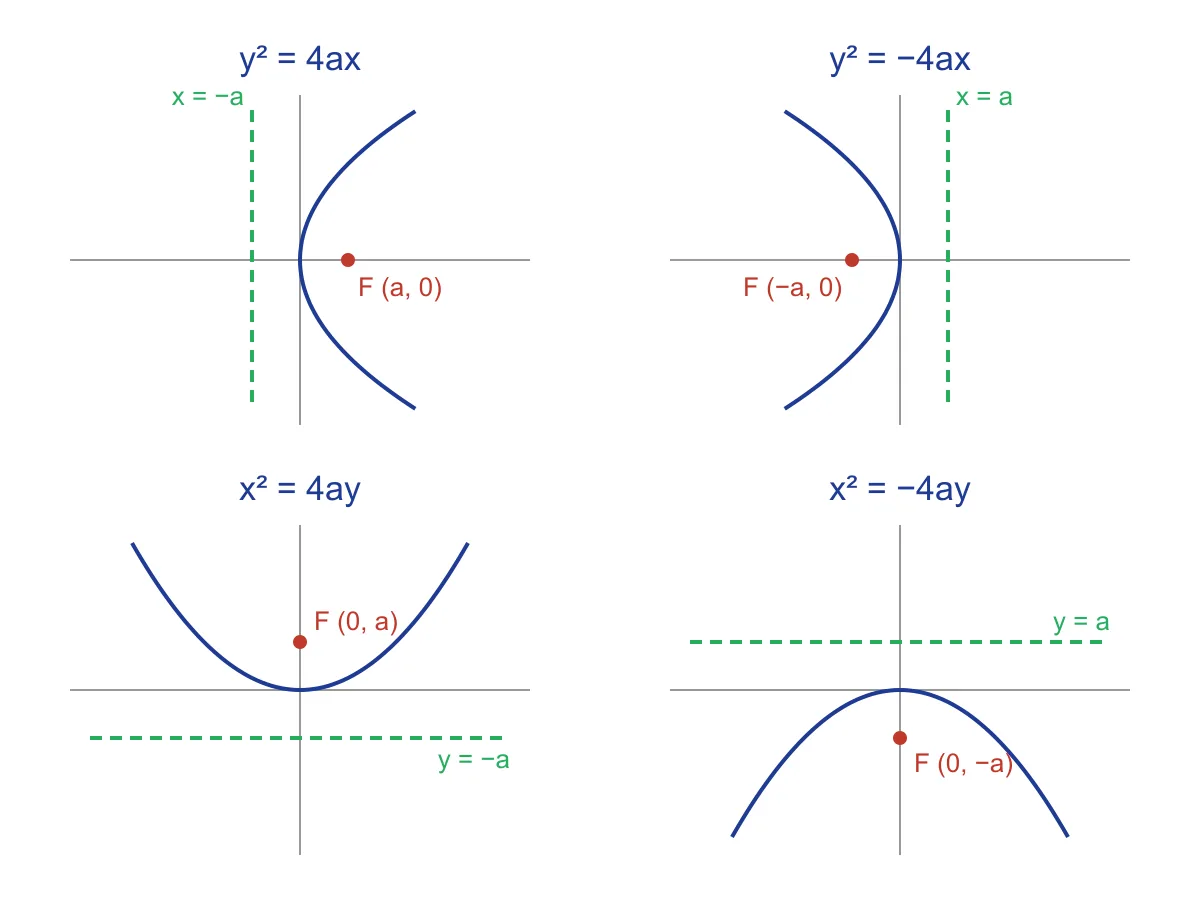
Figure 1.2: The four standard parabolas with focus and directrix
Memory trick: "Squared letter is the axis, sign is the direction." In $y^2 = 4ax$ the $y$ is squared, so the curve runs along the $x$-axis; the plus sign sends it towards positive $x$. The focus is always on the axis, inside the bend of the curve, and the directrix is always on the far side of the vertex.
Example 2: Find the equation of the parabola with focus $(0, -3)$ and directrix $y = 3$, and the point(s) on it with $y = -6$.
The focus is below the directrix, so the curve opens downward: form $x^2 = -4ay$.
Vertex is midway: $(0, 0)$. Distance from vertex to focus is 3, so $a = 3$.
Equation: $x^2 = -12y$.
Put $y = -6$: $x^2 = 72$, $x = \pm 6\sqrt{2}$.
Check by definition: $P(6\sqrt{2}, -6)$: $PF^2 = 72 + 9 = 81$, $PM = 3 - (-6) = 9$. Equal, good.
Why this works: focus and directrix on the same perpendicular line through the origin means the curve is already in standard position; only the direction needs care.
4. Parametric form and position of a point
Put $x = at^2$, $y = 2at$ into $y^2 = 4ax$: the left side is $4a^2t^2$ and the right side is $4a \cdot at^2 = 4a^2t^2$. They match for every real $t$, and as $t$ runs over all reals the point sweeps out the whole curve. So $(at^2, 2at)$ is called the point "$t$". The vertex is $t = 0$, the ends of the latus rectum are $t = \pm 1$. Its focal distance is $at^2 + a = a(1 + t^2)$.
For the other forms: $x^2 = 4ay$ has point $(2at, at^2)$; $y^2 = -4ax$ has $(-at^2, 2at)$; $x^2 = -4ay$ has $(2at, -at^2)$.
The parametric form is the quickest way to describe a general point, and it is the working language of the later sections.
Is a point inside, outside or on?
The region containing the focus is the "inside" of the parabola. For $y^2 = 4ax$, define
Why does it work? On the horizontal line $y = y_1$, the curve is at $x = \frac{y_1^2}{4a}$. A point to the right of that, which means $x_1 > \frac{y_1^2}{4a}$, is on the side where the focus is, so it is inside, and then $S_1 < 0$.
| $S_1$ | Position of $(x_1, y_1)$ |
|---|---|
| $S_1 > 0$ | outside |
| $S_1 = 0$ | on the parabola |
| $S_1 < 0$ | inside |
For $x^2 = 4ay$ use $x_1^2 - 4ay_1$, and so on; in every form, put the point into "left side minus right side".
Example 3: Where are $(4, 5)$ and $(2, 5)$ with respect to $y^2 = 8x$?
$S_1$ for $(4, 5)$: $25 - 8 \times 4 = 25 - 32 = -7 < 0$. Inside.
$S_1$ for $(2, 5)$: $25 - 16 = 9 > 0$. Outside.
Sanity check with the curve: at $y = 5$ the curve is at $x = \frac{25}{8} = 3.125$. The point $(4, 5)$ is to the right of that (towards the focus), so inside. $(2, 5)$ is to the left, so outside.
Why this works: one substitution replaces a picture. The sign of $S_1$ is the only thing that matters, not its size.
5. Tangents
Tangent at a point
Differentiate $y^2 = 4ax$: $2y\,\frac{dy}{dx} = 4a$, so at $(x_1, y_1)$ with $y_1 \ne 0$ the slope is $\frac{2a}{y_1}$. The tangent is
Since $y_1^2 = 4ax_1$, the right side becomes $2ax + 2ax_1$:
The rule behind it is a replacement: in the equation $y^2 = 4ax$, change $y^2$ into $yy_1$ and $x$ into $\frac{x + x_1}{2}$ (the usual "half-and-half" rule). It works for all four forms.
Memory trick: "Split the square, halve the plain": $y^2 \to yy_1$ and $x \to \frac{x + x_1}{2}$. Say it aloud while writing the tangent and you will not mix up the $2a$ and the $x_1$.
At the vertex ($y_1 = 0$) the tangent formula gives $0 = 2a(x + 0)$, that is $x = 0$: the tangent at the vertex is the $y$-axis. At the end $(a, 2a)$ of the latus rectum we get $2ay = 2a(x + a)$, that is $y = x + a$, a line of slope 1 which cuts the axis at $(-a, 0)$, on the directrix.
Tangent in parametric form
At the point $t$, the slope is $\frac{2a}{y_1} = \frac{2a}{2at} = \frac{1}{t}$. Put $(x_1, y_1) = (at^2, 2at)$ in the point form: $2at\,y = 2a(x + at^2)$, so
Tangent with a given slope, and the condition of tangency
Suppose the line $y = mx + c$ with $m \ne 0$ meets $y^2 = 4ax$. Substitute:
A line touches the curve when this quadratic has equal roots, so the discriminant is zero: $(2mc - 4a)^2 - 4m^2c^2 = 0$, which simplifies to $16a^2 - 16amc = 0$. Hence
and the tangent of slope $m$ is $y = mx + \frac{a}{m}$. Its point of contact is the repeated root: $x = \frac{a}{m^2}$, $y = \frac{2a}{m}$, which is the parametric point with $t = \frac{1}{m}$.
The same method gives the other forms.
| Parabola | Tangent of slope $m$ | Condition | Point of contact |
|---|---|---|---|
| $y^2 = 4ax$ | $y = mx + \frac{a}{m}$ | $c = \frac{a}{m}$ | $\left(\frac{a}{m^2}, \frac{2a}{m}\right)$ |
| $y^2 = -4ax$ | $y = mx - \frac{a}{m}$ | $c = -\frac{a}{m}$ | $\left(-\frac{a}{m^2}, \frac{-2a}{m}\right)$ |
| $x^2 = 4ay$ | $y = mx - am^2$ | $c = -am^2$ | $(2am, am^2)$ |
| $x^2 = -4ay$ | $y = mx + am^2$ | $c = am^2$ | $(-2am, -am^2)$ |
Do not treat the first row as a universal rule. A very common slip is to use $c = \frac{a}{m}$ for a parabola that opens up or down.
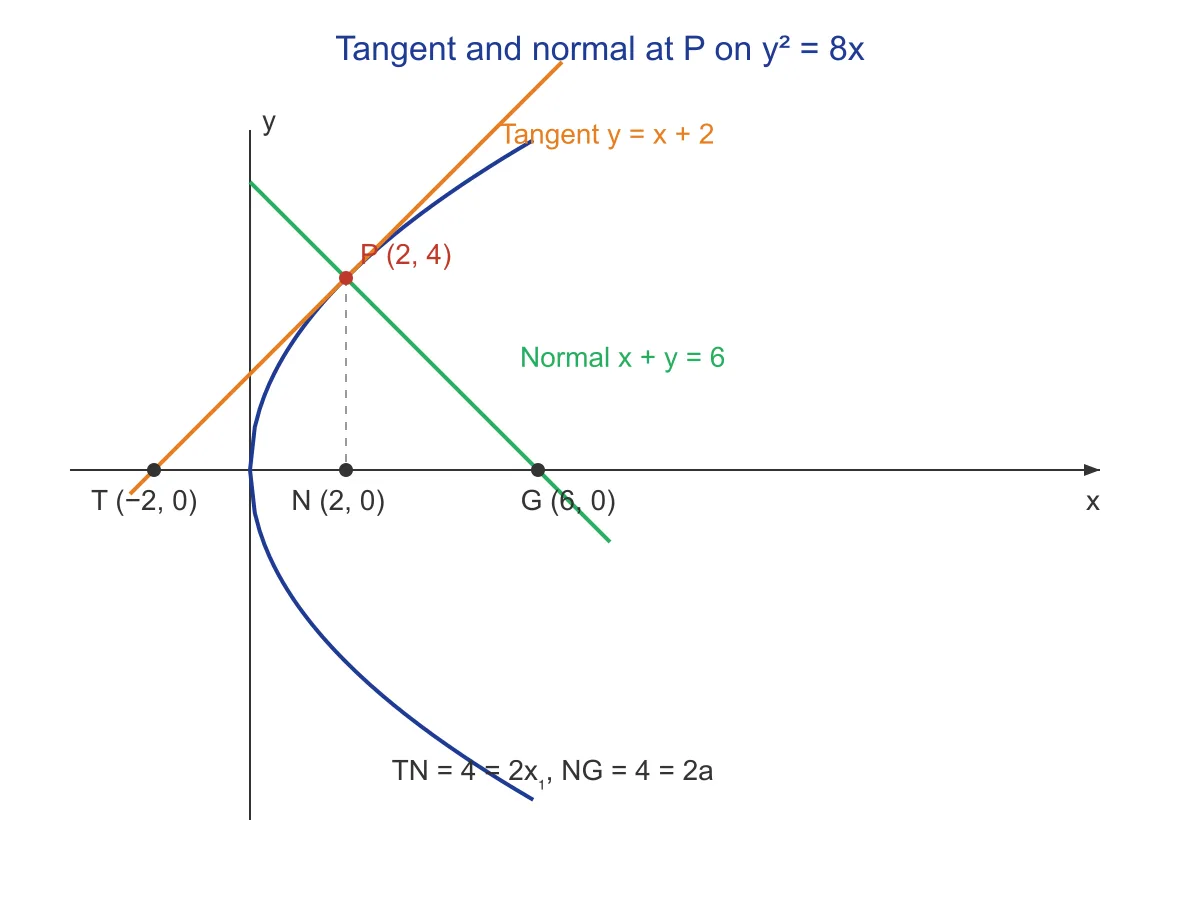
*Figure 1.3: Tangent and normal at $P(2, 4)$ on $y^2 = 8x$; the tangent meets the axis at $T$ and the normal at $G$*
The foot of the ordinate of $P$ is $N$. The tangent at $P(x_1, y_1)$ meets the axis where $y = 0$: $0 = 2a(x + x_1)$, so $x = -x_1$. Hence $TN = 2x_1$ (the subtangent). We will meet the normal's twin $NG = 2a$ in the next section.
Example 4: Find the tangent to $y^2 = 8x$ at $(2, 4)$ and check it with the condition $c = \frac{a}{m}$.
$4a = 8$, $a = 2$. Point form: $yy_1 = 2a(x + x_1)$ gives $4y = 4(x + 2)$, so $y = x + 2$.
Check: slope $m = 1$ and $c = 2$; the condition $c = \frac{a}{m} = \frac{2}{1} = 2$ holds.
Cut-check: substitute into the curve: $(x + 2)^2 = 8x$ gives $x^2 - 4x + 4 = 0$, $(x - 2)^2 = 0$: a double root at $x = 2$.
Why this works: touching means a double root, and three different methods give the same line.
Tangents from an outside point
A point $(x_1, y_1)$ lies on the tangent $y = mx + \frac{a}{m}$ when $y_1 = mx_1 + \frac{a}{m}$, that is
This quadratic in $m$ has real distinct roots exactly when $y_1^2 - 4ax_1 > 0$, which is the "outside" test from Section 4. So an outside point gives two tangents, a point on the curve gives one (the double root), and an inside point gives none. For the two slopes,
On the directrix, $x_1 = -a$, so $m_1m_2 = -1$: the two tangents from any point of the directrix are at right angles. Conversely, the directrix is the place from which perpendicular tangents are drawn.
Example 5: Find the tangents to $y^2 = 4x$ from the point $(2, 3)$.
$a = 1$. First test: $9 - 4 \times 1 \times 2 = 1 > 0$, so $(2, 3)$ is outside and two tangents exist.
Quadratic in $m$: $x_1m^2 - y_1m + a = 0$ becomes $2m^2 - 3m + 1 = 0$, which factors as $(2m - 1)(m - 1) = 0$.
$m = 1$: $c = \frac{1}{1} = 1$, tangent $y = x + 1$. Check at $(2, 3)$: $3 = 2 + 1$. Yes.
$m = \frac{1}{2}$: $c = \frac{1}{1/2} = 2$, tangent $y = \frac{x}{2} + 2$. Check: $\frac{2}{2} + 2 = 3$. Yes.
Why this works: the condition $c = \frac{a}{m}$ turns a geometry problem into a quadratic whose discriminant is the position test.
6. Normals
The normal at a point is the line through it perpendicular to the tangent. At $(x_1, y_1)$ on $y^2 = 4ax$ the tangent slope is $\frac{2a}{y_1}$, so the normal slope is $-\frac{y_1}{2a}$ and
At the point $t$ the tangent slope is $\frac{1}{t}$, the normal slope is $-t$, and
Check by putting in the point: $2at + at \cdot t^2 = 2at + at^3$, which is exactly the right side.
Normal of slope $m$: set $t = -m$, giving $y = mx - 2am - am^3$, with contact point $(am^2, -2am)$. Where does the normal cut the axis? Put $y = 0$ in the parametric normal: $x = 2a + at^2$. So the foot $N$ of the ordinate is at $x = at^2$ and the normal reaches $G$ at $x = 2a + at^2$; thus $NG = 2a$ (the subnormal) for every point. In Figure 1.3, $NG = 4 = 2a$ with $a = 2$.
Memory trick: Tangent: $ty = x + at^2$ has $t$ with $y$. Normal: $y + tx = 2at + at^3$ has $t$ with $x$. "The normal swaps the partner of $t$." The normal also has the bigger right side, since it must reach the axis further out.
Where the normal meets the curve again
The chord joining the points $t$ and $t_2$ has slope $\frac{2at - 2at_2}{at^2 - at_2^2} = \frac{2}{t + t_2}$. If this chord is the normal at $t$, its slope is $-t$:
Example 6: The normal at $t = 2$ on $y^2 = 4x$: find its equation, and the second point where it meets the curve. Then find the area of the triangle formed by the tangent, the normal and the $x$-axis at that point.
$a = 1$, $t = 2$: point $(4, 4)$.
Normal: $y + 2x = 2 \cdot 2 + 8 = 12$. Check: $4 + 8 = 12$.
$t_2 = -2 - \frac{2}{2} = -3$, point $(9, -6)$. Check on normal: $-6 + 18 = 12$. Yes. Check on curve: $36 = 4 \times 9$.
Tangent at $t = 2$: $2y = x + 4$. It meets the axis at $T(-4, 0)$; the normal meets the axis at $G(6, 0)$.
Triangle $PTG$: base $TG = 10$, height is the ordinate $4$. Area $= \frac{1}{2} \times 10 \times 4 = 20$.
Cross-check with $TN = 2x_1 = 8$ and $NG = 2a = 2$: $TG = 10$. Same.
Why this works: $t$ carries all the data, and the subtangent and subnormal lengths give a second route to the same base.
7. Focal chords
Let a chord of $y^2 = 4ax$ join $P(at_1^2, 2at_1)$ and $Q(at_2^2, 2at_2)$. Its equation is
(Check with $P$: the left side is $2at_1(t_1 + t_2) = 2at_1^2 + 2at_1t_2$; so is the right.) If it passes through the focus $(a, 0)$, then $0 = 2a + 2at_1t_2$, and
So if one end of a focal chord is $t$, the other is $-\frac{1}{t}$. Several results follow.
- Length. The two focal distances are $x_1 + a$ and $x_2 + a$, so $PQ = x_1 + x_2 + 2a = a\left(t^2 + \frac{1}{t^2} + 2\right) = a\left(t + \frac{1}{t}\right)^2$. Since $\left(t + \frac{1}{t}\right)^2 \ge 4$, the shortest focal chord has length $4a$: it is the latus rectum.
- Products. $x_1x_2 = a^2$ and $y_1y_2 = -4a^2$.
- Harmonic relation. $PF = a(1 + t^2)$ and $QF = a\left(1 + \frac{1}{t^2}\right) = \frac{a(1 + t^2)}{t^2}$, so $\frac{1}{PF} + \frac{1}{QF} = \frac{1}{a}$ for every focal chord.
- Tangents at the ends. The tangents $ty = x + at^2$ at $P$ and $t_2y = x + at_2^2$ at $Q$ meet at $\left(at_1t_2,\; a(t_1 + t_2)\right)$. With $t_1t_2 = -1$ the meeting point has $x = -a$: it lies on the directrix. Their slopes are $\frac{1}{t_1}$ and $\frac{1}{t_2}$, whose product is $\frac{1}{t_1t_2} = -1$: they are perpendicular.
| Fact for a focal chord of $y^2 = 4ax$ | Value |
|---|---|
| Parameters of the ends | $t$ and $-\frac{1}{t}$ |
| Length | $a\left(t + \frac{1}{t}\right)^2 \ge 4a$ |
| $x_1x_2$ and $y_1y_2$ | $a^2$ and $-4a^2$ |
| $\frac{1}{PF} + \frac{1}{QF}$ | $\frac{1}{a}$ |
| Tangents at the ends | perpendicular, meeting on $x = -a$ |
Example 7: One end of a focal chord of $y^2 = 12x$ is $(12, 12)$. Find the other end, the length of the chord, and where the tangents at the two ends meet.
$a = 3$. For $(12, 12)$: $2at = 12$ gives $t = 2$ and $at^2 = 12$. Yes.
Other end: $t_2 = -\frac{1}{2}$, point $\left(\frac{3}{4}, -3\right)$.
Length: $a\left(t + \frac{1}{t}\right)^2 = 3 \times \left(\frac{5}{2}\right)^2 = \frac{75}{4} = 18.75$. Cross-check: $x_1 + x_2 + 2a = 12 + 0.75 + 6 = 18.75$.
Tangent meeting point: $(at_1t_2, a(t_1 + t_2)) = \left(3 \times (-1),\; 3 \times \frac{3}{2}\right) = \left(-3, \frac{9}{2}\right)$.
Check on the tangent at $t = 2$: $2y = x + 12$ gives $9 = -3 + 12$. Yes. On the directrix $x = -3$: yes.
Why this works: the single relation $t_1t_2 = -1$ answers the "other end", the length and the meeting point.
Common traps
- Using the standard formulas for $y^2 = 4x$ when the equation is $y^2 = 12x$ (reading $a = 12$) → compare $4a$ with the coefficient: $a = 3$.
- Giving the latus rectum length as $a$ or $2a$ → the whole chord is $4a$; $2a$ is only the half-length on each side of the axis.
- Writing the focus of $x^2 = -4ay$ as $(a, 0)$ → the axis is the $y$-axis, so the focus is $(0, -a)$.
- Calling a point inside because it is "near the vertex" → decide by the sign of $y_1^2 - 4ax_1$, not by looks.
- Using $c = \frac{a}{m}$ for $x^2 = 4ay$ → there the condition is $c = -am^2$; check which letter is squared.
- Forgetting that a vertical line or a horizontal line needs separate care: a line parallel to the axis meets the parabola once but is not a tangent; the tangent at the vertex is the line perpendicular to the axis there.
- Taking the tangent at $(x_1, y_1)$ as $yy_1 = a(x + x_1)$ → the factor is $2a$, from $\frac{4a}{2}$.
- Putting a focal chord's parameters as $t_1 + t_2 = -1$ → it is the product $t_1t_2 = -1$.
- Computing the second meeting point of the normal as $t + \frac{2}{t}$ → the sign: $t_2 = -t - \frac{2}{t}$.
- Counting tangents from an inside point → there are none; the two-slope quadratic has a negative discriminant.
Quick revision
- Parabola: $PF = PM$, focus not on the directrix; the vertex is midway between them.
- $y^2 = 4ax$: focus $(a, 0)$, directrix $x = -a$, axis $y = 0$, latus rectum $4a$ with ends $(a, \pm 2a)$.
- The sign and the squared letter fix the direction: $y^2 = -4ax$ left, $x^2 = 4ay$ up, $x^2 = -4ay$ down.
- Focal distance of $(x_1, y_1)$ on $y^2 = 4ax$ is $x_1 + a$; in parametric form $a(1 + t^2)$.
- Parametric point of $y^2 = 4ax$: $(at^2, 2at)$; of $x^2 = 4ay$: $(2at, at^2)$.
- Position of a point: sign of $y_1^2 - 4ax_1$; positive is outside, zero is on, negative is inside.
- Tangent at $(x_1, y_1)$: $yy_1 = 2a(x + x_1)$; parametric: $ty = x + at^2$.
- Tangent of slope $m$ to $y^2 = 4ax$: $y = mx + \frac{a}{m}$, touching at $\left(\frac{a}{m^2}, \frac{2a}{m}\right)$.
- Tangent of slope $m$ to $x^2 = 4ay$: $y = mx - am^2$, touching at $(2am, am^2)$.
- Tangents from $(x_1, y_1)$: $x_1m^2 - y_1m + a = 0$; two exist only for an outside point; from the directrix they are perpendicular.
- Normal at $t$: $y + tx = 2at + at^3$; normal of slope $m$: $y = mx - 2am - am^3$.
- Normal at $t$ meets the curve again at $t_2 = -t - \frac{2}{t}$.
- Subtangent is $2x_1$ and subnormal is $2a$.
- Focal chord: $t_1t_2 = -1$, length $a\left(t + \frac{1}{t}\right)^2 \ge 4a$, $\frac{1}{PF} + \frac{1}{QF} = \frac{1}{a}$.
- Tangents at the ends of a focal chord are perpendicular and meet on the directrix.
Practice questions
The focus of the parabola $y^2 = -16x$ is
- $(0, -4)$
- $(4, 0)$
- $(-4, 0)$
- $(-16, 0)$
Answer
C. $(-4, 0)$
$4a = 16$ so $a = 4$. The curve opens to the left, so the focus is $(-a, 0) = (-4, 0)$.
The directrix of the parabola $x^2 = 20y$ is
- $x = -5$
- $y = -5$
- $y = -20$
- $y = 5$
Answer
B. $y = -5$
$4a = 20$ so $a = 5$. It opens upward, the focus is $(0, 5)$ and the directrix is $y = -a = -5$.
The length of the latus rectum of the parabola $x^2 = -6y$ is
- $6$
- $\frac{3}{2}$
- $12$
- $3$
Answer
A. $6$
Compare with $x^2 = -4ay$: $4a = 6$. The latus rectum has length $4a = 6$ ($a = \frac{3}{2}$, $2a = 3$ is only half of it).
Every point of the parabola $y^2 = 12x$ can be written as
- $(6t^2, 3t)$
- $(3t^2, 12t)$
- $(12t^2, 6t)$
- $(3t^2, 6t)$
Answer
D. $(3t^2, 6t)$
$a = 3$, so the point is $(at^2, 2at) = (3t^2, 6t)$. Check: $(6t)^2 = 36t^2 = 12 \cdot 3t^2$.
With respect to the parabola $y^2 = 8x$, the point $(4, 5)$ lies
- outside the parabola
- inside the parabola
- on the directrix
- on the parabola
Answer
B. inside the parabola
$y_1^2 - 4ax_1 = 25 - 32 = -7 < 0$, so the point is inside. At $y = 5$ the curve is at $x = 3.125$ and $4$ is to the right of it, on the focus side.
The equation of the parabola with focus $(3, 0)$ and directrix $x = -3$ is
- $x^2 = 12y$
- $y^2 = -12x$
- $y^2 = 12x$
- $y^2 = 6x$
Answer
C. $y^2 = 12x$
Vertex $(0, 0)$ is midway, so $a = 3$ and it opens right: $y^2 = 4 \cdot 3 \cdot x = 12x$. Check the point $(3, 6)$: $PF = 6$, distance to directrix $= 3 + 3 = 6$.
The tangent to $y^2 = 12x$ at the point $(3, 6)$ is
- $x - y - 3 = 0$
- $x + y - 9 = 0$
- $x - 2y + 3 = 0$
- $x - y + 3 = 0$
Answer
D. $x - y + 3 = 0$
$a = 3$. $yy_1 = 2a(x + x_1)$ gives $6y = 6(x + 3)$, so $y = x + 3$. Check: slope $1$, $c = \frac{a}{m} = 3$.
The focal distance of the point $(at^2, 2at)$ on $y^2 = 4ax$ is
- $a(1 + t^2)$
- $a(1 + t)^2$
- $2a(1 + t^2)$
- $a(1 - t^2)$
Answer
A. $a(1 + t^2)$
Focal distance is $x_1 + a = at^2 + a = a(1 + t^2)$. At $t = 1$ it is $2a$, which is half the latus rectum, as it should be.
One end of a focal chord of $y^2 = 4ax$ has parameter $t$. The parameter of the other end is
- $\frac{1}{t}$
- $-t$
- $t - \frac{1}{t}$
- $-\frac{1}{t}$
Answer
D. $-\frac{1}{t}$
Putting the focus $(a, 0)$ in the chord through $t_1, t_2$ gives $t_1t_2 = -1$. So $t_2 = -\frac{1}{t}$. For the latus rectum, $t = 1$ gives $-1$, the other end.
The normal to $y^2 = 4ax$ at the point $(at^2, 2at)$ is
- $y + tx = 2at - at^3$
- $y + tx = 2at + at^3$
- $y - tx = 2at - at^3$
- $ty = x + at^2$
Answer
B. $y + tx = 2at + at^3$
Tangent slope $\frac{1}{t}$, so normal slope $-t$: $y - 2at = -t(x - at^2)$, giving $y + tx = 2at + at^3$.
For the parabola $x^2 = -8y$, the focus and directrix are
- focus $(0, -2)$ and directrix $y = 2$
- focus $(0, 2)$ and directrix $y = -2$
- focus $(0, -8)$ and directrix $y = 8$
- focus $(-2, 0)$ and directrix $x = 2$
Answer
A. focus $(0, -2)$ and directrix $y = 2$
$4a = 8$, $a = 2$. It opens downward, so the focus is $(0, -a) = (0, -2)$ and the directrix is $y = a = 2$.
The two tangents drawn from a point on the directrix of a parabola to the parabola make an angle of
- $45^\circ$
- $30^\circ$
- $90^\circ$
- $60^\circ$
Answer
C. $90^\circ$
For $y^2 = 4ax$ from $(-a, k)$ the slopes satisfy $-am^2 - km + a = 0$, so $m_1m_2 = \frac{a}{-a} = -1$. The tangents are perpendicular.
The tangent at an end of the latus rectum of $y^2 = 4ax$ makes with the axis of the parabola an angle of
- $\tan^{-1} 2$
- $60^\circ$
- $30^\circ$
- $45^\circ$
Answer
D. $45^\circ$
At $(a, 2a)$: $y \cdot 2a = 2a(x + a)$, i.e. $y = x + a$. The slope is $1$, so the angle with the $x$-axis is $45^\circ$.
The normal at the point $t$ of $y^2 = 4ax$ meets the curve again at the point whose parameter is
- $t + \frac{2}{t}$
- $t - \frac{2}{t}$
- $-t - \frac{2}{t}$
- $-t + \frac{2}{t}$
Answer
C. $-t - \frac{2}{t}$
Chord through $t$ and $t_2$ has slope $\frac{2}{t + t_2}$. Normal slope is $-t$, so $t + t_2 = -\frac{2}{t}$ and $t_2 = -t - \frac{2}{t}$. Test with $t = 1$: $t_2 = -3$.
A point $P$ on $y^2 = 20x$ has abscissa $7$. The distance of $P$ from the focus is
- $2$
- $12$
- $5$
- $7$
Answer
B. $12$
$4a = 20$, $a = 5$. Focal distance $= x_1 + a = 7 + 5 = 12$. Check: $y_1^2 = 140$, $PF^2 = (7-5)^2 + 140 = 144$.
A parabola has its vertex at the origin and its focus at $(5, 0)$. The length of its latus rectum is
- $20$
- $5$
- $40$
- $10$
Answer
A. $20$
The focus is $(a, 0)$ so $a = 5$. Latus rectum $= 4a = 20$. Equation $y^2 = 20x$; at $x = 5$, $y = \pm 10$, chord length $20$.
The line $y = 2x + c$ touches the parabola $y^2 = 8x$. The value of $c$ is
- $2$
- $1$
- $4$
- $0.5$
Answer
B. $1$
$a = 2$, $m = 2$, $c = \frac{a}{m} = 1$. Check: $(2x + 1)^2 = 8x$ gives $4x^2 - 4x + 1 = 0$, which is $(2x - 1)^2 = 0$, a double root.
A point on $y^2 = 16x$ in the first quadrant is at distance $13$ from the focus. Its ordinate is
- $9$
- $8$
- $24$
- $12$
Answer
D. $12$
$a = 4$. $x_1 + 4 = 13$ so $x_1 = 9$. Then $y_1^2 = 16 \cdot 9 = 144$, $y_1 = 12$. Check: $PF^2 = 25 + 144 = 169$.
The tangent to $x^2 = 8y$ with slope $3$ meets the $y$-axis at $(0, k)$. The value of $k$ is
- $-18$
- $-6$
- $6$
- $18$
Answer
A. $-18$
$a = 2$. For $x^2 = 4ay$ the tangent is $y = mx - am^2 = 3x - 18$. Check: $x^2 = 24x - 144$ gives $(x - 12)^2 = 0$. So $k = -18$.
The area, in square units, of the triangle formed by the vertex and the two ends of the latus rectum of $y^2 = 12x$ is
- $9$
- $36$
- $18$
- $12$
Answer
C. $18$
$a = 3$; ends of the latus rectum $(3, \pm 6)$. Base $= 12$ (the chord), height $= 3$ (distance from the vertex). Area $= \frac{1}{2} \cdot 12 \cdot 3 = 18$.
Two tangents are drawn from the point $(4, 6)$ to the parabola $y^2 = 8x$. The sum of their slopes is
- $1.5$
- $2$
- $0.5$
- $3$
Answer
A. $1.5$
$a = 2$. Slopes satisfy $x_1m^2 - y_1m + a = 0$: $4m^2 - 6m + 2 = 0$, so $m_1 + m_2 = \frac{6}{4} = 1.5$. Check: roots $1$ and $\frac{1}{2}$.
One end of a focal chord of $y^2 = 4x$ has abscissa $4$. The length of the chord is
- $6$
- $6.25$
- $5$
- $4.25$
Answer
B. $6.25$
$a = 1$, $x_1x_2 = a^2 = 1$ so $x_2 = \frac{1}{4}$. Length $= x_1 + x_2 + 2a = 4 + 0.25 + 2 = 6.25$. Check: ends $(4, 4)$, $(\frac{1}{4}, -1)$, distance $\sqrt{3.75^2 + 25} = 6.25$.
The normal to $y^2 = 4x$ at the point $(9, 6)$ meets the $x$-axis at $(h, 0)$. The value of $h$ is
- $9$
- $33$
- $7$
- $11$
Answer
D. $11$
$a = 1$, $2at = 6$ so $t = 3$. Normal: $y + 3x = 6 + 27 = 33$. Put $y = 0$: $x = 11$. Check: $h = 2a + at^2 = 2 + 9 = 11$.
The line $y = -x + k$ touches the parabola $x^2 = 8y$. The value of $k$ is
- $2$
- $-8$
- $-2$
- $8$
Answer
C. $-2$
$a = 2$, $m = -1$. For $x^2 = 4ay$, $c = -am^2 = -2$. Check: $x^2 = -8x + 8k$ has discriminant $64 + 32k = 0$, so $k = -2$.
The two tangents drawn from $(-3, 5)$ to the parabola $y^2 = 4ax$ (with $a > 0$) are perpendicular. The value of $a$ is
- $6$
- $3$
- $5$
- $1.5$
Answer
B. $3$
Perpendicular tangents come only from the directrix, $x = -a$. So $-a = -3$ and $a = 3$. Check: $-3m^2 - 5m + 3 = 0$ has $m_1m_2 = -1$.
The normal at the point with parameter $1$ on $y^2 = 8x$ meets the curve again at $Q$. The ordinate of $Q$ is
- $-6$
- $12$
- $6$
- $-12$
Answer
D. $-12$
$a = 2$. $t_2 = -t - \frac{2}{t} = -3$. Ordinate $= 2at_2 = -12$. Check: normal $x + y = 6$ passes through $(18, -12)$ and $144 = 8 \cdot 18$.
Given below are two statements: Statement I: For a focal chord of $y^2 = 4ax$ with end parameters $t_1$ and $t_2$, $t_1t_2 = -1$. Statement II: The tangents at the two ends of a focal chord of a parabola are perpendicular.
- Both Statement I and Statement II are correct
- Both Statement I and Statement II are incorrect
- Statement I is correct but Statement II is incorrect
- Statement I is incorrect but Statement II is correct
Answer
A. Both Statement I and Statement II are correct
I: putting the focus in the chord equation gives $t_1t_2 = -1$. II: tangent slopes are $\frac{1}{t_1}, \frac{1}{t_2}$ with product $-1$. Both true.
Given below are two statements: Statement I: The line $y = mx + c$ with $m \ne 0$ touches $y^2 = 4ax$ when $c = \frac{a}{m}$. Statement II: The line $y = mx + c$ touches $x^2 = 4ay$ when $c = \frac{a}{m}$.
- Both Statement I and Statement II are correct
- Both Statement I and Statement II are incorrect
- Statement I is correct but Statement II is incorrect
- Statement I is incorrect but Statement II is correct
Answer
C. Statement I is correct but Statement II is incorrect
I is the standard condition. For $x^2 = 4ay$ the condition is $c = -am^2$, so II is false.
Given below are two statements: Statement I: The point $(1, 3)$ lies inside the parabola $y^2 = 8x$. Statement II: The point $(2, 4)$ lies on the parabola $y^2 = 8x$.
- Both Statement I and Statement II are correct
- Both Statement I and Statement II are incorrect
- Statement I is correct but Statement II is incorrect
- Statement I is incorrect but Statement II is correct
Answer
D. Statement I is incorrect but Statement II is correct
I: $9 - 8 = 1 > 0$, so outside; I is false. II: $16 = 8 \cdot 2$, true.
Given below are two statements: Statement I: The focal distance of a point $(x_1, y_1)$ on $x^2 = 4ay$ is $x_1 + a$. Statement II: The directrix of $y^2 = -4ax$ (with $a > 0$) is $x = -a$.
- Both Statement I and Statement II are correct
- Both Statement I and Statement II are incorrect
- Statement I is correct but Statement II is incorrect
- Statement I is incorrect but Statement II is correct
Answer
B. Both Statement I and Statement II are incorrect
I: the axis is the $y$-axis, so the focal distance is $y_1 + a$; false. II: the curve opens left, the directrix is $x = a$; false.
Given below are two statements: Statement I: The tangent to $y^2 = 4ax$ at $(a, 2a)$ has slope $1$. Statement II: The tangent at the vertex of $y^2 = 4ax$ is the line $y = 0$.
- Both Statement I and Statement II are correct
- Both Statement I and Statement II are incorrect
- Statement I is correct but Statement II is incorrect
- Statement I is incorrect but Statement II is correct
Answer
C. Statement I is correct but Statement II is incorrect
I: $2ay = 2a(x + a)$, slope $1$; true. II: the tangent at the vertex is $x = 0$, perpendicular to the axis; false.
Assertion (A): The locus of points from which perpendicular tangents can be drawn to $y^2 = 4ax$ is the line $x = -a$. Reason (R): For tangents drawn from $(x_1, y_1)$ to $y^2 = 4ax$, the product of the slopes is $\frac{a}{x_1}$.
- Both A and R are true and R is the correct explanation of A
- Both A and R are true but R is not the correct explanation of A
- A is true but R is false
- A is false but R is true
Answer
A. Both A and R are true and R is the correct explanation of A
The slopes solve $x_1m^2 - y_1m + a = 0$ so $m_1m_2 = \frac{a}{x_1}$. Setting it to $-1$ gives $x_1 = -a$. R proves A.
Assertion (A): A line parallel to the axis of a parabola is a tangent to it. Reason (R): A line parallel to the axis of a parabola meets it in exactly one point.
- Both A and R are true and R is the correct explanation of A
- Both A and R are true but R is not the correct explanation of A
- A is true but R is false
- A is false but R is true
Answer
D. A is false but R is true
R is true: $y = k$ meets $y^2 = 4ax$ at one point. But it cuts the curve and is not a tangent (no double root), so A is false.
Assertion (A): The point $(at^2, 2at)$ lies on $y^2 = 4ax$ for every real $t$. Reason (R): The focal distance of the point $(at^2, 2at)$ is $a(1 + t^2)$.
- Both A and R are true and R is the correct explanation of A
- Both A and R are true but R is not the correct explanation of A
- A is true but R is false
- A is false but R is true
Answer
B. Both A and R are true but R is not the correct explanation of A
Both are true, but R is a separate fact about the point; it does not show why the point is on the curve (that is $4a^2t^2 = 4a \cdot at^2$).
Match List I with List II. List I: a. $y^2 = 8x$ b. $y^2 = -8x$ c. $x^2 = 8y$ d. $x^2 = -8y$ List II: i. $(0, -2)$ ii. $(2, 0)$ iii. $(0, 2)$ iv. $(-2, 0)$
- a-ii, b-iv, c-iii, d-i
- a-ii, b-iv, c-i, d-iii
- a-iv, b-ii, c-iii, d-i
- a-iii, b-i, c-ii, d-iv
Answer
A. a-ii, b-iv, c-iii, d-i
All have $a = 2$. $y^2 = 8x$: $(2, 0)$. $y^2 = -8x$: $(-2, 0)$. $x^2 = 8y$: $(0, 2)$. $x^2 = -8y$: $(0, -2)$.
Match List I with List II. List I: a. Length of the latus rectum of $y^2 = 16x$ b. Distance between focus and directrix of $y^2 = 16x$ c. Focal distance of the point with $x = 5$ on $y^2 = 16x$ d. $x$-coordinate of the focus of $y^2 = 16x$ List II: i. $9$ ii. $16$ iii. $4$ iv. $8$
- a-iv, b-iii, c-ii, d-i
- a-ii, b-iv, c-iii, d-i
- a-ii, b-iv, c-i, d-iii
- a-iv, b-ii, c-i, d-iii
Answer
C. a-ii, b-iv, c-i, d-iii
$a = 4$. Latus rectum $4a = 16$ (ii). Focus to directrix $2a = 8$ (iv). Focal distance $5 + 4 = 9$ (i). Focus $x = 4$ (iii).
Match List I with List II. List I: a. Tangent to $y^2 = 4x$ at $(1, 2)$ b. Tangent to $y^2 = 4x$ at $(4, 4)$ c. Normal to $y^2 = 4x$ at $(1, 2)$ d. Normal to $y^2 = 4x$ at $(4, -4)$ List II: i. $x + y - 3 = 0$ ii. $x - 2y + 4 = 0$ iii. $x - y + 1 = 0$ iv. $2x - y - 12 = 0$
- a-ii, b-iii, c-i, d-iv
- a-iii, b-ii, c-iv, d-i
- a-iii, b-ii, c-i, d-iv
- a-i, b-iv, c-iii, d-ii
Answer
C. a-iii, b-ii, c-i, d-iv
$a = 1$. Tangent at $(1, 2)$: $2y = 2(x + 1)$, i.e. $x - y + 1 = 0$. At $(4, 4)$: $4y = 2(x + 4)$, i.e. $x - 2y + 4 = 0$. Normal at $t = 1$: $y + x = 3$. Normal at $t = -2$: $y - 2x = -12$.
The cross-section of a reflector is the parabola $y^2 = 16x$ (lengths in cm), with the vertex at the deepest point and the rim perpendicular to the axis. The reflector is $9$ cm deep. The width of the rim is
- $18$ cm
- $24$ cm
- $12$ cm
- $36$ cm
Answer
B. $24$ cm
Depth $9$ means $x = 9$. Then $y^2 = 144$, $y = \pm 12$, and the width is $2 \times 12 = 24$ cm.
The normal at a point $P$ (other than the vertex) of $y^2 = 8x$ meets the axis of the parabola at $(6, 0)$. The distance of $P$ from the focus is
- $6$
- $8$
- $2$
- $4$
Answer
D. $4$
$a = 2$. The normal at $t$ meets the axis at $x = 2a + at^2 = 4 + 2t^2$. Setting $4 + 2t^2 = 6$ gives $t^2 = 1$. Focal distance $= a(1 + t^2) = 4$. Check with $P(2, 4)$: $PF = 4$.
One end of a focal chord of $y^2 = 12x$ is $(12, 12)$. The tangents at the two ends of the chord meet at the point
- $\left(-3, \frac{9}{2}\right)$
- $\left(-3, \frac{3}{2}\right)$
- $\left(3, \frac{9}{2}\right)$
- $\left(-12, \frac{9}{2}\right)$
Answer
A. $\left(-3, \frac{9}{2}\right)$
$a = 3$, $t_1 = 2$, so $t_2 = -\frac{1}{2}$. Meeting point $(at_1t_2, a(t_1 + t_2)) = (-3, \frac{9}{2})$. Check on $2y = x + 12$: $9 = 9$. It lies on the directrix $x = -3$.