Ellipse
What to remember
- An ellipse is the set of points whose distances from two fixed points (the foci) add up to a constant $2a$, and $2a$ must be larger than the distance between the foci.
- For $\frac{x^2}{a^2}+\frac{y^2}{b^2}=1$ with $a>b$: foci $(\pm ae, 0)$, directrices $x=\pm\frac{a}{e}$, latus rectum $\frac{2b^2}{a}$, and $b^2=a^2(1-e^2)$ with $0<e<1$.
- Focal distances of $P(x_1,y_1)$ are $a-ex_1$ and $a+ex_1$; they always add up to $2a$.
- Any point of the ellipse is $(a\cos\theta, b\sin\theta)$. The same $\theta$ on the auxiliary circle $x^2+y^2=a^2$ gives the point directly above or below it.
- Tangent: $\frac{xx_1}{a^2}+\frac{yy_1}{b^2}=1$, or $y=mx\pm\sqrt{a^2m^2+b^2}$. Normal: $\frac{a^2x}{x_1}-\frac{b^2y}{y_1}=a^2-b^2$.
The definition and the standard equation
Push two pins into a board, tie a loose loop of thread around them, pull the loop tight with a pencil and drag the pencil round. The pencil traces an ellipse. The pins are the foci (singular: focus), and the length of thread from pin to pencil to pin never changes. That is the whole definition: the sum of the distances from the two foci is constant.
Call the foci $F_1$ and $F_2$, and call the constant sum $2a$. The curve exists only when $2a > F_1F_2$. If the two were equal, the pencil could only slide along the segment between the pins.
Place the centre at the origin with the foci at $(\pm c, 0)$. Writing $PF_1 + PF_2 = 2a$ and squaring twice (the usual clearing of two square roots) gives
Since $a>c$, the number $a^2-c^2$ is positive, so call it $b^2$. That gives the standard form
The eccentricity $e$ measures how stretched the ellipse is: $e=\frac{c}{a}$, so $c=ae$. Then $b^2 = a^2 - a^2e^2$, which is the relation you will use all through this chapter:
Because $c<a$, we always have $0<e<1$. A value of $e$ near $0$ means the ellipse is almost a circle ($c\to 0$, foci merge at the centre). A value near $1$ means a long thin ellipse.
There is a second description, using a line instead of a second point. For each focus there is a fixed line, its directrix, and every point $P$ of the ellipse satisfies
For the focus $(ae,0)$ the directrix is $x=\frac{a}{e}$, and for $(-ae,0)$ it is $x=-\frac{a}{e}$. Since $e<1$, the directrix lies outside the ellipse, beyond the vertex.
Example 1: An ellipse has its focus at $(2,0)$ and corresponding directrix $x=8$, and the distance of any point on it from the focus is half its distance from the directrix. Find its equation.
Let $P(x,y)$ be a point of the curve. Then $PF = \frac12 \times (\text{distance from } x=8)$.
$\sqrt{(x-2)^2+y^2} = \frac12 \vert x-8\vert$.
Square: $4(x^2-4x+4+y^2) = x^2-16x+64$.
$4x^2 - 16x + 16 + 4y^2 = x^2 - 16x + 64$, so $3x^2+4y^2 = 48$.
Divide by 48: $\frac{x^2}{16}+\frac{y^2}{12}=1$.
Check with the standard facts: $a=4$, $b^2=12$, $e^2 = 1-\frac{12}{16}=\frac14$, so $e=\frac12$; then $ae=2$ and $\frac{a}{e}=8$, matching the given focus and directrix.
Notice that the $-16x$ terms cancel; that is what tells you the centre sits at the origin, so the standard form must come out.
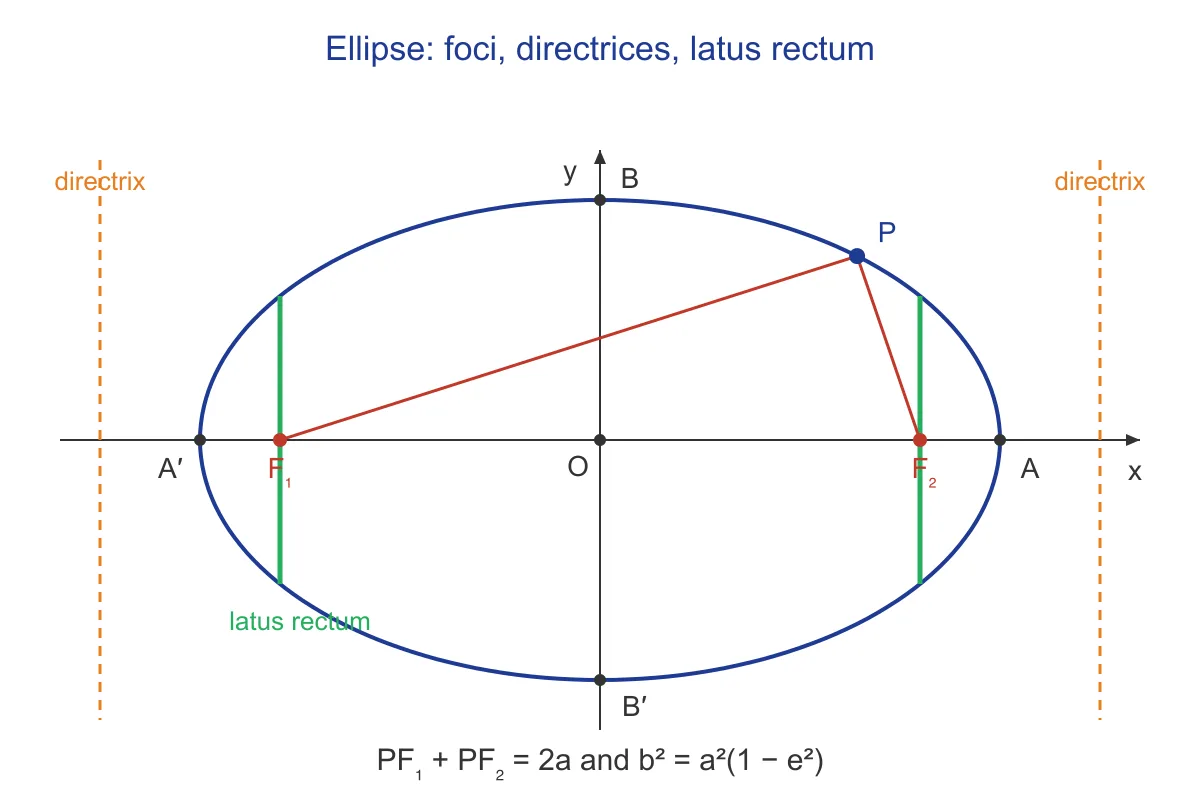
Figure 2.1: The standard ellipse with its foci, directrices and latus rectum
Parts of the ellipse
Take $\frac{x^2}{a^2}+\frac{y^2}{b^2}=1$ with $a>b$ (the case drawn in Figure 2.1).
- The major axis is the segment between the vertices $A'(-a,0)$ and $A(a,0)$. Its length is $2a$. The sum of the focal distances equals this length.
- The minor axis joins $B'(0,-b)$ and $B(0,b)$. Its length is $2b$.
- The centre is the midpoint of both axes. Every chord through it is bisected by it.
- The foci lie on the major axis at distance $ae$ from the centre. The distance between them is $2ae$.
- The two directrices are at distance $\frac{a}{e}$ from the centre, so the distance between them is $\frac{2a}{e}$.
- A latus rectum is the chord through a focus perpendicular to the major axis. At $x=ae$, the equation gives $\frac{y^2}{b^2}=1-e^2=\frac{b^2}{a^2}$, so $y=\pm\frac{b^2}{a}$. The length is $\frac{2b^2}{a}$, and its end points are $\left(\pm ae, \pm\frac{b^2}{a}\right)$.
A useful check: the end $B(0,b)$ of the minor axis is at the same distance from both foci, and the two distances add to $2a$, so each is $a$. The right triangle with legs $b$ and $ae$ and hypotenuse $a$ gives $b^2 + a^2e^2 = a^2$, which is the relation $b^2=a^2(1-e^2)$ seen from the picture.
The vertical ellipse
When the larger denominator sits under $y^2$, the major axis is along the $y$-axis. Write the ellipse as $\frac{x^2}{a^2}+\frac{y^2}{b^2}=1$ with $b>a$. Now the roles swap, and the eccentricity is defined from the larger one: $a^2=b^2(1-e^2)$.
| Feature | $a>b$ (horizontal) | $b>a$ (vertical) |
|---|---|---|
| Major axis length | $2a$ along $x$-axis | $2b$ along $y$-axis |
| Minor axis length | $2b$ | $2a$ |
| Relation for $e$ | $b^2=a^2(1-e^2)$ | $a^2=b^2(1-e^2)$ |
| Foci | $(\pm ae, 0)$ | $(0, \pm be)$ |
| Directrices | $x=\pm\frac{a}{e}$ | $y=\pm\frac{b}{e}$ |
| Latus rectum | $\frac{2b^2}{a}$ | $\frac{2a^2}{b}$ |
Memory trick: "Big one under the letter, foci on that letter's axis."
Look at which denominator is larger. If $25$ is under $y^2$, the foci are on the $y$-axis, and the major axis is $2\times 5$. Then use the latus rectum as $\frac{2\,(\text{small})^2}{\text{big}}$, whatever the letters are.
Example 2: For $25x^2+16y^2=400$ find the axes, eccentricity, foci, directrices and latus rectum.
Divide by 400: $\frac{x^2}{16}+\frac{y^2}{25}=1$. The larger denominator, $25$, is under $y^2$, so the ellipse is vertical.
Semi-major $=5$, semi-minor $=4$. Major axis $=10$ (along $y$), minor axis $=8$.
$e^2 = 1-\frac{16}{25}=\frac{9}{25}$, so $e=\frac35$.
Foci: $(0,\pm 5\cdot\frac35)=(0,\pm3)$.
Directrices: $y=\pm\frac{5}{3/5}=\pm\frac{25}{3}$.
Latus rectum $=\frac{2\times 16}{5}=\frac{32}{5}$.
Notice that the directrices (at $8.33$) lie well outside the vertices (at $5$), as they must.
Focal distances
Take a point $P(x_1,y_1)$ on the ellipse (with $a>b$) and drop a perpendicular $PM$ to the directrix $x=\frac{a}{e}$. The focus-directrix property for the focus $F_2(ae,0)$ gives
In the same way, with the other focus and directrix,
Adding, $PF_1+PF_2=2a$, which agrees with the thread definition and shows the two descriptions are the same curve. Since $-a\le x_1\le a$ and $e<1$, both distances stay positive. The distance to the nearer focus is smallest, $a-ae=a(1-e)$, at the vertex $A$.
The product also comes out neatly: $PF_1\cdot PF_2=a^2-e^2x_1^2$.
Example 3: The ellipse $\frac{x^2}{100}+\frac{y^2}{36}=1$ has a point $P$ with $x=5$ and $y>0$. Find its focal distances.
$a=10$, $b=6$, $e^2=1-\frac{36}{100}=\frac{16}{25}$, $e=\frac45$. Foci $(\pm8,0)$.
$y^2 = 36\left(1-\frac{25}{100}\right)=27$.
$PF_2 = a-ex_1 = 10-4 = 6$ and $PF_1 = 10+4=14$.
Check with the distance formula to $(8,0)$: $(5-8)^2+27=36$, so $6$. To $(-8,0)$: $13^2+27=196$, so $14$.
The sum is $20=2a$. Notice that you never needed $y$ at all; the formula only wants $x_1$.
Parametric form and the auxiliary circle
Every point of $\frac{x^2}{a^2}+\frac{y^2}{b^2}=1$ can be written
because $\cos^2\theta+\sin^2\theta=1$ makes $\frac{x^2}{a^2}+\frac{y^2}{b^2}=1$ true for every $\theta$. As $\theta$ runs from $0$ to $2\pi$, the point goes once round, anticlockwise. The angle $\theta$ is called the eccentric angle of the point.
Where does $\theta$ live on the picture? Draw the auxiliary circle, the circle $x^2+y^2=a^2$ whose diameter is the major axis. Take the point $Q(a\cos\theta, a\sin\theta)$ on this circle, with $OQ$ making angle $\theta$ with the $x$-axis. Drop a perpendicular from $Q$ to the $x$-axis. It meets the ellipse at $P(a\cos\theta, b\sin\theta)$, since it has the same $x$-coordinate. So the ellipse is the circle squashed vertically by the ratio $\frac{b}{a}$: every height is multiplied by $\frac{b}{a}$ and every $x$ stays unchanged.
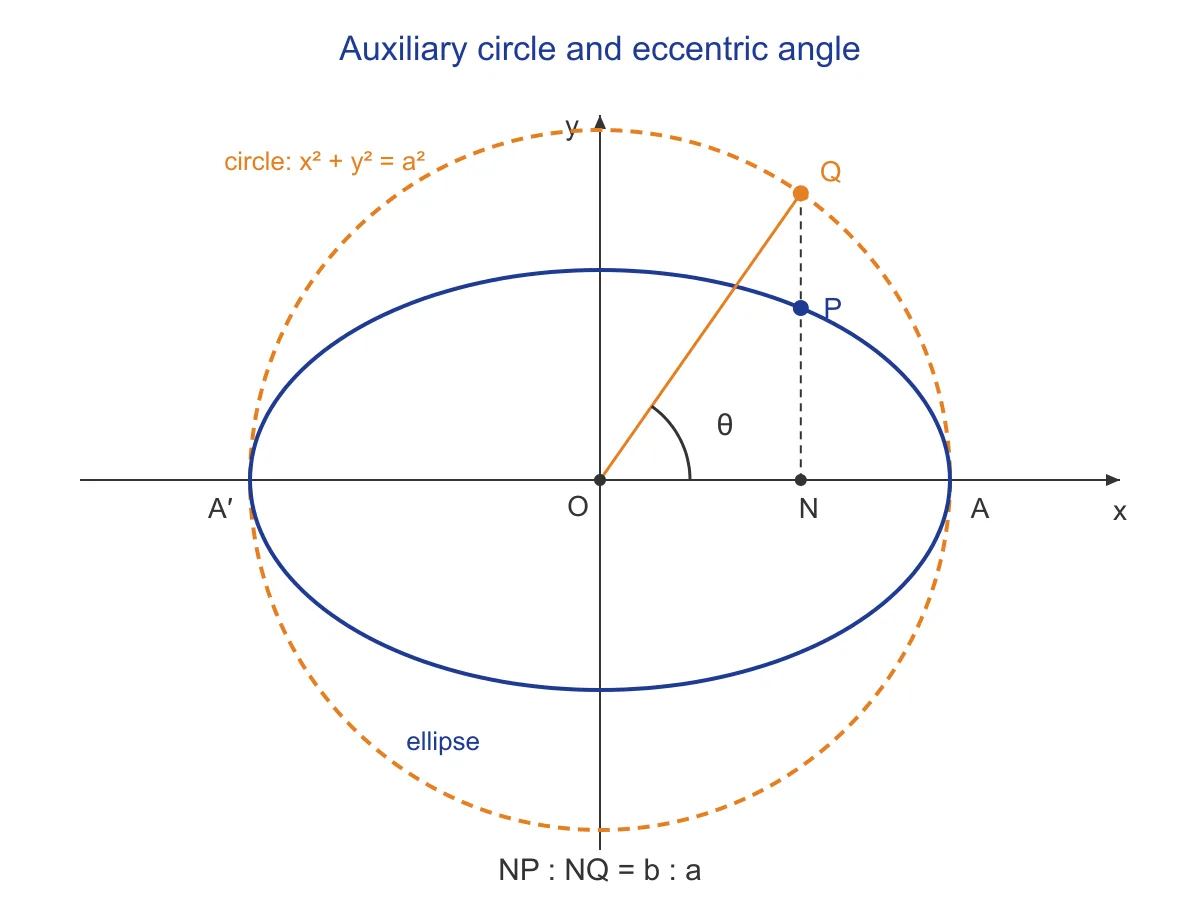
Figure 2.2: The auxiliary circle and the eccentric angle
Two warnings. The angle $\theta$ is the angle of $OQ$, not of $OP$; the line $OP$ makes a different angle with the axis, whose tangent is $\frac{b}{a}\tan\theta$. And if you are given a point $(x_1,y_1)$ on the ellipse, find $\theta$ from $\cos\theta=\frac{x_1}{a}$ and $\sin\theta=\frac{y_1}{b}$ together, not from one of them alone.
Memory trick: "Circle's radius is a, so cosine gets a; squash by b over a, so sine gets b."
When you write a parametric point, say it aloud: $x=a\cos$, $y=b\sin$. If you write $a\sin\theta$ by habit, the point will not satisfy the equation.
Example 4: The ellipse is $\frac{x^2}{16}+\frac{y^2}{4}=1$. Find $OP^2$ for the point with eccentric angle $\frac{\pi}{3}$ and show that $OP^2$ lies between $b^2$ and $a^2$ for every $\theta$.
$P = (4\cos\frac{\pi}{3},\,2\sin\frac{\pi}{3}) = (2, \sqrt3)$.
$OP^2 = 4+3 = 7$.
In general $OP^2 = 16\cos^2\theta + 4\sin^2\theta = 4 + 12\cos^2\theta$.
Since $0\le\cos^2\theta\le1$, this runs from $4$ to $16$, that is from $b^2$ to $a^2$.
The distance from the centre is smallest at the ends of the minor axis and largest at the ends of the major axis, which is exactly how the curve looks.
Tangent to the ellipse
Tangent at a point
Differentiate $\frac{x^2}{a^2}+\frac{y^2}{b^2}=1$: $\frac{2x}{a^2}+\frac{2y}{b^2}\frac{dy}{dx}=0$, so the slope at $(x_1,y_1)$ (with $y_1\ne0$) is $-\frac{b^2x_1}{a^2y_1}$. The tangent line is
Multiply out and use $\frac{x_1^2}{a^2}+\frac{y_1^2}{b^2}=1$ on the right side:
It is the equation of the ellipse with $x^2\to xx_1$ and $y^2\to yy_1$. This substitution works for every conic in this book, so it is worth remembering as a habit and not as a formula.
Tangent in parametric form
Put $x_1=a\cos\theta$, $y_1=b\sin\theta$:
Its slope is $-\frac{b\cos\theta}{a\sin\theta}$. At $\theta=0$ the equation reduces to $x=a$, the vertical tangent at the vertex, so this form handles the points with $y_1=0$ too.
Tangent in slope form and the condition of tangency
Take a line $y=mx+c$ and put it in the ellipse:
The line touches the ellipse when this quadratic has equal roots, that is when the discriminant is zero:
Cancel $4a^2$ and expand; the terms $a^2m^2c^2$ cancel and what is left is $b^2c^2=b^4+a^2m^2b^2$, so
For each slope $m$ there are exactly two parallel tangents, one on each side of the centre. This form fails for vertical tangents ($x=\pm a$), which you must remember separately.
The same condition can be written for a line $lx+my=n$ as $n^2=a^2l^2+b^2m^2$; this is the identical fact in different letters.
| Form | Equation | Use it when |
|---|---|---|
| Point | $\frac{xx_1}{a^2}+\frac{yy_1}{b^2}=1$ | the point of contact is known |
| Parametric | $\frac{x\cos\theta}{a}+\frac{y\sin\theta}{b}=1$ | the contact point is given by an angle |
| Slope | $y=mx\pm\sqrt{a^2m^2+b^2}$ | the direction is known, or tangents are drawn from an outside point |
| Condition | $c^2=a^2m^2+b^2$ | a line $y=mx+c$ is said to touch the ellipse |
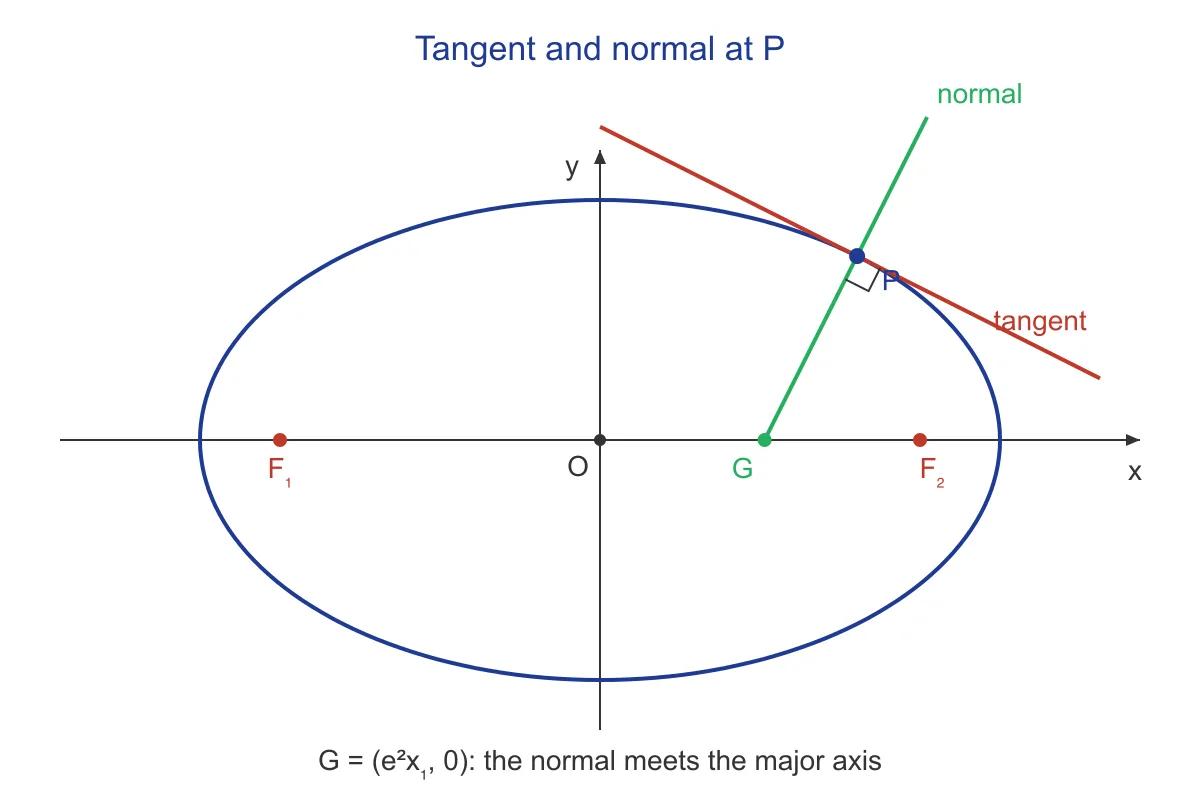
Figure 2.3: The tangent and normal at a point of the ellipse
Example 5: Find the tangent and the normal to $\frac{x^2}{36}+\frac{y^2}{9}=1$ at the point with eccentric angle $\frac{\pi}{3}$ (normal formula in the next section).
$a=6$, $b=3$. The point is $(6\cos60^\circ, 3\sin60^\circ)=(3, \frac{3\sqrt3}{2})$.
Tangent: $\frac{x\cos\theta}{a}+\frac{y\sin\theta}{b}=1$ gives $\frac{x}{12}+\frac{\sqrt3\,y}{6}=1$, that is $x+2\sqrt3\,y=12$. Check: $3+2\sqrt3\cdot\frac{3\sqrt3}{2}=3+9=12$.
Slope of the tangent: $-\frac{1}{2\sqrt3}$. So the normal slope is $2\sqrt3$.
Normal through $(3,\frac{3\sqrt3}{2})$: $y-\frac{3\sqrt3}{2}=2\sqrt3(x-3)$, which simplifies to $12x-2\sqrt3\,y=27$.
Notice that the product of the slopes, $-\frac{1}{2\sqrt3}\times 2\sqrt3=-1$, confirms that the two lines are perpendicular.
Example 6: Tangents are drawn to $x^2+4y^2=4$ from the point $(0,3)$. Find them.
The ellipse is $\frac{x^2}{4}+y^2=1$: $a^2=4$, $b^2=1$.
A tangent through $(0,3)$ has the form $y=mx+3$, so $c=3$. (The vertical line $x=0$ through $(0,3)$ cuts the ellipse in two points, so it is not a tangent.)
Condition: $c^2=a^2m^2+b^2 \Rightarrow 9=4m^2+1 \Rightarrow m^2=2$.
So $m=\pm\sqrt2$ and the tangents are $y=\sqrt2\,x+3$ and $y=-\sqrt2\,x+3$.
Notice that the symmetric result is expected: the point lies on the minor-axis line, so the two tangents mirror each other.
When the outside point is $(h,k)$ in general, write $y-k=m(x-h)$, so $c=k-mh$, and the condition becomes $(k-mh)^2=a^2m^2+b^2$. It is a quadratic in $m$. Two real roots mean two tangents. One real root means the second tangent is vertical (check $x=h$ separately). A point inside the ellipse, that is $\frac{h^2}{a^2}+\frac{k^2}{b^2}<1$, gives no real $m$ at all, because no tangent can be drawn from inside.
Normal to the ellipse
The normal at $P(x_1,y_1)$ is the line through $P$ perpendicular to the tangent. The tangent slope is $-\frac{b^2x_1}{a^2y_1}$, so the normal slope is $\frac{a^2y_1}{b^2x_1}$:
Multiply by $b^2x_1$, so $b^2x_1(y-y_1)=a^2y_1(x-x_1)$, then divide by $x_1y_1$:
which rearranges to
In parametric form, with $x_1=a\cos\theta$ and $y_1=b\sin\theta$:
Both need $x_1y_1\ne 0$. At the vertices and the ends of the minor axis the normal is simply the axis through that point.
Put $y=0$ in the normal to find where it meets the major axis: $x=\frac{(a^2-b^2)x_1}{a^2}=e^2x_1$. So the normal crosses the $x$-axis at $(e^2x_1,0)$, which lies between the centre and the foot of the point, and this is the fact drawn in Figure 2.3.
Memory trick: "Tangent: divide by squares; normal: swap the squares."
Tangent has $a^2, b^2$ in the denominators of $x$ and $y$ terms; the normal has $x_1, y_1$ in the denominators with $a^2,b^2$ on top and a minus sign between. Write the tangent first and flip it.
Which formula, and in what order
For most problems one of three situations decides the method. If you are told the point, use the point form and the normal formula. If you are told the slope or the direction of the tangent (parallel to a given line, perpendicular to a given line, or from an outside point), use the slope form, since $m$ is known or is the unknown. If the point is described by an angle, use the parametric form, and set up the answer as a function of $\theta$ before choosing any value.
Always begin with the equation in the form $\frac{x^2}{a^2}+\frac{y^2}{b^2}=1$ and note $a^2$ and $b^2$ carefully, whichever is larger; the standard forms for tangent and normal do not depend on which of them is larger, but the focus, directrix and eccentricity formulas do.
Common traps
- Reading the ellipse $\frac{x^2}{9}+\frac{y^2}{16}=1$ as having foci on the $x$-axis → the larger denominator is under $y^2$, so the foci are on the $y$-axis at $(0,\pm\sqrt7)$.
- Using $e=\sqrt{1-\frac{b^2}{a^2}}$ without checking which of $a,b$ is larger → always put the smaller square on top inside the root.
- Writing the latus rectum as $\frac{2a^2}{b}$ for a horizontal ellipse → it is $\frac{2b^2}{a}$, the square of the semi-minor over the semi-major.
- Taking the directrix to be $x=\pm ae$ → the foci are at $\pm ae$ and the directrices are at $\pm\frac{a}{e}$.
- Taking the sum of focal distances as $2c$ or $2b$ → the sum is always $2a$, the major axis, even when the major axis is vertical.
- Writing the point as $(a\sin\theta, b\cos\theta)$ → $x=a\cos\theta$, $y=b\sin\theta$ for the ellipse $\frac{x^2}{a^2}+\frac{y^2}{b^2}=1$.
- Using $c^2=a^2m^2-b^2$, which belongs to the hyperbola → for the ellipse the sign is plus, $c^2=a^2m^2+b^2$.
- Finding the tangent through an outside point with slope form and losing the vertical tangent → test the line $x=h$ separately whenever the quadratic gives only one slope.
- Treating the eccentric angle $\theta$ as the angle that $OP$ makes with the axis → it is the angle that $OQ$ makes, where $Q$ is on the auxiliary circle.
- Forgetting that the tangent and normal formulas need the point to lie on the ellipse → substitute the point first and confirm it satisfies the equation.
Quick revision
- Ellipse: $PF_1+PF_2=2a$ with $2a>F_1F_2$; equivalently $PF=e\cdot PM$ with $0<e<1$.
- Standard form $\frac{x^2}{a^2}+\frac{y^2}{b^2}=1$, $a>b$, with $b^2=a^2(1-e^2)$ and $c=ae$.
- Foci $(\pm ae,0)$; vertices $(\pm a,0)$; minor-axis ends $(0,\pm b)$.
- Directrices $x=\pm\frac{a}{e}$; their separation is $\frac{2a}{e}$; the foci are $2ae$ apart.
- Major axis $2a$, minor axis $2b$; the latus rectum is $\frac{2b^2}{a}$, with end points $\left(\pm ae,\pm\frac{b^2}{a}\right)$.
- Vertical ellipse ($b>a$): $a^2=b^2(1-e^2)$, foci $(0,\pm be)$, directrices $y=\pm\frac{b}{e}$, latus rectum $\frac{2a^2}{b}$.
- Focal distances of $(x_1,y_1)$: $a+ex_1$ and $a-ex_1$; product $a^2-e^2x_1^2$.
- Parametric point $(a\cos\theta, b\sin\theta)$; the auxiliary circle is $x^2+y^2=a^2$, and $P$ is $Q$ with its height scaled by $\frac{b}{a}$.
- Point inside the ellipse if $\frac{x_1^2}{a^2}+\frac{y_1^2}{b^2}<1$, on it if equal to $1$, outside if greater.
- Tangent at a point: $\frac{xx_1}{a^2}+\frac{yy_1}{b^2}=1$; parametric: $\frac{x\cos\theta}{a}+\frac{y\sin\theta}{b}=1$.
- Tangent of slope $m$: $y=mx\pm\sqrt{a^2m^2+b^2}$; the condition for $y=mx+c$ is $c^2=a^2m^2+b^2$.
- Normal at a point: $\frac{a^2x}{x_1}-\frac{b^2y}{y_1}=a^2-b^2$; slope $\frac{a^2y_1}{b^2x_1}$.
- Normal in parametric form: $ax\sec\theta-by\csc\theta=a^2-b^2$; it meets the major axis at $(e^2x_1,0)$.
Practice questions
The eccentricity of the ellipse $9x^2+16y^2=144$ is
- $\frac{\sqrt7}{3}$
- $\frac{7}{16}$
- $\frac34$
- $\frac{\sqrt7}{4}$
Answer
D. $\frac{\sqrt7}{4}$
Divide by 144: $\frac{x^2}{16}+\frac{y^2}{9}=1$. $e^2=1-\frac{9}{16}=\frac{7}{16}$, so $e=\frac{\sqrt7}{4}$.
The foci of the ellipse $\frac{x^2}{25}+\frac{y^2}{9}=1$ are
- $(\pm4,0)$
- $(\pm5,0)$
- $(0,\pm4)$
- $(\pm\sqrt{34},0)$
Answer
A. $(\pm4,0)$
$a=5$, $b=3$, so $c^2=25-9=16$ and $c=4$. The larger denominator is under $x^2$, so the foci are $(\pm4,0)$.
The length of the latus rectum of $\frac{x^2}{36}+\frac{y^2}{20}=1$ is
- $\frac{40}{3}$
- $\frac{10}{3}$
- $\frac{20}{3}$
- $\frac{5}{3}$
Answer
C. $\frac{20}{3}$
$a^2=36$, $b^2=20$. Latus rectum $=\frac{2b^2}{a}=\frac{40}{6}=\frac{20}{3}$.
The directrices of the ellipse $\frac{x^2}{16}+\frac{y^2}{7}=1$ are the lines
- $x=\pm3$
- $x=\pm\frac{16}{3}$
- $x=\pm\frac73$
- $x=\pm\frac43$
Answer
B. $x=\pm\frac{16}{3}$
$e^2=1-\frac{7}{16}=\frac{9}{16}$, $e=\frac34$. Directrices $x=\pm\frac{a}{e}=\pm\frac{4}{3/4}=\pm\frac{16}{3}$. (The value $\pm3$ is the position of the foci.)
The directrices of the ellipse $\frac{x^2}{9}+\frac{y^2}{16}=1$ are the lines
- $y=\pm\frac{9}{\sqrt7}$
- $x=\pm\frac{16}{\sqrt7}$
- $y=\pm\frac{36}{\sqrt7}$
- $y=\pm\frac{16}{\sqrt7}$
Answer
D. $y=\pm\frac{16}{\sqrt7}$
The larger denominator $16$ is under $y^2$: vertical ellipse, semi-major $4$. $e^2=1-\frac{9}{16}=\frac{7}{16}$, $e=\frac{\sqrt7}{4}$. Directrices $y=\pm\frac{4}{e}=\pm\frac{16}{\sqrt7}$.
The point of the ellipse $\frac{x^2}{4}+\frac{y^2}{9}=1$ with eccentric angle $\frac{\pi}{3}$ is
- $\left(\frac32,\sqrt3\right)$
- $\left(1,\frac{3\sqrt3}{2}\right)$
- $\left(1,\frac32\right)$
- $\left(\sqrt3,\frac32\right)$
Answer
B. $\left(1,\frac{3\sqrt3}{2}\right)$
$x=2\cos60^\circ=1$ and $y=3\sin60^\circ=\frac{3\sqrt3}{2}$. Check: $\frac14+\frac{27/4}{9}=1$.
The tangent to $\frac{x^2}{18}+\frac{y^2}{8}=1$ at the point $(3,2)$ is
- $3x+2y=12$
- $2x+3y=6$
- $2x+3y=12$
- $x+y=5$
Answer
C. $2x+3y=12$
Point form: $\frac{3x}{18}+\frac{2y}{8}=1$, i.e. $\frac{x}{6}+\frac{y}{4}=1$, so $2x+3y=12$. Check: $6+6=12$.
The tangents to $4x^2+9y^2=36$ that have slope $2$ are
- $y=2x\pm2\sqrt{10}$
- $y=2x\pm\sqrt{10}$
- $y=2x\pm4\sqrt2$
- $y=2x\pm5$
Answer
A. $y=2x\pm2\sqrt{10}$
$\frac{x^2}{9}+\frac{y^2}{4}=1$, so $c^2=a^2m^2+b^2=9\cdot4+4=40$ and $c=\pm2\sqrt{10}$.
The line $y=mx+5$ touches the ellipse $\frac{x^2}{16}+\frac{y^2}{9}=1$. Then $m$ equals
- $\pm1$
- $\pm\frac34$
- $\pm\frac43$
- $\pm\frac{\sqrt{34}}{4}$
Answer
A. $\pm1$
$c^2=a^2m^2+b^2$ gives $25=16m^2+9$, so $m^2=1$.
The normal to $\frac{x^2}{18}+\frac{y^2}{8}=1$ at the point $(3,2)$ is
- $3x+2y=13$
- $2x-3y=0$
- $3x-2y=5$
- $2x+3y=12$
Answer
C. $3x-2y=5$
Normal: $\frac{a^2x}{x_1}-\frac{b^2y}{y_1}=a^2-b^2$, i.e. $\frac{18x}{3}-\frac{8y}{2}=10$, so $6x-4y=10$, i.e. $3x-2y=5$. Check: $9-4=5$.
An ellipse with centre at the origin has its foci at $(\pm3,0)$ and passes through $(0,4)$. Its equation is
- $\frac{x^2}{25}+\frac{y^2}{9}=1$
- $\frac{x^2}{25}+\frac{y^2}{16}=1$
- $\frac{x^2}{7}+\frac{y^2}{16}=1$
- $\frac{x^2}{16}+\frac{y^2}{25}=1$
Answer
B. $\frac{x^2}{25}+\frac{y^2}{16}=1$
$(0,4)$ is the end of the minor axis, so $b=4$ and $c=3$. Then $a^2=b^2+c^2=25$. Check: the distances from $(0,4)$ to the foci are $5$ each, sum $10=2a$.
The latus rectum of an ellipse $\frac{x^2}{a^2}+\frac{y^2}{b^2}=1$ ($a>b$) has the same length as its semi-minor axis. Its eccentricity is
- $\frac34$
- $\frac{1}{\sqrt2}$
- $\frac12$
- $\frac{\sqrt3}{2}$
Answer
D. $\frac{\sqrt3}{2}$
$\frac{2b^2}{a}=b$ gives $a=2b$. Then $e^2=1-\frac{b^2}{a^2}=1-\frac14=\frac34$.
Which of these points lies inside the ellipse $\frac{x^2}{16}+\frac{y^2}{9}=1$?
- $(4,1)$
- $(0,3)$
- $(2,2)$
- $(3,2)$
Answer
C. $(2,2)$
Evaluate $\frac{x^2}{16}+\frac{y^2}{9}$: $(2,2)$ gives $\frac14+\frac49<1$ (inside); $(3,2)$ gives $\frac{9}{16}+\frac49=\frac{145}{144}>1$; $(4,1)$ gives $1+\frac19>1$; $(0,3)$ gives exactly $1$.
On $\frac{x^2}{25}+\frac{y^2}{9}=1$, the tangent at the point with eccentric angle $\theta$ ($0<\theta<\frac{\pi}{2}$) is parallel to the line $3x+5y=0$. Then $\theta$ is
- $\frac{3\pi}{4}$
- $\frac{\pi}{6}$
- $\frac{\pi}{3}$
- $\frac{\pi}{4}$
Answer
D. $\frac{\pi}{4}$
Tangent $\frac{x\cos\theta}{5}+\frac{y\sin\theta}{3}=1$ has slope $-\frac{3\cos\theta}{5\sin\theta}$. The line has slope $-\frac35$, so $\cot\theta=1$ and $\theta=\frac{\pi}{4}$.
The distance between the foci of the ellipse $9x^2+25y^2=225$ is
- $4$
- $8$
- $10$
- $6$
Answer
B. $8$
$\frac{x^2}{25}+\frac{y^2}{9}=1$; $c^2=25-9=16$, so $c=4$ and $2c=8$.
For every point on the ellipse $4x^2+9y^2=144$, the sum of the distances from the two foci is
- $12$
- $6$
- $8$
- $16$
Answer
A. $12$
$\frac{x^2}{36}+\frac{y^2}{16}=1$, so $a=6$ and the sum is $2a=12$.
An ellipse $\frac{x^2}{a^2}+\frac{y^2}{b^2}=1$ has eccentricity $\frac{12}{13}$ and the distance between its foci is $24$. The length of its minor axis is
- $10$
- $26$
- $12$
- $5$
Answer
A. $10$
$2ae=24$ gives $ae=12$, so $a=13$. $b^2=a^2-a^2e^2=169-144=25$, $b=5$, minor axis $2b=10$.
The length of the latus rectum of the ellipse $16x^2+25y^2=400$ is
- $8$
- $3.2$
- $12.8$
- $6.4$
Answer
D. $6.4$
$\frac{x^2}{25}+\frac{y^2}{16}=1$. $\frac{2b^2}{a}=\frac{32}{5}=6.4$.
The point $P\left(3,\frac{12}{5}\right)$ lies on $\frac{x^2}{25}+\frac{y^2}{9}=1$. The product of its distances from the two foci is
- $16$
- $19.24$
- $5.76$
- $22.6$
Answer
B. $19.24$
$e=\frac45$. Distances: $a-ex_1=5-2.4=2.6$ and $a+ex_1=7.4$. Product $=2.6\times7.4=19.24$. Check: $a^2-e^2x_1^2=25-5.76=19.24$.
For the ellipse $\frac{x^2}{16}+\frac{y^2}{4}=1$, the point $P$ has eccentric angle $\frac{\pi}{3}$. The value of $OP^2$, where $O$ is the origin, is
- $10$
- $5$
- $7$
- $12$
Answer
C. $7$
$P=(4\cos60^\circ,2\sin60^\circ)=(2,\sqrt3)$. $OP^2=4+3=7$.
The line $y=x+k$ with $k>0$ touches the ellipse $\frac{x^2}{12}+\frac{y^2}{4}=1$. The value of $k$ is
- $16$
- $4$
- $8$
- $2$
Answer
B. $4$
$c^2=a^2m^2+b^2=12\cdot1+4=16$, so $k=4$ (taking $k>0$).
The tangent at $(5,4)$ to $\frac{x^2}{50}+\frac{y^2}{32}=1$ cuts off a triangle with the coordinate axes. Its area is
- $80$
- $20$
- $18$
- $40$
Answer
D. $40$
Tangent: $\frac{5x}{50}+\frac{4y}{32}=1$, i.e. $\frac{x}{10}+\frac{y}{8}=1$. Intercepts $10$ and $8$; area $=\frac12\cdot10\cdot8=40$.
A tangent to $\frac{x^2}{16}+\frac{y^2}{9}=1$ at a point in the first quadrant meets the axes at $A$ and $B$. The least possible area of triangle $OAB$ is
- $6$
- $24$
- $12$
- $36$
Answer
C. $12$
Tangent at $\theta$: intercepts $\frac{4}{\cos\theta}$ and $\frac{3}{\sin\theta}$. Area $=\frac12\cdot\frac{12}{\sin\theta\cos\theta}=\frac{12}{\sin2\theta}\ge12$, with equality at $\theta=\frac{\pi}{4}$.
The point $P\left(4,\frac95\right)$ lies on $\frac{x^2}{25}+\frac{y^2}{9}=1$. The normal at $P$ meets the $x$-axis at the point whose $x$-coordinate is
- $2.56$
- $6.25$
- $1.44$
- $3.2$
Answer
A. $2.56$
Normal: $\frac{25x}{4}-\frac{9y}{9/5}=16$, i.e. $\frac{25x}{4}-5y=16$. Put $y=0$: $x=\frac{64}{25}=2.56$. Check: $e^2x_1=\frac{16}{25}\cdot4=2.56$.
An ellipse $\frac{x^2}{a^2}+\frac{y^2}{b^2}=1$ ($a>b$) has a focus at $(2,0)$ and the corresponding directrix $x=8$. The length of its latus rectum is
- $12$
- $6$
- $8$
- $3$
Answer
B. $6$
$ae=2$ and $\frac{a}{e}=8$ give $a^2=16$, $a=4$, $e=\frac12$. $b^2=a^2(1-e^2)=12$. Latus rectum $=\frac{2b^2}{a}=\frac{24}{4}=6$.
Two tangents are drawn to $\frac{x^2}{9}+\frac{y^2}{4}=1$ from the point $(3,4)$. One of them is vertical. The slope of the other is
- $1.5$
- $2$
- $0.5$
- $0.25$
Answer
C. $0.5$
Line $y-4=m(x-3)$ has $c=4-3m$. $(4-3m)^2=9m^2+4$ gives $16-24m=4$, so $m=0.5$. (The vertical line $x=3$ touches at $(3,0)$.)
Given below are two statements: Statement I: For $a>b$, the foci of $\frac{x^2}{a^2}+\frac{y^2}{b^2}=1$ lie on the $x$-axis. Statement II: The foci of $\frac{x^2}{9}+\frac{y^2}{16}=1$ are $(\pm\sqrt7,0)$.
- Both Statement I and Statement II are correct
- Both Statement I and Statement II are incorrect
- Statement I is correct but Statement II is incorrect
- Statement I is incorrect but Statement II is correct
Answer
C. Statement I is correct but Statement II is incorrect
I is true. In II the larger denominator is under $y^2$, so the foci are $(0,\pm\sqrt7)$, not on the $x$-axis.
Given below are two statements: Statement I: The line $y=x+5$ touches $\frac{x^2}{16}+\frac{y^2}{9}=1$. Statement II: The line $y=mx+c$ touches $\frac{x^2}{a^2}+\frac{y^2}{b^2}=1$ when $c^2=a^2m^2+b^2$.
- Both Statement I and Statement II are correct
- Both Statement I and Statement II are incorrect
- Statement I is correct but Statement II is incorrect
- Statement I is incorrect but Statement II is correct
Answer
A. Both Statement I and Statement II are correct
II is the standard condition. For I: $c^2=25$ and $a^2m^2+b^2=16+9=25$, so it touches.
Given below are two statements: Statement I: The eccentricity of an ellipse can be equal to $1$. Statement II: When $e$ is very close to $0$, the ellipse is very close to a circle.
- Both Statement I and Statement II are correct
- Both Statement I and Statement II are incorrect
- Statement I is correct but Statement II is incorrect
- Statement I is incorrect but Statement II is correct
Answer
D. Statement I is incorrect but Statement II is correct
For an ellipse $c<a$, so $0<e<1$, and I is wrong. As $e\to0$, $b\to a$ and the ellipse tends to a circle, so II is right.
Given below are two statements: Statement I: The distance between the two directrices of $\frac{x^2}{a^2}+\frac{y^2}{b^2}=1$ ($a>b$) is $\frac{2a}{e}$. Statement II: The directrices of this ellipse are the lines $x=\pm ae$.
- Both Statement I and Statement II are correct
- Both Statement I and Statement II are incorrect
- Statement I is correct but Statement II is incorrect
- Statement I is incorrect but Statement II is correct
Answer
C. Statement I is correct but Statement II is incorrect
Directrices are $x=\pm\frac{a}{e}$, so their separation is $\frac{2a}{e}$ (I true). $x=\pm ae$ gives the foci, not directrices (II false).
Given below are two statements: Statement I: The sum of the focal distances of a point on an ellipse changes as the point moves. Statement II: For $\frac{x^2}{a^2}+\frac{y^2}{b^2}=1$ with $a>b$, the foci are $(\pm be,0)$.
- Both Statement I and Statement II are correct
- Both Statement I and Statement II are incorrect
- Statement I is correct but Statement II is incorrect
- Statement I is incorrect but Statement II is correct
Answer
B. Both Statement I and Statement II are incorrect
The sum is always $2a$, so I is false. The foci are $(\pm ae,0)$, so II is false.
Assertion (A): The ellipse $\frac{x^2}{9}+\frac{y^2}{25}=1$ has its foci on the $y$-axis. Reason (R): In this ellipse the larger denominator is under $y^2$.
- Both A and R are true and R is the correct explanation of A
- Both A and R are true but R is not the correct explanation of A
- A is true but R is false
- A is false but R is true
Answer
A. Both A and R are true and R is the correct explanation of A
The larger denominator, $25$, is under $y^2$, so the major axis is vertical and the foci are on the $y$-axis. R states exactly that reason.
Assertion (A): For every point on $\frac{x^2}{25}+\frac{y^2}{9}=1$, the sum of the distances from the foci is $10$. Reason (R): The distance between the foci of $\frac{x^2}{25}+\frac{y^2}{9}=1$ is $8$.
- Both A and R are true and R is the correct explanation of A
- Both A and R are true but R is not the correct explanation of A
- A is true but R is false
- A is false but R is true
Answer
B. Both A and R are true but R is not the correct explanation of A
The sum is $2a=10$ (A true); the distance $2ae=8$ (R true). But the constant sum is $2a$ and does not come from $2c$, so R does not explain A.
Assertion (A): The ellipse $\frac{x^2}{4}+\frac{y^2}{9}=1$ has eccentricity $\frac{\sqrt5}{2}$. Reason (R): For $\frac{x^2}{a^2}+\frac{y^2}{b^2}=1$ with $a>b$, $e=\sqrt{1-\frac{b^2}{a^2}}$.
- Both A and R are true and R is the correct explanation of A
- Both A and R are true but R is not the correct explanation of A
- A is true but R is false
- A is false but R is true
Answer
D. A is false but R is true
Here $9>4$, so $e^2=1-\frac49=\frac59$ and $e=\frac{\sqrt5}{3}$; A is false (also $\frac{\sqrt5}{2}>1$ is impossible). R is the correct formula.
Match List I with List II. List I: a. Eccentricity of $\frac{x^2}{25}+\frac{y^2}{9}=1$ b. Latus rectum of $\frac{x^2}{25}+\frac{y^2}{9}=1$ c. Distance between the foci of $\frac{x^2}{25}+\frac{y^2}{9}=1$ d. Distance between the directrices of $\frac{x^2}{25}+\frac{y^2}{9}=1$ List II: i. $8$ ii. $\frac45$ iii. $\frac{18}{5}$ iv. $\frac{25}{2}$
- a-ii, b-iii, c-i, d-iv
- a-iii, b-ii, c-i, d-iv
- a-ii, b-iii, c-iv, d-i
- a-ii, b-i, c-iii, d-iv
Answer
A. a-ii, b-iii, c-i, d-iv
$a=5,b=3$: $e=\frac45$; latus rectum $\frac{2\cdot9}{5}=\frac{18}{5}$; foci apart $2ae=8$; directrices $x=\pm\frac{25}{4}$, apart $\frac{25}{2}$.
Match List I with List II. List I: a. Tangent at $(x_1,y_1)$ b. Tangent of slope $m$ c. Tangent at eccentric angle $\theta$ d. Normal at $(x_1,y_1)$ List II: i. $y=mx\pm\sqrt{a^2m^2+b^2}$ ii. $\frac{x\cos\theta}{a}+\frac{y\sin\theta}{b}=1$ iii. $\frac{xx_1}{a^2}+\frac{yy_1}{b^2}=1$ iv. $\frac{a^2x}{x_1}-\frac{b^2y}{y_1}=a^2-b^2$
- a-ii, b-i, c-iii, d-iv
- a-iii, b-i, c-iv, d-ii
- a-i, b-iii, c-ii, d-iv
- a-iii, b-i, c-ii, d-iv
Answer
D. a-iii, b-i, c-ii, d-iv
These are the standard forms for the ellipse $\frac{x^2}{a^2}+\frac{y^2}{b^2}=1$: point form iii, slope form i, parametric form ii, normal iv.
Match List I with List II. List I: a. $x^2+4y^2=4$ b. $\frac{x^2}{25}+\frac{y^2}{9}=1$ c. $\frac{x^2}{8}+\frac{y^2}{4}=1$ d. $16x^2+25y^2=400$ List II (eccentricity): i. $\frac45$ ii. $\frac{\sqrt3}{2}$ iii. $\frac35$ iv. $\frac{1}{\sqrt2}$
- a-i, b-ii, c-iv, d-iii
- a-ii, b-i, c-iii, d-iv
- a-ii, b-i, c-iv, d-iii
- a-iv, b-iii, c-ii, d-i
Answer
C. a-ii, b-i, c-iv, d-iii
a: $\frac{x^2}{4}+y^2=1$, $e^2=\frac34$. b: $e^2=1-\frac{9}{25}=\frac{16}{25}$. c: $e^2=1-\frac48=\frac12$. d: $\frac{x^2}{25}+\frac{y^2}{16}=1$, $e^2=\frac{9}{25}$.
The line $x=4$ passes through the focus $(4,0)$ of $\frac{x^2}{25}+\frac{y^2}{9}=1$ and meets the ellipse at $P$ in the first quadrant. The tangent at $P$ meets the $x$-axis at
- $\left(\frac{25}{4},0\right)$
- $\left(\frac{64}{25},0\right)$
- $(5,0)$
- $(4,0)$
Answer
A. $\left(\frac{25}{4},0\right)$
$y^2=9\left(1-\frac{16}{25}\right)=\frac{81}{25}$, so $P=\left(4,\frac95\right)$. Tangent: $\frac{4x}{25}+\frac{9y/5}{9}=1$. Put $y=0$: $x=\frac{25}{4}$, which is the directrix.
A point $P$ lies on $\frac{x^2}{36}+\frac{y^2}{20}=1$ and is $8$ units from the focus $(4,0)$. The distance of $P$ from the line $x=9$ is
- $4$
- $12$
- $8$
- $6$
Answer
B. $12$
$e=\frac23$ and $PF=a-ex_1$: $6-\frac23x_1=8$ gives $x_1=-3$ (then $y^2=15$, valid). Distance from $x=9$ is $9-(-3)=12$. Check: $PF=e\times12=8$.
The circle $x^2+y^2=20$ and the ellipse $\frac{x^2}{25}+\frac{y^2}{16}=1$ have a common tangent $y=mx+c$ with $m>0$ and $c>0$. The value of $c$ is
- $5$
- $4$
- $36$
- $6$
Answer
D. $6$
Ellipse: $c^2=25m^2+16$. Circle of radius $\sqrt{20}$: $c^2=20(1+m^2)$. Equate: $5m^2=4$, $m^2=\frac45$. Then $c^2=20+16=36$, $c=6$.