Hyperbola
What to remember
- A hyperbola is the path of a point whose distance from a fixed point (the focus) is $e$ times its distance from a fixed line (the directrix), with $e>1$. Equivalently, the difference of its distances from two fixed foci stays equal to $2a$.
- For $\frac{x^2}{a^2}-\frac{y^2}{b^2}=1$: $b^2=a^2(e^2-1)$, foci $(\pm ae,0)$, directrices $x=\pm\frac ae$, latus rectum $\frac{2b^2}{a}$, asymptotes $y=\pm\frac bax$.
- Tangent in slope form: $y=mx\pm\sqrt{a^2m^2-b^2}$, which exists only when $m^2>\frac{b^2}{a^2}$. At a point: $\frac{xx_1}{a^2}-\frac{yy_1}{b^2}=1$. Normal at a point: $\frac{a^2x}{x_1}+\frac{b^2y}{y_1}=a^2+b^2$.
- The hyperbola, its asymptotes and its conjugate differ only in the constant on the right side: $1$, $0$ and $-1$. For a hyperbola and its conjugate, $\frac{1}{e^2}+\frac{1}{e'^2}=1$.
- The rectangular hyperbola has $a=b$, $e=\sqrt2$, perpendicular asymptotes. Turned to the axes it is $xy=c^2$ with $a=c\sqrt2$.
The curve and its equation
Take a fixed point $S$ and a fixed line $d$. Let a point $P$ move so that
where $PM$ is the perpendicular distance from $P$ to $d$. For $e<1$ you get an ellipse, for $e=1$ a parabola, and for $e>1$ a hyperbola.
To get the equation, place the focus at $S(ae,0)$ and the directrix at $x=\frac ae$. For $P(x,y)$ the condition $PS^2=e^2PM^2$ reads
Expand both sides. The terms $-2aex$ cancel, and what is left is $x^2(e^2-1)-y^2=a^2(e^2-1)$. Divide by $a^2(e^2-1)$ and write $b^2=a^2(e^2-1)$:
This $b^2$ is the number that must be positive, which is why $e>1$ is forced. Rearranged, $e=\sqrt{1+\frac{b^2}{a^2}}$. Also $a^2e^2=a^2+b^2$, so the focus sits at distance $c=\sqrt{a^2+b^2}$ from the centre. Never confuse this with the ellipse, where $c^2=a^2-b^2$.
By symmetry the same curve has a second focus $S'(-ae,0)$ and a second directrix $x=-\frac ae$. The curve has two separate branches. Putting $y=0$ gives $x=\pm a$, the vertices $A(a,0)$ and $A'(-a,0)$. Putting $x=0$ gives $y^2=-b^2$, so the curve never meets the y-axis.
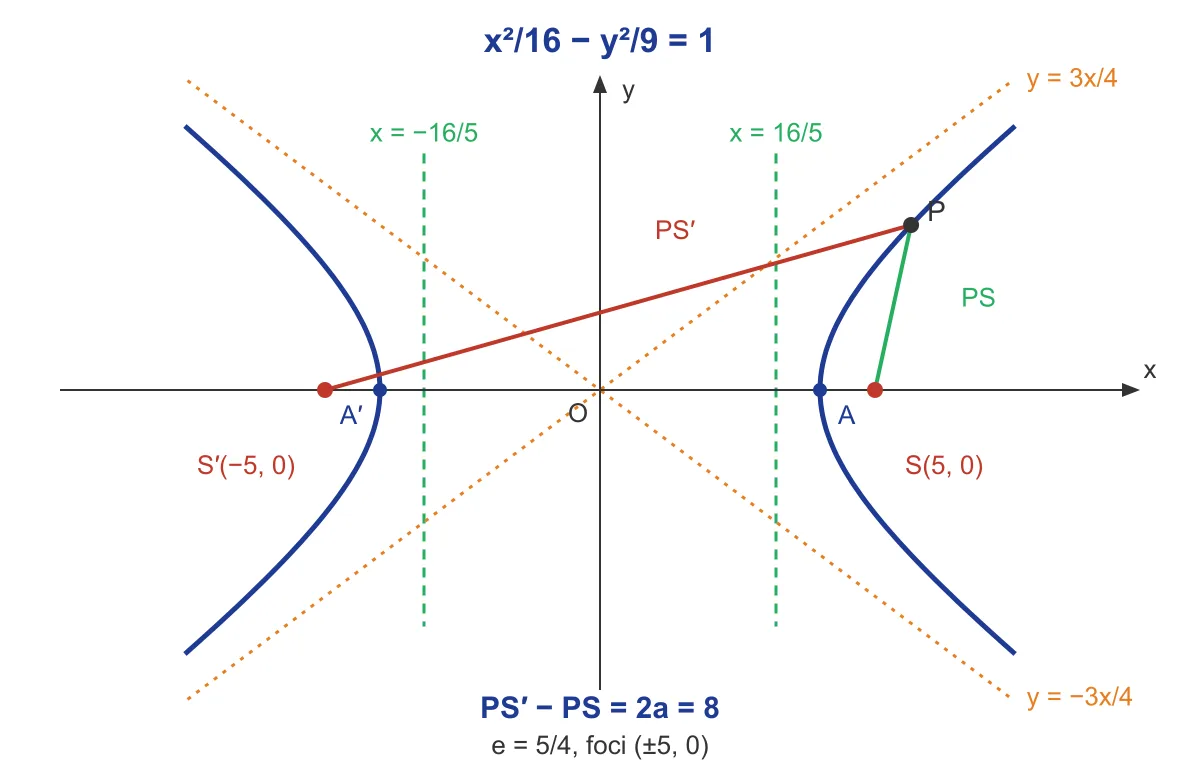
Figure 3.1: The hyperbola with its foci, vertices, directrices and asymptotes, and the focal distances of a point P
The names you must know:
- Transverse axis: the segment $AA'$ joining the vertices, length $2a$, along the line through the foci.
- Conjugate axis: the segment of length $2b$ on the perpendicular through the centre. The curve does not cross it, but the length $2b$ still matters in every formula.
- Latus rectum: the chord through a focus perpendicular to the transverse axis. Put $x=ae$ in the equation: $y^2=b^2(e^2-1)=\frac{b^4}{a^2}$, so $y=\pm\frac{b^2}{a}$ and the length is $\frac{2b^2}{a}$.
- Eccentricity: $e=\sqrt{1+\frac{b^2}{a^2}}$, always greater than 1. A larger $e$ means wider, flatter branches.
The two directrices lie between the vertices, because $\frac ae<a$. The foci lie outside the vertices, because $ae>a$. The order along the axis, left to right, is $S',A',(\text{directrix}),O,(\text{directrix}),A,S$.
Here is the summary for the curve and for the same hyperbola turned on its side, which is its conjugate (explained below).
| Quantity | $\frac{x^2}{a^2}-\frac{y^2}{b^2}=1$ | $\frac{y^2}{b^2}-\frac{x^2}{a^2}=1$ |
|---|---|---|
| Transverse axis | along x, length $2a$ | along y, length $2b$ |
| Eccentricity | $e=\sqrt{1+\frac{b^2}{a^2}}$ | $e'=\sqrt{1+\frac{a^2}{b^2}}$ |
| Vertices | $(\pm a,0)$ | $(0,\pm b)$ |
| Foci | $(\pm ae,0)$ | $(0,\pm be')$ |
| Directrices | $x=\pm\frac ae$ | $y=\pm\frac b{e'}$ |
| Latus rectum | $\frac{2b^2}{a}$ | $\frac{2a^2}{b}$ |
| Asymptotes | $y=\pm\frac bax$ | $y=\pm\frac bax$ |
Example 1: Find the foci, directrices, latus rectum and eccentricity of $7x^2-9y^2=63$.
Divide by 63: $\frac{x^2}{9}-\frac{y^2}{7}=1$. So $a^2=9$, $b^2=7$.
$e^2=1+\frac{b^2}{a^2}=1+\frac79=\frac{16}{9}$, so $e=\frac43$.
Foci: $ae=3\cdot\frac43=4$, so $(\pm4,0)$. Check: $a^2+b^2=16$, and $\sqrt{16}=4$.
Directrices: $x=\pm\frac ae=\pm\frac{3}{4/3}=\pm\frac94$.
Latus rectum: $\frac{2b^2}{a}=\frac{14}{3}$.
Answer: foci $(\pm4,0)$, directrices $x=\pm\frac94$, latus rectum $\frac{14}{3}$, $e=\frac43$. Notice that the directrix $\frac94=2.25$ is inside the vertex at 3, as it must be.
Example 2: A hyperbola has foci $(0,\pm5)$ and eccentricity $\frac53$, with centre at the origin. Find its equation.
The foci are on the y-axis, so the transverse axis is vertical: the equation is $\frac{y^2}{A^2}-\frac{x^2}{B^2}=1$ with foci $(0,\pm Ae)$.
$Ae=5$ and $e=\frac53$, so $A=3$.
$B^2=A^2(e^2-1)=9\cdot\frac{16}{9}=16$.
Equation: $\frac{y^2}{9}-\frac{x^2}{16}=1$. Check: $A^2+B^2=25$, so $c=5$.
Answer: $\frac{y^2}{9}-\frac{x^2}{16}=1$. Notice that the positive term tells you the direction of the transverse axis, never the larger denominator.
Focal distances
Let $P(x_1,y_1)$ lie on the hyperbola. The focus-directrix rule gives each focal distance directly. For the focus $S$ and its directrix, the distance from $P$ to that directrix is $\left|x_1-\frac ae\right|$, so $PS=e\left|x_1-\frac ae\right|=\left|ex_1-a\right|$. For the other focus, $PS'=\left|ex_1+a\right|$.
For a point on the right branch, $x_1\ge a$, so $ex_1>a$ and the signs open up:
Subtract: $PS'-PS=2a$. For a point on the left branch, $ex_1<-a$, so $PS=a-ex_1$ and $PS'=-ex_1-a$, and again $\left|PS-PS'\right|=2a$. This is the second definition of the hyperbola: the locus of a point whose distances from two fixed points differ by a constant, which is less than the distance between the points.
Two things to keep in mind. The sum $PS+PS'=2ex_1$ is not constant, so do not borrow the ellipse rule. And the constant $2a$ is the transverse axis, not the conjugate axis.
Example 3: The hyperbola is $\frac{x^2}{4}-\frac{y^2}{5}=1$. A point $P$ on the right branch has $x=4$. Find its distances from both foci.
$a=2$, $b^2=5$, $e=\sqrt{1+\frac54}=\frac32$, foci $(\pm3,0)$.
$PS=ex-a=\frac32\cdot4-2=4$ and $PS'=ex+a=6+2=8$.
Check by coordinates: $y^2=5\left(\frac{16}{4}-1\right)=15$. Distance to $(3,0)$: $\sqrt{(4-3)^2+15}=4$. Yes.
Answer: 4 and 8; the difference is $4=2a$. Notice that the nearer focus is the one on the same side as the branch.
Memory trick: "Near focus, subtract; far focus, add." On the right branch the near focus gives $ex-a$ and the far one gives $ex+a$. Use it to write the two distances in five seconds, and to check that their difference is $2a$.
Conjugate hyperbola
The hyperbola that has the conjugate axis of the first as its transverse axis, and the transverse axis as its conjugate axis, is called the conjugate hyperbola. For $\frac{x^2}{a^2}-\frac{y^2}{b^2}=1$ it is
The same four points $(\pm a,0)$ and $(0,\pm b)$ are involved: the first curve passes through the first pair, the second through the second pair. Both curves share the same asymptotes, and the four foci lie on one circle with the centre at the origin, since $ae$ and $be'$ are both equal to $\sqrt{a^2+b^2}$.
Eccentricities follow from the table above: $e^2=1+\frac{b^2}{a^2}$ and $e'^2=1+\frac{a^2}{b^2}$. Take reciprocals:
Only a rectangular hyperbola equals its conjugate in eccentricity. A hyperbola and its conjugate are generally different in $e$, in the latus rectum, and in the foci.
Rectangular hyperbola
If the transverse and conjugate axes are equal, $a=b$, the hyperbola is rectangular (also called equilateral). Its equation is $x^2-y^2=a^2$, and then
the asymptotes are $y=\pm x$, and they are at right angles. That perpendicularity is the reason for the name.
Rotate the axes by $45^\circ$ so that the asymptotes become the coordinate axes. The equation becomes $xy=c^2$, where $c^2=\frac{a^2}{2}$, that is $a=c\sqrt2$. In this position:
- Centre at the origin; asymptotes $x=0$ and $y=0$.
- Vertices $(c,c)$ and $(-c,-c)$ on the line $y=x$; transverse axis of length $2a=2\sqrt2\,c$.
- Foci $(c\sqrt2,\,c\sqrt2)$ and $(-c\sqrt2,\,-c\sqrt2)$, since $ae=c\sqrt2\cdot\sqrt2=2c$ along the line $y=x$.
- Directrices $x+y=\pm c\sqrt2$.
- Latus rectum $2\sqrt2\,c$, equal to the transverse axis.
- Parametric form $(ct,\frac ct)$ with $t\ne0$. Positive $t$ gives the branch in the first quadrant, negative $t$ the third.
Tangent at $(x_1,y_1)$: $xy_1+yx_1=2c^2$. At $\left(ct,\frac ct\right)$ this is $\frac xt+ty=2c$. The slope is $-\frac{1}{t^2}$, so the normal has slope $t^2$ and its equation is $xt^3-yt-ct^4+c=0$.
The tangent cuts the axes at $(2ct,0)$ and $\left(0,\frac{2c}{t}\right)$. The point of contact is the midpoint of this segment, and the triangle cut off with the axes has area $\frac12\cdot2ct\cdot\frac{2c}{t}=2c^2$, the same for every tangent.
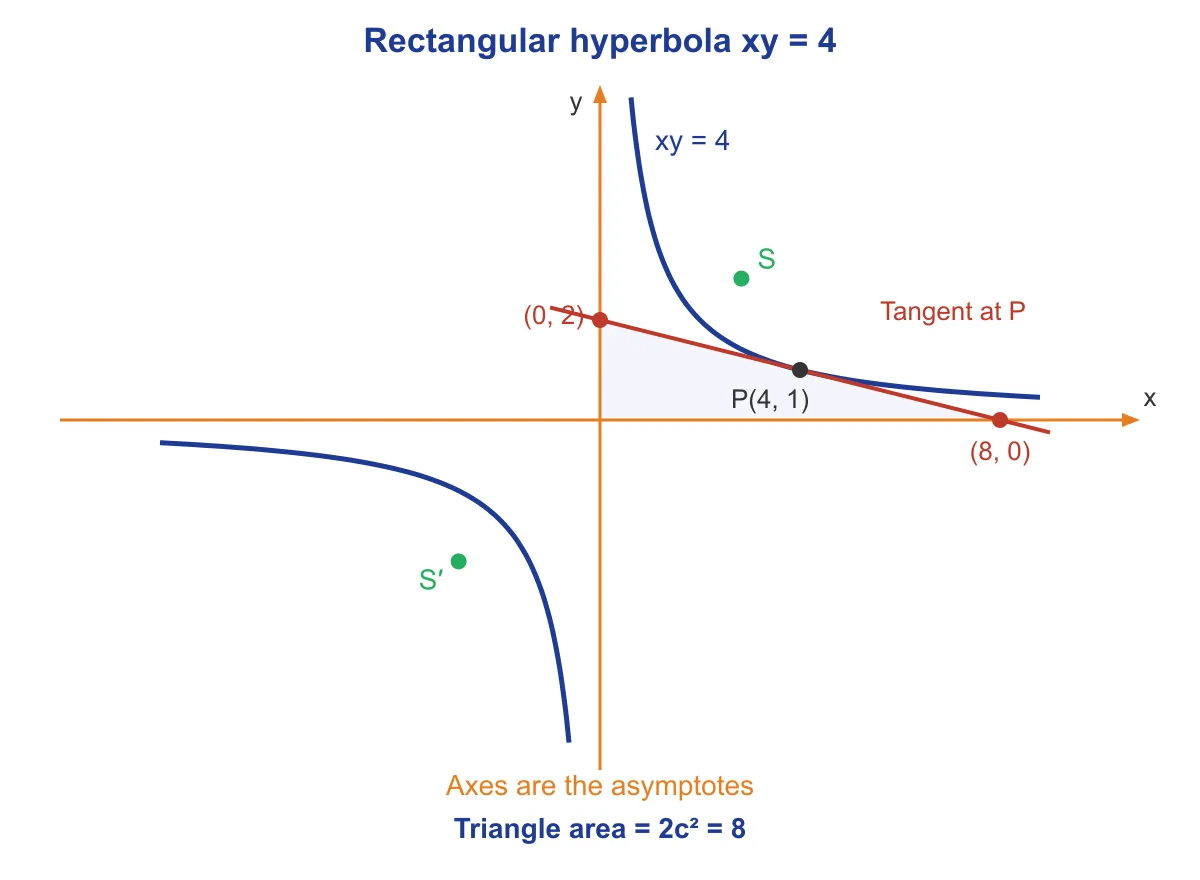
Figure 3.2: The rectangular hyperbola xy = 4 with its tangent at P(4, 1); the triangle cut off has area 2c²
Example 4: Find the tangent and normal to $xy=12$ at $(3,4)$, and the area cut off from the axes by the tangent.
$c^2=12$. Tangent: $xy_1+yx_1=2c^2$ gives $4x+3y=24$.
Slope of tangent $=-\frac43$, so the slope of the normal is $\frac34$.
Normal: $y-4=\frac34(x-3)$, so $4y-16=3x-9$, that is $3x-4y+7=0$.
Intercepts of the tangent: $(6,0)$ and $(0,8)$; area $=\frac12\cdot6\cdot8=24=2c^2$.
Answer: tangent $4x+3y=24$, normal $3x-4y+7=0$, area 24. Notice that $(3,4)$ is the midpoint of $(6,0)$ and $(0,8)$, which is your free check.
Parametric form
Because $\sec^2\theta-\tan^2\theta=1$, the point
satisfies $\frac{x^2}{a^2}-\frac{y^2}{b^2}=1$ for every $\theta$ with $\cos\theta\ne0$. For $-\frac\pi2<\theta<\frac\pi2$, $\sec\theta>0$ and the point is on the right branch; for $\frac\pi2<\theta<\frac{3\pi}{2}$ it is on the left. It is the counterpart of $(a\cos\theta,b\sin\theta)$ for the ellipse, with $\sec$ and $\tan$ in place of $\cos$ and $\sin$.
Use this form whenever a problem needs a general point, a tangent or normal at a general point, or the midpoint or locus of chords. For example, at $\theta=\frac\pi3$ on $\frac{x^2}{9}-\frac{y^2}{4}=1$ the point is $(6,2\sqrt3)$. Check: $\frac{36}{9}-\frac{12}{4}=1$.
Asymptotes
An asymptote is a line that the curve approaches without meeting as it goes off to infinity. For large $|x|$, solve for $y$:
So the asymptotes are $y=\pm\frac bax$, a pair of lines through the centre, and together they are $\frac{x^2}{a^2}-\frac{y^2}{b^2}=0$. The branches lie inside the angle that contains the transverse axis. The angle between the asymptotes is $2\tan^{-1}\frac ba$, which is $90^\circ$ for a rectangular hyperbola.
Three equations, one pattern:
| Curve | Equation | Right-hand side |
|---|---|---|
| Hyperbola | $\frac{x^2}{a^2}-\frac{y^2}{b^2}=1$ | $1$ |
| Pair of asymptotes | $\frac{x^2}{a^2}-\frac{y^2}{b^2}=0$ | $0$ |
| Conjugate hyperbola | $\frac{x^2}{a^2}-\frac{y^2}{b^2}=-1$ | $-1$ |
The same pattern holds whatever the position of the centre. If the asymptotes are $L_1=0$ and $L_2=0$, the hyperbola is $L_1L_2=k$ and its conjugate is $L_1L_2=-k$. The value of $k$ comes from one given point.
Memory trick: "Change the 1 to 0 for asymptotes; change the 1 to minus 1 for the conjugate." Use it for $xy=c^2$ too: asymptotes $xy=0$, conjugate $xy=-c^2$.
Other results worth keeping:
- The distance from a focus to an asymptote equals $b$. For the focus $(ae,0)$ and the line $bx-ay=0$ the distance is $\frac{abe}{\sqrt{a^2+b^2}}=b$.
- The product of the distances of a point $P(x_1,y_1)$ on the curve from the two asymptotes is
a constant.
- Any tangent and the two asymptotes enclose a triangle with the centre of area $ab$. The point of contact is the midpoint of the part of the tangent between the asymptotes. For $xy=c^2$ the asymptotes are the axes and $ab=2c^2$, which matches the intercept result above.
Example 5: A hyperbola has asymptotes $x+2y-3=0$ and $x-2y+1=0$ and passes through $(2,0)$. Find it and its conjugate.
Product of the asymptotes: $(x+2y-3)(x-2y+1)=x^2-4y^2-2x+8y-3$.
The hyperbola is this product $=k$. At $(2,0)$: $4-0-4+0-3=-3$, so $k=-3$.
Hyperbola: $x^2-4y^2-2x+8y-3=-3$, that is $x^2-4y^2-2x+8y=0$. Check $(2,0)$: $4-4=0$.
Conjugate: product $=+3$, that is $x^2-4y^2-2x+8y-6=0$.
The centre is where the asymptotes meet: $x+2y=3$, $x-2y=-1$ give $(1,1)$.
Answer: $x^2-4y^2-2x+8y=0$ and $x^2-4y^2-2x+8y-6=0$. Notice that you never needed $a$ or $b$.
Tangent and normal
At a point. Differentiate $\frac{x^2}{a^2}-\frac{y^2}{b^2}=1$: $\frac{2x}{a^2}-\frac{2y}{b^2}\frac{dy}{dx}=0$, so the slope at $(x_1,y_1)$ is $\frac{b^2x_1}{a^2y_1}$. The tangent is $y-y_1=\frac{b^2x_1}{a^2y_1}(x-x_1)$. Clear the fractions and use $\frac{x_1^2}{a^2}-\frac{y_1^2}{b^2}=1$:
The normal has the negative reciprocal slope, $-\frac{a^2y_1}{b^2x_1}$, and works out to
In parametric form with $(x_1,y_1)=(a\sec\theta,b\tan\theta)$:
Condition of tangency. Substitute $y=mx+c$ into $\frac{x^2}{a^2}-\frac{y^2}{b^2}=1$:
A tangent meets the curve in one point twice, so the discriminant is zero. Cancel the common factor $a^2$ and the terms in $a^2m^2c^2$ cancel:
Hence the tangents with slope $m$ are
with point of contact $\left(-\frac{a^2m}{c},\,-\frac{b^2}{c}\right)$. For a line $lx+my=n$ to touch the curve the condition is $a^2l^2-b^2m^2=n^2$.
Real values of $c$ need $a^2m^2\ge b^2$. So:
| Slope of the line | Tangents of that slope |
|---|---|
| $m^2>\frac{b^2}{a^2}$ | two, $c=\pm\sqrt{a^2m^2-b^2}$ |
| $m^2=\frac{b^2}{a^2}$ | none (this is the slope of an asymptote, $c=0$) |
| $m^2<\frac{b^2}{a^2}$ | none |
The three rows are the reason a line steeper than the asymptotes can touch the curve and a flatter one cannot. In particular, no tangent to $\frac{x^2}{4}-\frac{y^2}{9}=1$ has slope 1, because $4-9<0$.
Memory trick: "Hyperbola: minus, minus, minus." The sign of $y^2$, the relation $b^2=a^2(e^2-1)$ and the condition $c^2=a^2m^2-b^2$ each carry a minus where the ellipse has a plus. Use it to catch a sign slip before you commit to an answer.
Example 6: Find the tangents of slope 2 to $\frac{x^2}{9}-\frac{y^2}{20}=1$ and their points of contact.
$a^2=9$, $b^2=20$, $m=2$: $c^2=9\cdot4-20=16$, so $c=\pm4$.
Tangents: $y=2x+4$ and $y=2x-4$.
Contact for $c=4$: $\left(-\frac{a^2m}{c},-\frac{b^2}{c}\right)=\left(-\frac{18}{4},-\frac{20}{4}\right)=\left(-\frac92,-5\right)$.
Check: $\frac{81/4}{9}-\frac{25}{20}=\frac94-\frac54=1$, and $-5=2\left(-\frac92\right)+4$. Yes.
Answer: $y=2x\pm4$. Notice that the contact point lies on both the curve and the line, and by symmetry the other contact is $\left(\frac92,5\right)$.
Example 7: Tangents are drawn from $P(2,1)$ to $x^2-y^2=9$. Find the product of their slopes.
A line through $P$ with slope $m$ is $y=mx+(1-2m)$, so $c=1-2m$.
$x^2-y^2=9$ has $a^2=b^2=9$, so $c^2=9m^2-9$.
$(1-2m)^2=9m^2-9$ gives $1-4m+4m^2=9m^2-9$, so $5m^2+4m-10=0$.
Product of roots $=\frac{-10}{5}=-2$. The discriminant $16+200$ is positive, so both slopes are real.
Answer: $-2$. Notice that a negative product means the tangents are on different sides of the horizontal.
Comparison of the three conics
| Ellipse | Parabola | Hyperbola | |
|---|---|---|---|
| Eccentricity | $0<e<1$ | $e=1$ | $e>1$ |
| Standard equation | $\frac{x^2}{a^2}+\frac{y^2}{b^2}=1$ | $y^2=4ax$ | $\frac{x^2}{a^2}-\frac{y^2}{b^2}=1$ |
| Relation of $b$ | $b^2=a^2(1-e^2)$ | none | $b^2=a^2(e^2-1)$ |
| Foci | $(\pm ae,0)$ | $(a,0)$ | $(\pm ae,0)$ |
| Directrices | $x=\pm\frac ae$ | $x=-a$ | $x=\pm\frac ae$ |
| Focal distances | sum $2a$ | $PS=x+a$ | difference $2a$ |
| Latus rectum | $\frac{2b^2}{a}$ | $4a$ | $\frac{2b^2}{a}$ |
| Parametric point | $(a\cos\theta,b\sin\theta)$ | $(at^2,2at)$ | $(a\sec\theta,b\tan\theta)$ |
| Tangent with slope $m$ | $y=mx\pm\sqrt{a^2m^2+b^2}$ | $y=mx+\frac am$ | $y=mx\pm\sqrt{a^2m^2-b^2}$ |
| Tangent at $(x_1,y_1)$ | $\frac{xx_1}{a^2}+\frac{yy_1}{b^2}=1$ | $yy_1=2a(x+x_1)$ | $\frac{xx_1}{a^2}-\frac{yy_1}{b^2}=1$ |
| Branches / asymptotes | closed, none | one open branch, none | two branches, two asymptotes |
The parabola's $a$ is a different number from the ellipse's $a$; it is the distance from vertex to focus. In the tangent row, the sign of the $b^2$ term is the single quickest way to tell the ellipse and hyperbola rules apart.
Common traps
- Using $c^2=a^2-b^2$ for the foci of a hyperbola → use $c^2=a^2+b^2$, so $ae=\sqrt{a^2+b^2}$.
- Reading the direction of the transverse axis from the larger denominator → read it from the positive term: $\frac{y^2}{9}-\frac{x^2}{16}=1$ opens along the y-axis.
- Writing the latus rectum as $\frac{2a^2}{b}$ → it is $\frac{2b^2}{a}$ for $\frac{x^2}{a^2}-\frac{y^2}{b^2}=1$; $\frac{2a^2}{b}$ is for the conjugate.
- Taking the focal-distance difference as $2b$ or as the distance between the foci → it is $2a$.
- Using $c^2=a^2m^2+b^2$ for a hyperbola tangent → the condition is $c^2=a^2m^2-b^2$; check that it is non-negative first.
- Assuming every slope gives tangents → if $m^2\le\frac{b^2}{a^2}$ no tangent of that slope exists.
- Taking the conjugate of $\frac{x^2}{a^2}-\frac{y^2}{b^2}=1$ as $\frac{y^2}{a^2}-\frac{x^2}{b^2}=1$ → keep $a^2$ under $x^2$ and $b^2$ under $y^2$, and change only the right side to $-1$.
- Assuming $e'=e$ for the conjugate → in general they differ; use $\frac{1}{e^2}+\frac{1}{e'^2}=1$.
- Using $y^2=4ax$ habits on $xy=c^2$ (vertex at the origin) → $xy=c^2$ has its centre at the origin and its vertices at $(\pm c,\pm c)$.
- Forgetting the factor $2$ in the tangent to $xy=c^2$ → it is $xy_1+yx_1=2c^2$, not $c^2$.
Quick revision
- Hyperbola: $PS=e\cdot PM$ with $e>1$; also $\left|PS-PS'\right|=2a$.
- $\frac{x^2}{a^2}-\frac{y^2}{b^2}=1$, $b^2=a^2(e^2-1)$, $e=\sqrt{1+\frac{b^2}{a^2}}$.
- Vertices $(\pm a,0)$, foci $(\pm ae,0)$, directrices $x=\pm\frac ae$, centre $(0,0)$.
- Transverse axis $2a$, conjugate axis $2b$, latus rectum $\frac{2b^2}{a}$.
- Focal distances (right branch): $PS=ex-a$, $PS'=ex+a$.
- Conjugate: $\frac{y^2}{b^2}-\frac{x^2}{a^2}=1$; same asymptotes; $\frac{1}{e^2}+\frac{1}{e'^2}=1$.
- Asymptotes $y=\pm\frac bax$; pair $\frac{x^2}{a^2}-\frac{y^2}{b^2}=0$; right side $1,0,-1$ for hyperbola, asymptotes, conjugate.
- Rectangular: $a=b$, $e=\sqrt2$, latus rectum $2a$, asymptotes perpendicular; $xy=c^2$ with $a=c\sqrt2$.
- $xy=c^2$: point $(ct,\frac ct)$, tangent $\frac xt+ty=2c$, tangent at $(x_1,y_1)$ is $xy_1+yx_1=2c^2$.
- Parametric point $(a\sec\theta,b\tan\theta)$; tangent $\frac{x\sec\theta}{a}-\frac{y\tan\theta}{b}=1$.
- Tangent at $(x_1,y_1)$: $\frac{xx_1}{a^2}-\frac{yy_1}{b^2}=1$; normal $\frac{a^2x}{x_1}+\frac{b^2y}{y_1}=a^2+b^2$.
- Tangent of slope $m$: $y=mx\pm\sqrt{a^2m^2-b^2}$, valid only if $m^2>\frac{b^2}{a^2}$; contact $\left(-\frac{a^2m}{c},-\frac{b^2}{c}\right)$.
- Line $lx+my=n$ touches iff $a^2l^2-b^2m^2=n^2$.
- Distance of focus from asymptote is $b$; product of distances of a point from asymptotes is $\frac{a^2b^2}{a^2+b^2}$; tangent and asymptotes enclose area $ab$.
Practice questions
The eccentricity of the hyperbola $\frac{x^2}{144}-\frac{y^2}{25}=1$ is
- $\frac{13}{12}$
- $\frac{13}{5}$
- $\frac{12}{13}$
- $\frac{5}{12}$
Answer
A. $\frac{13}{12}$
$e=\sqrt{1+\frac{b^2}{a^2}}=\sqrt{1+\frac{25}{144}}=\frac{13}{12}$. Check: $c^2=144+25=169$, $e=c/a=13/12$.
The foci of the hyperbola $4x^2-9y^2=36$ are
- $(\pm\sqrt5,0)$
- $(\pm\sqrt{13},0)$
- $(\pm5,0)$
- $(\pm13,0)$
Answer
B. $(\pm\sqrt{13},0)$
Divide by 36: $\frac{x^2}{9}-\frac{y^2}{4}=1$. $ae=\sqrt{a^2+b^2}=\sqrt{13}$, so foci $(\pm\sqrt{13},0)$.
The length of the latus rectum of $\frac{x^2}{25}-\frac{y^2}{16}=1$ is
- $\frac{16}{5}$
- $\frac{25}{8}$
- $\frac{32}{5}$
- $\frac{8}{5}$
Answer
C. $\frac{32}{5}$
$\frac{2b^2}{a}=\frac{2\cdot16}{5}=\frac{32}{5}$. Check: at $x=ae=\sqrt{41}$, $y^2=16(\frac{41}{25}-1)=\frac{256}{25}$, so $2\vert y\vert=\frac{32}{5}$.
The foci of the hyperbola $16y^2-9x^2=144$ are
- $(0,\pm\sqrt7)$
- $(\pm5,0)$
- $(\pm\sqrt7,0)$
- $(0,\pm5)$
Answer
D. $(0,\pm5)$
Divide by 144: $\frac{y^2}{9}-\frac{x^2}{16}=1$. The positive term has $y^2$, so the transverse axis is the y-axis, $c^2=9+16=25$, foci $(0,\pm5)$.
If the eccentricity of a hyperbola is $\frac53$, the eccentricity of its conjugate hyperbola is
- $\frac43$
- $\frac35$
- $\frac54$
- $\frac{25}{9}$
Answer
C. $\frac54$
$\frac{1}{e^2}+\frac{1}{e'^2}=1$ gives $\frac{9}{25}+\frac{1}{e'^2}=1$, so $e'^2=\frac{25}{16}$ and $e'=\frac54$. Check with $\frac{x^2}{9}-\frac{y^2}{16}=1$ ($e=\frac53$): conjugate $\frac{y^2}{16}-\frac{x^2}{9}=1$ has $e'=\sqrt{1+\frac{9}{16}}=\frac54$.
The tangent to $\frac{x^2}{9}-\frac{y^2}{4}=1$ at the point $(3\sec\theta,\,2\tan\theta)$ with $\theta=\frac{\pi}{3}$ is
- $2x-3\sqrt3\,y=6$
- $4x-3\sqrt3\,y=6$
- $4x-3\sqrt3\,y=12$
- $4x+3\sqrt3\,y=6$
Answer
B. $4x-3\sqrt3\,y=6$
The point is $(6,2\sqrt3)$. Tangent: $\frac{6x}{9}-\frac{2\sqrt3\,y}{4}=1$, i.e. $\frac{2x}{3}-\frac{\sqrt3 y}{2}=1$; multiply by 6: $4x-3\sqrt3\,y=6$. The point satisfies it: $24-18=6$.
The line $y=2x+c$ touches $\frac{x^2}{4}-\frac{y^2}{9}=1$. Then $c$ equals
- $\pm\sqrt{13}$
- $\pm5$
- $\pm3$
- $\pm\sqrt7$
Answer
D. $\pm\sqrt7$
$c^2=a^2m^2-b^2=4\cdot4-9=7$, so $c=\pm\sqrt7$. (Using $+b^2$ would give $\pm5$, which is the ellipse condition.)
The asymptotes of the hyperbola $9x^2-16y^2=144$ are
- $3x\pm4y=0$
- $9x\pm16y=0$
- $16x\pm9y=0$
- $4x\pm3y=0$
Answer
A. $3x\pm4y=0$
Replace 144 by 0: $9x^2-16y^2=0$, so $(3x-4y)(3x+4y)=0$, i.e. $3x\pm4y=0$.
The length of the transverse axis of the rectangular hyperbola $xy=9$ is
- $6$
- $6\sqrt2$
- $3\sqrt2$
- $18$
Answer
B. $6\sqrt2$
Vertices lie on $y=x$: $x^2=9$ gives $(3,3)$ and $(-3,-3)$. Distance $=\sqrt{36+36}=6\sqrt2$. Also $a=c\sqrt2=3\sqrt2$, so $2a=6\sqrt2$.
The equation of the normal to $\frac{x^2}{16}-\frac{y^2}{9}=1$ at the point $\left(5,\frac94\right)$ is
- $20x+16y=136$
- $5x-4y=16$
- $16x-20y=35$
- $16x+20y=125$
Answer
D. $16x+20y=125$
Normal: $\frac{a^2x}{x_1}+\frac{b^2y}{y_1}=a^2+b^2$ gives $\frac{16x}{5}+4y=25$, i.e. $16x+20y=125$. Check: tangent slope $=\frac{b^2x_1}{a^2y_1}=\frac{45}{36}=\frac54$, normal slope $-\frac45$, and $16x+20y=125$ has slope $-\frac45$.
For every point on $\frac{x^2}{25}-\frac{y^2}{144}=1$, the difference of its distances from the two foci has absolute value
- $12$
- $5$
- $10$
- $26$
Answer
C. $10$
The difference of focal distances is $2a=10$. The value 26 is the distance between the foci, not the difference.
The equations of the directrices of $\frac{x^2}{16}-\frac{y^2}{9}=1$ are
- $x=\pm\frac{16}{5}$
- $x=\pm\frac95$
- $x=\pm5$
- $x=\pm\frac54$
Answer
A. $x=\pm\frac{16}{5}$
$e=\frac54$, directrices $x=\pm\frac ae=\pm\frac{4}{5/4}=\pm\frac{16}{5}$. They lie inside the vertices ($\frac{16}{5}<4$), as they must.
The line $x\cos\alpha+y\sin\alpha=p$ touches $\frac{x^2}{a^2}-\frac{y^2}{b^2}=1$ if
- $a^2\cos^2\alpha+b^2\sin^2\alpha=p^2$
- $a^2\sin^2\alpha-b^2\cos^2\alpha=p^2$
- $a^2\cos^2\alpha-b^2\sin^2\alpha=p$
- $a^2\cos^2\alpha-b^2\sin^2\alpha=p^2$
Answer
D. $a^2\cos^2\alpha-b^2\sin^2\alpha=p^2$
Write $y=-\cot\alpha\,x+\frac{p}{\sin\alpha}$. Then $c^2=a^2m^2-b^2$ gives $\frac{p^2}{\sin^2\alpha}=a^2\cot^2\alpha-b^2$. Multiply by $\sin^2\alpha$: $p^2=a^2\cos^2\alpha-b^2\sin^2\alpha$.
The asymptotes of a hyperbola with centre at the origin and transverse axis along the x-axis are $y=\pm\sqrt3\,x$. Its eccentricity is
- $\sqrt2$
- $\frac{2}{\sqrt3}$
- $2$
- $\sqrt3$
Answer
C. $2$
$\frac ba=\sqrt3$, so $e=\sqrt{1+\frac{b^2}{a^2}}=\sqrt{1+3}=2$.
The distance between the foci of $\frac{x^2}{9}-\frac{y^2}{16}=1$ is
- 5
- 10
- 7
- 14
Answer
B. 10
$ae=\sqrt{9+16}=5$, foci $(\pm5,0)$, distance $2ae=10$.
The length of the latus rectum of $9x^2-16y^2=144$ is
- 4.5
- 9
- 6
- 2.25
Answer
A. 4.5
$\frac{x^2}{16}-\frac{y^2}{9}=1$, so $\frac{2b^2}{a}=\frac{2\cdot9}{4}=4.5$.
A hyperbola $\frac{x^2}{a^2}-\frac{y^2}{b^2}=1$ has eccentricity 2 and latus rectum of length 12. The length of its transverse axis is
- 4
- 2
- 8
- 6
Answer
A. 4
$e=2$ gives $b^2=a^2(e^2-1)=3a^2$. Latus rectum $\frac{2b^2}{a}=6a=12$, so $a=2$ and $2a=4$. Check: $b^2=12$, $\frac{2\cdot12}{2}=12$.
Any tangent to $\frac{x^2}{9}-\frac{y^2}{4}=1$ and the two asymptotes enclose a triangle. Its area is
- 12
- 6
- 3
- 13
Answer
B. 6
The area is $ab=3\cdot2=6$ for every tangent. Check at the vertex tangent $x=3$: it meets $y=\pm\frac23x$ at $(3,\pm2)$, area $=\frac12\cdot4\cdot3=6$.
A point $P$ on the right branch of $\frac{x^2}{9}-\frac{y^2}{16}=1$ has abscissa 6. Its distance from the focus $(5,0)$ is
- 3
- 13
- 7
- 9
Answer
C. 7
$e=\frac53$, so $SP=ex-a=10-3=7$. Check: $y^2=16(4-1)=48$, distance$^2=(6-5)^2+48=49$.
The positive value of $c$ for which the line $y=\frac54x+c$ touches $\frac{x^2}{16}-\frac{y^2}{9}=1$ is
- 2
- 5
- 16
- 4
Answer
D. 4
$c^2=a^2m^2-b^2=16\cdot\frac{25}{16}-9=16$, $c=4$. Check: substituting gives $x^2+10x+25=0$, a double root.
The distance between the foci of the rectangular hyperbola $xy=16$ is
- 8
- 16
- 32
- 24
Answer
B. 16
$c=4$, $a=c\sqrt2=4\sqrt2$, $e=\sqrt2$, so $2ae=2\cdot4\sqrt2\cdot\sqrt2=16$. Check: foci $(4\sqrt2,4\sqrt2)$ and $(-4\sqrt2,-4\sqrt2)$.
For a point on $\frac{x^2}{16}-\frac{y^2}{9}=1$, the product of its perpendicular distances from the two asymptotes is
- 5.76
- 2.88
- 28.8
- 12
Answer
A. 5.76
Asymptotes $3x\pm4y=0$. Product $=\frac{\vert9x^2-16y^2\vert}{25}=\frac{144}{25}=5.76$. Check at the vertex $(4,0)$: $\frac{12}{5}\cdot\frac{12}{5}=5.76$.
The normal at the point with abscissa 8 on the right branch of $\frac{x^2}{16}-\frac{y^2}{9}=1$ cuts the x-axis at $x=$
- 6.25
- 5.12
- 8
- 12.5
Answer
D. 12.5
Put $y=0$ in $\frac{a^2x}{x_1}+\frac{b^2y}{y_1}=a^2+b^2$: $x=\frac{(a^2+b^2)x_1}{a^2}=\frac{25\cdot8}{16}=12.5$. This is $e^2x_1$ with $e^2=\frac{25}{16}$.
Two tangents are drawn from $(2,1)$ to $x^2-y^2=9$. The product of their slopes is
- 2
- 0.5
- -0.5
- -2
Answer
D. -2
Let the line be $y-1=m(x-2)$, i.e. $y=mx+(1-2m)$. $c^2=a^2m^2-b^2$: $(1-2m)^2=9m^2-9$, so $5m^2+4m-10=0$. Product $=\frac{-10}{5}=-2$ (discriminant $16+200>0$, two real slopes).
The perpendicular distance from the focus $(5,0)$ of $\frac{x^2}{16}-\frac{y^2}{9}=1$ to an asymptote is
- 3
- 4
- 5
- 2.4
Answer
A. 3
Asymptote $3x-4y=0$. Distance $=\frac{\vert15\vert}{\sqrt{9+16}}=3$, which equals $b$ (always true).
The tangent at any point of $xy=9$ forms a triangle with the coordinate axes. Its area is
- 4.5
- 36
- 18
- 9
Answer
C. 18
Tangent at $(ct,\frac ct)$: $\frac xt+ty=2c$, intercepts $2ct$ and $\frac{2c}{t}$, area $=\frac12\cdot2ct\cdot\frac{2c}{t}=2c^2=18$. Check at $(3,3)$: $x+y=6$, intercepts 6 and 6, area 18.
Given below are two statements: Statement I: The line $y=x+\sqrt7$ touches $\frac{x^2}{16}-\frac{y^2}{9}=1$. Statement II: A line $y=mx+c$ with $m^2<\frac{b^2}{a^2}$ touches $\frac{x^2}{a^2}-\frac{y^2}{b^2}=1$ for a suitable $c$.
- Both Statement I and Statement II are correct
- Both Statement I and Statement II are incorrect
- Statement I is correct but Statement II is incorrect
- Statement I is incorrect but Statement II is correct
Answer
C. Statement I is correct but Statement II is incorrect
I: $c^2=16\cdot1-9=7$, so it touches; correct. II: $c^2=a^2m^2-b^2<0$ when $m^2<\frac{b^2}{a^2}$, so no real $c$ exists; incorrect.
Given below are two statements: Statement I: The hyperbolas $\frac{x^2}{9}-\frac{y^2}{16}=1$ and $\frac{y^2}{16}-\frac{x^2}{9}=1$ have the same asymptotes. Statement II: If $e$ and $e'$ are the eccentricities of a hyperbola and its conjugate, then $\frac{1}{e^2}+\frac{1}{e'^2}=1$.
- Both Statement I and Statement II are correct
- Both Statement I and Statement II are incorrect
- Statement I is correct but Statement II is incorrect
- Statement I is incorrect but Statement II is correct
Answer
A. Both Statement I and Statement II are correct
I: both give $\frac{x^2}{9}-\frac{y^2}{16}=0$, i.e. $4x\pm3y=0$. II: $\frac{1}{e^2}+\frac{1}{e'^2}=\frac{a^2}{a^2+b^2}+\frac{b^2}{a^2+b^2}=1$. Both correct.
Given below are two statements: Statement I: The tangent to $xy=c^2$ at $\left(ct,\frac ct\right)$ is $x+t^2y=2ct$. Statement II: The triangle formed by any tangent to $xy=c^2$ and the coordinate axes has area $c^2$.
- Both Statement I and Statement II are correct
- Both Statement I and Statement II are incorrect
- Statement I is correct but Statement II is incorrect
- Statement I is incorrect but Statement II is correct
Answer
C. Statement I is correct but Statement II is incorrect
I: tangent is $\frac xt+ty=2c$; multiplying by $t$ gives $x+t^2y=2ct$, correct. II: intercepts $2ct$ and $\frac{2c}{t}$ give area $2c^2$, not $c^2$; incorrect.
Given below are two statements: Statement I: The latus rectum of $\frac{x^2}{a^2}-\frac{y^2}{b^2}=1$ is $\frac{2a^2}{b}$. Statement II: The latus rectum of $\frac{x^2}{a^2}-\frac{y^2}{a^2}=1$ is $2a$.
- Both Statement I and Statement II are correct
- Both Statement I and Statement II are incorrect
- Statement I is correct but Statement II is incorrect
- Statement I is incorrect but Statement II is correct
Answer
D. Statement I is incorrect but Statement II is correct
The latus rectum is $\frac{2b^2}{a}$, so I is incorrect ($\frac{2a^2}{b}$ belongs to the conjugate). Putting $b=a$ gives $2a$, so II is correct.
Given below are two statements: Statement I: The product of the slopes of the asymptotes of $\frac{x^2}{a^2}-\frac{y^2}{b^2}=1$ is $\frac{b^2}{a^2}$. Statement II: The length of the conjugate axis of $\frac{x^2}{a^2}-\frac{y^2}{b^2}=1$ is $2a$.
- Both Statement I and Statement II are correct
- Both Statement I and Statement II are incorrect
- Statement I is correct but Statement II is incorrect
- Statement I is incorrect but Statement II is correct
Answer
B. Both Statement I and Statement II are incorrect
Slopes are $\pm\frac ba$, product $-\frac{b^2}{a^2}$, so I is incorrect. The conjugate axis has length $2b$, so II is incorrect.
Assertion (A): The asymptotes of $xy=c^2$ are the coordinate axes. Reason (R): The asymptotes of a rectangular hyperbola are perpendicular to each other.
- Both A and R are true and R is the correct explanation of A
- Both A and R are true but R is not the correct explanation of A
- A is true but R is false
- A is false but R is true
Answer
B. Both A and R are true but R is not the correct explanation of A
A: as $x\to\infty$, $y=\frac{c^2}{x}\to0$, and likewise for $y\to\infty$, so the axes are the asymptotes; true. R is also true, but perpendicularity alone does not say which lines they are, so it does not explain A.
Assertion (A): For a point $P$ on a hyperbola with foci $S$ and $S'$, the value of $\vert SP-S'P\vert$ is the same for every position of $P$. Reason (R): $\vert SP-S'P\vert$ equals the length of the conjugate axis.
- Both A and R are true and R is the correct explanation of A
- Both A and R are true but R is not the correct explanation of A
- A is true but R is false
- A is false but R is true
Answer
C. A is true but R is false
A is true (the definition). The constant is $2a$, the transverse axis, not the conjugate axis $2b$. R is false.
Assertion (A): A line of slope 1 touches $\frac{x^2}{4}-\frac{y^2}{9}=1$ for some value of $c$. Reason (R): The line $y=mx+c$ touches $\frac{x^2}{a^2}-\frac{y^2}{b^2}=1$ only if $c^2=a^2m^2-b^2$.
- Both A and R are true and R is the correct explanation of A
- Both A and R are true but R is not the correct explanation of A
- A is true but R is false
- A is false but R is true
Answer
D. A is false but R is true
For $m=1$: $c^2=4-9=-5<0$, so no real $c$; A is false. R is the correct tangency condition; true.
Match List I with List II. List I: a. Eccentricity of $\frac{x^2}{16}-\frac{y^2}{9}=1$ b. Latus rectum of $\frac{x^2}{16}-\frac{y^2}{9}=1$ c. Distance between the foci d. Distance between the directrices List II: i. $10$ ii. $\frac54$ iii. $\frac92$ iv. $\frac{32}{5}$
- a-i, b-iii, c-ii, d-iv
- a-ii, b-iii, c-i, d-iv
- a-iv, b-iii, c-i, d-ii
- a-ii, b-i, c-iii, d-iv
Answer
B. a-ii, b-iii, c-i, d-iv
$e=\frac54$ (ii); $\frac{2b^2}{a}=\frac{18}{4}=\frac92$ (iii); $2ae=10$ (i); $\frac{2a}{e}=\frac{8}{5/4}=\frac{32}{5}$ (iv).
Match List I with List II. List I: a. Eccentricity of $\frac{x^2}{9}-\frac{y^2}{16}=1$ b. Eccentricity of its conjugate hyperbola c. Eccentricity of $x^2-y^2=5$ d. Eccentricity of $4x^2-y^2=4$ List II: i. $\sqrt2$ ii. $\frac54$ iii. $\frac53$ iv. $\sqrt5$
- a-iii, b-ii, c-i, d-iv
- a-i, b-ii, c-iii, d-iv
- a-iii, b-ii, c-iv, d-i
- a-ii, b-iii, c-i, d-iv
Answer
A. a-iii, b-ii, c-i, d-iv
a: $\sqrt{1+\frac{16}{9}}=\frac53$; b: $\sqrt{1+\frac{9}{16}}=\frac54$; c: $a=b$, so $\sqrt2$; d: $x^2-\frac{y^2}{4}=1$, $\sqrt{1+4}=\sqrt5$.
Match List I with List II. List I: a. Asymptotes of $\frac{x^2}{16}-\frac{y^2}{9}=1$ b. Asymptotes of $\frac{y^2}{16}-\frac{x^2}{9}=1$ c. Asymptotes of $xy=1$ d. Asymptotes of $x^2-y^2=1$ List II: i. $x\pm y=0$ ii. $xy=0$ iii. $4x\pm3y=0$ iv. $3x\pm4y=0$
- a-iii, b-iv, c-ii, d-i
- a-iii, b-iv, c-i, d-ii
- a-iv, b-iii, c-i, d-ii
- a-iv, b-iii, c-ii, d-i
Answer
D. a-iv, b-iii, c-ii, d-i
a: $\frac{x^2}{16}=\frac{y^2}{9}$, $3x\pm4y=0$. b: $y=\pm\frac43x$, $4x\pm3y=0$. c: replace 1 by 0, $xy=0$. d: $x^2=y^2$, $x\pm y=0$.
A hyperbola has its centre at the origin, foci at $(\pm5,0)$ and passes through $\left(5,\frac94\right)$. Its latus rectum has length
- $8$
- $\frac92$
- $9$
- $\frac94$
Answer
B. $\frac92$
The point has $x=5=ae$, so it is an end of a latus rectum and $\frac{b^2}{a}=\frac94$; the latus rectum is $2\cdot\frac94=\frac92$. Check: $a^2+b^2=25$ and $b^2=\frac{9a}{4}$ give $4a^2+9a-100=0$, $a=4$, $b^2=9$, and $\frac{2\cdot9}{4}=\frac92$.
The tangent and the normal at $P(6,2\sqrt3)$ to $\frac{x^2}{9}-\frac{y^2}{4}=1$ meet the x-axis at $T$ and $N$. The length $TN$ is
- $\frac{61}{6}$
- $\frac{26}{3}$
- $\frac{43}{6}$
- $\frac32$
Answer
C. $\frac{43}{6}$
Tangent $\frac{6x}{9}-\frac{2\sqrt3y}{4}=1$ meets $y=0$ at $x=\frac{a^2}{x_1}=\frac32$. Normal meets $y=0$ at $x=\frac{(a^2+b^2)x_1}{a^2}=\frac{13\cdot6}{9}=\frac{26}{3}$. $TN=\frac{26}{3}-\frac32=\frac{52-9}{6}=\frac{43}{6}$.
A hyperbola has asymptotes $2x-3y=0$ and $2x+3y=0$ and passes through $(3,1)$. The length of the transverse axis of its conjugate hyperbola is
- $2\sqrt3$
- $6$
- $3\sqrt3$
- $\sqrt3$
Answer
A. $2\sqrt3$
Hyperbola: $4x^2-9y^2=k$; at $(3,1)$, $k=27$, i.e. $\frac{x^2}{27/4}-\frac{y^2}{3}=1$. Conjugate: $4x^2-9y^2=-27$, i.e. $\frac{y^2}{3}-\frac{x^2}{27/4}=1$, transverse axis along y of length $2\sqrt3$. (The original's transverse axis is $3\sqrt3$.)