Trigonometric Ratios, Identities and Equations
What to remember
- Work in radians whenever calculus or general solutions are involved: $\pi$ radians $= 180^\circ$, and an arc of length $s$ on a circle of radius $r$ subtends $\theta = s/r$ radians.
- The sign of a ratio comes from the quadrant: all positive in I, only $\sin$ in II, only $\tan$ in III, only $\cos$ in IV. Periods: $2\pi$ for $\sin, \cos$ and $\pi$ for $\tan$.
- Everything else grows out of two formulae, $\sin(A+B)$ and $\cos(A+B)$. Double angle, half angle, sum-to-product and the triangle identities are all special cases or rearrangements.
- $a\sin x + b\cos x = R\sin(x+\varphi)$ with $R = \sqrt{a^2+b^2}$, so its maximum is $R$ and its minimum is $-R$.
- General solutions: $\sin x = \sin\alpha \Rightarrow x = n\pi + (-1)^n\alpha$; $\cos x = \cos\alpha \Rightarrow x = 2n\pi \pm \alpha$; $\tan x = \tan\alpha \Rightarrow x = n\pi + \alpha$. Always check the domain before dividing or squaring.
Measuring angles: degrees and radians
An angle is the amount of turning from one ray to another. In the degree system one full turn is $360^\circ$, a degree is split into 60 minutes and a minute into 60 seconds. In the radian system one radian is the angle at the centre of a circle that cuts off an arc equal in length to the radius. Since the whole circumference is $2\pi r$, one full turn is $2\pi$ radians, and therefore
To convert degrees to radians multiply by $\pi/180$; to go back multiply by $180/\pi$. If an arc of length $s$ lies on a circle of radius $r$ and subtends angle $\theta$ at the centre, then $\theta = s/r$ with $\theta$ in radians. This is the reason radians are used: the formula has no stray constant. In degree measure you would have to write $s = r\theta\pi/180$.
An angle is positive when measured anticlockwise from the positive $x$-axis (its initial side) and negative when measured clockwise. Two angles with the same terminal side, such as $40^\circ$ and $400^\circ$ and $-320^\circ$, are called coterminal. They differ by a whole number of full turns, and they have identical trigonometric ratios.
Example 1: A pendulum of length 12 cm swings so that its tip travels along an arc of length $6\pi$ cm. Find the angle of swing in radians and in degrees.
Use $\theta = s/r$ with $s = 6\pi$ and $r = 12$.
$\theta = \frac{6\pi}{12} = \frac{\pi}{2}$ radians.
In degrees: $\frac{\pi}{2}\times\frac{180}{\pi} = 90^\circ$.
Answer: $\frac{\pi}{2}$ rad, which is $90^\circ$. Notice that $\pi$ cancels when the arc is given in terms of $\pi$, so no decimal value of $\pi$ is needed.
Trigonometric functions of any angle
Draw the angle $\theta$ in standard position, with its vertex at the origin and initial side along the positive $x$-axis. Let $P(x, y)$ be the point where the terminal side meets the circle $x^2 + y^2 = 1$. Then by definition
and $\sec\theta = 1/\cos\theta$, $\csc\theta = 1/\sin\theta$, $\cot\theta = 1/\tan\theta$ wherever the denominators are non-zero. This definition works for every angle, not just acute ones, and it hands you the signs at once: in the first quadrant $x, y > 0$; in the second $x < 0, y > 0$; in the third both are negative; in the fourth $x > 0, y < 0$.
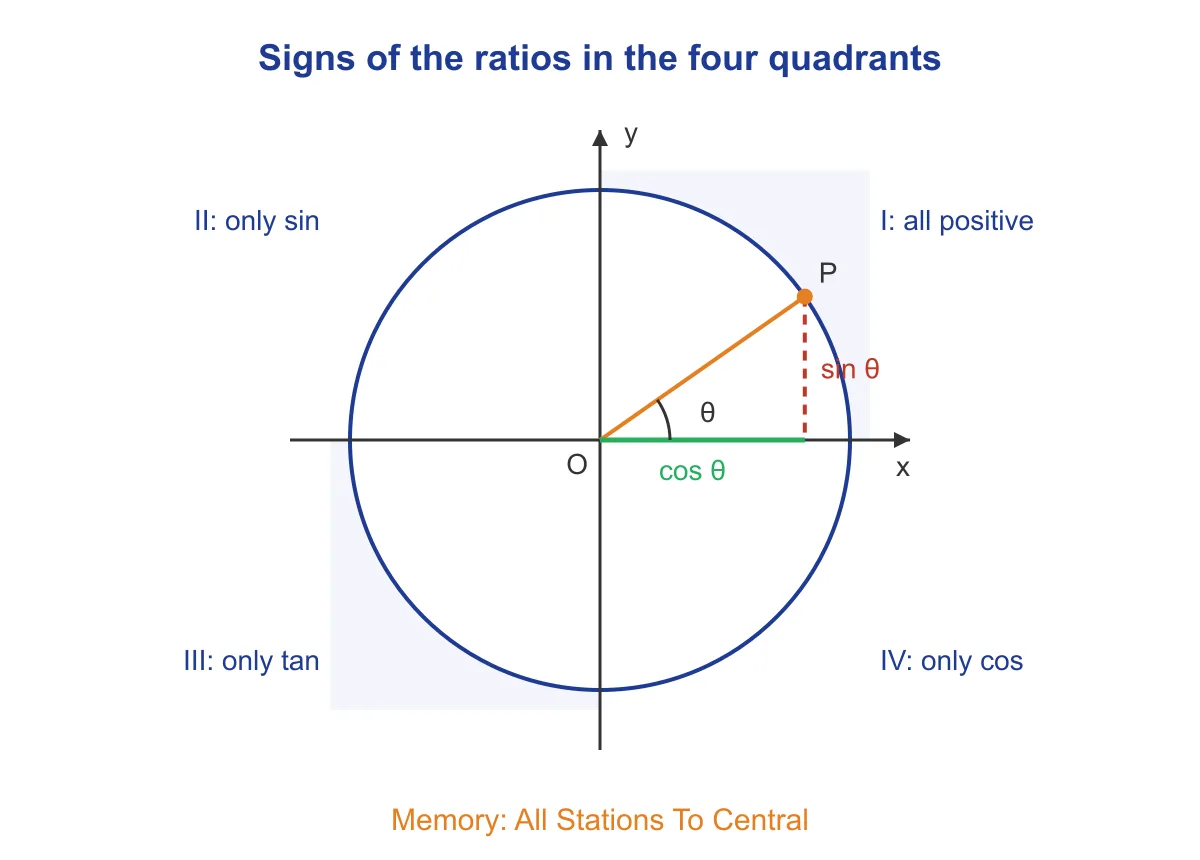
Figure 2.1: Signs of the ratios in the four quadrants
| Quadrant | $\sin$ | $\cos$ | $\tan$ |
|---|---|---|---|
| I ($0$ to $\pi/2$) | $+$ | $+$ | $+$ |
| II ($\pi/2$ to $\pi$) | $+$ | $-$ | $-$ |
| III ($\pi$ to $3\pi/2$) | $-$ | $-$ | $+$ |
| IV ($3\pi/2$ to $2\pi$) | $-$ | $+$ | $-$ |
Memory trick: All Stations To Central. Going anticlockwise from quadrant I, the letters A, S, T, C name what is positive: All, Sin, Tan, Cos. Use it by first reducing the angle to a quadrant, then reading off the sign of the function you need.
Three identities follow straight from $x^2 + y^2 = 1$:
The second one is the first divided by $\cos^2\theta$ and the third is the first divided by $\sin^2\theta$, so they hold only where those divisions make sense.
Periodicity
Adding a full turn returns $P$ to the same point, so $\sin(\theta + 2\pi) = \sin\theta$ and $\cos(\theta + 2\pi) = \cos\theta$. The tangent repeats sooner, after half a turn, because $P$ and the opposite point have the same ratio $y/x$. So
- $\sin x$ and $\cos x$ have period $2\pi$; $\tan x$ has period $\pi$.
- $\sin(nx)$ and $\cos(nx)$ have period $2\pi/n$; $\tan(nx)$ has period $\pi/n$.
- $\vert\sin x\vert$ and $\sin^2 x$ have period $\pi$, since squaring or taking the modulus removes the negative half.
- For a sum such as $\sin 2x + \cos 3x$, the period is the smallest positive number that is a whole-number multiple of both separate periods ($\pi$ and $2\pi/3$ here), which is $2\pi$.
Graphs and standard values
The curve $y = \sin x$ starts at $0$, rises to $1$ at $\pi/2$, returns to $0$ at $\pi$, falls to $-1$ at $3\pi/2$ and is back at $0$ at $2\pi$; then it repeats. The cosine curve is the same wave shifted left by $\pi/2$, so it starts at $1$. The tangent curve climbs from $-\infty$ to $+\infty$ in each interval between its vertical asymptotes $x = \pi/2 + n\pi$. Figure 2.2 shows the sine wave with the line $y = \tfrac12$ drawn across it, and we will use it in the section on equations.
| Function | Domain | Range | Period |
|---|---|---|---|
| $\sin x$ | all real $x$ | $[-1, 1]$ | $2\pi$ |
| $\cos x$ | all real $x$ | $[-1, 1]$ | $2\pi$ |
| $\tan x$ | $x \ne \frac{\pi}{2} + n\pi$ | all real | $\pi$ |
The values you must know by heart:
| Angle | $0$ | $30^\circ$ | $45^\circ$ | $60^\circ$ | $90^\circ$ |
|---|---|---|---|---|---|
| $\sin$ | $0$ | $\frac12$ | $\frac{1}{\sqrt2}$ | $\frac{\sqrt3}{2}$ | $1$ |
| $\cos$ | $1$ | $\frac{\sqrt3}{2}$ | $\frac{1}{\sqrt2}$ | $\frac12$ | $0$ |
| $\tan$ | $0$ | $\frac{1}{\sqrt3}$ | $1$ | $\sqrt3$ | not defined |
Memory trick: For sine write $\frac{\sqrt0}{2}, \frac{\sqrt1}{2}, \frac{\sqrt2}{2}, \frac{\sqrt3}{2}, \frac{\sqrt4}{2}$ and you get $0, \frac12, \frac{1}{\sqrt2}, \frac{\sqrt3}{2}, 1$. Cosine is the same row backwards. Say it aloud: zero, one, two, three, four, all over two!
Allied angles
Angles of the form $90^\circ \pm \theta$, $180^\circ \pm \theta$, $270^\circ \pm \theta$, $360^\circ - \theta$ and $-\theta$ are called allied angles of $\theta$. Their ratios are the ratios of $\theta$ itself, possibly with the function changed and a sign attached. Treat $\theta$ as a small acute angle and apply two steps:
- If the angle is an odd multiple of $90^\circ$ ($90^\circ$ or $270^\circ$), the function changes: $\sin \leftrightarrow \cos$, $\tan \leftrightarrow \cot$. If it is an even multiple ($180^\circ$ or $360^\circ$), the function stays.
- The sign is the sign that the original function has in the quadrant where the allied angle lies.
| Angle | $\sin$ | $\cos$ | $\tan$ |
|---|---|---|---|
| $-\theta$ | $-\sin\theta$ | $\cos\theta$ | $-\tan\theta$ |
| $90^\circ - \theta$ | $\cos\theta$ | $\sin\theta$ | $\cot\theta$ |
| $90^\circ + \theta$ | $\cos\theta$ | $-\sin\theta$ | $-\cot\theta$ |
| $180^\circ - \theta$ | $\sin\theta$ | $-\cos\theta$ | $-\tan\theta$ |
| $180^\circ + \theta$ | $-\sin\theta$ | $-\cos\theta$ | $\tan\theta$ |
| $270^\circ - \theta$ | $-\cos\theta$ | $-\sin\theta$ | $\cot\theta$ |
| $270^\circ + \theta$ | $-\cos\theta$ | $\sin\theta$ | $-\cot\theta$ |
| $360^\circ - \theta$ | $-\sin\theta$ | $\cos\theta$ | $-\tan\theta$ |
Take $\sin(270^\circ + \theta)$. The angle is an odd multiple of $90^\circ$, so sine turns into cosine. It lies in the fourth quadrant when $\theta$ is small, and sine is negative there. Hence $\sin(270^\circ+\theta) = -\cos\theta$, matching the table.
Example 2: Evaluate $\sin 765^\circ$ and $\cos(-1200^\circ)$.
$765^\circ = 2\times 360^\circ + 45^\circ$, so $\sin 765^\circ = \sin 45^\circ = \frac{1}{\sqrt2}$.
Cosine is even: $\cos(-1200^\circ) = \cos 1200^\circ$. Now $1200^\circ = 3\times 360^\circ + 120^\circ$, so we need $\cos 120^\circ$.
$120^\circ = 180^\circ - 60^\circ$ is in quadrant II where cosine is negative, so $\cos 120^\circ = -\cos 60^\circ = -\frac12$.
Answer: $\frac{1}{\sqrt2}$ and $-\frac12$. Strip full turns first; then use allied angles to land in the first quadrant.
Addition and subtraction formulae
The two master formulae are
Here is why the first is true. Put $P = (\cos A, \sin A)$ and $Q = (\cos B, \sin B)$ on the unit circle. The distance $PQ$ depends only on the angle $A - B$ between them, so it equals the distance from $(1,0)$ to $(\cos(A-B), \sin(A-B))$. Squaring both distances,
$(\cos A - \cos B)^2 + (\sin A - \sin B)^2 = (\cos(A-B) - 1)^2 + \sin^2(A-B)$. Expand using $\sin^2 + \cos^2 = 1$: the left side is $2 - 2\cos A\cos B - 2\sin A\sin B$ and the right side is $2 - 2\cos(A-B)$. Equate them and you have the formula. Replace $B$ by $-B$ to get $\cos(A+B)$; write $\sin(A+B) = \cos(90^\circ - A - B)$ and expand to get the sine formulae.
| Formula | Result |
|---|---|
| $\sin(A \pm B)$ | $\sin A\cos B \pm \cos A\sin B$ |
| $\cos(A \pm B)$ | $\cos A\cos B \mp \sin A\sin B$ |
| $\tan(A \pm B)$ | $\dfrac{\tan A \pm \tan B}{1 \mp \tan A\tan B}$ |
| $\cot(A + B)$ | $\dfrac{\cot A\cot B - 1}{\cot A + \cot B}$ |
The tangent rule is the sine rule divided by the cosine rule, and it needs $\tan A$, $\tan B$ and $\tan(A \pm B)$ all to exist.
Memory trick: For sine, "sin-cos, cos-sin, same sign". For cosine, "cos-cos, sin-sin, signs switch". Use it by writing the four letters first, then fixing the sign.
Example 3: Find the exact value of $\sin 75^\circ$ and of $\tan 15^\circ$.
$\sin 75^\circ = \sin(45^\circ + 30^\circ) = \sin 45^\circ\cos 30^\circ + \cos 45^\circ\sin 30^\circ$
$= \frac{1}{\sqrt2}\cdot\frac{\sqrt3}{2} + \frac{1}{\sqrt2}\cdot\frac12 = \frac{\sqrt3 + 1}{2\sqrt2} = \frac{\sqrt6 + \sqrt2}{4}$.
$\tan 15^\circ = \tan(45^\circ - 30^\circ) = \frac{1 - \frac{1}{\sqrt3}}{1 + \frac{1}{\sqrt3}} = \frac{\sqrt3 - 1}{\sqrt3 + 1}$.
Multiply top and bottom by $\sqrt3 - 1$: $\frac{(\sqrt3-1)^2}{2} = \frac{4 - 2\sqrt3}{2} = 2 - \sqrt3$.
Answer: $\frac{\sqrt6+\sqrt2}{4}$ and $2 - \sqrt3$. Any multiple of $15^\circ$ is reachable by splitting into $45^\circ$, $30^\circ$, $60^\circ$ pieces.
Multiple and sub-multiple angles
Put $B = A$ in the addition formulae and the double-angle results appear:
The three forms of $\cos 2A$ come from replacing $\cos^2 A$ by $1 - \sin^2 A$ or the other way round. Choose the form that contains only the function you already know. Rearranged, the middle two forms give the power-reduction pair
Reading these with $2A$ replaced by $A$ gives the sub-multiple (half-angle) results:
The $\pm$ is settled by the quadrant in which $A/2$ lies, not by the quadrant of $A$. This is where students lose marks: if $A = 300^\circ$ then $A/2 = 150^\circ$, where cosine is negative.
For three times an angle, use $\sin 3A = \sin(2A + A)$ and expand:
Example 4: Show that $\sin 18^\circ = \frac{\sqrt5 - 1}{4}$ and hence find $\cos 36^\circ$.
Let $\theta = 18^\circ$. Then $2\theta + 3\theta = 90^\circ$, so $\sin 2\theta = \cos 3\theta$.
$2\sin\theta\cos\theta = 4\cos^3\theta - 3\cos\theta$. Divide by $\cos\theta$ (non-zero for $18^\circ$): $2\sin\theta = 4\cos^2\theta - 3 = 4(1 - \sin^2\theta) - 3$.
So $4s^2 + 2s - 1 = 0$ with $s = \sin\theta$. Then $s = \frac{-2 \pm \sqrt{4 + 16}}{8} = \frac{-1 \pm \sqrt5}{4}$.
Since $\sin 18^\circ > 0$, take the plus sign: $\sin 18^\circ = \frac{\sqrt5 - 1}{4}$.
$\cos 36^\circ = 1 - 2\sin^2 18^\circ = 1 - 2\cdot\frac{6 - 2\sqrt5}{16} = 1 - \frac{3 - \sqrt5}{4} = \frac{1 + \sqrt5}{4}$.
Answer: $\sin 18^\circ = \frac{\sqrt5-1}{4}$, $\cos 36^\circ = \frac{\sqrt5+1}{4}$. Whenever two multiples of an angle add up to $90^\circ$, equate a sine with a cosine.
Sum-to-product and product-to-sum
Adding the formulae for $\sin(A+B)$ and $\sin(A-B)$ gives $2\sin A\cos B$. Doing the same with the other three pairs gives all four product-to-sum results:
Now write $C = A + B$ and $D = A - B$, so that $A = \frac{C+D}{2}$ and $B = \frac{C-D}{2}$. The same four results read right to left:
| Sum or difference | Product |
|---|---|
| $\sin C + \sin D$ | $2\sin\frac{C+D}{2}\cos\frac{C-D}{2}$ |
| $\sin C - \sin D$ | $2\cos\frac{C+D}{2}\sin\frac{C-D}{2}$ |
| $\cos C + \cos D$ | $2\cos\frac{C+D}{2}\cos\frac{C-D}{2}$ |
| $\cos C - \cos D$ | $-2\sin\frac{C+D}{2}\sin\frac{C-D}{2}$ |
Memory trick: "Sine plus sine: sine-cos. Cos plus cos: cos-cos. Cos minus cos: minus two sine-sine!" Use it by remembering that only the cosine difference carries a minus sign out front.
Use sum-to-product when you want a factorised expression (to solve an equation or simplify a fraction), and product-to-sum when you want a sum (to integrate, or to collapse a chain of products).
Example 5: Find the value of $\cos 20^\circ\cos 40^\circ\cos 80^\circ$.
Multiply and divide by $\sin 20^\circ$. Let $P$ be the product, so $P\sin 20^\circ = \sin 20^\circ\cos 20^\circ\cos 40^\circ\cos 80^\circ$.
$\sin 20^\circ\cos 20^\circ = \frac12\sin 40^\circ$, so the expression is $\frac12\sin 40^\circ\cos 40^\circ\cos 80^\circ$.
$\sin 40^\circ\cos 40^\circ = \frac12\sin 80^\circ$, giving $\frac14\sin 80^\circ\cos 80^\circ = \frac18\sin 160^\circ$.
And $\sin 160^\circ = \sin(180^\circ - 20^\circ) = \sin 20^\circ$. So $P\sin 20^\circ = \frac18\sin 20^\circ$, and $P = \frac18$.
Answer: $\frac18$. Angles that double each time ($20, 40, 80$) invite repeated use of $\sin 2A = 2\sin A\cos A$.
Conditional identities in a triangle
In a triangle $A + B + C = \pi$, so any two angles together make the supplement of the third. That gives the starting rules
From these come the standard results, each valid when $A + B + C = \pi$ (and for the tangent forms, when no angle is $\pi/2$):
| Identity | Result |
|---|---|
| Tangent sum | $\tan A + \tan B + \tan C = \tan A\tan B\tan C$ |
| Half-angle tangents | $\tan\frac A2\tan\frac B2 + \tan\frac B2\tan\frac C2 + \tan\frac C2\tan\frac A2 = 1$ |
| Sine of doubles | $\sin 2A + \sin 2B + \sin 2C = 4\sin A\sin B\sin C$ |
| Cosine sum | $\cos A + \cos B + \cos C = 1 + 4\sin\frac A2\sin\frac B2\sin\frac C2$ |
| Sine sum | $\sin A + \sin B + \sin C = 4\cos\frac A2\cos\frac B2\cos\frac C2$ |
To prove the tangent identity, start from $A + B = \pi - C$ and take tangent of both sides: $\frac{\tan A + \tan B}{1 - \tan A\tan B} = -\tan C$. Cross-multiply to get $\tan A + \tan B = -\tan C + \tan A\tan B\tan C$, then move $\tan C$ across.
To prove the sine-of-doubles identity, use sum-to-product on the first two terms: $\sin 2A + \sin 2B = 2\sin(A+B)\cos(A-B) = 2\sin C\cos(A-B)$. Also $\sin 2C = 2\sin C\cos C = -2\sin C\cos(A+B)$. Adding, $2\sin C\,[\cos(A-B) - \cos(A+B)] = 2\sin C\cdot 2\sin A\sin B$, which is the right side.
A fast check on any such identity is the equilateral triangle $A = B = C = 60^\circ$. For the cosine sum: left side is $\frac32$, right side is $1 + 4\cdot\frac18 = \frac32$. A single test cannot prove an identity, but a failed test proves it wrong.
Example 6: In a triangle $\tan A = 1$ and $\tan B = 2$. Find $\tan C$ and verify the tangent-sum identity.
$C = \pi - (A + B)$, so $\tan C = -\tan(A+B)$.
$\tan(A+B) = \frac{1 + 2}{1 - 1\cdot 2} = \frac{3}{-1} = -3$. So $\tan C = 3$.
Check: $\tan A + \tan B + \tan C = 1 + 2 + 3 = 6$ and $\tan A\tan B\tan C = 1\cdot 2\cdot 3 = 6$.
Answer: $\tan C = 3$. The minus sign in $\tan(A+B) = -\tan C$ is the one most often forgotten.
Maximum and minimum of $a\sin x + b\cos x$
Write the expression as one sine wave. Let $R = \sqrt{a^2 + b^2}$ and choose an angle $\varphi$ with $\cos\varphi = a/R$ and $\sin\varphi = b/R$. Then
Since $\sin(x+\varphi)$ runs through every value from $-1$ to $1$, the expression takes every value from $-R$ to $R$ and nothing outside. So
- maximum $= \sqrt{a^2+b^2}$, reached when $x + \varphi = \frac{\pi}{2}$ (plus full turns);
- minimum $= -\sqrt{a^2+b^2}$, reached when $x + \varphi = -\frac{\pi}{2}$;
- for $a\sin x + b\cos x + c$ the range is $[c - R,\ c + R]$.
The same expression can be written as $R\cos(x - \beta)$ with $\cos\beta = b/R$ instead, which is sometimes shorter. The method also handles $a\sin 2x + b\cos 2x$ (replace $x$ by $2x$) and expressions like $6\sin x\cos x + 4\cos^2x - 4\sin^2x$, which become $3\sin 2x + 4\cos 2x$ after double-angle rewriting.
Example 7: Find the range of $f(x) = 5\sin x - 12\cos x + 3$ and the least positive $x$ at which $f$ is greatest.
Here $a = 5$, $b = -12$, so $R = \sqrt{25 + 144} = 13$.
The range is $[3 - 13,\ 3 + 13] = [-10,\ 16]$.
Write $5\sin x - 12\cos x = 13\sin(x + \varphi)$ with $\cos\varphi = \frac{5}{13}$ and $\sin\varphi = -\frac{12}{13}$, so $\varphi$ is in the fourth quadrant, $\varphi = -\alpha$ where $\tan\alpha = \frac{12}{5}$.
Maximum when $x - \alpha = \frac{\pi}{2}$, that is $x = \frac{\pi}{2} + \alpha$ with $\alpha = \tan^{-1}\frac{12}{5}$.
Answer: range $[-10, 16]$, first maximum at $x = \frac{\pi}{2} + \tan^{-1}\frac{12}{5}$. Do not add $a$ and $b$ to get $17$ (or $|a|+|b|$); the two waves peak at different places.
Trigonometric equations
An equation such as $\sin x = k$ has infinitely many solutions because the function repeats. A principal solution is one that lies in $[0, 2\pi)$, so $\sin x = \frac12$ has the two principal solutions $\frac{\pi}{6}$ and $\frac{5\pi}{6}$. The general solution is a formula that gives every solution as $n$ runs over the integers.
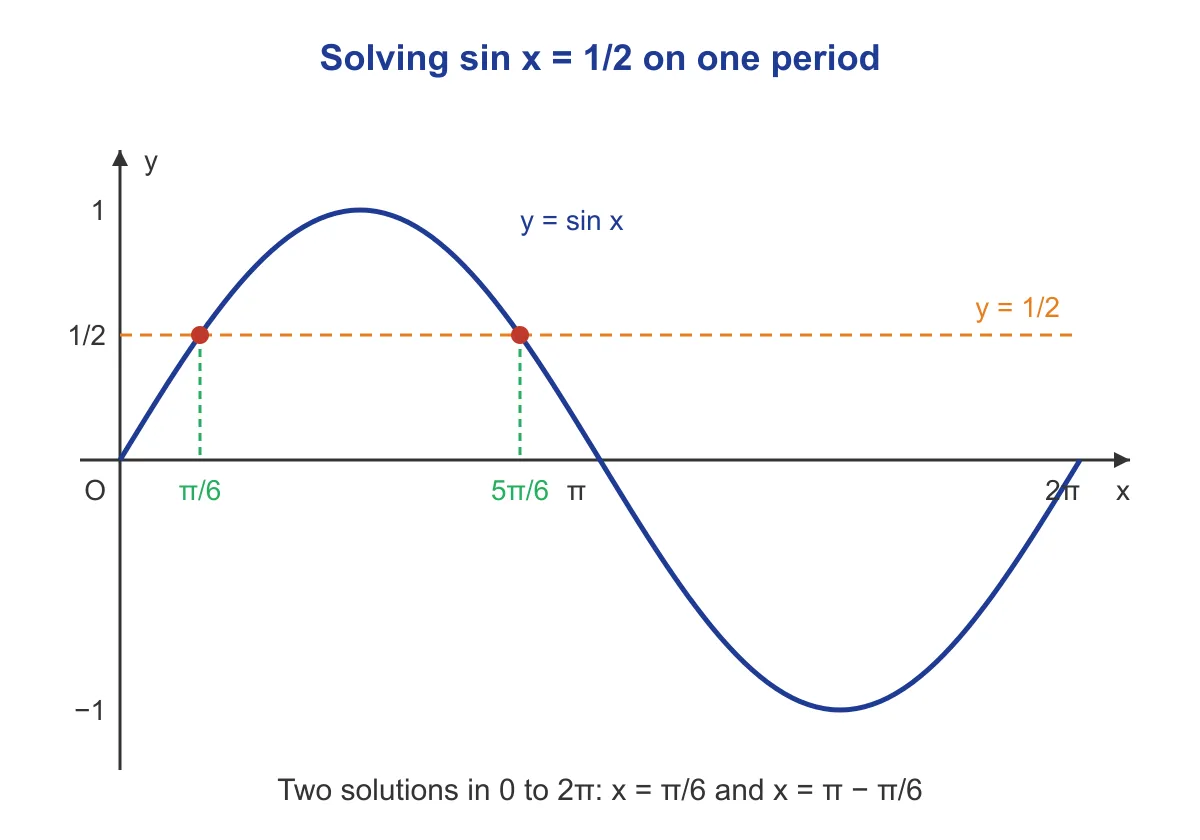
Figure 2.2: Two solutions of sin x = 1/2 in one period
Figure 2.2 shows why there are two solutions per period: the line meets the curve once on the rising part and once on the falling part, at $\alpha$ and $\pi - \alpha$. The formula $x = n\pi + (-1)^n\alpha$ packs these into one statement. For even $n$ it gives $\alpha$ plus full turns, and for odd $n$ it gives $\pi - \alpha$ plus full turns.
| Equation | Solvable when | General solution | Meaning of $\alpha$ |
|---|---|---|---|
| $\sin x = \sin\alpha$ | always | $x = n\pi + (-1)^n\alpha$ | $\alpha \in [-\frac{\pi}{2}, \frac{\pi}{2}]$ |
| $\cos x = \cos\alpha$ | always | $x = 2n\pi \pm \alpha$ | $\alpha \in [0, \pi]$ |
| $\tan x = \tan\alpha$ | always | $x = n\pi + \alpha$ | $\alpha \in (-\frac{\pi}{2}, \frac{\pi}{2})$ |
| $\sin^2x = \sin^2\alpha$ | always | $x = n\pi \pm \alpha$ | any |
| $\cos^2x = \cos^2\alpha$ | always | $x = n\pi \pm \alpha$ | any |
| $\tan^2x = \tan^2\alpha$ | always | $x = n\pi \pm \alpha$ | any |
For $\sin x = k$ and $\cos x = k$ you need $\vert k\vert \le 1$; if $\vert k\vert > 1$ there is no solution. Three special cases are worth memorising because they are shorter than the full formula: $\sin x = 0 \Rightarrow x = n\pi$; $\cos x = 0 \Rightarrow x = (2n+1)\frac{\pi}{2}$; $\tan x = 0 \Rightarrow x = n\pi$. And $\sin x = 1$ gives $x = 2n\pi + \frac{\pi}{2}$ while $\cos x = 1$ gives $x = 2n\pi$.
Equations reducible to these forms
- One function, quadratic. If the equation has only $\sin x$ (or only $\cos x$), treat it as a quadratic in that function, solve, and discard any root outside $[-1, 1]$.
- Two functions, convert. Use $\sin^2 x = 1 - \cos^2 x$ or similar to get a single function.
- Factorise. Use sum-to-product to turn $\sin 3x - \sin x$ or $\cos 5x + \cos x$ into products, then set each factor to zero. Never cancel a common factor; move everything to one side and factorise, or you lose roots.
- **$a\sin x + b\cos x = c$.** Write the left side as $R\sin(x+\varphi)$. A solution exists only if $\vert c\vert \le R$.
Example 8: Solve $2\sin^2 x + \sin x - 1 = 0$.
Treat $s = \sin x$: $2s^2 + s - 1 = (2s - 1)(s + 1) = 0$, so $s = \frac12$ or $s = -1$.
From $\sin x = \frac12 = \sin\frac{\pi}{6}$: $x = n\pi + (-1)^n\frac{\pi}{6}$.
From $\sin x = -1$: $x = 2n\pi - \frac{\pi}{2}$.
Answer: $x = n\pi + (-1)^n\frac{\pi}{6}$ or $x = 2n\pi - \frac{\pi}{2}$. Both roots of the quadratic lie in $[-1, 1]$, so both are used.
Example 9: Solve $\sqrt3\cos x + \sin x = \sqrt2$.
Here $a = 1$ (for $\sin x$) and $b = \sqrt3$, so $R = 2$, $\cos\varphi = \frac12$, $\sin\varphi = \frac{\sqrt3}{2}$, and $\varphi = \frac{\pi}{3}$.
The equation becomes $2\sin\left(x + \frac{\pi}{3}\right) = \sqrt2$, so $\sin\left(x + \frac{\pi}{3}\right) = \frac{1}{\sqrt2} = \sin\frac{\pi}{4}$.
Therefore $x + \frac{\pi}{3} = n\pi + (-1)^n\frac{\pi}{4}$, giving $x = n\pi + (-1)^n\frac{\pi}{4} - \frac{\pi}{3}$.
Check with $n = 0$: $x = \frac{\pi}{4} - \frac{\pi}{3} = -\frac{\pi}{12}$. Then $\sqrt3\cos\left(-\frac{\pi}{12}\right) + \sin\left(-\frac{\pi}{12}\right) = 2\sin\frac{\pi}{4} = \sqrt2$. It holds.
Answer: $x = n\pi + (-1)^n\frac{\pi}{4} - \frac{\pi}{3}$. Solvable because $\sqrt2 < 2 = R$.
Example 10: Solve $\sin 3x = \sin x$.
Move everything to one side: $\sin 3x - \sin x = 0$. By the difference formula, $2\cos 2x\sin x = 0$.
Either $\sin x = 0$, so $x = n\pi$; or $\cos 2x = 0$, so $2x = (2n+1)\frac{\pi}{2}$ and $x = (2n+1)\frac{\pi}{4}$.
Answer: $x = n\pi$ or $x = (2n+1)\frac{\pi}{4}$. Using $\sin A = \sin B \Rightarrow A = n\pi + (-1)^nB$ directly would also work, but needs two cases for even and odd $n$.
Common traps
- Mixing units, writing $\sin(30)$ when radians are meant → decide the unit first; in calculus and general solutions use radians only.
- Reading $\sin^2 x$ as $\sin(x^2)$, or $\sin 2x$ as $2\sin x$ → $\sin 2x = 2\sin x\cos x$; the angle is inside the function.
- Dropping the sign in $\cos(A+B) = \cos A\cos B - \sin A\sin B$ → cosine addition switches the sign, sine addition keeps it.
- Taking $\sin\frac{A}{2} = +\sqrt{\frac{1-\cos A}{2}}$ every time → pick the sign from the quadrant of $A/2$.
- Forgetting $\tan(A+B) = -\tan C$ in a triangle and writing $+\tan C$ → $A + B = \pi - C$, so every ratio takes the allied-angle sign.
- Cancelling $\sin x$ or $\cos x$ from both sides of an equation → move all terms to one side and factorise, so you keep the roots from the cancelled factor.
- Applying $x = n\pi + (-1)^n\alpha$ to $\cos x = k$ → cosine uses $2n\pi \pm \alpha$ and tangent uses $n\pi + \alpha$.
- Stating the maximum of $a\sin x + b\cos x$ as $a + b$ → it is $\sqrt{a^2+b^2}$.
- Squaring an equation and keeping every root → squaring brings in extra roots, so substitute back into the original equation.
- Solving $\sin x = 1.2$ or $\cos x = -3$ by routine formula → check $\vert k\vert \le 1$ first; otherwise there is no solution.
Quick revision
- $\pi$ rad $= 180^\circ$; arc length $s = r\theta$ with $\theta$ in radians.
- $\sin^2\theta + \cos^2\theta = 1$, $\sec^2\theta = 1 + \tan^2\theta$, $\csc^2\theta = 1 + \cot^2\theta$.
- Signs: All, Sin, Tan, Cos positive in quadrants I, II, III, IV.
- Periods: $\sin, \cos$ are $2\pi$; $\tan$ is $\pi$; $\sin^2 x$ and $\vert\sin x\vert$ are $\pi$; $\sin nx$ is $2\pi/n$.
- Odd multiples of $90^\circ$ change the function, even multiples keep it; sign from the quadrant.
- $\sin(A\pm B) = \sin A\cos B \pm \cos A\sin B$ and $\cos(A\pm B) = \cos A\cos B \mp \sin A\sin B$.
- $\tan(A \pm B) = \dfrac{\tan A \pm \tan B}{1 \mp \tan A\tan B}$.
- $\sin 2A = 2\sin A\cos A$; $\cos 2A = 2\cos^2 A - 1 = 1 - 2\sin^2 A$; $\tan 2A = \dfrac{2\tan A}{1-\tan^2 A}$.
- $\sin 3A = 3\sin A - 4\sin^3 A$ and $\cos 3A = 4\cos^3 A - 3\cos A$.
- $\tan\frac{A}{2} = \dfrac{1 - \cos A}{\sin A} = \dfrac{\sin A}{1+\cos A}$; the sign of $\sin\frac A2$ and $\cos\frac A2$ comes from the quadrant of $\frac A2$.
- $\sin C + \sin D = 2\sin\frac{C+D}{2}\cos\frac{C-D}{2}$ and $\cos C - \cos D = -2\sin\frac{C+D}{2}\sin\frac{C-D}{2}$.
- If $A + B + C = \pi$: $\tan A + \tan B + \tan C = \tan A\tan B\tan C$ and $\sin 2A + \sin 2B + \sin 2C = 4\sin A\sin B\sin C$.
- $a\sin x + b\cos x$ lies between $-\sqrt{a^2+b^2}$ and $\sqrt{a^2+b^2}$.
- General solutions: $\sin$: $n\pi + (-1)^n\alpha$; $\cos$: $2n\pi \pm \alpha$; $\tan$: $n\pi + \alpha$; squares: $n\pi \pm \alpha$.
- Values $\sin 18^\circ = \frac{\sqrt5-1}{4}$ and $\cos 36^\circ = \frac{\sqrt5+1}{4}$ appear often in problems.
Practice questions
What is the radian measure of $135^\circ$?
- $\frac{3\pi}{4}$
- $\frac{2\pi}{3}$
- $\frac{5\pi}{6}$
- $\frac{3\pi}{2}$
Answer
A. $\frac{3\pi}{4}$
Multiply by $\pi/180$: $135\times\frac{\pi}{180}=\frac{3\pi}{4}$.
The value of $\cos 210^\circ$ is
- $\frac12$
- $\frac{\sqrt3}{2}$
- $-\frac12$
- $-\frac{\sqrt3}{2}$
Answer
D. $-\frac{\sqrt3}{2}$
$210^\circ=180^\circ+30^\circ$ lies in quadrant III where cosine is negative, so $\cos210^\circ=-\cos30^\circ=-\frac{\sqrt3}{2}$.
$\sin(270^\circ+\theta)$ is equal to
- $\cos\theta$
- $-\cos\theta$
- $-\sin\theta$
- $\sin\theta$
Answer
B. $-\cos\theta$
$270^\circ$ is an odd multiple of $90^\circ$, so sine becomes cosine. For small $\theta$ the angle is in quadrant IV, where sine is negative. Hence $-\cos\theta$.
The period of $f(x)=\sin 2x+\cos 3x$ is
- $\pi$
- $6\pi$
- $2\pi$
- $\frac{2\pi}{3}$
Answer
C. $2\pi$
Periods are $\pi$ and $\frac{2\pi}{3}$. The least common multiple: $2\times\pi=3\times\frac{2\pi}{3}=2\pi$, and nothing smaller works, so the period is $2\pi$.
If $\tan\theta=\frac13$, then $\cos2\theta$ equals
- $\frac45$
- $\frac89$
- $\frac54$
- $\frac35$
Answer
A. $\frac45$
$\cos2\theta=\frac{1-\tan^2\theta}{1+\tan^2\theta}=\frac{1-\frac19}{1+\frac19}=\frac{8/9}{10/9}=\frac45$. (Check: $\sin2\theta=\frac{2/3}{10/9}=\frac35$ and $\left(\frac35\right)^2+\left(\frac45\right)^2=1$.)
The value of $\sin105^\circ+\cos105^\circ$ is
- $\frac{\sqrt6}{2}$
- $-\frac{1}{\sqrt2}$
- $\frac{1}{\sqrt2}$
- $1$
Answer
C. $\frac{1}{\sqrt2}$
$\sin105^\circ+\cos105^\circ=\sqrt2\sin(105^\circ+45^\circ)=\sqrt2\sin150^\circ=\frac{\sqrt2}{2}=\frac{1}{\sqrt2}$. Check: $\sin105^\circ=\frac{\sqrt6+\sqrt2}{4}$, $\cos105^\circ=-\frac{\sqrt6-\sqrt2}{4}$; the sum is $\frac{2\sqrt2}{4}$.
The general solution of $\tan x=\sqrt3$ is
- $x=n\pi+(-1)^n\frac{\pi}{3}$
- $x=n\pi+\frac{\pi}{3}$
- $x=2n\pi\pm\frac{\pi}{3}$
- $x=n\pi+\frac{\pi}{6}$
Answer
B. $x=n\pi+\frac{\pi}{3}$
$\sqrt3=\tan\frac{\pi}{3}$ and $\tan x=\tan\alpha$ gives $x=n\pi+\alpha$.
The general solution of $\cos2x=\frac12$ is
- $x=2n\pi\pm\frac{\pi}{6}$
- $x=n\pi+(-1)^n\frac{\pi}{6}$
- $x=n\pi\pm\frac{\pi}{3}$
- $x=n\pi\pm\frac{\pi}{6}$
Answer
D. $x=n\pi\pm\frac{\pi}{6}$
$\cos2x=\cos\frac{\pi}{3}$ gives $2x=2n\pi\pm\frac{\pi}{3}$, so $x=n\pi\pm\frac{\pi}{6}$.
The value of $\cos36^\circ-\cos72^\circ$ is
- $1$
- $\frac{\sqrt5}{4}$
- $\frac14$
- $\frac12$
Answer
D. $\frac12$
$\cos36^\circ=\frac{\sqrt5+1}{4}$ and $\cos72^\circ=\sin18^\circ=\frac{\sqrt5-1}{4}$. Difference $=\frac24=\frac12$.
The range of $f(x)=\sin x-\cos x$ is
- $[-1,1]$
- $[-2,2]$
- $[-\sqrt2,\sqrt2]$
- $[0,\sqrt2]$
Answer
C. $[-\sqrt2,\sqrt2]$
$R=\sqrt{1^2+(-1)^2}=\sqrt2$, so $f(x)=\sqrt2\sin\left(x-\frac{\pi}{4}\right)$ takes all values in $[-\sqrt2,\sqrt2]$.
In a triangle $ABC$, $\cos\frac{A+B}{2}$ is equal to
- $-\sin\frac C2$
- $\sin\frac C2$
- $\cos\frac C2$
- $\sin C$
Answer
B. $\sin\frac C2$
$\frac{A+B}{2}=\frac{\pi}{2}-\frac C2$, so $\cos\frac{A+B}{2}=\sin\frac C2$. Test with $A=B=C=60^\circ$: $\cos60^\circ=\sin30^\circ=\frac12$.
If $\sin\theta=\frac35$ and $\theta$ is acute, then $\sin3\theta$ equals
- $\frac{117}{125}$
- $\frac{108}{125}$
- $-\frac{31}{125}$
- $-\frac{117}{125}$
Answer
A. $\frac{117}{125}$
$\sin3\theta=3\sin\theta-4\sin^3\theta=\frac95-\frac{108}{125}=\frac{225-108}{125}=\frac{117}{125}$. Check with $\cos\theta=\frac45$: $\sin3\theta=3\cdot\frac35\cdot\frac{16}{25}-\frac{27}{125}=\frac{144-27}{125}$.
The smallest positive value of $x$ satisfying $\sin x=-\frac12$ is
- $\frac{5\pi}{6}$
- $\frac{7\pi}{6}$
- $\frac{11\pi}{6}$
- $\frac{4\pi}{3}$
Answer
B. $\frac{7\pi}{6}$
Sine is negative in quadrants III and IV. The reference angle is $\frac{\pi}{6}$, giving $\pi+\frac{\pi}{6}=\frac{7\pi}{6}$ and $2\pi-\frac{\pi}{6}=\frac{11\pi}{6}$. The smaller is $\frac{7\pi}{6}$.
The general solution of $\sin x+\cos x=1$ is
- $x=2n\pi+\frac{\pi}{4}$
- $x=n\pi$ or $x=n\pi+\frac{\pi}{2}$
- $x=2n\pi$ or $x=2n\pi+\frac{\pi}{2}$
- $x=2n\pi\pm\frac{\pi}{4}$
Answer
C. $x=2n\pi$ or $x=2n\pi+\frac{\pi}{2}$
$\sqrt2\sin\left(x+\frac{\pi}{4}\right)=1$ gives $x+\frac{\pi}{4}=n\pi+(-1)^n\frac{\pi}{4}$. For even $n=2k$: $x=2k\pi$. For odd $n=2k+1$: $x=2k\pi+\pi-\frac{\pi}{4}-\frac{\pi}{4}=2k\pi+\frac{\pi}{2}$. Check $x=\pi$: $0-1\ne1$, so the second option is wrong.
Find the value of $4\sin30^\circ\cos60^\circ+\tan45^\circ$.
- 3
- 1
- 4
- 2
Answer
D. 2
$4\cdot\frac12\cdot\frac12+1=1+1=2$.
A wheel makes $1.5$ complete revolutions anticlockwise. The angle turned is $k\pi$ radians. Find $k$.
- 1.5
- 3
- 6
- 0.75
Answer
B. 3
One revolution is $2\pi$, so $1.5$ revolutions give $3\pi$; $k=3$.
Find the value of $\sin15^\circ\cos15^\circ$.
- 0.25
- 0.5
- 0.75
- 0.125
Answer
A. 0.25
$\sin15^\circ\cos15^\circ=\frac12\sin30^\circ=\frac12\cdot\frac12=0.25$.
Find the value of $\sin10^\circ\sin50^\circ\sin70^\circ$.
- 0.5
- 0.0625
- 0.125
- 0.25
Answer
C. 0.125
$\sin10^\circ=\cos80^\circ$, $\sin50^\circ=\cos40^\circ$, $\sin70^\circ=\cos20^\circ$. The product $\cos20^\circ\cos40^\circ\cos80^\circ$: multiply by $\sin20^\circ$ and use $\sin2A=2\sin A\cos A$ thrice to get $\frac18\sin160^\circ=\frac18\sin20^\circ$. So the value is $\frac18=0.125$.
Find the minimum value of $3\sin x-4\cos x+7$.
- 12
- 0
- 3
- 2
Answer
D. 2
$R=\sqrt{9+16}=5$, so $3\sin x-4\cos x$ has minimum $-5$. Minimum of the expression is $7-5=2$.
Find the number of solutions of $2\cos x=1$ in the interval $[0,4\pi]$.
- 2
- 3
- 4
- 5
Answer
C. 4
$\cos x=\frac12$ gives $x=2n\pi\pm\frac{\pi}{3}$. In $[0,4\pi]$: $\frac{\pi}{3},\frac{5\pi}{3},\frac{7\pi}{3},\frac{11\pi}{3}$. Four solutions ($\frac{13\pi}{3}>4\pi$).
If $\tan A=2$ and $\tan B=3$, find $\tan(A+B)$.
- -1
- 1
- 5
- -5
Answer
A. -1
$\tan(A+B)=\frac{2+3}{1-2\cdot3}=\frac{5}{-5}=-1$.
Find the value of $\cos24^\circ+\cos55^\circ+\cos125^\circ+\cos204^\circ+\cos300^\circ$.
- 0
- 0.5
- 1
- -0.5
Answer
B. 0.5
$\cos204^\circ=\cos(180^\circ+24^\circ)=-\cos24^\circ$ and $\cos125^\circ=\cos(180^\circ-55^\circ)=-\cos55^\circ$. These cancel the first two terms. $\cos300^\circ=\cos60^\circ=0.5$.
The sum of all solutions of $\sin2x=\frac12$ in $[0,2\pi]$ is $k\pi$. Find $k$.
- 2
- 4
- 3
- 6
Answer
C. 3
$2x\in[0,4\pi]$ with $\sin2x=\frac12$: $2x=\frac{\pi}{6},\frac{5\pi}{6},\frac{13\pi}{6},\frac{17\pi}{6}$. So $x=\frac{\pi}{12},\frac{5\pi}{12},\frac{13\pi}{12},\frac{17\pi}{12}$, whose sum is $\frac{36\pi}{12}=3\pi$.
Find the number of solutions of $\sin x+\cos x=1$ in the closed interval $[0,4\pi]$.
- 5
- 4
- 3
- 6
Answer
A. 5
$\sin x+\cos x=1$ gives $x=2n\pi$ or $x=2n\pi+\frac{\pi}{2}$. In $[0,4\pi]$: $0,\frac{\pi}{2},2\pi,\frac{5\pi}{2},4\pi$. That is $5$ solutions.
Find the maximum value of $6\sin x\cos x+4\cos^2x-4\sin^2x$.
- 5
- 7
- 10
- 1
Answer
A. 5
The expression is $3\sin2x+4\cos2x$, whose maximum is $\sqrt{9+16}=5$.
If $\sin x+\sin^2x=1$, find the value of $\cos^2x+\cos^4x$.
- 0
- 1
- 2
- 0.5
Answer
B. 1
$\sin x=1-\sin^2x=\cos^2x$. So $\cos^2x+\cos^4x=\sin x+\sin^2x=1$.
Given below are two statements: Statement I: $\sin(-\theta)=-\sin\theta$ for every angle $\theta$. Statement II: $\cos(-\theta)=-\cos\theta$ for every angle $\theta$.
- Both Statement I and Statement II are correct
- Both Statement I and Statement II are incorrect
- Statement I is correct but Statement II is incorrect
- Statement I is incorrect but Statement II is correct
Answer
C. Statement I is correct but Statement II is incorrect
Sine is an odd function, so Statement I is correct. Cosine is even: $\cos(-\theta)=\cos\theta$, so Statement II is wrong.
Given below are two statements: Statement I: The function $\tan x$ has period $\pi$. Statement II: The general solution of $\tan x=\tan\alpha$ is $x=n\pi+\alpha$, where $n$ is an integer.
- Both Statement I and Statement II are correct
- Both Statement I and Statement II are incorrect
- Statement I is correct but Statement II is incorrect
- Statement I is incorrect but Statement II is correct
Answer
A. Both Statement I and Statement II are correct
Both are standard results; the second follows from the first, since $\tan(\alpha+n\pi)=\tan\alpha$.
Given below are two statements: Statement I: The equation $\sin x+\cos x=\frac32$ has no real solution. Statement II: The expression $a\sin x+b\cos x$ can take every value from $-(\vert a\vert+\vert b\vert)$ to $\vert a\vert+\vert b\vert$.
- Both Statement I and Statement II are correct
- Both Statement I and Statement II are incorrect
- Statement I is correct but Statement II is incorrect
- Statement I is incorrect but Statement II is correct
Answer
C. Statement I is correct but Statement II is incorrect
The maximum of $\sin x+\cos x$ is $\sqrt2\approx1.414<1.5$, so Statement I is correct. The true bound is $\sqrt{a^2+b^2}$, which is less than $\vert a\vert+\vert b\vert$ when both are non-zero, so the expression cannot reach $\vert a\vert+\vert b\vert$. Statement II is wrong.
Given below are two statements: Statement I: $\sin2A=2\sin A$ for every angle $A$. Statement II: $\tan(A+B)=\frac{\tan A+\tan B}{1-\tan A\tan B}$ whenever $\tan A$, $\tan B$ and $\tan(A+B)$ are all defined.
- Both Statement I and Statement II are correct
- Both Statement I and Statement II are incorrect
- Statement I is correct but Statement II is incorrect
- Statement I is incorrect but Statement II is correct
Answer
D. Statement I is incorrect but Statement II is correct
$\sin2A=2\sin A\cos A$; with $A=30^\circ$ the left side is $\frac{\sqrt3}{2}$ and the right side is $1$. Statement I is wrong. Statement II is the standard tangent addition rule, which is correct.
Given below are two statements: Statement I: The general solution of $\cos x=\cos\alpha$ is $x=n\pi+(-1)^n\alpha$. Statement II: The general solution of $\sin^2x=\sin^2\alpha$ is $x=2n\pi\pm\alpha$.
- Both Statement I and Statement II are correct
- Both Statement I and Statement II are incorrect
- Statement I is correct but Statement II is incorrect
- Statement I is incorrect but Statement II is correct
Answer
B. Both Statement I and Statement II are incorrect
For $\cos x=\cos\alpha$ the solution is $x=2n\pi\pm\alpha$, so Statement I is wrong. For $\sin^2x=\sin^2\alpha$ it is $x=n\pi\pm\alpha$; for example $x=\pi-\alpha$ works since $\sin(\pi-\alpha)=\sin\alpha$, but $\pi-\alpha$ is not of the form $2n\pi\pm\alpha$. Statement II is wrong.
Assertion (A): The equation $\sin x=2$ has no real solution. Reason (R): The range of $\sin x$ is $[-1,1]$.
- Both A and R are true and R is the correct explanation of A
- Both A and R are true but R is not the correct explanation of A
- A is true but R is false
- A is false but R is true
Answer
A. Both A and R are true and R is the correct explanation of A
Since $\sin x$ never exceeds $1$, no real $x$ gives $2$. R is true and directly explains A.
Assertion (A): The period of $\sin x\cos x$ is $\pi$. Reason (R): The period of $\sin x$ is $2\pi$.
- Both A and R are true and R is the correct explanation of A
- Both A and R are true but R is not the correct explanation of A
- A is true but R is false
- A is false but R is true
Answer
B. Both A and R are true but R is not the correct explanation of A
$\sin x\cos x=\frac12\sin2x$ has period $\frac{2\pi}{2}=\pi$, so A is true. R is also a true statement, but the period of $\sin x$ alone does not give the period of the product; the doubled angle does. R is not the explanation.
Assertion (A): The maximum value of $3\sin x+4\cos x$ is $7$. Reason (R): The maximum value of $a\sin x+b\cos x$ is $\sqrt{a^2+b^2}$.
- Both A and R are true and R is the correct explanation of A
- Both A and R are true but R is not the correct explanation of A
- A is true but R is false
- A is false but R is true
Answer
D. A is false but R is true
The maximum of $3\sin x+4\cos x$ is $\sqrt{9+16}=5$, not $7$, so A is false. R is the correct general result, so R is true.
Match List I with List II. List I: a. $\sin150^\circ$ b. $\cos120^\circ$ c. $\tan225^\circ$ d. $\cot135^\circ$ List II: i. $1$ ii. $-1$ iii. $\frac12$ iv. $-\frac12$
- a-iv, b-iii, c-i, d-ii
- a-i, b-ii, c-iii, d-iv
- a-iii, b-iv, c-ii, d-i
- a-iii, b-iv, c-i, d-ii
Answer
D. a-iii, b-iv, c-i, d-ii
$\sin150^\circ=\sin30^\circ=\frac12$ (iii). $\cos120^\circ=-\cos60^\circ=-\frac12$ (iv). $\tan225^\circ=\tan45^\circ=1$ (i). $\cot135^\circ=-\cot45^\circ=-1$ (ii).
Match List I with List II. List I: a. $\sin2A$ b. $\cos2A$ c. $\tan2A$ d. $\sin3A$ List II: i. $3\sin A-4\sin^3A$ ii. $\frac{2\tan A}{1-\tan^2A}$ iii. $2\sin A\cos A$ iv. $1-2\sin^2A$
- a-iii, b-iv, c-ii, d-i
- a-iv, b-iii, c-ii, d-i
- a-i, b-ii, c-iii, d-iv
- a-iii, b-iv, c-i, d-ii
Answer
A. a-iii, b-iv, c-ii, d-i
These are the standard double and triple angle forms: $\sin2A=2\sin A\cos A$ (iii), $\cos2A=1-2\sin^2A$ (iv), $\tan2A=\frac{2\tan A}{1-\tan^2A}$ (ii), $\sin3A=3\sin A-4\sin^3A$ (i).
Match List I with List II. List I: a. $\sin x=1$ b. $\cos x=-1$ c. $\cos x=0$ d. $\tan x=1$ List II: i. $x=(2n+1)\frac{\pi}{2}$ ii. $x=(2n+1)\pi$ iii. $x=2n\pi+\frac{\pi}{2}$ iv. $x=n\pi+\frac{\pi}{4}$
- a-i, b-ii, c-iii, d-iv
- a-iii, b-ii, c-iv, d-i
- a-iii, b-i, c-ii, d-iv
- a-iii, b-ii, c-i, d-iv
Answer
D. a-iii, b-ii, c-i, d-iv
$\sin x=1$ at $2n\pi+\frac{\pi}{2}$ (iii). $\cos x=-1$ at odd multiples of $\pi$ (ii). $\cos x=0$ at odd multiples of $\frac{\pi}{2}$ (i). $\tan x=1=\tan\frac{\pi}{4}$ gives $n\pi+\frac{\pi}{4}$ (iv).
In a triangle $ABC$, $\tan A=\frac12$ and $\tan B=\frac13$. The angle $C$ is
- $45^\circ$
- $135^\circ$
- $60^\circ$
- $120^\circ$
Answer
B. $135^\circ$
$\tan(A+B)=\frac{\frac12+\frac13}{1-\frac16}=\frac{5/6}{5/6}=1$. $A$ and $B$ are acute with $\tan(A+B)=1$, and $\tan A\tan B<1$ so $A+B=45^\circ$. Then $C=180^\circ-45^\circ=135^\circ$. Check: $\tan C=-1$ and $\frac12+\frac13-1=-\frac16=\frac12\cdot\frac13\cdot(-1)$.
An observer stands on level ground 40 m from the foot of a tower 30 m high that carries a flagstaff 10 m long on its top. If $\theta$ is the angle the flagstaff subtends at the observer's eye (take the eye at ground level), then $\tan\theta$ equals
- $\frac17$
- $7$
- $\frac15$
- $\frac14$
Answer
A. $\frac17$
Elevation of the tower top: $\tan\alpha=\frac{30}{40}=\frac34$. Elevation of the flagstaff top: $\tan\beta=\frac{40}{40}=1$. $\theta=\beta-\alpha$, so $\tan\theta=\frac{1-\frac34}{1+\frac34}=\frac{1/4}{7/4}=\frac17$.
The displacement of a particle is $y=\sin x+\sqrt3\cos x$ metres, with $x$ in radians. For $0\le x\le2\pi$, the displacement equals $1$ metre at $x=$
- $\frac{\pi}{2}$ alone
- $\frac{\pi}{6}$ and $\frac{5\pi}{6}$
- $\frac{\pi}{6}$ and $\frac{\pi}{2}$
- $\frac{\pi}{2}$ and $\frac{11\pi}{6}$
Answer
D. $\frac{\pi}{2}$ and $\frac{11\pi}{6}$
$y=2\sin\left(x+\frac{\pi}{3}\right)=1$, so $\sin\left(x+\frac{\pi}{3}\right)=\frac12$ with $x+\frac{\pi}{3}\in\left[\frac{\pi}{3},\frac{7\pi}{3}\right]$. Solutions: $\frac{5\pi}{6}$ and $\frac{13\pi}{6}$ (the value $\frac{\pi}{6}$ is below $\frac{\pi}{3}$). So $x=\frac{\pi}{2}$ and $\frac{11\pi}{6}$. Check $x=\frac{11\pi}{6}$: $-\frac12+\sqrt3\cdot\frac{\sqrt3}{2}=1$.