Inverse Trigonometric Functions
What to remember
- Every trigonometric function repeats its values, so it has no inverse until we cut out one piece where it is one-to-one. That piece is the principal branch, and every answer an inverse function gives must lie inside it.
- Principal ranges: $\sin^{-1}x \in [-\pi/2, \pi/2]$, $\cos^{-1}x \in [0, \pi]$, $\tan^{-1}x \in (-\pi/2, \pi/2)$, $\cot^{-1}x \in (0, \pi)$, $\sec^{-1}x \in [0,\pi]$ except $\pi/2$, $\csc^{-1}x \in [-\pi/2,\pi/2]$ except $0$.
- $\sin(\sin^{-1}x) = x$ for every $x$ in $[-1,1]$, but $\sin^{-1}(\sin x) = x$ only when $x$ is already in $[-\pi/2,\pi/2]$. Outside that interval the graph is a triangle wave, not a straight line.
- Complementary pairs: $\sin^{-1}x + \cos^{-1}x = \pi/2$ on $[-1,1]$, $\tan^{-1}x + \cot^{-1}x = \pi/2$ for all real $x$, $\sec^{-1}x + \csc^{-1}x = \pi/2$ for $\lvert x\rvert \ge 1$.
- $\tan^{-1}x + \tan^{-1}y = \tan^{-1}\frac{x+y}{1-xy}$ holds only when $xy < 1$. When $xy > 1$ you must add or subtract $\pi$, depending on the sign of $x$ and $y$.
1. Why a restricted domain is needed
Take $\sin\theta = \tfrac12$. The angles $\pi/6,\ 5\pi/6,\ 13\pi/6, \dots$ all satisfy it. If we wanted "the inverse of sine" as a function, one input ($\tfrac12$) would produce many outputs, and a function is allowed only one. The cure is to look at sine on a short stretch where it never repeats a value, and invert only that stretch.
For sine, the stretch $[-\pi/2, \pi/2]$ works. On it, sine climbs steadily from $-1$ to $1$, so every value in $[-1,1]$ is met exactly once. We then define
Read it as "$y$ is the angle, in the principal range, whose sine is $x$". The two conditions go together. If you drop the range condition, the symbol no longer names a single number.
Two warnings before we go on. First, $\sin^{-1}x$ is an angle, not $\frac{1}{\sin x}$. The reciprocal is $\csc x$. Second, the output of an inverse trigonometric function is always an angle, so in radians the answer is a multiple of $\pi$ (or something like $\tan^{-1}2$), never a ratio.
2. The six functions and their principal branches
Each trigonometric function is cut on an interval that (a) makes it one-to-one, (b) covers its whole range of values, and (c) contains angles near $0$ whenever possible. Cosine cannot use $[-\pi/2,\pi/2]$ because cosine falls and rises there, so it takes $[0,\pi]$. Tangent and cotangent need open intervals because they blow up at the ends.
| Function | Domain | Principal range | Behaviour |
|---|---|---|---|
| $\sin^{-1}x$ | $[-1,1]$ | $[-\pi/2, \pi/2]$ | increasing, odd |
| $\cos^{-1}x$ | $[-1,1]$ | $[0, \pi]$ | decreasing, neither odd nor even |
| $\tan^{-1}x$ | all real $x$ | $(-\pi/2, \pi/2)$ | increasing, odd |
| $\cot^{-1}x$ | all real $x$ | $(0, \pi)$ | decreasing, neither |
| $\sec^{-1}x$ | $\lvert x\rvert \ge 1$ | $[0,\pi]$, $y \ne \pi/2$ | increasing on each piece |
| $\csc^{-1}x$ | $\lvert x\rvert \ge 1$ | $[-\pi/2,\pi/2]$, $y \ne 0$ | decreasing on each piece |
This book uses the branches in the table. Some texts pick a different branch for $\sec^{-1}$, so if a question states its own convention, follow that.
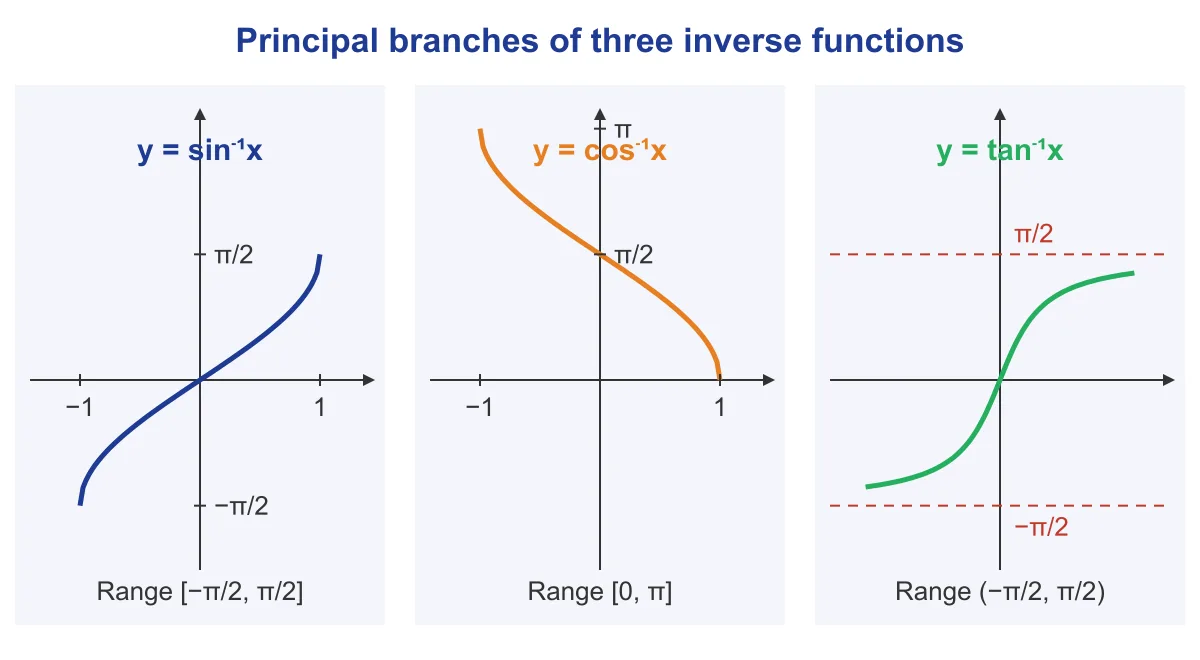
Figure 3.1: Graphs of the principal branches of sin⁻¹, cos⁻¹ and tan⁻¹
Look at what the picture tells you. The graph of $\sin^{-1}x$ is the graph of $\sin x$ on $[-\pi/2,\pi/2]$ reflected in the line $y = x$, so it ends in vertical tangents at $x = \pm 1$. The graph of $\cos^{-1}x$ is the same shape turned upside down and lifted by $\pi/2$, which is the picture behind $\sin^{-1}x + \cos^{-1}x = \pi/2$. The graph of $\tan^{-1}x$ is bounded: it creeps up towards $\pi/2$ as $x \to \infty$ and down towards $-\pi/2$ as $x \to -\infty$, and these two horizontal lines are asymptotes.
The other three follow the same plan. $\cot^{-1}x$ falls from $\pi$ (far left) to $0$ (far right) passing through $(0, \pi/2)$. $\sec^{-1}x$ has two pieces: for $x \ge 1$ it rises from $0$ towards $\pi/2$, and for $x \le -1$ it rises from $\pi/2$ (approached, not reached) up to $\pi$ at $x=-1$. $\csc^{-1}x$ also has two pieces: for $x\ge1$ it falls from $\pi/2$ towards $0$, and for $x \le -1$ it falls from $0$ towards $-\pi/2$ at $x=-1$.
Example 1: Find the principal values of (a) $\sin^{-1}\left(-\tfrac12\right)$, (b) $\cos^{-1}\left(-\tfrac{\sqrt3}{2}\right)$, (c) $\sec^{-1}(-2)$, (d) $\cot^{-1}(-1)$.
(a) We need an angle in $[-\pi/2,\pi/2]$ with sine $-\tfrac12$. That is $-\pi/6$.
(b) We need an angle in $[0,\pi]$ with cosine $-\tfrac{\sqrt3}{2}$. Cosine is negative in the second quadrant, and the reference angle is $\pi/6$, so the angle is $\pi - \pi/6 = 5\pi/6$.
(c) $\sec y = -2$ means $\cos y = -\tfrac12$ with $y\in[0,\pi]$. So $y = 2\pi/3$.
(d) $\cot y = -1$ with $y \in (0,\pi)$. Cotangent is negative in the second quadrant, reference angle $\pi/4$, so $y = 3\pi/4$.
Answers: $-\pi/6,\ 5\pi/6,\ 2\pi/3,\ 3\pi/4$.
Notice that the negative inputs gave negative angles only for $\sin^{-1}$. For $\cos^{-1}$, $\sec^{-1}$ and $\cot^{-1}$ the range has no negative angles, so a negative input lands in the second quadrant.
3. Basic properties
Negative arguments. Because sine, tangent and cosecant are odd functions, their inverses are odd too:
The other three have ranges that start at $0$, so a minus sign cannot simply come out. Instead they reflect about $\pi/2$ (the middle of the range):
Memory trick: "S, T, C come out, the rest are π-minus!" The letters stand for sine, tangent, cosecant: the minus sign comes out in front. Cos, cot, sec turn $x$ into $\pi$ minus the answer.
Use it the moment you see a negative argument inside any inverse function.
Complementary pairs. Let $\theta = \sin^{-1}x$, so $x = \sin\theta$ and $\theta \in[-\pi/2,\pi/2]$. Then $x = \cos\left(\frac{\pi}{2}-\theta\right)$ and $\frac\pi2 - \theta \in [0,\pi]$, which is exactly the principal range of $\cos^{-1}$. Hence $\cos^{-1}x = \frac{\pi}{2}-\theta$, that is,
The same reasoning gives $\tan^{-1}x + \cot^{-1}x = \frac\pi2$ for all real $x$, and $\sec^{-1}x + \csc^{-1}x = \frac\pi2$ for $\lvert x\rvert \ge 1$.
Reciprocal arguments. For $\lvert x\rvert \ge 1$: $\sin^{-1}\frac1x = \csc^{-1}x$ and $\cos^{-1}\frac1x = \sec^{-1}x$. For tangent the sign of $x$ matters:
Test $x = -1$: the left side is $-\pi/4$, and $\cot^{-1}(-1) - \pi = 3\pi/4 - \pi = -\pi/4$. Good.
| Property | Valid for |
|---|---|
| $\sin^{-1}x + \cos^{-1}x = \pi/2$ | $-1 \le x \le 1$ |
| $\tan^{-1}x + \cot^{-1}x = \pi/2$ | every real $x$ |
| $\sec^{-1}x + \csc^{-1}x = \pi/2$ | $\lvert x\rvert \ge 1$ |
| $\sin^{-1}(-x) = -\sin^{-1}x$ | $-1 \le x \le 1$ |
| $\cos^{-1}(-x) = \pi - \cos^{-1}x$ | $-1 \le x \le 1$ |
| $\tan^{-1}(1/x) = \cot^{-1}x$ | $x > 0$ only |
Example 2: Evaluate $\sin^{-1}\frac35 + \cos^{-1}\frac35 + \tan^{-1}(-\sqrt3)$.
Step 1: the first two terms have the same argument, $\frac35$, which is inside $[-1,1]$. So they add to $\frac\pi2$.
Step 2: $\tan^{-1}(-\sqrt3) = -\tan^{-1}\sqrt3 = -\frac\pi3$.
Step 3: $\frac\pi2 - \frac\pi3 = \frac\pi6$.
Answer: $\frac\pi6$.
No need to know $\sin^{-1}\frac35$ at all. Spot the pair first and the awkward number disappears.
4. $\sin(\sin^{-1}x)$ versus $\sin^{-1}(\sin x)$
These two look like mirror images and behave very differently.
Function first, then its inverse (outer function is the trig one): $\sin(\sin^{-1}x)$. The inner step produces an angle whose sine is $x$, and the outer sine just reads off $x$ again. So $\sin(\sin^{-1}x) = x$ for $x\in[-1,1]$, and the expression is not defined for $\lvert x\rvert>1$. The same holds for $\cos(\cos^{-1}x)$. For $\tan(\tan^{-1}x) = x$ the condition is nothing: every real $x$ is allowed.
Inverse first, then the function (outer function is the inverse): $\sin^{-1}(\sin x)$. Here $x$ can be any real number, but the answer must lie in $[-\pi/2,\pi/2]$. So the output equals $x$ only if $x$ is already in that interval. For other $x$ we replace $x$ by an angle in the principal range that has the same sine.
- If $x \in [\pi/2, 3\pi/2]$: $\sin x = \sin(\pi - x)$ and $\pi - x \in [-\pi/2, \pi/2]$, so $\sin^{-1}(\sin x) = \pi - x$.
- If $x\in[-3\pi/2,-\pi/2]$: $\sin x = \sin(-\pi - x)$, so $\sin^{-1}(\sin x) = -\pi - x$.
- Beyond these, shift by $2\pi$ first; the sine does not notice.
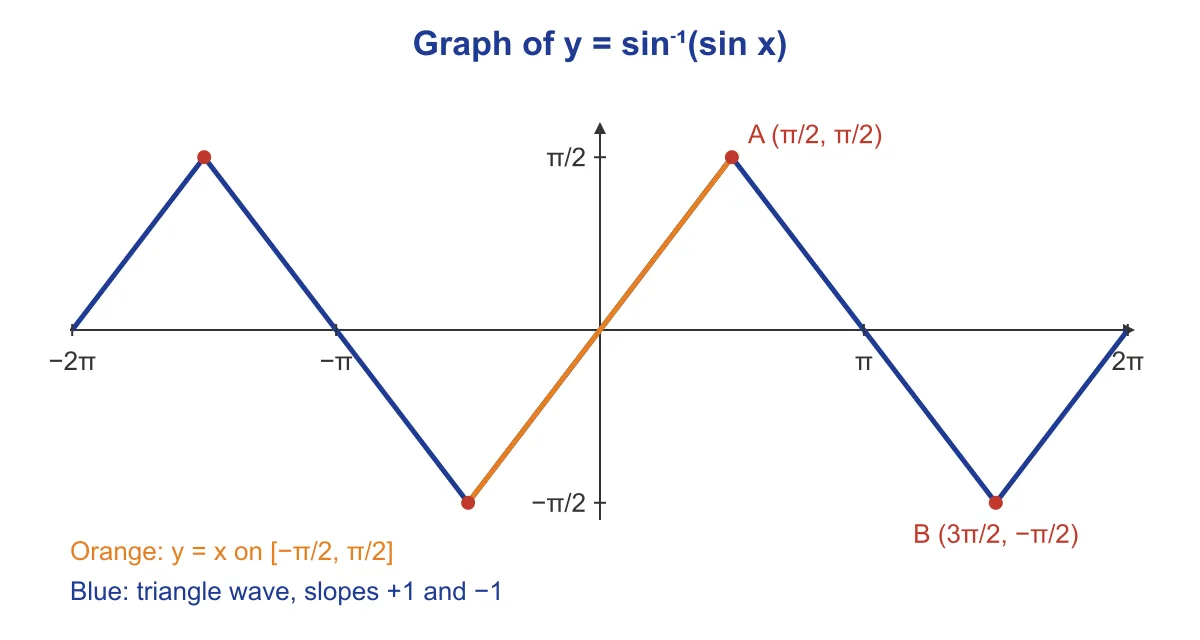
Figure 3.2: The graph of sin⁻¹(sin x) is a triangle wave, equal to x only on [−π/2, π/2]
The picture settles every question of this kind. The wave has period $2\pi$, peaks at $\pi/2$, valleys at $-\pi/2$, and its slope is $+1$ or $-1$ everywhere. If you forget the formula, sketch one tooth of the wave.
The same idea works for the other functions:
| Expression | Equals $x$ when | Other pieces |
|---|---|---|
| $\sin^{-1}(\sin x)$ | $x\in[-\pi/2,\pi/2]$ | $\pi - x$ on $[\pi/2, 3\pi/2]$ |
| $\cos^{-1}(\cos x)$ | $x\in[0,\pi]$ | $2\pi - x$ on $[\pi, 2\pi]$ |
| $\tan^{-1}(\tan x)$ | $x\in(-\pi/2,\pi/2)$ | $x - \pi$ on $(\pi/2, 3\pi/2)$ |
Memory trick: "Fold into the branch." Find where $x$ sits, and mirror or shift it by the symmetry of the trig function until the angle is inside the principal range.
Use it on every $f^{-1}(f(x))$ question: never write "the answer is $x$" until you have checked the branch.
Example 3: Find (a) $\sin^{-1}(\sin 10)$ and (b) $\sin^{-1}\left(\sin\frac{2\pi}{3}\right) + \cos^{-1}\left(\cos\frac{4\pi}{3}\right) + \tan^{-1}\left(\tan\frac{3\pi}{4}\right)$.
(a) $10$ radians is about $3.18\pi$, a little past $3\pi \approx 9.42$. Try $3\pi - 10 \approx -0.575$. It lies in $[-\pi/2,\pi/2]$. Check: $\sin(3\pi - 10) = \sin3\pi\cos10 - \cos3\pi\sin10 = 0 + \sin10$. So $\sin^{-1}(\sin10) = 3\pi - 10$.
(b) First term: $\frac{2\pi}{3}$ is in $[\pi/2,3\pi/2]$, so the value is $\pi - \frac{2\pi}3 = \frac\pi3$.
Second term: $\frac{4\pi}{3}$ is in $[\pi,2\pi]$, so the value is $2\pi - \frac{4\pi}3 = \frac{2\pi}{3}$.
Third term: $\tan\frac{3\pi}4 = -1$, and $\tan^{-1}(-1) = -\frac\pi4$.
Sum: $\frac\pi3 + \frac{2\pi}3 - \frac\pi4 = \frac{3\pi}{4}$.
Answers: (a) $3\pi - 10$, (b) $\frac{3\pi}4$.
A big angle is folded back by adding or subtracting multiples of $\pi$, and the answer is always checked against the branch.
Trig of an inverse trig
When the outer function is a different trig function, draw a right triangle. If $\theta = \sin^{-1}x$ with $x > 0$, take opposite side $x$ and hypotenuse $1$, so the adjacent side is $\sqrt{1-x^2}$. Reading the triangle:
The square root is positive in each case because $\sin^{-1}x$ lies where cosine is non-negative and $\cos^{-1}x$ lies where sine is non-negative. For $\tan^{-1}x$ the angle is in $(-\pi/2,\pi/2)$, where cosine is positive, so $\cos(\tan^{-1}x)$ is positive for every $x$.
Example 4: Find $\cos\left(\sin^{-1}\frac35 + \sin^{-1}\frac5{13}\right)$.
Let $A = \sin^{-1}\frac35$, $B = \sin^{-1}\frac5{13}$. Both are in the first quadrant, so $\cos A = \frac45$ and $\cos B = \frac{12}{13}$.
$\cos(A+B) = \cos A\cos B - \sin A\sin B = \frac45\cdot\frac{12}{13} - \frac35\cdot\frac5{13}$.
$= \frac{48}{65} - \frac{15}{65} = \frac{33}{65}$.
Answer: $\frac{33}{65}$.
Because only the cosine of the sum is wanted, we never need to decide which angle the sum equals.
5. Sum and difference of inverse tangents
Let $\alpha = \tan^{-1}x$, $\beta = \tan^{-1}y$. Then $\tan(\alpha+\beta) = \frac{x+y}{1-xy}$. The trap is that $\alpha + \beta$ can be anywhere in $(-\pi,\pi)$, while $\tan^{-1}$ of anything only returns an angle in $(-\pi/2,\pi/2)$. When $\alpha+\beta$ sits outside that interval, the formula gives an angle that is off by exactly $\pi$.
That happens precisely when $xy > 1$. (When $xy < 1$ the two angles together stay inside $(-\pi/2,\pi/2)$.) So:
| Condition | $\tan^{-1}x + \tan^{-1}y$ equals |
|---|---|
| $xy < 1$ | $\tan^{-1}\dfrac{x+y}{1-xy}$ |
| $xy > 1$, $x>0$, $y>0$ | $\pi + \tan^{-1}\dfrac{x+y}{1-xy}$ |
| $xy > 1$, $x<0$, $y<0$ | $-\pi + \tan^{-1}\dfrac{x+y}{1-xy}$ |
| $xy = 1$, $x>0$ | $\dfrac\pi2$ |
| $xy = 1$, $x<0$ | $-\dfrac\pi2$ |
For the difference, replace $y$ by $-y$ in the sum rule:
If $xy<-1$, add $\pi$ when $x>0>y$ and subtract $\pi$ when $x<0<y$.
Example 5: Find $\tan^{-1}2 + \tan^{-1}3$ and $\tan^{-1}\frac12 + \tan^{-1}\frac13$.
First pair: $xy = 6 > 1$ and both are positive, so we add $\pi$.
$\tan^{-1}\frac{2+3}{1-6} = \tan^{-1}(-1) = -\frac\pi4$. The sum is $\pi - \frac\pi4 = \frac{3\pi}{4}$.
Check with sizes: $\tan^{-1}2\approx1.107$, $\tan^{-1}3 \approx 1.249$, total $2.356 = \frac{3\pi}4$. Good.
Second pair: $xy = \frac16 < 1$, so no correction. $\tan^{-1}\frac{\frac12+\frac13}{1-\frac16} = \tan^{-1}\frac{5/6}{5/6} = \tan^{-1}1 = \frac\pi4$.
Answers: $\frac{3\pi}4$ and $\frac\pi4$.
Same top, same bottom, very different answers. Always compute $xy$ before you trust the formula.
Memory trick: "Product past one, pi comes on." If $xy$ is bigger than $1$, a $\pi$ appears, with the same sign as $x$ and $y$.
Use it as the very first check on any $\tan^{-1}x+\tan^{-1}y$.
Related double-angle forms, all valid for the ranges stated:
For the sine, there is a similar sum rule. If $\sin^{-1}x + \sin^{-1}y$ lands in $[-\pi/2,\pi/2]$, then
The landing condition holds when $xy\le0$, or when $x,y>0$ with $x^2+y^2\le1$. For two positive values with $x^2+y^2 > 1$ the sum exceeds $\pi/2$ and the correct result is $\pi$ minus that arcsine.
6. Simplification by substitution
An expression that hides a square root or a ratio like $\frac{2x}{1+x^2}$ is usually a trigonometric identity in disguise. Substitute an angle, simplify, then convert back.
| Pattern in the expression | Substitution |
|---|---|
| $\sqrt{1-x^2}$ | $x = \sin\theta$ (or $\cos\theta$) |
| $\sqrt{1+x^2}$ or $x^2+1$ | $x = \tan\theta$ |
| $\sqrt{x^2-1}$ | $x = \sec\theta$ |
| $\frac{2x}{1+x^2}$, $\frac{1-x^2}{1+x^2}$, $\frac{2x}{1-x^2}$ | $x=\tan\theta$ |
| $\sqrt{\frac{1-x}{1+x}}$ | $x = \cos2\theta$ |
Memory trick: "One plus calls tan, one minus calls sin, x-square-minus-one calls sec." Say it as you read the root.
Use it to pick the substitution in two seconds.
The step people skip: after substituting, the final $\theta$ must lie in the range of the inverse function being used. If it does not, fold it back first, as in section 4.
Example 6: Simplify $\tan^{-1}\dfrac{\sqrt{1+x^2}-1}{x}$ for $x\ne0$.
Put $x = \tan\theta$ with $\theta \in(-\pi/2,\pi/2)$. Then $\sqrt{1+x^2} = \sec\theta$ (positive, since $\cos\theta>0$).
The fraction becomes $\dfrac{\sec\theta - 1}{\tan\theta} = \dfrac{1-\cos\theta}{\sin\theta} = \dfrac{2\sin^2(\theta/2)}{2\sin(\theta/2)\cos(\theta/2)} = \tan\frac\theta2$.
Since $\frac\theta2 \in(-\pi/4,\pi/4)$, it is inside the range of $\tan^{-1}$, so $\tan^{-1}\tan\frac\theta2 = \frac\theta2$.
Answer: $\frac12\tan^{-1}x$.
No folding was needed because halving the angle shrank it into the branch.
Example 7: Simplify $\sin^{-1}\left(2x\sqrt{1-x^2}\right)$ for $x\in[-1,1]$, in each region.
Put $x = \sin\theta$ with $\theta\in[-\pi/2,\pi/2]$. Then $\sqrt{1-x^2} = \cos\theta$ and the expression is $\sin^{-1}(\sin2\theta)$.
Case 1: $\lvert x\rvert \le \frac1{\sqrt2}$, so $\theta \in[-\pi/4,\pi/4]$ and $2\theta\in[-\pi/2,\pi/2]$. The answer is $2\theta = 2\sin^{-1}x$.
Case 2: $\frac{1}{\sqrt2} < x \le 1$, so $2\theta \in(\pi/2,\pi]$. Fold: $\sin^{-1}(\sin2\theta) = \pi-2\theta = \pi - 2\sin^{-1}x$.
Case 3: $-1 \le x < -\frac1{\sqrt2}$: $2\theta \in[-\pi,-\pi/2)$, and the answer is $-\pi - 2\theta = -\pi-2\sin^{-1}x$.
Check at $x = 1$: the expression is $\sin^{-1}0 = 0$, and $\pi - 2\cdot\frac\pi2 = 0$. Good.
A single formula would have been wrong in two of the three regions.
7. Equations with inverse trigonometric functions
A reliable routine:
- Write the domain of every inverse function (arguments in $[-1,1]$ for $\sin^{-1}$, $\cos^{-1}$) and note the range of each term.
- Isolate or combine terms, using the complement identity when sine and cosine inverses appear together.
- Apply a trigonometric function to both sides. This can create extra roots, because two different angles may share a sine.
- Put every candidate root back into the original equation and into the domain list. Reject the ones that fail.
Example 8: Solve $\sin^{-1}x + \sin^{-1}(2x) = \frac\pi2$.
Domain: $\lvert 2x\rvert\le1$, so $x \in[-\frac12,\frac12]$.
Since $\sin^{-1}x + \cos^{-1}x = \frac\pi2$, the equation says $\sin^{-1}(2x) = \cos^{-1}x$.
Take sine of both sides: $2x = \sin(\cos^{-1}x) = \sqrt{1-x^2}$.
The right side is non-negative, so $x\ge0$. Squaring: $4x^2 = 1 - x^2$, so $x^2 = \frac15$, $x = \frac1{\sqrt5}\approx0.447$.
Check: $0.447 \le 0.5$, inside the domain. $\sin^{-1}(0.447)\approx0.464$ and $\sin^{-1}(0.894) \approx 1.107$; their sum is $1.571 \approx \frac\pi2$. Good.
Answer: $x = \frac1{\sqrt5}$.
The condition $x \ge 0$ came for free from the identity, and it is what removes $-\frac1{\sqrt5}$.
Example 9: Solve $\tan^{-1}(x+1) + \tan^{-1}(x-1) = \tan^{-1}\frac12$.
The product is $(x+1)(x-1) = x^2-1$. Suppose it is below $1$, that is $\lvert x\rvert<\sqrt2$. Then
$\dfrac{(x+1)+(x-1)}{1-(x^2-1)} = \dfrac{2x}{2-x^2} = \dfrac12$.
So $4x = 2 - x^2$, giving $x^2+4x-2=0$ and $x = -2\pm\sqrt6$.
Test $x = \sqrt6-2\approx0.449$: $\lvert x\rvert<\sqrt2$, valid.
Test $x = -2-\sqrt6 \approx -4.449$: $\lvert x\rvert>\sqrt2$, so the product exceeds $1$ with both terms negative. The left side is then $-\pi + \tan^{-1}\frac12$, not $\tan^{-1}\frac12$. Reject.
Answer: $x = \sqrt6 - 2$ only.
Solving the algebra gave two roots, and the condition $xy<1$ removed one of them.
Common traps
- Writing $\sin^{-1}(\sin x) = x$ for any $x$ → it is true only on $[-\pi/2,\pi/2]$; fold the angle otherwise.
- Writing $\sin(\sin^{-1}2) = 2$ → $\sin^{-1}2$ does not exist, so the expression is undefined.
- Reading $\sin^{-1}x$ as $\frac1{\sin x}$ → it is the angle whose sine is $x$; the reciprocal is $\csc x$.
- Giving $\cos^{-1}(-\frac12) = -\frac{\pi}{3}$ → the range of $\cos^{-1}$ has no negative angles; the answer is $\frac{2\pi}3$.
- Using $\tan^{-1}x+\tan^{-1}y=\tan^{-1}\frac{x+y}{1-xy}$ without checking $xy$ → if $xy>1$ add or subtract $\pi$.
- Taking $\tan^{-1}\frac1x = \cot^{-1}x$ for negative $x$ → it holds only for $x>0$; for $x<0$ subtract $\pi$ from $\cot^{-1}x$.
- Taking $\cos^{-1}(-x) = -\cos^{-1}x$ → it is $\pi - \cos^{-1}x$.
- Simplifying after a substitution without checking the angle lies in the branch → test it, and fold if it does not.
- Keeping every root of a squared equation → substitute back and also test the domain and signs.
- Treating the range of $\sec^{-1}$ as $[0,\pi]$ with $\pi/2$ included → $\sec y$ is undefined at $\frac\pi2$, so that point is excluded.
Quick revision
- $\sin^{-1}:[-1,1]\to[-\frac\pi2,\frac\pi2]$; $\cos^{-1}:[-1,1]\to[0,\pi]$; $\tan^{-1}:\mathbb{R}\to(-\frac\pi2,\frac\pi2)$.
- $\cot^{-1}:\mathbb R\to(0,\pi)$; $\sec^{-1}$ and $\csc^{-1}$ have domain $\lvert x\rvert\ge1$.
- $\sec^{-1}x \in [0,\pi]$ minus $\frac\pi2$; $\csc^{-1}x\in[-\frac\pi2,\frac\pi2]$ minus $0$.
- $\sin^{-1}$, $\tan^{-1}$, $\csc^{-1}$ are odd functions.
- $\cos^{-1}(-x)=\pi-\cos^{-1}x$, and the same pattern holds for $\cot^{-1}$ and $\sec^{-1}$.
- $\sin^{-1}x+\cos^{-1}x=\frac\pi2$ for $x\in[-1,1]$.
- $\tan^{-1}x+\cot^{-1}x=\frac\pi2$ for every real $x$.
- $\sin(\sin^{-1}x)=x$ on $[-1,1]$; $\tan(\tan^{-1}x)=x$ for all real $x$.
- $\sin^{-1}(\sin x)$ is a triangle wave of period $2\pi$ with peak $\frac\pi2$ and valley $-\frac\pi2$.
- $\cos^{-1}(\cos x)=2\pi-x$ for $x\in[\pi,2\pi]$.
- $\tan^{-1}x+\tan^{-1}y=\tan^{-1}\frac{x+y}{1-xy}$ when $xy<1$; add $\pi$ if $xy>1$ with $x,y>0$, subtract $\pi$ if both negative.
- $\tan^{-1}x-\tan^{-1}y=\tan^{-1}\frac{x-y}{1+xy}$ when $xy>-1$.
- $\cos(\sin^{-1}x)=\sin(\cos^{-1}x)=\sqrt{1-x^2}$; $\cos(\tan^{-1}x)=\frac1{\sqrt{1+x^2}}$.
- Substitutions: $\sqrt{1-x^2}\to\sin\theta$, $\sqrt{1+x^2}\to\tan\theta$, $\sqrt{x^2-1}\to\sec\theta$; then check the branch.
- In equations: find the domain first, reject roots that fail the original equation.
Practice questions
What is the principal value of $\sin^{-1}\left(-\frac{\sqrt3}{2}\right)$?
- $-\frac{\pi}{3}$
- $\frac{2\pi}{3}$
- $\frac{\pi}{3}$
- $-\frac{2\pi}{3}$
Answer
A. $-\frac{\pi}{3}$
$\sin^{-1}$ is odd, so the value is $-\sin^{-1}\frac{\sqrt3}{2} = -\frac{\pi}{3}$. The angle $-\frac{2\pi}{3}$ has the right sine but lies outside $[-\frac{\pi}{2},\frac{\pi}{2}]$.
The principal value branch (range) of $\cos^{-1}x$ is
- $\left[-\frac{\pi}{2},\frac{\pi}{2}\right]$
- $(0,\pi)$
- $\left[0,\frac{\pi}{2}\right]$
- $[0,\pi]$
Answer
D. $[0,\pi]$
Cosine is one-to-one on $[0,\pi]$ and takes the values $1$ and $-1$ at the end points, so the closed interval $[0,\pi]$ is the range.
The value of $\tan^{-1}(-\sqrt3)+\cot^{-1}(-\sqrt3)$ is
- $\frac{\pi}{6}$
- $\frac{5\pi}{6}$
- $\frac{\pi}{2}$
- $-\frac{\pi}{2}$
Answer
C. $\frac{\pi}{2}$
The identity $\tan^{-1}x+\cot^{-1}x=\frac{\pi}{2}$ holds for every real $x$. Check: $-\frac{\pi}{3}+\frac{5\pi}{6}=\frac{\pi}{2}$.
The value of $\sin^{-1}\left(\sin\frac{5\pi}{6}\right)$ is
- $-\frac{\pi}{6}$
- $\frac{\pi}{6}$
- $\frac{7\pi}{6}$
- $\frac{5\pi}{6}$
Answer
B. $\frac{\pi}{6}$
$\frac{5\pi}{6}$ is outside $[-\frac{\pi}{2},\frac{\pi}{2}]$. Use $\sin\frac{5\pi}{6}=\sin\left(\pi-\frac{5\pi}{6}\right)=\sin\frac{\pi}{6}$, so the value is $\frac{\pi}{6}$.
The value of $\cos^{-1}(\cos 8)$, with $8$ in radians, is
- $8-2\pi$
- $8$
- $2\pi-8$
- $4\pi-8$
Answer
A. $8-2\pi$
$8>2\pi\approx6.28$, so $\cos8=\cos(8-2\pi)$ and $8-2\pi\approx1.72\in[0,\pi]$. Hence the value is $8-2\pi$. The option $2\pi-8$ is negative, and $4\pi-8\approx4.57$ is outside $[0,\pi]$.
The domain of the function $f(x)=\sec^{-1}(2x+1)$ is
- $[-1,1]$
- $[-1,0]$
- $(-\infty,-1]\cup[0,\infty)$
- $(-\infty,-1)\cup(0,\infty)$
Answer
C. $(-\infty,-1]\cup[0,\infty)$
We need $\lvert 2x+1\rvert\ge1$. So $2x+1\ge1$ gives $x\ge0$, or $2x+1\le-1$ gives $x\le-1$. End points are allowed because $\sec^{-1}(\pm1)$ exists.
If $\sin^{-1}x=\frac{\pi}{5}$, then $\cos^{-1}x$ equals
- $\frac{7\pi}{10}$
- $\frac{2\pi}{5}$
- $\frac{4\pi}{5}$
- $\frac{3\pi}{10}$
Answer
D. $\frac{3\pi}{10}$
$\cos^{-1}x=\frac{\pi}{2}-\sin^{-1}x=\frac{\pi}{2}-\frac{\pi}{5}=\frac{3\pi}{10}$.
The range of $f(x)=\cos^{-1}x+2\sin^{-1}x$ is
- $\left[-\frac{\pi}{2},\frac{\pi}{2}\right]$
- $[0,\pi]$
- $\left[0,\frac{\pi}{2}\right]$
- $\left[\frac{\pi}{2},\pi\right]$
Answer
B. $[0,\pi]$
$f(x)=(\cos^{-1}x+\sin^{-1}x)+\sin^{-1}x=\frac{\pi}{2}+\sin^{-1}x$. As $\sin^{-1}x$ runs over $[-\frac{\pi}{2},\frac{\pi}{2}]$, $f$ runs over $[0,\pi]$.
The value of $\sec^{-1}(-\sqrt2)+\csc^{-1}(-\sqrt2)$ is
- $\frac{3\pi}{4}$
- $\pi$
- $\frac{\pi}{2}$
- $\frac{\pi}{4}$
Answer
C. $\frac{\pi}{2}$
$\sec^{-1}(-\sqrt2)=\frac{3\pi}{4}$ and $\csc^{-1}(-\sqrt2)=-\frac{\pi}{4}$. Sum $=\frac{\pi}{2}$. This agrees with $\sec^{-1}x+\csc^{-1}x=\frac{\pi}{2}$ for $\lvert x\rvert\ge1$.
For $x\in\left[\pi,\frac{3\pi}{2}\right]$, the expression $\sin^{-1}(\sin x)$ equals
- $\pi-x$
- $x$
- $2\pi-x$
- $x-\pi$
Answer
A. $\pi-x$
For such $x$, $\pi-x\in\left[-\frac{\pi}{2},0\right]$ and $\sin(\pi-x)=\sin x$. So the value is $\pi-x$. Test $x=\frac{5\pi}{4}$: $\sin x<0$, answer $-\frac{\pi}{4}$, and $\pi-\frac{5\pi}{4}=-\frac{\pi}{4}$.
For $x\in[\pi,2\pi]$, the expression $\cos^{-1}(\cos x)$ equals
- $x$
- $2\pi-x$
- $x-2\pi$
- $x-\pi$
Answer
B. $2\pi-x$
$\cos x=\cos(2\pi-x)$ and $2\pi-x\in[0,\pi]$. The value is $2\pi-x$. The option $x-2\pi$ is negative, which $\cos^{-1}$ never gives.
For every real $x$, $\cos(\tan^{-1}x)$ equals
- $\frac{x}{\sqrt{1+x^2}}$
- $\sqrt{1+x^2}$
- $\frac{1}{\sqrt{1-x^2}}$
- $\frac{1}{\sqrt{1+x^2}}$
Answer
D. $\frac{1}{\sqrt{1+x^2}}$
Take a right triangle with opposite side $x$ and adjacent side $1$; the hypotenuse is $\sqrt{1+x^2}$. So $\cos=\frac{1}{\sqrt{1+x^2}}$, and it is positive because $\tan^{-1}x\in(-\frac{\pi}{2},\frac{\pi}{2})$.
For every real $x$, $\tan^{-1}\left(\sqrt{1+x^2}-x\right)$ equals
- $\frac{1}{2}\tan^{-1}x$
- $\frac{\pi}{4}+\frac{1}{2}\tan^{-1}x$
- $\frac{\pi}{4}-\tan^{-1}x$
- $\frac{\pi}{4}-\frac{1}{2}\tan^{-1}x$
Answer
D. $\frac{\pi}{4}-\frac{1}{2}\tan^{-1}x$
Put $x=\tan\theta$, $\theta\in(-\frac{\pi}{2},\frac{\pi}{2})$. Then $\sec\theta-\tan\theta=\frac{1-\sin\theta}{\cos\theta}=\tan\left(\frac{\pi}{4}-\frac{\theta}{2}\right)$, and $\frac{\pi}{4}-\frac{\theta}{2}\in(0,\frac{\pi}{2})$ is in the branch. Check $x=0$: the left side is $\tan^{-1}1=\frac{\pi}{4}$.
For $x\in\left[-\frac{1}{\sqrt2},\frac{1}{\sqrt2}\right]$ the expression $\sin^{-1}\left(2x\sqrt{1-x^2}\right)$ equals $2\sin^{-1}x$. The same equality fails for $x$ in
- $[0,\frac{1}{2}]$
- $\left(\frac{1}{\sqrt2},1\right]$
- $\left[-\frac{1}{2},\frac{1}{2}\right]$
- $\left[-\frac{1}{\sqrt2},0\right]$
Answer
B. $\left(\frac{1}{\sqrt2},1\right]$
With $x=\sin\theta$ the expression is $\sin^{-1}(\sin2\theta)$, equal to $2\theta$ only if $2\theta\in[-\frac{\pi}{2},\frac{\pi}{2}]$. For $x>\frac{1}{\sqrt2}$, $2\theta>\frac{\pi}{2}$, so the value is $\pi-2\theta$ and the equality fails. The other three intervals lie inside $\left[-\frac{1}{\sqrt2},\frac{1}{\sqrt2}\right]$.
Find the value of $\cos\left(2\tan^{-1}\frac{1}{3}\right)$.
- 0.6
- 0.4
- 0.8
- 1.25
Answer
C. 0.8
With $t=\frac13$: $\cos2\theta=\frac{1-t^2}{1+t^2}=\frac{8/9}{10/9}=0.8$. The value $0.6$ is $\sin2\theta$.
Find the value of $\sin\left(2\cos^{-1}\frac{3}{5}\right)$.
- 0.96
- 0.8
- 0.6
- -0.28
Answer
A. 0.96
Let $\theta=\cos^{-1}\frac35$, so $\sin\theta=\frac45$. Then $\sin2\theta=2\cdot\frac45\cdot\frac35=\frac{24}{25}=0.96$.
Find $\frac{4}{\pi}\left(\tan^{-1}\frac12+\tan^{-1}\frac13\right)$.
- 1
- 3
- 0.5
- -1
Answer
A. 1
The product $\frac12\cdot\frac13=\frac16<1$, so the sum is $\tan^{-1}\frac{5/6}{5/6}=\tan^{-1}1=\frac{\pi}{4}$. Then $\frac{4}{\pi}\cdot\frac{\pi}{4}=1$.
If $x$ is the real number satisfying $\tan^{-1}2x+\tan^{-1}3x=\frac{\pi}{4}$, find $12x$.
- 2
- -12
- 1
- 6
Answer
A. 2
If $6x^2<1$: $\frac{5x}{1-6x^2}=1$, so $6x^2+5x-1=0$, giving $x=\frac16$ or $x=-1$. For $x=-1$ the product $6x^2=6>1$ with both terms negative, so the sum is $-\frac{3\pi}{4}$; reject. For $x=\frac16$: $\tan^{-1}\frac13+\tan^{-1}\frac12=\frac{\pi}{4}$. So $12x=2$.
How many integers lie in the domain of $f(x)=\sin^{-1}(x-3)+\cos^{-1}\left(\frac{x-1}{2}\right)$?
- 2
- 3
- 1
- 4
Answer
A. 2
First term needs $-1\le x-3\le1$, so $2\le x\le4$. Second needs $-1\le\frac{x-1}{2}\le1$, so $-1\le x\le3$. Common part is $[2,3]$, containing the integers $2$ and $3$.
Find $\frac{12}{\pi}\cos^{-1}\left(\cos\frac{7\pi}{6}\right)$.
- 10
- 14
- 2
- -10
Answer
A. 10
$\cos\frac{7\pi}{6}=-\frac{\sqrt3}{2}$, and $\cos^{-1}\left(-\frac{\sqrt3}{2}\right)=\frac{5\pi}{6}$ (also $2\pi-\frac{7\pi}{6}=\frac{5\pi}{6}$). Then $\frac{12}{\pi}\cdot\frac{5\pi}{6}=10$.
If $\cos^{-1}x+\cos^{-1}y+\cos^{-1}z=3\pi$, find $x+y+z$.
- -3
- 3
- 0
- -1
Answer
A. -3
Each term is at most $\pi$, so the sum $3\pi$ forces each to equal $\pi$. Then $x=y=z=\cos\pi=-1$ and $x+y+z=-3$.
Find $\frac{4}{\pi}\left(\tan^{-1}1+\tan^{-1}2+\tan^{-1}3\right)$.
- 4
- 0
- 3
- 2
Answer
A. 4
$\tan^{-1}1=\frac{\pi}{4}$. For $2$ and $3$ the product is $6>1$ with both positive, so $\tan^{-1}2+\tan^{-1}3=\pi+\tan^{-1}(-1)=\frac{3\pi}{4}$. Total $=\pi$, and $\frac{4}{\pi}\cdot\pi=4$.
Find the value of $\csc\left(\cot^{-1}\frac{3}{4}\right)$.
- 1.5
- 0.8
- 0.75
- 1.25
Answer
D. 1.25
Let $\theta=\cot^{-1}\frac34$. A right triangle has adjacent $3$, opposite $4$, hypotenuse $5$. So $\csc\theta=\frac{5}{4}=1.25$.
Find the value of $\tan\left(\frac{1}{2}\cos^{-1}\frac{3}{5}\right)$.
- 0.5
- 2
- 0.75
- 0.25
Answer
A. 0.5
Let $\theta=\cos^{-1}\frac35$, with $\sin\theta=\frac45$. Then $\tan\frac{\theta}{2}=\frac{\sin\theta}{1+\cos\theta}=\frac{0.8}{1.6}=0.5$. Check: $\frac{1-\cos\theta}{\sin\theta}=\frac{0.4}{0.8}$.
How many real numbers $x$ satisfy $\left(\sin^{-1}x\right)^2=\left(\cos^{-1}x\right)^2$?
- 1
- 2
- 0
- 3
Answer
A. 1
Either $\sin^{-1}x=\cos^{-1}x$, which gives $x=\frac{1}{\sqrt2}$, or $\sin^{-1}x=-\cos^{-1}x$. In the second case $\sin^{-1}x+\cos^{-1}x=0$, contradicting $\frac{\pi}{2}$. So there is exactly one solution.
Let $f(x)=\sin^{-1}x+\cos^{-1}x+\tan^{-1}x$ for $x\in[-1,1]$. Find $\frac{4}{\pi}$ times the maximum value of $f$.
- 3
- 2
- 1
- 4
Answer
A. 3
$f(x)=\frac{\pi}{2}+\tan^{-1}x$, which is increasing, so the maximum is at $x=1$: $\frac{\pi}{2}+\frac{\pi}{4}=\frac{3\pi}{4}$. Multiply by $\frac{4}{\pi}$ to get $3$.
Given below are two statements: Statement I: $\sin^{-1}\left(\sin\frac{2\pi}{3}\right)=\frac{2\pi}{3}$. Statement II: $\sin^{-1}(\sin x)=x$ for every $x$ in $\left[-\frac{\pi}{2},\frac{\pi}{2}\right]$.
- Both Statement I and Statement II are correct
- Both Statement I and Statement II are incorrect
- Statement I is correct but Statement II is incorrect
- Statement I is incorrect but Statement II is correct
Answer
D. Statement I is incorrect but Statement II is correct
$\frac{2\pi}{3}$ is outside the branch, and $\sin\frac{2\pi}{3}=\sin\frac{\pi}{3}$, so Statement I gives $\frac{\pi}{3}$ and is incorrect. Statement II is correct.
Given below are two statements: Statement I: $\tan^{-1}x+\tan^{-1}y=\tan^{-1}\frac{x+y}{1-xy}$ for all real $x,y$ with $xy\ne1$. Statement II: $\tan^{-1}3+\tan^{-1}4=\pi+\tan^{-1}\left(-\frac{7}{11}\right)$.
- Both Statement I and Statement II are correct
- Both Statement I and Statement II are incorrect
- Statement I is correct but Statement II is incorrect
- Statement I is incorrect but Statement II is correct
Answer
D. Statement I is incorrect but Statement II is correct
Statement I fails when $xy>1$ (for example $x=3,y=4$ the right side is negative but the left is positive), so it is incorrect. For Statement II, $xy=12>1$ with both positive, so $\pi$ is added to $\tan^{-1}\frac{7}{1-12}=\tan^{-1}\left(-\frac{7}{11}\right)$. It is correct.
Given below are two statements: Statement I: $\cos^{-1}(-x)=\pi-\cos^{-1}x$ for all $x\in[-1,1]$. Statement II: $\sin^{-1}(-x)=\pi-\sin^{-1}x$ for all $x\in[-1,1]$.
- Both Statement I and Statement II are correct
- Both Statement I and Statement II are incorrect
- Statement I is correct but Statement II is incorrect
- Statement I is incorrect but Statement II is correct
Answer
C. Statement I is correct but Statement II is incorrect
Statement I is the standard reflection result and is correct. Statement II is wrong because $\sin^{-1}$ is odd: $\sin^{-1}(-x)=-\sin^{-1}x$. Test $x=\frac12$: left side $-\frac{\pi}{6}$, right side $\frac{5\pi}{6}$.
Given below are two statements: Statement I: $\tan^{-1}x+\cot^{-1}x=\frac{\pi}{2}$ for every real $x$. Statement II: The principal range of $\cot^{-1}x$ is $(0,\pi)$.
- Both Statement I and Statement II are correct
- Both Statement I and Statement II are incorrect
- Statement I is correct but Statement II is incorrect
- Statement I is incorrect but Statement II is correct
Answer
A. Both Statement I and Statement II are correct
Both are correct. With $\cot^{-1}x\in(0,\pi)$ and $\tan^{-1}x\in(-\frac{\pi}{2},\frac{\pi}{2})$, the identity holds for all real $x$; at $x=-1$: $-\frac{\pi}{4}+\frac{3\pi}{4}=\frac{\pi}{2}$.
Given below are two statements: Statement I: The principal range of $\sec^{-1}x$ is the full closed interval $[0,\pi]$. Statement II: $\cos^{-1}(\cos x)=x$ for every $x\in[0,2\pi]$.
- Both Statement I and Statement II are correct
- Both Statement I and Statement II are incorrect
- Statement I is correct but Statement II is incorrect
- Statement I is incorrect but Statement II is correct
Answer
B. Both Statement I and Statement II are incorrect
Statement I is incorrect: $\sec y$ is undefined at $y=\frac{\pi}{2}$, so that point is excluded. Statement II is incorrect: for $x\in(\pi,2\pi]$ the value is $2\pi-x$, not $x$. Test $x=\frac{3\pi}{2}$: $\cos^{-1}0=\frac{\pi}{2}$.
Assertion (A): $\cos^{-1}x+\cos^{-1}(-x)=\pi$ for every $x\in[-1,1]$. Reason (R): $\cos^{-1}(-x)=\pi-\cos^{-1}x$ for every $x\in[-1,1]$.
- Both A and R are true and R is the correct explanation of A
- Both A and R are true but R is not the correct explanation of A
- A is true but R is false
- A is false but R is true
Answer
A. Both A and R are true and R is the correct explanation of A
R is the reflection property and is true. Substituting it into the left side of A gives $\cos^{-1}x+\pi-\cos^{-1}x=\pi$. So A follows directly from R.
Assertion (A): $\tan^{-1}2+\tan^{-1}3=\frac{3\pi}{4}$. Reason (R): $\tan^{-1}x+\tan^{-1}y=\tan^{-1}\frac{x+y}{1-xy}$ for all real $x,y$ with $xy\ne1$.
- Both A and R are true and R is the correct explanation of A
- Both A and R are true but R is not the correct explanation of A
- A is true but R is false
- A is false but R is true
Answer
C. A is true but R is false
A is true: $xy=6>1$, so the sum is $\pi+\tan^{-1}(-1)=\frac{3\pi}{4}$. R is false, because the formula needs $xy<1$. Using R blindly would give $-\frac{\pi}{4}$.
Assertion (A): $\sin^{-1}x+\cos^{-1}x=\frac{\pi}{2}$ for $x\in[-1,1]$. Reason (R): $\sin^{-1}(-x)=-\sin^{-1}x$ for $x\in[-1,1]$.
- Both A and R are true and R is the correct explanation of A
- Both A and R are true but R is not the correct explanation of A
- A is true but R is false
- A is false but R is true
Answer
B. Both A and R are true but R is not the correct explanation of A
Both statements are true. But R is the oddness of $\sin^{-1}$; it says nothing about adding $\sin^{-1}x$ and $\cos^{-1}x$. A rests on the complement argument: if $\theta=\sin^{-1}x$ then $x=\cos\left(\frac{\pi}{2}-\theta\right)$.
Match List I with List II. List I: a. $\sin^{-1}\left(-\frac12\right)$ b. $\cos^{-1}\left(-\frac12\right)$ c. $\tan^{-1}(-1)$ d. $\cot^{-1}(-1)$ List II: i. $\frac{2\pi}{3}$ ii. $-\frac{\pi}{6}$ iii. $-\frac{\pi}{4}$ iv. $\frac{3\pi}{4}$
- a-ii, b-i, c-iv, d-iii
- a-ii, b-i, c-iii, d-iv
- a-iii, b-iv, c-ii, d-i
- a-i, b-ii, c-iii, d-iv
Answer
B. a-ii, b-i, c-iii, d-iv
a: $-\frac{\pi}{6}$ (ii). b: $\pi-\frac{\pi}{3}=\frac{2\pi}{3}$ (i). c: $-\frac{\pi}{4}$ (iii). d: $\pi-\frac{\pi}{4}=\frac{3\pi}{4}$ (iv).
Match List I with List II. List I: a. $\sin^{-1}\left(\sin\frac{4\pi}{3}\right)$ b. $\cos^{-1}\left(\cos\frac{4\pi}{3}\right)$ c. $\tan^{-1}\left(\tan\frac{4\pi}{3}\right)$ d. $\sin^{-1}\left(\sin\frac{5\pi}{6}\right)$ List II: i. $\frac{\pi}{3}$ ii. $\frac{\pi}{6}$ iii. $\frac{2\pi}{3}$ iv. $-\frac{\pi}{3}$
- a-iii, b-iv, c-i, d-ii
- a-i, b-iii, c-iv, d-ii
- a-iv, b-iii, c-i, d-ii
- a-iv, b-i, c-iii, d-ii
Answer
C. a-iv, b-iii, c-i, d-ii
a: $\pi-\frac{4\pi}{3}=-\frac{\pi}{3}$ (iv). b: $2\pi-\frac{4\pi}{3}=\frac{2\pi}{3}$ (iii). c: $\tan\frac{4\pi}{3}=\sqrt3$, so $\frac{\pi}{3}$ (i). d: $\pi-\frac{5\pi}{6}=\frac{\pi}{6}$ (ii).
Match List I with List II. List I: a. $\tan\left(\sin^{-1}\frac35\right)$ b. $\sec\left(\tan^{-1}\frac34\right)$ c. $\cos\left(\tan^{-1}\frac34\right)$ d. $\cot\left(\sin^{-1}\frac35\right)$ List II: i. $\frac45$ ii. $\frac43$ iii. $\frac34$ iv. $\frac54$
- a-iii, b-iv, c-ii, d-i
- a-iii, b-iv, c-i, d-ii
- a-ii, b-iv, c-i, d-iii
- a-iv, b-iii, c-i, d-ii
Answer
B. a-iii, b-iv, c-i, d-ii
For $\sin^{-1}\frac35$ the triangle is $3,4,5$ with opposite $3$, adjacent $4$: $\tan=\frac34$ (iii), $\cot=\frac43$ (ii). For $\tan^{-1}\frac34$ the hypotenuse is $5$: $\sec=\frac54$ (iv), $\cos=\frac45$ (i).
Find the value of $\sin^{-1}(\sin2)+\sin^{-1}(\sin4)+\sin^{-1}(\sin6)$, where the angles are in radians.
- $12$
- $12-4\pi$
- $3\pi-12$
- $0$
Answer
D. $0$
$2\in[\frac{\pi}{2},\frac{3\pi}{2}]$ gives $\pi-2$. $4$ is also in that interval, giving $\pi-4$. $6$ exceeds $\frac{3\pi}{2}$, so use $\sin6=\sin(6-2\pi)$ with $6-2\pi\approx-0.28$ in the branch: value $6-2\pi$. Sum $=(\pi-2)+(\pi-4)+(6-2\pi)=0$.
An observer stands $6$ m from a vertical wall. A picture on the wall has its lower edge $2$ m and its upper edge $5$ m above the level of the observer's eye. The angle the picture subtends at the eye is
- $\tan^{-1}\frac12$
- $\tan^{-1}\frac{23}{9}$
- $\tan^{-1}\frac{9}{23}$
- $\tan^{-1}\frac{21}{13}$
Answer
C. $\tan^{-1}\frac{9}{23}$
The angle is $\tan^{-1}\frac56-\tan^{-1}\frac26$. The product $\frac56\cdot\frac13>-1$, so the difference formula applies: $\tan^{-1}\frac{\frac56-\frac13}{1+\frac56\cdot\frac13}=\tan^{-1}\frac{1/2}{23/18}=\tan^{-1}\frac{9}{23}$.
For real $x$, define $g(x)=\cos^{-1}\left(\frac{1-x^2}{1+x^2}\right)$. Then $g\left(-\frac{1}{\sqrt3}\right)+g(\sqrt3)$ equals
- $\frac{4\pi}{3}$
- $\frac{\pi}{3}$
- $\pi$
- $\frac{2\pi}{3}$
Answer
C. $\pi$
Direct evaluation: $g\left(-\frac{1}{\sqrt3}\right)=\cos^{-1}\frac{2/3}{4/3}=\cos^{-1}\frac12=\frac{\pi}{3}$ and $g(\sqrt3)=\cos^{-1}\left(-\frac12\right)=\frac{2\pi}{3}$. Sum $=\pi$. (In general $g(x)=2\lvert\tan^{-1}x\rvert$; dropping the modulus gives the wrong $\frac{\pi}{3}$.)