Sequences and Series
What to remember
- An AP adds the same $d$ each step: $a_n = a + (n-1)d$ and $S_n = \frac{n}{2}\left[2a + (n-1)d\right]$. A GP multiplies by the same $r$: $a_n = ar^{n-1}$ and $S_n = \frac{a(r^n - 1)}{r - 1}$ for $r \ne 1$.
- An infinite GP has a sum only when $\vert r \vert < 1$, and then the sum is $\frac{a}{1-r}$. For any other $r$, the sum does not exist.
- For positive numbers, AM $\ge$ GM, and equality holds only when all the numbers are equal. This is the quickest tool for maxima and minima when a sum or a product is fixed.
- $\sum k = \frac{n(n+1)}{2}$, $\sum k^2 = \frac{n(n+1)(2n+1)}{6}$, $\sum k^3 = \left[\frac{n(n+1)}{2}\right]^2$. Almost every "find the sum" question reduces to these three.
- Telescoping: if a term can be written as $f(k+1) - f(k)$, the whole sum collapses to $f(n+1) - f(1)$. An arithmetico-geometric series is handled by multiplying by $r$ and subtracting.
Sequences and series
A sequence is a list of numbers in a definite order: a first term, a second term, and so on. We write the terms as $a_1, a_2, a_3, \dots$ and call $a_n$ the general term, or the $n$th term. A rule such as $a_n = n^2 + 1$ gives every term at once: $2, 5, 10, 17, \dots$. A sequence may stop at some $a_n$ (finite) or go on for ever (infinite).
A series is what you get when you add the terms: $a_1 + a_2 + \dots + a_n$. The sum of the first $n$ terms is written $S_n$. The two are linked by a relation you will use again and again:
The reason is plain. $S_n$ contains all the terms up to $a_n$, $S_{n-1}$ contains all the terms up to $a_{n-1}$, so their difference is the last term. Keep $a_1 = S_1$ separate, because $S_0$ means nothing here. Some formulas for $S_n$ give a wrong $a_1$ when you push $n = 1$ into the formula for $a_n$; that is exactly how a sequence turns out not to be an AP even though it looks like one.
Arithmetic progression
A sequence is an arithmetic progression (AP) when every term is obtained from the previous one by adding a fixed number $d$, the common difference. If the first term is $a$, the terms are $a,\ a+d,\ a+2d,\ \dots$ and the $n$th term is
The $d$ is found as any term minus the one before it. If $d > 0$ the terms increase, if $d < 0$ they decrease, and if $d = 0$ they are all equal.
**Sum of $n$ terms.** Write the sum forwards and backwards and add:
Each of the $n$ columns adds up to $a + l$, where $l = a + (n-1)d$ is the last term. So $2S_n = n(a+l)$, giving
The first form is faster when you know the last term; the second when you know $d$.
Properties worth knowing by heart.
- Any term (except the first and last) is the average of its two neighbours: $a_n = \frac{a_{n-1} + a_{n+1}}{2}$. This is also the test for three numbers $x, y, z$ to be in AP: $2y = x + z$.
- Terms equidistant from the two ends have the same sum: $a_k + a_{n-k+1} = a_1 + a_n$. This is why the pairing trick above works.
- If a fixed number is added to every term, or every term is multiplied by a fixed number, the result is still an AP.
- The sum of any $n$ consecutive terms behaves like $n$ times their middle value. In particular, if the number of terms is odd, $S_n = n \times$ (middle term).
- If $S_n = An^2 + Bn$ (no constant term), the sequence is an AP with $d = 2A$ and first term $A + B$. If $S_n$ has a nonzero constant term, the whole sequence is not an AP, although the terms after the first are.
Choosing terms smartly. For 3 terms in AP take $a - d,\ a,\ a + d$ (the sum is then $3a$). For 4 terms take $a - 3d,\ a - d,\ a + d,\ a + 3d$. For 5, take $a - 2d, a - d, a, a + d, a + 2d$. Symmetry kills the odd powers of $d$ and shortens the algebra.
Arithmetic means. If $m$ numbers $A_1, A_2, \dots, A_m$ are placed between $a$ and $b$ so that $a, A_1, \dots, A_m, b$ is an AP, then there are $m + 2$ terms and $b = a + (m+1)d$. Hence
Adding the means: $A_1 + A_2 + \dots + A_m = m \cdot \frac{a+b}{2}$, because the means pair up around the centre. The arithmetic mean of just two numbers $a, b$ is $\frac{a+b}{2}$, which is the case $m = 1$.
Example 1: The 3rd term of an AP is 7 and the 7th term is 19. Find the first term, the common difference and the sum of the first 10 terms.
Rough work: $a + 2d = 7$ and $a + 6d = 19$.
Subtract: $4d = 12$, so $d = 3$. Then $a = 7 - 6 = 1$.
$S_{10} = \frac{10}{2}\left[2(1) + 9(3)\right] = 5 \times 29 = 145$.
Check: the terms are $1, 4, 7, 10, \dots, 28$; first plus last is $29$, five pairs give $145$.
Answer: $a = 1$, $d = 3$, $S_{10} = 145$. Two linear equations in $a$ and $d$ are all an AP ever gives you.
Example 2: Insert 5 arithmetic means between 8 and 32, and verify their sum.
Here $a = 8$, $b = 32$, $m = 5$, so $d = \frac{32 - 8}{6} = 4$.
The means are $12, 16, 20, 24, 28$.
Sum $= 5 \times \frac{8 + 32}{2} = 5 \times 20 = 100$, and $12 + 16 + 20 + 24 + 28 = 100$.
Answer: $12, 16, 20, 24, 28$. The divisor is $m + 1$, not $m$, because five means make six gaps.
Geometric progression
In a geometric progression (GP) each term is the previous one multiplied by a fixed number $r$, the common ratio. With first term $a$ the terms are $a,\ ar,\ ar^2,\ \dots$ and
The ratio is found as any term divided by the one before it, so no term may be zero. A negative $r$ makes the signs alternate. If $\vert r \vert < 1$ the terms shrink towards zero, if $\vert r \vert > 1$ their size grows without limit.
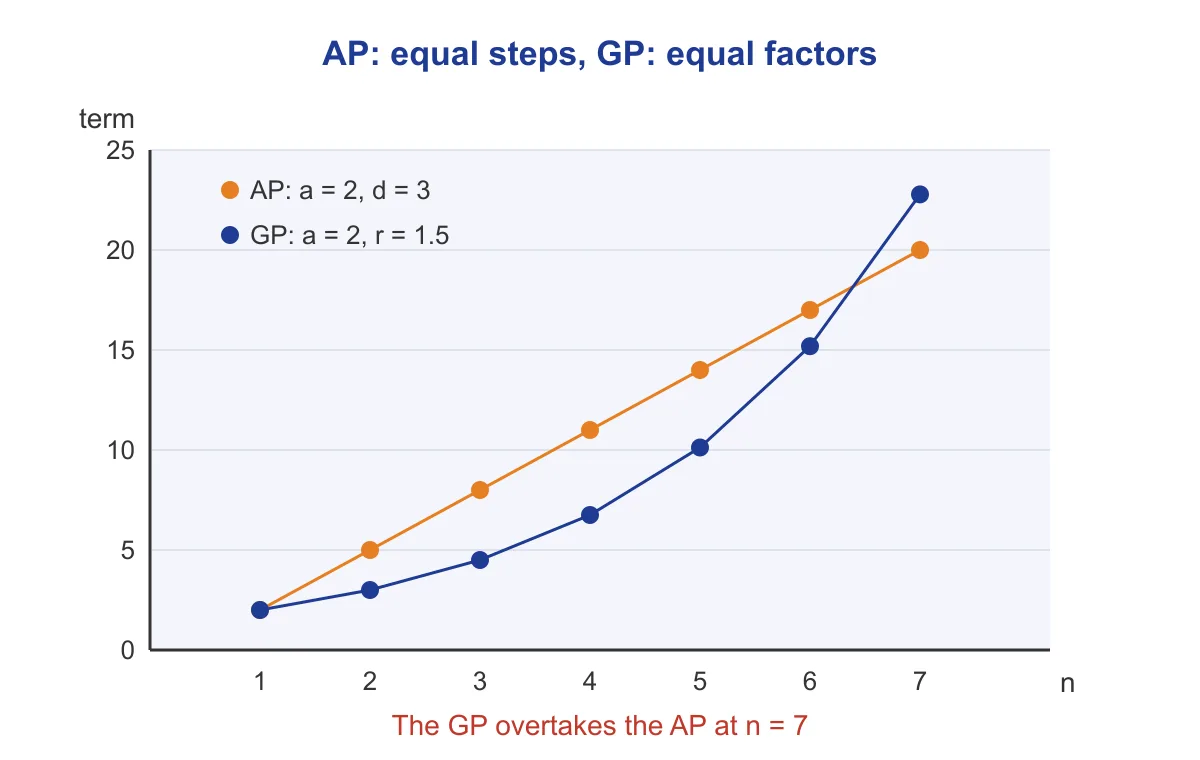
Figure 1.1: An AP grows by equal steps (a straight line of points); a GP grows by equal factors (a curve that bends upward and eventually overtakes)
**Sum of $n$ terms.** Let $S_n = a + ar + \dots + ar^{n-1}$. Multiply by $r$ and subtract:
When $r = 1$ every term equals $a$ and $S_n = na$. Use the form with $1 - r^n$ when $\vert r \vert < 1$, and the other form when $r > 1$, so that numerator and denominator are both positive.
Infinite GP. When $\vert r \vert < 1$, $r^n$ goes to $0$ as $n$ grows, so $S_n$ settles at
If $\vert r \vert \ge 1$ the partial sums do not settle (they grow, or keep swinging), and writing $\frac{a}{1-r}$ is simply wrong. For instance $1 + 2 + 4 + \dots$ does not equal $\frac{1}{1-2} = -1$.
Properties.
- Three nonzero numbers $x, y, z$ are in GP exactly when $y^2 = xz$.
- Terms equidistant from the two ends have the same product: $a_k \cdot a_{n-k+1} = a_1 \cdot a_n$. So the product of all $n$ terms is $(a_1 a_n)^{n/2}$.
- Multiplying every term by a nonzero constant, or taking the reciprocal of every term, leaves a GP (with ratio $r$ and $\frac{1}{r}$ respectively). Raising every term to a power $p$ gives a GP with ratio $r^p$.
- Three terms in GP: take $\frac{a}{r},\ a,\ ar$ (product $a^3$). Four terms: $\frac{a}{r^3},\ \frac{a}{r},\ ar,\ ar^3$.
- If $a, b, c$ are in AP then $x^a, x^b, x^c$ are in GP for any $x > 0$. The exponents of a GP form an AP, and logarithms turn a GP of positive terms into an AP.
Geometric means. To place $m$ numbers $G_1, \dots, G_m$ between $a$ and $b$ so that the whole list is a GP, we need $b = ar^{m+1}$, so
Their product is $G_1 G_2 \cdots G_m = (ab)^{m/2}$, since the means pair off with product $ab$ each. The single geometric mean of two positive numbers is $\sqrt{ab}$. (For an even $m+1$ and $\frac{b}{a} > 0$ there are two values of $r$ of opposite sign; unless the question says otherwise, positive terms are intended.)
Recurring decimals are infinite GPs in disguise, as the next example shows.
Example 3: Express $0.3\overline{18} = 0.3181818\dots$ as a fraction.
Split off the non-repeating part: $0.3 + 0.0181818\dots$
The repeating part is $0.018 + 0.00018 + 0.0000018 + \dots$, a GP with $a = 0.018 = \frac{18}{1000}$ and $r = \frac{1}{100}$.
Its sum is $\frac{18/1000}{1 - 1/100} = \frac{18}{1000} \times \frac{100}{99} = \frac{18}{990} = \frac{1}{55}$.
Total $= \frac{3}{10} + \frac{1}{55} = \frac{33}{110} + \frac{2}{110} = \frac{35}{110} = \frac{7}{22}$.
Check: $7 \div 22 = 0.31818\dots$ Right.
Answer: $\frac{7}{22}$. A repeating block of $k$ digits gives ratio $\frac{1}{10^k}$.
Example 4: Three numbers in GP have sum 21 and the sum of their squares is 189. Find them.
Take $\frac{a}{r},\ a,\ ar$. Sum: $a\left(\frac{1}{r} + 1 + r\right) = 21$.
Squares: $a^2\left(\frac{1}{r^2} + 1 + r^2\right) = 189$.
Use $\frac{1}{r^2} + 1 + r^2 = \left(\frac{1}{r} + 1 + r\right)\left(\frac{1}{r} - 1 + r\right)$. The second equation becomes $21 \times a\left(\frac{1}{r} - 1 + r\right) = 189$, so $a\left(\frac{1}{r} - 1 + r\right) = 9$.
Subtract this from the first equation: $2a = 12$, so $a = 6$.
Then $\frac{1}{r} + r = \frac{15}{6} = \frac{5}{2}$, which gives $2r^2 - 5r + 2 = 0$, so $r = 2$ or $r = \frac{1}{2}$.
The numbers are $3, 6, 12$ (or the same in reverse order).
Check: $3 + 6 + 12 = 21$ and $9 + 36 + 144 = 189$.
Answer: $3, 6, 12$. Factoring $\frac{1}{r^2} + 1 + r^2$ is the whole trick; spot it and the rest is arithmetic.
| Feature | AP | GP |
|---|---|---|
| Step | add $d$ | multiply by $r$ |
| $n$th term | $a + (n-1)d$ | $ar^{n-1}$ |
| Sum of $n$ terms | $\frac{n}{2}\left[2a + (n-1)d\right]$ | $\frac{a(r^n - 1)}{r - 1}$, $r \ne 1$ |
| Sum to infinity | does not exist (unless all terms are 0) | $\frac{a}{1-r}$ when $\vert r \vert < 1$ |
| Three in progression | $2y = x + z$ | $y^2 = xz$ |
| Insert $m$ means between $a, b$ | $d = \frac{b-a}{m+1}$ | $r = \left(\frac{b}{a}\right)^{1/(m+1)}$ |
| Means of two numbers | $\frac{a+b}{2}$ | $\sqrt{ab}$ |
AM, GM and the AM–GM inequality
For positive numbers $a_1, a_2, \dots, a_n$ the arithmetic mean and geometric mean are
The AM is the number that, placed between two terms, makes an AP; the GM is the one that makes a GP. For two numbers the inequality is easy to see. Since a square is never negative,
with equality only when $a = b$.
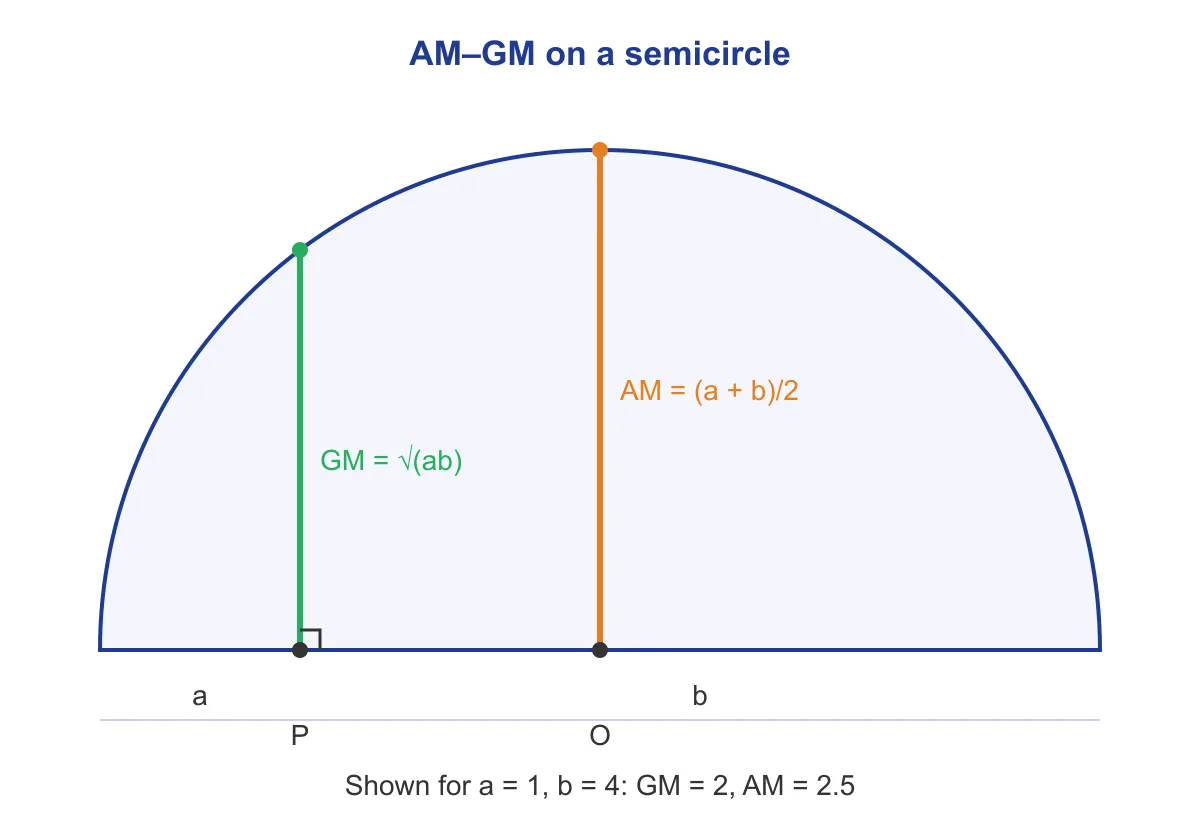
*Figure 1.2: Diameter $a + b$, so radius $= \frac{a+b}{2}$ (the AM). The perpendicular at $P$ has length $\sqrt{ab}$ (the GM). A perpendicular can never be longer than the radius.*
The picture explains the inequality. In a semicircle, the perpendicular from a point of the diameter to the arc has length $\sqrt{ab}$ (product of the two parts of the diameter), and the radius is $\frac{a+b}{2}$. The perpendicular is never longer than the radius, and the two are equal only when $P$ is the centre, that is when $a = b$.
For $n$ numbers the statement is the same:
with equality exactly when $a_1 = a_2 = \dots = a_n$. Three conditions must hold before you use it: every number is positive, the sum or the product is a constant (that is what makes the bound useful), and the equality case must actually be reachable.
The two uses in maxima and minima.
- If the sum $a_1 + \dots + a_n$ is fixed, the product is largest when all the numbers are equal. Written out: product $\le \left(\frac{\text{sum}}{n}\right)^n$.
- If the product is fixed, the sum is smallest when all the numbers are equal: sum $\ge n \,(\text{product})^{1/n}$.
For example, for $x > 0$ we get $x + \frac{1}{x} \ge 2$, with equality at $x = 1$, because the product of $x$ and $\frac{1}{x}$ is the constant $1$. For $x < 0$ the inequality turns around, so $x + \frac{1}{x} \le -2$; the positivity condition cannot be dropped.
Splitting to make the sum fixed. Often the given expression does not have a constant sum, so you split a term into equal pieces, or give a variable a weight, so that the variable cancels. The exponents tell you how many copies to use. To maximise $x^2 y^3$ when $2x + 3y = 30$, take the five numbers $x, x, y, y, y$. Their sum is $2x + 3y = 30$, fixed, and their product is $x^2 y^3$. So $x^2 y^3 \le 6^5$, with equality at $x = y = 6$.
Example 5: For $0 < x < 6$, find the maximum of $x^2(6 - x)$.
The sum $x + (6 - x) = 6$ is fixed, but $x^2$ needs two copies of $x$. Split $x$ into halves: use the three numbers $\frac{x}{2},\ \frac{x}{2},\ 6 - x$.
Their sum is $\frac{x}{2} + \frac{x}{2} + 6 - x = 6$, which does not depend on $x$.
AM–GM: $\frac{6}{3} \ge \left[\frac{x}{2} \cdot \frac{x}{2} \cdot (6 - x)\right]^{1/3}$, so $\frac{x^2(6-x)}{4} \le 8$.
Hence $x^2(6 - x) \le 32$.
Equality needs $\frac{x}{2} = 6 - x$, so $x = 4$. Check: $16 \times 2 = 32$. Reachable, and $4$ lies in $(0, 6)$.
Answer: maximum $32$ at $x = 4$. Split the variable so the sum has no $x$ left, and always check the equality condition is reachable.
Example 6: For $x > 0$, find the minimum of $2x + \frac{3}{x^2}$.
The product $2x \cdot \frac{3}{x^2}$ still has an $x$ in it. Split $2x$ as $x + x$: the three numbers $x,\ x,\ \frac{3}{x^2}$ have product $x \cdot x \cdot \frac{3}{x^2} = 3$, constant.
AM–GM: $\frac{x + x + 3/x^2}{3} \ge 3^{1/3}$, so $2x + \frac{3}{x^2} \ge 3 \cdot 3^{1/3} = 3^{4/3}$.
Equality: $x = \frac{3}{x^2}$, so $x^3 = 3$, a positive real $x$. Reachable.
Answer: minimum $3^{4/3}$. The number of pieces is chosen so that powers of $x$ cancel in the product.
Memory trick: "Sum fixed, product maximum; product fixed, sum minimum, all equal at the extreme." Say it before every AM–GM question; then ask only which of the two is fixed.
Sums of natural numbers, squares and cubes
Three results are used so often that you should be able to write them from memory and from first principles.
| Sum | Value | Remark |
|---|---|---|
| $1 + 2 + \dots + n$ | $\frac{n(n+1)}{2}$ | AP with $a = 1$, $d = 1$ |
| $1^2 + 2^2 + \dots + n^2$ | $\frac{n(n+1)(2n+1)}{6}$ | not an AP, needs the telescoping idea below |
| $1^3 + 2^3 + \dots + n^3$ | $\left[\frac{n(n+1)}{2}\right]^2$ | the square of the first sum |
| $1 + 3 + 5 + \dots + (2n-1)$ | $n^2$ | first $n$ odd numbers |
| $2 + 4 + 6 + \dots + 2n$ | $n(n+1)$ | first $n$ even numbers |
Why the first one is true: it is an AP with $a = 1$, $l = n$, so $S = \frac{n}{2}(1 + n)$.
Why the second is true. Start from the expansion $(k+1)^3 - k^3 = 3k^2 + 3k + 1$ and add it for $k = 1, 2, \dots, n$. On the left everything cancels except $(n+1)^3 - 1$:
Put $\sum k = \frac{n(n+1)}{2}$ and solve for $\sum k^2$:
Now $(n+1)^3 - 1 - n = n^3 + 3n^2 + 2n = n(n+1)(n+2)$. Taking out $n(n+1)$ gives $3\sum k^2 = n(n+1)\left[(n+2) - \frac{3}{2}\right] = \frac{n(n+1)(2n+1)}{2}$, and dividing by 3 gives the stated value. The same idea with $(k+1)^4 - k^4$ produces the formula for $\sum k^3$.
Sigma notation. The symbol $\sum_{k=1}^{n} t_k$ means $t_1 + t_2 + \dots + t_n$. Its rules are the rules of ordinary addition:
- $\sum (t_k + u_k) = \sum t_k + \sum u_k$.
- $\sum c\,t_k = c \sum t_k$ for a constant $c$.
- $\sum_{k=1}^{n} c = nc$, because a constant is added $n$ times. The sum $\sum_{k=1}^{n} 1$ is $n$, not $1$.
- A sum starting at $k = m$ is a difference: $\sum_{k=m}^{n} t_k = \sum_{k=1}^{n} t_k - \sum_{k=1}^{m-1} t_k$.
To sum a series whose $k$th term is a polynomial in $k$, expand it, split it using these rules and substitute the three standard results.
Example 7: Find $1 \cdot 3 + 2 \cdot 4 + 3 \cdot 5 + \dots + 10 \cdot 12$.
The $k$th term is $k(k+2) = k^2 + 2k$, and $k$ runs from 1 to 10.
$\sum k^2 = \frac{10 \cdot 11 \cdot 21}{6} = 385$ and $\sum k = \frac{10 \cdot 11}{2} = 55$.
Sum $= 385 + 2 \times 55 = 495$.
Check the last pieces by hand for $n = 2$: $1\cdot3 + 2\cdot4 = 11$, and $\frac{2\cdot3\cdot5}{6} + 2 \cdot 3 = 5 + 6 = 11$. The method works.
Answer: $495$. Find the general term first; the rest is substitution.
Memory trick: "Cubes are the square of the plain sum: $\sum k^3 = (\sum k)^2$." And "odd numbers add to a square, even numbers add to $n$ times $n$ plus one!" A quick check with $n = 3$ ($1 + 3 + 5 = 9$, $2 + 4 + 6 = 12$) catches mix-ups.
Arithmetico-geometric series
An arithmetico-geometric series has terms that are the product of a term of an AP and the matching term of a GP:
You cannot sum it with either the AP or the GP formula alone. The method is the same one that proves the GP formula: multiply by $r$, shift one place and subtract.
The middle terms form an ordinary GP with first term $dr$, so for $r \ne 1$
For $\vert r \vert < 1$, the terms $r^n$ and $n r^n$ both go to zero, and the infinite sum is
You need not memorise either formula. Remember the procedure (multiply by $r$, subtract, sum the GP left behind) and work it out in the exam; it is quick and avoids sign mistakes. A well-known special case is $1 + 2x + 3x^2 + \dots = \frac{1}{(1 - x)^2}$ for $\vert x \vert < 1$.
Example 8: Find the sum to infinity of $1 + \frac{4}{5} + \frac{7}{25} + \frac{10}{125} + \dots$
The numerators $1, 4, 7, 10$ form an AP ($a = 1$, $d = 3$); the denominators $1, 5, 25, 125$ form a GP with $r = \frac{1}{5}$.
$S = 1 + 4\left(\frac{1}{5}\right) + 7\left(\frac{1}{5}\right)^2 + \dots$ and $\frac{S}{5} = \frac{1}{5} + 4\left(\frac{1}{5}\right)^2 + \dots$
Subtract: $\frac{4S}{5} = 1 + 3\left[\frac{1}{5} + \frac{1}{25} + \frac{1}{125} + \dots\right] = 1 + 3 \cdot \frac{1/5}{1 - 1/5} = 1 + \frac{3}{4} = \frac{7}{4}$.
So $S = \frac{7}{4} \times \frac{5}{4} = \frac{35}{16}$.
Check by adding the first few terms: $1 + 0.8 + 0.28 + 0.08 + 0.0208 + 0.0051 + \dots \approx 2.186$, heading to $2.1875 = \frac{35}{16}$.
Answer: $\frac{35}{16}$. Notice the bracket is a GP with the common ratio of the original series.
Method of differences
Suppose each term of a series can be written as a difference, $t_k = f(k+1) - f(k)$. Then adding the terms from $k = 1$ to $n$ cancels everything in the middle:
This is telescoping. The skill is in writing the term as a difference. The usual routes are:
| Form of the term | Rewrite as | Sum from $k = 1$ to $n$ |
|---|---|---|
| $\frac{1}{k(k+1)}$ | $\frac{1}{k} - \frac{1}{k+1}$ | $1 - \frac{1}{n+1} = \frac{n}{n+1}$ |
| $\frac{1}{k(k+2)}$ | $\frac{1}{2}\left(\frac{1}{k} - \frac{1}{k+2}\right)$ | $\frac{1}{2}\left(1 + \frac{1}{2} - \frac{1}{n+1} - \frac{1}{n+2}\right)$ |
| $\frac{1}{k(k+1)(k+2)}$ | $\frac{1}{2}\left[\frac{1}{k(k+1)} - \frac{1}{(k+1)(k+2)}\right]$ | $\frac{1}{4} - \frac{1}{2(n+1)(n+2)}$ |
| $\frac{1}{\sqrt{k} + \sqrt{k+1}}$ | $\sqrt{k+1} - \sqrt{k}$ (rationalise) | $\sqrt{n+1} - 1$ |
In the second row two terms survive at each end because the gap is 2; in general a gap of $g$ leaves $g$ terms at each end.
Series whose differences are in AP. If the differences between successive terms $t_{k+1} - t_k$ themselves form an AP, then $t_k$ is a quadratic in $k$. Find it by fitting a quadratic, then sum with the standard results. This is a method of differences applied twice.
Example 9: Find the sum of $n$ terms of $3 + 7 + 13 + 21 + \dots$
First differences: $4, 6, 8, \dots$ form an AP, so the $k$th term is a quadratic $pk^2 + qk + s$.
Use $k = 1, 2, 3$: $p + q + s = 3$, $4p + 2q + s = 7$, $9p + 3q + s = 13$.
Subtract successive pairs: $3p + q = 4$ and $5p + q = 6$, so $p = 1$, $q = 1$, $s = 1$.
The general term is $t_k = k^2 + k + 1$. Test $k = 4$: $16 + 4 + 1 = 21$. Right.
$S_n = \sum k^2 + \sum k + n = \frac{n(n+1)(2n+1)}{6} + \frac{n(n+1)}{2} + n = \frac{n(n+1)(n+2)}{3} + n$.
Check $n = 2$: $\frac{2 \cdot 3 \cdot 4}{3} + 2 = 10 = 3 + 7$. Right.
Answer: $S_n = \frac{n(n+1)(n+2)}{3} + n$. A check at $n = 1$ and $n = 2$ takes ten seconds and catches most slips.
Example 10: Evaluate $\frac{1}{\sqrt{1} + \sqrt{2}} + \frac{1}{\sqrt{2} + \sqrt{3}} + \dots + \frac{1}{\sqrt{99} + \sqrt{100}}$.
Rationalise each term: $\frac{1}{\sqrt{k} + \sqrt{k+1}} \times \frac{\sqrt{k+1} - \sqrt{k}}{\sqrt{k+1} - \sqrt{k}} = \sqrt{k+1} - \sqrt{k}$, since the denominator becomes $(k+1) - k = 1$.
The sum telescopes to $\sqrt{100} - \sqrt{1} = 10 - 1 = 9$.
Answer: $9$. When roots sit in a denominator, rationalising usually turns the sum into a telescoping one.
Memory trick: "Write the term as a difference, cross out the middle, keep first and last." Use it whenever a fraction has factors in its denominator that differ by a constant.
Common traps
- Using $S_n = \frac{n}{2}\left[2a + nd\right]$ → the correct form has $(n - 1)d$, because there are $n - 1$ steps from the first term to the $n$th.
- Writing the common difference of $n$ means as $\frac{b - a}{n}$ → there are $n + 1$ gaps, so $d = \frac{b-a}{n+1}$.
- Computing $a_1$ from the formula for $a_n = S_n - S_{n-1}$ → find $a_1 = S_1$ separately; the formula for $a_n$ may not hold at $n = 1$.
- Applying $\frac{a}{1-r}$ when $\vert r \vert \ge 1$ → check $\vert r \vert < 1$ first; otherwise the infinite sum does not exist.
- Taking $r = \frac{a_3}{a_1}$ as the ratio → that is $r^2$. The ratio is a ratio of consecutive terms.
- Using AM–GM when some numbers are negative, such as $x + \frac{1}{x} \ge 2$ for all real $x$ → require positivity, otherwise $x + \frac{1}{x} \le -2$ for $x < 0$.
- Quoting a minimum by AM–GM without checking equality → solve the equality condition and confirm it fits the allowed range of the variable.
- Reading $\sum_{k=1}^{n} 5$ as $5$ → a constant summed $n$ times is $5n$.
- Using $\sum k^2 = \left(\sum k\right)^2$ → it is the cubes that equal the square of the sum: $\sum k^3 = \left(\sum k\right)^2$.
- Subtracting the AGP shifted series without aligning powers of $r$ → write $S$ and $rS$ one below the other so that equal powers of $r$ sit in the same column.
Quick revision
- $a_n = a + (n-1)d$; $S_n = \frac{n}{2}(a + l) = \frac{n}{2}\left[2a + (n-1)d\right]$.
- Three numbers in AP: $2y = x + z$; choose $a - d, a, a + d$.
- $m$ arithmetic means between $a$ and $b$: $d = \frac{b-a}{m+1}$; their sum is $m\cdot\frac{a+b}{2}$.
- $a_n = S_n - S_{n-1}$ for $n \ge 2$, with $a_1 = S_1$; $S_n = An^2 + Bn$ means an AP with $d = 2A$.
- $a_n = ar^{n-1}$; $S_n = \frac{a(r^n - 1)}{r - 1}$ for $r \ne 1$, and $S_n = na$ for $r = 1$.
- Infinite GP: $S_\infty = \frac{a}{1-r}$ only when $\vert r \vert < 1$.
- Three numbers in GP: $y^2 = xz$; choose $\frac{a}{r}, a, ar$.
- $m$ geometric means between $a$ and $b$: $r = \left(\frac{b}{a}\right)^{1/(m+1)}$; their product is $(ab)^{m/2}$.
- AM $\ge$ GM for positive numbers, equality only when all are equal.
- Sum fixed gives the maximum product; product fixed gives the minimum sum.
- $\sum k = \frac{n(n+1)}{2}$; $\sum k^2 = \frac{n(n+1)(2n+1)}{6}$; $\sum k^3 = \left[\frac{n(n+1)}{2}\right]^2$.
- First $n$ odd numbers add to $n^2$; first $n$ even numbers add to $n(n+1)$.
- AGP: multiply by $r$, subtract, sum the GP left; $S_\infty = \frac{a}{1-r} + \frac{dr}{(1-r)^2}$ for $\vert r \vert < 1$.
- Telescoping: $\sum_{k=1}^{n}\left[f(k+1) - f(k)\right] = f(n+1) - f(1)$; for example $\sum \frac{1}{k(k+1)} = \frac{n}{n+1}$.
Practice questions
The 10th term of the arithmetic progression $5, 9, 13, \dots$ is
- $45$
- $41$
- $37$
- $49$
Answer
B. $41$
$a = 5$, $d = 4$, so $a_{10} = 5 + 9 \times 4 = 41$.
The third term of a geometric progression is $12$ and the sixth term is $96$. Its common ratio is
- $3$
- $\frac{1}{2}$
- $4$
- $2$
Answer
D. $2$
$a_6 / a_3 = r^3 = 96/12 = 8$, so $r = 2$. Check: $a = 3$ and the terms $3, 6, 12, 24, 48, 96$ fit.
The sum to infinity of $6 + 2 + \frac{2}{3} + \dots$ is
- $9$
- $12$
- $8$
- $18$
Answer
A. $9$
$a = 6$, $r = \frac{1}{3}$, $\vert r \vert < 1$, so $S = \frac{6}{1 - 1/3} = \frac{6}{2/3} = 9$.
The sum of the first $n$ terms of a sequence is $S_n = 3n^2 + 2n$. Its 10th term is
- $65$
- $320$
- $59$
- $62$
Answer
C. $59$
$a_{10} = S_{10} - S_9 = 320 - 261 = 59$. In general $a_n = 6n - 1$, and $6 \times 10 - 1 = 59$.
Two positive numbers have arithmetic mean $10$ and geometric mean $8$. The numbers are
- $6$ and $14$
- $4$ and $16$
- $2$ and $18$
- $5$ and $15$
Answer
B. $4$ and $16$
Sum $= 20$ and product $= 64$. The numbers are roots of $t^2 - 20t + 64 = 0$, that is $(t - 4)(t - 16) = 0$. Check: $\frac{4 + 16}{2} = 10$, $\sqrt{64} = 8$.
When $7$ arithmetic means are inserted between $3$ and $19$, the common difference of the resulting progression is
- $2$
- $\frac{16}{9}$
- $\frac{16}{7}$
- $3$
Answer
A. $2$
There are $7 + 2 = 9$ terms, so $8$ gaps: $d = \frac{19 - 3}{8} = 2$.
The value of $\sum_{k=1}^{n} k(k-1)$ is
- $\frac{n(n+1)(2n+1)}{6}$
- $\frac{n(n+1)(n+2)}{3}$
- $\frac{n(n-1)(n+1)}{6}$
- $\frac{n(n-1)(n+1)}{3}$
Answer
D. $\frac{n(n-1)(n+1)}{3}$
$\sum k^2 - \sum k = \frac{n(n+1)(2n+1)}{6} - \frac{n(n+1)}{2} = \frac{n(n+1)(2n-2)}{6} = \frac{n(n-1)(n+1)}{3}$. Check $n = 3$: $0 + 2 + 6 = 8$ and $\frac{3 \cdot 2 \cdot 4}{3} = 8$.
The least value of $2^x + 2^{-x}$ over all real $x$ is
- $1$
- $4$
- $2$
- $\frac{5}{2}$
Answer
C. $2$
Both $2^x$ and $2^{-x}$ are positive and their product is $1$. AM-GM gives $2^x + 2^{-x} \ge 2$, with equality at $x = 0$.
In a geometric progression with positive terms, every term equals the sum of the next two terms. The common ratio is
- $\frac{\sqrt{5} - 1}{2}$
- $\frac{1 - \sqrt{5}}{2}$
- $\frac{\sqrt{5} + 1}{2}$
- $\frac{1}{2}$
Answer
A. $\frac{\sqrt{5} - 1}{2}$
$a = ar + ar^2$ gives $r^2 + r - 1 = 0$, so $r = \frac{-1 \pm \sqrt{5}}{2}$. Positive terms need $r > 0$, so $r = \frac{\sqrt{5} - 1}{2}$.
The sum of the infinite series $1 + \frac{2}{3} + \frac{3}{9} + \frac{4}{27} + \dots$ is
- $3$
- $\frac{3}{2}$
- $\frac{9}{4}$
- $\frac{9}{8}$
Answer
C. $\frac{9}{4}$
Let $S = \sum n x^{n-1}$ with $x = \frac{1}{3}$. Then $S - \frac{S}{3} = 1 + \frac{1}{3} + \frac{1}{9} + \dots = \frac{3}{2}$, so $\frac{2S}{3} = \frac{3}{2}$ and $S = \frac{9}{4}$.
The sum $\frac{1}{1 \cdot 2} + \frac{1}{2 \cdot 3} + \dots + \frac{1}{n(n+1)}$ equals
- $\frac{n+1}{n+2}$
- $\frac{1}{n+1}$
- $\frac{n}{n+2}$
- $\frac{n}{n+1}$
Answer
D. $\frac{n}{n+1}$
$\frac{1}{k(k+1)} = \frac{1}{k} - \frac{1}{k+1}$, so the sum telescopes to $1 - \frac{1}{n+1} = \frac{n}{n+1}$. Check $n = 1$: $\frac{1}{2}$.
The 5th term of an arithmetic progression is $0$. The ratio of its 23rd term to its 11th term is
- $6$
- $3$
- $\frac{1}{3}$
- $2$
Answer
B. $3$
$a + 4d = 0$ gives $a = -4d$. Then $a_{23} = -4d + 22d = 18d$ and $a_{11} = -4d + 10d = 6d$. Ratio $= 3$.
If $x, y > 0$ and $x + y = 12$, the maximum value of $x^2 y$ is
- $192$
- $256$
- $288$
- $216$
Answer
B. $256$
Take the three numbers $\frac{x}{2}, \frac{x}{2}, y$ with fixed sum $12$. AM-GM: $\frac{x^2 y}{4} \le 4^3 = 64$, so $x^2 y \le 256$. Equality at $\frac{x}{2} = y = 4$, that is $x = 8$, $y = 4$. (Taking $x = y = 6$ gives only $216$.)
Two geometric means (with positive common ratio) are inserted between $1$ and $64$. They are
- $4$ and $16$
- $2$ and $32$
- $8$ and $16$
- $21$ and $42$
Answer
A. $4$ and $16$
$64 = r^3$, so $r = 4$ and the progression is $1, 4, 16, 64$. The pair $21, 42$ is what arithmetic means would give.
Find the sum of the first $20$ terms of $3, 5, 7, \dots$
- $460$
- $420$
- $400$
- $440$
Answer
D. $440$
$a = 3$, $d = 2$: $S_{20} = 10\left[6 + 19 \times 2\right] = 10 \times 44 = 440$. Check: the 20th term is $41$, and $\frac{20}{2}(3 + 41) = 440$.
The number of terms in the arithmetic progression $7, 11, 15, \dots, 143$ is
- $37$
- $34$
- $35$
- $36$
Answer
C. $35$
$143 = 7 + (n-1) \cdot 4$, so $n - 1 = 34$ and $n = 35$.
The value of $1^2 + 2^2 + \dots + 12^2$ is
- $600$
- $702$
- $676$
- $650$
Answer
D. $650$
$\frac{12 \cdot 13 \cdot 25}{6} = 2 \times 13 \times 25 = 650$.
The value of $11^3 + 12^3 + 13^3 + 14^3 + 15^3$ is
- $11375$
- $12000$
- $3025$
- $14400$
Answer
A. $11375$
$\sum_{1}^{15} k^3 = 120^2 = 14400$ and $\sum_{1}^{10} k^3 = 55^2 = 3025$. The difference is $14400 - 3025 = 11375$.
The sum of the first $6$ terms of the geometric progression $2, 6, 18, \dots$ is
- $1458$
- $728$
- $364$
- $242$
Answer
B. $728$
$S_6 = \frac{2(3^6 - 1)}{3 - 1} = 3^6 - 1 = 728$.
The sum of the first $n$ terms of $24, 20, 16, \dots$ is $72$ for two values of $n$. The larger value is
- $18$
- $13$
- $9$
- $4$
Answer
C. $9$
$\frac{n}{2}\left[48 - 4(n-1)\right] = 72$ gives $n^2 - 13n + 36 = 0$, so $n = 4$ or $9$. Check $n = 9$: terms $24$ down to $-8$, sum $\frac{9}{2}(24 - 8) = 72$.
The sum of all three-digit numbers divisible by $7$ is
- $70434$
- $71071$
- $70336$
- $140672$
Answer
C. $70336$
The numbers run from $105$ to $994$: $\frac{994 - 105}{7} + 1 = 128$ terms. $S = \frac{128}{2}(105 + 994) = 64 \times 1099 = 70336$.
An infinite geometric series has sum $12$, and the sum of its first two terms is $9$. The largest possible first term is
- $6$
- $18$
- $9$
- $12$
Answer
B. $18$
$\frac{a}{1-r} = 12$ and $a(1 + r) = 9$. Dividing, $(1 - r)(1 + r) = \frac{3}{4}$, so $r = \pm\frac{1}{2}$. Then $a = 12(1 - r)$ is $6$ for $r = \frac{1}{2}$ and $18$ for $r = -\frac{1}{2}$. Both satisfy $\vert r \vert < 1$; the larger is $18$.
The value of $\sum_{k=1}^{20} (2k+1)^2$ is
- $12340$
- $12360$
- $12320$
- $11480$
Answer
A. $12340$
$(2k+1)^2 = 4k^2 + 4k + 1$. With $\sum k^2 = 2870$ and $\sum k = 210$: $4(2870) + 4(210) + 20 = 11480 + 840 + 20 = 12340$.
The value of $\frac{1}{1 \cdot 4} + \frac{1}{4 \cdot 7} + \frac{1}{7 \cdot 10} + \dots + \frac{1}{22 \cdot 25}$ is
- $0.96$
- $0.30$
- $0.36$
- $0.32$
Answer
D. $0.32$
$\frac{1}{(3k-2)(3k+1)} = \frac{1}{3}\left[\frac{1}{3k-2} - \frac{1}{3k+1}\right]$. There are $8$ terms (last is $k = 8$), so the sum is $\frac{1}{3}\left(1 - \frac{1}{25}\right) = \frac{8}{25} = 0.32$.
The value of $1 \cdot 2 + 2 \cdot 2^2 + 3 \cdot 2^3 + \dots + 6 \cdot 2^6$ is
- $512$
- $768$
- $770$
- $642$
Answer
D. $642$
$S = \sum k 2^k$. $2S = \sum k 2^{k+1}$. $S - 2S = (2 + 2^2 + \dots + 2^6) - 6 \cdot 2^7 = 126 - 768 = -642$, so $S = 642$. Direct check: $2 + 8 + 24 + 64 + 160 + 384 = 642$.
For positive real numbers $a, b, c$, the least value of $\frac{(a+b)(b+c)(c+a)}{abc}$ is
- $9$
- $8$
- $12$
- $6$
Answer
B. $8$
AM-GM: $a + b \ge 2\sqrt{ab}$, $b + c \ge 2\sqrt{bc}$, $c + a \ge 2\sqrt{ca}$. Multiplying, the product is at least $8abc$. Equality at $a = b = c$ gives exactly $\frac{2 \cdot 2 \cdot 2}{1} = 8$.
Given below are two statements: Statement I: The series $1 + 2 + 4 + 8 + \dots$ has sum $\frac{1}{1-2} = -1$. Statement II: The sum $\frac{a}{1-r}$ of an infinite geometric series is valid only when $\vert r \vert < 1$.
- Both Statement I and Statement II are correct
- Both Statement I and Statement II are incorrect
- Statement I is correct but Statement II is incorrect
- Statement I is incorrect but Statement II is correct
Answer
D. Statement I is incorrect but Statement II is correct
Here $r = 2$, so the partial sums grow without limit and the series has no sum; Statement I is wrong. Statement II is the correct condition.
Given below are two statements: Statement I: For the positive numbers $4$ and $9$, the arithmetic mean is greater than the geometric mean. Statement II: The arithmetic mean of two positive numbers equals their geometric mean only when the two numbers are equal.
- Both Statement I and Statement II are correct
- Both Statement I and Statement II are incorrect
- Statement I is correct but Statement II is incorrect
- Statement I is incorrect but Statement II is correct
Answer
A. Both Statement I and Statement II are correct
AM $= 6.5$ and GM $= 6$, so Statement I is correct. Statement II follows from $(\sqrt{a} - \sqrt{b})^2 = 0$ only when $a = b$.
Given below are two statements: Statement I: If $S_n = 2n^2 + 3n$, the sequence is an arithmetic progression with common difference $4$. Statement II: If $S_n = n^2 + 1$, the sequence is an arithmetic progression.
- Both Statement I and Statement II are correct
- Both Statement I and Statement II are incorrect
- Statement I is correct but Statement II is incorrect
- Statement I is incorrect but Statement II is correct
Answer
C. Statement I is correct but Statement II is incorrect
I: $a_1 = 5$, $a_n = S_n - S_{n-1} = 4n + 1$ for $n \ge 2$ (also $5$ at $n = 1$), so $d = 4$. II: $a_1 = 2$, $a_2 = 3$, $a_3 = 5$; differences $1$ and $2$ differ, so not an AP.
Given below are two statements: Statement I: The sum of the first $n$ odd natural numbers is $n(n+1)$. Statement II: The sum of the first $n$ even natural numbers is $n^2$.
- Both Statement I and Statement II are correct
- Both Statement I and Statement II are incorrect
- Statement I is correct but Statement II is incorrect
- Statement I is incorrect but Statement II is correct
Answer
B. Both Statement I and Statement II are incorrect
The odd numbers add to $n^2$ ($1 + 3 + 5 = 9$) and the even numbers to $n(n+1)$ ($2 + 4 + 6 = 12$). The statements are swapped, so both are wrong.
Given below are two statements: Statement I: Three nonzero numbers $a, b, c$ are in geometric progression exactly when $b^2 = ac$. Statement II: If a geometric progression has common ratio $r$, the reciprocals of its terms form a geometric progression with common ratio $\frac{1}{r}$.
- Both Statement I and Statement II are correct
- Both Statement I and Statement II are incorrect
- Statement I is correct but Statement II is incorrect
- Statement I is incorrect but Statement II is correct
Answer
A. Both Statement I and Statement II are correct
I: $b^2 = ac$ gives $\frac{b}{a} = \frac{c}{b}$, and conversely. II: $\frac{1/a_{n+1}}{1/a_n} = \frac{a_n}{a_{n+1}} = \frac{1}{r}$. Both are correct.
Assertion (A): $1 + \frac{1}{2} + \frac{1}{4} + \dots = 2$. Reason (R): For $\vert r \vert < 1$ the sum to infinity of a geometric progression with first term $a$ is $\frac{a}{1-r}$.
- Both A and R are true and R is the correct explanation of A
- Both A and R are true but R is not the correct explanation of A
- A is true but R is false
- A is false but R is true
Answer
A. Both A and R are true and R is the correct explanation of A
Here $a = 1$, $r = \frac{1}{2}$, so $S = \frac{1}{1 - 1/2} = 2$. R is the formula that gives A.
Assertion (A): The least value of $x + \frac{1}{x}$ over all nonzero real $x$ is $2$. Reason (R): For positive numbers, the arithmetic mean is at least the geometric mean.
- Both A and R are true and R is the correct explanation of A
- Both A and R are true but R is not the correct explanation of A
- A is true but R is false
- A is false but R is true
Answer
D. A is false but R is true
For $x < 0$, $x + \frac{1}{x} \le -2$ (for example $x = -1$ gives $-2$, and $x = -0.1$ gives $-10.1$), so $2$ is not the least value. A is false. R is the true AM-GM statement.
Assertion (A): If three numbers in geometric progression have middle term $5$, their product is $125$. Reason (R): In any geometric progression of positive terms, the middle one of three consecutive terms is the arithmetic mean of the other two.
- Both A and R are true and R is the correct explanation of A
- Both A and R are true but R is not the correct explanation of A
- A is true but R is false
- A is false but R is true
Answer
C. A is true but R is false
The numbers are $\frac{5}{r}, 5, 5r$ with product $125$, so A is true. The middle term is the geometric mean, not the arithmetic mean (for example $1, 2, 4$), so R is false.
Match List I with List II. List I: a. $1 + 2 + \dots + n$ b. $1^2 + 2^2 + \dots + n^2$ c. $1^3 + 2^3 + \dots + n^3$ d. $1 + 3 + 5 + \dots + (2n-1)$ List II: i. $n^2$ ii. $\frac{n^2(n+1)^2}{4}$ iii. $\frac{n(n+1)}{2}$ iv. $\frac{n(n+1)(2n+1)}{6}$
- a-ii, b-iv, c-iii, d-i
- a-iii, b-iv, c-i, d-ii
- a-iii, b-iv, c-ii, d-i
- a-iv, b-iii, c-ii, d-i
Answer
C. a-iii, b-iv, c-ii, d-i
Standard results: $\sum k = \frac{n(n+1)}{2}$, $\sum k^2 = \frac{n(n+1)(2n+1)}{6}$, $\sum k^3 = \frac{n^2(n+1)^2}{4}$, odd numbers give $n^2$. Check $n = 2$: $3, 5, 9, 4$.
Match List I with List II. List I: a. $1 + \frac{1}{2} + \frac{1}{4} + \dots$ (to infinity) b. $1 - \frac{1}{2} + \frac{1}{4} - \dots$ (to infinity) c. $1 + 2 + 3 + \dots + 10$ d. $1 + 3 + 9 + 27$ List II: i. $40$ ii. $2$ iii. $\frac{2}{3}$ iv. $55$
- a-ii, b-iv, c-iii, d-i
- a-ii, b-iii, c-iv, d-i
- a-iii, b-ii, c-iv, d-i
- a-ii, b-iii, c-i, d-iv
Answer
B. a-ii, b-iii, c-iv, d-i
a: $\frac{1}{1 - 1/2} = 2$. b: $r = -\frac{1}{2}$, $\frac{1}{1 + 1/2} = \frac{2}{3}$. c: $\frac{10 \cdot 11}{2} = 55$. d: $1 + 3 + 9 + 27 = 40$.
Match List I with List II. List I: a. Arithmetic mean of $2$ and $8$ b. Positive geometric mean of $2$ and $8$ c. Common difference when $3$ arithmetic means are inserted between $2$ and $10$ d. Common ratio when $3$ positive geometric means are inserted between $1$ and $81$ List II: i. $2$ ii. $3$ iii. $4$ iv. $5$
- a-iv, b-iii, c-i, d-ii
- a-iv, b-i, c-iii, d-ii
- a-iv, b-iii, c-ii, d-i
- a-iii, b-iv, c-i, d-ii
Answer
A. a-iv, b-iii, c-i, d-ii
a: $\frac{2 + 8}{2} = 5$. b: $\sqrt{16} = 4$. c: $d = \frac{10 - 2}{4} = 2$. d: $r^4 = 81$, so $r = 3$.
Three numbers are in arithmetic progression with sum $27$ and product $585$. The largest of the three numbers is
- $15$
- $11$
- $13$
- $9$
Answer
C. $13$
Take $9 - d, 9, 9 + d$ (the sum fixes the middle as $9$). Product: $9(81 - d^2) = 585$, so $81 - d^2 = 65$ and $d = \pm 4$. The numbers are $5, 9, 13$. Check: $5 \times 9 \times 13 = 585$.
A ball is dropped from a height of $20$ m. Each time it hits the ground it rebounds to $\frac{3}{4}$ of the height it fell from. The total distance it travels before coming to rest, in metres, is
- $120$
- $80$
- $160$
- $140$
Answer
D. $140$
First fall: $20$. Rebound heights: $15, 11.25, \dots$ a GP with $a = 15$, $r = \frac{3}{4}$, sum $\frac{15}{1/4} = 60$. Each rebound is travelled up and down, so $2 \times 60 = 120$. Total $= 20 + 120 = 140$.
A rectangular tank with a square base and no top must hold $32$ cubic metres. The least possible total area of its base and four walls, in square metres, is
- $96$
- $48$
- $64$
- $24$
Answer
B. $48$
Base side $x$, height $\frac{32}{x^2}$. Area $= x^2 + 4x \cdot \frac{32}{x^2} = x^2 + \frac{64}{x} + \frac{64}{x}$. The product of the three terms is $4096$, constant, so AM-GM gives area $\ge 3 \times 16 = 48$. Equality at $x^2 = \frac{64}{x}$, $x = 4$, which is allowed. Check: $16 + 4 \cdot 4 \cdot 2 = 48$.