Complex Numbers
What to remember
- A complex number is an ordered pair $(a, b)$ written $a + ib$ with $i^2 = -1$. Equality means both parts match. There is no "bigger" or "smaller" among non-real complex numbers.
- The conjugate $\bar z$ mirrors $z$ in the real axis, and $z\bar z = |z|^2$. This one product turns every division into a multiplication.
- In polar form $z = re^{i\theta}$: multiplying multiplies moduli and adds angles, dividing divides moduli and subtracts angles. Multiplying by $e^{i\varphi}$ rotates a point by $\varphi$ about the origin.
- Triangle inequality: $|z_1 + z_2| \le |z_1| + |z_2|$, with equality only when both point the same way. It decides every "greatest or least $|z|$" question.
- The cube roots of unity are $1, \omega, \omega^2$ with $\omega^3 = 1$ and $1 + \omega + \omega^2 = 0$. They sit at the corners of an equilateral triangle on the unit circle.
Complex numbers as ordered pairs
The equation $x^2 + 1 = 0$ has no real root. We do not try to find a "square root of $-1$" by magic; we build a bigger number system in which one exists. Take ordered pairs of real numbers $(a, b)$ and define
Pairs of the form $(a, 0)$ add and multiply exactly like the real number $a$, so we identify $(a, 0)$ with $a$. Write $i = (0, 1)$. Then $i^2 = (0,1)(0,1) = (-1, 0) = -1$, and any pair can be written $(a, b) = (a, 0) + (b, 0)(0, 1) = a + ib$. Here $a$ is the real part $\operatorname{Re}(z)$ and $b$ is the imaginary part $\operatorname{Im}(z)$; note that $\operatorname{Im}(z)$ is the real number $b$, not $ib$.
Two complex numbers are equal when their real parts are equal and their imaginary parts are equal. So one complex equation gives two real equations, which is how most problems of the type "find real $x, y$" are solved.
Algebra
Treat $i$ like a letter and replace $i^2$ by $-1$ whenever it appears.
- Add or subtract: $(a + ib) \pm (c + id) = (a \pm c) + i(b \pm d)$.
- Multiply: $(a + ib)(c + id) = (ac - bd) + i(ad + bc)$.
- Divide: multiply top and bottom by the conjugate of the denominator.
Powers of $i$ repeat with period 4: $i^1 = i,\ i^2 = -1,\ i^3 = -i,\ i^4 = 1$. So $i^n$ depends only on the remainder of $n$ divided by 4, and any four consecutive powers add up to zero. Also $\frac{1}{i} = -i$.
A warning that costs marks every year: the rule $\sqrt{a}\sqrt{b} = \sqrt{ab}$ holds only when at least one of $a, b$ is non-negative. For $a = b = -1$ you get $i \cdot i = -1$, but $\sqrt{(-1)(-1)} = 1$. Write $\sqrt{-k} = i\sqrt{k}$ for $k > 0$ first, and only then multiply.
Example 1: Write $\dfrac{2 + 3i}{1 - i}$ in the form $a + ib$.
Multiply top and bottom by the conjugate of the denominator, $1 + i$.
Numerator: $(2 + 3i)(1 + i) = 2 + 2i + 3i + 3i^2 = 2 + 5i - 3 = -1 + 5i$.
Denominator: $(1 - i)(1 + i) = 1 - i^2 = 2$.
So the value is $-\dfrac{1}{2} + \dfrac{5}{2}i$.
Notice that the denominator always becomes a real number, namely $c^2 + d^2$.
The conjugate
For $z = a + ib$ the conjugate is $\bar z = a - ib$. Geometrically it is the mirror image of $z$ in the real axis.
| Property | Statement |
|---|---|
| Double conjugate | $\overline{\bar z} = z$ |
| Sum, difference | $\overline{z_1 \pm z_2} = \bar z_1 \pm \bar z_2$ |
| Product, quotient | $\overline{z_1 z_2} = \bar z_1 \bar z_2$, $\ \overline{z_1 / z_2} = \bar z_1 / \bar z_2$ |
| Power | $\overline{z^n} = (\bar z)^n$ |
| Real and imaginary parts | $z + \bar z = 2\operatorname{Re}(z)$, $\ z - \bar z = 2i\operatorname{Im}(z)$ |
| Product with itself | $z\bar z = a^2 + b^2 = \vert z \vert^2$ |
| Real number | $z$ is real if and only if $z = \bar z$ |
| Purely imaginary | $z \ne 0$ is purely imaginary if and only if $z = -\bar z$ |
Each of these follows by writing $z = a + ib$ and expanding. For the product rule, $\overline{(a + ib)(c + id)} = (ac - bd) - i(ad + bc)$, and $(a - ib)(c - id)$ gives the same thing.
A useful consequence: if a polynomial has real coefficients and $p + iq$ is a root, so is $p - iq$, because conjugating the equation $f(z) = 0$ leaves the real coefficients unchanged. Non-real roots of such polynomials come in pairs.
Modulus, argument and the Argand plane
Plot $z = a + ib$ as the point $(a, b)$. The plane used this way is the Argand plane; the horizontal axis holds real numbers and the vertical axis holds purely imaginary numbers.
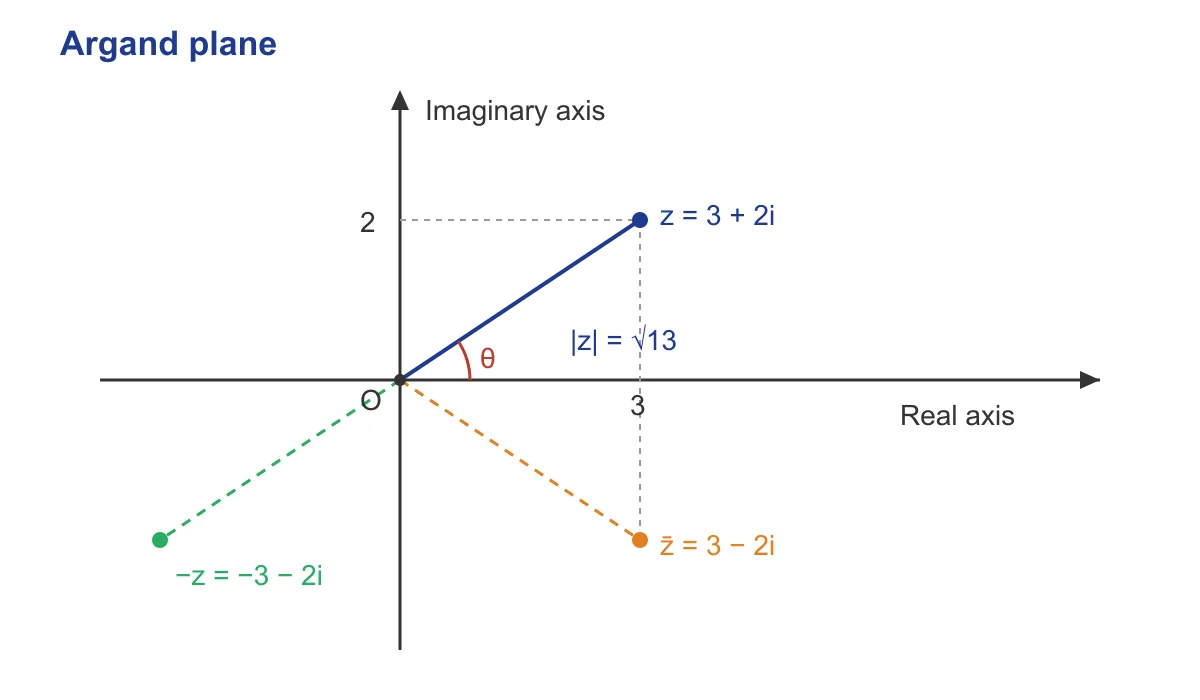
Figure 3.1: The point z, its conjugate (mirror image in the real axis) and −z (the point through the origin)
The modulus is the distance from the origin:
The argument is the angle $\theta$ that the line from the origin to $z$ makes with the positive real axis, measured anticlockwise. It is defined for $z \ne 0$ only, and it is not unique: adding $2\pi$ gives the same direction. The principal argument, written $\operatorname{Arg} z$, is the one value with $-\pi < \theta \le \pi$.
To find it, never use $\tan^{-1}(b/a)$ blindly, because it cannot tell $(1, 1)$ from $(-1, -1)$. Find the acute angle $\alpha = \tan^{-1}\left\vert \frac{b}{a} \right\vert$ and then place it by the quadrant of the point:
| Quadrant of $z$ | Principal argument |
|---|---|
| I ($a > 0, b > 0$) | $\alpha$ |
| II ($a < 0, b > 0$) | $\pi - \alpha$ |
| III ($a < 0, b < 0$) | $\alpha - \pi$ |
| IV ($a > 0, b < 0$) | $-\alpha$ |
On the axes: positive real gives $0$, positive imaginary gives $\frac{\pi}{2}$, negative real gives $\pi$, negative imaginary gives $-\frac{\pi}{2}$.
Example 2: Find the modulus and principal argument of $z = -1 - i\sqrt{3}$.
$|z| = \sqrt{1 + 3} = 2$.
The point $(-1, -\sqrt3)$ is in quadrant III.
$\alpha = \tan^{-1}\sqrt3 = \dfrac{\pi}{3}$, so $\operatorname{Arg} z = \alpha - \pi = -\dfrac{2\pi}{3}$.
Check: $2\left(\cos\left(-\frac{2\pi}{3}\right) + i\sin\left(-\frac{2\pi}{3}\right)\right) = 2\left(-\frac12 - i\frac{\sqrt3}{2}\right) = -1 - i\sqrt3$. Correct.
Always put the answer back into $r(\cos\theta + i\sin\theta)$ to catch a wrong quadrant.
Polar form and Euler form
Writing $a = r\cos\theta$ and $b = r\sin\theta$ with $r = |z|$ gives the polar form
Euler's formula $e^{i\theta} = \cos\theta + i\sin\theta$ lets us write this compactly as $z = re^{i\theta}$. For this chapter you can treat it as a notation, justified by one fact: $e^{i\alpha}e^{i\beta} = e^{i(\alpha + \beta)}$ is exactly the rule
which you get by multiplying out and using the addition formulae for sine and cosine. A few values worth knowing: $e^{i\pi} = -1$, $e^{i\pi/2} = i$, $e^{-i\pi/2} = -i$, $e^{2\pi i} = 1$.
Repeated use of the product rule gives de Moivre's theorem for integer $n$:
Properties of modulus and argument
| Rule | Modulus | Argument |
|---|---|---|
| Product | $\vert z_1 z_2 \vert = \vert z_1 \vert \vert z_2 \vert$ | $\arg(z_1 z_2) = \arg z_1 + \arg z_2$ |
| Quotient | $\left\vert \frac{z_1}{z_2} \right\vert = \frac{\vert z_1 \vert}{\vert z_2 \vert}$ | $\arg\frac{z_1}{z_2} = \arg z_1 - \arg z_2$ |
| Power | $\vert z^n \vert = \vert z \vert^n$ | $\arg(z^n) = n\arg z$ |
| Conjugate | $\vert \bar z \vert = \vert z \vert$ | $\arg\bar z = -\arg z$ |
| Negative | $\vert -z \vert = \vert z \vert$ | $\arg(-z) = \arg z \pm \pi$ |
The argument rules hold up to a multiple of $2\pi$. After adding or subtracting arguments, bring the answer back into $(-\pi, \pi]$ if the question asks for the principal value. For example, $\operatorname{Arg}(-1) = \pi$ and the product $(-1)(-1) = 1$ has $\operatorname{Arg} = 0$, not $2\pi$.
Other handy facts: $z\bar z = |z|^2$ gives $\frac{1}{z} = \frac{\bar z}{|z|^2}$, so for $|z| = 1$ we have $\frac1z = \bar z$. In polar form, $\bar z = re^{-i\theta}$ and $\frac1z = \frac1r e^{-i\theta}$.
Example 3: Evaluate $\left(1 + i\sqrt3\right)^6$.
$|1 + i\sqrt3| = 2$ and the point is in quadrant I with $\tan\theta = \sqrt3$, so $\theta = \dfrac{\pi}{3}$.
$1 + i\sqrt3 = 2e^{i\pi/3}$.
$\left(2e^{i\pi/3}\right)^6 = 2^6 e^{2\pi i} = 64$.
Expanding by the binomial theorem would take six lines and invite a sign slip; the polar form turns the power into one multiplication of the angle.
Memory trick: "Times means multiply the length and add the angle; divide means divide the length and subtract the angle." Say it as: times, add; divide, subtract.
Use it whenever a product or quotient of complex numbers appears and the answer is wanted as a modulus or an argument.
Triangle inequality
For any two complex numbers,
The reason is short. $|z_1 + z_2|^2 = (z_1 + z_2)(\bar z_1 + \bar z_2) = |z_1|^2 + |z_2|^2 + 2\operatorname{Re}(z_1 \bar z_2)$, and the real part of a number never exceeds its modulus, so $\operatorname{Re}(z_1\bar z_2) \le |z_1||z_2|$. The right side is then $(|z_1| + |z_2|)^2$. In the picture: one side of a triangle is never longer than the other two sides together.
Equality in $|z_1 + z_2| = |z_1| + |z_2|$ holds when $z_1, z_2$ point in the same direction (one is a non-negative multiple of the other). Equality in the lower bound $|z_1 - z_2| = \big||z_1| - |z_2|\big|$ also needs the same direction; equality in $|z_1 - z_2| = |z_1| + |z_2|$ needs opposite directions.
A companion identity, from adding the expansions of $|z_1 + z_2|^2$ and $|z_1 - z_2|^2$:
Example 4: If $|z - 3 - 4i| = 2$, find the greatest and least values of $|z|$.
Write $z = (z - 3 - 4i) + (3 + 4i)$. Then $|3 + 4i| = 5$ and $|z - 3 - 4i| = 2$.
Upper bound: $|z| \le 2 + 5 = 7$.
Lower bound: $|z| \ge \big|5 - 2\big| = 3$.
Both are reached when $z - 3 - 4i$ points along $3 + 4i$ (giving $7$) or against it (giving $3$).
Greatest value $7$, least value $3$.
Geometrically $z$ moves on a circle of radius 2 around the point $3 + 4i$, which is 5 from the origin; the nearest and farthest points lie on the line through the origin and the centre.
Square root of a complex number
We look for $p + iq$ with $(p + iq)^2 = a + ib$. Squaring and comparing parts gives $p^2 - q^2 = a$ and $2pq = b$. The modulus of both sides gives a third relation, $p^2 + q^2 = |a + ib| = \sqrt{a^2 + b^2}$. Adding and subtracting the first and third:
Take the real square roots for $p$ and $q$ and choose signs so that $pq$ has the sign of $b$ (same signs if $b > 0$, opposite signs if $b < 0$). The two square roots are $\pm(p + iq)$. The third relation is the shortcut: without it you meet a fourth-degree equation.
In polar form it is even quicker: if $z = re^{i\theta}$ then the square roots are $\pm\sqrt r\,e^{i\theta/2}$. A non-zero complex number has exactly two square roots, and they are negatives of each other.
Example 5: Find the square roots of $-7 + 24i$.
$|z| = \sqrt{49 + 576} = 25$, $a = -7$, $b = 24 > 0$.
$p^2 = \dfrac{25 - 7}{2} = 9$, so $p = \pm 3$.
$q^2 = \dfrac{25 + 7}{2} = 16$, so $q = \pm 4$.
$b > 0$ means $p$ and $q$ have the same sign: the roots are $\pm(3 + 4i)$.
Check: $(3 + 4i)^2 = 9 + 24i - 16 = -7 + 24i$. Correct.
The check takes ten seconds and confirms the sign choice.
Cube roots of unity
Solve $z^3 = 1$. Factor: $z^3 - 1 = (z - 1)(z^2 + z + 1) = 0$. The quadratic gives $z = \dfrac{-1 \pm i\sqrt3}{2}$. Call one of these $\omega$:
The three roots are $1, \omega, \omega^2$. They are the same distance (1) from the origin and $120^\circ$ apart, so they are the corners of an equilateral triangle inscribed in the unit circle.
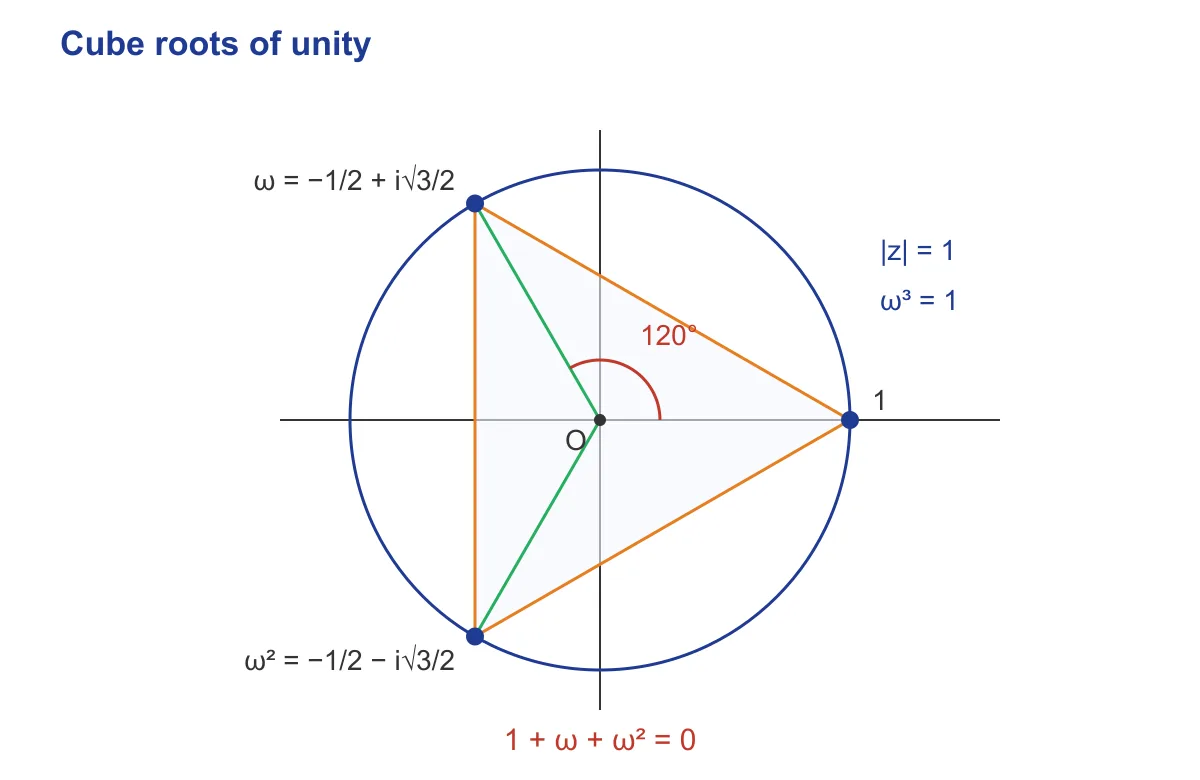
Figure 3.2: The cube roots of unity on the unit circle
Properties you will use constantly:
| Fact | Reason |
|---|---|
| $\omega^3 = 1$ | $\omega$ is a root of $z^3 = 1$ |
| $1 + \omega + \omega^2 = 0$ | $\omega$ satisfies $z^2 + z + 1 = 0$ |
| $\omega^2 = \bar\omega = \dfrac{1}{\omega}$ | $\omega\bar\omega = \vert\omega\vert^2 = 1$ |
| $\omega^n = 1, \omega, \omega^2$ as $n \equiv 0, 1, 2 \pmod 3$ | Powers repeat with period 3 |
| $1 + \omega^n + \omega^{2n} = 3$ if $3 \mid n$, otherwise $0$ | Either all three terms are 1, or the three roots appear once each |
| $1 + \omega = -\omega^2$, $\ 1 + \omega^2 = -\omega$ | From $1 + \omega + \omega^2 = 0$ |
| $z^2 + z + 1 = (z - \omega)(z - \omega^2)$ | The quadratic has roots $\omega, \omega^2$ |
Two factorisations follow by expanding and using $\omega + \omega^2 = -1$, $\omega^3 = 1$:
Multiplying either by a real linear factor gives $a^3 \mp b^3$ as a product of three factors. In the same spirit, the cube roots of any number $c$ are $c_0, c_0\omega, c_0\omega^2$ where $c_0$ is any one of them.
Memory trick: "Three arms of a Mercedes badge cancel: $1 + \omega + \omega^2 = 0$." Three equal arms, 120 degrees apart, pull equally and the badge stays still.
Use it to replace $1 + \omega$ by $-\omega^2$ in one step, and never expand a cube root of unity into surds.
Example 6: Find $\left(1 - \omega + \omega^2\right)^6 + \left(1 + \omega - \omega^2\right)^6$.
$1 + \omega^2 = -\omega$, so $1 - \omega + \omega^2 = -2\omega$.
$1 + \omega = -\omega^2$, so $1 + \omega - \omega^2 = -2\omega^2$.
$(-2\omega)^6 = 64\omega^6 = 64$ and $(-2\omega^2)^6 = 64\omega^{12} = 64$.
The sum is $128$.
Use $1 + \omega + \omega^2 = 0$ first and surds never appear.
Geometric interpretation
Distance and collinearity
If $z_1$ and $z_2$ are points in the Argand plane, $|z_1 - z_2|$ is the distance between them. So $|z - z_0|$ is the distance of $z$ from the fixed point $z_0$. Three points $z_1, z_2, z_3$ are collinear when $\dfrac{z_3 - z_1}{z_2 - z_1}$ is real, and the lines $z_1z_2$ and $z_1z_3$ are perpendicular when that ratio is purely imaginary.
Rotation
Multiplying by $e^{i\varphi}$ keeps the modulus and adds $\varphi$ to the argument, so it **rotates the point by $\varphi$ anticlockwise about the origin**. In particular multiplying by $i$ turns a point through $90^\circ$, and multiplying by $\omega$ through $120^\circ$. To rotate $z$ about a point $z_0$ by angle $\varphi$:
More generally, if $\dfrac{z_3 - z_1}{z_2 - z_1} = \rho e^{i\alpha}$, then the segment from $z_1$ to $z_3$ is $\rho$ times as long as the segment from $z_1$ to $z_2$, and is turned by $\alpha$ from it.
Example 7: Rotate $1 + i$ about the point $2$ through $90^\circ$ anticlockwise.
Shift the centre to the origin: $z - z_0 = (1 + i) - 2 = -1 + i$.
Rotate: $(-1 + i)\cdot i = -i + i^2 = -1 - i$.
Shift back: $z' = 2 + (-1 - i) = 1 - i$.
Check: both $1 + i$ and $1 - i$ are at distance $\sqrt2$ from $2$, and the angle between them at $2$ is $90^\circ$.
Always subtract the centre, rotate, add the centre back.
Simple loci
The same ideas give the locus (path) of a point $z = x + iy$ under a condition:
| Condition | Locus |
|---|---|
| $\vert z - z_0 \vert = r$ | Circle, centre $z_0$, radius $r$ |
| $\vert z - z_0 \vert < r$ | Inside of that circle |
| $\vert z - z_1 \vert = \vert z - z_2 \vert$ | Perpendicular bisector of the segment joining $z_1, z_2$ |
| $\vert z - z_1 \vert = k\vert z - z_2 \vert$, $k > 0$, $k \ne 1$ | A circle |
| $\operatorname{Re}(z) = c$ or $\operatorname{Im}(z) = c$ | A vertical or a horizontal line |
| $\operatorname{Arg}(z - z_0) = \alpha$ | Ray from $z_0$ at angle $\alpha$ to the real axis ($z_0$ itself excluded) |
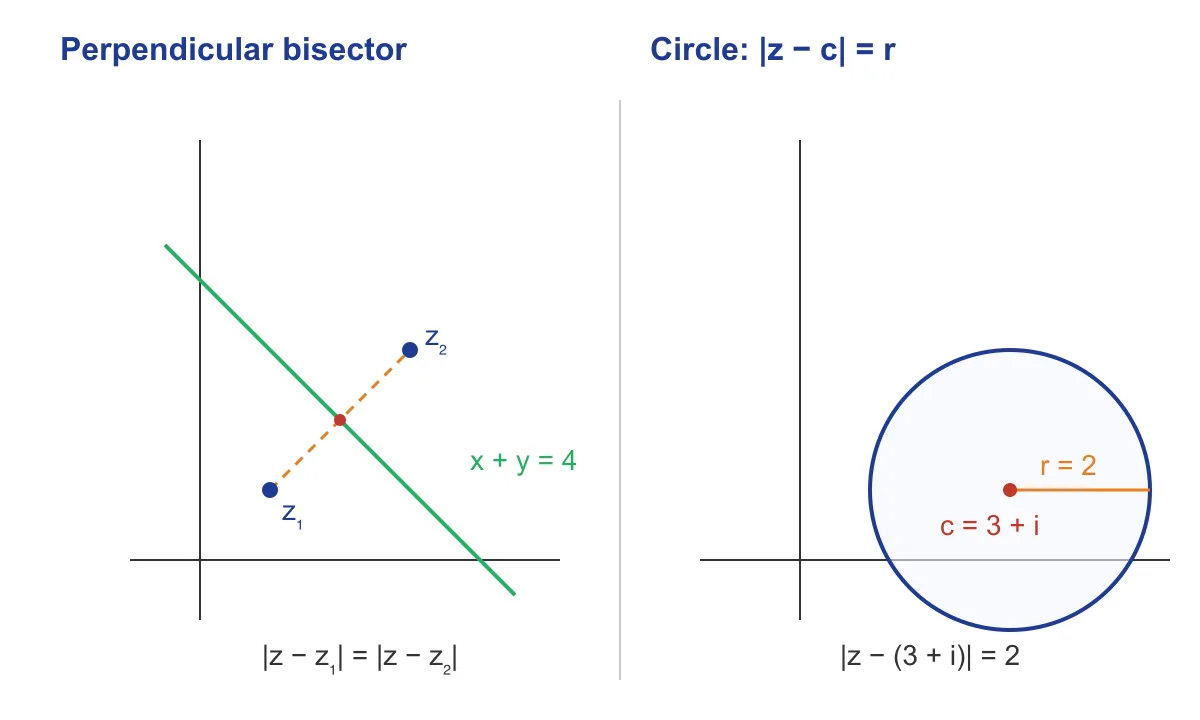
Figure 3.3: Two loci — the perpendicular bisector and the circle
The reliable method is to put $z = x + iy$, expand the moduli as $\sqrt{(\ )^2 + (\ )^2}$ and square. The two examples below show how the first line of the table is read off and how the circle of the $k \ne 1$ type is found.
For the perpendicular bisector, $|z - z_1| = |z - z_2|$ with $z_1 = 1 + i$, $z_2 = 3 + 3i$ gives $(x - 1)^2 + (y - 1)^2 = (x - 3)^2 + (y - 3)^2$, which simplifies to $x + y = 4$. The line passes through the midpoint $2 + 2i$ and is at right angles to the segment, as the figure shows.
Example 8: Describe the locus $|z - 1| = 3|z + 1|$.
Put $z = x + iy$ and square both sides.
$(x - 1)^2 + y^2 = 9\left[(x + 1)^2 + y^2\right]$.
$x^2 - 2x + 1 + y^2 = 9x^2 + 18x + 9 + 9y^2$.
$8x^2 + 8y^2 + 20x + 8 = 0$, so $x^2 + y^2 + \dfrac52 x + 1 = 0$.
Complete the square: $\left(x + \dfrac54\right)^2 + y^2 = \dfrac{25}{16} - 1 = \dfrac{9}{16}$.
Circle with centre $-\dfrac54$ on the real axis and radius $\dfrac34$.
Check with a point: $z = -0.5$ gives $|{-1.5}| = 1.5$ and $3|0.5| = 1.5$, and it lies at distance $0.75$ from the centre.
Memory trick: "Equal distances, a line; a fixed ratio of distances, a circle." If $k = 1$ the circle becomes infinitely large and turns into the perpendicular bisector.
Use it to decide the shape of a locus before doing any algebra.
Common traps
- Writing $\sqrt{-a}\sqrt{-b} = \sqrt{ab}$ → first write $\sqrt{-a} = i\sqrt a$, multiply, then use $i^2 = -1$.
- Using $\tan^{-1}(b/a)$ as the argument for every point → find the acute angle first, then place it by the quadrant.
- Giving $\operatorname{Arg}(z_1 z_2) = \operatorname{Arg} z_1 + \operatorname{Arg} z_2$ without checking the range → add the angles, then add or subtract $2\pi$ to land in $(-\pi, \pi]$.
- Writing $\operatorname{Im}(z) = ib$ → the imaginary part is the real number $b$.
- Treating $|z|^2$ as $z^2$ → $|z|^2 = z\bar z$, while $z^2$ is generally complex.
- Comparing $2 + i$ and $3$ with $<$ or $>$ → inequalities between non-real complex numbers have no meaning; compare moduli instead.
- Dividing by a complex number without clearing the denominator → multiply top and bottom by the conjugate.
- Expanding $(1 + \omega)^3$ with surds → use $1 + \omega = -\omega^2$ and $\omega^3 = 1$.
- Reducing $\omega^{n}$ by $n \bmod 2$ or $n \bmod 4$ → powers of $\omega$ repeat with period 3, powers of $i$ with period 4.
- Claiming $|z_1 + z_2| = |z_1| + |z_2|$ for all pairs → equality needs the same direction; otherwise the sum is strictly smaller.
Quick revision
- $(a, b)(c, d) = (ac - bd,\ ad + bc)$, $i = (0, 1)$, $i^2 = -1$.
- $i^n$ repeats with period 4; $i^{4k} = 1$, and $\frac1i = -i$.
- $z\bar z = |z|^2$ and $\frac{1}{z} = \frac{\bar z}{|z|^2}$.
- $z + \bar z = 2\operatorname{Re}z$, $z - \bar z = 2i\operatorname{Im}z$; $z$ is real iff $z = \bar z$.
- $|z| = \sqrt{a^2 + b^2}$; $|z_1 z_2| = |z_1||z_2|$; $|z^n| = |z|^n$.
- Principal argument lies in $(-\pi, \pi]$; $\arg\bar z = -\arg z$.
- Product: multiply moduli, add arguments. Quotient: divide moduli, subtract arguments.
- $z = r(\cos\theta + i\sin\theta) = re^{i\theta}$; $(\cos\theta + i\sin\theta)^n = \cos n\theta + i\sin n\theta$.
- $|z_1 + z_2| \le |z_1| + |z_2|$ and $|z_1 - z_2| \ge \big||z_1| - |z_2|\big|$.
- $|z_1 + z_2|^2 + |z_1 - z_2|^2 = 2(|z_1|^2 + |z_2|^2)$.
- Square roots of $a + ib$: $\pm\left(\sqrt{\frac{|z| + a}{2}} + i\,\mathrm{sgn}(b)\sqrt{\frac{|z| - a}{2}}\right)$.
- Cube roots of unity: $1, \omega, \omega^2$ with $\omega = \frac{-1 + i\sqrt3}{2}$; $\omega^3 = 1$, $1 + \omega + \omega^2 = 0$, $\omega^2 = \bar\omega$.
- Rotation by $\varphi$ about $z_0$: $z' - z_0 = (z - z_0)e^{i\varphi}$.
- $|z - z_1| = |z - z_2|$ is a perpendicular bisector; $|z - z_0| = r$ is a circle.
Practice questions
The value of $i^{57} + \frac{1}{i^{57}}$ is
- $2$
- $0$
- $-2i$
- $2i$
Answer
B. $0$
$57 = 4\cdot14 + 1$, so $i^{57} = i$. Then $\frac1i = -i$. The sum is $i - i = 0$.
The conjugate of $\dfrac{(1+i)^2}{2-i}$ is
- $\frac45 - \frac25 i$
- $-\frac25 + \frac45 i$
- $\frac25 - \frac45 i$
- $-\frac25 - \frac45 i$
Answer
D. $-\frac25 - \frac45 i$
$(1+i)^2 = 2i$. $\frac{2i}{2-i} = \frac{2i(2+i)}{5} = \frac{4i - 2}{5} = -\frac25 + \frac45 i$. Its conjugate is $-\frac25 - \frac45 i$.
The principal argument of $-1 + i$ is
- $-\frac{\pi}{4}$
- $\frac{\pi}{4}$
- $\frac{3\pi}{4}$
- $-\frac{3\pi}{4}$
Answer
C. $\frac{3\pi}{4}$
The point $(-1, 1)$ is in quadrant II. $\alpha = \tan^{-1}1 = \frac{\pi}{4}$, so the argument is $\pi - \frac{\pi}{4} = \frac{3\pi}{4}$.
The value of $\left|\dfrac{3+4i}{5-12i}\right|$ is
- $\frac{5}{13}$
- $\frac{7}{17}$
- $\frac{1}{13}$
- $\frac{13}{5}$
Answer
A. $\frac{5}{13}$
$|3+4i| = 5$ and $|5-12i| = 13$. The modulus of a quotient is the quotient of moduli: $\frac{5}{13}$.
The square roots of $5 - 12i$ are
- $\pm(2 + 3i)$
- $\pm(2 - 3i)$
- $\pm(3 - 2i)$
- $\pm(3 + 2i)$
Answer
C. $\pm(3 - 2i)$
$|z| = 13$. $p^2 = \frac{13+5}{2} = 9$, $q^2 = \frac{13-5}{2} = 4$. Since the imaginary part is negative, $p$ and $q$ have opposite signs. Check: $(3-2i)^2 = 9 - 12i - 4 = 5 - 12i$.
If $\omega$ is a non-real cube root of unity, then $(1+\omega)^3 + (1+\omega^2)^3$ equals
- $0$
- $-2$
- $2$
- $-1$
Answer
B. $-2$
$1+\omega = -\omega^2$ and $1+\omega^2 = -\omega$. Cubes: $-\omega^6 = -1$ and $-\omega^3 = -1$. Sum $= -2$.
The locus of the point $z$ satisfying $|z - 2| = |z + 2i|$ is
- the line $x + y = 0$
- the line $x - y = 0$
- the line $x + y = 2$
- a circle through the origin
Answer
A. the line $x + y = 0$
With $z = x + iy$: $(x-2)^2 + y^2 = x^2 + (y+2)^2$, so $-4x + 4 = 4y + 4$, giving $x + y = 0$. The points $2$ and $-2i$ are mirror images in this line.
If $|z| = 1$, then $z + \dfrac{1}{z}$ is equal to
- twice the imaginary part of $z$
- $2$ for every such $z$
- $0$ for every such $z$
- twice the real part of $z$
Answer
D. twice the real part of $z$
For $|z| = 1$, $\frac1z = \bar z$, so $z + \frac1z = z + \bar z = 2\operatorname{Re}(z)$. It equals $2$ only when $z = 1$.
For non-zero complex numbers $z_1, z_2$, the equation $|z_1 + z_2| = |z_1| + |z_2|$ holds if and only if
- $z_1$ and $z_2$ have principal arguments differing by $\pi$
- $z_1$ and $z_2$ have the same principal argument
- $z_1$ and $z_2$ have principal arguments differing by $\frac{\pi}{2}$
- $|z_1| = |z_2|$
Answer
B. $z_1$ and $z_2$ have the same principal argument
Equality in the triangle inequality needs both points in the same direction from the origin, that is, equal arguments. Opposite directions give $\big||z_1| - |z_2|\big|$ instead.
The point $2 + 3i$ is rotated about the origin through $90^\circ$ anticlockwise. The new point is
- $-3 - 2i$
- $3 - 2i$
- $3 + 2i$
- $-3 + 2i$
Answer
D. $-3 + 2i$
Multiplication by $i$ rotates by $90^\circ$ anticlockwise: $i(2 + 3i) = 2i + 3i^2 = -3 + 2i$.
If $z = re^{i\theta}$ with $r > 0$, then $\dfrac{\bar z}{z}$ equals
- $e^{-2i\theta}$
- $e^{-i\theta}$
- $e^{2i\theta}$
- $-1$
Answer
A. $e^{-2i\theta}$
$\bar z = re^{-i\theta}$, so $\frac{\bar z}{z} = \frac{re^{-i\theta}}{re^{i\theta}} = e^{-2i\theta}$.
For $-\pi < \theta < \pi$, the principal argument of $1 + \cos\theta + i\sin\theta$ is
- $2\theta$
- $\frac{\pi}{2} - \frac{\theta}{2}$
- $\frac{\theta}{2}$
- $\theta$
Answer
C. $\frac{\theta}{2}$
$1 + \cos\theta = 2\cos^2\frac\theta2$ and $\sin\theta = 2\sin\frac\theta2\cos\frac\theta2$. So the number is $2\cos\frac\theta2\left(\cos\frac\theta2 + i\sin\frac\theta2\right)$. As $|\theta| < \pi$, $\cos\frac\theta2 > 0$, so the modulus is positive and the argument is $\frac\theta2$.
If $z^2 + z + 1 = 0$, then $z^{2020} + z^{2021}$ equals
- $0$
- $-1$
- $1$
- $2$
Answer
B. $-1$
$z$ is $\omega$ or $\omega^2$, so $z^3 = 1$. $2020 = 3\cdot673 + 1$, so $z^{2020} = z$ and $z^{2021} = z^2$. The sum is $z + z^2 = -1$ from the equation.
If $\left|z - \dfrac{4}{z}\right| = 2$, the greatest value of $|z|$ is
- $2\sqrt2$
- $\sqrt5 - 1$
- $1 + \sqrt3$
- $1 + \sqrt5$
Answer
D. $1 + \sqrt5$
$|z| = \left|\left(z - \frac4z\right) + \frac4z\right| \le 2 + \frac{4}{|z|}$. With $t = |z|$: $t^2 - 2t - 4 \le 0$, so $t \le 1 + \sqrt5$. It is reached: $z^2 - 2z - 4 = 0$ has the root $z = 1 + \sqrt5$, and then $z - \frac4z = 2$.
The real part of $(1 + 2i)(3 - i)$ is
- $3$
- $1$
- $5$
- $7$
Answer
C. $5$
$(1+2i)(3-i) = 3 - i + 6i - 2i^2 = 3 + 5i + 2 = 5 + 5i$. The real part is $5$.
The modulus of $(1 + i)^{10}$ is
- $32$
- $16$
- $1024$
- $10$
Answer
A. $32$
$|1+i| = \sqrt2$, so $|(1+i)^{10}| = (\sqrt2)^{10} = 2^5 = 32$.
The number of complex numbers $z$ satisfying $z^2 = \bar z$ is
- $2$
- $3$
- $4$
- $1$
Answer
C. $4$
Taking moduli, $|z|^2 = |z|$, so $|z| = 0$ or $1$. $|z| = 0$ gives $z = 0$. If $|z| = 1$, $\bar z = \frac1z$, so $z^3 = 1$, which gives three values. Total $1 + 3 = 4$.
If $x, y$ are real and $(x + iy)(2 - 3i) = 4 + 7i$, the value of $xy$ is
- $-2$
- $2$
- $1$
- $5$
Answer
A. $-2$
$x + iy = \frac{4 + 7i}{2 - 3i} = \frac{(4+7i)(2+3i)}{13} = \frac{8 + 26i - 21}{13} = -1 + 2i$. So $x = -1$, $y = 2$, $xy = -2$. Check: $(-1 + 2i)(2 - 3i) = -2 + 3i + 4i + 6 = 4 + 7i$.
The smallest positive integer $n$ for which $\left(\dfrac{1 + i}{1 - i}\right)^n = 1$ is
- $1$
- $4$
- $2$
- $8$
Answer
B. $4$
$\frac{1+i}{1-i} = \frac{(1+i)^2}{2} = i$. $i^n = 1$ first when $n = 4$.
The area, in square units, of the triangle with vertices $0$, $z$ and $iz$, where $z = 3 + 4i$, is
- $25$
- $6.25$
- $10$
- $12.5$
Answer
D. $12.5$
$iz$ is $z$ rotated through $90^\circ$ with the same length $|z| = 5$. The triangle is right-angled at $0$ with both legs $5$, so the area is $\frac12\cdot5\cdot5 = 12.5$.
The distance between the points representing $-2 + 3i$ and $4 - 5i$ is
- $100$
- $14$
- $2$
- $10$
Answer
D. $10$
$|(-2+3i) - (4-5i)| = |-6 + 8i| = \sqrt{36 + 64} = 10$.
The radius of the circle $|z - 1| = 3|z + 1|$ is
- $0.5$
- $1.5$
- $0.75$
- $1.25$
Answer
C. $0.75$
$(x-1)^2 + y^2 = 9[(x+1)^2 + y^2]$ gives $8x^2 + 8y^2 + 20x + 8 = 0$, i.e. $x^2 + y^2 + 2.5x + 1 = 0$. Then $(x + 1.25)^2 + y^2 = 1.5625 - 1 = 0.5625$, so the radius is $0.75$.
If $\omega$ is a non-real cube root of unity, the value of $(1 + \omega - \omega^2)(1 - \omega + \omega^2)$ is
- $-4$
- $4$
- $2$
- $0$
Answer
B. $4$
$1 + \omega - \omega^2 = -2\omega^2$ and $1 - \omega + \omega^2 = -2\omega$. The product is $4\omega^3 = 4$.
If $\omega$ is a non-real cube root of unity, then $(1-\omega)(1-\omega^2)(1-\omega^4)(1-\omega^8)$ equals
- $9$
- $3$
- $27$
- $0$
Answer
A. $9$
$\omega^4 = \omega$ and $\omega^8 = \omega^2$. $(1-\omega)(1-\omega^2) = 1 - \omega - \omega^2 + \omega^3 = 1 + 1 + 1 = 3$. The product is $3 \cdot 3 = 9$.
If $|z - 6 - 8i| \le 4$, the least value of $|z|$ is
- $10$
- $6$
- $4$
- $14$
Answer
B. $6$
The centre $6 + 8i$ is $10$ from the origin and the radius is $4$. The nearest point of the disc is $10 - 4 = 6$ from the origin.
If $|z_1| = 3$ and $|z_2| = 4$, the value of $|z_1 + z_2|^2 + |z_1 - z_2|^2$ is
- $50$
- $7$
- $100$
- $25$
Answer
A. $50$
$|z_1 + z_2|^2 + |z_1 - z_2|^2 = 2(|z_1|^2 + |z_2|^2) = 2(9 + 16) = 50$.
Given below are two statements: Statement I: For every complex number $z$, $z\bar z$ is a non-negative real number. Statement II: For every complex number $z$, $z + \bar z$ is purely imaginary.
- Both Statement I and Statement II are correct
- Both Statement I and Statement II are incorrect
- Statement I is correct but Statement II is incorrect
- Statement I is incorrect but Statement II is correct
Answer
C. Statement I is correct but Statement II is incorrect
$z\bar z = |z|^2 \ge 0$, so Statement I is correct. $z + \bar z = 2\operatorname{Re}(z)$ is real, so Statement II is incorrect.
Given below are two statements: Statement I: For any complex numbers, $|z_1 + z_2| \le |z_1| + |z_2|$. Statement II: For any complex numbers, $|z_1 z_2| = |z_1||z_2|$.
- Both Statement I and Statement II are correct
- Both Statement I and Statement II are incorrect
- Statement I is correct but Statement II is incorrect
- Statement I is incorrect but Statement II is correct
Answer
A. Both Statement I and Statement II are correct
Both are standard: the first is the triangle inequality, the second follows from $|z_1z_2|^2 = z_1z_2\bar z_1\bar z_2 = |z_1|^2|z_2|^2$.
Given below are two statements: Statement I: For all real numbers $a$ and $b$, $\sqrt a\,\sqrt b = \sqrt{ab}$. Statement II: $i \cdot i = -1$.
- Both Statement I and Statement II are correct
- Both Statement I and Statement II are incorrect
- Statement I is correct but Statement II is incorrect
- Statement I is incorrect but Statement II is correct
Answer
D. Statement I is incorrect but Statement II is correct
Take $a = b = -1$: $\sqrt{-1}\sqrt{-1} = i\cdot i = -1$ but $\sqrt{1} = 1$, so Statement I is incorrect. $i^2 = -1$ makes Statement II correct.
Given below are two statements: Statement I: For any two complex numbers $z_1$ and $z_2$, exactly one of $z_1 < z_2$, $z_1 = z_2$, $z_1 > z_2$ holds. Statement II: If $z^3 = 1$, then $z = 1$.
- Both Statement I and Statement II are correct
- Both Statement I and Statement II are incorrect
- Statement I is correct but Statement II is incorrect
- Statement I is incorrect but Statement II is correct
Answer
B. Both Statement I and Statement II are incorrect
Non-real complex numbers cannot be ordered, so Statement I is incorrect. $z^3 = 1$ also has the roots $\omega$ and $\omega^2$, so Statement II is incorrect.
Given below are two statements: Statement I: If $\omega$ is a non-real cube root of unity, then $\omega^2 = \bar\omega$. Statement II: The sum of the three cube roots of unity is $1$.
- Both Statement I and Statement II are correct
- Both Statement I and Statement II are incorrect
- Statement I is correct but Statement II is incorrect
- Statement I is incorrect but Statement II is correct
Answer
C. Statement I is correct but Statement II is incorrect
$\omega\bar\omega = |\omega|^2 = 1$ and $\omega\cdot\omega^2 = 1$, so $\bar\omega = \omega^2$; Statement I is correct. The sum is $1 + \omega + \omega^2 = 0$, so Statement II is incorrect.
Assertion (A): If $|z| = 1$, then $\frac1z = \bar z$. Reason (R): $z\bar z = |z|^2$ for every complex number $z$.
- Both A and R are true and R is the correct explanation of A
- Both A and R are true but R is not the correct explanation of A
- A is true but R is false
- A is false but R is true
Answer
A. Both A and R are true and R is the correct explanation of A
From $z\bar z = |z|^2 = 1$ we get $\bar z = \frac1z$. R is true and gives A directly.
Assertion (A): The principal argument of $-1 - i$ is $\frac{5\pi}{4}$. Reason (R): The principal argument of a non-zero complex number lies in the interval $(-\pi, \pi]$.
- Both A and R are true and R is the correct explanation of A
- Both A and R are true but R is not the correct explanation of A
- A is true but R is false
- A is false but R is true
Answer
D. A is false but R is true
The point is in quadrant III with $\alpha = \frac\pi4$, so the principal argument is $\frac\pi4 - \pi = -\frac{3\pi}{4}$. A is false because $\frac{5\pi}{4}$ is outside $(-\pi, \pi]$. R is true.
Assertion (A): The locus of $|z - 1| = |z + 1|$ is the imaginary axis. Reason (R): The equation $|z - z_1| = |z - z_2|$ represents a circle with the segment joining $z_1$ and $z_2$ as diameter.
- Both A and R are true and R is the correct explanation of A
- Both A and R are true but R is not the correct explanation of A
- A is true but R is false
- A is false but R is true
Answer
C. A is true but R is false
$(x-1)^2 + y^2 = (x+1)^2 + y^2$ gives $x = 0$, the imaginary axis, so A is true. $|z - z_1| = |z - z_2|$ is the perpendicular bisector, not a circle, so R is false.
Match List I with List II. List I: a. $|z - 1| = |z - i|$ b. $|z - 1| = 2$ c. $\operatorname{Arg} z = \frac\pi4$ d. $z + \bar z = 0$ List II: i. a ray starting at the origin ii. the line $y = x$ iii. a circle of radius 2 iv. the imaginary axis
- a-i, b-iii, c-ii, d-iv
- a-ii, b-iii, c-i, d-iv
- a-iv, b-iii, c-i, d-ii
- a-ii, b-i, c-iii, d-iv
Answer
B. a-ii, b-iii, c-i, d-iv
$|z-1| = |z-i|$ is the perpendicular bisector of $1$ and $i$, the line $y = x$. $|z-1| = 2$ is a circle of radius 2. $\operatorname{Arg} z = \frac\pi4$ is a ray from the origin. $z + \bar z = 2x = 0$ is the imaginary axis.
Match List I with List II. List I: a. $\omega^{50}$ b. $1 + \omega^{50} + \omega^{100}$ c. $|1 - \omega|$ d. $\operatorname{Arg}\omega$ List II: i. $0$ ii. $\sqrt3$ iii. $\frac{2\pi}{3}$ iv. $\omega^2$
- a-i, b-iv, c-ii, d-iii
- a-iv, b-i, c-iii, d-ii
- a-iii, b-i, c-ii, d-iv
- a-iv, b-i, c-ii, d-iii
Answer
D. a-iv, b-i, c-ii, d-iii
$50 = 3\cdot16 + 2$, so $\omega^{50} = \omega^2$. $\omega^{100} = \omega$ since $100 \equiv 1$, so the sum is $1 + \omega^2 + \omega = 0$. $|1 - \omega|^2 = \left(\frac32\right)^2 + \left(\frac{\sqrt3}{2}\right)^2 = 3$. $\omega = e^{2\pi i/3}$ has principal argument $\frac{2\pi}{3}$.
Match List I with List II. List I: a. $1 + i$ b. $-1 - i$ c. $1 - i$ d. $-1$ List II: i. $-\frac{3\pi}{4}$ ii. $\frac{\pi}{4}$ iii. $\pi$ iv. $-\frac{\pi}{4}$
- a-ii, b-iii, c-iv, d-i
- a-ii, b-i, c-iii, d-iv
- a-iv, b-i, c-ii, d-iii
- a-ii, b-i, c-iv, d-iii
Answer
D. a-ii, b-i, c-iv, d-iii
$1 + i$ is in quadrant I: $\frac\pi4$. $-1 - i$ is in quadrant III: $\frac\pi4 - \pi = -\frac{3\pi}{4}$. $1 - i$ is in quadrant IV: $-\frac\pi4$. $-1$ lies on the negative real axis: $\pi$.
Two adjacent vertices of a square, taken in anticlockwise order, are $1 + i$ and $4 + 5i$. The other two vertices of the square are
- $8 + 2i$ and $5 - 2i$
- $8i$ and $-3 + 4i$
- $-4 + 3i$ and $-3 + 8i$
- $-3 + 4i$ and $8 + 2i$
Answer
B. $8i$ and $-3 + 4i$
The side vector is $(4 + 5i) - (1 + i) = 3 + 4i$. For an anticlockwise square the next side turns left by $90^\circ$: $i(3 + 4i) = -4 + 3i$. The vertices are $(4 + 5i) + (-4 + 3i) = 8i$ and $(1 + i) + (-4 + 3i) = -3 + 4i$. Check: $8i - (-3 + 4i) = 3 + 4i$, the first side again.
If $|z + 4| \le 3$, the greatest value of $|z + 1|$ is
- $6$
- $4$
- $3$
- $7$
Answer
A. $6$
$|z + 1| = |(z + 4) - 3| \le |z + 4| + 3 \le 6$. Equality: $z = -7$ gives $|z + 4| = 3$ and $|z + 1| = 6$.
If $\omega$ is a non-real cube root of unity, then $\dfrac{1}{2 + \omega} + \dfrac{1}{1 + 2\omega}$ equals
- $1$
- $\omega$
- $-\omega$
- $-\omega^2$
Answer
C. $-\omega$
The sum is $\frac{(1 + 2\omega) + (2 + \omega)}{(2 + \omega)(1 + 2\omega)} = \frac{3(1 + \omega)}{2 + 5\omega + 2\omega^2}$. Denominator: $2(1 + \omega + \omega^2) + 3\omega = 3\omega$. Numerator: $3(1+\omega) = -3\omega^2$. So the value is $\frac{-3\omega^2}{3\omega} = -\omega$.