Quadratic Equations
What to remember
- A quadratic $ax^2+bx+c=0$ ($a\ne 0$) has exactly two roots in the complex numbers, counted with multiplicity. The formula $x=\dfrac{-b\pm\sqrt{D}}{2a}$ with $D=b^2-4ac$ works for real and complex coefficients alike.
- For real coefficients the sign of $D$ decides the nature of the roots. For complex coefficients it decides nothing, and non-real roots need not come as conjugates.
- Sum of roots $=-\dfrac{b}{a}$, product $=\dfrac{c}{a}$. Almost every "symmetric function" question is $S^2-2P$ or $S^3-3SP$ in disguise.
- For a parabola with $a>0$: always positive needs $D<0$; a number $k$ lies between the roots exactly when $f(k)<0$; both roots on one side of $k$ needs three checks ($D$, vertex, $f(k)$).
- Minimum (if $a>0$) or maximum (if $a<0$) of $f$ is $-\dfrac{D}{4a}$ at $x=-\dfrac{b}{2a}$. On a closed interval, compare the end points with the vertex.
The equation and its solution by formula
An equation of the form $ax^2+bx+c=0$ with $a\ne 0$ is a quadratic equation. The numbers $a,b,c$ may be real, or they may be complex. A number that makes the left side zero is a root. Two ways of solving are worth having ready: factorisation when the numbers are friendly, and the formula when they are not.
The formula comes from completing the square. Divide by $a$ and move the constant across:
Add $\left(\dfrac{b}{2a}\right)^2$ on both sides:
Take square roots and you get
$D$ is called the discriminant. Nothing in this derivation used the fact that $a,b,c$ are real, so the same formula holds for complex coefficients. The only change is that $\sqrt{D}$ now means "any complex number whose square is $D$". Either choice of that number gives the same pair of roots, because the $\pm$ takes care of the other.
To find such a square root, write $\sqrt{3+4i}=p+iq$ with real $p,q$. Squaring gives $p^2-q^2=3$ and $2pq=4$. Try $p=2$, $q=1$: both hold. So $\sqrt{3+4i}=\pm(2+i)$. For real coefficients you rarely need this, because a negative $D$ simply gives $\sqrt{D}=i\sqrt{-D}$.
Two quick checks save work. If $a+b+c=0$, then $x=1$ is a root (put $x=1$ and see), and the other root is $\dfrac{c}{a}$. If $a-b+c=0$, then $x=-1$ is a root.
Example 1: Solve $z^2-(2+3i)z+(-1+3i)=0$.
Here $a=1$, $b=-(2+3i)$, $c=-1+3i$.
$D=(2+3i)^2-4(-1+3i)=(4+12i-9)+4-12i=-1$.
So $\sqrt{D}=\pm i$ and $z=\dfrac{(2+3i)\pm i}{2}$.
$z=\dfrac{2+4i}{2}=1+2i$ or $z=\dfrac{2+2i}{2}=1+i$.
Check: sum $=2+3i$ and product $=(1+2i)(1+i)=1+i+2i-2=-1+3i$. Both match.
Answer: $z=1+2i$ or $z=1+i$. Notice that the two roots are not conjugates of each other. That is allowed here because the coefficients are not real.
Discriminant and nature of roots
For $a,b,c$ real, the sign of $D$ tells everything.
| Condition | Roots | Graph of $y=ax^2+bx+c$ |
|---|---|---|
| $D>0$ | real and distinct | cuts the x-axis at two points |
| $D=0$ | real and equal, $x=-\dfrac{b}{2a}$ | touches the x-axis at the vertex |
| $D<0$ | non-real, conjugate pair $p\pm iq$ | does not meet the x-axis |
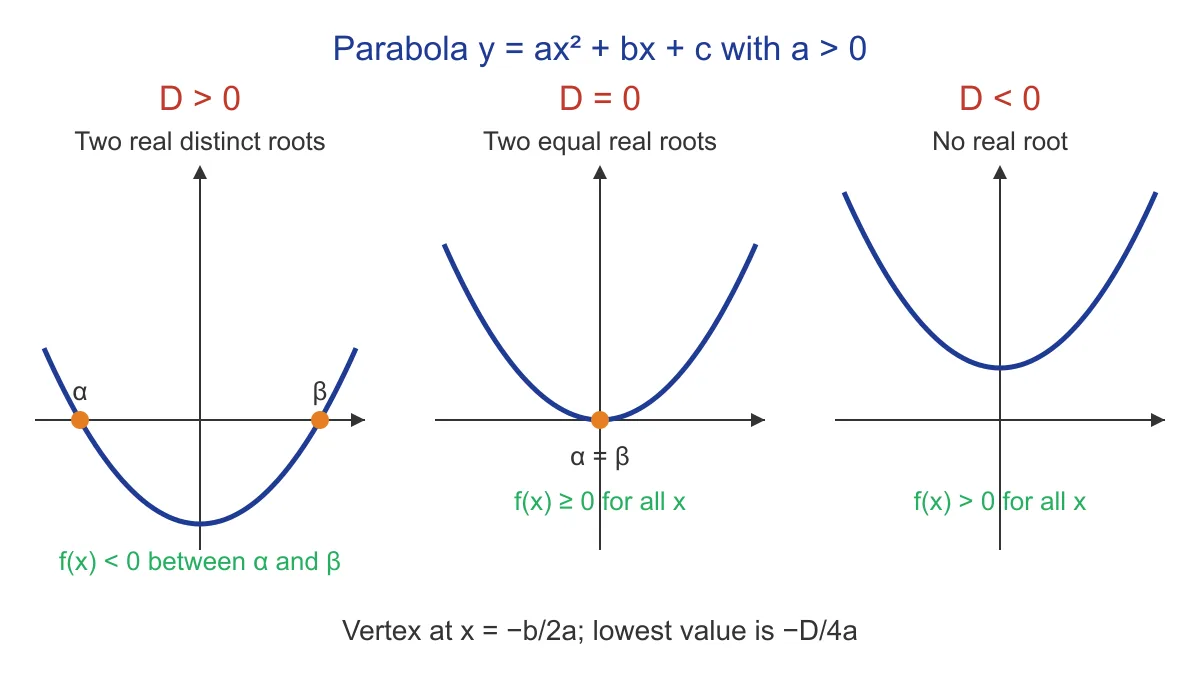
*Figure 4.1: The three cases of the discriminant for a parabola with $a>0$*
The conjugate-pair statement needs real coefficients, and it is easy to prove: if $\alpha$ satisfies $a\alpha^2+b\alpha+c=0$, take the conjugate of both sides. Real $a,b,c$ stay as they are, and you get $a\bar\alpha^2+b\bar\alpha+c=0$. So $\bar\alpha$ is a root too.
Now add the case where the coefficients are rational. Then $D$ is rational, and:
- if $D$ is a perfect square of a rational number, both roots are rational;
- if $D>0$ but not a perfect square, the roots are irrational and come as a conjugate pair of surds, $p+\sqrt{q}$ and $p-\sqrt{q}$. So if $2+\sqrt{3}$ is a root of a rational quadratic, $2-\sqrt{3}$ is also a root.
If $a,b,c$ are integers and $D$ is a perfect square, the roots are rational, though not always integers. For a monic equation ($a=1$) with integer $b,c$, a perfect-square $D$ does give integer roots.
When the coefficients are complex and not all real, do not use $D$ to classify roots. The word "real" or "imaginary" for $D$ means nothing here. Take $x^2-(2+i)x+(1+i)=0$. Its $D=(2+i)^2-4(1+i)=-1$, which is negative, yet the roots are $1$ and $1+i$: one real, one not. If you must find which real $x$ satisfies a complex-coefficient equation, put $x$ real, separate the real and imaginary parts, and set each to zero. Both parts must vanish together.
Example 2: For which real $k$ does $x^2-2kx+(k+2)=0$ have real roots? Find the condition for equal roots as well.
$D=4k^2-4(k+2)=4(k^2-k-2)=4(k-2)(k+1)$.
Real roots need $D\ge 0$, so $(k-2)(k+1)\ge 0$. This holds for $k\le -1$ or $k\ge 2$.
Equal roots need $D=0$, so $k=2$ or $k=-1$.
Answer: real roots for $k\le-1$ or $k\ge 2$; equal roots at $k=2,-1$.
The factor 4 comes out of $D$ at once, so always look for a common factor before you solve the inequality.
Relations between roots and coefficients
Let $\alpha,\beta$ be the roots of $ax^2+bx+c=0$. Since the polynomial equals $a(x-\alpha)(x-\beta)$, compare the coefficients of $x$ and the constant terms. Then
These are true for real or complex coefficients. Write $S=\alpha+\beta$ and $P=\alpha\beta$. Some consequences you should read off without thinking:
- roots equal in size and opposite in sign: $S=0$, so $b=0$;
- roots are reciprocals of each other: $P=1$, so $c=a$;
- one root is zero: $c=0$;
- roots of opposite sign (real roots): $P<0$, which means $a$ and $c$ have opposite signs, and then $D>0$ automatically.
Memory trick: "The Sum Sulks, the Product stays Plain." The sum carries a minus, $-\dfrac{b}{a}$, and the product has none, $\dfrac{c}{a}$. Say it each time before you write a Vieta relation, so the sign of $b$ never slips.
Forming an equation from its roots
If the roots are $\alpha$ and $\beta$, the equation is
where $S$ and $P$ are the sum and product of the roots. Any non-zero multiple of it is also an equation with those roots.
For roots such as $2+\sqrt{3}$ and $2-\sqrt{3}$: $S=4$ and $P=4-3=1$, so the equation is $x^2-4x+1=0$. For roots $3+2i$ and $3-2i$: $S=6$, $P=9+4=13$, giving $x^2-6x+13=0$.
New equation from an old one
Suppose $\alpha,\beta$ are roots of $f(x)=0$. You rarely need to find $\alpha,\beta$ themselves. Three shifts of variable do most of the work:
| New roots | Replace $x$ in $f(x)=0$ by |
|---|---|
| $\alpha+h,\ \beta+h$ | $x-h$ |
| $m\alpha,\ m\beta$ | $\dfrac{x}{m}$ |
| $\dfrac{1}{\alpha},\ \dfrac{1}{\beta}$ | $\dfrac{1}{x}$ (reverse the order of the coefficients) |
For anything else, such as roots $\alpha^2,\beta^2$, compute the new $S$ and $P$ from the old ones and use $x^2-Sx+P=0$.
Symmetric functions of the roots
A symmetric expression is unchanged when $\alpha$ and $\beta$ swap. Every such expression can be written in $S$ and $P$.
| Expression | In terms of $S,P$ |
|---|---|
| $\alpha^2+\beta^2$ | $S^2-2P$ |
| $\alpha^3+\beta^3$ | $S^3-3SP$ |
| $\alpha^4+\beta^4$ | $(S^2-2P)^2-2P^2$ |
| $(\alpha-\beta)^2$ | $S^2-4P$ |
| $\dfrac{1}{\alpha}+\dfrac{1}{\beta}$ | $\dfrac{S}{P}$ |
| $\dfrac{\alpha}{\beta}+\dfrac{\beta}{\alpha}$ | $\dfrac{S^2-2P}{P}$ |
The difference of roots is $\vert\alpha-\beta\vert=\dfrac{\sqrt{D}}{\vert a\vert}$ for real roots, which follows from $(\alpha-\beta)^2=S^2-4P$.
Where do they come from? $(\alpha+\beta)^2=\alpha^2+\beta^2+2\alpha\beta$ gives the second row. For cubes, expand $(\alpha+\beta)^3=\alpha^3+\beta^3+3\alpha\beta(\alpha+\beta)$. Higher powers come from squaring a lower one, or from the recurrence that each root itself satisfies: $\alpha^2=S\alpha-P$, so $\alpha^{n+2}+\beta^{n+2}=S(\alpha^{n+1}+\beta^{n+1})-P(\alpha^n+\beta^n)$.
One more relation turns up in JEE questions: the roots are in a given ratio $m:n$. Put the roots as $mt$ and $nt$. Then $(m+n)t=-\dfrac{b}{a}$ and $mnt^2=\dfrac{c}{a}$. Eliminating $t$:
For "one root is twice the other" use $m=1,n=2$: $2b^2=9ac$.
Example 3: If $\alpha,\beta$ are roots of $x^2-5x+3=0$, find $\alpha^3+\beta^3$, and form the equation whose roots are $\alpha^2$ and $\beta^2$.
$S=5$, $P=3$.
$\alpha^3+\beta^3=S^3-3SP=125-45=80$.
$\alpha^2+\beta^2=S^2-2P=25-6=19$ and $\alpha^2\beta^2=P^2=9$.
The new equation is $x^2-19x+9=0$.
We never solved the original equation. The roots are irrational anyway, so avoiding them also avoids messy arithmetic.
Example 4: The roots of $x^2+ax+8=0$ are real, and one root is the square of the other. Find $a$.
Let the roots be $r$ and $r^2$. Product: $r\cdot r^2=r^3=8$, so $r=2$ for real $r$.
The roots are $2$ and $4$. Sum $=6=-a$, so $a=-6$.
Check: $x^2-6x+8=(x-2)(x-4)$. Good.
The product relation fixes the root; the sum relation then gives the coefficient. Use the one that is easier first.
Common roots
Take two quadratics $a_1x^2+b_1x+c_1=0$ and $a_2x^2+b_2x+c_2=0$.
Both roots common. The equations must be the same equation up to a multiplier:
Exactly one common root. Let $x$ be the common root. Multiply the first equation by $b_2$, the second by $b_1$ and subtract: the $x$ terms vanish and you get $x^2$ in terms of constants. Do the same with $a_2$ and $a_1$ to cancel $x^2$ and get $x$. The two results are
Squaring the second and equating with the first gives the condition
In practice you seldom need it. The reliable method is to subtract the equations to get a linear equation, solve that for $x$, and put the value back in one of the equations. Better still, when one equation factorises, put each of its roots into the other equation.
If the coefficients are real and the common root is non-real, its conjugate is a root of both equations as well, so both roots are common. That is how one fact about conjugates settles many "common root" questions.
Example 5: Find all $k$ for which $x^2-5x+6=0$ and $x^2+kx+8=0$ have a common root.
The first factorises: $(x-2)(x-3)=0$, roots $2$ and $3$.
Root $2$ in the second equation: $4+2k+8=0$, so $k=-6$. (Second equation becomes $x^2-6x+8$, roots $2,4$.)
Root $3$ in the second equation: $9+3k+8=0$, so $k=-\dfrac{17}{3}$.
Answer: $k=-6$ or $k=-\dfrac{17}{3}$.
Each root of the first equation can be the shared one, so there are two answers. Stopping after the first value is the usual loss of marks.
When two equations of the type $x^2+px+q=0$ and $x^2+qx+p=0$ share a root and $p\ne q$, subtracting gives $(p-q)x+(q-p)=0$, so the common root is $x=1$ and $1+p+q=0$.
Sign of a quadratic expression
Write $f(x)=ax^2+bx+c$ with real coefficients and $a>0$. Let the real roots, if any, be $\alpha\le\beta$. Since $f(x)=a(x-\alpha)(x-\beta)$:
- $f$ has the sign of $a$ when $x<\alpha$ or $x>\beta$ (outside the roots);
- $f$ has the opposite sign to $a$ when $\alpha<x<\beta$ (between the roots).
If $D<0$ there are no real roots, so $f$ never changes sign, and it has the sign of $a$ everywhere.
| Requirement for all real $x$ | Condition |
|---|---|
| $f(x)>0$ | $a>0$ and $D<0$ |
| $f(x)\ge 0$ | $a>0$ and $D\le 0$ |
| $f(x)<0$ | $a<0$ and $D<0$ |
| $f(x)\le 0$ | $a<0$ and $D\le 0$ |
Memory trick: "a up, D down" for always positive; "a down, D down" for always negative. In both, $D$ stays below zero. Say the pair to yourself, and flip only the first word.
If the leading coefficient itself carries a parameter, such as $(k-2)x^2+\dots$, you must check the case where it is zero separately. At $k=2$ the expression stops being a quadratic and may or may not be positive.
Example 6: Find all real $k$ for which $(k-2)x^2+2(k-2)x+4>0$ for every real $x$.
Case $k=2$: the expression is $4>0$, always true. So $k=2$ works.
Case $k\ne 2$: need $k-2>0$ and $D<0$.
$D=4(k-2)^2-16(k-2)=4(k-2)(k-2-4)=4(k-2)(k-6)$.
$D<0$ means $2<k<6$. With $k>2$ this gives $2<k<6$.
Combine both cases: $2\le k<6$.
The end point $k=2$ was only found because the degenerate case was checked on its own.
Location of roots
Questions of this type ask where the roots sit compared with fixed numbers. Everything comes from one picture: a parabola, its vertex at $x=-\dfrac{b}{2a}$, and the sign of $f$ at the numbers in question. Take $a>0$; if $a<0$, use $af(k)$ in place of $f(k)$ and every condition below holds as written.
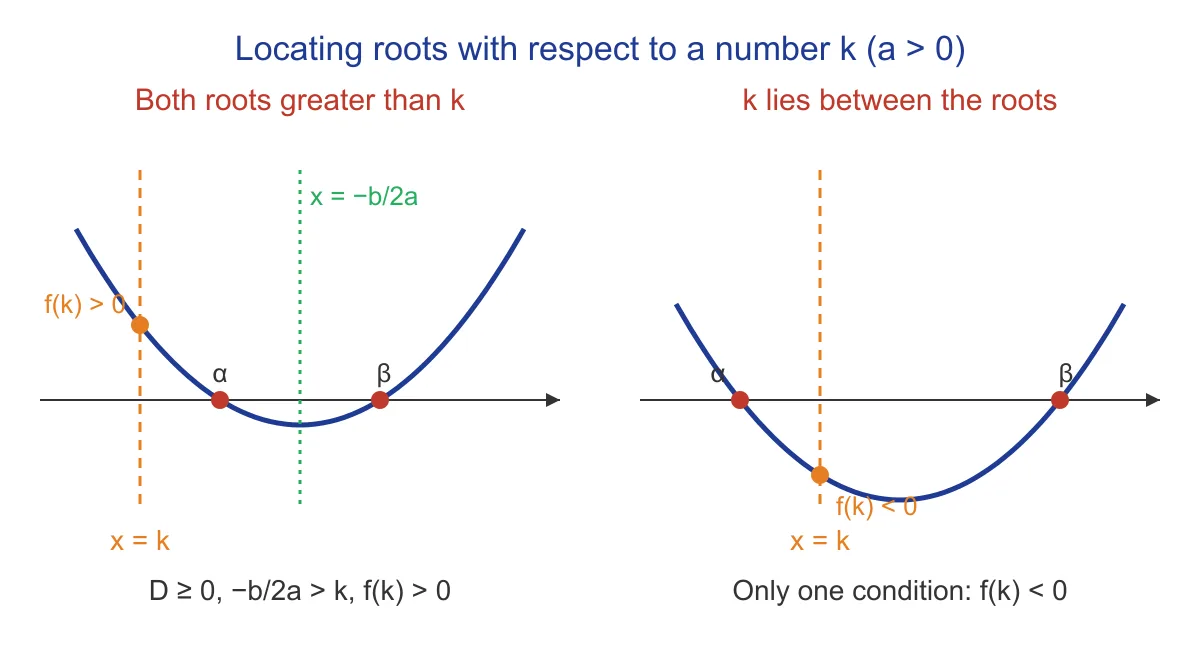
*Figure 4.2: Both roots greater than $k$ (left) and $k$ between the roots (right)*
| Situation (real roots, $a>0$) | Conditions |
|---|---|
| Both roots greater than $k$ | $D\ge 0$, $-\dfrac{b}{2a}>k$, $f(k)>0$ |
| Both roots less than $k$ | $D\ge 0$, $-\dfrac{b}{2a}<k$, $f(k)>0$ |
| $k$ lies between the roots | $f(k)<0$ (no other condition) |
| Exactly one root in $(k_1,k_2)$ | $f(k_1)\,f(k_2)<0$ |
| Both roots in $(k_1,k_2)$ | $D\ge 0$, $k_1<-\dfrac{b}{2a}<k_2$, $f(k_1)>0$, $f(k_2)>0$ |
Why do we need three conditions for "both greater than $k$"? $D\ge 0$ makes the roots real. $f(k)>0$ says $k$ is outside the roots, but that could mean either side. The vertex condition picks the side. Leave out any one and a wrong case slips in.
For "$k$ between the roots", $f(k)<0$ forces the parabola below the axis at $k$, so $D>0$ automatically and the roots straddle $k$. That is why one condition is enough.
Memory trick: "D, V, F": Discriminant, Vertex, Function value. For both roots on one side of $k$, check all three; for $k$ between the roots, F alone.
The condition $f(k_1)f(k_2)<0$ for exactly one root in an interval fails to cover the end cases. If $f(k_1)=0$ or $f(k_2)=0$, check by hand whether the other root lies inside.
Example 7: Find the values of $k$ for which both roots of $x^2-2kx+k+2=0$ are greater than $1$.
$f(x)=x^2-2kx+k+2$ and the number to compare is $1$.
$D\ge 0$: from Example 2, $k\le-1$ or $k\ge 2$.
Vertex: $-\dfrac{b}{2a}=k>1$.
$f(1)=1-2k+k+2=3-k>0$, so $k<3$.
Intersect the three: $k\ge 2$ (from $D$ and $k>1$) together with $k<3$ gives $2\le k<3$.
At $k=2$ the roots are equal ($x=2$), still greater than 1, so the end point is included.
Intersect the conditions on a number line; do not merge them by eye.
Equations reducible to quadratics
Many equations look different but become quadratic after a substitution. The skill is in choosing the substitution, and then going back to $x$ at the end.
Modulus. Write $t=\vert x\vert$ and use $x^2=\vert x\vert^2$. For $x^2-3\vert x\vert+2=0$, put $t=\vert x\vert$: $t^2-3t+2=0$, so $t=1$ or $2$. Now $t$ must be non-negative, and each positive $t$ gives two values of $x$ (namely $\pm t$), while $t=0$ gives one. So the solutions are $x=\pm1,\pm2$. If a root $t$ comes out negative, throw it away: $\vert x\vert=-3$ has no solution.
For an equation such as $\vert x-1\vert^2-4\vert x-1\vert-5=0$, put $t=\vert x-1\vert$; then $t=5$ (since $t=-1$ is rejected), so $x-1=\pm5$.
Exponential. For $4^x-5\cdot2^x+4=0$, put $t=2^x$, which is always positive. Then $t^2-5t+4=0$ gives $t=1,4$, so $x=0,2$. Again reject any $t\le 0$.
Reciprocal pairs. With $t=x+\dfrac{1}{x}$ we get $x^2+\dfrac{1}{x^2}=t^2-2$. For real non-zero $x$, $\vert t\vert\ge 2$, so any root $t$ with $\vert t\vert<2$ gives no real $x$.
Repeated block. If the same expression occurs twice, such as $(x^2+x)$ below, call it $t$.
Radicals. Square to remove the root, solve, then substitute every answer into the original equation. Squaring can create roots that were never there.
Example 8: Solve $(x^2+x)^2-8(x^2+x)+12=0$ over the reals.
Put $t=x^2+x$. Then $t^2-8t+12=0$, so $(t-2)(t-6)=0$ and $t=2$ or $t=6$.
$x^2+x-2=0$ gives $(x+2)(x-1)=0$, so $x=-2,1$.
$x^2+x-6=0$ gives $(x+3)(x-2)=0$, so $x=-3,2$.
Answer: $x=-3,-2,1,2$. Four real roots.
Check $x=2$: $x^2+x=6$ and $36-48+12=0$. Good.
The quartic never had to be expanded. A substitution turns a fourth-degree equation into two easy quadratics.
Maximum and minimum of a quadratic
Complete the square:
The squared term is never negative. So, for $a>0$ the least value is $-\dfrac{D}{4a}$ at $x=-\dfrac{b}{2a}$, and $f$ has no greatest value. For $a<0$ the greatest value is $-\dfrac{D}{4a}$ and there is no least value.
If $x$ is confined to a closed interval $[p,q]$, the extreme values may sit at the end points, so compute $f(p)$, $f(q)$, and $f$ at the vertex when the vertex lies inside $[p,q]$. Compare them.
Two useful consequences. If $x+y=s$ is fixed, then $xy=x(s-x)\le\dfrac{s^2}{4}$ with equality at $x=y=\dfrac{s}{2}$. If $xy=q$ is fixed with $x,y>0$, then $x+y\ge 2\sqrt{q}$.
Example 9: A farmer has $40$ m of fencing and builds a rectangular pen using a wall as one side, so only three sides need fencing. What is the largest area?
Let the two sides at right angles to the wall be $x$ m each and the side along the wall be $y$ m. Then $2x+y=40$, so $y=40-2x$.
Area $A=x(40-2x)=-2x^2+40x$.
Here $a=-2<0$, so $A$ has a maximum at $x=-\dfrac{40}{2(-2)}=10$.
$A(10)=10\times20=200$ m$^2$.
The vertex value is the answer, but check it is allowed: $x=10$ gives $y=20>0$, so the pen exists.
Example 10: Find the least value of $f(x)=x^2-4x+7$ on $[3,5]$.
The vertex is at $x=2$, which is outside $[3,5]$.
On $[3,5]$ the function is increasing, since $x>2$.
$f(3)=9-12+7=4$ and $f(5)=25-20+7=12$.
The least value is $4$, at $x=3$.
The unrestricted minimum would be $f(2)=3$. That value is not reached inside the given interval, so the end point is the answer.
Common traps
- Using $D$ to classify roots when the coefficients are complex and non-real → use $D$ for nature only with real coefficients; otherwise solve with the formula and a complex square root.
- Writing the sum of roots as $\dfrac{b}{a}$ → it is $-\dfrac{b}{a}$; the minus sign belongs to the sum only.
- Writing $\alpha^2+\beta^2=S^2+2P$ → the sign is minus: $S^2-2P$.
- Stopping at one value of $k$ in a common-root question → each root of the factorisable equation can be the shared root, so test all of them.
- Forgetting the case where the leading coefficient is $0$ in "positive for all $x$" questions → treat $a=0$ separately and see whether the remaining expression qualifies.
- Using only $f(k)>0$ for "both roots greater than $k$" → add $D\ge 0$ and the vertex condition.
- Using $D>0$ together with $f(k)<0$ for "$k$ between the roots" → $f(k)<0$ already gives it; extra conditions cost time and invite errors.
- Counting $\vert x\vert=t$ as one solution for every $t$ → each $t>0$ gives two values of $x$, $t=0$ gives one, and $t<0$ gives none.
- Keeping a root of $t=2^x$ that is zero or negative → $2^x>0$, so such $t$ is rejected.
- Taking the minimum at the vertex when $x$ is restricted to an interval → compare the end points as well; the vertex counts only if it lies inside.
Quick revision
- Formula: $x=\dfrac{-b\pm\sqrt{b^2-4ac}}{2a}$, valid for real and complex coefficients.
- Real coefficients: $D>0$ two real roots, $D=0$ equal real roots, $D<0$ conjugate complex roots.
- Rational coefficients and $D$ a perfect square: rational roots; otherwise irrational roots come as $p\pm\sqrt{q}$.
- $\alpha+\beta=-\dfrac{b}{a}$ and $\alpha\beta=\dfrac{c}{a}$, for any coefficients.
- Equation with roots $\alpha,\beta$: $x^2-(\alpha+\beta)x+\alpha\beta=0$.
- $\alpha^2+\beta^2=S^2-2P$ and $\alpha^3+\beta^3=S^3-3SP$.
- $(\alpha-\beta)^2=S^2-4P$, so $\vert\alpha-\beta\vert=\dfrac{\sqrt{D}}{\vert a\vert}$.
- Roots in ratio $m:n$: $mn\,b^2=(m+n)^2ac$.
- $a+b+c=0$ gives root $1$; $a-b+c=0$ gives root $-1$.
- Both roots common: coefficients proportional. One common root: subtract the equations and solve the linear result.
- Always positive: $a>0$ and $D<0$. Always negative: $a<0$ and $D<0$.
- $k$ between the roots: $af(k)<0$. Both roots on one side of $k$: $D\ge 0$, vertex on that side, $af(k)>0$.
- Exactly one root in $(k_1,k_2)$: $f(k_1)f(k_2)<0$.
- Extreme value of a quadratic: $-\dfrac{D}{4a}$ at $x=-\dfrac{b}{2a}$; minimum if $a>0$, maximum if $a<0$.
Practice questions
What is the nature of the roots of $2x^2-3x+5=0$, where the coefficients are real?
- Real and equal
- Real and irrational
- Non-real complex conjugates
- Real and distinct
Answer
C. Non-real complex conjugates
$D=9-40=-31<0$ with real coefficients, so the roots are a non-real conjugate pair.
If the roots of $x^2+px+12=0$ differ by $1$ and $p>0$, then $p$ equals
- $12$
- $7$
- $1$
- $-7$
Answer
B. $7$
Roots $r,r+1$ with $r(r+1)=12$ give $r=3$ or $r=-4$. Sum of roots $=-p$. For $p>0$ the roots are $-4,-3$, sum $-7$, so $p=7$.
If $\alpha,\beta$ are the roots of $2x^2-5x+3=0$, the equation with roots $\dfrac{1}{\alpha},\dfrac{1}{\beta}$ is
- $3x^2-5x+2=0$
- $3x^2-2x+5=0$
- $2x^2-5x+3=0$
- $3x^2+5x+2=0$
Answer
A. $3x^2-5x+2=0$
Replace $x$ by $1/x$: $2-5x+3x^2=0$. Check: $S'=\dfrac{S}{P}=\dfrac{5/2}{3/2}=\dfrac{5}{3}$, $P'=\dfrac{2}{3}$, giving $3x^2-5x+2=0$.
If $a,b$ are rational and $2+\sqrt{3}$ is a root of $x^2+ax+b=0$, then $(a,b)$ is
- $(4,-1)$
- $(-4,-1)$
- $(4,1)$
- $(-4,1)$
Answer
D. $(-4,1)$
The other root is $2-\sqrt{3}$. Sum $=4=-a$, so $a=-4$. Product $=4-3=1=b$.
For $x^2-(k+2)x+4=0$ to have equal roots with $k>0$, the value of $k$ is
- $4$
- $6$
- $-6$
- $2$
Answer
D. $2$
$D=(k+2)^2-16=0$ gives $k+2=\pm4$, so $k=2$ or $k=-6$. Since $k>0$, $k=2$.
The number of real solutions of $x^2-\vert x\vert-6=0$ is
- $3$
- $4$
- $2$
- $1$
Answer
C. $2$
Put $t=\vert x\vert$: $t^2-t-6=0$, $t=3$ or $t=-2$. Only $t=3$ is allowed, giving $x=\pm3$: two solutions.
The set of all real $m$ for which $x^2+mx+4>0$ for every real $x$ is
- $-4<m<4$
- $0<m<4$
- $m<-4$ or $m>4$
- $-4\le m\le4$
Answer
A. $-4<m<4$
Need $D=m^2-16<0$ with leading coefficient $1>0$, so $-4<m<4$. At $m=\pm4$ the expression touches zero at $x=\mp2$, so the ends are excluded.
The roots of $x^2-2x+5=0$ are
- $1\pm4i$
- $1\pm2i$
- $-1\pm2i$
- $2\pm i$
Answer
B. $1\pm2i$
$x=\dfrac{2\pm\sqrt{4-20}}{2}=\dfrac{2\pm4i}{2}=1\pm2i$.
The quadratic $-3x^2+6x-1$ has
- a greatest value $2$ at $x=1$
- a greatest value $-1$ at $x=0$
- a greatest value $2$ at $x=-1$
- a least value $2$ at $x=1$
Answer
A. a greatest value $2$ at $x=1$
Leading coefficient is negative, so there is a maximum at $x=-\dfrac{6}{2(-3)}=1$. Value: $-3+6-1=2$.
If $a+b+c=0$ and $a\ne0$, the roots of $ax^2+bx+c=0$ are
- $-1$ and $\dfrac{c}{a}$
- $1$ and $\dfrac{c}{a}$
- $1$ and $-\dfrac{c}{a}$
- $1$ and $\dfrac{a}{c}$
Answer
B. $1$ and $\dfrac{c}{a}$
Put $x=1$: $a+b+c=0$, so $1$ is a root. Product of roots is $\dfrac{c}{a}$, so the other root is $\dfrac{c}{a}$.
Both roots of $x^2-2ax+a^2-1=0$ lie strictly inside the interval $(-2,4)$. Then $a$ lies in
- $(-2,4)$
- $(-3,5)$
- $(-1,3)$
- $[-1,3]$
Answer
C. $(-1,3)$
The roots are $a-1$ and $a+1$. Need $a-1>-2$ and $a+1<4$, so $-1<a<3$.
If $x^2+px+q=0$ and $x^2+qx+p=0$ with $p\ne q$ have a common root, then $p+q$ equals
- $pq$
- $0$
- $1$
- $-1$
Answer
D. $-1$
Subtract: $(p-q)x+(q-p)=0$, so $x=1$. Substituting, $1+p+q=0$, so $p+q=-1$.
The roots of $x^2+(m-3)x+m=0$ lie on either side of $1$ exactly when
- $m<3$
- $m>1$
- $m<0$
- $m<1$
Answer
D. $m<1$
$1$ lies between the roots when $f(1)<0$: $1+m-3+m=2m-2<0$, so $m<1$.
For real $a$, one root of $x^2+ax+8=0$ is the square of the other. Then $a$ equals
- $6$
- $-6$
- $-9$
- $9$
Answer
B. $-6$
Roots $r,r^2$: $r^3=8$. A real $a$ needs real roots, so $r=2$; roots $2,4$, sum $6=-a$, $a=-6$. (Other cube roots give a non-real sum.)
If $\alpha,\beta$ are the roots of $x^2-6x+4=0$, the value of $\alpha^2+\beta^2$ is
- $28$
- $32$
- $40$
- $20$
Answer
A. $28$
$S=6$, $P=4$: $S^2-2P=36-8=28$.
The value of $k$ for which $4x^2-12x+k=0$ has equal roots is
- $3$
- $36$
- $9$
- $-9$
Answer
C. $9$
$D=144-16k=0$ gives $k=9$. Check: $4x^2-12x+9=(2x-3)^2$.
If $\alpha,\beta$ are roots of $x^2-4x+2=0$, the value of $\dfrac{\alpha}{\beta}+\dfrac{\beta}{\alpha}$ is
- $12$
- $6$
- $8$
- $4$
Answer
B. $6$
$S=4$, $P=2$: $\dfrac{S^2-2P}{P}=\dfrac{16-4}{2}=6$.
If $\alpha,\beta$ are roots of $x^2-3x+1=0$, the value of $\alpha^3+\beta^3$ is
- $24$
- $9$
- $27$
- $18$
Answer
D. $18$
$S=3$, $P=1$: $S^3-3SP=27-9=18$.
The number of integer values of $m$ for which $x^2+mx+16>0$ for all real $x$ is
- $15$
- $17$
- $16$
- $7$
Answer
A. $15$
$D=m^2-64<0$ gives $-8<m<8$. Integers $-7,\dots,7$: $15$ values.
The least value of $2x^2-12x+5$ is
- $-7$
- $5$
- $-13$
- $-18$
Answer
C. $-13$
Minimum at $x=3$: $18-36+5=-13$. By formula, $-\dfrac{D}{4a}=-\dfrac{144-40}{8}=-13$.
If $2x+3y=12$ with $x,y$ real, the greatest value of $xy$ is
- $6$
- $3$
- $9$
- $12$
Answer
A. $6$
$y=\dfrac{12-2x}{3}$, so $xy=\dfrac{12x-2x^2}{3}$. Maximum at $x=3$: $\dfrac{36-18}{3}=6$.
The number of real roots of $x^2-5\vert x\vert+6=0$ is
- $6$
- $3$
- $2$
- $4$
Answer
D. $4$
$t=\vert x\vert$: $t^2-5t+6=0$, $t=2,3$. Each gives two values of $x$: $\pm2,\pm3$, so $4$ roots.
The sum of all real roots of $4^x-5\cdot2^x+4=0$ is
- $5$
- $2$
- $0$
- $4$
Answer
B. $2$
$t=2^x>0$: $t^2-5t+4=0$, $t=1,4$. So $x=0,2$; sum $=2$.
The sum of all values of $k$ for which $x^2-5x+6=0$ and $x^2+kx+12=0$ have a common root is
- $15$
- $-8$
- $-15$
- $-7$
Answer
C. $-15$
Roots of the first are $2,3$. Root $2$: $4+2k+12=0$, $k=-8$. Root $3$: $9+3k+12=0$, $k=-7$. Sum $=-15$.
If $\alpha,\beta$ are the roots of $x^2-(m-2)x-(m+3)=0$, the least value of $\alpha^2+\beta^2$ over real $m$ is
- $5$
- $8$
- $9$
- $10$
Answer
C. $9$
$S=m-2$, $P=-(m+3)$: $S^2-2P=m^2-4m+4+2m+6=m^2-2m+10=(m-1)^2+9$. Least value $9$ at $m=1$.
If $\alpha,\beta$ are the roots of $x^2-x-1=0$, the value of $\alpha^8+\beta^8$ is
- $55$
- $47$
- $49$
- $34$
Answer
B. $47$
$S=1$, $P=-1$. $\alpha^2+\beta^2=1+2=3$; $\alpha^4+\beta^4=9-2=7$; $\alpha^8+\beta^8=49-2=47$.
Given below are two statements: Statement I: If a quadratic equation with real coefficients has $2+3i$ as a root, then $2-3i$ is also a root. Statement II: If a quadratic equation with complex coefficients that are not all real has $2+3i$ as a root, then $2-3i$ is also a root.
- Both Statement I and Statement II are correct
- Both Statement I and Statement II are incorrect
- Statement I is correct but Statement II is incorrect
- Statement I is incorrect but Statement II is correct
Answer
C. Statement I is correct but Statement II is incorrect
Statement I is true by the conjugate-root property for real coefficients. Statement II is false: $x^2-(2+i)x+(1+i)=0$ has roots $1,1+i$, so non-real roots need not pair up.
Given below are two statements: Statement I: If $a>0$ and $f(k)<0$ for some real $k$, where $f(x)=ax^2+bx+c$ has real coefficients, then $k$ lies between the two roots of $f(x)=0$. Statement II: If $a>0$ and $D<0$, then $f(x)>0$ for all real $x$.
- Both Statement I and Statement II are correct
- Both Statement I and Statement II are incorrect
- Statement I is correct but Statement II is incorrect
- Statement I is incorrect but Statement II is correct
Answer
A. Both Statement I and Statement II are correct
I: $f(k)<0$ with $a>0$ means the parabola is below the axis at $k$, so there are real roots with $k$ between them. II: no real roots and an upward parabola means $f>0$ everywhere. Both true.
Given below are two statements: Statement I: If the roots of $ax^2+bx+c=0$ are reciprocals of each other, then $a=c$. Statement II: If the roots of $ax^2+bx+c=0$ are equal in size and opposite in sign, then $c=0$.
- Both Statement I and Statement II are correct
- Both Statement I and Statement II are incorrect
- Statement I is correct but Statement II is incorrect
- Statement I is incorrect but Statement II is correct
Answer
C. Statement I is correct but Statement II is incorrect
I: product $\dfrac{c}{a}=1$, so $a=c$. II: roots $\pm r$ give sum $0$, so $b=0$, not $c=0$ (for example $x^2-4=0$). I true, II false.
Given below are two statements: Statement I: The equation $x^2-3\vert x\vert+2=0$ has exactly two real roots. Statement II: The equation $x^2+\vert x\vert+1=0$ has no real root.
- Both Statement I and Statement II are correct
- Both Statement I and Statement II are incorrect
- Statement I is correct but Statement II is incorrect
- Statement I is incorrect but Statement II is correct
Answer
D. Statement I is incorrect but Statement II is correct
I: $\vert x\vert=1,2$ gives four roots $\pm1,\pm2$, so I is false. II: for real $x$ the left side is at least $1$, so there is no real root; II true.
Given below are two statements: Statement I: If $D<0$ for a quadratic $ax^2+bx+c$ with real coefficients, then $ax^2+bx+c>0$ for all real $x$. Statement II: If a quadratic with real coefficients has two distinct real roots, then $D$ must be a positive perfect square.
- Both Statement I and Statement II are correct
- Both Statement I and Statement II are incorrect
- Statement I is correct but Statement II is incorrect
- Statement I is incorrect but Statement II is correct
Answer
B. Both Statement I and Statement II are incorrect
I fails when $a<0$ (for example $-x^2-1<0$ everywhere). II fails because $x^2-2=0$ has distinct real roots but $D=8$ is not a perfect square. Both incorrect.
Assertion (A): If real $a,b$ are such that $x^2+x+1=0$ and $x^2+ax+b=0$ have a common root, then $a=b=1$. Reason (R): For a quadratic with real coefficients, non-real roots occur as a conjugate pair.
- Both A and R are true and R is the correct explanation of A
- Both A and R are true but R is not the correct explanation of A
- A is true but R is false
- A is false but R is true
Answer
A. Both A and R are true and R is the correct explanation of A
The roots of $x^2+x+1$ are non-real. A common non-real root has its conjugate also common (R), so both roots are common and $a=b=1$. R explains A.
Assertion (A): If $a+b+c=0$ and $a\ne0$, then $x=1$ is a root of $ax^2+bx+c=0$. Reason (R): The product of the roots of $ax^2+bx+c=0$ is $\dfrac{c}{a}$.
- Both A and R are true and R is the correct explanation of A
- Both A and R are true but R is not the correct explanation of A
- A is true but R is false
- A is false but R is true
Answer
B. Both A and R are true but R is not the correct explanation of A
A: putting $x=1$ gives $a+b+c=0$. R is a true fact, but A is proved by direct substitution and R does not explain why $1$ is a root.
Assertion (A): The expression $x^2-6x+10$ is positive for every real $x$. Reason (R): A quadratic expression with positive leading coefficient is positive for every real $x$.
- Both A and R are true and R is the correct explanation of A
- Both A and R are true but R is not the correct explanation of A
- A is true but R is false
- A is false but R is true
Answer
C. A is true but R is false
A: $D=36-40<0$ and $a=1>0$, so true. R is false: $x^2-1$ is negative for $\vert x\vert<1$.
Match List I with List II. List I: a. $x^2-4x+4=0$ b. $x^2+x+1=0$ c. $x^2-2x-1=0$ d. $x^2-5x+6=0$ List II: i. Real, rational and distinct roots ii. Real and equal roots iii. Non-real roots iv. Real, irrational and distinct roots
- a-ii, b-iv, c-iii, d-i
- a-iii, b-ii, c-iv, d-i
- a-ii, b-iii, c-i, d-iv
- a-ii, b-iii, c-iv, d-i
Answer
D. a-ii, b-iii, c-iv, d-i
a: $D=0$. b: $D=-3<0$. c: $D=8>0$, not a square. d: $D=1$, roots $2,3$.
Match List I with List II. In List I, $f(x)=ax^2+bx+c$ has real coefficients and $a>0$. List I: a. Both roots positive b. Both roots negative c. Roots of opposite sign d. Roots reciprocal of each other List II: i. $c<0$ ii. $b>0$, $c>0$, $D\ge0$ iii. $b<0$, $c>0$, $D\ge0$ iv. $c=a$
- a-iv, b-ii, c-i, d-iii
- a-iii, b-ii, c-iv, d-i
- a-ii, b-iii, c-i, d-iv
- a-iii, b-ii, c-i, d-iv
Answer
D. a-iii, b-ii, c-i, d-iv
Sum $=-\dfrac{b}{a}$, product $=\dfrac{c}{a}$. Both positive: sum and product positive, so $b<0$, $c>0$, $D\ge0$. Both negative: $b>0$, $c>0$, $D\ge0$. Opposite signs: $c<0$. Reciprocals: product $1$, $c=a$.
Match List I with List II. List I (roots $\alpha,\beta$ of): a. $x^2-5x+6=0$ b. $x^2-4x+2=0$ c. $x^2-x-2=0$ d. $x^2+2x+3=0$ List II (value of $\alpha^2+\beta^2$): i. $-2$ ii. $5$ iii. $12$ iv. $13$
- a-iv, b-iii, c-ii, d-i
- a-iv, b-ii, c-iii, d-i
- a-iii, b-iv, c-ii, d-i
- a-iv, b-iii, c-i, d-ii
Answer
A. a-iv, b-iii, c-ii, d-i
Using $S^2-2P$: a: $25-12=13$. b: $16-4=12$. c: $1+4=5$. d: $4-6=-2$.
Find all real $a$ for which both roots of $x^2+2(a-1)x+(a+5)=0$ are positive and real.
- $a\le-1$
- $a\ge4$
- $-5<a<-1$
- $-5<a\le-1$
Answer
D. $-5<a\le-1$
Need $D\ge0$: $4(a-1)^2-4(a+5)\ge0$ gives $a^2-3a-4\ge0$, so $a\le-1$ or $a\ge4$. Sum $>0$: $-2(a-1)>0$, $a<1$. Product $>0$: $a>-5$. Intersection: $-5<a\le-1$. (At $a=-1$ the roots are equal and positive.)
If $\alpha,\beta$ are the roots of $x^2-3x+1=0$, the equation whose roots are $\alpha+\dfrac{1}{\beta}$ and $\beta+\dfrac{1}{\alpha}$ is
- $x^2+6x+4=0$
- $x^2-6x+4=0$
- $x^2-3x+4=0$
- $x^2-6x+1=0$
Answer
B. $x^2-6x+4=0$
$\alpha+\beta=3$, $\alpha\beta=1$. New sum $=(\alpha+\beta)+\dfrac{\alpha+\beta}{\alpha\beta}=3+3=6$. New product $=\alpha\beta+1+1+\dfrac{1}{\alpha\beta}=1+2+1=4$. Equation: $x^2-6x+4=0$.
A rectangular plot is to be fenced on three sides, the fourth side being an existing wall. With $60$ m of fencing, the largest possible area in square metres is
- $450$
- $300$
- $225$
- $900$
Answer
A. $450$
Sides at right angles to the wall $x$ each, along the wall $60-2x$. Area $=60x-2x^2$, maximum at $x=15$: $900-450=450$.