Sets
What to remember
- A set is a well-defined collection: for any object you can say yes or no to "is it in the set?". Order and repetition do not matter, so $\{1,2,2,3\}=\{3,1,2\}$.
- A set with $n$ elements has $2^n$ subsets and $2^n-1$ proper subsets. The empty set $\varnothing$ is a subset of every set, and $\{\varnothing\}$ is not empty: it has one element.
- Union, intersection, difference and symmetric difference are all decided element by element. De Morgan: $(A\cup B)'=A'\cap B'$ and $(A\cap B)'=A'\cup B'$.
- Counting rule for two sets: $n(A\cup B)=n(A)+n(B)-n(A\cap B)$. For three sets add all three singles, subtract the three pairs, add back the triple.
- Almost every word problem becomes easy once you fill the innermost Venn region first and work outwards.
Describing a set
You can describe a set in two ways. The roster form lists the elements inside braces, separated by commas: $A=\{2,4,6,8\}$. The set-builder form states a rule that every member satisfies and no outsider does: $A=\{x : x=2k,\ k\in\mathbb{N},\ k\le 4\}$, that is, the positive even numbers below 10. In this book we write the rule after the colon in words or symbols, for example $\{x : x\in\mathbb{Z},\ x^2<10\}$.
The standard number sets are $\mathbb{N}$ (natural numbers $1,2,3,\dots$), $\mathbb{Z}$ (integers), $\mathbb{Q}$ (rationals) and $\mathbb{R}$ (reals). We write $a\in A$ for "$a$ belongs to $A$" and $a\notin A$ otherwise.
Two rules about the roster form catch people out. First, an element is listed once, however many times it turns up. The letters of the word "SCHOOL" give $\{S,C,H,O,L\}$, five elements, not six. Second, the order is irrelevant. When you convert from set-builder form to roster form, solve the condition fully. For $\{x : x^2-5x+6=0\}$ you must find both roots, giving $\{2,3\}$.
Example 1: Write $A=\{x : x\in\mathbb{Z},\ x^2<10\}$ in roster form, and write $B=\{1,4,9,16,25\}$ in set-builder form.
Rough work for $A$: $x^2<10$ means $-\sqrt{10}<x<\sqrt{10}$, and $\sqrt{10}\approx 3.16$.
Integers strictly between $-3.16$ and $3.16$ are $-3,-2,-1,0,1,2,3$.
So $A=\{-3,-2,-1,0,1,2,3\}$, seven elements.
For $B$: every member is a perfect square of a natural number, and the largest is $5^2$.
So $B=\{x : x=n^2,\ n\in\mathbb{N},\ n\le 5\}$.
Answer: as above. Notice that $A$ includes negative integers and $0$; forgetting them is the usual slip.
Kinds of sets
- Empty set $\varnothing$ (also written $\{\ \}$): no elements. $\{x\in\mathbb{R} : x^2+1=0\}$ is empty because no real number squares to $-1$. Writing $\{\varnothing\}$ or $\{0\}$ gives a set with exactly one element, so neither is empty.
- Finite set: you can count its elements and the count ends. Infinite set: it never ends, as with $\mathbb{N}$. A singleton has exactly one element.
- Equal sets: $A=B$ when they have exactly the same elements. Equivalent sets: $n(A)=n(B)$, the same number of elements, though the elements may differ. Equal sets are always equivalent; the reverse fails. $\{1,2,3\}$ and $\{a,b,c\}$ are equivalent but not equal.
- Universal set $U$: the big set that contains everything under discussion in a given problem. It changes from problem to problem. If we talk about digits, $U$ may be $\{0,1,\dots,9\}$.
Subsets and the power set
$A$ is a subset of $B$, written $A\subseteq B$, when every element of $A$ is also in $B$. It is a proper subset, written $A\subset B$, when in addition $A\ne B$. Three facts are used constantly:
- $A\subseteq A$ for every set.
- $\varnothing\subseteq A$ for every set. The reason: to break the statement you would need an element of $\varnothing$ that is not in $A$, and no such element exists.
- $A\subseteq B$ and $B\subseteq A$ together mean $A=B$. This is the standard way to prove two sets equal.
The power set $P(A)$ is the set of all subsets of $A$. Take $A=\{a,b,c\}$. Then $P(A)=\{\varnothing,\{a\},\{b\},\{c\},\{a,b\},\{a,c\},\{b,c\},\{a,b,c\}\}$, which has $8=2^3$ members.
Why $2^n$? To build a subset, go through the $n$ elements one by one and decide "in" or "out". That is two choices per element, made independently, so $2\times2\times\cdots\times2=2^n$ subsets. One of them is the whole set, so there are $2^n-1$ proper subsets, and $2^n-2$ subsets that are neither empty nor the whole set.
Memory trick: "In or out, in or out, each element shouts!" Each element chooses in or out, so $n$ elements give $2^n$ subsets. Use it whenever a problem says "how many subsets": fix the elements that are forced, and let every free element double the count.
Example 2: How many subsets of $A=\{1,2,3,4,5,6\}$ contain both $1$ and $2$ but not $3$?
Elements $1,2$ must be in: no choice, factor $1$.
Element $3$ must be out: no choice, factor $1$.
Free elements: $4,5,6$, each in or out, so $2^3=8$.
Answer: $8$.
Notice that forcing an element in or out removes it from the doubling; only free elements count.
The power set of the empty set is $P(\varnothing)=\{\varnothing\}$, one element, which agrees with $2^0=1$. The power set of that has $2^1=2$ elements. Always check the layers: $P(P(A))$ with $n(A)=2$ has $2^{2^2}=16$ elements.
Operations on sets
Let $A,B$ be subsets of a universal set $U$. Each operation is a rule on membership.
| Operation | Symbol | An element $x$ is in it when | Region |
|---|---|---|---|
| Union | $A\cup B$ | $x$ is in $A$ or in $B$ or in both | everything shaded in the two circles |
| Intersection | $A\cap B$ | $x$ is in both $A$ and $B$ | the overlap |
| Difference | $A-B$ | $x$ is in $A$ but not in $B$ | $A$ minus the overlap |
| Symmetric difference | $A\,\Delta\,B$ | $x$ is in exactly one of $A,B$ | the two crescents |
| Complement | $A'$ | $x$ is in $U$ but not in $A$ | outside circle $A$ |
Two sets with $A\cap B=\varnothing$ are called disjoint. The key rewrites are
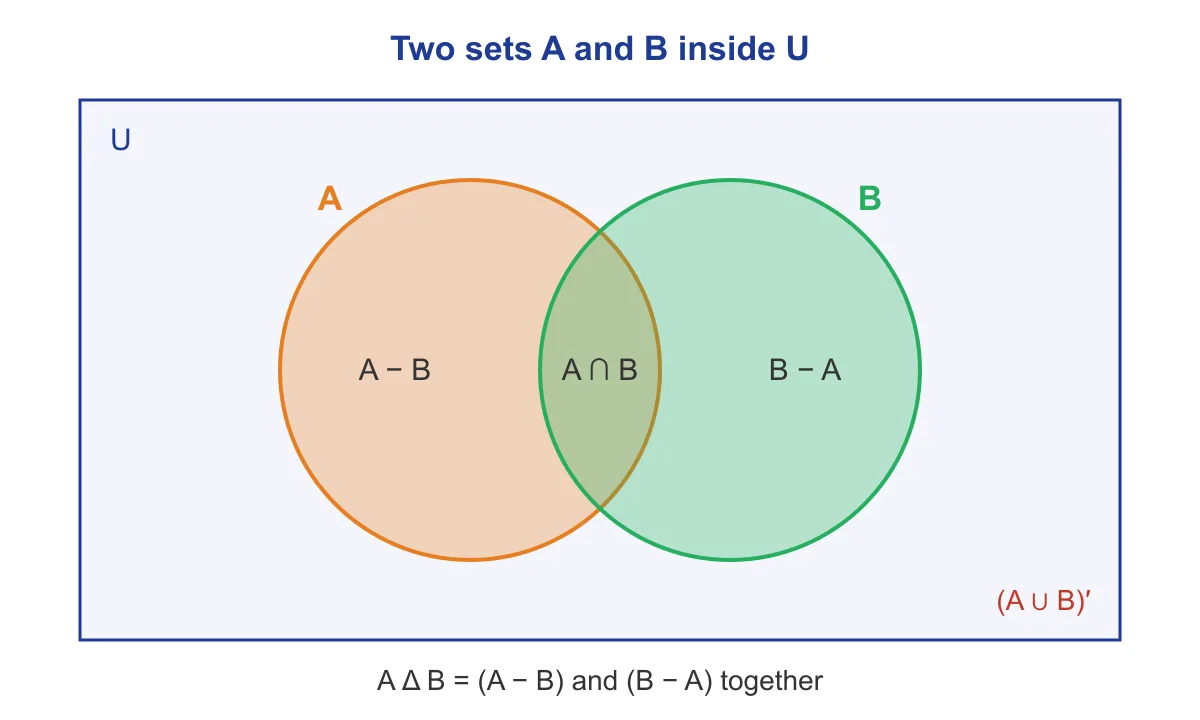
Figure 1.1: the four regions made by two sets
Read the picture as four disjoint pieces: $A-B$, $A\cap B$, $B-A$ and the outside $(A\cup B)'$. Every statement about two sets can be checked by asking which pieces it contains. For example $A\cup B$ is the first three pieces, and $A\,\Delta\,B$ is the first and third.
Example 3: Let $U=\{1,2,\dots,10\}$, $A=\{1,2,3,4,5,6\}$, $B=\{4,5,6,7,8\}$. Find $A-B$, $B-A$, $A\,\Delta\,B$, $A'$ and $(A\cup B)'$.
$A\cap B=\{4,5,6\}$.
$A-B$: remove $4,5,6$ from $A$, giving $\{1,2,3\}$.
$B-A$: remove $4,5,6$ from $B$, giving $\{7,8\}$.
$A\,\Delta\,B=\{1,2,3\}\cup\{7,8\}=\{1,2,3,7,8\}$.
$A'=U-A=\{7,8,9,10\}$.
$A\cup B=\{1,\dots,8\}$, so $(A\cup B)'=\{9,10\}$.
Answer: as listed. Check: $n(A\,\Delta\,B)=n(A)+n(B)-2n(A\cap B)=6+5-6=5$, which matches the five elements found.
Algebra of sets
These laws hold for all subsets of $U$. You need not memorise them as a list; each follows from the meaning of "and" and "or".
| Law | Statement |
|---|---|
| Idempotent | $A\cup A=A,\quad A\cap A=A$ |
| Identity | $A\cup\varnothing=A,\quad A\cap U=A$ |
| Domination | $A\cup U=U,\quad A\cap\varnothing=\varnothing$ |
| Complement | $A\cup A'=U,\quad A\cap A'=\varnothing,\quad (A')'=A$ |
| Commutative | $A\cup B=B\cup A,\quad A\cap B=B\cap A$ |
| Associative | $(A\cup B)\cup C=A\cup(B\cup C)$, and the same for $\cap$ |
| Distributive | $A\cap(B\cup C)=(A\cap B)\cup(A\cap C)$ and $A\cup(B\cap C)=(A\cup B)\cap(A\cup C)$ |
| Absorption | $A\cup(A\cap B)=A,\quad A\cap(A\cup B)=A$ |
| De Morgan | $(A\cup B)'=A'\cap B',\quad (A\cap B)'=A'\cup B'$ |
Note that difference is neither commutative nor associative: $A-B\ne B-A$ in general. Symmetric difference, on the other hand, is both.
Why De Morgan works. Take $x\in(A\cup B)'$. It means $x$ is not in $A\cup B$, that is, $x$ is in neither $A$ nor $B$. So $x\notin A$ and $x\notin B$, which is $x\in A'\cap B'$. The steps reverse, so the two sets are equal. For the second law, "not in both" means "missing from at least one", which is $A'\cup B'$. The laws extend to any number of sets: $(A\cup B\cup C)'=A'\cap B'\cap C'$.
Memory trick: "Break the bar, flip the sign!" When a complement bar sits over a bracket, break it into separate bars and flip $\cup$ to $\cap$ (or $\cap$ to $\cup$). Use it to rewrite any "not (this or that)" as "not this and not that".
Consequences worth knowing, each proved by the $\subseteq$ both ways method or by regions:
- $A\subseteq B$ is equivalent to each of $A\cap B=A$, $A\cup B=B$, $A-B=\varnothing$ and $B'\subseteq A'$.
- $A-(B\cup C)=(A-B)\cap(A-C)$ and $A-(B\cap C)=(A-B)\cup(A-C)$.
- $A\cap(B-C)=(A\cap B)-(A\cap C)$.
Example 4: Prove $A-(B\cup C)=(A-B)\cap(A-C)$.
Left side: $A-(B\cup C)=A\cap(B\cup C)'$ by the rewrite for difference.
De Morgan gives $(B\cup C)'=B'\cap C'$, so the left side is $A\cap B'\cap C'$.
Right side: $(A-B)\cap(A-C)=(A\cap B')\cap(A\cap C')$.
Since $A\cap A=A$ and intersection is commutative and associative, this is $A\cap B'\cap C'$.
Both sides reduce to $A\cap B'\cap C'$, so they are equal.
Notice how the difference-to-complement rewrite turns every difference problem into a plain algebra problem.
Proving a set identity
When a problem says "show that" or "which of these is always true", you have three dependable routes. Pick the one that fits the size of the statement.
| Method | How it works | Best when |
|---|---|---|
| Two-way inclusion | Take $x$ in the left side, show $x$ is in the right side; then reverse | the statement is short and the sets are abstract |
| Algebra of sets | Rewrite differences as $\cap$ with a complement, then use De Morgan and distributive laws | differences and complements are mixed together |
| Region check | Shade each side in a Venn diagram and compare the pieces | you only need to decide true or false, or to find a counter-example |
A counter-example is a perfect way to kill a false statement. Pick tiny sets such as $A=\{1\}$, $B=\{2\}$ inside $U=\{1,2,3\}$ and compute both sides. One mismatch is enough to prove that a claimed law is not always true; ten matches prove nothing.
Example 9: Show that $A\,\Delta\,B=\varnothing$ exactly when $A=B$.
If $A=B$: $A-B=\varnothing$ and $B-A=\varnothing$, so their union is $\varnothing$.
Conversely, suppose $A\,\Delta\,B=(A-B)\cup(B-A)=\varnothing$.
A union is empty only when both parts are empty, so $A-B=\varnothing$ and $B-A=\varnothing$.
$A-B=\varnothing$ says every element of $A$ is in $B$, so $A\subseteq B$. Similarly $B\subseteq A$.
Together these give $A=B$.
Answer: proved. Notice that "difference is empty" is the same as "subset", which turns many identity questions into inclusion questions.
Look-alike pairs
Several pairs of ideas sit very close together. Keep this table in mind when a statement seems to be "obviously true".
| Pair | Difference |
|---|---|
| $\varnothing$ and $\{\varnothing\}$ | $0$ elements versus $1$ element |
| $\subseteq$ and $\subset$ | the first allows equality, the second does not |
| $a\in A$ and $\{a\}\subseteq A$ | an element belongs to a set; a set is contained in a set |
| $A-B$ and $B-A$ | different regions; equal only when $A=B$ |
| $A\cup B$ and $A\,\Delta\,B$ | the union also keeps the overlap |
| Equal and equivalent sets | same elements versus same number of elements |
The third row matters in practice. If $A=\{1,2,\{3\}\}$ then $\{3\}\in A$ but $3\notin A$, and $\{1,2\}\subseteq A$ but $\{1,2\}\notin A$. Sets can be members of other sets, so always ask which level you are at.
Counting with Venn diagrams
For finite sets, $n(S)$ is the number of elements of $S$. Counting is just region arithmetic. If $A$ and $B$ overlap, adding $n(A)$ and $n(B)$ counts the overlap twice, so take it off once:
Useful variants, all read straight off Figure 1.1:
- $n(A-B)=n(A)-n(A\cap B)$.
- $n(A\,\Delta\,B)=n(A)+n(B)-2\,n(A\cap B)$.
- Neither: $n\big((A\cup B)'\big)=n(U)-n(A\cup B)$.
- If $A\cap B=\varnothing$ the formula reduces to $n(A\cup B)=n(A)+n(B)$. It is valid only for disjoint sets.
For three sets the same idea gives
The reason: elements in exactly two sets are counted twice by the singles and removed once by the pairs, which is right. Elements in all three are counted three times by the singles, removed three times by the pairs, and so end at zero, so the triple term puts them back once.
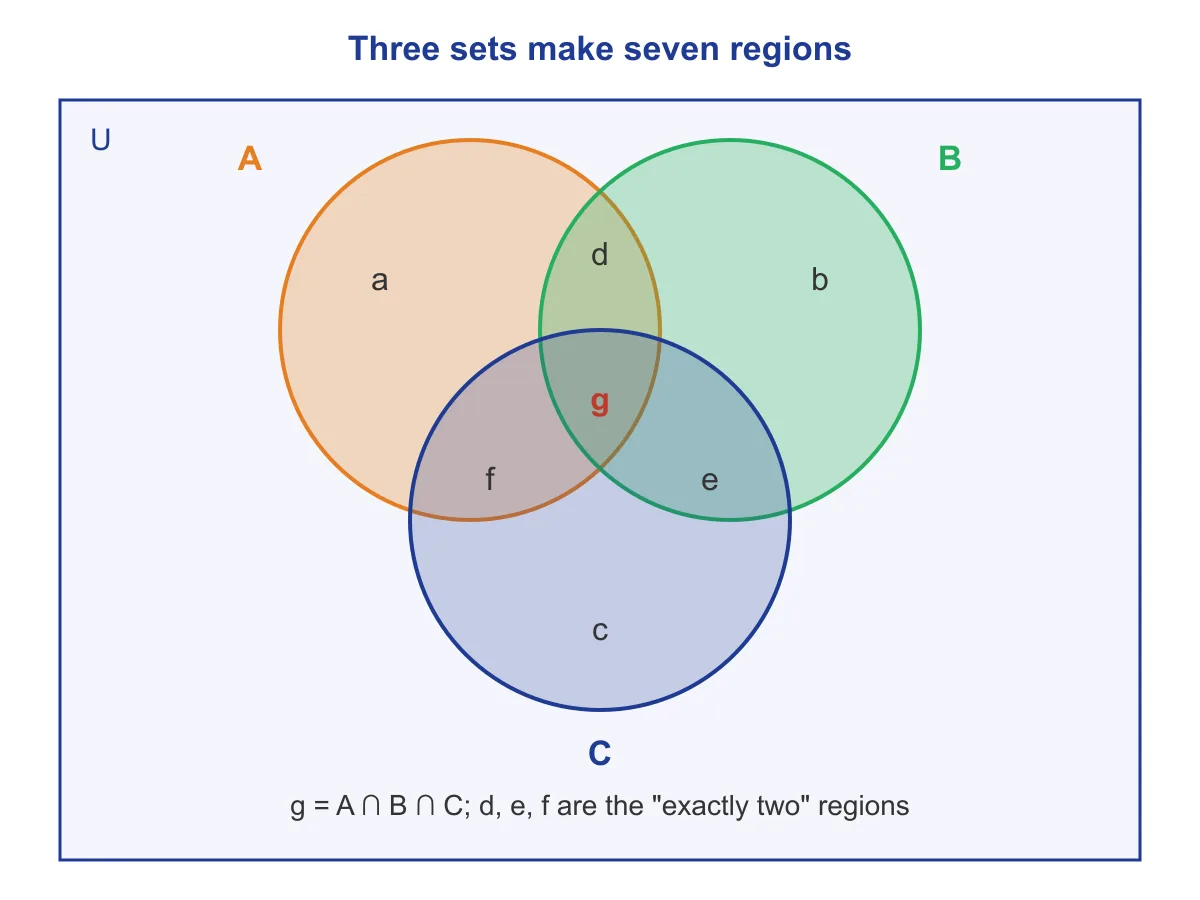
Figure 1.2: three sets, seven regions
In the figure, $a,b,c$ are "only one set", $d,e,f$ are "exactly two sets" and $g$ is "all three". The pair intersections include the centre, for instance $n(A\cap B)=d+g$. So
- exactly two sets $=n(A\cap B)+n(B\cap C)+n(A\cap C)-3\,n(A\cap B\cap C)$,
- exactly one set $=n(A)+n(B)+n(C)-2\,S_2+3\,n(A\cap B\cap C)$, where $S_2$ is the sum of the three pair counts.
Memory trick: "Add the singles, subtract the pairs, put the triple back." Say it aloud while you write the formula. Use it for three sets; for four sets the signs keep alternating.
Practical problems
The routine never changes. Name the sets, write down what is given, start with the most restricted region (the triple overlap, or the overlap of two sets), and subtract outwards. Draw the diagram even if you could do it by formula; it prevents wrong region readings.
Example 5: In a class of 60 students, 35 drink tea, 30 drink coffee and 10 drink both. How many drink neither, and how many drink tea only?
Let $T$ be tea drinkers, $C$ coffee drinkers.
$n(T\cup C)=35+30-10=55$.
Neither: $60-55=5$.
Tea only: $n(T)-n(T\cap C)=35-10=25$.
Answer: $5$ drink neither, $25$ drink tea only.
Notice that "neither" always comes from the complement of the union, never from the single counts.
Example 6: Among 80 students, 45 play cricket, 40 play football and 30 play hockey. Also 20 play cricket and football, 15 play football and hockey, 12 play cricket and hockey, and 8 play all three. How many play none of the three games, and how many play exactly two?
$n(C\cup F\cup H)=45+40+30-(20+15+12)+8$.
Singles sum to $115$, pairs sum to $47$, so $115-47+8=76$.
None: $80-76=4$.
Exactly two: $47-3\times8=47-24=23$.
Check by regions: cricket only $=45-20-12+8=21$, football only $=40-20-15+8=13$, hockey only $=30-15-12+8=11$, and exactly two $=12+7+4=23$. Total $21+13+11+23+8=76$, which agrees.
Answer: $4$ play none, $23$ play exactly two.
Notice the pair figures given in the problem include the triple players, so the "exactly two" count needs the $3\times8$ subtraction.
Example 7: How many integers from $1$ to $100$ are divisible by none of $2,3,5$?
Let $A,B,C$ be the multiples of $2,3,5$ in $\{1,\dots,100\}$.
$n(A)=50$, $n(B)=33$, $n(C)=20$ (take the whole part of $100\div$ the number).
Pairs are multiples of $6,10,15$: $16,10,6$.
Triple is multiples of $30$: $3$.
$n(A\cup B\cup C)=103-32+3=74$.
Required count $=100-74=26$.
Answer: $26$.
Notice that "divisible by both 2 and 3" means divisible by $6$, the least common multiple, not by $2\times3$ in some other sense.
Example 8: Of 100 students, 80 pass in Maths, 70 in Physics and 60 in Chemistry. Find the least possible number who pass all three.
Count those who fail: $20$ in Maths, $30$ in Physics, $40$ in Chemistry.
The number failing at least one subject is at most $20+30+40=90$ (equality when no student fails two).
So at least $100-90=10$ students pass all three.
Answer: $10$, and it is reached when the three failing groups do not overlap.
Notice that working with the complements turns a minimum problem into a simple upper bound.
Common traps
- Treating $\{\varnothing\}$ as the empty set → it has one element, namely $\varnothing$, so its power set has 2 elements.
- Using $n(A\cup B)=n(A)+n(B)$ without checking for overlap → this holds only for disjoint sets; otherwise subtract $n(A\cap B)$.
- Counting $2^n$ proper subsets → proper subsets exclude the set itself, so the count is $2^n-1$.
- Writing $(A\cup B)'=A'\cup B'$ → De Morgan flips the sign: $(A\cup B)'=A'\cap B'$.
- Assuming $A-B=B-A$ → difference is not commutative; the two are equal only when $A=B$.
- Taking $n(A\cap B)$ as "exactly two" in a three-set problem → the pair counts include the centre; subtract the triple.
- Forgetting the triple term, or adding it with the wrong sign, in the three-set formula → singles minus pairs plus triple.
- Listing a repeated element twice in roster form → each element appears once; $n(\{1,2,2,3\})=3$.
- Using the wrong universal set for a complement → $A'$ depends on $U$; read $U$ from the problem before computing.
- Saying equivalent sets are equal → equivalent only means the same number of elements.
Quick revision
- $\varnothing\subseteq A$ for every set $A$, and $\varnothing$ has no elements while $\{\varnothing\}$ has one.
- $n(P(A))=2^{n(A)}$; proper subsets number $2^n-1$.
- $A=B$ if and only if $A\subseteq B$ and $B\subseteq A$.
- $A-B=A\cap B'$; $A\,\Delta\,B=(A-B)\cup(B-A)=(A\cup B)-(A\cap B)$.
- $A\,\Delta\,B$ contains the elements that lie in exactly one of $A$, $B$.
- $A\subseteq B\iff A\cap B=A\iff A\cup B=B\iff B'\subseteq A'$.
- De Morgan: $(A\cup B)'=A'\cap B'$ and $(A\cap B)'=A'\cup B'$.
- Distributive: $A\cap(B\cup C)=(A\cap B)\cup(A\cap C)$.
- $A-(B\cup C)=(A-B)\cap(A-C)$.
- $n(A\cup B)=n(A)+n(B)-n(A\cap B)$.
- $n(A\,\Delta\,B)=n(A)+n(B)-2\,n(A\cap B)$.
- $n(A\cup B\cup C)=n(A)+n(B)+n(C)$ minus the pair counts plus $n(A\cap B\cap C)$.
- Exactly two of three $=n(A\cap B)+n(B\cap C)+n(A\cap C)-3\,n(A\cap B\cap C)$.
- The "neither" count is $n(U)-n(A\cup B)$ for two sets.
Practice questions
Which of the following is the roster form of $\{x : x\in\mathbb{Z},\ x^2<10\}$?
- $\{1,2,3\}$
- $\{0,1,2,3\}$
- $\{-2,-1,0,1,2\}$
- $\{-3,-2,-1,0,1,2,3\}$
Answer
D. $\{-3,-2,-1,0,1,2,3\}$
$x^2<10$ gives $-3.16<x<3.16$. Integers there: $-3$ to $3$, seven values (check $(\pm3)^2=9<10$).
Which of the following sets is empty?
- $\{x\in\mathbb{R} : x^2=0\}$
- $\{x\in\mathbb{R} : x^2+1=0\}$
- $\{\varnothing\}$
- $\{0\}$
Answer
B. $\{x\in\mathbb{R} : x^2+1=0\}$
$x^2+1\ge1$ for real $x$, so no solution. $\{0\}$ and $\{\varnothing\}$ have one element each, and the last set equals $\{0\}$.
The number of subsets of a set with 5 elements is
- 32
- 25
- 10
- 31
Answer
A. 32
Each element is in or out: $2^5=32$. (31 is the proper-subset count, 10 and 25 are wrong formulas.)
For sets $A$ and $B$, the equation $A\cap B=A$ holds if and only if
- $B\subseteq A$
- $A=B$
- $A\subseteq B$
- $A\cap B=\varnothing$
Answer
C. $A\subseteq B$
$A\cap B=A$ means every element of $A$ is in $B$, which is $A\subseteq B$. It need not give $A=B$.
If $n(A)=20$, $n(B)=15$ and $n(A\cap B)=6$, then $n(A\cup B)$ equals
- 29
- 35
- 26
- 41
Answer
A. 29
$20+15-6=29$. Adding 6 gives 41; ignoring the overlap gives 35.
Given below are two statements: Statement I: The empty set is a subset of every set. Statement II: The set $\{\varnothing\}$ has no elements.
- Both Statement I and Statement II are correct
- Both Statement I and Statement II are incorrect
- Statement I is correct but Statement II is incorrect
- Statement I is incorrect but Statement II is correct
Answer
C. Statement I is correct but Statement II is incorrect
Statement I is true. $\{\varnothing\}$ has one element, namely $\varnothing$, so Statement II is false.
For subsets $A,B$ of a universal set $U$, $(A\cup B)'$ equals
- $A'\cap B$
- $A'\cap B'$
- $A'\cup B'$
- $A\cap B'$
Answer
B. $A'\cap B'$
De Morgan: an element outside the union lies in neither set, so it is in $A'$ and in $B'$.
The number of proper subsets of $\{1,2,3,4\}$ is
- 14
- 16
- 8
- 15
Answer
D. 15
Subsets $2^4=16$; remove the set itself: 15.
$A-B$ is the same as
- $(A\cap B)'$
- $A\cup B'$
- $A\cap B'$
- $A'\cap B$
Answer
C. $A\cap B'$
$x\in A-B$ means $x\in A$ and $x\notin B$, i.e. $x\in A\cap B'$.
The power set of the empty set is
- $\{\varnothing,\{\varnothing\}\}$
- $\{\varnothing\}$
- $\varnothing$
- $\{0\}$
Answer
B. $\{\varnothing\}$
$\varnothing$ has only one subset, itself, so $P(\varnothing)=\{\varnothing\}$, with $2^0=1$ element.
If $n(A)=2$, the number of elements in $P(P(A))$ is
- 4
- 8
- 32
- 16
Answer
D. 16
$n(P(A))=2^2=4$, then $n(P(P(A)))=2^4=16$.
The symmetric difference $A\,\Delta\,B$ equals
- $(A\cup B)-(A\cap B)$
- $A-B$
- $A\cup B$
- $(A\cap B)-(A\cup B)$
Answer
A. $(A\cup B)-(A\cap B)$
It holds the elements in exactly one of the two sets: all of the union except the overlap.
If $A=\{1,2,3\}$ and $B=\{2,3,4\}$, then $A\,\Delta\,B$ equals
- $\{1,4\}$
- $\{1,2,3,4\}$
- $\{2,3\}$
- $\{1\}$
Answer
A. $\{1,4\}$
Union $\{1,2,3,4\}$ minus overlap $\{2,3\}$ gives $\{1,4\}$.
The number of subsets of $\{1,2,3,4,5,6\}$ that contain $1$ and $2$ but not $3$ is
- 8
- 4
- 16
- 12
Answer
A. 8
Elements $1,2,3$ are forced; $4,5,6$ are free: $2^3=8$.
Which set equals $\{x : x^2-3x+2=0\}$?
- $\{-1,-2\}$
- $\{1,2\}$
- $\{2,3\}$
- $\{0,1,2\}$
Answer
B. $\{1,2\}$
$(x-1)(x-2)=0$ gives $x=1,2$.
Given below are two statements: Statement I: $(A\cup B)'=A'\cup B'$. Statement II: $(A\cap B)'=A'\cup B'$.
- Both Statement I and Statement II are correct
- Both Statement I and Statement II are incorrect
- Statement I is correct but Statement II is incorrect
- Statement I is incorrect but Statement II is correct
Answer
D. Statement I is incorrect but Statement II is correct
By De Morgan $(A\cup B)'=A'\cap B'$, so I is wrong (take $A=\{1\},B=\{2\},U=\{1,2,3\}$: LHS $\{3\}$, RHS $U$). II is the second De Morgan law, true.
A has 3 elements, B has 6 elements and $A\subseteq B$. The number of sets $X$ with $A\subseteq X\subseteq B$ is
- 3
- 7
- 8
- 64
Answer
C. 8
$X$ must contain the 3 elements of $A$; each of the 3 elements of $B-A$ is in or out: $2^3=8$.
In a class of 60, 35 like tea, 30 like coffee and 10 like both. The number who like neither is
- 15
- 0
- 5
- 10
Answer
C. 5
Union $=35+30-10=55$; neither $=60-55=5$.
Assertion (A): A set with 4 elements has 16 subsets. Reason (R): Each element is either in a subset or out of it, giving two choices per element.
- Both A and R are true and R is the correct explanation of A
- Both A and R are true but R is not the correct explanation of A
- A is true but R is false
- A is false but R is true
Answer
A. Both A and R are true and R is the correct explanation of A
Two independent choices for each of 4 elements: $2^4=16$. R is exactly the counting argument behind A.
If $A\subseteq B$, then which of the following is true?
- $A'\subseteq B'$
- $A'=B'$
- $A'\cap B=\varnothing$
- $B'\subseteq A'$
Answer
D. $B'\subseteq A'$
An element outside $B$ is outside $A$ too, since $A$ lies inside $B$. The other options fail for $A=\{1\},B=\{1,2\},U=\{1,2,3\}$.
$A\cap(B\cup C)$ equals
- $(A\cap B)\cap(A\cap C)$
- $(A\cap B)\cup(A\cap C)$
- $(A\cap B)\cup C$
- $(A\cup B)\cap(A\cup C)$
Answer
B. $(A\cap B)\cup(A\cap C)$
Distributive law of $\cap$ over $\cup$. Option B is the other distributive law and equals $A\cup(B\cap C)$.
A non-empty set has 127 proper subsets. The number of its elements is
- 6
- 7
- 127
- 8
Answer
B. 7
$2^n-1=127$ gives $2^n=128$, so $n=7$.
Given below are two statements: Statement I: A set with $n$ elements has $2^n$ subsets. Statement II: A set with $n$ elements has $2^n-1$ proper subsets.
- Both Statement I and Statement II are correct
- Both Statement I and Statement II are incorrect
- Statement I is correct but Statement II is incorrect
- Statement I is incorrect but Statement II is correct
Answer
A. Both Statement I and Statement II are correct
Both are standard: the only subset that is not proper is the whole set.
Assertion (A): The power set of $\{1,2\}$ has 4 elements. Reason (R): Every power set contains the empty set.
- Both A and R are true and R is the correct explanation of A
- Both A and R are true but R is not the correct explanation of A
- A is true but R is false
- A is false but R is true
Answer
B. Both A and R are true but R is not the correct explanation of A
$2^2=4$ so A is true. R is also true but does not give the count; the count comes from in-or-out choices.
If $n(A)=10$, $n(B)=7$ and $n(A\cap B)=4$, then $n(A\,\Delta\,B)$ equals
- 17
- 13
- 6
- 9
Answer
D. 9
$10+7-2(4)=9$. Check: $n(A-B)=6$, $n(B-A)=3$, total $9$. (13 is the union.)
Match List I with List II. List I: a. $A\cup B$ b. $A\cap B$ c. $A-B$ d. $A\,\Delta\,B$ List II: i. elements in at least one of $A,B$ ii. elements in both $A$ and $B$ iii. elements in exactly one of $A,B$ iv. elements in $A$ but not in $B$
- a-i, b-ii, c-iii, d-iv
- a-ii, b-i, c-iv, d-iii
- a-i, b-ii, c-iv, d-iii
- a-iv, b-iii, c-i, d-ii
Answer
C. a-i, b-ii, c-iv, d-iii
Union is at least one (i), intersection is both (ii), difference is in $A$ not $B$ (iv), symmetric difference is exactly one (iii).
Given below are two statements: Statement I: $\{x\in\mathbb{Z} : 0<x<1\}$ is a singleton. Statement II: $\varnothing$ and $\{0\}$ are equal sets.
- Both Statement I and Statement II are correct
- Both Statement I and Statement II are incorrect
- Statement I is correct but Statement II is incorrect
- Statement I is incorrect but Statement II is correct
Answer
B. Both Statement I and Statement II are incorrect
No integer lies strictly between 0 and 1, so the set is empty, not a singleton. $\{0\}$ has one element while $\varnothing$ has none.
If $n(A)=25$, $n(B)=20$, $n(C)=18$, $n(A\cap B)=8$, $n(B\cap C)=7$, $n(A\cap C)=6$ and $n(A\cap B\cap C)=3$, then $n(A\cup B\cup C)$ is
- 48
- 42
- 63
- 45
Answer
D. 45
$63-(8+7+6)+3=45$. (42 forgets the triple, 63 is the plain sum.)
Assertion (A): If $A\subseteq B$ then $A\cap B=A$. Reason (R): $A\subseteq B$ means every element of $B$ is in $A$.
- Both A and R are true and R is the correct explanation of A
- Both A and R are true but R is not the correct explanation of A
- A is true but R is false
- A is false but R is true
Answer
C. A is true but R is false
A is true: the overlap is all of $A$. R states the definition backwards ($A\subseteq B$ means every element of $A$ is in $B$), so R is false.
Let $n(A)=4$. Match List I with List II. List I: a. number of subsets of $A$ b. number of proper subsets of $A$ c. number of non-empty proper subsets of $A$ d. number of subsets of $A$ containing a given element of $A$ List II: i. $8$ ii. $14$ iii. $15$ iv. $16$
- a-iii, b-iv, c-ii, d-i
- a-iv, b-iii, c-i, d-ii
- a-i, b-ii, c-iii, d-iv
- a-iv, b-iii, c-ii, d-i
Answer
D. a-iv, b-iii, c-ii, d-i
$2^4=16$; $16-1=15$; $16-2=14$; fixing one element in leaves $2^3=8$.
Given below are two statements: Statement I: $n(A\cup B)=n(A)+n(B)$ for all finite sets $A,B$. Statement II: $n(A\cup B)=n(A)+n(B)$ when $A$ and $B$ are disjoint.
- Both Statement I and Statement II are correct
- Both Statement I and Statement II are incorrect
- Statement I is correct but Statement II is incorrect
- Statement I is incorrect but Statement II is correct
Answer
D. Statement I is incorrect but Statement II is correct
I fails when the sets overlap (e.g. $A=B=\{1\}$ gives 1, not 2). II is the special case $n(A\cap B)=0$.
$A-(B\cup C)$ equals
- $(A\cup B)-C$
- $A\cap(B\cup C)$
- $(A-B)\cap(A-C)$
- $(A-B)\cup(A-C)$
Answer
C. $(A-B)\cap(A-C)$
$A\cap(B\cup C)'=A\cap B'\cap C'=(A\cap B')\cap(A\cap C')$. Option A equals $A-(B\cap C)$, a different set.
Among 80 students, 45 play cricket, 40 play football, 30 play hockey, 20 play cricket and football, 15 play football and hockey, 12 play cricket and hockey, and 8 play all three. The number who play none of the three is
- 12
- 8
- 0
- 4
Answer
D. 4
Union $=115-47+8=76$; none $=80-76=4$.
If $A\subseteq B$, then $A\cup(B-A)$ equals
- $B$
- $B-A$
- $\varnothing$
- $A$
Answer
A. $B$
$B-A$ is the part of $B$ outside $A$; adding $A$ back gives all of $B$ because $A$ lies inside $B$.
For three sets, $n(A)=25$, $n(B)=20$, $n(C)=18$, $n(A\cap B)=8$, $n(B\cap C)=7$, $n(A\cap C)=6$, $n(A\cap B\cap C)=3$. The number of elements lying in exactly two of the sets is
- 21
- 15
- 12
- 18
Answer
C. 12
Exactly two $=(8+7+6)-3(3)=12$. By regions: $5+4+3=12$.
Let $A=\{1,2,3,4,5,6\}$ and $B=\{4,5,6,7,8\}$. Match List I with List II. List I: a. $A\cap B$ b. $A-B$ c. $B-A$ d. $A\,\Delta\,B$ List II: i. $\{7,8\}$ ii. $\{1,2,3,7,8\}$ iii. $\{4,5,6\}$ iv. $\{1,2,3\}$
- a-i, b-ii, c-iii, d-iv
- a-iii, b-iv, c-i, d-ii
- a-iv, b-iii, c-ii, d-i
- a-iii, b-i, c-iv, d-ii
Answer
B. a-iii, b-iv, c-i, d-ii
$A\cap B=\{4,5,6\}$, $A-B=\{1,2,3\}$, $B-A=\{7,8\}$, and $A\,\Delta\,B$ joins the last two differences.
Which of the following is NOT true for all sets $A$ and $B$?
- $A-B=B-A$
- $A\cup(A\cap B)=A$
- $(A-B)\cap B=\varnothing$
- $A-B=A-(A\cap B)$
Answer
A. $A-B=B-A$
For $A=\{1\},B=\{2\}$: $A-B=\{1\}$ but $B-A=\{2\}$. The others always hold.
In a survey of 200 people, 120 read the English paper, 90 read the Hindi paper and 40 read both. The number who read exactly one of the two papers is
- 30
- 170
- 130
- 80
Answer
C. 130
English only $80$, Hindi only $50$: $130$. Check: union $170$ minus both $40$ gives $130$.
Among 100 students, 80 pass in Maths, 70 in Physics and 60 in Chemistry. The least possible number passing all three is
- 60
- 10
- 0
- 20
Answer
B. 10
Failures: $20+30+40=90$ at most, so at least $100-90=10$ pass all three, attained when the failure groups are disjoint.
Among the integers $1,2,\dots,100$, how many are divisible by neither $3$ nor $5$?
- 53
- 80
- 47
- 67
Answer
A. 53
Multiples of 3: 33; of 5: 20; of 15: 6. Union $33+20-6=47$. Neither $=100-47=53$.