Probability
What to remember
- For equally likely outcomes, $P(E) = \dfrac{n(E)}{n(S)}$. Everything starts with counting, so decide first whether order matters and whether items are replaced.
- Addition rule: $P(A \cup B) = P(A) + P(B) - P(A \cap B)$. For "at least one", go through the complement: $P(\text{at least one}) = 1 - P(\text{none})$.
- Conditional probability shrinks the sample space to the given event: $P(A \mid B) = \dfrac{P(A \cap B)}{P(B)}$. Multiplication rule: $P(A \cap B) = P(A)\,P(B \mid A)$.
- Independent means $P(A \cap B) = P(A)P(B)$. Mutually exclusive events with positive probabilities are never independent.
- Total probability adds up the branches of a tree; Bayes' theorem divides one branch by that total. A discrete random variable has $\sum p_i = 1$, $E(X) = \sum x_i p_i$ and $\operatorname{Var}(X) = E(X^2) - [E(X)]^2$.
Random experiments, sample space and events
A random experiment is an action whose result cannot be predicted in advance, although every possible result is known and the action can be repeated under the same conditions. Tossing a coin, rolling a die, drawing a card from a shuffled pack and picking a ball from an urn are the standard ones.
The set of all possible outcomes is the sample space $S$. Each member is a sample point or outcome.
- One coin: $S = \{H, T\}$.
- Two coins: $S = \{HH, HT, TH, TT\}$, four points. Note that $HT$ and $TH$ are different outcomes.
- One die: $S = \{1,2,3,4,5,6\}$.
- Two dice: 36 ordered pairs $(a, b)$, where $a$ is the number on the first die and $b$ on the second.
An event is a subset of the sample space. We say the event happens when the outcome of the experiment is a member of that subset.
| Type of event | Meaning | Example (one die) |
|---|---|---|
| Impossible event | Empty set $\varnothing$, never happens | Getting 7 |
| Sure (certain) event | The whole set $S$, always happens | Getting a number from 1 to 6 |
| Simple event | Exactly one sample point | Getting 4 |
| Compound event | Two or more sample points | Getting an even number |
| Mutually exclusive | $A \cap B = \varnothing$, cannot happen together | Even number and a 5 |
| Exhaustive | $A_1 \cup A_2 \cup \dots \cup A_n = S$, at least one must happen | Even, and odd |
Events can be combined with set operations. $A \cup B$ means "A or B (or both)", $A \cap B$ means "both A and B", and $A'$ (the complement) means "A does not happen". The event "A but not B" is $A \cap B'$. Events that are mutually exclusive and exhaustive together are called a partition of $S$; the even and odd outcomes of a die form one.
Outcomes are equally likely when there is no reason to prefer one over another: a fair coin, a fair die, a well-shuffled pack. Every formula in the next section assumes this. If a coin is biased, or a die is loaded, you must be given the individual probabilities.
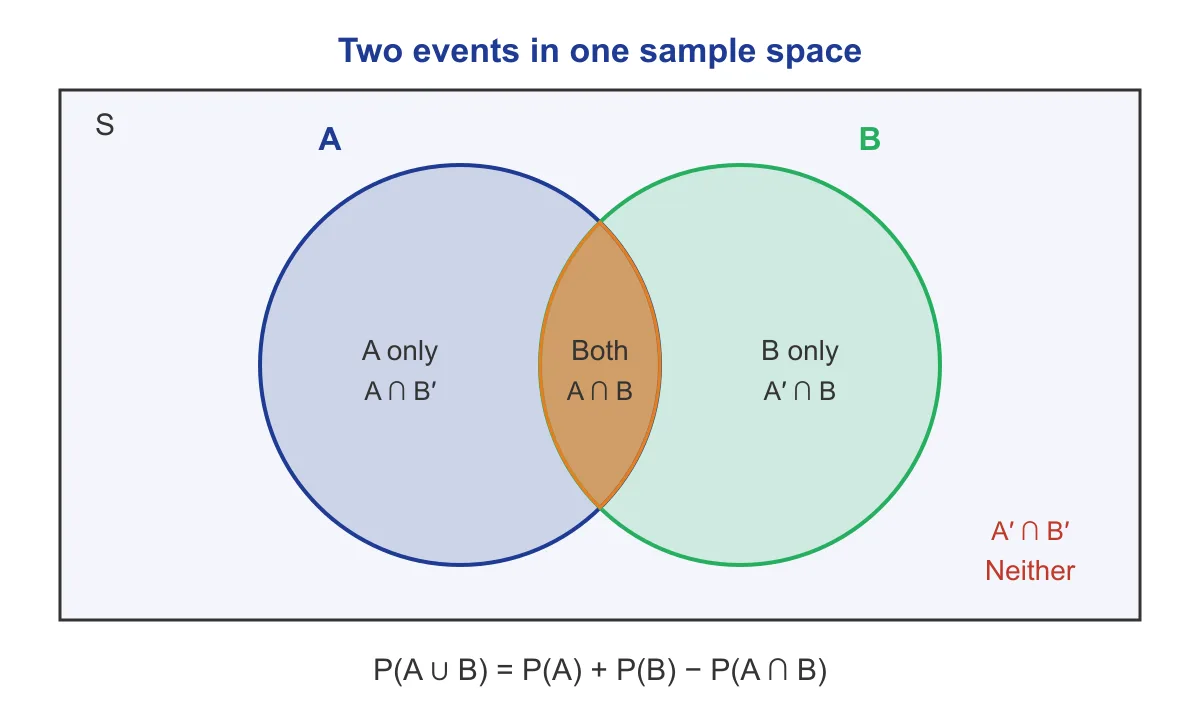
*Figure 2.1: Overlapping events. The addition rule subtracts the overlap once because adding $P(A)$ and $P(B)$ counts it twice.*
Classical probability and counting
For a finite sample space of equally likely outcomes,
Three consequences follow at once: $0 \le P(E) \le 1$, $P(S) = 1$ and $P(\varnothing) = 0$. If $A$ and $B$ are mutually exclusive, $P(A \cup B) = P(A) + P(B)$, and this extends to any number of pairwise exclusive events.
The real work is counting. A few reference facts you should know without looking:
- $n$ coins give $2^n$ outcomes; $n$ dice give $6^n$.
- A pack has 52 cards: 4 suits of 13 (26 red, 26 black), 4 kings, 4 aces, 12 face cards (J, Q, K), 16 cards that are a king, queen, jack or ace.
- Two dice, sum $s$: the number of ways for $s = 2, 3, \dots, 12$ is $1, 2, 3, 4, 5, 6, 5, 4, 3, 2, 1$. They add to 36.
- Selecting $r$ items from $n$ where order does not matter: $\binom{n}{r}$. Where order matters: $n(n-1)\cdots(n-r+1)$.
When objects are drawn from an urn together, or one after another without replacement, use combinations in both numerator and denominator (or use ordered counts in both; never mix). When they are drawn with replacement, each draw is a fresh experiment with the same sample space.
Example 1: A fair die is thrown twice. Find the probability that the sum is 9.
$n(S) = 36$.
Pairs with sum 9: $(3,6), (4,5), (5,4), (6,3)$. That is 4 pairs.
$P = \dfrac{4}{36} = \dfrac{1}{9}$.
Notice that $(3,6)$ and $(6,3)$ are different outcomes. Counting them once is the standard mistake.
Example 2: An urn holds 5 red and 4 black balls. Three balls are drawn together. Find the probability that exactly two are red.
$n(S) = \binom{9}{3} = 84$.
Favourable: two red from five and one black from four, $\binom{5}{2}\binom{4}{1} = 10 \times 4 = 40$.
$P = \dfrac{40}{84} = \dfrac{10}{21}$.
Drawing "together" is the same as drawing without replacement, so the combination method is right; no need to track which ball came first.
Addition rule and complementary events
For any two events,
The reason is in the diagram: the overlap sits inside both circles and so is counted twice when you add. If $A$ and $B$ are mutually exclusive the overlap is empty and the last term vanishes.
For three events,
The complement satisfies $P(A') = 1 - P(A)$, because $A$ and $A'$ are exclusive and exhaustive. Using it with De Morgan's laws gives the most useful identities of the chapter:
| Want | Formula |
|---|---|
| At least one of $A, B$ | $P(A \cup B) = 1 - P(A' \cap B')$ |
| Neither $A$ nor $B$ | $P(A' \cap B') = 1 - P(A \cup B)$ |
| $A$ only | $P(A \cap B') = P(A) - P(A \cap B)$ |
| Exactly one of $A, B$ | $P(A) + P(B) - 2P(A \cap B)$ |
| $A$ or $B$, not both | same as exactly one |
Memory trick: "At least one means one minus none!"
Whenever you see "at least", write $1 - P(\text{none})$ first. Count the long list of favourable cases only if the complement is harder.
Example 3: Three persons are asked, independently and at random, for the month of their birth. Find the probability that at least two share a birth month, assuming all 12 months are equally likely.
Total outcomes: $12^3 = 1728$.
Complement, all three months different: $12 \times 11 \times 10 = 1320$.
$P(\text{all different}) = \dfrac{1320}{1728} = \dfrac{55}{72}$.
$P(\text{at least two same}) = 1 - \dfrac{55}{72} = \dfrac{17}{72}$.
Direct counting would need "exactly two same" plus "all three same". The complement is one line.
Conditional probability and the multiplication rule
Sometimes you are told that something has already happened. The probability of $A$ given that $B$ has occurred is
Think of it as a new sample space. Only the outcomes inside $B$ remain, and you ask what fraction of those also lie in $A$. For equally likely outcomes this is simply $\dfrac{n(A \cap B)}{n(B)}$.
Properties worth knowing:
- $0 \le P(A \mid B) \le 1$ and $P(S \mid B) = 1$.
- $P(A' \mid B) = 1 - P(A \mid B)$. The complement rule works on the left side of the bar only.
- $P(A \cup C \mid B) = P(A \mid B) + P(C \mid B) - P(A \cap C \mid B)$.
- In general $P(A \mid B) \ne P(B \mid A)$. They share the numerator $P(A \cap B)$ but have different denominators.
Rearranging the definition gives the multiplication rule:
For three events, $P(A \cap B \cap C) = P(A)\,P(B \mid A)\,P(C \mid A \cap B)$. This is how you handle drawing without replacement: multiply the probability of each draw, using the updated contents of the urn.
Example 4: Two fair dice are thrown. Find the probability that the sum is 8, given that the first die shows an even number.
Outcomes with first die even: $3 \times 6 = 18$.
Among these, sum 8: $(2,6), (4,4), (6,2)$. That is 3.
$P = \dfrac{3}{18} = \dfrac{1}{6}$.
Check with the formula: $P(A \cap B) = \dfrac{3}{36}$, $P(B) = \dfrac{18}{36}$, ratio $\dfrac{1}{6}$. Both routes agree.
Independent events
Events $A$ and $B$ are independent if knowing that one has happened does not change the probability of the other:
If $A$ and $B$ are independent, so are $A$ and $B'$, $A'$ and $B$, and $A'$ and $B'$. You can prove the first quickly: $P(A \cap B') = P(A) - P(A \cap B) = P(A) - P(A)P(B) = P(A)(1 - P(B)) = P(A)P(B')$.
Three events $A, B, C$ are independent only if all four conditions hold: the three pair conditions $P(A \cap B) = P(A)P(B)$ and the two like it, and in addition $P(A \cap B \cap C) = P(A)P(B)P(C)$. Pairwise independence alone is not enough.
For independent events, "at least one" becomes easy: $P(A \cup B \cup C) = 1 - P(A')P(B')P(C')$.
Do not confuse independence with exclusiveness.
| Mutually exclusive | Independent | |
|---|---|---|
| Defined by | $A \cap B = \varnothing$ | $P(A \cap B) = P(A)P(B)$ |
| Then $P(A \cap B)$ is | $0$ | $P(A)P(B)$ |
| Nature | A statement about outcomes (sets) | A statement about probabilities |
| If both $P(A), P(B) > 0$ | Cannot also be independent | Cannot also be exclusive |
If $A$ happens, an exclusive $B$ cannot happen, so $A$ gives you a great deal of information about $B$. That is the opposite of independence.
Example 5: Events $A$ and $B$ are independent, $P(A) = 0.4$ and $P(A \cup B) = 0.7$. Find $P(B)$.
Let $P(B) = p$. Independence gives $P(A \cap B) = 0.4p$.
Addition rule: $0.7 = 0.4 + p - 0.4p = 0.4 + 0.6p$.
$0.6p = 0.3$, so $p = 0.5$.
Check: $0.4 + 0.5 - 0.2 = 0.7$. The independence condition turned two unknowns into one.
Total probability and Bayes' theorem
Suppose $E_1, E_2, \dots, E_n$ form a partition of $S$: they are mutually exclusive, exhaustive, and each has $P(E_i) > 0$. Any event $A$ can be split along them, $A = (A \cap E_1) \cup \dots \cup (A \cap E_n)$, and these pieces are exclusive. Adding and applying the multiplication rule to each piece gives the total probability theorem:
In a tree, each path to $A$ multiplies along its branches; $P(A)$ is the sum over those paths.
Bayes' theorem reverses the conditioning. Once $A$ is known to have happened, the chance that it came through $E_k$ is
The numerator is one path of the tree; the denominator is all paths that end in $A$. The probabilities $P(E_i)$ are called priors, and $P(E_i \mid A)$ the posteriors. For any $A$ with $P(A) > 0$, the posteriors add up to 1.
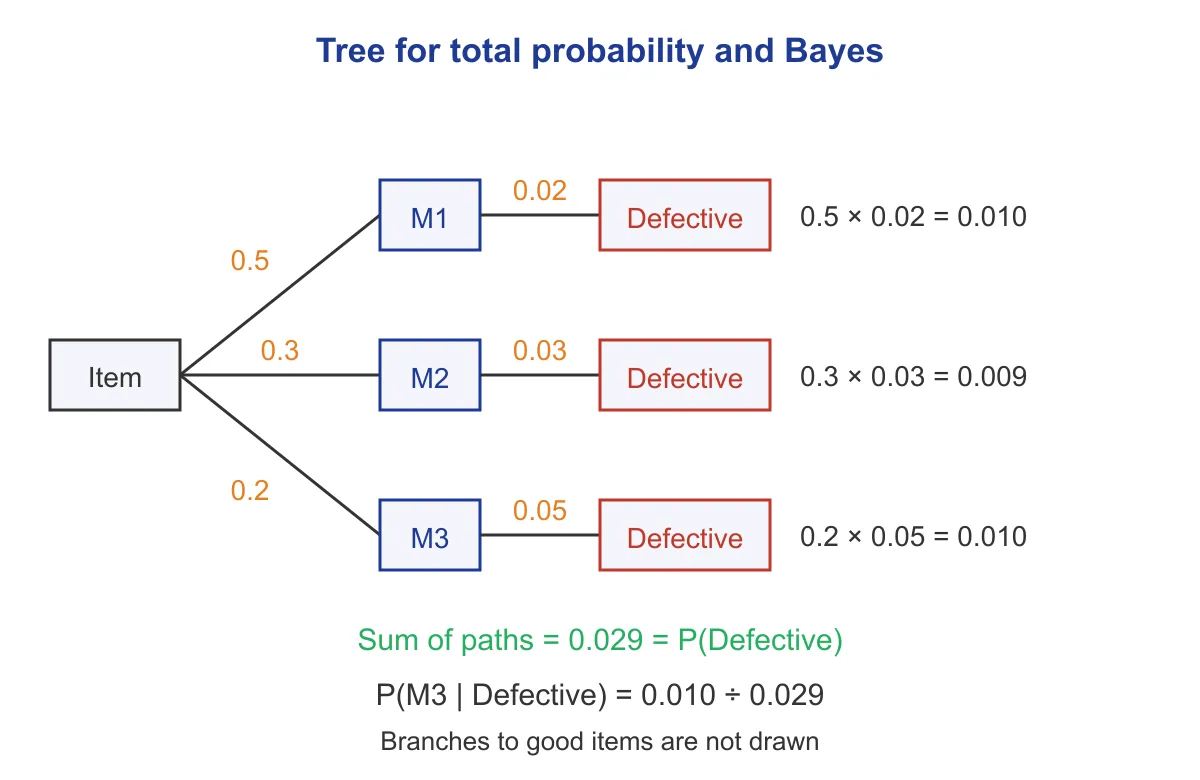
*Figure 2.2: A probability tree. The three path products add to $P(\text{defective})$; Bayes divides one path by that sum.*
Example 6: A factory has three machines. M1, M2, M3 make 50%, 30% and 20% of all items, and 2%, 3% and 5% of their items are defective. An item is picked at random and found defective. Find the probability that M3 made it.
Paths: M1 gives $0.5 \times 0.02 = 0.010$; M2 gives $0.3 \times 0.03 = 0.009$; M3 gives $0.2 \times 0.05 = 0.010$.
$P(D) = 0.010 + 0.009 + 0.010 = 0.029$.
$P(M3 \mid D) = \dfrac{0.010}{0.029} = \dfrac{10}{29}$.
M3 makes only 20% of the items, yet it is responsible for about 34% of defective ones. A small prior can still carry a large posterior.
Memory trick: "Branch over bush!"
Bayes is one branch divided by the whole bush (all branches ending in the observed event). Draw the tree before you write any formula.
Random variable, distribution, mean and variance
A random variable $X$ is a rule that attaches a real number to each outcome of the sample space. If $X$ takes only isolated values $x_1, x_2, \dots, x_n$, it is discrete. Tossing three coins and letting $X$ be the number of heads gives $X \in \{0,1,2,3\}$.
The probability distribution lists each value with its probability, $p_i = P(X = x_i)$. Two conditions must hold: every $p_i \ge 0$ and $\sum p_i = 1$. These two conditions are the only way to find an unknown constant in a distribution.
For $X$ = number of heads in three tosses of a fair coin:
| $x$ | 0 | 1 | 2 | 3 |
|---|---|---|---|---|
| $P(X = x)$ | $\frac{1}{8}$ | $\frac{3}{8}$ | $\frac{3}{8}$ | $\frac{1}{8}$ |
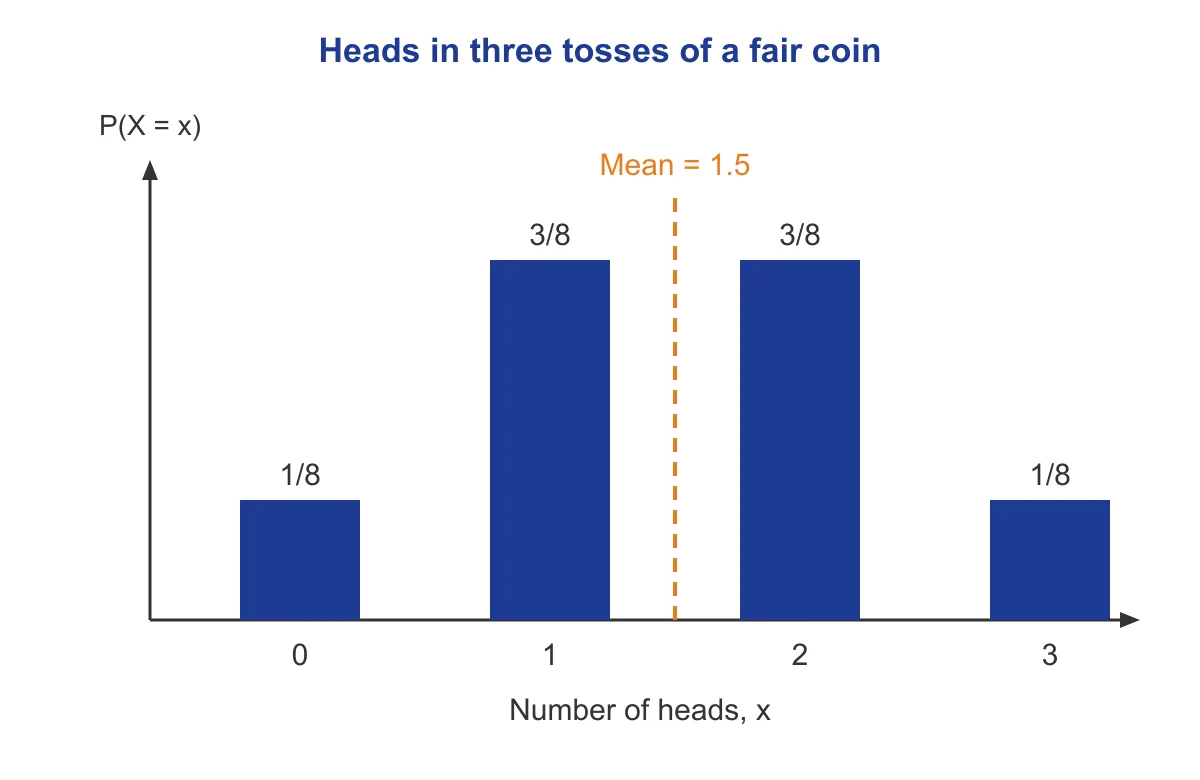
Figure 2.3: The distribution of heads in three tosses. It is symmetric, so the mean 1.5 sits at the centre.
The mean (expectation) is the probability-weighted average,
and the variance measures spread about it,
The standard deviation is $\sigma = \sqrt{\operatorname{Var}(X)}$. The second form of the variance is almost always quicker, and it shows $E(X^2) \ge \mu^2$, so variance is never negative. Variance is zero only when $X$ takes a single value.
For constants $a$ and $b$:
Shifting by $b$ moves the centre but not the spread; scaling by $a$ scales the spread by $a^2$.
For the three-coin table: $E(X) = 0 + \frac{3}{8} + \frac{6}{8} + \frac{3}{8} = \frac{12}{8} = 1.5$. $E(X^2) = 0 + \frac{3}{8} + \frac{12}{8} + \frac{9}{8} = 3$. $\operatorname{Var}(X) = 3 - 2.25 = 0.75$.
Memory trick: "Mean of squares minus square of mean."
Say it as you write $E(X^2) - \mu^2$. The order matters: the first term is always the larger one.
Example 7: Two balls are drawn together from a bag with 3 red and 2 blue balls. Let $X$ be the number of red balls drawn. Find the distribution, mean and variance.
$n(S) = \binom{5}{2} = 10$.
$P(X=0) = \dfrac{\binom{2}{2}}{10} = \dfrac{1}{10}$; $P(X=1) = \dfrac{3 \times 2}{10} = \dfrac{6}{10}$; $P(X=2) = \dfrac{\binom{3}{2}}{10} = \dfrac{3}{10}$. The sum is 1, a good check.
$E(X) = 0 + \dfrac{6}{10} + \dfrac{6}{10} = 1.2$.
$E(X^2) = 0 + \dfrac{6}{10} + \dfrac{12}{10} = 1.8$.
$\operatorname{Var}(X) = 1.8 - 1.44 = 0.36$.
Sampling two balls from a bag that is 60% red gives an average of $2 \times 0.6 = 1.2$ red balls. That quick check catches most slips in the table.
Problems with cards, dice, coins and urns
These four objects supply nearly every counting setup. A short procedure works for all of them.
- Name the experiment and write $n(S)$. Decide: ordered or unordered; with or without replacement.
- Write the event in words. If it contains "at least", "not", or "neither", try the complement.
- If the problem says "given" or "if it is known that", it is conditional: restrict to the given event.
- If an event depends on which of several sources produced it (which box, which machine, which coin), draw the tree.
- Check that your answer lies between 0 and 1 and that cases you added are really exclusive.
Typical traps by object:
- Coins. Coins are distinguishable even when identical in look. Three tosses give 8 equally likely strings.
- Dice. Use ordered pairs. "At least one six" is $1 - \dfrac{25}{36} = \dfrac{11}{36}$, not $\dfrac{12}{36}$.
- Cards. A pack is 52 distinct cards. "King or heart" overlaps in the king of hearts, so $\dfrac{4}{52} + \dfrac{13}{52} - \dfrac{1}{52} = \dfrac{16}{52}$.
- Urns. "With replacement" means independent draws with the same probability each time. "Without" means the contents change; the multiplication rule keeps track.
A useful symmetry for draws without replacement: before any ball is seen, the second ball is as likely to be red as the first. If an urn has 4 red and 6 blue balls, $P(\text{second red}) = \dfrac{4}{10}$, even though the second draw depends on the first. The proof is a one-line total-probability sum: $\dfrac{4}{10}\cdot\dfrac{3}{9} + \dfrac{6}{10}\cdot\dfrac{4}{9} = \dfrac{36}{90} = \dfrac{4}{10}$.
Example 8: A player pays Rs 5 to play a game. She tosses a fair coin three times. If all three tosses match she receives Rs 12; if exactly two heads appear she receives Rs 4; otherwise she receives nothing. Find her expected net gain.
Outcomes: 8. Three alike: $HHH, TTT$, probability $\dfrac{2}{8}$. Exactly two heads: $HHT, HTH, THH$, probability $\dfrac{3}{8}$. These are exclusive.
Expected receipt $= 12 \times \dfrac{2}{8} + 4 \times \dfrac{3}{8} = 3 + 1.5 = 4.5$.
Net gain $= 4.5 - 5 = -0.5$.
Her average loss is 50 paise per game. Expectation is a long-run average per play, not what one game gives.
Common traps
- Counting $(3,6)$ and $(6,3)$ as one outcome of two dice → treat dice as distinguishable and count ordered pairs, 36 in all.
- Adding $P(A) + P(B)$ when the events overlap → subtract $P(A \cap B)$, or check first that they are really exclusive.
- Mixing combinations in the numerator with permutations in the denominator → use the same counting model (both ordered or both unordered) on both sides.
- Treating $P(A \mid B)$ as $P(B \mid A)$ → write the definition and see which event sits in the denominator.
- Declaring two events independent because they cannot happen together → exclusive events with positive probabilities are dependent; test $P(A \cap B) = P(A)P(B)$.
- Using pairwise independence for three events → also verify $P(A \cap B \cap C) = P(A)P(B)P(C)$.
- Forgetting to update the urn when drawing without replacement → reduce both the number of the drawn colour and the total before each next factor.
- In Bayes' problems, using only the numerator → divide by the sum over every branch that ends in the observed event.
- Computing variance as $\sum x_i^2 p_i - \mu$ or forgetting to square the mean → $\operatorname{Var}(X) = E(X^2) - \mu^2$, and check it is not negative.
- Using $\operatorname{Var}(aX+b) = a\operatorname{Var}(X) + b$ → the correct form is $a^2\operatorname{Var}(X)$.
Quick revision
- Classical probability: $P(E) = \dfrac{n(E)}{n(S)}$ for equally likely outcomes; $0 \le P(E) \le 1$.
- Sample space of two dice has 36 points; sum 7 is the commonest with 6 ways.
- $P(A') = 1 - P(A)$; "at least one" is $1 - P(\text{none})$.
- $P(A \cup B) = P(A) + P(B) - P(A \cap B)$.
- $P(A \cap B') = P(A) - P(A \cap B)$; exactly one of $A, B$ is $P(A) + P(B) - 2P(A \cap B)$.
- $P(A \mid B) = \dfrac{P(A \cap B)}{P(B)}$ and $P(A \cap B) = P(A)P(B \mid A)$.
- Independent: $P(A \cap B) = P(A)P(B)$; then $A, B'$ and $A', B'$ are independent too.
- Mutually exclusive, with positive probabilities, means not independent.
- Three events are independent only if the pair conditions and the triple condition all hold.
- Total probability: $P(A) = \sum P(E_i)P(A \mid E_i)$ over a partition.
- Bayes: $P(E_k \mid A) = \dfrac{P(E_k)P(A \mid E_k)}{P(A)}$; posteriors sum to 1.
- Distribution of a discrete $X$: all $p_i \ge 0$ and $\sum p_i = 1$.
- $E(X) = \sum x_i p_i$ and $\operatorname{Var}(X) = E(X^2) - [E(X)]^2 \ge 0$.
- $E(aX + b) = aE(X) + b$ and $\operatorname{Var}(aX + b) = a^2\operatorname{Var}(X)$.
Practice questions
Two fair dice are thrown. The probability that the sum of the numbers is 7 is
- $\frac{7}{36}$
- $\frac{1}{12}$
- $\frac{5}{36}$
- $\frac{1}{6}$
Answer
D. $\frac{1}{6}$
Pairs with sum 7: (1,6),(2,5),(3,4),(4,3),(5,2),(6,1), six of 36. Probability $\frac{6}{36} = \frac{1}{6}$.
A card is drawn at random from a well-shuffled pack of 52 cards. The probability that it is a red card or a king is
- $\frac{6}{13}$
- $\frac{7}{13}$
- $\frac{15}{26}$
- $\frac{8}{13}$
Answer
B. $\frac{7}{13}$
Red cards 26, kings 4, red kings 2. Favourable $= 26 + 4 - 2 = 28$. Probability $\frac{28}{52} = \frac{7}{13}$.
Events $A$ and $B$ are mutually exclusive with $P(A) = 0.5$ and $P(B) = 0.3$. Then $P(A \cup B')$ equals
- $0.9$
- $0.8$
- $0.7$
- $0.5$
Answer
C. $0.7$
Mutually exclusive means $A \subseteq B'$, so $A \cup B' = B'$. $P(B') = 1 - 0.3 = 0.7$.
For events $A$ and $B$, $P(A) = 0.6$, $P(B) = 0.5$ and $P(A \cup B) = 0.7$. Then $P(A \mid B)$ equals
- $0.8$
- $\frac{2}{3}$
- $0.5$
- $0.4$
Answer
A. $0.8$
$P(A \cap B) = 0.6 + 0.5 - 0.7 = 0.4$. $P(A \mid B) = \frac{0.4}{0.5} = 0.8$. The value $\frac{2}{3}$ is $P(B \mid A)$.
Three fair coins are tossed. Given that at least one head appears, the probability that at least two heads appear is
- $\frac{3}{7}$
- $\frac{4}{7}$
- $\frac{1}{2}$
- $\frac{1}{7}$
Answer
B. $\frac{4}{7}$
At least one head: 7 outcomes. At least two heads: $HHH$ and three with two heads, 4 outcomes (all inside the first set). Probability $\frac{4}{7}$.
An urn contains 4 white and 6 black balls. Two balls are drawn together. The probability that both are of the same colour is
- $\frac{1}{2}$
- $\frac{8}{15}$
- $\frac{7}{15}$
- $\frac{13}{25}$
Answer
C. $\frac{7}{15}$
Total $\binom{10}{2} = 45$. Both black $\binom{6}{2} = 15$, both white $\binom{4}{2} = 6$. Probability $\frac{21}{45} = \frac{7}{15}$. ($\frac{13}{25}$ is the answer with replacement.)
A random variable $X$ takes the values $-1, 0, 1$ with probabilities $\frac{1}{4}, \frac{1}{2}, \frac{1}{4}$. Its variance is
- $\frac{1}{4}$
- $0$
- $1$
- $\frac{1}{2}$
Answer
D. $\frac{1}{2}$
$E(X) = -\frac{1}{4} + 0 + \frac{1}{4} = 0$. $E(X^2) = \frac{1}{4} + 0 + \frac{1}{4} = \frac{1}{2}$. $\operatorname{Var}(X) = \frac{1}{2} - 0 = \frac{1}{2}$.
$A$ and $B$ are independent events with $P(A) = \frac{1}{3}$ and $P(B) = \frac{1}{4}$. The probability that neither occurs is
- $\frac{1}{2}$
- $\frac{7}{12}$
- $\frac{1}{12}$
- $\frac{5}{12}$
Answer
A. $\frac{1}{2}$
Complements of independent events are independent. $P(A')P(B') = \frac{2}{3} \times \frac{3}{4} = \frac{1}{2}$.
Box I has 3 red and 2 blue balls, and Box II has 1 red and 3 blue balls. A box is chosen at random and one ball is drawn from it. The probability that the ball is red is
- $\frac{17}{40}$
- $\frac{1}{2}$
- $\frac{3}{10}$
- $\frac{4}{9}$
Answer
A. $\frac{17}{40}$
$P(R) = \frac{1}{2} \cdot \frac{3}{5} + \frac{1}{2} \cdot \frac{1}{4} = \frac{3}{10} + \frac{1}{8} = \frac{12 + 5}{40} = \frac{17}{40}$.
One of two coins is picked at random; one is fair and the other has heads on both sides. The chosen coin is tossed once and shows heads. The probability that it is the two-headed coin is
- $\frac{3}{4}$
- $\frac{1}{2}$
- $\frac{1}{3}$
- $\frac{2}{3}$
Answer
D. $\frac{2}{3}$
$P(H) = \frac{1}{2} \cdot \frac{1}{2} + \frac{1}{2} \cdot 1 = \frac{3}{4}$. Bayes: $\frac{1/2}{3/4} = \frac{2}{3}$.
If $P(A) = 0.5$, $P(B) = 0.4$ and $P(A \cap B) = 0.2$, the probability that exactly one of $A$ and $B$ occurs is
- $0.3$
- $0.5$
- $0.7$
- $0.1$
Answer
B. $0.5$
Exactly one $= P(A) + P(B) - 2P(A \cap B) = 0.5 + 0.4 - 0.4 = 0.5$. (0.7 is $P(A \cup B)$.)
Four letters are put at random into four addressed envelopes, one in each. The probability that no letter goes into its own envelope is
- $\frac{11}{24}$
- $\frac{1}{4}$
- $\frac{3}{8}$
- $\frac{9}{16}$
Answer
C. $\frac{3}{8}$
Total $4! = 24$. By inclusion–exclusion the number with no letter in place is $24 - 24 + 12 - 4 + 1 = 9$. Probability $\frac{9}{24} = \frac{3}{8}$.
A number is chosen at random from $1, 2, \dots, 100$. The probability that it is divisible by 2 or by 3 but not by both is
- $\frac{33}{100}$
- $\frac{17}{50}$
- $\frac{51}{100}$
- $\frac{67}{100}$
Answer
C. $\frac{51}{100}$
Multiples of 2: 50, of 3: 33, of 6: 16. Either one $= 50 + 33 = 83$; subtract the overlap twice: $50 + 33 - 2(16) = 51$. Probability $\frac{51}{100}$.
Three independent events have probabilities $\frac{1}{2}$, $\frac{1}{3}$ and $\frac{1}{4}$. The probability that at least one of them occurs is
- $\frac{13}{24}$
- $\frac{3}{4}$
- $\frac{1}{4}$
- $\frac{23}{24}$
Answer
B. $\frac{3}{4}$
$1 - P(\text{none}) = 1 - \frac{1}{2} \cdot \frac{2}{3} \cdot \frac{3}{4} = 1 - \frac{1}{4} = \frac{3}{4}$.
A coin is tossed three times and a die is rolled once. The number of points in the sample space is
- $14$
- $36$
- $24$
- $48$
Answer
D. $48$
$2^3 \times 6 = 8 \times 6 = 48$ outcomes.
Three fair coins are tossed. The probability of getting exactly two heads is
- $0.375$
- $0.25$
- $0.5$
- $0.125$
Answer
A. $0.375$
Exactly two heads: $HHT, HTH, THH$, three of 8. $P = \frac{3}{8} = 0.375$.
A random variable takes the values $0, 1, 2, 3$ with probabilities $0.1, 0.3, 0.4, 0.2$ respectively. Its mean is
- $2.0$
- $1.6$
- $1.7$
- $1.5$
Answer
C. $1.7$
$E(X) = 0(0.1) + 1(0.3) + 2(0.4) + 3(0.2) = 0.3 + 0.8 + 0.6 = 1.7$.
A random variable $X$ has variance 4. The variance of $3X - 2$ is
- $10$
- $36$
- $12$
- $34$
Answer
B. $36$
$\operatorname{Var}(3X - 2) = 3^2 \operatorname{Var}(X) = 9 \times 4 = 36$. The shift $-2$ has no effect.
Events $A$ and $B$ are independent with $P(A) = 0.3$ and $P(B) = 0.4$. Then $P(A \cup B)$ is
- $0.58$
- $0.12$
- $0.7$
- $0.46$
Answer
A. $0.58$
$P(A \cap B) = 0.12$. $P(A \cup B) = 0.3 + 0.4 - 0.12 = 0.58$.
A die is thrown twice. The number of outcomes in which the product of the two numbers is even is
- $30$
- $18$
- $9$
- $27$
Answer
D. $27$
Product is odd only when both are odd: $3 \times 3 = 9$ outcomes. Even product: $36 - 9 = 27$.
A random variable $X$ takes the values $1, 2, 3, 4$ with $P(X = x) = kx$. Its mean is
- $3.5$
- $3$
- $2$
- $2.5$
Answer
B. $3$
$k(1 + 2 + 3 + 4) = 1$ gives $k = 0.1$. $E(X) = k(1 + 4 + 9 + 16) = 0.1 \times 30 = 3$.
A random variable takes the values $0, 1, 2$ with probabilities $0.2, 0.5, 0.3$. Its variance is
- $0.7$
- $1.7$
- $0.49$
- $0.51$
Answer
C. $0.49$
$E(X) = 0.5 + 0.6 = 1.1$. $E(X^2) = 0.5 + 1.2 = 1.7$. $\operatorname{Var} = 1.7 - 1.21 = 0.49$. (1.7 is $E(X^2)$.)
For events $A$ and $B$, $P(A \cap B) = 0.24$ and $P(B) = 0.6$. Then $P(A \mid B)$ is
- $0.6$
- $2.5$
- $0.144$
- $0.4$
Answer
D. $0.4$
$P(A \mid B) = \frac{0.24}{0.6} = 0.4$.
A company has two plants. Plant I makes 25% of the items and 4% of them are defective; Plant II makes the rest and 2% of its items are defective. An item is found defective. The probability that it came from Plant I is
- $0.4$
- $0.25$
- $0.5$
- $0.6$
Answer
A. $0.4$
$P(D) = 0.25 \times 0.04 + 0.75 \times 0.02 = 0.010 + 0.015 = 0.025$. Bayes: $\frac{0.010}{0.025} = 0.4$.
Two balls are drawn together from 3 red and 2 blue balls. If $X$ is the number of red balls drawn, then $\operatorname{Var}(X)$ is
- $0.36$
- $1.2$
- $0.24$
- $0.6$
Answer
A. $0.36$
$P(X = 0, 1, 2) = \frac{1}{10}, \frac{6}{10}, \frac{3}{10}$. $E(X) = 1.2$, $E(X^2) = 0.6 + 1.2 = 1.8$. $\operatorname{Var} = 1.8 - 1.44 = 0.36$.
Three fair dice are thrown. The probability that the sum of the three numbers is 10 is
- $0.15$
- $0.1$
- $0.125$
- $0.0625$
Answer
C. $0.125$
Count ordered triples with sum 10: arrangements of $\{1,3,6\}, \{1,4,5\}, \{2,3,5\}$ give $6 \times 3 = 18$; $\{2,2,6\}, \{2,4,4\}, \{3,3,4\}$ give $3 \times 3 = 9$. Total 27. $P = \frac{27}{216} = 0.125$.
Given below are two statements: Statement I: For any two events $A$ and $B$, $P(A \cup B) \le P(A) + P(B)$. Statement II: Two mutually exclusive events with positive probabilities are always independent.
- Both Statement I and Statement II are correct
- Both Statement I and Statement II are incorrect
- Statement I is correct but Statement II is incorrect
- Statement I is incorrect but Statement II is correct
Answer
C. Statement I is correct but Statement II is incorrect
I holds because $P(A \cup B) = P(A) + P(B) - P(A \cap B)$ and the last term is not negative. II fails: exclusive gives $P(A \cap B) = 0$, but independence needs $P(A)P(B) > 0$.
Given below are two statements: Statement I: If $A$ and $B$ are independent events, then $A$ and $B'$ are independent. Statement II: If $P(B) > 0$, then $P(A \mid B) + P(A' \mid B) = 1$.
- Both Statement I and Statement II are correct
- Both Statement I and Statement II are incorrect
- Statement I is correct but Statement II is incorrect
- Statement I is incorrect but Statement II is correct
Answer
A. Both Statement I and Statement II are correct
I: $P(A \cap B') = P(A) - P(A)P(B) = P(A)P(B')$. II: conditional probabilities of complementary events add to 1. Both correct.
Given below are two statements: Statement I: If $P(A \cap B) > 0$, then $P(A \mid B) = P(B \mid A)$ always. Statement II: If $P(A \cap B) > 0$, then $P(A \mid B) = P(B \mid A)$ exactly when $P(A) = P(B)$.
- Both Statement I and Statement II are correct
- Both Statement I and Statement II are incorrect
- Statement I is correct but Statement II is incorrect
- Statement I is incorrect but Statement II is correct
Answer
D. Statement I is incorrect but Statement II is correct
The two share the numerator $P(A \cap B)$, so they are equal exactly when the denominators $P(B)$ and $P(A)$ are equal. I says always, which is false; II is true.
Given below are two statements: Statement I: On a throw of a fair die, the events "an even number" and "a number greater than 3" are mutually exclusive. Statement II: On a throw of a fair die, the events "an even number" and "a number greater than 3" are independent.
- Both Statement I and Statement II are correct
- Both Statement I and Statement II are incorrect
- Statement I is correct but Statement II is incorrect
- Statement I is incorrect but Statement II is correct
Answer
B. Both Statement I and Statement II are incorrect
Both contain 4 and 6, so not exclusive. $P(\text{even}) = P(>3) = \frac{1}{2}$, product $\frac{1}{4}$, but $P(\text{both}) = \frac{2}{6} = \frac{1}{3}$. Not independent. Both incorrect.
Given below are two statements: Statement I: $P(A \cap B) = P(A)P(B \mid A)$ holds only when $A$ and $B$ are independent. Statement II: If $A$ and $B$ are independent and $P(A) > 0$, then $P(B \mid A) = P(B)$.
- Both Statement I and Statement II are correct
- Both Statement I and Statement II are incorrect
- Statement I is correct but Statement II is incorrect
- Statement I is incorrect but Statement II is correct
Answer
D. Statement I is incorrect but Statement II is correct
The multiplication rule holds for all events with $P(A) > 0$, so I is incorrect. II is the definition of independence in conditional form, so correct.
Assertion (A): When two fair coins are tossed, the probability of getting at least one head is $\frac{3}{4}$. Reason (R): $P(\text{at least one head}) = 1 - P(\text{no head})$.
- Both A and R are true and R is the correct explanation of A
- Both A and R are true but R is not the correct explanation of A
- A is true but R is false
- A is false but R is true
Answer
A. Both A and R are true and R is the correct explanation of A
$P(\text{no head}) = \frac{1}{4}$, so $1 - \frac{1}{4} = \frac{3}{4}$. R is the method that produces A.
Assertion (A): Two mutually exclusive events with positive probabilities are independent. Reason (R): For mutually exclusive events $P(A \cap B) = 0$.
- Both A and R are true and R is the correct explanation of A
- Both A and R are true but R is not the correct explanation of A
- A is true but R is false
- A is false but R is true
Answer
D. A is false but R is true
R is true. A is false: independence needs $P(A \cap B) = P(A)P(B) > 0$, which contradicts $P(A \cap B) = 0$.
Assertion (A): If $E_1, E_2, E_3$ form a partition of the sample space, then $P(A) = \sum P(E_i)P(A \mid E_i)$. Reason (R): The formula for $P(A)$ is valid for any events $E_i$, even when they are not exhaustive.
- Both A and R are true and R is the correct explanation of A
- Both A and R are true but R is not the correct explanation of A
- A is true but R is false
- A is false but R is true
Answer
C. A is true but R is false
A is the total probability theorem. R is false: if the $E_i$ miss part of $S$, the sum can be less than $P(A)$.
Match List I with List II. List I: a. Impossible event b. Sure event c. Mutually exclusive events $A, B$ d. Complement of $A$ List II: i. Has $P(A \cap B) = 0$ ii. Has probability 1 iii. Has probability $1 - P(A)$ iv. Has probability 0
- a-iv, b-i, c-iii, d-ii
- a-iv, b-ii, c-i, d-iii
- a-i, b-iv, c-ii, d-iii
- a-ii, b-i, c-iv, d-iii
Answer
B. a-iv, b-ii, c-i, d-iii
Impossible event: probability 0 (iv). Sure event: probability 1 (ii). Mutually exclusive: $P(A \cap B) = 0$ (i). Complement: $1 - P(A)$ (iii).
Match List I with List II. List I: a. Sum of two dice is 7 b. Sum of two dice is 8 c. Sum of two dice is at most 3 d. Sum of two dice is 12 List II: i. $\frac{1}{36}$ ii. $\frac{1}{12}$ iii. $\frac{5}{36}$ iv. $\frac{1}{6}$
- a-iv, b-iii, c-i, d-ii
- a-iv, b-iii, c-ii, d-i
- a-iv, b-ii, c-iii, d-i
- a-iii, b-iv, c-ii, d-i
Answer
B. a-iv, b-iii, c-ii, d-i
Sum 7: 6/36 = 1/6 (iv). Sum 8: 5/36 (iii). Sum 2 or 3: 3/36 = 1/12 (ii). Sum 12: 1/36 (i).
A fair coin is tossed three times and $X$ is the number of heads. Match List I with List II. List I: a. $E(X)$ b. $\operatorname{Var}(X)$ c. $P(X = 2)$ d. $P(X \ge 1)$ List II: i. $\frac{3}{8}$ ii. $\frac{7}{8}$ iii. $\frac{3}{4}$ iv. $\frac{3}{2}$
- a-iv, b-iii, c-i, d-ii
- a-iv, b-iii, c-ii, d-i
- a-iii, b-iv, c-i, d-ii
- a-iv, b-i, c-iii, d-ii
Answer
A. a-iv, b-iii, c-i, d-ii
For heads in three fair tosses: mean 1.5 (iv), variance 0.75 (iii), $P(X=2) = \frac{3}{8}$ (i), $P(X \ge 1) = 1 - \frac{1}{8} = \frac{7}{8}$ (ii).
Bag A has 2 white and 3 black balls. Bag B has 4 white and 1 black ball. A bag is chosen at random and a ball drawn from it is white. The probability that the ball came from Bag A is
- $\frac{2}{5}$
- $\frac{1}{2}$
- $\frac{1}{3}$
- $\frac{2}{3}$
Answer
C. $\frac{1}{3}$
$P(W) = \frac{1}{2} \cdot \frac{2}{5} + \frac{1}{2} \cdot \frac{4}{5} = \frac{3}{5}$. $P(A \mid W) = \frac{1/5}{3/5} = \frac{1}{3}$.
An urn has 4 red and 6 blue balls. Two balls are drawn one after another without replacement. Given that the second ball is red, the probability that the first ball was also red is
- $\frac{2}{15}$
- $\frac{1}{3}$
- $\frac{2}{5}$
- $\frac{4}{9}$
Answer
B. $\frac{1}{3}$
$P(R_1 \cap R_2) = \frac{4}{10} \cdot \frac{3}{9} = \frac{2}{15}$. $P(R_2) = \frac{4}{10} \cdot \frac{3}{9} + \frac{6}{10} \cdot \frac{4}{9} = \frac{2}{5}$. Ratio $\frac{2/15}{2/5} = \frac{1}{3}$.
A player pays Rs 6 and tosses a fair coin three times. If all three tosses show the same face she receives Rs 20; if exactly two heads appear she receives Rs 5; otherwise she receives nothing. Her expected net gain in rupees is
- $0.125$
- $1.875$
- $6.875$
- $0.875$
Answer
D. $0.875$
$P(\text{all same}) = \frac{2}{8}$, $P(\text{exactly two heads}) = \frac{3}{8}$. Expected receipt $= 20 \cdot \frac{2}{8} + 5 \cdot \frac{3}{8} = 5 + 1.875 = 6.875$. Net $= 6.875 - 6 = 0.875$.