Vector Algebra
What to remember
- A vector has magnitude and direction; a scalar has magnitude only. Two vectors are equal only when both magnitude and direction agree, wherever they are drawn in space.
- Everything reduces to components: $\vec{a} = a_1\hat{i} + a_2\hat{j} + a_3\hat{k}$, with $\lvert\vec{a}\rvert = \sqrt{a_1^2 + a_2^2 + a_3^2}$. Add, subtract and scale component by component.
- The dot product gives a number, $\vec{a}\cdot\vec{b} = \lvert\vec{a}\rvert\lvert\vec{b}\rvert\cos\theta$. It measures how much two vectors lean the same way, and it is zero exactly when they are perpendicular.
- The cross product gives a vector, $\vec{a}\times\vec{b} = \lvert\vec{a}\rvert\lvert\vec{b}\rvert\sin\theta\,\hat{n}$, perpendicular to both. Its length is the area of the parallelogram on $\vec{a}$ and $\vec{b}$, and it is zero exactly when they are parallel.
- Direction cosines of a vector satisfy $l^2 + m^2 + n^2 = 1$; direction ratios are any numbers in the same proportion.
1. Scalars, vectors, magnitude and direction
Mass, time, temperature and speed need one number each. Displacement, velocity and force need more: "5 km" does not tell you where you end up, but "5 km towards the east" does. A quantity described by a magnitude and a direction is a vector. A quantity described by a magnitude alone is a scalar.
We draw a vector as a directed line segment. For points $A$ and $B$, the vector $\vec{AB}$ starts at $A$ (the tail) and ends at $B$ (the head). Its length $AB$ is its magnitude, written $\lvert\vec{AB}\rvert$. A single letter with an arrow, $\vec{a}$, names a vector without mentioning its end points.
The magnitude is never negative. The direction is the way the arrow points; $\vec{BA}$ has the same magnitude as $\vec{AB}$ but the opposite direction, so $\vec{BA} = -\vec{AB}$.
2. Position vectors and types of vectors
Fix a point $O$ as the origin. The position vector of a point $P$ is $\vec{OP}$. If $P = (x, y, z)$ then
where $\hat{i}, \hat{j}, \hat{k}$ are unit vectors along the three axes. The vector from $A$ to $B$ is found by head minus tail:
Students lose marks here by subtracting in the wrong order. Write "head minus tail" in the margin once and the habit sticks.
| Type | Meaning | Example |
|---|---|---|
| Zero vector $\vec{0}$ | Magnitude 0, no definite direction | $\vec{AA}$ |
| Unit vector $\hat{a}$ | Magnitude 1 | $\hat{i}$ |
| Equal vectors | Same magnitude and same direction | two parallel arrows of equal length |
| Negative of $\vec{a}$ | Same magnitude, opposite direction | $-\vec{a}$ |
| Collinear (parallel) | Lie on one line or on parallel lines | $\vec{a}$ and $3\vec{a}$ |
| Coplanar | Lie in one plane, or can be moved into one | any two vectors; three vectors need a check |
Two vectors are always coplanar. For three or more, coplanarity is a real condition, and you meet its test with the products below. A free vector can be slid anywhere as long as magnitude and direction stay the same; every vector in this chapter is treated that way, except position vectors, which are tied to the origin.
The unit vector along any non-zero $\vec{a}$ is
so $\vec{a} = \lvert\vec{a}\rvert\,\hat{a}$. This is the basic way to build a vector of any required length in a given direction.
Example 1: Find the unit vector along $\vec{a} = 2\hat{i} - 3\hat{j} + 6\hat{k}$, and a vector of magnitude 21 opposite to $\vec{a}$.
Step 1: $\lvert\vec{a}\rvert = \sqrt{4 + 9 + 36} = \sqrt{49} = 7$.
Step 2: unit vector $= \frac{1}{7}(2\hat{i} - 3\hat{j} + 6\hat{k})$.
Step 3: opposite direction means $-\hat{a}$; multiply by 21: $-3(2\hat{i} - 3\hat{j} + 6\hat{k}) = -6\hat{i} + 9\hat{j} - 18\hat{k}$.
Check: $\sqrt{36 + 81 + 324} = \sqrt{441} = 21$. Divide by the length first, then scale to the length you want.
3. Addition, scalar multiplication and components
Triangle law. Place the tail of $\vec{b}$ at the head of $\vec{a}$. Then $\vec{a} + \vec{b}$ is the vector from the tail of $\vec{a}$ to the head of $\vec{b}$. In symbols, $\vec{OA} + \vec{AB} = \vec{OB}$.
Parallelogram law. Draw $\vec{a}$ and $\vec{b}$ from the same point. The diagonal from that point is $\vec{a} + \vec{b}$. The two laws give the same result, because the parallelogram is two triangles joined along a diagonal.
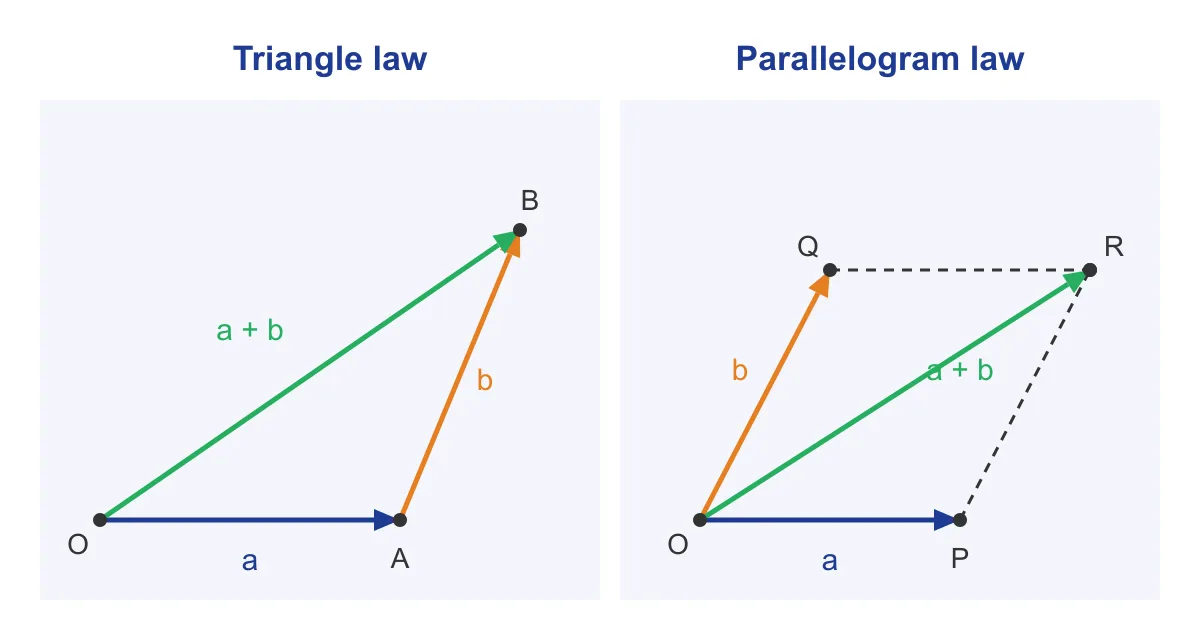
Figure 1.1: Triangle law and parallelogram law of vector addition
Addition is commutative and associative: $\vec{a} + \vec{b} = \vec{b} + \vec{a}$ and $(\vec{a} + \vec{b}) + \vec{c} = \vec{a} + (\vec{b} + \vec{c})$. Subtraction is addition of the negative: $\vec{a} - \vec{b} = \vec{a} + (-\vec{b})$. If $ABCD$ is a parallelogram with $\vec{AB} = \vec{p}$ and $\vec{AD} = \vec{q}$, then $\vec{AC} = \vec{p} + \vec{q}$ and $\vec{BD} = \vec{q} - \vec{p}$.
For any two vectors, $\lvert\vec{a} + \vec{b}\rvert \le \lvert\vec{a}\rvert + \lvert\vec{b}\rvert$, with equality only when they point the same way. This is the statement that one side of a triangle is shorter than the sum of the other two.
Scalar multiplication. For a real number $k$, the vector $k\vec{a}$ has magnitude $\lvert k\rvert\lvert\vec{a}\rvert$, the direction of $\vec{a}$ if $k > 0$, and the opposite direction if $k < 0$. Also $k(\vec{a} + \vec{b}) = k\vec{a} + k\vec{b}$. Two non-zero vectors are collinear exactly when one is a scalar multiple of the other.
Components. In two dimensions, a vector of length $r$ making angle $\theta$ with the positive $x$-axis is $r\cos\theta\,\hat{i} + r\sin\theta\,\hat{j}$. In three dimensions, if $\vec{a} = a_1\hat{i} + a_2\hat{j} + a_3\hat{k}$ and $\vec{b} = b_1\hat{i} + b_2\hat{j} + b_3\hat{k}$,
Two vectors are equal when all three components are equal. They are parallel when the components are in proportion: $\frac{a_1}{b_1} = \frac{a_2}{b_2} = \frac{a_3}{b_3}$ (read a zero in a denominator as "that numerator is also zero").
A useful consequence: the vector along the internal bisector of the angle between $\vec{a}$ and $\vec{b}$ is $\hat{a} + \hat{b}$, because adding two unit vectors gives the diagonal of a rhombus, and a rhombus diagonal bisects the angle.
4. Section formula and collinearity
Let $A$ and $B$ have position vectors $\vec{a}$ and $\vec{b}$. A point $P$ on line $AB$ with $AP : PB = m : n$ has position vector
The reason for the internal formula: $\vec{AP} = \frac{m}{m+n}\vec{AB}$, so $\vec{p} = \vec{a} + \frac{m}{m+n}(\vec{b} - \vec{a}) = \frac{n\vec{a} + m\vec{b}}{m+n}$. The external formula comes from replacing $n$ by $-n$. For the midpoint, $m = n$, giving $\frac{\vec{a} + \vec{b}}{2}$. The centroid of a triangle with vertices $\vec{a}, \vec{b}, \vec{c}$ is $\frac{\vec{a} + \vec{b} + \vec{c}}{3}$.
Notice the crossing pattern: $m$ multiplies the position vector of $B$, the far end. That is the single most common slip.
Three points $A, B, C$ are collinear exactly when $\vec{AB}$ and $\vec{AC}$ are parallel, that is, $\vec{AC} = k\,\vec{AB}$ for some real $k$.
Example 2: $A = (1, -2, 4)$ and $B = (6, 3, -1)$. Find the points dividing $AB$ internally and externally in the ratio $2:3$.
Step 1: $\vec{a} = (1, -2, 4)$, $\vec{b} = (6, 3, -1)$, $m = 2$, $n = 3$.
Step 2 (internal): $\frac{3\vec{a} + 2\vec{b}}{5} = \frac{(3, -6, 12) + (12, 6, -2)}{5} = \frac{(15, 0, 10)}{5} = (3, 0, 2)$.
Step 3 (external): $\frac{2\vec{b} - 3\vec{a}}{2 - 3} = \frac{(12, 6, -2) - (3, -6, 12)}{-1} = (-9, -12, 14)$.
Check the external point $Q$: $\vec{AQ} = (-10, -10, 10)$ and $\vec{BQ} = (-15, -15, 15)$, lengths in the ratio $2:3$.
The external point lies beyond $A$ because the smaller part of the ratio belongs to $A$.
Example 3: Points $A(1, 2, 3)$, $B(3, 5, 9)$ and $C(\lambda, -1, -3)$ are collinear. Find $\lambda$.
Step 1: $\vec{AB} = (2, 3, 6)$ and $\vec{AC} = (\lambda - 1, -3, -6)$.
Step 2: parallel means $\vec{AC} = k\vec{AB}$. The second components give $-3 = 3k$, so $k = -1$.
Step 3: the third components agree: $-6 = 6k$. The first gives $\lambda - 1 = 2k = -2$, so $\lambda = -1$.
Compare any pair of components to find $k$, then use the remaining one to confirm it is consistent.
5. Direction cosines and direction ratios
Let $\vec{a} = a_1\hat{i} + a_2\hat{j} + a_3\hat{k}$ make angles $\alpha, \beta, \gamma$ with the positive $x$, $y$, $z$ axes. The numbers $l = \cos\alpha$, $m = \cos\beta$, $n = \cos\gamma$ are the direction cosines. Projecting $\vec{a}$ on each axis gives $a_1 = \lvert\vec{a}\rvert l$, $a_2 = \lvert\vec{a}\rvert m$, $a_3 = \lvert\vec{a}\rvert n$, so
The direction cosines are the components of the unit vector: $\hat{a} = l\hat{i} + m\hat{j} + n\hat{k}$. Numbers proportional to them, such as $a_1, a_2, a_3$ themselves, are direction ratios. They are not unique: $(2, -3, 6)$ and $(4, -6, 12)$ describe the same direction. To go from ratios $a, b, c$ to cosines, divide by $\sqrt{a^2 + b^2 + c^2}$, and remember the opposite direction has all signs flipped.
For two vectors with direction cosines $(l_1, m_1, n_1)$ and $(l_2, m_2, n_2)$, the angle $\theta$ between them satisfies $\cos\theta = l_1l_2 + m_1m_2 + n_1n_2$; this follows at once from the dot product in the next section. The $x$-axis has cosines $(1, 0, 0)$, and the vector $\hat{i} + \hat{j} + \hat{k}$ has cosines $\left(\frac{1}{\sqrt{3}}, \frac{1}{\sqrt{3}}, \frac{1}{\sqrt{3}}\right)$.
A quick way to test a candidate triple is to square and add. If a question says a vector makes angles of $60^\circ$ with two axes, then $\frac{1}{4} + \frac{1}{4} + n^2 = 1$ gives $n = \pm\frac{1}{\sqrt{2}}$, so the angle with the third axis is $45^\circ$ or $135^\circ$. Read the question for the word "acute" or for a sign before choosing one.
Memory trick: "Cosines are the Cut-down version: divide by the length." Ratios are any scale; cosines are the unit-length scale, so their squares always add to 1.
6. Scalar (dot) product
For two vectors at angle $\theta$ ($0 \le \theta \le \pi$) when drawn from one point,
The result is a number. It is positive for an acute angle, zero for a right angle, negative for an obtuse angle. In components, $\vec{a}\cdot\vec{b} = a_1b_1 + a_2b_2 + a_3b_3$. This follows from the facts $\hat{i}\cdot\hat{i} = \hat{j}\cdot\hat{j} = \hat{k}\cdot\hat{k} = 1$ and $\hat{i}\cdot\hat{j} = \hat{j}\cdot\hat{k} = \hat{k}\cdot\hat{i} = 0$, together with the distributive law.
Properties: $\vec{a}\cdot\vec{b} = \vec{b}\cdot\vec{a}$; $\vec{a}\cdot(\vec{b} + \vec{c}) = \vec{a}\cdot\vec{b} + \vec{a}\cdot\vec{c}$; $\vec{a}\cdot\vec{a} = \lvert\vec{a}\rvert^2$; $(k\vec{a})\cdot\vec{b} = k(\vec{a}\cdot\vec{b})$. The last two let you expand squares like algebra:
Angle and perpendicularity. Rearranging the definition,
For non-zero vectors, $\vec{a}\perp\vec{b}$ exactly when $\vec{a}\cdot\vec{b} = 0$. The zero vector gives a zero dot product with everything, so the statement "dot product zero implies perpendicular" needs both vectors non-zero.
Projection. Drop a perpendicular from the head of $\vec{b}$ onto the line of $\vec{a}$. The signed length along $\vec{a}$ is the scalar projection of $\vec{b}$ on $\vec{a}$, and the vector projection points along $\hat{a}$:
The projection of $\vec{b}$ on $\vec{a}$ divides by $\lvert\vec{a}\rvert$, the vector you project onto. It is negative for an obtuse angle. The geometric meaning of the dot product is: length of $\vec{a}$ times the shadow of $\vec{b}$ on $\vec{a}$.
The projection also splits $\vec{b}$ into a part along $\vec{a}$ and a part across it. Write $\vec{b} = \vec{b}_{\parallel} + \vec{b}_{\perp}$, where $\vec{b}_{\parallel}$ is the vector projection above. Then $\vec{b}_{\perp} = \vec{b} - \vec{b}_{\parallel}$, and a quick check is that $\vec{b}_{\perp}\cdot\vec{a} = 0$. Questions that ask for the component of a force along a slope, or for the foot of a perpendicular, are this idea in disguise.
Example 4: For $\vec{a} = 2\hat{i} + 2\hat{j} - \hat{k}$ and $\vec{b} = 6\hat{i} + 3\hat{j} + 2\hat{k}$, find the angle's cosine, the scalar projection of $\vec{b}$ on $\vec{a}$ and the vector projection.
Step 1: $\vec{a}\cdot\vec{b} = 12 + 6 - 2 = 16$. $\lvert\vec{a}\rvert = 3$, $\lvert\vec{b}\rvert = \sqrt{36 + 9 + 4} = 7$.
Step 2: $\cos\theta = \frac{16}{3 \times 7} = \frac{16}{21}$.
Step 3: scalar projection $= \frac{16}{3}$.
Step 4: vector projection $= \frac{16}{9}(2\hat{i} + 2\hat{j} - \hat{k}) = \frac{32}{9}\hat{i} + \frac{32}{9}\hat{j} - \frac{16}{9}\hat{k}$.
The cosine is positive, so the angle is acute, and the projection came out positive, consistent with that.
Example 5: Unit vectors $\vec{a}$ and $\vec{b}$ satisfy $\lvert\vec{a} + \vec{b}\rvert = \sqrt{3}$. Find $(2\vec{a} + 5\vec{b})\cdot(3\vec{a} - \vec{b})$.
Step 1: square the given: $3 = \lvert\vec{a}\rvert^2 + 2\vec{a}\cdot\vec{b} + \lvert\vec{b}\rvert^2 = 2 + 2\vec{a}\cdot\vec{b}$, so $\vec{a}\cdot\vec{b} = \frac{1}{2}$.
Step 2: expand the product: $6\lvert\vec{a}\rvert^2 - 2\,\vec{a}\cdot\vec{b} + 15\,\vec{a}\cdot\vec{b} - 5\lvert\vec{b}\rvert^2$.
Step 3: substitute: $6 - 1 + 7.5 - 5 = 7.5$.
Never try to find the vectors themselves; only the dot product of $\vec{a}$ and $\vec{b}$ is needed, and the squared-magnitude trick delivers it.
Memory trick: "Dot is a Doormat, Cross is a Cross-wire: dot gives a number you can step on, cross gives a new vector pointing out of the page." Use it when you forget which product returns which kind of object.
7. Vector (cross) product
For two vectors at angle $\theta$,
where $\hat{n}$ is the unit vector perpendicular to both, chosen by the right-hand rule: turn the fingers from $\vec{a}$ towards $\vec{b}$ through the smaller angle and the thumb points along $\hat{n}$. Properties:
- $\vec{b}\times\vec{a} = -(\vec{a}\times\vec{b})$, so order matters.
- $\vec{a}\times(\vec{b} + \vec{c}) = \vec{a}\times\vec{b} + \vec{a}\times\vec{c}$, and $(k\vec{a})\times\vec{b} = k(\vec{a}\times\vec{b})$.
- $\vec{a}\times\vec{a} = \vec{0}$; for non-zero vectors, $\vec{a}\times\vec{b} = \vec{0}$ exactly when they are parallel.
- $\hat{i}\times\hat{j} = \hat{k}$, $\hat{j}\times\hat{k} = \hat{i}$, $\hat{k}\times\hat{i} = \hat{j}$, and reversing any pair flips the sign.
These rules give the determinant form, with $\vec{a} = (a_1, a_2, a_3)$ and $\vec{b} = (b_1, b_2, b_3)$:
Expand along the first row and keep the minus sign in front of the middle term.
Geometric meaning. Take a parallelogram with adjacent sides $\vec{a}$ and $\vec{b}$. Its base is $\lvert\vec{a}\rvert$ and its height is $\lvert\vec{b}\rvert\sin\theta$, so
For a parallelogram with diagonals $\vec{d_1}$ and $\vec{d_2}$, the area is $\frac{1}{2}\lvert\vec{d_1}\times\vec{d_2}\rvert$, since $\vec{d_1} = \vec{a} + \vec{b}$, $\vec{d_2} = \vec{b} - \vec{a}$ and $\vec{d_1}\times\vec{d_2} = 2(\vec{a}\times\vec{b})$.
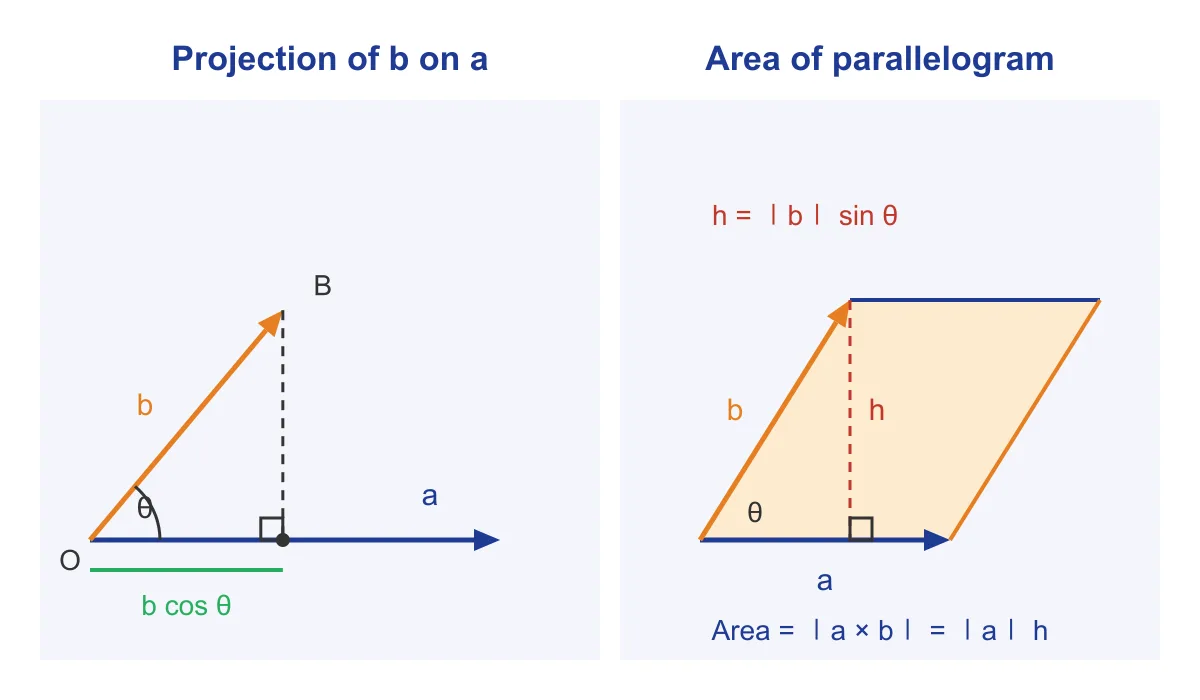
*Figure 1.2: Left, projection of $\vec{b}$ on $\vec{a}$; right, parallelogram area $\lvert\vec{a}\times\vec{b}\rvert = \lvert\vec{a}\rvert h$*
A link between the two products that is worth owning:
It is just $\sin^2\theta + \cos^2\theta = 1$ multiplied by $\lvert\vec{a}\rvert^2\lvert\vec{b}\rvert^2$.
To find a vector perpendicular to two given vectors, take their cross product. To make it a unit vector, divide by its length: $\pm\frac{\vec{a}\times\vec{b}}{\lvert\vec{a}\times\vec{b}\rvert}$ gives the two unit vectors normal to both, one for each side of the plane. If a question asks for a vector of given length perpendicular to two vectors, this is the method, and the answer has two signs unless the direction is fixed.
| Dot product | Cross product | |
|---|---|---|
| Result | Scalar | Vector |
| Formula | $\lvert\vec{a}\rvert\lvert\vec{b}\rvert\cos\theta$ | $\lvert\vec{a}\rvert\lvert\vec{b}\rvert\sin\theta\,\hat{n}$ |
| Commutative | Yes | No, sign flips |
| Zero when | Perpendicular | Parallel |
| Maximum when | Parallel | Perpendicular |
| Gives | Projection, angle, work | Area, normal direction, moment |
Example 6: Find the area of the triangle with vertices $A(1, 2, 3)$, $B(3, 3, 5)$, $C(2, 4, 1)$.
Step 1: $\vec{AB} = (2, 1, 2)$ and $\vec{AC} = (1, 2, -2)$.
Step 2: $\vec{AB}\times\vec{AC} = \hat{i}(1\cdot(-2) - 2\cdot 2) - \hat{j}(2\cdot(-2) - 2\cdot 1) + \hat{k}(2\cdot 2 - 1\cdot 1) = -6\hat{i} + 6\hat{j} + 3\hat{k}$.
Step 3: magnitude $= \sqrt{36 + 36 + 9} = 9$.
Step 4: area $= \frac{1}{2}\times 9 = 4.5$.
Here $\vec{AB}\cdot\vec{AC} = 2 + 2 - 4 = 0$, so the angle at $A$ is a right angle and the area is also $\frac{1}{2}(3)(3)$, which confirms the answer.
Example 7: Three unit vectors $\vec{a}, \vec{b}, \vec{c}$ satisfy $\vec{a} + \vec{b} + \vec{c} = \vec{0}$. Find $\vec{a}\cdot\vec{b} + \vec{b}\cdot\vec{c} + \vec{c}\cdot\vec{a}$, and the angle between any two of them.
Step 1: square the vanishing sum: $0 = \lvert\vec{a}\rvert^2 + \lvert\vec{b}\rvert^2 + \lvert\vec{c}\rvert^2 + 2(\vec{a}\cdot\vec{b} + \vec{b}\cdot\vec{c} + \vec{c}\cdot\vec{a})$.
Step 2: the three squares add to 3, so the bracket is $-\frac{3}{2}$.
Step 3: for the angle, $\vec{a} + \vec{b} = -\vec{c}$ gives $\lvert\vec{a} + \vec{b}\rvert^2 = 1$, so $2 + 2\vec{a}\cdot\vec{b} = 1$, $\cos\theta = -\frac{1}{2}$, $\theta = 120^\circ$.
Three unit vectors that close into a triangle sit at $120^\circ$ to each other, like three equal ropes pulling in balance.
Memory trick: "Sine Slides sideways, Cosine Copies." The cosine of the angle keeps what lies along the other vector (projection, dot); the sine takes what stands across it (height, area, cross).
8. Work done and moment of a force
Work. A constant force $\vec{F}$ acting while a body moves through displacement $\vec{d}$ does work
Only the component of the force along the displacement does work; a force at right angles to the motion does none.
Moment. If a force $\vec{F}$ acts at a point with position vector $\vec{r}$ measured from a reference point $O$, the moment (torque) of $\vec{F}$ about $O$ is
Its magnitude is $\lvert\vec{r}\rvert\lvert\vec{F}\rvert\sin\theta$, the force times the perpendicular distance from $O$ to the line of the force. Its direction is the axis about which the force tends to turn the body.
Work is a scalar and can be negative: a force that opposes the motion, such as friction, has an obtuse angle with the displacement and so takes energy away. The moment is zero when the line of the force passes through $O$, because then $\vec{r}$ and $\vec{F}$ are parallel and $\sin\theta = 0$. The moment also does not change if the force is slid along its own line, since $\vec{r}$ changes by a multiple of $\vec{F}$ and that adds nothing to the cross product.
Example 8: A force $\vec{F} = 4\hat{i} - \hat{j} + 2\hat{k}$ newton acts at the point $P(1, 2, 3)$ metre and moves its point of application to $Q(4, 0, 5)$. Find the work done and the moment of the force about the origin when it acts at $P$.
Step 1: displacement $\vec{PQ} = (3, -2, 2)$.
Step 2: work $= 4(3) + (-1)(-2) + 2(2) = 12 + 2 + 4 = 18$ joule.
Step 3: $\vec{r} = (1, 2, 3)$. $\vec{r}\times\vec{F} = \hat{i}(2\cdot 2 - 3\cdot(-1)) - \hat{j}(1\cdot 2 - 3\cdot 4) + \hat{k}(1\cdot(-1) - 2\cdot 4) = 7\hat{i} + 10\hat{j} - 9\hat{k}$.
Check: this moment must be perpendicular to $\vec{F}$ and $\vec{r}$. Dot with $\vec{F}$: $28 - 10 - 18 = 0$. Dot with $\vec{r}$: $7 + 20 - 27 = 0$.
The perpendicularity check costs ten seconds and catches almost every arithmetic slip in a cross product.
Common traps
- Writing $\vec{AB} = \vec{OA} - \vec{OB}$ → head minus tail: $\vec{AB} = \vec{OB} - \vec{OA}$.
- Using $\frac{m\vec{a} + n\vec{b}}{m+n}$ for $AP:PB = m:n$ → the far end carries the other part: $\frac{n\vec{a} + m\vec{b}}{m+n}$.
- Treating a direction-ratio triple as direction cosines → divide by $\sqrt{a^2 + b^2 + c^2}$ first.
- Concluding $\vec{a} = \vec{0}$ or $\vec{b} = \vec{0}$ from $\vec{a}\cdot\vec{b} = 0$ → a zero dot product also allows perpendicular vectors.
- Cancelling in $\vec{a}\cdot\vec{b} = \vec{a}\cdot\vec{c}$ to get $\vec{b} = \vec{c}$ → only $\vec{a}\cdot(\vec{b} - \vec{c}) = 0$ follows. The same holds for the cross product.
- Writing $\vec{a}\times\vec{b} = \vec{b}\times\vec{a}$ → the cross product changes sign when the order is swapped.
- Dividing by $\lvert\vec{b}\rvert$ for the projection of $\vec{b}$ on $\vec{a}$ → divide by the length of the vector you project onto, $\lvert\vec{a}\rvert$.
- Expanding $\lvert\vec{a} + \vec{b}\rvert^2$ as $\lvert\vec{a}\rvert^2 + \lvert\vec{b}\rvert^2$ → add the cross term $2\,\vec{a}\cdot\vec{b}$.
- Dropping the minus sign on the middle term of the determinant → expand with signs $+ - +$ along $\hat{i}, \hat{j}, \hat{k}$.
- Asserting $\lvert\vec{a} + \vec{b}\rvert = \lvert\vec{a}\rvert + \lvert\vec{b}\rvert$ → this holds only when the vectors have the same direction.
Quick revision
- $\vec{AB} = \vec{OB} - \vec{OA}$; $\lvert\vec{a}\rvert = \sqrt{a_1^2 + a_2^2 + a_3^2}$; $\hat{a} = \vec{a}/\lvert\vec{a}\rvert$.
- Triangle law: $\vec{OA} + \vec{AB} = \vec{OB}$; parallelogram diagonals are $\vec{p} + \vec{q}$ and $\vec{q} - \vec{p}$.
- $\lvert\vec{a} + \vec{b}\rvert \le \lvert\vec{a}\rvert + \lvert\vec{b}\rvert$, equality for the same direction.
- Parallel vectors: $\vec{a} = k\vec{b}$, components in proportion.
- Internal section: $\frac{n\vec{a} + m\vec{b}}{m+n}$; external: $\frac{m\vec{b} - n\vec{a}}{m-n}$; centroid $\frac{\vec{a}+\vec{b}+\vec{c}}{3}$.
- Direction cosines are the components of the unit vector, so $l^2 + m^2 + n^2 = 1$.
- $\vec{a}\cdot\vec{b} = a_1b_1 + a_2b_2 + a_3b_3 = \lvert\vec{a}\rvert\lvert\vec{b}\rvert\cos\theta$.
- Perpendicular: $\vec{a}\cdot\vec{b} = 0$ for non-zero vectors.
- Scalar projection of $\vec{b}$ on $\vec{a}$: $\frac{\vec{a}\cdot\vec{b}}{\lvert\vec{a}\rvert}$.
- $\lvert\vec{a} \pm \vec{b}\rvert^2 = \lvert\vec{a}\rvert^2 \pm 2\,\vec{a}\cdot\vec{b} + \lvert\vec{b}\rvert^2$.
- $\vec{a}\times\vec{b}$ is perpendicular to both; $\lvert\vec{a}\times\vec{b}\rvert = \lvert\vec{a}\rvert\lvert\vec{b}\rvert\sin\theta$; $\vec{b}\times\vec{a} = -\vec{a}\times\vec{b}$.
- Parallel vectors: $\vec{a}\times\vec{b} = \vec{0}$.
- Area of parallelogram $= \lvert\vec{a}\times\vec{b}\rvert$; triangle $= \frac{1}{2}\lvert\vec{a}\times\vec{b}\rvert$; with diagonals, $\frac{1}{2}\lvert\vec{d_1}\times\vec{d_2}\rvert$.
- $\lvert\vec{a}\times\vec{b}\rvert^2 + (\vec{a}\cdot\vec{b})^2 = \lvert\vec{a}\rvert^2\lvert\vec{b}\rvert^2$.
- Work $= \vec{F}\cdot\vec{d}$; moment $= \vec{r}\times\vec{F}$.
Practice questions
What is the magnitude of the vector $2\hat{i} - 3\hat{j} + 6\hat{k}$?
- 5
- 7
- $\sqrt{31}$
- 11
Answer
B. 7
$\sqrt{4+9+36}=\sqrt{49}=7$. The value 5 comes from adding the components, and $\sqrt{31}$ from a sign slip on the squares.
The unit vector in the direction of $3\hat{i} - 4\hat{k}$ is
- $\frac{1}{7}(3\hat{i} - 4\hat{k})$
- $\frac{1}{5}(3\hat{i} + 4\hat{k})$
- $\frac{1}{5}(3\hat{i} - 4\hat{k})$
- $3\hat{i} - 4\hat{k}$
Answer
C. $\frac{1}{5}(3\hat{i} - 4\hat{k})$
Magnitude $=\sqrt{9+16}=5$. Divide the vector by 5, keeping its signs.
The points $A(2,-1,3)$ and $B(5,3,-2)$ are given. The vector $\vec{AB}$ is
- $3\hat{i} + 4\hat{j} - 5\hat{k}$
- $3\hat{i} + 4\hat{j} + 5\hat{k}$
- $-3\hat{i} - 4\hat{j} + 5\hat{k}$
- $7\hat{i} + 2\hat{j} + \hat{k}$
Answer
A. $3\hat{i} + 4\hat{j} - 5\hat{k}$
Head minus tail: $(5-2,\,3-(-1),\,-2-3)=(3,4,-5)$.
$P$ divides the segment joining points with position vectors $\vec{a}$ and $\vec{b}$ externally in the ratio $2:1$, that is $AP:PB=2:1$ with $P$ outside the segment. The position vector of $P$ is
- $2\vec{a}-\vec{b}$
- $\frac{2\vec{b}+\vec{a}}{3}$
- $\frac{2\vec{b}-\vec{a}}{3}$
- $2\vec{b}-\vec{a}$
Answer
D. $2\vec{b}-\vec{a}$
External formula $\frac{m\vec{b}-n\vec{a}}{m-n}$ with $m=2$, $n=1$ gives $\frac{2\vec{b}-\vec{a}}{1}$. Check with $\vec{a}=0$, $\vec{b}=1$ on a line: $P=2$, so $AP=2$ and $PB=1$.
The direction cosines of the vector $\hat{i} - 2\hat{j} + 2\hat{k}$ are
- $\frac{1}{3},\frac{2}{3},\frac{2}{3}$
- $\frac{1}{9},-\frac{2}{9},\frac{2}{9}$
- $1,-2,2$
- $\frac{1}{3},-\frac{2}{3},\frac{2}{3}$
Answer
D. $\frac{1}{3},-\frac{2}{3},\frac{2}{3}$
Magnitude $=\sqrt{1+4+4}=3$; divide each component by 3. Check: $\frac19+\frac49+\frac49=1$.
The vectors $2\hat{i} + \lambda\hat{j} + \hat{k}$ and $\hat{i} - 2\hat{j} + 3\hat{k}$ are perpendicular. The value of $\lambda$ is
- $\frac{1}{2}$
- $\frac{5}{2}$
- $1$
- $-\frac{5}{2}$
Answer
B. $\frac{5}{2}$
Dot product zero: $2-2\lambda+3=0$, so $\lambda=\frac{5}{2}$. Substitute back: $2-5+3=0$.
The value of $(\hat{i} \times \hat{j}) \times \hat{j}$ is
- $-\hat{i}$
- $\vec{0}$
- $\hat{k}$
- $\hat{i}$
Answer
A. $-\hat{i}$
$\hat{i}\times\hat{j}=\hat{k}$ and $\hat{k}\times\hat{j}=-\hat{i}$ because $\hat{j}\times\hat{k}=\hat{i}$ and reversing the order flips the sign.
For non-zero vectors $\vec{a}$ and $\vec{b}$ with angle $\theta$ between them, $\lvert\vec{a}\times\vec{b}\rvert=\vec{a}\cdot\vec{b}$. Then $\theta$ equals
- $\frac{\pi}{2}$
- $\frac{\pi}{3}$
- $\frac{\pi}{4}$
- $\frac{\pi}{6}$
Answer
C. $\frac{\pi}{4}$
$\lvert\vec{a}\rvert\lvert\vec{b}\rvert\sin\theta=\lvert\vec{a}\rvert\lvert\vec{b}\rvert\cos\theta$ gives $\tan\theta=1$. The dot product is positive, so $\theta=\frac{\pi}{4}$.
For non-zero vectors $\vec{a}$ and $\vec{b}$, the equation $(\vec{a}+\vec{b})\cdot(\vec{a}-\vec{b})=0$ holds if and only if
- $\vec{a}=\vec{b}$
- $\lvert\vec{a}\rvert=\lvert\vec{b}\rvert$
- $\vec{a}$ is perpendicular to $\vec{b}$
- $\vec{a}$ is parallel to $\vec{b}$
Answer
B. $\lvert\vec{a}\rvert=\lvert\vec{b}\rvert$
Expanding, $\lvert\vec{a}\rvert^2-\lvert\vec{b}\rvert^2=0$. Equal magnitudes is enough; $\vec{a}=\vec{b}$ is only one special case.
The area of the parallelogram whose adjacent sides are $\hat{i} + 2\hat{j} + 3\hat{k}$ and $-3\hat{i} - 2\hat{j} + \hat{k}$ is
- $6\sqrt{5}$
- $2\sqrt{57}$
- $3\sqrt{5}$
- $12\sqrt{5}$
Answer
A. $6\sqrt{5}$
Cross product: $\hat{i}(2+6)-\hat{j}(1+9)+\hat{k}(-2+6)=8\hat{i}-10\hat{j}+4\hat{k}$. Magnitude $\sqrt{64+100+16}=\sqrt{180}=6\sqrt{5}$.
Which of the following is a unit vector?
- $\frac{1}{3}(\hat{i} + \hat{j} + \hat{k})$
- $\frac{1}{\sqrt{3}}(\hat{i} + \hat{j})$
- $\frac{1}{3}(\hat{i} + 2\hat{j} + 2\hat{k})$
- $\frac{1}{2}(\hat{i} + \hat{j} + \hat{k})$
Answer
C. $\frac{1}{3}(\hat{i} + 2\hat{j} + 2\hat{k})$
Only the last has $\frac{1+4+4}{9}=1$. The others give $\frac34$, $\frac23$ and $\frac13$ for the squared magnitude.
$ABCD$ is a parallelogram with $\vec{AB}=\vec{p}$ and $\vec{AD}=\vec{q}$. The vector $\vec{BD}$ is
- $\vec{p}+\vec{q}$
- $-\vec{p}-\vec{q}$
- $\vec{p}-\vec{q}$
- $\vec{q}-\vec{p}$
Answer
D. $\vec{q}-\vec{p}$
$\vec{BD}=\vec{BA}+\vec{AD}=-\vec{p}+\vec{q}$.
The points $A(1,2,3)$, $B(3,5,9)$ and $C(\lambda,-1,-3)$ are collinear. Then $\lambda$ equals
- $-1$
- $1$
- $-3$
- $3$
Answer
A. $-1$
$\vec{AB}=(2,3,6)$, $\vec{AC}=(\lambda-1,-3,-6)=k\,\vec{AB}$ gives $k=-1$, so $\lambda-1=-2$ and $\lambda=-1$.
Let $\vec a = \hat{i} + 2\hat{j} + 2\hat{k}$ and $\vec b = 4\hat{i} - 3\hat{k}$. A unit vector along the internal bisector of the angle between them is
- $\frac{-7\hat{i} + 10\hat{j} + 19\hat{k}}{\sqrt{510}}$
- $\frac{5\hat{i} + 2\hat{j} - \hat{k}}{\sqrt{30}}$
- $\frac{17\hat{i} + 10\hat{j} + \hat{k}}{15}$
- $\frac{17\hat{i} + 10\hat{j} + \hat{k}}{\sqrt{390}}$
Answer
D. $\frac{17\hat{i} + 10\hat{j} + \hat{k}}{\sqrt{390}}$
$\lvert\vec a\rvert=3$, $\lvert\vec b\rvert=5$. Bisector direction $\hat a+\hat b=\frac13(1,2,2)+\frac15(4,0,-3)=\frac{1}{15}(17,10,1)$. Its length is $\frac{\sqrt{390}}{15}$, so divide by that: $\frac{(17,10,1)}{\sqrt{390}}$. The simple sum $\vec a+\vec b$ is not along the bisector unless the lengths are equal.
The value of $(2\hat{i} - \hat{j} + 3\hat{k})\cdot(\hat{i} + 4\hat{j} + 2\hat{k})$ is
- 0
- 12
- 4
- 8
Answer
C. 4
$2(1)+(-1)(4)+3(2)=2-4+6=4$.
Two vectors have magnitudes 2 and 3 and their dot product is 3. The angle between them, in degrees, is
- 120
- 60
- 45
- 30
Answer
B. 60
$\cos\theta=\frac{3}{2\times3}=\frac12$, so $\theta=60^\circ$.
The scalar projection of $\hat{i} + 2\hat{j} + \hat{k}$ on $2\hat{i} + 3\hat{j} + 6\hat{k}$ is
- 14
- 2
- 7
- 4
Answer
B. 2
Dot product $=2+6+6=14$. Length of the vector projected on $=\sqrt{4+9+36}=7$. Projection $=\frac{14}{7}=2$.
The area of the triangle with vertices $(1,2,3)$, $(3,3,5)$ and $(2,4,1)$ in square units is
- 6
- 9
- 4.5
- 2.25
Answer
C. 4.5
Sides from the first vertex: $(2,1,2)$ and $(1,2,-2)$. Cross product $=(-6,6,3)$, magnitude 9. Area $=\frac92=4.5$. Check: the two sides have dot product $2+2-4=0$, a right angle, and area $\frac12(3)(3)$.
For vectors with $\lvert\vec{a}\rvert=3$, $\lvert\vec{b}\rvert=5$ and $\vec{a}\cdot\vec{b}=9$, the value of $\lvert\vec{a}\times\vec{b}\rvert$ is
- 15
- 9
- 20
- 12
Answer
D. 12
$\cos\theta=\frac{9}{15}=\frac35$, so $\sin\theta=\frac45$ and $\lvert\vec{a}\times\vec{b}\rvert=15\times\frac45=12$. Check with $\lvert\vec a\times\vec b\rvert^2+81=225$: $144+81=225$.
Vectors $\vec{a}$ and $\vec{b}$ have $\lvert\vec{a}\rvert=4$, $\lvert\vec{b}\rvert=7$ and $\lvert\vec{a}+\vec{b}\rvert=9$. The value of $\lvert\vec{a}-\vec{b}\rvert$ is
- 7
- 5
- 9
- 8
Answer
A. 7
$81=16+49+2\,\vec a\cdot\vec b$ gives $\vec a\cdot\vec b=8$. Then $\lvert\vec a-\vec b\rvert^2=16+49-16=49$, so $7$. Check with the parallelogram rule: $81+49=2(16+49)=130$.
A force $3\hat{i} + 2\hat{j} + \hat{k}$ newton moves a particle from $(1,1,1)$ to $(4,3,-1)$, the lengths being in metres. The work done in joule is
- 11
- 13
- 17
- 7
Answer
A. 11
Displacement $=(3,2,-2)$. Work $=3(3)+2(2)+1(-2)=11$. Using the end point alone gives 17, which is wrong.
A force $3\hat{i} + 2\hat{j} + 2\hat{k}$ newton acts at the point with position vector $\hat{i} - 2\hat{j} + 2\hat{k}$ metre. The magnitude of its moment about the origin, in newton metre, is
- 3
- 12
- 144
- 6
Answer
B. 12
$\vec r\times\vec F=\hat i(-4-4)-\hat j(2-6)+\hat k(2+6)=-8\hat{i}+4\hat{j}+8\hat{k}$. Magnitude $=\sqrt{64+16+64}=12$. Check: $\lvert r\rvert=3$, $\lvert F\rvert=\sqrt{17}$, and $\vec r\cdot\vec F=3$, so $\lvert\vec r\times\vec F\rvert^2=153-9=144$.
A vector makes angles of $45^\circ$ with the positive $x$-axis and $60^\circ$ with the positive $y$-axis, and an acute angle with the positive $z$-axis. This acute angle, in degrees, is
- 120
- 30
- 60
- 90
Answer
C. 60
$l^2+m^2+n^2=1$: $\frac12+\frac14+n^2=1$, so $n=\frac12$ (acute means $n>0$), and the angle is $60^\circ$.
A vector of magnitude 14 points in the direction of $2\hat{i} + 3\hat{j} + 6\hat{k}$. The sum of its three components is
- 11
- 14
- 44
- 22
Answer
D. 22
Unit vector $=\frac{1}{7}(2,3,6)$; times 14 gives $(4,6,12)$. Sum $=22$.
Vectors $\vec{a}$ and $\vec{b}$ satisfy $\lvert\vec{a}\rvert=2$, $\lvert\vec{b}\rvert=3$ and $\lvert\vec{a}+\vec{b}\rvert=\sqrt{19}$. The value of $(\vec{a}+\vec{b})\cdot(\vec{a}-2\vec{b})$ is
- -17
- -11
- -15
- 19
Answer
A. -17
$19=4+9+2\,\vec a\cdot\vec b$, so $\vec a\cdot\vec b=3$. Expand: $\lvert\vec a\rvert^2-\vec a\cdot\vec b-2\lvert\vec b\rvert^2=4-3-18=-17$.
The diagonals of a parallelogram are $3\hat{i} + 2\hat{j} + 2\hat{k}$ and $\hat{i} - 2\hat{j} + 2\hat{k}$. Its area in square units is
- 18
- 12
- 6
- 3
Answer
C. 6
$\vec d_1\times\vec d_2=\hat i(4+4)-\hat j(6-2)+\hat k(-6-2)=8\hat{i}-4\hat{j}-8\hat{k}$, magnitude $12$. Area $=\frac12(12)=6$. Forgetting the half gives 12.
Given below are two statements: Statement I: For any two vectors, $\vec{a}\cdot\vec{b}=\vec{b}\cdot\vec{a}$. Statement II: For any two vectors, $\vec{a}\times\vec{b}=\vec{b}\times\vec{a}$.
- Both Statement I and Statement II are correct
- Both Statement I and Statement II are incorrect
- Statement I is correct but Statement II is incorrect
- Statement I is incorrect but Statement II is correct
Answer
C. Statement I is correct but Statement II is incorrect
The dot product is commutative. The cross product changes sign when the order is swapped, so II is false unless $\vec a\times\vec b=\vec 0$.
Given below are two statements: Statement I: For all vectors, $\lvert\vec{a}+\vec{b}\rvert\le\lvert\vec{a}\rvert+\lvert\vec{b}\rvert$. Statement II: For all vectors, $\lvert\vec{a}\times\vec{b}\rvert\le\lvert\vec{a}\rvert\lvert\vec{b}\rvert$.
- Both Statement I and Statement II are correct
- Both Statement I and Statement II are incorrect
- Statement I is correct but Statement II is incorrect
- Statement I is incorrect but Statement II is correct
Answer
A. Both Statement I and Statement II are correct
I is the triangle inequality. II holds because $\sin\theta\le 1$. Both are correct.
Given below are two statements: Statement I: For all non-zero vectors, the scalar projection of $\vec{a}$ on $\vec{b}$ equals the scalar projection of $\vec{b}$ on $\vec{a}$. Statement II: The scalar projection of $\vec{a}$ on $\vec{b}$ is $\frac{\vec{a}\cdot\vec{b}}{\lvert\vec{b}\rvert}$.
- Both Statement I and Statement II are correct
- Both Statement I and Statement II are incorrect
- Statement I is correct but Statement II is incorrect
- Statement I is incorrect but Statement II is correct
Answer
D. Statement I is incorrect but Statement II is correct
The two projections are $\frac{\vec a\cdot\vec b}{\lvert\vec b\rvert}$ and $\frac{\vec a\cdot\vec b}{\lvert\vec a\rvert}$, equal only when the magnitudes are equal (or the dot product is zero). I is false, II is true.
Given below are two statements: Statement I: If $\vec{a}\cdot\vec{b}=\vec{a}\cdot\vec{c}$ and $\vec{a}\ne\vec{0}$, then $\vec{b}=\vec{c}$. Statement II: If $\vec{a}\times\vec{b}=\vec{a}\times\vec{c}$ and $\vec{a}\ne\vec{0}$, then $\vec{b}=\vec{c}$.
- Both Statement I and Statement II are correct
- Both Statement I and Statement II are incorrect
- Statement I is correct but Statement II is incorrect
- Statement I is incorrect but Statement II is correct
Answer
B. Both Statement I and Statement II are incorrect
I only gives $\vec a\cdot(\vec b-\vec c)=0$: take $\vec a=\hat{i}$, $\vec b=\hat{j}$, $\vec c=\hat{k}$. II only gives $\vec a\times(\vec b-\vec c)=\vec 0$: take $\vec b=\vec c+\vec a$. Both are false.
Given below are two statements: Statement I: The direction cosines $l, m, n$ of a vector satisfy $l^2+m^2+n^2=1$. Statement II: Any three direction ratios $a, b, c$ of a vector satisfy $a^2+b^2+c^2=1$.
- Both Statement I and Statement II are correct
- Both Statement I and Statement II are incorrect
- Statement I is correct but Statement II is incorrect
- Statement I is incorrect but Statement II is correct
Answer
C. Statement I is correct but Statement II is incorrect
The cosines are components of a unit vector, so I is true. Ratios are only proportional to the cosines, for example $2,3,6$, so II is false.
Assertion (A): For all vectors, $\lvert\vec{a}\times\vec{b}\rvert^2+(\vec{a}\cdot\vec{b})^2=\lvert\vec{a}\rvert^2\lvert\vec{b}\rvert^2$. Reason (R): $\lvert\vec{a}\times\vec{b}\rvert=\lvert\vec{a}\rvert\lvert\vec{b}\rvert\sin\theta$ and $\vec{a}\cdot\vec{b}=\lvert\vec{a}\rvert\lvert\vec{b}\rvert\cos\theta$.
- Both A and R are true and R is the correct explanation of A
- Both A and R are true but R is not the correct explanation of A
- A is true but R is false
- A is false but R is true
Answer
A. Both A and R are true and R is the correct explanation of A
Squaring and adding the two formulas and using $\sin^2\theta+\cos^2\theta=1$ proves A, so R explains A.
Assertion (A): Two non-zero vectors $\vec{a}$ and $\vec{b}$ are perpendicular if and only if $\vec{a}\cdot\vec{b}=0$. Reason (R): $\hat{i}\cdot\hat{j}=0$.
- Both A and R are true and R is the correct explanation of A
- Both A and R are true but R is not the correct explanation of A
- A is true but R is false
- A is false but R is true
Answer
B. Both A and R are true but R is not the correct explanation of A
A is true because $\cos\theta=0$. R is a true fact, but one example does not explain the general statement.
Assertion (A): The dot product of two vectors can be a vector. Reason (R): The dot product of $\vec{a}$ and $\vec{b}$ is defined as $\lvert\vec{a}\rvert\lvert\vec{b}\rvert\cos\theta$.
- Both A and R are true and R is the correct explanation of A
- Both A and R are true but R is not the correct explanation of A
- A is true but R is false
- A is false but R is true
Answer
D. A is false but R is true
R is the definition, and it is a real number, so A is false while R is true.
Match List I with List II. List I: a. $\vec a\cdot\vec b=0$ for non-zero vectors b. $\vec a\times\vec b=\vec 0$ for non-zero vectors c. $\vec a\cdot\vec b=-\lvert\vec a\rvert\lvert\vec b\rvert$ d. $\vec a\cdot\vec b=\lvert\vec a\rvert\lvert\vec b\rvert$ List II: i. The vectors are perpendicular ii. The vectors are collinear iii. The vectors have the same direction iv. The vectors have opposite directions
- a-ii, b-i, c-iv, d-iii
- a-i, b-ii, c-iv, d-iii
- a-i, b-iii, c-iv, d-ii
- a-i, b-ii, c-iii, d-iv
Answer
B. a-i, b-ii, c-iv, d-iii
Zero dot: right angle. Zero cross: $\sin\theta=0$, collinear. Dot equal to $-\lvert a\rvert\lvert b\rvert$: $\cos\theta=-1$, opposite. Dot equal to $+\lvert a\rvert\lvert b\rvert$: $\cos\theta=1$, same direction.
Match List I with List II. List I: a. $\vec a\cdot\vec b$ for $\vec a=\hat{i}+\hat{j}$ and $\vec b=\hat{j}+\hat{k}$ b. $\lvert\vec a\times\vec b\rvert$ for the same two vectors c. Cosine of the angle between the same two vectors d. Scalar projection of $\vec a$ on $\vec b$ for the same two vectors List II: i. $\frac12$ ii. $\sqrt3$ iii. $1$ iv. $\frac{1}{\sqrt2}$
- a-iii, b-ii, c-iv, d-i
- a-i, b-ii, c-iii, d-iv
- a-iii, b-i, c-ii, d-iv
- a-iii, b-ii, c-i, d-iv
Answer
D. a-iii, b-ii, c-i, d-iv
For $\vec a=\hat{i}+\hat{j}$ and $\vec b=\hat{j}+\hat{k}$: dot $=1$; cross $=\hat{i}-\hat{j}+\hat{k}$ with magnitude $\sqrt3$; $\cos\theta=\frac{1}{\sqrt2\sqrt2}=\frac12$; projection $=\frac{1}{\sqrt2}$.
Match List I with List II. List I: a. Work done by a constant force $\vec F$ over displacement $\vec d$ b. Moment of a force $\vec F$ acting at position vector $\vec r$ about the origin c. Area of a triangle with adjacent sides $\vec a$ and $\vec b$ d. Scalar projection of $\vec a$ on $\vec b$ List II: i. $\vec r\times\vec F$ ii. $\frac12\lvert\vec a\times\vec b\rvert$ iii. $\frac{\vec a\cdot\vec b}{\lvert\vec b\rvert}$ iv. $\vec F\cdot\vec d$
- a-iv, b-i, c-iii, d-ii
- a-i, b-iv, c-ii, d-iii
- a-iv, b-i, c-ii, d-iii
- a-iv, b-ii, c-i, d-iii
Answer
C. a-iv, b-i, c-ii, d-iii
Work is a dot product, moment is a cross product, the triangle area is half the cross magnitude, and projection divides the dot product by the length of the vector projected on.
$ABCD$ is a parallelogram with $A(1,1,1)$, $B(3,2,0)$ and $C(4,5,1)$. Its area in square units is
- $5\sqrt{3}$
- $5\sqrt{2}$
- $10$
- $\sqrt{26}$
Answer
B. $5\sqrt{2}$
$\vec{AB}=(2,1,-1)$ and $\vec{BC}=(1,3,1)$ are adjacent sides. Cross product $=\hat{i}(1+3)-\hat{j}(2+1)+\hat{k}(6-1)=4\hat{i}-3\hat{j}+5\hat{k}$. Magnitude $\sqrt{16+9+25}=\sqrt{50}=5\sqrt2$.
A vector $\vec c$ is perpendicular to both $\hat{i} + \hat{j}$ and $\hat{j} + \hat{k}$, and $\vec c\cdot(2\hat{i} + \hat{j} + \hat{k})=6$. The magnitude of $\vec c$ is
- $3\sqrt{3}$
- $3$
- $\sqrt{3}$
- $6$
Answer
A. $3\sqrt{3}$
$\vec c$ is parallel to $(\hat{i}+\hat{j})\times(\hat{j}+\hat{k})=\hat{i}-\hat{j}+\hat{k}$, so $\vec c=\lambda(\hat{i}-\hat{j}+\hat{k})$. Then $\vec c\cdot(2,1,1)=\lambda(2-1+1)=2\lambda=6$, $\lambda=3$. Magnitude $=3\sqrt3$.
In triangle $OAB$ with $O$ the origin, $\lvert\vec{OA}\rvert=3$, $\lvert\vec{OB}\rvert=6$ and $\angle AOB=60^\circ$. The point $P$ lies on $AB$ with $AP:PB=1:2$. The value of $\lvert\vec{OP}\rvert^2$ is
- $18$
- $9$
- $21$
- $12$
Answer
D. $12$
$\vec{OP}=\frac{2\vec a+\vec b}{3}$ and $\vec a\cdot\vec b=3\cdot6\cdot\frac12=9$. $\lvert\vec{OP}\rvert^2=\frac{4(9)+4(9)+36}{9}=\frac{108}{9}=12$. Using $\frac{\vec a+2\vec b}{3}$ by mistake gives $21$.