Three-Dimensional Geometry
What to remember
- Every point in space is an ordered triple $(x, y, z)$. Distance, midpoint and section formulae are the plane formulae with one more coordinate.
- A line is fixed by one point and a direction. The direction is stored as direction ratios $a, b, c$ (any multiple will do) or as direction cosines $l, m, n$ with $l^2 + m^2 + n^2 = 1$.
- Two lines in space either meet, are parallel, or are skew. For skew lines the shortest distance is the projection of the gap between the two base points on the common perpendicular, $\vec b_1 \times \vec b_2$.
- A plane is fixed by one point and a normal. Almost every plane question becomes "find the normal" and then substitute a point.
- Angle between planes uses the normals with $\cos\theta$. Angle between a line and a plane uses the line direction and the normal with $\sin\theta$.
Points in space: distance and section formula
Take three mutually perpendicular axes $Ox$, $Oy$, $Oz$ meeting at the origin $O$. A point $P$ is written $(x, y, z)$, where $x$, $y$, $z$ are its signed distances from the $yz$-plane, the $zx$-plane and the $xy$-plane. Three coordinate planes cut space into eight octants. The $x$-axis is the set of points $(t, 0, 0)$, the $xy$-plane is $z = 0$, and so on.
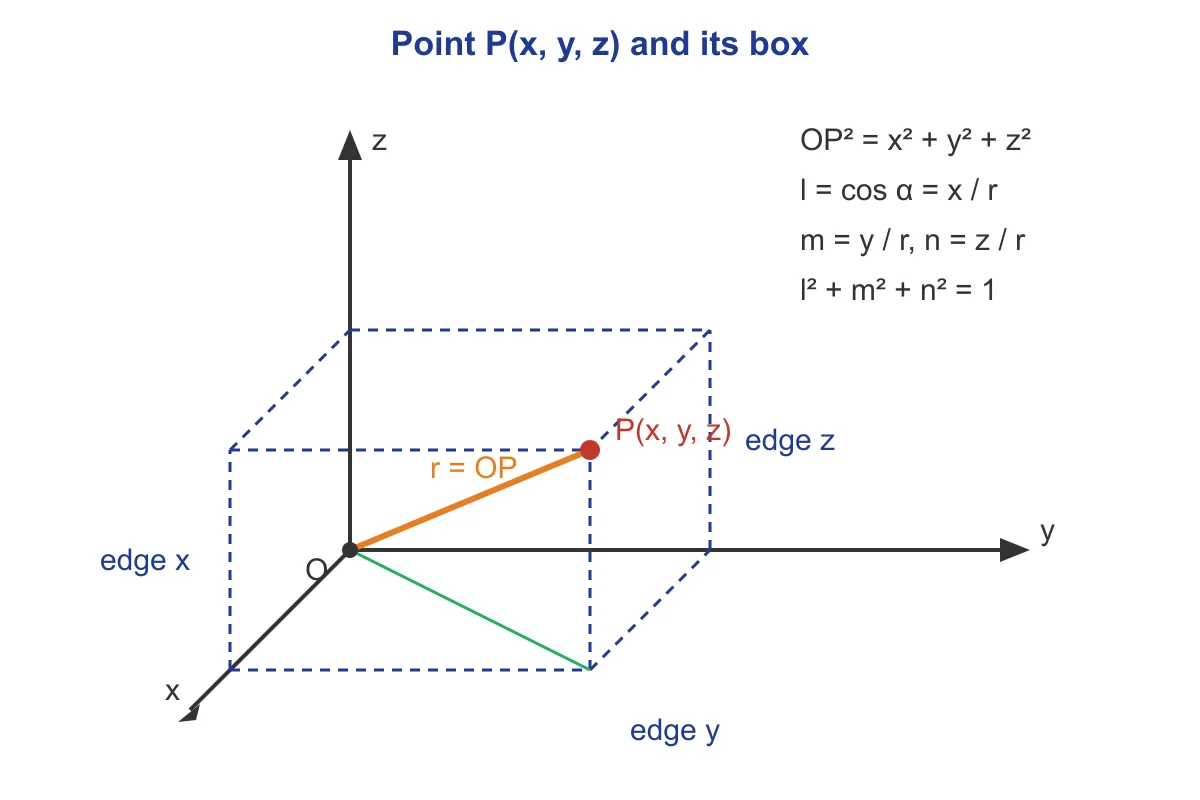
Look at the box in Figure 2.1. The edges from $O$ along the axes have lengths $x$, $y$, $z$ and $OP$ is the space diagonal. Applying Pythagoras twice gives $OP^2 = x^2 + y^2 + z^2$. For two points the same argument works on the differences:
Section formula. If $P$ divides $A(x_1, y_1, z_1)$ and $B(x_2, y_2, z_2)$ in the ratio $m : n$, then
For internal division $m, n > 0$. For external division, put $n \to -n$, so the denominator becomes $m - n$. The midpoint is the case $m = n$. A useful habit: to find where a coordinate plane cuts $AB$, set that coordinate of $P$ to zero and solve for $m : n$. A negative ratio means the cut lies outside the segment.
Example 1: Find the points that divide $A(2, -1, 3)$ and $B(8, 5, -3)$ internally and externally in the ratio $2 : 1$, and find $AB$.
Internal, $m = 2, n = 1$: $x = (2 \cdot 8 + 1 \cdot 2)/3 = 6$, $y = (2 \cdot 5 - 1)/3 = 3$, $z = (2 \cdot (-3) + 3)/3 = -1$. Point $(6, 3, -1)$.
External: denominator $m - n = 1$. $x = 16 - 2 = 14$, $y = 10 + 1 = 11$, $z = -6 - 3 = -9$. Point $(14, 11, -9)$.
$AB = \sqrt{6^2 + 6^2 + 6^2} = 6\sqrt{3}$.
Answer: $(6, 3, -1)$, $(14, 11, -9)$, $6\sqrt{3}$. Notice the internal point is two thirds of the way from $A$ to $B$, and the external point lies beyond $B$ at the same distance as $AB$.
Direction cosines, direction ratios and the angle between lines
The reason for working with directions rather than with points is simple: a line has infinitely many points, but its tilt in space is described by just three numbers. Once you have those, every question about parallel, perpendicular and angle becomes arithmetic with dot products.
If a directed line makes angles $\alpha, \beta, \gamma$ with the positive $x$, $y$, $z$ axes, then $l = \cos\alpha$, $m = \cos\beta$, $n = \cos\gamma$ are its direction cosines. In Figure 2.1, for the line $OP$ these are $x/r$, $y/r$, $z/r$ with $r = OP$, which gives at once
Reversing the direction changes all three signs. So a line (without arrow) has two sets of direction cosines, $(l, m, n)$ and $(-l, -m, -n)$. The $x$-axis has $(1, 0, 0)$, the $y$-axis $(0, 1, 0)$, the $z$-axis $(0, 0, 1)$. From $l^2 + m^2 + n^2 = 1$ you also get $\sin^2\alpha + \sin^2\beta + \sin^2\gamma = 2$.
Any three numbers $a, b, c$ (not all zero) proportional to $l, m, n$ are called direction ratios. They are not unique: $(1, 2, 2)$ and $(3, 6, 6)$ describe the same direction. To convert, divide by $\sqrt{a^2 + b^2 + c^2}$:
The line through $A(x_1, y_1, z_1)$ and $B(x_2, y_2, z_2)$ has direction ratios $x_2 - x_1,\ y_2 - y_1,\ z_2 - z_1$. The vector $\vec b = a\hat i + b\hat j + c\hat k$ along the line carries the direction ratios as its components.
Angle between two lines. It is the angle between their direction vectors. The formula is just $\vec b_1 \cdot \vec b_2 = \vert \vec b_1 \vert \vert \vec b_2 \vert \cos\theta$ solved for $\cos\theta$. Two lines in space need not meet, and the angle is still defined: slide one line parallel to itself until it crosses the other, then measure. With direction ratios $(a_1, b_1, c_1)$ and $(a_2, b_2, c_2)$,
The modulus gives the acute angle, which is the usual convention for lines. With direction cosines the denominator is 1, so $\cos\theta = \vert l_1 l_2 + m_1 m_2 + n_1 n_2 \vert$.
| Relation of two lines | Test on direction ratios |
|---|---|
| Parallel | $\dfrac{a_1}{a_2} = \dfrac{b_1}{b_2} = \dfrac{c_1}{c_2}$ |
| Perpendicular | $a_1 a_2 + b_1 b_2 + c_1 c_2 = 0$ |
| Angle $\theta$ | $\cos\theta = \dfrac{\vert a_1 a_2 + b_1 b_2 + c_1 c_2 \vert}{\sqrt{\sum a_1^2}\,\sqrt{\sum a_2^2}}$ |
Memory trick: "Parallel divides, perpendicular multiplies." Parallel lines: divide the ratios and get one common value. Perpendicular lines: multiply and add to get zero.
Example 2: Line $L_1$ passes through $A(1, 1, 1)$ and $B(2, 3, 3)$. Line $L_2$ passes through $C(0, 0, 0)$ and $D(2, 3, 6)$. Find the angle between them and the direction cosines of $L_1$.
$L_1$ direction ratios: $(1, 2, 2)$, with length $\sqrt{1 + 4 + 4} = 3$.
$L_2$ direction ratios: $(2, 3, 6)$, with length $\sqrt{4 + 9 + 36} = 7$.
Dot product: $2 + 6 + 12 = 20$. So $\cos\theta = 20/21$.
Direction cosines of $L_1$: $\pm(1/3, 2/3, 2/3)$.
Answer: $\theta = \cos^{-1}(20/21)$. Direction ratios like $(1, 2, 2)$ and $(2, 3, 6)$ have whole-number lengths 3 and 7, which is why examples are built from them.
Equation of a line
A line is the set of points $P$ such that $\overrightarrow{AP}$ is a scalar multiple of a fixed direction $\vec b$. That gives the vector form
where $\vec a$ is the position vector of a known point $A(x_1, y_1, z_1)$ and $\lambda$ is a real parameter. Writing $\vec b = a\hat i + b\hat j + c\hat k$ and eliminating $\lambda$ gives the Cartesian (symmetric) form
Each fraction equals $\lambda$, so a general point of the line is $(x_1 + a\lambda,\ y_1 + b\lambda,\ z_1 + c\lambda)$. You will use this "general point" in almost every problem. If one of $a, b, c$ is zero, say $c = 0$, the line is written $\dfrac{x - x_1}{a} = \dfrac{y - y_1}{b}$, $z = z_1$. The zero in a denominator is only a way of saying that $z$ does not change.
Through two points $A$ and $B$: use the direction $\overrightarrow{AB}$, so $\vec r = \vec a + \lambda\,\overrightarrow{AB}$. In Cartesian form,
Example 3: Write the line through $A(2, 1, -1)$ and $B(5, 5, 11)$ in vector and Cartesian forms, give its direction cosines, and check whether $(8, 9, 23)$ lies on it.
Direction: $B - A = (3, 4, 12)$, length $\sqrt{9 + 16 + 144} = 13$.
Vector form: $\vec r = (2\hat i + \hat j - \hat k) + \lambda(3\hat i + 4\hat j + 12\hat k)$.
Cartesian form: $\dfrac{x - 2}{3} = \dfrac{y - 1}{4} = \dfrac{z + 1}{12}$.
Direction cosines: $\pm(3/13, 4/13, 12/13)$.
Test $(8, 9, 23)$: $\dfrac{6}{3} = 2$, $\dfrac{8}{4} = 2$, $\dfrac{24}{12} = 2$. All equal, so it lies on the line (at $\lambda = 2$).
Answer as above. Checking a point means getting the same value of $\lambda$ from all three fractions.
Skew lines and the shortest distance
In a plane, two lines that are not parallel always meet. In space that fails, and this is the new idea of the chapter. Read the next paragraph slowly, because the shortest-distance formula is easy to learn and easy to misuse.
Two lines in space can be parallel, can intersect, or can be skew: not parallel and never meeting, so no plane contains both. Picture an overpass and the road beneath it. There is a unique segment, perpendicular to both lines, joining them. Its length is the shortest distance.
Let $L_1: \vec r = \vec a_1 + \lambda\vec b_1$ and $L_2: \vec r = \vec a_2 + \mu\vec b_2$. The common perpendicular is along $\vec b_1 \times \vec b_2$. The shortest distance is the component of $\vec a_2 - \vec a_1$ along that direction:
Valid only when $\vec b_1 \times \vec b_2 \ne \vec 0$, that is, when the lines are not parallel. If the numerator is zero, the lines meet and $d = 0$.
Parallel lines $\vec r = \vec a_1 + \lambda\vec b$ and $\vec r = \vec a_2 + \mu\vec b$ have the same $\vec b$. The cross-product trick now fails, since $\vec b \times \vec b = \vec 0$. Use the area of a parallelogram instead:
The numerator is the area of the parallelogram on $\vec b$ and $\vec a_2 - \vec a_1$, the denominator is its base.
Example 4: Find the shortest distance between $\dfrac{x - 1}{2} = \dfrac{y - 2}{1} = \dfrac{z - 3}{2}$ and $\dfrac{x - 4}{1} = \dfrac{y - 3}{2} = \dfrac{z - 13}{-2}$.
$\vec a_1 = (1, 2, 3)$, $\vec b_1 = (2, 1, 2)$. $\vec a_2 = (4, 3, 13)$, $\vec b_2 = (1, 2, -2)$.
$\vec b_1 \times \vec b_2 = (1\cdot(-2) - 2\cdot 2,\ 2\cdot 1 - 2\cdot(-2),\ 2\cdot 2 - 1\cdot 1) = (-6, 6, 3)$. Its length is $\sqrt{36 + 36 + 9} = 9$.
$\vec a_2 - \vec a_1 = (3, 1, 10)$. Dot product: $-18 + 6 + 30 = 18$.
$d = 18/9 = 2$.
Answer: 2. The directions are not proportional and $d \ne 0$, so the lines are skew.
Equation of a plane
Why does a normal and one point fix a plane? Take the point $A$ on the plane and any other point $P$. Then $P$ is on the plane exactly when $\overrightarrow{AP}$ is perpendicular to the normal. That single condition, a dot product equal to zero, is the whole equation. Everything below is a way of finding a normal and a point.
A plane is described by a normal vector $\vec n = (A, B, C)$ and one point.
- Normal form. If $p$ is the perpendicular distance of the plane from the origin and $\hat n$ the unit normal pointing from $O$ towards the plane, then $\vec r \cdot \hat n = p$. In Cartesian form $lx + my + nz = p$ with $(l, m, n)$ the direction cosines of $\hat n$ and $p \ge 0$. To bring $Ax + By + Cz = D$ to this form, divide by $\sqrt{A^2 + B^2 + C^2}$ (after making $D$ positive).
- Through a point with a given normal. $A(x - x_1) + B(y - y_1) + C(z - z_1) = 0$. In vector form $(\vec r - \vec a)\cdot\vec n = 0$.
- Through three points $P, Q, R$ (not collinear). Take $\vec n = \overrightarrow{PQ} \times \overrightarrow{PR}$ and use the point-normal form. The determinant form $\begin{vmatrix} x - x_1 & y - y_1 & z - z_1 \\ x_2 - x_1 & y_2 - y_1 & z_2 - z_1 \\ x_3 - x_1 & y_3 - y_1 & z_3 - z_1 \end{vmatrix} = 0$ says the same thing.
- Intercept form. A plane cutting the axes at $(a, 0, 0)$, $(0, b, 0)$, $(0, 0, c)$ is $\dfrac{x}{a} + \dfrac{y}{b} + \dfrac{z}{c} = 1$, with $a, b, c \ne 0$. The tetrahedron it cuts off with the coordinate planes has volume $\dfrac{1}{6}\vert abc \vert$.
- Through the intersection of two planes $P_1 = 0$ and $P_2 = 0$. Every plane through their line of intersection is $P_1 + \lambda P_2 = 0$ for some $\lambda$ (this misses $P_2 = 0$ itself, which would need $\lambda = \infty$). Fix $\lambda$ by one more condition: a point it must pass through, or a plane it must be parallel or perpendicular to.
The coefficients of $x, y, z$ in $Ax + By + Cz + D = 0$ are the components of a normal. A plane with $D = 0$ passes through the origin.
Example 5: (a) Find the plane through $P(1, 2, -1)$, $Q(2, 0, 1)$, $R(0, 3, 2)$. (b) Find the plane through the intersection of $2x - y + z = 1$ and $x + y - z = 3$ that passes through $(1, 1, 1)$.
(a) $\overrightarrow{PQ} = (1, -2, 2)$, $\overrightarrow{PR} = (-1, 1, 3)$.
$\overrightarrow{PQ} \times \overrightarrow{PR} = ((-2)(3) - 2\cdot 1,\ 2\cdot(-1) - 1\cdot 3,\ 1\cdot 1 - (-2)(-1)) = (-8, -5, -1)$. Take normal $(8, 5, 1)$.
Plane: $8x + 5y + z = 8 + 10 - 1 = 17$. Check $Q$: $16 + 0 + 1 = 17$. Check $R$: $0 + 15 + 2 = 17$.
(b) $(2x - y + z - 1) + \lambda(x + y - z - 3) = 0$. At $(1, 1, 1)$: $1 + \lambda(-2) = 0$, so $\lambda = 1/2$.
Multiply by 2: $(4x - 2y + 2z - 2) + (x + y - z - 3) = 5x - y + z - 5 = 0$. Check $(1, 1, 1)$: $5 - 1 + 1 - 5 = 0$.
Answer: (a) $8x + 5y + z = 17$; (b) $5x - y + z = 5$. Always test the answer with the points you were given. It takes ten seconds and catches a sign slip.
Angles and distances involving planes
The normal does all the work here. The distance formulae come from projecting a segment on the normal, and the angle formulae come from comparing normals with directions. If you remember that the normal is the one vector the plane cannot hide, you can rebuild each formula in a minute.
Let the planes be $A_1x + B_1y + C_1z + D_1 = 0$ and $A_2x + B_2y + C_2z + D_2 = 0$, with normals $\vec n_1$, $\vec n_2$.
Angle between two planes is the angle between their normals:
Planes are parallel when $\dfrac{A_1}{A_2} = \dfrac{B_1}{B_2} = \dfrac{C_1}{C_2}$ and perpendicular when $A_1A_2 + B_1B_2 + C_1C_2 = 0$.
Angle between a line and a plane. Let the line have direction $\vec b$ and the plane normal $\vec n$. The angle $\theta$ between the line and the plane is the angle between the line and its projection on the plane. This is $90^\circ$ minus the angle between $\vec b$ and $\vec n$, so
The line is parallel to the plane when $\vec b \cdot \vec n = 0$ and perpendicular to it when $\vec b$ is parallel to $\vec n$.
| Quantity | Uses | Formula gives |
|---|---|---|
| Angle between planes | normal and normal | $\cos\theta$ |
| Angle between lines | direction and direction | $\cos\theta$ |
| Angle between line and plane | direction and normal | $\sin\theta$ |
Distance of a point from a plane. For $P(x_0, y_0, z_0)$ and plane $Ax + By + Cz + D = 0$,
The same formula with $P = O$ gives $\dfrac{\vert D \vert}{\sqrt{A^2 + B^2 + C^2}}$, the distance from the origin.
Distance between parallel planes. Make the coefficients of $x, y, z$ identical first: $Ax + By + Cz + D_1 = 0$ and $Ax + By + Cz + D_2 = 0$. Then
The trap is forgetting to match the coefficients: $2x + y + z = 1$ and $4x + 2y + 2z = 3$ must first be written as $4x + 2y + 2z - 2 = 0$ and $4x + 2y + 2z - 3 = 0$, giving $1/\sqrt{24}$.
Memory trick: "Line and plane: sine, because the normal sits at 90 degrees." Plane with plane and line with line, use cosine. Mixed pair, use sine. Say it aloud before you write the formula.
Foot, image, intersection and coplanarity
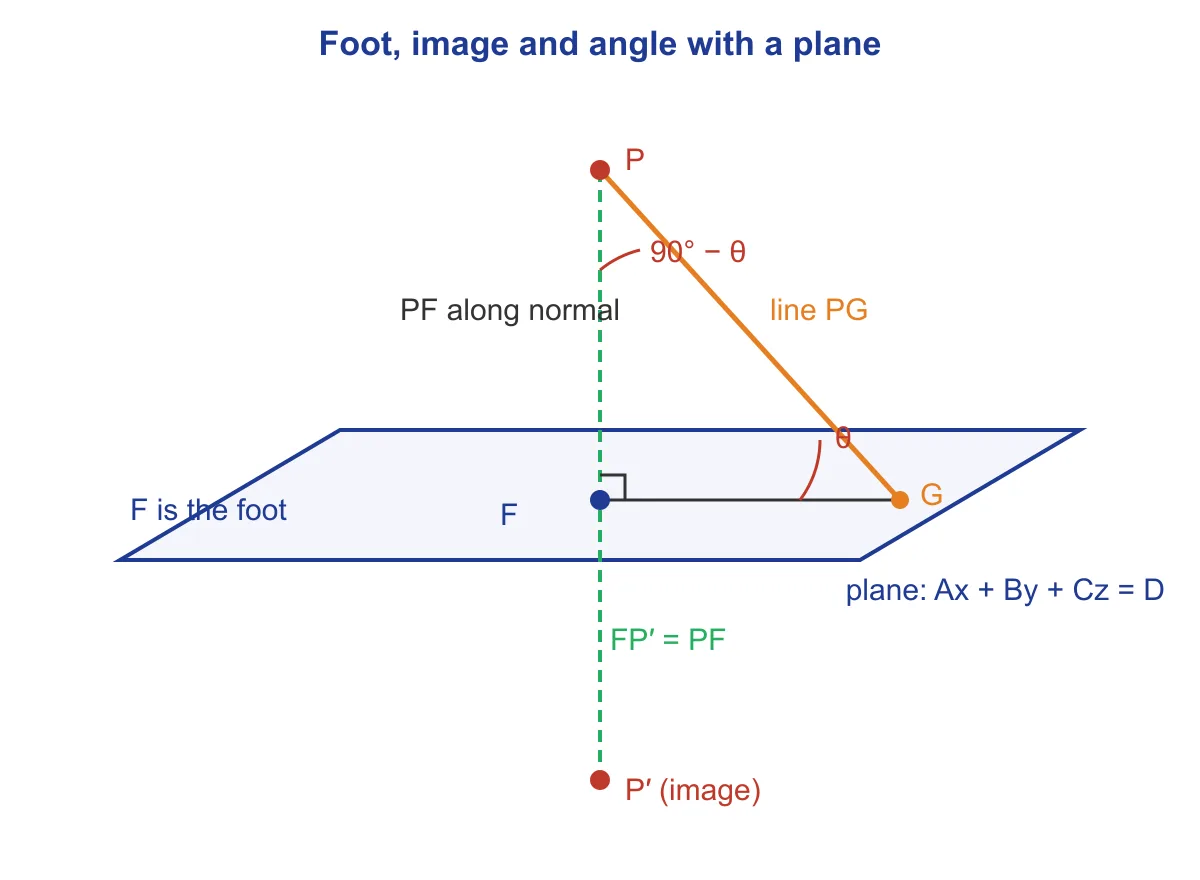
Foot and image. Let the plane be $Ax + By + Cz = D$ and the point $P(x_0, y_0, z_0)$. The perpendicular from $P$ runs along $(A, B, C)$, so the foot is $F = P - t(A, B, C)$ with $t$ chosen to put $F$ on the plane:
$P'$ is the image. $F$ is the midpoint of $PP'$, so the image is one more step of the same size. Here $\vert t \vert \sqrt{A^2 + B^2 + C^2}$ is the distance $PF$.
Example 6: Find the foot and the image of $P(1, -2, 4)$ in the plane $2x - y + 2z = 3$.
$A^2 + B^2 + C^2 = 4 + 1 + 4 = 9$. Value at $P$: $2 + 2 + 8 - 3 = 9$. So $t = 9/9 = 1$.
Foot: $P - 1\cdot(2, -1, 2) = (-1, -1, 2)$. Check on plane: $-2 + 1 + 4 = 3$.
Image: $P - 2\cdot(2, -1, 2) = (-3, 0, 0)$.
Distance $PF = 1 \cdot 3 = 3$. Check with the distance formula: $9/3 = 3$.
Answer: foot $(-1, -1, 2)$, image $(-3, 0, 0)$. The midpoint of $P$ and the image is the foot, which is a quick check.
The distance formula for a point and a plane is the same projection idea: take any point $Q$ on the plane, project $\overrightarrow{QP}$ on the unit normal, and take the modulus. The numerator $Ax_0 + By_0 + Cz_0 + D$ is exactly the dot product of the normal with $\overrightarrow{QP}$, since $D = -(Ax_1 + By_1 + Cz_1)$ for the point $Q = (x_1, y_1, z_1)$.
Intersection of a line and a plane. Write the general point of the line, $(x_1 + a\lambda,\ y_1 + b\lambda,\ z_1 + c\lambda)$, and put it in the plane equation. This is linear in $\lambda$ and gives three cases:
- one value of $\lambda$: the line meets the plane at one point;
- no value (the $\lambda$ cancels and a false equation remains): the line is parallel to the plane and not in it;
- every value (the equation reduces to $0 = 0$): the line lies in the plane.
A line lies in a plane exactly when it is parallel to the plane ($\vec b \cdot \vec n = 0$) and one point of the line is on the plane. Parallelism alone is not enough.
Coplanarity of two lines. Lines $\vec r = \vec a_1 + \lambda\vec b_1$ and $\vec r = \vec a_2 + \mu\vec b_2$ are coplanar if they meet or are parallel. For non-parallel lines this is the same as zero shortest distance:
In determinant form, with $\vec a_1 = (x_1, y_1, z_1)$, $\vec a_2 = (x_2, y_2, z_2)$ and directions $(a_1, b_1, c_1)$, $(a_2, b_2, c_2)$:
The plane containing two coplanar (non-parallel) lines has normal $\vec b_1 \times \vec b_2$ and passes through $\vec a_1$.
Example 7: Show that $L_1$: $\dfrac{x}{1} = \dfrac{y - 1}{1} = \dfrac{z - 2}{2}$ and $L_2$: $\dfrac{x - 2}{3} = \dfrac{y - 1}{1} = \dfrac{z + 1}{-1}$ are coplanar. Find the plane containing them and their point of intersection.
$\vec a_1 = (0, 1, 2)$, $\vec b_1 = (1, 1, 2)$; $\vec a_2 = (2, 1, -1)$, $\vec b_2 = (3, 1, -1)$.
$\vec b_1 \times \vec b_2 = (1\cdot(-1) - 2\cdot 1,\ 2\cdot 3 - 1\cdot(-1),\ 1\cdot 1 - 1\cdot 3) = (-3, 7, -2)$.
$\vec a_2 - \vec a_1 = (2, 0, -3)$. Dot product: $-6 + 0 + 6 = 0$. Coplanar.
Plane: normal $(3, -7, 2)$ through $(0, 1, 2)$: $3x - 7y + 2z = -7 + 4 = -3$, i.e. $3x - 7y + 2z + 3 = 0$. Check $\vec a_2$: $6 - 7 - 2 + 3 = 0$.
Intersection: $L_1$ point $(t, 1 + t, 2 + 2t)$, $L_2$ point $(2 + 3s, 1 + s, -1 - s)$. Equal $y$ gives $t = s$. Equal $x$: $t = 2 + 3t$, so $t = -1$. Check $z$: $2 - 2 = 0$ and $-1 + 1 = 0$. Point $(-1, 0, 0)$.
Answer: coplanar; plane $3x - 7y + 2z + 3 = 0$; meet at $(-1, 0, 0)$. A zero scalar triple product says the lines are coplanar. Solving the two equations then tells you whether they meet or are parallel.
Memory trick: "Foot first, then double." For the image, find the foot $F$ and go the same distance again. Image is $2F - P$, so the foot is always the midpoint.
Common traps
- Using $(a, b, c)$ as direction cosines without dividing by the length → check $l^2 + m^2 + n^2 = 1$ before using them as cosines.
- Writing only one set of direction cosines for a line with no arrow → give both $\pm$ sets.
- Taking a zero in the denominator of $\dfrac{x - x_1}{a} = \dfrac{y - y_1}{b} = \dfrac{z - z_1}{0}$ as "undefined" → it means $z = z_1$ throughout.
- Applying the skew-lines formula to parallel lines (the cross product is zero) → use $\vert \vec b \times (\vec a_2 - \vec a_1) \vert / \vert \vec b \vert$.
- Worrying about the order of $\vec a_2 - \vec a_1$ and of the cross product in the skew-lines formula → the modulus removes the sign, so only the arithmetic needs care.
- Using $\cos\theta$ for the angle between a line and a plane → use $\sin\theta$ with the normal.
- Using the distance between parallel planes without matching the coefficients → rewrite both with the same $(A, B, C)$ first.
- Calling a line parallel to a plane "inside" it → also test one point of the line in the plane.
- Finding no $\lambda$ that satisfies the condition and giving up → test $P_2 = 0$ itself, which the family $P_1 + \lambda P_2 = 0$ cannot produce.
- Reporting the foot as the image → the image is $P - 2t(A, B, C)$, twice the step.
Quick revision
- $AB^2 = (x_2 - x_1)^2 + (y_2 - y_1)^2 + (z_2 - z_1)^2$; section formula uses $(mx_2 + nx_1)/(m + n)$, external ratio replaces $n$ by $-n$.
- Direction cosines satisfy $l^2 + m^2 + n^2 = 1$; reversing a line flips all three signs.
- $l = a/\sqrt{a^2 + b^2 + c^2}$ and so on, from direction ratios $(a, b, c)$.
- Line through two points has direction ratios $x_2 - x_1,\ y_2 - y_1,\ z_2 - z_1$.
- Angle between lines: $\cos\theta = \vert a_1a_2 + b_1b_2 + c_1c_2 \vert / (\vert \vec b_1 \vert \vert \vec b_2 \vert)$; perpendicular if the dot product is zero.
- Line: $\vec r = \vec a + \lambda\vec b$, or $\dfrac{x - x_1}{a} = \dfrac{y - y_1}{b} = \dfrac{z - z_1}{c}$.
- Skew lines: $d = \vert (\vec a_2 - \vec a_1)\cdot(\vec b_1 \times \vec b_2) \vert / \vert \vec b_1 \times \vec b_2 \vert$.
- Parallel lines: $d = \vert \vec b \times (\vec a_2 - \vec a_1) \vert / \vert \vec b \vert$.
- Plane through a point with normal $\vec n$: $\vec n \cdot (\vec r - \vec a) = 0$; through three points, $\vec n = \overrightarrow{PQ} \times \overrightarrow{PR}$.
- Intercept form $x/a + y/b + z/c = 1$; the tetrahedron volume is $\vert abc \vert / 6$.
- Plane through the intersection of two planes: $P_1 + \lambda P_2 = 0$.
- Angle between planes: $\cos\theta$ with normals; line and plane: $\sin\theta = \vert \vec b \cdot \vec n \vert / (\vert \vec b \vert \vert \vec n \vert)$.
- Point to plane: $\vert Ax_0 + By_0 + Cz_0 + D \vert / \sqrt{A^2 + B^2 + C^2}$; parallel planes: $\vert D_1 - D_2 \vert / \sqrt{A^2 + B^2 + C^2}$.
- Foot $= P - t(A, B, C)$, image $= P - 2t(A, B, C)$ with $t = (Ax_0 + By_0 + Cz_0 - D)/(A^2 + B^2 + C^2)$.
- Coplanar lines: $(\vec a_2 - \vec a_1)\cdot(\vec b_1 \times \vec b_2) = 0$; a line is in a plane when $\vec b \cdot \vec n = 0$ and one point lies on it.
Practice questions
The point $P$ divides the segment joining $A(1, 2, 3)$ and $B(7, 8, 9)$ internally in the ratio $1 : 2$. The coordinates of $P$ are
- $(5, 6, 7)$
- $(3, 4, 5)$
- $(4, 5, 6)$
- $(2, 3, 4)$
Answer
B. $(3, 4, 5)$
With $m = 1, n = 2$: $x = (1\cdot 7 + 2\cdot 1)/3 = 3$, $y = (8 + 4)/3 = 4$, $z = (9 + 6)/3 = 5$. $P$ is one third of the way from $A$ to $B$. $(5,6,7)$ is the $2:1$ point and $(4,5,6)$ the midpoint.
Which of the following is a set of direction cosines of a line whose direction ratios are $2, -3, 6$?
- $\left(\frac{2}{7}, -\frac{3}{7}, \frac{6}{7}\right)$
- $\left(\frac{2}{\sqrt{7}}, -\frac{3}{\sqrt{7}}, \frac{6}{\sqrt{7}}\right)$
- $\left(\frac{2}{11}, -\frac{3}{11}, \frac{6}{11}\right)$
- $\left(\frac{2}{7}, \frac{3}{7}, \frac{6}{7}\right)$
Answer
A. $\left(\frac{2}{7}, -\frac{3}{7}, \frac{6}{7}\right)$
$\sqrt{4 + 9 + 36} = 7$, so divide each ratio by 7. Check: $4/49 + 9/49 + 36/49 = 1$. The other sets do not satisfy $l^2 + m^2 + n^2 = 1$ or change a sign.
The line through $A(1, -2, 3)$ and $B(4, 2, 3)$ has the Cartesian equation
- $\dfrac{x - 1}{3} = \dfrac{y - 2}{4}$, $z = 3$
- $\dfrac{x - 1}{4} = \dfrac{y + 2}{2}$, $z = 3$
- $\dfrac{x - 1}{3} = \dfrac{y + 2}{4}$, $z = 3$
- $\dfrac{x - 1}{3} = \dfrac{y + 2}{4} = \dfrac{z - 3}{3}$
Answer
C. $\dfrac{x - 1}{3} = \dfrac{y + 2}{4}$, $z = 3$
Direction $B - A = (3, 4, 0)$. The $z$-ratio is zero, so $z$ stays 3. The line uses the point $A$, which gives $y + 2$.
The acute angle between two lines with direction ratios $(1, 1, 0)$ and $(0, 1, 1)$ is
- $90^\circ$
- $45^\circ$
- $30^\circ$
- $60^\circ$
Answer
D. $60^\circ$
Dot product $= 1$; each length is $\sqrt{2}$. So $\cos\theta = 1/2$ and $\theta = 60^\circ$.
The plane through $(1, 2, 3)$ with normal along $2\hat i - \hat j + 4\hat k$ is
- $2x - y + 4z = 0$
- $2x - y + 4z = 12$
- $2x - y + 4z = 8$
- $2x - y + 4z = 16$
Answer
B. $2x - y + 4z = 12$
$2(x - 1) - (y - 2) + 4(z - 3) = 0$ gives $2x - y + 4z = 2 - 2 + 12 = 12$.
A plane makes intercepts $2, -3, 4$ on the $x$, $y$, $z$ axes respectively. Its equation is
- $2x - 3y + 4z = 1$
- $6x + 4y + 3z = 12$
- $6x - 4y + 3z = 12$
- $6x - 4y + 3z = 1$
Answer
C. $6x - 4y + 3z = 12$
$\frac{x}{2} - \frac{y}{3} + \frac{z}{4} = 1$. Multiply by 12: $6x - 4y + 3z = 12$. The intercept $-3$ gives a minus sign on $y$.
The equation of the plane through the points $(1, 0, 0)$, $(0, 2, 0)$ and $(0, 0, 3)$ is
- $6x + 3y + 2z = 6$
- $6x + 2y + 3z = 6$
- $3x + 2y + z = 6$
- $x + 2y + 3z = 6$
Answer
A. $6x + 3y + 2z = 6$
Intercept form: $x/1 + y/2 + z/3 = 1$. Multiply by 6: $6x + 3y + 2z = 6$. Check $(0, 2, 0)$: $6 = 6$.
The angle between the line with direction ratios $(2, 1, 2)$ and the plane $x + 2y + 2z = 5$ is
- $\cos^{-1}\left(\frac{8}{9}\right)$
- $\cos^{-1}\left(\frac{2}{3}\right)$
- $\sin^{-1}\left(\frac{2}{3}\right)$
- $\sin^{-1}\left(\frac{8}{9}\right)$
Answer
D. $\sin^{-1}\left(\frac{8}{9}\right)$
Normal $(1, 2, 2)$, dot with $(2, 1, 2)$ is $2 + 2 + 4 = 8$. Both lengths are 3. For a line and a plane $\sin\theta = 8/9$.
The plane through the line of intersection of $x + y + z = 1$ and $2x + 3y - z = 4$ and through the origin is
- $2x + y + 5z = 0$
- $2x + y + 5z = 8$
- $6x + 7y + 3z = 0$
- $6x + 7y + 3z = 8$
Answer
A. $2x + y + 5z = 0$
$(x + y + z - 1) + \lambda(2x + 3y - z - 4) = 0$. At the origin $-1 - 4\lambda = 0$, $\lambda = -1/4$. Then $4(x + y + z - 1) - (2x + 3y - z - 4) = 2x + y + 5z = 0$.
The image of the point $(1, 2, 3)$ in the plane $x + y + z = 3$ is
- $(2, 3, 4)$
- $(-1, 0, 1)$
- $(0, 1, 2)$
- $(-2, -1, 0)$
Answer
B. $(-1, 0, 1)$
Value at $P$: $6 - 3 = 3$; $t = 3/3 = 1$. Foot $= (0, 1, 2)$; image $= P - 2(1, 1, 1) = (-1, 0, 1)$. Midpoint of $P$ and image is $(0, 1, 2)$, on the plane.
The lines $\dfrac{x - 1}{2} = \dfrac{y - 2}{3} = \dfrac{z - 3}{4}$ and $\dfrac{x - 2}{3} = \dfrac{y - 3}{4} = \dfrac{z - 4}{5}$ lie in a plane. That plane is
- $x - 2y + z = 2$
- $3x - 2y + z = 2$
- $x - 2y + z = 0$
- $x + 2y - z = 2$
Answer
C. $x - 2y + z = 0$
$\vec b_1 \times \vec b_2 = (2,3,4)\times(3,4,5) = (-1, 2, -1)$. Plane through $(1, 2, 3)$: $-(x - 1) + 2(y - 2) - (z - 3) = 0$, i.e. $x - 2y + z = 0$. Check $(2, 3, 4)$: $2 - 6 + 4 = 0$.
The line $\dfrac{x - 2}{3} = \dfrac{y + 1}{4} = \dfrac{z - 2}{12}$ meets the plane $x - y + z = 16$ at the point
- $(2, -1, 2)$
- $(-1, -5, -10)$
- $(8, 7, 26)$
- $(5, 3, 14)$
Answer
D. $(5, 3, 14)$
General point $(2 + 3t, -1 + 4t, 2 + 12t)$. Substituting: $2 + 3t + 1 - 4t + 2 + 12t = 5 + 11t = 16$, so $t = 1$ and the point is $(5, 3, 14)$.
If a line makes angles $\alpha, \beta, \gamma$ with the three coordinate axes, then $\sin^2\alpha + \sin^2\beta + \sin^2\gamma$ equals
- $3$
- $2$
- $\dfrac{3}{2}$
- $1$
Answer
B. $2$
$\sin^2\alpha + \sin^2\beta + \sin^2\gamma = 3 - (l^2 + m^2 + n^2) = 3 - 1 = 2$.
The angle $\theta$ between the planes $2x + y - 2z = 5$ and $6x - 3y + 2z = 1$ satisfies
- $\cos\theta = \dfrac{5}{21}$
- $\cos\theta = \dfrac{11}{21}$
- $\sin\theta = \dfrac{5}{21}$
- $\cos\theta = \dfrac{5}{63}$
Answer
A. $\cos\theta = \dfrac{5}{21}$
Normals $(2, 1, -2)$, $(6, -3, 2)$. Dot $= 12 - 3 - 4 = 5$. Lengths $3$ and $7$. $\cos\theta = 5/21$.
The distance between $A(1, 2, 3)$ and $B(4, 6, 15)$ is
- $12$
- $19$
- $13$
- $15$
Answer
C. $13$
Differences $(3, 4, 12)$; $9 + 16 + 144 = 169$; distance $13$.
The distance of the point $(1, 2, 3)$ from the plane $2x - 2y + z = 7$ is
- $1$
- $3$
- $6$
- $2$
Answer
D. $2$
Value at the point: $2 - 4 + 3 - 7 = -6$. Divide by $\sqrt{4 + 4 + 1} = 3$. Distance $2$.
The distance between the planes $2x + 2y - z = 3$ and $2x + 2y - z = 12$ is
- $9$
- $1$
- $3$
- $6$
Answer
C. $3$
The coefficients already match. $\vert 3 - 12 \vert / \sqrt{4 + 4 + 1} = 9/3 = 3$.
The shortest distance between the lines through $(1, 2, 3)$ with direction $(2, 1, 2)$ and through $(3, 5, 16)$ with direction $(1, 2, -2)$ is
- $3$
- $15$
- $45$
- $5$
Answer
D. $5$
$(2,1,2)\times(1,2,-2) = (-6, 6, 3)$, length $9$. Gap $(2, 3, 13)$; dot $= -12 + 18 + 39 = 45$. Distance $45/9 = 5$.
The sum of the coordinates of the image of $(1, 2, 3)$ in the plane $x + 2y + 2z = 2$ is
- $-4$
- $-2$
- $1$
- $2$
Answer
A. $-4$
Value at the point: $1 + 4 + 6 - 2 = 9$; $A^2 + B^2 + C^2 = 9$, so $t = 1$. Image $= (1, 2, 3) - 2(1, 2, 2) = (-1, -2, -1)$. Sum $-4$. ($1$ is the coordinate sum of the foot $(0, 0, 1)$.)
Lines with direction ratios $(1, k, 2)$ and $(3, 1, -5)$ are perpendicular. The value of $k$ is
- $-7$
- $7$
- $-13$
- $13$
Answer
B. $7$
Dot product: $3 + k - 10 = 0$, so $k = 7$.
The lines $\dfrac{x - 1}{1} = \dfrac{y + 1}{2} = \dfrac{z - 1}{-1}$ and $\dfrac{x - 4}{2} = \dfrac{y}{-1} = \dfrac{z - \lambda}{3}$ are coplanar. The value of $\lambda$ is
- $5$
- $1$
- $-3$
- $3$
Answer
D. $3$
$\vec b_1 \times \vec b_2 = (5, -5, -5)$. Gap $= (3, 1, \lambda - 1)$. Dot: $15 - 5 - 5(\lambda - 1) = 0$, so $\lambda = 3$.
The plane $2x + 3y + 6z = 12$ and the coordinate planes enclose a tetrahedron. Its volume is
- $48$
- $16$
- $8$
- $24$
Answer
C. $8$
Intercepts $6, 4, 2$. Volume $= \frac{1}{6}\cdot 6\cdot 4\cdot 2 = 8$.
A line has direction ratios $1, 1, \sqrt{2}$. The angle, in degrees, between this line and the plane $z = 0$ is
- $45$
- $30$
- $60$
- $90$
Answer
A. $45$
Normal $(0, 0, 1)$. $\sin\theta = \sqrt{2}/\sqrt{1 + 1 + 2} = \sqrt{2}/2$, so $\theta = 45^\circ$.
The $xy$-plane divides the segment joining $(2, 3, -4)$ and $(5, 6, 2)$ internally in the ratio $k : 1$. The value of $k$ is
- $0.5$
- $2$
- $1$
- $4$
Answer
B. $2$
The $z$-coordinate of the point is $(2k - 4)/(k + 1) = 0$, so $k = 2$.
The plane $(x + 2y + 3z - 4) + \lambda(2x - y + z - 3) = 0$ passes through $(2, 1, 1)$. The value of $\lambda$ is
- $3$
- $-3$
- $1$
- $-1$
Answer
B. $-3$
First bracket at the point: $2 + 2 + 3 - 4 = 3$; second: $4 - 1 + 1 - 3 = 1$. $3 + \lambda = 0$, $\lambda = -3$.
Two parallel lines both have direction $(1, 2, 2)$. One passes through $(0, 0, 0)$ and the other through $(3, -2, 2)$. The distance between them is
- $4$
- $3$
- $12$
- $5$
Answer
A. $4$
$\vec b \times (3, -2, 2) = (2\cdot2 - 2\cdot(-2),\ 2\cdot3 - 1\cdot2,\ 1\cdot(-2) - 2\cdot3) = (8, 4, -8)$, length $12$; divide by $\vert \vec b \vert = 3$: $4$. Check: $17 - (3/3)^2 = 16$.
Given below are two statements: Statement I: A line in space has exactly one set of direction cosines. Statement II: The direction cosines of a line satisfy $l^2 + m^2 + n^2 = 1$.
- Both Statement I and Statement II are correct
- Both Statement I and Statement II are incorrect
- Statement I is correct but Statement II is incorrect
- Statement I is incorrect but Statement II is correct
Answer
D. Statement I is incorrect but Statement II is correct
Reversing the line changes the signs, so there are two sets $\pm(l, m, n)$: Statement I is incorrect. Statement II is correct.
Given below are two statements: Statement I: Two skew lines cannot lie in a common plane. Statement II: The shortest distance between two skew lines is measured along the line perpendicular to both.
- Both Statement I and Statement II are correct
- Both Statement I and Statement II are incorrect
- Statement I is correct but Statement II is incorrect
- Statement I is incorrect but Statement II is correct
Answer
A. Both Statement I and Statement II are correct
Skew lines are non-parallel and non-intersecting, so no plane holds both. The common perpendicular gives the shortest distance. Both are correct.
Given below are two statements: Statement I: The distance between the planes $ax + by + cz + d_1 = 0$ and $ax + by + cz + d_2 = 0$ equals $\dfrac{\vert d_1 - d_2 \vert}{\sqrt{a^2 + b^2 + c^2}}$. Statement II: The distance between the planes $2x + y + z = 1$ and $4x + 2y + 2z = 3$ is $\dfrac{1}{\sqrt{6}}$.
- Both Statement I and Statement II are correct
- Both Statement I and Statement II are incorrect
- Statement I is correct but Statement II is incorrect
- Statement I is incorrect but Statement II is correct
Answer
C. Statement I is correct but Statement II is incorrect
Statement I is the standard result. For II rewrite as $4x + 2y + 2z - 2 = 0$ and $4x + 2y + 2z - 3 = 0$: distance $1/\sqrt{24} = 1/(2\sqrt{6})$, not $1/\sqrt{6}$.
Given below are two statements: Statement I: A line parallel to a plane lies in that plane. Statement II: A line is perpendicular to a plane when its direction vector $\vec b$ and the normal $\vec n$ of the plane satisfy $\vec b \cdot \vec n = 0$.
- Both Statement I and Statement II are correct
- Both Statement I and Statement II are incorrect
- Statement I is correct but Statement II is incorrect
- Statement I is incorrect but Statement II is correct
Answer
B. Both Statement I and Statement II are incorrect
A parallel line can lie off the plane, so I is incorrect. $\vec b \cdot \vec n = 0$ means the line is parallel to the plane; perpendicular needs $\vec b$ parallel to $\vec n$. Both incorrect.
Given below are two statements: Statement I: The plane $2x - 3y + z = 0$ passes through the origin. Statement II: The angle between the planes $x + y + z = 1$ and $x + y + z = 5$ is $90^\circ$.
- Both Statement I and Statement II are correct
- Both Statement I and Statement II are incorrect
- Statement I is correct but Statement II is incorrect
- Statement I is incorrect but Statement II is correct
Answer
C. Statement I is correct but Statement II is incorrect
I: no constant term, so $(0,0,0)$ satisfies it. II: the normals are the same, the planes are parallel and the angle is $0^\circ$. I correct, II incorrect.
Assertion (A): The lines $\dfrac{x - 1}{2} = \dfrac{y - 2}{3} = \dfrac{z - 3}{4}$ and $\dfrac{x - 2}{3} = \dfrac{y - 3}{4} = \dfrac{z - 4}{5}$ are coplanar. Reason (R): Two non-parallel lines are coplanar when $(\vec a_2 - \vec a_1)\cdot(\vec b_1 \times \vec b_2) = 0$.
- Both A and R are true and R is the correct explanation of A
- Both A and R are true but R is not the correct explanation of A
- A is true but R is false
- A is false but R is true
Answer
A. Both A and R are true and R is the correct explanation of A
Gap $(1, 1, 1)$, cross product $(-1, 2, -1)$; dot $= 0$. A is true, and R is the very test used.
Assertion (A): There is exactly one plane through any three given points. Reason (R): Three non-collinear points determine a unique plane.
- Both A and R are true and R is the correct explanation of A
- Both A and R are true but R is not the correct explanation of A
- A is true but R is false
- A is false but R is true
Answer
D. A is false but R is true
Three collinear points lie on infinitely many planes, so A is false. R is true.
Assertion (A): The shortest distance between two skew lines is greater than zero. Reason (R): Any two lines that do not meet are skew.
- Both A and R are true and R is the correct explanation of A
- Both A and R are true but R is not the correct explanation of A
- A is true but R is false
- A is false but R is true
Answer
C. A is true but R is false
Skew lines are not parallel and do not meet, and the common perpendicular has positive length, so A is true. Parallel lines also never meet but are not skew, so R is false.
Match List I with List II. List I: a. Distance of the plane $2x + 3y + 6z = 14$ from the origin b. Distance of the plane $x + 2y + 2z = 12$ from the origin c. Distance of the plane $2x - y + 2z = 9$ from the origin d. Distance of the plane $2x + 6y + 9z = 11$ from the origin List II: i. $1$ ii. $2$ iii. $3$ iv. $4$
- a-ii, b-iv, c-i, d-iii
- a-ii, b-iv, c-iii, d-i
- a-iv, b-ii, c-iii, d-i
- a-ii, b-iii, c-iv, d-i
Answer
B. a-ii, b-iv, c-iii, d-i
Divide the constant by $\sqrt{A^2 + B^2 + C^2}$: $14/7 = 2$, $12/3 = 4$, $9/3 = 3$, $11/11 = 1$.
Match List I with List II. List I: a. Angle between lines with ratios $(1, 0, 0)$ and $(0, 1, 0)$ b. Angle between lines with ratios $(1, 1, 0)$ and $(1, 0, 0)$ c. Angle between lines with ratios $(1, \sqrt{3}, 0)$ and $(1, 0, 0)$ d. Angle between lines with ratios $(\sqrt{3}, 1, 0)$ and $(1, 0, 0)$ List II: i. $30^\circ$ ii. $45^\circ$ iii. $60^\circ$ iv. $90^\circ$
- a-ii, b-iv, c-iii, d-i
- a-iv, b-ii, c-i, d-iii
- a-iv, b-iii, c-ii, d-i
- a-iv, b-ii, c-iii, d-i
Answer
D. a-iv, b-ii, c-iii, d-i
$\cos\theta$: a: $0$, so $90^\circ$. b: $1/\sqrt{2}$, $45^\circ$. c: $1/2$, $60^\circ$. d: $\sqrt{3}/2$, $30^\circ$.
Match List I with List II. The segment joins $A(1, 2, 3)$ and $B(7, 8, 9)$. List I: a. Midpoint of $AB$ b. Point dividing $AB$ internally in $1 : 2$ c. Point dividing $AB$ internally in $2 : 1$ d. Point dividing $AB$ externally in $2 : 1$ List II: i. $(3, 4, 5)$ ii. $(4, 5, 6)$ iii. $(5, 6, 7)$ iv. $(13, 14, 15)$
- a-ii, b-i, c-iii, d-iv
- a-ii, b-iii, c-i, d-iv
- a-ii, b-i, c-iv, d-iii
- a-i, b-ii, c-iii, d-iv
Answer
A. a-ii, b-i, c-iii, d-iv
Midpoint $(4, 5, 6)$. Internal $1:2$: $(3, 4, 5)$. Internal $2:1$: $(5, 6, 7)$. External $2:1$: $(14 - 1, 16 - 2, 18 - 3) = (13, 14, 15)$.
The plane passes through the line of intersection of $x + y + z = 6$ and $2x + 3y + 4z + 5 = 0$ and is perpendicular to the plane $x - y + z = 0$. Its equation is
- $x + z = 23$
- $x - y = 23$
- $x - z = -23$
- $x - z = 23$
Answer
D. $x - z = 23$
Normal of $(x + y + z - 6) + \lambda(2x + 3y + 4z + 5)$ is $(1 + 2\lambda, 1 + 3\lambda, 1 + 4\lambda)$. Dot with $(1, -1, 1)$: $1 + 3\lambda = 0$, $\lambda = -1/3$. Then $3(x + y + z - 6) - (2x + 3y + 4z + 5) = x - z - 23 = 0$.
The distance of the point $P(1, 2, 3)$ from the plane $x - y + z = 5$, measured along the line through $P$ with direction ratios $(2, 3, -6)$, is
- $\dfrac{3}{7}$
- $3$
- $\dfrac{3}{\sqrt{3}}$
- $21$
Answer
B. $3$
Point on line: $(1 + 2t, 2 + 3t, 3 - 6t)$. In the plane: $2 - 7t = 5$, $t = -3/7$. Distance $= \vert t \vert\sqrt{4 + 9 + 36} = (3/7)\cdot 7 = 3$. ($3/7$ is just $\vert t \vert$.)
The plane through the points $(1, 2, 3)$ and $(3, 1, 1)$ that is perpendicular to the plane $x + y + z = 0$ is
- $x - 2y + z = 0$
- $x + 4y - 3z = 0$
- $x - 4y + 3z = 2$
- $2x - y - 2z = -6$
Answer
C. $x - 4y + 3z = 2$
Direction $(2, -1, -2)$ lies in the plane; the normal $(1, 1, 1)$ also lies in it. Required normal $= (2,-1,-2)\times(1,1,1) = (1, -4, 3)$. Plane $x - 4y + 3z = 1 - 8 + 9 = 2$; check $(3, 1, 1)$: $3 - 4 + 3 = 2$.