Qualitative Inorganic Analysis
What to remember
- Cations are separated in a fixed order by group reagents: dil HCl (Group I), H₂S in acid (II), NH₄Cl + NH₄OH (III), H₂S in ammoniacal medium (IV), (NH₄)₂CO₃ (V). Mg²⁺ is left in the last filtrate.
- Every group separation is a solubility-product argument. A sulphide or hydroxide precipitates only when the ionic product Q exceeds Kₛₚ, and the common ion (H⁺ or NH₄⁺) is used to hold [S²⁻] or [OH⁻] at the right level.
- Colour of the precipitate is evidence, not proof. Each cation needs a confirmatory test (a second, independent reaction).
- Anions are identified by gas evolution, precipitation with a metal ion and a few special tests: brown ring (nitrate), chromyl chloride (chloride only), AgNO₃ and ammonia solubility (Cl⁻, Br⁻, I⁻).
- In organic compounds, Lassaigne's sodium fusion turns N, S and halogens into ionic NaCN, Na₂S and NaX, which are then tested one by one. Functional groups are recognised by short wet tests.
Preliminary and dry tests
Before any reagent is added to a solution, the unknown salt is looked at and heated. Colour, smell and behaviour on heating narrow the field and save time later.
- Colour of the solid: blue or green hints at Cu²⁺; pale pink at Mn²⁺; yellow-brown at Fe³⁺; dark green or violet at Cr³⁺. White tells you little.
- Action of heat in a dry test tube: a white sublimate suggests ammonium salts; a brown gas (NO₂) with a metallic residue suggests a nitrate; a gas that turns lime water milky suggests a carbonate.
- Flame test: a clean platinum wire (or a glass rod) is dipped in conc. HCl, then in the salt, and held in the non-luminous flame. Chlorides are volatile, so the paste is made with conc. HCl.
| Cation | Flame colour |
|---|---|
| Na⁺ | Golden yellow |
| Ca²⁺ | Brick red |
| Ba²⁺ | Apple green |
| Cu²⁺ | Bluish green |
- Borax bead test: borax melts to a glass of sodium metaborate and boric anhydride. A coloured metal oxide dissolves in it, and the colour of the bead tells you the metal. This test is meaningful only for coloured ions.
| Metal | Bead colour (oxidising flame) |
|---|---|
| Cu | Blue when cold (green while hot) |
| Fe | Yellow while hot, pale yellow when cold |
| Cr | Green |
| Mn | Violet (amethyst) |
Memory trick: "Brick Ca, Apple Ba, Blue-green Cu." Say the three colours with the metal in the same breath. Use it before every flame-test answer so Ca and Ba never swap.
None of these dry tests proves a cation. They only guide the wet analysis.
Preparing the original solution
The solid is tested for solubility in this order: cold water, hot water, dil HCl, conc. HCl (warm), and finally aqua regia (3 parts conc. HCl to 1 part conc. HNO₃) for stubborn sulphides such as HgS. The first solvent that dissolves the salt gives the original solution. The order matters because a later solvent can destroy an ion: conc. HNO₃ oxidises S²⁻, and nitrate or sulphate added with the solvent would spoil the anion tests.
For anions, a separate sodium carbonate extract is prepared by boiling the salt with Na₂CO₃ solution. Heavy-metal cations form insoluble carbonates, and the filtrate contains the anions as sodium salts. This extract must be acidified before use, and the CO₃²⁻ it contains is removed by boiling.
Group separation of cations
The idea is simple. Take a mixture of ions. Add a reagent that precipitates only some of them. Filter. Treat the filtrate with the next reagent, and repeat. The five reagents are ordered so that each one needs a stronger precipitating condition than the one before.
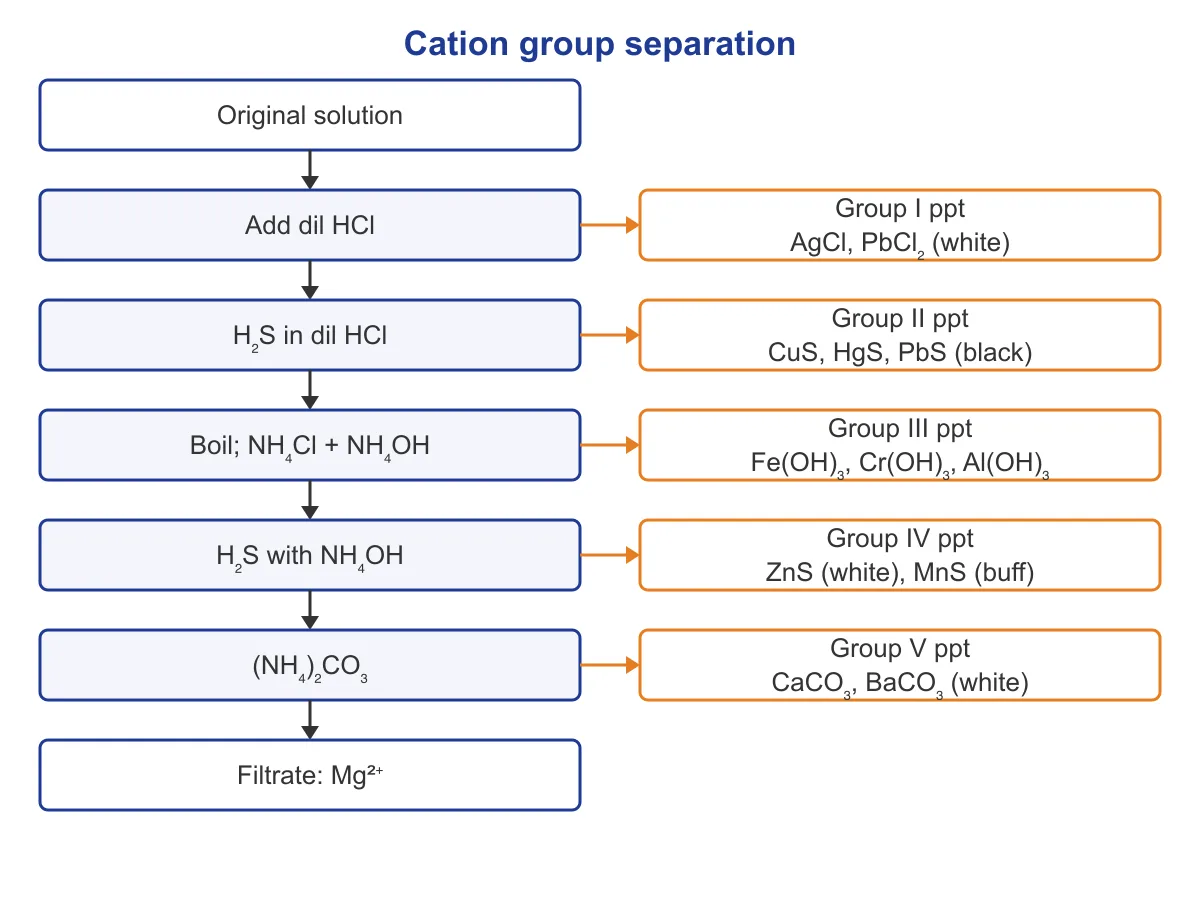
Figure 1.1: Separation of the cations used in this chapter into groups
| Group | Reagent | Precipitate (colour) | Cations here |
|---|---|---|---|
| I | dil HCl | Chlorides: AgCl (white), PbCl₂ (white) | Ag⁺, Pb²⁺ (part) |
| II | H₂S, in presence of dil HCl | Sulphides: CuS (black), HgS (black), PbS (black) | Cu²⁺, Hg²⁺, Pb²⁺ |
| III | NH₄Cl, then NH₄OH (excess) | Fe(OH)₃ (reddish brown), Cr(OH)₃ (green), Al(OH)₃ (white, gelatinous) | Fe³⁺, Cr³⁺, Al³⁺ |
| IV | H₂S, in presence of NH₄OH | ZnS (white), MnS (buff or flesh) | Zn²⁺, Mn²⁺ |
| V | (NH₄)₂CO₃, with NH₄Cl and NH₄OH | CaCO₃, BaCO₃ (both white) | Ca²⁺, Ba²⁺ |
| Left over | none of the above | stays in solution | Mg²⁺ |
Memory trick: "Clean Sheets Oh So Cosy" gives the five reagents in order: Cl⁻ (HCl), S²⁻ (acid), OH⁻ (NH₄OH), S²⁻ (base), CO₃²⁻. Recite it before writing any scheme and the order never slips.
Group I: dilute HCl
Ag⁺ and Pb²⁺ form chlorides with very small solubility products. AgCl has Kₛₚ of about $1.8 \times 10^{-10}$, so even 0.01 M Ag⁺ precipitates once [Cl⁻] reaches $1.8 \times 10^{-8}$ M. PbCl₂ is far more soluble (Kₛₚ about $1.7 \times 10^{-5}$) and precipitates only from a fairly concentrated Pb²⁺ solution with plenty of chloride. Because PbCl₂ is also appreciably soluble in cold water and much more soluble in hot water, some Pb²⁺ always slips through into Group II. Add dilute HCl in only a slight excess; a large excess of concentrated HCl would redissolve the chlorides by forming complex ions such as [PbCl₄]²⁻.
Separating the two chlorides: boil the precipitate with water. PbCl₂ dissolves, AgCl does not. Filter hot.
Group II: H₂S in the presence of dilute HCl
Hydrogen sulphide is a weak diprotic acid. Taking the overall equilibrium H₂S ⇌ 2H⁺ + S²⁻, the product [H⁺]²[S²⁻] is fixed in a saturated 0.1 M solution at about $1 \times 10^{-22}$. Adding HCl pushes [H⁺] up and [S²⁻] down by the common-ion effect. At [H⁺] = 0.3 M,
That is a tiny concentration, but it is still enough for sulphides whose Kₛₚ is very small (CuS about $10^{-36}$, HgS far smaller, PbS about $10^{-28}$). It is not enough for ZnS or MnS, whose Kₛₚ values are many orders larger. So Group II precipitates and Group IV stays in solution. This is the entire logic of the acid medium.
Fe³⁺ needs a remark: H₂S in acid reduces Fe³⁺ to Fe²⁺ and leaves a milky white deposit of sulphur. The solution is therefore boiled to drive off H₂S and then treated with conc. HNO₃ to oxidise Fe²⁺ back to Fe³⁺ before Group III.
Group III: NH₄Cl, then NH₄OH
Fe(OH)₃, Cr(OH)₃ and Al(OH)₃ have extremely small solubility products (Fe(OH)₃ about $10^{-38}$). Mg(OH)₂ is far more soluble (Kₛₚ about $10^{-11}$). If NH₄OH alone is added, [OH⁻] is large enough to precipitate Mg(OH)₂ and the later groups as well. NH₄Cl is added first. NH₄⁺ is the common ion of the weak base, so it suppresses the ionisation of NH₄OH and holds [OH⁻] near $10^{-6}$ M. Only the hydroxides with the tiniest Kₛₚ then precipitate.
The ammonia must be in slight excess and the solution warm. The three hydroxides are told apart by colour: reddish brown Fe(OH)₃, green Cr(OH)₃, white gelatinous Al(OH)₃.
Group IV: H₂S in the presence of NH₄OH
The filtrate is now ammoniacal. OH⁻ removes H⁺ from H₂S, so [S²⁻] rises sharply (at pH 9, $10^{-4}$ M or more). ZnS and MnS now pass their Kₛₚ and precipitate: ZnS white, MnS buff or flesh-coloured. Mg²⁺ is not precipitated, because MgS reacts with water to give soluble products.
Group V: (NH₄)₂CO₃ with NH₄Cl and NH₄OH
CaCO₃ and BaCO₃ are insoluble, and both precipitate as white solids from the warm ammoniacal solution. NH₄Cl keeps [CO₃²⁻] low enough that MgCO₃ stays dissolved. The reagent is added to an ammoniacal solution and must not be boiled hard, because hot (NH₄)₂CO₃ decomposes.
Example 1: A solution contains 0.01 M Ag⁺ and 0.01 M Pb²⁺. Dilute HCl is added until [Cl⁻] = 0.02 M. Kₛₚ of AgCl = $1.8 \times 10^{-10}$, of PbCl₂ = $1.7 \times 10^{-5}$. Which chloride precipitates?
AgCl: Q = [Ag⁺][Cl⁻] = 0.01 × 0.02 = $2 \times 10^{-4}$, much larger than $1.8 \times 10^{-10}$. So AgCl precipitates, and it removes almost all the Ag⁺.
PbCl₂: Q = [Pb²⁺][Cl⁻]² = 0.01 × $(0.02)^2$ = $4 \times 10^{-6}$, smaller than $1.7 \times 10^{-5}$. No PbCl₂ appears.
Answer: only AgCl. What to notice: Pb²⁺ needs a higher [Cl⁻] (above about 0.04 M here), which is why Pb²⁺ is found in Group II as well.
Example 2: In a solution with [H⁺] = 0.3 M saturated with H₂S, will 0.01 M Cu²⁺ and 0.01 M Zn²⁺ precipitate? Use [H⁺]²[S²⁻] = $1 \times 10^{-22}$, Kₛₚ(CuS) = $10^{-36}$, Kₛₚ(ZnS) = $10^{-22}$.
[S²⁻] = $10^{-22}$ / 0.09 = $1.1 \times 10^{-21}$ M.
Cu²⁺: Q = 0.01 × $1.1 \times 10^{-21}$ = $1.1 \times 10^{-23}$, far above $10^{-36}$. CuS precipitates.
Zn²⁺: Q = $1.1 \times 10^{-23}$, below $10^{-22}$. No ZnS.
Answer: CuS yes, ZnS no. What to notice: the same sulphide ion concentration decides both; only the Kₛₚ differs.
Example 3: A buffer is 0.1 M in NH₃ and 0.9 M in NH₄Cl (Kb = $1.8 \times 10^{-5}$). Can 0.01 M Mg²⁺ and 0.01 M Fe³⁺ precipitate as hydroxides? Kₛₚ Mg(OH)₂ = $10^{-11}$, Fe(OH)₃ = $10^{-38}$.
[OH⁻] = Kb × [NH₃] / [NH₄⁺] = $1.8 \times 10^{-5}$ × 0.1 / 0.9 = $2 \times 10^{-6}$ M.
Mg(OH)₂: Q = 0.01 × $(2 \times 10^{-6})^2$ = $4 \times 10^{-14}$, below $10^{-11}$. No precipitate.
Fe(OH)₃: Q = 0.01 × $(2 \times 10^{-6})^3$ = $8 \times 10^{-20}$, far above $10^{-38}$. It precipitates.
Answer: Fe(OH)₃ only. What to notice: without NH₄Cl, [OH⁻] would be about $1.3 \times 10^{-3}$ M and Mg(OH)₂ would come down with it.
Confirmatory tests for the cations
A precipitate in a group only places the ion in a family. The confirmatory test uses a second reagent. Learn each as "reagent → observation".
| Cation | Confirmatory test | Observation |
|---|---|---|
| Ag⁺ | Group I ppt in excess NH₃, then HNO₃ | Dissolves as [Ag(NH₃)₂]⁺; white AgCl returns on acidifying |
| Ag⁺ | KI | Yellow AgI |
| Pb²⁺ | K₂CrO₄ | Yellow PbCrO₄, soluble in NaOH, insoluble in acetic acid |
| Pb²⁺ | KI | Yellow PbI₂ (golden spangles on cooling the hot solution) |
| Cu²⁺ | Excess NH₃ | Deep blue [Cu(NH₃)₄]²⁺ |
| Cu²⁺ | K₄[Fe(CN)₆] | Chocolate brown Cu₂[Fe(CN)₆] |
| Hg²⁺ | SnCl₂ | White Hg₂Cl₂, then grey Hg |
| Hg²⁺ | KI | Scarlet red HgI₂, dissolving in excess KI as K₂[HgI₄] |
| Fe³⁺ | K₄[Fe(CN)₆] | Prussian blue, Fe₄[Fe(CN)₆]₃ |
| Fe³⁺ | KSCN | Blood red [Fe(SCN)]²⁺ |
| Cr³⁺ | NaOH + H₂O₂, then acetic acid + lead acetate | Yellow CrO₄²⁻, then yellow PbCrO₄ |
| Al³⁺ | NaOH, then excess | White gelatinous Al(OH)₃ dissolves as [Al(OH)₄]⁻ |
| Al³⁺ | Heat with Co(NO₃)₂ on charcoal | Blue ash (Thenard's blue) |
| Zn²⁺ | NaOH, then excess | White Zn(OH)₂ dissolves as [Zn(OH)₄]²⁻ |
| Zn²⁺ | K₄[Fe(CN)₆] | Bluish white Zn₂[Fe(CN)₆] |
| Mn²⁺ | NaOH + H₂O₂ | Brown MnO(OH)₂ (hydrated MnO₂) |
| Mn²⁺ | PbO₂ + conc. HNO₃, boil | Purple MnO₄⁻ |
| Ca²⁺ | (NH₄)₂C₂O₄ | White CaC₂O₄ |
| Ba²⁺ | K₂CrO₄ | Yellow BaCrO₄, soluble in mineral acid, insoluble in acetic acid |
| Mg²⁺ | Na₂HPO₄ + NH₄OH | White crystalline MgNH₄PO₄ |
Two points come up in problems again and again. First, Pb²⁺ and Ba²⁺ both give a yellow chromate, but the first belongs to Groups I and II and the second to Group V, so the group tells you which one it is. Second, PbCrO₄ dissolves in NaOH (forming plumbite), and BaCrO₄ does not.
Example 4: A student has a solution of one cation. It gives no precipitate with dil HCl or with H₂S in acid. NH₄Cl + NH₄OH gives no precipitate. H₂S in ammoniacal medium gives a white precipitate that dissolves in dil HCl. Adding NaOH gives a white precipitate soluble in excess NaOH. Which cation is it?
No ppt with dil HCl: not Group I. No ppt with H₂S/acid: not Group II. No ppt with NH₄OH/NH₄Cl: not Group III. White ppt with H₂S/NH₄OH: Group IV, and white excludes MnS (buff).
NaOH test: the white hydroxide dissolves in excess because it is amphoteric. That fits Zn(OH)₂.
Answer: Zn²⁺. What to notice: the route through the groups gave the family, and the colour gave the member.
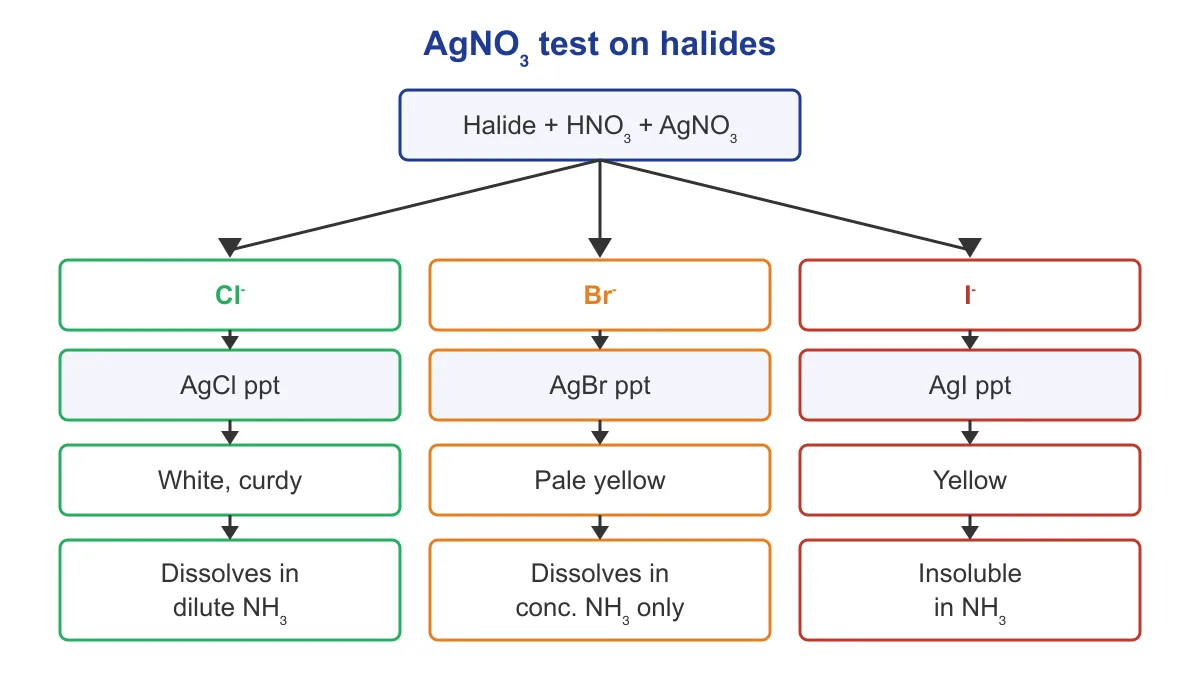
Figure 1.2: AgNO₃ test for halides and the effect of ammonia
Anions
An anion test usually starts with the sodium carbonate extract or the solid itself.
Carbonate and bicarbonate
With dilute HCl, both give brisk effervescence of CO₂, which turns lime water milky (CaCO₃). Passing more CO₂ makes the milkiness vanish because soluble Ca(HCO₃)₂ forms. To tell the two apart, add MgSO₄ solution in the cold: a carbonate gives an immediate white precipitate of MgCO₃, while a bicarbonate gives none until it is boiled.
Sulphide
Dilute H₂SO₄ or HCl releases H₂S, with a smell of rotten eggs. The gas turns a paper moistened with lead acetate black (PbS). Sodium nitroprusside added to the alkaline solution gives a purple colour, from Na₄[Fe(CN)₅NOS].
Sulphate
BaCl₂ gives a white BaSO₄ precipitate insoluble in conc. HCl. This is what separates it from BaCO₃ and BaSO₃, which dissolve. Lead acetate also gives white PbSO₄, soluble in ammonium acetate.
Nitrate: brown ring test
Add freshly prepared FeSO₄ to the nitrate solution, then pour conc. H₂SO₄ slowly down the wall of the tilted tube so that it forms a layer at the bottom. At the junction a brown ring appears. Nitrate is reduced to NO by Fe²⁺, and NO coordinates to more Fe²⁺:
NO₃⁻ + 3Fe²⁺ + 4H⁺ → NO + 3Fe³⁺ + 2H₂O
[Fe(H₂O)₆]²⁺ + NO → [Fe(H₂O)₅NO]²⁺ + H₂O
The ring complex is formally Fe(I) with NO⁺. Shaking the tube destroys the ring, and a brown solution results, so the layers must not be mixed. Nitrite and bromide/iodide interfere and must be removed first.
Halides (except fluoride)
Acidify the extract with HNO₃ (to destroy carbonate and sulphide) and add AgNO₃.
| Halide | Precipitate | Action of ammonia |
|---|---|---|
| Cl⁻ | White, curdy AgCl | Dissolves in dilute NH₃ |
| Br⁻ | Pale yellow AgBr | Dissolves only in conc. NH₃ |
| I⁻ | Yellow AgI | Insoluble in NH₃ |
Fluoride is excluded because AgF is soluble, so no precipitate forms.
Memory trick: "Cl Cl, Br Brr, I Immovable." Chloride dissolves easily in dilute ammonia, bromide needs strong ammonia, iodide never dissolves. Use it to rank the three halides in any solubility question.
Chromyl chloride test (for chloride only). Heat a chloride with solid K₂Cr₂O₇ and conc. H₂SO₄. Deep red vapours of chromyl chloride (CrO₂Cl₂) are evolved:
4Cl⁻ + Cr₂O₇²⁻ + 6H⁺ → 2CrO₂Cl₂ + 3H₂O (with HSO₄⁻ as the other product)
Pass the vapours into NaOH. A yellow solution of Na₂CrO₄ forms. Add acetic acid and lead acetate, and yellow PbCrO₄ confirms chromate, and therefore chloride. Bromides and iodides do not give the test: they give Br₂ or I₂ vapours instead. In this test chromium stays in the +6 state throughout; only chlorine is substituted for oxygen.
Example 5: 11.7 g of NaCl is heated with excess K₂Cr₂O₇ and conc. H₂SO₄. Find the mass of CrO₂Cl₂ (molar mass 155 g/mol) formed, assuming complete reaction. (NaCl = 58.5 g/mol.)
Moles NaCl = 11.7 / 58.5 = 0.2.
From the equation, 4 Cl⁻ gives 2 CrO₂Cl₂, so 0.2 mol Cl⁻ gives 0.1 mol CrO₂Cl₂.
Mass = 0.1 × 155 = 15.5 g.
Answer: 15.5 g. What to notice: only half as many moles of chromyl chloride as chloride, because each CrO₂Cl₂ holds two Cl.
Detection of N, S and halogens in organic compounds
Organic compounds are covalent, so their N, S and halogen atoms cannot be tested directly. Lassaigne's test converts them into ions. A small piece of dry sodium is fused with the compound in an ignition tube, heated red hot and plunged into distilled water. The extract (sodium fusion extract) is filtered. The reactions are:
Na + C + N → NaCN; 2Na + S → Na₂S; Na + X → NaX
If both N and S are present, NaSCN also forms.
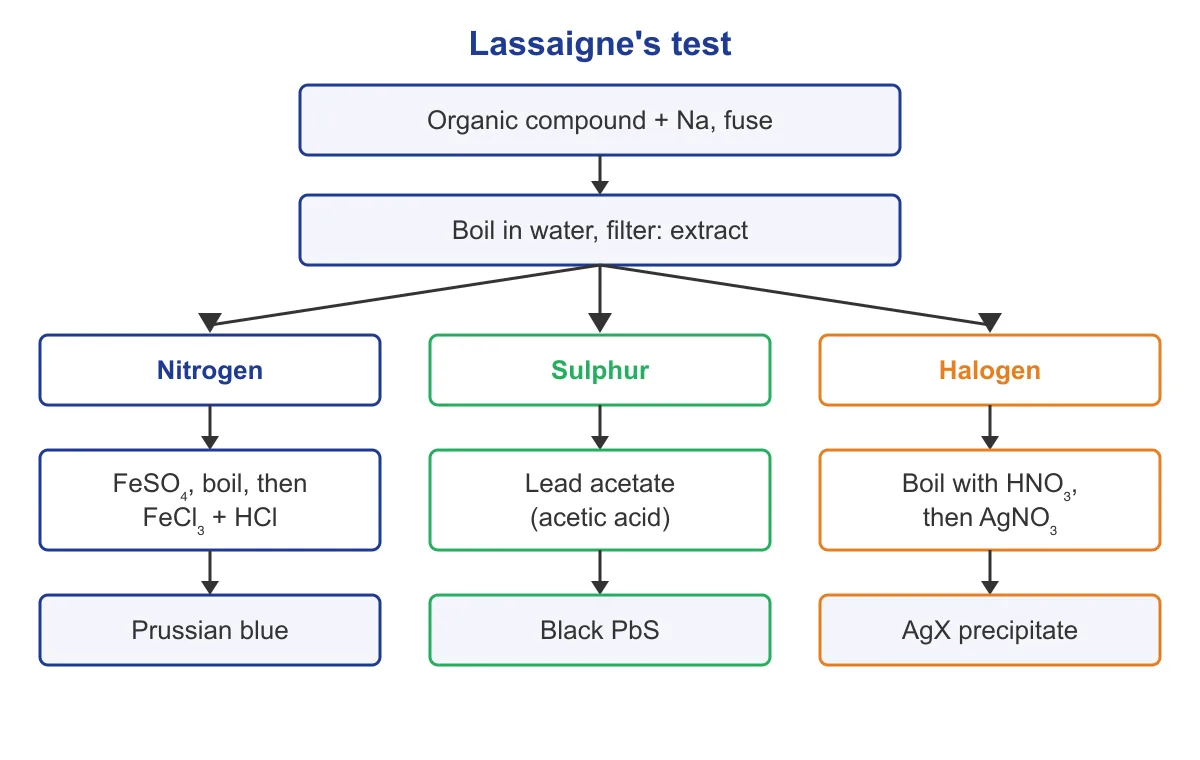
Figure 1.3: Lassaigne's test for nitrogen, sulphur and halogens
- Nitrogen: boil part of the extract with FeSO₄, which forms hexacyanoferrate(II); add a few drops of FeCl₃ and conc. H₂SO₄ or HCl to dissolve the iron hydroxides. A Prussian blue colour or precipitate (Fe₄[Fe(CN)₆]₃) shows nitrogen.
- Sulphur: acetic acid plus lead acetate gives black PbS. Alternatively, sodium nitroprusside gives a violet colour.
- Sulphur and nitrogen together: NaSCN is formed, and FeCl₃ alone gives blood-red [Fe(SCN)]²⁺. No Prussian blue appears, because no free CN⁻ is left.
- Halogens: boil the extract with dilute HNO₃ and then add AgNO₃. Boiling removes CN⁻ and S²⁻ as HCN and H₂S; otherwise Ag₂S and AgCN would precipitate and mislead. White (curdy) means Cl, pale yellow means Br, yellow means I; use the ammonia solubility from the table above to confirm.
Example 6: A compound containing C, H and S only gives a black precipitate with lead acetate after fusion. It gives no precipitate with AgNO₃ after boiling with HNO₃, and no Prussian blue. What does this show?
Black PbS: S²⁻ was present in the extract, so S is in the compound.
No AgNO₃ precipitate after boiling: no halogen. No Prussian blue: no nitrogen.
Answer: sulphur is present; N and halogens are absent. What to notice: boiling with HNO₃ first matters. Without it, Ag₂S would have precipitated and falsely suggested a halogen.
Functional-group tests
| Group | Test | Positive result |
|---|---|---|
| Alcoholic –OH | Sodium metal | H₂ bubbles |
| Alcoholic –OH | Ceric ammonium nitrate | Red colour |
| Alcoholic –OH | Lucas reagent (ZnCl₂ + conc. HCl) | 3° turbid at once, 2° in about 5 min, 1° no turbidity at room temperature |
| Phenolic –OH | Neutral FeCl₃ | Violet, blue or green colour |
| Phenolic –OH | Bromine water | White ppt of 2,4,6-tribromophenol |
| Aldehyde and ketone | 2,4-DNP | Orange-yellow ppt (both) |
| Aldehyde only | Tollens' reagent | Silver mirror |
| Aliphatic aldehyde | Fehling's solution | Red Cu₂O (aromatic aldehydes do not) |
| Methyl ketone, CH₃CO– or CH₃CH(OH)– | I₂ + NaOH | Yellow iodoform |
| –COOH | NaHCO₃ | CO₂ effervescence (phenols do not) |
| –COOH | Alcohol + conc. H₂SO₄, warm | Fruity ester smell |
| Primary –NH₂ | Carbylamine: CHCl₃ + alcoholic KOH, heat | Foul-smelling isocyanide |
| Aromatic primary –NH₂ | Diazotise (NaNO₂ + HCl, 0–5 °C), then β-naphthol | Orange-red azo dye |
| –NO₂ | Zn + NH₄Cl, then Tollens' reagent | Grey-black silver (hydroxylamine formed) |
A few reasons behind the table. A phenol is too weak an acid to decompose bicarbonate (carbonic acid is stronger than phenol), while a carboxylic acid is stronger than carbonic acid, so it does. Benzaldehyde has its –CHO attached to a ring that stabilises it by resonance, so it fails Fehling's test but still reduces the more strongly oxidising Tollens' reagent. The carbylamine test works for primary amines only, aliphatic or aromatic; secondary and tertiary amines give nothing. For –NO₂, mild reduction with Zn and NH₄Cl gives ArNHOH, which reduces Tollens' reagent; strong reduction with Sn and HCl gives the amine, which can then be diazotised and coupled.
Memory trick: "Phenol Purple with FeCl₃, Aldehyde Silver, Amine Stinks." Three groups, three signals. Use it to match each group to its signature test in one line.
Common traps
- Adding NH₄OH without NH₄Cl for Group III → Mg²⁺ and later groups precipitate with it; add NH₄Cl first.
- Treating a black sulphide in Group II as proof of Cu²⁺ → colour only places the group; do the ammonia test for Cu²⁺.
- Forgetting that some Pb²⁺ escapes Group I → Pb²⁺ appears in Group II too, so test for it there.
- Passing H₂S in Group IV without boiling off the earlier H₂S → the medium is not ammoniacal and the common-ion effect is wrong; boil first.
- Skipping the oxidation of Fe²⁺ → H₂S reduces Fe³⁺, so boil off H₂S and oxidise with conc. HNO₃ before Group III.
- Shaking the brown ring tube → the ring disappears; pour H₂SO₄ down the wall and leave it undisturbed.
- Expecting a chromyl chloride test from Br⁻ or I⁻ → only Cl⁻ gives red CrO₂Cl₂; Br⁻ and I⁻ give Br₂ and I₂.
- Adding AgNO₃ to Lassaigne's extract without boiling with HNO₃ → CN⁻ and S²⁻ precipitate as AgCN and Ag₂S; boil first.
- Looking for Prussian blue when both N and S are present → a blood-red colour appears instead, from SCN⁻.
- Using Fehling's test for benzaldehyde → it gives no reaction; use Tollens' reagent.
Quick revision
- Group reagents in order: dil HCl, H₂S/acid, NH₄Cl + NH₄OH, H₂S/NH₄OH, (NH₄)₂CO₃.
- Group I: AgCl (white), PbCl₂ (white, soluble in hot water); AgCl dissolves in NH₃.
- Group II sulphides CuS, HgS and PbS are all black; acid keeps [S²⁻] low so ZnS and MnS stay in solution.
- Group III: Fe(OH)₃ reddish brown, Cr(OH)₃ green, Al(OH)₃ white gelatinous; NH₄Cl lowers [OH⁻] by the common-ion effect.
- Group IV: ZnS white, MnS buff; ammoniacal medium raises [S²⁻].
- Group V: CaCO₃ and BaCO₃ are white; Mg²⁺ stays in the filtrate and gives white MgNH₄PO₄ with Na₂HPO₄.
- Ba²⁺ flame is apple green, Ca²⁺ brick red, Cu²⁺ bluish green.
- Cu²⁺ with excess NH₃ is deep blue; Fe³⁺ with K₄[Fe(CN)₆] is Prussian blue and with KSCN blood red.
- Zn(OH)₂ and Al(OH)₃ dissolve in excess NaOH; Mn²⁺ gives brown MnO(OH)₂ with NaOH + H₂O₂.
- Carbonate gives CO₂; a cold MgSO₄ precipitate means carbonate, none means bicarbonate.
- Sulphide gives H₂S, which blackens lead acetate paper; sulphate gives BaSO₄ insoluble in conc. HCl.
- Brown ring: [Fe(H₂O)₅NO]²⁺ at the junction of FeSO₄ and conc. H₂SO₄ layers.
- AgCl dissolves in dilute NH₃, AgBr in conc. NH₃, AgI does not dissolve.
- Chromyl chloride (CrO₂Cl₂, red) is formed from Cl⁻ only; it turns NaOH yellow (chromate).
- Lassaigne: N gives Prussian blue, S gives black PbS or violet nitroprusside, N + S gives blood red, halogens give AgX after boiling with HNO₃.
Practice questions
Which reagent is the group reagent for Group I cations (Ag⁺, Pb²⁺)?
- (NH₄)₂CO₃ in presence of NH₄Cl and NH₄OH
- H₂S in presence of dilute HCl
- NH₄Cl followed by NH₄OH
- Dilute HCl
Answer
D. Dilute HCl
Ag⁺ and Pb²⁺ form the insoluble chlorides AgCl and PbCl₂ with dilute HCl. The other reagents belong to later groups.
When NH₄Cl and excess NH₄OH are added to a solution containing Fe³⁺, the precipitate is
- white gelatinous Fe(OH)₃
- reddish brown Fe(OH)₃
- buff coloured FeS
- green Fe(OH)₃
Answer
B. reddish brown Fe(OH)₃
Fe³⁺ gives Fe(OH)₃, which is reddish brown. Green is Cr(OH)₃, white gelatinous is Al(OH)₃ and FeS is not formed with NH₄OH alone.
NH₄Cl is added before NH₄OH in the precipitation of Group III hydroxides mainly because it
- converts the hydroxides into soluble ammine complexes
- raises [OH⁻] so that all hydroxides precipitate completely
- lowers [OH⁻] by the common-ion effect so that Mg(OH)₂ does not precipitate
- reduces Fe³⁺ to Fe²⁺
Answer
C. lowers [OH⁻] by the common-ion effect so that Mg(OH)₂ does not precipitate
NH₄⁺ suppresses the ionisation of NH₄OH, so [OH⁻] stays low. Only hydroxides with very small Ksp (Fe, Cr, Al) then precipitate and Mg(OH)₂ stays dissolved.
A white precipitate with dilute HCl dissolves completely in boiling water and reappears on cooling. The solution of the hot filtrate gives a yellow precipitate with K₂CrO₄. The cation is
- Pb²⁺
- Hg²⁺
- Ag⁺
- Ba²⁺
Answer
A. Pb²⁺
PbCl₂ is soluble in hot water, and Pb²⁺ gives yellow PbCrO₄. AgCl does not dissolve in boiling water. Ba²⁺ is not precipitated by dilute HCl and Hg²⁺ gives no chloride precipitate.
Deep red vapours of CrO₂Cl₂ are evolved on heating a salt with solid K₂Cr₂O₇ and conc. H₂SO₄ when the salt contains
- I⁻
- Br⁻
- Cl⁻
- NO₃⁻
Answer
C. Cl⁻
Only chloride gives chromyl chloride. Br⁻ and I⁻ are oxidised to Br₂ and I₂ instead.
The brown colour of the ring in the brown ring test for nitrate is due to
- [Fe(CN)₅NO]²⁻
- [Fe(H₂O)₅NO]²⁺
- Fe(NO₃)₃
- [Fe(H₂O)₅NO₂]²⁺
Answer
B. [Fe(H₂O)₅NO]²⁺
NO produced by reduction of nitrate with Fe²⁺ coordinates to Fe²⁺ giving [Fe(H₂O)₅NO]²⁺. [Fe(CN)₅NO]²⁻ is the nitroprusside ion.
A solution of a single cation gives no precipitate with dilute HCl, with H₂S in acid or with NH₄Cl and NH₄OH, but gives a white precipitate with H₂S in ammoniacal medium. The cation is
- Ca²⁺
- Mn²⁺
- Al³⁺
- Zn²⁺
Answer
D. Zn²⁺
Absence of Groups I, II and III leaves Group IV or V. A white sulphide in ammoniacal H₂S is ZnS; MnS would be buff. Al³⁺ would have precipitated in Group III and Ca²⁺ gives no sulphide.
Lassaigne's extract gives a Prussian blue colour on boiling with FeSO₄ and then adding FeCl₃ and HCl. This shows the presence of
- nitrogen
- oxygen
- sulphur
- a halogen
Answer
A. nitrogen
NaCN in the extract forms hexacyanoferrate(II), which gives Prussian blue Fe₄[Fe(CN)₆]₃ with Fe³⁺.
Which reagent distinguishes phenol from ethanol?
- Schiff's reagent
- Neutral FeCl₃ solution
- 2,4-DNP reagent
- Sodium metal
Answer
B. Neutral FeCl₃ solution
Phenol gives a violet colour with neutral FeCl₃, ethanol does not. Both liberate H₂ with sodium; neither reacts with 2,4-DNP or Schiff's reagent.
Which of the following reduces Tollens' reagent but not Fehling's solution?
- Propanal
- Acetaldehyde
- Acetone
- Benzaldehyde
Answer
D. Benzaldehyde
Aromatic aldehydes do not reduce Fehling's solution but give a silver mirror with Tollens' reagent. Acetaldehyde and propanal give both; acetone gives neither.
Which compound gives brisk effervescence with aqueous NaHCO₃?
- Benzoic acid
- Aniline
- Benzaldehyde
- Phenol
Answer
A. Benzoic acid
Carboxylic acids are stronger than carbonic acid and liberate CO₂. Phenol is weaker than carbonic acid, so it does not.
The carbylamine test is positive for
- N,N-dimethylaniline
- diethylamine
- ethylamine
- triethylamine
Answer
C. ethylamine
Only primary amines (aliphatic or aromatic) form the foul-smelling isocyanide with CHCl₃ and alcoholic KOH.
Which precipitate dissolves in dilute NH₃ at room temperature and reappears when the solution is acidified with HNO₃?
- AgCl
- PbCl₂
- AgI
- AgBr
Answer
A. AgCl
AgCl forms [Ag(NH₃)₂]⁺, which breaks up on acidifying and gives AgCl back. AgBr needs conc. NH₃, AgI does not dissolve and PbCl₂ is not an ammine former.
In Group V, NH₄Cl is present with (NH₄)₂CO₃ so that
- Ca²⁺ is oxidised
- NH₃ escapes as gas
- MgCO₃ is not precipitated
- BaCO₃ dissolves
Answer
C. MgCO₃ is not precipitated
NH₄Cl keeps [CO₃²⁻] low enough that the ionic product of MgCO₃ stays below its Ksp, so Mg²⁺ remains in solution while CaCO₃ and BaCO₃ precipitate.
Among CuS, PbS, HgS, Ag₂S, ZnS and MnS, the number of sulphides that are black is
- 2
- 3
- 4
- 5
Answer
C. 4
CuS, PbS, HgS and Ag₂S are black. ZnS is white and MnS is buff.
Taking NO as NO⁺, the oxidation state of iron in [Fe(H₂O)₅NO]²⁺ is
- 1
- 2
- 3
- 0
Answer
A. 1
x + 0 + (+1) = +2, so x = +1.
The oxidation state of chromium in CrO₂Cl₂ is
- 4
- 3
- 2
- 6
Answer
D. 6
x + 2(−2) + 2(−1) = 0, so x = +6.
A saturated H₂S solution obeys [H⁺]²[S²⁻] = $1 \times 10^{-22}$. At [H⁺] = 0.2 M, [S²⁻] in units of $10^{-21}$ M is
- 0.5
- 2.5
- 0.25
- 4
Answer
B. 2.5
[S²⁻] = $\frac{10^{-22}}{(0.2)^2}$ = $2.5 \times 10^{-21}$ M. Forgetting to square [H⁺] gives 0.5.
Ksp of AgCl is $1.8 \times 10^{-10}$. The [Cl⁻], in units of $10^{-8}$ M, at which AgCl just begins to precipitate from 0.01 M Ag⁺ is
- 18
- 0.18
- 180
- 1.8
Answer
D. 1.8
[Cl⁻] = $\frac{1.8 \times 10^{-10}}{0.01}$ = $1.8 \times 10^{-8}$ M.
A buffer contains 0.1 M NH₃ and 0.9 M NH₄Cl (Kb of NH₃ = $1.8 \times 10^{-5}$). Its [OH⁻] in units of $10^{-6}$ M is
- 2
- 1.8
- 162
- 1340
Answer
A. 2
[OH⁻] = Kb × $\frac{0.1}{0.9}$ = $2 \times 10^{-6}$ M. Inverting the ratio gives 162; ignoring NH₄Cl gives about 1340.
Excess dilute HCl is added to 100 mL of 0.1 M AgNO₃. Mass in g of AgCl precipitated (Ag = 108, Cl = 35.5) is
- 2.87
- 1.435
- 14.35
- 0.1435
Answer
B. 1.435
Moles Ag⁺ = 0.1 × 0.1 = 0.01. Mass = 0.01 × 143.5 = 1.435 g.
In the chromyl chloride test, 4Cl⁻ + Cr₂O₇²⁻ + 6H⁺ → 2CrO₂Cl₂ + 3H₂O. The maximum mass in g of CrO₂Cl₂ (155 g/mol) from 11.7 g NaCl (58.5 g/mol) with excess of other reagents is
- 62
- 15.5
- 7.75
- 31
Answer
B. 15.5
NaCl = 0.2 mol. Four Cl⁻ give two CrO₂Cl₂, so 0.1 mol forms. Mass = 0.1 × 155 = 15.5 g.
Prussian blue has the formula Fe₄[Fe(CN)₆]₃. The number of cyanide ions in one formula unit is
- 12
- 6
- 18
- 24
Answer
C. 18
Three [Fe(CN)₆]⁴⁻ units each carry six CN⁻: 3 × 6 = 18.
For PbCl₂ take Ksp = $3.2 \times 10^{-5}$. Its solubility in mol per litre in pure water is
- 0.005
- 0.04
- 0.2
- 0.02
Answer
D. 0.02
PbCl₂ ⇌ Pb²⁺ + 2Cl⁻, so Ksp = $4s^3$. $s^3 = 8 \times 10^{-6}$, so $s = 0.02$ M.
In a buffer with [OH⁻] = $2 \times 10^{-6}$ M, the maximum [Mg²⁺] in M that can stay in solution is (Ksp of Mg(OH)₂ = $1.2 \times 10^{-11}$)
- 1.5
- 6
- 0.3
- 3
Answer
D. 3
[Mg²⁺] = $\frac{1.2 \times 10^{-11}}{(2 \times 10^{-6})^2}$ = $\frac{1.2 \times 10^{-11}}{4 \times 10^{-12}}$ = 3 M.
0.01 M Zn²⁺ is in a solution saturated with H₂S, where [H⁺]²[S²⁻] = $1 \times 10^{-22}$. Ksp of ZnS is $1 \times 10^{-22}$. ZnS begins to precipitate when [H⁺] in M falls just below
- 0.01
- 1
- 0.1
- 0.001
Answer
C. 0.1
Needed [S²⁻] = $\frac{10^{-22}}{0.01}$ = $10^{-20}$ M. Then [H⁺]² = $\frac{10^{-22}}{10^{-20}}$ = 0.01, so [H⁺] = 0.1 M.
Given below are two statements: Statement I: AgCl dissolves in dilute ammonia solution as [Ag(NH₃)₂]⁺. Statement II: AgI dissolves readily in dilute ammonia solution.
- Both Statement I and Statement II are correct
- Both Statement I and Statement II are incorrect
- Statement I is correct but Statement II is incorrect
- Statement I is incorrect but Statement II is correct
Answer
C. Statement I is correct but Statement II is incorrect
AgCl forms the diammine complex in dilute NH₃, so I is correct. AgI is too insoluble and does not dissolve in NH₃, so II is incorrect.
Given below are two statements: Statement I: Phenol gives a violet colour with neutral FeCl₃. Statement II: Both aldehydes and ketones give an orange-yellow precipitate with 2,4-DNP reagent.
- Both Statement I and Statement II are correct
- Both Statement I and Statement II are incorrect
- Statement I is correct but Statement II is incorrect
- Statement I is incorrect but Statement II is correct
Answer
A. Both Statement I and Statement II are correct
Both statements are standard results: phenol forms a coloured iron complex, and both carbonyl classes form 2,4-dinitrophenylhydrazones.
Given below are two statements: Statement I: NH₄Cl increases [OH⁻] in the precipitation of Group III hydroxides. Statement II: Fe³⁺ gives a blood-red colour with SCN⁻ ions.
- Both Statement I and Statement II are correct
- Both Statement I and Statement II are incorrect
- Statement I is correct but Statement II is incorrect
- Statement I is incorrect but Statement II is correct
Answer
D. Statement I is incorrect but Statement II is correct
NH₄Cl lowers [OH⁻] by the common-ion effect, so I is incorrect. Fe³⁺ with SCN⁻ gives blood-red [Fe(SCN)]²⁺, so II is correct.
Given below are two statements: Statement I: BaCrO₄ dissolves in acetic acid. Statement II: PbCrO₄ is insoluble in NaOH solution.
- Both Statement I and Statement II are correct
- Both Statement I and Statement II are incorrect
- Statement I is correct but Statement II is incorrect
- Statement I is incorrect but Statement II is correct
Answer
B. Both Statement I and Statement II are incorrect
BaCrO₄ is insoluble in acetic acid, and dissolves only in mineral acids, so I is incorrect. PbCrO₄ dissolves in NaOH, so II is incorrect.
Given below are two statements: Statement I: Fe(OH)₃ and Al(OH)₃ are both precipitated in Group III. Statement II: Al(OH)₃ is reddish brown.
- Both Statement I and Statement II are correct
- Both Statement I and Statement II are incorrect
- Statement I is correct but Statement II is incorrect
- Statement I is incorrect but Statement II is correct
Answer
C. Statement I is correct but Statement II is incorrect
Both hydroxides are in Group III, so I is correct. Al(OH)₃ is white and gelatinous, so II is incorrect.
Assertion (A): Cu²⁺ is precipitated by H₂S in dilute HCl but Zn²⁺ is not. Reason (R): CuS has a much smaller solubility product than ZnS, so it precipitates at the low [S²⁻] present in acid.
- Both A and R are true and R is the correct explanation of A
- Both A and R are true but R is not the correct explanation of A
- A is true but R is false
- A is false but R is true
Answer
A. Both A and R are true and R is the correct explanation of A
The acid keeps [S²⁻] low. Only CuS, with a very small Ksp, has Q above Ksp, so R explains A.
Assertion (A): Lassaigne's extract is boiled with dilute HNO₃ before adding AgNO₃ for halogens. Reason (R): HNO₃ is a strong oxidising acid.
- Both A and R are true and R is the correct explanation of A
- Both A and R are true but R is not the correct explanation of A
- A is true but R is false
- A is false but R is true
Answer
B. Both A and R are true but R is not the correct explanation of A
Both are true, but the reason for boiling is to expel CN⁻ and S²⁻ as HCN and H₂S so that Ag₂S and AgCN do not precipitate, not the oxidising power of HNO₃.
Assertion (A): Bromides give the chromyl chloride test. Reason (R): Chloride gives CrO₂Cl₂ when heated with K₂Cr₂O₇ and conc. H₂SO₄.
- Both A and R are true and R is the correct explanation of A
- Both A and R are true but R is not the correct explanation of A
- A is true but R is false
- A is false but R is true
Answer
D. A is false but R is true
Bromides give Br₂ vapour and no CrO₂Cl₂, so A is false. R is a true statement of the chromyl chloride reaction.
Match List I with List II. List I: a. Fe³⁺ with NH₄Cl + NH₄OH b. Cr³⁺ with NH₄Cl + NH₄OH c. Al³⁺ with NH₄Cl + NH₄OH d. Mn²⁺ with H₂S in ammoniacal medium List II: i. white gelatinous precipitate ii. reddish brown precipitate iii. green precipitate iv. buff coloured precipitate
- a-ii, b-iii, c-i, d-iv
- a-ii, b-iii, c-iv, d-i
- a-ii, b-i, c-iii, d-iv
- a-iii, b-ii, c-i, d-iv
Answer
A. a-ii, b-iii, c-i, d-iv
Fe(OH)₃ is reddish brown (ii), Cr(OH)₃ is green (iii), Al(OH)₃ is white gelatinous (i) and MnS is buff (iv).
Match List I with List II. List I: a. Nitrate b. Sulphide c. Sulphate d. Chloride List II: i. Sodium nitroprusside gives a purple colour ii. FeSO₄ and conc. H₂SO₄ give a brown ring iii. BaCl₂ gives a white precipitate insoluble in conc. HCl iv. K₂Cr₂O₇ and conc. H₂SO₄ give red vapours
- a-i, b-ii, c-iii, d-iv
- a-ii, b-i, c-iii, d-iv
- a-ii, b-i, c-iv, d-iii
- a-iii, b-i, c-ii, d-iv
Answer
B. a-ii, b-i, c-iii, d-iv
Nitrate: brown ring (ii). Sulphide: nitroprusside purple (i). Sulphate: BaSO₄ insoluble in conc. HCl (iii). Chloride: chromyl chloride (iv).
Match List I with List II. List I: a. Phenol b. Aliphatic aldehyde c. Aromatic primary amine d. Nitro compound List II: i. Zn and NH₄Cl, then Tollens' reagent gives grey ppt ii. Fehling's solution gives a red precipitate iii. Diazotisation then β-naphthol gives an orange-red dye iv. Neutral FeCl₃ gives a violet colour
- a-iv, b-ii, c-iii, d-i
- a-ii, b-iv, c-iii, d-i
- a-i, b-ii, c-iii, d-iv
- a-iv, b-ii, c-i, d-iii
Answer
A. a-iv, b-ii, c-iii, d-i
Phenol: FeCl₃ (iv). Aliphatic aldehyde: Fehling's (ii). Aromatic primary amine: azo dye test (iii). Nitro: Zn/NH₄Cl then Tollens' (i).
A solution contains Ag⁺, Cu²⁺, Al³⁺, Mn²⁺ and Ba²⁺. Dilute HCl, then H₂S in acid, then NH₄Cl with NH₄OH, then H₂S in ammoniacal medium, and finally (NH₄)₂CO₃ are used in this order, filtering after each step. The colours of the successive precipitates are
- white, black, green, white, yellow
- white, black, white, buff, white
- black, white, white, buff, black
- white, white, black, buff, white
Answer
B. white, black, white, buff, white
AgCl is white. CuS is black. Al(OH)₃ is white gelatinous. MnS is buff. BaCO₃ is white. Ba²⁺ is the only ion left for the last step.
A colourless solid gives brisk effervescence of an odourless gas that turns lime water milky when treated with dilute HCl. Its aqueous solution gives no precipitate with MgSO₄ in the cold but a white precipitate on boiling, and the salt colours the flame golden yellow. The solid is
- Na₂CO₃
- NaNO₃
- Na₂S
- NaHCO₃
Answer
D. NaHCO₃
Odourless CO₂ shows carbonate or bicarbonate. No cold precipitate with MgSO₄ means bicarbonate. Golden yellow flame means Na⁺.
An organic compound gives Prussian blue with Lassaigne's extract, gives no effervescence with NaHCO₃, a violet colour with neutral FeCl₃, and an orange-red dye after diazotisation and coupling with β-naphthol. The compound is
- aniline
- 4-hydroxybenzoic acid
- 4-aminophenol
- 4-nitrophenol
Answer
C. 4-aminophenol
Prussian blue shows N. Violet FeCl₃ shows a phenolic –OH. The azo dye shows a primary aromatic –NH₂. Aniline has no phenolic –OH, 4-nitrophenol has no –NH₂ and 4-hydroxybenzoic acid has no N.