Environmental Chemistry and Chemistry in Everyday Life
What to remember
- Photochemical smog is oxidising (NO₂, O₃, PAN, formed in sunlight); classical smog is reducing (SO₂ and smoke, cold and damp). Acid rain means pH below 5.6, not below 7.
- Chlorine radicals from CFCs destroy stratospheric ozone in a chain: Cl· + O₃ → ClO· + O₂, then ClO· + O → Cl· + O₂. The chlorine is regenerated, so a few atoms ruin thousands of ozone molecules.
- BOD is the oxygen that microbes use to oxidise the organic matter in a litre of water over 5 days at 20 °C. High BOD means dirty water; clean water stays below about 5 ppm.
- Every drug works by meeting a target: it either blocks an enzyme's active site, or sits on a receptor and switches it on (agonist) or keeps it off (antagonist).
- Soaps are sodium or potassium salts of long-chain fatty acids and clean by forming micelles; they fail in hard water because Ca²⁺ and Mg²⁺ precipitate them. Straight-chain detergents are biodegradable, branched ones are not.
Air pollution in the troposphere
The troposphere is the lowest layer, up to roughly 10 to 15 km, and it is where we live and breathe. Pollutants here are either gases or fine solid and liquid particles.
The main gaseous pollutants and what they do:
| Pollutant | Main source | Harm |
|---|---|---|
| CO | Incomplete burning of carbon fuels, vehicle exhaust | Binds haemoglobin about 200 times more strongly than O₂, forming carboxyhaemoglobin, so tissues starve of oxygen |
| SO₂ | Burning coal and oil, smelting of sulphide ores | Irritates lungs, forms acid rain, damages stone and leaves |
| NO and NO₂ | Hot engines and furnaces, where N₂ and O₂ combine | NO₂ is a lung irritant, a smog ingredient and a source of HNO₃ |
| Hydrocarbons | Unburnt fuel, evaporation | Feed photochemical smog, some are carcinogenic |
| CO₂, CH₄ | Fuel burning, paddy fields, cattle, landfills | Greenhouse gases |
Particulates include dust, soot, fly ash, smoke, mist and lead compounds from leaded petrol.
Why does CO poison? Haemoglobin has one site per iron that takes O₂ reversibly. CO takes the same site, and because it holds on much harder, even a small amount of CO ties up a large share of the blood's carrying capacity.
Smog
"Smog" is smoke plus fog, but the two kinds that matter have different chemistry.
| Feature | Classical smog | Photochemical smog |
|---|---|---|
| Typical place | London in winter | Los Angeles, Delhi in some seasons |
| Weather | Cool, humid, still air | Warm, dry, bright sunshine |
| Main ingredients | SO₂, smoke, fog | NO₂, hydrocarbons, sunlight |
| Chemical nature | Reducing | Oxidising |
| Key products | H₂SO₄ droplets | O₃, PAN, HCHO, acrolein |
The photochemical cycle starts when sunlight splits NO₂:
NO₂ → NO + O
O + O₂ → O₃
NO + O₃ → NO₂ + O₂
On its own this cycle gives no net ozone, since NO takes back the O₃ it helped to make. Hydrocarbons from vehicles break the balance. They react to form radicals that convert NO to NO₂ without using up any O₃, so O₃ piles up. The same radicals, with NO₂, make peroxyacetyl nitrate (PAN), which makes eyes water. Formaldehyde and acrolein add to the irritation. Ozone at ground level cracks rubber, harms crops and aggravates asthma.
Memory trick: "Cold and Classical, Sunny and Photo." Cold fog gives the Classical (reducing) smog; Sunshine gives the Photochemical (oxidising) one. Say it before any smog question.
Acid rain
Rain is never neutral. Dissolved CO₂ makes a little carbonic acid and pulls the pH of clean rain down to about 5.6. So acid rain is rain with pH below 5.6.
The extra acidity comes mainly from oxides of sulphur and nitrogen:
2SO₂ + O₂ → 2SO₃ (slow in air, speeded up by soot and metal-ion particles)
SO₃ + H₂O → H₂SO₄
2NO₂ + H₂O → HNO₂ + HNO₃
Effects you should be able to state: it dissolves marble and limestone, CaCO₃ + H₂SO₄ → CaSO₄ + H₂O + CO₂ (the reason monuments in industrial towns turn dull and pitted); it corrodes iron bridges and railings; it acidifies lakes and kills fish; it leaches nutrients from soil and damages forests; it harms human lungs and skin.
Controls: remove sulphur from fuel, fit scrubbers that react SO₂ in the flue gas with lime or limestone, use catalytic converters to cut NOₓ, and shift to cleaner fuels such as CNG.
Greenhouse effect and global warming
The Earth absorbs sunlight and sends back long-wave infrared. Some gases absorb that infrared and re-radiate part of it down. This natural effect keeps the planet about 30 °C warmer than it would be. Trouble begins when the gas content rises faster than natural sinks can cope.
- CO₂ is the biggest contributor by quantity, from burning fossil fuels and cutting forests.
- CH₄ comes from marshes, rice fields, ruminant animals and waste dumps.
- N₂O comes from fertilisers and some combustion. CFCs and ground-level O₃ are greenhouse gases too. Water vapour is the most abundant but its level is set by temperature rather than by direct emission.
Stratospheric ozone and its depletion
Between about 15 and 50 km, in the stratosphere, ozone forms and breaks continuously:
O₂ → 2O (UV of wavelength below about 242 nm)
O + O₂ → O₃
O₃ → O₂ + O (absorbs UV-B, around 280 to 320 nm)
This is a steady state, and it is the reason the ozone layer shields us from harmful UV. UV-B causes skin cancer, cataract, damage to plant growth and to plankton.
Chlorofluorocarbons (Freons, used in refrigerators and aerosols) are chemically inert near the ground, so they drift up unharmed. In the stratosphere UV breaks a C–Cl bond:
CF₂Cl₂ → ·CF₂Cl + Cl·
The chlorine radical then runs a chain:
Cl· + O₃ → ClO· + O₂
ClO· + O → Cl· + O₂
The second step gives back Cl·. Net change: O₃ + O → 2O₂. Chlorine is a catalyst here, so a single atom can destroy about a hundred thousand ozone molecules before it is locked up as HCl or ClONO₂.
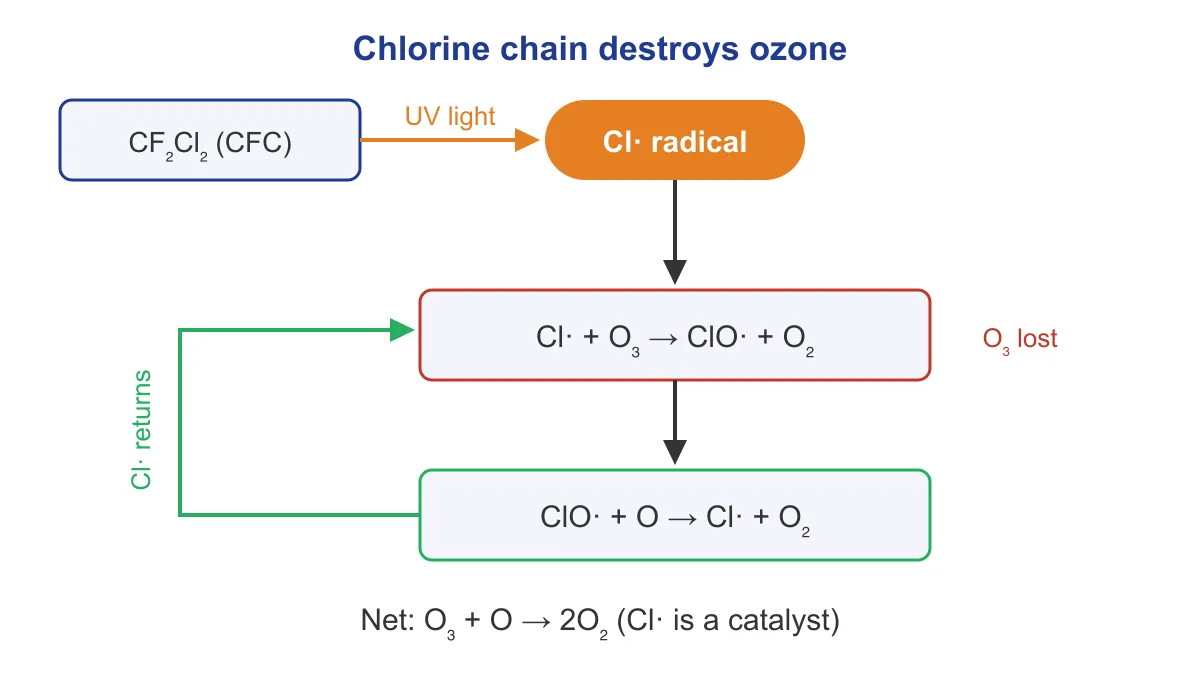
Figure 3.1: The catalytic chlorine cycle that destroys stratospheric ozone
The Antarctic ozone hole
In the polar winter the stratosphere is extremely cold, and clouds of ice and nitric acid form. On their surfaces the "reservoir" compounds are opened up:
ClONO₂ + H₂O → HOCl + HNO₃
ClONO₂ + HCl → Cl₂ + HNO₃
When the spring sun returns, it splits these into Cl· atoms: Cl₂ → 2Cl·. The sudden flood of radicals causes a sharp seasonal thinning over Antarctica.
Memory trick: "Cl takes, Cl gives back." Chlorine takes an O from ozone and gives it back to an oxygen atom, so it is never used up. If a question asks what happens to the radical, the answer is always "regenerated".
Water pollution
Common causes and their effects:
- Pathogens: sewage carrying bacteria and viruses (cholera, typhoid, hepatitis). Test: presence of E. coli counts.
- Organic waste: dead plants, sewage, food and paper-mill waste. Bacteria feed on it and use up dissolved oxygen.
- Plant nutrients (nitrates, phosphates from fertiliser run-off and detergents): cause algal bloom and eutrophication. The algae die, rot, remove oxygen, and fish suffocate.
- Toxic metals: Pb, Hg, Cd, As. Mercury gives Minamata disease, cadmium gives a painful bone disease, lead harms nerves and kidneys.
- Pesticides, oil, hot water from power plants (thermal pollution), acids and alkalis from industry.
Natural water holds dissolved oxygen (DO), and fish need about 5 to 6 ppm. Below this level they suffer.
BOD
Biochemical oxygen demand is the amount of oxygen consumed by bacteria in breaking down the organic matter in one litre of water, measured at 20 °C over 5 days. Its unit is mg per litre, the same as ppm.
If the sample is diluted before the test, multiply the drop in DO by the dilution factor (final volume divided by volume of sample taken). Clean water has BOD below 5 ppm. Water with BOD of 17 ppm or more is highly polluted. A lake that feeds on sewage has a large BOD and almost no DO. Do not mix the two up: BOD high means DO low.
Standards
Drinking water is judged against limits fixed by international and national bodies, written in ppm or ppb. The idea is simple: a substance has a safe ceiling, and above it harm appears. Some illustrative values: fluoride up to about 1 ppm (below 1 ppm, teeth decay; above about 2 ppm, mottled teeth and, at high levels, bone damage), nitrate not above about 50 ppm (more causes methaemoglobinemia, the "blue baby" condition), and lead only in traces of the order of 50 ppb or less.
Soil pollution and industrial waste
Soil is polluted by pesticides, fertiliser salts, plastics, mine tailings and industrial waste.
- Insecticides: DDT and BHC (gamma-hexachlorocyclohexane) are chlorinated hydrocarbons. They are cheap and effective, but they do not break down in soil, dissolve in fat rather than water, and so build up along the food chain (biomagnification). The bird at the top of the chain carries the largest load.
- Herbicides: sodium chlorate (NaClO₃) and sodium arsenite (Na₃AsO₃) kill weeds. Fungicides are the third group, for moulds and blight.
- Newer pesticides are chosen to be biodegradable and specific to the pest.
Industrial solid waste is dealt with by recycling (metals, paper, glass, plastic), by sanitary landfill, by incineration with air-pollution control, and by treating hazardous waste before disposal.
Strategies to control pollution
- Reduce at source: cleaner fuels, efficient engines, process changes.
- Treat what remains: electrostatic precipitators and scrubbers for flue gas, effluent treatment plants for water, sewage plants.
- Reuse and recycle: the cheapest waste is the one never made.
- Plant trees, since green belts absorb CO₂ and trap dust.
Green chemistry
Green chemistry is the design of reactions and products so that hazardous substances are not used or made in the first place. It differs from clean-up because it removes the problem at the drawing board. Its working ideas include:
- Prevent waste rather than treat it.
- Choose reactions with high atom economy.
- Use safer solvents and reagents, ideally water or CO₂.
- Use catalysts instead of large amounts of reagents.
- Use renewable raw materials, and save energy by working at room temperature and pressure where possible.
- Design products that break down after use.
Atom economy tells how much of the reactant mass ends up in the wanted product:
Addition reactions can reach 100 per cent, while substitutions and eliminations waste part of the input as by-product.
Examples from industry and daily life:
- Dry cleaning with liquid CO₂ and a detergent instead of tetrachloroethene (a suspected carcinogen that pollutes groundwater).
- Bleaching paper with H₂O₂ and a catalyst instead of chlorine, avoiding chlorinated organic waste.
- Making ethanal from ethene and oxygen in water with a palladium catalyst, in one step with about 90 per cent yield, replacing older routes.
Drug–target interaction
Medicines are chemicals of low molecular mass (about 100 to 500 u) that act on large biological molecules called targets, mainly proteins. Two kinds matter.
Enzymes speed up reactions in the body. A drug acting as an enzyme inhibitor can work in two ways. In competitive inhibition it resembles the substrate and sits in the active site, so the substrate cannot enter. In allosteric inhibition it binds at a different site and changes the shape of the active site so that the substrate no longer fits.
Receptors are proteins in cell membranes that carry messages, such as a signal from a nerve. A drug that mimics the natural messenger and switches the receptor on is an agonist. A drug that binds and blocks the receptor without switching it on is an antagonist.
Selectivity matters. A good drug binds strongly to its target and barely to others, because binding elsewhere gives side effects.
Therapeutic action of common drug groups
Antacids
Excess HCl in the stomach causes acidity and ulcers. Antacids are bases that neutralise it: NaHCO₃, Mg(OH)₂ (milk of magnesia) and Al(OH)₃. Sodium bicarbonate is soluble and can make the stomach alkaline, which makes it secrete even more acid. The insoluble hydroxides of Mg and Al cannot do this, because they only dissolve as the acid needs them.
A better answer to ulcers came from understanding that histamine makes the stomach wall secrete acid. Cimetidine and ranitidine bind the receptors that carry that message, so less acid is released. So antacids neutralise acid that has already been made, while these drugs reduce how much is made.
Antihistamines
Histamine, released in allergic reactions, causes sneezing, itching and watery eyes. Brompheniramine, chlorpheniramine and terfenadine are antagonists of the histamine receptor in the nose and skin. They do not stop acid secretion, because the receptor in the stomach is a different one; this is why an allergy tablet cannot replace an ulcer drug.
Tranquilizers
These act on the nervous system to relieve stress, anxiety and depression. Chlordiazepoxide and diazepam are used for anxiety; iproniazid and phenelzine for depression; meprobamate as a mild sedative. Barbiturates such as veronal and luminal are hypnotics, producing sleep. They are dangerous in overdose and habit-forming, so they need prescription.
Analgesics
They relieve pain without causing unconsciousness, confusion or disturbing the nervous system.
| Group | Examples | Key facts |
|---|---|---|
| Non-narcotic | Aspirin, paracetamol, ibuprofen | Aspirin blocks the production of prostaglandins that cause pain and inflammation; it also thins the blood slightly, so low doses help against heart attack |
| Narcotic | Morphine, codeine, heroin | Bind opioid receptors in the brain; used after surgery and in terminal cancer; addictive |
Antimicrobials
They kill or stop growth of microbes. Three subgroups:
- Antibiotics are made by or derived from microorganisms and act at low concentrations inside the body. Bactericidal ones kill (penicillin, ofloxacin, aminoglycosides); bacteriostatic ones stop growth (erythromycin, tetracycline, chloramphenicol). Narrow-spectrum drugs such as penicillin G hit mainly one group of bacteria; broad-spectrum ones (ampicillin, amoxycillin, chloramphenicol) hit many.
- Antiseptics are applied to living tissue such as wounds. Examples: dilute boric acid, tincture of iodine (2 to 3 per cent iodine in alcohol-water), dettol (chloroxylenol with terpineol), 0.2 per cent phenol.
- Disinfectants are used on non-living things such as floors and drains. Examples: 1 per cent phenol, chlorine at 0.2 to 0.4 ppm in drinking water, SO₂ in very low concentration.
The same chemical can be either, depending on strength: phenol at 0.2 per cent is an antiseptic, at 1 per cent a disinfectant.
Antifertility drugs
Birth-control pills contain a mixture of synthetic oestrogen-type and progesterone-type compounds, for example ethynylestradiol with norethindrone. They imitate pregnancy hormones, so ovulation is suppressed and the uterus lining is made unreceptive.
Memory trick: "Antacid neutralises, Antihistamine blocks, Antiseptic skin, Disinfectant floor." Four short pairs; use them to sort any drug-use question in seconds.
Artificial sweeteners
These give sweetness with almost no calories and are useful for diabetics. Names to know: saccharin, aspartame, alitame and sucralose. Saccharin passes through the body unchanged. Aspartame decomposes on heating, so it is used only in cold foods and drinks. Sucralose is stable at cooking temperatures. Alitame is the most intense of the four, roughly two thousand times as sweet as cane sugar, and its sweetness is hard to control. Saccharin is about 550 times as sweet.
Soaps, detergents and cleansing action
Soaps
Soap is the sodium or potassium salt of a long-chain fatty acid, such as sodium stearate C₁₇H₃₅COONa. It is made by boiling fat with alkali (saponification):
fat (triglyceride) + 3NaOH → glycerol + 3 RCOONa
Salt is added to push the soap out of solution. Sodium soaps are hard and used for washing; potassium soaps are soft and used in shaving creams. Soaps made with ethanol and glycerol are transparent.
Cleansing action
A soap ion has a long hydrocarbon tail that dislikes water and loves grease, and a charged head, –COO⁻, that loves water. Above a certain concentration the ions gather into spherical micelles with tails pointing in and heads pointing out. Oil is trapped among the tails, the micelle stays suspended because the heads are charged and repel each other, and rinsing washes it away as an emulsion.
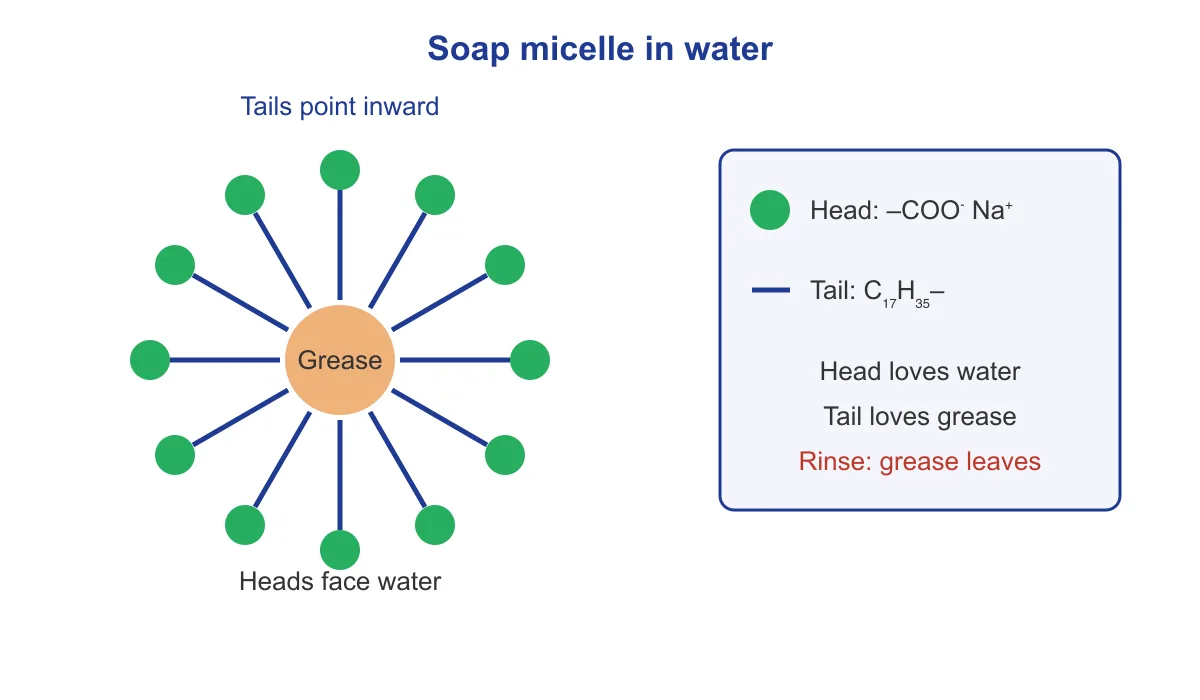
Figure 3.2: A soap micelle holding a grease drop inside and charged heads outside
Hard water and soap
Hard water has Ca²⁺ and Mg²⁺. They form insoluble salts, called scum, with soap:
2C₁₇H₃₅COONa + CaCl₂ → (C₁₇H₃₅COO)₂Ca↓ + 2NaCl
Soap is wasted before it can lather. Detergents do not precipitate this way.
Synthetic detergents
Detergents are cleansing agents that work in hard water because their Ca²⁺ and Mg²⁺ salts are soluble. Three types:
| Type | Example | Use |
|---|---|---|
| Anionic | Sodium alkylbenzene sulphonate, sodium lauryl sulphate | Laundry powders, shampoos, dishwashing |
| Cationic | Cetyltrimethylammonium bromide (a quaternary ammonium salt) | Hair conditioners; also germicidal, and costly |
| Non-ionic | Polyethylene glycol stearate | Liquid dishwashing; do not produce ions |
Biodegradability is a pollution question. Detergents with a branched hydrocarbon chain resist bacteria, so they persist in rivers and leave foam. Those with a straight chain are broken down by microbes, so modern detergents use linear chains. Soaps are biodegradable. Detergents containing phosphates also feed algal blooms.
Example 1: How much SO₂ is released when 500 kg of coal containing 1.6% sulphur by mass burns completely?
Mass of S = 500 × 0.016 = 8 kg = 8000 g.
S + O₂ → SO₂, so 32 g S gives 64 g SO₂.
SO₂ = 8000 × 2 = 16000 g = 16 kg.
Answer: 16 kg. Notice that SO₂ has double the mass of the sulphur because S takes its own mass of oxygen.
Example 2: A water sample of 20 mL is diluted to 400 mL with oxygen-saturated water. DO before incubation is 8.5 mg per litre, after 5 days 5.5 mg per litre. Find the BOD of the original sample.
Fall in DO of the diluted sample = 8.5 − 5.5 = 3.0 mg per litre.
Dilution factor = 400 / 20 = 20.
BOD = 3.0 × 20 = 60 mg per litre.
Answer: 60 ppm. Notice that the sample was diluted, so the measured fall must be scaled back up.
Example 3: Acid rain has pH 4.6, normal rain has pH 5.6. Compare the hydrogen ion concentrations.
$[\text{H}^+] = 10^{-\text{pH}}$, so the ratio is $\frac{10^{-4.6}}{10^{-5.6}} = 10^{1} = 10$.
Answer: the acid rain is ten times more acidic. Notice that each pH unit is a factor of 10, not 1.
Example 4: Atom economy of making CaO by heating limestone: CaCO₃ → CaO + CO₂. If the wanted product is CaO.
Molar mass CaCO₃ = 40 + 12 + 48 = 100.
CaO = 40 + 16 = 56.
Atom economy = 56 / 100 × 100 = 56%.
Answer: 56%. Notice that the other 44% leaves as CO₂, which is a greenhouse gas, a reason cement makers look for alternatives.
Example 5: Each chlorine radical runs 10⁵ cycles of the ozone chain before it is locked up. How many moles of O₃ are destroyed by 2 × 10⁻⁶ mol of Cl·?
Each cycle: Cl· + O₃ → ClO· + O₂, then ClO· + O → Cl· + O₂. One O₃ per cycle.
Moles of O₃ = 2 × 10⁻⁶ × 10⁵ = 0.2 mol.
Answer: 0.2 mol. Notice that Cl· is a catalyst, so its amount does not fall; only the cycle count matters.
Example 6: Hard water holds 120 mg of Ca²⁺ per litre. Find the mass of sodium stearate (molar mass 306 g per mol) precipitated per litre. Ca = 40.
Moles of Ca²⁺ = 0.120 / 40 = 0.003 mol.
2 mol soap per mol Ca²⁺, so soap = 0.006 mol.
Mass = 0.006 × 306 = 1.836 g.
Answer: 1.836 g per litre. Notice that the mass of soap wasted is far larger than the mass of calcium, because each Ca²⁺ takes two big stearate ions.
Common traps
- Calling any rain with pH below 7 "acid rain" → the limit is 5.6, because CO₂ already makes clean rain slightly acidic.
- Saying photochemical smog is reducing → it is oxidising (O₃, PAN); classical smog is the reducing one.
- Treating Cl· as consumed in ozone depletion → it is a catalyst and is regenerated by ClO· + O.
- Forgetting the dilution factor in BOD → multiply the fall in DO by the final volume over the sample volume.
- Assuming high BOD means high dissolved oxygen → high BOD means low DO.
- Treating antacid and antihistamine as the same action → antacids neutralise acid, antihistamines block histamine receptors; ranitidine type blocks the stomach receptor.
- Calling a substance an antiseptic by name alone → the same phenol is antiseptic at 0.2 per cent and disinfectant at 1 per cent.
- Saying detergents form scum with hard water → their Ca and Mg salts are soluble; soaps form the scum.
- Calling all detergents biodegradable → only straight-chain types are; branched ones persist.
- Counting the water of reaction as wanted product in atom economy → only the desired product is in the numerator, all reactants are in the denominator.
Quick revision
- Acid rain has pH below 5.6.
- Photochemical smog is oxidising: NO₂ + hydrocarbons + sunlight → O₃ and PAN.
- Classical smog is reducing: SO₂ plus smoke in cold, damp air.
- CO binds haemoglobin far more strongly than O₂ and gives carboxyhaemoglobin.
- CFC photolysis in the stratosphere gives Cl·, which catalytically destroys O₃.
- Chain steps: Cl· + O₃ → ClO· + O₂ and ClO· + O → Cl· + O₂.
- Antarctic ozone hole: polar stratospheric clouds free Cl₂ from ClONO₂, sunlight makes Cl·.
- Eutrophication is caused by excess nitrate and phosphate, leading to oxygen loss.
- BOD is the oxygen used by microbes in 5 days at 20 °C; clean water is below about 5 ppm.
- DDT is persistent, fat-soluble and biomagnifies.
- Green chemistry: atom economy equals mass of desired product over mass of all reactants, times 100.
- Drug targets: enzymes (competitive or allosteric inhibition) and receptors (agonist or antagonist).
- Antacids neutralise; ranitidine and cimetidine block histamine receptors in the stomach wall.
- Aspirin blocks prostaglandin synthesis; narcotic analgesics bind opioid receptors.
- Soap is a sodium or potassium salt of a fatty acid; it cleans by micelles and precipitates in hard water; straight-chain detergents are biodegradable.
Practice questions
Carbon monoxide is poisonous mainly because it
- reacts with plasma to form carbonic acid in the blood
- dissolves in lung tissue and corrodes it as an acid
- binds haemoglobin more strongly than O₂, forming carboxyhaemoglobin
- oxidises the Fe²⁺ of haemoglobin to Fe³⁺ permanently
Answer
C. binds haemoglobin more strongly than O₂, forming carboxyhaemoglobin
CO occupies the O₂-binding site of haemoglobin and holds it about 200 times harder, so oxygen transport falls.
Rain is called acid rain when its pH is below
- 7.0
- 4.0
- 6.5
- 5.6
Answer
D. 5.6
Dissolved CO₂ already brings clean rain to about pH 5.6; only a lower value shows extra acids from SO₂ and NOₓ.
Which of the following is formed in photochemical smog but not in classical smog?
- Smoke particles
- Peroxyacetyl nitrate
- Sulphur dioxide
- Sulphuric acid mist
Answer
B. Peroxyacetyl nitrate
PAN forms from hydrocarbons and NO₂ in sunlight. SO₂, smoke and H₂SO₄ droplets belong to classical (reducing) smog.
In the catalytic destruction of stratospheric ozone by chlorine, which step regenerates the chlorine radical?
- ClO· + O → Cl· + O₂
- Cl· + O₃ → ClO· + O₂
- CF₂Cl₂ → ·CF₂Cl + Cl·
- ClONO₂ + H₂O → HOCl + HNO₃
Answer
A. ClO· + O → Cl· + O₂
Only ClO· + O returns Cl·. The step Cl· + O₃ consumes it, photolysis of CF₂Cl₂ creates it, and the last option is a reservoir reaction.
Eutrophication of a lake is mainly caused by an excess of
- lead and mercury ions
- dissolved oxygen
- chloride and sodium ions
- nitrates and phosphates
Answer
D. nitrates and phosphates
Plant nutrients cause algal bloom; when the algae die their decay uses up the dissolved oxygen.
A river sample shows a very high BOD. Which conclusion is most reasonable?
- It contains mainly inorganic salts and no organic matter
- Its pH must be below 5.6
- It carries much biodegradable organic matter and has little dissolved oxygen
- It is rich in dissolved oxygen and supports fish well
Answer
C. It carries much biodegradable organic matter and has little dissolved oxygen
BOD measures oxygen used by microbes on organic matter; a high value means a heavy organic load and low DO.
Birds at the top of a food chain carry the largest DDT load mainly because DDT is
- fat-soluble and not metabolised, so it accumulates
- broken down by soil bacteria into a stable product
- water-soluble and excreted slowly in urine
- volatile and concentrated by wind in the upper air
Answer
A. fat-soluble and not metabolised, so it accumulates
Fat-soluble, persistent compounds are stored in fatty tissue and magnified at each feeding level (biomagnification).
Which antacid is insoluble and so does not make the stomach excessively alkaline?
- NaHCO₃
- Mg(OH)₂
- NaOH
- Na₂CO₃
Answer
B. Mg(OH)₂
Mg(OH)₂ dissolves only as acid removes it. Soluble bases can overshoot, after which the stomach secretes more acid.
Ranitidine reduces acidity in the stomach by
- raising the pH of the intestine with a base
- blocking histamine receptors in the nose and skin
- blocking the histamine receptors on the stomach wall
- neutralising HCl directly
Answer
C. blocking the histamine receptors on the stomach wall
It is a receptor antagonist that stops histamine from triggering acid release; it does not neutralise acid already made.
The pain-relieving action of aspirin is mainly due to
- inhibition of prostaglandin synthesis
- lowering the noradrenaline level in the brain
- blocking the histamine receptors
- binding to opioid receptors in the brain
Answer
A. inhibition of prostaglandin synthesis
Aspirin inhibits the enzyme that makes prostaglandins, which cause pain and inflammation. Opioid binding is a narcotic action.
Which compound acts as an antiseptic at 0.2 per cent and as a disinfectant at 1 per cent?
- Boric acid
- Iodoform
- Furacin
- Phenol
Answer
D. Phenol
Phenol changes role with concentration; the other compounds are used only on living tissue.
Which artificial sweetener decomposes on heating and so is used only in cold foods and drinks?
- Saccharin
- Aspartame
- Sodium benzoate
- Sucralose
Answer
B. Aspartame
Saccharin and sucralose survive cooking; aspartame breaks down when heated.
Which of the following is a cationic detergent?
- Polyethylene glycol stearate
- Cetyltrimethylammonium bromide
- Sodium stearate
- Sodium lauryl sulphate
Answer
B. Cetyltrimethylammonium bromide
The cetyltrimethylammonium ion carries a positive charge on the head. Sodium lauryl sulphate is anionic, the glycol ester is non-ionic and sodium stearate is a soap.
Soap lathers poorly in hard water because
- Na⁺ ions in hard water make the soap insoluble
- hard water is acidic and neutralises soap
- Ca²⁺ and Mg²⁺ ions precipitate the soap as insoluble salts
- hard water contains detergents that foam against it
Answer
C. Ca²⁺ and Mg²⁺ ions precipitate the soap as insoluble salts
2RCOONa + Ca²⁺ → (RCOO)₂Ca↓ + 2Na⁺; the soap is used up as scum.
Limestone is heated: CaCO₃ → CaO + CO₂, and CaO is the desired product. Using Ca = 40, C = 12, O = 16, the atom economy in per cent is
- 100
- 28
- 44
- 56
Answer
D. 56
Atom economy = 56/100 × 100 = 56 per cent. The other 44 per cent leaves as CO₂.
Normal rain has pH 5.6. Another sample has pH 3.6. The ratio of [H⁺] in the second sample to that in the first is
- 2
- 10
- 20
- 100
Answer
D. 100
The pH differs by 2 units, so [H⁺] differs by 10² = 100. Check: 10⁻³·⁶ / 10⁻⁵·⁶ = 100.
A 10 mL water sample is diluted to 300 mL. Dissolved oxygen in the diluted sample falls by 6.0 mg per litre in 5 days. The BOD of the original sample in mg per litre is
- 180
- 6
- 60
- 1800
Answer
A. 180
Dilution factor = 300/10 = 30, so BOD = 6.0 × 30 = 180 mg per litre. Check: 180 mg L⁻¹ diluted 30-fold gives 6.
Coal containing 2 per cent sulphur by mass burns completely. The mass of SO₂ released from 1 kg of this coal in grams is (S = 32, O = 16)
- 40
- 20
- 64
- 80
Answer
A. 40
S = 20 g = 0.625 mol. SO₂ = 0.625 × 64 = 40 g. Check: SO₂ is twice the mass of S, 2 × 20 = 40.
Acid rain contains 9.8 g of H₂SO₄ that falls on marble (CaCO₃). The maximum mass of CaCO₃ it can dissolve, in grams, is (H₂SO₄ = 98, CaCO₃ = 100)
- 9.8
- 5
- 10
- 20
Answer
C. 10
9.8 g = 0.1 mol H₂SO₄. CaCO₃ + H₂SO₄ → CaSO₄ + H₂O + CO₂ is 1 : 1, so 0.1 mol CaCO₃ = 10 g.
Tristearin (molar mass 890 g per mol) of mass 89 g is completely saponified with excess NaOH. The mass of sodium stearate (molar mass 306 g per mol) formed, in grams, is
- 122.4
- 91.8
- 30.6
- 61.2
Answer
B. 91.8
89 g = 0.1 mol fat, and one fat molecule gives 3 soap ions: 0.3 mol × 306 = 91.8 g.
A litre of hard water has 100 mg of Ca²⁺ (Ca = 40). The mass of sodium stearate (molar mass 306 g per mol) that is precipitated as calcium stearate, in grams, is
- 1.53
- 0.765
- 15.3
- 3.06
Answer
A. 1.53
Ca²⁺ = 0.1/40 = 0.0025 mol. Each needs 2 stearate ions, so 0.005 mol × 306 = 1.53 g.
The O–O bond energy of O₂ is 499 kJ per mol. Using h = 6.63 × 10⁻³⁴ J s, c = 3 × 10⁸ m s⁻¹ and N_A = 6.022 × 10²³ mol⁻¹, the longest wavelength of light able to break one bond, in nm to the nearest whole number, is
- 480
- 120
- 960
- 240
Answer
D. 240
$\lambda = \frac{hcN_A}{E} = \frac{6.63\times10^{-34}\times3\times10^{8}\times6.022\times10^{23}}{4.99\times10^{5}}$ = 2.40 × 10⁻⁷ m = 240 nm.
Complete combustion of 11.4 g of octane (C₈H₁₈, molar mass 114) in a vehicle gives CO₂ of mass, in grams (C = 12, O = 16),
- 70.4
- 4.4
- 35.2
- 352
Answer
C. 35.2
11.4 g = 0.1 mol. Each mole gives 8 mol CO₂, so 0.8 mol × 44 = 35.2 g.
An antacid tablet is Mg(OH)₂. The mass needed to neutralise 100 mL of 0.2 M HCl completely, in grams, is (Mg(OH)₂ = 58)
- 0.29
- 0.58
- 2.9
- 1.16
Answer
B. 0.58
HCl = 0.1 × 0.2 = 0.02 mol. Mg(OH)₂ + 2HCl → MgCl₂ + 2H₂O needs 0.01 mol = 0.58 g.
0.84 g of NaHCO₃ (molar mass 84) reacts completely with stomach acid. The volume of CO₂ released at STP, in mL, is (molar volume 22.4 L)
- 22.4
- 448
- 112
- 224
Answer
D. 224
0.01 mol NaHCO₃ gives 0.01 mol CO₂ (1 : 1) = 0.01 × 22400 mL = 224 mL.
Drinking water is chlorinated to 0.2 ppm (0.2 mg per litre). The mass of chlorine needed for 5000 litres of water, in grams, is
- 0.2
- 1
- 5
- 1000
Answer
B. 1
0.2 mg × 5000 = 1000 mg = 1 g. The common slip is leaving the answer in mg.
Given below are two statements: Statement I: Rain with a pH below 5.6 is classed as acid rain. Statement II: Clean rain is slightly acidic because of dissolved CO₂.
- Both Statement I and Statement II are correct
- Both Statement I and Statement II are incorrect
- Statement I is correct but Statement II is incorrect
- Statement I is incorrect but Statement II is correct
Answer
A. Both Statement I and Statement II are correct
Both are correct: CO₂ gives about pH 5.6, so acid rain needs a lower value.
Given below are two statements: Statement I: Photochemical smog is reducing in nature. Statement II: Classical smog contains SO₂ and smoke.
- Both Statement I and Statement II are correct
- Both Statement I and Statement II are incorrect
- Statement I is correct but Statement II is incorrect
- Statement I is incorrect but Statement II is correct
Answer
D. Statement I is incorrect but Statement II is correct
Photochemical smog is oxidising (O₃, PAN). Classical smog is the reducing one, with SO₂ and smoke.
Given below are two statements: Statement I: Highly polluted water has a high BOD. Statement II: Such water has a high concentration of dissolved oxygen.
- Both Statement I and Statement II are correct
- Both Statement I and Statement II are incorrect
- Statement I is correct but Statement II is incorrect
- Statement I is incorrect but Statement II is correct
Answer
C. Statement I is correct but Statement II is incorrect
High BOD means microbes are consuming much oxygen, so DO is low; Statement II is wrong.
Given below are two statements: Statement I: Soaps lather well in hard water. Statement II: Detergents with highly branched hydrocarbon chains are readily biodegradable.
- Both Statement I and Statement II are correct
- Both Statement I and Statement II are incorrect
- Statement I is correct but Statement II is incorrect
- Statement I is incorrect but Statement II is correct
Answer
B. Both Statement I and Statement II are incorrect
Soaps form scum with Ca²⁺ and Mg²⁺. Branched-chain detergents resist bacteria and persist; straight-chain ones are biodegradable.
Given below are two statements: Statement I: Phenol at 0.2 per cent is an antiseptic, and at 1 per cent it acts as a disinfectant. Statement II: Tincture of iodine is a disinfectant meant for floors and drains.
- Both Statement I and Statement II are correct
- Both Statement I and Statement II are incorrect
- Statement I is correct but Statement II is incorrect
- Statement I is incorrect but Statement II is correct
Answer
C. Statement I is correct but Statement II is incorrect
Statement I is correct. Tincture of iodine is an antiseptic applied to wounds, not a floor disinfectant.
Assertion (A): A single chlorine radical can destroy a very large number of ozone molecules. Reason (R): The chlorine radical is regenerated in the second step of the chain.
- Both A and R are true and R is the correct explanation of A
- Both A and R are true but R is not the correct explanation of A
- A is true but R is false
- A is false but R is true
Answer
A. Both A and R are true and R is the correct explanation of A
Cl· + O₃ → ClO· + O₂ and ClO· + O → Cl· + O₂. Because Cl· returns, it acts as a catalyst, which explains the large number.
Assertion (A): Soap removes grease by forming micelles. Reason (R): Soap forms a precipitate with the Ca²⁺ ions present in hard water.
- Both A and R are true and R is the correct explanation of A
- Both A and R are true but R is not the correct explanation of A
- A is true but R is false
- A is false but R is true
Answer
B. Both A and R are true but R is not the correct explanation of A
Both are true, but the precipitate is a separate effect; cleaning comes from micelles with tails enclosing the grease.
Assertion (A): Aspartame is suitable for baking cakes. Reason (R): Aspartame is much sweeter than cane sugar.
- Both A and R are true and R is the correct explanation of A
- Both A and R are true but R is not the correct explanation of A
- A is true but R is false
- A is false but R is true
Answer
D. A is false but R is true
Aspartame decomposes on heating, so A is false. R is true (about 100 times as sweet).
Match List I with List II. List I: a. CO b. SO₂ c. CFCs d. PAN List II: i. Acid rain ii. Ozone depletion iii. Carboxyhaemoglobin iv. Photochemical smog
- a-iii, b-i, c-ii, d-iv
- a-iii, b-iv, c-i, d-ii
- a-i, b-iii, c-iv, d-ii
- a-iv, b-i, c-iii, d-ii
Answer
A. a-iii, b-i, c-ii, d-iv
CO gives carboxyhaemoglobin, SO₂ gives acid rain, CFCs give chlorine radicals that deplete ozone, PAN is a photochemical smog product.
Match List I with List II. List I: a. Ranitidine b. Aspirin c. Chlordiazepoxide d. Brompheniramine List II: i. Reduces release of stomach acid ii. Relieves allergy symptoms iii. Relieves anxiety iv. Inhibits prostaglandin synthesis
- a-i, b-iii, c-iv, d-ii
- a-ii, b-iv, c-iii, d-i
- a-i, b-iv, c-iii, d-ii
- a-iv, b-i, c-ii, d-iii
Answer
C. a-i, b-iv, c-iii, d-ii
Ranitidine lowers acid release, aspirin blocks prostaglandins, chlordiazepoxide is a tranquilizer, brompheniramine is an antihistamine.
Match List I with List II. List I: a. Soap b. Anionic detergent c. Cationic detergent d. Non-ionic detergent List II: i. Sodium alkylbenzene sulphonate ii. Cetyltrimethylammonium bromide iii. Polyethylene glycol stearate iv. Sodium stearate
- a-i, b-iv, c-ii, d-iii
- a-iv, b-i, c-ii, d-iii
- a-iv, b-ii, c-i, d-iii
- a-iii, b-i, c-ii, d-iv
Answer
B. a-iv, b-i, c-ii, d-iii
Sodium stearate is a soap; alkylbenzene sulphonate is anionic; the quaternary ammonium salt is cationic; the glycol ester is non-ionic.
A power station burns 2000 kg of coal per hour containing 2 per cent sulphur. A scrubber removes all the SO₂ as CaSO₄ using CaCO₃ (SO₂ + CaCO₃ + ½O₂ → CaSO₄ + CO₂). The mass of CaCO₃ needed per hour is (S = 32, CaCO₃ = 100)
- 62.5 kg
- 80 kg
- 250 kg
- 125 kg
Answer
D. 125 kg
S = 40 kg = 1.25 kmol, so SO₂ = 1.25 kmol, and CaCO₃ is 1 : 1, giving 125 kg. Check: 100 kg per 32 kg S × 40 = 125.
River water holds 9 mg of dissolved oxygen per litre. Waste containing 90 mg per litre of glucose, C₆H₁₂O₆, enters it, and microbes oxidise it fully: C₆H₁₂O₆ + 6O₂ → 6CO₂ + 6H₂O (C = 12, H = 1, O = 16). What happens?
- Oxygen demand is 96 mg per litre, far above 9, so the dissolved oxygen is exhausted
- Oxygen demand is 16 mg per litre, so the oxygen is exhausted
- Oxygen demand is 96 mg per litre, so the 9 mg per litre is enough
- Oxygen demand is 48 mg per litre, so 9 mg per litre suffices and fish survive
Answer
A. Oxygen demand is 96 mg per litre, far above 9, so the dissolved oxygen is exhausted
Glucose = 180 g per mol, so 90 mg = 0.5 mmol. It needs 6 × 0.5 = 3 mmol O₂ = 96 mg per litre, far more than 9 mg per litre.
A factory saponifies 8.9 kg of tristearin (molar mass 890 g per mol) completely. The mass of NaOH required in kg is (Na = 23, O = 16, H = 1)
- 12
- 0.4
- 1.2
- 3.6
Answer
C. 1.2
8900 g / 890 = 10 mol fat. Each needs 3 mol NaOH, so 30 mol × 40 = 1200 g = 1.2 kg.