Polymers
What to remember
- A polymer is a giant molecule built by joining many small molecules (monomers) through covalent bonds. In addition polymers the whole monomer ends up in the chain; in condensation polymers a small molecule such as H₂O is lost at every link.
- Addition polymerisation of alkenes is a chain reaction (initiation, propagation, termination) driven by free radicals. Condensation polymerisation is a step reaction between two functional groups, so the monomers must be bi- or poly-functional.
- Know the monomers by heart: ethene (polythene), CF₂=CF₂ (Teflon), CH₂=CHCl (PVC), hexamethylenediamine + adipic acid (nylon-6,6), caprolactam (nylon-6), ethylene glycol + terephthalic acid (terylene), phenol + HCHO (Bakelite), butadiene + styrene (Buna-S), butadiene + acrylonitrile (Buna-N).
- Natural rubber is cis-1,4-polyisoprene. Sulfur cross-links (vulcanisation) make it harder, stronger and less sticky. Cellulose is a linear β-1,4 polymer of D-glucose.
- Biodegradable polymers (PHBV, nylon-2-nylon-6) carry ester or amide links that enzymes and microbes can cut.
Basic ideas: monomer, polymer, repeat unit
A monomer is the small molecule you start with. A polymer is what you get when hundreds or thousands of them are joined. The part that repeats along the chain is the repeat unit, and the number of repeat units in one chain is the degree of polymerisation, $n$.
For an addition polymer the repeat unit has the same formula as the monomer, so the polymer's molar mass is simply $n$ times the monomer's. For a condensation polymer the repeat unit is lighter than the sum of its two monomers, because water (or HCl, or an alcohol) is thrown out at each link.
A real sample is a mixture of chains with different $n$, so the molar mass quoted for a polymer is always an average. That is why polymers have a softening range and not a sharp melting point.
Homopolymer and copolymer
A homopolymer is made from one kind of monomer: polythene, PVC, Teflon, nylon-6. A copolymer contains two or more different repeat units: Buna-S, Buna-N, nylon-6,6, terylene, Bakelite, PHBV. Watch the wording. Nylon-6,6 is built from two different monomers, yet each of them reacts at both ends, so the chain alternates A–B–A–B. It is a copolymer by this definition. Nylon-6 comes from one monomer, caprolactam, and is a homopolymer.
Classification of polymers
No single scheme covers everything, so we classify in several ways.
| Basis | Classes | Examples |
|---|---|---|
| Source | Natural, semi-synthetic, synthetic | Cellulose, rubber; cellulose acetate; nylon, PVC |
| Structure | Linear, branched, cross-linked (network) | HDPE; LDPE; Bakelite, vulcanised rubber |
| Mode of polymerisation | Addition (chain-growth), condensation (step-growth) | Polythene, Teflon; nylon-6,6, terylene |
| Molecular forces | Elastomer, fibre, thermoplastic, thermosetting | Buna-S; nylon-6,6; PVC; Bakelite |
Structure decides behaviour. Linear chains pack closely, so the polymer is dense and strong. Branches keep chains apart, so the polymer is softer and less dense. Cross-links lock chains together permanently.
- Elastomers: weak forces, coiled chains that stretch and snap back (rubber, Buna-S).
- Fibres: strong hydrogen bonding or dipole attraction, chains packed in parallel (nylon-6,6, terylene).
- Thermoplastics: soften on heating, harden on cooling, can be remoulded again and again (polythene, PVC).
- Thermosetting polymers: cross-linked during moulding, so heating after setting only chars them (Bakelite).
Addition polymerisation (chain growth)
The monomer is an alkene or a substituted alkene. One C=C π bond breaks and becomes two σ bonds, so no atom leaves. The reaction goes through a reactive intermediate, which for the polymers in this chapter is a free radical. Three stages occur.
- Initiation. An initiator such as benzoyl peroxide or a persulphate splits homolytically into radicals; a radical attacks a monomer's C=C and gives a larger radical.
- Propagation. The chain radical attacks the next monomer, and the radical centre moves to the new end. This repeats many thousands of times, very fast.
- Termination. Two chain radicals combine, or one radical picks up a hydrogen from another chain, and growth stops.
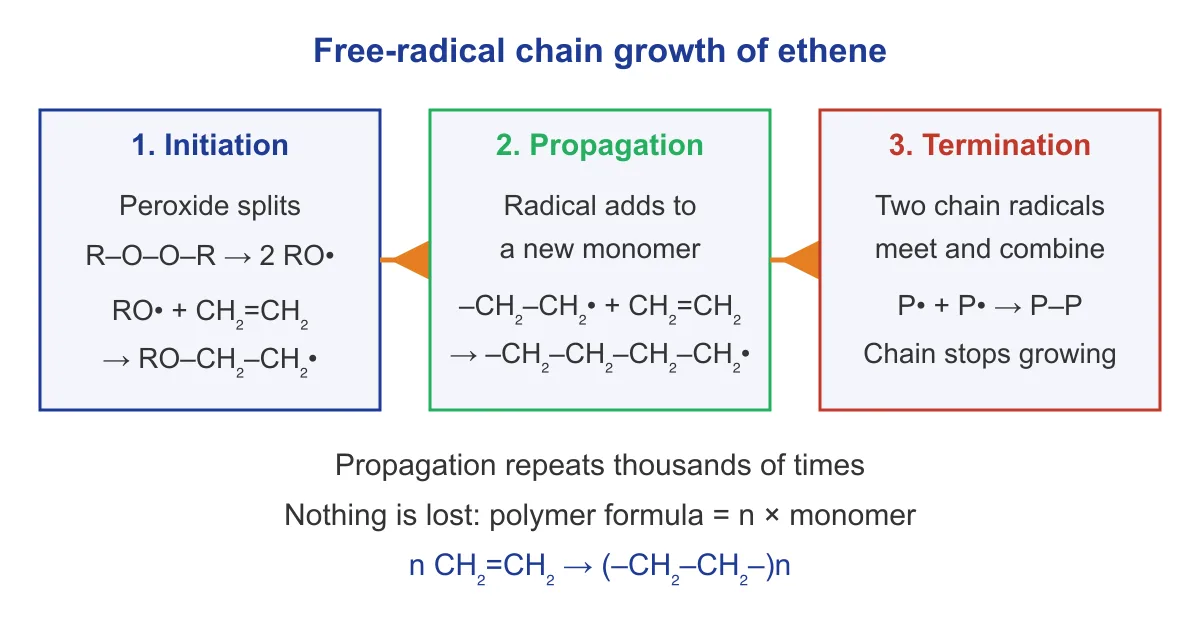
Figure 2.1: Free-radical chain growth of ethene
Two features separate chain growth from step growth. High molar mass chains appear from the first moment, so the mixture holds only monomer and long polymer, with almost nothing in between. And the monomer is used up gradually, not all at once.
Polythene
Ethene gives two very different polymers depending on the conditions.
- LDPE (low-density polythene): ethene at 1000–2000 atm and 350–570 K with a trace of dioxygen or a peroxide. A growing radical can pull a hydrogen from the middle of another chain, so a new branch starts there. The product is highly branched, soft, flexible and has lower density. It goes into films, squeeze bottles and insulation for wire.
- HDPE (high-density polythene): ethene at 6–7 atm and 333–343 K with a Ziegler–Natta catalyst, TiCl₄ with Al(C₂H₅)₃. The chains are linear, pack closely, and give a harder, denser, more rigid polymer for buckets, pipes and toys. This is a coordination (not free-radical) process.
Teflon, PVC
Teflon (polytetrafluoroethene, PTFE) comes from CF₂=CF₂ heated under pressure with a persulphate initiator. The C–F bond is very strong and the fluorine sheath protects the carbon backbone, so it resists acids, bases and heat, and nothing sticks to it. It coats non-stick cookware and makes gaskets and seals.
PVC (polyvinyl chloride) comes from CH₂=CHCl by free-radical polymerisation. Rigid PVC makes water pipes and window frames; with a plasticiser it becomes flexible and serves for cable covering and raincoats. Its repeat unit, –CH₂–CHCl–, has molar mass 62.5 g mol⁻¹.
Condensation polymerisation (step growth)
Here the monomers carry two (or more) reactive groups, such as –NH₂ with –COOH, or –OH with –COOH. Any two reactive molecules can join, whatever their size, and a small molecule is eliminated each time. Dimers form first, then they join to tetramers, and so on. The molar mass rises slowly, and very long chains appear only when nearly all the monomer is used. A tiny excess of one monomer, or an impurity with one reactive group, caps the chain and limits the length.
If a chain contains $n$ repeat units, each built from two monomer molecules, there are $2n$ monomer molecules and $2n-1$ new links, so $2n-1$ water molecules leave. For large $n$ we write $2n$.
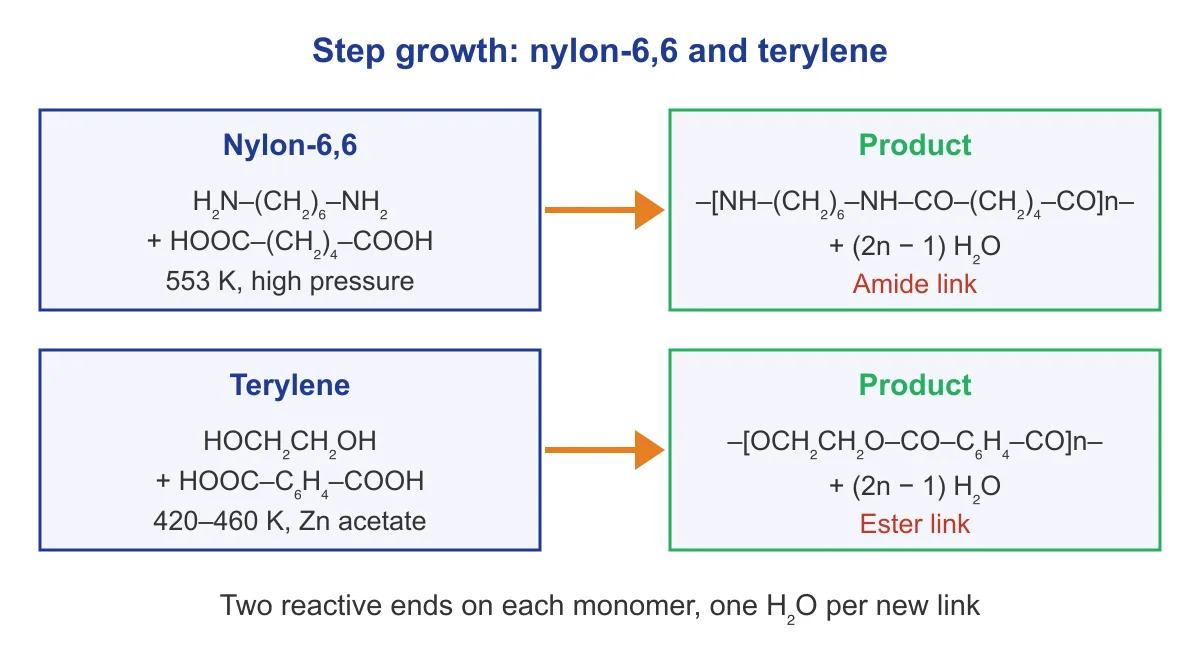
Figure 2.2: Step growth of nylon-6,6 and terylene
Nylon-6,6
Hexamethylenediamine, H₂N(CH₂)₆NH₂, and adipic acid, HOOC(CH₂)₄COOH, are heated at about 553 K under high pressure. The first digit counts carbons in the diamine and the second in the diacid. The chain is held by amide links, and neighbouring chains by hydrogen bonds between N–H and C=O, so it spins into strong fibres. Uses: ropes, tyre cords, fabrics, gears.
The repeat unit is –NH(CH₂)₆NHCO(CH₂)₄CO–, C₁₂H₂₂N₂O₂, molar mass 226 g mol⁻¹ (116 + 146 − 36).
Nylon-6
Caprolactam, a seven-membered cyclic amide, is heated with a little water at 533–543 K. Water opens a few rings to 6-aminohexanoic acid, and the amino end of one molecule then attacks the lactam carbonyl of another, opening it. Because this is a ring-opening addition, no small molecule is lost, and the polymer repeat unit has the same formula as caprolactam, C₆H₁₁NO (113 g mol⁻¹). Uses: tyre cords, fabrics, ropes. It is still grouped with the polyamides, and it is a homopolymer.
Terylene (Dacron, polyethylene terephthalate)
Ethylene glycol and terephthalic acid (benzene-1,4-dicarboxylic acid) are heated at 420–460 K with a catalyst such as zinc acetate with antimony trioxide. The link is an ester. The repeat unit –OCH₂CH₂O–CO–C₆H₄–CO– is C₁₀H₈O₄, 192 g mol⁻¹ (62 + 166 − 36). It is a polyester used for crease-resistant clothing, sails and bottles.
Bakelite
Phenol and methanal (HCHO) are condensed in the presence of an acid or a base. Methanal attacks the ortho and para positions of phenol, giving hydroxymethylphenols that join through –CH₂– bridges.
- With an acid catalyst and less than one mole of HCHO per mole of phenol, a linear, fusible polymer called novolac forms.
- Heating novolac with hexamethylenetetramine supplies extra –CH₂– bridges and builds a rigid three-dimensional network, Bakelite.
Bakelite is a hard, infusible, cross-linked thermosetting polymer, a good insulator. It is used for electrical switches, handles of pans and combs.
Copolymers: Buna-S, Buna-N
A copolymer forms when two or more different monomers add into the same chain. The name Buna comes from butadiene and Na (sodium, the original catalyst).
- Buna-S: 1,3-butadiene and styrene (C₆H₅CH=CH₂), with sodium as catalyst. It is tough, abrasion-resistant, and is used for tyres and floor tiles.
- Buna-N: 1,3-butadiene and acrylonitrile (CH₂=CH–CN). It resists oil and petrol, so it makes oil seals, hoses and tank linings.
Butadiene adds through its terminal carbons (1,4-addition), leaving a C=C inside the chain. That residual double bond is why these rubbers can still be vulcanised.
Natural rubber and vulcanisation
Natural rubber is a polymer of isoprene (2-methylbuta-1,3-diene, C₅H₈, 68 g mol⁻¹), joined 1,4 with cis geometry at every double bond. The cis double bonds put a kink in each unit, so chains cannot line up and pack. They stay randomly coiled, which is the source of the stretch and recovery.
Raw rubber has drawbacks: it is soft and sticky, wears quickly, becomes tacky when warm and brittle when cold, and slowly dissolves in organic solvents. Heating it with sulfur at 373–415 K (vulcanisation) fixes this. Sulfur atoms form –S–S– or –S– bridges between neighbouring chains at the reactive allylic positions beside the double bonds. The cross-links stop chains sliding past each other permanently, so the rubber becomes harder, stronger, more resilient, and less affected by heat and solvents. The more sulfur used, the stiffer the product: a few percent gives a flexible tyre rubber, 30 percent or more gives hard ebonite.
Memory trick: "Cis kinks, sulfur sticks." Cis bends the chain so it coils; sulfur stitches the coils together. Use it to recall both why rubber stretches and what vulcanisation changes.
Cellulose
Cellulose is the structural polymer of plant cell walls: cotton is about 90 percent cellulose, wood about half. It is a linear polymer of β-D-glucose units joined by β-1,4-glycosidic links between C-1 of one ring and C-4 of the next. Its formula is (C₆H₁₀O₅)n, repeat unit 162 g mol⁻¹. Hydrolysis with acid gives only D-glucose, with one water added per link broken:
The β links make each unit flip relative to the previous one, so the chain is a straight ribbon. Many such ribbons lie side by side and hydrogen-bond into strong fibres. That is why cellulose is tough and insoluble. Humans lack the enzyme that cuts β-links, so we cannot digest it. Starch, made of α-D-glucose with α-1,4 links, is coiled and digestible. Cellulose treated with acetic anhydride gives cellulose acetate (a semi-synthetic polymer, used in rayon-type fibres), and with HNO₃ gives cellulose nitrate.
Biodegradable polymers
Most synthetic polymers last for centuries in soil and water. Biodegradable polymers contain links that microbes and enzymes can hydrolyse into small molecules.
- PHBV (poly-β-hydroxybutyrate-co-β-hydroxyvalerate): a copolyester of 3-hydroxybutanoic acid, CH₃CH(OH)CH₂COOH, and 3-hydroxypentanoic acid, CH₃CH₂CH(OH)CH₂COOH. Bacteria and enzymes degrade it. Uses: packaging, orthopaedic devices, controlled drug release.
- Nylon-2-nylon-6: an alternating copolyamide of glycine, H₂NCH₂COOH ("2" carbon) and 6-aminohexanoic acid, H₂N(CH₂)₅COOH ("6" carbon). Because it contains amide links that match natural protein-type bonds, it is biodegradable.
Memory trick: "Nylon-2-nylon-6: two-carbon glycine, six-carbon amino acid, no diamine." Use it to rebuild the monomers without memorising a structure.
Comparison of look-alikes
| Polymer | Monomer(s) | Type | Link or note |
|---|---|---|---|
| Polythene | Ethene | Addition | LDPE: O₂ and high pressure; HDPE: Ziegler–Natta |
| Teflon | CF₂=CF₂ | Addition | Persulphate, pressure |
| PVC | CH₂=CHCl | Addition | Free radical |
| Buna-S | Butadiene, styrene | Addition copolymer | Na catalyst |
| Buna-N | Butadiene, acrylonitrile | Addition copolymer | Oil resistant |
| Nylon-6,6 | HMDA, adipic acid | Condensation | Amide, loses H₂O |
| Nylon-6 | Caprolactam | Ring-opening | Amide, nothing lost |
| Terylene | Glycol, terephthalic acid | Condensation | Ester, loses H₂O |
| Bakelite | Phenol, HCHO | Condensation | Cross-linked |
Worked examples
Example 1: Polythene has an average molar mass of 56 000 g mol⁻¹. Find the average degree of polymerisation.
Repeat unit –CH₂–CH₂– = 28 g mol⁻¹.
$n = \frac{56000}{28} = 2000$.
Why this works: an addition polymer's repeat unit has the monomer's formula, so simply divide.
Example 2: Nylon-6,6 with 100 repeat units: molar mass, and moles of water released per mole of chain (ignore end groups).
Repeat unit = C₁₂H₂₂N₂O₂ = 144 + 22 + 28 + 32 = 226.
Mass = 100 × 226 = 22 600 g mol⁻¹.
Water: each repeat unit comes from one diamine and one diacid, and joining them in the chain costs 2 H₂O, so about 2 × 100 = 200 mol.
Check by mass: 100 × (116 + 146) = 26 200; 26 200 − 200 × 18 = 22 600. ✓
Why this works: counting the new links (or subtracting the water mass) gives the same answer.
Example 3: 1.66 kg of terephthalic acid reacts completely with excess ethylene glycol. Find the maximum mass of terylene (long chains, ends ignored).
Terephthalic acid, C₈H₆O₄ = 166, so moles = 1660 / 166 = 10.
Each mole of acid becomes one repeat unit of 192 g.
Mass = 10 × 192 = 1920 g.
Check by conservation: glycol used = 10 × 62 = 620 g, input 2280 g, water out 20 × 18 = 360 g, so 2280 − 360 = 1920 g. ✓
Why this works: the repeat unit already accounts for the lost water.
Example 4: A Buna-S sample has the butadiene : styrene mole ratio of 3 : 1. Find the mass percent of styrene.
Butadiene unit C₄H₆ = 54, styrene unit C₈H₈ = 104.
For 3 : 1: mass of butadiene = 162, styrene = 104; total = 266.
Styrene % = $\frac{104}{266} \times 100 = 39.1$.
Why this works: in addition polymerisation each monomer enters the chain whole, so the unit masses equal the monomer masses.
Example 5: Vulcanised rubber contains 3.2 percent sulfur by mass. Estimate the number of isoprene units per sulfur atom.
Take 100 g. Sulfur = 3.2 g = 0.1 mol. Rubber hydrocarbon = 96.8 g.
Isoprene units = 96.8 / 68 = 1.42 mol.
Ratio = 1.42 / 0.1 ≈ 14 isoprene units per S atom.
Why this works: the repeat unit is C₅H₈, so mass converts to moles of units, which compare directly with moles of S.
Example 6: Decide, with reasons, which pair is wrongly matched: (a) HDPE, TiCl₄ and Al(C₂H₅)₃; (b) nylon-6, loss of water at every link; (c) Bakelite, thermosetting; (d) PVC, free radical.
(a) correct, Ziegler–Natta.
(b) caprolactam opens by ring-opening, with no small molecule eliminated per link, so (b) is the wrong match.
(c), (d) correct.
Why this works: ask what the monomer is before asking what is lost. A lactam has no free –COOH and –NH₂ to condense.
Example 7: 116 g of hexamethylenediamine and 146 g of adipic acid react completely to long chains. Find the mass of polymer and the mass of water.
Moles: 116 / 116 = 1; 146 / 146 = 1. Equimolar, so both are used up.
For large chains, water ≈ 2 mol × 18 = 36 g.
Polymer = (116 + 146) − 36 = 226 g.
Why this works: when the two difunctional monomers are in equimolar ratio, chains grow long. Mass is conserved.
Memory trick: "Addition adds all, condensation drops a drop." Add all atoms to the chain in addition; condensation drops water. Use it to decide the repeat-unit mass in any numerical question.
Applications at a glance
- LDPE: films, carry bags, wire insulation. HDPE: pipes, containers, toys.
- PVC: pipes, floor coverings, cable sheath.
- Teflon: non-stick coating, chemical-resistant seals.
- Nylon-6,6 and nylon-6: ropes, tyre cord, stockings, fishing lines, gears.
- Terylene: clothes (often blended with cotton), sails, tapes.
- Bakelite: electrical fittings and handles.
- Buna-S: tyres. Buna-N: oil seals and hoses.
- Natural rubber (vulcanised): tyres, hoses, gloves, belts.
- PHBV and nylon-2-nylon-6: disposable packaging and medical items that break down in the body or in soil.
Common traps
- Calling nylon-6 a condensation product that loses water → it is a ring-opening polymer of caprolactam and loses nothing.
- Treating nylon-6,6 as a homopolymer because it has "one name" → it is built from two different monomers and is a copolymer.
- Writing the repeat unit of a condensation polymer as the sum of both monomers → subtract the 2 H₂O (or the appropriate small molecule) per repeat unit.
- Believing HDPE is branched because it is "high" → HDPE is linear and dense; LDPE is the branched one.
- Writing trans geometry for natural rubber → it is cis-1,4-polyisoprene; the trans form is gutta-percha.
- Thinking vulcanisation removes the sulfur chains on heating → cross-links are permanent; sulfur forms the bridges and the product is harder.
- Treating Bakelite as thermoplastic because phenol-formaldehyde novolac melts → novolac is the linear intermediate; the cured network is thermosetting.
- Confusing Buna-N with Buna-S by the letter → N means acrylonitrile (nitrile), S means styrene.
- Calling cellulose α-glucose polymer, or saying humans digest it → cellulose is β-D-glucose with β-1,4 links and is not digestible by humans.
- Putting a diamine in nylon-2-nylon-6 → the "2" and "6" are two amino acids (glycine and 6-aminohexanoic acid).
Quick revision
- Addition polymer: repeat unit = monomer; condensation polymer: small molecule (H₂O) lost per link.
- $M = n \times M_{repeat\ unit}$, and chains in a sample have different $n$, so molar mass is an average.
- Free-radical addition: initiation, propagation, termination.
- LDPE: 1000–2000 atm, 350–570 K, trace O₂ or peroxide, branched. HDPE: 6–7 atm, 333–343 K, TiCl₄ + Al(C₂H₅)₃, linear.
- Teflon: CF₂=CF₂, persulphate; PVC: CH₂=CHCl.
- Nylon-6,6: HMDA + adipic acid, 553 K, repeat unit 226.
- Nylon-6: caprolactam + water, 533–543 K, repeat unit 113, nothing lost.
- Terylene: glycol + terephthalic acid, 420–460 K, repeat unit 192, ester links.
- Bakelite: phenol + HCHO, novolac then hexamethylenetetramine, cross-linked, thermosetting.
- Buna-S: butadiene + styrene (Na); Buna-N: butadiene + acrylonitrile.
- Natural rubber: cis-1,4-polyisoprene; vulcanisation: sulfur cross-links at 373–415 K.
- Cellulose: linear β-D-glucose, β-1,4 links, hydrolyses to glucose only.
- PHBV: 3-hydroxybutanoic + 3-hydroxypentanoic acids. Nylon-2-nylon-6: glycine + 6-aminohexanoic acid.
- Elastomers have weak forces, fibres strong H-bonds, thermoplastics soften, thermosets cross-link.
Practice questions
Which of the following is a condensation polymer?
- Teflon
- Buna-S
- PVC
- Terylene
Answer
D. Terylene
Terylene forms from ethylene glycol and terephthalic acid with loss of water at each ester link. PVC, Teflon and Buna-S form by addition of C=C monomers.
The monomer of Teflon is
- CF₂=CF₂
- CF₃–CF₃
- CClF=CF₂
- CH₂=CF₂
Answer
A. CF₂=CF₂
Teflon is polytetrafluoroethene, made from tetrafluoroethene, CF₂=CF₂.
Linear high-density polythene is prepared from ethene using
- benzoyl peroxide at 2000 atm
- a trace of dioxygen at 1500 atm
- TiCl₄ with Al(C₂H₅)₃ at 6–7 atm
- sodium metal at 350 K
Answer
C. TiCl₄ with Al(C₂H₅)₃ at 6–7 atm
HDPE needs a Ziegler–Natta catalyst, TiCl₄ with Al(C₂H₅)₃, at about 333–343 K and 6–7 atm. Dioxygen or peroxide with very high pressure gives branched LDPE.
Natural rubber is a polymer of isoprene with the structure
- cis-1,4-polybutadiene
- cis-1,4-polyisoprene
- trans-1,4-polyisoprene
- 1,2-polyisoprene
Answer
B. cis-1,4-polyisoprene
Natural rubber is cis-1,4-polyisoprene. The trans form is gutta-percha, which is hard and not elastic.
Vulcanisation improves natural rubber mainly because
- sulfur removes all double bonds and makes the chains straight and crystalline
- sulfur converts the cis double bonds into trans
- sulfur forms cross-links between chains at sites near the double bonds
- sulfur breaks the chains into shorter units
Answer
C. sulfur forms cross-links between chains at sites near the double bonds
Heating with sulfur makes –S– or –S–S– bridges between neighbouring chains at reactive allylic positions. Chains cannot slip, so the rubber is harder, stronger and less sticky.
Bakelite is best described as
- a cross-linked thermosetting polymer from phenol and methanal
- a linear thermoplastic from phenol and methanal
- an addition polymer of styrene and butadiene
- an elastomer from isoprene
Answer
A. a cross-linked thermosetting polymer from phenol and methanal
Bakelite is the three-dimensional network formed when novolac (from phenol and methanal) is heated with hexamethylenetetramine. It is infusible once set.
Which of the following is a homopolymer?
- Nylon-6,6
- Buna-S
- Buna-N
- Nylon-6
Answer
D. Nylon-6
Nylon-6 is made from one monomer, caprolactam. Buna-N, Buna-S and nylon-6,6 each contain two different monomer units.
PHBV is a copolymer of
- 3-hydroxybutanoic acid and butanedioic acid
- 3-hydroxybutanoic acid and 3-hydroxypentanoic acid
- 3-hydroxybutanoic acid and 2-hydroxypropanoic acid
- 4-hydroxybutanoic acid and 5-hydroxypentanoic acid
Answer
B. 3-hydroxybutanoic acid and 3-hydroxypentanoic acid
PHBV stands for poly(hydroxybutyrate-co-hydroxyvalerate): 3-hydroxybutanoic acid and 3-hydroxypentanoic acid joined as a polyester.
The monomers of the biodegradable polymer nylon-2-nylon-6 are
- glycine and hexamethylenediamine
- caprolactam and ethylene glycol
- alanine and adipic acid
- glycine and 6-aminohexanoic acid
Answer
D. glycine and 6-aminohexanoic acid
The numbers 2 and 6 refer to the amino acids with two carbons (glycine) and six carbons (6-aminohexanoic acid), alternating along the chain through amide links.
Low-density polythene is made from ethene under the conditions
- 6–7 atm, 420–460 K, zinc acetate
- 6–7 atm, 333–343 K, TiCl₄ with Al(C₂H₅)₃
- 1000–2000 atm, 350–570 K, trace of dioxygen or a peroxide
- 1–2 atm, 300 K, sodium
Answer
C. 1000–2000 atm, 350–570 K, trace of dioxygen or a peroxide
LDPE is a free-radical high-pressure process. Option A is the HDPE process and option D resembles the terylene process.
Cellulose is a linear polymer in which the repeat unit is joined through
- α-1,4 glycosidic links between α-D-glucose units
- β-1,4 glycosidic links between β-D-glucose units
- β-1,2 glycosidic links between fructose units
- α-1,6 glycosidic links between α-D-glucose units
Answer
B. β-1,4 glycosidic links between β-D-glucose units
Cellulose is β-D-glucose joined by β-1,4 links. Option A describes the main chain of starch.
A feature that distinguishes step-growth from chain-growth polymerisation is that in step-growth
- very high molar mass chains appear right at the start of the reaction
- chains grow only at a radical end
- an initiator that gives radicals is required
- monomers vanish early as dimers and small oligomers, and high molar mass appears only at high conversion
Answer
D. monomers vanish early as dimers and small oligomers, and high molar mass appears only at high conversion
In step growth any two reactive molecules can join, so monomer is used up early and long chains form only when almost all functional groups have reacted. Options A to C describe chain growth.
In the conversion of novolac into Bakelite, the reagent that supplies the extra –CH₂– cross-links is
- hexamethylenetetramine
- sulfur
- TiCl₄ with Al(C₂H₅)₃
- benzoyl peroxide
Answer
A. hexamethylenetetramine
Heating novolac with hexamethylenetetramine releases methylene units that bridge the chains and build the three-dimensional network.
When n molecules of caprolactam form nylon-6, the polymer (ignoring end groups) is best described as
- (C₆H₁₁NO)n formed with loss of n H₂O
- (C₆H₁₁NO)n with no small molecule lost
- (C₆H₁₀NO)n formed with loss of n/2 H₂O
- (C₆H₉N)n formed with loss of n NH₃
Answer
B. (C₆H₁₁NO)n with no small molecule lost
Water only opens the first few rings. Each further ring opens by attack of an amino end on the lactam carbonyl, so the repeat unit –NH(CH₂)₅CO– has the same formula as caprolactam, C₆H₁₁NO.
A sample of high-density polythene has an average molar mass of 140 000 g mol⁻¹. What is the average degree of polymerisation? (C = 12, H = 1)
- 5000
- 2500
- 10000
- 1400
Answer
A. 5000
Repeat unit –CH₂–CH₂– has mass 28. n = 140000 / 28 = 5000. Check: 5000 × 28 = 140000.
Polyvinyl chloride has 800 repeat units per chain on average. What is its average molar mass in g mol⁻¹? (C = 12, H = 1, Cl = 35.5)
- 100000
- 25000
- 50000
- 22400
Answer
C. 50000
Repeat unit –CH₂–CHCl– is C₂H₃Cl = 24 + 3 + 35.5 = 62.5. Mass = 800 × 62.5 = 50000. Check: 62.5 × 8 = 500, times 100 = 50000.
A nylon-6,6 chain has 200 repeat units. Ignoring end groups, what is its molar mass in g mol⁻¹? (C = 12, H = 1, N = 14, O = 16)
- 45200
- 52400
- 90400
- 22600
Answer
A. 45200
Repeat unit C₁₂H₂₂N₂O₂ = 144 + 22 + 28 + 32 = 226. Mass = 200 × 226 = 45200. Check: monomers 116 + 146 = 262, minus 2 H₂O (36) = 226.
Nylon-6 chain with 500 caprolactam-derived repeat units. What is its molar mass in g mol⁻¹, ignoring end groups? (C = 12, H = 1, N = 14, O = 16)
- 28250
- 113000
- 65500
- 56500
Answer
D. 56500
Caprolactam C₆H₁₁NO = 72 + 11 + 14 + 16 = 113, and no mass is lost on polymerisation. Mass = 500 × 113 = 56500.
Terephthalic acid (molar mass 166 g mol⁻¹), 1660 g, reacts completely with excess ethylene glycol to give long terylene chains. What is the mass of terylene formed in grams? (Ethylene glycol 62, H₂O 18)
- 2280
- 1920
- 2100
- 1660
Answer
B. 1920
Moles of acid = 1660 / 166 = 10. Repeat unit = 166 + 62 − 36 = 192. Mass = 10 × 192 = 1920 g. Check by the other route: C₁₀H₈O₄ = 120 + 8 + 64 = 192.
A Buna-S sample contains butadiene (C₄H₆) and styrene (C₈H₈) units in the mole ratio 3 : 1. What is the molar mass in g mol⁻¹ of one such group of four units? (C = 12, H = 1)
- 158
- 212
- 266
- 320
Answer
C. 266
3 × 54 = 162 for butadiene, 104 for styrene. Total = 162 + 104 = 266. Addition copolymerisation loses nothing.
A sample of vulcanised rubber of mass 500 g contains 6.4 percent sulfur by mass. How many moles of sulfur atoms does it contain? (S = 32)
- 1
- 0.5
- 2
- 32
Answer
A. 1
Mass of sulfur = 0.064 × 500 = 32 g. Moles = 32 / 32 = 1.
Natural rubber of average molar mass 68 000 g mol⁻¹ is a polymer of isoprene, C₅H₈. How many isoprene units does an average chain contain? (C = 12, H = 1)
- 500
- 1000
- 2000
- 4000
Answer
B. 1000
Isoprene unit = 60 + 8 = 68. n = 68000 / 68 = 1000.
What is the mass percent of fluorine in Teflon? (C = 12, F = 19)
- 24
- 19
- 38
- 76
Answer
D. 76
Repeat unit C₂F₄ = 24 + 76 = 100. Fluorine = 76 / 100 = 76 percent. Carbon is the other 24 percent.
PHBV chains contain 3-hydroxybutanoate and 3-hydroxypentanoate units (formulas C₄H₆O₂ and C₅H₈O₂) in the mole ratio 9 : 1. What is the molar mass in g mol⁻¹ of a group of ten such units? (C = 12, H = 1, O = 16)
- 774
- 986
- 874
- 860
Answer
C. 874
C₄H₆O₂ = 48 + 6 + 32 = 86; C₅H₈O₂ = 60 + 8 + 32 = 100. Mass = 9 × 86 + 100 = 774 + 100 = 874.
162 g of cellulose, (C₆H₁₀O₅)n, is completely hydrolysed by dilute acid to glucose. What is the mass of glucose in grams? (C = 12, H = 1, O = 16)
- 180
- 198
- 162
- 324
Answer
A. 180
Cellulose unit C₆H₁₀O₅ = 162, glucose C₆H₁₂O₆ = 180. Each unit takes up one H₂O (18 g), so 162 + 18 = 180 g. Moles of units = 1, glucose = 1 mol.
Nylon-2-nylon-6 is an alternating polymer of glycine and 6-aminohexanoic acid. What is the molar mass in g mol⁻¹ of one alternating repeat pair, –NHCH₂CO–NH(CH₂)₅CO–? (C = 12, H = 1, N = 14, O = 16)
- 340
- 170
- 131
- 188
Answer
B. 170
Glycine unit –NHCH₂CO– = C₂H₃NO = 57. Aminohexanoic unit –NH(CH₂)₅CO– = C₆H₁₁NO = 113. Pair = 57 + 113 = 170.
Given below are two statements: Statement I: Teflon is prepared by condensation of tetrafluoroethene with loss of HF. Statement II: Teflon is chemically inert because the C–F bond is very strong. Choose the correct option.
- Both Statement I and Statement II are correct
- Both Statement I and Statement II are incorrect
- Statement I is correct but Statement II is incorrect
- Statement I is incorrect but Statement II is correct
Answer
D. Statement I is incorrect but Statement II is correct
Teflon forms by free-radical addition polymerisation with nothing lost, so Statement I is incorrect. Strong C–F bonds and the fluorine sheath make it inert, so Statement II is correct.
Given below are two statements: Statement I: High-density polythene is denser than low-density polythene. Statement II: Low-density polythene is made by using a Ziegler–Natta catalyst. Choose the correct option.
- Both Statement I and Statement II are correct
- Both Statement I and Statement II are incorrect
- Statement I is correct but Statement II is incorrect
- Statement I is incorrect but Statement II is correct
Answer
C. Statement I is correct but Statement II is incorrect
HDPE has linear chains that pack closely, so it is denser; Statement I is correct. LDPE needs a trace of dioxygen or peroxide at high pressure; the Ziegler–Natta catalyst gives HDPE, so Statement II is incorrect.
Given below are two statements: Statement I: Buna-S is prepared by condensation of butadiene and styrene with loss of water. Statement II: PHBV is a non-biodegradable polymer. Choose the correct option.
- Both Statement I and Statement II are correct
- Both Statement I and Statement II are incorrect
- Statement I is correct but Statement II is incorrect
- Statement I is incorrect but Statement II is correct
Answer
B. Both Statement I and Statement II are incorrect
Buna-S is an addition copolymer; nothing is lost, so Statement I is wrong. PHBV is a polyester that microbes degrade, so Statement II is wrong.
Given below are two statements: Statement I: Novolac is a linear, fusible polymer formed from phenol and methanal under acid catalysis. Statement II: Heating novolac with hexamethylenetetramine gives the cross-linked Bakelite. Choose the correct option.
- Both Statement I and Statement II are correct
- Both Statement I and Statement II are incorrect
- Statement I is correct but Statement II is incorrect
- Statement I is incorrect but Statement II is correct
Answer
A. Both Statement I and Statement II are correct
Both statements are standard facts. Novolac is the linear intermediate; hexamethylenetetramine supplies methylene bridges to cure it.
Given below are two statements: Statement I: Cellulose is a linear polymer of β-D-glucose. Statement II: Cellulose chains are heavily branched through α-1,6 links. Choose the correct option.
- Both Statement I and Statement II are correct
- Both Statement I and Statement II are incorrect
- Statement I is correct but Statement II is incorrect
- Statement I is incorrect but Statement II is correct
Answer
C. Statement I is correct but Statement II is incorrect
Cellulose has only β-1,4 links and is linear, so Statement I is correct. α-1,6 branches occur in amylopectin and glycogen, not cellulose, so Statement II is incorrect.
Assertion (A): Natural rubber is highly elastic. Reason (R): Its chains have cis configuration at the double bonds, so they cannot pack closely and stay coiled. Choose the correct option.
- Both A and R are true and R is the correct explanation of A
- Both A and R are true but R is not the correct explanation of A
- A is true but R is false
- A is false but R is true
Answer
A. Both A and R are true and R is the correct explanation of A
The cis kinks stop the chains aligning, so they stay randomly coiled and can stretch and recoil. R explains A.
Assertion (A): Terylene is a condensation polymer. Reason (R): Terylene fibres are used to make crease-resistant clothing. Choose the correct option.
- Both A and R are true and R is the correct explanation of A
- Both A and R are true but R is not the correct explanation of A
- A is true but R is false
- A is false but R is true
Answer
B. Both A and R are true but R is not the correct explanation of A
Terylene is a polyester formed with loss of water, so A is true. R is also true, but a use does not explain the mode of formation.
Assertion (A): Bakelite can be melted and remoulded repeatedly. Reason (R): Bakelite is a thermosetting polymer with a cross-linked network. Choose the correct option.
- Both A and R are true and R is the correct explanation of A
- Both A and R are true but R is not the correct explanation of A
- A is true but R is false
- A is false but R is true
Answer
D. A is false but R is true
A is false: a cured thermoset cannot be remelted. R is true, and it is the reason that A is false.
Match List I with List II. List I: a. Buna-N b. Teflon c. Nylon-6 d. Terylene. List II: i. Caprolactam ii. Butadiene and acrylonitrile iii. Ethylene glycol and terephthalic acid iv. Tetrafluoroethene.
- a-i, b-iv, c-ii, d-iii
- a-iv, b-ii, c-iii, d-i
- a-ii, b-iii, c-i, d-iv
- a-ii, b-iv, c-i, d-iii
Answer
D. a-ii, b-iv, c-i, d-iii
Buna-N: butadiene with acrylonitrile (ii). Teflon: CF₂=CF₂ (iv). Nylon-6: caprolactam (i). Terylene: glycol with terephthalic acid (iii).
Match List I with List II. List I: a. Bakelite b. PHBV c. Natural rubber d. Cellulose. List II: i. cis-1,4-polyisoprene ii. β-D-glucose units iii. Thermosetting phenol–methanal polymer iv. Biodegradable copolyester.
- a-iv, b-iii, c-i, d-ii
- a-iii, b-iv, c-ii, d-i
- a-iii, b-iv, c-i, d-ii
- a-i, b-iv, c-iii, d-ii
Answer
C. a-iii, b-iv, c-i, d-ii
Bakelite is the thermosetting phenol–methanal polymer (iii). PHBV is the biodegradable copolyester (iv). Natural rubber is cis-1,4-polyisoprene (i). Cellulose is made of β-D-glucose units (ii).
Match List I with List II. List I: a. LDPE b. HDPE c. Nylon-6 d. Buna-S. List II: i. Ziegler–Natta catalyst ii. Trace of dioxygen at very high pressure iii. Caprolactam heated with water iv. Sodium as catalyst.
- a-ii, b-i, c-iii, d-iv
- a-ii, b-i, c-iv, d-iii
- a-i, b-ii, c-iii, d-iv
- a-iii, b-i, c-ii, d-iv
Answer
A. a-ii, b-i, c-iii, d-iv
LDPE: dioxygen or peroxide at high pressure (ii). HDPE: Ziegler–Natta (i). Nylon-6: caprolactam with water (iii). Buna-S: sodium (iv).
A nylon-6,6 sample has an average molar mass of 22600 g mol⁻¹ (ends ignored). Each repeat unit is –NH(CH₂)₆NHCO(CH₂)₄CO– (molar mass 226). Estimate the number of amide (–CONH–) links per average chain, counting the two in each repeat unit.
- 50
- 100
- 200
- 400
Answer
C. 200
n = 22600 / 226 = 100 repeat units. Each unit contains two amide links (one from each end of the diamine), so 2 × 100 = 200.
A 1 : 1 mole-ratio copolymer of 1,3-butadiene (C₄H₆) and acrylonitrile (C₃H₃N) is analysed. What is its nitrogen content by mass? (C = 12, H = 1, N = 14)
- 26.2 percent
- 13.1 percent
- 8.9 percent
- 6.5 percent
Answer
B. 13.1 percent
One pair unit = C₇H₉N = 54 + 53 = 107. Nitrogen = 14 / 107 = 0.131, that is 13.1 percent. Option D wrongly uses butadiene plus styrene, 158.
232 g of hexamethylenediamine (molar mass 116) and 292 g of adipic acid (molar mass 146) are heated to form long nylon-6,6 chains. Assume complete reaction and ignore end groups. What is the mass of polymer in grams? (H₂O = 18)
- 488
- 226
- 524
- 452
Answer
D. 452
Moles: 232 / 116 = 2 and 292 / 146 = 2, equimolar. Each pair releases 2 H₂O, so 4 mol of water = 72 g. Polymer = 232 + 292 − 72 = 452 g. Check: 2 repeat units × 226 = 452.