Definite Integrals
What to remember
- If $F'(x) = f(x)$ on $[a, b]$, then $\int_a^b f(x)\,dx = F(b) - F(a)$. No constant of integration appears, because it cancels.
- In a substitution the limits change with the variable. In integration by parts, evaluate the bracket $[uv]_a^b$ first and then integrate what is left.
- The "king" property $\int_0^a f(x)\,dx = \int_0^a f(a - x)\,dx$ lets you add two copies of the same integral so that the difficult part cancels.
- Over $[-a, a]$: an odd function gives $0$, an even function gives $2\int_0^a f(x)\,dx$. A function of period $T$ has $\int_0^{nT} f(x)\,dx = n\int_0^T f(x)\,dx$.
- A modulus or a greatest integer function must be broken into pieces at the points where the sign changes or the value jumps. Differentiating an integral with variable limits uses $\frac{d}{dx}\int_{g(x)}^{h(x)} f(t)\,dt = f(h(x))\,h'(x) - f(g(x))\,g'(x)$.
The definite integral and the fundamental theorem
Cut the interval $[a, b]$ into $n$ equal strips of width $\Delta x = \frac{b-a}{n}$. On each strip pick a point $x_k$ and form the product $f(x_k)\,\Delta x$. Adding all of them and letting $n$ grow gives a number:
This limit exists for every function that is continuous on $[a, b]$, and also for a function with a finite number of jumps. The number is the signed area between the graph and the $x$-axis: area above the axis counts positive, area below counts negative. That is why $\int_0^{2\pi} \sin x\,dx = 0$ even though the graph clearly encloses area.
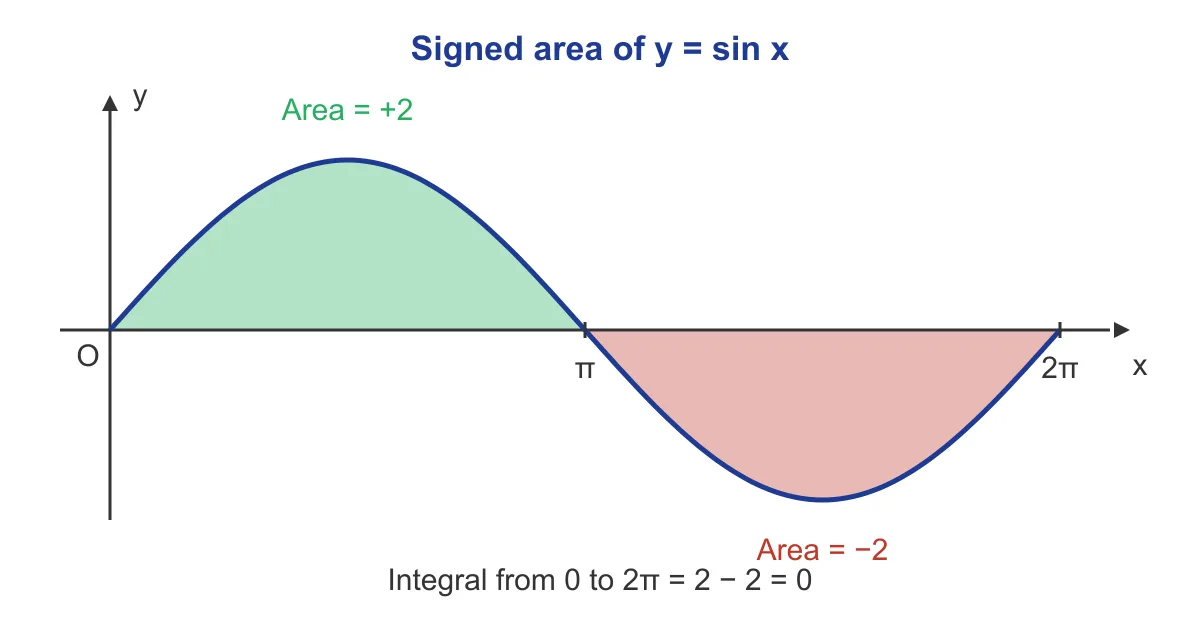
*Figure 2.1: Signed area. The two arches of $\sin x$ cancel over a full period.*
Two facts connect this limit to the antiderivatives of Chapter 1.
- Accumulation function. If $f$ is continuous and $A(x) = \int_a^x f(t)\,dt$, then $A'(x) = f(x)$. The rate at which the area grows equals the height of the curve at the moving end.
- Evaluation. If $F$ is any antiderivative of $f$, then $\int_a^b f(x)\,dx = F(b) - F(a)$. We write this as $[F(x)]_a^b$.
Why the second follows from the first: $A(x)$ and $F(x)$ both have derivative $f(x)$, so they differ by a constant, $A(x) = F(x) + c$. Since $A(a) = 0$, we get $c = -F(a)$, and then $A(b) = F(b) - F(a)$.
Three immediate rules: $\int_a^a f = 0$; $\int_b^a f = -\int_a^b f$; and the integral of a sum is the sum of integrals, with constants taken outside.
Example 1: Evaluate $\int_1^2 \left(x^2 - \frac{1}{x^2}\right) dx$.
An antiderivative of $x^2$ is $\frac{x^3}{3}$. An antiderivative of $-x^{-2}$ is $x^{-1} = \frac{1}{x}$.
So the integral is $\left[\frac{x^3}{3} + \frac{1}{x}\right]_1^2$.
At $2$: $\frac{8}{3} + \frac{1}{2} = \frac{19}{6}$. At $1$: $\frac{1}{3} + 1 = \frac{8}{6}$.
Difference: $\frac{19}{6} - \frac{8}{6} = \frac{11}{6}$.
Answer: $\frac{11}{6}$. Write the antiderivative once, put both limits in, subtract; most slips are sign slips at the lower limit.
Evaluation by substitution
For $\int_a^b f(g(x))\,g'(x)\,dx$ put $t = g(x)$. Then $dt = g'(x)\,dx$, and the limits $x = a$, $x = b$ become $t = g(a)$, $t = g(b)$:
Once you change the limits you never go back to $x$. This saves the step of re-substituting. Two conditions keep the method honest: $g'$ must be continuous on $[a, b]$, and $f$ must be continuous on the set of values that $g$ takes. If $g$ wanders through a point where $f$ blows up, the formula fails. For example, $t = \tan x$ cannot be used across $x = \frac{\pi}{2}$.
Memory trick: "New variable, new limits." Say it when you write $t = g(x)$ and draw two empty boxes for the limits before you do anything else.
Example 2: Evaluate $\int_0^{\pi/4} \frac{\sec^2 x}{(1 + \tan x)^2}\,dx$.
Put $t = 1 + \tan x$, so $dt = \sec^2 x\,dx$.
When $x = 0$, $t = 1$. When $x = \frac{\pi}{4}$, $t = 2$.
The integral becomes $\int_1^2 t^{-2}\,dt = \left[-\frac{1}{t}\right]_1^2 = -\frac{1}{2} + 1 = \frac{1}{2}$.
Answer: $\frac{1}{2}$. The derivative of the inner part sits in the numerator, which is the signal for substitution.
Example 3: Evaluate $\int_0^2 \frac{x}{\sqrt{x + 2}}\,dx$.
Put $t = x + 2$, so $x = t - 2$ and $dx = dt$. Limits: $x = 0 \Rightarrow t = 2$; $x = 2 \Rightarrow t = 4$.
Integrand: $\frac{t - 2}{\sqrt t} = t^{1/2} - 2t^{-1/2}$.
Antiderivative: $\frac{2}{3}t^{3/2} - 4t^{1/2}$.
At $t = 4$: $\frac{16}{3} - 8 = -\frac{8}{3}$. At $t = 2$: $\frac{4\sqrt2}{3} - 4\sqrt2 = -\frac{8\sqrt2}{3}$.
Difference: $-\frac{8}{3} + \frac{8\sqrt2}{3} = \frac{8}{3}(\sqrt2 - 1)$.
Answer: $\frac{8}{3}(\sqrt2 - 1)$. When the substitution is linear in the awkward part, rewrite $x$ in terms of $t$ and split the fraction.
Evaluation by parts
From $\frac{d}{dx}(uv) = u'v + uv'$, integrating over $[a, b]$ gives
Choose $u$ as the part that becomes simpler on differentiation (a logarithm, an inverse trigonometric function, a power of $x$). Choose $v'$ as the part you can integrate easily. The bracket term is a number here, not an expression, so you can often see at once that it vanishes.
Example 4: Evaluate $\int_1^e (\ln x)^2\,dx$.
Take $u = (\ln x)^2$ and $v' = 1$. Then $u' = \frac{2\ln x}{x}$ and $v = x$.
$\int_1^e (\ln x)^2 dx = \left[x (\ln x)^2\right]_1^e - \int_1^e 2\ln x\,dx$.
The bracket: $e \cdot 1 - 1 \cdot 0 = e$.
Now $\int_1^e \ln x\,dx = [x\ln x - x]_1^e = (e - e) - (0 - 1) = 1$.
So the value is $e - 2 \times 1 = e - 2$.
Answer: $e - 2$. A power of $\ln x$ comes down by one with each round of parts, so repeat until it disappears.
Properties of definite integrals
All of these follow from the definition and the fundamental theorem. Let $f$ be continuous on the intervals involved.
| No. | Property | Condition |
|---|---|---|
| P1 | $\int_a^b f(x)\,dx = \int_a^b f(t)\,dt$ | The variable name does not matter |
| P2 | $\int_a^b f = \int_a^c f + \int_c^b f$ | $c$ any point, inside $[a, b]$ or not |
| P3 | $\int_a^b f(x)\,dx = \int_a^b f(a + b - x)\,dx$ | General king property |
| P4 | $\int_0^a f(x)\,dx = \int_0^a f(a - x)\,dx$ | Special case with lower limit $0$ |
| P5 | $\int_{-a}^{a} f(x)\,dx = 2\int_0^a f(x)\,dx$ or $0$ | $f$ even, or $f$ odd |
| P6 | $\int_0^{nT} f(x)\,dx = n\int_0^T f(x)\,dx$ | $f$ has period $T$, $n$ a positive integer |
| P7 | $\int_0^{2a} f(x)\,dx = 2\int_0^a f(x)\,dx$ or $0$ | $f(2a - x) = f(x)$, or $f(2a - x) = -f(x)$ |
Proof of P3. Put $x = a + b - t$. Then $dx = -dt$, and $x = a$ becomes $t = b$, $x = b$ becomes $t = a$. So $\int_a^b f(x)\,dx = -\int_b^a f(a+b-t)\,dt = \int_a^b f(a + b - t)\,dt$, which is the same as P3 after renaming $t$ as $x$. P4 is P3 with $a = 0$ and $b = a$.
The reason P3 is so useful: it replaces $x$ by $a + b - x$, which reflects the graph in the line $x = \frac{a+b}{2}$. If $f(x)$ and $f(a+b-x)$ are two pieces of one fraction that add to something simple, adding the two copies of the integral finishes the problem.
Memory trick: "King flips, then add: the two copies make 2I." Flip $x$ to $a - x$, write the integral twice, add, and the hard denominator cancels.
Example 5: Evaluate $I = \int_0^{\pi/2} \frac{\cos^5 x}{\cos^5 x + \sin^5 x}\,dx$.
By P4 with $a = \frac{\pi}{2}$, replace $x$ by $\frac{\pi}{2} - x$. Cosine becomes sine and sine becomes cosine:
$I = \int_0^{\pi/2} \frac{\sin^5 x}{\sin^5 x + \cos^5 x}\,dx$.
Add the two forms: $2I = \int_0^{\pi/2} \frac{\cos^5 x + \sin^5 x}{\cos^5 x + \sin^5 x}\,dx = \int_0^{\pi/2} 1\,dx = \frac{\pi}{2}$.
So $I = \frac{\pi}{4}$.
Answer: $\frac{\pi}{4}$. The exponent $5$ never mattered; any power gives the same result.
Even and odd functions
A function is even if $f(-x) = f(x)$ and odd if $f(-x) = -f(x)$. Over a symmetric interval an odd function has equal and opposite areas on the two sides, so they cancel. An even function has equal areas, so they double.
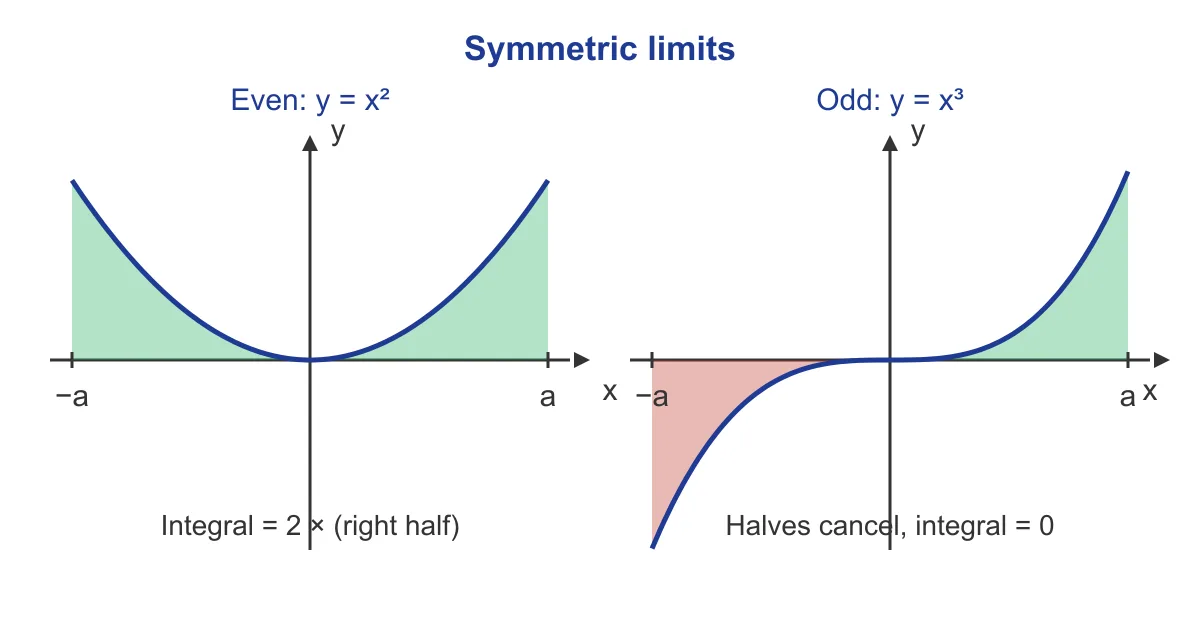
Figure 2.2: Symmetric limits. Even functions double, odd functions cancel.
Useful facts to carry: a sum of an even and an odd function splits into two integrals, and only the even part survives. Products follow sign rules: even times even is even, odd times odd is even, even times odd is odd. Also $\sin x$, $x$, $x^3$, $\tan x$ and $\ln\frac{1-x}{1+x}$ are odd, while $\cos x$, $x^2$, $\vert x \vert$ and $e^x + e^{-x}$ are even.
Memory trick: "Odd cancels, even doubles." Look at the limits first; if they are $-a$ and $a$, test $f(-x)$ before you integrate anything.
A useful trick appears when the integrand has the form $\frac{g(x)}{1 + e^x}$ and $g$ is even. Call the integral $I$. Replace $x$ by $-x$: $I = \int_{-a}^{a} \frac{g(x)}{1 + e^{-x}}\,dx = \int_{-a}^{a} \frac{e^x g(x)}{1 + e^x}\,dx$. Adding the two forms gives $2I = \int_{-a}^{a} g(x)\,dx$.
Example 6: Evaluate $\int_{-\pi/2}^{\pi/2} \frac{\sin^2 x}{1 + e^x}\,dx$.
Call it $I$. Replace $x$ by $-x$; $\sin^2 x$ is unchanged: $I = \int_{-\pi/2}^{\pi/2} \frac{\sin^2 x \cdot e^x}{e^x + 1}\,dx$.
Add: $2I = \int_{-\pi/2}^{\pi/2} \sin^2 x\,dx = 2\int_0^{\pi/2} \sin^2 x\,dx = 2 \cdot \frac{\pi}{4}$.
So $I = \frac{\pi}{4}$.
Answer: $\frac{\pi}{4}$. Here the integrand itself is neither even nor odd, but the pair $\frac{1}{1+e^x} + \frac{1}{1+e^{-x}} = 1$ rescues it.
Periodic functions
If $f(x + T) = f(x)$ for all $x$, the graph repeats every $T$ units, so every full period has the same area. Therefore $\int_a^{a + nT} f(x)\,dx = n\int_0^T f(x)\,dx$ for any starting point $a$. Moving the start never changes the area of one complete period. Useful periods: $\sin x$ and $\cos x$ have $2\pi$; $\vert \sin x \vert$, $\vert \cos x \vert$, $\sin^2 x$, $\tan x$ have $\pi$; $x - \lfloor x \rfloor$ has $1$.
Example 7: Evaluate $\int_0^{10\pi} \vert \sin x \vert\,dx$.
$\vert \sin x \vert$ has period $\pi$, so $\int_0^{10\pi} \vert \sin x \vert\,dx = 10\int_0^{\pi} \sin x\,dx$.
On $[0, \pi]$, $\sin x \ge 0$, so the modulus changes nothing: $\int_0^{\pi} \sin x\,dx = [-\cos x]_0^{\pi} = 1 + 1 = 2$.
Total: $10 \times 2 = 20$.
Answer: $20$. Find the true period of the modulus function before you count periods.
Choosing the right property
Before you start any real calculation on a definite integral, spend ten seconds looking at it. Read the limits first. Symmetric limits $-a$ and $a$ point to even and odd functions. Limits $0$ and $\frac{\pi}{2}$ or $0$ and $\pi$ together with a trigonometric fraction point to the king property. A limit like $n\pi$ or $2\pi$ with a trigonometric integrand points to periodicity. If none of these fits, go back to substitution or parts.
The king property has a recognisable shape: a fraction whose numerator and denominator are built from the same pair of functions that swap places when $x$ becomes $a - x$. When the numerator is exactly one of the two terms of the denominator, the answer is always half the length of the interval. When an extra factor of $x$ sits in front, as in $\int_0^{\pi} x\,g(\sin x)\,dx$, replace $x$ by $\pi - x$ and add; you get $\int_0^{\pi} x\,g(\sin x)\,dx = \frac{\pi}{2}\int_0^{\pi} g(\sin x)\,dx$, because $\sin(\pi - x) = \sin x$ and the two factors $x$ and $\pi - x$ add to $\pi$.
Modulus and greatest integer functions
The fundamental theorem needs a continuous integrand. A modulus keeps the integrand continuous but has a corner, and a greatest integer function has jumps. In both cases, use P2 to split the interval at the trouble points and integrate each piece with a plain formula.
Modulus. To integrate $\vert f(x) \vert$, find where $f(x) = 0$ inside the interval, decide the sign of $f$ on each piece, and replace $\vert f \vert$ by $f$ where $f \ge 0$ and by $-f$ where $f < 0$. A quick sign scheme on a number line prevents mistakes.
Example 8: Evaluate $\int_{-1}^{3} \vert x^2 - 2x \vert\,dx$.
$x^2 - 2x = x(x - 2)$. It is positive for $x < 0$, negative for $0 < x < 2$, positive for $x > 2$.
An antiderivative of $x^2 - 2x$ is $G(x) = \frac{x^3}{3} - x^2$. Values: $G(-1) = -\frac{4}{3}$, $G(0) = 0$, $G(2) = -\frac{4}{3}$, $G(3) = 0$.
On $[-1, 0]$: $G(0) - G(-1) = \frac{4}{3}$. On $[0, 2]$ the sign is negative, so we take $-(G(2) - G(0)) = \frac{4}{3}$. On $[2, 3]$: $G(3) - G(2) = \frac{4}{3}$.
Total: $\frac{4}{3} \times 3 = 4$.
Answer: $4$. Dropping the modulus would give $G(3) - G(-1) = \frac{4}{3}$, a different and wrong number.
Greatest integer function. $\lfloor x \rfloor$ is the largest integer not exceeding $x$. It equals $k$ on every interval $[k, k + 1)$. So $\int_0^n \lfloor x \rfloor\,dx = 0 + 1 + 2 + \dots + (n - 1) = \frac{n(n-1)}{2}$. For a function like $\lfloor x^2 \rfloor$ or $\lfloor \sqrt x \rfloor$, find where the inside crosses each integer and cut there.
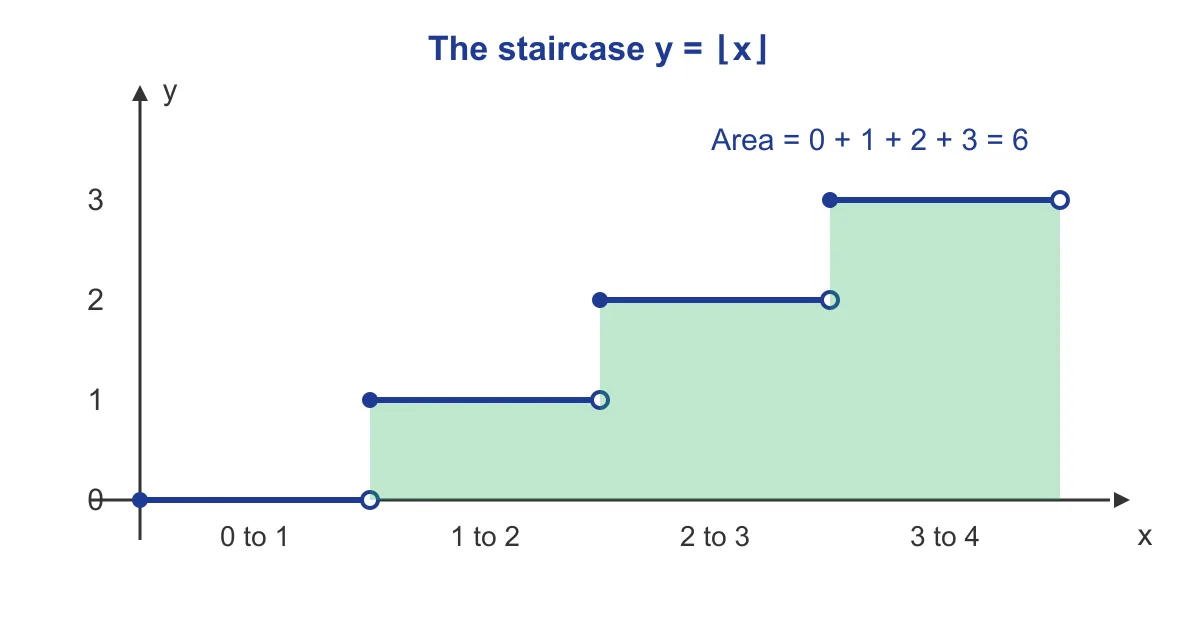
*Figure 2.3: $\lfloor x \rfloor$ is a staircase. The integral is the total area of the rectangles under the steps.*
Example 9: Evaluate $\int_0^3 x \lfloor x \rfloor\,dx$.
Split: on $[0, 1)$, $\lfloor x \rfloor = 0$; on $[1, 2)$ it is $1$; on $[2, 3)$ it is $2$.
$\int_0^1 0\,dx = 0$. $\int_1^2 x\,dx = \frac{4 - 1}{2} = \frac{3}{2}$. $\int_2^3 2x\,dx = 9 - 4 = 5$.
Total: $0 + \frac{3}{2} + 5 = \frac{13}{2}$.
Answer: $\frac{13}{2}$. The value of the function at an isolated jump point does not change the integral, so the closed or open end of each piece does not matter.
Differentiation under the integral sign
Let $F(x) = \int_{g(x)}^{h(x)} f(t)\,dt$, where $f$ is continuous and $g$, $h$ are differentiable. If $\Phi$ is an antiderivative of $f$, then $F(x) = \Phi(h(x)) - \Phi(g(x))$. By the chain rule,
Special cases: if the lower limit is a constant, the second term vanishes. If $h(x) = x$ and $g$ is constant, the result is simply $f(x)$. If the variable is in the lower limit only, you get a minus sign: $\frac{d}{dx}\int_x^b f(t)\,dt = -f(x)$.
| Form of $F(x)$ | $F'(x)$ |
|---|---|
| $\int_a^x f(t)\,dt$ | $f(x)$ |
| $\int_x^b f(t)\,dt$ | $-f(x)$ |
| $\int_a^{h(x)} f(t)\,dt$ | $f(h(x))\,h'(x)$ |
| $\int_{g(x)}^{h(x)} f(t)\,dt$ | $f(h(x))\,h'(x) - f(g(x))\,g'(x)$ |
Watch for $x$ appearing inside the integrand as well as in the limits. Then you cannot apply the formula directly; either pull $x$ outside the integral if it is a constant factor, or substitute to remove it.
Memory trick: "Top in, times top's slope; minus bottom in, times bottom's slope." Put the limit into $f$, then multiply by how fast that limit moves.
Example 10: Find $F'(x)$ for $F(x) = \int_{x^2}^{x^3} \sqrt{1 + t^2}\,dt$, and then evaluate $\lim_{x \to 0} \frac{1}{x^2}\int_0^x \ln(1 + t)\,dt$.
For the first part, $h(x) = x^3$, $h'(x) = 3x^2$, $g(x) = x^2$, $g'(x) = 2x$.
$F'(x) = \sqrt{1 + x^6}\cdot 3x^2 - \sqrt{1 + x^4}\cdot 2x$.
For the limit, both numerator and denominator tend to $0$, so differentiate each: numerator gives $\ln(1 + x)$, denominator gives $2x$.
$\lim_{x \to 0} \frac{\ln(1 + x)}{2x} = \frac{1}{2}$.
Answer: $F'(x) = 3x^2\sqrt{1 + x^6} - 2x\sqrt{1 + x^4}$ and the limit is $\frac{1}{2}$. You never need the actual antiderivative of an integrand like $\sqrt{1 + t^2}$.
Simple inequalities for definite integrals
Suppose $a < b$ and the functions are continuous on $[a, b]$.
- If $f(x) \ge 0$ on $[a, b]$, then $\int_a^b f(x)\,dx \ge 0$.
- If $f(x) \le g(x)$ on $[a, b]$, then $\int_a^b f \le \int_a^b g$.
- If $m \le f(x) \le M$ on $[a, b]$, then $m(b - a) \le \int_a^b f(x)\,dx \le M(b - a)$.
- $\left\vert \int_a^b f(x)\,dx \right\vert \le \int_a^b \vert f(x) \vert\,dx$.
- If $f(x) \ge 0$ and $\int_a^b f(x)\,dx = 0$, then $f(x) = 0$ for every $x$ in $[a, b]$.
Rule 2 is the one that lets you compare two integrals without evaluating either. If you know $\sin x \le x$ for $x \ge 0$, you can write $\int_0^1 \sin x\,dx \le \int_0^1 x\,dx = \frac{1}{2}$ immediately. Rule 4 is the integral form of the triangle inequality and is useful when a sign-changing integrand makes direct bounds hard.
Statement 5 needs both conditions. A function that takes both signs can have integral zero without being the zero function, as $\sin x$ does on $[0, 2\pi]$. Statement 3 is the one used most: find the smallest and largest value of the integrand and multiply by the length. It gives a bracket for an integral you cannot evaluate in closed form.
Example 11: Show that $1 \le \int_0^1 e^{x^2}\,dx \le e$.
On $[0, 1]$, $x^2$ increases from $0$ to $1$, so $e^{x^2}$ increases from $e^0 = 1$ to $e^1 = e$.
So $1 \le e^{x^2} \le e$ for every $x$ in the interval, and the length of the interval is $1$.
By rule 3: $1 \cdot 1 \le \int_0^1 e^{x^2}\,dx \le e \cdot 1$.
Answer: the integral lies between $1$ and $e$. Finding the extreme values of the integrand is a small calculus step; use the derivative if the function is not obviously monotonic.
Common traps
- Forgetting to change the limits after a substitution → change them at once, or revert to $x$ before using the old limits.
- Substituting across a point where the new integrand is undefined (such as $t = \tan x$ over an interval that contains $\frac{\pi}{2}$) → split the interval or choose another substitution.
- Evaluating $\int_a^b \vert f(x) \vert\,dx$ as $\left\vert \int_a^b f(x)\,dx \right\vert$ → find where $f$ changes sign and add the absolute areas piece by piece.
- Using the odd-function rule on limits that are not symmetric, such as $\int_{-1}^{2} x^3\,dx$ → the cancellation needs exactly $-a$ to $a$.
- Applying P5 to a function that is neither even nor odd → split $f$ into its even and odd parts first.
- Writing $\int_0^{a} f(x)\,dx = \int_0^{a} f(a + x)\,dx$ in the king property → the replacement is $a - x$, not $a + x$.
- Using $\int_0^{nT} f = n\int_0^T f$ with the wrong period (for example $2\pi$ for $\vert \sin x \vert$) → write the true smallest period first.
- Dropping the second term in Leibniz's rule, or forgetting the chain-rule factor $h'(x)$ → write both boundary terms every time, including the sign.
- Differentiating $\int_0^x x\,f(t)\,dt$ as if $x$ were only in the limit → take the factor $x$ out first: $x\int_0^x f(t)\,dt$, then use the product rule.
- Treating $\lfloor x \rfloor$ as $x$ on a whole interval, or forgetting to split $\lfloor x^2 \rfloor$ at $x = \sqrt 2$ and similar points → list the points where the inside equals an integer.
Quick revision
- $\int_a^b f(x)\,dx = F(b) - F(a)$ when $F' = f$; the integral is signed area.
- $\frac{d}{dx}\int_a^x f(t)\,dt = f(x)$ for continuous $f$.
- After $t = g(x)$, the new limits are $g(a)$ and $g(b)$.
- By parts: $\int_a^b u\,v'\,dx = [uv]_a^b - \int_a^b u'\,v\,dx$.
- $\int_a^b f(x)\,dx = \int_a^b f(a + b - x)\,dx$.
- $\int_0^a f(x)\,dx = \int_0^a f(a - x)\,dx$, and adding the two forms gives $2I$.
- If the numerator and denominator are $f(x)$ and $f(x) + f(a - x)$, then $\int_0^a \frac{f(x)}{f(x) + f(a-x)}\,dx = \frac{a}{2}$.
- Odd $f$: $\int_{-a}^{a} f = 0$. Even $f$: $\int_{-a}^{a} f = 2\int_0^a f$.
- Period $T$: $\int_0^{nT} f = n\int_0^T f$, and a full period can start anywhere.
- $\int_0^{2a} f = 2\int_0^a f$ if $f(2a - x) = f(x)$, and $0$ if $f(2a - x) = -f(x)$.
- Split $\int \vert f \vert$ at the zeros of $f$; split $\int \lfloor f \rfloor$ where $f$ crosses an integer.
- $\int_0^n \lfloor x \rfloor\,dx = \frac{n(n-1)}{2}$ for a positive integer $n$.
- $\frac{d}{dx}\int_{g(x)}^{h(x)} f(t)\,dt = f(h(x))\,h'(x) - f(g(x))\,g'(x)$.
- If $m \le f \le M$ on $[a, b]$, then $m(b - a) \le \int_a^b f \le M(b - a)$.
- A continuous $f \ge 0$ with $\int_a^b f = 0$ must be identically zero on $[a, b]$.
Practice questions
Evaluate $\int_0^2 (3x^2-2x+1)\,dx$.
- $6$
- $4$
- $8$
- $10$
Answer
A. $6$
Antiderivative $x^3-x^2+x$. At 2: $8-4+2=6$. At 0: $0$. Value $6$.
Evaluate $\int_1^4 \frac{dx}{\sqrt{x}}$.
- $4$
- $1$
- $2$
- $3$
Answer
C. $2$
$\int x^{-1/2}dx = 2\sqrt{x}$. So $2(2)-2(1)=2$.
Evaluate $\int_0^1 \frac{x^2}{1+x^2}\,dx$.
- $\frac{\pi}{4}$
- $1-\frac{\pi}{4}$
- $\frac{\pi}{4}-1$
- $1+\frac{\pi}{4}$
Answer
B. $1-\frac{\pi}{4}$
Write $\frac{x^2}{1+x^2}=1-\frac{1}{1+x^2}$. Integral $=[x-\tan^{-1}x]_0^1=1-\frac{\pi}{4}$.
The value of $\int_0^{\pi/2} \frac{\sin x}{\sin x+\cos x}\,dx$ is
- $\frac{\pi}{8}$
- $\frac{\pi}{2}$
- $1$
- $\frac{\pi}{4}$
Answer
D. $\frac{\pi}{4}$
Replace $x$ by $\frac{\pi}{2}-x$: $I=\int_0^{\pi/2}\frac{\cos x}{\sin x+\cos x}dx$. Adding, $2I=\int_0^{\pi/2}1\,dx=\frac{\pi}{2}$, so $I=\frac{\pi}{4}$.
Evaluate $\int_0^1 x e^{x}\,dx$.
- $e$
- $e-1$
- $e-2$
- $1$
Answer
D. $1$
By parts: $[xe^x]_0^1-\int_0^1 e^x dx = e-(e-1)=1$.
The value of $\int_0^{2\pi} \vert \sin x \vert\,dx$ is
- $2$
- $4$
- $8$
- $0$
Answer
B. $4$
$\vert\sin x\vert$ has period $\pi$, so the integral is $2\int_0^{\pi}\sin x\,dx = 2\cdot 2 = 4$. Without the modulus the answer would be $0$.
Evaluate $\int_0^{\pi/2} \ln(\sin x)\,dx$.
- $-\pi\ln 2$
- $0$
- $-\frac{\pi}{2}\ln 2$
- $\frac{\pi}{2}\ln 2$
Answer
C. $-\frac{\pi}{2}\ln 2$
Let $I=\int_0^{\pi/2}\ln\sin x\,dx=\int_0^{\pi/2}\ln\cos x\,dx$. Adding, $2I=\int_0^{\pi/2}\ln\frac{\sin 2x}{2}dx=\int_0^{\pi/2}\ln\sin 2x\,dx-\frac{\pi}{2}\ln 2$. Put $u=2x$: $\int_0^{\pi/2}\ln\sin 2x\,dx=\frac12\int_0^{\pi}\ln\sin u\,du=I$. So $2I=I-\frac{\pi}{2}\ln 2$ and $I=-\frac{\pi}{2}\ln 2$.
For $0<x<\frac{\pi}{2}$, the derivative of $\int_{\sin x}^{\cos x}\sqrt{1-t^2}\,dt$ with respect to $x$ is
- $-1$
- $0$
- $-\cos 2x$
- $1$
Answer
A. $-1$
Leibniz: $\sqrt{1-\cos^2x}\,(-\sin x)-\sqrt{1-\sin^2x}\,(\cos x)$. For $x$ in $(0,\frac{\pi}{2})$ the roots are $\sin x$ and $\cos x$, giving $-\sin^2x-\cos^2x=-1$.
The value of $\lim_{x\to 0}\frac{1}{x^3}\int_0^x \sin(t^2)\,dt$ is
- $0$
- $\frac{1}{2}$
- $1$
- $\frac{1}{3}$
Answer
D. $\frac{1}{3}$
Form $\frac00$. Differentiate top and bottom: $\frac{\sin(x^2)}{3x^2}\to\frac{1}{3}$ as $x\to0$.
Evaluate $\int_0^{\pi} \frac{x\sin x}{1+\cos^2 x}\,dx$.
- $\frac{\pi^2}{2}$
- $\frac{\pi^2}{4}$
- $\frac{\pi^2}{8}$
- $\frac{\pi}{4}$
Answer
B. $\frac{\pi^2}{4}$
Replace $x$ by $\pi-x$ and add: $2I=\pi\int_0^{\pi}\frac{\sin x}{1+\cos^2x}dx=\pi[-\tan^{-1}(\cos x)]_0^{\pi}=\pi\left(\frac{\pi}{4}+\frac{\pi}{4}\right)=\frac{\pi^2}{2}$. So $I=\frac{\pi^2}{4}$.
The value of $\int_{-1}^{1}\ln\left(\frac{2-x}{2+x}\right)dx$ is
- $0$
- $2\ln 3$
- $\ln 3$
- $-\ln 3$
Answer
A. $0$
Let $f(x)=\ln\frac{2-x}{2+x}$. Then $f(-x)=\ln\frac{2+x}{2-x}=-f(x)$, so $f$ is odd and the integral over $[-1,1]$ is $0$.
Evaluate $\int_0^{\pi}\sqrt{1+\cos 2x}\,dx$.
- $0$
- $\sqrt{2}$
- $2\sqrt{2}$
- $4$
Answer
C. $2\sqrt{2}$
$1+\cos2x=2\cos^2x$, so the integrand is $\sqrt2\,\vert\cos x\vert$. $\int_0^{\pi}\vert\cos x\vert dx=2$. Value $2\sqrt2$.
The value of $\int_{-\pi/4}^{\pi/4}\frac{x^{11}-3x^5+x^3+1}{\cos^2 x}\,dx$ is
- $2$
- $\frac{\pi}{2}$
- $0$
- $1$
Answer
A. $2$
The terms $x^{11}, x^5, x^3$ over $\cos^2x$ are odd and vanish. Remaining: $\int_{-\pi/4}^{\pi/4}\sec^2x\,dx=[\tan x]=1-(-1)=2$.
Let $I=\int_0^1\frac{dx}{\sqrt{1+x^4}}$. Which of the following is true?
- $0\le I\le\frac{1}{\sqrt2}$
- $1\le I\le\sqrt2$
- $\frac{1}{\sqrt2}\le I\le 1$
- $I\ge\sqrt2$
Answer
C. $\frac{1}{\sqrt2}\le I\le 1$
For $0\le x\le1$, $1\le 1+x^4\le2$, so $\frac{1}{\sqrt2}\le\frac{1}{\sqrt{1+x^4}}\le1$. Integrating over an interval of length $1$ gives the bracket.
Evaluate $\int_0^{3.5}\lfloor x\rfloor\,dx$.
- 3
- 4.5
- 6
- 5.25
Answer
B. 4.5
On $[0,1)$ value $0$; $[1,2)$ value $1$; $[2,3)$ value $2$; $[3,3.5)$ value $3$ over length $0.5$. Sum $0+1+2+1.5=4.5$.
Evaluate $\int_0^4\vert x-2\vert\,dx$.
- 0
- 2
- 4
- 8
Answer
C. 4
Split at $x=2$: $\int_0^2(2-x)dx+\int_2^4(x-2)dx=2+2=4$.
Evaluate $\int_0^2\vert x^2-x\vert\,dx$.
- 0.5
- 1
- 1.5
- 2
Answer
B. 1
$x^2-x\le0$ on $[0,1]$ and $\ge0$ on $[1,2]$. $\int_0^1(x-x^2)dx=\frac16$. $\int_1^2(x^2-x)dx=\frac{8}{3}-2-\frac13+\frac12=\frac56$. Total $1$.
Evaluate $\int_2^8\frac{\sqrt{x}}{\sqrt{x}+\sqrt{10-x}}\,dx$.
- 6
- 5
- 4
- 3
Answer
D. 3
Here $a+b=10$. Replacing $x$ by $10-x$ gives the companion fraction; adding gives $2I=\int_2^8 1\,dx=6$, so $I=3$.
Evaluate $\int_{-2}^{2}(x^3+3x^2+x+1)\,dx$.
- 20
- 10
- 12
- 16
Answer
A. 20
The odd terms $x^3$ and $x$ cancel. Even part: $2\int_0^2(3x^2+1)dx=2[x^3+x]_0^2=2(10)=20$.
A continuous function $f$ has period $3$ and $\int_0^3 f(x)\,dx=4$. Find $\int_1^{19} f(x)\,dx$.
- 18
- 72
- 20
- 24
Answer
D. 24
The length $19-1=18$ equals $6$ full periods. Each period contributes $4$, wherever it starts. Total $6\times4=24$.
Evaluate $\int_0^1 x(1-x)^3\,dx$.
- 0.05
- 0.2
- 0.25
- 0.1
Answer
A. 0.05
Put $t=1-x$: $\int_0^1(1-t)t^3dt=\frac14-\frac15=\frac{1}{20}=0.05$.
Let $\varphi(x)=\int_x^{x^2}\frac{dt}{1+t^2}$. Find $\varphi'(1)$.
- 1
- 1.5
- 0
- 0.5
Answer
D. 0.5
$\varphi'(x)=\frac{2x}{1+x^4}-\frac{1}{1+x^2}$. At $x=1$: $1-\frac12=0.5$.
A function $f$ satisfies $\int_0^{x^2}f(t)\,dt=x^2+x^3$ for all $x>0$. Find $f(4)$.
- 16
- 4
- 5
- 3.5
Answer
B. 4
Differentiate: $f(x^2)\cdot2x=2x+3x^2$, so $f(x^2)=1+\frac{3x}{2}$. Put $x=2$: $f(4)=1+3=4$.
Evaluate $\int_0^9\lfloor\sqrt{x}\rfloor\,dx$.
- 15
- 12
- 13
- 18
Answer
C. 13
$\lfloor\sqrt x\rfloor=0$ on $[0,1)$, $1$ on $[1,4)$, $2$ on $[4,9)$. Integral $=0+1\cdot3+2\cdot5=13$.
Evaluate $\int_{-2}^{2}\frac{6x^2}{1+e^{x}}\,dx$.
- 12
- 8
- 32
- 16
Answer
D. 16
Let $I$ be the integral. Replacing $x$ by $-x$ and adding gives $2I=\int_{-2}^{2}6x^2dx=2\int_0^26x^2dx=32$. So $I=16$.
Evaluate $\int_0^{\sqrt{15}}x\sqrt{x^2+1}\,dx$.
- 21
- 15
- 63
- 7
Answer
A. 21
Put $t=x^2+1$, $x\,dx=\frac{dt}{2}$; limits $1$ to $16$. $\frac12\cdot\frac23[t^{3/2}]_1^{16}=\frac13(64-1)=21$.
Given below are two statements: Statement I: $\int_{-1}^{1}x\vert x\vert\,dx=0$. Statement II: $\int_{-1}^{1}x^2\,dx=0$.
- Both Statement I and Statement II are correct
- Both Statement I and Statement II are incorrect
- Statement I is correct but Statement II is incorrect
- Statement I is incorrect but Statement II is correct
Answer
C. Statement I is correct but Statement II is incorrect
$x\vert x\vert$ is odd, so Statement I is correct. $x^2\ge0$ and not identically zero, so $\int_{-1}^1x^2dx=\frac23\ne0$. Statement II is incorrect.
Given below are two statements: Statement I: $\int_0^{\pi/2}\sin^2x\,dx=\int_0^{\pi/2}\cos^2x\,dx$. Statement II: $\int_0^{\pi/2}\sin x\,dx=\int_0^{\pi/2}\cos x\,dx$.
- Both Statement I and Statement II are correct
- Both Statement I and Statement II are incorrect
- Statement I is correct but Statement II is incorrect
- Statement I is incorrect but Statement II is correct
Answer
A. Both Statement I and Statement II are correct
By the king property both pairs are equal, and direct evaluation agrees: $\frac{\pi}{4}=\frac{\pi}{4}$ and $1=1$. Both are correct.
Given below are two statements: Statement I: If $f$ is continuous on $[a,b]$ with $a<b$ and $\int_a^b f(x)\,dx=0$, then $f(x)=0$ for every $x$ in $[a,b]$. Statement II: If $f$ is continuous on $[a,b]$ with $a<b$, $f(x)\ge0$ throughout and $\int_a^b f(x)\,dx=0$, then $f(x)=0$ for every $x$ in $[a,b]$.
- Both Statement I and Statement II are correct
- Both Statement I and Statement II are incorrect
- Statement I is correct but Statement II is incorrect
- Statement I is incorrect but Statement II is correct
Answer
D. Statement I is incorrect but Statement II is correct
Statement I fails: $f(x)=\sin x$ on $[0,2\pi]$ has integral $0$. Statement II holds: a continuous non-negative function that is positive at one point is positive on a small interval, giving a positive area.
Given below are two statements: Statement I: $\frac{d}{dx}\int_1^{x^2}\sin t\,dt=\sin(x^2)$. Statement II: $\int_0^{\pi}\cos x\,dx=2\int_0^{\pi/2}\cos x\,dx$.
- Both Statement I and Statement II are correct
- Both Statement I and Statement II are incorrect
- Statement I is correct but Statement II is incorrect
- Statement I is incorrect but Statement II is correct
Answer
B. Both Statement I and Statement II are incorrect
Statement I misses the chain factor: the derivative is $2x\sin(x^2)$. Statement II: $\cos(\pi-x)=-\cos x$, so the left side is $0$ while the right side is $2$. Both are incorrect.
Given below are two statements: Statement I: $\int_0^2\lfloor x\rfloor\,dx=1$. Statement II: $\int_0^2\lfloor x\rfloor\,dx=\left\lfloor\int_0^2 x\,dx\right\rfloor$.
- Both Statement I and Statement II are correct
- Both Statement I and Statement II are incorrect
- Statement I is correct but Statement II is incorrect
- Statement I is incorrect but Statement II is correct
Answer
C. Statement I is correct but Statement II is incorrect
$\int_0^2\lfloor x\rfloor dx=0\cdot1+1\cdot1=1$, so Statement I is correct. $\int_0^2x\,dx=2$ and its floor is $2\ne1$, so Statement II is incorrect.
Assertion (A): $\int_{-\pi/2}^{\pi/2}\sin^3x\,dx=0$. Reason (R): $\sin^3x$ is an odd function, and the integral of an odd function over $[-a,a]$ is $0$.
- Both A and R are true and R is the correct explanation of A
- Both A and R are true but R is not the correct explanation of A
- A is true but R is false
- A is false but R is true
Answer
A. Both A and R are true and R is the correct explanation of A
$\sin^3(-x)=-\sin^3x$, so the integrand is odd and the integral vanishes. R is true and is exactly why A holds.
Assertion (A): $\int_0^{2\pi}\sin^2x\,dx=\pi$. Reason (R): $\int_0^{2\pi}\sin x\,dx=0$.
- Both A and R are true and R is the correct explanation of A
- Both A and R are true but R is not the correct explanation of A
- A is true but R is false
- A is false but R is true
Answer
B. Both A and R are true but R is not the correct explanation of A
$\sin^2x=\frac{1-\cos2x}{2}$ gives $\pi$, so A is true. R is also true, but the fact that $\sin x$ has zero integral says nothing about $\sin^2x$, so it is not the explanation.
Assertion (A): $\int_0^2\vert x-1\vert\,dx=0$. Reason (R): $\int_0^2(x-1)\,dx=0$.
- Both A and R are true and R is the correct explanation of A
- Both A and R are true but R is not the correct explanation of A
- A is true but R is false
- A is false but R is true
Answer
D. A is false but R is true
R: $\left[\frac{x^2}{2}-x\right]_0^2=0$, true. A: $\vert x-1\vert\ge0$ and not always zero, so the integral is $1$, and A is false.
Match List I with List II. List I: a. $\int_0^1\frac{dx}{1+x^2}$ b. $\int_{-\pi}^{\pi}\sin^3x\,dx$ c. $\int_0^{\pi}\vert\cos x\vert\,dx$ d. $\int_0^1 e^x\,dx$ List II: i. $0$ ii. $2$ iii. $\frac{\pi}{4}$ iv. $e-1$
- a-iii, b-ii, c-i, d-iv
- a-iii, b-i, c-ii, d-iv
- a-i, b-iii, c-ii, d-iv
- a-iv, b-i, c-ii, d-iii
Answer
B. a-iii, b-i, c-ii, d-iv
a: $[\tan^{-1}x]_0^1=\frac{\pi}{4}$. b: odd integrand, $0$. c: $2\int_0^{\pi/2}\cos x\,dx=2$. d: $e-1$.
Match List I with List II. List I: a. $\int_0^4\vert x-1\vert\,dx$ b. $\int_0^4\lfloor x\rfloor\,dx$ c. $\int_{-4}^{4}x^3\,dx$ d. $\int_0^4\frac{\sqrt{x}}{\sqrt{x}+\sqrt{4-x}}\,dx$ List II: i. $0$ ii. $2$ iii. $5$ iv. $6$
- a-ii, b-iv, c-i, d-iii
- a-iii, b-iv, c-ii, d-i
- a-iii, b-iv, c-i, d-ii
- a-iv, b-iii, c-i, d-ii
Answer
C. a-iii, b-iv, c-i, d-ii
a: $\frac12+\frac92=5$. b: $0+1+2+3=6$. c: odd, $0$. d: king property gives $\frac{4}{2}=2$.
Match List I with List II. List I (the function $F(x)$): a. $\int_0^x t^2\,dt$ b. $\int_x^1\cos t\,dt$ c. $\int_0^{x^2}e^t\,dt$ d. $\int_x^{2x}dt$ List II (the derivative $F'(x)$): i. $1$ ii. $x^2$ iii. $2xe^{x^2}$ iv. $-\cos x$
- a-iv, b-ii, c-iii, d-i
- a-ii, b-i, c-iii, d-iv
- a-ii, b-iv, c-i, d-iii
- a-ii, b-iv, c-iii, d-i
Answer
D. a-ii, b-iv, c-iii, d-i
a: $x^2$. b: lower limit variable, so $-\cos x$. c: $e^{x^2}\cdot2x$. d: $F(x)=x$, so $F'(x)=1$ (Leibniz: $1\cdot2-1\cdot1=1$).
Let $F(x)=\int_0^x(t-1)(t-2)\,dt$ for $x\ge0$. The local maximum value of $F$ is
- $\frac{5}{6}$
- $1$
- $\frac{2}{3}$
- $\frac{1}{6}$
Answer
A. $\frac{5}{6}$
$F'(x)=(x-1)(x-2)$ changes from positive to negative at $x=1$, so the local maximum is $F(1)=\int_0^1(t^2-3t+2)dt=\frac13-\frac32+2=\frac56$. (At $x=2$ there is a local minimum, $F(2)=\frac23$.)
A continuous function $f$ satisfies $f(x)+f(2-x)=4$ for all $x$. The value of $\int_0^2 f(x)\,dx$ is
- $2$
- $6$
- $4$
- $8$
Answer
C. $4$
Let $I=\int_0^2f(x)dx=\int_0^2f(2-x)dx$. Adding: $2I=\int_0^2 4\,dx=8$, so $I=4$.
A function $f$ satisfies $f(x)=x^2+x\int_0^1f(t)\,dt$ for all $x$. The value of $f(2)$ is
- $4$
- $\frac{16}{3}$
- $\frac{14}{3}$
- $6$
Answer
B. $\frac{16}{3}$
Let $c=\int_0^1f(t)dt$, a constant. Then $f(x)=x^2+cx$ and $c=\int_0^1(x^2+cx)dx=\frac13+\frac c2$, so $c=\frac23$. $f(2)=4+2c=\frac{16}{3}$.