Differential Equations
What to remember
- The order is the highest derivative present; the degree is the power of that highest derivative once the equation is a polynomial in its derivatives. Degree may not exist.
- A family of curves with $n$ independent arbitrary constants gives a differential equation of order exactly $n$. You get it by differentiating $n$ times and eliminating the constants.
- The general solution has as many arbitrary constants as the order. Fixing the constants with given conditions gives a particular solution.
- Three first-order methods cover almost every question: separate the variables, put $y = vx$ for a homogeneous equation, and multiply by $e^{\int P\,dx}$ for $\frac{dy}{dx} + Py = Q$.
- Growth and decay obey $\frac{dN}{dt} = kN$. Geometric conditions on tangents and normals are turned into a differential equation first, then solved by one of the three methods.
1. Order and degree
An ordinary differential equation (ODE) is an equation that connects one independent variable, say $x$, an unknown function $y$ of it, and one or more derivatives of $y$ with respect to $x$. "Ordinary" only means there is a single independent variable. Everything in this chapter is about ODEs.
Two numbers describe every such equation.
- Order: the order of the highest derivative that appears.
- Degree: the power of that highest-order derivative, after the equation has been written as a polynomial in the derivatives (no roots, fractions or functions such as $\sin$, $\ln$, $e^{(\cdot)}$ applied to a derivative).
Take $\frac{d^2y}{dx^2} + \left(\frac{dy}{dx}\right)^3 + y = 0$. The highest derivative is the second, so the order is 2. It appears to the first power, so the degree is 1. The cube on $\frac{dy}{dx}$ does not matter, because that is not the highest-order derivative.
The word "polynomial" is where students lose marks. Consider
The fractional power makes it look as if the degree is something odd. Clear the root by squaring both sides: $\left(1 + \left(\frac{dy}{dx}\right)^2\right)^{3} = k^2\left(\frac{d^2y}{dx^2}\right)^{2}$. Now it is a polynomial in the derivatives, the highest derivative is the second, and its power is 2. Order 2, degree 2.
When the highest derivative sits inside a function that is not a polynomial, the degree is not defined. For $\frac{d^2y}{dx^2} + \sin\left(\frac{dy}{dx}\right) = 0$ the order is 2 but there is no way to write the equation as a polynomial in $\frac{dy}{dx}$, so the degree is not defined. Note that the rule is about the equation being a polynomial in derivatives. The term $\sin y$ or $e^{x}$ is perfectly fine, because $y$ and $x$ are not derivatives.
Example 1: Find the order and degree of $\left(1 + \left(\frac{dy}{dx}\right)^2\right)^{3/2} = k\,\frac{d^2y}{dx^2}$.
Step 1: the highest derivative is $\frac{d^2y}{dx^2}$, so order $= 2$.
Step 2: the left side has a power $3/2$. Square both sides to remove it: $\left(1 + \left(\frac{dy}{dx}\right)^2\right)^{3} = k^2\left(\frac{d^2y}{dx^2}\right)^{2}$.
Step 3: now the equation is a polynomial in the derivatives and $\frac{d^2y}{dx^2}$ carries the power 2.
Answer: order 2, degree 2.
Notice: always remove roots and fractions that touch a derivative before you read the degree.
| Equation | Order | Degree |
|---|---|---|
| $y'' + y = 0$ | 2 | 1 |
| $(y')^2 + y = x$ | 1 | 2 |
| $(y''')^2 + 5(y')^4 = x$ | 3 | 2 |
| $y' = \sin(y'') $ with $y''$ inside $\sin$ | 2 | not defined |
| $y' + \sin y = 0$ | 1 | 1 |
2. Forming a differential equation from a family of curves
A family such as $y = Cx^2$, or $y = A\cos x + B\sin x$, or $x^2 + y^2 = r^2$ is described by letters that can take many values. These letters are the arbitrary constants (or parameters). A differential equation for the family is a relation that holds for every member of it and contains no arbitrary constant. The procedure is mechanical.
- Count the independent arbitrary constants. Call the number $n$.
- Differentiate the given relation $n$ times (it is often enough to differentiate as many times as there are constants, and the resulting equation then has order $n$).
- You now have $n+1$ equations: the original and its $n$ derivatives. Eliminate the $n$ constants among them.
The reason the order equals $n$ is this. After $n$ differentiations you have $n+1$ equations containing $n$ constants; eliminating the constants leaves one equation that still has the $n$-th derivative in it, and fewer differentiations would not give enough equations to remove every constant.
"Independent" matters. In $y = Ae^{x+B}$ it looks as if there are two constants, but $Ae^{x+B} = (Ae^{B})e^{x}$, which is a single constant times $e^x$. Merge such combinations before you count. Similarly $y = a + b + x$ has only one real constant, $a + b$.
One constant
For the family $y = Cx$ (lines through the origin), differentiate once: $\frac{dy}{dx} = C$. Replace $C$ by $\frac{y}{x}$ from the original to get $x\frac{dy}{dx} = y$.
Example 2: Form the differential equation of the family $y^2 = 4a(x + a)$, where $a$ is the arbitrary constant.
One constant, so differentiate once: $2y\,\frac{dy}{dx} = 4a$, which gives $a = \frac{y}{2}\frac{dy}{dx}$.
Put this in $y^2 = 4ax + 4a^2$. Write $p = \frac{dy}{dx}$. Then $4a = 2yp$ and $4a^2 = y^2p^2$.
So $y^2 = 2xyp + y^2p^2$.
Divide by $y$ (for $y \ne 0$): $y = 2xp + yp^2$, that is $y\left(\frac{dy}{dx}\right)^2 + 2x\frac{dy}{dx} - y = 0$.
Answer: order 1, degree 2.
Notice: the constant is eliminated by substitution, and the degree can be higher than 1 even though the order is 1.
Two constants
For $y = Ae^{2x} + Be^{-3x}$ there are two constants, so differentiate twice.
Treat $y, y', y''$ as three linear expressions in $Ae^{2x}$ and $Be^{-3x}$. Now look for numbers $\alpha, \beta$ with $y'' + \alpha y' + \beta y = 0$. The coefficient of $Ae^{2x}$ gives $4 + 2\alpha + \beta = 0$ and of $Be^{-3x}$ gives $9 - 3\alpha + \beta = 0$. Subtracting, $5 - 5\alpha = 0$, so $\alpha = 1$ and $\beta = -6$.
Example 3: Find the differential equation of $y = Ae^{2x} + Be^{-3x}$.
Differentiate twice: $y' = 2Ae^{2x} - 3Be^{-3x}$ and $y'' = 4Ae^{2x} + 9Be^{-3x}$.
Add $y'$ and $-6y$ to $y''$ term by term. For the $Ae^{2x}$ part: $4 + 2 - 6 = 0$. For the $Be^{-3x}$ part: $9 - 3 - 6 = 0$.
So $y'' + y' - 6y = 0$.
Answer: $\frac{d^2y}{dx^2} + \frac{dy}{dx} - 6y = 0$.
Notice: the numbers $2$ and $-3$ in the exponents decide the equation; the factors $m^2 + m - 6 = (m-2)(m+3)$ show it at a glance.
A one-line check you can always do at the end: substitute the original family back into your equation. If it does not give $0 = 0$, something is wrong.
Memory trick: "Constants out, order in!" The number of constants you remove is the order you get.
Use it as a sanity check: two constants in the family must give a second-order equation.
For a family of circles of unit radius with centre on the $x$-axis, $(x-a)^2 + y^2 = 1$, differentiate once to get $(x - a) + y\frac{dy}{dx} = 0$, so $x - a = -y\frac{dy}{dx}$. Substituting in the original, $y^2\left(\frac{dy}{dx}\right)^2 + y^2 = 1$.
3. General and particular solutions
A solution of a differential equation is a function $y = \phi(x)$ that satisfies the equation identically on an interval. For $\frac{dy}{dx} = 2x$, each of $y = x^2$, $y = x^2 + 5$, $y = x^2 - 7$ is a solution.
- The general solution contains as many independent arbitrary constants as the order of the equation. For $\frac{dy}{dx} = 2x$ it is $y = x^2 + C$. It represents a whole family of curves.
- A particular solution is obtained by giving the constants definite values, usually from conditions such as "the curve passes through $(1, 3)$", written $y(1) = 3$. For the example, $3 = 1 + C$ gives $C = 2$ and $y = x^2 + 2$.
Geometrically, a first-order equation says: "at the point $(x, y)$ the curve has slope $f(x, y)$." The general solution is the whole family of curves that obey this slope rule, and a particular solution is the one member through a chosen point.
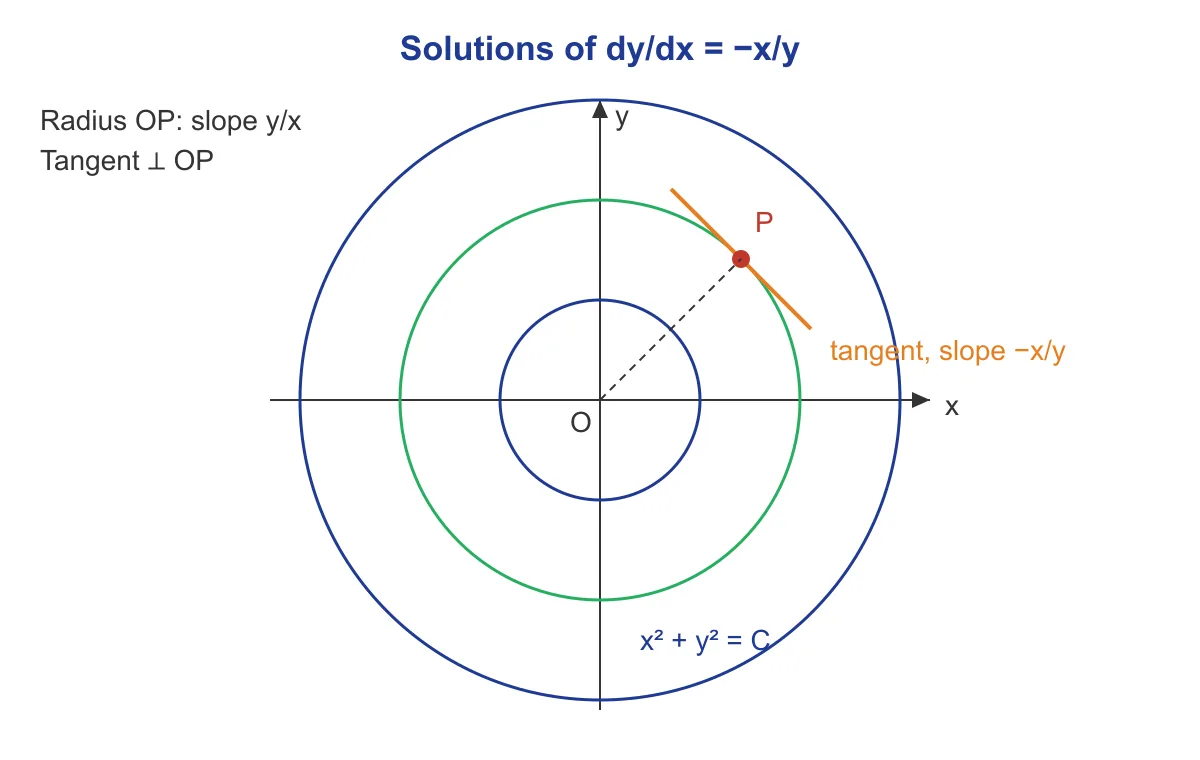
*Figure 4.1: The equation $\frac{dy}{dx} = -\frac{x}{y}$ has the general solution $x^2 + y^2 = C$, circles about the origin. The condition $y(3) = 4$ picks the circle of radius 5.*
To confirm a solution, differentiate it and substitute. To confirm a general solution, also count the constants.
Two cautions. When you divide by an expression containing $y$, a solution can be lost. For $\frac{dy}{dx} = y^2$, dividing by $y^2$ and integrating gives $y = -\frac{1}{x + C}$, yet $y = 0$ also satisfies the equation and is not in that family for any finite $C$. Second, a particular solution is only valid on an interval where everything in it is defined, so $y = \frac{1}{x}$ lives on $x > 0$ or on $x < 0$, not across $0$.
4. Variables separable
If you can rearrange $\frac{dy}{dx}$ so that all the $y$'s are on one side with $dy$ and all the $x$'s on the other with $dx$, the equation is separable:
Then integrate both sides, and put one constant $C$ on one side only. Two constants are not needed; their difference is one constant.
Treat $\frac{dy}{dx}$ as the ratio of two small changes for the purpose of rearranging. What you are really doing is dividing by $g(y)$ and then integrating both sides with respect to $x$, using the substitution rule on the left. That is why dividing by $g(y)$ can lose a constant solution where $g(y) = 0$.
Two sums of the same kind appear again and again. The first is $\int \frac{dy}{y} = \ln\vert y\vert$, which turns multiplicative relations into additive ones. The second is a constant of integration written as $\ln C$ to make the logarithms combine neatly.
Example 4: Solve $\frac{dy}{dx} = \frac{x(1+y^2)}{y(1+x^2)}$ with $y(0) = 1$.
Separate: $\frac{y\,dy}{1 + y^2} = \frac{x\,dx}{1 + x^2}$.
Integrate: $\tfrac12 \ln(1 + y^2) = \tfrac12 \ln(1 + x^2) + c$.
Multiply by 2 and combine logs: $1 + y^2 = C(1 + x^2)$, where $C = e^{2c} > 0$.
Use $y(0) = 1$: $1 + 1 = C(1 + 0)$, so $C = 2$.
Then $1 + y^2 = 2 + 2x^2$, so $y^2 = 1 + 2x^2$ and, since $y(0) = 1 > 0$, $y = \sqrt{1 + 2x^2}$.
Answer: $y = \sqrt{1 + 2x^2}$.
Notice: the logarithms are absorbed into one multiplicative constant; no absolute values are needed because $1+y^2$ and $1+x^2$ are positive.
A frequent shape is $\frac{dy}{dx} = e^{x+y}$. Split the power: $e^{-y}\,dy = e^{x}\,dx$, so $-e^{-y} = e^{x} + c$, that is $e^{x} + e^{-y} = C$.
Sometimes the equation does not look separable until you factor. For example $\frac{dy}{dx} = xy + x + 2y + 2$ factors as $(x+2)(y+1)$ and is then separable.
5. Homogeneous equations of first order and first degree
A first-order equation is homogeneous if it can be written as
Equivalently, $\frac{dy}{dx} = \frac{P(x,y)}{Q(x,y)}$ where $P$ and $Q$ are homogeneous polynomials of the same degree: replacing $(x, y)$ by $(\lambda x, \lambda y)$ multiplies each by the same power of $\lambda$, which cancels in the ratio.
A quick test: put $\lambda x$ and $\lambda y$ everywhere and see whether every $\lambda$ cancels. For $\frac{x^2 + y^2}{xy}$ it does (each term has total degree 2). For $\frac{x + y + 1}{x - y}$ it does not, because of the lone $1$. For $\frac{y}{x} + x$ it does not, because $x$ alone is not a function of $\frac{y}{x}$.
Method. Put $y = vx$, where $v$ is a new unknown function of $x$. Then
Substitute into the equation. The $x$'s will cancel and the equation becomes $v + x\frac{dv}{dx} = F(v)$, which is separable:
Solve, then replace $v$ by $\frac{y}{x}$ at the end.
Do not skip the "$v +$" on the left. Dropping it is the most common slip.
If the equation is easier in the form $\frac{dx}{dy} = G\!\left(\frac{x}{y}\right)$, put $x = vy$ instead, so that $\frac{dx}{dy} = v + y\frac{dv}{dy}$.
Example 5: Solve $\frac{dy}{dx} = \frac{x + y}{x - y}$.
Put $y = vx$: $v + x\frac{dv}{dx} = \frac{1 + v}{1 - v}$.
So $x\frac{dv}{dx} = \frac{1 + v}{1 - v} - v = \frac{1 + v - v + v^2}{1 - v} = \frac{1 + v^2}{1 - v}$.
Separate: $\frac{1 - v}{1 + v^2}\,dv = \frac{dx}{x}$.
Integrate: $\tan^{-1} v - \tfrac12\ln(1 + v^2) = \ln\vert x\vert + c$.
Move the log: $\tan^{-1} v = \ln\vert x\vert + \tfrac12\ln(1 + v^2) + c = \tfrac12\ln(x^2 + x^2v^2) + c$.
Replace $v = \frac{y}{x}$.
Answer: $\tan^{-1}\frac{y}{x} = \tfrac12\ln(x^2 + y^2) + c$.
Notice: the $\ln\vert x\vert$ was merged with $\tfrac12\ln(1+v^2)$ to give $\tfrac12\ln(x^2+y^2)$, which is the neat final form.
Memory trick: "Homogeneous? Count the degrees: same on top and bottom, set y equal to v x."
Say it before you start any equation with $x^2$, $xy$, $y^2$ terms all of one total degree.
Another example of the same kind: $\frac{dy}{dx} = \frac{y}{x} + \tan\frac{y}{x}$. With $y = vx$ the right side becomes $v + \tan v$, so $x\frac{dv}{dx} = \tan v$, which separates to $\cot v\,dv = \frac{dx}{x}$. Hence $\ln\vert \sin v\vert = \ln\vert x\vert + c$ and the solution is $\sin\frac{y}{x} = Cx$.
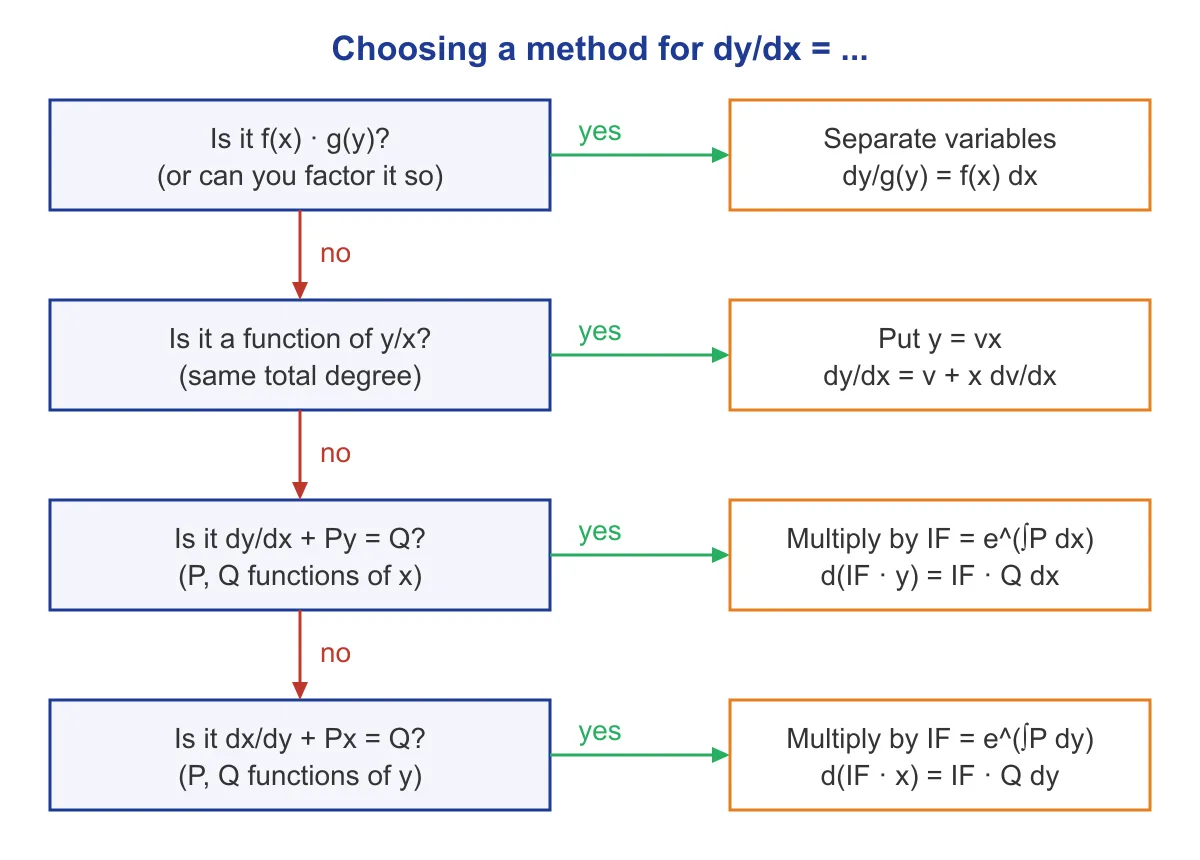
Figure 4.2: Choosing a method for a first-order equation, from the simplest test to the least obvious.
6. Linear first-order equations
A first-order equation is linear if $y$ and $\frac{dy}{dx}$ appear only to the first power and are not multiplied together. The standard form is
where $P$ and $Q$ are functions of $x$ alone (or constants).
Integrating factor (IF). Multiply the whole equation by $\mu(x)$, hoping that the left side becomes $\frac{d}{dx}(\mu y)$. By the product rule, $\frac{d}{dx}(\mu y) = \mu\frac{dy}{dx} + \mu' y$. This matches $\mu\frac{dy}{dx} + \mu P y$ exactly when $\mu' = P\mu$, that is, $\frac{d\mu}{\mu} = P\,dx$, so
After multiplying, the equation reads $\frac{d}{dx}\left(\mu y\right) = \mu Q$. Integrate:
Points to watch:
- The constant in $\int P\,dx$ is dropped. Any constant would only multiply $\mu$ by a number and cancel from both sides.
- Use $e^{\ln f(x)} = f(x)$. For $P = \frac{1}{x}$, $\int P\,dx = \ln\vert x\vert$ and the IF is $\vert x\vert$; the sign cancels, so use $x$ (taking $x > 0$, or just keep $x$ as it is).
- The equation must first be brought to the standard form with the coefficient of $\frac{dy}{dx}$ equal to 1. For $x\frac{dy}{dx} + 2y = x^2$ divide by $x$ first, so $P = \frac{2}{x}$ and $Q = x$, not $P = 2$.
- Remember to divide the final constant: if $\mu y = \text{(something)} + C$, then $y = \frac{\text{something} + C}{\mu}$, so $C$ is divided too.
| Standard form | Integrating factor |
|---|---|
| $\frac{dy}{dx} + \frac{k}{x}y = Q$ | $x^{k}$ |
| $\frac{dy}{dx} + ky = Q$ | $e^{kx}$ |
| $\frac{dy}{dx} + y\tan x = Q$ | $\sec x$ |
| $\frac{dy}{dx} + y\cot x = Q$ | $\sin x$ |
| $\frac{dy}{dx} + \frac{2x}{1 + x^2}y = Q$ | $1 + x^2$ |
Example 6: Solve $x\frac{dy}{dx} + 2y = x^2$ for $x > 0$, given $y(1) = 1$.
Standard form: $\frac{dy}{dx} + \frac{2}{x}y = x$, so $P = \frac{2}{x}$, $Q = x$.
IF $= e^{\int \frac{2}{x}dx} = e^{2\ln x} = x^2$.
Multiply: $x^2\frac{dy}{dx} + 2xy = x^3$, which is $\frac{d}{dx}(x^2 y) = x^3$.
Integrate: $x^2 y = \frac{x^4}{4} + C$.
Use $y(1) = 1$: $1 = \frac14 + C$, so $C = \frac34$.
Answer: $y = \frac{x^2}{4} + \frac{3}{4x^2}$.
Notice: the left side after multiplying is always the derivative of $\text{IF}\times y$, so you can check your IF in one line.
Memory trick: "P in the power of e, multiply across, product rule backwards."
Say it each time you form an integrating factor, and write the standard form before touching $P$.
Sometimes the equation is not linear in $y$ but is linear in $x$. Then treat $x$ as the unknown function of $y$:
For $y\,dx + (x - y^3)\,dy = 0$ with $y > 0$: divide by $dy$ to get $y\frac{dx}{dy} + x = y^3$, so $\frac{dx}{dy} + \frac{x}{y} = y^2$. The IF is $y$, so $\frac{d}{dy}(xy) = y^3$ and $xy = \frac{y^4}{4} + C$.
A simpler but important point: the equation $\frac{dy}{dx} + y\cot x = 2\cos x$ has IF $\sin x$, and then $\frac{d}{dx}(y\sin x) = 2\sin x\cos x = \sin 2x$, which integrates at once.
7. Applications
Growth and decay
If a quantity changes at a rate proportional to its present size, $\frac{dN}{dt} = kN$. Separate and integrate: $\ln N = kt + c$, so $N = N_0 e^{kt}$, where $N_0$ is the value at $t = 0$.
- $k > 0$: growth (population, a bacterial culture, money at continuous compounding).
- $k < 0$: decay (a radioactive substance, a drug leaving the body). Write $\frac{dN}{dt} = -\lambda N$ with $\lambda > 0$ and $N = N_0 e^{-\lambda t}$.
The time to double does not depend on $N_0$. If $N_0 e^{kT} = 2N_0$ then $T = \frac{\ln 2}{k}$. For decay, the half-life is $\frac{\ln 2}{\lambda}$, also independent of the starting amount. This means you rarely need $k$ itself: if a quantity doubles every $T$ units, then after $t$ units it is multiplied by $2^{t/T}$.
Example 7: A culture of bacteria grows at a rate proportional to its size. It doubles in 10 hours. After how many hours is it 3 times its original size?
$N = N_0 e^{kt}$. Doubling at $t = 10$: $e^{10k} = 2$, so $k = \frac{\ln 2}{10}$.
Tripling: $e^{kt} = 3$, so $kt = \ln 3$ and $t = \frac{\ln 3}{k} = \frac{10\ln 3}{\ln 2}$.
With $\ln 3 \approx 1.0986$ and $\ln 2 \approx 0.6931$: $t \approx 10 \times 1.585 = 15.85$ hours.
Answer: about 15.85 hours.
Notice: tripling takes $\log_2 3 \approx 1.585$ doubling periods, more than 1.5, because growth compounds rather than adds.
Curves with a slope property
The method has three steps. Take a general point $P(x, y)$ on the curve. Write the geometric condition using the slope $y' = \frac{dy}{dx}$. Solve the resulting equation and fit the given point.
Facts you will need:
- The tangent at $P$: $Y - y = y'(X - x)$. It meets the $x$-axis ($Y = 0$) at $X = x - \frac{y}{y'}$ and the $y$-axis ($X = 0$) at $Y = y - xy'$.
- The normal at $P$ has slope $-\frac{1}{y'}$.
Example 8: Find the curve through $(1, 3)$ for which the tangent at any point $P(x, y)$ cuts the $x$-axis at a point whose abscissa is half that of $P$.
The tangent meets the $x$-axis at $X = x - \frac{y}{y'}$. The condition says $x - \frac{y}{y'} = \frac{x}{2}$.
So $\frac{y}{y'} = \frac{x}{2}$, that is $\frac{dy}{dx} = \frac{2y}{x}$.
Separate: $\frac{dy}{y} = \frac{2\,dx}{x}$, so $\ln\vert y\vert = 2\ln\vert x\vert + c$ and $y = Cx^2$.
Use $(1, 3)$: $C = 3$.
Answer: $y = 3x^2$.
Check: $y' = 6x$ and $x - \frac{3x^2}{6x} = \frac{x}{2}$, as required.
If the normal at every point passes through the origin, the slope of the normal equals $\frac{y}{x}$, so the tangent slope is $-\frac{x}{y}$. That is the equation of Figure 4.1, and the curves are circles about the origin.
Common traps
- Reading the degree before clearing roots and fractions from the derivatives → first make the equation a polynomial in the derivatives, then read the power of the highest-order derivative.
- Giving a degree when the highest derivative sits inside $\sin$, $\ln$ or an exponential → say the degree is not defined.
- Counting $A$ and $B$ as two constants in $y = Ae^{x+B}$ → merge them into one constant, so the order is 1.
- Eliminating constants but leaving one behind in the final equation → substitute the family back into your result and confirm it gives $0 = 0$.
- Adding a constant on both sides after separating variables → put a single $C$ on one side.
- Writing $\frac{dy}{dx} = v + x\frac{dv}{dx}$ as $\frac{dv}{dx}$ alone, or forgetting the "$v$" term → always keep $v + x\frac{dv}{dx}$.
- Using $y = vx$ on an equation with a stray constant such as $\frac{x + y + 1}{x - y}$ → first check the homogeneity of the degrees; it is not homogeneous.
- Taking $P$ from $x\frac{dy}{dx} + 2y = x^2$ as $2$ → divide by $x$ first, so $P = \frac{2}{x}$ and $Q = x$.
- Dividing the right side by the IF but not the arbitrary constant → after $\mu y = \int \mu Q\,dx + C$, divide the whole right side including $C$ by $\mu$.
- Losing a constant solution when dividing by $g(y)$ → check separately whether $g(y) = 0$ gives a solution.
Quick revision
- Order is the highest derivative; degree is its power after clearing radicals and fractions, and is not defined when a derivative sits inside $\sin$, $\ln$ or an exponential.
- A family with $n$ independent constants gives an equation of order $n$ with no constant in it.
- General solution: $n$ constants for an $n$-th order equation. Particular solution: constants fixed by a condition.
- Separable form: $\frac{dy}{g(y)} = f(x)\,dx$; integrate both sides and add one constant.
- $\frac{dy}{dx} = e^{x+y}$ gives $e^{x} + e^{-y} = C$.
- Homogeneous: $\frac{dy}{dx} = F\!\left(\frac{y}{x}\right)$; substitute $y = vx$ so that $\frac{dy}{dx} = v + x\frac{dv}{dx}$.
- If it is easier as $\frac{dx}{dy} = G\!\left(\frac{x}{y}\right)$, put $x = vy$.
- Linear form: $\frac{dy}{dx} + Py = Q$ with $P, Q$ functions of $x$.
- Integrating factor: $e^{\int P\,dx}$, with no constant in the integral.
- Solution of linear equation: $y\cdot\text{IF} = \int Q\cdot\text{IF}\,dx + C$.
- If linear in $x$: $\frac{dx}{dy} + P_1 x = Q_1$, IF $= e^{\int P_1\,dy}$.
- Growth or decay: $\frac{dN}{dt} = kN$ gives $N = N_0e^{kt}$; doubling time $\frac{\ln 2}{k}$ does not depend on $N_0$.
- Tangent meets the $x$-axis at $x - \frac{y}{y'}$ and the $y$-axis at $y - xy'$; the normal slope is $-\frac{1}{y'}$.
- Normals through the origin give $x^2 + y^2 = C$.
Practice questions
What are the order and degree of $\frac{d^2y}{dx^2} + \left(\frac{dy}{dx}\right)^3 + 4y = 0$?
- Order 1, degree 3
- Order 2, degree 1
- Order 3, degree 2
- Order 2, degree 3
Answer
B. Order 2, degree 1
The highest derivative is the second, so order 2. It appears to the first power, so degree 1. The cube is on a lower derivative and does not count.
The differential equation of the family of straight lines $y = Cx$ through the origin ($C$ arbitrary) is
- $\frac{dy}{dx} = xy$
- $x\frac{dy}{dx} = -y$
- $x\frac{dy}{dx} = y$
- $y\frac{dy}{dx} = x$
Answer
C. $x\frac{dy}{dx} = y$
Differentiate: $\frac{dy}{dx} = C = \frac{y}{x}$, so $x\frac{dy}{dx} = y$. Check: $y = Cx$ gives $x \cdot C = Cx$.
The degree of the differential equation $y = x\frac{dy}{dx} + \sqrt{1 + \left(\frac{dy}{dx}\right)^2}$ is
- 1
- 3
- 2
- not defined
Answer
C. 2
Write $p = \frac{dy}{dx}$. Isolate the root: $y - xp = \sqrt{1+p^2}$. Squaring gives $(y - xp)^2 = 1 + p^2$, a polynomial in $p$ of degree 2.
The degree of $\frac{d^2y}{dx^2} + \sin\left(\frac{dy}{dx}\right) = 0$ is
- 1
- 2
- 0
- not defined
Answer
D. not defined
The order is 2, but the equation cannot be written as a polynomial in the derivatives because $\frac{dy}{dx}$ is inside $\sin$. Degree is not defined.
The general solution of $\frac{dy}{dx} = e^{x+y}$ is
- $e^{x} + e^{-y} = C$
- $e^{x} - e^{-y} = C$
- $e^{x} + e^{y} = C$
- $e^{-x} + e^{-y} = C$
Answer
A. $e^{x} + e^{-y} = C$
Split the power: $e^{-y}dy = e^{x}dx$. Integrate: $-e^{-y} = e^{x} + c$, so $e^{x} + e^{-y} = C$. Check: differentiating $e^{x} + e^{-y} = C$ gives $e^{x} - e^{-y}y' = 0$, so $y' = e^{x+y}$.
The integrating factor of $\frac{dy}{dx} + y\tan x = \sin x$ on $\left(-\frac{\pi}{2}, \frac{\pi}{2}\right)$ is
- $\sec x$
- $\ln \sec x$
- $\tan x$
- $\cos x$
Answer
A. $\sec x$
$P = \tan x$, and $\int \tan x\,dx = \ln\sec x$. The factor is $e^{\ln \sec x} = \sec x$ on this interval.
Substituting $y = vx$ in $\frac{dy}{dx} = \frac{x^2 + y^2}{xy}$ gives
- $x\frac{dv}{dx} = \frac{1 + v^2}{v}$
- $x\frac{dv}{dx} = v$
- $\frac{dv}{dx} = \frac{1}{v}$
- $x\frac{dv}{dx} = \frac{1}{v}$
Answer
D. $x\frac{dv}{dx} = \frac{1}{v}$
The right side becomes $\frac{1 + v^2}{v} = \frac{1}{v} + v$. The left side is $v + x\frac{dv}{dx}$. Cancel $v$: $x\frac{dv}{dx} = \frac{1}{v}$.
The general solution of $\frac{dy}{dx} = \frac{y}{x} + \tan\frac{y}{x}$ is
- $\tan\frac{y}{x} = Cx$
- $\sin\frac{y}{x} = Cx$
- $\cos\frac{y}{x} = Cx$
- $\sin\frac{y}{x} = C$
Answer
B. $\sin\frac{y}{x} = Cx$
Put $y = vx$: $v + x v' = v + \tan v$, so $x v' = \tan v$ and $\cot v\,dv = \frac{dx}{x}$. Then $\ln\vert\sin v\vert = \ln\vert x\vert + c$, i.e. $\sin\frac{y}{x} = Cx$.
The general solution of a third-order differential equation contains how many independent arbitrary constants?
- 1
- 3
- 2
- 4
Answer
B. 3
The number of independent arbitrary constants in the general solution equals the order, which is 3.
The differential equation of all circles of radius 1 whose centres lie on the $x$-axis is
- $y^2 + \left(\frac{dy}{dx}\right)^2 = 1$
- $y^2\frac{dy}{dx} = 1$
- $\left(1 + y^2\right)\left(\frac{dy}{dx}\right)^2 = 1$
- $y^2\left(1 + \left(\frac{dy}{dx}\right)^2\right) = 1$
Answer
D. $y^2\left(1 + \left(\frac{dy}{dx}\right)^2\right) = 1$
Family: $(x-a)^2 + y^2 = 1$. Differentiate: $x - a = -y\frac{dy}{dx}$. Substitute: $y^2\left(\frac{dy}{dx}\right)^2 + y^2 = 1$.
The general solution of $\frac{dy}{dx} + y = e^{-x}$ is
- $y = (x + C)e^{-x}$
- $y = \left(e^{-x} + C\right)e^{-x}$
- $y = (x + C)e^{x}$
- $y = xe^{-x} + C$
Answer
A. $y = (x + C)e^{-x}$
IF $= e^{x}$. Then $\frac{d}{dx}(e^{x}y) = e^{x}e^{-x} = 1$, so $e^{x}y = x + C$ and $y = (x + C)e^{-x}$.
The general solution of $(1 + x^2)\frac{dy}{dx} + 2xy = \cot x$ is
- $(1 + x^2)y = \ln\vert\cos x\vert + C$
- $y = \ln\vert\sin x\vert + C$
- $(1 + x^2)y = \ln\vert\sin x\vert + C$
- $(1 + x^2)y = -\ln\vert\sin x\vert + C$
Answer
C. $(1 + x^2)y = \ln\vert\sin x\vert + C$
The left side is exactly $\frac{d}{dx}\left[(1 + x^2)y\right]$. Integrate $\cot x$: $\ln\vert\sin x\vert$. So $(1 + x^2)y = \ln\vert\sin x\vert + C$.
For $y > 0$, the general solution of $y\,dx + (x - y^3)\,dy = 0$ is
- $xy = \frac{y^4}{4} + C$
- $x = \frac{y^4}{4} + C$
- $xy = \frac{y^3}{3} + C$
- $x = \frac{y^3}{4} + Cy$
Answer
A. $xy = \frac{y^4}{4} + C$
Divide by $dy$: $\frac{dx}{dy} + \frac{x}{y} = y^2$. IF $= y$. Then $\frac{d}{dy}(xy) = y^3$, so $xy = \frac{y^4}{4} + C$.
The solution of $\frac{dy}{dx} = 2y$ with $y(0) = 3$ is
- $y = 3e^{x}$
- $y = 3e^{-2x}$
- $y = 3e^{2x}$
- $y = e^{2x} + 2$
Answer
C. $y = 3e^{2x}$
$\frac{dy}{y} = 2\,dx$ gives $y = Ce^{2x}$. $y(0) = 3$ gives $C = 3$.
The sum of the order and the degree of $\left(\frac{d^3y}{dx^3}\right)^2 + 5\left(\frac{dy}{dx}\right)^4 = x$ is
- 5
- 4
- 6
- 7
Answer
A. 5
Order $= 3$ (third derivative). Degree $=$ power of that derivative $= 2$. Sum $= 5$.
If $y = Cx^2$ satisfies $x\frac{dy}{dx} = ky$ for every $C$, then $k$ equals
- 1
- 2
- 3
- 4
Answer
B. 2
$\frac{dy}{dx} = 2Cx$, so $x\frac{dy}{dx} = 2Cx^2 = 2y$. Hence $k = 2$.
If $\frac{dy}{dx} = xy$ and $y(0) = 1$, then $\ln y(2)$ equals
- 1
- 4
- 2
- 0.5
Answer
C. 2
$\frac{dy}{y} = x\,dx$ gives $\ln y = \frac{x^2}{2} + c$; $y(0) = 1$ gives $c = 0$. At $x = 2$: $\ln y = 2$.
A population obeys $\frac{dN}{dt} = kN$ and triples in 5 years. After 15 years it is how many times the initial population?
- 9
- 45
- 15
- 27
Answer
D. 27
Triples every 5 years, so after 15 years it is multiplied by $3^3 = 27$. (Using $e^{5k} = 3$: $e^{15k} = 27$.)
A radioactive sample has a half-life of 8 days. If 160 g is present now, the mass in grams left after 24 days is
- 10
- 20
- 80
- 40
Answer
B. 20
$24$ days is 3 half-lives, so $160 \times \left(\frac12\right)^3 = 20$ g. Check with $N = N_0 e^{-\lambda t}$, $\lambda = \frac{\ln 2}{8}$: $e^{-3\ln 2} = \frac18$.
If $\frac{dy}{dx} + y = 1$ and $y(0) = 0$, then $y(\ln 4)$ equals
- 1.25
- 0.5
- 0.25
- 0.75
Answer
D. 0.75
IF $= e^{x}$, so $e^{x}y = e^{x} + C$; $y(0) = 0$ gives $C = -1$. Thus $y = 1 - e^{-x}$. At $x = \ln 4$: $1 - \frac14 = 0.75$.
The solution of $\frac{dy}{dx} = \frac{x^2 + y^2}{2xy}$ with $y(1) = 2$ is positive for $x > 0$ near 1. The value of $y(3)^2$ is
- 12
- 36
- 24
- 18
Answer
D. 18
Put $y = vx$: $x v' = \frac{1 - v^2}{2v}$, so $\frac{2v\,dv}{1 - v^2} = \frac{dx}{x}$ and $x(1 - v^2) = C$, i.e. $x^2 - y^2 = Cx$. $y(1) = 2$ gives $C = -3$. At $x = 3$: $9 - y^2 = -9$, so $y^2 = 18$.
If $x\frac{dy}{dx} - y = x^2$ for $x > 0$ and $y(1) = 3$, then $y(2)$ equals
- 6
- 10
- 8
- 12
Answer
C. 8
$\frac{dy}{dx} - \frac{y}{x} = x$, IF $= \frac1x$. Then $\frac{d}{dx}\left(\frac{y}{x}\right) = 1$, so $y = x^2 + Cx$. $y(1) = 3$ gives $C = 2$. $y(2) = 4 + 4 = 8$.
A curve passes through the origin and has slope $y + 2$ at every point $(x, y)$. The value of $y$ at $x = \ln 3$ is
- 2
- 4
- 6
- 8
Answer
B. 4
$\frac{dy}{y+2} = dx$ gives $y + 2 = Ae^{x}$. At the origin, $A = 2$. So $y = 2e^{x} - 2$; at $x = \ln 3$: $6 - 2 = 4$.
If $y = Ae^{3x} + Be^{-3x}$ satisfies $\frac{d^2y}{dx^2} = ky$ for all $A, B$, then $k$ equals
- 3
- 6
- -9
- 9
Answer
D. 9
$y'' = 9Ae^{3x} + 9Be^{-3x} = 9y$, so $k = 9$.
The normal at every point of a curve passes through the origin, and the curve passes through $(3, 4)$. The radius of the curve is
- 5
- 3
- 4
- 25
Answer
A. 5
Slope of normal $= \frac{y}{x} = -\frac{1}{y'}$, so $y\,y' = -x$, giving $x^2 + y^2 = C$. Through $(3, 4)$: $C = 25$, a circle of radius 5.
If $(1 + x^2)\frac{dy}{dx} + 2xy = 3x^2$ and $y(0) = 0$, then $y(1)$ equals
- 0.25
- 0.5
- 1
- 1.5
Answer
B. 0.5
The left side is $\frac{d}{dx}\left[(1 + x^2)y\right]$. So $(1 + x^2)y = x^3 + C$; $y(0) = 0$ gives $C = 0$. At $x = 1$: $2y = 1$, so $y = 0.5$.
Given below are two statements: Statement I: The family $y = Ax + A^2$ ($A$ arbitrary) leads to a differential equation of degree 2. Statement II: The degree of $\frac{d^2y}{dx^2} = \sqrt{1 + \left(\frac{dy}{dx}\right)^2}$ is 2.
- Both Statement I and Statement II are correct
- Both Statement I and Statement II are incorrect
- Statement I is correct but Statement II is incorrect
- Statement I is incorrect but Statement II is correct
Answer
A. Both Statement I and Statement II are correct
I: $y' = A$, so $y = xy' + (y')^2$, degree 2. II: squaring gives $(y'')^2 = 1 + (y')^2$, degree 2. Both correct.
Given below are two statements: Statement I: $y = 3e^{2x}$ is a particular solution of $\frac{dy}{dx} = 2y$. Statement II: The general solution of $\frac{dy}{dx} = 2y$ is $y = e^{2x} + C$.
- Both Statement I and Statement II are correct
- Both Statement I and Statement II are incorrect
- Statement I is correct but Statement II is incorrect
- Statement I is incorrect but Statement II is correct
Answer
C. Statement I is correct but Statement II is incorrect
I: $y' = 6e^{2x} = 2y$, correct. II: the general solution is $y = Ce^{2x}$; $e^{2x} + C$ has derivative $2e^{2x} \ne 2(e^{2x} + C)$. So II is incorrect.
Given below are two statements: Statement I: $(x^2 + y^2)\,dx - 2xy\,dy = 0$ is a homogeneous differential equation. Statement II: $\frac{dy}{dx} = \frac{y}{x} + x$ is a homogeneous differential equation.
- Both Statement I and Statement II are correct
- Both Statement I and Statement II are incorrect
- Statement I is correct but Statement II is incorrect
- Statement I is incorrect but Statement II is correct
Answer
C. Statement I is correct but Statement II is incorrect
I: $\frac{dy}{dx} = \frac{x^2 + y^2}{2xy}$, both parts of degree 2, homogeneous. II: the term $x$ is not a function of $\frac{y}{x}$, so it is not homogeneous.
Given below are two statements: Statement I: The integrating factor of $\frac{dy}{dx} - \frac{y}{x} = x$ is $x$. Statement II: The integrating factor of $\frac{dy}{dx} + 3y = e^{x}$ is $e^{3x}$.
- Both Statement I and Statement II are correct
- Both Statement I and Statement II are incorrect
- Statement I is correct but Statement II is incorrect
- Statement I is incorrect but Statement II is correct
Answer
D. Statement I is incorrect but Statement II is correct
I: $P = -\frac1x$, IF $= e^{-\ln x} = \frac1x$, not $x$. II: $P = 3$, IF $= e^{3x}$, correct.
Given below are two statements: Statement I: The general solution of $\frac{dN}{dt} = -kN$ with $k > 0$ is $N = N_0e^{kt}$. Statement II: The half-life of a quantity decaying by $\frac{dN}{dt} = -kN$ depends on the initial amount $N_0$.
- Both Statement I and Statement II are correct
- Both Statement I and Statement II are incorrect
- Statement I is correct but Statement II is incorrect
- Statement I is incorrect but Statement II is correct
Answer
B. Both Statement I and Statement II are incorrect
I: the solution is $N_0e^{-kt}$, so I is incorrect. II: half-life is $\frac{\ln 2}{k}$, independent of $N_0$, so II is incorrect.
Assertion (A): The differential equation of the family $y = Ae^{x} + Be^{-x}$ has order 2. Reason (R): The order of the differential equation obtained from a family equals the number of independent arbitrary constants eliminated.
- Both A and R are true and R is the correct explanation of A
- Both A and R are true but R is not the correct explanation of A
- A is true but R is false
- A is false but R is true
Answer
A. Both A and R are true and R is the correct explanation of A
Two independent constants are eliminated, so the order is 2 ($y'' = y$). R states the rule that explains A.
Assertion (A): $y = 0$ is a solution of $\frac{dy}{dx} = y^2$. Reason (R): The family $y = -\frac{1}{x + C}$, obtained by separating variables, contains $y = 0$ for some value of $C$.
- Both A and R are true and R is the correct explanation of A
- Both A and R are true but R is not the correct explanation of A
- A is true but R is false
- A is false but R is true
Answer
C. A is true but R is false
A: $0 = 0^2$ holds, so true. R: $-\frac{1}{x + C}$ is never zero, so R is false.
Assertion (A): The degree of $\frac{d^2y}{dx^2} + \sin\left(\frac{dy}{dx}\right) = 0$ is 1. Reason (R): The degree is defined only when the equation is a polynomial in the derivatives.
- Both A and R are true and R is the correct explanation of A
- Both A and R are true but R is not the correct explanation of A
- A is true but R is false
- A is false but R is true
Answer
D. A is false but R is true
The derivative sits inside $\sin$, so the equation is not a polynomial in the derivatives and the degree is not defined; A is false. R is a true statement of the rule.
Match List I with List II. List I: a. $\frac{dy}{dx} = \frac{y}{x}$ b. $\frac{dy}{dx} = -\frac{x}{y}$ c. $\frac{dy}{dx} = y$ d. $\frac{dy}{dx} = \frac{2y}{x}$ List II: i. $y = Ce^{x}$ ii. $x^2 + y^2 = C$ iii. $y = Cx^2$ iv. $y = Cx$
- a-iv, b-ii, c-iii, d-i
- a-iv, b-ii, c-i, d-iii
- a-iii, b-ii, c-i, d-iv
- a-ii, b-iv, c-i, d-iii
Answer
B. a-iv, b-ii, c-i, d-iii
a: $\frac{dy}{y} = \frac{dx}{x}$ gives $y = Cx$. b: $y\,dy = -x\,dx$ gives circles. c: $y = Ce^{x}$. d: $\frac{dy}{y} = \frac{2dx}{x}$ gives $y = Cx^2$.
Match List I with List II. List I: a. $\frac{dy}{dx} + \frac{y}{x} = x^2$ b. $\frac{dy}{dx} + y = \sin x$ c. $\frac{dy}{dx} + y\tan x = 1$ d. $\frac{dy}{dx} - \frac{2y}{x} = x$ List II: i. $e^{x}$ ii. $\sec x$ iii. $x$ iv. $x^{-2}$
- a-iii, b-i, c-ii, d-iv
- a-i, b-iii, c-ii, d-iv
- a-iii, b-i, c-iv, d-ii
- a-ii, b-i, c-iii, d-iv
Answer
A. a-iii, b-i, c-ii, d-iv
a: $e^{\int dx/x} = x$. b: $e^{x}$. c: $e^{\ln\sec x} = \sec x$. d: $e^{-2\ln x} = x^{-2}$.
Match List I with List II. List I: a. $\frac{d^2y}{dx^2} + y = 0$ b. $\left(\frac{dy}{dx}\right)^2 = x + y$ c. $\left(\frac{d^3y}{dx^3}\right)^2 + y = 0$ d. $\frac{dy}{dx} + \sin y = 0$ List II: i. order 1, degree 2 ii. order 2, degree 1 iii. order 3, degree 2 iv. order 1, degree 1
- a-ii, b-i, c-iii, d-iv
- a-ii, b-iv, c-iii, d-i
- a-ii, b-i, c-iv, d-iii
- a-i, b-ii, c-iii, d-iv
Answer
A. a-ii, b-i, c-iii, d-iv
a: highest derivative second, power 1. b: first derivative squared. c: third derivative squared. d: first derivative to power 1 (the $\sin y$ is not a derivative).
A culture of bacteria grows at a rate proportional to the number present. There are 1000 bacteria at the start and 2000 after 3 hours. After how many hours will there be 16000?
- 15 hours
- 12 hours
- 9 hours
- 16 hours
Answer
B. 12 hours
From 1000 to 16000 is a factor 16 $= 2^4$, so four doublings are needed. Each doubling takes 3 hours, so 12 hours. Check: $e^{3k} = 2$, $e^{kt} = 16$ gives $kt = 4\ln 2$, $t = 12$.
A curve passes through $(1, 2)$ and for $x > 0$ the tangent at any point $(x, y)$ has $y$-intercept equal to $x$. The value of $y$ on the curve at $x = e$ is
- $e^2$
- $e + 1$
- $2e$
- $e$
Answer
D. $e$
Intercept $= y - xy' = x$, so $\frac{dy}{dx} - \frac{y}{x} = -1$. IF $= \frac1x$: $\frac{d}{dx}\left(\frac{y}{x}\right) = -\frac1x$, so $\frac{y}{x} = -\ln x + C$. $(1, 2)$ gives $C = 2$. So $y = x(2 - \ln x)$, and at $x = e$: $y = e$.
The curve $y(x)$ with $\frac{dy}{dx} = \frac{y}{x} + \frac{x}{y}$ for $x > 0$, $y > 0$ passes through $(1, 2)$. The value of $y$ at $x = e$ is
- $e\sqrt{5}$
- $2e$
- $e\sqrt{6}$
- $e\sqrt{10}$
Answer
C. $e\sqrt{6}$
Put $y = vx$: $v + xv' = v + \frac1v$, so $v\,dv = \frac{dx}{x}$ and $\frac{v^2}{2} = \ln x + c$, i.e. $y^2 = 2x^2(\ln x + C)$. $(1, 2)$ gives $C = 2$. At $x = e$: $y^2 = 2e^2 \cdot 3 = 6e^2$.