Area under Curves
What to remember
- Area is always positive. The integral $\int_a^b f(x)\,dx$ gives signed area, so it equals the area only where $f(x) \ge 0$ on $[a,b]$.
- Slice the region into thin strips. Vertical strips give $\int (\text{top} - \text{bottom})\,dx$; horizontal strips give $\int (\text{right} - \text{left})\,dy$.
- Sketch first, always. The sketch tells you the limits, which curve is on top, and whether the area must be split.
- Where the curve crosses the axis (or two curves cross each other), split the integral at the crossing and add the pieces as positive numbers.
- Use symmetry. A circle or ellipse is four equal quadrants; an even function doubles; a region symmetric about $y = x$ can be found in half.
Why an integral gives area
Take a curve $y = f(x)$ lying above the $x$-axis between $x = a$ and $x = b$. Cut the region into very thin vertical strips. A strip at position $x$ has width $dx$ and height $y = f(x)$, so its area is almost $y\,dx$. Add them all up and let the width go to zero: the sum becomes an integral.
This is the definition of the definite integral doing exactly what it was built for. Nothing new is needed except care with signs and limits.
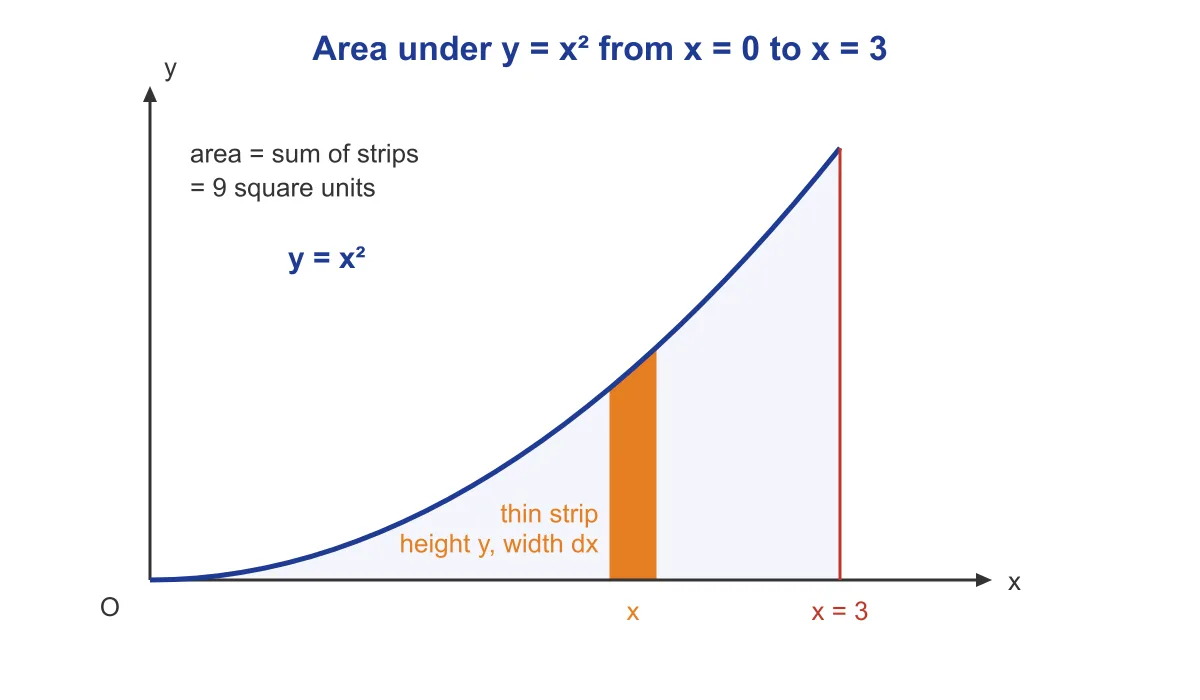
Figure 3.1: The area under y = x² is the sum of thin vertical strips of height y and width dx.
For the region in Figure 3.1:
The conditions matter. The formula above needs $f$ continuous on $[a,b]$ and $f(x) \ge 0$ there. Break either condition and you must adjust.
Area against the y-axis
If the region is described by $x = g(y)$ with $g(y) \ge 0$ between $y = c$ and $y = d$, then we cut into horizontal strips of length $x$ and thickness $dy$:
The $y$-axis plays the role the $x$-axis played before. Nothing else changes.
Example 1: Find the area under $y = x^2 + 1$ between $x = 1$ and $x = 3$.
The curve is always above the axis (it is at least 1), so no splitting is needed.
$A = \int_1^3 (x^2 + 1)\,dx = \left[\frac{x^3}{3} + x\right]_1^3$
At 3: $9 + 3 = 12$. At 1: $\frac{1}{3} + 1 = \frac{4}{3}$.
$A = 12 - \frac{4}{3} = \frac{32}{3}$ square units.
Why this works: the curve never touches the axis, so the plain integral already equals the area.
Example 2: Find the area under $y = e^{2x}$ from $x = 0$ to $x = \ln 2$.
$e^{2x} > 0$ for every $x$, so the area is the integral.
$A = \int_0^{\ln 2} e^{2x}\,dx = \left[\frac{e^{2x}}{2}\right]_0^{\ln 2}$
$e^{2\ln 2} = e^{\ln 4} = 4$, so $A = \frac{4 - 1}{2} = \frac{3}{2}$.
Why this works: exponential curves never cross the $x$-axis, and $e^{\ln 4} = 4$ removes the logarithm at the upper limit.
When the curve crosses the axis
Suppose $f$ is negative on part of $[a,b]$. Below the axis the strip height is $-f(x)$, not $f(x)$, because height is a length. So the area of the part below the axis is $-\int f\,dx$, which is a positive number.
The safe rule:
- Solve $f(x) = 0$ and find every root inside $[a,b]$.
- Split $[a,b]$ at these roots.
- On each piece, take the integral and then its absolute value.
- Add the pieces.
Equivalent statement: $A = \int_a^b \vert f(x) \vert\,dx$.
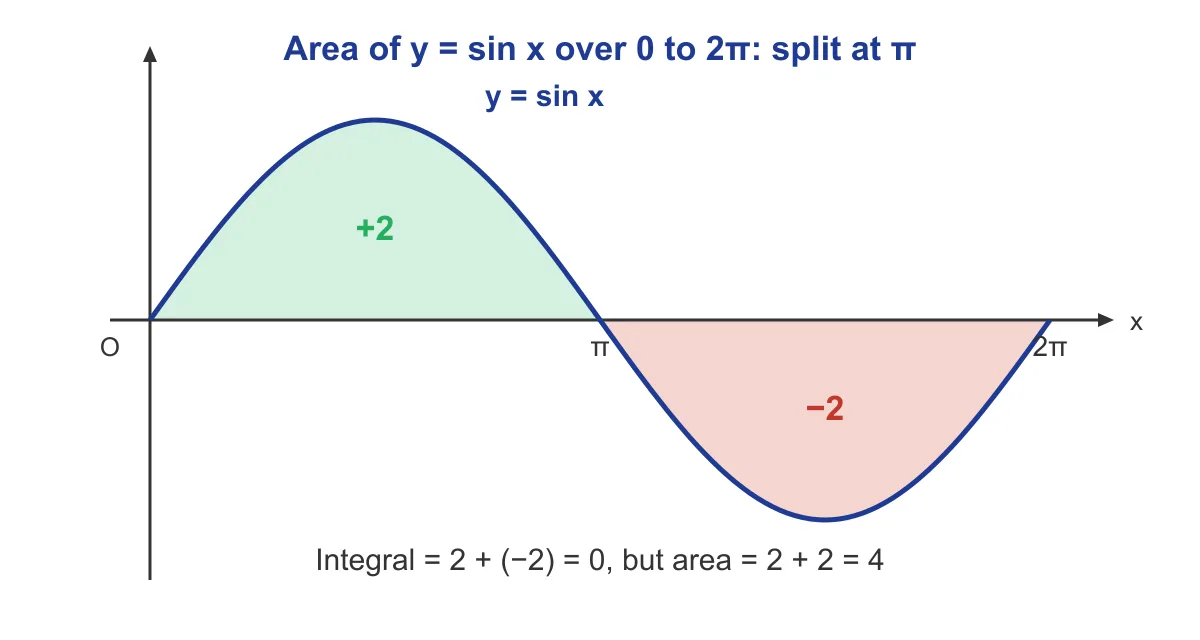
Figure 3.3: The two halves of a sine wave cancel in the integral (0) but add as areas (4).
The sine wave in Figure 3.3 is the standard warning. $\int_0^{2\pi} \sin x\,dx = 0$, yet the region between the curve and the axis is clearly not empty. Each hump has area 2, and the total is 4.
Example 3: Find the area between $y = x^2 - 4$, the $x$-axis, and the lines $x = 0$ and $x = 3$.
Roots: $x^2 - 4 = 0$ gives $x = 2$ (the root $-2$ lies outside $[0,3]$).
On $[0,2]$ the curve is below the axis: $\int_0^2 (x^2-4)\,dx = \frac{8}{3} - 8 = -\frac{16}{3}$, so this piece has area $\frac{16}{3}$.
On $[2,3]$ the curve is above the axis: $\int_2^3 (x^2-4)\,dx = (9 - 12) - \left(\frac{8}{3} - 8\right) = -3 + \frac{16}{3} = \frac{7}{3}$.
Total: $\frac{16}{3} + \frac{7}{3} = \frac{23}{3}$.
Why this works: the single integral from 0 to 3 would give $-3$, which is neither area nor even positive. Splitting at the root is the whole trick.
Memory trick: "Cross the axis, cut the integral." Whenever the curve touches the $x$-axis inside your limits, stop and cut there. Use it as a reflex while reading the question.
Area between two curves
Let two curves $y = f(x)$ (upper) and $y = g(x)$ (lower) enclose a region between $x = a$ and $x = b$. A vertical strip has height $f(x) - g(x)$, so
Both curves may sit above the axis, below it, or one on each side. The difference $f - g$ is the strip height in every case, so the rule does not care where the axis is. That is a big relief: you never have to treat the axis separately.
The limits are usually the $x$-coordinates where the curves meet. Find them by setting $f(x) = g(x)$.
If the curves cross inside the interval, the upper curve changes. Then $A = \int \vert f - g \vert\,dx$, which means you split at each crossing and always subtract lower from upper on each piece.
Example 4: Find the area enclosed by $y = x^2$ and $y = x + 2$.
Meeting points: $x^2 = x + 2$ gives $x^2 - x - 2 = 0$, so $x = -1$ and $x = 2$.
Test a point between them, $x = 0$: the line gives 2, the parabola gives 0. The line is on top.
$A = \int_{-1}^{2} (x + 2 - x^2)\,dx = \left[\frac{x^2}{2} + 2x - \frac{x^3}{3}\right]_{-1}^{2}$
At 2: $2 + 4 - \frac{8}{3} = \frac{10}{3}$. At $-1$: $\frac{1}{2} - 2 + \frac{1}{3} = -\frac{7}{6}$.
$A = \frac{10}{3} + \frac{7}{6} = \frac{27}{6} = \frac{9}{2}$.
Why this works: a test point settles which curve is on top, and the strip height is always top minus bottom.
A shortcut for a parabola and a line
If a parabola $y = ax^2 + bx + c$ meets a line at $x = \alpha$ and $x = \beta$, then $f(x) - g(x) = a(x - \alpha)(x - \beta)$. Integrating from $\alpha$ to $\beta$ gives
Check with Example 4: $a = 1$, width $= 3$, so $A = \frac{27}{6} = \frac{9}{2}$. It agrees. The same formula applies to $x = ay^2 + by + c$ and a line, with the roots measured along the $y$-axis. This holds only for a parabola with a straight line, not for two parabolas or other curves.
| Pair of curves | Meeting points | Area |
|---|---|---|
| $y = x^2$ and $y = x$ | $x = 0, 1$ | $\frac{1}{6}$ |
| $y = x^2$ and $y = kx$, $k > 0$ | $x = 0, k$ | $\frac{k^3}{6}$ |
| $y^2 = 4ax$ and $x^2 = 4by$ | $(0,0)$ and the point where both hold | $\frac{16ab}{3}$ |
| $y^2 = 4ax$ and its latus rectum $x = a$ | $y = \pm 2a$ | $\frac{8a^2}{3}$ |
Each row can be checked in a few lines of integration. Do that once for the third row, and you will remember it.
Horizontal strips
Sometimes the region is easier to cut sideways. This happens when the curves are given as $x$ in terms of $y$ (a parabola opening right), or when vertical strips would force you to split the region because the lower or upper boundary changes at some $x$.
For horizontal strips, the strip at height $y$ stretches from the left curve to the right curve, so
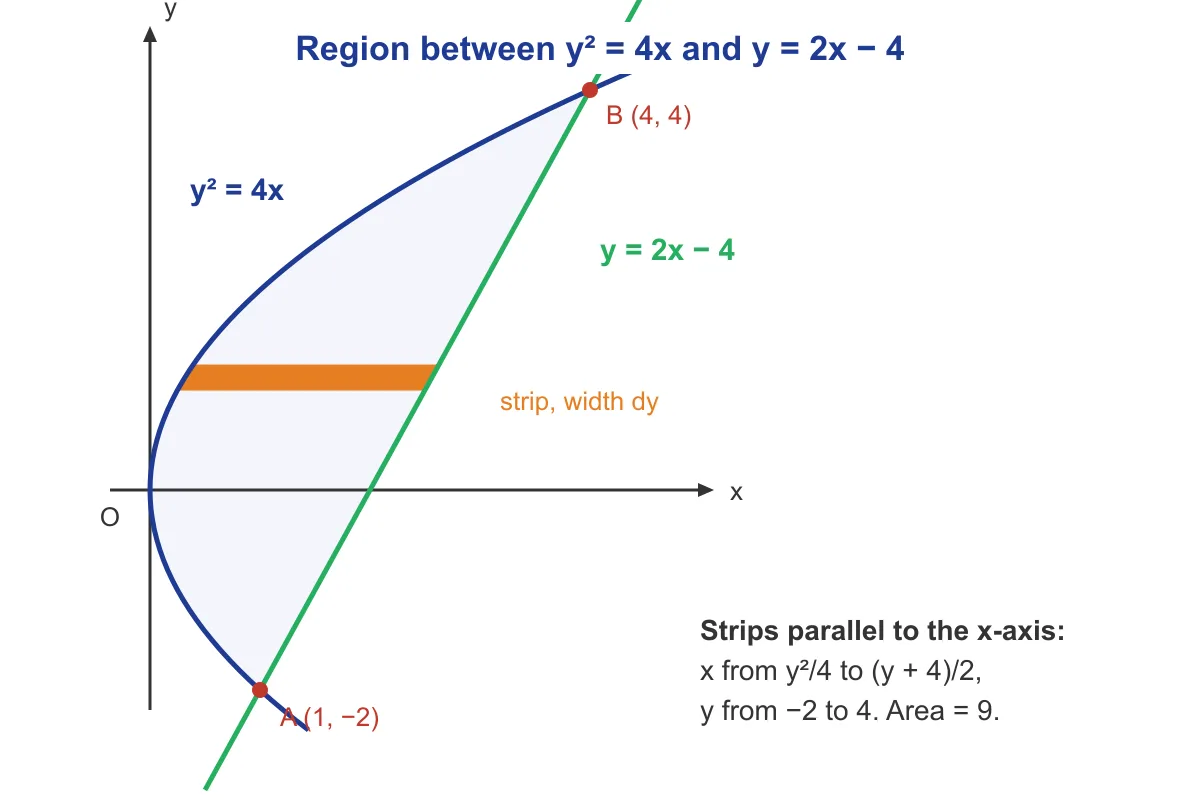
Figure 3.2: With horizontal strips the left edge is always the parabola and the right edge is always the line, so one integral does the job.
In Figure 3.2, vertical strips would need two integrals: for $0 \le x \le 1$ the strip runs from the lower half of the parabola to the upper half, and for $1 \le x \le 4$ it runs from the line to the upper half. Horizontal strips need one.
Example 5: Find the area enclosed by $y^2 = 2x$ and $y = x - 4$.
Write the line as $x = y + 4$ and the parabola as $x = \frac{y^2}{2}$.
Meeting points: $\frac{y^2}{2} = y + 4$ gives $y^2 - 2y - 8 = 0$, so $y = -2$ and $y = 4$.
Between these, the line is on the right ($y = 0$: line gives 4, parabola gives 0).
$A = \int_{-2}^{4} \left(y + 4 - \frac{y^2}{2}\right) dy = \left[\frac{y^2}{2} + 4y - \frac{y^3}{6}\right]_{-2}^{4}$
At 4: $8 + 16 - \frac{32}{3} = \frac{40}{3}$. At $-2$: $2 - 8 + \frac{4}{3} = -\frac{14}{3}$.
$A = \frac{40}{3} + \frac{14}{3} = 18$.
Why this works: with $x$ in terms of $y$ both boundaries are single-valued, and the shortcut formula agrees: $\frac{\frac{1}{2}\cdot 6^3}{6} = 18$.
Memory trick: "Look along the strip." Stand on a strip and look in the direction it runs. If every strip runs from one curve to one other curve, you have chosen well. If the strip changes its starting curve halfway, turn the strips ninety degrees.
Symmetry and the standard closed curves
Symmetry saves half or three-quarters of the work, so check for it before integrating.
| Symmetry of the region | What it lets you do |
|---|---|
| About the $x$-axis (replacing $y$ by $-y$ gives the same equation) | Find the upper half, then double |
| About the $y$-axis (replacing $x$ by $-x$ gives the same equation) | Find the right half, then double |
| About both axes | Find the first quadrant, then multiply by 4 |
| About the line $y = x$ (swapping $x$ and $y$ gives the same equation) | Find one side of the line, then double |
For an even function $f$, $\int_{-a}^{a} f\,dx = 2\int_0^a f\,dx$. For an odd function the signed integral over $[-a,a]$ is zero, but the area is not: it is twice the area on the positive side. Do not confuse the two.
Circle
The circle $x^2 + y^2 = r^2$ has area $\pi r^2$. Using four quadrants, $A = 4\int_0^r \sqrt{r^2 - x^2}\,dx$. With the standard integral
the value at $x = r$ is $\frac{r^2}{2}\cdot\frac{\pi}{2} = \frac{\pi r^2}{4}$, and at $x = 0$ it is 0. Multiply by 4 and you get $\pi r^2$. The same standard integral is what you need for any piece of a circle cut by a line, such as a segment.
Ellipse
For $\frac{x^2}{a^2} + \frac{y^2}{b^2} = 1$, the upper half is $y = \frac{b}{a}\sqrt{a^2 - x^2}$. By symmetry,
The ellipse is just the circle stretched by the factor $\frac{b}{a}$ in the $y$ direction, so its area is the circle's area times that factor.
Example 6: Find the area enclosed by the ellipse $4x^2 + 9y^2 = 36$.
Divide by 36: $\frac{x^2}{9} + \frac{y^2}{4} = 1$, so $a = 3$ and $b = 2$.
$A = \pi ab = 6\pi$ square units.
Why this works: the equation had to be put in standard form first. Reading the coefficients 4 and 9 as $a$ and $b$ would give the wrong answer.
Trigonometric curves
For $y = \sin x$ and $y = \cos x$, remember where each is positive. The curve $y = \sin x$ is positive on $(0,\pi)$ and negative on $(\pi, 2\pi)$. The curve $y = \cos x$ is positive on $\left(-\frac{\pi}{2}, \frac{\pi}{2}\right)$ and negative on $\left(\frac{\pi}{2}, \frac{3\pi}{2}\right)$.
Each full arch of either curve, between consecutive zeros, has area 2. When two trigonometric curves meet, solve the equation for every meeting point inside the interval; the curves can swap which is on top.
Example 7: Find the area enclosed by $y = \sin x$ and $y = \cos x$ between two consecutive points of intersection, starting at $x = \frac{\pi}{4}$.
Setting $\sin x = \cos x$ gives $\tan x = 1$, so $x = \frac{\pi}{4}$ and the next meeting is at $x = \frac{5\pi}{4}$.
Test $x = \frac{\pi}{2}$: $\sin = 1$, $\cos = 0$, so $\sin x$ is on top throughout this interval (they do not cross again before $\frac{5\pi}{4}$).
$A = \int_{\pi/4}^{5\pi/4} (\sin x - \cos x)\,dx = \left[-\cos x - \sin x\right]_{\pi/4}^{5\pi/4}$
At $\frac{5\pi}{4}$: $\frac{\sqrt{2}}{2} + \frac{\sqrt{2}}{2} = \sqrt{2}$. At $\frac{\pi}{4}$: $-\frac{\sqrt{2}}{2} - \frac{\sqrt{2}}{2} = -\sqrt{2}$.
$A = \sqrt{2} - (-\sqrt{2}) = 2\sqrt{2}$.
Why this works: between two consecutive meeting points one curve stays on top, so one integral with no absolute value is enough.
How to attack any area problem
- Draw the curves with their meeting points and intercepts. Rough but honest: right shape, right side of the axis, right order of the curves.
- Shade the region the question describes. Words like "bounded by" mean the finite region enclosed; if the answer is unclear, check which part has all its edges named.
- Decide on strips. Pick the direction in which the top and bottom (or left and right) boundaries each come from one equation.
- Find the limits from the meeting points or the given lines.
- Write top minus bottom (or right minus left) and integrate.
- Check the sign. An area is never negative. Compare the size with a rough count of squares from your sketch.
If the region is a standard shape (circle, ellipse, triangle), use its known area and only integrate for the leftover curved bits.
| Situation | Method |
|---|---|
| Curve above axis throughout | $\int f\,dx$ directly |
| Curve crosses the axis | Split at roots, add absolute pieces |
| Two curves, no crossing | $\int (\text{top} - \text{bottom})\,dx$ |
| Two curves, crossing | Split at crossings, subtract on each piece |
| Boundary equations like $x = g(y)$ | Horizontal strips |
| Vertical strips change their boundary curve | Horizontal strips (or split) |
| Symmetric region | Find one part, then multiply |
Memory trick: "Sketch, strip, solve, sum." Four words, four steps, in this order. Say it before every area question until you do it without thinking.
Common traps
- Using $\int_a^b f\,dx$ when $f$ changes sign → split at each root and add the absolute values.
- Subtracting the wrong way round and getting a negative area → test one point between the limits to see which curve is on top.
- Taking the intersection points from the sketch by eye → solve the equations simultaneously and check both coordinates.
- Forgetting the area on the negative side of the axis when the problem says "bounded by the $x$-axis" → the region may extend below as well; check it in your sketch.
- Reading $x = y^2$ as "the parabola $y = x^2$" → it opens to the right, so integrate along $y$ or use both $\pm\sqrt{x}$ branches.
- Using $\pi ab$ for the ellipse without dividing the equation by the constant → write it as $\frac{x^2}{a^2} + \frac{y^2}{b^2} = 1$ first.
- Taking the first-quadrant area of a circle or ellipse as $\frac{\pi r^2}{2}$ or $\frac{\pi ab}{2}$ → it is one quarter, so $\frac{\pi r^2}{4}$ or $\frac{\pi ab}{4}$.
- Saying the area of $y = x^3$ between $-1$ and $1$ is zero → the signed integral is zero but the area is $\frac{1}{2}$.
- Using the shortcut $\frac{\vert a \vert (\beta - \alpha)^3}{6}$ for two curves that are not a parabola and a line → integrate directly.
- Leaving out the strip thickness: writing $\int (x^2) $ without $dx$ and then mixing variables in the limits → keep $dx$ or $dy$ and make the limits match the variable.
Quick revision
- Area under $y = f(x)$ above the axis from $a$ to $b$: $\int_a^b f(x)\,dx$.
- If $f$ changes sign, area $= \int_a^b \vert f(x) \vert\,dx$: split at each root.
- Area between two curves: $\int_a^b (f - g)\,dx$, with $f$ the upper curve.
- Horizontal strips: area $= \int_c^d (x_{\text{right}} - x_{\text{left}})\,dy$.
- The limits are the meeting points: solve the two equations together.
- Parabola and line meeting at $\alpha,\beta$: area $= \frac{\vert a \vert(\beta-\alpha)^3}{6}$.
- Area between $y = x^2$ and $y = kx$ ($k>0$): $\frac{k^3}{6}$.
- Area between $y^2 = 4ax$ and $x^2 = 4by$: $\frac{16ab}{3}$.
- Parabola $y^2 = 4ax$ cut by the latus rectum: area $\frac{8a^2}{3}$.
- Circle: $\pi r^2$; ellipse $\frac{x^2}{a^2}+\frac{y^2}{b^2}=1$: $\pi ab$; one quadrant is a quarter of these.
- One arch of $\sin x$ or $\cos x$ between consecutive zeros has area 2; $\int_0^{2\pi}\sin x\,dx = 0$ but the area is 4.
- $\int_0^{\ln k} e^x\,dx = k - 1$.
- For $y = x^3$ between $-1$ and $1$, signed integral 0, area $\frac{1}{2}$.
- Symmetry: double for even functions or symmetric regions; the odd-function trick works only for signed integrals.
Practice questions
The area of the region bounded by $y = x^2$, the $x$-axis, $x = 0$ and $x = 3$ (in square units) is
- $9$
- $3$
- $27$
- $\frac{9}{2}$
Answer
A. $9$
$\int_0^3 x^2\,dx = \frac{27}{3} = 9$. The curve is above the axis, so no splitting is needed. Check: the rectangle $3\times 9 = 27$ contains the region, and one third of it is $9$.
The area bounded by $y = \sin x$ and the $x$-axis from $x = 0$ to $x = 2\pi$ is
- $2$
- $8$
- $0$
- $4$
Answer
D. $4$
Each half-wave has area $2$: $\int_0^\pi \sin x\,dx = 2$ and $\left\vert\int_\pi^{2\pi}\sin x\,dx\right\vert = 2$. Total $4$ (the plain integral gives $0$).
The area enclosed by the circle $x^2 + y^2 = 16$ is
- $4\pi$
- $256\pi$
- $16\pi$
- $8\pi$
Answer
C. $16\pi$
Radius $r = 4$, so area $= \pi r^2 = 16\pi$. Four quadrants of $4\int_0^4\sqrt{16-x^2}\,dx = 4\cdot 4\pi = 16\pi$ agree.
The area enclosed by the ellipse $\frac{x^2}{25} + \frac{y^2}{9} = 1$ is
- $8\pi$
- $15\pi$
- $30\pi$
- $225\pi$
Answer
B. $15\pi$
$a = 5$, $b = 3$, area $= \pi ab = 15\pi$.
The area enclosed between the curves $y = x^2$ and $y = x$ is
- $\frac{1}{2}$
- $\frac{1}{3}$
- $\frac{1}{12}$
- $\frac{1}{6}$
Answer
D. $\frac{1}{6}$
They meet at $x = 0, 1$ with the line on top: $\int_0^1 (x - x^2)\,dx = \frac{1}{2} - \frac{1}{3} = \frac{1}{6}$. The shortcut $\frac{k^3}{6}$ with $k = 1$ agrees.
The area bounded by the parabolas $y^2 = 4x$ and $x^2 = 4y$ is
- $\frac{32}{3}$
- $\frac{16}{3}$
- $4$
- $\frac{8}{3}$
Answer
B. $\frac{16}{3}$
They meet at $x = 0$ and $x = 4$. $\int_0^4 \left(2\sqrt{x} - \frac{x^2}{4}\right)dx = \frac{32}{3} - \frac{16}{3} = \frac{16}{3}$. Formula $\frac{16ab}{3}$ with $a = b = 1$ gives the same.
The area bounded by $y = e^x$, the $x$-axis, the $y$-axis and the line $x = \ln 3$ is
- $\ln 3$
- $3$
- $2$
- $1$
Answer
C. $2$
$\int_0^{\ln 3} e^x\,dx = e^{\ln 3} - e^0 = 3 - 1 = 2$.
The area of the region bounded by $y = \vert x \vert$ and $y = 2$ is
- $4$
- $8$
- $6$
- $2$
Answer
A. $4$
The lines meet at $(\pm 2, 2)$. $2\int_0^2 (2 - x)\,dx = 2(4 - 2) = 4$. As a triangle: base $4$, height $2$, area $\frac{1}{2}\cdot 4\cdot 2 = 4$.
The area bounded by $y = x^3$, the $x$-axis, $x = -1$ and $x = 2$ is
- $4$
- $\frac{9}{4}$
- $\frac{17}{4}$
- $\frac{15}{4}$
Answer
C. $\frac{17}{4}$
The curve is below the axis on $[-1,0]$ (area $\frac{1}{4}$) and above on $[0,2]$ (area $4$). Total $\frac{1}{4} + 4 = \frac{17}{4}$. The signed integral $\frac{15}{4}$ is not the area.
The area of the region bounded by the parabola $x = y^2$ and the line $x = 4$ is
- $\frac{32}{3}$
- $\frac{16}{3}$
- $\frac{64}{3}$
- $8$
Answer
A. $\frac{32}{3}$
Horizontal strips, $y$ from $-2$ to $2$: $\int_{-2}^{2} (4 - y^2)\,dy = 2\left(8 - \frac{8}{3}\right) = \frac{32}{3}$.
The area enclosed between $y = x^2$ and $y = 2 - x^2$ is
- $4$
- $\frac{8}{3}$
- $\frac{16}{3}$
- $\frac{4}{3}$
Answer
B. $\frac{8}{3}$
They meet where $x^2 = 1$, i.e. $x = \pm 1$. $\int_{-1}^{1} (2 - 2x^2)\,dx = 4 - \frac{4}{3} = \frac{8}{3}$.
The area bounded by $y = \sin x$, $y = \cos x$ and the $y$-axis, in the region where $\cos x \ge \sin x$ (the first closed region on the right of the $y$-axis), is
- $\sqrt{2} + 1$
- $2 - \sqrt{2}$
- $1 - \frac{1}{\sqrt{2}}$
- $\sqrt{2} - 1$
Answer
D. $\sqrt{2} - 1$
The curves meet first at $x = \frac{\pi}{4}$. $\int_0^{\pi/4} (\cos x - \sin x)\,dx = [\sin x + \cos x]_0^{\pi/4} = \sqrt{2} - 1$.
The area of the smaller part of the disc $x^2 + y^2 \le 4$ cut off by the line $x = 1$ is
- $\frac{4\pi}{3} - \frac{\sqrt{3}}{2}$
- $\frac{8\pi}{3} - \sqrt{3}$
- $\frac{2\pi}{3} - \sqrt{3}$
- $\frac{4\pi}{3} - \sqrt{3}$
Answer
D. $\frac{4\pi}{3} - \sqrt{3}$
Area $= \int_1^2 2\sqrt{4 - x^2}\,dx = \left[x\sqrt{4-x^2} + 4\sin^{-1}\frac{x}{2}\right]_1^2 = 2\pi - \sqrt{3} - \frac{2\pi}{3} = \frac{4\pi}{3} - \sqrt{3}$. Segment formula: half-angle $60^\circ$, so $\frac{r^2}{2}(\theta - \sin\theta)$ with $\theta = \frac{2\pi}{3}$ gives the same.
The area of the region $\{(x,y) : x^2 \le y \le \vert x \vert\}$ is
- $\frac{1}{3}$
- $\frac{2}{3}$
- $\frac{1}{6}$
- $\frac{1}{2}$
Answer
A. $\frac{1}{3}$
The region is symmetric about the $y$-axis. For $x \ge 0$ it lies between $y = x^2$ and $y = x$ with area $\frac{1}{6}$. Doubling gives $\frac{1}{3}$.
The area (in square units) under the line $y = 2x + 1$ between $x = 1$ and $x = 3$, above the $x$-axis, is
- $12$
- $14$
- $10$
- $8$
Answer
C. $10$
$\int_1^3 (2x+1)\,dx = [x^2 + x]_1^3 = 12 - 2 = 10$. Trapezoid check: heights $3$ and $7$, width $2$: $\frac{3+7}{2}\cdot 2 = 10$.
The area (in square units) enclosed by $y = 6x - x^2$ and the $x$-axis is
- $108$
- $36$
- $72$
- $18$
Answer
B. $36$
Roots $x = 0, 6$. $\int_0^6 (6x - x^2)\,dx = 108 - 72 = 36$. Shortcut: $\frac{1\cdot 6^3}{6} = 36$.
The area (in square units) enclosed between the parabola $y = x^2$ and the line $y = 3x$ is
- $2.25$
- $4.5$
- $9$
- $13.5$
Answer
B. $4.5$
They meet at $x = 0, 3$. $\int_0^3 (3x - x^2)\,dx = \frac{27}{2} - 9 = 4.5$. Check by $\frac{k^3}{6} = \frac{27}{6} = 4.5$.
The area (in square units) bounded by $y^2 = 12x$ and $x^2 = 12y$ is
- $48$
- $16$
- $144$
- $96$
Answer
A. $48$
Here $4a = 12$, so $a = b = 3$, area $= \frac{16ab}{3} = 48$. Direct: they meet at $x = 0, 12$; $\int_0^{12}\left(\sqrt{12x} - \frac{x^2}{12}\right)dx = 96 - 48 = 48$.
The area (in square units) of the triangle-shaped region bounded by $y = \vert x - 1 \vert$ and $y = 4$ is
- $8$
- $12$
- $32$
- $16$
Answer
D. $16$
The lines meet at $x = -3$ and $x = 5$, base $8$, apex at $(1,0)$ of height $4$. Area $= \frac{1}{2}\cdot 8 \cdot 4 = 16$. Integral: $\int_{-3}^{5}(4 - \vert x-1\vert)\,dx = 32 - 16 = 16$.
The region enclosed by $y = x$ and $y = x^3$ consists of two equal parts, one in the first quadrant and one in the third. The total area (in square units) is
- $0.25$
- $1$
- $0.5$
- $2$
Answer
C. $0.5$
First quadrant: $\int_0^1 (x - x^3)\,dx = \frac{1}{2} - \frac{1}{4} = \frac{1}{4}$. The two parts are equal by symmetry about the origin, so total $= 0.5$. (Integrating $x - x^3$ over $-1$ to $1$ gives $0$, which is wrong here.)
The curve $x^2 + y^2 - 4x + 6y - 12 = 0$ encloses an area of $k\pi$ square units. The value of $k$ is
- $12$
- $25$
- $50$
- $5$
Answer
B. $25$
Complete the squares: $(x-2)^2 + (y+3)^2 = 12 + 4 + 9 = 25$, so $r = 5$ and area $= 25\pi$. $k = 25$.
The area (in square units) bounded by $y = 9 - x^2$ and the two coordinate axes in the first quadrant is
- $9$
- $27$
- $18$
- $36$
Answer
C. $18$
The curve meets the $x$-axis at $x = 3$. $\int_0^3 (9 - x^2)\,dx = 27 - 9 = 18$.
The area (in square units) of the region lying between $y = x^2$ and $y = 6\vert x \vert$ is
- $72$
- $36$
- $18$
- $108$
Answer
A. $72$
Symmetric about the $y$-axis. For $x \ge 0$ they meet at $x = 0, 6$: $\int_0^6 (6x - x^2)\,dx = 36$. Double: $72$.
The area (in square units) enclosed by the parabola $y^2 = 4x$ and the line $y = 2x - 4$ is
- $4.5$
- $6$
- $18$
- $9$
Answer
D. $9$
The curves meet at $(1,-2)$ and $(4,4)$. Horizontal strips: $\int_{-2}^{4}\left(\frac{y+4}{2} - \frac{y^2}{4}\right)dy = \frac{20}{3} + \frac{7}{3} = 9$. Vertical strips: $\frac{8}{3} + \frac{19}{3} = 9$.
The area (in square units) bounded by $y = x^3$, the line $y = 8$ and the $y$-axis is
- $16$
- $12$
- $6$
- $24$
Answer
B. $12$
Meeting point $(2, 8)$. Vertical strips: $\int_0^2 (8 - x^3)\,dx = 16 - 4 = 12$. Horizontal: $\int_0^8 y^{1/3}\,dy = \frac{3}{4}\cdot 16 = 12$.
The curves $y = \sin x$ and $y = \sin 2x$ enclose regions between $x = 0$ and $x = \pi$. The total area (in square units) of these regions is
- $2.5$
- $2.25$
- $0.25$
- $5$
Answer
A. $2.5$
They meet where $\sin x(1 - 2\cos x) = 0$, i.e. $x = 0, \frac{\pi}{3}, \pi$. On $\left[0,\frac{\pi}{3}\right]$, $\sin 2x$ is on top: $\frac{1}{4}$. On $\left[\frac{\pi}{3},\pi\right]$, $\sin x$ is on top: $\frac{9}{4}$. Total $\frac{10}{4} = 2.5$.
Given below are two statements: Statement I: For any continuous function $f$, the area between $y = f(x)$ and the $x$-axis from $x = a$ to $x = b$ always equals $\int_a^b f(x)\,dx$. Statement II: The area between $y = \sin x$ and the $x$-axis from $x = 0$ to $x = 2\pi$ is $4$ square units.
- Both Statement I and Statement II are correct
- Both Statement I and Statement II are incorrect
- Statement I is correct but Statement II is incorrect
- Statement I is incorrect but Statement II is correct
Answer
D. Statement I is incorrect but Statement II is correct
Statement I fails when $f$ is negative somewhere: $\int_0^{2\pi}\sin x\,dx = 0$ although the area is not zero. Statement II is true: $2 + 2 = 4$.
Given below are two statements: Statement I: The area enclosed by $y = x^2$ and $y = x$ equals the area enclosed by $y = \sqrt{x}$ and $y = x$. Statement II: For $x \ge 0$, the graphs of $y = x^2$ and $y = \sqrt{x}$ are mirror images of each other in the line $y = x$, and a reflection preserves area.
- Both Statement I and Statement II are correct
- Both Statement I and Statement II are incorrect
- Statement I is correct but Statement II is incorrect
- Statement I is incorrect but Statement II is correct
Answer
A. Both Statement I and Statement II are correct
Both areas equal $\frac{1}{6}$ ($\int_0^1 (\sqrt{x} - x)\,dx = \frac{2}{3} - \frac{1}{2} = \frac{1}{6}$). Statement II is the correct geometric reason, and it is true.
Given below are two statements: Statement I: The area enclosed by $\frac{x^2}{a^2} + \frac{y^2}{b^2} = 1$ is $\pi ab$. Statement II: The part of this ellipse lying in the first quadrant has area $\frac{\pi ab}{2}$.
- Both Statement I and Statement II are correct
- Both Statement I and Statement II are incorrect
- Statement I is correct but Statement II is incorrect
- Statement I is incorrect but Statement II is correct
Answer
C. Statement I is correct but Statement II is incorrect
Statement I is true. By symmetry the first quadrant holds one quarter, $\frac{\pi ab}{4}$, so Statement II is false.
Given below are two statements: Statement I: The area bounded by $y = \sin x$, the $x$-axis, $x = 0$ and $x = \pi$ is $1$ square unit. Statement II: The area bounded by $y = \cos x$, the $x$-axis, $x = 0$ and $x = \pi$ is $0$.
- Both Statement I and Statement II are correct
- Both Statement I and Statement II are incorrect
- Statement I is correct but Statement II is incorrect
- Statement I is incorrect but Statement II is correct
Answer
B. Both Statement I and Statement II are incorrect
$\int_0^\pi \sin x\,dx = 2$, not $1$. For $\cos x$ the integral is $0$ but the area is $2 \cdot \int_0^{\pi/2}\cos x\,dx = 2$. Both statements are false.
Given below are two statements: Statement I: The area bounded by $y^2 = 4x$ and the line $x = 1$ is $\frac{8}{3}$ square units. Statement II: This area equals $\int_0^1 2\sqrt{x}\,dx = \frac{4}{3}$.
- Both Statement I and Statement II are correct
- Both Statement I and Statement II are incorrect
- Statement I is correct but Statement II is incorrect
- Statement I is incorrect but Statement II is correct
Answer
C. Statement I is correct but Statement II is incorrect
The region has both an upper half $y = 2\sqrt{x}$ and a lower half $y = -2\sqrt{x}$, so the area is $2\int_0^1 2\sqrt{x}\,dx = \frac{8}{3}$. Statement II counts only the upper half.
Assertion (A): The area bounded by $y = \sin x$ and the $x$-axis from $x = 0$ to $x = 2\pi$ is $4$. Reason (R): $\sin x$ is positive on $(0,\pi)$ and negative on $(\pi, 2\pi)$, so the area is $\left\vert\int_0^\pi \sin x\,dx\right\vert + \left\vert\int_\pi^{2\pi}\sin x\,dx\right\vert$.
- Both A and R are true and R is the correct explanation of A
- Both A and R are true but R is not the correct explanation of A
- A is true but R is false
- A is false but R is true
Answer
A. Both A and R are true and R is the correct explanation of A
R gives the correct method and evaluates to $2 + 2 = 4$, which is A. So both are true and R explains A.
Assertion (A): The area enclosed between $y^2 = x$ and $x^2 = y$ is $\frac{1}{3}$. Reason (R): The two curves meet at the points $(0,0)$ and $(1,1)$.
- Both A and R are true and R is the correct explanation of A
- Both A and R are true but R is not the correct explanation of A
- A is true but R is false
- A is false but R is true
Answer
B. Both A and R are true but R is not the correct explanation of A
$\int_0^1 (\sqrt{x} - x^2)\,dx = \frac{2}{3} - \frac{1}{3} = \frac{1}{3}$, so A is true. R is also true (it gives the limits), but the meeting points alone do not give the area value, so R does not explain A.
Assertion (A): The area of the ellipse $\frac{x^2}{16} + \frac{y^2}{9} = 1$ is $12\pi$. Reason (R): The area of an ellipse with semi-axes $a$ and $b$ is $\pi(a + b)$.
- Both A and R are true and R is the correct explanation of A
- Both A and R are true but R is not the correct explanation of A
- A is true but R is false
- A is false but R is true
Answer
C. A is true but R is false
A is true: $\pi \cdot 4 \cdot 3 = 12\pi$. R is false, because the area is $\pi ab$ (for this ellipse $\pi(a+b) = 7\pi$).
Match List I with List II. List I: a. Region inside the circle $x^2 + y^2 = 9$ b. Region between $y = x^2$ and $y = x$ c. Region between $y = x^2$ and $y = 4$ d. Region between $y = \sin x$ and the $x$-axis, $0 \le x \le 2\pi$ List II: i. $4$ ii. $\frac{1}{6}$ iii. $9\pi$ iv. $\frac{32}{3}$
- a-iii, b-iv, c-ii, d-i
- a-i, b-ii, c-iv, d-iii
- a-iii, b-i, c-iv, d-ii
- a-iii, b-ii, c-iv, d-i
Answer
D. a-iii, b-ii, c-iv, d-i
a: $\pi r^2 = 9\pi$ (iii). b: $\frac{1}{6}$ (ii). c: $2\int_0^2 (4 - x^2)\,dx = \frac{32}{3}$ (iv). d: $2 + 2 = 4$ (i).
Match List I with List II. List I: a. Area between $y = x^2$ and $y = 2x$ b. Area between $y = x^2$ and $y = 3x$ c. Area between $y = x^2$ and $y = 4x$ d. Area between $y = x^2$ and $y = x$ List II: i. $\frac{32}{3}$ ii. $\frac{1}{6}$ iii. $\frac{9}{2}$ iv. $\frac{4}{3}$
- a-iv, b-iii, c-ii, d-i
- a-i, b-iii, c-iv, d-ii
- a-iii, b-iv, c-i, d-ii
- a-iv, b-iii, c-i, d-ii
Answer
D. a-iv, b-iii, c-i, d-ii
For $y = x^2$ and $y = kx$ the area is $\frac{k^3}{6}$. $k = 2$: $\frac{4}{3}$ (iv). $k = 3$: $\frac{9}{2}$ (iii). $k = 4$: $\frac{32}{3}$ (i). $k = 1$: $\frac{1}{6}$ (ii).
Match List I with List II. List I: a. Area under $y = \sin x$ from $0$ to $\pi$ b. Area under $y = \cos x$ from $0$ to $\frac{\pi}{2}$ c. Area under $y = e^x$ from $x = 0$ to $x = \ln 5$ d. Area under $y = 2x$ from $x = 0$ to $x = 3$ List II: i. $1$ ii. $9$ iii. $2$ iv. $4$
- a-iii, b-i, c-iv, d-ii
- a-iii, b-i, c-ii, d-iv
- a-i, b-iii, c-iv, d-ii
- a-iv, b-i, c-iii, d-ii
Answer
A. a-iii, b-i, c-iv, d-ii
a: $[-\cos x]_0^\pi = 2$ (iii). b: $[\sin x]_0^{\pi/2} = 1$ (i). c: $e^{\ln 5} - 1 = 4$ (iv). d: $[x^2]_0^3 = 9$ (ii).
A region is bounded by the parabola $y^2 = 4x$ and the line $y = x - 3$. Its area (in square units) is
- $\frac{16}{3}$
- $\frac{128}{3}$
- $\frac{64}{3}$
- $\frac{32}{3}$
Answer
C. $\frac{64}{3}$
Write the line as $x = y + 3$. Meeting: $\frac{y^2}{4} = y + 3$ gives $y^2 - 4y - 12 = 0$, so $y = -2, 6$. Area $= \int_{-2}^{6}\left(y + 3 - \frac{y^2}{4}\right)dy = 18 + \frac{10}{3} = \frac{64}{3}$. Shortcut: $\frac{\frac{1}{4}\cdot 8^3}{6} = \frac{64}{3}$.
The line $y = c$ with $0 < c < 4$ divides the region bounded by $y = x^2$ and $y = 4$ into two parts of equal area. The value of $c$ is
- $2^{2/3}$
- $3$
- $2$
- $2^{4/3}$
Answer
D. $2^{4/3}$
Total area $= \frac{32}{3}$. The part below $y = c$ (inside the parabola) is $\int_0^c 2\sqrt{y}\,dy = \frac{4}{3}c^{3/2}$. Set it equal to $\frac{16}{3}$: $c^{3/2} = 4$, so $c = 4^{2/3} = 2^{4/3}$. (Check: $c \approx 2.52$, not $2$.)
The area of the region inside the circle $x^2 + y^2 = 16$ and inside the parabola $y^2 = 6x$ is
- $\frac{16\pi - 4\sqrt{3}}{3}$
- $\frac{16\pi + 4\sqrt{3}}{3}$
- $\frac{16\pi + 2\sqrt{3}}{3}$
- $\frac{8\pi + 4\sqrt{3}}{3}$
Answer
B. $\frac{16\pi + 4\sqrt{3}}{3}$
They meet where $x^2 + 6x = 16$, so $x = 2$, $y = \pm 2\sqrt{3}$. Upper half: $\int_0^2 \sqrt{6x}\,dx = \frac{8\sqrt{3}}{3}$ and $\int_2^4 \sqrt{16 - x^2}\,dx = \frac{8\pi}{3} - 2\sqrt{3}$. Sum $= \frac{8\pi}{3} + \frac{2\sqrt{3}}{3}$. Double: $\frac{16\pi + 4\sqrt{3}}{3}$ (about $19.06$).