Indefinite Integrals
What to remember
- Integration undoes differentiation. $\int f(x)\,dx = F(x) + C$ means $F'(x) = f(x)$, and the constant $C$ is never optional.
- Learn the table of standard integrals until it is automatic. Every technique in this chapter exists to push a hard integral back into that table.
- Substitution handles "function of a function times its derivative". By parts handles a product of unlike functions, and the order I, L, A, T, E tells you which factor to differentiate.
- A rational function whose denominator factorises is split into partial fractions. A quadratic $ax^2+bx+c$ is always handled by completing the square.
- $\int e^x\,[f(x)+f'(x)]\,dx = e^x f(x) + C$ is the fastest result in the chapter. Learn to see the pattern before you start by parts.
Integration as the inverse of differentiation
Differentiation takes a function and gives its slope function. Integration runs the machine backwards: you are handed the slope function $f(x)$ and asked for a function $F(x)$ whose derivative is $f(x)$. Such an $F$ is called an antiderivative or primitive of $f$, and we write
Why the $+C$? Because $x^2$, $x^2 + 5$ and $x^2 - 100$ all have the same derivative $2x$. If $F$ and $G$ are two antiderivatives of the same $f$, then $(F-G)' = 0$ on an interval, so $F - G$ is a constant. Hence the full family of antiderivatives is $F(x) + C$, one curve for each value of $C$. All these curves are vertical shifts of each other, and at any fixed $x$ they all have the same slope.
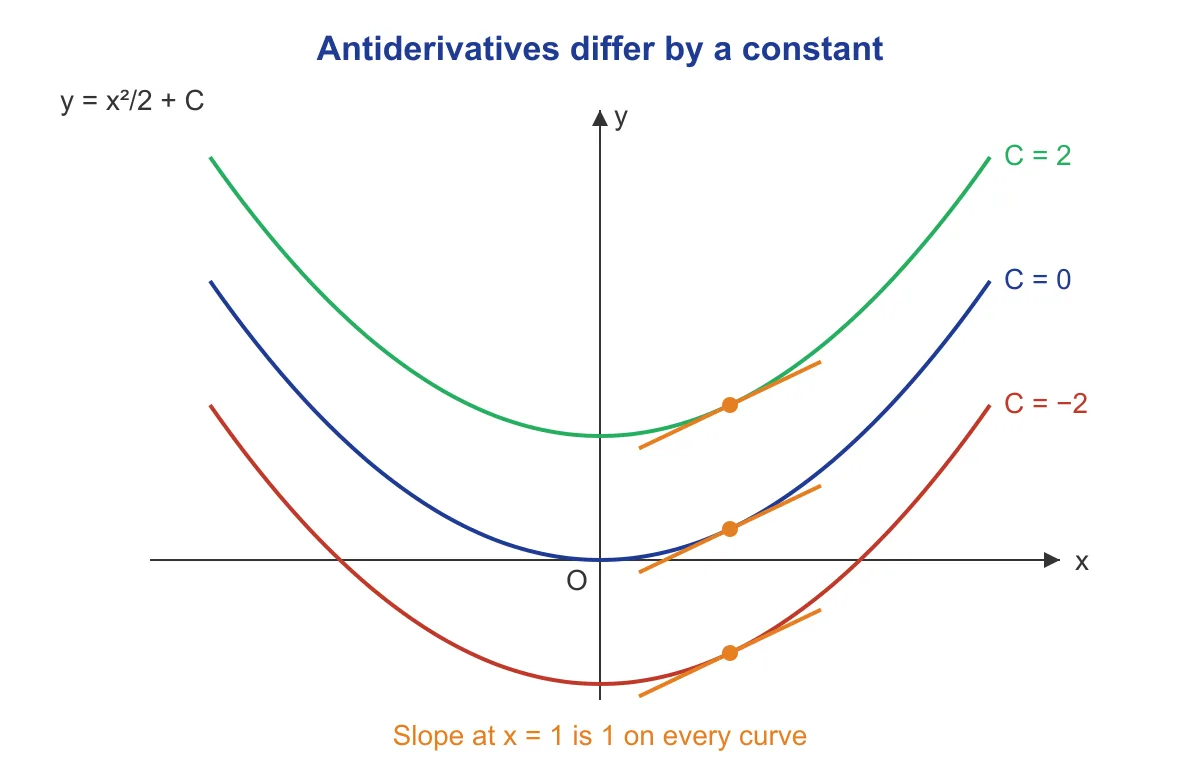
Figure 1.1: Antiderivatives of x form a family of vertically shifted parabolas, with equal slopes at the same x
A direct consequence: the answer to an indefinite integral can look different in two textbooks and both can be right. $\int \sin x\cos x\,dx$ equals $\frac{\sin^2 x}{2} + C$ and also $-\frac{\cos^2 x}{2} + C$, because the two differ by the constant $\frac12$. To check any integral you ever do, differentiate your answer. If you get the integrand back, you are done.
Properties
- Constant factor: $\int k f(x)\,dx = k\int f(x)\,dx$ for a constant $k$.
- Sum and difference: $\int [f(x) \pm g(x)]\,dx = \int f(x)\,dx \pm \int g(x)\,dx$. This extends to any finite number of terms.
- Derivative of an integral: $\frac{d}{dx}\int f(x)\,dx = f(x)$. The integral of a derivative is $\int f'(x)\,dx = f(x) + C$.
- Linear argument: if $\int f(x)\,dx = F(x) + C$, then $\int f(ax+b)\,dx = \frac{1}{a}F(ax+b) + C$ for $a \ne 0$.
- Integration does not split over a product: $\int f(x)g(x)\,dx \ne \int f(x)\,dx \cdot \int g(x)\,dx$. Also $\int \frac{f}{g}\,dx$ is not the ratio of the two integrals.
Standard integrals
Each line below is just a differentiation formula read backwards. The constant of integration is understood on every line.
| Integrand | Integral | Condition |
|---|---|---|
| $x^n$ | $\frac{x^{n+1}}{n+1}$ | $n \ne -1$ |
| $\frac{1}{x}$ | $\ln\vert x\vert$ | $x \ne 0$ |
| $e^x$ | $e^x$ | none |
| $a^x$ | $\frac{a^x}{\ln a}$ | $a>0,\ a\ne1$ |
| $\sin x$ | $-\cos x$ | none |
| $\cos x$ | $\sin x$ | none |
| $\sec^2 x$ | $\tan x$ | $\cos x \ne 0$ |
| $\csc^2 x$ | $-\cot x$ | $\sin x \ne 0$ |
| $\sec x\tan x$ | $\sec x$ | $\cos x \ne 0$ |
| $\csc x\cot x$ | $-\csc x$ | $\sin x \ne 0$ |
| $\frac{1}{\sqrt{1-x^2}}$ | $\sin^{-1}x$ | $\vert x\vert < 1$ |
| $\frac{1}{1+x^2}$ | $\tan^{-1}x$ | none |
| $\tan x$ | $\ln\vert\sec x\vert$ | $\cos x \ne 0$ |
| $\cot x$ | $\ln\vert\sin x\vert$ | $\sin x \ne 0$ |
| $\sec x$ | $\ln\vert\sec x + \tan x\vert$ | $\cos x \ne 0$ |
| $\csc x$ | $\ln\vert\csc x - \cot x\vert$ | $\sin x \ne 0$ |
The entry for $\frac1x$ carries a modulus because $\ln x$ exists only for $x>0$, while $\frac1x$ lives on negative $x$ as well. Differentiate $\ln(-x)$ for $x<0$ and you get $\frac1x$ again, which is why $\ln\vert x\vert$ covers both sides.
Memory trick: "Sin sinks, cos climbs." Integrating $\sin x$ gives $-\cos x$ (it sinks into a minus), integrating $\cos x$ gives $+\sin x$. Use it every time you integrate a trigonometric function, then differentiate once to confirm the sign.
Before using any technique, rewrite the integrand so that each term is a power or a table function. Powers of $x$ in a numerator over a single term are the easiest case.
Example 1: Find $\int \dfrac{(2x+1)^2}{x}\,dx$.
Expand the numerator: $(2x+1)^2 = 4x^2 + 4x + 1$.
Divide each term by $x$: $\dfrac{(2x+1)^2}{x} = 4x + 4 + \dfrac{1}{x}$.
Integrate term by term: $\int 4x\,dx = 2x^2$, $\int 4\,dx = 4x$, $\int \frac{dx}{x} = \ln\vert x\vert$.
Answer: $2x^2 + 4x + \ln\vert x\vert + C$.
Why this works: a fraction with a single-term denominator is just a sum of powers, so no technique beyond the table is needed. Do not reach for substitution here.
Trigonometric squares need an identity first. For example $\cos^2 x = \frac{1+\cos 2x}{2}$ gives $\int\cos^2x\,dx = \frac{x}{2} + \frac{\sin 2x}{4} + C$, and $\sin^2 x = \frac{1-\cos 2x}{2}$ gives $\int \sin^2x\,dx = \frac{x}{2} - \frac{\sin 2x}{4} + C$.
Integration by substitution
The chain rule says $\frac{d}{dx}F(g(x)) = F'(g(x))\,g'(x)$. Read backwards, if $\int f(t)\,dt = F(t) + C$, then
In practice you choose a new variable $t = g(x)$, replace $g'(x)\,dx$ by $dt$, integrate in $t$, and then put $x$ back. Three habits make this reliable. First, pick $t$ to be the inside of the most awkward part: the thing under a root, the exponent, the denominator, the argument of a trig function. Second, every $x$ must disappear; if one is left over, either solve for it from $t=g(x)$ or choose a different $t$. Third, return to $x$ in the final answer.
One result is used so often that it deserves its own line:
It is the substitution $t = f(x)$ in disguise. It gives $\int \tan x\,dx = -\ln\vert\cos x\vert$ at once, since the numerator $\sin x$ is minus the derivative of $\cos x$. In the same way, $\int \frac{2x}{x^2+1}\,dx = \ln(x^2+1) + C$, with no modulus needed because $x^2+1 > 0$.
Example 2: Find $\int x\sqrt{x+2}\,dx$.
Put $t = x+2$, so $x = t - 2$ and $dx = dt$.
The integral becomes $\int (t-2)\,t^{1/2}\,dt = \int \left(t^{3/2} - 2t^{1/2}\right)dt$.
Integrate: $\frac{2}{5}t^{5/2} - 2\cdot\frac{2}{3}t^{3/2} = \frac{2}{5}t^{5/2} - \frac{4}{3}t^{3/2}$.
Answer: $\frac{2}{5}(x+2)^{5/2} - \frac{4}{3}(x+2)^{3/2} + C$.
Why this works: the root was the awkward part, and substituting its inside turned the extra $x$ into $t-2$, which is a polynomial in $t$.
Trigonometric substitutions
When a square root of a quadratic with no $x$-term appears, a trigonometric substitution removes the root using an identity. Here $a>0$.
| Expression present | Substitution | Identity that kills the root |
|---|---|---|
| $\sqrt{a^2 - x^2}$ | $x = a\sin\theta$ | $1 - \sin^2\theta = \cos^2\theta$ |
| $\sqrt{a^2 + x^2}$ | $x = a\tan\theta$ | $1 + \tan^2\theta = \sec^2\theta$ |
| $\sqrt{x^2 - a^2}$ | $x = a\sec\theta$ | $\sec^2\theta - 1 = \tan^2\theta$ |
Memory trick: "Minus first goes sine, plus goes tan, minus second goes sec." If $a^2$ comes first with a minus, use sine; if there is a plus, use tangent; if $x^2$ comes first with a minus, use secant. Say it while you look at the root.
To return to $x$ after integrating, draw a right triangle from the substitution. For $x = a\tan\theta$, the opposite side is $x$, the adjacent side is $a$ and the hypotenuse is $\sqrt{a^2+x^2}$.
Example 3: Find $\int \dfrac{dx}{x^2\sqrt{x^2+4}}$.
Plus sign under the root, so put $x = 2\tan\theta$. Then $dx = 2\sec^2\theta\,d\theta$ and $\sqrt{x^2+4} = 2\sec\theta$.
The integrand becomes $\dfrac{2\sec^2\theta}{4\tan^2\theta\cdot 2\sec\theta}\,d\theta = \dfrac{1}{4}\cdot\dfrac{\sec\theta}{\tan^2\theta}\,d\theta = \dfrac{1}{4}\cdot\dfrac{\cos\theta}{\sin^2\theta}\,d\theta$.
Put $s = \sin\theta$: $\frac14\int s^{-2}\,ds = -\frac{1}{4s} = -\frac{1}{4\sin\theta}$.
From the triangle, $\sin\theta = \frac{x}{\sqrt{x^2+4}}$.
Answer: $-\dfrac{\sqrt{x^2+4}}{4x} + C$.
Why this works: the trig form turned a root into a single trig function, and then a second, easy substitution finished it. Differentiating the answer returns the integrand, which is a good habit to confirm.
Integration by parts
The product rule $(uv)' = u'v + uv'$ rearranges into
In words: differentiate the first factor, integrate the second, and trade the original integral for a hopefully easier one. The choice of which factor is $u$ decides everything. The standard order of preference for $u$ is I, L, A, T, E: inverse trigonometric, logarithmic, algebraic, trigonometric, exponential. The factor that comes earlier in the list is taken as $u$.
Memory trick: "I Love Apple Tea Everyday." The first letters give I, L, A, T, E. The earlier letter is differentiated, the later letter is integrated.
If the integrand is a single function such as $\ln x$ or $\tan^{-1}x$, write it as $1\cdot$ that function and take the function as $u$ and $1$ as $v'$. This gives $\int \ln x\,dx = x\ln x - x + C$ and $\int \tan^{-1}x\,dx = x\tan^{-1}x - \frac12\ln(1+x^2) + C$.
Example 4: Find $\int x\,e^{2x}\,dx$.
Algebraic comes before exponential in ILATE, so $u = x$ and $v' = e^{2x}$.
Then $u' = 1$ and $v = \frac{e^{2x}}{2}$.
$\int x e^{2x}dx = \frac{x e^{2x}}{2} - \int \frac{e^{2x}}{2}\,dx = \frac{x e^{2x}}{2} - \frac{e^{2x}}{4}$.
Answer: $\dfrac{e^{2x}}{4}(2x - 1) + C$.
Why this works: differentiating $x$ made it vanish into $1$, so the new integral is easier than the old one. If your choice makes the integral harder, swap the roles.
When the same type of function comes back after two rounds of parts, you can solve for the integral like an equation. For $I = \int e^{ax}\sin bx\,dx$, two rounds give $I$ on both sides, and
The result $\int e^x[f(x)+f'(x)]\,dx$
Write $\int e^x f(x)\,dx$ by parts with $u = f(x)$: it equals $e^x f(x) - \int e^x f'(x)\,dx$. Move the second integral across and you get
The sign inside the bracket must be plus. With a minus sign the formula fails. Typical uses: $\int e^x(\sin x + \cos x)\,dx = e^x\sin x + C$, and $\int e^x\left(\frac1x - \frac1{x^2}\right)dx = \frac{e^x}{x} + C$ (here $f = \frac1x$, $f' = -\frac{1}{x^2}$, so it is the plus pattern after all). When you see $e^x$ times a bracket of two terms, ask whether one is the derivative of the other.
Memory trick: "Eˣ stays, f plus f-dash gives eˣ f." Whenever $e^x$ is outside a bracket, test the bracket for the pair $f$ and $f'$ with a plus between them.
Standard forms with quadratics
Seven results cover most integrals that contain $x^2 \pm a^2$. All of them can be checked by differentiation, and the roots are derived by the trigonometric substitutions above.
| Integral | Result |
|---|---|
| $\int\frac{dx}{x^2+a^2}$ | $\frac1a\tan^{-1}\frac{x}{a}$ |
| $\int\frac{dx}{x^2-a^2}$ | $\frac{1}{2a}\ln\left\vert\frac{x-a}{x+a}\right\vert$ |
| $\int\frac{dx}{a^2-x^2}$ | $\frac{1}{2a}\ln\left\vert\frac{a+x}{a-x}\right\vert$ |
| $\int\frac{dx}{\sqrt{a^2-x^2}}$ | $\sin^{-1}\frac{x}{a}$ |
| $\int\frac{dx}{\sqrt{x^2+a^2}}$ | $\ln\left\vert x+\sqrt{x^2+a^2}\right\vert$ |
| $\int\frac{dx}{\sqrt{x^2-a^2}}$ | $\ln\left\vert x+\sqrt{x^2-a^2}\right\vert$ |
and the three square-root integrals:
| Integral | Result |
|---|---|
| $\int\sqrt{a^2-x^2}\,dx$ | $\frac{x}{2}\sqrt{a^2-x^2} + \frac{a^2}{2}\sin^{-1}\frac{x}{a}$ |
| $\int\sqrt{x^2+a^2}\,dx$ | $\frac{x}{2}\sqrt{x^2+a^2} + \frac{a^2}{2}\ln\left\vert x+\sqrt{x^2+a^2}\right\vert$ |
| $\int\sqrt{x^2-a^2}\,dx$ | $\frac{x}{2}\sqrt{x^2-a^2} - \frac{a^2}{2}\ln\left\vert x+\sqrt{x^2-a^2}\right\vert$ |
Notice that the $\tan^{-1}$ form has a factor $\frac1a$ and the $\sin^{-1}$ form does not. The reason is the chain rule: $\frac{d}{dx}\tan^{-1}\frac xa = \frac{a}{a^2+x^2}$, so a $\frac1a$ is needed to cancel the extra $a$, while $\frac{d}{dx}\sin^{-1}\frac xa = \frac{1}{\sqrt{a^2-x^2}}$ already comes out clean. The logarithm in $\frac{dx}{x^2-a^2}$ has the factor $\frac{1}{2a}$ because $\frac{1}{x^2-a^2} = \frac{1}{2a}\left[\frac{1}{x-a} - \frac{1}{x+a}\right]$.
General quadratic $ax^2+bx+c$
For $\int\frac{dx}{ax^2+bx+c}$ and for $\int\frac{dx}{\sqrt{ax^2+bx+c}}$ and $\int\sqrt{ax^2+bx+c}\,dx$, factor out $a$ and complete the square:
Put $t = x + \frac{b}{2a}$ and the quadratic becomes $t^2 \pm k^2$ (or $k^2 - t^2$), which matches one of the tables above. For a numerator $px + q$, split it as
The first part is a multiple of the derivative of the quadratic, so it integrates to $A\ln\vert ax^2+bx+c\vert$ for the denominator case and to $2A\sqrt{ax^2+bx+c}$ for the square-root case. The leftover constant $B$ goes to the complete-the-square step.
Example 5: Find $\int \dfrac{2x+3}{x^2+4x+7}\,dx$.
The derivative of the denominator is $2x+4$. Write $2x + 3 = (2x+4) - 1$.
First part: $\int\frac{2x+4}{x^2+4x+7}dx = \ln(x^2+4x+7)$.
Second part: $x^2+4x+7 = (x+2)^2 + 3$, so $-\int\frac{dx}{(x+2)^2+3} = -\frac{1}{\sqrt3}\tan^{-1}\frac{x+2}{\sqrt3}$.
Answer: $\ln(x^2+4x+7) - \dfrac{1}{\sqrt3}\tan^{-1}\dfrac{x+2}{\sqrt3} + C$.
Why this works: any numerator of degree one splits into "derivative of the denominator" plus a constant, and each piece has a known integral. No modulus is needed because the quadratic has no real root and is always positive.
Partial fractions
A rational function $\frac{P(x)}{Q(x)}$ is proper when the degree of $P$ is less than the degree of $Q$. If it is improper, divide first and integrate the polynomial quotient separately. For a proper fraction, factorise $Q$ and write the fraction as a sum of simple pieces, one pattern for each kind of factor:
| Factor in $Q(x)$ | Pieces to write |
|---|---|
| $(x-a)$ | $\frac{A}{x-a}$ |
| $(x-a)^2$ | $\frac{A}{x-a} + \frac{B}{(x-a)^2}$ |
| $(x^2+px+q)$ with no real root | $\frac{Ax+B}{x^2+px+q}$ |
Repeated factors need one piece for every power up to the repeat. Leaving out the first power in $(x-a)^2$ is a common loss of marks. To find the constants, multiply through by $Q(x)$ and either compare coefficients or substitute convenient values of $x$. For a simple linear factor $(x-a)$, the cover-up shortcut gives its constant directly: cover that factor in $Q$ and put $x = a$ in what remains.
Each piece then integrates by a table result: $\int \frac{dx}{x-a} = \ln\vert x-a\vert$, $\int\frac{dx}{(x-a)^2} = -\frac{1}{x-a}$, and the $(Ax+B)$ piece by the derivative split described above.
Example 6: Find $\int \dfrac{3x+5}{(x-1)(x+3)}\,dx$.
Write $\dfrac{3x+5}{(x-1)(x+3)} = \dfrac{A}{x-1} + \dfrac{B}{x+3}$.
Cover-up at $x=1$: $A = \frac{3+5}{1+3} = 2$. Cover-up at $x=-3$: $B = \frac{-9+5}{-3-1} = 1$.
Check: $\frac{2}{x-1}+\frac{1}{x+3} = \frac{2x+6+x-1}{(x-1)(x+3)} = \frac{3x+5}{(x-1)(x+3)}$.
Integrate: $2\ln\vert x-1\vert + \ln\vert x+3\vert$.
Answer: $2\ln\vert x-1\vert + \ln\vert x+3\vert + C$.
Why this works: two distinct linear factors give two constants, and the cover-up method finds each in one line. The check by recombining costs ten seconds and catches arithmetic slips.
Example 7: Find $\int \dfrac{dx}{(x-1)^2(x+2)}$.
Write $\dfrac{1}{(x-1)^2(x+2)} = \dfrac{A}{x-1} + \dfrac{B}{(x-1)^2} + \dfrac{C}{x+2}$.
Cover-up at $x=1$ for the squared factor: $B = \frac{1}{1+2} = \frac13$. Cover-up at $x=-2$: $C = \frac{1}{(-3)^2} = \frac19$.
The $x^2$ coefficients on both sides must match: $A + C = 0$, so $A = -\frac19$.
Check at $x=0$: left side is $\frac12$; right side is $-A\cdot1 + B + \frac C2 = \frac19 + \frac13 + \frac1{18} = \frac12$. Good.
Integrate: $-\frac19\ln\vert x-1\vert - \frac{1}{3(x-1)} + \frac19\ln\vert x+2\vert$.
Answer: $\dfrac19\ln\left\vert\dfrac{x+2}{x-1}\right\vert - \dfrac{1}{3(x-1)} + C$.
Why this works: the repeated factor needs both the first and second power, and the cover-up method gives only the highest power's constant, so the remaining constant is found from the coefficient of $x^2$.
A frequent shortcut with a quadratic factor: $\frac{1}{x(x^2+1)} = \frac{1}{x} - \frac{x}{x^2+1}$, which integrates to $\ln\vert x\vert - \frac12\ln(x^2+1)$. When the denominator contains only even powers, such as $x(x^2+1)^2$ or $x(x^3+1)$, try the substitution $t = x^2$ or $t = x^3$ after multiplying numerator and denominator by the right power of $x$.
Integrals of the form $\int\frac{dx}{a + b\cos x}$
The general method is the half-angle substitution $t = \tan\frac x2$, which gives
Then $a + b\cos x = \frac{(a+b) + (a-b)t^2}{1+t^2}$, and the integral turns into
For $a > \vert b\vert$ both coefficients are positive, and the answer is an inverse tangent:
When $a = b$ the denominator is $a(1+\cos x) = 2a\cos^2\frac x2$ and the integral is just $\frac1a\tan\frac x2$. When $\vert b\vert > a$ the integral becomes a logarithmic form; at this level you should be able to reach the $t$-integral and finish with $\frac{dt}{p^2 - q^2t^2}$-type results. The antiderivative has a break at $x = \pi$ where $\tan\frac x2$ is undefined, so it is valid on each interval between such points.
Example 8: Find $\int \dfrac{dx}{5+4\cos x}$.
Here $a = 5$, $b = 4$, so $a + b = 9$ and $a - b = 1$.
Put $t = \tan\frac x2$: the integral is $\int\frac{2\,dt}{9 + t^2}$.
Use $\int\frac{dt}{t^2+3^2} = \frac13\tan^{-1}\frac t3$: this gives $\frac23\tan^{-1}\frac t3$.
Answer: $\dfrac23\tan^{-1}\left(\dfrac13\tan\dfrac x2\right) + C$.
Why this works: the substitution converts a trigonometric fraction into a plain rational one. Compare with the general formula: $\frac{2}{\sqrt{25-16}} = \frac23$ and $\sqrt{\frac{1}{9}} = \frac13$, which agrees.
Choosing a method
Most of the marks in this chapter are lost not on algebra but on picking a method that fights the integrand. Run through the questions in the figure from top to bottom, and stop at the first yes.
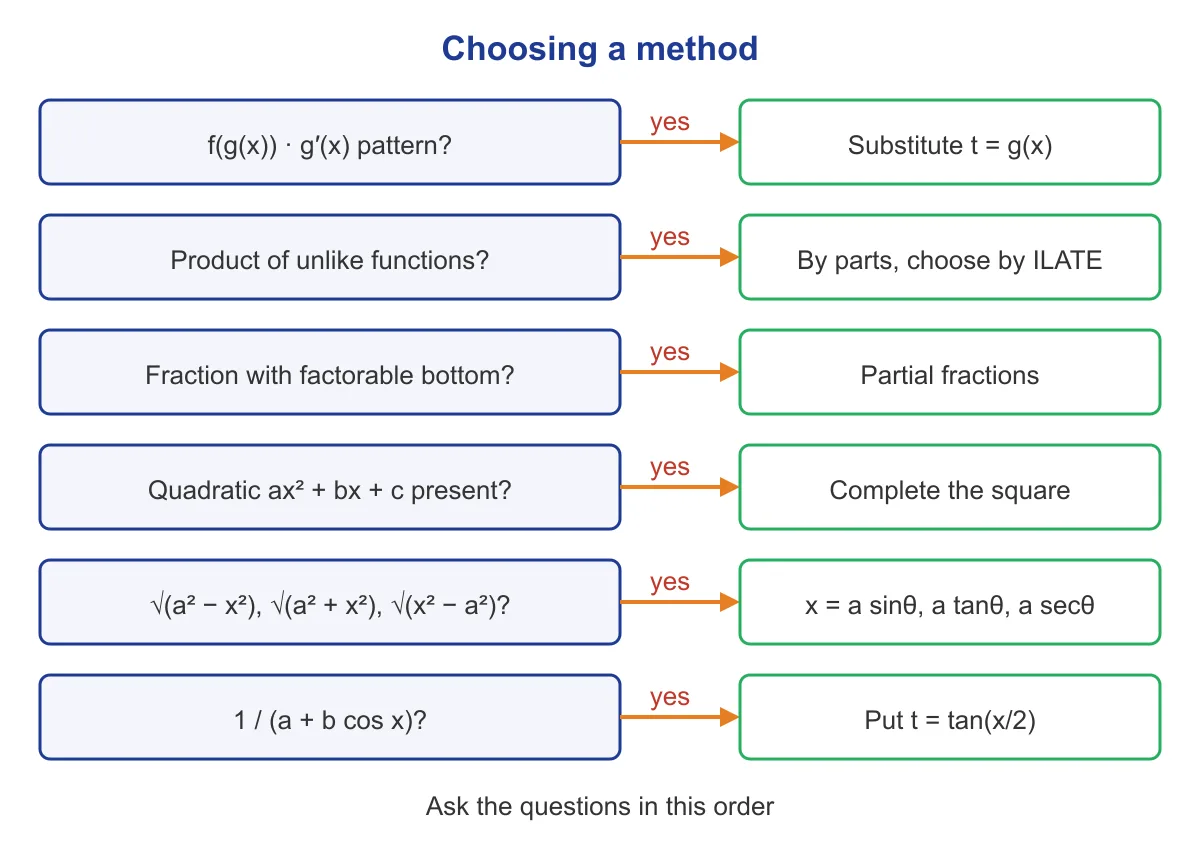
Figure 1.2: A checklist for choosing the method of integration
Two further points help. Methods combine: a substitution often exposes a product that needs parts, or a rational function that needs partial fractions. And a failed attempt is information. If by parts makes the integral longer, you chose $u$ the wrong way round; swap the factors.
Common traps
- Leaving out $+C$ in an indefinite integral → always write $+C$ once the last integral sign disappears.
- Writing $\int\frac{dx}{x} = \ln x$ → write $\ln\vert x\vert$, since $x$ may be negative.
- Taking $\int x^{-1}dx = \frac{x^0}{0}$ using the power rule → the power rule excludes $n=-1$; use $\ln\vert x\vert$.
- Splitting $\int f g\,dx$ as the product of the two integrals → integrals do not multiply; use substitution or parts.
- Writing $\int\frac{dx}{x^2+a^2} = \tan^{-1}\frac xa$ without the $\frac1a$ → include $\frac1a$, or write $\frac{1}{a}\tan^{-1}\frac xa$.
- Forgetting the extra $\frac1a$ when the argument is linear: $\int e^{3x}dx = e^{3x}$ → divide by the coefficient, $\frac{e^{3x}}{3}$.
- Applying $\int e^x[f - f']dx = e^xf$ with a minus sign → the pattern needs $f + f'$ with a plus.
- Choosing $u$ as the exponential or trig function in parts and ending with a harder integral → follow ILATE, and swap if the integral grows.
- Substituting $t = g(x)$ and leaving a stray $x$ in the integrand → express every $x$ in $t$, or change the substitution.
- Using $\sqrt{x^2-a^2}$ result with a plus sign in front of the $\frac{a^2}{2}$ logarithm → the sign is minus for $x^2-a^2$ and plus for $x^2+a^2$.
- Splitting an improper fraction straight into partial fractions → divide first, then split the remainder.
Quick revision
- $\int x^n dx = \frac{x^{n+1}}{n+1} + C$ for $n\ne-1$, and $\int\frac{dx}{x} = \ln\vert x\vert + C$.
- Antiderivatives of the same function differ by a constant, so different-looking answers can both be right.
- $\int f(ax+b)\,dx = \frac1aF(ax+b) + C$.
- $\int\frac{f'(x)}{f(x)}dx = \ln\vert f(x)\vert + C$.
- $\int\tan x\,dx = \ln\vert\sec x\vert + C$, $\int\sec x\,dx = \ln\vert\sec x+\tan x\vert + C$.
- Trigonometric substitutions: $a\sin\theta$ for $\sqrt{a^2-x^2}$, $a\tan\theta$ for $\sqrt{a^2+x^2}$, $a\sec\theta$ for $\sqrt{x^2-a^2}$.
- By parts: $\int uv'\,dx = uv - \int u'v\,dx$, with $u$ chosen by I, L, A, T, E.
- $\int\ln x\,dx = x\ln x - x + C$.
- $\int e^x[f(x)+f'(x)]\,dx = e^xf(x) + C$.
- $\int\frac{dx}{x^2+a^2} = \frac1a\tan^{-1}\frac xa + C$ and $\int\frac{dx}{\sqrt{a^2-x^2}} = \sin^{-1}\frac xa + C$.
- $\int\frac{dx}{x^2-a^2} = \frac1{2a}\ln\left\vert\frac{x-a}{x+a}\right\vert + C$.
- $\int\frac{dx}{\sqrt{x^2\pm a^2}} = \ln\left\vert x+\sqrt{x^2\pm a^2}\right\vert + C$.
- For $ax^2+bx+c$: complete the square; for numerator $px+q$ split into derivative of the quadratic plus a constant.
- Partial fractions: divide if improper; a repeated factor $(x-a)^2$ needs both $\frac{A}{x-a}$ and $\frac{B}{(x-a)^2}$.
- $\int\frac{dx}{a+b\cos x}$: put $t=\tan\frac x2$, giving $\int\frac{2\,dt}{(a+b)+(a-b)t^2}$.
Practice questions
Evaluate $\int\left(3x^2-\frac{2}{x}\right)dx$ for $x>0$.
- $x^3-2\ln x+C$
- $x^3-\frac{2}{x^2}+C$
- $x^3+2\ln x+C$
- $6x-\frac{2}{x^2}+C$
Answer
A. $x^3-2\ln x+C$
$\int 3x^2dx=x^3$ and $\int\frac{2}{x}dx=2\ln x$, so the result is $x^3-2\ln x+C$. Differentiating gives $3x^2-\frac2x$.
Evaluate $\int\cos^2x\,dx$.
- $\frac{x}{2}-\frac{\sin 2x}{4}+C$
- $\frac{x}{2}+\frac{\sin 2x}{4}+C$
- $\frac{\cos^3x}{3}+C$
- $\frac{x}{2}+\frac{\sin 2x}{2}+C$
Answer
B. $\frac{x}{2}+\frac{\sin 2x}{4}+C$
Use $\cos^2x=\frac{1+\cos2x}{2}$. Then $\int\frac{1}{2}dx=\frac x2$ and $\int\frac{\cos 2x}{2}dx=\frac{\sin2x}{4}$.
Evaluate $\int\frac{dx}{\sqrt{9-x^2}}$ for $\vert x\vert<3$.
- $\sin^{-1}x+C$
- $\frac{1}{3}\sin^{-1}\frac{x}{3}+C$
- $3\sin^{-1}\frac{x}{3}+C$
- $\sin^{-1}\frac{x}{3}+C$
Answer
D. $\sin^{-1}\frac{x}{3}+C$
Standard form with $a=3$: $\int\frac{dx}{\sqrt{a^2-x^2}}=\sin^{-1}\frac xa$. No extra factor of $\frac1a$ appears for this form.
Evaluate $\int\frac{dx}{4x^2+9}$.
- $\frac{1}{3}\tan^{-1}\frac{2x}{3}+C$
- $\frac{1}{12}\tan^{-1}\frac{2x}{3}+C$
- $\frac{1}{6}\tan^{-1}\frac{2x}{3}+C$
- $\frac{1}{6}\tan^{-1}\frac{x}{3}+C$
Answer
C. $\frac{1}{6}\tan^{-1}\frac{2x}{3}+C$
Put $t=2x$, $dx=\frac{dt}{2}$: $\frac12\int\frac{dt}{t^2+9}=\frac12\cdot\frac13\tan^{-1}\frac t3=\frac16\tan^{-1}\frac{2x}{3}$.
Evaluate $\int\frac{e^x}{e^{2x}-1}dx$ for $x>0$.
- $\frac{1}{2}\ln\left\vert\frac{e^x+1}{e^x-1}\right\vert+C$
- $\frac{1}{2}\ln\left\vert\frac{e^x-1}{e^x+1}\right\vert+C$
- $\ln\left\vert\frac{e^x-1}{e^x+1}\right\vert+C$
- $\frac{1}{2}\ln\vert e^{2x}-1\vert+C$
Answer
B. $\frac{1}{2}\ln\left\vert\frac{e^x-1}{e^x+1}\right\vert+C$
Put $t=e^x$, $dt=e^xdx$: $\int\frac{dt}{t^2-1}=\frac12\ln\left\vert\frac{t-1}{t+1}\right\vert$. Differentiating confirms it.
Evaluate $\int\frac{dx}{x\ln x}$ for $x>1$.
- $\frac{1}{2}(\ln x)^2+C$
- $-\frac{1}{\ln x}+C$
- $\ln x\cdot\ln\vert x\vert+C$
- $\ln\vert\ln x\vert+C$
Answer
D. $\ln\vert\ln x\vert+C$
Put $t=\ln x$, $dt=\frac{dx}{x}$: $\int\frac{dt}{t}=\ln\vert t\vert=\ln\vert\ln x\vert$.
Evaluate $\int x\sin x\,dx$.
- $-x\cos x+\sin x+C$
- $-x\cos x-\sin x+C$
- $x\cos x-\sin x+C$
- $x\cos x+\sin x+C$
Answer
A. $-x\cos x+\sin x+C$
By parts with $u=x$, $v'=\sin x$: $-x\cos x+\int\cos x\,dx=-x\cos x+\sin x$. Derivative check: $-\cos x+x\sin x+\cos x=x\sin x$.
Evaluate $\int e^x\left(\tan x+\sec^2x\right)dx$.
- $e^x\sec x+C$
- $e^x\sec^2x+C$
- $e^x\tan x+C$
- $e^x\left(\tan x-\sec^2x\right)+C$
Answer
C. $e^x\tan x+C$
With $f=\tan x$, $f'=\sec^2x$, the bracket is $f+f'$, so the integral is $e^xf(x)=e^x\tan x$.
Evaluate $\int\frac{dx}{x^2+2x+5}$.
- $\frac{1}{2}\tan^{-1}(x+1)+C$
- $\frac{1}{4}\ln\left\vert\frac{x+1}{x+3}\right\vert+C$
- $\frac{1}{2}\tan^{-1}\frac{x+1}{2}+C$
- $\tan^{-1}\frac{x+1}{2}+C$
Answer
C. $\frac{1}{2}\tan^{-1}\frac{x+1}{2}+C$
$x^2+2x+5=(x+1)^2+2^2$. So $\int\frac{dx}{(x+1)^2+2^2}=\frac12\tan^{-1}\frac{x+1}{2}$.
Evaluate $\int\frac{dx}{\sqrt{x^2-4x+13}}$.
- $\ln\left\vert x-2+\sqrt{x^2-4x+13}\right\vert+C$
- $\ln\left\vert x+2+\sqrt{x^2-4x+13}\right\vert+C$
- $\sin^{-1}\frac{x-2}{3}+C$
- $\frac{1}{3}\tan^{-1}\frac{x-2}{3}+C$
Answer
A. $\ln\left\vert x-2+\sqrt{x^2-4x+13}\right\vert+C$
$x^2-4x+13=(x-2)^2+3^2$. With $t=x-2$, $\int\frac{dt}{\sqrt{t^2+9}}=\ln\vert t+\sqrt{t^2+9}\vert$.
Evaluate $\int\frac{dx}{x(x^3+1)}$.
- $\frac{1}{3}\ln\left\vert x^3(x^3+1)\right\vert+C$
- $\frac{1}{3}\ln\left\vert\frac{x^3+1}{x^3}\right\vert+C$
- $\ln\left\vert\frac{x^3}{x^3+1}\right\vert+C$
- $\frac{1}{3}\ln\left\vert\frac{x^3}{x^3+1}\right\vert+C$
Answer
D. $\frac{1}{3}\ln\left\vert\frac{x^3}{x^3+1}\right\vert+C$
Multiply top and bottom by $x^2$ and put $u=x^3$: $\frac13\int\frac{du}{u(u+1)}=\frac13\ln\left\vert\frac{u}{u+1}\right\vert$. Check: derivative of $\ln x-\frac13\ln(x^3+1)$ is $\frac1x-\frac{x^2}{x^3+1}=\frac{1}{x(x^3+1)}$.
Evaluate $\int\frac{\sin x}{\sin x-\cos x}dx$.
- $x+\ln\vert\sin x-\cos x\vert+C$
- $\frac{x}{2}+\frac{1}{2}\ln\vert\sin x-\cos x\vert+C$
- $\frac{x}{2}-\frac{1}{2}\ln\vert\sin x-\cos x\vert+C$
- $\frac{x}{2}+\frac{1}{2}\ln\vert\sin x+\cos x\vert+C$
Answer
B. $\frac{x}{2}+\frac{1}{2}\ln\vert\sin x-\cos x\vert+C$
Write $\sin x=\frac12(\sin x-\cos x)+\frac12(\sin x+\cos x)$. The denominator's derivative is $\cos x+\sin x$. So the integral is $\frac x2+\frac12\ln\vert\sin x-\cos x\vert$.
Evaluate $\int x\sqrt{1-x^2}\,dx$ for $\vert x\vert<1$.
- $-\frac{2}{3}(1-x^2)^{3/2}+C$
- $-\frac{1}{3}(1-x^2)^{3/2}+C$
- $\frac{1}{3}(1-x^2)^{3/2}+C$
- $-\frac{1}{2}(1-x^2)^{3/2}+C$
Answer
B. $-\frac{1}{3}(1-x^2)^{3/2}+C$
Put $t=1-x^2$, $x\,dx=-\frac{dt}{2}$: $-\frac12\int t^{1/2}dt=-\frac12\cdot\frac23t^{3/2}=-\frac13(1-x^2)^{3/2}$.
Evaluate $\int\sqrt{4-x^2}\,dx$ for $\vert x\vert<2$.
- $\frac{x}{2}\sqrt{4-x^2}+4\sin^{-1}\frac{x}{2}+C$
- $\frac{x}{2}\sqrt{4-x^2}-2\sin^{-1}\frac{x}{2}+C$
- $\frac{x}{2}\sqrt{4-x^2}+2\sin^{-1}\frac{x}{2}+C$
- $\frac{x}{2}\sqrt{4-x^2}+\sin^{-1}\frac{x}{2}+C$
Answer
C. $\frac{x}{2}\sqrt{4-x^2}+2\sin^{-1}\frac{x}{2}+C$
Standard result with $a=2$: $\frac x2\sqrt{a^2-x^2}+\frac{a^2}{2}\sin^{-1}\frac xa$, and $\frac{a^2}{2}=2$.
A function $F$ satisfies $F'(x)=4x^3-6x+1$ and $F(0)=2$. Find $F(2)$.
- 8
- 10
- 12
- 6
Answer
A. 8
$F(x)=x^4-3x^2+x+C$ and $F(0)=2$ gives $C=2$. So $F(2)=16-12+2+2=8$.
If $\int f(x)\,dx=(x^2+1)^3+C$, find $f(1)$.
- 48
- 12
- 8
- 24
Answer
D. 24
$f(x)=\frac{d}{dx}(x^2+1)^3=6x(x^2+1)^2$. At $x=1$: $6\cdot1\cdot4=24$.
A function $F$ satisfies $F'(x)=\frac{x}{\sqrt{x^2+9}}$ and $F(0)=5$. Find $F(4)$.
- 7
- 5
- 3
- 9
Answer
A. 7
$F(x)=\sqrt{x^2+9}+C$. $F(0)=3+C=5$ gives $C=2$. So $F(4)=5+2=7$.
The curve of an antiderivative $F$ of $xe^x$ passes through $(0,3)$. Find $F(1)$.
- 4
- 3
- 5
- 1
Answer
A. 4
$\int xe^xdx=(x-1)e^x+C$. At $x=0$: $-1+C=3$, so $C=4$. Then $F(1)=0+4=4$.
Given $\int\frac{dx}{x^2+6x+13}=\lambda\tan^{-1}\frac{x+3}{2}+C$, find $\frac{1}{\lambda}$.
- 2
- 4
- 0.5
- 1
Answer
A. 2
$x^2+6x+13=(x+3)^2+2^2$, so the integral is $\frac12\tan^{-1}\frac{x+3}{2}$. Thus $\lambda=\frac12$ and $\frac1\lambda=2$.
If $\int\frac{5x+1}{(x-1)(x+2)}dx=A\ln\vert x-1\vert+B\ln\vert x+2\vert+C$, find $AB$.
- 10
- 5
- 6
- -1
Answer
C. 6
Cover-up: $A=\frac{5+1}{1+2}=2$, $B=\frac{-10+1}{-2-1}=3$. Check: $\frac{2}{x-1}+\frac{3}{x+2}=\frac{5x+1}{(x-1)(x+2)}$. So $AB=6$.
The antiderivative $F$ of $x\cos x$ with $F(0)=4$ is considered. Find $F(\pi)$.
- 2
- -1
- 3
- 4
Answer
A. 2
$\int x\cos x\,dx=x\sin x+\cos x+C$. $F(0)=1+C=4$ gives $C=3$. $F(\pi)=0-1+3=2$.
Given $\int\frac{dx}{5+3\cos x}=\lambda\tan^{-1}\left(\mu\tan\frac{x}{2}\right)+C$ with $\lambda,\mu>0$, find $\frac{1}{\lambda\mu}$.
- 4
- 2
- 1
- 8
Answer
A. 4
With $t=\tan\frac x2$: $\int\frac{2\,dt}{8+2t^2}=\int\frac{dt}{t^2+4}=\frac12\tan^{-1}\frac t2$. So $\lambda=\mu=\frac12$ and $\frac{1}{\lambda\mu}=4$.
In $\int\sqrt{16-x^2}\,dx=\frac{x}{2}\sqrt{16-x^2}+k\sin^{-1}\frac{x}{4}+C$, find $k$.
- 8
- 16
- 4
- 2
Answer
A. 8
For $\int\sqrt{a^2-x^2}dx$ the inverse-sine coefficient is $\frac{a^2}{2}$. With $a=4$, $k=\frac{16}{2}=8$.
If $\int\frac{x^2+1}{x(x-1)^2}dx=\ln\vert x\vert+\frac{p}{x-1}+C$, find $p$.
- -2
- 2
- -4
- 1
Answer
A. -2
Write $\frac{x^2+1}{x(x-1)^2}=\frac{A}{x}+\frac{B}{x-1}+\frac{D}{(x-1)^2}$. Cover-up gives $A=1$, $D=2$; the $x^2$ coefficient gives $A+B=1$, so $B=0$. Then $\int\frac{2}{(x-1)^2}dx=-\frac{2}{x-1}$, so $p=-2$.
If $\int e^x(x^2+3x+1)\,dx=e^x(ax^2+bx+c)+C$, find $a+b+c$.
- 2
- 3
- 4
- 1
Answer
A. 2
Differentiate the right side: $e^x[ax^2+(2a+b)x+(b+c)]$. Matching: $a=1$, $2a+b=3\Rightarrow b=1$, $b+c=1\Rightarrow c=0$. So $a+b+c=2$.
If $\int\frac{x+5}{x^2+2x+2}dx=\frac12\ln(x^2+2x+2)+\lambda\tan^{-1}(x+1)+C$, find $\lambda$.
- 4
- 2
- 5
- 0.5
Answer
A. 4
$x+5=\frac12(2x+2)+4$. The first part gives $\frac12\ln(x^2+2x+2)$. The rest is $4\int\frac{dx}{(x+1)^2+1}=4\tan^{-1}(x+1)$. So $\lambda=4$.
Given below are two statements: Statement I: $\int\frac{dx}{x}=\ln\vert x\vert+C$ for all $x\ne0$. Statement II: $\int x^n\,dx=\frac{x^{n+1}}{n+1}+C$ is valid for every real $n$.
- Both Statement I and Statement II are correct
- Both Statement I and Statement II are incorrect
- Statement I is correct but Statement II is incorrect
- Statement I is incorrect but Statement II is correct
Answer
C. Statement I is correct but Statement II is incorrect
Statement I is correct: $\ln\vert x\vert$ has derivative $\frac1x$ for negative and positive $x$. Statement II is wrong: for $n=-1$ the denominator is zero.
Given below are two statements: Statement I: $\int\sin x\cos x\,dx$ equals $\frac{\sin^2x}{2}+C$ and also equals $-\frac{\cos2x}{4}+C'$. Statement II: Two antiderivatives of the same function on an interval differ by a constant.
- Both Statement I and Statement II are correct
- Both Statement I and Statement II are incorrect
- Statement I is correct but Statement II is incorrect
- Statement I is incorrect but Statement II is correct
Answer
A. Both Statement I and Statement II are correct
$\frac{\sin^2x}{2}=\frac{1-\cos2x}{4}=-\frac{\cos2x}{4}+\frac14$, so the two forms differ by a constant. Statement II is the general fact that explains it. Both are correct.
Given below are two statements: Statement I: $\int e^x(\sin x+\cos x)\,dx=e^x\sin x+C$. Statement II: $\int e^x[f(x)-f'(x)]\,dx=e^xf(x)+C$ for every differentiable $f$.
- Both Statement I and Statement II are correct
- Both Statement I and Statement II are incorrect
- Statement I is correct but Statement II is incorrect
- Statement I is incorrect but Statement II is correct
Answer
C. Statement I is correct but Statement II is incorrect
Statement I is the pattern $f+f'$ with $f=\sin x$, so it is correct. For Statement II, take $f=x$: $\frac{d}{dx}(xe^x)=e^x(x+1)$, not $e^x(x-1)$. So II is incorrect.
Given below are two statements: Statement I: $\int\frac{dx}{x^2+4}=\frac12\ln(x^2+4)+C$. Statement II: $\int\frac{2x}{x^2+4}dx=\tan^{-1}\frac{x}{2}+C$.
- Both Statement I and Statement II are correct
- Both Statement I and Statement II are incorrect
- Statement I is correct but Statement II is incorrect
- Statement I is incorrect but Statement II is correct
Answer
B. Both Statement I and Statement II are incorrect
Statement I is wrong: the correct result is $\frac12\tan^{-1}\frac x2$. Statement II is wrong: the numerator is the derivative of the denominator, so the result is $\ln(x^2+4)$. Both are incorrect.
Given below are two statements: Statement I: $\int\csc x\,dx=\ln\vert\csc x+\cot x\vert+C$. Statement II: $\int\sec x\,dx=\ln\vert\sec x+\tan x\vert+C$.
- Both Statement I and Statement II are correct
- Both Statement I and Statement II are incorrect
- Statement I is correct but Statement II is incorrect
- Statement I is incorrect but Statement II is correct
Answer
D. Statement I is incorrect but Statement II is correct
Statement II is the standard result. For Statement I, $\frac{d}{dx}\ln\vert\csc x+\cot x\vert=\frac{-\csc x\cot x-\csc^2x}{\csc x+\cot x}=-\csc x$, so I is incorrect. The correct form is $\ln\vert\csc x-\cot x\vert$.
Assertion (A): $\int\frac{dx}{1+x^2}$ can be written as $\tan^{-1}x+C$ and also as $-\cot^{-1}x+C'$. Reason (R): $\tan^{-1}x+\cot^{-1}x=\frac{\pi}{2}$ for all real $x$.
- Both A and R are true and R is the correct explanation of A
- Both A and R are true but R is not the correct explanation of A
- A is true but R is false
- A is false but R is true
Answer
A. Both A and R are true and R is the correct explanation of A
The sum $\tan^{-1}x+\cot^{-1}x$ is a constant, so $\tan^{-1}x$ and $-\cot^{-1}x$ differ by a constant. R is true and explains A.
Assertion (A): $\int\sin x\cos x\,dx$ has the two answers $\frac{\sin^2x}{2}+C$ and $-\frac{\cos^2x}{2}+C$. Reason (R): $\int\cos2x\,dx=\frac{\sin2x}{2}+C$.
- Both A and R are true and R is the correct explanation of A
- Both A and R are true but R is not the correct explanation of A
- A is true but R is false
- A is false but R is true
Answer
B. Both A and R are true but R is not the correct explanation of A
A is true since $\frac{\sin^2x}{2}-\left(-\frac{\cos^2x}{2}\right)=\frac12$, a constant. R is also true, but it does not explain why the two answers differ.
Assertion (A): $\int\sqrt{x}\,dx=\frac{3}{2}x^{3/2}+C$. Reason (R): $\int x^n\,dx=\frac{x^{n+1}}{n+1}+C$ for $n\ne-1$.
- Both A and R are true and R is the correct explanation of A
- Both A and R are true but R is not the correct explanation of A
- A is true but R is false
- A is false but R is true
Answer
D. A is false but R is true
With $n=\frac12$ the rule gives $\frac{x^{3/2}}{3/2}=\frac23x^{3/2}$. So A is false (the factor is $\frac23$), while R is true.
Match List I with List II. List I: a. $\int\frac{dx}{x^2+9}$ b. $\int\frac{dx}{x^2-9}$ c. $\int\frac{dx}{\sqrt{x^2-9}}$ d. $\int\frac{dx}{\sqrt{9-x^2}}$ List II: i. $\sin^{-1}\frac{x}{3}+C$ ii. $\ln\vert x+\sqrt{x^2-9}\vert+C$ iii. $\frac{1}{6}\ln\left\vert\frac{x-3}{x+3}\right\vert+C$ iv. $\frac{1}{3}\tan^{-1}\frac{x}{3}+C$
- a-iv, b-iii, c-i, d-ii
- a-iv, b-iii, c-ii, d-i
- a-i, b-iii, c-ii, d-iv
- a-iii, b-iv, c-ii, d-i
Answer
B. a-iv, b-iii, c-ii, d-i
a is $\frac1a\tan^{-1}\frac xa$ with $a=3$. b is $\frac{1}{2a}\ln\left\vert\frac{x-a}{x+a}\right\vert$ with $a=3$. c is the log form with a root. d is the inverse sine form. So a-iv, b-iii, c-ii, d-i.
Match List I with List II. List I: a. $\int xe^x\,dx$ b. $\int e^x(x+1)\,dx$ c. $\int xe^{x^2}dx$ d. $\int\frac{e^x}{1+e^x}dx$ List II: i. $xe^x+C$ ii. $\ln(1+e^x)+C$ iii. $(x-1)e^x+C$ iv. $\frac{1}{2}e^{x^2}+C$
- a-iii, b-i, c-ii, d-iv
- a-i, b-iii, c-iv, d-ii
- a-iv, b-i, c-iii, d-ii
- a-iii, b-i, c-iv, d-ii
Answer
D. a-iii, b-i, c-iv, d-ii
a: by parts gives $(x-1)e^x$. b: pattern $f+f'$ with $f=x$ gives $xe^x$. c: put $t=x^2$ gives $\frac12e^{x^2}$. d: the numerator is the derivative of the denominator, giving $\ln(1+e^x)$.
Match List I with List II. List I: a. $\int\sqrt{25-x^2}\,dx$ b. $\int\frac{dx}{(x^2+25)^{3/2}}$ c. $\int\frac{dx}{x\sqrt{x^2-25}}$ d. $\int\frac{dx}{3+2\cos x}$ List II: i. $t=\tan\frac{x}{2}$ ii. $x=5\sin\theta$ iii. $x=5\sec\theta$ iv. $x=5\tan\theta$
- a-iv, b-ii, c-iii, d-i
- a-ii, b-iv, c-i, d-iii
- a-ii, b-iv, c-iii, d-i
- a-iii, b-iv, c-ii, d-i
Answer
C. a-ii, b-iv, c-iii, d-i
$25-x^2$ suggests sine, $x^2+25$ suggests tangent, $x^2-25$ suggests secant, and $a+b\cos x$ suggests $t=\tan\frac x2$.
A curve has slope $\frac{dy}{dx}=\frac{1}{x^2+2x+2}$ at every point and passes through $(-1,0)$. Find $y$ at $x=0$.
- $1$
- $\frac{\pi}{4}$
- $\frac{\pi}{3}$
- $\frac{\pi}{2}$
Answer
B. $\frac{\pi}{4}$
$x^2+2x+2=(x+1)^2+1$, so $y=\tan^{-1}(x+1)+C$. At $(-1,0)$: $0+C=0$, so $C=0$. At $x=0$: $y=\tan^{-1}1=\frac\pi4$.
Evaluate $\int\frac{dx}{x(x^2+1)^2}$ for $x>0$.
- $\ln x-\frac{1}{2}\ln(x^2+1)-\frac{1}{2(x^2+1)}+C$
- $\frac{1}{2}\ln x-\frac{1}{2}\ln(x^2+1)+\frac{1}{2(x^2+1)}+C$
- $\ln x-\ln(x^2+1)+\frac{1}{x^2+1}+C$
- $\ln x-\frac{1}{2}\ln(x^2+1)+\frac{1}{2(x^2+1)}+C$
Answer
D. $\ln x-\frac{1}{2}\ln(x^2+1)+\frac{1}{2(x^2+1)}+C$
Multiply by $\frac{x}{x}$ and put $u=x^2$: $\frac12\int\frac{du}{u(u+1)^2}$. Partial fractions: $\frac{1}{u(u+1)^2}=\frac1u-\frac1{u+1}-\frac1{(u+1)^2}$. Integrating gives $\frac12\left[\ln u-\ln(u+1)+\frac{1}{u+1}\right]$, which is option A.
Let $F$ be the antiderivative of $e^x\sin x$ with $F(0)=0$. Find $F(\pi)$.
- $e^\pi+1$
- $\frac{e^\pi}{2}$
- $\frac{e^\pi-1}{2}$
- $\frac{e^\pi+1}{2}$
Answer
D. $\frac{e^\pi+1}{2}$
Two rounds of parts give $\int e^x\sin x\,dx=\frac{e^x(\sin x-\cos x)}{2}+C$. $F(0)=-\frac12+C=0$, so $C=\frac12$. $F(\pi)=\frac{e^\pi(0+1)}{2}+\frac12=\frac{e^\pi+1}{2}$.