Limits
What to remember
- The limit of $f(x)$ as $x\to a$ is the value $f(x)$ approaches while $x$ stays close to $a$ but is never equal to $a$. The value $f(a)$ itself plays no part.
- A limit exists only when the left-hand limit and the right-hand limit are both finite and equal. Whenever a function changes its formula at the point, or contains $\vert x\vert$ or $[x]$, check both sides.
- Substitute first. Only a form such as $\frac00$, $\frac\infty\infty$, $\infty-\infty$ or $1^\infty$ needs a technique: factorise, rationalise, divide by the highest power, or use a standard limit.
- Learn the standard limits cold: $\frac{\sin x}{x}$, $\frac{e^x-1}{x}$, $\frac{\ln(1+x)}{x}$ all tend to $1$ as $x\to0$, $\frac{x^n-a^n}{x-a}\to na^{n-1}$, and $(1+x)^{1/x}\to e$.
- For a $1^\infty$ form, $\lim f(x)^{g(x)}=e^{L}$ where $L=\lim g(x)\,(f(x)-1)$. For a bounded, oscillating factor multiplied by something that tends to $0$, use the sandwich theorem.
1. The idea of a limit
Take $f(x)=\frac{x^2-1}{x-1}$. At $x=1$ it is not defined, since it gives $\frac00$. Now feed it numbers close to $1$.
| $x$ | 0.9 | 0.99 | 0.999 | 1.001 | 1.01 | 1.1 |
|---|---|---|---|---|---|---|
| $f(x)$ | 1.9 | 1.99 | 1.999 | 2.001 | 2.01 | 2.1 |
The outputs squeeze towards $2$ from both sides. We write $\lim_{x\to1}f(x)=2$. The function has no value at $1$, yet the limit is perfectly good, because for $x\ne1$ we can cancel and get $f(x)=x+1$.
That is the whole idea. "$x\to a$" means $x$ gets as close to $a$ as you like without ever being $a$. The limit is a statement about the neighbourhood of $a$, never about the point itself. Three things can happen at a point $a$:
- $f(a)$ exists and equals the limit (an ordinary, well-behaved point).
- $f(a)$ exists but differs from the limit.
- $f(a)$ does not exist, but the limit does (like the example above).
A limit can also fail to exist. It fails when $f(x)$ grows without bound ($\frac1{x^2}$ near $0$ goes to $+\infty$, and we say the limit is $\infty$, which is a way of saying it does not exist as a number), when the two sides disagree, or when $f(x)$ keeps oscillating, as $\sin\frac1x$ does near $0$.
Left-hand and right-hand limits
$\lim_{x\to a^-}f(x)$ is the value $f(x)$ approaches while $x$ stays below $a$ (take $x=a-h$, $h\to0^+$). $\lim_{x\to a^+}f(x)$ is the same with $x$ above $a$ (take $x=a+h$). Then
Example 1: Find $\lim_{x\to0}\frac{\vert x\vert}{x}$.
For $x>0$, $\vert x\vert=x$, so the ratio is $1$. Right-hand limit $=1$.
For $x<0$, $\vert x\vert=-x$, so the ratio is $-1$. Left-hand limit $=-1$.
The two sides differ, so the limit does not exist.
Why this works: the formula changes at $0$, so you must split the two sides before doing anything else.
A practical way to feel a limit is to test it with two or three numbers on each side, the way the table above does. Use a calculator in radian mode for trigonometric functions. This does not prove anything, but it catches wrong answers quickly. If your algebra says the limit is $3$ and the numbers settle near $2$, the algebra has a slip somewhere. In an examination hall, a quick check with $x=0.001$ is often worth the ten seconds.
Notice also what "close" means in practice. Near $a$ you may take $x=a+h$ with $h$ tiny, positive or negative. Writing $x$ as $a+h$ turns every limit at $a$ into a limit at $h\to0$, and that is the form in which the standard limits are stated. We use this shift again and again below.
2. Algebra of limits
If $\lim_{x\to a}f(x)=l$ and $\lim_{x\to a}g(x)=m$ are both finite, then:
- $\lim\,(f\pm g)=l\pm m$ and $\lim\,(cf)=cl$ for a constant $c$.
- $\lim\,(fg)=lm$.
- $\lim\,\frac{f}{g}=\frac{l}{m}$, provided $m\ne0$.
- $\lim\,\bigl(f(x)\bigr)^{n}=l^{n}$, and $\lim\,\sqrt{f(x)}=\sqrt l$ when $l\ge0$.
- If $f$ is a polynomial or a sum of sines, cosines, exponentials and so on that is defined at $a$, then $\lim_{x\to a}f(x)=f(a)$. This is why "substitute first" works for most limits.
The conditions matter. The quotient rule fails when $m=0$, and the sum rule cannot be used when one part has no finite limit. For example $\frac1x-\frac1x$ is $0$ for every $x\ne0$, though each piece blows up. You cannot split $\lim\bigl(\frac1x-\frac1x\bigr)$ into two separate limits.
Another rule you will use constantly is substitution: if $t=g(x)\to b$ as $x\to a$ (and $t\ne b$ near $a$), then $\lim_{x\to a}F(g(x))=\lim_{t\to b}F(t)$. We use it to turn an unfamiliar limit into a standard one.
3. Standard limits
These come in a short table. Each is stated with its condition.
| Limit | Value | Condition |
|---|---|---|
| $\lim_{x\to0}\frac{\sin x}{x}$ | $1$ | $x$ in radians |
| $\lim_{x\to0}\frac{\tan x}{x}$ | $1$ | $x$ in radians |
| $\lim_{x\to0}\frac{1-\cos x}{x^2}$ | $\frac12$ | $x$ in radians |
| $\lim_{x\to0}\frac{e^x-1}{x}$ | $1$ | none |
| $\lim_{x\to0}\frac{a^x-1}{x}$ | $\ln a$ | $a>0$ |
| $\lim_{x\to0}\frac{\ln(1+x)}{x}$ | $1$ | none |
| $\lim_{x\to a}\frac{x^n-a^n}{x-a}$ | $na^{n-1}$ | $n$ a positive integer, or any real $n$ if $a>0$ |
| $\lim_{x\to0}(1+x)^{1/x}$ | $e$ | none |
| $\lim_{x\to\infty}\bigl(1+\frac1x\bigr)^x$ | $e$ | none |
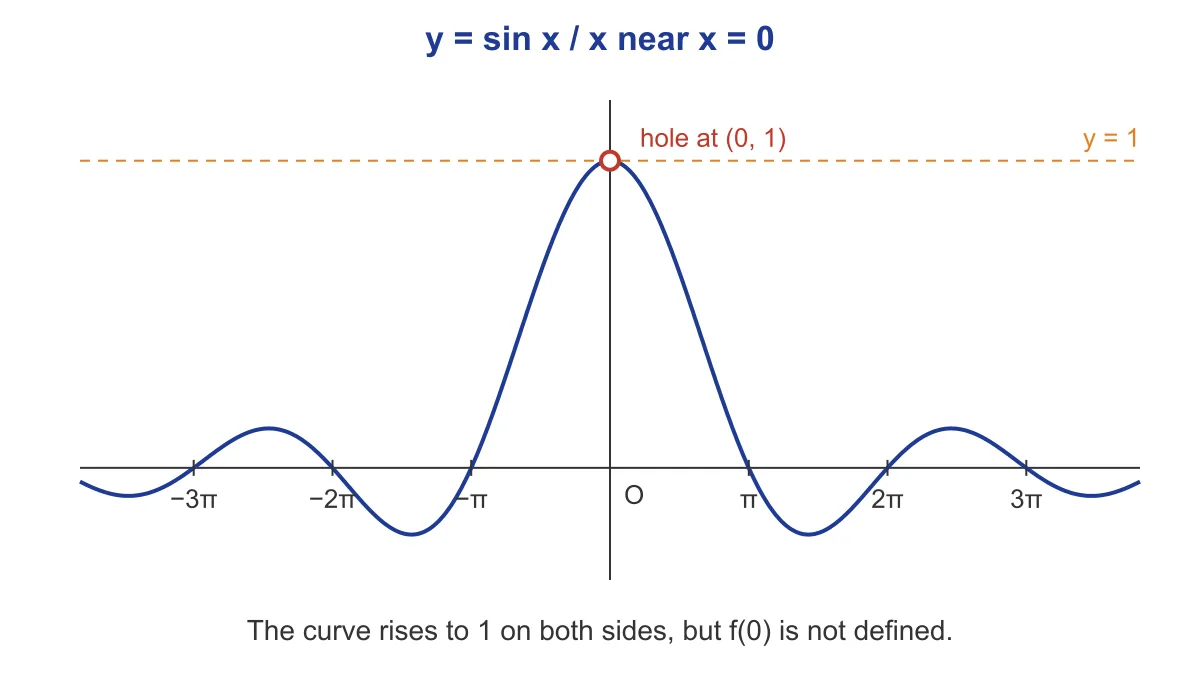
*Figure 1.1: $\frac{\sin x}{x}$ approaches $1$ from both sides of $0$, although the function is not defined at $0$.*
Why the sine limit is true
Draw a unit circle and take an angle $x$ with $0<x<\frac\pi2$. Comparing the area of the small triangle, the sector and the larger triangle gives $\sin x<x<\tan x$. Divide through by $\sin x$ and take reciprocals:
As $x\to0^+$, $\cos x\to1$, so $\frac{\sin x}{x}$ is trapped and must go to $1$. The expression is even in $x$, so the left side behaves the same way. The condition "radians" is built into the geometry: the area of a sector is $\frac12x$ only when $x$ is in radians. In degrees the limit is $\frac{\pi}{180}$.
The cosine limit follows by an identity: $1-\cos x=2\sin^2\frac x2$, so
Where the other limits come from
The number $e$ is defined by $\lim_{x\to0}(1+x)^{1/x}=e$. Take natural logs: $\frac{\ln(1+x)}{x}=\ln\bigl[(1+x)^{1/x}\bigr]\to\ln e=1$. For the exponential, put $t=e^x-1$, so $x=\ln(1+t)$ and $t\to0$; then $\frac{e^x-1}{x}=\frac{t}{\ln(1+t)}\to1$. For $a^x$, write $a^x=e^{x\ln a}$ and use the previous result with $x\ln a$ in place of $x$.
For $\frac{x^n-a^n}{x-a}$ with a positive integer $n$, factorise:
After cancelling $x-a$ there are $n$ terms, each tending to $a^{n-1}$, so the sum is $na^{n-1}$.
How to use a standard limit
The standard limit only applies when the argument of the function and the denominator match, and both tend to $0$. So $\frac{\sin 3x}{x}$ is not yet standard, but $\frac{\sin 3x}{3x}$ is. The trick is to multiply and divide by what you need:
Memory trick: "Same inside, same below, tends to zero, then it is one."
Use it as a checklist before you write the value $1$: whatever sits inside $\sin$, $\tan$, $\ln(1+\cdot)$ or $e^{\cdot}-1$ must also sit in the denominator, and must tend to $0$.
Example 2: Find $\lim_{x\to0}\frac{\sin 5x}{\tan 2x}$.
Write $\frac{\sin5x}{\tan2x}=\frac{\sin5x}{5x}\cdot\frac{2x}{\tan2x}\cdot\frac{5x}{2x}$.
The first factor tends to $1$, the second to $1$, the third is $\frac52$.
Answer: $\frac52$.
Why this works: the $x$ cancels in $\frac{5x}{2x}$, so only the ratio of the coefficients survives.
Example 3: Find $\lim_{x\to0}\frac{e^{3x}-e^{x}}{x}$.
Split: $\frac{e^{3x}-e^{x}}{x}=\frac{e^{3x}-1}{x}-\frac{e^{x}-1}{x}$.
The first piece is $3\cdot\frac{e^{3x}-1}{3x}\to3$. The second tends to $1$.
Answer: $3-1=2$.
Why this works: adding and subtracting $1$ creates two standard forms. Both pieces have finite limits, so the difference rule is allowed.
4. The form 0/0
When substitution gives $\frac00$, both top and bottom vanish at $a$. That means both contain a factor that is "zero at $a$". The job is to expose that factor and cancel it. A fixed order of attack saves time.
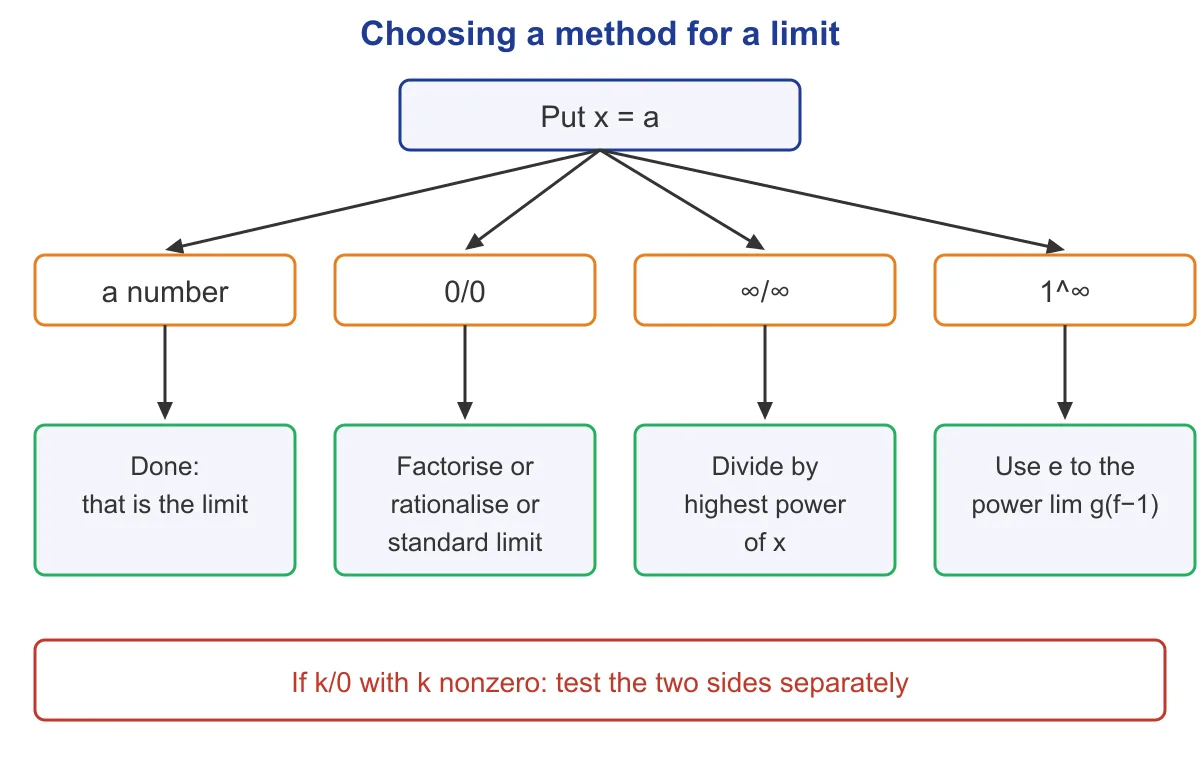
Figure 1.2: Substitute first, read the form you get, then pick the matching tool.
- Factorise when the expression is a rational function. Cancel the common factor and substitute again.
- Rationalise when square roots are present. Multiply top and bottom by the conjugate, since $(\sqrt p-\sqrt q)(\sqrt p+\sqrt q)=p-q$ removes the roots.
- Standard limits when trigonometric, exponential or logarithmic terms are present.
- Substitution (put $x=a+h$ with $h\to0$) when the point is not $0$, so that standard limits become usable.
Example 4: Find $\lim_{x\to2}\frac{x^3-8}{x^2-3x+2}$.
Substituting $x=2$ gives $\frac00$.
Factorise: $x^3-8=(x-2)(x^2+2x+4)$ and $x^2-3x+2=(x-2)(x-1)$.
Cancel $x-2$: the limit is $\lim_{x\to2}\frac{x^2+2x+4}{x-1}=\frac{12}{1}=12$.
Answer: $12$.
Why this works: the common factor is exactly the $\frac00$ culprit. Once it is gone, direct substitution is legal.
Example 5: Find $\lim_{x\to4}\frac{\sqrt{x+5}-3}{x-4}$ and $\lim_{x\to0}\frac{\sqrt{1+x}-\sqrt{1-x}}{x}$.
First: multiply by $\sqrt{x+5}+3$. Numerator becomes $(x+5)-9=x-4$. So the expression is $\frac{1}{\sqrt{x+5}+3}\to\frac16$.
Second: multiply by $\sqrt{1+x}+\sqrt{1-x}$. Numerator becomes $(1+x)-(1-x)=2x$. So the expression is $\frac{2}{\sqrt{1+x}+\sqrt{1-x}}\to\frac22=1$.
Answers: $\frac16$ and $1$.
Why this works: the conjugate turns a difference of roots into a plain polynomial that carries the vanishing factor.
Example 6: Find $\lim_{x\to a}\frac{x^{7}-a^{7}}{x^{3}-a^{3}}$ for $a\ne0$.
Divide top and bottom by $x-a$:
$\frac{x^7-a^7}{x-a}\to7a^6$ and $\frac{x^3-a^3}{x-a}\to3a^2$.
Ratio $=\frac{7a^6}{3a^2}=\frac73a^4$.
Answer: $\frac{7a^{4}}{3}$.
Why this works: dividing by the same vanishing factor keeps the fraction unchanged and gives two standard limits.
When the point is not $0$, shift it. To find $\lim_{x\to\pi}\frac{\sin x}{\pi-x}$, put $x=\pi-h$: $\sin(\pi-h)=\sin h$, so the limit is $\lim_{h\to0}\frac{\sin h}{h}=1$.
A few habits make the $\frac00$ work faster. Always try to factorise before anything else, because it is the cheapest step. If you see a quadratic that vanishes at $a$, then $(x-a)$ is a factor, so divide it out by inspection. If you see a cubic or higher, use the identity $x^n-a^n=(x-a)(\dots)$ or divide synthetically. When trigonometric functions appear, rewrite the numerator in terms of $\sin$ of a half-angle or use $\tan x=\frac{\sin x}{\cos x}$, so that every factor looks like $\frac{\sin(\text{something})}{\text{something}}$.
Sometimes two techniques have to be mixed. In $\lim_{x\to0}\frac{\sqrt{1+x}-1}{\sin 2x}$ you may rationalise the top, which gives $\frac{x}{\sin2x\,(\sqrt{1+x}+1)}$, and then use the sine limit to get $\frac12\cdot\frac12=\frac14$. Neither technique alone finishes the job.
5. Limits at infinity
As $x\to\infty$, a polynomial behaves like its highest-power term. A rational function $\frac{p(x)}{q(x)}$ with $p$ of degree $m$ and $q$ of degree $n$ therefore follows the pattern below. Divide both top and bottom by the highest power of $x$ appearing in the bottom, and use $\frac1x\to0$.
| Degrees | Limit as $x\to\pm\infty$ | Example |
|---|---|---|
| $m<n$ | $0$ | $\frac{2x+1}{x^2+5}\to0$ |
| $m=n$ | ratio of leading coefficients | $\frac{3x^2+5x}{2x^2-1}\to\frac32$ |
| $m>n$ | $\pm\infty$, no finite limit | $\frac{x^2+1}{x}\to\infty$ |
For exponential expressions, divide by the biggest base. For instance $\frac{3^{x}+2^{x}}{3^{x}-2^{x}}$: divide by $3^x$, and since $\bigl(\frac23\bigr)^x\to0$ the limit is $1$.
Square roots need care. Remember $\sqrt{x^2}=\vert x\vert$, which equals $-x$ when $x\to-\infty$. The form $\infty-\infty$ is almost always cured by rationalising.
Example 7: Find $\lim_{x\to\infty}\left(\sqrt{x^2+3x}-x\right)$.
This is $\infty-\infty$. Multiply and divide by the conjugate:
$\frac{(x^2+3x)-x^2}{\sqrt{x^2+3x}+x}=\frac{3x}{\sqrt{x^2+3x}+x}$.
Divide top and bottom by $x$ (positive as $x\to\infty$): $\frac{3}{\sqrt{1+\frac3x}+1}\to\frac32$.
Answer: $\frac32$.
Why this works: rationalising converts a difference of two huge numbers into a ratio whose pieces are of the same size, and then the highest-power rule applies.
The same technique works for sums of the type $\lim_{n\to\infty}\frac{1+2+\dots+n}{n^2}$. Use $1+2+\dots+n=\frac{n(n+1)}{2}$, then the ratio is $\frac{n+1}{2n}\to\frac12$. Notice that you may not take the limit of each term separately, because the number of terms is itself growing.
Two more points about limits at infinity. First, $\lim_{x\to\infty}$ and $\lim_{x\to-\infty}$ can differ, for example $\frac{x}{\sqrt{x^2+1}}$ tends to $1$ on the right and to $-1$ on the left. Second, an exponential such as $e^{x}$ grows faster than any power of $x$, so $\frac{x^{100}}{e^x}\to0$ as $x\to\infty$; you will meet such ratios when comparing growth.
6. The form $1^\infty$
If $f(x)\to1$ and $g(x)\to\infty$, the expression $f(x)^{g(x)}$ is not $1$. Think of $\bigl(1+\frac1n\bigr)^n$: the base is slightly more than $1$, but you multiply it by itself a huge number of times, and the two effects balance at $e\approx2.718$.
Write $f(x)=1+u(x)$ with $u\to0$. Then
So the working rule is
It applies only to the $1^\infty$ form. Check both conditions before using it.
Memory trick: "One to the infinity: take the base minus one, times the power, and put it up on e."
Say it while writing $e^{\lim g\,(f-1)}$, and the sign of $f-1$ will not get lost.
Example 8: Find $\lim_{x\to0}(\cos x)^{1/x^2}$.
Base $\to1$, power $\to\infty$, so it is $1^\infty$.
Exponent of $e$: $\lim\frac{\cos x-1}{x^2}=-\frac12$.
Answer: $e^{-1/2}=\frac{1}{\sqrt e}$.
Why this works: $\cos x-1$ is negative, so the base is slightly less than $1$ and the answer is below $1$. Always sanity-check this.
Example 9: Find $\lim_{x\to\infty}\left(\frac{x+2}{x-1}\right)^{x}$.
Base $\to1$, power $\to\infty$. Compute $\lim x\left(\frac{x+2}{x-1}-1\right)=\lim x\cdot\frac{3}{x-1}=3$.
Answer: $e^{3}$.
Why this works: the term $f-1=\frac{3}{x-1}$ is of size $\frac1x$, and multiplying by $x$ gives a finite number.
7. Greatest integer and modulus functions
$[x]$ is the greatest integer not exceeding $x$, so $[2.7]=2$, $[-2.7]=-3$ and $[3]=3$. It jumps at every integer. $\vert x\vert$ equals $x$ for $x\ge0$ and $-x$ for $x<0$. Both functions change their rule at a special point, so limits there need a one-sided look.
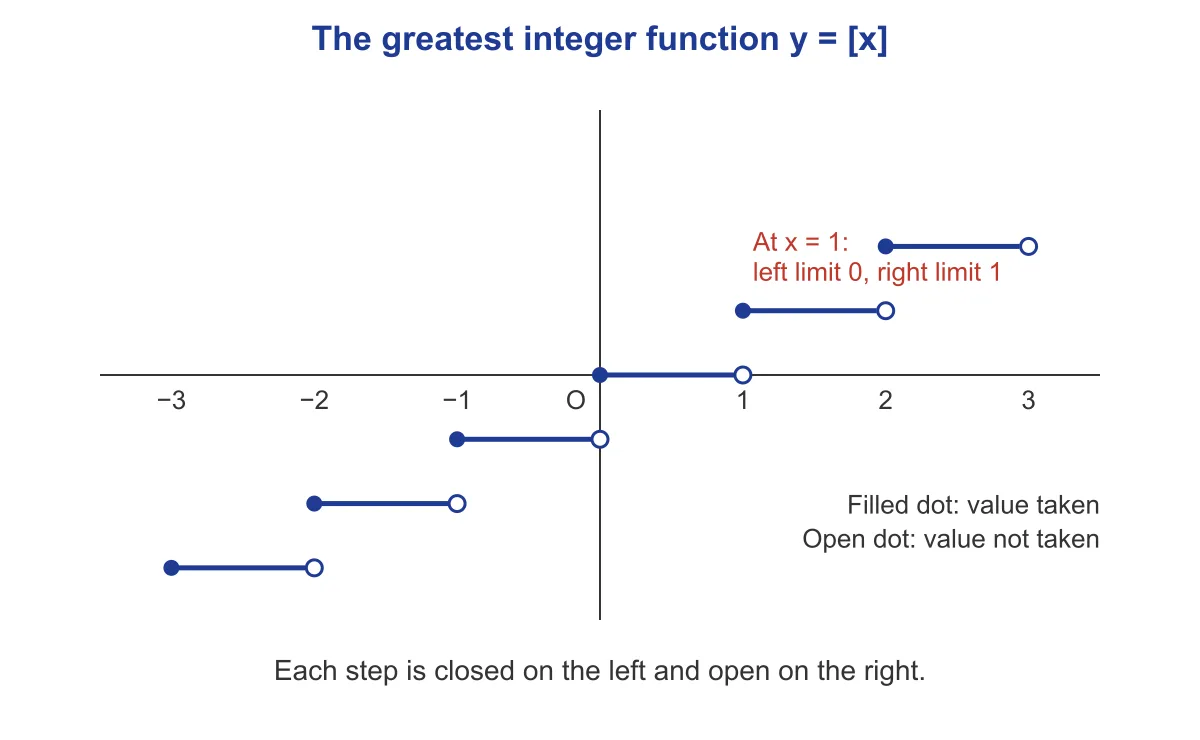
*Figure 1.3: $[x]$ is constant between integers and jumps by $1$ at each integer.*
At an integer $k$:
So $\lim_{x\to k}[x]$ does not exist for any integer $k$. At a non-integer point $c$ the function is locally constant, so $\lim_{x\to c}[x]=[c]$.
| Situation | Left-hand limit | Right-hand limit | Limit |
|---|---|---|---|
| $[x]$ at $x=2$ | $1$ | $2$ | does not exist |
| $[x]$ at $x=2.5$ | $2$ | $2$ | $2$ |
| $\frac{\vert x\vert}{x}$ at $x=0$ | $-1$ | $1$ | does not exist |
| $\vert x\vert$ at $x=0$ | $0$ | $0$ | $0$ |
A useful instance: for small positive $h$, $[0+h]=0$ and $[0-h]=-1$, so $[x]$ takes values $0$ and $-1$ next to $0$. To evaluate an expression like $\lim_{x\to1^+}\bigl([x]+[-x]\bigr)$, use the exact values just beyond $1$: $[x]=1$ and $[-x]=-2$, giving $-1$. At the point $x=1$ itself the sum is $1+(-1)=0$, which is a different number, and a classic trap.
Example 10: Find $\lim_{x\to0^-}\frac{[x]}{x}$ and $\lim_{x\to0^+}\frac{[x]}{x}$.
For $x$ slightly negative, $[x]=-1$, so the ratio is $\frac{-1}{x}$, which is positive and large. It tends to $+\infty$.
For $x$ slightly positive, $[x]=0$, so the ratio is $0$ and the right limit is $0$.
Answer: $+\infty$ (no finite limit) from the left and $0$ from the right.
Why this works: inside $[\,\cdot\,]$ you need the exact integer, and that depends on which side of $0$ you stand.
For limits such as $\lim_{x\to\infty}\frac{[x]}{x}$ use the inequality $x-1<[x]\le x$. Dividing by $x>0$ gives $1-\frac1x<\frac{[x]}{x}\le1$, which squeezes the ratio to $1$. That brings us to the sandwich idea.
8. The sandwich theorem
If $g(x)\le f(x)\le h(x)$ near $a$ (except possibly at $a$), and $\lim_{x\to a}g(x)=\lim_{x\to a}h(x)=L$, then $\lim_{x\to a}f(x)=L$.
It is the tool for expressions that oscillate. Consider $x\sin\frac1x$ near $0$. The factor $\sin\frac1x$ keeps jumping between $-1$ and $1$ and has no limit, but it is bounded:
Both bounds tend to $0$, so $\lim_{x\to0}x\sin\frac1x=0$.
The general pattern is: bounded times infinitesimal tends to zero. In the same way, $\lim_{x\to\infty}\frac{\sin x}{x}=0$, because $-\frac1x\le\frac{\sin x}{x}\le\frac1x$ for $x>0$.
Contrast this with $\lim_{x\to0}\sin\frac1x$ alone: there is nothing small multiplying it, so no squeeze is possible, and the limit does not exist. Also $\lim_{x\to0}\frac{\sin(1/x)}{1/x}$ is not $1$. The standard limit needs the argument to tend to $0$, and here $\frac1x\to\infty$. The ratio is $x\sin\frac1x$, which tends to $0$.
Example 11: Find $\lim_{n\to\infty}\frac{n+(-1)^n\cdot5}{2n+3}$ and $\lim_{x\to0}x^2\cos\frac{1}{x}$.
First, divide top and bottom by $n$: $\frac{1+\frac{5(-1)^n}{n}}{2+\frac3n}$. Since $\left\vert\frac{5(-1)^n}{n}\right\vert\le\frac5n\to0$, the top tends to $1$ and the bottom to $2$. The limit is $\frac12$.
Second, $-x^2\le x^2\cos\frac1x\le x^2$, and both bounds go to $0$. The limit is $0$.
Answers: $\frac12$ and $0$.
Why this works: the awkward part is bounded, and it is multiplied by something that dies out.
Common traps
- Writing $\frac{\sin x}{x}\to1$ for $x\to\infty$ or $x\to2$ → the value $1$ needs $x\to0$; at infinity the answer is $0$.
- Using $\lim\frac{\sin 3x}{x}=1$ → the argument and the denominator must match; the answer is $3$.
- Treating $\frac00$ as $0$ or as $1$ → it is a signal to cancel, rationalise or use a standard limit.
- Treating $1^\infty$ as $1$ → apply $e^{\lim g(f-1)}$.
- Splitting a limit into two pieces when one piece has no finite limit → combine first, or rationalise.
- Forgetting that $\sqrt{x^2}=\vert x\vert$ → when $x\to-\infty$, divide by $x$ and remember $x=-\sqrt{x^2}$.
- Evaluating $\lim_{x\to k}[x]$ by substituting $x=k$ → check $k^-$ and $k^+$ separately.
- Taking $\lim\frac{\vert x\vert}{x}$ as $1$ → it is $1$ only from the right; from the left it is $-1$.
- Applying the sine limit when $x$ is in degrees → the value then picks up the factor $\frac{\pi}{180}$.
- Calling $\lim_{x\to a}\frac{x^n-a^n}{x-a}$ equal to $na^n$ → the power drops by one: $na^{n-1}$.
Quick revision
- $\lim_{x\to a}f(x)$ exists $\iff$ LHL $=$ RHL (finite).
- $f(a)$ plays no role in the limit; only values near $a$ matter.
- $\lim_{x\to0}\frac{\sin x}{x}=\lim_{x\to0}\frac{\tan x}{x}=1$ (radians).
- $\lim_{x\to0}\frac{1-\cos x}{x^2}=\frac12$.
- $\lim_{x\to0}\frac{e^x-1}{x}=1$ and $\lim_{x\to0}\frac{a^x-1}{x}=\ln a$.
- $\lim_{x\to0}\frac{\ln(1+x)}{x}=1$.
- $\lim_{x\to a}\frac{x^n-a^n}{x-a}=na^{n-1}$.
- $\lim_{x\to0}(1+x)^{1/x}=\lim_{x\to\infty}\bigl(1+\frac1x\bigr)^x=e$.
- Forms needing work: $\frac00$, $\frac\infty\infty$, $\infty-\infty$, $0\cdot\infty$, $1^\infty$.
- Rational function at infinity: compare degrees; equal degrees give the ratio of leading coefficients.
- $\infty-\infty$ with roots: multiply and divide by the conjugate.
- $1^\infty$: the limit is $e^{\lim g\,(f-1)}$.
- At an integer $k$: LHL of $[x]$ is $k-1$, RHL is $k$.
- $\vert x\vert$ splits as $-x$ for $x<0$ and $x$ for $x\ge0$.
- Sandwich: bounded times a quantity tending to $0$ tends to $0$.
Practice questions
The value of $\lim_{x\to0}\frac{\sin 5x}{3x}$ is
- $\frac35$
- $\frac53$
- $1$
- $15$
Answer
B. $\frac53$
$\frac{\sin5x}{3x}=\frac53\cdot\frac{\sin5x}{5x}$ and the last factor tends to $1$. So the limit is $\frac53$.
For a non-zero constant $a$, $\lim_{x\to a}\frac{x^5-a^5}{x-a}$ equals
- $a^5$
- $5a^5$
- $4a^4$
- $5a^4$
Answer
D. $5a^4$
Use $\lim\frac{x^n-a^n}{x-a}=na^{n-1}$ with $n=5$. Check with $a=1$: the factorised form $x^4+x^3+x^2+x+1$ gives $5$.
$\lim_{x\to\infty}\frac{3x^2+5x}{2x^2-1}$ equals
- $0$
- $\frac23$
- $\frac32$
- $\infty$
Answer
C. $\frac32$
Divide top and bottom by $x^2$: $\frac{3+5/x}{2-1/x^2}\to\frac32$.
$\lim_{x\to0}\frac{1-\cos x}{x^2}$ equals
- $\frac12$
- $1$
- $0$
- $2$
Answer
A. $\frac12$
$1-\cos x=2\sin^2\frac x2$, so the ratio is $\frac12\left(\frac{\sin(x/2)}{x/2}\right)^2\to\frac12$.
$\lim_{x\to0}\frac{e^{4x}-1}{\ln(1+2x)}$ equals
- $2$
- $8$
- $\frac12$
- $4$
Answer
A. $2$
$\frac{e^{4x}-1}{\ln(1+2x)}=\frac{4x}{2x}\cdot\frac{(e^{4x}-1)/4x}{\ln(1+2x)/2x}\to2\cdot\frac11=2$.
$\lim_{x\to\infty}\left(1+\frac2x\right)^x$ equals
- $2e$
- $e^2$
- $e$
- $e^{1/2}$
Answer
B. $e^2$
This is $1^\infty$. The exponent of $e$ is $\lim x\cdot\frac2x=2$. So the limit is $e^2$.
$\lim_{x\to0^-}\frac{\vert x\vert}{x}$ equals
- does not exist
- $1$
- $-1$
- $0$
Answer
C. $-1$
For $x<0$, $\vert x\vert=-x$, so the ratio is $-1$ for every such $x$. The one-sided limit exists and equals $-1$.
$\lim_{x\to0}\frac{\sin\vert x\vert}{x}$
- equals $0$
- equals $-1$
- equals $1$
- does not exist
Answer
D. does not exist
For $x>0$ it is $\frac{\sin x}{x}\to1$. For $x<0$, $\sin\vert x\vert=\sin(-x)=-\sin x$, so it is $-\frac{\sin x}{x}\to-1$. The sides differ.
$\lim_{x\to1}\frac{\sqrt x-1}{x-1}$ equals
- $1$
- $0$
- $2$
- $\frac12$
Answer
D. $\frac12$
Multiply by $\sqrt x+1$: the expression becomes $\frac{1}{\sqrt x+1}\to\frac12$. Check $x=1.0001$: about $0.49999$.
$\lim_{x\to\infty}\left(\sqrt{x+1}-\sqrt{x}\right)$ equals
- $1$
- $0$
- $\infty$
- $\frac12$
Answer
B. $0$
Rationalise: $\frac{1}{\sqrt{x+1}+\sqrt x}\to0$.
$\lim_{x\to0}x\sin\frac1x$
- equals $\infty$
- does not exist
- equals $0$
- equals $1$
Answer
C. equals $0$
$\vert x\sin\frac1x\vert\le\vert x\vert\to0$. By the sandwich theorem the limit is $0$.
$\lim_{x\to\infty}\frac{\sin x}{x}$ equals
- $0$
- $\infty$
- $1$
- does not exist
Answer
A. $0$
For $x>0$, $-\frac1x\le\frac{\sin x}{x}\le\frac1x$, and both bounds tend to $0$.
$\lim_{x\to0}\frac{\tan 2x}{\sin 3x}$ equals
- $1$
- $\frac32$
- $6$
- $\frac23$
Answer
D. $\frac23$
$\frac{\tan2x}{\sin3x}=\frac{\tan2x}{2x}\cdot\frac{3x}{\sin3x}\cdot\frac{2x}{3x}\to\frac23$.
$\lim_{x\to\infty}\frac{3^{x+1}+2^x}{3^x+2^{x+1}}$ equals
- $3$
- $\frac13$
- $\frac32$
- $1$
Answer
A. $3$
Divide by $3^x$: $\frac{3+(2/3)^x}{1+2(2/3)^x}$. Since $(2/3)^x\to0$, the limit is $3$.
The value of $\lim_{x\to3}\frac{x^2-9}{x-3}$ is
- $0$
- $6$
- $9$
- $3$
Answer
B. $6$
Cancel $x-3$: $x+3\to6$.
The value of $\lim_{x\to2}\frac{x^3-8}{x^2-4}$ is
- $6$
- $4$
- $3$
- $12$
Answer
C. $3$
Cancel $x-2$: $\frac{x^2+2x+4}{x+2}\to\frac{12}{4}=3$.
The value of $\lim_{x\to0}\frac{\sin7x-\sin3x}{x}$ is
- $4$
- $21$
- $10$
- $0$
Answer
A. $4$
$\frac{\sin7x}{x}\to7$ and $\frac{\sin3x}{x}\to3$. Difference: $4$.
The value of $\lim_{x\to0}\frac{1-\cos4x}{x^2}$ is
- $2$
- $4$
- $16$
- $8$
Answer
D. $8$
$1-\cos4x=2\sin^22x$, so the ratio is $2\cdot\left(\frac{\sin2x}{x}\right)^2\to2\cdot4=8$.
The value of $\lim_{x\to0}\frac{x\tan3x}{1-\cos2x}$ is
- $3$
- $6$
- $1.5$
- $0.75$
Answer
C. $1.5$
$1-\cos2x=2\sin^2x\sim2x^2$ and $x\tan3x\sim3x^2$. Ratio: $\frac32$.
The value of $\lim_{x\to\infty}x\left(\sqrt{x^2+4}-x\right)$ is
- $0$
- $2$
- $1$
- $4$
Answer
B. $2$
Rationalise: $\frac{4x}{\sqrt{x^2+4}+x}=\frac{4}{\sqrt{1+4/x^2}+1}\to2$.
The value of $\lim_{x\to0}\frac{\ln(1+3x)}{\ln(1+x)}$ is
- $1$
- $0$
- $3$
- $9$
Answer
C. $3$
$\frac{\ln(1+3x)}{3x}\to1$ and $\frac{\ln(1+x)}{x}\to1$, so the ratio is $\frac{3x}{x}=3$.
The value of $\lim_{x\to1}\frac{\sqrt{3x+1}-2}{x-1}$ is
- $3$
- $0.25$
- $1.5$
- $0.75$
Answer
D. $0.75$
Multiply by $\sqrt{3x+1}+2$: numerator $3x-3$. Result $\frac{3}{\sqrt{3x+1}+2}\to\frac34$.
The value of $\lim_{x\to1^+}\bigl([x]+[-x]\bigr)$ is
- $-1$
- $-2$
- $0$
- $1$
Answer
A. $-1$
Just above $1$: $[x]=1$ and $[-x]=-2$. Sum $-1$. (The value at $x=1$ is $0$, but the limit ignores it.)
The value of $\lim_{x\to0}\frac{e^{5x}-e^{2x}}{x}$ is
- $0$
- $3$
- $7$
- $10$
Answer
B. $3$
$\frac{e^{5x}-1}{x}-\frac{e^{2x}-1}{x}\to5-2=3$.
For positive integer $n$, the value of $\lim_{n\to\infty}\frac{1+2+\dots+n}{n^2}$ is
- $1$
- $2$
- $0.5$
- $0$
Answer
C. $0.5$
The sum is $\frac{n(n+1)}{2}$. Ratio $\frac{n+1}{2n}\to\frac12$.
The value of $\lim_{x\to2}\frac{x^4-16}{x-2}$ is
- $8$
- $32$
- $16$
- $64$
Answer
B. $32$
Use $na^{n-1}$ with $n=4$, $a=2$: $4\cdot8=32$. Check by factorising: $(x+2)(x^2+4)\to4\cdot8=32$.
Given below are two statements: Statement I: $\lim_{x\to0}\frac{\sin x}{x}=1$ when $x$ is in radians. Statement II: $\lim_{x\to0}\frac{\sin x^\circ}{x}=\frac{\pi}{180}$.
- Both Statement I and Statement II are correct
- Both Statement I and Statement II are incorrect
- Statement I is correct but Statement II is incorrect
- Statement I is incorrect but Statement II is correct
Answer
A. Both Statement I and Statement II are correct
I is the standard limit. II: $\sin x^\circ=\sin\frac{\pi x}{180}$, so the ratio is $\frac{\pi}{180}\cdot\frac{\sin(\pi x/180)}{\pi x/180}\to\frac{\pi}{180}$. Both correct.
Given below are two statements: Statement I: If the left-hand and right-hand limits of $f$ at $a$ are both $L$, then $\lim_{x\to a}f(x)=L$ even when $f(a)$ is not defined. Statement II: If $f(a)$ is defined, then $\lim_{x\to a}f(x)$ must exist.
- Both Statement I and Statement II are correct
- Both Statement I and Statement II are incorrect
- Statement I is correct but Statement II is incorrect
- Statement I is incorrect but Statement II is correct
Answer
C. Statement I is correct but Statement II is incorrect
I is correct since the limit ignores $f(a)$. II is false: $f(x)=[x]$ has $f(1)=1$ but no limit at $1$.
Given below are two statements: Statement I: $\lim_{x\to0}(1+x)^{1/x}=e$. Statement II: $\lim_{x\to\infty}\left(1+\frac1{x^2}\right)^x=e$.
- Both Statement I and Statement II are correct
- Both Statement I and Statement II are incorrect
- Statement I is correct but Statement II is incorrect
- Statement I is incorrect but Statement II is correct
Answer
C. Statement I is correct but Statement II is incorrect
I is the definition of $e$. II is $1^\infty$ with exponent of $e$ equal to $\lim x\cdot\frac1{x^2}=0$, so the limit is $e^0=1$, not $e$.
Given below are two statements: Statement I: $\lim_{x\to0}\sin\frac1x=0$. Statement II: $\lim_{x\to\infty}\frac{x^2+1}{x}=1$.
- Both Statement I and Statement II are correct
- Both Statement I and Statement II are incorrect
- Statement I is correct but Statement II is incorrect
- Statement I is incorrect but Statement II is correct
Answer
B. Both Statement I and Statement II are incorrect
I: $\sin\frac1x$ oscillates between $-1$ and $1$, so no limit. II: $\frac{x^2+1}{x}=x+\frac1x\to\infty$. Both incorrect.
Given below are two statements: Statement I: $\lim_{x\to0^-}\frac{[x]}{x}=0$. Statement II: $\lim_{x\to0^+}\frac{[x]}{x}=0$.
- Both Statement I and Statement II are correct
- Both Statement I and Statement II are incorrect
- Statement I is correct but Statement II is incorrect
- Statement I is incorrect but Statement II is correct
Answer
D. Statement I is incorrect but Statement II is correct
For $x\to0^-$, $[x]=-1$ and $\frac{-1}{x}\to+\infty$, so I is wrong. For $x\to0^+$, $[x]=0$, so the ratio is $0$ and II is right.
Assertion (A): $\lim_{x\to0}\frac{x}{\vert x\vert}$ does not exist. Reason (R): For $x>0$ the ratio is $1$ and for $x<0$ it is $-1$.
- Both A and R are true and R is the correct explanation of A
- Both A and R are true but R is not the correct explanation of A
- A is true but R is false
- A is false but R is true
Answer
A. Both A and R are true and R is the correct explanation of A
The two one-sided limits are $1$ and $-1$, which differ. R is exactly the reason for A.
Assertion (A): $\lim_{x\to0}\frac{e^x-1}{x}=1$. Reason (R): $\lim_{x\to0}\frac{\ln(1+x)}{x}=1$.
- Both A and R are true and R is the correct explanation of A
- Both A and R are true but R is not the correct explanation of A
- A is true but R is false
- A is false but R is true
Answer
B. Both A and R are true but R is not the correct explanation of A
Both are standard limits and both are true. R is a different standard limit; it is not the reason A holds (A follows from the definition of $e^x$ via the substitution $t=e^x-1$).
Assertion (A): $\lim_{x\to0}\frac{\sin(1/x)}{1/x}=1$. Reason (R): $\lim_{t\to0}\frac{\sin t}{t}=1$.
- Both A and R are true and R is the correct explanation of A
- Both A and R are true but R is not the correct explanation of A
- A is true but R is false
- A is false but R is true
Answer
D. A is false but R is true
R is true. In A, $t=\frac1x\to\infty$, not $0$; the ratio is $x\sin\frac1x\to0$. So A is false.
Match List I with List II. List I: a. $\lim_{x\to0}\frac{\sin3x}{x}$ b. $\lim_{x\to0}\frac{1-\cos x}{x^2}$ c. $\lim_{x\to0}(1+2x)^{1/x}$ d. $\lim_{x\to\infty}\frac{x}{x^2+1}$ List II: i. $0$ ii. $\frac12$ iii. $3$ iv. $e^2$
- a-iii, b-ii, c-iv, d-i
- a-ii, b-iii, c-iv, d-i
- a-iii, b-ii, c-i, d-iv
- a-iv, b-ii, c-iii, d-i
Answer
A. a-iii, b-ii, c-iv, d-i
a: $3$. b: $\frac12$. c: $1^\infty$, exponent $\lim\frac{2x}{x}=2$, so $e^2$. d: degree of top is less, so $0$.
Match List I with List II. List I: a. $\lim_{x\to\infty}\frac{2x+1}{x-3}$ b. $\lim_{x\to0}\frac{\sin x}{x}$ c. $\lim_{x\to0}(1+x)^{1/x}$ d. $\lim_{x\to\infty}\left(\sqrt{x^2+x}-x\right)$ List II: i. form $\frac00$ ii. form $\frac\infty\infty$ iii. form $1^\infty$ iv. form $\infty-\infty$
- a-i, b-ii, c-iii, d-iv
- a-iii, b-i, c-ii, d-iv
- a-ii, b-i, c-iv, d-iii
- a-ii, b-i, c-iii, d-iv
Answer
D. a-ii, b-i, c-iii, d-iv
Substitution in each: a gives $\frac\infty\infty$; b gives $\frac00$; c gives base $1$ to an infinite power; d gives a difference of two infinite quantities.
Match List I with List II. List I: a. $\lim_{x\to2^-}[x]$ b. $\lim_{x\to2^+}[x]$ c. $\lim_{x\to-1^+}[x]$ d. $\lim_{x\to-1^-}[x]$ List II: i. $-2$ ii. $-1$ iii. $1$ iv. $2$
- a-iv, b-iii, c-ii, d-i
- a-iii, b-iv, c-ii, d-i
- a-iv, b-iii, c-i, d-ii
- a-iii, b-iv, c-i, d-ii
Answer
B. a-iii, b-iv, c-ii, d-i
Just below $2$, $[x]=1$; just above $2$, $[x]=2$. Just above $-1$, $[x]=-1$; just below $-1$, $[x]=-2$.
Real numbers $a$ and $b$ satisfy $\lim_{x\to1}\frac{x^2+ax+b}{x-1}=3$. Then $ab$ equals
- $-2$
- $2$
- $3$
- $-6$
Answer
A. $-2$
A finite limit with denominator $\to0$ needs numerator $=0$ at $x=1$, so $b=-1-a$. Then $x^2+ax-1-a=(x-1)(x+1+a)$, limit $=2+a=3$, so $a=1$, $b=-2$ and $ab=-2$. Check: $(x-1)(x+2)$, limit $3$.
$\lim_{x\to\infty}\left(\frac{x^2+1}{x^2-1}\right)^{x^2}$ equals
- $e$
- $1$
- $e^{-2}$
- $e^2$
Answer
D. $e^2$
$1^\infty$ form. $x^2\left(\frac{x^2+1}{x^2-1}-1\right)=\frac{2x^2}{x^2-1}\to2$. So $e^2$.
$\lim_{x\to\infty}\frac{[x]+[2x]+[3x]}{x}$ equals
- $5$
- $3$
- $6$
- does not exist
Answer
C. $6$
For each $k$, $kx-1<[kx]\le kx$, so $[kx]/x\to k$. Sum: $1+2+3=6$.