Continuity and Differentiability
What to remember
- $f$ is continuous at $x=a$ when three things hold together: $f(a)$ exists, $\lim_{x\to a}f(x)$ exists, and the two are equal. In one line: $\text{LHL}=\text{RHL}=f(a)$.
- A discontinuity is removable (limit exists but does not match $f(a)$), a jump (both one-sided limits finite but different) or infinite (a one-sided limit is $\pm\infty$).
- $[x]$ breaks at every integer and is continuous everywhere else. $|x|$ is continuous everywhere. Sums, products and composites of continuous functions are continuous; a quotient is continuous wherever the denominator is not zero.
- $f$ is differentiable at $a$ only if the left derivative and right derivative both exist and are equal. The two sides are tested separately, exactly like left and right limits.
- Differentiable implies continuous, never the other way round. $|x|$ is continuous at $0$ but has a corner there, so it is not differentiable.
Continuity at a point
Take a function $f$ and a number $a$ in its domain. Walk along the graph towards $x=a$ from the left, then from the right. If you reach the same height from both sides and that height is exactly where $f(a)$ sits, you never lift your pencil. That is continuity.
Written as a test, $f$ is continuous at $x=a$ when
Each of the three parts can fail on its own, so check all three:
- $f(a)$ must be defined. $\frac{x^2-1}{x-1}$ has no value at $x=1$, so it cannot be continuous there.
- The limit must exist, which means the left-hand limit (LHL) and right-hand limit (RHL) exist and agree.
- The limit must equal $f(a)$.
A useful way to write the left and right limits for computation: put $x=a-h$ for the left side and $x=a+h$ for the right side, with $h\to0^+$. Then
Continuity on an interval
$f$ is continuous on an open interval $(a,b)$ when it is continuous at every point of it. For a closed interval $[a,b]$ we also need continuity at the end points, but only from the side that lies inside the interval:
"Continuous on $\mathbb{R}$" means continuous at every real number. Polynomials, $e^x$, $\sin x$, $\cos x$ and $|x|$ are continuous on all of $\mathbb{R}$. $\ln x$ is continuous on $(0,\infty)$, $\tan x$ on every interval that avoids odd multiples of $\frac\pi2$, and a rational function wherever its denominator is not zero. Remember that a function is only judged at points of its domain: $\frac1x$ is continuous at every point where it is defined, even though its graph breaks at $0$, because $0$ is not in its domain.
Example 1: Show that $f(x)=\dfrac{x^2-9}{x-3}$ for $x\ne3$, $f(3)=6$, is continuous at $x=3$.
Step 1: $f(3)=6$ is given, so the value exists.
Step 2: for $x\ne3$, $\frac{x^2-9}{x-3}=\frac{(x-3)(x+3)}{x-3}=x+3$.
Step 3: $\lim_{x\to3}(x+3)=6$, and the limit never uses the value at $3$ itself.
Step 4: limit $=6=f(3)$.
So $f$ is continuous at $3$. Why this works: the limit ignores what happens at the point, so the cancelled factor does no harm. What matters is whether the value you assign matches the limit.
Types of discontinuity
If $f$ is not continuous at $a$, we say it is discontinuous there. The failure comes in three shapes.
- Removable discontinuity. $\lim_{x\to a}f(x)$ exists (both sides agree and are finite) but either $f(a)$ is undefined or $f(a)$ is a different number. You can repair it by redefining the single value $f(a)$ as the limit. Example: $f(x)=\frac{\sin x}{x}$ with $f(0)=2$; the limit is $1$, the value is $2$.
- Jump discontinuity. LHL and RHL both exist and are finite but are not equal. The graph jumps from one height to another. No choice of $f(a)$ can repair it. Example: $f(x)=\frac{|x|}{x}$ at $0$, with limits $-1$ and $1$.
- Infinite discontinuity. At least one of LHL, RHL is $+\infty$ or $-\infty$. The graph shoots off along a vertical asymptote. Example: $\frac{1}{x-2}$ at $x=2$.
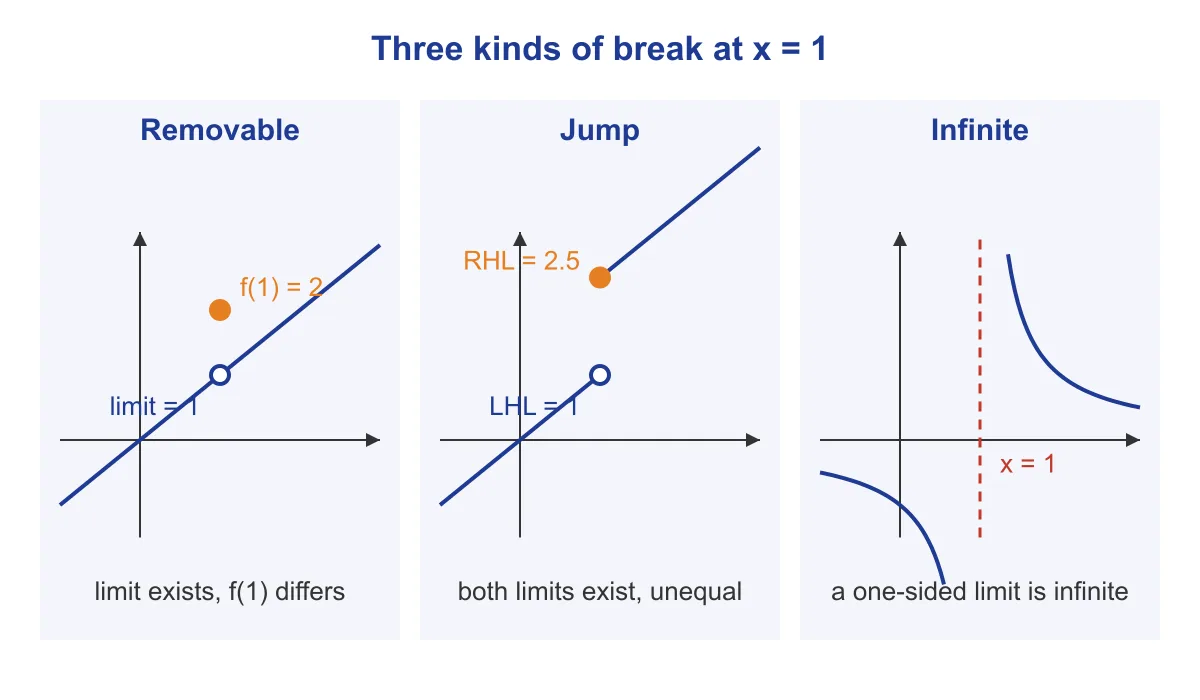
Figure 2.1: Removable, jump and infinite discontinuity at x = 1
| Type | LHL and RHL | Can it be repaired? |
|---|---|---|
| Removable | equal and finite, but $\ne f(a)$ or $f(a)$ missing | yes, redefine $f(a)$ |
| Jump | finite but unequal | no |
| Infinite | at least one is $\pm\infty$ | no |
Memory trick: "Hole, Hop, Hit the wall."
Hole is removable (a missing point), Hop is the jump (the pencil hops up or down), Hit the wall is the infinite break at a vertical asymptote. When you meet a break, ask which of the three it is before you do anything else.
Algebra of continuous functions
Suppose $f$ and $g$ are both continuous at $x=a$. Then the following are continuous at $a$ as well:
- $f+g$, $f-g$ and $cf$ for any constant $c$;
- the product $fg$;
- the quotient $\frac fg$, provided $g(a)\ne0$;
- the composite $g\circ f$, provided $g$ is continuous at the point $f(a)$ (that is, the outer function is continuous where the inner one lands).
These follow at once from the limit laws: the limit of a sum is the sum of the limits, and so on. They let you say, without any work, that $x^2\sin x+e^x\cos x$ is continuous on $\mathbb{R}$ and that $\frac{x+1}{x^2-4}$ is continuous everywhere except $x=\pm2$.
Two cautions.
- The rules go one way only. A sum of two discontinuous functions can be continuous: $[x]$ and $-[x]$ are both discontinuous at $1$, but their sum is $0$. In the same way, one continuous and one discontinuous function always give a discontinuous sum (if the sum were continuous, subtracting the continuous one would make the other continuous too).
- For a composite, check where the inner function lands. $g(x)=[x]$ is discontinuous only at integers, so $[x^2]$ can only break where $x^2$ is an integer.
Example 2: Is $h(x)=[x^2]$ continuous at $x=0$? At $x=1$?
Step 1: near $x=0$ (with $|x|<1$), $0\le x^2<1$, so $[x^2]=0$. Also $h(0)=0$.
Step 2: the limit at $0$ is $0$ from both sides and equals $h(0)$, so $h$ is continuous at $0$.
Step 3: at $x=1$, take $x$ slightly less than $1$: $x^2<1$ gives $[x^2]=0$. Take $x$ slightly more than $1$: $x^2>1$ (but under $2$) gives $[x^2]=1$.
Step 4: LHL $=0$, RHL $=1$, so there is a jump at $1$.
Answer: continuous at $0$, discontinuous at $1$. What to notice: the inner function $x^2$ touches the integer $0$ without crossing it, so no jump appears; at $1$ it crosses upward and the jump appears.
Greatest integer, modulus and piecewise functions
The greatest integer function
$[x]$ is the largest integer not exceeding $x$: $[2.7]=2$, $[-2.7]=-3$, $[5]=5$. On each interval $[n,n+1)$ it is constant, equal to $n$. At an integer $n$:
So the right limit matches the value but the left limit does not: $[x]$ has a jump of size $1$ at every integer, and is continuous at every non-integer. In an interval, count the integers that lie strictly inside to count the jumps.
Variations come up constantly:
- $x-[x]$ (the fractional part) is $0$ at integers but tends to $1$ from the left: discontinuous at every integer.
- $[x]+[-x]$ equals $0$ at an integer and $-1$ at a non-integer. At a non-integer it is constant near the point, hence continuous; at an integer the limit is $-1$ but the value is $0$, so it is discontinuous.
- $x[x]$ at an integer $n$ has LHL $n(n-1)$ and RHL $n^2$, equal only when $n=0$. So $x[x]$ is continuous at $0$ and discontinuous at every other integer.
- $[kx]$ for a positive constant $k$ breaks where $kx$ is an integer, that is at $x=\frac nk$.
The modulus function
$|x|$ equals $x$ for $x\ge0$ and $-x$ for $x<0$. It is continuous everywhere, because both pieces tend to $0$ at the origin. For $|f(x)|$: if $f$ is continuous then so is $|f|$, since $|\cdot|$ is continuous and a composite of continuous functions is continuous. The converse is false: $f(x)=\frac{|x|}{x}$ for $x\ne0$ jumps at $0$, yet $|f(x)|=1$ for $x\ne0$ has no jump at all there.
Piecewise functions
A function defined by different formulas on different intervals is continuous inside each interval if each formula is. Only the points where the formula changes (the "joints") need a test. At a joint $x=a$:
- LHL: put $x=a-h$ in the formula for the left piece and let $h\to0^+$.
- RHL: put $x=a+h$ in the formula for the right piece.
- Value: use whichever piece includes $x=a$.
- Continuous exactly when the three numbers agree.
Example 3: Test the continuity of $f(x)=x[x]$ at $x=0$ and at $x=1$.
Step 1, at $x=0$: for $-1<x<0$, $[x]=-1$ so $f(x)=-x\to0$. For $0\le x<1$, $[x]=0$ so $f(x)=0$. Also $f(0)=0$.
Step 2: LHL $=0$, RHL $=0$, value $=0$. Continuous at $0$.
Step 3, at $x=1$: for $0\le x<1$, $f(x)=0$, so LHL $=0$. For $1\le x<2$, $[x]=1$ so $f(x)=x\to1$, so RHL $=1$.
Step 4: $0\ne1$. Jump at $1$.
What to notice: $[x]$ jumps at every integer, but at $0$ it is multiplied by $x\to0$, which smothers the jump.
Finding constants that make a function continuous
This is the most common JEE use of continuity. The recipe never changes: write LHL, RHL and the value at the joint, set them equal, and solve. With one unknown you need one equation; with two unknowns the function needs two joints (or one joint with a limit that gives two equations).
Two limits are used again and again at a joint where the function becomes $\frac00$: $\lim_{x\to0}\frac{\sin x}{x}=1$ and $\lim_{x\to0}\frac{1-\cos x}{x^2}=\frac12$.
Example 4: Find $k$ so that $f(x)=\dfrac{1-\cos4x}{x^2}$ for $x\ne0$, $f(0)=k$, is continuous at $0$.
Step 1: $1-\cos4x=2\sin^2 2x$.
Step 2: so $f(x)=2\cdot\dfrac{\sin^22x}{x^2}=2\cdot4\left(\dfrac{\sin2x}{2x}\right)^2$.
Step 3: as $x\to0$ the bracket tends to $1$, so the limit is $8$.
Step 4: continuity needs $k=8$.
Check: $1-\cos u\approx\frac{u^2}{2}$ for small $u$, giving $\frac{16x^2/2}{x^2}=8$. The two routes agree.
Example 5: Find $a$ and $b$ if $f(x)=4$ for $x\le1$, $f(x)=ax+b$ for $1<x<3$, $f(x)=10$ for $x\ge3$ is continuous everywhere.
Step 1: the joints are $x=1$ and $x=3$. Each piece is continuous on its own interval.
Step 2, at $x=1$: LHL $=4$, RHL $=a+b$. So $a+b=4$.
Step 3, at $x=3$: LHL $=3a+b$, RHL $=10$. So $3a+b=10$.
Step 4: subtract: $2a=6$, $a=3$, then $b=1$.
Check: the middle piece $3x+1$ gives $4$ at $x=1$ and $10$ at $x=3$. Both joints close.
What to notice: two joints gave two equations, which is how you can tell a problem with two constants is solvable.
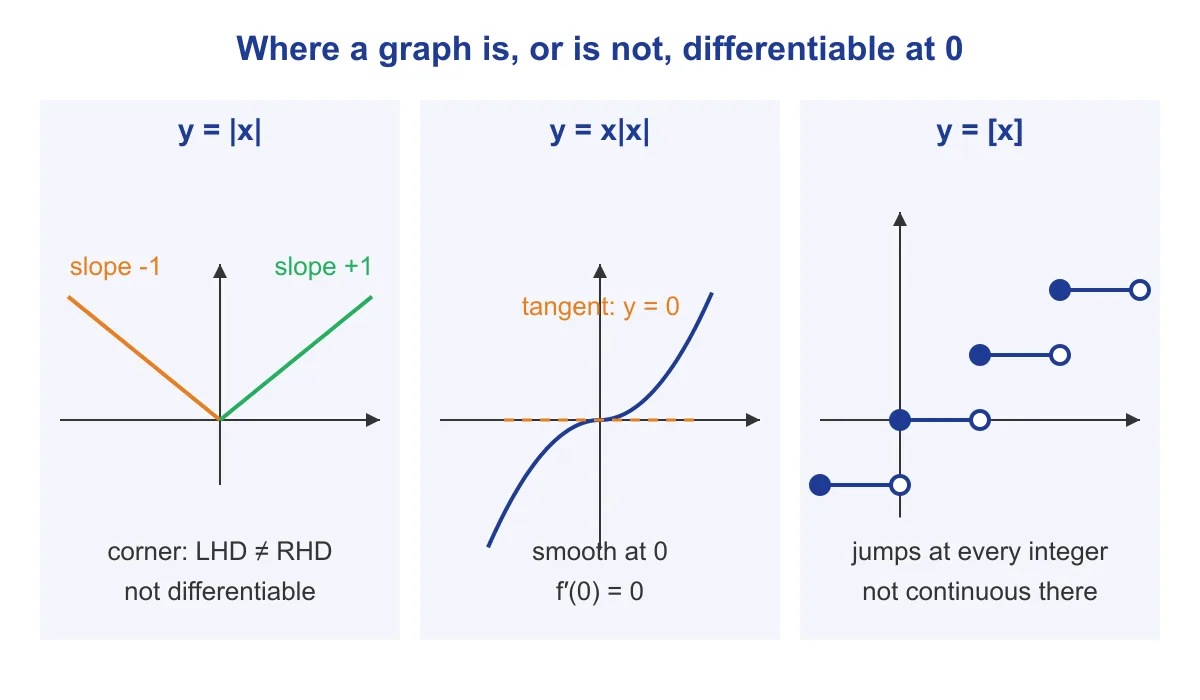
Figure 2.2: A corner, a smooth point and a staircase
Differentiability at a point
The derivative of $f$ at $a$ is the limit of the slope of the chord:
Because $h$ can approach $0$ from either side, there are two one-sided versions.
$f$ is differentiable at $a$ exactly when LHD and RHD both exist (as finite numbers) and are equal. Their common value is $f'(a)$. If the two differ, the graph has a corner at that point: it arrives with one slope and leaves with another, so there is no single tangent line.
A note on the denominator of the LHD. When you put $x=a-h$, the step in $x$ is $-h$, so the quotient is $\frac{f(a-h)-f(a)}{-h}$. Forgetting that minus sign flips the sign of the LHD, and that is the usual cause of a wrong "differentiable" verdict.
Example 6: Find LHD and RHD of $f(x)=|x-1|$ at $x=1$.
Step 1: $f(1)=0$.
Step 2, RHD: for $h>0$, $f(1+h)=|h|=h$, so the quotient is $\frac{h-0}{h}=1$. RHD $=1$.
Step 3, LHD: for $h>0$, $f(1-h)=|-h|=h$, and the quotient is $\frac{h-0}{-h}=-1$. LHD $=-1$.
Step 4: $-1\ne1$, so $f$ is not differentiable at $1$.
What to notice: the slopes of the two arms of the V are $-1$ and $+1$, which is exactly what the one-sided derivatives return.
For a function made of different formulas, you do not always need the definition. When both pieces are themselves differentiable, the one-sided derivative at the joint is the derivative of that piece at the joint, provided the function is continuous there. So for $f(x)=g(x)$ on the left and $h(x)$ on the right, check continuity first, then compare $g'(a)$ and $h'(a)$.
Example 7: Find $a,b$ so that $f(x)=x^2+3x+a$ for $x\le1$ and $f(x)=bx+2$ for $x>1$ is differentiable at $x=1$.
Step 1, continuity first: LHL $=1+3+a=4+a$; RHL $=b+2$. So $4+a=b+2$.
Step 2, equal slopes: left slope $=2x+3$ at $1$ is $5$; right slope is $b$. So $b=5$.
Step 3: then $a=b+2-4=3$.
Answer: $a=3$, $b=5$.
What to notice: continuity alone gives one equation; matching slopes gives the second. Differentiability needs both.
Continuity and differentiability together
Differentiable implies continuous. If $f'(a)$ exists, then
so $f(a+h)\to f(a)$, which is continuity at $a$.
The converse is false. $f(x)=|x|$ is continuous at $0$ but has RHD $=1$ and LHD $=-1$ there. Read the statement the other way to use it: if a function is not continuous at $a$, it cannot be differentiable at $a$. That is the quickest test, and it settles $[x]$ at every integer without computing any quotient.
| Property at $a$ | What it demands | Implication |
|---|---|---|
| Continuous | $\text{LHL}=\text{RHL}=f(a)$ | does not give differentiability |
| Differentiable | $\text{LHD}=\text{RHD}$, finite | gives continuity |
| Not continuous | one of the three conditions fails | forces not differentiable |
| Corner | continuous, $\text{LHD}\ne\text{RHD}$ | continuous, not differentiable |
Memory trick: "Smooth means joined, joined need not be smooth."
Say it as a rope: a rope that is smooth is certainly in one piece, but a rope in one piece can still have a kink. Use it to remember which way the implication points.
A subtler case: $f(x)=x\sin\frac1x$ with $f(0)=0$ is continuous at $0$ (because $|x\sin\frac1x|\le|x|$) but the quotient $\frac{f(h)-f(0)}{h}=\sin\frac1h$ keeps oscillating between $-1$ and $1$, so neither one-sided derivative exists. By contrast $g(x)=x^2\sin\frac1x$ with $g(0)=0$ has quotient $h\sin\frac1h$, squeezed between $-|h|$ and $|h|$, so $g'(0)=0$.
Points where $|x|$ and $[x]$ type functions fail to be differentiable
Modulus. $|f(x)|$ can lose differentiability only at a point $a$ where $f(a)=0$. Away from the zeros of $f$, the function $|f|$ equals either $f$ or $-f$ on a small interval and is as smooth as $f$.
At a zero $a$ of $f$ (with $f$ differentiable):
- if $f'(a)\ne0$, then $|f|$ has a corner: RHD and LHD are $|f'(a)|$ and $-|f'(a)|$. Not differentiable.
- if $f'(a)=0$, then $|f|$ is differentiable at $a$ with derivative $0$.
So $|x|$ breaks at $0$ (slope $1$), $|x^2-4|$ breaks at $\pm2$ (slopes $\pm4$), and $|\sin x|$ breaks at every multiple of $\pi$. But $|x|^3$ and $x|x|$ are smooth at $0$. For $x|x|$: the quotient at $0$ is $\frac{h|h|}{h}=|h|\to0$ from both sides.
When a zero of $f$ is multiplied by another factor that is also zero there, the corner is smoothed away. The function $(x^2-1)\,|x-1|$ is differentiable at $x=1$: the factor $x-1$ in front of $|x-1|$ acts like the extra $x$ in $x|x|$.
A sum of modulus terms has a corner at each point where one term has a corner, unless two corners cancel. Slopes add: $|x|+|x-1|$ has a corner at $0$ and at $1$ but is a straight line of slope $0$ in between.
Greatest integer. $[x]$ is not continuous at an integer, so it is not differentiable there. Between integers it is constant, so its derivative is $0$ at every non-integer. Functions built from $[x]$ add their own jumps, and each jump point is a point of non-differentiability.
| Function | Points of non-differentiability |
|---|---|
| $\lvert x\rvert$ | $x=0$ |
| $\lvert x-c\rvert$ | $x=c$ |
| $\lvert x\rvert+\lvert x-2\rvert$ | $x=0$ and $x=2$ |
| $x\lvert x\rvert$ | none |
| $\lvert\sin x\rvert$ | $x=n\pi$, $n$ an integer |
| $[x]$ | every integer |
| $\lvert x^2-5x+6\rvert$ | $x=2$ and $x=3$ |
Example 8: Find the points where $f(x)=(x^2-1)\,|x^2-3x+2|$ is not differentiable.
Step 1: $x^2-3x+2=(x-1)(x-2)$, so $|x^2-3x+2|$ can only break at $x=1$ and $x=2$, where its inside vanishes with non-zero slope.
Step 2: write $f(x)=(x-1)(x+1)\,|x-1|\,|x-2|$.
Step 3, at $x=1$: the factor $(x-1)|x-1|$ is smooth (the same pattern as $x|x|$), and the rest, $(x+1)|x-2|$, is smooth near $1$. So $f$ is differentiable at $1$.
Step 4, at $x=2$: the other factors $(x^2-1)|x-1|$ equal $3\cdot1=3$ at $2$, not zero, so the corner of $|x-2|$ survives.
Answer: only $x=2$. What to notice: before you count the zeros of an expression inside a modulus, look at what multiplies it.
Common traps
- Checking only the limit and forgetting $f(a)$ → check that $f(a)$ exists and equals the limit.
- Assuming a function is discontinuous because its graph has a hole at a point outside the domain → continuity is judged only at points of the domain.
- Using the same formula for LHL and RHL on a piecewise function → use the left piece for $x=a-h$ and the right piece for $x=a+h$.
- Thinking the sum of two discontinuous functions must be discontinuous → it can be continuous; test it directly.
- Computing $\text{LHD}$ with denominator $h$ instead of $-h$ → with $x=a-h$ the denominator is $-h$.
- Saying "continuous, hence differentiable" → continuous is not enough; compare the two one-sided derivatives.
- Saying $|f(x)|$ is not differentiable at every zero of $f$ → only where $f'\ne0$; at a double zero it stays smooth.
- Counting every integer for $[x]$ on a closed interval without thinking → count only integers inside, and treat an end point as a one-sided case.
- Treating $[x^2]$ or $[2x]$ as breaking at integers $x$ → it breaks where the inside becomes an integer.
- Believing that a function with a removable break is "not defined well enough to matter" → it is still discontinuous until the value is redefined.
Quick revision
- Continuous at $a$: $\text{LHL}=\text{RHL}=f(a)$, all finite.
- Closed interval: use one-sided limits at the end points.
- Removable: limit exists, $f(a)$ missing or different; repair by redefining $f(a)$.
- Jump: finite one-sided limits, unequal; the size of the jump is $\text{RHL}-\text{LHL}$.
- Infinite: a one-sided limit is $\pm\infty$.
- Sum, difference, product, composite of continuous functions are continuous; quotient continuous where the denominator is not $0$.
- Continuous plus discontinuous is always discontinuous; discontinuous plus discontinuous can be either.
- $[x]$ has a jump of $1$ at every integer; $x-[x]$ and $[x]+[-x]$ are also discontinuous at integers.
- $|x|$ is continuous everywhere; $|f|$ is continuous whenever $f$ is.
- Constants for continuity: equate LHL, RHL and the value at each joint.
- $f'(a)$ exists iff $\text{LHD}=\text{RHD}$ (both finite); LHD uses $\frac{f(a-h)-f(a)}{-h}$.
- Differentiable at $a$ implies continuous at $a$; the converse fails.
- $|f|$ has a corner only at a zero of $f$ where $f'\ne0$.
- $|x|$ fails at $0$, $[x]$ fails at every integer, $x|x|$ never fails.
- For constants that make a piecewise function differentiable: equal values first, then equal slopes.
Practice questions
The function $f$ is given by $f(x)=\frac{\sin x}{x}$ for $x\ne0$ and $f(0)=2$. At $x=0$ the function has
- a removable discontinuity
- a jump discontinuity
- an infinite discontinuity
- no discontinuity
Answer
A. a removable discontinuity
$\lim_{x\to0}\frac{\sin x}{x}=1$ exists but $f(0)=2\ne1$. The limit exists and differs from the value, so the break is removable.
The greatest integer function $f(x)=[x]$ is discontinuous at
- every real number
- every integer and nowhere else
- only $x=0$
- every non-integer real number
Answer
B. every integer and nowhere else
At an integer $n$, LHL $=n-1$ and RHL $=n$. Between integers the function is constant, hence continuous.
The function $f(x)=\frac{1}{x-2}$ has, at $x=2$,
- a jump discontinuity
- a removable discontinuity
- a continuous point
- an infinite discontinuity
Answer
D. an infinite discontinuity
As $x\to2^+$, $f\to+\infty$ and as $x\to2^-$, $f\to-\infty$. The one-sided limits are infinite.
The set of all real $x$ at which $f(x)=|x-2|+|x-5|$ is not differentiable is
- $\{2\}$
- $\{2,\frac72,5\}$
- $\{2,5\}$
- $\{5\}$
Answer
C. $\{2,5\}$
Each modulus term has a corner where its inside is zero: $x=2$ and $x=5$. The two corners are at different points, so neither cancels. At $x=3.5$ the function is the constant $3$.
Which of the following functions is continuous but not differentiable at $x=0$?
- $|x|$
- $[x]$
- $x^2$
- $x^3$
Answer
A. $|x|$
$x^2$ and $x^3$ are differentiable at $0$; $[x]$ is not even continuous at $0$. $|x|$ is continuous with LHD $=-1$, RHD $=1$.
For $f(x)=x|x|$, at $x=0$ the function is
- continuous but not differentiable
- differentiable with $f'(0)=1$
- discontinuous
- differentiable with $f'(0)=0$
Answer
D. differentiable with $f'(0)=0$
$\frac{f(h)-f(0)}{h}=\frac{h|h|}{h}=|h|\to0$ from both sides, so $f'(0)=0$.
Let $f(x)=[x]+[-x]$. Then $f$ is continuous
- at no real number
- at every real number
- at every non-integer and at no integer
- at every integer and at no non-integer
Answer
C. at every non-integer and at no integer
For non-integer $x$, $[x]+[-x]=-1$, constant near the point. At an integer, the limit is $-1$ but $f=0$, so it is discontinuous there.
Let $f(x)=[\sin x]$. At $x=0$ the left limit, right limit and value of $f$ are, in that order,
- $0,\ 0,\ 0$
- $-1,\ 0,\ 0$
- $0,\ 1,\ 0$
- $-1,\ -1,\ 0$
Answer
B. $-1,\ 0,\ 0$
For small $x<0$, $\sin x$ is a small negative number, so $[\sin x]=-1$. For small $x>0$, $0<\sin x<1$ gives $0$. And $[\sin0]=0$.
If a function $f$ is differentiable at $x=a$, then
- $f'$ is continuous at $x=a$
- $f$ is discontinuous at $x=a$
- $f$ is continuous at $x=a$
- $f$ has a corner at $x=a$
Answer
C. $f$ is continuous at $x=a$
Differentiability at a point forces continuity there: $f(a+h)-f(a)=\frac{f(a+h)-f(a)}{h}\cdot h\to f'(a)\cdot0=0$.
For $f(x)=|2x-6|$, the left derivative and right derivative at $x=3$ are, respectively,
- $2$ and $2$
- $-2$ and $-2$
- $2$ and $-2$
- $-2$ and $2$
Answer
D. $-2$ and $2$
For $x<3$, $f=6-2x$ with slope $-2$. For $x>3$, $f=2x-6$ with slope $2$. So LHD $=-2$, RHD $=2$.
Let $f(x)=x^2\sin\frac1x$ for $x\ne0$ and $f(0)=0$. Then $f'(0)$ is
- not defined
- $0$
- $\frac12$
- $1$
Answer
B. $0$
$\frac{f(h)-f(0)}{h}=h\sin\frac1h$. Since $\left|h\sin\frac1h\right|\le|h|\to0$, the limit is $0$.
Let $f$ be continuous at $x=a$ and let $g$ be discontinuous at $x=a$. Then $f+g$ at $x=a$ is
- always continuous
- continuous only if $f(a)=0$
- sometimes continuous and sometimes discontinuous
- always discontinuous
Answer
D. always discontinuous
If $f+g$ were continuous, then $g=(f+g)-f$ would be continuous too, a contradiction. So $f+g$ is always discontinuous.
Let $f(x)=\frac{|x|}{x}$ for $x\ne0$ and $f(0)=1$. At $x=0$ the function has
- a jump discontinuity
- an infinite discontinuity
- a removable discontinuity
- no discontinuity
Answer
A. a jump discontinuity
LHL $=-1$ and RHL $=1$. Both are finite but unequal, so it is a jump no matter what $f(0)$ is.
Let $f(x)=x\sin\frac1x$ for $x\ne0$ and $f(0)=0$. At $x=0$ the function $f$ is
- differentiable with $f'(0)=1$
- differentiable with $f'(0)=0$
- continuous but not differentiable
- discontinuous
Answer
C. continuous but not differentiable
$\left|x\sin\frac1x\right|\le|x|\to0$, so $f$ is continuous. But $\frac{f(h)-f(0)}{h}=\sin\frac1h$ oscillates between $-1$ and $1$, so no derivative exists.
If $f(x)=\frac{x^3-8}{x-2}$ for $x\ne2$ and $f(2)=k$ is continuous at $x=2$, then $k$ equals
- 8
- 6
- 12
- 4
Answer
C. 12
$\frac{x^3-8}{x-2}=x^2+2x+4\to12$ as $x\to2$. Check with the formula $n a^{n-1}=3\cdot4=12$. So $k=12$.
The function $f(x)=kx+1$ for $x\le4$ and $f(x)=3x-5$ for $x>4$ is continuous at $x=4$. The value of $k$ is
- 2.5
- 0.5
- 3
- 1.5
Answer
D. 1.5
LHL $=4k+1$, RHL $=12-5=7$. So $4k+1=7$ and $k=1.5$. Check: $4(1.5)+1=7$.
If $f(x)=\frac{e^{5x}-1}{\sin2x}$ for $x\ne0$ and $f(0)=k$ is continuous at $0$, then $k$ equals
- 2.5
- 10
- 0.4
- 7
Answer
A. 2.5
$\frac{e^{5x}-1}{\sin2x}=\frac{5x}{2x}\cdot\frac{(e^{5x}-1)/5x}{\sin2x/2x}\to\frac52\cdot\frac11=2.5$.
A function is $f(x)=5$ for $x\le2$, $f(x)=ax+b$ for $2<x<4$ and $f(x)=11$ for $x\ge4$, and it is continuous on $\mathbb{R}$. The value of $a-b$ is
- 2
- 4
- -4
- 8
Answer
B. 4
At $x=2$: $2a+b=5$. At $x=4$: $4a+b=11$. Subtract: $a=3$, then $b=-1$. So $a-b=4$. Check: $3(2)-1=5$ and $3(4)-1=11$.
The number of points of discontinuity of $f(x)=[x]$ in the interval $(-1.5,\,3.2)$ is
- 4
- 6
- 5
- 3
Answer
C. 5
The integers strictly inside the interval are $-1,0,1,2,3$. That is $5$ points of discontinuity.
The number of points in the open interval $(-2\pi,\,2\pi)$ at which $f(x)=|\sin x|$ is not differentiable is
- 5
- 4
- 2
- 3
Answer
D. 3
$|\sin x|$ has corners where $\sin x=0$, that is at $x=n\pi$. Inside $(-2\pi,2\pi)$ these are $-\pi,\,0,\,\pi$. The end points are excluded. So $3$.
For $f(x)=2|x|+3x$, the sum of the right derivative and the left derivative at $x=0$ is
- 6
- 4
- 5
- 10
Answer
A. 6
For $x>0$, $f=5x$ so RHD $=5$. For $x<0$, $f=x$ so LHD $=1$. Sum $=6$.
The number of points at which $f(x)=|x-1|+|x^2-9|+|x+5|$ is not differentiable is
- 3
- 4
- 5
- 2
Answer
B. 4
The inside of each modulus vanishes at $x=1$; $x=3$ and $x=-3$; $x=-5$. These are four different points, each with non-zero slope, so there are $4$ corners.
The number of points at which $f(x)=(x-1)|x|+(x+1)|x-1|+(x^2-1)|x+1|$ is not differentiable is
- 3
- 1
- 2
- 4
Answer
C. 2
Corners can occur only at $0$, $1$, $-1$. At $x=0$: $(x-1)|x|$ has a corner since $x-1=-1\ne0$. At $x=1$: $(x+1)|x-1|$ has a corner since $x+1=2\ne0$. At $x=-1$: $(x^2-1)|x+1|=(x-1)(x+1)|x+1|$ is smooth like $x|x|$. So $2$ points.
For $f(x)=|x^2-9|$, the value of (right derivative minus left derivative) at $x=3$ is
- 0
- 12
- -12
- 6
Answer
B. 12
Just right of $3$, $f=x^2-9$ with slope $6$. Just left of $3$, $f=9-x^2$ with slope $-6$. RHD $-$ LHD $=6-(-6)=12$.
The number of points of discontinuity of $f(x)=[3x]$ in the open interval $(0,\,2.5)$ is
- 7
- 6
- 8
- 5
Answer
A. 7
$[3x]$ jumps where $3x$ is an integer: $x=\frac13,\frac23,\dots,\frac73$. Since $\frac73<2.5<\frac83$ there are $7$ such points.
Let $f(x)=\frac{\sin3x}{x}$ for $x<0$, $f(0)=k$, and $f(x)=\frac{\sqrt{1+px}-1}{x}$ for $x>0$, with $p>0$ a constant. If $f$ is continuous at $0$, then $p+k$ equals
- 6
- 9
- 12
- 3
Answer
B. 9
LHL $=3$. For the right side multiply by the conjugate: $\frac{px}{x(\sqrt{1+px}+1)}\to\frac p2$. So $\frac p2=3=k$, giving $p=6$, $k=3$, and $p+k=9$.
Given below are two statements: Statement I: The function $\frac{x^2-4}{x-2}$ has a removable discontinuity at $x=2$. Statement II: The function $\frac{1}{x-2}$ has an infinite discontinuity at $x=2$.
- Both Statement I and Statement II are correct
- Both Statement I and Statement II are incorrect
- Statement I is correct but Statement II is incorrect
- Statement I is incorrect but Statement II is correct
Answer
A. Both Statement I and Statement II are correct
Statement I: $\frac{x^2-4}{x-2}=x+2\to4$, a finite limit with the value missing, so removable. Statement II: the one-sided limits are $\pm\infty$. Both are correct.
Given below are two statements: Statement I: If $f$ and $g$ are both discontinuous at $x=a$, then $f+g$ is discontinuous at $x=a$. Statement II: If $f$ is differentiable at $x=a$, then $f$ is continuous at $x=a$.
- Both Statement I and Statement II are correct
- Both Statement I and Statement II are incorrect
- Statement I is correct but Statement II is incorrect
- Statement I is incorrect but Statement II is correct
Answer
D. Statement I is incorrect but Statement II is correct
Statement I is false: $[x]$ and $-[x]$ are both discontinuous at $1$ but their sum is $0$, continuous. Statement II is the standard result and is true.
Given below are two statements: Statement I: $f(x)=x[x]$ is continuous at $x=0$. Statement II: $f(x)=x[x]$ is continuous at $x=1$.
- Both Statement I and Statement II are correct
- Both Statement I and Statement II are incorrect
- Statement I is correct but Statement II is incorrect
- Statement I is incorrect but Statement II is correct
Answer
C. Statement I is correct but Statement II is incorrect
At $0$: $f(x)=-x\to0$ on the left, $0$ on the right, $f(0)=0$, so continuous. At $1$: LHL $=1\cdot0=0$ but RHL $=1\cdot1=1$, so it jumps.
Given below are two statements: Statement I: If $f$ is continuous at $x=a$, then $f$ is differentiable at $x=a$. Statement II: The function $[x]$ is not differentiable at $x=0.5$.
- Both Statement I and Statement II are correct
- Both Statement I and Statement II are incorrect
- Statement I is correct but Statement II is incorrect
- Statement I is incorrect but Statement II is correct
Answer
B. Both Statement I and Statement II are incorrect
Statement I is false ($|x|$ at $0$). Statement II is false: near $0.5$, $[x]=0$ is constant, so the derivative exists and equals $0$.
Given below are two statements: Statement I: $f(x)=|x|+|x-1|$ is differentiable at $x=0.5$. Statement II: $f(x)=x|x|$ is differentiable at $x=0$.
- Both Statement I and Statement II are correct
- Both Statement I and Statement II are incorrect
- Statement I is correct but Statement II is incorrect
- Statement I is incorrect but Statement II is correct
Answer
A. Both Statement I and Statement II are correct
Statement I: near $0.5$, $f(x)=x+(1-x)=1$, constant, so differentiable. Statement II: $\frac{h|h|}{h}=|h|\to0$ from both sides. Both are correct.
Assertion (A): $f(x)=[x]$ is discontinuous at $x=3$. Reason (R): $\lim_{x\to3^-}[x]=2$ whereas $\lim_{x\to3^+}[x]=3$.
- Both A and R are true and R is the correct explanation of A
- Both A and R are true but R is not the correct explanation of A
- A is true but R is false
- A is false but R is true
Answer
A. Both A and R are true and R is the correct explanation of A
A is true and R gives exactly the reason: the two one-sided limits differ, so the limit does not exist.
Assertion (A): $f(x)=|x|$ is not differentiable at $x=0$. Reason (R): $f(x)=|x|$ is continuous at $x=0$.
- Both A and R are true and R is the correct explanation of A
- Both A and R are true but R is not the correct explanation of A
- A is true but R is false
- A is false but R is true
Answer
B. Both A and R are true but R is not the correct explanation of A
Both statements are true. But continuity does not cause non-differentiability; the real reason is LHD $=-1\ne$ RHD $=1$. So R does not explain A.
Assertion (A): $f(x)=[x]$ is continuous at $x=0$. Reason (R): A function that is differentiable at a point is continuous at that point.
- Both A and R are true and R is the correct explanation of A
- Both A and R are true but R is not the correct explanation of A
- A is true but R is false
- A is false but R is true
Answer
D. A is false but R is true
$[x]$ has LHL $=-1$ and RHL $=0$ at $0$, so A is false. R is the standard true result.
Match List I with List II. List I: a. $f(x)=x\sin\frac1x$ for $x\ne0$, $f(0)=0$ b. $f(x)=\frac{x}{|x|}$ for $x\ne0$, $f(0)=0$ c. $f(x)=\frac{\sin x}{x}$ for $x\ne0$, $f(0)=2$ d. $f(x)=\frac{1}{x^2}$ for $x\ne0$, $f(0)=0$. List II: i. removable discontinuity at $0$ ii. jump discontinuity at $0$ iii. infinite discontinuity at $0$ iv. continuous at $0$
- a-iv, b-i, c-ii, d-iii
- a-ii, b-iv, c-i, d-iii
- a-iv, b-ii, c-i, d-iii
- a-i, b-ii, c-iv, d-iii
Answer
C. a-iv, b-ii, c-i, d-iii
a: $|x\sin\frac1x|\le|x|\to0=f(0)$, continuous. b: limits $-1$ and $1$, jump. c: limit $1\ne2$, removable. d: $\frac1{x^2}\to\infty$, infinite.
Match List I with List II. List I: a. $|x-1|$ b. $|x|+|x-2|$ c. $x|x|$ d. $[x]$. List II: i. differentiable at every real number ii. not differentiable only at $x=1$ iii. not differentiable at exactly two points, $x=0$ and $x=2$ iv. not differentiable at every integer
- a-ii, b-iii, c-iv, d-i
- a-iii, b-ii, c-i, d-iv
- a-i, b-iii, c-ii, d-iv
- a-ii, b-iii, c-i, d-iv
Answer
D. a-ii, b-iii, c-i, d-iv
a has a corner only at $1$. b has corners at $0$ and $2$. c is smooth everywhere. d jumps at every integer, so it is not differentiable there.
Match List I with List II. List I (the value at $x=0$ is $0$ where needed): a. $3|x|$ b. $x^2$ c. $2x+|x|$ d. $x\sin\frac1x$ for $x\ne0$, value $0$ at $x=0$. List II: i. differentiable at $0$ with derivative $0$ ii. RHD $=3$ and LHD $=1$ iii. RHD $=3$ and LHD $=-3$ iv. continuous at $0$, neither one-sided derivative exists
- a-iii, b-iv, c-ii, d-i
- a-iii, b-i, c-ii, d-iv
- a-i, b-iii, c-ii, d-iv
- a-ii, b-i, c-iii, d-iv
Answer
B. a-iii, b-i, c-ii, d-iv
a: slopes $3$ and $-3$. b: $f'(0)=0$. c: right $2+1=3$, left $2-1=1$. d: quotient $\sin\frac1h$ oscillates.
Let $f(x)=ax^2+bx$ for $x<1$ and $f(x)=x^3$ for $x\ge1$. If $f$ is differentiable at $x=1$, then $a-b$ equals
- -1
- 3
- 1
- 5
Answer
B. 3
Continuity at $1$: $a+b=1$. Slopes: $2a+b=3$ (derivative of $x^3$ at $1$). Subtract: $a=2$, $b=-1$. So $a-b=3$.
The number of points in $(0,3)$ at which $f(x)=[x]+|x-1.5|$ is not differentiable is
- 2
- 1
- 3
- 4
Answer
C. 3
$[x]$ jumps at $x=1$ and $x=2$, so $f$ is discontinuous and not differentiable there. $|x-1.5|$ has a corner at $x=1.5$, where $[x]$ is constant. Three points: $1,\ 1.5,\ 2$.
Let $f(x)=\frac{x^2-5x+6}{x^2-x-2}$ for $x\ne2,-1$, with $f(2)=0$ and $f(-1)=0$. Then $f$ has
- an infinite discontinuity at both $x=2$ and $x=-1$
- a removable discontinuity at both $x=2$ and $x=-1$
- no discontinuity at $x=2$ and an infinite discontinuity at $x=-1$
- a removable discontinuity at $x=2$ and an infinite discontinuity at $x=-1$
Answer
D. a removable discontinuity at $x=2$ and an infinite discontinuity at $x=-1$
$f(x)=\frac{(x-2)(x-3)}{(x-2)(x+1)}=\frac{x-3}{x+1}$. At $2$ the limit is $-\frac13\ne0=f(2)$: removable. At $-1$ the denominator tends to $0$ with numerator $-4$: infinite.