Applications of Derivatives
What to remember
- $\frac{dy}{dx}$ is the rate at which $y$ changes per unit change in $x$. When both depend on time, the chain rule gives $\frac{dy}{dt}=\frac{dy}{dx}\cdot\frac{dx}{dt}$. Differentiate first, substitute the numbers afterwards.
- The slope of the tangent at $(x_0,y_0)$ is $f'(x_0)$. The tangent is $y-y_0=f'(x_0)(x-x_0)$ and the normal has slope $-\frac{1}{f'(x_0)}$. The angle between two curves is the angle between their tangents at the common point.
- $f'>0$ on an interval means $f$ is increasing there, $f'<0$ means decreasing. Local extrema can sit only at critical points, where $f'=0$ or $f'$ does not exist, but not every critical point is an extremum.
- First derivative test: $f'$ changing from $+$ to $-$ gives a local maximum, from $-$ to $+$ a local minimum, no change of sign gives neither. Second derivative test: $f'(c)=0$ and $f''(c)<0$ gives a maximum, $f''(c)>0$ a minimum, $f''(c)=0$ says nothing.
- On a closed interval $[a,b]$ a continuous function has its absolute maximum and minimum among the values at the endpoints and at the critical points. Optimisation is this idea applied to a function you build yourself. For small $\Delta x$, $f(x+\Delta x)\approx f(x)+f'(x)\,\Delta x$.
1. Rate of change
If $y=f(x)$, then $\frac{dy}{dx}$ measures how fast $y$ changes when $x$ changes. It is positive when $y$ grows with $x$ and negative when $y$ shrinks. Its units are units of $y$ per unit of $x$: if $V$ is in cm$^3$ and $r$ in cm, then $\frac{dV}{dr}$ is in cm$^2$.
Most problems in this section are about time. A balloon is being inflated, a ladder is sliding, water is draining from a tank. Each quantity depends on $t$, and a geometric relation ties them together. The method never changes:
- Name the variables and write the relation between them (for example $V=\frac43\pi r^3$).
- Differentiate both sides with respect to $t$, using the chain rule.
- Only now put in the values at the instant asked.
- Read the sign: a minus sign in the answer means the quantity is decreasing.
If you substitute the numbers before differentiating, a variable that was changing becomes a constant and the derivative collapses to zero. This is the most common slip in the topic.
To find the rate of $y$ with respect to some other quantity $z$ (neither of them time), use $\frac{dy}{dz}=\dfrac{dy/dx}{dz/dx}$.
Example 1: The radius of a spherical balloon grows at $0.2$ cm/s. How fast is the volume increasing, and how fast is the surface area increasing, when $r=5$ cm?
$V=\frac43\pi r^3$, so $\frac{dV}{dt}=4\pi r^2\frac{dr}{dt}$.
At $r=5$: $\frac{dV}{dt}=4\pi(25)(0.2)=20\pi$ cm$^3$/s.
$S=4\pi r^2$, so $\frac{dS}{dt}=8\pi r\frac{dr}{dt}=8\pi(5)(0.2)=8\pi$ cm$^2$/s.
Answer: $20\pi$ cm$^3$/s and $8\pi$ cm$^2$/s.
Why this works: $4\pi r^2$ is the surface area, so $\frac{dV}{dr}$ equals the area. The volume grows by "a shell of thickness $dr$" each instant.
Example 2: A ladder $10$ m long leans against a wall. Its foot is $6$ m from the wall and is pulled away at $0.5$ m/s. How fast does the top slide down?
Let the foot be $x$ m from the wall and the top $y$ m high: $x^2+y^2=100$.
Differentiate in $t$: $2x\frac{dx}{dt}+2y\frac{dy}{dt}=0$, so $\frac{dy}{dt}=-\frac{x}{y}\frac{dx}{dt}$.
At $x=6$, $y=\sqrt{100-36}=8$. So $\frac{dy}{dt}=-\frac68(0.5)=-0.375$.
Answer: the top slides down at $0.375$ m/s.
Why this works: $y$ had to be found from the relation at that instant, after differentiating. The minus sign only tells you the height is falling.
2. Tangents and normals
The derivative $f'(x_0)$ is the slope of the tangent to $y=f(x)$ at $(x_0,y_0)$. Call it $m$. Then
- tangent: $y-y_0=m(x-x_0)$,
- normal (the line through the point perpendicular to the tangent): $y-y_0=-\frac1m(x-x_0)$, valid when $m\ne0$.
Two special cases need care. If $m=0$ the tangent is the horizontal line $y=y_0$ and the normal is the vertical line $x=x_0$. If the tangent is vertical (the slope is infinite, $\frac{dx}{dy}=0$), the tangent is $x=x_0$ and the normal is $y=y_0$.
When the curve is given in parametric form, $m=\frac{dy/dt}{dx/dt}$. When it is given implicitly, differentiate both sides and solve for $\frac{dy}{dx}$.
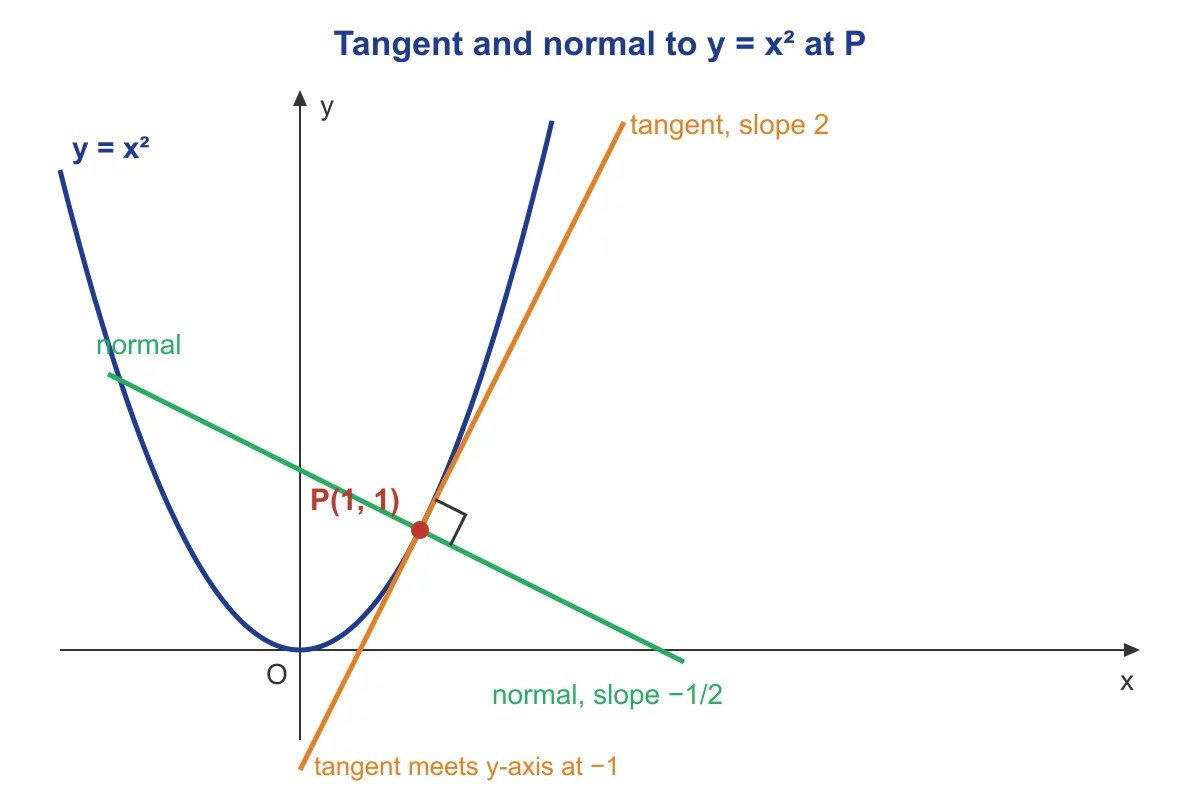
*Figure 4.1: Tangent and normal to $y=x^2$ at $P(1,1)$*
In the figure the tangent has slope $2$, so the normal has slope $-\frac12$. Their product is $-1$, which is exactly the statement that they are perpendicular.
Lengths connected with a tangent and a normal
Let the tangent and normal at $P(x,y)$ meet the $x$-axis at $T$ and $N$, and let $M$ be the foot of the perpendicular from $P$ to the $x$-axis. With $m=\frac{dy}{dx}$ at $P$, simple right triangles give:
| Quantity | Meaning | Value |
|---|---|---|
| Length of tangent | $PT$ | $\left\vert \frac{y\sqrt{1+m^2}}{m}\right\vert$ |
| Length of normal | $PN$ | $\left\vert y\sqrt{1+m^2}\right\vert$ |
| Subtangent | $TM$ | $\left\vert \frac{y}{m}\right\vert$ |
| Subnormal | $MN$ | $\left\vert ym\right\vert$ |
You do not need to memorise the table. Draw the right triangle $PMT$, note that the angle at $T$ has $\tan=m$, and read off the lengths. For the parabola $y^2=4ax$ the subnormal is $y\cdot\frac{2a}{y}=2a$ at every point, a constant.
Angle between two curves
Two curves meet at a point. The angle between them there is the angle between their tangents. If the slopes are $m_1$ and $m_2$,
If $m_1m_2=-1$ the curves are orthogonal (cut at a right angle). If one tangent is horizontal and the other vertical, the formula breaks down because one slope is infinite, but the angle is plainly $90^\circ$. Always find the common point first by solving the two equations together, then take the slopes at that point.
Example 3: Find the tangent and the normal to $y=x^3-3x+2$ at the point where $x=2$.
$y=8-6+2=4$, so the point is $(2,4)$.
$\frac{dy}{dx}=3x^2-3=9$ at $x=2$.
Tangent: $y-4=9(x-2)$, that is $y=9x-14$.
Normal: $y-4=-\frac19(x-2)$, that is $x+9y=38$.
Answer: $9x-y=14$ and $x+9y=38$.
Why this works: only two things are needed, the point and the slope. Compute $y$ from the curve, never from the tangent.
Example 4: Find the angle between $y=x^2$ and $y^2=x$ at $(1,1)$ and at $(0,0)$.
At $(1,1)$: for $y=x^2$, $m_1=2x=2$. For $y^2=x$, $2y\frac{dy}{dx}=1$, so $m_2=\frac12$.
$\tan\theta=\left|\frac{2-\frac12}{1+2\cdot\frac12}\right|=\frac{3/2}{2}=\frac34$, so $\theta=\tan^{-1}\frac34$.
At $(0,0)$: $y=x^2$ has a horizontal tangent ($m_1=0$) and $y^2=x$ has a vertical tangent, so the angle is $90^\circ$.
Answer: $\tan^{-1}\frac34$ at $(1,1)$, and $90^\circ$ at the origin.
Why this works: the same two curves meet at two points and cut at different angles at each. The origin needed a look at the slopes, not the formula.
Tangent drawn from a point outside the curve
If the given point is not on the curve, call the point of contact $(t,f(t))$. Write the tangent there, force it to pass through the given point, and solve for $t$.
Example 5: Find the tangents to $y=x^2$ that pass through $(0,-1)$.
Contact point $(t,t^2)$, slope $2t$. Tangent: $y-t^2=2t(x-t)$.
It passes through $(0,-1)$: $-1-t^2=-2t^2$, so $t^2=1$ and $t=\pm1$.
For $t=1$: $y=2x-1$. For $t=-1$: $y=-2x-1$.
Answer: $y=2x-1$ and $y=-2x-1$.
Why this works: the unknown is the contact point, not the slope, so the condition "passes through the given point" gives one equation in one unknown.
A tangent can meet the curve again elsewhere. For $y=x^3$ the tangent at $(1,1)$ is $y=3x-2$, and $x^3-3x+2=(x-1)^2(x+2)=0$ shows the second meeting point at $x=-2$. The squared factor $(x-1)^2$ is the sign of tangency.
3. Increasing and decreasing functions
A function $f$ is increasing on an interval if $x_1<x_2$ always gives $f(x_1)\le f(x_2)$, and strictly increasing if it gives $f(x_1)<f(x_2)$. Decreasing is the same with the inequalities turned around.
For a function that is continuous on an interval and differentiable inside it:
- $f'(x)>0$ on the interval gives strictly increasing,
- $f'(x)<0$ on the interval gives strictly decreasing,
- $f'(x)\ge0$ with $f'=0$ only at isolated points still gives strictly increasing. For example $f(x)=x^3$ has $f'(0)=0$, yet it rises everywhere.
The reason is the picture of the tangent. A positive slope means the curve is climbing as you move right.
Method for the intervals of monotonicity
- Find the domain and $f'(x)$.
- Solve $f'(x)=0$ and find where $f'$ does not exist. These split the line into pieces.
- Check the sign of $f'$ in each piece with a test value, or draw the wavy-curve sign scheme.
- Write the intervals. Since $f$ is continuous, the critical points themselves can be included at either end.
Example 6: Find the intervals on which $f(x)=2x^3-9x^2+12x+5$ is increasing and decreasing.
$f'(x)=6x^2-18x+12=6(x-1)(x-2)$.
The roots are $1$ and $2$. For $x<1$ both factors are negative, so $f'>0$. For $1<x<2$ the signs are $+,-$, so $f'<0$. For $x>2$ both are positive, so $f'>0$.
Answer: increasing on $(-\infty,1]$ and $[2,\infty)$, decreasing on $[1,2]$.
Why this works: $f'$ is a quadratic opening upward, so it is negative exactly between its roots. Do not write a union such as $(-\infty,1]\cup[2,\infty)$ as one interval of increase.
Take care with a domain that has a gap. $f(x)=\frac1x$ has $f'(x)=-\frac1{x^2}<0$ everywhere it is defined, but $f$ is decreasing separately on $(-\infty,0)$ and on $(0,\infty)$, not on the two together: $f(-1)=-1<f(1)=1$.
Another useful case: $f(x)=x-\sin x$ has $f'(x)=1-\cos x\ge0$, zero only at isolated points, so it is increasing on all of $\mathbb R$.
4. Critical points and local extrema
A critical point of $f$ is a point $c$ in the domain where $f'(c)=0$ or $f'(c)$ does not exist. A point $c$ is a local maximum if $f(c)\ge f(x)$ for all $x$ near $c$, and a local minimum if $f(c)\le f(x)$ for all $x$ near $c$. At a local extremum the tangent, if there is one, is horizontal, so extrema can occur only at critical points. The converse is false: $f(x)=x^3$ has $f'(0)=0$ and no extremum.
Local is not the same as overall. A local maximum may even be smaller than a local minimum: for $f(x)=x+\frac1x$ the local maximum is $-2$ at $x=-1$ and the local minimum is $2$ at $x=1$.
First derivative test
Let $c$ be a critical point and look at the sign of $f'$ just left and just right of $c$.
- $+$ to $-$: local maximum.
- $-$ to $+$: local minimum.
- same sign on both sides: no extremum.
This test works at every kind of critical point, including those where $f'$ does not exist.
Second derivative test
If $f'(c)=0$ and $f''(c)$ exists:
- $f''(c)<0$: local maximum (the curve bends downward, like a cap),
- $f''(c)>0$: local minimum (the curve bends upward, like a cup),
- $f''(c)=0$: the test fails. Go back to the first derivative test.
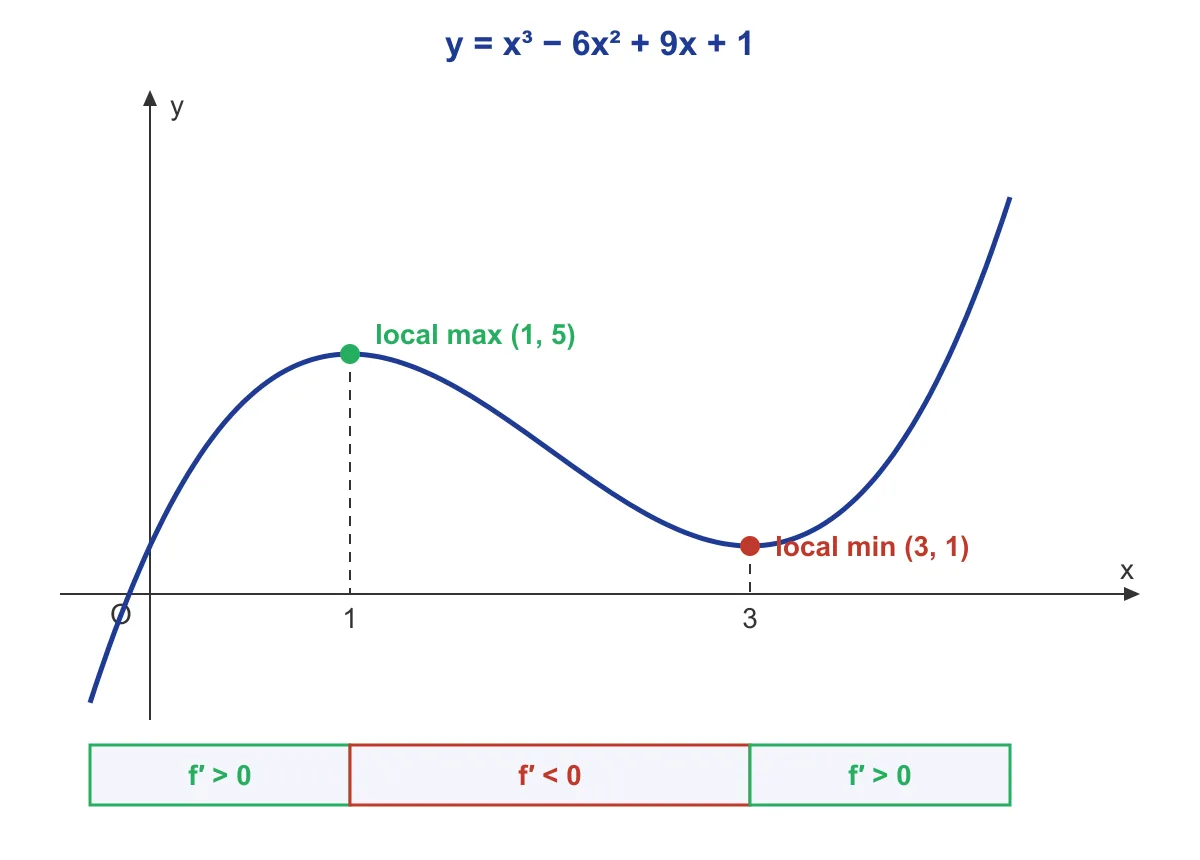
*Figure 4.2: $f(x)=x^3-6x^2+9x+1$ and the sign of $f'$*
| First derivative test | Second derivative test | |
|---|---|---|
| Needs | sign of $f'$ on both sides of $c$ | $f'(c)=0$ and the value of $f''(c)$ |
| Works if $f'(c)$ does not exist | yes | no |
| Works if $f''(c)=0$ | yes | no, inconclusive |
| Speed | slower | quick when $f''$ is simple |
Memory trick: "Plus then minus, a hill; minus then plus, a dip." And for $f''$: "negative is a frown, so the top; positive is a smile, so the bottom."
Say it while sketching the tangent slopes from left to right: climbing then falling makes a hilltop.
Example 7: Find the local maximum and minimum values of $f(x)=x^3-6x^2+9x+1$.
$f'(x)=3x^2-12x+9=3(x-1)(x-3)$, so the critical points are $x=1$ and $x=3$.
$f''(x)=6x-12$. At $x=1$: $f''=-6<0$, a local maximum, with $f(1)=1-6+9+1=5$.
At $x=3$: $f''=6>0$, a local minimum, with $f(3)=27-54+27+1=1$.
Answer: local maximum value $5$ at $x=1$, local minimum value $1$ at $x=3$.
Why this works: the sign strip in Figure 4.2 agrees with the second derivative test. The two tests are two views of one fact.
Example 8: Examine $x=0$ for local extrema of (a) $x^4$, (b) $x^3$, (c) $\vert x\vert$, (d) $x^{2/3}$.
(a) $f'=4x^3$ is negative for $x<0$ and positive for $x>0$: a local minimum, although $f''(0)=0$ so the second test could not decide.
(b) $f'=3x^2\ge0$ on both sides: no extremum.
(c) $f'=-1$ for $x<0$ and $+1$ for $x>0$: a local minimum. $f'(0)$ does not exist, yet $0$ is a critical point.
(d) $f'=\frac{2}{3}x^{-1/3}$ is negative for $x<0$ and positive for $x>0$: a local minimum, with $f'(0)$ undefined.
Answer: minimum in (a), (c), (d); no extremum in (b).
Why this works: when $f''(c)=0$ or $f'(c)$ does not exist, only the sign change of $f'$ can answer the question.
5. Absolute maximum and minimum on a closed interval
If $f$ is continuous on $[a,b]$, it attains a greatest value (absolute maximum) and a least value (absolute minimum) somewhere in the interval. Each is either at an endpoint or at an interior point where the function turns, which must be a critical point. So:
- Find all critical points inside $(a,b)$.
- Evaluate $f$ at those points and at $a$ and $b$.
- The largest of these values is the absolute maximum and the smallest is the absolute minimum.
No second derivative test is needed here. You are comparing numbers, not classifying turns.
Memory trick: "Ends and bends." Check the two ends and every bend (critical point) in between, then compare.
It reminds you not to forget the endpoints, which is where many JEE answers are hiding.
Example 9: Find the absolute maximum and minimum of $f(x)=2x^3-3x^2-12x+5$ on $[-2,3]$.
$f'(x)=6x^2-6x-12=6(x-2)(x+1)$. Critical points: $x=-1$ and $x=2$, both inside the interval.
$f(-2)=-16-12+24+5=1$.
$f(-1)=-2-3+12+5=12$.
$f(2)=16-12-24+5=-15$.
$f(3)=54-27-36+5=-4$.
Answer: absolute maximum $12$ (at $x=-1$), absolute minimum $-15$ (at $x=2$).
Why this works: the endpoint values $1$ and $-4$ are neither the greatest nor the least here, but you could only know after computing them.
If the interval is open or unbounded, a maximum or minimum may not exist at all: $f(x)=x$ on $(0,1)$ has neither. If a continuous function has exactly one critical point on an interval and it is a local minimum, then it is also the absolute minimum on that interval (likewise for a maximum). Optimisation problems lean on this.
6. Applied optimisation
A word problem asks for the largest or smallest value of some quantity. Turn it into a function of one variable and apply Sections 4 and 5.
- Draw a figure and name the variables.
- Write the quantity to be maximised or minimised (the objective).
- Use the given condition to remove all variables but one.
- Note the allowed range of that variable (lengths are positive, and so on).
- Differentiate, set $f'=0$, and decide max or min by the sign change of $f'$ or by $f''$.
- Answer what the question asks: the optimum value, or the dimensions, not just $x$.
Some standard results come out of this routine: of all rectangles with a given perimeter the square has the largest area; of all closed cylinders with a given volume the one with $h=2r$ has the least surface area.
Example 10: From a square sheet of side $24$ cm, equal squares of side $x$ are cut from the four corners and the sides folded up to make an open box. Find $x$ for maximum volume, and that volume.
The base is $(24-2x)$ by $(24-2x)$ and the height is $x$, so $V=x(24-2x)^2$, with $0<x<12$.
$V'=(24-2x)^2+x\cdot2(24-2x)(-2)=(24-2x)(24-6x)=12(12-x)(4-x)$. So $V'=0$ at $x=4$ (the root $x=12$ is outside the open range).
For $x<4$, $V'>0$; for $4<x<12$, $V'<0$. So $x=4$ is a maximum.
$V=4\cdot16^2=1024$.
Answer: $x=4$ cm, maximum volume $1024$ cm$^3$.
Why this works: the endpoints $x=0$ and $x=12$ both give volume $0$, so the single interior turn must be the maximum.
Example 11: A closed cylindrical tin must hold $54\pi$ cm$^3$. Find the radius that uses the least metal, and that area.
$\pi r^2h=54\pi$ gives $h=\frac{54}{r^2}$.
Surface area $S=2\pi r^2+2\pi rh=2\pi r^2+\frac{108\pi}{r}$.
$S'=4\pi r-\frac{108\pi}{r^2}=0$ gives $r^3=27$, so $r=3$ and $h=6$.
$S''=4\pi+\frac{216\pi}{r^3}>0$, so this is a minimum.
$S=18\pi+36\pi=54\pi$.
Answer: $r=3$ cm (with $h=6$ cm $=2r$), least area $54\pi$ cm$^2$.
Why this works: one condition (fixed volume) removed $h$. The result $h=2r$ is general, not a coincidence of the numbers.
7. Approximation using derivatives
When $\Delta x$ is small, the curve and its tangent are almost together, so the change in $y$ is close to the change along the tangent:
To estimate $f$ at an awkward number, pick a nearby easy number $x$, treat the gap as $\Delta x$, and compute. The approximation gets better as $\Delta x$ shrinks.
If a measured quantity $x$ has an error $\Delta x$, then $y=f(x)$ has an error about $f'(x)\Delta x$. The ratio $\frac{\Delta x}{x}$ is the relative error and $100\cdot\frac{\Delta x}{x}$ is the percentage error.
Example 12: Find an approximate value of $\sqrt{25.3}$.
Take $f(x)=\sqrt x$, $x=25$, $\Delta x=0.3$. Then $f'(x)=\frac{1}{2\sqrt x}=\frac1{10}$.
$f(25.3)\approx5+\frac1{10}(0.3)=5.03$.
Answer: $5.03$.
Why this works: $25$ was chosen because its square root is exact. The true value is $5.0299\ldots$, so the error is tiny.
Example 13: The radius of a sphere is measured with a $1\%$ error. Find the approximate percentage error in its volume.
$V=\frac43\pi r^3$, so $\Delta V\approx4\pi r^2\Delta r$.
$\frac{\Delta V}{V}\approx\frac{4\pi r^2\Delta r}{\frac43\pi r^3}=3\frac{\Delta r}{r}=3(1\%)=3\%$.
Answer: about $3\%$.
Why this works: for $V\propto r^n$, the relative error is $n$ times the relative error in $r$. Use this shortcut for any power law.
Memory trick: "Relative error gets multiplied by the power."
If $y=x^n$, the percentage error in $y$ is $n$ times the percentage error in $x$.
Common traps
- Substituting the values before differentiating a related-rates relation → differentiate with respect to $t$ first, then substitute.
- Using $-\frac1m$ for the normal when $m=0$ → the normal at a horizontal tangent is the vertical line $x=x_0$.
- Taking the slope from the tangent's own equation, or the point from the tangent → the point $(x_0,y_0)$ always comes from the curve.
- Using $\frac{dy}{dx}$ at the wrong point on a curve given implicitly → find the slope in terms of $x$ and $y$, then put in both coordinates of the given point.
- Calling $f'(c)=0$ proof of an extremum → check the sign change of $f'$ or the sign of $f''$; $x^3$ at $0$ is the usual counter-example.
- Using the second derivative test when $f''(c)=0$ → switch to the first derivative test.
- Forgetting critical points where $f'$ does not exist, such as $x=0$ for $\vert x\vert$ → list both kinds of critical point.
- Writing two separate intervals of increase as one union → say "increasing on each of $(-\infty,1]$ and $[2,\infty)$", not on the union.
- Skipping the endpoints in an absolute maximum or minimum problem → always evaluate $f(a)$ and $f(b)$.
- Stopping at the optimising variable in a word problem → compute the quantity the question asks for, and check the range of the variable.
Quick revision
- $\frac{dy}{dt}=\frac{dy}{dx}\cdot\frac{dx}{dt}$; for rate of $y$ with respect to $z$, use $\frac{dy/dt}{dz/dt}$.
- Differentiate the relation in $t$ first, then put in the instant values.
- Tangent at $(x_0,y_0)$: $y-y_0=f'(x_0)(x-x_0)$; normal slope $=-\frac{1}{f'(x_0)}$.
- Horizontal tangent: $f'=0$. Vertical tangent: $\frac{dx}{dy}=0$.
- Parametric slope: $\frac{dy}{dx}=\frac{dy/dt}{dx/dt}$.
- Subtangent $=\left\vert\frac ym\right\vert$, subnormal $=\left\vert ym\right\vert$, tangent length $=\left\vert\frac{y\sqrt{1+m^2}}{m}\right\vert$, normal length $=\left\vert y\sqrt{1+m^2}\right\vert$.
- Angle between curves: $\tan\theta=\left\vert\frac{m_1-m_2}{1+m_1m_2}\right\vert$; orthogonal when $m_1m_2=-1$.
- $f'>0$ on an interval: increasing; $f'<0$: decreasing; isolated zeros of $f'$ do not spoil strictness.
- Critical point: $f'(c)=0$ or $f'(c)$ does not exist, with $c$ in the domain.
- First derivative test: $+\to-$ is a maximum, $-\to+$ is a minimum, no change is neither.
- Second derivative test: $f''(c)<0$ maximum, $f''(c)>0$ minimum, $f''(c)=0$ no conclusion.
- Absolute extrema on $[a,b]$: compare $f(a)$, $f(b)$ and $f$ at the critical points inside.
- Optimisation: one variable, the allowed range, $f'=0$, then confirm max or min.
- Square is the largest-area rectangle for a given perimeter; a closed cylinder of fixed volume has least surface area when $h=2r$.
- $f(x+\Delta x)\approx f(x)+f'(x)\Delta x$; for $y=x^n$ the percentage error in $y$ is $n$ times that in $x$.
Practice questions
The slope of the tangent to $y=x^3-2x+1$ at $x=2$ is
- $12$
- $7$
- $10$
- $6$
Answer
C. $10$
$y'=3x^2-2=12-2=10$. Check: at $x=2$ the slope is $3(4)-2$, the same.
The function $f(x)=x^2-4x+5$ is decreasing on
- $(2,\infty)$
- $(-\infty,2)$
- $(0,4)$
- $(-\infty,\infty)$
Answer
B. $(-\infty,2)$
$f'(x)=2x-4<0$ exactly when $x<2$. Its graph is a parabola with vertex at $x=2$, falling to the left of it.
The function $f(x)=x^3-3x$ has a local maximum at
- $x=3$
- $x=1$
- $x=0$
- $x=-1$
Answer
D. $x=-1$
$f'=3x^2-3=0$ gives $x=\pm1$. $f''=6x$ is $-6$ at $x=-1$ (maximum) and $6$ at $x=1$ (minimum).
The equation of the normal to the curve $y=x^2$ at the point $(1,1)$ is
- $x+2y=3$
- $2x+y=3$
- $2x-y=1$
- $x-2y=-1$
Answer
A. $x+2y=3$
Slope of tangent $=2x=2$, so the normal slope is $-\frac12$: $y-1=-\frac12(x-1)$ gives $x+2y=3$. The point $(1,1)$ satisfies it; $2x-y=1$ is the tangent.
The function $f(x)=xe^{-x}$ has a local maximum at
- $x=e$
- $x=1$
- $x=-1$
- $x=0$
Answer
B. $x=1$
$f'(x)=e^{-x}(1-x)$ is positive for $x<1$ and negative for $x>1$, so $f'$ changes from $+$ to $-$ at $x=1$.
The greatest value of $f(x)=\sin x+\cos x$ on $\left[0,\frac{\pi}{2}\right]$ is
- $1$
- $\frac{1}{\sqrt2}$
- $2$
- $\sqrt2$
Answer
D. $\sqrt2$
$f'=\cos x-\sin x=0$ at $x=\frac\pi4$, where $f=\sqrt2$. The endpoints give $f(0)=f\left(\frac\pi2\right)=1$. The largest is $\sqrt2$.
The function $f(x)=x^3-3ax+5$ is increasing on the whole real line for
- $a\ge0$
- $a<0$
- $a\le0$
- $a>0$
Answer
C. $a\le0$
$f'(x)=3x^2-3a\ge0$ for all $x$ needs $a\le0$. At $a=0$, $f'=3x^2$ vanishes only at $x=0$, and $f$ is still increasing, so $a=0$ is allowed.
The acute angle between the curves $y=x$ and $y=x^2$ at the point $(1,1)$ is
- $\tan^{-1}\frac13$
- $\frac\pi3$
- $\tan^{-1}3$
- $\frac\pi4$
Answer
A. $\tan^{-1}\frac13$
Slopes at $(1,1)$ are $m_1=1$ and $m_2=2$. $\tan\theta=\left\vert\frac{1-2}{1+2}\right\vert=\frac13$.
Which of these functions has no local extremum at $x=0$?
- $\vert x\vert$
- $x^3$
- $x^2$
- $x^4$
Answer
B. $x^3$
$x^2$, $x^4$ and $\vert x\vert$ all have a local minimum at $0$. For $x^3$, $f'=3x^2\ge0$ does not change sign, so there is none.
The local maximum value of $f(x)=x+\frac1x$ is
- $-1$
- $2$
- $-2$
- $0$
Answer
C. $-2$
$f'=1-\frac1{x^2}=0$ gives $x=\pm1$. $f''=\frac{2}{x^3}$ is negative at $x=-1$, so $x=-1$ is the maximum, with $f(-1)=-1-1=-2$. (The local minimum is $2$.)
The tangent to $y=x^2-4x+7$ is parallel to the $x$-axis at the point
- $(-2,19)$
- $(2,-3)$
- $(0,7)$
- $(2,3)$
Answer
D. $(2,3)$
$y'=2x-4=0$ gives $x=2$ and $y=4-8+7=3$.
The tangent to $y=x^3$ at $(1,1)$ meets the curve again at the point
- $(-2,-8)$
- $(-1,-1)$
- $(-3,-27)$
- $(2,8)$
Answer
A. $(-2,-8)$
Tangent: $y=3x-2$. Then $x^3-3x+2=(x-1)^2(x+2)=0$, so the other point has $x=-2$, $y=-8$. Check: $3(-2)-2=-8$.
For the parabola $y^2=4ax$, the length of the subnormal at any point is
- $a$
- $2a$
- $4a$
- $y$
Answer
B. $2a$
$2y\frac{dy}{dx}=4a$, so $\frac{dy}{dx}=\frac{2a}{y}$. Subnormal $=\left\vert y\frac{dy}{dx}\right\vert=2a$.
The function $f(x)=2x^3-15x^2+36x+1$ is decreasing on
- $(-\infty,2)\cup(3,\infty)$
- $(-\infty,2)$
- $(2,3)$
- $(3,\infty)$
Answer
C. $(2,3)$
$f'=6(x^2-5x+6)=6(x-2)(x-3)$, which is negative between the roots $2$ and $3$.
The side of a cube increases at $3$ cm/s. When the side is $4$ cm, the volume increases at the rate (in cm$^3$/s) of
- $192$
- $36$
- $48$
- $144$
Answer
D. $144$
$V=x^3$, $\frac{dV}{dt}=3x^2\frac{dx}{dt}=3(16)(3)=144$. Check: $\frac{dV}{dx}$ at $4$ is the face area sum $48$, times $3$.
The radius of a sphere is measured with an error of $2\%$. The approximate percentage error in its volume is
- $6$
- $4$
- $8$
- $2$
Answer
A. $6$
$V\propto r^3$, so the relative error is $3$ times that of $r$: $3\times2=6\%$. Check: $\frac{\Delta V}{V}=3\frac{\Delta r}{r}$.
Using differentials, the approximate value of $\sqrt{36.6}$ is
- $6.1$
- $6.025$
- $6.3$
- $6.05$
Answer
D. $6.05$
$f(x)=\sqrt x$, $x=36$, $\Delta x=0.6$, $f'=\frac1{12}$. $\sqrt{36.6}\approx6+\frac{0.6}{12}=6.05$.
The difference between the absolute maximum and the absolute minimum of $f(x)=x^3-12x$ on $[-3,5]$ is
- $32$
- $49$
- $81$
- $65$
Answer
C. $81$
$f'=3x^2-12=0$ gives $x=\pm2$. $f(-3)=9$, $f(-2)=16$, $f(2)=-16$, $f(5)=65$. Difference $=65-(-16)=81$.
The normal to $y=x^2$ at $(1,1)$ meets the $y$-axis at the point $(0,k)$. The value of $k$ is
- $3$
- $1.5$
- $2.5$
- $0.5$
Answer
B. $1.5$
Normal: $y-1=-\frac12(x-1)$. At $x=0$: $y=1+\frac12=1.5$.
Among all rectangles of perimeter $40$ cm, the greatest possible area (in cm$^2$) is
- $100$
- $400$
- $80$
- $75$
Answer
A. $100$
Sides $x$ and $20-x$: $A=x(20-x)$, $A'=20-2x=0$ at $x=10$, $A=100$. Check: the square $10\times10$.
A $13$ m ladder rests against a wall. Its foot is $12$ m from the wall and moves away at $2$ m/s. The speed (in m/s) at which the top slides down is
- $4.8$
- $2.4$
- $2$
- $5$
Answer
A. $4.8$
$x^2+y^2=169$ gives $\frac{dy}{dt}=-\frac xy\frac{dx}{dt}$. At $x=12$, $y=5$: $\frac{dy}{dt}=-\frac{12}{5}(2)=-4.8$. The speed is $4.8$.
The sum of the local maximum value and the local minimum value of $f(x)=x^3-3x^2-9x+2$ is
- $18$
- $-32$
- $-18$
- $32$
Answer
C. $-18$
$f'=3(x-3)(x+1)$. At $x=-1$ (maximum): $-1-3+9+2=7$. At $x=3$ (minimum): $27-27-27+2=-25$. Sum $=7-25=-18$.
The line $y=2x+k$ touches the curve $y=x^2-2x+5$. The value of $k$ is
- $5$
- $-1$
- $3$
- $1$
Answer
D. $1$
Slope of curve $=2x-2=2$ gives $x=2$, $y=5$. The line passes through $(2,5)$: $5=4+k$, so $k=1$. Check: $x^2-4x+4=0$ has a double root.
An open box is made from a square sheet of side $18$ cm by cutting equal squares from the corners and folding up the sides. The greatest volume (in cm$^3$) is
- $576$
- $432$
- $324$
- $486$
Answer
B. $432$
$V=x(18-2x)^2$, $V'=(18-2x)(18-6x)=0$ gives $x=3$. $V=3\times12^2=432$. Volume is $0$ at both ends of the range, so this is the maximum.
Using differentials, the approximate value of $(2.01)^3$ is
- $8.01$
- $8.2$
- $8.06$
- $8.12$
Answer
D. $8.12$
$f=x^3$, $x=2$, $\Delta x=0.01$, $f'=12$. $f\approx8+12(0.01)=8.12$.
The minimum value of $f(x)=x^2+\frac{16}{x}$ for $x>0$ is
- $10$
- $8$
- $12$
- $20$
Answer
C. $12$
$f'=2x-\frac{16}{x^2}=0$ gives $x^3=8$, $x=2$. $f(2)=4+8=12$. Check by AM-GM on $x^2,\frac8x,\frac8x$: sum $\ge3\sqrt[3]{64}=12$.
Given below are two statements: Statement I: The function $f(x)=x^3$ is strictly increasing on the whole real line. Statement II: A function can be strictly increasing on an interval even if $f'(x)=0$ at an isolated point of that interval.
- Both Statement I and Statement II are correct
- Both Statement I and Statement II are incorrect
- Statement I is correct but Statement II is incorrect
- Statement I is incorrect but Statement II is correct
Answer
A. Both Statement I and Statement II are correct
$f'=3x^2\ge0$, zero only at $x=0$, so $f$ is strictly increasing. Statement II is the principle behind it. Both correct.
Given below are two statements: Statement I: If $f'(c)=0$, then $f$ has a local extremum at $c$. Statement II: $x=0$ is a point of local minimum of $f(x)=\vert x\vert$ although $f'(0)$ does not exist.
- Both Statement I and Statement II are correct
- Both Statement I and Statement II are incorrect
- Statement I is correct but Statement II is incorrect
- Statement I is incorrect but Statement II is correct
Answer
D. Statement I is incorrect but Statement II is correct
Statement I fails for $f=x^3$ at $0$. Statement II is true: $\vert x\vert\ge0=f(0)$. So I is incorrect and II is correct.
Given below are two statements: Statement I: A continuous function on a closed interval $[a,b]$ attains an absolute maximum and an absolute minimum. Statement II: $f(x)=x$ attains an absolute maximum on the open interval $(0,1)$.
- Both Statement I and Statement II are correct
- Both Statement I and Statement II are incorrect
- Statement I is correct but Statement II is incorrect
- Statement I is incorrect but Statement II is correct
Answer
C. Statement I is correct but Statement II is incorrect
Statement I is true. For II, $f(x)=x$ gets close to $1$ on $(0,1)$ but never reaches it, so no absolute maximum exists. I correct, II incorrect.
Given below are two statements: Statement I: If $f'(c)=0$ and $f''(c)=0$, then $f$ has neither a maximum nor a minimum at $c$. Statement II: If $f'(c)=0$ and $f''(c)>0$, then $f$ has a local maximum at $c$.
- Both Statement I and Statement II are correct
- Both Statement I and Statement II are incorrect
- Statement I is correct but Statement II is incorrect
- Statement I is incorrect but Statement II is correct
Answer
B. Both Statement I and Statement II are incorrect
Statement I is false: $f=x^4$ has $f'(0)=f''(0)=0$ and a minimum at $0$. Statement II is false: $f''(c)>0$ gives a local minimum. Both incorrect.
Given below are two statements: Statement I: For small $\Delta x$, $f(x+\Delta x)\approx f(x)+f'(x)\Delta x$. Statement II: Taking $x=25$ and $\Delta x=1$ for $f(x)=\sqrt x$, the approximate value of $\sqrt{26}$ is $5.2$.
- Both Statement I and Statement II are correct
- Both Statement I and Statement II are incorrect
- Statement I is correct but Statement II is incorrect
- Statement I is incorrect but Statement II is correct
Answer
C. Statement I is correct but Statement II is incorrect
Statement I is the linear approximation, correct. In II, $f'(25)=\frac1{10}$, so $\sqrt{26}\approx5+\frac1{10}=5.1$, not $5.2$. II is incorrect.
Assertion (A): The function $f(x)=x^3+x$ is increasing on $\mathbb R$. Reason (R): $f'(x)=3x^2+1>0$ for every real $x$.
- Both A and R are true and R is the correct explanation of A
- Both A and R are true but R is not the correct explanation of A
- A is true but R is false
- A is false but R is true
Answer
A. Both A and R are true and R is the correct explanation of A
$f'>0$ everywhere, which is exactly why $f$ is increasing. Both true and R explains A.
Assertion (A): The function $f(x)=x^3$ has neither a local maximum nor a local minimum. Reason (R): $f'(0)=0$.
- Both A and R are true and R is the correct explanation of A
- Both A and R are true but R is not the correct explanation of A
- A is true but R is false
- A is false but R is true
Answer
B. Both A and R are true but R is not the correct explanation of A
A is true since $f'=3x^2$ does not change sign. R is true, but $f'(0)=0$ alone does not rule out or give an extremum, so it does not explain A.
Assertion (A): Every critical point of a function is a point of local extremum. Reason (R): $f(x)=x^3$ has a critical point at $x=0$ but no extremum there.
- Both A and R are true and R is the correct explanation of A
- Both A and R are true but R is not the correct explanation of A
- A is true but R is false
- A is false but R is true
Answer
D. A is false but R is true
A is false, as R's example shows. R is true: $f'(0)=0$ and $f'$ keeps its sign.
Match List I with List II. List I: a. $x^2$ at $x=0$ b. $x^3$ at $x=0$ c. $-x^4$ at $x=0$ d. $\vert x\vert$ at $x=0$ List II: i. local minimum with $f'(0)=0$ and $f''(0)>0$ ii. no extremum iii. local maximum with $f''(0)=0$ iv. local minimum where $f'(0)$ does not exist
- a-i, b-ii, c-iii, d-iv
- a-i, b-ii, c-iv, d-iii
- a-iii, b-ii, c-i, d-iv
- a-ii, b-i, c-iii, d-iv
Answer
A. a-i, b-ii, c-iii, d-iv
$x^2$: $f''=2>0$ (i). $x^3$: no sign change (ii). $-x^4$: $f'=-4x^3$ goes $+$ to $-$, $f''(0)=0$ (iii). $\vert x\vert$: minimum, no derivative at $0$ (iv).
Match List I with List II for the curve $y=x^2$ at the point $(2,4)$. List I: a. slope of the tangent b. slope of the normal c. length of the subtangent d. length of the subnormal List II: i. $1$ ii. $16$ iii. $4$ iv. $-\frac14$
- a-iv, b-iii, c-i, d-ii
- a-iii, b-iv, c-i, d-ii
- a-i, b-ii, c-iii, d-iv
- a-iii, b-iv, c-ii, d-i
Answer
B. a-iii, b-iv, c-i, d-ii
$m=2x=4$ (iii). Normal slope $-\frac14$ (iv). Subtangent $=\left\vert\frac ym\right\vert=\frac44=1$ (i). Subnormal $=\vert ym\vert=16$ (ii).
Match List I with List II. List I: a. rate of change of the area of a square with respect to its side, at side $5$ b. rate of change of the volume of a cube with respect to its edge, at edge $2$ c. rate of change of $x^3$ with respect to $x^2$ at $x=4$ d. rate of change of $\frac1x$ with respect to $x$ at $x=2$ List II: i. $12$ ii. $6$ iii. $-\frac14$ iv. $10$
- a-i, b-iv, c-ii, d-iii
- a-ii, b-i, c-iv, d-iii
- a-iv, b-i, c-iii, d-ii
- a-iv, b-i, c-ii, d-iii
Answer
D. a-iv, b-i, c-ii, d-iii
a: $2x=10$. b: $3x^2=12$. c: $\frac{3x^2}{2x}=\frac{3x}2=6$. d: $-\frac1{x^2}=-\frac14$.
An open tank with a square base must hold $32$ m$^3$ of water. The least area of sheet (in m$^2$) needed to make it is
- $64$
- $48$
- $40$
- $96$
Answer
B. $48$
Base side $x$, height $h=\frac{32}{x^2}$. Area $S=x^2+4xh=x^2+\frac{128}{x}$. $S'=2x-\frac{128}{x^2}=0$ gives $x=4$, $h=2$, $S=16+32=48$. $S''>0$, so it is a minimum.
The least distance from the point $(0,3)$ to the curve $y=x^2$ is
- $\frac{\sqrt{11}}{2}$
- $\sqrt3$
- $\frac{11}{4}$
- $\frac{\sqrt{11}}{4}$
Answer
A. $\frac{\sqrt{11}}{2}$
With $y=x^2$ the squared distance is $D=x^2+(x^2-3)^2=x^4-5x^2+9$. $D'=4x^3-10x=0$ gives $x=0$ or $x^2=\frac52$. At $x=0$, $D=9$ (a local maximum); at $x^2=\frac52$, $D=\frac{25}4-\frac{25}2+9=\frac{11}4$. Distance $=\frac{\sqrt{11}}2$.
Two positive numbers $x$ and $y$ satisfy $x+y=12$. The greatest value of $x^2y$ is
- $216$
- $144$
- $256$
- $288$
Answer
C. $256$
$f=x^2(12-x)$, $f'=24x-3x^2=3x(8-x)=0$ gives $x=8$, $y=4$, $f=256$. Check by AM-GM on $\frac x2,\frac x2,y$: $x^2y\le4\left(\frac{12}{3}\right)^3=256$.