Methods of Differentiation
What to remember
- The derivative is a limit: $f'(x)=\lim_{h\to0}\frac{f(x+h)-f(x)}{h}$. It is the slope of the tangent. Every rule in this chapter is a shortcut for that one limit.
- Learn the basic table cold: $x^n$, $\sin x$, $\cos x$, $\tan x$, $\sec x$, $e^x$, $a^x$, $\ln x$, and the six inverse trigonometric functions. Anything built from them uses the sum, product, quotient and chain rules.
- The chain rule is the engine: $\frac{d}{dx}f(g(x))=f'(g(x))\cdot g'(x)$. Differentiate the outside, leave the inside alone, then multiply by the derivative of the inside.
- When $x$ and $y$ are tangled (implicit), when the base and the power both contain $x$ (logarithmic differentiation), or when both are given through a parameter $t$, there is a fixed recipe for each. For a second derivative, differentiate the first derivative again, and never forget the chain rule on the second pass.
- An inverse-trig expression that looks hard is usually a disguised multiple of a simple angle. Substitute $x=\tan\theta$, $\sin\theta$ or $\cos\theta$, simplify, then differentiate. Check the range of $\theta$ before you trust the simplification.
1. The derivative from first principles
Pick a point $P$ on a curve $y=f(x)$ and a second point $Q$ a little to the right, at $x+h$. The line $PQ$ is a secant, with slope $\frac{f(x+h)-f(x)}{h}$. Let $Q$ slide towards $P$, that is $h\to0$. The secant turns into the tangent at $P$, and its slope settles to a number. That number is the derivative.
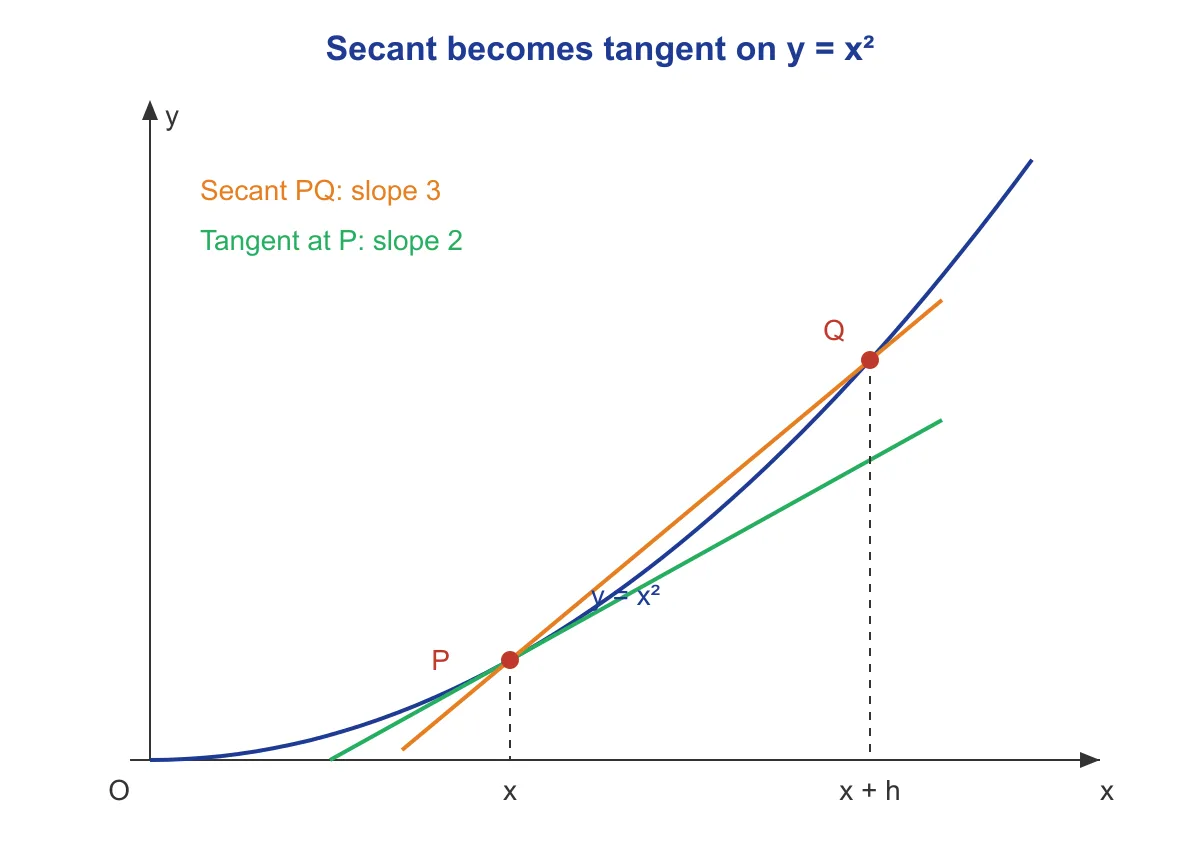
Figure 3.1: The secant through P and Q turns into the tangent at P as Q slides to P
On $y=x^2$ with $P=(1,1)$ and $Q=(2,4)$ the secant slope is $3$. Moving $Q$ closer gives $2.1$ for $Q$ at $x=1.1$, then $2.01$, and the tangent slope is $2$, which is $2x$ at $x=1$.
Three first-principles results are worth deriving once, because they are the base of the whole table.
- **Power of $x$.** For $f(x)=x^n$ with $n$ a positive integer, expand $(x+h)^n=x^n+nx^{n-1}h+\ldots$ The terms after the second carry $h^2$ or higher. Dividing by $h$ and letting $h\to0$ leaves $nx^{n-1}$.
- Sine. $\frac{\sin(x+h)-\sin x}{h}=\sin x\cdot\frac{\cos h-1}{h}+\cos x\cdot\frac{\sin h}{h}$. Since $\frac{\cos h-1}{h}=-\sin\frac h2\cdot\frac{\sin(h/2)}{h/2}\to0$ and $\frac{\sin h}{h}\to1$, we get $\frac{d}{dx}\sin x=\cos x$. This uses $x$ in radians.
- Exponential and logarithm. $\frac{e^{x+h}-e^x}{h}=e^x\cdot\frac{e^h-1}{h}\to e^x$. For the logarithm, $\frac{\ln(x+h)-\ln x}{h}=\frac1x\cdot\frac{\ln(1+h/x)}{h/x}\to\frac1x$.
Example 1: Find $\frac{d}{dx}\sqrt x$ from first principles, for $x>0$.
Rough work: $\frac{\sqrt{x+h}-\sqrt x}{h}$ is $\frac00$ at $h=0$. Rationalise.
$\frac{\sqrt{x+h}-\sqrt x}{h}\cdot\frac{\sqrt{x+h}+\sqrt x}{\sqrt{x+h}+\sqrt x}=\frac{(x+h)-x}{h(\sqrt{x+h}+\sqrt x)}=\frac{1}{\sqrt{x+h}+\sqrt x}$.
Let $h\to0$: the denominator tends to $2\sqrt x$.
Answer: $\frac{1}{2\sqrt x}$.
Notice: the $h$ cancelled only because we rationalised first. Whenever a root sits in the numerator of a difference quotient, multiply by the conjugate.
The derivative also gives the rule for the standard functions below. Keep this table in your head; it is the dictionary for everything that follows.
| Function | Derivative | Condition |
|---|---|---|
| $x^n$ | $nx^{n-1}$ | any real $n$, where defined |
| $\sin x$, $\cos x$ | $\cos x$, $-\sin x$ | all $x$ |
| $\tan x$, $\cot x$ | $\sec^2x$, $-\operatorname{cosec}^2x$ | where defined |
| $\sec x$, $\operatorname{cosec}x$ | $\sec x\tan x$, $-\operatorname{cosec}x\cot x$ | where defined |
| $e^x$ | $e^x$ | all $x$ |
| $a^x$ | $a^x\ln a$ | $a>0$ |
| $\ln x$ | $\frac1x$ | $x>0$ |
| $\log_ax$ | $\frac{1}{x\ln a}$ | $x>0$, $a>0$, $a\ne1$ |
| $\sin^{-1}x$, $\cos^{-1}x$ | $\frac{1}{\sqrt{1-x^2}}$, $-\frac{1}{\sqrt{1-x^2}}$ | $\vert x\vert<1$ |
| $\tan^{-1}x$, $\cot^{-1}x$ | $\frac{1}{1+x^2}$, $-\frac{1}{1+x^2}$ | all $x$ |
| $\sec^{-1}x$, $\operatorname{cosec}^{-1}x$ | $\frac{1}{\vert x\vert\sqrt{x^2-1}}$, $-\frac{1}{\vert x\vert\sqrt{x^2-1}}$ | $\vert x\vert>1$ |
Why the inverse trigonometric ones look the way they do: let $y=\sin^{-1}x$, so $x=\sin y$ with $y\in[-\frac\pi2,\frac\pi2]$. Differentiate both sides with respect to $x$: $1=\cos y\cdot\frac{dy}{dx}$. On that interval $\cos y\ge0$, so $\cos y=\sqrt{1-x^2}$ and $\frac{dy}{dx}=\frac{1}{\sqrt{1-x^2}}$. The same trick gives $\frac{1}{1+x^2}$ for $\tan^{-1}x$. Since $\sin^{-1}x+\cos^{-1}x=\frac\pi2$ is a constant, the derivatives of $\sin^{-1}x$ and $\cos^{-1}x$ are exact negatives. The same holds for $\tan^{-1}$ and $\cot^{-1}$.
Memory trick: "Co-functions carry a minus." Every derivative of a function starting with "co" (cos, cot, cosec, cos⁻¹, cot⁻¹, cosec⁻¹) is minus the derivative of its partner.
Use it: write the sin, tan or sec derivative, then put a minus sign in front for the co-version.
2. Sum, product and quotient rules
If $u$ and $v$ are differentiable functions of $x$:
- Sum: $(u\pm v)'=u'\pm v'$, and $(cu)'=cu'$ for a constant $c$.
- Product: $(uv)'=u'v+uv'$.
- Quotient: $\left(\frac uv\right)'=\frac{u'v-uv'}{v^2}$, where $v\ne0$.
The product rule comes straight from the definition. Write $u(x+h)v(x+h)-u(x)v(x)=u(x+h)\,[v(x+h)-v(x)]+v(x)\,[u(x+h)-u(x)]$, divide by $h$, and let $h\to0$. Because $u$ is differentiable it is continuous, so $u(x+h)\to u(x)$, and the result is $uv'+vu'$. The quotient rule follows by applying the product rule to $u\cdot v^{-1}$.
A product of three functions: $(uvw)'=u'vw+uv'w+uvw'$. Differentiate one factor at a time, keep the other two as they are, and add.
Memory trick: "Low d-high minus high d-low, over low low." For $\frac{\text{high}}{\text{low}}$ the numerator is (low times derivative of high) minus (high times derivative of low), and the denominator is low squared.
Use it: the minus sign and the order matter, and this chant fixes both.
The rest of the trigonometric table now follows without any new limit. Take $\tan x=\frac{\sin x}{\cos x}$ and apply the quotient rule: $\frac{\cos x\cos x-\sin x(-\sin x)}{\cos^2x}=\frac{1}{\cos^2x}=\sec^2x$. In the same way $\sec x=\frac{1}{\cos x}$ gives $\frac{0-(-\sin x)}{\cos^2x}=\sec x\tan x$, and $\cot x$, $\operatorname{cosec}x$ follow from $\frac{\cos x}{\sin x}$ and $\frac{1}{\sin x}$. For the exponential with base $a$, write $a^x=e^{x\ln a}$; the chain rule then gives $e^{x\ln a}\cdot\ln a=a^x\ln a$.
Do not use the quotient rule when a simpler route exists. $\frac{x^3+1}{x}=x^2+x^{-1}$ differentiates in one line, and $\frac{\sin x}{\cos x}$ is just $\tan x$.
3. The chain rule
If $y=f(u)$ and $u=g(x)$, then
The idea: $\frac{\Delta y}{\Delta x}=\frac{\Delta y}{\Delta u}\cdot\frac{\Delta u}{\Delta x}$, and each factor settles to its derivative as the increments shrink. With three layers, $y=f(g(h(x)))$, you simply get three factors, outermost first.
Examples of layers. $\sin^3(2x)$ has three: the cube (outer), the sine, and $2x$ (inner). So $\frac{d}{dx}\sin^3(2x)=3\sin^2(2x)\cdot\cos(2x)\cdot2$. Similarly $\frac{d}{dx}\sqrt{1+x^2}=\frac{1}{2\sqrt{1+x^2}}\cdot2x=\frac{x}{\sqrt{1+x^2}}$.
Two results that come up constantly and are worth remembering as ready-made: $\frac{d}{dx}\ln f(x)=\frac{f'(x)}{f(x)}$ (valid where $f(x)>0$), and $\frac{d}{dx}e^{f(x)}=f'(x)\,e^{f(x)}$.
Example 2: Differentiate $y=e^{2x}\sin3x$.
This is a product, and each factor is a chain.
$u=e^{2x}$, so $u'=2e^{2x}$. $v=\sin3x$, so $v'=3\cos3x$.
$y'=u'v+uv'=2e^{2x}\sin3x+3e^{2x}\cos3x$.
Answer: $e^{2x}\,(2\sin3x+3\cos3x)$.
Notice: pulling out the common factor $e^{2x}$ at the end makes the answer short and easy to check.
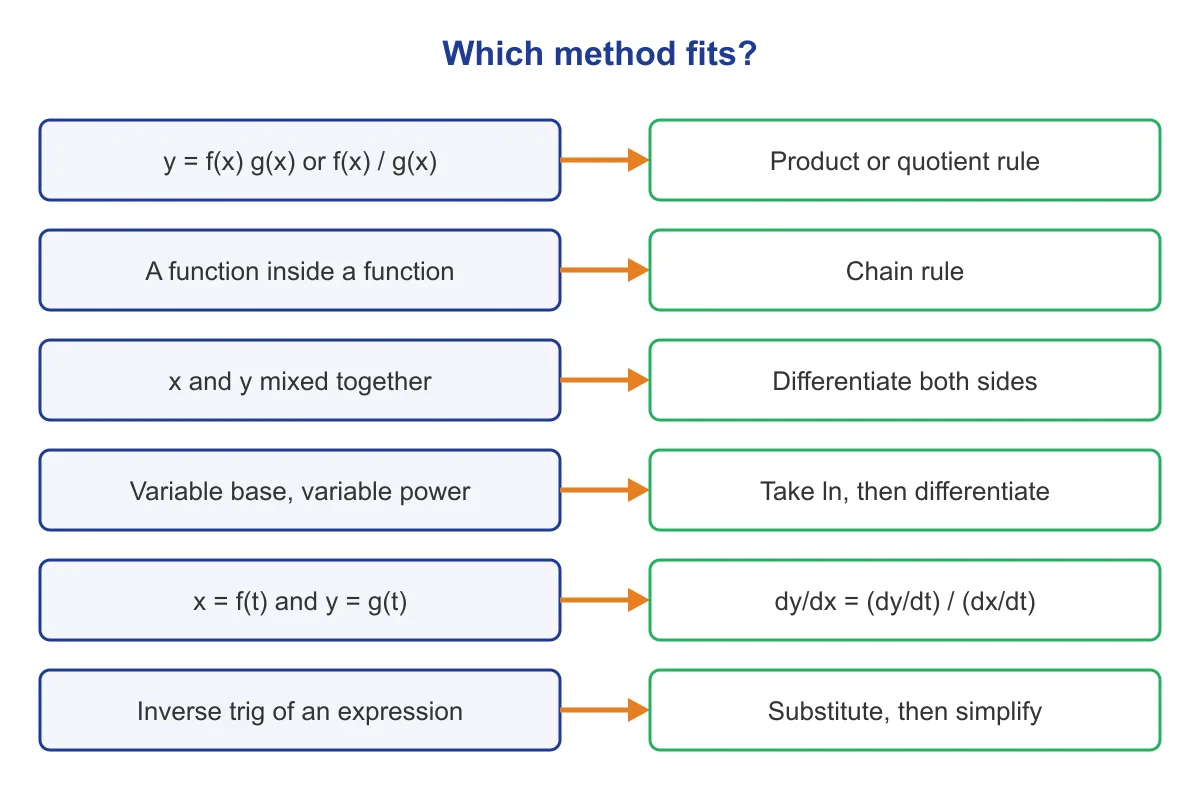
Figure 3.2: Choosing a method of differentiation from the form of the expression
4. Implicit differentiation
Sometimes $y$ is not given as $y=f(x)$. An equation like $x^3+y^3=3xy$ ties $x$ and $y$ together. You do not need to solve for $y$. Differentiate both sides with respect to $x$, treating $y$ as a function of $x$. So $\frac{d}{dx}(y^3)=3y^2\frac{dy}{dx}$ by the chain rule, and $\frac{d}{dx}(xy)=y+x\frac{dy}{dx}$ by the product rule. Then collect every term containing $\frac{dy}{dx}$ on one side and solve.
Example 3: Find $\frac{dy}{dx}$ for $x^3+y^3=3xy$, and the slope at $\left(\frac32,\frac32\right)$.
Differentiate: $3x^2+3y^2y'=3y+3xy'$.
Collect $y'$: $y'(3y^2-3x)=3y-3x^2$, so $y'=\frac{y-x^2}{y^2-x}$.
At $\left(\frac32,\frac32\right)$: numerator $\frac32-\frac94=-\frac34$, denominator $\frac94-\frac32=\frac34$.
Answer: $\frac{dy}{dx}=\frac{y-x^2}{y^2-x}$, and the slope is $-1$.
Notice: the answer is allowed to contain both $x$ and $y$. Check the point lies on the curve first: $\frac{27}{8}+\frac{27}{8}=\frac{27}{4}=3\cdot\frac94$. Yes.
5. Logarithmic differentiation
Use it in two situations. One: the expression is $[f(x)]^{g(x)}$, with a variable base and a variable power. Two: a long product or quotient with many factors and powers.
Method: take $\ln$ of both sides (the function must be positive, or use $\ln\vert y\vert$, which has the same derivative), simplify using $\ln(ab)=\ln a+\ln b$ and $\ln a^b=b\ln a$, differentiate both sides, and finally multiply by $y$.
| Form | Why the usual rule fails | Fix |
|---|---|---|
| $x^n$, $n$ constant | none, it is the power rule | $nx^{n-1}$ |
| $a^x$, $a$ constant | none, it is the exponential rule | $a^x\ln a$ |
| $x^x$, $[f(x)]^{g(x)}$ | power rule needs a constant exponent, exponential rule needs a constant base | take $\ln$, differentiate |
Example 4: Differentiate $y=(\sin x)^x$ for $0<x<\pi$.
$\ln y=x\ln\sin x$.
Differentiate: $\frac1y\,y'=\ln\sin x+x\cdot\frac{\cos x}{\sin x}=\ln\sin x+x\cot x$.
Multiply by $y$: $y'=(\sin x)^x\,(\ln\sin x+x\cot x)$.
Answer: $(\sin x)^x\,(\ln\sin x+x\cot x)$.
Notice: the product rule appeared automatically on the right side. The shortcut is to differentiate $x^x$ as "treat the power as constant, then treat the base as constant, and add the two answers".
Example 5: Let $y=\frac{(x+1)^2(x+2)^3}{(x+3)^4}$. Find $\frac{dy}{dx}$ at $x=0$.
The quotient rule on a three-factor expression is heavy, so take $\ln$ first (all factors are positive near $x=0$).
$\ln y=2\ln(x+1)+3\ln(x+2)-4\ln(x+3)$.
Differentiate: $\frac{y'}{y}=\frac{2}{x+1}+\frac{3}{x+2}-\frac{4}{x+3}$.
At $x=0$: $y=\frac{1\cdot8}{81}=\frac{8}{81}$ and $\frac{y'}{y}=2+\frac32-\frac43=\frac{13}{6}$.
$y'(0)=\frac{8}{81}\cdot\frac{13}{6}=\frac{52}{243}$.
Answer: $\frac{52}{243}$.
Notice: logarithms turn products and powers into sums, and sums are easy to differentiate. Keep $y$ as a number at the point instead of expanding it as an expression.
6. Parametric functions
Suppose $x=f(t)$ and $y=g(t)$. Then by the chain rule $\frac{dy}{dt}=\frac{dy}{dx}\cdot\frac{dx}{dt}$, so
For a circle $x=a\cos t$, $y=a\sin t$ this gives $\frac{dy}{dx}=\frac{a\cos t}{-a\sin t}=-\cot t$. The result is in terms of $t$, and that is fine. To get it at a point, find the value of $t$ first.
7. Derivative of one function with respect to another
To differentiate $f(x)$ with respect to $g(x)$, find $\frac{d\,f}{d\,g}$. By the chain rule
This is just the parametric formula with $x$ playing the part of the parameter. For instance, the derivative of $x^3$ with respect to $x^2$ is $\frac{3x^2}{2x}=\frac32x$.
A single formula does not tell you whether $\frac{dy}{dx}$ is zero, positive or negative at a point, but the logarithmic and parametric methods give a value there, and that is all the question usually asks for. Remember that in the quotient $\frac{df/dx}{dg/dx}$ the denominator must not vanish at the point, otherwise the derivative of $f$ with respect to $g$ is not defined there.
Example 6: Find the derivative of $\tan^{-1}\frac{x}{\sqrt{1-x^2}}$ with respect to $\sin^{-1}(3x-4x^3)$, for $\vert x\vert<\frac12$.
Put $x=\sin\theta$ with $\theta\in(-\frac\pi6,\frac\pi6)$, so $\sqrt{1-x^2}=\cos\theta$.
First function: $\tan^{-1}(\tan\theta)=\theta$.
Second function: $3x-4x^3=\sin3\theta$ and $3\theta\in(-\frac\pi2,\frac\pi2)$, so it equals $3\theta$.
The required derivative is $\frac{d\theta}{d(3\theta)}=\frac13$.
Answer: $\frac13$.
Notice: both functions are multiples of the same angle, so the $x$ never needed to appear. This is the standard way these questions are meant to be solved.
8. Second-order derivatives
The second derivative is the derivative of the first. For an explicit function, write $f''(x)=\frac{d}{dx}\left(\frac{dy}{dx}\right)$ and differentiate twice. For $y=e^x\sin x$: $y'=e^x(\sin x+\cos x)$, then $y''=e^x(\sin x+\cos x+\cos x-\sin x)=2e^x\cos x$.
The notation $\frac{d^2y}{dx^2}$ is not a square of anything. It means "apply $\frac{d}{dx}$ to $\frac{dy}{dx}$". In particular it is different from $\left(\frac{dy}{dx}\right)^2$. If $y=x^3$, then $\frac{d^2y}{dx^2}=6x$ while $\left(\frac{dy}{dx}\right)^2=9x^4$. A quick check of any second derivative you compute is to test it on a simple case such as $y=x^2$, where the answer must be the constant $2$.
Implicit functions
Get $y'$ first, then differentiate it again. Wherever a $y$ appears, a $y'$ is born from the chain rule. Afterwards substitute the first derivative back so that the answer is free of $y'$.
Example 7: For $x^2+y^2=a^2$, find $\frac{d^2y}{dx^2}$.
First derivative: $2x+2yy'=0$, so $y'=-\frac xy$.
Second: $y''=-\frac{y\cdot1-x\cdot y'}{y^2}=-\frac{y+\frac{x^2}{y}}{y^2}=-\frac{y^2+x^2}{y^3}$.
Use $x^2+y^2=a^2$: $y''=-\frac{a^2}{y^3}$.
Answer: $-\frac{a^2}{y^3}$.
Notice: the sign agrees with geometry. On the upper half of the circle $y>0$ and the curve bends downward, so $y''<0$.
Parametric functions
Here the second derivative is not $\frac{d^2y/dt^2}{d^2x/dt^2}$. That is the classic error. You must differentiate $\frac{dy}{dx}$, which is a function of $t$, and then divide by $\frac{dx}{dt}$ again:
where primes denote derivatives with respect to $t$.
Example 8: For the cycloid $x=a(t-\sin t)$, $y=a(1-\cos t)$ with $a>0$, find $\frac{dy}{dx}$ and $\frac{d^2y}{dx^2}$.
$\frac{dx}{dt}=a(1-\cos t)$, $\frac{dy}{dt}=a\sin t$.
$\frac{dy}{dx}=\frac{\sin t}{1-\cos t}=\frac{2\sin\frac t2\cos\frac t2}{2\sin^2\frac t2}=\cot\frac t2$.
$\frac{d}{dt}\cot\frac t2=-\frac12\operatorname{cosec}^2\frac t2$. Also $1-\cos t=2\sin^2\frac t2$.
$\frac{d^2y}{dx^2}=\frac{-\frac12\operatorname{cosec}^2\frac t2}{2a\sin^2\frac t2}=-\frac{1}{4a\sin^4\frac t2}$.
Answer: $\frac{dy}{dx}=\cot\frac t2$, $\frac{d^2y}{dx^2}=-\frac{1}{4a\sin^4(t/2)}$.
Notice: the second derivative is negative wherever it exists, so every arch of the cycloid bends downward.
9. Inverse trigonometric functions by substitution
Differentiating $\tan^{-1}\frac{\sqrt{1+x^2}-1}{x}$ directly is painful. Substituting $x=\tan\theta$ turns it into a plain angle. The table lists the standard simplifications. In each, the identity holds only on the stated range, because $\sin^{-1}(\sin\alpha)=\alpha$ only when $\alpha\in[-\frac\pi2,\frac\pi2]$, and $\cos^{-1}(\cos\alpha)=\alpha$ only when $\alpha\in[0,\pi]$.
| Expression | Substitution | Simplifies to | Valid for |
|---|---|---|---|
| $\tan^{-1}\frac{2x}{1-x^2}$ | $x=\tan\theta$ | $2\tan^{-1}x$ | $\vert x\vert<1$ |
| $\sin^{-1}\frac{2x}{1+x^2}$ | $x=\tan\theta$ | $2\tan^{-1}x$ | $\vert x\vert\le1$ |
| $\cos^{-1}\frac{1-x^2}{1+x^2}$ | $x=\tan\theta$ | $2\tan^{-1}x$ | $x\ge0$ |
| $\tan^{-1}\frac{3x-x^3}{1-3x^2}$ | $x=\tan\theta$ | $3\tan^{-1}x$ | $\vert x\vert<\frac{1}{\sqrt3}$ |
| $\sin^{-1}\left(2x\sqrt{1-x^2}\right)$ | $x=\sin\theta$ | $2\sin^{-1}x$ | $\vert x\vert\le\frac{1}{\sqrt2}$ |
| $\sin^{-1}(3x-4x^3)$ | $x=\sin\theta$ | $3\sin^{-1}x$ | $\vert x\vert\le\frac12$ |
Outside the stated range the expression equals a different combination, for example $\pi-2\sin^{-1}x$ for the second-to-last row when $\frac{1}{\sqrt2}\le x\le1$, so the derivative changes sign. Always read the range from the question.
Memory trick: "Plus one, tan; minus one, sine or cosine." An expression with $1+x^2$ calls for $x=\tan\theta$; $\sqrt{1-x^2}$ calls for $x=\sin\theta$ or $\cos\theta$; $\sqrt{x^2-1}$ calls for $x=\sec\theta$.
Use it: the substitution is chosen by the sign inside the square root or the denominator.
Example 9: Differentiate $y=\tan^{-1}\frac{\sqrt{1+x^2}-1}{x}$, for $x\ne0$.
Put $x=\tan\theta$ with $\theta\in(-\frac\pi2,\frac\pi2)$, so $\sqrt{1+x^2}=\sec\theta$.
$\frac{\sec\theta-1}{\tan\theta}=\frac{1-\cos\theta}{\sin\theta}=\frac{2\sin^2\frac\theta2}{2\sin\frac\theta2\cos\frac\theta2}=\tan\frac\theta2$.
So $y=\tan^{-1}\left(\tan\frac\theta2\right)=\frac\theta2$, since $\frac\theta2\in(-\frac\pi4,\frac\pi4)$. Hence $y=\frac12\tan^{-1}x$.
$\frac{dy}{dx}=\frac{1}{2(1+x^2)}$.
Answer: $\frac{1}{2(1+x^2)}$.
Notice: the range of $\theta$ was safe, so no case-splitting was needed. A direct attack with the quotient and chain rules would be several lines of algebra.
Example 10: Find the derivative of $\sin^{-1}\left(2x\sqrt{1-x^2}\right)$ with respect to $\sin^{-1}x$, for $0<x<\frac{1}{\sqrt2}$.
Let $x=\sin\theta$, $\theta\in(0,\frac\pi4)$. Then $2x\sqrt{1-x^2}=2\sin\theta\cos\theta=\sin2\theta$, and $2\theta\in(0,\frac\pi2)$.
So the first function is $2\theta$ and the second is $\theta$.
$\frac{d(2\theta)}{d\theta}=2$.
Answer: $2$.
Notice: for $\frac{1}{\sqrt2}<x<1$ the first function becomes $\pi-2\theta$ and the answer flips to $-2$. The range decides the sign.
Common traps
- Writing $\frac{d}{dx}f(g(x))=f'(x)g'(x)$ → the outer derivative must be evaluated at $g(x)$, so write $f'(g(x))\,g'(x)$.
- Differentiating $x^x$ with the power rule as $x\cdot x^{x-1}$ → take logarithms; the answer is $x^x(1+\ln x)$.
- Treating $a^x$ like $x^n$, giving $x\,a^{x-1}$ → the derivative is $a^x\ln a$.
- Forgetting $\frac{dy}{dx}$ when differentiating $y^2$ or $\sin y$ implicitly → every term in $y$ needs the chain-rule factor $\frac{dy}{dx}$.
- Using $\frac{d}{dx}(uv)=u'v'$ → the product rule has two terms, $u'v+uv'$.
- Reversing the quotient rule numerator to $uv'-u'v$ → it is $u'v-uv'$, and the denominator is $v^2$.
- Computing the parametric second derivative as $\frac{y''}{x''}$ → differentiate $\frac{dy}{dx}$ with respect to $t$ and divide by $\frac{dx}{dt}$.
- Forgetting the $\sqrt{1-x^2}$ sign for the derivative of $\cos^{-1}x$ → it is $-\frac{1}{\sqrt{1-x^2}}$.
- Taking $\sin^{-1}(\sin\alpha)=\alpha$ for every $\alpha$ → this holds only for $\alpha\in[-\frac\pi2,\frac\pi2]$, and elsewhere you must shift by $\pi$ or flip the sign.
- Calling the derivative of $\ln x$ for negative $x$ meaningless and stopping → for $x\ne0$ use $\ln\vert x\vert$, whose derivative is $\frac1x$ on both sides.
Quick revision
- $f'(x)=\lim_{h\to0}\frac{f(x+h)-f(x)}{h}$, the slope of the tangent.
- $\frac{d}{dx}x^n=nx^{n-1}$, $\frac{d}{dx}e^x=e^x$, $\frac{d}{dx}a^x=a^x\ln a$, $\frac{d}{dx}\ln x=\frac1x$.
- $\frac{d}{dx}\sin x=\cos x$, $\frac{d}{dx}\cos x=-\sin x$, $\frac{d}{dx}\tan x=\sec^2x$, $\frac{d}{dx}\sec x=\sec x\tan x$.
- $\frac{d}{dx}\sin^{-1}x=\frac{1}{\sqrt{1-x^2}}$ and $\frac{d}{dx}\tan^{-1}x=\frac{1}{1+x^2}$; the "co" partners carry a minus.
- $(uv)'=u'v+uv'$ and $\left(\frac uv\right)'=\frac{u'v-uv'}{v^2}$.
- Chain rule: $\frac{d}{dx}f(g(x))=f'(g(x))\,g'(x)$.
- $\frac{d}{dx}\ln f(x)=\frac{f'(x)}{f(x)}$ and $\frac{d}{dx}e^{f(x)}=f'(x)e^{f(x)}$.
- Implicit: differentiate both sides, attach $\frac{dy}{dx}$ to each $y$ term, then solve for it.
- Logarithmic differentiation handles $[f(x)]^{g(x)}$: $\frac{d}{dx}x^x=x^x(1+\ln x)$.
- Parametric: $\frac{dy}{dx}=\frac{dy/dt}{dx/dt}$.
- Parametric second derivative: $\frac{d^2y}{dx^2}=\frac{x'y''-y'x''}{(x')^3}$.
- Derivative of $f$ with respect to $g$ is $\frac{f'(x)}{g'(x)}$.
- $\tan^{-1}\frac{2x}{1-x^2}=2\tan^{-1}x$ for $\vert x\vert<1$, and $\sin^{-1}\frac{2x}{1+x^2}=2\tan^{-1}x$ for $\vert x\vert\le1$.
- $\sin^{-1}(2x\sqrt{1-x^2})=2\sin^{-1}x$ only for $\vert x\vert\le\frac1{\sqrt2}$, so check the range before differentiating.
Practice questions
The derivative of $\frac{1}{x^3}$ with respect to $x$ is
- $-\frac{3}{x^4}$
- $\frac{3}{x^4}$
- $-\frac{1}{3x^2}$
- $-\frac{3}{x^2}$
Answer
A. $-\frac{3}{x^4}$
Write $x^{-3}$. Derivative $=-3x^{-4}=-\frac{3}{x^4}$.
$\frac{d}{dx}(\sin x\cos x)$ equals
- $-\cos2x$
- $2\cos2x$
- $\sin2x$
- $\cos2x$
Answer
D. $\cos2x$
Product rule: $\cos x\cdot\cos x+\sin x\cdot(-\sin x)=\cos^2x-\sin^2x=\cos2x$. Check: $\sin x\cos x=\frac12\sin2x$, derivative $\cos2x$.
For all real $x$, $\frac{d}{dx}\left(\tan^{-1}x+\cot^{-1}x\right)$ equals
- $\frac{2}{1+x^2}$
- $1$
- $0$
- $\frac{\pi}{2}$
Answer
C. $0$
The two derivatives are $\frac{1}{1+x^2}$ and $-\frac{1}{1+x^2}$, and they cancel. Also the sum is the constant $\frac\pi2$, whose derivative is $0$.
If $y=e^x\ln x$ for $x>0$, then $\frac{dy}{dx}$ equals
- $e^x\ln x+\frac1x$
- $e^x\left(\ln x+\frac1x\right)$
- $e^x\left(\ln x-\frac1x\right)$
- $\frac{e^x}{x}$
Answer
B. $e^x\left(\ln x+\frac1x\right)$
Product rule: $e^x\ln x+e^x\cdot\frac1x=e^x\left(\ln x+\frac1x\right)$.
For $\vert x\vert<1$, $\frac{d}{dx}\sin^{-1}(x^2)$ equals
- $\frac{2x}{1+x^4}$
- $\frac{2x}{\sqrt{1-x^2}}$
- $\frac{2x}{\sqrt{1-x^4}}$
- $\frac{1}{\sqrt{1-x^4}}$
Answer
C. $\frac{2x}{\sqrt{1-x^4}}$
Chain rule: $\frac{1}{\sqrt{1-(x^2)^2}}\cdot2x=\frac{2x}{\sqrt{1-x^4}}$.
For $0<x<\frac\pi2$, $\frac{d}{dx}\ln(\sec x+\tan x)$ equals
- $\sec x\tan x$
- $\sec x$
- $\tan x$
- $\frac{1}{\sec x+\tan x}$
Answer
B. $\sec x$
$\frac{\sec x\tan x+\sec^2x}{\sec x+\tan x}=\frac{\sec x(\tan x+\sec x)}{\sec x+\tan x}=\sec x$.
$\frac{d}{dx}\left(\frac{x}{1+x^2}\right)$ equals
- $\frac{1-x^2}{(1+x^2)^2}$
- $\frac{1+x^2}{(1+x^2)^2}$
- $\frac{1-x^2}{1+x^2}$
- $\frac{x^2-1}{(1+x^2)^2}$
Answer
A. $\frac{1-x^2}{(1+x^2)^2}$
Quotient rule: $\frac{1\cdot(1+x^2)-x\cdot2x}{(1+x^2)^2}=\frac{1-x^2}{(1+x^2)^2}$.
$\frac{d}{dx}\left(e^{\sin^2x}\right)$ equals
- $e^{\sin^2x}$
- $2\sin x\;e^{\sin^2x}$
- $\cos^2x\;e^{\sin^2x}$
- $\sin2x\;e^{\sin^2x}$
Answer
D. $\sin2x\;e^{\sin^2x}$
Chain rule: $e^{\sin^2x}\cdot2\sin x\cos x=\sin2x\,e^{\sin^2x}$.
If $x^2+xy+y^2=7$, then $\frac{dy}{dx}$ equals
- $-\frac{2x+y}{2y}$
- $\frac{2x+y}{x+2y}$
- $-\frac{x+2y}{2x+y}$
- $-\frac{2x+y}{x+2y}$
Answer
D. $-\frac{2x+y}{x+2y}$
Differentiate: $2x+y+xy'+2yy'=0$, so $y'(x+2y)=-(2x+y)$.
For $x>0$, $\frac{d}{dx}\left(x^x\right)$ equals
- $x^x(1-\ln x)$
- $x\cdot x^{x-1}$
- $x^x(1+\ln x)$
- $x^x\ln x$
Answer
C. $x^x(1+\ln x)$
$\ln y=x\ln x$, so $\frac{y'}{y}=\ln x+1$, giving $y'=x^x(1+\ln x)$.
If $x=a\cos\theta$ and $y=b\sin\theta$ with $\sin\theta\ne0$, then $\frac{dy}{dx}$ equals
- $-\frac ba\cot\theta$
- $\frac ba\cot\theta$
- $-\frac ba\tan\theta$
- $-\frac ab\cot\theta$
Answer
A. $-\frac ba\cot\theta$
$\frac{dy/d\theta}{dx/d\theta}=\frac{b\cos\theta}{-a\sin\theta}=-\frac ba\cot\theta$.
For $\vert x\vert<1$, the derivative of $\sin^{-1}\frac{2x}{1+x^2}$ is
- $-\frac{2}{1+x^2}$
- $\frac{2}{1+x^2}$
- $\frac{1}{1+x^2}$
- $\frac{2}{1-x^2}$
Answer
B. $\frac{2}{1+x^2}$
Put $x=\tan\theta$: $\sin^{-1}(\sin2\theta)=2\theta$ since $2\theta\in(-\frac\pi2,\frac\pi2)$. So the function is $2\tan^{-1}x$, with derivative $\frac{2}{1+x^2}$.
If $y=e^x\sin x$, then $\frac{d^2y}{dx^2}$ equals
- $2e^x\cos x$
- $e^x\cos x$
- $2e^x\sin x$
- $-2e^x\cos x$
Answer
A. $2e^x\cos x$
$y'=e^x(\sin x+\cos x)$. $y''=e^x(\sin x+\cos x)+e^x(\cos x-\sin x)=2e^x\cos x$.
If $y=\sin^{-1}x$ for $\vert x\vert<1$, then $(1-x^2)\frac{d^2y}{dx^2}-x\frac{dy}{dx}$ equals
- $-1$
- $1$
- $y$
- $0$
Answer
D. $0$
$y'=(1-x^2)^{-1/2}$, $y''=x(1-x^2)^{-3/2}$. So $(1-x^2)y''=x(1-x^2)^{-1/2}=xy'$, and the expression is $0$.
If $f(x)=3x^4-2x^2+5$, then $f'(1)$ equals
- 8
- 12
- 4
- 16
Answer
A. 8
$f'(x)=12x^3-4x$. At $x=1$: $12-4=8$.
If $f(x)=xe^x$, then $f'(0)$ equals
- 1
- 0
- 2
- 2.5
Answer
A. 1
$f'(x)=e^x+xe^x=e^x(1+x)$. At $0$: $1\cdot1=1$.
If $f(x)=\sqrt x$, then $f'(16)$ equals
- 0.25
- 0.0625
- 0.125
- 0.5
Answer
C. 0.125
$f'(x)=\frac{1}{2\sqrt x}$. At $16$: $\frac{1}{2\cdot4}=0.125$.
If $f(x)=\ln(1+x^2)$, then $f'(2)$ equals
- 0.4
- 0.8
- 1.25
- 0.5
Answer
B. 0.8
$f'(x)=\frac{2x}{1+x^2}$. At $2$: $\frac45=0.8$.
If $f(x)=\frac{x^2+1}{x-1}$, then $f'(3)$ equals
- 0.5
- 2
- 1
- 1.5
Answer
A. 0.5
$f'(x)=\frac{2x(x-1)-(x^2+1)}{(x-1)^2}$. At $3$: $\frac{12-10}{4}=0.5$.
The slope of the tangent to $x^2+y^2=25$ at the point $(3,4)$ is
- -1
- -0.6
- 0.75
- -0.75
Answer
D. -0.75
$2x+2yy'=0$ gives $y'=-\frac xy=-\frac34=-0.75$.
If $x=t^2+1$ and $y=t^3-t$, then $\frac{dy}{dx}$ at $t=2$ equals
- 5.5
- 2.25
- 2.75
- 11
Answer
C. 2.75
$\frac{dy}{dt}=3t^2-1=11$, $\frac{dx}{dt}=2t=4$. Ratio $\frac{11}{4}=2.75$.
If $y=x^4-3x^2$, then $\frac{d^2y}{dx^2}$ at $x=2$ equals
- 48
- 42
- 32
- 36
Answer
B. 42
$y'=4x^3-6x$, $y''=12x^2-6$. At $2$: $48-6=42$.
If $f(x)=(x^2+x+1)^3$, then $f'(1)$ equals
- 27
- 243
- 81
- 54
Answer
C. 81
$f'(x)=3(x^2+x+1)^2(2x+1)$. At $1$: $3\cdot9\cdot3=81$.
For $\vert x\vert<1$, the derivative of $\tan^{-1}\frac{2x}{1-x^2}$ at $x=0$ equals
- 2
- 1
- 0
- 4
Answer
A. 2
For $\vert x\vert<1$ the function is $2\tan^{-1}x$ (put $x=\tan\theta$), derivative $\frac{2}{1+x^2}$. At $0$ this is $2$.
If $x=t^2$ and $y=t^3$ with $t>0$, then $\frac{d^2y}{dx^2}$ at $t=2$ equals
- 0.1875
- 0.375
- 1.5
- 0.75
Answer
B. 0.375
$\frac{dy}{dx}=\frac{3t^2}{2t}=\frac{3t}{2}$. $\frac{d}{dt}\left(\frac{3t}{2}\right)=\frac32$, divide by $\frac{dx}{dt}=2t$: $\frac{3}{4t}$. At $t=2$: $\frac38=0.375$.
If $y=x^{\ln x}$ for $x>0$, then $\frac{dy}{dx}$ at $x=e$ equals
- 2
- 1
- 4
- 0.5
Answer
A. 2
$\ln y=(\ln x)^2$, so $\frac{y'}{y}=\frac{2\ln x}{x}$. At $x=e$: $y=e$, so $y'=e\cdot\frac2e=2$.
Given below are two statements: Statement I: For $\vert x\vert<1$, $\frac{d}{dx}\cos^{-1}x=\frac{1}{\sqrt{1-x^2}}$. Statement II: For $\vert x\vert<1$, $\frac{d}{dx}\cos^{-1}x=-\frac{d}{dx}\sin^{-1}x$.
- Both Statement I and Statement II are correct
- Both Statement I and Statement II are incorrect
- Statement I is correct but Statement II is incorrect
- Statement I is incorrect but Statement II is correct
Answer
D. Statement I is incorrect but Statement II is correct
Since $\sin^{-1}x+\cos^{-1}x=\frac\pi2$, the derivatives are negatives, so $\frac{d}{dx}\cos^{-1}x=-\frac{1}{\sqrt{1-x^2}}$. Statement I has the wrong sign; Statement II is correct.
Given below are two statements: Statement I: $\frac{d}{dx}\log_ax=\frac{1}{x\ln a}$ for $x>0$, $a>0$, $a\ne1$. Statement II: $\frac{d}{dx}a^x=a^x\ln a$ for $a>0$.
- Both Statement I and Statement II are correct
- Both Statement I and Statement II are incorrect
- Statement I is correct but Statement II is incorrect
- Statement I is incorrect but Statement II is correct
Answer
A. Both Statement I and Statement II are correct
$\log_ax=\frac{\ln x}{\ln a}$ gives the first. For the second, $a^x=e^{x\ln a}$ and the chain rule gives $a^x\ln a$. Both correct.
Given below are two statements: Statement I: $\frac{d}{dx}x^x=x\cdot x^{x-1}$. Statement II: $\frac{d}{dx}\sin(x^2)=2\sin x\cos x$.
- Both Statement I and Statement II are correct
- Both Statement I and Statement II are incorrect
- Statement I is correct but Statement II is incorrect
- Statement I is incorrect but Statement II is correct
Answer
B. Both Statement I and Statement II are incorrect
First: $x^x$ has a variable exponent, so the power rule does not apply; the true value is $x^x(1+\ln x)$. Second: the chain rule gives $2x\cos(x^2)$, not $2\sin x\cos x$. Both wrong.
Given below are two statements: Statement I: For $x=f(t)$, $y=g(t)$, $\frac{d^2y}{dx^2}=\frac{d^2y/dt^2}{d^2x/dt^2}$. Statement II: For $x=f(t)$, $y=g(t)$, $\frac{d^2y}{dx^2}=\frac{\frac{d}{dt}\left(\frac{dy}{dx}\right)}{dx/dt}$.
- Both Statement I and Statement II are correct
- Both Statement I and Statement II are incorrect
- Statement I is correct but Statement II is incorrect
- Statement I is incorrect but Statement II is correct
Answer
D. Statement I is incorrect but Statement II is correct
Test with $x=t^2$, $y=t^3$: the first formula gives $\frac{6t}{2}=3t$, but the true value is $\frac{3}{4t}$. The second formula gives $\frac{3/2}{2t}=\frac{3}{4t}$. Statement II is correct.
Given below are two statements: Statement I: For $x\ne0$, $\frac{d}{dx}\ln\vert x\vert=\frac1x$. Statement II: $\frac{d}{dx}\left(\sin^{-1}x+\cos^{-1}x\right)=\frac{2}{\sqrt{1-x^2}}$ for $\vert x\vert<1$.
- Both Statement I and Statement II are correct
- Both Statement I and Statement II are incorrect
- Statement I is correct but Statement II is incorrect
- Statement I is incorrect but Statement II is correct
Answer
C. Statement I is correct but Statement II is incorrect
For $x<0$, $\ln\vert x\vert=\ln(-x)$ and the chain rule gives $\frac{-1}{-x}=\frac1x$, so I is correct. The sum is the constant $\frac\pi2$, with derivative $0$, so II is wrong.
Assertion (A): $\frac{d}{dx}\left(\tan^{-1}x+\cot^{-1}x\right)=0$ for every real $x$. Reason (R): $\tan^{-1}x+\cot^{-1}x=\frac\pi2$ for every real $x$.
- Both A and R are true and R is the correct explanation of A
- Both A and R are true but R is not the correct explanation of A
- A is true but R is false
- A is false but R is true
Answer
A. Both A and R are true and R is the correct explanation of A
The sum is a constant, and the derivative of a constant is $0$. R is exactly why A holds.
Assertion (A): If $x=t^2$ and $y=t^3$ for $t>0$, then $\frac{d^2y}{dx^2}=\frac{3}{4t}$. Reason (R): $\frac{d^2y}{dx^2}=\frac{d^2y/dt^2}{d^2x/dt^2}$ for parametric functions.
- Both A and R are true and R is the correct explanation of A
- Both A and R are true but R is not the correct explanation of A
- A is true but R is false
- A is false but R is true
Answer
C. A is true but R is false
$\frac{dy}{dx}=\frac{3t}{2}$, then $\frac{3/2}{2t}=\frac{3}{4t}$, so A is true. The formula in R gives $3t$, which is wrong, so R is false.
Match List I with List II. List I: a. $\ln x$ b. $\tan^{-1}x$ c. $\sec x$ d. $2^x$ List II: i. $\frac{1}{1+x^2}$ ii. $2^x\ln2$ iii. $\sec x\tan x$ iv. $\frac1x$
- a-iv, b-i, c-ii, d-iii
- a-ii, b-i, c-iii, d-iv
- a-i, b-iv, c-iii, d-ii
- a-iv, b-i, c-iii, d-ii
Answer
D. a-iv, b-i, c-iii, d-ii
The derivative of $\ln x$ is $\frac1x$, of $\tan^{-1}x$ is $\frac{1}{1+x^2}$, of $\sec x$ is $\sec x\tan x$, and of $2^x$ is $2^x\ln2$.
Match List I with List II. List I: a. $y=x^{\sin x}$ b. $x^3+y^3=6xy$ c. $x=3\cos t,\ y=3\sin t$ d. $y=x^2\sin x$ List II: i. Implicit differentiation ii. Logarithmic differentiation iii. Product rule iv. Parametric differentiation
- a-ii, b-i, c-iii, d-iv
- a-iv, b-i, c-ii, d-iii
- a-i, b-ii, c-iv, d-iii
- a-ii, b-i, c-iv, d-iii
Answer
D. a-ii, b-i, c-iv, d-iii
A variable power on a variable base needs logarithms. An equation that mixes $x$ and $y$ is differentiated implicitly. Both coordinates in terms of $t$ is parametric. A plain product of $x^2$ and $\sin x$ uses the product rule.
Match List I with List II. List I: a. $\frac{d^2}{dx^2}x^3$ at $x=2$ b. $\frac{d^2}{dx^2}\sin x$ at $x=\frac\pi2$ c. $\frac{d^2}{dx^2}e^{2x}$ at $x=0$ d. $\frac{d^2}{dx^2}\frac1x$ at $x=1$ List II: i. $2$ ii. $-1$ iii. $4$ iv. $12$
- a-i, b-ii, c-iii, d-iv
- a-iv, b-iii, c-ii, d-i
- a-iv, b-ii, c-iii, d-i
- a-iv, b-ii, c-i, d-iii
Answer
C. a-iv, b-ii, c-iii, d-i
$6x=12$ at $x=2$. $-\sin x=-1$ at $\frac\pi2$. $4e^{2x}=4$ at $0$. $2x^{-3}=2$ at $1$.
For $0<x<\frac\pi2$, let $y=\cot^{-1}\left(\frac{\sqrt{1+\sin x}+\sqrt{1-\sin x}}{\sqrt{1+\sin x}-\sqrt{1-\sin x}}\right)$. Then $\frac{dy}{dx}$ equals
- $1$
- $\frac12$
- $\frac14$
- $-\frac12$
Answer
B. $\frac12$
For this range $\sqrt{1+\sin x}=\cos\frac x2+\sin\frac x2$ and $\sqrt{1-\sin x}=\cos\frac x2-\sin\frac x2$. The ratio is $\frac{2\cos(x/2)}{2\sin(x/2)}=\cot\frac x2$. So $y=\frac x2$ (as $\frac x2\in(0,\pi)$), and $\frac{dy}{dx}=\frac12$.
The curve $xy^2+x^2y=6$ passes through $(1,2)$. The slope of the tangent there is
- $\frac85$
- $-\frac43$
- $-\frac85$
- $-\frac58$
Answer
C. $-\frac85$
Differentiate: $y^2+2xyy'+2xy+x^2y'=0$. At $(1,2)$: $4+4y'+4+y'=0$, so $5y'=-8$ and $y'=-\frac85$. Check the point: $1\cdot4+1\cdot2=6$.
For the curve $x=a\cos^3t$, $y=a\sin^3t$ with $a>0$, the value of $\frac{d^2y}{dx^2}$ at $t=\frac\pi4$ is
- $\frac{8\sqrt2}{3a}$
- $\frac{4}{3a}$
- $\frac{2\sqrt2}{3a}$
- $\frac{4\sqrt2}{3a}$
Answer
D. $\frac{4\sqrt2}{3a}$
$\frac{dx}{dt}=-3a\cos^2t\sin t$, $\frac{dy}{dt}=3a\sin^2t\cos t$, so $\frac{dy}{dx}=-\tan t$. Then $\frac{d}{dt}(-\tan t)=-\sec^2t$, and $\frac{d^2y}{dx^2}=\frac{-\sec^2t}{-3a\cos^2t\sin t}=\frac{1}{3a\cos^4t\sin t}$. At $\frac\pi4$: $\cos^4t=\frac14$, $\sin t=\frac{1}{\sqrt2}$, giving $\frac{4\sqrt2}{3a}$.