Matrices
What to remember
- A matrix of order $m \times n$ has $m$ rows and $n$ columns. Two matrices are equal only when they have the same order and every pair of matching entries is equal. That one rule turns a matrix equation into several ordinary equations.
- $AB$ exists only when the number of columns of $A$ equals the number of rows of $B$. Even then $AB \ne BA$ in general, and $AB = O$ does not force $A = O$ or $B = O$.
- The transpose reverses the order of a product: $(AB)^T = B^T A^T$. The trace obeys $\operatorname{tr}(AB) = \operatorname{tr}(BA)$.
- Every square matrix is the sum of a symmetric part and a skew-symmetric part: $A = \frac{1}{2}(A + A^T) + \frac{1}{2}(A - A^T)$, and the split is unique.
- Powers are easy when the matrix is special. If $A^2 = A$ then $(I + A)^n = I + (2^n - 1)A$. If $N^k = O$ the binomial expansion of $(I + N)^n$ stops after $k$ terms.
What a matrix is
A matrix is a rectangular arrangement of numbers in rows and columns, written inside brackets. Each number is an entry (or element). We name a matrix with a capital letter and its entries with the same small letter and two subscripts: $a_{ij}$ sits in row $i$ and column $j$. The first subscript is the row, the second is the column. Students mix this up under exam pressure, so say it aloud once: row first, then column.
A matrix with $m$ rows and $n$ columns has order $m \times n$ and contains $mn$ entries. So $A = [a_{ij}]_{m \times n}$ is the full way to write it. When $m = n$ the matrix is square and we speak of its order as just $n$.
Sometimes the matrix is given by a rule instead of a list. For a $2 \times 3$ matrix with $a_{ij} = 2i - j$, you fill the six places one by one: $a_{11} = 1$, $a_{12} = 0$, $a_{13} = -1$, $a_{21} = 3$, $a_{22} = 2$, $a_{23} = 1$. Always write the matrix out before doing anything else with it.
Equality
Two matrices $A$ and $B$ are equal when they have the same order and $a_{ij} = b_{ij}$ for every $i$ and $j$. A $2 \times 2$ matrix equation therefore gives four scalar equations, and you solve them as a system.
Example 1: Find $x, y, z, w$ if $\begin{bmatrix} x + y & x - y \\ 2z & z + w \end{bmatrix} = \begin{bmatrix} 7 & 1 \\ 6 & 5 \end{bmatrix}$.
Same order ($2 \times 2$), so compare entries one at a time.
$x + y = 7$ and $x - y = 1$. Add: $2x = 8$, so $x = 4$ and $y = 3$.
$2z = 6$ gives $z = 3$. Then $z + w = 5$ gives $w = 2$.
Answer: $x = 4,\ y = 3,\ z = 3,\ w = 2$.
Notice that each unknown was fixed by entries in its own pair of positions; the matrix form added no difficulty beyond the equal-order check.
Types of matrices
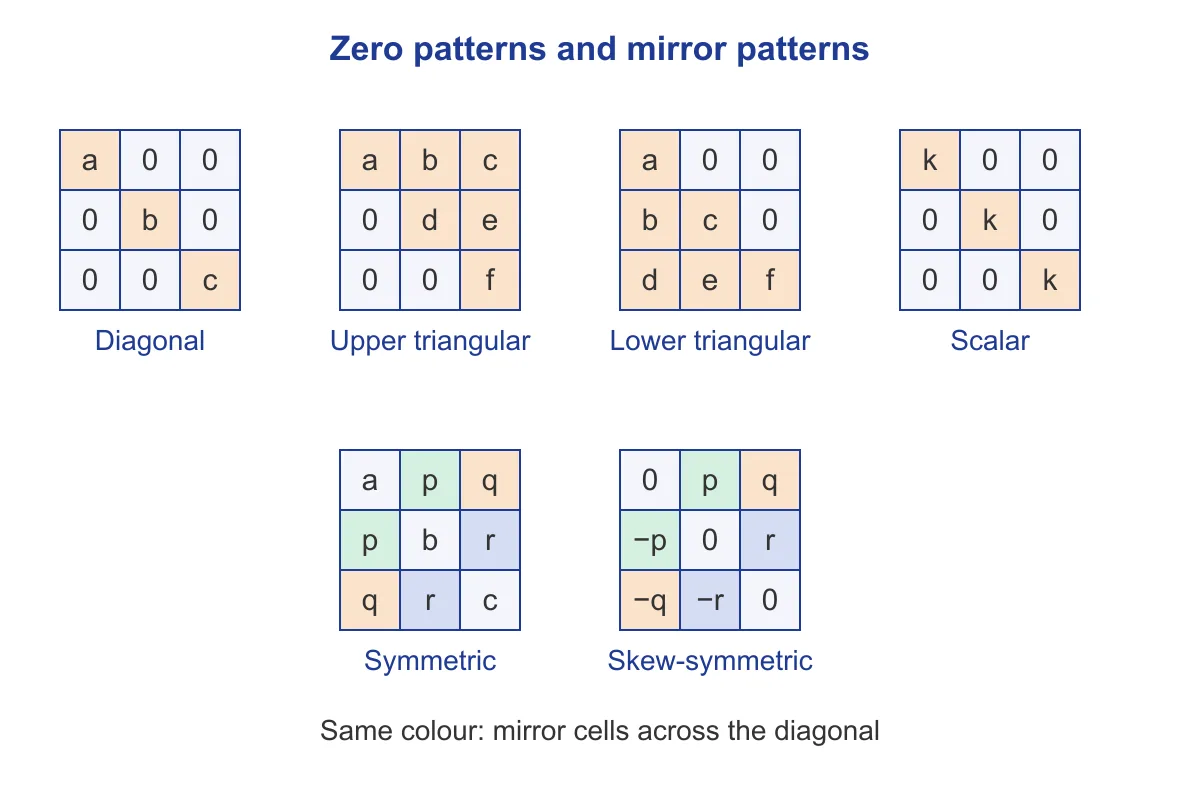
The names below are used in every question from here on, so learn them as definitions, not pictures.
| Name | Definition | Example of the pattern |
|---|---|---|
| Row matrix | only one row, order $1 \times n$ | $\begin{bmatrix} 2 & 5 & 7 \end{bmatrix}$ |
| Column matrix | only one column, order $m \times 1$ | $\begin{bmatrix} 2 \\ 5 \end{bmatrix}$ |
| Square matrix | rows equal columns | order $3 \times 3$ |
| Zero matrix $O$ | every entry is $0$ | any order |
| Diagonal matrix | square, $a_{ij} = 0$ whenever $i \ne j$ | diagonal entries may be anything |
| Scalar matrix | diagonal with all diagonal entries equal | $kI$ |
| Identity matrix $I$ | scalar matrix with $k = 1$ | $a_{ii} = 1$, rest $0$ |
| Upper triangular | square, $a_{ij} = 0$ whenever $i > j$ | zeros below the diagonal |
| Lower triangular | square, $a_{ij} = 0$ whenever $i < j$ | zeros above the diagonal |
The main diagonal of a square matrix runs from the top left to the bottom right: the entries $a_{11}, a_{22}, \ldots, a_{nn}$. The square types are nested: scalar inside diagonal, and diagonal inside both triangular kinds. A diagonal matrix is upper and lower triangular at once, and the zero matrix of square order is all of these.
Addition and scalar multiplication
You can add two matrices only when they have the same order; the sum is formed by adding matching entries. If $A = [a_{ij}]$ and $B = [b_{ij}]$ then $A + B = [a_{ij} + b_{ij}]$. Subtraction works the same way. Multiplying by a scalar $k$ multiplies every entry: $kA = [k\,a_{ij}]$.
These two operations behave exactly like ordinary number arithmetic:
- $A + B = B + A$ and $(A + B) + C = A + (B + C)$.
- $A + O = A$ and $A + (-A) = O$.
- $k(A + B) = kA + kB$ and $(k + l)A = kA + lA$.
Nothing surprising happens until we multiply two matrices.
Matrix multiplication
The rule
Let $A$ be of order $m \times n$ and $B$ of order $n \times p$. Then $AB$ is defined and has order $m \times p$. The entry in row $i$, column $j$ of $AB$ is
In words: take row $i$ of $A$, column $j$ of $B$, multiply matching entries, and add. The condition is that the inner numbers match: columns of $A$ = rows of $B$, and the outer numbers $m$ and $p$ give the order of the answer.
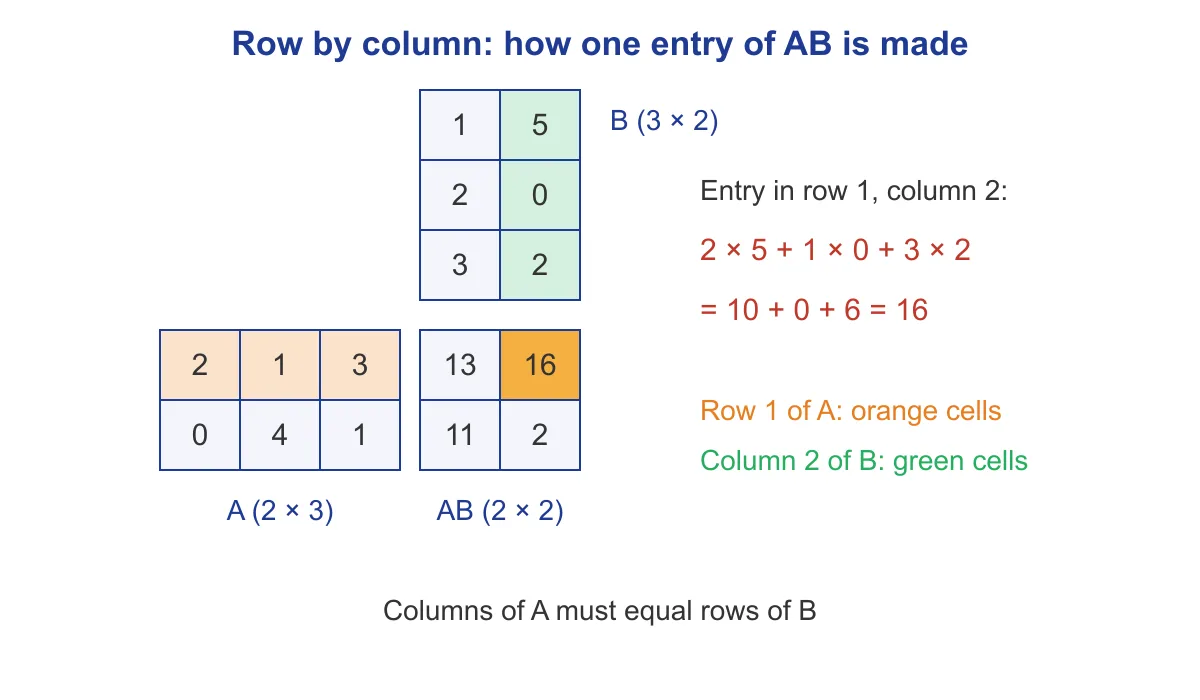
Memory trick: "Inner match, outer decide." Write the orders side by side, $(m \times n)(n \times p)$. If the two inner numbers agree, the product exists, and the two outer numbers are its order.
Use it before you start any product; it takes two seconds and saves a whole line of wasted arithmetic.
Example 2: For $A = \begin{bmatrix} 1 & 2 \\ 3 & -1 \end{bmatrix}$ and $B = \begin{bmatrix} 2 & 0 \\ 1 & 3 \end{bmatrix}$ find $AB$ and $BA$.
$AB$: row 1 of $A$ with column 1 of $B$: $1 \cdot 2 + 2 \cdot 1 = 4$. Row 1 with column 2: $1 \cdot 0 + 2 \cdot 3 = 6$.
Row 2 with column 1: $3 \cdot 2 + (-1) \cdot 1 = 5$. Row 2 with column 2: $3 \cdot 0 + (-1) \cdot 3 = -3$.
So $AB = \begin{bmatrix} 4 & 6 \\ 5 & -3 \end{bmatrix}$.
$BA$: row 1 of $B$ with column 1 of $A$: $2 \cdot 1 + 0 \cdot 3 = 2$. Row 1 with column 2: $2 \cdot 2 + 0 \cdot (-1) = 4$.
Row 2 with column 1: $1 \cdot 1 + 3 \cdot 3 = 10$. Row 2 with column 2: $1 \cdot 2 + 3 \cdot (-1) = -1$.
So $BA = \begin{bmatrix} 2 & 4 \\ 10 & -1 \end{bmatrix}$.
Both products exist and have the same order, yet $AB \ne BA$. Order of multiplication matters, and this is the single biggest difference from number arithmetic.
Properties that hold
Whenever the products and sums are defined:
- $(AB)C = A(BC)$ (associative).
- $A(B + C) = AB + AC$ and $(A + B)C = AC + BC$ (distributive).
- $AI = IA = A$ for the identity of the right order, and $AO = OA = O$.
- $k(AB) = (kA)B = A(kB)$.
Properties that fail
This is where JEE questions are built.
- $AB \ne BA$ in general. If $AB = BA$ we say $A$ and $B$ commute. Even when $AB$ exists, $BA$ may not (a $2 \times 3$ times a $3 \times 4$ gives $2 \times 4$, but $3 \times 4$ times $2 \times 3$ is undefined).
- $AB = O$ does not imply $A = O$ or $B = O$. For example $\begin{bmatrix} 1 & 0 \\ 0 & 0 \end{bmatrix}\begin{bmatrix} 0 & 0 \\ 0 & 1 \end{bmatrix} = O$, and neither factor is zero.
- $AB = AC$ does not imply $B = C$, because you cannot cancel $A$ on the left.
Because of non-commutativity, the usual algebra identities change:
These reduce to the familiar $A^2 + 2AB + B^2$ and $A^2 - B^2$ only when $AB = BA$. The same condition decides whether the binomial theorem can be used for $(A + B)^n$.
Two helpful special cases. A scalar matrix $kI$ commutes with every square matrix of its order, since $(kI)A = kA = A(kI)$. And the powers of a single matrix, $A^m$ and $A^n$, always commute with each other, which is why $(I + A)^n$ can be expanded by the binomial theorem: $I$ commutes with everything.
Transpose, symmetric and skew-symmetric matrices
Transpose
The transpose $A^T$ of $A$ is obtained by turning rows into columns: the $(i, j)$ entry of $A^T$ is $a_{ji}$. If $A$ is $m \times n$ then $A^T$ is $n \times m$. The properties:
| Property | Statement | Remark |
|---|---|---|
| Double transpose | $(A^T)^T = A$ | |
| Sum | $(A + B)^T = A^T + B^T$ | same order needed |
| Scalar | $(kA)^T = k A^T$ | |
| Product | $(AB)^T = B^T A^T$ | order reverses |
| Longer product | $(ABC)^T = C^T B^T A^T$ | reverse the whole chain |
| Power | $(A^n)^T = (A^T)^n$ | follows from the product rule |
Why does the product rule reverse? Check the orders: if $A$ is $m \times n$ and $B$ is $n \times p$, then $B^T$ is $p \times n$ and $A^T$ is $n \times m$. The product $B^T A^T$ is defined and has order $p \times m$, which matches $(AB)^T$. The product $A^T B^T$ is usually not even defined.
Memory trick: "Socks and shoes." You put on socks, then shoes. To undo it, shoes come off first, then socks. Transpose (and inverse) of a product undoes the order.
Whenever you see $(AB)^T$, say "shoes off first" and write $B^T A^T$.
Symmetric and skew-symmetric
A square matrix $A$ is symmetric if $A^T = A$, that is $a_{ij} = a_{ji}$. It is skew-symmetric if $A^T = -A$, that is $a_{ij} = -a_{ji}$. Putting $j = i$ in the skew condition gives $a_{ii} = -a_{ii}$, so $a_{ii} = 0$: every diagonal entry of a skew-symmetric matrix is zero. A symmetric matrix has no restriction on the diagonal.
A matrix that is both symmetric and skew-symmetric satisfies $A = A^T = -A$, so $A = O$.
Counting freedom is a favourite question. In a symmetric matrix of order $n$ you choose the diagonal ($n$ entries) and the entries above it ($\frac{n(n-1)}{2}$ entries); the rest are copies. In a skew-symmetric matrix you choose only the entries above the diagonal.
Useful facts, each proved by one transpose:
- If $A$ is any square matrix, then $A + A^T$ is symmetric and $A - A^T$ is skew-symmetric.
- For any matrix $A$ (even rectangular), $AA^T$ and $A^T A$ are symmetric, since $(AA^T)^T = (A^T)^T A^T = AA^T$.
- If $A$ and $B$ are symmetric, $A + B$ is symmetric, and $AB$ is symmetric if and only if $AB = BA$. Indeed $(AB)^T = B^T A^T = BA$.
- If $A$ is skew-symmetric, then $A^2$ is symmetric (because $(A^2)^T = (-A)^2 = A^2$), and in general an even power of $A$ is symmetric while an odd power is skew-symmetric.
- If $A$ is symmetric, every power $A^n$ is symmetric.
| Matrix | Symmetric? | Skew-symmetric? |
|---|---|---|
| $A + A^T$ | yes | no (unless zero) |
| $A - A^T$ | no (unless zero) | yes |
| $AA^T$ | yes | no (unless zero) |
| $AB + BA$, $A$ symmetric, $B$ skew | no | yes |
| $AB - BA$, $A$ symmetric, $B$ skew | yes | no |
| $A^2$, $A$ skew | yes | no (unless zero) |
Splitting any square matrix
Take any square $A$. Define $P = \frac{1}{2}(A + A^T)$ and $Q = \frac{1}{2}(A - A^T)$. Then $P$ is symmetric, $Q$ is skew-symmetric, and $P + Q = A$. The split is unique: if $A = P' + Q'$ with $P'$ symmetric and $Q'$ skew, taking the transpose gives $A^T = P' - Q'$, and adding and subtracting recovers $P' = P$, $Q' = Q$.
In entry terms, $P$ has $(i, j)$ entry $\frac{a_{ij} + a_{ji}}{2}$ and $Q$ has $\frac{a_{ij} - a_{ji}}{2}$. For an $a_{ii}$ on the diagonal, $P$ keeps it and $Q$ shows $0$.
Example 3: Write $A = \begin{bmatrix} 2 & 5 & 1 \\ 3 & -1 & 4 \\ 7 & 0 & 6 \end{bmatrix}$ as a symmetric plus a skew-symmetric matrix.
$A^T = \begin{bmatrix} 2 & 3 & 7 \\ 5 & -1 & 0 \\ 1 & 4 & 6 \end{bmatrix}$.
$A + A^T = \begin{bmatrix} 4 & 8 & 8 \\ 8 & -2 & 4 \\ 8 & 4 & 12 \end{bmatrix}$, so $P = \begin{bmatrix} 2 & 4 & 4 \\ 4 & -1 & 2 \\ 4 & 2 & 6 \end{bmatrix}$.
$A - A^T = \begin{bmatrix} 0 & 2 & -6 \\ -2 & 0 & 4 \\ 6 & -4 & 0 \end{bmatrix}$, so $Q = \begin{bmatrix} 0 & 1 & -3 \\ -1 & 0 & 2 \\ 3 & -2 & 0 \end{bmatrix}$.
Check one place: $P_{12} + Q_{12} = 4 + 1 = 5 = a_{12}$, and $P_{21} + Q_{21} = 4 - 1 = 3 = a_{21}$.
The check shows why it works: mirror entries of $A$ are shared between $P$ (their average) and $Q$ (half their difference).
Trace
The trace of a square matrix is the sum of its diagonal entries: $\operatorname{tr}(A) = a_{11} + a_{22} + \cdots + a_{nn}$. It is defined only for square matrices.
| Property | Statement |
|---|---|
| Sum | $\operatorname{tr}(A + B) = \operatorname{tr}(A) + \operatorname{tr}(B)$ |
| Scalar | $\operatorname{tr}(kA) = k \operatorname{tr}(A)$ |
| Transpose | $\operatorname{tr}(A^T) = \operatorname{tr}(A)$ |
| Cyclic | $\operatorname{tr}(AB) = \operatorname{tr}(BA)$ |
| Not true | $\operatorname{tr}(AB) \ne \operatorname{tr}(A)\operatorname{tr}(B)$ in general |
The cyclic property is worth seeing once. The diagonal entry $(AB)_{ii} = \sum_j a_{ij} b_{ji}$, so $\operatorname{tr}(AB) = \sum_i \sum_j a_{ij} b_{ji}$. Swapping the names $i$ and $j$ and the order of summation gives $\sum_j \sum_i b_{ji} a_{ij}$, which is $\operatorname{tr}(BA)$. It even works when $A$ is $m \times n$ and $B$ is $n \times m$, though the two products then have different orders.
A skew-symmetric matrix has trace $0$ because its diagonal is zero. For a skew-symmetric $A$ of order 3 with entries $a, b, c$ above the diagonal, $\operatorname{tr}(A^2) = -2(a^2 + b^2 + c^2)$, a result worth remembering because $\operatorname{tr}(A^2) \ne (\operatorname{tr} A)^2$ is the usual trap.
Elementary row and column operations
There are three elementary operations on rows, and three of the same kind on columns:
- Interchange two rows (columns): $R_i \leftrightarrow R_j$ ($C_i \leftrightarrow C_j$).
- Multiply a row (column) by a non-zero constant $k$: $R_i \to k R_i$.
- Add a multiple of one row (column) to another: $R_i \to R_i + k R_j$.
Each operation changes the appearance of the matrix but not the information in it; the matrix you reach is called equivalent to the one you started with, written $A \sim B$.
The link with multiplication is neat. Apply the operation to the identity matrix and you get an elementary matrix $E$. Then multiplying $A$ on the left by $E$ performs that operation on the rows of $A$, and multiplying on the right performs the same operation on the columns. So an operation is just a multiplication.
Example 4: For $A = \begin{bmatrix} 1 & 3 & 2 \\ 2 & 7 & 1 \end{bmatrix}$ apply $R_2 \to R_2 - 2R_1$ and show the same result is $EA$ for a suitable $E$.
Row 2 becomes $(2 - 2,\ 7 - 6,\ 1 - 4) = (0,\ 1,\ -3)$. So the new matrix is $\begin{bmatrix} 1 & 3 & 2 \\ 0 & 1 & -3 \end{bmatrix}$.
Apply the same operation to $I_2$: row 2 of $I_2$ is $(0, 1)$, minus $2(1, 0)$ gives $(-2, 1)$, so $E = \begin{bmatrix} 1 & 0 \\ -2 & 1 \end{bmatrix}$.
$EA$: row 1 is $(1, 3, 2)$; row 2 is $-2(1, 3, 2) + (2, 7, 1) = (0, 1, -3)$. This agrees.
The zero in the first place of row 2 is the point of such operations: they are used to build up zeros in a controlled way.
Operations must be done one at a time and recorded. A common slip is to change row 1 with $R_1 \to R_1 + R_2$ and then use the new row 1 in a second operation without realising it has changed.
Memory trick: "Rows from the left, columns from the right." Left multiplication acts on rows; right multiplication acts on columns.
Use it when an elementary matrix is given and you must decide which side to multiply on.
Powers of a matrix
For a square matrix $A$, define $A^0 = I$, $A^1 = A$, $A^2 = AA$, and so on. Power rules $A^m A^n = A^{m+n}$ and $(A^m)^n = A^{mn}$ hold. But $(AB)^n = A^n B^n$ holds only when $AB = BA$.
To find $A^n$ for a general $n$, compute $A^2$ and $A^3$ and look for a pattern, then confirm the pattern by induction. Two patterns come up repeatedly.
Example 5: Let $A = \begin{bmatrix} 1 & 1 \\ 0 & 1 \end{bmatrix}$. Find $A^n$ and hence $A^{50}$.
$A^2 = \begin{bmatrix} 1 & 2 \\ 0 & 1 \end{bmatrix}$ and $A^3 = A^2 A = \begin{bmatrix} 1 & 3 \\ 0 & 1 \end{bmatrix}$. Guess $A^n = \begin{bmatrix} 1 & n \\ 0 & 1 \end{bmatrix}$.
Induction step: $A^{n+1} = A^n A = \begin{bmatrix} 1 & n \\ 0 & 1 \end{bmatrix}\begin{bmatrix} 1 & 1 \\ 0 & 1 \end{bmatrix} = \begin{bmatrix} 1 & n + 1 \\ 0 & 1 \end{bmatrix}$.
So $A^{50} = \begin{bmatrix} 1 & 50 \\ 0 & 1 \end{bmatrix}$.
A second route: $A = I + N$ with $N = \begin{bmatrix} 0 & 1 \\ 0 & 0 \end{bmatrix}$ and $N^2 = O$, so $A^n = I + nN$. Both routes agree, and the second one is the faster habit.
When $A$ is idempotent or nilpotent, a pattern is guaranteed; the next section shows how to use it.
Idempotent, nilpotent, involutory and orthogonal matrices
| Type | Definition | Immediate consequence |
|---|---|---|
| Idempotent | $A^2 = A$ | $A^n = A$ for every $n \ge 1$ |
| Nilpotent (index $k$) | $A^k = O$ and $A^{k-1} \ne O$ | $A^n = O$ for all $n \ge k$ |
| Involutory | $A^2 = I$ | $A^{2m} = I$, $A^{2m+1} = A$ |
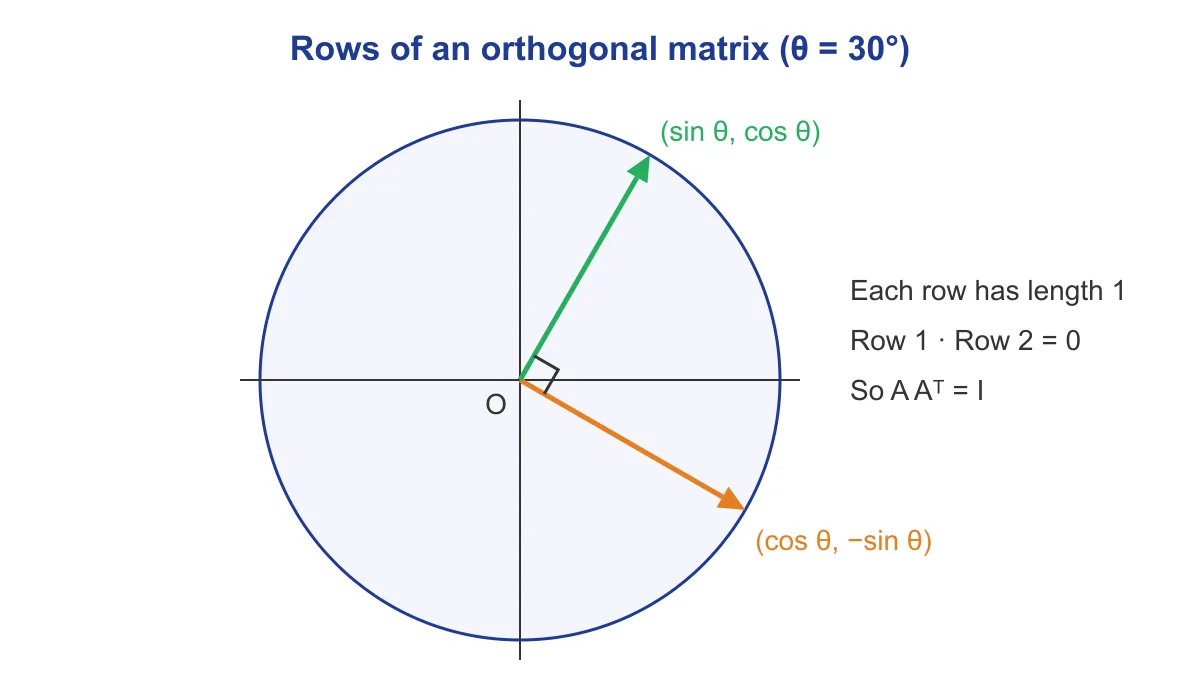
| Orthogonal | $AA^T = A^T A = I$ | rows (and columns) are mutually perpendicular unit vectors |
Using these definitions
Idempotent. Suppose $A^2 = A$. Since $I$ and $A$ commute, binomial expansion of $(I + A)^n$ is allowed, and every power $A^k$ with $k \ge 1$ is $A$:
Also $I - A$ is idempotent: $(I - A)^2 = I - 2A + A^2 = I - A$. And if $A$ and $B$ are idempotent with $AB = BA$, then $AB$ is idempotent.
Nilpotent. If $N^k = O$, then $(I + N)^n = I + nN + \binom{n}{2} N^2 + \cdots + \binom{n}{k-1} N^{k-1}$ and nothing beyond. For $k = 2$ it is just $I + nN$.
Involutory. If $A^2 = I$, then $\frac{1}{2}(I + A)$ is idempotent, and if $P$ is idempotent then $2P - I$ is involutory: $(2P - I)^2 = 4P^2 - 4P + I = I$.
Orthogonal. The condition says: the dot product of any row with itself is $1$, and the dot product of two different rows is $0$. A rotation matrix $\begin{bmatrix} \cos\theta & -\sin\theta \\ \sin\theta & \cos\theta \end{bmatrix}$ is the standard example. The product of two orthogonal matrices of the same order is orthogonal, and so is the transpose of an orthogonal matrix.
Example 6: Show that $P = \begin{bmatrix} 4 & -6 \\ 2 & -3 \end{bmatrix}$ is idempotent and find $(I + P)^6$.
$P^2$: $(1,1)$: $16 - 12 = 4$. $(1,2)$: $-24 + 18 = -6$. $(2,1)$: $8 - 6 = 2$. $(2,2)$: $-12 + 9 = -3$. So $P^2 = P$.
$I$ commutes with $P$, so $(I + P)^6 = I + (2^6 - 1)P = I + 63P$.
$63P = \begin{bmatrix} 252 & -378 \\ 126 & -189 \end{bmatrix}$, so $(I + P)^6 = \begin{bmatrix} 253 & -378 \\ 126 & -188 \end{bmatrix}$.
Notice that you never multiplied six matrices; recognising the type did the work.
Example 7: Let $N = \begin{bmatrix} 0 & 1 & 2 \\ 0 & 0 & 3 \\ 0 & 0 & 0 \end{bmatrix}$. Find $(I + N)^{10}$.
$N^2$: only the $(1,3)$ place is non-zero: row 1 of $N$ with column 3 of $N$ gives $0 \cdot 2 + 1 \cdot 3 + 2 \cdot 0 = 3$. So $N^2 = \begin{bmatrix} 0 & 0 & 3 \\ 0 & 0 & 0 \\ 0 & 0 & 0 \end{bmatrix}$ and $N^3 = O$ (a nilpotent matrix of index 3).
$(I + N)^{10} = I + 10N + \binom{10}{2} N^2 = I + 10N + 45N^2$.
Entries: $(1,2)$ is $10 \cdot 1 = 10$. $(2,3)$ is $10 \cdot 3 = 30$. $(1,3)$ is $10 \cdot 2 + 45 \cdot 3 = 20 + 135 = 155$.
So $(I + N)^{10} = \begin{bmatrix} 1 & 10 & 155 \\ 0 & 1 & 30 \\ 0 & 0 & 1 \end{bmatrix}$.
The $(1,3)$ entry has two contributions, one from each power of $N$, which is exactly where students drop a term.
Memory trick: "Idem keeps, nil kills, invol returns." Idempotent keeps itself, nilpotent dies at some power, involutory returns to $I$ after two steps.
Use it to recall the three types quickly in a match-the-following question.
Common traps
- Adding matrices of different orders → check the orders first; the sum exists only for equal orders.
- Writing $AB = BA$ without proof → commutativity is the exception; test it or avoid using it.
- Expanding $(A + B)^2$ as $A^2 + 2AB + B^2$ → write $A^2 + AB + BA + B^2$ unless $AB = BA$ is given.
- Concluding $A = O$ or $B = O$ from $AB = O$ → this is false; find a counterexample with zeros in different places.
- Cancelling $A$ from $AB = AC$ → no cancellation law; only if $A$ can be undone by a suitable matrix is $B = C$ forced.
- Writing $(AB)^T = A^T B^T$ → reverse the order: $B^T A^T$.
- Using $\operatorname{tr}(AB) = \operatorname{tr}(A)\operatorname{tr}(B)$ → the correct fact is $\operatorname{tr}(AB) = \operatorname{tr}(BA)$.
- Believing $(AB)^n = A^n B^n$ always → true only when $A$ and $B$ commute.
- Forgetting that a skew-symmetric matrix has zero diagonal → set $a_{ii} = 0$ before filling in the rest.
- Reading a left multiplication as a column operation → left acts on rows, right acts on columns.
Quick revision
- Order $m \times n$ means $m$ rows, $n$ columns; $a_{ij}$ is row $i$, column $j$.
- Equal matrices: same order and equal matching entries.
- Scalar $\subset$ diagonal $\subset$ triangular (upper and lower) within square matrices.
- $A + B$ needs equal orders; $AB$ needs columns of $A$ = rows of $B$.
- $(AB)_{ij}$ = row $i$ of $A$ times column $j$ of $B$.
- $AB \ne BA$ generally; $AB = O$ does not force a zero factor.
- $(A + B)^2 = A^2 + AB + BA + B^2$.
- $(AB)^T = B^T A^T$ and $(A^T)^T = A$.
- Symmetric: $A^T = A$; skew-symmetric: $A^T = -A$ with zero diagonal.
- $A = \frac{1}{2}(A + A^T) + \frac{1}{2}(A - A^T)$, uniquely.
- $AA^T$ and $A^T A$ are always symmetric; $A^2$ is symmetric for skew $A$.
- $\operatorname{tr}(AB) = \operatorname{tr}(BA)$, $\operatorname{tr}(A^T) = \operatorname{tr}(A)$.
- Left multiplication by an elementary matrix is a row operation; right is a column operation.
- Idempotent: $(I + A)^n = I + (2^n - 1)A$; nilpotent: the expansion of $(I + N)^n$ stops early; involutory: $A^2 = I$; orthogonal: $AA^T = I$.
Practice questions
$A$ is of order $3 \times 4$ and $B$ is of order $4 \times 2$. Which statement is correct?
- $AB$ is not defined
- $AB$ has order $3 \times 2$ and $BA$ is not defined
- $AB$ has order $4 \times 4$
- $AB$ has order $3 \times 2$ and $BA$ has order $2 \times 3$
Answer
B. $AB$ has order $3 \times 2$ and $BA$ is not defined
Columns of $A$ = 4 = rows of $B$, so $AB$ exists with order $3 \times 2$. For $BA$ we need columns of $B$ (2) = rows of $A$ (3), which fails.
Which of the following is a scalar matrix?
- $\begin{bmatrix}3 & 0 \\ 0 & 2\end{bmatrix}$
- $\begin{bmatrix}3 & 1 \\ 0 & 3\end{bmatrix}$
- $\begin{bmatrix}0 & 3 \\ 3 & 0\end{bmatrix}$
- $\begin{bmatrix}3 & 0 \\ 0 & 3\end{bmatrix}$
Answer
D. $\begin{bmatrix}3 & 0 \\ 0 & 3\end{bmatrix}$
A scalar matrix is diagonal with equal diagonal entries; only the first has zeros off the diagonal and equal diagonal entries.
$A$ is a symmetric matrix and $B$ is a skew-symmetric matrix of the same order. Which of the following is always skew-symmetric?
- $A + B$
- $A^2 + B^2$
- $AB + BA$
- $AB - BA$
Answer
C. $AB + BA$
$(AB+BA)^T = B^TA^T + A^TB^T = -BA - AB = -(AB+BA)$. The matrix $AB-BA$ has transpose $-BA+AB$, so it is symmetric; $A^2+B^2$ is symmetric.
$A$ is a skew-symmetric matrix of order 3. Then $A^{101}$ is
- skew-symmetric
- a diagonal matrix
- the zero matrix
- symmetric
Answer
A. skew-symmetric
$(A^{101})^T = (A^T)^{101} = (-A)^{101} = -A^{101}$. It need not be zero or diagonal, so the safe description is skew-symmetric.
If $A$ is of order $2 \times 3$ and $B$ is of order $3 \times 4$, then $(AB)^T$ equals
- $AB^T$
- $A^TB$
- $A^TB^T$
- $B^TA^T$
Answer
D. $B^TA^T$
The transpose reverses the product: $(AB)^T = B^TA^T$, of order $4 \times 2$. The product $A^TB^T$ is not even defined.
For square matrices $A$ and $B$ of the same order, which statement is always true?
- $\operatorname{tr}(AB) = \operatorname{tr}(BA)$
- $\operatorname{tr}(AB) = \operatorname{tr}(A)\operatorname{tr}(B)$
- $\operatorname{tr}(A^2) = (\operatorname{tr} A)^2$
- $\operatorname{tr}(A+B) = \operatorname{tr}(A)\operatorname{tr}(B)$
Answer
A. $\operatorname{tr}(AB) = \operatorname{tr}(BA)$
$\operatorname{tr}(AB) = \sum_i\sum_j a_{ij}b_{ji}$, and swapping the names $i,j$ gives $\operatorname{tr}(BA)$. For $A=B=I_3$ the others fail: $\operatorname{tr}(AB)=3$ but $\operatorname{tr}(A)\operatorname{tr}(B)=9$, $(\operatorname{tr}A)^2=9$, and $\operatorname{tr}(A+B)=6 \ne 9$.
If $A^2 = A$, then $(I + A)^3$ equals
- $I + 8A$
- $7I + A$
- $I + 7A$
- $I + 6A$
Answer
C. $I + 7A$
$(I+A)^3 = I + 3A + 3A^2 + A^3 = I + 3A + 3A + A = I + 7A$.
If $A^2 = O$, then $(A + I)^{10}$ equals
- $I$
- $I + 10A$
- $10A$
- $I + 45A$
Answer
B. $I + 10A$
$A$ commutes with $I$, so $(I+A)^{10} = I + 10A + 45A^2 + \cdots = I + 10A$ because $A^2 = O$.
Which of the following matrices is involutory?
- $\begin{bmatrix}1 & 0 \\ 1 & 0\end{bmatrix}$
- $\begin{bmatrix}1 & 2 \\ 0 & 1\end{bmatrix}$
- $\begin{bmatrix}0 & 1 \\ -1 & 0\end{bmatrix}$
- $\begin{bmatrix}0 & 1 \\ 1 & 0\end{bmatrix}$
Answer
D. $\begin{bmatrix}0 & 1 \\ 1 & 0\end{bmatrix}$
Squares: $\begin{bmatrix}0&1\\1&0\end{bmatrix}^2=I$; the second gives $\begin{bmatrix}1&4\\0&1\end{bmatrix}$; the third gives $-I$; the fourth gives itself.
The matrix $\frac{1}{3}\begin{bmatrix}1 & 2 & 2 \\ 2 & 1 & x \\ 2 & -2 & 1\end{bmatrix}$ is orthogonal. Then $x$ equals
- $-1$
- $1$
- $-2$
- $2$
Answer
C. $-2$
Row 1 $\cdot$ Row 2 $= \frac{1}{9}(2 + 2 + 2x) = 0$ gives $x = -2$. Check the length of row 2: $4 + 1 + 4 = 9$, correct. The choice $x = 2$ fixes the length but not perpendicularity.
$A$ and $B$ are symmetric matrices of the same order. Then $AB$ is symmetric if and only if
- $AB = BA$
- $A = B$
- $A$ or $B$ is the identity matrix
- $A$ and $B$ are both diagonal
Answer
A. $AB = BA$
$(AB)^T = B^TA^T = BA$. So $AB$ is symmetric exactly when $AB = BA$. The other options are sufficient in some cases but not necessary.
Applying $R_1 \leftrightarrow R_3$ to a $3 \times 3$ matrix $A$ is the same as the product $EA$, where $E$ is
- $\begin{bmatrix}0 & 1 & 0 \\ 1 & 0 & 0 \\ 0 & 0 & 1\end{bmatrix}$
- $\begin{bmatrix}0 & 0 & 1 \\ 0 & 1 & 0 \\ 1 & 0 & 0\end{bmatrix}$
- $\begin{bmatrix}0 & 0 & 1 \\ 1 & 0 & 0 \\ 0 & 1 & 0\end{bmatrix}$
- $\begin{bmatrix}1 & 0 & 1 \\ 0 & 1 & 0 \\ 0 & 0 & 1\end{bmatrix}$
Answer
B. $\begin{bmatrix}0 & 0 & 1 \\ 0 & 1 & 0 \\ 1 & 0 & 0\end{bmatrix}$
Apply the same operation to $I_3$: swap its first and third rows, giving the first matrix. Left multiplication acts on rows.
A matrix $A = [a_{ij}]$ of order $3 \times 3$ has $a_{ij} = i - j$. Then $A$ is
- symmetric
- diagonal
- skew-symmetric
- upper triangular
Answer
C. skew-symmetric
$a_{ji} = j - i = -a_{ij}$, so $A^T = -A$. It is not triangular since $a_{21} = 1 \ne 0$ and $a_{12} = -1 \ne 0$.
A square matrix $A$ satisfies $A^2 = 2A - I$. Then $A^4$ equals
- $4A - 3I$
- $3A - 2I$
- $8A - 7I$
- $4A + 3I$
Answer
A. $4A - 3I$
$A^3 = 2A^2 - A = 4A - 2I - A = 3A - 2I$. $A^4 = 3A^2 - 2A = 6A - 3I - 2A = 4A - 3I$. Pattern: $A^n = nA - (n-1)I$.
The number of possible orders of a matrix that has exactly 18 entries is
- 6
- 3
- 9
- 12
Answer
A. 6
Orders $m \times n$ with $mn = 18$: $m \in \{1,2,3,6,9,18\}$, giving 6 orders.
If $\begin{bmatrix}2x+y & 3 \\ 4 & x-y\end{bmatrix}$ = $\begin{bmatrix}8 & 3 \\ 4 & 1\end{bmatrix}$, the value of $xy$ is
- 6
- 5
- 12
- 3
Answer
A. 6
$2x+y=8$ and $x-y=1$ give $3x=9$, so $x=3$, $y=2$, $xy=6$. Check: $6+2=8$ and $3-2=1$.
The trace of the $3 \times 3$ matrix $A = [a_{ij}]$ with $a_{ij} = i^2 - j$ is
- 14
- 8
- 6
- 0
Answer
B. 8
Diagonal entries $a_{ii} = i^2 - i = 0, 2, 6$. Sum $= 8$.
For $A = \begin{bmatrix}1 & 2 \\ 3 & 4\end{bmatrix}$, the sum of all entries of $A^2$ is
- 100
- 44
- 30
- 54
Answer
D. 54
$A^2 = \begin{bmatrix}7&10\\15&22\end{bmatrix}$ and $7+10+15+22 = 54$. The value 30 comes from squaring each entry instead.
For $A = \begin{bmatrix}2 & 1 \\ -1 & 3\end{bmatrix}$, the value of $\operatorname{tr}(A^2)$ is
- 9
- 11
- 5
- 13
Answer
B. 11
$A^2 = \begin{bmatrix}3&5\\-5&8\end{bmatrix}$, trace $= 3+8 = 11$. Squaring diagonal entries gives 13, which is wrong.
If $A = \begin{bmatrix}1 & 2 \\ 0 & 1\end{bmatrix}$, the $(1,2)$ entry of $A^{15}$ is
- 15
- 32
- 30
- 16
Answer
C. 30
$A = I + N$ with $N^2 = O$, $N = \begin{bmatrix}0&2\\0&0\end{bmatrix}$. So $A^n = I + nN$ and the entry is $2n = 30$.
The matrix $A = \begin{bmatrix}6 & k \\ -9 & -6\end{bmatrix}$ satisfies $A^2 = O$. The value of $k$ is
- 4
- -4
- 9
- 6
Answer
A. 4
$(1,1)$ entry of $A^2$ is $36 - 9k = 0$, so $k = 4$. Check $(1,2)$: $6k - 6k = 0$.
The number of symmetric matrices of order 3 that have every entry equal to $0$ or $1$ is
- 36
- 27
- 512
- 64
Answer
D. 64
A symmetric $3 \times 3$ matrix has $3 + 3 = 6$ independent entries (diagonal and above). Each has 2 choices: $2^6 = 64$.
The number of diagonal matrices of order 3 with real entries that satisfy $A^2 = I$ is
- 8
- 6
- 3
- 2
Answer
A. 8
For a diagonal matrix, $A^2 = I$ means each diagonal entry $d$ has $d^2 = 1$, so $d = \pm 1$. Three independent choices: $2^3 = 8$.
Let $A = \begin{bmatrix}3 & 7 & 2 \\ 1 & 5 & 9 \\ 6 & 4 & 8\end{bmatrix}$. The $(2,3)$ entry of the skew-symmetric part of $A$ is
- 5
- 6.5
- 13
- 2.5
Answer
D. 2.5
The skew part is $\frac{1}{2}(A - A^T)$, with $(2,3)$ entry $\frac{9 - 4}{2} = 2.5$. The value 6.5 is the symmetric part.
Let $N = \begin{bmatrix}0 & 1 & 0 \\ 0 & 0 & 1 \\ 0 & 0 & 0\end{bmatrix}$. The sum of all nine entries of $(I + N)^8$ is
- 31
- 56
- 47
- 19
Answer
C. 47
$N^3 = O$, so $(I+N)^8 = I + 8N + 28N^2$; $N^2$ has a single 1 at the $(1,3)$ place. Entries: three 1's, then $8,8$ and $28$: $3+16+28=47$.
For $A = \begin{bmatrix}0 & 1 & 2 \\ -1 & 0 & 3 \\ -2 & -3 & 0\end{bmatrix}$, the value of $\operatorname{tr}(A^2)$ is
- -14
- -28
- 28
- -56
Answer
B. -28
Diagonal of $A^2$: $-(1+4) = -5$, $-(1+9) = -10$, $-(4+9) = -13$. Sum $= -28$. Also $-2(a^2+b^2+c^2) = -2(14) = -28$.
Given below are two statements: Statement I: The product of two non-zero matrices can be the zero matrix. Statement II: If $AB = O$ then $A = O$ or $B = O$.
- Both Statement I and Statement II are correct
- Both Statement I and Statement II are incorrect
- Statement I is correct but Statement II is incorrect
- Statement I is incorrect but Statement II is correct
Answer
C. Statement I is correct but Statement II is incorrect
Statement I is true: $\begin{bmatrix}1&0\\0&0\end{bmatrix}\begin{bmatrix}0&0\\0&1\end{bmatrix}=O$. Statement II is false for the same example.
Given below are two statements: Statement I: If $A$ and $B$ are symmetric matrices of the same order, then $AB - BA$ is skew-symmetric. Statement II: For any square matrix $A$, $A + A^T$ is symmetric and $A - A^T$ is skew-symmetric.
- Both Statement I and Statement II are correct
- Both Statement I and Statement II are incorrect
- Statement I is correct but Statement II is incorrect
- Statement I is incorrect but Statement II is correct
Answer
A. Both Statement I and Statement II are correct
$(AB-BA)^T = BA - AB = -(AB-BA)$, so I is correct. $(A\pm A^T)^T = A^T \pm A$ gives II.
Given below are two statements: Statement I: If $A$ is an involutory matrix, then $A^{100} = A$. Statement II: If $A$ is an idempotent matrix, then $A^n = A$ for every positive integer $n$.
- Both Statement I and Statement II are correct
- Both Statement I and Statement II are incorrect
- Statement I is correct but Statement II is incorrect
- Statement I is incorrect but Statement II is correct
Answer
D. Statement I is incorrect but Statement II is correct
$A^{100} = (A^2)^{50} = I$, which equals $A$ only when $A = I$; for $A = \begin{bmatrix}0&1\\1&0\end{bmatrix}$ Statement I fails. For idempotent $A$, $A^n = A$ follows by induction.
Given below are two statements: Statement I: The product of two symmetric matrices of the same order is always symmetric. Statement II: The product of two skew-symmetric matrices of the same order is always skew-symmetric.
- Both Statement I and Statement II are correct
- Both Statement I and Statement II are incorrect
- Statement I is correct but Statement II is incorrect
- Statement I is incorrect but Statement II is correct
Answer
B. Both Statement I and Statement II are incorrect
For symmetric $A, B$, $(AB)^T = BA$, which differs from $AB$ unless they commute. For skew $A$, $A \cdot A = A^2$ is symmetric and non-zero in general, so the product need not be skew.
Given below are two statements: Statement I: If $A$ is skew-symmetric, then $A^2$ is symmetric. Statement II: If $A$ and $B$ are idempotent and $AB = BA$, then $AB$ is idempotent.
- Both Statement I and Statement II are correct
- Both Statement I and Statement II are incorrect
- Statement I is correct but Statement II is incorrect
- Statement I is incorrect but Statement II is correct
Answer
A. Both Statement I and Statement II are correct
$(A^2)^T = (A^T)^2 = (-A)^2 = A^2$. And $(AB)^2 = ABAB = A^2B^2 = AB$ using $AB=BA$.
Assertion (A): For a $2 \times 3$ matrix $A$ and a $3 \times 2$ matrix $B$, $\operatorname{tr}(AB) = \operatorname{tr}(BA)$. Reason (R): Matrix multiplication is associative.
- Both A and R are true and R is the correct explanation of A
- Both A and R are true but R is not the correct explanation of A
- A is true but R is false
- A is false but R is true
Answer
B. Both A and R are true but R is not the correct explanation of A
$\operatorname{tr}(AB) = \sum_i\sum_j a_{ij}b_{ji} = \operatorname{tr}(BA)$, so A is true. R is true but the proof of A uses entry sums, not associativity.
Assertion (A): Every diagonal matrix is a symmetric matrix. Reason (R): Every symmetric matrix is a diagonal matrix.
- Both A and R are true and R is the correct explanation of A
- Both A and R are true but R is not the correct explanation of A
- A is true but R is false
- A is false but R is true
Answer
C. A is true but R is false
For a diagonal matrix, $a_{ij} = 0 = a_{ji}$ for $i \ne j$, so A is true. R is false: $\begin{bmatrix}1&2\\2&1\end{bmatrix}$ is symmetric but not diagonal.
Assertion (A): For all square matrices $A$ and $B$ of the same order, $(AB)^2 = A^2B^2$. Reason (R): Matrix multiplication is associative.
- Both A and R are true and R is the correct explanation of A
- Both A and R are true but R is not the correct explanation of A
- A is true but R is false
- A is false but R is true
Answer
D. A is false but R is true
$(AB)^2 = ABAB$, and rearranging to $A^2B^2$ needs $BA = AB$. So A is false. R is true.
Match List I with List II. List I: a. \begin{bmatrix}5 & 0 \\ 0 & 5\end{bmatrix} b. \begin{bmatrix}1 & 2 \\ 0 & 3\end{bmatrix} c. \begin{bmatrix}0 & 2 \\ -2 & 0\end{bmatrix} d. \begin{bmatrix}0 & 1 \\ 1 & 0\end{bmatrix} List II: i. skew-symmetric ii. upper triangular but not diagonal iii. scalar iv. symmetric and involutory
- a-iv, b-iii, c-ii, d-i
- a-iii, b-ii, c-iv, d-i
- a-iii, b-ii, c-i, d-iv
- a-ii, b-iii, c-i, d-iv
Answer
C. a-iii, b-ii, c-i, d-iv
a is $5I$ (scalar). b has a zero below the diagonal and a non-zero entry above it. c has $a_{12} = -a_{21}$ and zero diagonal. d equals its transpose and squares to $I$.
Match List I with List II. List I: a. \begin{bmatrix}1 & 0 \\ 0 & 0\end{bmatrix} b. \begin{bmatrix}0 & 1 \\ 0 & 0\end{bmatrix} c. \begin{bmatrix}1 & 1 \\ 0 & -1\end{bmatrix} d. \begin{bmatrix}0 & -1 \\ 1 & 0\end{bmatrix} List II: i. involutory ii. orthogonal iii. idempotent iv. nilpotent
- a-iv, b-iii, c-i, d-ii
- a-iii, b-iv, c-i, d-ii
- a-iii, b-iv, c-ii, d-i
- a-i, b-iv, c-iii, d-ii
Answer
B. a-iii, b-iv, c-i, d-ii
a squares to itself. b squares to $O$. c squares to $\begin{bmatrix}1&0\\0&1\end{bmatrix}$ but $cc^T \ne I$. d has $dd^T = I$ while $d^2 = -I$.
For $A = \begin{bmatrix}1 & 2 \\ 3 & 4\end{bmatrix}$, match List I with List II. List I: a. $\operatorname{tr}(A)$ b. $\operatorname{tr}(A^2)$ c. $\operatorname{tr}(A^TA)$ d. sum of all entries of $A + A^T$ List II: i. 30 ii. 5 iii. 20 iv. 29
- a-ii, b-i, c-iv, d-iii
- a-iv, b-ii, c-i, d-iii
- a-ii, b-iv, c-iii, d-i
- a-ii, b-iv, c-i, d-iii
Answer
D. a-ii, b-iv, c-i, d-iii
$\operatorname{tr}A = 5$. $A^2 = \begin{bmatrix}7&10\\15&22\end{bmatrix}$ has trace 29. $A^TA = \begin{bmatrix}10&14\\14&20\end{bmatrix}$ has trace 30. $A+A^T = \begin{bmatrix}2&5\\5&8\end{bmatrix}$ has entries summing to 20.
Let $A = \begin{bmatrix}1 & -1 \\ 2 & -1\end{bmatrix}$. Then $A^{2027}$ equals
- $I$
- $-I$
- $A$
- $-A$
Answer
D. $-A$
$A^2 = \begin{bmatrix}-1&0\\0&-1\end{bmatrix} = -I$, so $A^4 = I$. $2027 = 4 \cdot 506 + 3$, so $A^{2027} = A^3 = A^2 A = -A$.
For $P = \begin{bmatrix}4 & -6 \\ 2 & -3\end{bmatrix}$, the $(1,2)$ entry of $(I + P)^5$ is
- -192
- -186
- -6
- -30
Answer
B. -186
$P^2 = P$, so $(I+P)^5 = I + (2^5 - 1)P = I + 31P$. The $(1,2)$ entry is $31 \times (-6) = -186$.
A square matrix $A = P + Q$, where $P = \begin{bmatrix}1 & 2 \\ 2 & 5\end{bmatrix}$ is symmetric and $Q = \begin{bmatrix}0 & 3 \\ -3 & 0\end{bmatrix}$ is skew-symmetric. The $(2,1)$ entry of $A^2$ is
- 6
- -12
- -6
- 12
Answer
C. -6
$A = \begin{bmatrix}1&5\\-1&5\end{bmatrix}$. $(A^2)_{21} = (-1)(1) + (5)(-1) = -6$. Adding $P^2 + Q^2$ would give 12, which ignores the cross terms.