Permutations and Combinations
What to remember
- Counting always starts with two rules: independent stages multiply, mutually exclusive cases add. Every formula in this chapter is a shortcut built from these two rules.
- Order matters, use permutations $^nP_r = \frac{n!}{(n-r)!}$. Order does not matter, use combinations $^nC_r = \frac{n!}{r!\,(n-r)!}$. The link is $^nP_r = r!\;{}^nC_r$.
- When objects repeat, divide by the factorial of each repeat count. In a circle, fix one object to kill rotations, which gives $(n-1)!$.
- Restrictions are handled in three ways: place the fussy objects first, count the complement (total minus bad), or split into disjoint cases.
- For equal-sized groups that carry no labels, divide by the factorial of the number of equal groups, otherwise every grouping is counted several times over.
1. The two counting rules
Suppose a job is done in stages, and the choices at one stage do not disturb the number of choices at the next. If stage 1 can be done in $m$ ways and stage 2 in $n$ ways, the whole job can be done in $m \times n$ ways. This is the multiplication rule. It extends to any number of stages.
Suppose instead the job can be done by exactly one of two kinds of action, and no action belongs to both kinds. If kind 1 gives $m$ ways and kind 2 gives $n$ ways, the total is $m + n$. This is the addition rule.
A quick way to decide: if the words "and then" fit the situation, multiply. If "or" fits, add. A shirt and a trouser: multiply. A bus or a train: add.
The multiplication rule only works when the stages really are independent in count. If choosing the first digit of a number changes how many choices the last digit has, you must either split into cases or fill the most restricted place first.
Example 1: How many 3-digit even numbers have all three digits different?
Rough work. The last digit is the most restricted, and 0 behaves differently from the others, so split on the last digit.
Case 1: last digit is 0. Hundreds digit: 9 choices (1 to 9). Tens digit: 8 choices (anything left except the two used). Count $= 9 \times 8 = 72$.
Case 2: last digit is 2, 4, 6 or 8, so 4 choices. Hundreds digit cannot be 0 and cannot equal the last digit, so 8 choices. Tens digit can be 0 but not the two already used, so 8 choices. Count $= 4 \times 8 \times 8 = 256$.
The cases are disjoint, so add: $72 + 256 = 328$.
Answer: 328. What to notice: when one digit value (here 0) is special, split on it before multiplying.
2. Factorial and permutations
The factorial of a positive integer is $n! = n(n-1)(n-2)\cdots 3\cdot 2\cdot 1$, and by definition $0! = 1$. That definition is not a trick: it is what makes $^nP_n = n!$ and $^nC_n = 1$ come out right.
A permutation is an arrangement in a definite order. The number of ways to arrange $r$ objects taken from $n$ different objects is found by filling $r$ places one after another: $n$ choices for the first place, $n-1$ for the second, and so on.
Two special cases are worth knowing by sight: $^nP_n = n!$ and $^nP_1 = n$.
If the objects may be used again and again (digits of a PIN, for example), each of the $r$ places has all $n$ choices, so the count is $n^r$. Do not confuse this with $^nP_r$, which forbids repetition.
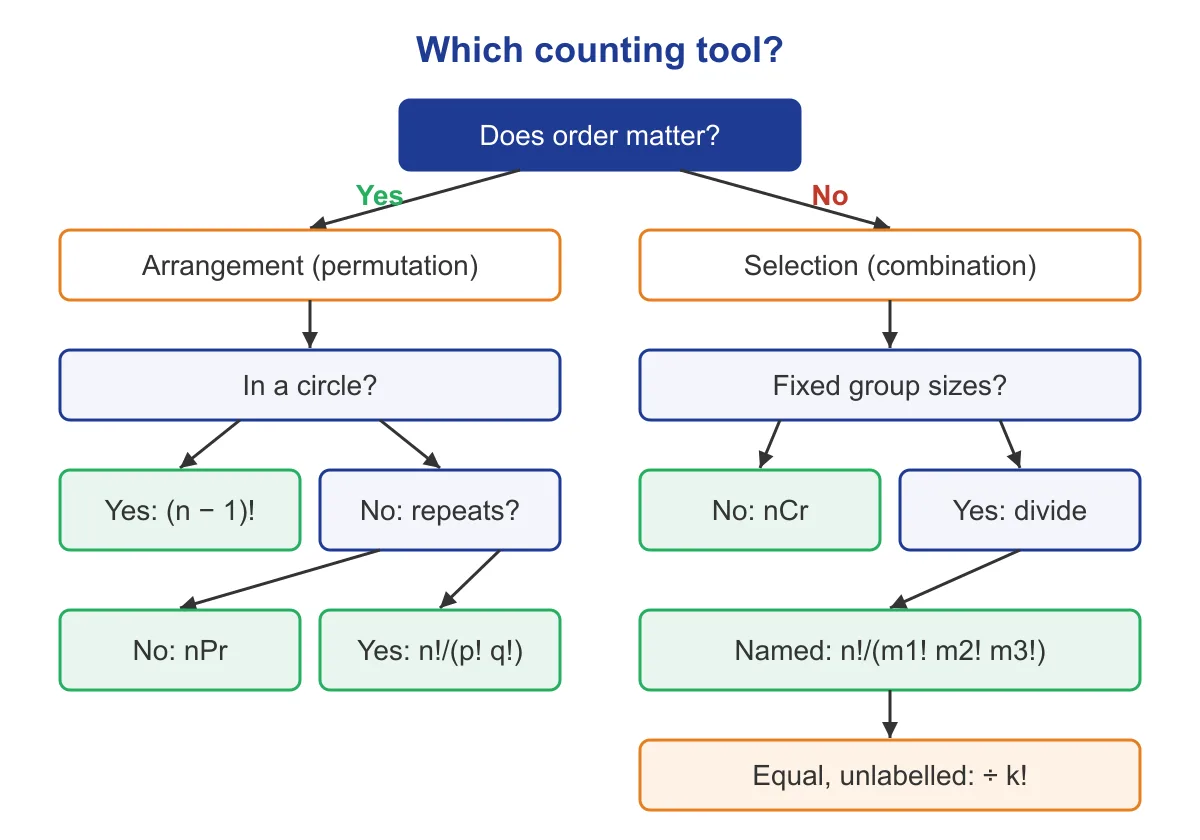
Figure 3.1: Choosing the right counting tool
Here is the summary of the main formulas you will keep reaching for.
| Situation | Count |
|---|---|
| Arrange $r$ of $n$ different objects, no repetition | $^nP_r = \frac{n!}{(n-r)!}$ |
| Arrange all $n$ different objects in a row | $n!$ |
| Arrange $r$ places, repetition allowed | $n^r$ |
| Arrange $n$ objects, $p$ alike of one kind, $q$ alike of another | $\frac{n!}{p!\,q!}$ |
| Arrange $n$ different objects in a circle | $(n-1)!$ |
| Choose $r$ of $n$ different objects | $^nC_r = \frac{n!}{r!\,(n-r)!}$ |
Objects that are not all different
If $n$ objects contain $p$ of one kind, $q$ of a second kind and $r$ of a third kind (the rest all different), the number of distinct arrangements in a row is
The reason is simple. Pretend the $p$ identical objects were different. Then there are $n!$ arrangements. But any arrangement and the one obtained by shuffling those $p$ objects among themselves look identical in reality, and there are $p!$ such shuffles. So every real arrangement was counted $p!$ times, and we divide.
Example 2: (a) How many different arrangements of all the letters of COMMITTEE are there? (b) In how many of them are the two E's next to each other?
(a) Letters: C, O, M, M, I, T, T, E, E. That is 9 letters, with M twice, T twice, E twice.
Count $= \frac{9!}{2!\,2!\,2!} = \frac{362880}{8} = 45360$.
(b) Glue the two E's into one block EE. Now there are 8 objects: C, O, M, M, I, T, T and the block. Only M and T repeat.
Count $= \frac{8!}{2!\,2!} = \frac{40320}{4} = 10080$.
Answer: 45360 and 10080. What to notice: gluing turns "must be together" into an ordinary arrangement problem with fewer objects.
Words and digits
For word problems, list the letters first and mark which repeat. For number problems, write the places (units, tens, hundreds, ...) and fill the restricted place first. A number such as 0 at the front is never allowed in an $n$-digit number, which is where most digit-counting mistakes happen.
Numbers formed from given digits and divisible by a certain number follow a test. A number is even if its last digit is even, divisible by 5 if its last digit is 0 or 5, divisible by 4 if the number formed by its last two digits is, and divisible by 3 if its digit sum is. Fix the part the test looks at, then fill the rest freely.
When asked for the number of words, "words" means any arrangement, meaningful or not.
Rank of a word in dictionary order
To find the position of a word in the list of all its arrangements written in dictionary order, count how many words come before it, and add 1.
Go letter by letter from the left. At each position, count how many unused letters are alphabetically smaller than the letter in the word at that position. Each such smaller letter, placed there, allows all arrangements of the remaining letters. So you add (number of smaller unused letters) $\times$ (arrangements of the letters still unplaced).
When some letters repeat, count the arrangements of the remaining letters with the repeat division, and count a smaller letter once per distinct letter, not once per copy.
Example 3: Find the rank of GARDEN among all arrangements of its letters in dictionary order.
Alphabetical order of the letters: A, D, E, G, N, R.
Position 1 is G. Smaller unused letters: A, D, E, which is 3. Remaining letters: 5, so $5! = 120$ each. Add $3 \times 120 = 360$.
Position 2 is A. Smaller unused letters: none. Add 0.
Position 3 is R. Unused letters now are D, E, N, R. Smaller than R: D, E, N, which is 3. Remaining after fixing position 3: 3 letters, so $3! = 6$. Add $3 \times 6 = 18$.
Position 4 is D. Smaller unused: none. Position 5 is E. Smaller unused: none. Position 6 is N, the last letter. Add 0.
Words before GARDEN: $360 + 18 = 378$. Rank $= 378 + 1 = 379$.
Answer: 379. What to notice: the last step is always "add 1", because the word itself occupies a place.
3. Circular permutations
In a row, the positions are distinct: first, second, third. Around a round table, there is no first seat. If everybody moves one seat clockwise, the picture is the same, because every person still has the same two neighbours in the same order. So for $n$ different objects, each circular arrangement shows up as $n$ different row-style arrangements (one for each rotation). Hence
The practical method is to fix one person's seat as the reference, and arrange the other $n-1$ around that seat.
If clockwise and anticlockwise orders count as the same (a necklace or garland, which you can turn over), each arrangement has a mirror image that is a different circular arrangement but the same necklace. For $n \ge 3$ the count is $\frac{(n-1)!}{2}$.
| Case | Count |
|---|---|
| $n$ people round a table (clockwise and anticlockwise different) | $(n-1)!$ |
| $n$ different beads on a necklace or garland (can be flipped) | $\frac{(n-1)!}{2}$ |
| $n$ people round a table, two named people adjacent | $2\,(n-2)!$ |
| $n$ people in a row, two named people adjacent | $2\,(n-1)!$ |
The last two rows deserve a second look. In a circle, glue the two people into one block: that makes $n-1$ objects, arranged in $(n-2)!$ ways, and the pair can swap inside the block, giving the factor 2.
Example 4: In how many ways can 4 men and 4 women sit at a round table so that men and women alternate?
Rough work. Fix man M1 in a seat. This removes the rotation freedom.
The other 3 men must take every second seat, which are 3 definite seats: $3! = 6$ ways.
The 4 women take the 4 seats between the men: $4! = 24$ ways.
Count $= 6 \times 24 = 144$.
Answer: 144. What to notice: fix one person of the larger "fixed" group first, then the other group has plain row-like freedom.
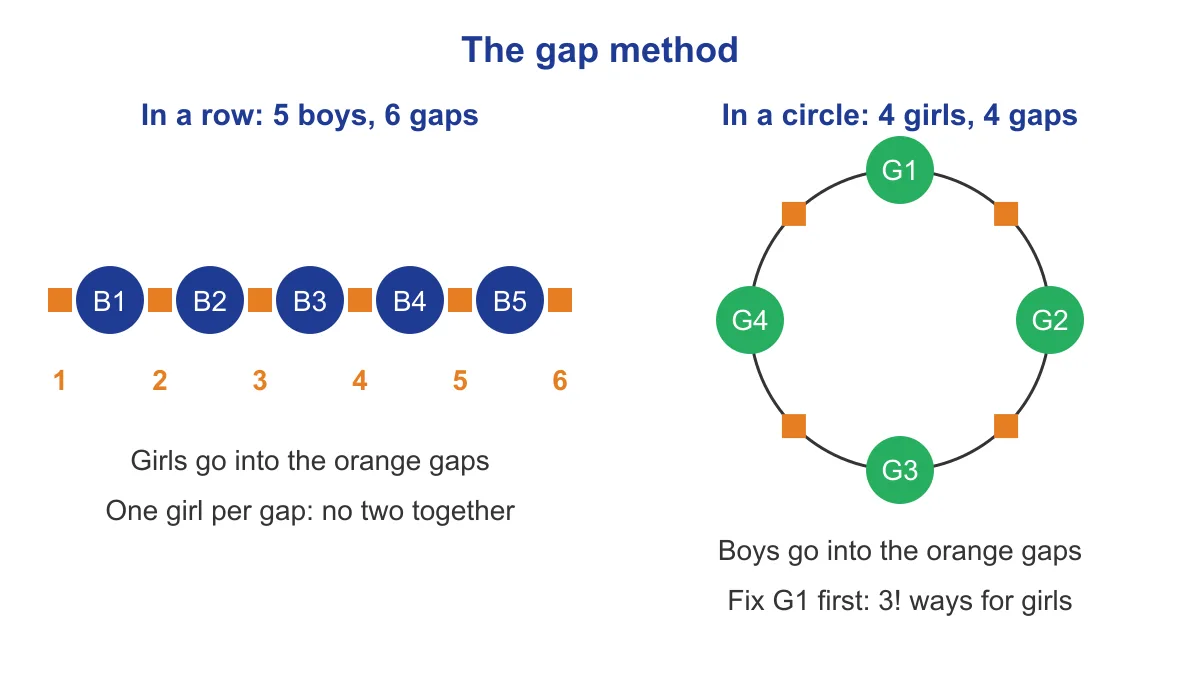
Figure 3.2: The gap method in a row and in a circle
4. Combinations and their properties
When only the selection matters and not the order (a committee, a hand of cards, a team), we count combinations. Every selection of $r$ objects can be arranged in $r!$ ways, so the permutations are $r!$ times the combinations:
Memory trick: "Committee is Combination, Position is Permutation."
Ask yourself: if I swap two chosen things, is it a new outcome? A new president and secretary pair is new, so permutation. The same committee of two is not, so combination.
Properties you should know and be able to prove in a line each:
- $^nC_r = {}^nC_{n-r}$. Choosing $r$ objects to take is the same as choosing $n-r$ to leave.
- $^nC_0 = {}^nC_n = 1$, and $^nC_1 = n$.
- $^nC_r + {}^nC_{r-1} = {}^{n+1}C_r$ (Pascal's rule). Count the selections of $r$ from $n+1$ objects by splitting on one special object: either it is left out ($^nC_r$ ways) or it is taken (the other $r-1$ come from $n$, so $^nC_{r-1}$ ways).
- $^nC_x = {}^nC_y$ means either $x = y$ or $x + y = n$.
- $^nC_r = \frac{n}{r}\;{}^{n-1}C_{r-1}$.
- The total number of ways to select any number of objects (including none) from $n$ different objects is $2^n$, because each object is independently "in" or "out". Excluding the empty selection gives $2^n - 1$.
- $^nC_r$ is largest for $r = \frac{n}{2}$ when $n$ is even, and for $r = \frac{n \pm 1}{2}$ when $n$ is odd.
Selections with restrictions
Most selection questions say "at least", "at most", "includes" or "excludes". These are the standard moves, when choosing $r$ objects from $n$ different ones.
| Condition | Count |
|---|---|
| $k$ particular objects are always included | $^{n-k}C_{r-k}$ |
| $k$ particular objects are never included | $^{n-k}C_{r}$ |
| Exactly $a$ from group A and $b$ from group B | $^{n_A}C_a \times {}^{n_B}C_b$ |
| "At least" or "at most" | add the allowed cases, or subtract the forbidden ones from the total |
The complement method is often shorter. For "at least one" the forbidden case is "none", so the answer is total minus the count with none.
Example 5: From 7 batters and 5 bowlers a squad of 6 is chosen with at least 2 bowlers. In how many ways can this be done?
Rough work. Direct counting needs cases for 2, 3, 4, 5 bowlers. Complement is quicker.
Total squads of 6 from 12 players: $^{12}C_6 = 924$.
Squads with 0 bowlers: all 6 from the 7 batters, $^7C_6 = 7$.
Squads with exactly 1 bowler: $^5C_1 \times {}^7C_5 = 5 \times 21 = 105$.
Required $= 924 - 7 - 105 = 812$.
Answer: 812. What to notice: "at least 2" has forbidden cases 0 and 1, only two of them, so subtract.
Restrictions in arrangements: the gap method
When some objects must not be adjacent, first arrange the unrestricted objects. They create gaps, including the two ends. Then place the fussy objects into distinct gaps, one per gap.
For 5 boys in a row there are 6 gaps. If 3 different girls are to sit with no two together, choose which 3 gaps and order the girls: $^6C_3 \times 3! = {}^6P_3 = 120$ ways, multiplied by $5!$ for the boys. In a circle of $m$ people there are only $m$ gaps (no ends), as the right panel of the figure shows.
Memory trick: "Seat the free ones, slot the fussy ones."
Use it whenever the question says "no two together": arrange the others first, count the gaps, then slot.
Example 8: Letters of the word DAUGHTER are arranged so that no two vowels are next to each other. Find the number of ways.
Rough work. Vowels: A, U, E, which is 3. Consonants: D, G, H, T, R, which is 5. All 8 letters are different.
Arrange the 5 consonants first: $5! = 120$ ways.
They create 6 gaps (4 between, 2 at the ends). Choose 3 gaps and arrange the 3 vowels in them: $^6P_3 = 120$.
Count $= 120 \times 120 = 14400$.
Answer: 14400. What to notice: when the fussy objects are different, the gaps must be both chosen and ordered, which is $^6P_3$, not $^6C_3$.
5. Distributing and grouping
Here the question is how to split a collection into parts. Three situations must be kept apart.
Different objects into groups of given sizes. To split $n$ different objects into groups of sizes $m_1, m_2, \dots$ with $m_1 + m_2 + \cdots = n$, and where the groups are told apart (they go to named people, or have different sizes), the count is
Choose $m_1$ objects from $n$, then $m_2$ from the rest, and so on. The product of the combinations simplifies to the formula above.
Equal-sized groups with no labels. If $k$ of the groups have the same size and nothing distinguishes them, swapping those groups gives the same grouping. Each grouping was counted $k!$ times, so divide by $k!$.
| Split of 8 different objects | Count |
|---|---|
| Groups of 5 and 3 | $\frac{8!}{5!\,3!} = 56$ |
| Two groups of 4, labelled (to A and B) | $\frac{8!}{4!\,4!} = 70$ |
| Two groups of 4, unlabelled | $\frac{70}{2!} = 35$ |
| Groups of 2, 3, 3, unlabelled | $\frac{8!}{2!\,3!\,3!\,2!} = 280$ |
If the unlabelled groups are then handed to named people, multiply by the number of ways to assign the groups to them. Groups of 2, 3, 3 given to three named people, with no rule about who gets which size, give $280 \times 3! = 1680$ ways. If it is already fixed which person gets which size, the count is $\frac{8!}{2!\,3!\,3!} = 560$.
Identical objects. If $n$ identical objects go into $k$ distinct boxes, with any box allowed to be empty, the count is $^{n+k-1}C_{k-1}$. If every box must get at least one, first put one in each, and the count is $^{n-1}C_{k-1}$. The reasoning: lay the $n$ objects in a line and place $k-1$ dividers among them.
For different objects into $k$ named boxes with no restriction, each object chooses a box independently, giving $k^n$.
Example 6: (a) In how many ways can 10 identical pencils be given to 4 children so that every child gets at least one? (b) In how many ways can 8 different gifts be divided among three named people as 3, 3, 2?
(a) Give each child one pencil first. That leaves 6 pencils for 4 children with no restriction: $^{6+4-1}C_{4-1} = {}^9C_3 = 84$.
Check with the direct formula $^{n-1}C_{k-1} = {}^9C_3 = 84$. Same.
(b) The sizes 3, 3, 2 are given to named people, say 3 to A, 3 to B, 2 to C. Choose A's three, then B's three from the rest: $^8C_3 \times {}^5C_3 = 56 \times 10 = 560$. C gets the last 2.
Answer: 84 and 560. What to notice: the word "named" means no dividing by repeated groups.
6. Counting from points and polygons
For $n$ points in a plane, no three on a line, every pair of points gives a line and every triple gives a triangle: $^nC_2$ lines and $^nC_3$ triangles.
If $m$ of the points lie on one line, then those $m$ points do not give $^mC_2$ different lines, they give only one. They also give no triangles. So
A diagonal joins two vertices that are not neighbours. A convex polygon with $n$ vertices has $^nC_2$ pairs of vertices, and $n$ of those pairs are sides. So
For a hexagon this gives $\frac{6 \times 3}{2} = 9$.
Example 7: Nine points lie in a plane, and exactly 4 of them are on one straight line. No other three are collinear. Find the number of lines and the number of triangles.
Lines: if there were no collinear points, $^9C_2 = 36$. The 4 collinear points were counted as $^4C_2 = 6$ lines but are really 1 line. Lines $= 36 - 6 + 1 = 31$.
Triangles: $^9C_3 = 84$. The collinear points give $^4C_3 = 4$ fake triangles. Triangles $= 84 - 4 = 80$.
Answer: 31 lines and 80 triangles. What to notice: collinear points cut the triangle count but they also merge lines, and the merge is a "+1", not just a subtraction.
When the problem asks for a figure formed by choosing lines (for instance, a triangle needs three vertices), identify what choice determines the figure, then count that choice and correct for any choices that fail to give the figure.
Common traps
- Using $^nP_r$ for a selection problem (committee, team, hand of cards) → if swapping the chosen objects gives the same outcome, use $^nC_r$.
- Forgetting that a 0 cannot lead an $n$-digit number → fill the leading place first, or count with 0 allowed and subtract those starting with 0.
- Dividing by $p!$ for repeated letters but treating the glued block as if it still contained repeats inside → after gluing, recount which letters really repeat in the new list of objects.
- Writing $n!$ for people around a round table → fix one person and write $(n-1)!$.
- Using $\frac{(n-1)!}{2}$ for every circular problem → halve only when the circle can be turned over (necklace, garland, bracelet), not for people seated at a table.
- Dividing by the factorial of repeated group sizes when the groups are named or labelled → divide only when equal-sized groups cannot be told apart.
- Subtracting $^mC_2$ for collinear points and stopping → add 1 back, because the $m$ points still give one line.
- In "at least" problems, listing only some of the cases → either list every allowed case, or subtract all forbidden cases from the total.
- In "no two together" problems, taking $^nC_r$ gaps and forgetting the order of different objects → multiply by the arrangements of the objects being slotted in, or use $^{n+1}P_r$ directly.
- Counting the diagonals of a polygon as $^nC_2$ → subtract the $n$ sides.
Quick revision
- Multiplication rule for "and then", addition rule for "or"; stages must be independent, cases must be disjoint.
- $n! = n(n-1)\cdots 1$ and $0! = 1$.
- $^nP_r = \frac{n!}{(n-r)!}$, $^nP_n = n!$, with repetition allowed the count is $n^r$.
- $n$ objects with $p$, $q$, $r$ alike of three kinds: $\frac{n!}{p!\,q!\,r!}$.
- Circular arrangement of $n$ different objects: $(n-1)!$; if it can be flipped (necklace), $\frac{(n-1)!}{2}$.
- $^nC_r = \frac{n!}{r!\,(n-r)!}$ and $^nP_r = r!\;{}^nC_r$.
- $^nC_r = {}^nC_{n-r}$, and $^nC_x = {}^nC_y$ gives $x = y$ or $x + y = n$.
- Pascal's rule: $^nC_r + {}^nC_{r-1} = {}^{n+1}C_r$.
- Selecting any number of objects from $n$ different ones: $2^n$ with the empty selection, $2^n - 1$ without.
- Choose $r$ from $n$ with $k$ fixed members always in: $^{n-k}C_{r-k}$; never in: $^{n-k}C_r$.
- Different objects into labelled groups of sizes $m_1, m_2, \dots$: $\frac{n!}{m_1!\,m_2!\cdots}$; divide by $k!$ for $k$ equal unlabelled groups.
- $n$ identical objects into $k$ boxes: $^{n+k-1}C_{k-1}$ (empty allowed), $^{n-1}C_{k-1}$ (each at least one).
- Points: lines $^nC_2 - {}^mC_2 + 1$ and triangles $^nC_3 - {}^mC_3$ when $m$ points are collinear; diagonals of an $n$-gon $\frac{n(n-3)}{2}$.
- Rank of a word: add (smaller unused letters) $\times$ (arrangements of the rest) at each position, then add 1.
Practice questions
How many different arrangements can be made using all the letters of the word LEVEL?
- 30
- 120
- 15
- 60
Answer
A. 30
The word has 5 letters with L twice and E twice. Count $=\frac{5!}{2!\,2!}=\frac{120}{4}=30$.
If $^nP_2 = 56$, then $n$ is
- 28
- 7
- 8
- 9
Answer
C. 8
$^nP_2=n(n-1)=56$, so $n^2-n-56=0$, $(n-8)(n+7)=0$, $n=8$ since $n>0$. Check: $8\times7=56$.
The value of $^{12}C_5 + {}^{12}C_6$ equals
- $^{24}C_{11}$
- $^{12}C_{11}$
- $^{13}C_5$
- $^{13}C_6$
Answer
D. $^{13}C_6$
By Pascal's rule $^nC_r+{}^nC_{r-1}={}^{n+1}C_r$ with $n=12$, $r=6$: the sum is $^{13}C_6$. Numerically $792+924=1716={}^{13}C_6$.
Seven people sit around a round table. In how many ways can they sit if two particular people, Asha and Ravi, must be next to each other?
- 120
- 240
- 1440
- 720
Answer
B. 240
Treat Asha and Ravi as one block: 6 objects in a circle give $5!=120$ ways. The pair can swap inside the block, so $120\times2=240$.
A convex polygon has 12 sides. The number of its diagonals is
- 132
- 60
- 54
- 66
Answer
C. 54
Pairs of vertices: $^{12}C_2=66$. Remove the 12 sides: $66-12=54$. Also $\frac{n(n-3)}{2}=\frac{12\times9}{2}=54$.
How many 4-digit numbers with all digits different can be formed using the digits 0 to 9?
- 4500
- 4536
- 5040
- 3024
Answer
B. 4536
Thousands place: 9 choices (not 0). Then 9, 8, 7 choices for the remaining places (0 is now allowed, one digit used). Count $=9\times9\times8\times7=4536$.
Ten points lie in a plane and exactly 4 of them are collinear; no other three are collinear. The number of triangles with vertices among these points is
- 116
- 114
- 120
- 96
Answer
A. 116
All triples: $^{10}C_3=120$. The 4 collinear points give $^4C_3=4$ triples that are not triangles. $120-4=116$.
In how many ways can 9 different books be put into three bundles of 3 books each, if the bundles are not labelled?
- 1680
- 840
- 560
- 280
Answer
D. 280
Labelled bundles: $\frac{9!}{3!\,3!\,3!}=1680$. The three equal bundles can be reordered in $3!=6$ ways without changing the grouping, so divide: $\frac{1680}{6}=280$.
A committee of 4 is to be chosen from 6 men and 4 women with at least 2 women. The number of ways is
- 114
- 90
- 115
- 168
Answer
C. 115
Total $^{10}C_4=210$. No woman: $^6C_4=15$. Exactly one woman: $4\times{}^6C_3=80$. Required $=210-15-80=115$. Direct: $6\cdot15+4\cdot6+1=115$.
The number of different arrangements of the letters of the word SUCCESS is
- 420
- 840
- 5040
- 2520
Answer
A. 420
7 letters: S three times, C twice. Count $=\frac{7!}{3!\,2!}=\frac{5040}{12}=420$.
At a gathering of 10 people, every two people shake hands exactly once. The total number of handshakes is
- 55
- 100
- 90
- 45
Answer
D. 45
A handshake is an unordered pair: $^{10}C_2=\frac{10\times9}{2}=45$. The value 90 counts each handshake twice.
All arrangements of the letters of the word TRAIN are written in dictionary order. The rank of TRAIN is
- 116
- 115
- 121
- 114
Answer
B. 115
Order: A, I, N, R, T. Words starting with A, I, N, R: $4\times4!=96$. Starting with T, second letter smaller than R among A, I, N, R: A, I, N gives $3\times3!=18$. Then A, I, N in order add 0. Before TRAIN: 114, so rank 115.
Five boys and three girls, all different, stand in a row so that no two girls are together. The number of ways is
- 2400
- 4800
- 14400
- 28800
Answer
C. 14400
Boys first: $5!=120$. They make 6 gaps; the 3 different girls take 3 of them in order: $^6P_3=120$. Total $120\times120=14400$. The value 2400 treats the girls as identical.
In how many ways can 6 identical sweets be distributed among 3 children if a child may get none?
- 729
- 28
- 216
- 20
Answer
B. 28
Solutions of $x_1+x_2+x_3=6$ in non-negative integers: $^{6+3-1}C_{3-1}={}^8C_2=28$. The values 729 and 216 treat the sweets as different.
The value of $^8C_3$ is
- 56
- 28
- 336
- 24
Answer
A. 56
$^8C_3=\frac{8\times7\times6}{3\times2\times1}=56$. The value 336 is $^8P_3$.
The number of distinct arrangements of all the letters of the word BANANA is
- 360
- 120
- 720
- 60
Answer
D. 60
6 letters: A three times, N twice. $\frac{6!}{3!\,2!}=\frac{720}{12}=60$.
How many 3-digit even numbers with all digits different can be formed from the digits 1, 2, 3, 4, 5?
- 60
- 48
- 24
- 36
Answer
C. 24
Units digit 2 or 4: 2 choices. Hundreds digit: 4 left. Tens digit: 3 left. Count $=2\times4\times3=24$.
A convex polygon has 35 diagonals. The number of its sides is
- 10
- 9
- 12
- 11
Answer
A. 10
$\frac{n(n-3)}{2}=35$ gives $n^2-3n-70=0$, $(n-10)(n+7)=0$, so $n=10$. Check: $\frac{10\times7}{2}=35$.
The number of arrangements of all the letters of the word MISSISSIPPI is
- 17325
- 34650
- 69300
- 138600
Answer
B. 34650
11 letters: I four times, S four times, P twice. $\frac{11!}{4!\,4!\,2!}=\frac{39916800}{1152}=34650$.
The number of ways in which 7 different beads can be strung on a necklace is
- 5040
- 2520
- 720
- 360
Answer
D. 360
A necklace can be turned over, so the count is $\frac{(7-1)!}{2}=\frac{720}{2}=360$. The value 720 would suit people at a round table.
How many numbers greater than 1000 and less than 5000 can be formed from the digits 0, 1, 2, 3, 4, 5 if no digit is repeated?
- 240
- 96
- 300
- 360
Answer
A. 240
Such numbers have 4 digits, and the first digit is 1, 2, 3 or 4: 4 choices. The other three places take $5\times4\times3=60$. Count $=4\times60=240$.
In how many ways can a team of 5 be selected from 12 players if two particular players must be in the team?
- 210
- 120
- 792
- 252
Answer
B. 120
With two players fixed, choose the other 3 from the remaining 10: $^{10}C_3=\frac{10\times9\times8}{6}=120$.
Twelve points lie in a plane and exactly 5 of them are collinear; no other three are collinear. The number of triangles formed is
- 220
- 215
- 210
- 100
Answer
C. 210
All triples $^{12}C_3=220$. The 5 collinear points give $^5C_3=10$ triples that fail. $220-10=210$.
The number of ways of dividing 8 different persons into three unlabelled groups of sizes 2, 3 and 3 is
- 1120
- 140
- 560
- 280
Answer
D. 280
Labelled: $\frac{8!}{2!\,3!\,3!}=560$. The two groups of 3 are interchangeable, so divide by $2!$: $280$.
The number of 4-letter arrangements (with or without meaning) that can be made from the letters of the word BALLOON is
- 264
- 270
- 336
- 120
Answer
B. 270
Letters: B, A, N, L (twice), O (twice). All different, from B, A, L, O, N: $^5P_4=120$. One pair (L or O) plus two others: $2\times{}^4C_2\times\frac{4!}{2!}=2\times6\times12=144$. Two pairs LLOO: $\frac{4!}{2!\,2!}=6$. Total $120+144+6=270$.
How many 5-digit numbers divisible by 4 can be formed from the digits 1, 2, 3, 4, 5 if digits may repeat?
- 500
- 750
- 625
- 3125
Answer
C. 625
The last two digits must form a multiple of 4: 12, 24, 32, 44, 52, which is 5 pairs. The first three digits are free: $5^3=125$. Count $=125\times5=625$.
Given below are two statements: Statement I: The number of ways 6 different people can sit around a round table is $5!$. Statement II: The number of ways 6 different beads can be strung on a necklace is also $5!$.
- Both Statement I and Statement II are correct
- Both Statement I and Statement II are incorrect
- Statement I is correct but Statement II is incorrect
- Statement I is incorrect but Statement II is correct
Answer
C. Statement I is correct but Statement II is incorrect
Statement I is correct: fix one person, arrange 5 others. Statement II is incorrect: a necklace can be turned over, so the count is $\frac{5!}{2}=60$.
Given below are two statements: Statement I: $0! = 0$. Statement II: $^nC_0 = 1$ for every positive integer $n$.
- Both Statement I and Statement II are correct
- Both Statement I and Statement II are incorrect
- Statement I is correct but Statement II is incorrect
- Statement I is incorrect but Statement II is correct
Answer
D. Statement I is incorrect but Statement II is correct
Statement I is incorrect: $0!=1$ by definition. Statement II is correct: there is exactly one way to choose nothing, and $\frac{n!}{0!\,n!}=1$.
Given below are two statements: Statement I: The letters of the word ALOOF can be arranged in 60 ways. Statement II: The letters of the word BOOK can be arranged in 12 ways.
- Both Statement I and Statement II are correct
- Both Statement I and Statement II are incorrect
- Statement I is correct but Statement II is incorrect
- Statement I is incorrect but Statement II is correct
Answer
A. Both Statement I and Statement II are correct
ALOOF: $\frac{5!}{2!}=60$. BOOK: $\frac{4!}{2!}=12$. Both statements are correct.
Given below are two statements: Statement I: A hexagon has 15 diagonals. Statement II: Eight points in a plane, no three collinear, form 336 triangles.
- Both Statement I and Statement II are correct
- Both Statement I and Statement II are incorrect
- Statement I is correct but Statement II is incorrect
- Statement I is incorrect but Statement II is correct
Answer
B. Both Statement I and Statement II are incorrect
Hexagon: $\frac{6\times3}{2}=9$ diagonals, so Statement I is wrong (15 is $^6C_2$, which includes sides). Triangles: $^8C_3=56$, not $336$ (which is $^8P_3$). Both are incorrect.
Given below are two statements: Statement I: The number of committees of 3 chosen from 7 people in which one particular person is not included is $^6C_2$. Statement II: The number of committees of 3 chosen from 7 people in which one particular person is included is $^6C_2$.
- Both Statement I and Statement II are correct
- Both Statement I and Statement II are incorrect
- Statement I is correct but Statement II is incorrect
- Statement I is incorrect but Statement II is correct
Answer
D. Statement I is incorrect but Statement II is correct
Excluding the person leaves 6 people to choose 3 from: $^6C_3=20$, so Statement I is incorrect. Including the person leaves 2 more from 6: $^6C_2=15$, so Statement II is correct.
Assertion (A): Five people can be seated in a row in 120 ways but around a round table in only 24 ways. Reason (R): In a circular arrangement, rotating everyone by one seat gives the same arrangement, so each circular arrangement corresponds to 5 row arrangements.
- Both A and R are true and R is the correct explanation of A
- Both A and R are true but R is not the correct explanation of A
- A is true but R is false
- A is false but R is true
Answer
A. Both A and R are true and R is the correct explanation of A
$5!=120$ and $4!=24$. The 5 rotations of a circle are the same circular arrangement, so $\frac{120}{5}=24$. R explains A.
Assertion (A): Seven different people can sit around a round table in 720 ways. Reason (R): $n$ different objects can be arranged in a row in $n!$ ways.
- Both A and R are true and R is the correct explanation of A
- Both A and R are true but R is not the correct explanation of A
- A is true but R is false
- A is false but R is true
Answer
B. Both A and R are true but R is not the correct explanation of A
A: $(7-1)!=720$, true. R is a true statement, but A rests on fixing one person and arranging 6 others, not on the row count. R does not explain A.
Assertion (A): The number of ways of dividing 10 different objects into two groups of 5 each, with no labels on the groups, is $^{10}C_5$. Reason (R): Two groups of equal size cannot be told apart, so each grouping is counted twice in $^{10}C_5$.
- Both A and R are true and R is the correct explanation of A
- Both A and R are true but R is not the correct explanation of A
- A is true but R is false
- A is false but R is true
Answer
D. A is false but R is true
$^{10}C_5=252$ counts a group together with its complement as an ordered pair, so each unlabelled grouping appears twice; the correct count is $126$. A is false and R is true.
Match List I with List II. List I: a. Arrangements of the letters of BOOK b. Circular arrangements of 5 different people c. $^6C_2$ d. Diagonals of a convex octagon List II: i. 12 ii. 15 iii. 20 iv. 24
- a-i, b-iv, c-ii, d-iii
- a-ii, b-iv, c-i, d-iii
- a-i, b-iv, c-iii, d-ii
- a-iv, b-i, c-ii, d-iii
Answer
A. a-i, b-iv, c-ii, d-iii
a: $\frac{4!}{2!}=12$. b: $4!=24$. c: $\frac{6\times5}{2}=15$. d: $\frac{8\times5}{2}=20$. So a-i, b-iv, c-ii, d-iii.
Match List I with List II. List I: a. 3-digit numbers from the digits 1, 2, 3 with no repetition b. 3-digit numbers from the digits 1, 2, 3 with repetition allowed c. Ways to choose 2 objects from 5 different objects d. Arrangements of the letters of AAB List II: i. 3 ii. 6 iii. 10 iv. 27
- a-ii, b-i, c-iii, d-iv
- a-ii, b-iv, c-i, d-iii
- a-ii, b-iv, c-iii, d-i
- a-iv, b-ii, c-iii, d-i
Answer
C. a-ii, b-iv, c-iii, d-i
a: $3!=6$. b: $3^3=27$. c: $^5C_2=10$. d: $\frac{3!}{2!}=3$. So a-ii, b-iv, c-iii, d-i.
Match List I with List II. List I: a. Number of ways to choose $r$ of $n$ different objects b. Number of ways to arrange $r$ of $n$ different objects c. Circular arrangements of $n$ different objects d. Arrangements of $n$ objects with $p$ alike of one kind and $q$ alike of another List II: i. $(n-1)!$ ii. $\frac{n!}{(n-r)!}$ iii. $\frac{n!}{p!\,q!}$ iv. $\frac{n!}{r!\,(n-r)!}$
- a-ii, b-iv, c-i, d-iii
- a-iv, b-i, c-ii, d-iii
- a-iv, b-ii, c-iii, d-i
- a-iv, b-ii, c-i, d-iii
Answer
D. a-iv, b-ii, c-i, d-iii
Choosing is $\frac{n!}{r!(n-r)!}$ (iv), arranging is $\frac{n!}{(n-r)!}$ (ii), circle is $(n-1)!$ (i), repeats give $\frac{n!}{p!q!}$ (iii).
The letters of the word DAUGHTER are arranged so that all three vowels occupy even-numbered places (2nd, 4th, 6th, 8th) of the 8 places. The number of such arrangements is
- 2880
- 14400
- 1440
- 5760
Answer
A. 2880
Vowels A, U, E go into 3 of the 4 even places in order: $^4P_3=24$. The 5 consonants fill the remaining 5 places: $5!=120$. Total $24\times120=2880$.
A team of 5 is chosen from 7 men and 5 women so that it contains at least 3 women. The number of ways is
- 210
- 252
- 246
- 245
Answer
C. 246
3 women, 2 men: $^5C_3\times{}^7C_2=10\times21=210$. 4 women, 1 man: $5\times7=35$. 5 women: 1. Total $210+35+1=246$.
Three different boys and four different girls sit around a round table so that no two boys sit next to each other. The number of ways is
- 720
- 144
- 288
- 24
Answer
B. 144
Seat the girls first: $(4-1)!=6$ ways. They create 4 gaps. The boys take 3 of the 4 gaps in order: $^4P_3=24$. Total $6\times24=144$.