Binomial Theorem
What to remember
- For a positive integer $n$: $(a+b)^n = \sum_{r=0}^{n}\binom{n}{r}a^{n-r}b^{r}$. There are $n+1$ terms, and the general term is $T_{r+1}=\binom{n}{r}a^{n-r}b^{r}$.
- The middle term is one term when $n$ is even (the $\left(\frac{n}{2}+1\right)$th) and two terms when $n$ is odd (the $\frac{n+1}{2}$th and the $\frac{n+3}{2}$th).
- Every "coefficient of $x^k$" or "term independent of $x$" question is the same job: write the power of $x$ in $T_{r+1}$, set it equal to $k$, solve for $r$, and accept the answer only if $r$ is a whole number from $0$ to $n$.
- Putting $x=1$ and $x=-1$ in $(1+x)^n$ gives $\sum \binom{n}{r}=2^n$, the alternating sum $0$, and the even-place sum equal to the odd-place sum, each $2^{n-1}$.
- For remainders and approximations, rewrite the number as (a multiple of the divisor $\pm 1$) raised to the power, or as $(1+\text{small})^n$, and keep only the first few terms.
1. The theorem and why it is true
Multiply out a few small cases and look at the numbers in front:
The powers of $a$ fall by one each step, the powers of $b$ rise by one, and in every term the two powers add up to $n$. What needs explaining is the number in front.
Write $(a+b)^n$ as $n$ brackets $(a+b)(a+b)\cdots(a+b)$. To get a term, you pick either $a$ or $b$ from each bracket and multiply. If you pick $b$ from exactly $r$ of the brackets, you must have picked $a$ from the other $n-r$, and the product is $a^{n-r}b^{r}$. The number of ways to choose which $r$ brackets give $b$ is $\binom{n}{r}$. So $a^{n-r}b^{r}$ appears $\binom{n}{r}$ times, which is the whole theorem:
This holds for a positive integer $n$ and any numbers or expressions $a$ and $b$. We often write $C_r$ or $^nC_r$ for $\binom{n}{r}$, and $C_0,C_1,\dots,C_n$ for the whole list of binomial coefficients.
Changing the sign of $b$ only flips the sign of the odd-numbered powers of $b$:
Three facts you will use constantly:
- The expansion has $n+1$ terms.
- The coefficients of terms equally far from the two ends are equal, because $\binom{n}{r}=\binom{n}{n-r}$.
- Swapping $a$ and $b$ reverses the order of the terms and changes nothing else.
2. The general term
The term with $b^{r}$ is called the $(r+1)$th term, because $r$ starts at $0$:
Mind the shift. The 5th term uses $r=4$, not $r=5$. Most lost marks in this chapter come from this single off-by-one.
Term from the end. Counting from the last term backwards, the $k$th term from the end is the $(n-k+2)$th term from the beginning. Check with $k=1$: the last term is the $(n+1)$th, correct. Equivalently, the $k$th term from the end of $(a+b)^n$ is the $k$th term from the start of $(b+a)^n$, which is often the quicker way to think of it.
Example 1: Expand $\left(2x-\frac{1}{x}\right)^4$.
Here $a=2x$, $b=-\frac1x$, $n=4$, so $T_{r+1}=\binom{4}{r}(2x)^{4-r}\left(-\frac1x\right)^{r}$.
$r=0$: $1\cdot 16x^4 = 16x^4$.
$r=1$: $4\cdot 8x^3\cdot\left(-\frac1x\right) = -32x^2$.
$r=2$: $6\cdot 4x^2\cdot\frac{1}{x^2} = 24$.
$r=3$: $4\cdot 2x\cdot\left(-\frac{1}{x^3}\right) = -\frac{8}{x^2}$.
$r=4$: $1\cdot 1\cdot\frac{1}{x^4} = \frac{1}{x^4}$.
Answer: $16x^4-32x^2+24-\frac{8}{x^2}+\frac{1}{x^4}$.
Check: put $x=1$. The left side is $(2-1)^4=1$ and the right side is $16-32+24-8+1=1$. A check like this takes ten seconds and catches sign slips. The signs alternate because $b$ is negative, and the powers of $x$ drop by $2$ each step because $2x$ and $\frac1x$ have powers differing by $2$.
A quick use of this: the 3rd term from the end of $(2+x)^7$ is the $(7-3+2)=6$th term from the start, $\binom75 2^{2}x^{5}=84x^5$. You can confirm it by listing the last three terms in order: $x^7$, then $14x^6$, then $84x^5$.
When $a$ and $b$ are themselves messy, such as $\sqrt{x}$ and $\frac{1}{x^2}$, do not simplify early. Write each as a power of $x$ first ($x^{1/2}$ and $x^{-2}$), because then the exponent of $x$ in $T_{r+1}$ is just $\frac{n-r}{2}-2r$, and the arithmetic stays clean. Fractional powers inside the bracket are fine; only the index $n$ must be a positive integer for this theorem.
3. Middle term(s)
There are $n+1$ terms, so the position of the middle depends on whether $n+1$ is odd or even.
- **$n$ even.** $n+1$ is odd, so there is exactly one middle term, the $\left(\frac{n}{2}+1\right)$th: $T_{\frac n2+1}=\binom{n}{n/2}a^{n/2}b^{n/2}$.
- **$n$ odd.** $n+1$ is even, so there are two middle terms, the $\frac{n+1}{2}$th and the $\frac{n+3}{2}$th: with $n=2m+1$ these are $T_{m+1}$ and $T_{m+2}$.
| $n$ | Terms in all | Middle term(s) | Example |
|---|---|---|---|
| even, $n=2m$ | $2m+1$ | $T_{m+1}$ only | $n=8$: the 5th term |
| odd, $n=2m+1$ | $2m+2$ | $T_{m+1}$ and $T_{m+2}$ | $n=9$: the 5th and 6th terms |
Example 2: Find the middle terms of $\left(x-\frac{y}{2}\right)^7$.
$n=7$ is odd, so the middle terms are the 4th and 5th ($m=3$).
$T_4=\binom{7}{3}x^{4}\left(-\frac y2\right)^{3}=35x^4\cdot\left(-\frac{y^3}{8}\right)=-\frac{35}{8}x^4y^3$.
$T_5=\binom{7}{4}x^{3}\left(-\frac y2\right)^{4}=35x^3\cdot\frac{y^4}{16}=\frac{35}{16}x^3y^4$.
Notice that $\binom73=\binom74=35$, the same number, as it must be. The sign is negative for $T_4$ because the power of $-\frac y2$ is odd, and positive for $T_5$ because it is even.
Memory trick: "Even is alone, odd comes in twos."
Say it before every middle-term question: even $n$ gives one middle term, odd $n$ gives a pair. Then count $n+1$ terms and find the centre.
4. A given power of $x$, and the term independent of $x$
This is the most frequent type in the exams, and one method solves all of it.
- Write $T_{r+1}$ in full, including the numbers and signs.
- Collect all the powers of $x$ into a single power, in terms of $r$.
- Set that power equal to the target. For the term independent of $x$ the target is $0$.
- Solve for $r$. If $r$ is not a whole number between $0$ and $n$, there is no such term. The answer is then "does not exist", not "zero".
- Put that $r$ back and evaluate the coefficient.
For example, in $\left(x^2+\frac1x\right)^n$ the power of $x$ in $T_{r+1}$ is $2(n-r)-r=2n-3r$. The constant term needs $r=\frac{2n}{3}$, so it exists only when $n$ is a multiple of $3$.
Example 3: Find the term independent of $x$ in $\left(2x^2-\frac1x\right)^9$.
$T_{r+1}=\binom9r(2x^2)^{9-r}\left(-\frac1x\right)^r=\binom9r 2^{9-r}(-1)^r x^{18-2r-r}$.
Power of $x$: $18-3r=0$, so $r=6$. This is a whole number between $0$ and $9$, so the term exists.
Coefficient: $\binom96\cdot 2^{3}\cdot(-1)^6=84\cdot 8=672$.
Answer: $672$.
What to notice: both parts of the bracket carry numbers, so the numerical powers $2^{9-r}$ and $(-1)^r$ must be carried along. Forgetting the $2^{9-r}$ is the usual loss.
Always test the last step. If the equation for $r$ gives something like $r=\frac{7}{2}$ or $r=11$ when $n=9$, the answer to "find the term" is that no such term exists. Examiners set this on purpose, since the same bracket with $n=10$ might have a perfectly good constant term. Also note that the sign of a term depends on $r$ only through $(-1)^r$ when $b$ is negative, so an even $r$ gives a positive coefficient and an odd $r$ a negative one, provided the other numbers are positive.
Two brackets multiplied. When the expression is a product, such as $(1+x^2)^5(1+x)^4$, expand each factor separately, and then collect the ways the powers can add up to the target.
Example 4: Find the coefficient of $x^5$ in $(1+x^2)^5(1+x)^4$.
$(1+x^2)^5$ has terms $\binom5a x^{2a}$, and $(1+x)^4$ has terms $\binom4b x^{b}$ with $b\le 4$.
We need $2a+b=5$. The options: $a=0,b=5$ is not allowed since $b\le 4$. $a=1,b=3$: $\binom51\binom43=5\cdot4=20$. $a=2,b=1$: $\binom52\binom41=10\cdot4=40$.
Total $=20+40=60$.
Answer: $60$.
The skill here is listing the pairs $(a,b)$ in an orderly way and throwing out the ones that break the limits on $b$.
Sometimes the product simplifies first. Since $(1+x)^6(1-x)^6=(1-x^2)^6$, the coefficient of $x^4$ in the left side is the coefficient of $x^4$ in $(1-x^2)^6$, which is $\binom62=15$. Look for this before expanding.
5. Pascal's triangle and the shape of the coefficients
Write the coefficients of $(1+x)^n$ for $n=0,1,2,\dots$ in rows, one under another. The result is Pascal's triangle. Every row starts and ends with $1$, and every other entry is the sum of the two entries just above it. The reason is the identity
which you can prove by choosing $r$ people from $n+1$ and splitting on whether one named person is chosen: if yes, choose $r-1$ from the other $n$; if no, choose $r$ from the other $n$.
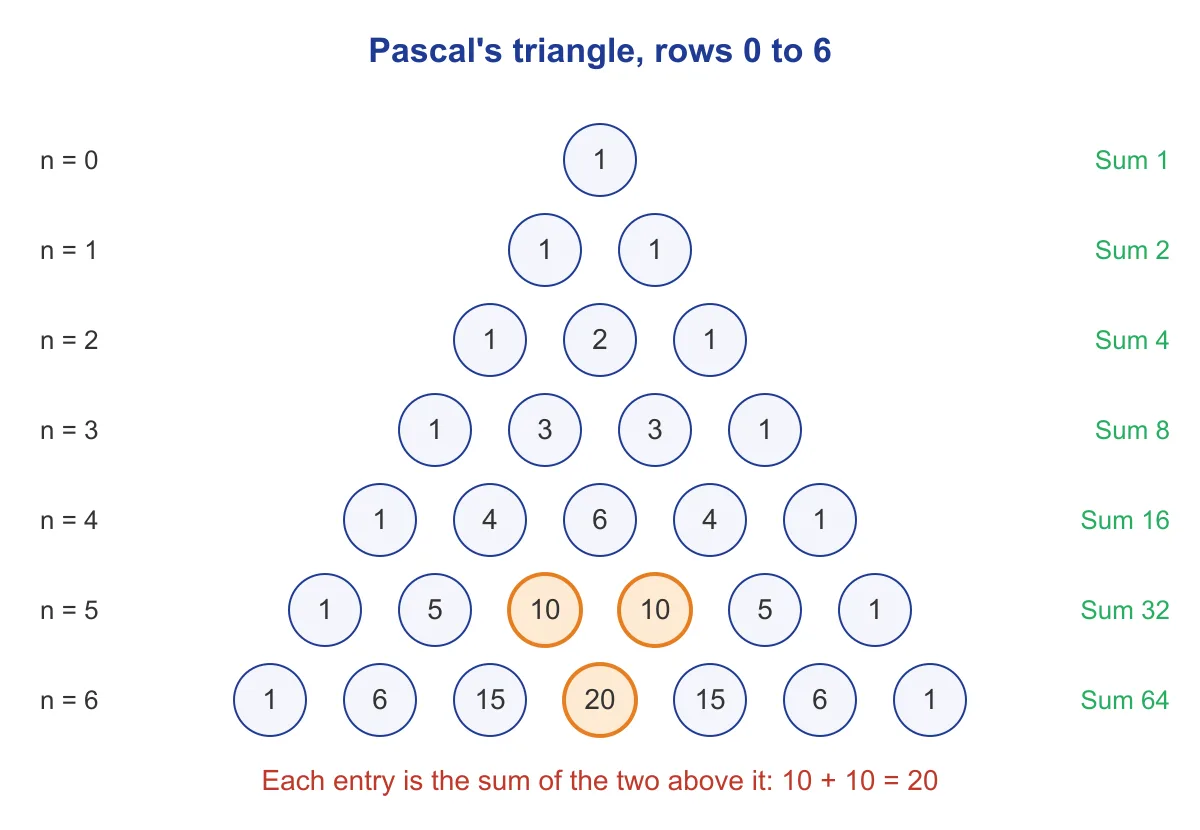
Figure 4.1: Pascal's triangle, rows 0 to 6. Each row adds up to a power of 2.
Reading the triangle gives you a lot for free:
- Each row is a mirror image of itself. This is $\binom nr=\binom n{n-r}$.
- The sum of row $n$ is $2^n$.
- Row $n$ gives the whole expansion of $(a+b)^n$ with no computing: for $n=5$ the row is $1,5,10,10,5,1$.
- The rows rise to a peak in the middle and fall away again.
The greatest binomial coefficient. Compare neighbours. For $r\ge1$,
This ratio is at least $1$ exactly when $n-r+1\ge r$, that is, when $r\le\frac{n+1}{2}$. So the coefficients keep growing until $r$ passes $\frac{n+1}2$, and then they shrink.
- If $n$ is even, the peak is at $r=\frac n2$, so the greatest coefficient is $\binom{n}{n/2}$, one value.
- If $n$ is odd, the ratio equals exactly $1$ at $r=\frac{n+1}{2}$, so $\binom n{(n-1)/2}=\binom n{(n+1)/2}$ are equal and both are greatest.
These are the coefficients of the middle terms, so the greatest coefficient sits in the middle term(s). It is the coefficient only, not the value of the term, which also depends on $a$ and $b$.
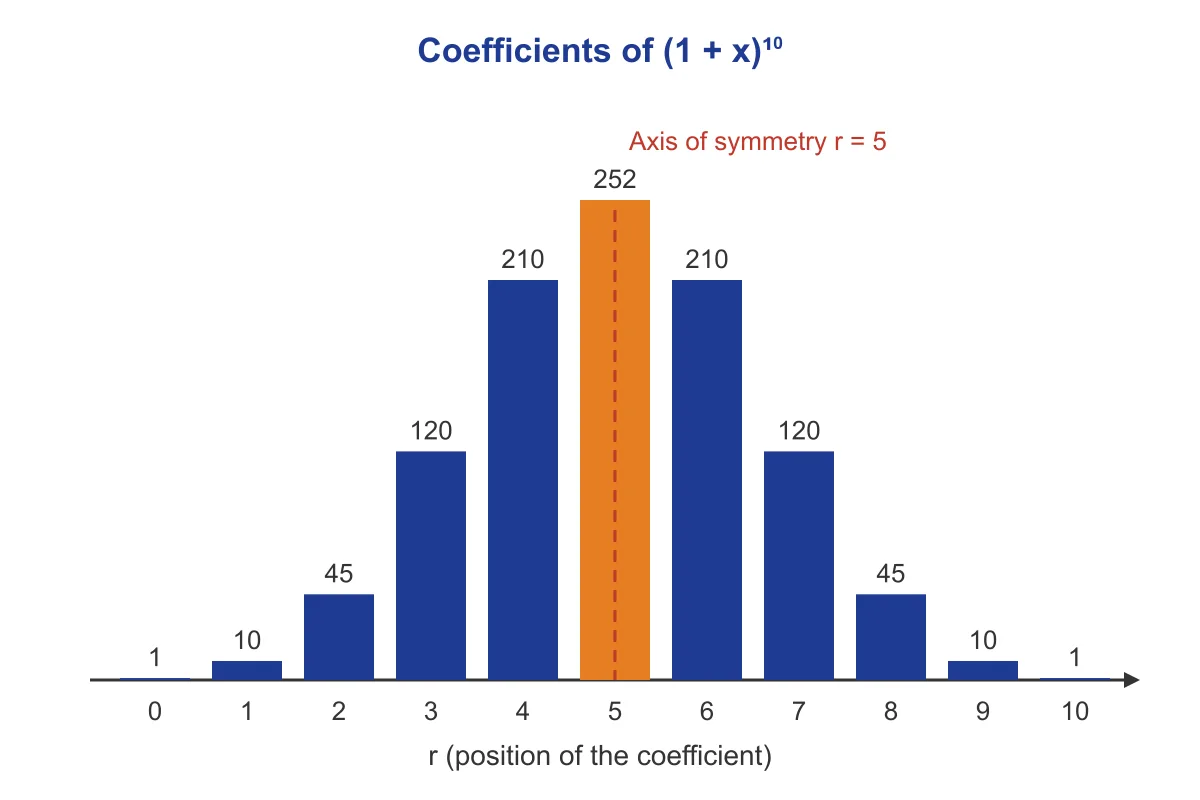
*Figure 4.2: The coefficients $\binom{10}{r}$ rise to the middle and fall symmetrically.*
Example 5: Three consecutive coefficients in the expansion of $(1+x)^n$ are in the ratio $1:3:5$. Find $n$.
Let the coefficients be $\binom n{r-1},\binom nr,\binom n{r+1}$.
First ratio: $\frac{\binom nr}{\binom n{r-1}}=\frac{n-r+1}{r}=3$, so $n=4r-1$.
Second ratio: $\frac{\binom n{r+1}}{\binom nr}=\frac{n-r}{r+1}=\frac53$, so $3(n-r)=5(r+1)$, that is $3n=8r+5$.
Put $n=4r-1$ in: $12r-3=8r+5$, so $r=2$, and $n=7$.
Check: $\binom71,\binom72,\binom73=7,21,35$, and $7:21:35=1:3:5$.
Answer: $n=7$.
The ratio formula $\frac{n-r+1}{r}$ is the tool for every "consecutive coefficients" problem. It turns factorials into plain fractions.
Memory trick: "Down by one, up by one, over the next."
To get the next coefficient from the last one, multiply by $\frac{n-r+1}{r}$: the top goes down by one each time, the bottom goes up by one. Say it as you step along the row.
6. Sums of binomial coefficients
Put $a=1$ and $b=x$:
This is an identity in $x$, so you may put in any value of $x$ you like. Two choices do almost all the work.
- $x=1$: $C_0+C_1+C_2+\dots+C_n=2^n$.
- $x=-1$: $C_0-C_1+C_2-\dots+(-1)^nC_n=0$, for $n\ge1$.
Add these two results, and the odd-place terms cancel. Subtract them, and the even-place terms cancel. Either way,
The same trick works on any polynomial. If $f(x)$ is a polynomial, then:
| What you want | Value |
|---|---|
| Sum of all coefficients | $f(1)$ |
| Constant term | $f(0)$ |
| Sum of coefficients of even powers | $\frac{f(1)+f(-1)}{2}$ |
| Sum of coefficients of odd powers | $\frac{f(1)-f(-1)}{2}$ |
| Alternating sum $a_0-a_1+a_2-\dots$ | $f(-1)$ |
Other values of $x$ give other sums. For example, $x=2$ gives $C_0+2C_1+4C_2+\dots+2^nC_n=3^n$.
A useful companion identity is $r\binom nr=n\binom{n-1}{r-1}$. It comes from writing both sides out in factorials. It is how you handle sums with a factor $r$ in front: $\sum r\binom nr=n\sum\binom{n-1}{r-1}=n\cdot2^{n-1}$.
Example 6: Find the sum of the coefficients of the odd powers of $x$ in $(2x-1)^7$.
Let $f(x)=(2x-1)^7$. Then $f(1)=1^7=1$ and $f(-1)=(-3)^7=-2187$.
Sum of odd-power coefficients $=\frac{f(1)-f(-1)}{2}=\frac{1+2187}{2}=1094$.
Check: the even-power sum is $\frac{1-2187}{2}=-1093$. The two add to $1$, which equals $f(1)$, the sum of all coefficients.
Answer: $1094$.
Do not hunt for individual terms. A pair of substitutions replaces eight terms of work.
Memory trick: "Plus one, minus one, halve it."
Put $x=1$ and $x=-1$, then add and halve for the even powers, subtract and halve for the odd powers.
7. Simple applications
Remainders
If a number is written as $(M\pm1)^k$ where $M$ is a multiple of the divisor, then in the expansion every term except the last is a multiple of $M$. So only the last term, $(\pm1)^k$, matters for the remainder.
Example 7: Find the remainder when $5^{99}$ is divided by $13$.
$5^2=25=26-1$, so $5^{99}=5\cdot(5^2)^{49}=5\cdot(26-1)^{49}$.
In $(26-1)^{49}$ every term except the last has a factor $26$, so $(26-1)^{49}=26k+(-1)^{49}=26k-1$ for some integer $k$.
So $5^{99}=5(26k-1)=130k-5$. A remainder cannot be negative, and $-5=-13+8$, so the remainder is $8$.
Check by another route: $5^4=625=13\cdot48+1$, so $5^{96}\equiv1$ and $5^{99}\equiv5^3=125=9\cdot13+8$. Same answer.
Answer: $8$.
The step people skip is the last one. A negative leftover must be pushed up by the divisor before you call it a remainder.
A neat variant is the last digits of a power. Writing $11^{n}=(10+1)^n=1+10n+\binom n2100+\dots$, you see that the last two digits of $11^n$ are those of $1+10n$.
Approximations
When $|x|$ is small, the terms of $(1+x)^n$ shrink fast, so a few of them are enough:
For example $(1.02)^{10}=(1+0.02)^{10}\approx1+0.2+45(0.0004)+120(0.000008)=1+0.2+0.018+0.00096=1.21896$, so $(1.02)^{10}\approx1.219$ to three decimal places. Stop when the next term cannot change the digit you want.
Comparing large numbers
Example 8: Which is larger, $101^{50}$ or $99^{50}+100^{50}$?
Write $101^{50}=(100+1)^{50}$ and $99^{50}=(100-1)^{50}$. In the difference the even-numbered terms cancel and the odd ones double:
$101^{50}-99^{50}=2\left[\binom{50}{1}100^{49}+\binom{50}{3}100^{47}+\dots\right]$.
The first term alone gives $2\cdot50\cdot100^{49}=100\cdot100^{49}=100^{50}$.
The remaining terms are all positive, so $101^{50}-99^{50}>100^{50}$.
Hence $101^{50}>99^{50}+100^{50}$.
Answer: $101^{50}$ is larger.
The idea: pair $(c+1)^n$ with $(c-1)^n$ so that half the terms cancel, then compare using only the first surviving term.
A word on method. Look at the base and ask what it is close to. A number like $99$, $101$, $26$ or $1.02$ is a small step away from a friendly number ($100$, $25$, $1$). Write it as friendly plus small, raise it to the power, and the binomial theorem tells you that the small part, once raised to a power of two or more, is either a multiple of the divisor or too tiny to matter. Choose the nearest multiple of the divisor, not just any friendly number, or the leftover terms will not vanish.
Divisibility
The same pattern shows that $(10^n-1)$ is divisible by $9$ for every positive integer $n$, since $10^n=(9+1)^n=9k+1$. Likewise $9^n-1$ is divisible by $8$, and $9^n\equiv1$ when divided by $8$.
Common traps
- Calling the $r$th term $\binom nr a^{n-r}b^r$ → the $(r+1)$th term has $\binom nr$, so the 5th term uses $r=4$.
- Forgetting the number parts of the bracket, such as the $2$ in $(2x^2-\frac1x)^9$ → carry $2^{n-r}$ and $(-1)^r$ in every term.
- Dropping the minus sign when $b$ is negative → the sign of $T_{r+1}$ is $(-1)^r$ times the sign of the rest.
- Writing "the middle term" for odd $n$ → there are two middle terms, $T_{(n+1)/2}$ and $T_{(n+3)/2}$.
- Treating a fractional or negative $r$ as a valid answer → the term exists only if $r$ is a whole number from $0$ to $n$; otherwise say there is no such term.
- Confusing the greatest coefficient with the greatest term → the greatest coefficient is $\binom{n}{n/2}$ for even $n$, but the term's value also depends on the numbers inside the bracket.
- Putting $x=1$ for the alternating sum → the alternating sum needs $x=-1$.
- Giving $2^n$ as the sum of even-place binomial coefficients → it is $2^{n-1}$, half of the total.
- Leaving a negative remainder, such as $-5$ → add the divisor until it lies between $0$ and the divisor minus one.
- Counting the terms of $(a+b)^n+(a-b)^n$ as $n+1$ → the odd-numbered powers of $b$ cancel, leaving about half the terms.
Quick revision
- $(a+b)^n=\sum_{r=0}^{n}\binom nr a^{n-r}b^r$ for positive integer $n$; it has $n+1$ terms.
- $T_{r+1}=\binom nr a^{n-r}b^r$; the $k$th term from the end is the $(n-k+2)$th from the start.
- $(a-b)^n$ has the same coefficients with signs $(-1)^r$.
- Middle term: $T_{n/2+1}$ for even $n$; $T_{(n+1)/2}$ and $T_{(n+3)/2}$ for odd $n$.
- Set the power of $x$ in $T_{r+1}$ equal to the target to find $r$; $r$ must be a whole number in $[0,n]$.
- $\binom nr=\binom n{n-r}$ and $\binom nr+\binom n{r-1}=\binom{n+1}r$.
- $\frac{\binom nr}{\binom n{r-1}}=\frac{n-r+1}{r}$, the tool for consecutive coefficients.
- Greatest coefficient: $\binom n{n/2}$ for even $n$; $\binom n{(n-1)/2}=\binom n{(n+1)/2}$ for odd $n$.
- $C_0+C_1+\dots+C_n=2^n$.
- $C_0-C_1+C_2-\dots=0$ for $n\ge1$.
- $C_0+C_2+C_4+\dots=C_1+C_3+C_5+\dots=2^{n-1}$.
- For a polynomial $f$: sum of coefficients $=f(1)$; even powers $\frac{f(1)+f(-1)}2$; odd powers $\frac{f(1)-f(-1)}2$.
- $r\binom nr=n\binom{n-1}{r-1}$, so $\sum r\binom nr=n2^{n-1}$.
- Row $n$ of Pascal's triangle is the list of coefficients of $(1+x)^n$ and adds to $2^n$.
- Remainders: write the base as (multiple of the divisor $\pm1$)$^k$ and keep only the last term; approximations: $(1+x)^n\approx1+nx+\binom n2x^2$ for small $x$.
Practice questions
How many terms are there in the expansion of $(2x+3y)^{12}$?
- $24$
- $14$
- $13$
- $12$
Answer
C. $13$
A positive integer index $n$ gives $n+1$ terms, so $12+1=13$.
What is the fifth term in the expansion of $\left(x+\frac{2}{x}\right)^8$?
- $560$
- $70$
- $1680$
- $1120$
Answer
D. $1120$
The fifth term uses $r=4$: $\binom84x^4\left(\frac2x\right)^4=70\cdot16=1120$. The powers of $x$ cancel.
The sum of all the binomial coefficients in the expansion of $(x+y)^9$ is
- $511$
- $512$
- $1024$
- $256$
Answer
B. $512$
Put $x=y=1$: $\sum\binom9r=2^9=512$.
The middle term in the expansion of $(1+x)^{2n}$ is
- $\binom{2n}{n}x^n$
- $\binom{2n}{n-1}x^{n-1}$
- $\binom{2n+1}{n}x^n$
- $\binom{2n}{n+1}x^{n+1}$
Answer
A. $\binom{2n}{n}x^n$
The index $2n$ is even, so the middle term is the $(n+1)$th, $T_{n+1}=\binom{2n}{n}x^n$.
The term containing $x^3$ in the expansion of $\left(x^2-\frac1x\right)^6$ is
- $20x^3$
- $15x^3$
- $-15x^3$
- $-20x^3$
Answer
D. $-20x^3$
$T_{r+1}=\binom6r(-1)^rx^{12-2r-r}$. Set $12-3r=3$, so $r=3$. The term is $\binom63(-1)^3x^3=-20x^3$.
The greatest binomial coefficient in the expansion of $(1+x)^{12}$ is
- $\binom{12}{6}$
- $\binom{12}{4}$
- $\binom{12}{12}$
- $\binom{12}{5}$
Answer
A. $\binom{12}{6}$
For even $n$ the greatest coefficient is $\binom{n}{n/2}$, here $\binom{12}{6}=924$.
For a positive integer $n$, the value of $\binom n0+\binom n2+\binom n4+\dots$ is
- $2^n-1$
- $2^{n-1}$
- $2^n$
- $2^{n+1}$
Answer
B. $2^{n-1}$
Adding $(1+1)^n$ and $(1-1)^n$ gives twice the even-place sum $=2^n+0$, so the even-place sum is $2^{n-1}$.
For every positive integer $n$, the value of $\binom n0-\binom n1+\binom n2-\dots+(-1)^n\binom nn$ is
- $(-1)^n$
- $2^n$
- $0$
- $1$
Answer
C. $0$
Put $x=-1$ in $(1+x)^n$: the left side becomes the alternating sum and the right side is $0^n=0$.
For which of the following values of $n$ does the expansion of $\left(x^2+\frac1x\right)^n$ contain a term independent of $x$?
- $10$
- $11$
- $12$
- $14$
Answer
C. $12$
The power of $x$ in $T_{r+1}$ is $2n-3r$. It is $0$ when $r=\frac{2n}{3}$, which is a whole number only if $3$ divides $n$. Of the options only $12$ qualifies, with $r=8$.
The value of $\binom{20}{7}+\binom{20}{8}$ equals
- $\binom{40}{15}$
- $\binom{21}{8}$
- $\binom{21}{7}$
- $\binom{20}{15}$
Answer
B. $\binom{21}{8}$
By $\binom nr+\binom n{r-1}=\binom{n+1}{r}$ with $n=20$, $r=8$: the sum is $\binom{21}{8}$.
The number of terms in the expansion of $(x+y)^{10}+(x-y)^{10}$ is
- $6$
- $5$
- $10$
- $11$
Answer
A. $6$
Terms with odd powers of $y$ cancel and the even ones double. The powers $y^0,y^2,\dots,y^{10}$ give $6$ terms.
The third term from the end in the expansion of $(2+x)^7$ is
- $672x^2$
- $42x^5$
- $168x^5$
- $84x^5$
Answer
D. $84x^5$
The third term from the end is the $(7-3+2)=6$th term: $\binom75\cdot2^{2}x^5=21\cdot4\,x^5=84x^5$. The option $672x^2$ is the third term from the start.
The value of $\binom n0+2\binom n1+4\binom n2+\dots+2^n\binom nn$ is
- $3^n$
- $2^{n+1}$
- $4^n$
- $3^n-1$
Answer
A. $3^n$
Put $x=2$ in $(1+x)^n=\sum\binom nrx^r$: the sum is $3^n$.
The middle terms of the expansion of $(a+b)^{15}$ are
- The 8th and 10th terms
- The 7th and 8th terms
- The 7th and 9th terms
- The 8th and 9th terms
Answer
D. The 8th and 9th terms
$n=15$ is odd, so there are $16$ terms and two middle terms, the $\frac{n+1}{2}=8$th and $\frac{n+3}{2}=9$th.
What is the coefficient of $x^3$ in the expansion of $(1+2x)^5$?
- $40$
- $160$
- $80$
- $10$
Answer
C. $80$
$T_4=\binom53(2x)^3=10\cdot8x^3=80x^3$.
What is the sum of all the coefficients in the expansion of $(3x-2)^5$?
- $243$
- $1$
- $-1$
- $32$
Answer
B. $1$
Put $x=1$: $(3-2)^5=1$.
What is the term independent of $x$ in the expansion of $\left(x-\frac{2}{x^2}\right)^{12}$?
- $495$
- $3960$
- $7920$
- $-7920$
Answer
C. $7920$
$T_{r+1}=\binom{12}{r}(-2)^rx^{12-3r}$. For $12-3r=0$, $r=4$. Value: $\binom{12}{4}\cdot16=495\cdot16=7920$.
What is the term independent of $x$ in the expansion of $\left(\sqrt x-\frac1{x^2}\right)^{10}$?
- $120$
- $-45$
- $210$
- $45$
Answer
D. $45$
$T_{r+1}=\binom{10}{r}(-1)^rx^{\frac{10-r}{2}-2r}$. The power is $0$ when $10-5r=0$, so $r=2$. Value: $\binom{10}{2}(+1)=45$.
What is the coefficient of $x^4$ in the expansion of $(1+x)^6(1-x)^6$?
- $15$
- $-15$
- $20$
- $30$
Answer
A. $15$
$(1+x)^6(1-x)^6=(1-x^2)^6$. The $x^4$ term is $\binom62(-x^2)^2=15x^4$. The coefficient is $15$.
The coefficients of the 5th and 12th terms in the expansion of $(1+x)^n$ are equal. What is $n$?
- $16$
- $15$
- $17$
- $14$
Answer
B. $15$
The coefficients are $\binom n4$ and $\binom n{11}$. Equal means $4+11=n$, so $n=15$. Check: $\binom{15}{4}=\binom{15}{11}=1365$.
What is the sum of the coefficients of the even powers of $x$ in the expansion of $(1+2x)^5$?
- $243$
- $120$
- $121$
- $122$
Answer
C. $121$
With $f(x)=(1+2x)^5$: $f(1)=243$, $f(-1)=-1$. Even-power sum $=\frac{243-1}{2}=121$ (the odd-power sum is $122$).
What is the remainder when $7^{103}$ is divided by $25$?
- $17$
- $18$
- $24$
- $7$
Answer
B. $18$
$7^2=49=50-1$, so $7^{103}=7(50-1)^{51}=7(50k-1)=350k-7$. Then $-7+25=18$. Check: $7^4=2401\equiv1$, so $7^{103}\equiv7^3=343\equiv18$.
What is the greatest binomial coefficient in the expansion of $(1+x)^{10}$?
- $252$
- $120$
- $126$
- $210$
Answer
A. $252$
For even $n$ it is $\binom{n}{n/2}=\binom{10}{5}=252$.
What is the value of $\binom{10}{1}+2\binom{10}{2}+3\binom{10}{3}+\dots+10\binom{10}{10}$?
- $2560$
- $10240$
- $1024$
- $5120$
Answer
D. $5120$
Using $r\binom{10}{r}=10\binom9{r-1}$, the sum is $10\left[\binom90+\binom91+\dots+\binom99\right]=10\cdot2^9=5120$.
What is the coefficient of $x^3$ in $(1+x)^3+(1+x)^4+(1+x)^5+(1+x)^6$?
- $56$
- $20$
- $35$
- $34$
Answer
C. $35$
The coefficient of $x^3$ in each is $\binom33+\binom43+\binom53+\binom63=1+4+10+20=35$. Check with $\binom74=35$.
Three consecutive coefficients in the expansion of $(1+x)^n$ are in the ratio $1:7:42$. What is $n$?
- $55$
- $63$
- $49$
- $56$
Answer
A. $55$
Let the coefficients be $\binom n{r-1},\binom nr,\binom n{r+1}$. Then $\frac{n-r+1}{r}=7$ gives $n=8r-1$, and $\frac{n-r}{r+1}=6$ gives $n=7r+6$. So $r=7$, $n=55$.
Given below are two statements: Statement I: The expansion of $(x+y)^n$ has $n+1$ terms. Statement II: In that expansion, the coefficients of terms equally far from the two ends are equal.
- Both Statement I and Statement II are correct
- Both Statement I and Statement II are incorrect
- Statement I is correct but Statement II is incorrect
- Statement I is incorrect but Statement II is correct
Answer
A. Both Statement I and Statement II are correct
Both are true: $n+1$ terms, and $\binom nr=\binom n{n-r}$.
Given below are two statements: Statement I: The expansion of $(1+x)^9$ has a unique middle term. Statement II: When $n$ is odd, the expansion of $(a+b)^n$ has two middle terms.
- Both Statement I and Statement II are correct
- Both Statement I and Statement II are incorrect
- Statement I is correct but Statement II is incorrect
- Statement I is incorrect but Statement II is correct
Answer
D. Statement I is incorrect but Statement II is correct
$n=9$ is odd, so there are $10$ terms and two middle terms (5th and 6th). Statement I is false, Statement II is true.
Given below are two statements: Statement I: In the expansion of $(1+x)^{14}$ the greatest binomial coefficient belongs to the 8th term. Statement II: In the expansion of $(1+x)^{14}$ the coefficient of $x^6$ is greater than the coefficient of $x^7$.
- Both Statement I and Statement II are correct
- Both Statement I and Statement II are incorrect
- Statement I is correct but Statement II is incorrect
- Statement I is incorrect but Statement II is correct
Answer
C. Statement I is correct but Statement II is incorrect
The 8th term has $r=7$ and $\binom{14}{7}=3432$ is greatest, so I is true. $\binom{14}{6}=3003<3432$, so II is false.
Given below are two statements: Statement I: The middle term of $(a+b)^{12}$ is the 6th term. Statement II: The sum of the coefficients in the expansion of $(2x-1)^6$ is $64$.
- Both Statement I and Statement II are correct
- Both Statement I and Statement II are incorrect
- Statement I is correct but Statement II is incorrect
- Statement I is incorrect but Statement II is correct
Answer
B. Both Statement I and Statement II are incorrect
$n=12$ gives $13$ terms; the middle one is the 7th, so I is false. Putting $x=1$ gives $(2-1)^6=1$, not $64$, so II is false.
Given below are two statements: Statement I: In Pascal's triangle every entry other than the $1$s at the ends is the sum of the two entries just above it. Statement II: The entries of the row that begins $1, 6$ add up to $64$.
- Both Statement I and Statement II are correct
- Both Statement I and Statement II are incorrect
- Statement I is correct but Statement II is incorrect
- Statement I is incorrect but Statement II is correct
Answer
A. Both Statement I and Statement II are correct
The first is the identity $\binom nr+\binom n{r-1}=\binom{n+1}r$. The row is $1,6,15,20,15,6,1$ and sums to $64=2^6$. Both are correct.
Assertion (A): In the expansion of $(1+x)^{10}$ the coefficient of $x^5$ equals the coefficient of $x^6$. Reason (R): $\binom nr=\binom n{n-r}$ for $0\le r\le n$.
- Both A and R are true and R is the correct explanation of A
- Both A and R are true but R is not the correct explanation of A
- A is true but R is false
- A is false but R is true
Answer
D. A is false but R is true
$\binom{10}5=252$ but $\binom{10}6=210$, so A is false. R is the standard symmetry and is true; it would equate $x^4$ and $x^6$.
Assertion (A): The expansion of $\left(x-\frac1x\right)^7$ has no term independent of $x$. Reason (R): In the general term of $\left(x-\frac1x\right)^7$ the power of $x$ is $7-2r$, which is odd for every integer $r$.
- Both A and R are true and R is the correct explanation of A
- Both A and R are true but R is not the correct explanation of A
- A is true but R is false
- A is false but R is true
Answer
A. Both A and R are true and R is the correct explanation of A
The power $7-2r$ is odd, so it is never $0$. That is exactly why there is no constant term, so R explains A.
Assertion (A): $\binom n0-\binom n1+\binom n2-\dots+(-1)^n\binom nn=0$ for every positive integer $n$. Reason (R): Putting $x=1$ in the expansion of $(1+x)^n$ gives the alternating sum of the binomial coefficients.
- Both A and R are true and R is the correct explanation of A
- Both A and R are true but R is not the correct explanation of A
- A is true but R is false
- A is false but R is true
Answer
C. A is true but R is false
A is true. R is false: $x=1$ gives the plain sum $2^n$. The alternating sum comes from $x=-1$.
Match List I with List II. List I: a. The number of terms in $(a+b)^9$ b. The greatest binomial coefficient in $(1+x)^6$ c. The sum of the binomial coefficients in $(1+x)^5$ d. The value of $\binom50+\binom52+\binom54$ List II: i. $16$ ii. $32$ iii. $10$ iv. $20$
- a-iii, b-iv, c-i, d-ii
- a-iii, b-iv, c-ii, d-i
- a-i, b-ii, c-iii, d-iv
- a-iv, b-iii, c-ii, d-i
Answer
B. a-iii, b-iv, c-ii, d-i
a: $9+1=10$ (iii). b: $\binom63=20$ (iv). c: $2^5=32$ (ii). d: even-place sum $2^4=16$ (i).
Match List I with List II. List I: a. The constant term of $\left(x+\frac1x\right)^6$ b. The constant term of $\left(x^2+\frac1x\right)^6$ c. The constant term of $\left(x-\frac1x\right)^4$ d. The constant term of $\left(x-\frac1x\right)^6$ List II: i. $6$ ii. $-20$ iii. $15$ iv. $20$
- a-iv, b-i, c-iii, d-ii
- a-ii, b-iii, c-i, d-iv
- a-iii, b-iv, c-ii, d-i
- a-iv, b-iii, c-i, d-ii
Answer
D. a-iv, b-iii, c-i, d-ii
a: $r=3$, $\binom63=20$. b: $12-3r=0$, $r=4$, $\binom64=15$. c: $r=2$, $\binom42=6$. d: $r=3$, $-\binom63=-20$.
Match List I with List II. List I: a. The remainder when $10^9$ is divided by $9$ b. The remainder when $8^{25}$ is divided by $9$ c. The remainder when $6^{41}$ is divided by $7$ d. The remainder when $5^{21}$ is divided by $6$ List II: i. $5$ ii. $8$ iii. $1$ iv. $6$
- a-ii, b-iii, c-iv, d-i
- a-iii, b-ii, c-iv, d-i
- a-i, b-ii, c-iv, d-iii
- a-iii, b-ii, c-i, d-iv
Answer
B. a-iii, b-ii, c-iv, d-i
a: $(9+1)^9\to1$. b: $(9-1)^{25}\to-1\to8$. c: $(7-1)^{41}\to-1\to6$. d: $(6-1)^{21}\to-1\to5$.
The term independent of $x$ in the expansion of $\left(x+\frac{k}{x^2}\right)^9$ equals $2268$, where $k$ is a positive real number. What is $k$?
- $4$
- $3$
- $6$
- $2$
Answer
B. $3$
$T_{r+1}=\binom9rk^rx^{9-3r}$. The power is $0$ at $r=3$, so $\binom93k^3=84k^3=2268$, which gives $k^3=27$ and $k=3$.
The coefficients of the 2nd, 3rd and 4th terms in the expansion of $(1+x)^n$, where $n\ge3$, are in arithmetic progression. What is $n$?
- $14$
- $2$
- $5$
- $7$
Answer
D. $7$
$2\binom n2=\binom n1+\binom n3$ gives $n(n-1)=n+\frac{n(n-1)(n-2)}6$. Dividing by $n$ and simplifying: $n^2-9n+14=0$, so $n=2$ or $7$. Since $n\ge3$, $n=7$. Check: $7,21,35$ has common difference $14$.
What are the last two digits of $11^{25}$?
- $11$
- $21$
- $51$
- $01$
Answer
C. $51$
$11^{25}=(10+1)^{25}=1+25\cdot10+\binom{25}2\cdot100+\dots$. Every term from the third on is a multiple of $100$. So the last two digits are those of $1+250=251$, that is $51$.